Bronze and Silk
What did China's bronze bells and the gamelan's tunings make of pitch, and why would an orchestra tune out of unison on purpose?
In 1978 the tomb of Marquis Yi of Zeng, sealed in 433 BCE, gave up 65 bronze bells, each sounding two notes: an almond-shaped section splits the modes into two families, struck at the centre or the side, a minor or major third apart. Chinese theory generated its pitches by cutting a pipe of length 81 by thirds: five give the pentatonic, twelve the lü, and the circle misses closing by the Pythagorean comma. Jing Fang carried the chain to sixty and found 53 fifths within 3.6 cents of 31 octaves; Zhu Zaiyu computed equal temperament in 1584. Five notes make five modes; the guqin's thirteen hui are harmonic nodes. Heterophony plays one melody several ways at once, in Chinese ensembles and in gagaku. Gamelan has slendro and pelog with no standard, and a free bar's inharmonic spectrum moves the dissonance minima away from the just intervals and the octave. Balinese pairs are tuned to beat at a fixed rate, the gong cycle marks time, and kotekan splits a figure between two players who each leave every other pulse empty. The Tune is played in qin harmonics and as a balungan with interlocking parts.
What you need. Part 1 for harmonics; Part 5 for beats and dissonance curves; Part 6 for commas; Part 9 for bars, bells and gongs; Part 12 for pentatonic scales; Part 33 for continued fractions and tilings. Modal analysis, continued fractions, roughness models.
- Ideas, mathematics and history
- the two-tone bells of Marquis Yi, the twelve lü and Jing Fang's 53, the guqin's harmonics, gagaku, the gamelan's tunings, beats by design, interlocking
- What we build, compute and hear
- a two-tone bell and a bronze ensemble; the Tune as balungan with kotekan
What you will be able to do
Foundations
- Hear a two-tone bell and explain why its shape gives two notes.
- Hear the five pentatonic modes, qin harmonics, and slendro and pelog.
- Hear ombak and interlocking parts, and explain how they are designed.
Full course
- Generate the lü by the rule of three and find the chains of fifths that nearly close.
- Compute dissonance curves for harmonic and inharmonic spectra.
- Design a paired tuning by beat rate and render a colotomic cycle.
Research
- Design a test of whether gamelan tunings fit their instruments' measured spectra.
Practice
- Tune paired instruments to a chosen beat rate, as gamelan makers do.
Contents
Each chapter has a home level. Choose a track to see what to read and watch: Foundations 29 min · Full course 31 min · Research 33 min · Practice 31 min.
- 0Two notes from one bellFoundations2 min
- 1The bells of Marquis YiFoundations3 min
- 2Twelve pitches from a pipeFoundations3 min
- 3Jing Fang's sixtyFoundations3 min
- 4Five notes, five modesFoundations2 min
- 5The guqinFoundations3 min
- 6Heterophony and gagakuFoundations2 min
- 7Slendro and pelogFoundations4 min
- 8Tuned apart on purposePractice3 min
- 9The gong cycle and interlocking partsFoundations3 min
- 10Frontier: bells and tunings measuredResearch2 min
- Variation 36, recap and problemsAll tracks2 min
Also on this page: Lecture · Key results · Try it · Lab · Problems · Notes and sources · Build the film.
Lecture
The text of each chapter is the film's narration, as it is spoken, so you can read along or revise without the film. The pictures are in the film. A dashed box stands for a number the film computes when it is rendered (hover over it to see what is computed); the README's figures for each chapter, where it lists them, follow the chapter's text.
Two notes from one bellFoundations2 min
A tomb sealed in China in 433 BCE held sixty-five bronze bells. Start with your ears. Three bronze bells, each struck twice, once in the middle of its face and once near its edge. Does each bell give the same note both times, or two different notes?
Two different notes. Each bell sounds one pitch when struck at the centre and another, here a minor third higher, when struck near the edge. These are models of a kind of bell that was made in China two and a half thousand years ago, on purpose, by founders who understood exactly what they were doing.
In 1978 soldiers levelling a hill in Hubei province found a tomb. It was the tomb of Marquis Yi of Zeng, sealed in 433 BCE. It held sixty-five bronze bells hung in three tiers on a lacquered frame, with stone chimes, zithers and pipes. Many bells in the set sound two distinct notes; the set also includes a different gift bell, and inscriptions inlaid in gold name them and relate them to the pitch systems of neighbouring states. It is a treatise on tuning cast in bronze, older than the Greek theorist Aristoxenus. This part goes from those bells to the gamelan of Java and Bali.
Here is the plan. The two-tone bell, and why it works. Twelve pitches from cutting a pipe, and Jing Fang's sixty, with the near-closing fifty-third. Five notes and five modes, and the guqin's harmonics. Heterophony, and the court music of Japan. Gamelan, whose scales have no standard, and the spectra of bronze. Instruments tuned apart on purpose, the gong cycle, and parts that interlock.
One more word before the details. These traditions are heard here only through our own models and phrases. Every piece, instrument and ensemble named deserves to be heard in real performance, and recordings by Chinese, Japanese, Korean, Javanese and Balinese musicians are easy to find. Listen for texture and time as much as for pitch. The models show the mechanisms; the musicians make the music.
1The bells of Marquis YiFoundations3 min
How can one bell sound two notes?
The secret is the shape. A European church bell, Part 9's, is round in section, and its vibration modes come in pairs that sound the same note, whichever way round the bell they point. These bells are almond-shaped in section, like two curved plates joined at sharp edges. That breaks the pairs apart into two different notes. A blow on the centre of the face excites one family of modes, and a blow near the edge, where that family has a node, excites the other. The founders thinned and shaped the bronze inside to set the two notes, usually a major or minor third apart.
The founders could choose the interval. Here are two bells on the same C: the first gives a minor third between its centre and side notes, the second a major third. In the Zeng set both kinds appear, so that the two notes of each bell help fill the gaps left by its neighbours.
The set is enormous. Sixty-five bells, the largest over two hundred kilograms, span about five octaves, and the two-tone bells help give a complete chromatic scale over much of that range. The inscriptions name each note in the Zeng state's system and give its equivalents in other states. Measurements made in the 1980s related the measured tones to the inscribed pitch names; those names do not by themselves supply a modern absolute frequency standard. Playing them took several musicians with mallets and poles.
With two notes per bell, fewer bells play more music. Here is a pentatonic melody of ours on four bells, C, D, G and A. Each E, in pink, is played by striking the C bell at its side, where it sounds a major third higher. The player moves between spots on a bell as well as between bells.
Compare the bells of Part 9. A European church bell has one strike note, a crowd of inharmonic partials and a long hum. The Chinese bianzhong has two strike notes and a fast decay, suited to melody: its shape and construction support the relatively short decay so that notes stay distinct in quick succession. The bells sounded at rituals and banquets, a sign of a ruler's status. After the Han dynasty the art of the two-tone bell was largely lost.
The inscriptions deserve a closer look. About two thousand eight hundred characters are inlaid on the bells and their frame. They name the note each strike gives, in the names used by the state of Zeng, and translate them into the names used by Chu, Zhou and other states, as a modern scholar might list the same pitch in several tuning systems. It is a comparative music theory, written for a court that met many traditions. And it shows that a full twelve-pitch system was in use by the fifth century BCE, long before most of the written theory that survives.
2Twelve pitches from a pipeFoundations3 min
How do you generate a scale by cutting?
Chinese theory generated its pitches by a rule for cutting pipes or strings, recorded by the third century BCE. Start with a length of eighty-one. Take away a third: fifty-four, a fifth higher. Add a third: seventy-two, a fourth lower. Take away a third, add a third, alternately. Each step multiplies by two thirds or four thirds, up a fifth or down a fourth, the same chain of fifths Part 6 built for Pythagoras, found independently. Eighty-one is convenient for repeated division by three; historical pitch standards also had numerical and cosmological meanings.
Fold the first five pitches into one octave and they are the pentatonic scale, the notes named gong, shang, jue, zhi and yu: in Western letters C, D, E, G and A, with Pythagorean thirds. Listen.
Keep going. Twelve generated notes give the twelve lü, a chromatic scale of two sizes of semitone. But the thirteenth pitch misses the starting note's octave by twenty-three and a half cents, the Pythagorean comma. The circle does not close, the same problem every tuning system meets. Chinese theorists spent two thousand years on it.
Here are all twelve lü in rising order. The semitones are not equal: some are ninety cents and some one hundred and fourteen, the limma and the apotome of Pythagorean tuning. Listen for the slight unevenness as the scale climbs.
The pitches belonged to a larger order. The twelve lü were matched to the twelve months of the year, each month with its pitch, sounded in its rituals. Some old texts describe pitch pipes buried in the ground to detect the arrival of each season. Music was part of a correlative cosmology in which notes, seasons, colours and directions answered one another. Part 23's medieval Europe tied music to the cosmos too, as the music of the spheres.
The first pitch had a name and a role. It was called huangzhong, the yellow bell, and it was the reference for the whole system. Its pitch pipe's length also served as a standard of measure, for length, volume and weight. New dynasties often reset it, so that fixing the pitch was a political act, a sign that the new ruler had brought the world back into order. Music, measure and cosmic order were tied together in court ritual. It is Part 6's concert pitch, with an empire behind it.
3Jing Fang's sixtyFoundations3 min
How many fifths before you come home?
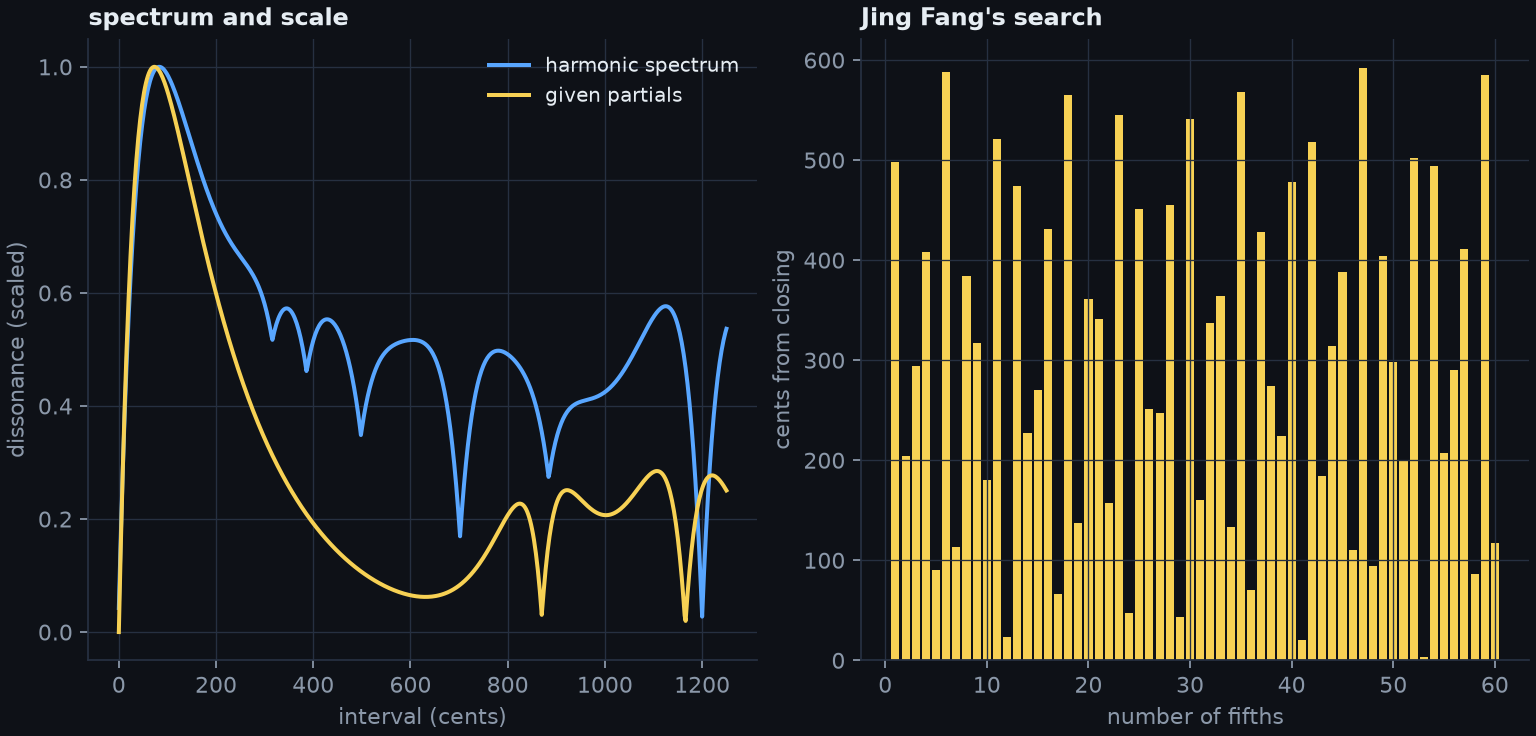
In the first century BCE the scholar Jing Fang carried the chain of fifths far beyond twelve, to sixty pitches. The program repeats his computation: for each number of pure fifths, how far from a whole number of octaves does it land? Twelve fifths miss by twenty-three and a half cents. Forty-one miss by under twenty. And fifty-three fifths come within three and a half cents of thirty-one octaves, nearly closed. Jing Fang noticed it: his fifty-fourth pitch fell almost exactly on his first.
Hear the difference. Middle C sounded with the note twelve pure fifths away, brought back into the same octave: the two beat about three and a half times a second. Then with the note fifty-three fifths away: it beats about once every two seconds, so nearly in tune that only patience hears the drift.
The search went on for centuries. In the fifth century Qian Lezhi extended the chain to three hundred and sixty pitches, and He Chengtian spread the comma over twelve steps, an approach towards equal temperament. In 1584 the prince Zhu Zaiyu computed twelve-tone equal temperament exactly, to many digits, at about the same time as Simon Stevin in Europe. Part 33's continued fractions explain why twelve, forty-one and fifty-three keep appearing.
Hear what Zhu Zaiyu's equal temperament changes. The pentatonic up and down, then C with its third, first in Pythagorean tuning, with a third of four hundred and eight cents, then in equal temperament, with four hundred. The melody hardly changes; the third, sounded together, beats a little less.
Fifty-three keeps returning. It appears again in Nicholas Mercator's work in seventeenth-century England and in the Turkish theory of Part 35. Forty-one and fifty-three are denominators of the fifth's continued fraction, as Part 33 showed, so three cultures meeting the same arithmetic is no coincidence: the fifth's irrationality forces it. What differs is what each made of it: a ritual cosmology, a keyboard, a theory of commas. The mathematics is shared; the music is not.
How did Zhu Zaiyu do it? Equal temperament needs the twelfth root of two, about one point oh five nine four six. He took square roots and a cube root by hand, reportedly on a very large abacus, and his values are correct to about twenty-five digits. He also built instruments and wrote out dances to go with his theory. His work was admired, and largely ignored in the court's actual practice, which kept its older tunings.
4Five notes, five modesFoundations2 min
What can you do with five notes?
The five notes make five modes, depending on which is home. Gong mode is C, D, E, G, A; shang starts the same collection on D; jue on E; zhi on G; yu on A. Each has its own pattern of whole tones and minor thirds, heard here from the same C. Compare Part 12's church modes, seven rotations of the diatonic: the same idea with five.
Here is a pentatonic melody of our own in gong mode, ending on C: no semitones anywhere, the cadence made by falling through E and D. Then the same melody with the two bian tones, F sharp and B, slipped in as passing notes on weak beats. The skeleton is unchanged; the surface gains semitones.
The scale can grow. Two more pitches from the chain of fifths, called bian, changing tones, fill the gaps and make seven-note scales: in the oldest system, bianzhi, an F sharp, and biangong, a B. They act as passing notes; the five remain the skeleton. The seven are the notes of Part 12's Lydian mode. And as Part 28 noted, Debussy heard pentatonic melody at the Paris exhibition of 1889.
Pentatonic melody works differently. It has no semitones, so it has no diatonic semitone leading tone, although melodic context can still establish strong tonal attraction, and cadence comes from contour and rhythm rather than from a dominant chord. Pentatonic scales appear all over the world, in Scotland, West Africa, the Andes and East Asia. Part 12 showed one geometric property of them: the pentatonic is the maximally even five-note set. Part 47 asks whether such scales are universal.
Five-note modes are everywhere in Chinese music. Folk songs and regional operas use pentatonic and related modes. Beijing opera has two main melodic systems, xipi and erhuang, led by the high jinghu fiddle, with percussion marking speech and movement on stage. The modes carry character and mood, as rasa does for raga. Part 40 hears song across traditions.
5The guqinFoundations3 min
What is a scholar's instrument for?
From bronze to silk. The guqin is a seven-string zither, played on a table, with some three thousand years of history, the instrument of the scholar; Confucius is said to have played it. It is quiet by design, made for self-cultivation rather than for an audience. It has three kinds of sound: open strings, stopped notes, and harmonics. It is Part 1's string, played with all its harmonics.
Along the qin's face run thirteen inlaid studs, the hui. They mark an eighth, a sixth, a fifth, a quarter, a third, two fifths and a half of the string's length, and the same from the other end. Touch the string lightly at a hui and pluck, and it sounds the harmonic that has a node there: the second partial at the half, the third at a third or two thirds, the fifth at any of the fifths. The studs are Part 1's harmonic nodes, inlaid in mother-of-pearl.
Here is one string, open, then touched at a half, a third, a quarter, a fifth, a sixth and an eighth: the octave, the twelfth, two octaves, the major third above that, the fifth above that, and three octaves. Qin music uses these pure, bell-like harmonics as a whole register of its own.
A common tuning for the seven strings is C, D, F, G, A, C, D: a pentatonic collection, here on F, spread over more than an octave. Players tune it by harmonics, matching a harmonic on one string to a harmonic on another, so the fifths and fourths come out pure. Listen to the open strings in order.
The qin's three kinds of sound can give the same pitch. Here is one note as an open string, as a stopped note pressed on another string, and as a harmonic, standing in here as a pure, bell-like tone. Qin players call the harmonics the sound of heaven, the open strings the sound of earth, and the stopped notes the sound of humanity.
The qin has its own notation. Jianzipu writes each sound as a compound character built from pieces of others, saying which string, which hui, which finger, and how to pluck or slide. It records actions, not pitches, and leaves most of the rhythm to the teacher. It is a tablature, like the lute tablatures of Part 10, far richer in technique. Modern players reconstruct old pieces from it, a practice called dapu.
The qin has a great repertory. Thousands of pieces survive in tablature, from the fifteenth century on. One, Liu Shui, Flowing Water, was chosen for the golden record carried by the Voyager spacecraft in 1977. Pieces have titles and stories: a landscape, a poem, the friendship of a player and the one listener who understood him. The qin was recognised as intangible heritage by UNESCO in 2003. It was a scholar's art, practised alongside calligraphy, painting and the game of go.
6Heterophony and gagakuFoundations2 min
Can everyone play the same tune differently?
East Asian ensembles often use a texture that Western theory long overlooked. In heterophony several voices play one melody at once, each in its own version: one plainly, one ornamented, one holding its main notes. It describes simultaneous variants of a melody; actual textures can combine it with counterpoint and chordal effects, common in East and Southeast Asia, in Arabic music, and in some folk hymn singing. The melody exists in the players' minds; each realizes it on their own instrument.
Here is the idea with the Tune's first phrase: a plucked string plays it plainly, a metallophone an octave up ornaments it with neighbour notes, and a low tone holds its main notes. Three versions, one melody, sounding together.
Japan preserved one of the oldest orchestral traditions. Gagaku, the imperial court music, has been performed for over a thousand years, brought from Tang China and Korea between the seventh and ninth centuries and kept ever since. The sho, a mouth organ of seventeen pipes, sustains clusters of five or six notes called aitake. The music is slow and heterophonic, its cycles marked by drums. It is a living tradition with its own historical changes and continuing creative practice.
The sho has a distinctive sustained cluster texture: six notes at once, many of them a tone or a fourth apart, swelling slowly and moving to the next cluster as the melody changes. These three are our own voicings in that manner, on additive tones, not the traditional aitake.
Korea kept its own court music. Jongmyo jeryeak, the music of the royal ancestral rite, is still performed. It uses sets of bronze bells and stone chimes descended from China's bianzhong and bianqing, with slow tempos, long notes and heterophony. It is ritual music preserved while East Asia's courts changed around it. The same family of instruments lives on in China, Korea and Japan, each in its own way.
7Slendro and pelogFoundations4 min
What if every orchestra had its own tuning?
Now south-east to Java and Bali. A gamelan is an ensemble, mostly of bronze metallophones and gongs, with drums, voices and strings. It has two tuning systems: slendro, with five nearly equal steps to the octave, and pelog, with seven unequal ones. A full Javanese gamelan has a set of instruments for each, side by side. The instruments of a gamelan are made and tuned together, and belong together. Many gamelans have names, and some are treated with ceremony.
Here is one illustrative tuning of each, played on a model metallophone. Slendro, with five steps of about two hundred and forty cents, none of them the piano's: neither a whole tone nor a minor third. Then pelog, seven steps from about one hundred and fifteen to two hundred and seventy cents, from which a piece usually uses five. These particular numbers are ours.
A pelog piece usually uses five of the seven notes. Two common choices are degrees one, two, three, five and six, and degrees two, three, five, six and seven. In Javanese practice these belong to different pathet, modes associated with different times of the night and different moods, like Part 34's ragas. Hear both subsets of the same illustrative pelog.
What happens to a familiar melody? Here is the Tune's first phrase on a metallophone, first in the illustrative slendro, where with only five notes its F and E must share one key, then in the illustrative pelog. Neither sounds like a piano's Tune: the intervals themselves are different, and so is the melody's character.
There is no standard. Each gamelan's slendro and pelog are its own, and measurements of many gamelans, by Wasisto Surjodiningrat and colleagues in 1972 among others, found them differing by tens of cents, step by step. A gamelan's tuning, its embat, is part of its character, like a voice. Even the octaves are often slightly stretched or compressed, on purpose. The scales are defined by a family resemblance, not by numbers.
How is a gamelan tuned? A smith forges each bronze key and gong, then grinds it. Thinning the middle of a key lowers its pitch; shortening its ends raises it, as Part 9's bars showed. The tuner works by ear, to match the gamelan's own embat, not a chart. Bronze drifts slowly over the years, and gamelans are retuned. A new gamelan copying an old one's tuning is a kind of lineage.
Why such scales? William Sethares, extending Part 5, suggested that a scale suits the spectrum of the instruments playing it. For a tone with harmonic partials, the dissonance curve dips at the just intervals and the octave. For a uniform free bar, Part 9's partials of one, two point seven six and five point four, the dips fall in quite different places, and there is no dip at the octave at all. Sethares, using the measured spectra of real gamelan instruments, whose bars are shaped, found dips near slendro's steps; our idealized bar does not show that, which is itself worth knowing. Listen to the same slendro on both kinds of tone.
8Tuned apart on purposePractice3 min
Why would an orchestra tune out of unison?
In many Balinese gamelan types, particular instruments are built in detuned pairs. The two members, pengumbang and pengisep, are tuned slightly apart, so every note they play together beats: ombak, the wave. The beating gives the whole ensemble its shimmer. It is Part 5's physics: two tones close in pitch beat at their difference frequency. European ensembles also use vibrato and intentional detuning; these Balinese pairs make a deliberately regulated beating texture especially prominent.
A question for your ears. Three notes, in three octaves, each played on two metallophones at once. In one version the two are tuned exactly together; in the other, apart. Which shimmers, A or B?
B shimmers. Its second instrument is tuned six hertz higher at every pitch, so every note beats six times a second. In cents, that is at the low note, in the middle and at the top: this demonstration keeps a constant beat rate rather than constant cents; real tuning practices and rate profiles vary.
The beat rate is a choice. Here are two notes on paired metallophones, first tuned to beat three times a second, a slow, wide wave, then eight times a second, a fast shimmer close to roughness. Different Balinese styles prefer different rates.
The shimmer is designed. Measured Balinese gamelans show beat rates from a few hertz to about eight, fairly even across the range, and different villages and styles prefer faster or slower shimmer. The tuner chooses a rate and derives every pair's detuning from it: Part 6's tuning by beats, used to make beats instead of removing them. The gamelan's sound lives in the space between two instruments.
Gamelan has fascinated Western musicians. In Paris in 1889 Debussy heard a Javanese gamelan at the World Exhibition. Colin McPhee lived in Bali in the 1930s and transcribed its music. Britten, Messiaen, Steve Reich and Lou Harrison drew on gamelan in different ways, and Harrison built American gamelans tuned to ratios of his own choosing. Influence runs both ways: Balinese and Javanese composers write new music for gamelan today.
9The gong cycle and interlocking partsFoundations3 min
How does a gamelan keep time?
Gamelan music is built on cycles marked by gongs, a structure called colotomic. The great gong ends each cycle; smaller gongs such as kenong, kempul and ketuk articulate subdivisions according to the particular form. Over them the balungan, the skeleton melody, is played one note per beat on the sarons. Part 34's tala was marked by claps; this one by gongs.
Here is a lancaran, a sixteen-beat form, with a balungan of our own in an illustrative slendro. The ketuk ticks on the odd beats, the kenong strikes every four beats, the kempul in between, and the great gong on the sixteenth beat ends the cycle, together with the last kenong. Listen to two cycles, and feel where the gong falls.
A question for your ears. A fast figure, played first by one player alone, then by a second alone, then by both together. When both play, does it sound like one player or two?
It sounds like one player, playing very fast. In fact each player has a gap on every other pulse, and together they fill every pulse exactly once, like Part 33's tiling canon. This is a simple alternating illustration of kotekan. Traditional patterns can overlap and use more elaborate relationships, rather than always leaving alternate pulses empty.
Javanese musicians call the relation between the balungan and its elaboration irama. Here is one balungan line of ours with an elaborating part playing two notes for every balungan note, then four. As the elaboration fills in, the balungan slows, and the music seems to open up.
A gamelan is layered by speed. The gongs are slowest, then the balungan, then faster and faster elaborations, each layer two or four times as dense as the one below. The elaborating instruments, bonang, gender and gambang, paraphrase the balungan: heterophony again, organised by speed. And Balinese gong kebyar, from around 1915, added sudden changes of tempo and dynamics and virtuoso interlocking.
Gamelan is now played worldwide. Universities in North America, Europe, Australia and Japan own gamelans, and students learn by imitation and memory, often without notation, though a cipher notation, kepatihan, writes the balungan as the numbers one to seven. In many Javanese settings the drummer leads tempo and transitions without a Western-style conductor; singers and instruments can still have prominent solo or leading roles. Part 43 turns to performing together.
Gong kebyar, the Balinese style that arose around 1915, is famous for explosions of sound. Here is a burst of our own in that manner: a fast interlocking figure on paired metallophones, beating seven times a second, cut off dead by a gong. Kebyar means to flare up.
10Frontier: bells and tunings measuredResearch2 min
What can acoustics tell archaeology?
The bells are now studied as acoustic objects. Finite-element models of their shapes reproduce their two notes, and thickness maps show where founders scraped bronze away to tune them. Replicas have been cast, and the originals played on rare occasions. An open question is how they were designed, so precisely, long before the physics existed. Lothar von Falkenhausen's Suspended Music reads the bells as history.
The tunings are studied the same way. How much do measured slendro and pelog tunings vary, and along which dimensions? Do musicians recognise slendro by its step sizes, its melodic contours, or its repertoire? Sethares's hypothesis, that scales fit spectra, has had mixed tests on measured instruments. And cross-cultural studies find that musical experience shapes which intervals sound right. Part 47 takes up universals and their limits.
A concrete version. Measure the spectra and tunings of many gamelans, instrument by instrument. Compute each set's dissonance minima from its own spectra. Test whether the tuning sits nearer those minima than chance would place it. Do gamelan tunings fit their instruments' spectra? The answer would say how timbre and tradition jointly contribute to tuning; observational agreement alone does not establish causation.
Research here raises questions of ownership. Archaeological instruments raise questions of display, playing and replication. Many recordings of Asian music made in colonial times sit in European archives, and communities ask for access, for return, and for a say in how their music is used. Research with instruments and traditions is research with people. Part 67 sets out how to do it well.
Variation 36, recap and problemsAll tracks2 min
Every part ends by doing something to the Tune with what it built. First in silk: each of its notes as a natural harmonic on a qin tuned by pure fifths and fourths, the program choosing the string and harmonic nearest each note; the worst lies cents from the piano. Then in bronze: the Tune as a balungan in an illustrative pelog, one note a beat, with an interlocking figure at four pulses a beat, a kenong every four beats and the gong at the end.
Row thirty-six of the ledger: seconds; the measurement is the qin's worst error and the balungan's length.
What did we find? An almond-shaped bell sounds two notes, a third apart. Twelve pitches come from cutting a pipe, and fifty-three fifths come within three and a half cents of closing. Five notes make five modes, and the qin's studs are harmonic nodes. Heterophony plays one melody several ways at once. Slendro and pelog have no standard, and bronze has its own dissonance. And the gamelan shimmers by design, keeps time with gongs, and splits fast figures between players.
Five problems. One to compute, one to prove, one for your ears, one to build, and a research problem, marked with a star. Solutions are in this part's notes. Pause here.
Where does this come back? Next, in timelines and cycles. In scales and universals. In synthesis for any tuning and timbre. In the sound of an ensemble in a room. And in acoustics and archaeology as research.
And in practice. Gamelan makers tune each set as a whole, by ear, with its own character. Qin players learn pieces from tablature and teachers. Composers write for gamelan in Europe, America and Asia. And museums cast replica bells to hear what the originals sounded like.
The books and papers this part follows. The full list, with notes, is in the README.
Where it goes next. Timelines in Part 37; scales and universals in Part 47; synthesis for any tuning in Part 52; ensembles in rooms in Part 55; acoustics and archaeology as research in Part 67.
Key results
The part's results in one place, for revision.
Try it
Lab 36 · Bronze and silk, computed
Generate the lü by the rule of three; find the chains of fifths that nearly close; compute dissonance curves for different spectra; design a paired tuning by beat rate; and split a figure into interlocking parts.
python -m videos.music.labs 36
needs numpy, scipy, matplotlib · download lab36.py ·
source on GitHubthe twelve lü (cents, in order generated) 0, 702, 204, 906, 408, 1110, 612, 114, 816, 318, 1020, 522
chains of fifths that nearly close (n: cents off) 53: +3.62, 41: -19.84, 12: +23.46, 29: -43.30
dissonance minima for partials [1.0, 2.76, 5.4, 8.93] [870.0, 1002.0, 1166.0]
paired tuning at 6 Hz: cents apart at 100, 400, 1600 Hz 100.9, 25.8, 6.5
interlocking: polos / sangsih [1, None, 3, None, 3, None, 1, None, 3, None, 6, None, 3, None, 3, None] / [None, 2, None, 5, None, 2, None, 2, None, 5, None, 5, None, 2, None, 1]
ear problem: each pair's tuning, in order (listen first) 7 Hz, 4 Hz, 4 Hz, together, together, together
Fifty-three fifths come within 3.6 cents of 31 octaves; a bar's inharmonic partials move the dissonance minima away from the just intervals and the octave; and a constant beat needs less detuning at higher pitch.The code (65 lines; it asserts its own result)
"""Lab 36: bronze and silk, computed: the rule of three and the twelve lü, how close chains of fifths come to closing,
qin harmonics, dissonance curves for harmonic and bar spectra, paired tuning by beat rate, and interlocking parts."""

import numpy as np

from videos.coursekit import labs
from explainer.music.monochord import SR, Clip, concat, mix
from explainer.music.monochord import bronze as B

TITLE = "Bronze and silk, computed"
GOAL = ("Generate the lü by the rule of three; find the chains of fifths that nearly close; compute dissonance curves "
        "for different spectra; design a paired tuning by beat rate; and split a figure into interlocking parts.")
TASKS = [
    "Change PARTIALS (a list of ratios). Where do the dissonance curve's minima fall? Is there one at the octave?",
    "Change BEAT. How many cents apart must the pair be at 100 Hz, 400 Hz and 1600 Hz?",
    "Write your own FIGURE and split it with bronze.interlock. Does every pulse sound exactly once?",
]
PARTIALS = B.bar_partials(4)
BEAT = 6.0
FIGURE = [1, 2, 3, 5, 3, 2, 1, 2, 3, 5, 6, 5, 3, 2, 3, 1]


def run(seed=0):
    rng = np.random.default_rng(seed)
    lab = labs.Lab()
    lu = B.sanfen_lu(12)
    lab.row("the twelve lü (cents, in order generated)", ", ".join(f"{x['cents']:.0f}" for x in lu))
    best = sorted(B.fifths_closeness(60), key=lambda r: abs(r["gap"]))[:4]
    lab.row("chains of fifths that nearly close (n: cents off)", ", ".join(f"{b['n']}: {b['gap']:+.2f}" for b in best))
    cs, d = B.dissonance_curve(PARTIALS)
    lab.row(f"dissonance minima for partials {[round(p, 2) for p in PARTIALS]}", str(B.minima(cs, d)))
    lab.row(f"paired tuning at {BEAT:g} Hz: cents apart at 100, 400, 1600 Hz",
            ", ".join(f"{1200 * np.log2((f + BEAT) / f):.1f}" for f in (100, 400, 1600)))
    a, b = B.interlock(FIGURE)
    assert all((x is None) != (y is None) for x, y in zip(a, b))
    lab.row("interlocking: polos / sangsih", f"{a} / {b}")

    # Problem 3: pairs of metallophones, some tuned apart
    kinds, clips = [], []
    for i in range(6):
        beat = float(rng.choice([0.0, 0.0, 4.0, 7.0]))
        f = 300.0
        y = B.metallophone(f, 2.0) + B.metallophone(f + beat, 2.0)
        clips.append(Clip(y, SR).at_level(-20.0))
        kinds.append("together" if beat == 0 else f"{beat:g} Hz")
    lab.audio = concat(clips, gap=0.8)
    lab.row("ear problem: each pair's tuning, in order (listen first)", ", ".join(kinds))

    fig, (ax1, ax2) = labs.figure(2)
    cs2, dh = B.dissonance_curve([1, 2, 3, 4, 5, 6])
    ax1.plot(cs2, dh / dh.max(), label="harmonic spectrum")
    ax1.plot(cs, d / d.max(), label="given partials")
    ax1.set_xlabel("interval (cents)")
    ax1.set_ylabel("dissonance (scaled)")
    ax1.legend(frameon=False)
    ax1.set_title("spectrum and scale")
    gaps = [r["gap"] for r in B.fifths_closeness(60)]
    ax2.bar(range(1, 61), np.abs(gaps), color=labs.GOLD)
    ax2.set_xlabel("number of fifths")
    ax2.set_ylabel("cents from closing")
    ax2.set_title("Jing Fang's search")
    lab.fig = fig
    lab.note = ("Fifty-three fifths come within 3.6 cents of 31 octaves; a bar's inharmonic partials move the dissonance "
                "minima away from the just intervals and the octave; and a constant beat needs less detuning at higher pitch.")
    return lab
Now change it
- Change PARTIALS (a list of ratios). Where do the dissonance curve's minima fall? Is there one at the octave?
- Change BEAT. How many cents apart must the pair be at 100 Hz, 400 Hz and 1600 Hz?
- Write your own FIGURE and split it with bronze.interlock. Does every pulse sound exactly once?
Problems, with solutions
Try each problem before opening its solution.
-
Compute. Using the rule of three from a length of 81, compute the first seven lengths and their pitches in cents.
Solution
81, 54, 72, 48, 64, 128/3 ≈ 42.67, 512/9 ≈ 56.89; folded into one octave above the first: 0, 702, 204, 906, 408, 1110 and 612 cents. The first five are the pentatonic; the sixth and seventh are B and F♯, the bian tones.
-
Prove. Prove that n pure fifths can never exactly equal a whole number of octaves.
Solution
(3/2)ⁿ = 2ᵐ would mean 3ⁿ = 2ⁿ⁺ᵐ; the left side is odd and the right side even for n ≥ 1, which is impossible. So every chain of fifths misses, however long; Jing Fang's 53 merely misses by little.
-
Ear. The lab plays pairs of metallophones; say which pairs are tuned apart, and how fast they beat.
Solution
The lab prints the answers. Count the slow swells: four a second is a gentle wave, seven a fast shimmer; a pair in unison sounds like one instrument, louder.
-
Build. Write a colotomic renderer for ladrang (32 beats) and play a balungan of your own in it.
Where to look. Extend
bronze.COLOTOMICwith a ladrang pattern (kenong every 8 beats, kempul between, ketuk on the odd beats or at the chosen irama, gong at 32), reusecompute_cycle's rendering, and check that the gong falls on the last beat of every cycle. -
★ Do gamelan tunings fit their instruments' spectra?
Where the frontier is. Measure keys and gongs of many gamelans (spectra and tunings); compute each set's dissonance minima from its own spectra; test, against tunings drawn at random from plausible ranges, whether real tunings sit nearer the minima; report effect sizes with uncertainty, and discuss with makers what they aim for.
Notes and sources
Sources
- L. von Falkenhausen, Suspended Music: Chime-Bells in the Culture of Bronze Age China (1993); Chen Cheng-Yih (ed.), Two-Tone Set-Bells of Marquis Yi (1994).
- J. Needham, Science and Civilisation in China, vol. 4 part 1 (1962), on acoustics and pitch; K. G. Y. Robinson, A Critical Study of Chu Tsai-yü's Contribution to the Theory of Equal Temperament in Chinese Music (1980).
- R. van Gulik, The Lore of the Chinese Lute (1940).
- M. Tenzer, Gamelan Gong Kebyar (2000); Sumarsam, Gamelan: Cultural Interaction and Musical Development in Central Java (1995); C. McPhee, Music in Bali (1966).
- W. Surjodiningrat, P. J. Sudarjana and A. Susanto, Tone Measurements of Outstanding Javanese Gamelans in Jogjakarta and Surakarta (1972); W. A. Sethares, Tuning, Timbre, Spectrum, Scale (2nd ed. 2005), chapter 10.
- Part 5 for dissonance curves; Part 9 for bars, bells and gongs; Part 33 for continued fractions and tilings.
About this partfrom its README
Part 36 of a sixty-eight-part course in music (see the series plan and
the syllabus), the third part of Act VI. In 1978 a tomb in Hubei, sealed in 433 BCE, gave up
sixty-five bronze bells. Each sounds two notes, depending on where it is struck, and their inscriptions are a tuning
treatise older than Aristoxenus. This part goes from those bells, through Chinese pitch theory and the guqin, to the
gamelan, an orchestra whose paired instruments are tuned apart on purpose so that the whole shimmers. The models are
Monochord's (explainer/music/monochord/bronze.py): a two-tone bell by modal synthesis with designed mode families,
Part 9's bars, gongs and membrane, and Part 35's retuned plucked string for the qin. Every melody is ours, and the
gamelan tunings are illustrative: no two gamelans are tuned alike. Published findings are the ones listed under Sources.
- Two notes from one bell. An ear question (three bells, centre then side: same note or two?); the tomb of Marquis Yi; listening across traditions; the plan.
- 1. The bells of Marquis Yi. Why an almond section gives two notes; a minor-third and a major-third bell, heard; the set of 65; a melody of ours on two-tone bells, heard; the inscriptions; two kinds of bell.
- 2. Twelve pitches from a pipe. The rule of three from a length of 81; the first five, the pentatonic, heard; the twelve lü and the Pythagorean comma (23.46 cents); the twelve heard as a chromatic scale (semitones of 90 and 114 cents); the yellow bell; pitches and the calendar.
- 3. Jing Fang's sixty. How close n fifths come to whole octaves for n up to 60 (12: 23.5 cents; 41: −19.8; 53: 3.6); 12 and 53 fifths heard against the start (beats of 3.6 and 0.55 per second); fifty-three elsewhere; after Jing Fang (Qian Lezhi, He Chengtian, Zhu Zaiyu in 1584); Pythagorean against equal temperament, heard; how Zhu Zaiyu computed it.
- 4. Five notes, five modes. Gong, shang, jue, zhi and yu, heard; a pentatonic melody of ours, then with the bian tones, heard; seven from five; five notes on stage; melody without semitones.
- 5. The guqin. The instrument; the thirteen hui as harmonic nodes; harmonics at six hui, heard; the open strings in a common tuning, heard; one pitch as open string, stopped note and harmonic, heard; the repertory; jianzipu.
- 6. Heterophony and gagaku. Heterophony; the Tune's first phrase three ways at once, heard; gagaku; clusters in the manner of the sho (ours), heard; court music in Korea.
- 7. Slendro and pelog. Gamelan; illustrative slendro and pelog, heard; two pelog subsets, heard; the Tune's phrase in both, heard; no standard (Surjodiningrat and colleagues); how a gamelan is tuned; spectrum and scale (dissonance curves for a harmonic spectrum and a uniform free bar, whose minima fall at 870, 1,002 and 1,166 cents with none at the octave; Sethares's measured spectra), heard on both tones.
- 8. Tuned apart on purpose. Ombak; an ear question (which pair shimmers?), with 6 Hz needing 78, 39 and 20 cents of detuning in three octaves; slow and fast shimmer, heard; a beat by design; gamelan and the West.
- 9. The gong cycle and interlocking parts. Colotomic structure; a lancaran of ours, heard; an ear question (one player or two?) on kotekan; irama at two and four notes per beat, heard; layers of speed; a kebyar-style burst, heard; gamelan worldwide.
- 10. Frontier: bells and tunings measured. The bells as data; tunings as data; heritage and ownership; ★ research problem: do gamelan tunings fit their instruments' spectra?
- Variation 36, recap and problems. The Tune's first two phrases as natural harmonics on a qin tuned by pure fifths and fourths (the program choosing string and harmonic; the worst 8 cents from equal temperament), then as a balungan in an illustrative pelog with interlocking elaboration, kenong and gong; the ledger; what we found; five problems; where it comes back; in practice; references; Part 37.
What is computed and built
python -m videos.music.music36.compute (about ten seconds) fills .cache/music36/.
| Item | What it computes | Checked against |
|---|---|---|
hook, thirds, bellsong |
two-tone bells struck at centre and side; a melody on them | the side note's interval (tests) |
lu, twelve, jingfang, zhu |
the rule of three; the twelve lü; closeness of chains of fifths; Pythagorean and equal | Jing Fang's 53 |
modes, melody |
the five modes; a melody with and without bian tones | — |
qin, openqin, stopped |
harmonics at the hui; the open strings; one pitch three ways | harmonic node positions |
hetero, sho |
heterophony; sho-like clusters | — |
spectra, scales, patet, two_scales |
dissonance curves for two spectra; illustrative slendro and pelog | no octave minimum for a bar |
ombak, rates |
paired tuning by beat rate | cents shrink with pitch |
cycle, kotekan, irama, kebyar |
a lancaran; interlocking parts; densities; a burst | every pulse once |
tune, variation |
Variation 36 | — |
Monochord's tools are held in tests/music/test_bronze.py; this part's claims and clips in
tests/music/test_music36.py.
Sounds. Two-tone bells by modal synthesis with designed mode families (a model of the principle, not of a measured bell); metallophones as Part 9's free bar; gongs and the kempul as Part 9's gong; the qin as Part 35's plucked string at exact pitches; sho-like clusters, pure tones and harmonic tones by additive synthesis. There are no recordings.
What the models are, and are not. The bells have designed mode ratios; real bells' partials come from their measured shapes. The gamelan tunings are illustrative: real gamelans each have their own embat, and measured tunings differ by tens of cents. The bar is uniform; real gamelan keys are shaped, which is why Sethares's measured spectra behave differently from ours. The qin model has no slides or touch noise. All melodies are ours.
Notes
The tomb’s full 65-bell assemblage is not uniformly the same two-tone bell type. Inscribed pitch names are not modern absolute frequency standards. Twelve generated notes require eleven generator steps, while twelve fifths produce the comma comparison. Pentatonic collections can establish tonic attraction without a semitone leading tone. Gagaku is a continuing tradition, not a frozen historical exhibit. Heterophony can coexist with counterpoint and chordal effects. The gamelan tunings, beat-rate profile and alternating interlock are illustrative choices; practices vary by ensemble, genre and region. Javanese performance can include prominent solo and leading parts. Timbre and tradition are joint explanations, not exclusive alternatives.
Companion material in this repository
The syllabus's plan for this partfrom SYLLABUS.md, the plan of record
- Hook: an ear question (one bell, two notes?); the tomb; listening across traditions; the plan.
- The bells of Marquis Yi: why an almond section gives two notes; minor- and major-third bells heard; the set; a bell melody heard; inscriptions; two kinds of bell.
- Twelve pitches from a pipe: the rule of three; the pentatonic heard; the twelve lü and the comma; the lü heard; the yellow bell; the calendar.
- Jing Fang's sixty: closeness of chains of fifths; 12 and 53 heard; fifty-three elsewhere; after Jing Fang; Pythagorean against equal heard; Zhu Zaiyu's method.
- Five notes, five modes: the modes heard; a melody with and without bian tones heard; seven from five; opera; melody without semitones.
- The guqin: the instrument; the hui; harmonics heard; open strings heard; one pitch three ways heard; repertory; jianzipu.
- Heterophony and gagaku: heterophony heard; gagaku; sho-like clusters heard; Korea.
- Slendro and pelog: gamelan; scales heard; pelog subsets heard; the Tune in both heard; no standard; how a gamelan is tuned; spectrum and scale heard.
- Tuned apart on purpose: ombak; an ear question (which pair shimmers?); slow and fast heard; a beat by design; the West.
- The gong cycle and interlocking parts: colotomy; a lancaran heard; an ear question (one player or two?); irama heard; layers; a kebyar burst heard; worldwide.
- Frontier: bells as data; tunings as data; heritage; the research problem.
- Variation 36: the Tune in qin harmonics, then as balungan with interlocking parts. Outro: problems, payoffs.
Covers: the two-tone bell; generating the twelve lü; Jing Fang's sixty and the near-closing fifty-third; the
five modes; the guqin, its harmonics and its tablature; heterophony; gagaku; gamelan: slendro and pelog without a
standard, bronze spectra and their scales, paired tuning and beating, the gong cycle, interlocking parts.
Built and computed: monochord/bronze.py: a two-tone bell (designed mode families a third apart); the rule of
three and the lü; chains of fifths up to 60 (53 within 3.6 cents); the five modes; the hui as harmonic nodes; bar
spectra and dissonance curves (a uniform bar has no octave minimum); paired tuning by beat rate; a lancaran
renderer; an interlocking splitter.
Variation 36: a study: the Tune for qin harmonics (the worst 8 cents from equal temperament), then as balungan
with interlocking elaboration.
Frontier: the acoustics and archaeology of the bells; measured gamelan tunings; whether tunings fit spectra.
Rights: every sound is the film's own model (§2.4); melodies are ours; gamelan tunings are illustrative and say so.
Reading: von Falkenhausen, Suspended Music; Tenzer, Gamelan Gong Kebyar; Sumarsam; Sethares ch. 10.
Build the film
python -m videos.music.music36.compute        # the part's numbers, into .cache/music36
python tools/build.py music36                  # render and assemble the film
EXPLAINER_TTS=silent python tools/qa_scene.py music36 Hook   # one chapter, silent, with a contact sheet
Scenes: videos/music/music36. Setup: see the course page. Source of these notes: the README and the scenes' narration.
Build it
python -m videos.music.music36.compute                          # numbers and sounds (about ten seconds)
EXPLAINER_TTS=silent python tools/build.py music36 -q l --fps 15   # a silent-narration preview, with the sounds
python tools/qa_sound.py music36 --sync                         # the sound gates
python tools/dead_air.py renders/music36_480p.mp4 --sound music36  # no empty screen; no sound over a still one
python tools/lecture_length.py music36                          # 30 to 60 minutes, listening included
python tools/build.py music36                                   # 1080p30, narrated
python -m pytest -q tests/music                                 # Monochord against its references; this part's claims and clips
python -m videos.music.labs 36                                  # the lab (writes a figure and a short WAV)