Drums, Bars and Bells
Why does a drum go thump when a string sings, how were skins, bars and bells taught to play in tune, and can one hear the shape of a drum?
A string and a drum on the same lowest frequency: one has a note and the other a thump, because a round skin's overtones follow the zeros of Bessel functions (1, 1.59, 2.14, 2.30) and form no series. Makers found ways round nature. A kettledrum's skin is loaded by the air it must move, which slows its low modes into something close to 1 : 1.5 : 2 : 2.5. A tabla's skin carries a patch of paste at its centre, and its modes gather at 1, 2, 3, 4, 5. A bar is held straight by stiffness, so its pitch goes as thickness over length squared and its overtones are at 2.76 and 5.40; an arch cut underneath moves them to 4 and 10, and a marimba is born. A bell's strike note is a missing fundamental, supplied by the ear from partials at 2, 3 and 4 times it, and every traditional bell carries a minor third. Sand on a bowed plate draws its still lines, Chladni's figures, and the prize offered for explaining them gave Sophie Germain's plate equation. A gong's pitch follows its loudness, a cymbal's crash is a cascade through hundreds of modes, and a steelpan's notes are domes hammered until three modes agree. Last, Kac's question, the makers' problem reversed: the overtones of a drum give its area and its rim, but two different drums can share every one of them. The Tune is played on a marimba, bells, a steelpan and kettledrums. Act I ends here.
What you need. Part 1 for modes and stiffness; Part 2 for the air; Part 4 for the missing fundamental and fusion; Part 5 for what inharmonic partials do to consonance; Part 8 for the stopped tube. Square roots and logarithms; no Bessel functions are needed beyond a table of their zeros.
- Ideas, mathematics and history
- Bessel modes of a membrane, how timpani and tabla become harmonic, tuned bars, the bell's minor third, Chladni figures, "can one hear the shape of a drum?"
- What we build, compute and hear
- modal percussion; two different drums with the same spectrum, computed
What you will be able to do
Foundations
- Describe the modes of a skin, a bar and a bell, and why none is a harmonic series.
- Explain how the kettledrum, the tabla, the marimba and the bell are tuned.
- Say what a drum's overtones do and do not determine about its shape.
Full course
- Find a drum's overtones from Bessel zeros, and a bar's scaling with length and thickness.
- Compute the modes of a bar with an arch, and of a membrane of any outline.
- Use Weyl's law to read a drum's area and rim from its spectrum.
Research
- State Kac's question, its answer, and what remains open.
- Say what is and is not known about hearing material, size and shape.
Practice
- Choose where to strike, and with what, for the tone wanted.
- Tune a bar or a drumhead knowing which modes each adjustment moves.
- Build a struck sound from a list of partials and decays.
Contents
Each chapter has a home level. Choose a track to see what to read and watch: Foundations 34 min · Full course 34 min · Research 43 min · Practice 34 min.
- 0Can one hear the shape of a drum?Foundations2 min
- 1A skinFoundations4 min
- 2A drum with a noteFoundations4 min
- 3A patch of pasteFoundations3 min
- 4BarsFoundations5 min
- 5BellsFoundations5 min
- 6Plates and sandFoundations2 min
- 7Gongs and cymbalsFoundations2 min
- 8The steelpanFoundations3 min
- 9Hearing a shapeResearch6 min
- 10Frontier: what the ear knows about thingsResearch3 min
- Variation 9, recap and problemsAll tracks4 min
Also on this page: Lecture · Key results · Try it · Lab · Problems · Notes and sources · Build the film.
Lecture
The text of each chapter is the film's narration, as it is spoken, so you can read along or revise without the film. The pictures are in the film. A dashed box stands for a number the film computes when it is rendered (hover over it to see what is computed); the README's figures for each chapter, where it lists them, follow the chapter's text.
Can one hear the shape of a drum?Foundations2 min
A string, and a drum. Their lowest frequencies are the same. The string plays a note you could sing back to me. The drum says thump. Much of the first eight parts has used tensioned strings and air columns. Their simplest uniform models have regularly spaced resonances: integer multiples, or an odd-multiple series for a stopped cylinder. Consonance, tuning, the ear's sense of pitch: Parts 4, 5 and 6 were all built on that. A drumhead is a string's nearest relation, a thing under tension, held at its edge. Its overtones are at one point five nine, two point one four, two point three, two point six five times the lowest. There is no harmonic series here for the ear to fuse as readily. Bars and bells have different patterns again.
And yet those irregular numbers hold a great deal of information. In 1966 the mathematician Mark Kac asked a question in the title of a lecture: can one hear the shape of a drum? If you knew every overtone of a drum, exactly, could you work out what shape it must be? For twenty-six years nobody knew. Then, in 1992, three mathematicians drew these two shapes. By the end of this part Monochord will have computed the notes of both, and you will have heard them.
Meanwhile instrument makers had been solving the opposite problem for three thousand years. Not: what shape has these overtones? But: how do I change this skin, this bar, this bell, so that its overtones are the ones I want? So this part goes through the things that are struck. A skin, and why it goes thump. Two drums that were taught to sing, by quite different means. A wooden bar, tuned with a knife. A Western tuned bell, with its characteristic minor-third partial for four hundred years. Plates, gongs and cymbals, and an instrument beaten out of an oil barrel. And at the end, the two drums of 1992.
1A skinFoundations4 min
What are the notes of a drumhead?
Part 1 found the modes of a string: one half wave, two, three, each with still points, the nodes, between its moving parts. A skin does the same in two directions at once. Its simplest mode is the whole skin rising and falling together. In the next, one half rises while the other falls, and the line between them, a diameter, stays still. Then two diameters, and four quarters. Then a mode with no diameter but a still circle, the centre moving against the rim. And so on: every mode of a round skin is some number of still diameters and some number of still circles. Under each is its frequency, as a multiple of the lowest. One, one point five nine, two point one four, two point three. The numbers come from the mathematics of round things, the Bessel functions, and they are what they are.
A worked example, to see where one of those numbers comes from. Along a radius, the height of the skin in its lowest mode follows the blue curve, and in its next mode the gold one. The rim of a drum is held still. So each mode must end exactly where its curve first comes down to zero, and the frequency of the mode is proportional to that distance. The zeros are marked. What is the interval between a drum's two lowest notes? Pause, and work it out.
Three point eight three two over two point four oh five is . In cents, : wider than a fifth, and a little short of a minor sixth. The first overtone of a string is an octave above its fundamental. The ideal drum's next mode falls between familiar intervals. The complete membrane spectrum does not form an integer harmonic series. Zeros of each fixed-order Bessel function do approach even spacing at high order, but that is a different statement.
For a fixed ideal head, tension and boundary, these ratios are fixed. But a drummer can choose which of them to sound, and the choice is made with the stick. Here is one drum, struck twice: once at the very centre, once about halfway out. Which blow was at the centre?
B was the centre: short and dead. A blow at the centre can only start the modes that move at the centre, and those are the ones with no still diameter: the whole skin going up and down, with or without circles. Those modes push the air above the drum in and out as a whole. At low frequencies they radiate efficiently compared with diameter modes, so they can lose their energy in a fraction of a second, and the drum goes thud. Strike off centre and the modes with diameters join in. Half the skin pushes air while the other half pulls, so they radiate poorly and can ring longer. The model includes that radiation contrast; real decay also depends on the head, shell and damping. A timpanist strikes about a quarter of the way in from the rim, and now you know why.
2A drum with a noteFoundations4 min
How does a kettledrum play in tune?
An orchestra's kettledrums are tuned to notes, and composers write for them as they would for a double bass. How can a skin do that? Take the modes that ring: the ones with one, two, three, four and five still diameters. In an ideal skin their frequencies stand at one, , , , . The dashed lines are where a musician would want them: one, one and a half, two, two and a half, three. Not close. But a real skin does not vibrate in a vacuum. It has to move the air lying against it, and for the long, slow waves of the low modes that is a good deal of air: on a large drum, as much weight as the skin itself. Air loads the low modes more than the high ones, and so slows them more. Here is Monochord's rough estimate of the effect: one, , , . Every mode has moved towards its line. And here is a real kettledrum, measured by Thomas Rossing in 1982: one, one point five, one point nine eight, two point four four. The rest of the way is the air shut inside the kettle and the stiffness of the head. The kettle and its enclosed air participate in a coupled acoustic system. Air loading is central here. It helps move the ringing modes towards a harmonic pattern.
Can you hear the difference those shifts make? Two drums, with the same lowest ringing mode. One is the bare skin. One has the kettledrum's overtones. Which has a note you could hum?
B. And to prove it is a note, here are four of them. The first four notes of the Tune. No orchestra could do without that sound, and it rests on an accident: that air is heavy enough to matter to a thin skin.
There is a loose end here, and it is worth showing you. One, one and a half, two, two and a half. Double them: two, three, four, five. Those are harmonics two to five of a note an octave below the drum's lowest ringing mode, with the fundamental missing. Part 4's model of the ear, given the kettledrum's sound, reports exactly that missing note, at hertz, and with greater model salience than it has about anything in the bare skin's sound. But ask a timpanist, or an audience, and they name the note of the lowest ringing mode itself, at hertz. The usual musical pitch label is not an octave below where it is written. So the model has the important thing right: these partials fuse into one clear note. Which octave the ear files that note under, when the lowest partial is itself strong, is a finer question, and the textbooks do not agree on the answer.
3A patch of pasteFoundations3 min
How did Indian drum makers get five harmonics from a skin?
The kettledrum's tuning was a lucky accident, improved by trial. In India, drum makers did something deliberate, and they did it centuries earlier. The tabla's right-hand dayan is a small hand drum, and the player tunes it, with a hammer on the rim, to the note the singer has chosen. In the middle of its goatskin head is a black disc: a paste of flour and iron dust, rubbed on in dozens of thin layers and polished with a stone. In 1920 the physicist C. V. Raman, ten years before his Nobel prize for the scattering of light, studied these drums with sand and a careful ear. He reported that the tabla sounds a fundamental and four approximately harmonic partials above it: one, two, three, four, five. From a drum.
Monochord can check that. Take the round skin of chapter one, with its inharmonic modes. Now make the middle of it heavy: a disc reaching four tenths of the way to the rim, about ten times as heavy as the skin around it. And solve for the modes again. One. . and . and . Then three more, all near five. Nine modes, gathered into five groups, and the groups stand at one, two, three, four, five. This illustrates the grouping Raman described, rather than a full calculation of a real layered drumhead. Why does it work? Modes differ in how much they move the central region of the skin, so a central load shifts them by different amounts and stretches the ladder from the bottom. Here is how far the worst mode misses a whole number, as the patch gets heavier. From cents with no patch, to at ten times, and little better after that. This optimum belongs to our chosen patch radius and simplified density model.
Hear the two skins. Nine modes sound on each with the same relative weights and decay rates, then the clips are level matched. Their frequencies are different.
A clang, and a note. So there are two quite different ways to make a skin sing. Europe loaded it with air, and found a harmonic series with its fundamental missing. Indian makers loaded it with paste, and got the whole series. Neither knew a Bessel function.
4BarsFoundations5 min
How do you tune a piece of wood with a knife?
Now take away the tension altogether. A wooden bar, lying on two supports, is held straight by nothing but its own stiffness: bend it, and it springs back. Part 1 met stiffness as a small nuisance in piano strings. In a bar it is everything. A worked example. A string cut to half its length sounds an octave higher. For a uniform slender rectangular beam, with matching support conditions, frequency goes as thickness divided by the square of its length. Cut a bar in half: how much higher does it sound? Pause, and say.
Half the length, squared, is a quarter: four times the frequency. Two octaves. So the bars of a marimba do not halve in length for each octave, as a harp's strings nearly do. They shrink much more slowly. And there are two more handles a string does not have. Make the bar thinner and it gets lower, because it is less stiff. Width cancels from that ideal bending formula; wide plates, anisotropic wood and real supports need more care.
A bar on a marimba or a xylophone is free at both ends: it rests on two cords, placed where its lowest mode stands still. That lowest mode is one gentle bend. The next has three still points, and the one after, four. Their frequencies are and times the lowest. In musical terms the first overtone is an octave and a sharp fourth above the note, and the second is two octaves and a sharp fourth. Strike a plain bar and you hear its note with a sour clink on top. A length of steel pipe dropped on a floor is a free bar, and that is its sound.
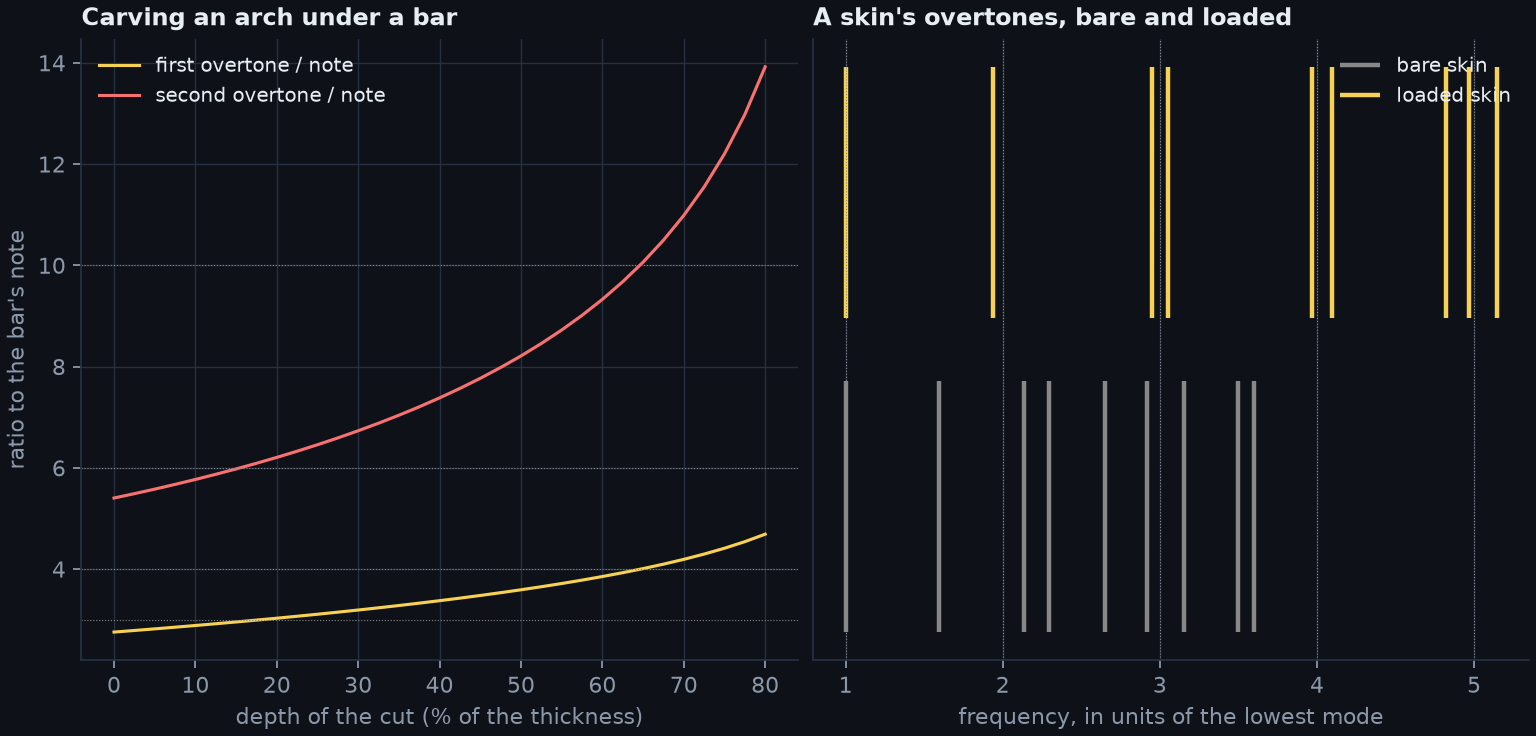
Here is what a maker does about it. Turn the bar over, and carve an arch out of its underside. The lowest mode does most of its bending in the middle of the bar. Thin the middle, and you weaken the bar exactly where that mode needs its stiffness: its frequency drops a long way. The overtones bend elsewhere as well, and drop less. So the ratios between them open out. Monochord carves until the first overtone is exactly four times the note. That takes an arch percent of the way through the wood, and the second overtone lands at . One, four, ten: two octaves above the note, and three octaves and a major third. These are common targets for low concert marimba bars; actual tuning varies with register and maker. A shallower cut puts the first overtone at three times the note, a twelfth above, and the second near six. That is a common xylophone target, contributing to a sound that is brighter and drier than a marimba. The same knife does a second job. The marimba's arch lowers the bar's own note by octaves. Without it, the bass bars of a marimba would be as long as the instrument is wide.
Can you hear the knife? One note, on two wooden bars. One is plain. One has been carved until its overtones are in tune. Which has been carved?
B. The plain bar clinks; the carved one sings. One more piece of tuning hangs under many marimba bars: a tube, closed at the bottom, as long as a quarter of the note's wavelength. You met it in Part 8. A stopped pipe answers at one, three and five times its lowest note, and the bar's overtones are at four and ten. So the ideal tube preferentially strengthens the fundamental; real resonances have finite bandwidth and affect radiation too.
The maker fixes where a bar's overtones are. The player decides how much of each to have, with the choice of mallet. It is Part 7's piano hammer again. A soft mallet, wound with yarn, stays on the bar for a millisecond or two, and a blow that slow weakly excites high modes whose cycles are short compared with the contact: the example emphasizes the fundamental. A hard mallet bounces off in a quarter of a millisecond, and much more of each overtone the maker tuned is there. Listen: the same bar, the two mallets.
Warm, and then bright. A marimba player may carry many pairs of mallets, and choosing among them is choosing a filter.
5BellsFoundations5 min
What note is a bell playing?
A bell is a thick, curved shell of bronze, and computing its modes requires a shell model. So I will not pretend: these are representative published tuning ratios, synthesized here rather than measured from one specific bell. Here they are, for a well-made church bell, each with the name founders give it. The lowest is the hum. An octave above it, the prime. Then the tierce, the quint, and the nominal, an octave above the prime. Higher still, a twelfth and a double octave. A raw casting does not come out like this. Its partials are wherever the mould happened to put them. In 1644, in the Dutch town of Zutphen, the brothers Frans and Pieter Hemony, advised by a blind musician with a famous ear, Jacob van Eyck, began turning each bell on a lathe: shaving metal from rings inside it, each ring lowering some partials more than others, until five of them stood in these ratios. Many modern tuned carillon bells have been through that.
You can learn to hear these inside a bell, the way bell tuners do. Here are the five lowest, one at a time: hum, prime, tierce, quint, nominal. Then the bell. Try to pick each of them out again once they are sounding together.
The hum lingers longest, under everything. The tierce is the easiest to find: it is the one that makes the bell sound sad. A tuner listens for each in turn, with a tuning fork or a meter, and knows which ring of metal inside the bell to shave in order to move it.
So what note does a bell play? Strike one, and for the first instant you hear a clear pitch, the strike note. Founders have always known an awkward thing about it. It is decided mostly by three high partials: the nominal, the twelfth and the double octave, at two, three and four times the note. Two, three, four: a harmonic series with its first member missing. Part 4 told us what the ear does with that. Listen to the whole bell, and then to those three partials alone.
The colour changes, and the note stays. Part 4's model of the ear, given only those three partials, reports a pitch of hertz, where nothing was sounding. The strike note of a bell is a missing fundamental. That is why the founder then tunes the prime, the partial that really is at that frequency, to agree with it. When the two disagree, the bell sounds as if it cannot make up its mind.
Now look at the third partial, the tierce. It stands at one point two times the note: six to five, a minor third. It is characteristic of the Western minor-third bell, not of all bell traditions. Hum, prime, tierce and quint spell out a minor chord, and the bell sounds it all by itself. Two bells, on the same note. One is the kind that has been cast for four centuries. In the other, one partial has been moved. Which is the old kind?
B is the old kind: darker, with that slightly mournful colour that says bell. It is why a carillon playing a cheerful tune in a major key can sound a little wistful: every note of the major chord brings its own minor third along. For centuries founders tried to cast a bell with a major third and failed. It was done in the nineteen eighties, in the Netherlands, and not on a lathe: engineers at Eindhoven let a computer reshape the bell's profile, thousands of times, until the third partial moved up and the others stayed put. The answer was a bell with a bulge in its side that no founder would have drawn. Here is a major chord, first on three bells of the old kind, then on three of the new.
The first chord argues with itself, major thirds between the bells against the minor third inside each one. The second is at peace. Some carillons have been built from the new bells. Which colour listeners prefer depends on context and familiarity; this model comparison does not establish a population preference.
6Plates and sandFoundations2 min
How do you see a vibration?
A bar is stiff in one direction. Widen it into a plate and it is stiff in two, with a still richer crowd of modes. How would you ever find out what they look like? In 1787 a lawyer and amateur musician in Wittenberg, Ernst Chladni, found a way that needs only simple equipment. Hold a metal plate at its middle. Scatter fine sand on it. Draw a violin bow down its edge until it sings. Wherever the plate is moving, the sand is thrown into the air. It comes to rest only on the lines where the plate stands still. And so the sand draws the mode. Touch the edge with a finger in a different place, bow again, and another figure appears, with another pitch. Chladni filled books with them. These are idealized computed plate patterns, following the approximate trial-shape approach associated with Ritz, and under each is the simple index m squared plus n squared used to order these sketches, not a measured pitch or a rigorously solved free-plate eigenvalue. Chladni toured Europe with his plates, and audiences paid to watch sound become visible.
The sand started something. In 1809, in Paris, the plates were shown to Napoleon, who was impressed enough to fund a prize for anyone who could explain them mathematically. It was won in 1816, at her third attempt, by Sophie Germain, who had taught herself mathematics from her father's library and corresponded with Gauss under a man's name. Her equation for the bending of a plate is, with corrections, the one used today. Kirchhoff got the edges right in 1850, and in 1909 Walther Ritz computed the figures themselves, by a method of trial shapes that is now the foundation of how engineers compute anything that bends. And the sand is still in use. A violin maker lays a half-carved top plate over a loudspeaker, sprinkles it with glitter, and monitors particular figures, such as a cross and a ring, and their frequencies. Those targets alone do not guarantee the finished violin's quality. It is Part 7's tap tone, made visible.
7Gongs and cymbalsFoundations2 min
Why does a gong's pitch move, and what is a crash?
Our linear models of struck objects obey one rule: the pitch of a thing does not depend on how hard you hit it. A loud note and a soft one are the same note. Part 1 mentioned that a string stretched far enough breaks the rule slightly. A thin metal plate breaks it thoroughly. When a plate bends a long way, it also has to stretch, and stretching makes it stiffer. So while the motion is large the plate is stiffer than it will be later, and its pitch is higher. As the sound dies away, the pitch sinks. A shallow dome can do the opposite: bending flattens it, which makes it less stiff, so it starts low and climbs. The orchestra of the Chinese opera has one gong of each kind. Listen, and follow the pitch of each.
The first fell by cents, a whole tone, as it faded. The second rose by nearly as much. No tension was changed and nothing was retuned. The gong's pitch is a record of its own loudness.
A cymbal goes further. It is so thin, and struck so hard, that its modes do not merely shift. They trade energy with each other. A cymbal has hundreds of modes within the range of hearing, crowded together without an integer harmonic series. The stick directly excites a range of modes, and nonlinear coupling can set further ones going. Within a few hundredths of a second, energy has spilled from them into the modes above, and from those into the ones above them, in a cascade, the way a large eddy in a stream breaks into smaller ones. That is the crash: not a note, but a shimmer that brightens just after the blow. Here is a sketch of one, made from four hundred and twenty partials.
I call it a sketch because I told each partial when to arrive. In a real cymbal nobody tells them. The cascade follows from the plate's own equations, and computing it honestly is one of the frontiers we will come to.
8The steelpanFoundations3 min
How do you make an instrument out of an oil barrel?
The newest instrument in this part is younger than the saxophone and grew through the work of many makers rather than one inventor. In Trinidad in the nineteen thirties, carnival bands, forbidden skin drums and then forbidden bamboo, were beating out their rhythms on biscuit tins, paint pans and the brake drums of cars. Somebody noticed that a dent in the bottom of a tin rings at a pitch, and that the pitch depends on the dent. A few dents made a few notes. By 1946 the players had moved to the oil drums left behind by the wartime naval base, with the top sunk into a smooth bowl by a sledgehammer and a note hammered back up out of the bowl for every pitch in the scale. Each note is a shallow dome of steel a few centimetres across. It is a curved shell, like a tiny bell, and in a common lead-pan layout the notes run round the rim in fifths, so that a note's neighbours are the ones that sound best with it.
A raw dome has overtones wherever its shape puts them, and sounds like a dustbin lid. The tuner's work is everything this part has been about, done by ear with a small hammer. First the dome's lowest mode is brought to the note. Then, by tapping the dome along its length, the next mode is moved until it is exactly an octave above. Then, by tapping across it, a third mode is brought to the twelfth, or the double octave. Three modes of one small shell, steered into a harmonic series one at a time. Listen to the note before tuning, and then as it is built.
A clank; a dull thud; and then, with two more partials in tune, that bright, singing, slightly swelling sound. A good tuner spends days on one pan, and every hammer blow moves all the notes around it. Kettledrums were tuned by air, tablas by paste, marimbas by the knife, bells on the lathe. The steelpan was tuned by Trinidadian makers drawing on local musical and craft traditions, with a hammer, in about twenty years.
9Hearing a shapeResearch6 min
Can one hear the shape of a drum?
Now back to Mark Kac. His drum is an ideal skin of any outline, and you are told every one of its overtones, to any accuracy. What can you work out? Quite a lot. Count how many modes lie below each frequency. Hermann Weyl proved in 1911 that the count grows in proportion to the area of the skin, with a correction in proportion to the length of its rim, these are the leading asymptotic terms, not the whole exact count. Here is the count for one drum, and Weyl's formula laid over it. So from the overtones alone you can hear how big a drum is, and how long its edge. For sufficiently smooth planar boundaries, heat-trace terms also reveal the number of holes; corners require additional care. With that much decided by the sound, it seemed a fair guess that the whole shape was.
A worked example of hearing size. The count of modes grows as the area of the drum times the square of the frequency. Suppose one drum has its hundredth mode at a thousand hertz. A second drum, of the same skin at the same tension, has twice the area. Approximately where, using the leading area term? Pause, and work it out.
Twice the area, so the frequency squared must halve to keep the count at a hundred. A thousand over the square root of two: seven hundred and seven hertz. In the leading asymptotic estimate, the count is reached half an octave sooner. So a big drum is not only lower than a small one. Its overtones are packed more closely, and that crowding is something you hear, as the difference between a bass drum's rumble and a bongo's pop, with shape and boundary corrections at finite mode number.
In 1992 Carolyn Gordon, David Webb and Scott Wolpert settled it, with a pair of shapes you could cut out of card. Each is made of the same seven triangles, joined along different edges. They have the same area and the same length of rim, as Weyl says they must. They are plainly not the same shape: no turning or flipping lays one on the other. Monochord stretches a skin over each, and solves for its modes. Here are the six lowest of each drum. The computed scaled squared frequencies agree to approximately thirteen decimal places in this discretization; floating-point arithmetic itself keeps about sixteen significant digits. The lowest, rescaled to the size used in the mathematical literature, comes out at , against a published value of ; the small difference is our grid. The modes themselves look quite different on the two drums. Here is the lowest of each, and here the fifth. Different shapes, different patterns of motion, and identical notes, all the way up.
How can that be? The proof is something you could do with scissors. Each drum is seven copies of the same triangle, joined along their edges in a different pattern. Take any mode of the first drum, and cut it along those edges into seven triangular pieces. Now build a shape on the second drum: on each of its triangles, lay three of the seven pieces on top of one another, some of them flipped over, and add them. Which three, and which way up, is a fixed recipe. The recipe is arranged so that where two triangles of the second drum meet, the sums join smoothly, and where a triangle lies on the rim, the sum comes to zero. A smooth shape that vanishes on the rim and ripples at one frequency is a mode. So every note of the first drum is a note of the second, and the same recipe run backwards gives the reverse. The idea came from the theory of symmetry, where Toshikazu Sunada had shown in 1985 how to manufacture such pairs.
You can check this with your own ears. Three drums of the same area, each sounding its twelve lowest modes. Two of them have exactly the same notes. Which is the odd one out?
B, the middle one. It was a square drum of the same area: its spectrum is consistent with that size, and you can hear that it is a different shape. A and C were the two drums of 1992. Here we matched mode weights and decays deliberately. Real isospectral drums can differ in strike-dependent amplitudes, damping and radiation; equal frequencies alone do not imply identical sounds.
So, can one hear the shape of a drum? Not always. Two different drums can share every overtone. The proof is a piece of paper folding: take any mode of one drum, cut it along the seven triangles, and the pieces, with some of them turned over, fit together into a mode of the other drum at the same frequency. In 1994 two physicists built the shapes as flat copper boxes and filled them with microwaves, which obey the same equation as a drumhead. The resonances of the two boxes agreed, line for line. But the answer is often yes. A triangle is known by its overtones. There are also uniqueness theorems for restricted smooth, symmetric classes, with extra analytic and dynamical assumptions. Every pair of sound-alike drums found so far has corners. With wave speed known, area and rim are spectral invariants. Under smooth-boundary assumptions, so is the number of holes in it. Which is a good deal more than Kac's audience expected.
10Frontier: what the ear knows about thingsResearch3 min
What can be heard about an object, and what can be designed to be heard?
Kac asked what a mathematician could deduce from a spectrum. A different question is what an ordinary ear does deduce, and it is being worked on now. Tap a table, a glass, a saucepan. You know at once what each is made of. Experiments show that listeners rely less on where the overtones are than on how quickly each one dies away, because it reflects a mix of material loss, geometry, radiation and support conditions. Size comes through too: people can judge the length of a dropped bar. Shape hardly does. Asked whether a struck plate is a circle, a square or a triangle, listeners do only a little better than guessing. The mathematics is unfinished as well. For most outlines nobody knows whether a drum's overtones pin down its shape. It is not even known whether every smooth, convex drum, an egg shape, say, has a spectrum all its own. And the cymbal of chapter seven. The flow of energy through its hundreds of modes can now be computed from the equations of a thin plate, at great cost, a few seconds of sound in hours. A fully resolved cymbal model remains expensive, while simplified and reduced models can already run in real time.
The other frontier is the makers' problem, turned over to machines. Going from a shape to its overtones is what this part has done all along. Going from the overtones you want to a shape that has them is what the knife, the lathe and the hammer did, slowly, by ear. Now a computer does the carving: it changes a shape a little, recomputes the modes, and keeps what helps. That is how the major-third bell was found. In 2015 a group of computer scientists used the same idea to design xylophone bars in the outlines of animals, each one cut so that its note and its first overtones are in tune, and built the instrument. The mathematicians asked whether a sound decides a shape, and found that it need not. The makers never needed it to. They only needed one shape with the right sound, and for three thousand years they have been finding one.
Variation 9, recap and problemsAll tracks4 min
Every part ends by doing something to the Tune with what it has built. This part built instruments whose partials makers reshape towards chosen targets. So here is the Tune on four of them: a marimba, bells, a steelpan and a pair of kettledrums. Each alone, then in pairs, and then together.
Row nine of the ledger. seconds. The measurement is the knife's: every bar of that marimba has its overtones at and times its note, where a plain bar would have them at two point seven six and five point four.
What did we find? A round skin's overtones follow Bessel's numbers, rather than an integer harmonic series. Two cultures gave a skin a note: one by letting air load it, one with a patch of paste. A bar's overtones are just as unhelpful, until an arch cut underneath moves them to two octaves and beyond. A bell's strike note is a missing fundamental, supplied by the ear, and a Western tuned minor-third bell carries a minor third. Sand shows where a plate stands still, and a gong's pitch is a record of its loudness. And a drum's overtones give away its area and the length of its rim, but two different shapes can share them all.
Five problems. One to compute, one to prove, one for your ears, one to build, and a research problem, marked with a star. Solutions are in this part's notes. Pause here.
Where does this come back? Drums return as the keepers of time, when we reach rhythm. The bronze instruments of Java and Bali, whose overtones are not harmonic, return with scales fitted to them instead of to strings. Percussion becomes colour for an orchestrator. A list of partials, each dying at its own rate, becomes one of the cheapest ways to synthesize a sound. And the sharp start of a struck note is what a machine listens for when it transcribes music.
And in practice. A timpanist tunes with an ear close to the skin, and adjusts each lug until the head gives one note all the way round. A marimba maker carves the arch in stages, checking three frequencies after each pass. A bell founder casts thick and turns metal away, knowing that none can be put back. And some game sound systems synthesize knocks and clinks from dying partials, computed as the objects collide.
The books and papers this part follows. The full list, with notes, is in the README.
That is the end of the first act of this series. In nine parts we have gone from one string through several major ways instruments make sound: what a vibration is, how it travels, what the ear does with it, why some sounds agree, and how strings, pipes, skins and metal are persuaded to make them. What we have not done is play anything but one small tune. To go further, music has to be remembered, and handed to someone else. Around the year 1025, Guido of Arezzo helped develop staff-based pitch teaching and reported that a singer could now learn in a year or two what used to take ten. That is where Act Two begins. Part 10: Writing It Down.
Where it goes next. Act II begins with notation (Part 10) and rhythm (Part 11), where drums keep time. Scales fitted to bronze, not to strings, belong to the gamelan (Part 36); percussion is colour for an orchestrator (Part 41). A list of dying partials is a way to synthesize sound (Parts 51 and 52), and the sharp start of a struck note is what a transcriber looks for (Part 61).
Key results
The part's results in one place, for revision.
Try it
Lab 9 · Percussion, computed: tuning things that nature tunes badly
Work out a drum's overtones from Bessel's zeros, load the skin at its centre and watch the overtones line up, carve a bar until its overtones are at 4 and 10 times its note, compare two drums that cannot be told apart, and name the third inside a bell by ear.
python -m videos.music.labs 9
needs numpy, scipy, matplotlib · download lab09.py ·
source on GitHubzeros of J0, J1, J2 2.405, 3.832, 5.136
the drum's three lowest modes 80.0 Hz, 127.5 Hz, 170.8 Hz; 806 and 1314 cents up
speed of waves on the skin 62.7 m/s
a bare skin's overtones 1.00, 1.59, 2.14, 2.30, 2.65, 2.92, 3.16, 3.50, 3.60
with a patch 9.76 times as heavy out to 0.4 1.00, 1.94, 2.95, 3.05, 3.97, 4.10, 4.82, 4.96, 5.14
worst miss from 1, 2, 3, 4, 5 569 cents bare; 56 cents loaded
a plain bar's modes 1.00 : 2.76 : 5.40
a round arch with the first overtone at 4 59% deep; modes 1.00 : 4.00 : 9.35
a flatter-bottomed arch (the cut's shape is a second handle) power 3, 65% deep; modes 1.00 : 4.00 : 10.01
how far the cut lowers the bar's own note 1.62 octaves
the two drums of 1992: their six lowest eigenvalues 10.173, 14.605, 20.676, 25.986, 28.839, 36.505
largest difference between the two drums 6.0e-14
the lowest, rescaled; published (Driscoll) 2.5431; 2.5379
ear problem, the five bells (listen first) major third; major third; major third; minor third; minor third
Strings and pipes are in tune by nature; skins, bars and bells are not. A weight at the centre of a skin, an arch under a bar, metal turned out of a bell: each moves some modes more than others, and the maker's art is knowing which. Going the other way, from the sound to the shape, has no unique answer: two drums can sound alike.The code (101 lines; it asserts its own result)
"""Lab 9: a skin's overtones, a patch that tunes them, a bar carved to 1 : 4 : 10, two drums with one spectrum, and bells to tell apart by ear."""

import math

import numpy as np
from scipy.special import jn_zeros

from videos.coursekit import labs
from explainer.music.monochord import Clip, concat
from explainer.music.monochord.instruments import percussion as P

TITLE = "Percussion, computed: tuning things that nature tunes badly"
GOAL = ("Work out a drum's overtones from Bessel's zeros, load the skin at its centre and watch the overtones line up, "
        "carve a bar until its overtones are at 4 and 10 times its note, compare two drums that cannot be told apart, "
        "and name the third inside a bell by ear.")
TASKS = [
    "Set DENSITY to 1, 4 and 16. How does the worst miss change? Set PATCH to 0.2 and 0.6: does a small heavy patch or a large one do better?",
    "Set TARGET to 3.0. How deep is the cut for a xylophone, and where does its second overtone land?",
    "Set GRID to 8 and to 20. Do the two drums' spectra still agree with each other? Do they still agree with the published values?",
]
DIAMETER = 0.60     # the drum of Problem 1, metres
LOWEST = 80.0       # its lowest mode, Hz
PATCH = 0.4         # radius of the loaded patch, as a fraction of the skin's
DENSITY = 9.76      # how many times heavier the patch is
TARGET = 4.0        # where the bar's first overtone should be, in units of its note
GRID = 12           # mesh cells per unit length for the two drums
SR = 48_000


def run(seed=0):
    rng = np.random.default_rng(seed)
    lab = labs.Lab()

    # 1. a drumhead from Bessel's zeros (Problem 1)
    z = [float(jn_zeros(m, 1)[0]) for m in (0, 1, 2)]
    f = [LOWEST * v / z[0] for v in z]
    speed = 2 * math.pi * (DIAMETER / 2) * LOWEST / z[0]
    lab.row("zeros of J0, J1, J2", ", ".join(f"{v:.3f}" for v in z))
    lab.row("the drum's three lowest modes", ", ".join(f"{v:.1f} Hz" for v in f) + f"; {1200 * math.log2(f[1] / f[0]):.0f} and {1200 * math.log2(f[2] / f[0]):.0f} cents up")
    lab.row("speed of waves on the skin", f"{speed:.1f} m/s")
    assert abs(f[1] - 127.5) < 0.1 or LOWEST != 80.0

    # 2. a loaded skin
    bare = [r["ratio"] for r in P.drum_modes(9)]
    loaded = [r["ratio"] for r in P.tabla_modes(PATCH, DENSITY, 9)]
    lab.row("a bare skin's overtones", ", ".join(f"{r:.2f}" for r in bare))
    lab.row(f"with a patch {DENSITY:g} times as heavy out to {PATCH:g}", ", ".join(f"{r:.2f}" for r in loaded))
    lab.row("worst miss from 1, 2, 3, 4, 5", f"{P.harmonic_misfit(bare):.0f} cents bare; {P.harmonic_misfit(loaded):.0f} cents loaded")
    if (PATCH, DENSITY) == (0.4, 9.76):
        assert P.harmonic_misfit(loaded) < 70 < 500 < P.harmonic_misfit(bare)

    # 3. a bar and a knife (Problem 4): first an arch, then the shape of the arch as well
    plain = P.bar_modes(np.ones(240), count=3)
    lab.row("a plain bar's modes", " : ".join(f"{r:.2f}" for r in plain))
    cut = P.tune_bar(TARGET, power=2.0)
    lab.row(f"a round arch with the first overtone at {TARGET:g}", f"{100 * cut['depth']:.0f}% deep; modes " + " : ".join(f"{r:.2f}" for r in cut["ratios"][:3]))
    best = min((abs(P.tune_bar(TARGET, power=p)["ratios"][2] - (10.0 if TARGET == 4.0 else 6.0)), p) for p in np.arange(1.5, 4.51, 0.25))
    flat = P.tune_bar(TARGET, power=float(best[1]))
    lab.row("a flatter-bottomed arch (the cut's shape is a second handle)", f"power {best[1]:g}, {100 * flat['depth']:.0f}% deep; modes " + " : ".join(f"{r:.2f}" for r in flat["ratios"][:3]))
    lab.row("how far the cut lowers the bar's own note", f"{-math.log2(flat['lowered']):.2f} octaves")
    assert abs(flat["ratios"][1] - TARGET) < 1e-3 and (TARGET != 4.0 or abs(flat["ratios"][2] - 10.0) < 0.2)

    # 4. two drums, one spectrum
    a, b = P.membrane_eigs(P.GWW_1, 6, GRID), P.membrane_eigs(P.GWW_2, 6, GRID)
    lab.row("the two drums of 1992: their six lowest eigenvalues", ", ".join(f"{v:.3f}" for v in a))
    lab.row("largest difference between the two drums", f"{np.abs(a - b).max():.1e}")
    lab.row("the lowest, rescaled; published (Driscoll)", f"{a[0] / 4:.4f}; 2.5379")
    assert np.allclose(a, b, rtol=1e-8) and abs(a[0] / 4 - 2.5379) < 0.03

    # 5. the ear problem (Problem 3): five bells, minor or major third
    kinds = rng.integers(0, 2, 5)
    if kinds.min() == kinds.max():
        kinds[0] = 1 - kinds[0]
    notes = [Clip(P.bell(262.0, 2.4, tierce=1.25 if k else 1.2), SR).fade(0.001, 0.4).at_level(-20.0) for k in kinds]
    lab.audio = concat(notes, gap=0.35)
    lab.row("ear problem, the five bells (listen first)", "; ".join("major third" if k else "minor third" for k in kinds))

    fig, (p, q) = labs.figure(2)
    depths = np.linspace(0.0, 0.8, 33)
    r1 = [P.bar_modes(P.arch(float(d), 0.6, power=float(best[1])), count=3) for d in depths]
    p.plot(100 * depths, [r[1] / r[0] for r in r1], color=labs.GOLD, lw=1.4, label="first overtone / note")
    p.plot(100 * depths, [r[2] / r[0] for r in r1], color=labs.RED, lw=1.4, label="second overtone / note")
    for v in (3, 4, 6, 10):
        p.axhline(v, color="#888", lw=0.5, ls=":")
    p.set_title("Carving an arch under a bar")
    p.set_xlabel("depth of the cut (% of the thickness)")
    p.set_ylabel("ratio to the bar's note")
    p.legend()
    for k, (rs, col, name) in enumerate(((bare, "#888", "bare skin"), (loaded, labs.GOLD, "loaded skin"))):
        q.vlines(rs, k + 0.1, k + 0.9, color=col, lw=2, label=name)
    for v in range(1, 6):
        q.axvline(v, color="#888", lw=0.5, ls=":")
    q.set_yticks([])
    q.set_title("A skin's overtones, bare and loaded")
    q.set_xlabel("frequency, in units of the lowest mode")
    q.legend()
    lab.fig = fig
    lab.note = ("Strings and pipes are in tune by nature; skins, bars and bells are not. A weight at the centre of a skin, an arch "
                "under a bar, metal turned out of a bell: each moves some modes more than others, and the maker's art is knowing "
                "which. Going the other way, from the sound to the shape, has no unique answer: two drums can sound alike.")
    return lab
Now change it
- Set DENSITY to 1, 4 and 16. How does the worst miss change? Set PATCH to 0.2 and 0.6: does a small heavy patch or a large one do better?
- Set TARGET to 3.0. How deep is the cut for a xylophone, and where does its second overtone land?
- Set GRID to 8 and to 20. Do the two drums' spectra still agree with each other? Do they still agree with the published values?
Problems, with solutions
Try each problem before opening its solution.
-
A drumhead. The first zeros of the Bessel functions J₀, J₁, J₂ are 2.405, 3.832 and 5.136. A drumhead 60 cm across has its lowest mode at 80 Hz. Find its next two modes in hertz and in cents above the lowest, and the speed of waves on the skin.
Solution
The frequencies are in proportion to the zeros: 80 × 3.832/2.405 = 127.5 Hz and 80 × 5.136/2.405 = 170.8 Hz. In cents, 1200 log₂(1.593) = 806 and 1200 log₂(2.136) = 1314: slightly below a just minor sixth, and an octave and a wide semitone. A mode's frequency is f = c z/(2πa), so c = 2π × 0.30 × 80/2.405 = 62.7 m/s, a fifth of the speed of sound in air. (The lab computes all of these.)
-
A bar. A bar's stiffness goes as its width times the cube of its thickness, and its mass per length as width times thickness. Show, by dimensions, that its frequency goes as thickness over length squared, and that the width cancels.
Solution
The bending stiffness is EI with I = wh³/12, and the mass per length is ρwh. The only combination of EI (N m²), ρwh (kg/m) and the length L (m) with the dimensions of a frequency is √(EI/(ρwh))/L². Inside the root w cancels and h³/h leaves h²: f ∝ (h/L²)√(E/ρ). So the frequency is proportional to the thickness, to the inverse square of the length, and to the speed of sound in the material; and a marimba maker can choose the width of a bar for the player's convenience.
-
Ear. The lab strikes five bells in a random order: some have a minor third among their partials, some a major third. Say which is which.
Solution
The lab prints the order. The two differ in one partial, at 1.2 or 1.25 times the note: 316 or 386 cents above the prime, 70 cents apart. Most people hear the minor-third bell as darker and more "bell-like", and the major-third bell as sweeter and a little like a struck glass; it is easier in chords than on single notes.
-
Build. With
percussion.bar_modes, find a cut, not a simple arch, that puts a bar's overtones at exactly 4 and 10 times its note. Where must wood come off to move the third mode alone?Solution
One handle moves one ratio: a round arch deep enough for 1 : 4 leaves the second overtone at 9.35. The shape of the cut is a second handle. An arch with a flatter bottom (in the lab, the exponent 3 in place of 2, 65% deep) gives 1 : 4.00 : 10.0. In general, wood removed where a mode bends most lowers that mode most. The lowest mode bends most at the centre; the second has no bending there and bends most about a quarter of the way from each end; the third bends at the centre and near a sixth of the way in. So a maker lowers the first and third together at the centre, the second alone at the quarter points, and corrects the third against the first near the sixths (Bork, 1995).
-
★ A harmonic plate. Design a flat plate, by varying its thickness from place to place, whose five lowest modes are in the ratios 1 : 2 : 3 : 4 : 5. Is there more than one answer, and what does Kac's question say about that?
Where the frontier is. This is the makers' problem stated for a computer, and it has been solved for bells: Schoofs and colleagues (1987) reshaped a bell's profile until its tierce became a major third, and McLachlan, Keramati Nigjeh and Hasell (2003) designed bells with up to seven partials in a harmonic series, which now hang in Melbourne. Bharaj and colleagues (2015) optimized the outlines of flat bars so that arbitrary shapes play in tune. There are many answers: the set of shapes with five prescribed frequencies is large, and the isospectral drums show that even all the frequencies need not fix a shape. What is not understood is the map from the remaining freedom to what a listener hears: the strengths and decays of the partials, and how the object radiates.
Notes and sources
Sources
Books: T. D. Rossing, Science of Percussion Instruments (2000); N. H. Fletcher and T. D. Rossing, The Physics of Musical Instruments (2nd ed., 1998), chs. 3 and 18–21, for membranes, bars, plates, the kettledrum's modes, the tabla, bells and gongs; Lord Rayleigh, The Theory of Sound (1877), chs. 8–10; E. F. F. Chladni, Entdeckungen über die Theorie des Klanges (1787); A. Lehr, The Art of the Carillon in the Low Countries (1991); S. Stuempfle, The Steelband Movement (1995).
Papers: C. V. Raman and S. Kumar, "Musical drums with harmonic overtones", Nature 104 (1920); B. S. Ramakrishna and M. M. Sondhi, "Vibrations of Indian musical drums regarded as composite membranes", JASA 26 (1954); T. D. Rossing, "The physics of kettledrums", Scientific American 247 (1982); R. S. Christian, R. E. Davis, A. Tubis, C. A. Anderson, R. I. Mills and T. D. Rossing, "Effects of air loading on timpani membrane vibrations", JASA 76 (1984); I. Bork, "Practical tuning of xylophone bars and resonators", Applied Acoustics 46 (1995); W. Ritz, "Theorie der Transversalschwingungen einer quadratischen Platte mit freien Rändern", Annalen der Physik 28 (1909); T. D. Rossing and N. H. Fletcher, "Nonlinear vibrations in plates and gongs", JASA 73 (1983); A. J. G. Schoofs, F. van Asperen, P. Maas and A. Lehr, "A carillon of major-third bells. I. Computation of bell profiles using structural optimization", Music Perception 4 (1987); N. McLachlan, B. Keramati Nigjeh and A. Hasell, "The design of bells with harmonic overtones", JASA 114 (2003); H. Weyl, "Das asymptotische Verteilungsgesetz der Eigenwerte linearer partieller Differentialgleichungen", Mathematische Annalen 71 (1912); M. Kac, "Can one hear the shape of a drum?", American Mathematical Monthly 73 (1966); C. Gordon, D. Webb and S. Wolpert, "One cannot hear the shape of a drum", Bulletin of the AMS 27 (1992); S. Sridhar and A. Kudrolli, "Experiments on not 'hearing the shape' of drums", Physical Review Letters 72 (1994); T. A. Driscoll, "Eigenmodes of isospectral drums", SIAM Review 39 (1997); S. Zelditch, "Inverse spectral problem for analytic domains, II: Z₂-symmetric domains", Annals of Mathematics 170 (2009); R. P. Wildes and W. A. Richards, "Recovering material properties from sound", in Natural Computation (1988); C. Carello, K. L. Anderson and A. J. Kunkler-Peck, "Perception of object length by sound", Psychological Science 9 (1998); A. J. Kunkler-Peck and M. T. Turvey, "Hearing shape", Journal of Experimental Psychology: Human Perception and Performance 26 (2000); G. Bharaj, D. I. W. Levin, J. Tompkin, Y. Fei, H. Pfister, W. Matusik and C. Zheng, "Computational design of metallophone contact sounds", ACM Transactions on Graphics 34 (2015).
About this partfrom its README
Part 9 of a sixty-eight-part course in music (see the series plan and
the syllabus), and the last part of Act I. Ideal tensioned strings and uniform air columns have simple harmonic resonance patterns.
Skins, bending bars, plates and bells have different patterns; makers reshape them towards chosen targets, with air, paste, a knife, a
lathe and a hammer. The part computes what nature gives and what the makers did about it, and ends on the
opposite question, Kac's: if you knew every overtone of a drum, would you know its shape? The instruments are
Monochord's (explainer/music/monochord/instruments/percussion.py); every sound is computed in compute.py.
Dates and attributions are the published ones, listed under Sources.
- Can one hear the shape of a drum? A string and a drum on the same lowest frequency; their overtones (1, 2, 3, 4 against 1, 1.59, 2.14, 2.30); Kac's question (1966) and the two drums of 1992; the plan.
- 1. A skin. The modes of a round skin: still diameters and still circles; a worked example (the zeros of two Bessel functions, 3.832/2.405 = 1.593: 806 cents, between a fifth and a just minor sixth); an ear question (struck at the centre, or off it?); why the modes with no diameter die fast, and where a timpanist strikes.
- 2. A drum with a note. The ringing modes of an ideal skin (1, 1.34, 1.66, 1.98, 2.29); an estimate of the air's load (1, 1.42, 1.83, 2.24, 2.64); a kettledrum as measured (1, 1.50, 1.98, 2.44, 2.91); an ear question (a bare skin and a kettledrum); four notes; which octave the ear hears, and what a model of the ear says.
- 3. A patch of paste. Raman on the tabla (1920): a fundamental and four harmonics; a skin with a centre ten times as heavy, out to 0.4 of the radius: nine modes gathered at 1, 2, 3, 4, 5 (the worst miss falls from 569 cents to 56); the bare and the loaded skin compared.
- 4. Bars. A worked example (a bar's frequency goes as thickness over length squared: half the length is two octaves); the modes of a free bar (1 : 2.76 : 5.40); the arch: 65% deep for a marimba (1 : 4.00 : 10.0, and the note itself 1.6 octaves lower), 18% for a xylophone (1 : 3.00 : 6.1); an ear question (plain or carved?); the stopped tube under each bar; a soft mallet and a hard one (1.6 and 0.25 ms on the bar).
- 5. Bells. The partials of a tuned bell (hum, prime, tierce, quint, nominal ...); the Hemonys and van Eyck (1644); five partials heard one at a time, and then the bell; the strike note as a missing fundamental (the ear model, given the partials at 2, 3 and 4, returns the prime's 262 Hz); the tierce of a Western minor-third bell; an ear question (the old kind and the new); the major-third bell of the 1980s; a major chord on each kind.
- 6. Plates and sand. Chladni's figures (1787), in Ritz's approximation; Napoleon's prize, Sophie Germain (1816), Kirchhoff, Ritz; a violin maker's glitter.
- 7. Gongs and cymbals. When pitch depends on loudness: a gong that falls a whole tone as it fades and one that rises; a cymbal as 420 schematic partials without an integer harmonic series, and the cascade that makes a crash (a sketch).
- 8. The steelpan. Trinidad, the 1930s and 1940s; a note as a small dome; tuning the dome's first three modes to 1 : 2 : 3 with a hammer; the note before tuning and built up.
- 9. Hearing a shape. Weyl's law: the overtones give the area and the rim; a worked example (twice the area: the leading area term estimates a fall from 1000 to 707 Hz); Gordon, Webb and Wolpert's two drums (1992), computed: six eigenvalues of each, equal to thirteen decimal places, and within 0.1% of Driscoll's published values; why they agree (a mode of one, cut into seven triangles, reassembles on the other); an ear question (two of three drums have the same notes); the answer to Kac.
- 10. Frontier: what the ear knows about things. Hearing material, size and shape; which outlines can be heard; the cymbal's cascade; design run backwards, from the overtones wanted to a shape. ★ research problem.
- Variation 9, recap and problems. The Tune on a marimba, bells, a steelpan and kettledrums; the ledger; what we found; five problems; where it comes back; in practice; references; the end of Act I, and Part 10.
What is computed and built
python -m videos.music.music9.compute (about ten seconds) fills .cache/music9/.
| Item | What it computes | Checked against |
|---|---|---|
hook |
Part 1's string and an ideal drum on one note | the Bessel ratios |
skin |
the modes of a round skin; how strongly a blow at each radius starts them | zeros of J₀ … J₅ (SciPy); a central blow starts only m = 0 |
timpani |
the (m,1) modes bare and with an estimate of the air's load; a kettledrum's measured modes as sound | Rossing's measurements (1, 1.50, 1.98, 2.44, 2.91) |
tabla |
a skin with a heavy central disc, by finite differences in the radius; the miss against the patch's weight | no load gives Bessel's zeros; Ramakrishna and Sondhi's patch (0.4, 9.76) |
bars |
a free bar of any thickness profile, by beam finite elements; arches tuned to 1 : 4 and 1 : 3 | the uniform bar's 1 : 2.7565 : 5.4039 : 8.9330 |
bells |
a bell from published partials; the pitch a model of the ear gives its partials at 2, 3 and 4 | the prime, to a fraction of a cent |
plates |
eight Chladni figures of a free square plate | Ritz's two-term approximation (not a solved plate) |
gongs |
modes whose frequency depends on their amplitude; a cymbal sketched from 420 partials | — |
shape |
the two isospectral drums by finite elements on a criss-cross mesh; a square of the same area; Weyl's count | each other (1e-13); Driscoll's 2.53794, 3.65551, 5.17556 (within 0.1%) |
tune |
Variation 9 | the plan of who plays each phrase |
Monochord's percussion is held against these references in tests/music/test_percussion.py; this part's claims
and clips in tests/music/test_music9.py.
Sounds. Sixteen clips, labelled on screen. physical model: sounds made from modes that Monochord computed
(the skins, the bars, the three drums of chapter 9) or that were measured on a real instrument and are cited (the
kettledrum). synthesized: sounds made from a list of partials that was not computed here (bells, the steelpan),
or from a rule (the gongs, the cymbal). There are no recordings.
What the models are, and are not. Every sound in this part is modal: a sum of partials, each with a frequency, a strength and a rate of decay. The frequencies are the content; strengths and decays are plausible choices (a blow's strength in each mode of a skin follows the mode's shape at the point struck; modes of a drum with no nodal diameter are made to die four times as fast, because they radiate well). The kettledrum's air loading is estimated by one formula, the mass of air a wave of given wavelength carries; it moves the modes the right way and about half far enough, and the film shows the measured values beside it. The tabla is a membrane with a step in its density; a real syahi is also stiff and graded. The bar is an Euler-Bernoulli beam; real bars are thick enough for shear to matter in the higher modes, and makers cut in more than one place. The bell is not computed: its partials are the published ratios of a tuned bell, and the major-third bell differs only in its tierce. Chladni's figures are approximate trial patterns; the displayed m²+n² indices order these sketches and are not measured pitches or rigorously solved free-plate eigenvalues. The gongs are single modes with an amplitude-dependent frequency, the simplest thing that glides; the cymbal is a sketch in which the late arrival of the high partials was written in by hand, and the film says so. The steelpan is a list of partials. The ear model is Part 4's; it is used for two statements (the bell's strike note from three partials, and the kettledrum's sub-octave), and the second is reported as a disagreement with the usual musical pitch label.
Equal eigenfrequencies do not imply identical struck sounds: the shape comparison deliberately matches modal weights and decays. Real excitation, damping and radiation can differ. Area and perimeter follow from an ideal membrane spectrum when wave speed is known. Hole counts require appropriate boundary regularity; uniqueness theorems for smooth symmetric domains have additional restrictive hypotheses. Fixed-order Bessel zeros approach equal spacing asymptotically, although the full circular-membrane spectrum is not an integer harmonic series. Slender-beam width cancellation is likewise an ideal-model result.
Companion material in this repository
The syllabus's plan for this partfrom SYLLABUS.md, the plan of record
- Hook: a string and a drum on one note; Kac's question; the plan.
- A skin: its modes; the first interval of a drum (a worked example); where it is struck (an ear question).
- A drum with a note: the kettledrum's modes, bare, estimated and measured (an ear question); which octave.
- A patch of paste: Raman on the tabla; a loaded skin computed; bare and loaded.
- Bars: thickness over length squared (a worked example); a free bar's modes; the arch; plain or carved (an ear question); the tube beneath.
- Bells: the partials; the strike note as a missing fundamental; the minor third (an ear question); the major-third bell.
- Plates and sand: Chladni's figures; what the sand started.
- Gongs and cymbals: pitch that follows loudness; a crash.
- The steelpan: a dome tuned with a hammer.
- Hearing a shape: Weyl's law; the two drums of 1992, computed (an ear question); the answer.
- Frontier: hearing material, size and shape; design run backwards.
- Variation 9: the Tune on marimba, bells, steelpan and kettledrums. Outro: problems, payoffs, the end of Act I.
Covers: membrane modes and Bessel zeros; how air loading makes the timpani nearly harmonic, and how a loaded
skin does it for the tabla (Raman); bars and their undercut tuning; the bell's partials, its strike note and its
minor third; Chladni's figures; gongs and cymbals; the steelpan; Weyl's law and the isospectral drums.
Built and computed: instruments/percussion.py: a membrane solver for any polygon (the isospectral pair
computed), a loaded membrane, a beam solver for carved bars, modal synthesis.
Variation 9: the Tune on marimba, bells, steelpan and kettledrums.
Frontier: hearing material and size; which shapes can be heard; nonlinear plates and gongs; inverse design.
Reading: Rossing, Science of Percussion Instruments; Kac (1966); Gordon, Webb & Wolpert (1992).
Build the film
python -m videos.music.music9.compute        # the part's numbers, into .cache/music9
python tools/build.py music9                  # render and assemble the film
EXPLAINER_TTS=silent python tools/qa_scene.py music9 Hook   # one chapter, silent, with a contact sheet
Scenes: videos/music/music9. Setup: see the course page. Source of these notes: the README and the scenes' narration.
Build it
python -m videos.music.music9.compute                          # numbers and sounds (about ten seconds)
EXPLAINER_TTS=silent python tools/build.py music9 -q l --fps 15   # a silent-narration preview, with the sounds
python tools/qa_sound.py music9 --sync                         # the sound gates
python tools/dead_air.py renders/music9_480p.mp4 --sound music9   # no empty screen; no sound over a still one
python tools/lecture_length.py music9                          # 30 to 60 minutes, listening included
python tools/build.py music9                                   # 1080p30, narrated
python -m pytest -q tests/music                                # Monochord against its references; this part's claims and clips
python -m videos.music.labs 9                                  # the lab (writes a figure and a short WAV)