Rhythm and Meter
Where do beat and metre come from, how are rhythms counted and measured, and what is a rhythm when it is played too fast to count?
Play sixteen identical strokes and listeners hear them in pairs, tick and tock: Bolton found it in 1894, and a century later the brain's response was seen to differ on the ticks. Metre is something a listener adds. The part starts from a pulse and finds the window in which a beat can be felt, from about a quarter of a second to two seconds, steadiest near two beats a second. A metre is pulses nested in pulses, drawn as Lerdahl and Jackendoff's grid of dots; a toy pulse finder taps the Tune at the tempo it was played. Accents tell the listener which beats are strong: louder sounds begin groups and longer ones end them. The beat is cut in twos and threes. Syncopation is a note on a weak pulse before a silent strong one, and Longuet-Higgins and Lee's index measures it: 0 for a rhythm on the beats, 4 for the son clave, 7 for the off-beats; listeners want most to move in between. Six eighth notes are two threes or three twos, and music that changes between them, or plays both at once, is hemiola and polyrhythm. Seven pulses make three unequal beats, three ways, and the count of such metres obeys a(n) = a(n-2) + a(n-3). Swing is not a ratio: on records the short note stays near 100 ms, so the ratio is two to one at one tempo only. Then three against two is sped up until, near twenty clicks a second, it stops being a rhythm and becomes two notes a perfect fifth apart: an interval is a polyrhythm too fast to count. The frontier is the telephone game on rhythms, which reads a listener's expectations, and what it found in fifteen countries. The Tune is played in four, as a waltz, in five, in seven, swung, and with a hemiola.
What you need. Part 1 for the ratio 3:2; Part 4 for the lowest pitch the ear hears; Part 9 for the drums; Part 10 for note values, dots and bar lines. Fractions and logarithms; nothing else.
- Ideas, mathematics and history
- pulse and tempo, meter as nested periods, syncopation, hemiola, polyrhythm, additive meters, swing, the rhythm–pitch continuum
- What we build, compute and hear
- the rhythm engine; a 3:2 polyrhythm accelerated into a fifth
What you will be able to do
Foundations
- Turn a tempo into the time between beats, and read a time signature as a nesting of pulses.
- Say what makes a beat strong, and how loudness and length group sounds.
- Clap three against two, and count a bar of seven three ways.
Full course
- Compute a metre's weights and a rhythm's syncopation index.
- Count the metres made of twos and threes, and prove the recurrence.
- Derive the swing ratio from a short note of fixed length, and the interval that a polyrhythm becomes.
Research
- Describe the telephone game on rhythms and what it has and has not shown.
- Say what is known and disputed about syncopation, microtiming and the urge to move.
Practice
- Choose a tempo and a level of the metre to beat or to click.
- Programme a swung or an uneven metre knowing its values in milliseconds.
- Make a new rhythm by sliding an old one against the grid.
Contents
Each chapter has a home level. Choose a track to see what to read and watch: Foundations 26 min · Full course 31 min · Research 35 min · Practice 31 min.
- 0Tick, tockFoundations3 min
- 1A pulseFoundations4 min
- 2MeterFoundations3 min
- 3AccentFoundations2 min
- 4Dividing the beatFoundations2 min
- 5SyncopationFoundations4 min
- 6Three against twoFoundations3 min
- 7Long beats and shortPractice2 min
- 8SwingPractice3 min
- 9Where rhythm becomes pitchFoundations3 min
- 10Frontier: what the listener expectsResearch4 min
- Variation 11, recap and problemsAll tracks4 min
Also on this page: Lecture · Key results · Try it · Lab · Problems · Notes and sources · Build the film.
Lecture
The text of each chapter is the film's narration, as it is spoken, so you can read along or revise without the film. The pictures are in the film. A dashed box stands for a number the film computes when it is rendered (hover over it to see what is computed); the README's figures for each chapter, where it lists them, follow the chapter's text.
Tick, tockFoundations3 min
Listen to sixteen strokes on a wood block. Do you hear them all alike, or do you hear them in groups?
Many listeners impose groups, often pairs: tick, tock, strong, weak. Others hear different groupings or no clear grouping; tempo, attention and experience matter. But here is the measurement. Every stroke is the same sound, copied sixteen times, the same distance apart. The difference in level between any two of them is zero. The tick and the tock were not in the air. You put them there.
Bolton systematically studied subjective grouping in 1894, when Thaddeus Bolton played trains of identical clicks to students and asked what they heard. They heard groups of two, of three, of four; which one depended on the speed. In 2003 a group in France looked for the effect in the brain itself. They made one click in a train a little softer, and recorded the listener's brain waves. When the soft click fell on an odd-numbered place, a tick, the brain's response was larger than when it fell on a tock. The listeners had been told nothing about ticks and tocks. Meter is an inferred pattern of strong and weak positions, shaped by both acoustic cues and the listener's expectations. This part is about what the listener adds, and about how musicians lean on it, and play against it.
In Part 10 we learned to write down how long a note lasts. But a length on a page is only a ratio. This part is about what happens when those ratios are played in time, to a listener. We start with a pulse, and find out how fast and how slow a beat can be. Then meter: counting on several levels at once, and what makes one beat stronger than another. We cut the beat into twos and threes. We put notes where the meter is weak, and measure that with a number; and we set three against two. We meet beats of unequal length, and swing, whose detailed timing is often left implicit. And at the end we take a rhythm and speed it up, until it stops being a rhythm and becomes an interval we met in Part 1.
1A pulseFoundations4 min
How fast can a beat be, and how slow?
The simplest rhythm is a pulse: one sound after another, evenly spaced. Musicians measure its speed, the tempo, in beats per minute, and since 1815, when Maelzel put his metronome on sale, they have been able to write that number at the top of a score. Sixty to the minute is one beat every second. A hundred and twenty is one every half second. Sixty divided by the tempo gives the time between beats, and that time is what the ear and the body actually deal with.
How slow can a pulse be, and still be felt as a pulse? And how fast? Here is a train of clicks that speeds up steadily, from one every two and a half seconds to fifty a second. Notice three moments: when you can first tap along, when you no longer can, and when the clicks turn into a note.
Slower than about one click every two seconds, many listeners lose a compelling beat without additional subdivisions or contextual cues; prediction itself is not impossible. Then a window opens. From about two seconds between beats down to a quarter of a second, you can tap along, walk, or dance. Faster than that, synchronizing each tap becomes harder for many people, but you still hear a rhythm; these are the divisions of a beat, and their individual rhythmic identity becomes harder to track around ten to the second, depending on the task. Then comes a flutter. And at about twenty a second a pulse train can acquire a low repetition pitch, with a gradual and stimulus-dependent transition, as Part 4 found. So the beat lives in a window roughly three octaves wide in this schematic guide. In the middle of it, near two beats a second, people tap most steadily, and that is the tempo of a brisk walk, and of a great deal of dance music.
One more fact about the beat, before we build on it. Ask people to tap along with a metronome, and measure when the finger lands. In many auditory tapping experiments the average tap lands early: a few hundredths of a second before the click, time after time, often without the tapper noticing. If we were reacting to each click, we would be late, by a fifth of a second or so. We are not reacting. We are predicting when the next beat will come, and aiming at it. A beat is not a sound. It is a prediction that sounds keep confirming.
How finely can we judge a tempo? Nine strokes, twice. Which is faster: A or B?
B. It was to the minute against : five per cent faster. This is an illustrative comparison, not a measured threshold for everyone. A listener can usually tell two tempos apart when they differ by a few per cent of the time between beats, over a useful middle range, with poorer discrimination at extremes; practised musicians do a little better. Tempo, like pitch and loudness, is judged by ratios.
2MeterFoundations3 min
What does a time signature count?
A beat alone is only a pulse. Meter is several pulses at once, one inside another. Take one bar of four-four time. The fastest pulse here is sixteen to the bar. Every second one of those is an eighth. Every second eighth is a quarter, often the tapping level in a moderate-tempo reading: the beat. Above it the half bar, and the bar itself. Now read down each column and count the dots. In this metrical-grid model, membership in more levels gives a position greater structural weight; that is not necessarily greater loudness. The first moment of the bar belongs to all five: the downbeat. The middle of the bar has four. The moments between the eighths have one. This picture is from a book of 1983 by a composer and a linguist, Lerdahl and Jackendoff, and we will use it for the rest of this part.
A time signature names such a nesting. Its lower number says which note value is counted, and its upper number how many. Three-four: three quarter notes to the bar, each one two eighths. Six-eight: six eighths to the bar, but grouped in threes, so that there are two beats, each a dotted quarter. Both bars hold the same six eighth notes. What differs is where the dots stack up. Hold on to this pair; in chapter six, music will switch between them.
So where does a listener's beat come from? Nobody knows in full, but here is a toy that does something like it. Give Monochord the moments when the notes of a tune begin, and nothing else. It searches a finite set of grid speeds and phases, and scores each grid. A good grid catches most of the notes, has a note on most of its points, and runs at a speed near two to the second. For the first two phrases of the Tune the best grid has seconds between beats: to the minute, which is the tempo it was played at. Here is that grid, tapped on a wood block.
It found the beat. It did not find the bar. Whether these beats go in twos or in threes is not determined uniquely by these onset times: every note but two is the same length. To hear a meter, accents and musical context can help a listener infer stronger positions. That is the job of accent.
3AccentFoundations2 min
What makes a beat strong?
A listener will supply strong and weak beats unasked. A musician who wants a particular meter has to say which beats are the strong ones, and there are three plain ways to do it. Make a note louder than its neighbours. Make it longer. Or make it higher. Here are twelve tones, three times over, with every third one marked in each of those ways in turn.
Each time you heard threes: a waltz with no tune. Musicians call the first kind a dynamic accent and the second an agogic accent, from a Greek word for leading. In music these cues can reinforce one another, and a change of harmony or a low bass note agrees with them. When a composer sets them against each other, the meter becomes uncertain, and that is a resource too.
Loudness and length do not do the same job, though. Listen to two streams of sounds in pairs. Each fades in, so you cannot hear where it starts. In A, loud and soft alternate. In B, long and short. In each stream, which sound begins the pair?
Most listeners hear A as loud, soft; loud, soft. The loud sound begins the pair. And most hear B as short, long; short, long. The long sound ends the pair. Herbert Woodrow measured this in 1909, and it has held up since: a louder sound tends to start a group, and a longer sound tends to finish one. Those tendencies help explain common downbeat accents and phrase-ending lengthening; they are not compulsory rules for every style. The Tune does exactly that: six short notes and a long one. The half about length is the weaker of the two; it seems to depend on the rhythms of the language a listener grew up with.
4Dividing the beatFoundations2 min
How is a beat cut up?
Below the beat, the question is how to cut it. Part 10's note values cut by two: a quarter note is two eighths, or four sixteenths. To cut a beat in three, notation borrows three eighths and marks them with a small figure three: a triplet, three in the time of two. Listen to one beat cut each way, four beats at a time, over a bass drum that keeps the beat.
On a clock, those cuts get short quickly. At the Tune's tempo, a hundred and nine beats to the minute, a beat lasts milliseconds; half of it, ; a third, ; a quarter of it, .
Try one. At a hundred and twenty beats to the minute, how long does one note of a triplet last? Pause, and work it out.
Sixty over a hundred and twenty is half a second for the beat, and a third of that is a hundred and sixty-seven milliseconds. Around a hundred milliseconds, tracking individual subdivisions becomes harder in many tasks. It is not a hard floor: faster ornaments and rhythmic events are possible, and written values depend on the chosen beat unit.
If every beat of a piece is cut in three, writing a figure three over each one is a nuisance, so the notation changes the beat instead. In simple meters, two-four, three-four, four-four, the beat is a plain note and splits in two. In compound meters, six-eight, nine-eight, twelve-eight, the beat is a dotted note and splits in three. Two beats to the bar, each of three: that is six-eight, the meter of a jig, and of a lullaby.
5SyncopationFoundations4 min
Can "off the beat" be measured?
Now put a rhythm on the grid. The filled squares are where notes begin; the dots above are the meter's weights. A note on a strong moment confirms the meter. The interesting case is the reverse: a note on a weak moment, followed by silence on a stronger one. The listener's grid expected something there, and got nothing. That is a syncopation. In 1984 Christopher Longuet-Higgins and Christopher Lee made it a number. Find every note that is followed by a silent moment stronger than itself, and add up the differences in weight. Here the second note has weight one, and the silence after it has weight three: two. The third note has weight two, and the silent middle of the bar has four: two more. The last two notes are followed by nothing stronger. This pattern scores four under our chosen one-bar grid; the same onset shape is commonly notated as a two-bar son clave at another pulse scale.
Here are four rhythms with their scores, from none at all to seven. You will hear each one twice on a clave, over a bass drum that plays the four beats, so that you always know where the grid is.
Your turn. Two rhythms over the same bass drum. Which is the more syncopated: A or B?
B. Its index is , against for A. In A only two notes leave a stronger moment empty. In B the notes come every three sixteenths, so they drift across the beats of the bar and land on only one of them.
One thing about this number should bother you. It needs a grid, and chapter one said that the grid is in the listener. So try this. Here are clave strokes half a second apart, with nothing else. Tap along with them. After a while a bass drum joins. Notice where it falls.
Alone, those strokes were the beat. You tapped with them, and their index was zero. Then the drum arrived in between, and the very same strokes turned into off-beats, with an index of seven. Nothing about the strokes had changed. Syncopation depends on a rhythm's relation to an inferred grid that something else is holding: a drum, a bass, or the listener's memory of the bars before.
Why would anyone want a rhythm that fights the meter? In 2014 Maria Witek and her colleagues played fifty drum patterns to listeners on the web and asked two things: does this make you want to move, and do you enjoy it? Plotted against a syncopation index like ours, both answers made an arch. One interpretation is that intermediate complexity invites predictive engagement, while very high complexity can obscure the beat; a regular pattern can still invite movement. In the middle, the listener's own beat has to fill the gaps the drummer leaves, as one proposed explanation, rather than a mechanism established by the rating curve.
6Three against twoFoundations3 min
What if two metres are right at once?
Go back to the six eighth notes of chapter two. Grouped in threes they make two beats: six-eight. Grouped in twos they make three beats: three-four. Nothing stops a composer from changing the grouping from one bar to the next. The eighth notes go on evenly; only the accents move. Listen: the bass drum marks the groups, and they change every bar.
That device has a Greek name, hemiola, which means one and a half: three in the place of two. Baroque dances use it to broaden before a cadence, and it is the engine of a great deal of music from Spain and Latin America. The six notes never change. The listener's grid is pulled from one shape to the other and back.
A bolder idea: do not take turns. Play both groupings at once. Draw the cycle as a circle of six pulses, with a hand that goes round once a cycle. One player strikes three times a cycle, evenly: the triangle. The other strikes twice: the line across. Together they make a pattern neither plays: long, short, short, long. Musicians learn it as one rhythm, shared between two hands. You will hear the two alone, the three alone, and then both.
The second one was four against three, on a cycle of twelve. Any two positive whole numbers give a ratio. Reduce the ratio first: for coprime counts, aligned evenly spaced parts coincide once per minimal cycle. Unreduced counts have repeated coincidences. Smaller reduced counts generally make the pattern easier to follow, with tempo and training also important. Keep that in mind. Three against two is going to come back at the end of this part, in a different disguise.
There is one more thing to set a rhythm against: itself. Take the clave, and a copy of it on another sound, and start the copy late. For each delay, count how many strokes of the two still fall together. With no delay, all five. Two pulses late, one. Eight pulses late, none: the two interlock, and ten strokes come out where there were five. Listen to those three.
The composer Steve Reich made whole pieces out of this, a pattern drifting slowly against itself, and called it phasing. This example shifts a repeated pattern by fixed offsets; Reich's continuous phasing also changes relative timing gradually.
7Long beats and shortPractice2 min
Must the beats of a bar be equal?
So far every beat in a bar has been the same length. It need not be. Take seven quick pulses to the bar. Seven cannot be divided into several equal groups of two or three pulses. It can, of course, be heard as seven single beats or one long cycle. But it can be cut into beats of two pulses and beats of three. Two, two, three. Two, three, two. Three, two, two. A bar of three beats, one of them half as long again as the others. In Turkish the word for it is aksak, limping, and through the Balkans, Turkey and beyond, people dance to it without a thought. Listen to the three sevens. The drums mark the beats; the wood block ticks all seven pulses.
How many ordered groupings of twos and threes fill a bar? Monochord counts each ordering from a fixed bar start, treating rotations separately, and lists every way to fill a bar with twos and threes. Five pulses: two ways. Seven: three. Nine: five. Twelve: twelve. The numbers obey a simple rule. A bar must begin with a two or a three; after a two there are n minus two pulses left to fill, and after a three, n minus three. So each count is the sum of two earlier ones. And these are not curiosities. Each of these is, as it is usually counted, the meter of a dance that whole villages know. Bartok, who collected them, called it Bulgarian rhythm. Notice the ratio of a long beat to a short one: three to two, again.
8SwingPractice3 min
What does the page not say about eighth notes?
Detailed swing timing is often conveyed by style and listening, though it can be measured or encoded explicitly. In many jazz swing settings, paired eighths are uneven; other jazz settings use straight eighths. The first is longer and the second shorter: the eighths swing. How much longer is the swing ratio. One to one is even eighths. Two to one is the triplet feel that the textbooks describe. Three to one is a dotted rhythm. Listen to all three on a hi-hat, over the same four beats.
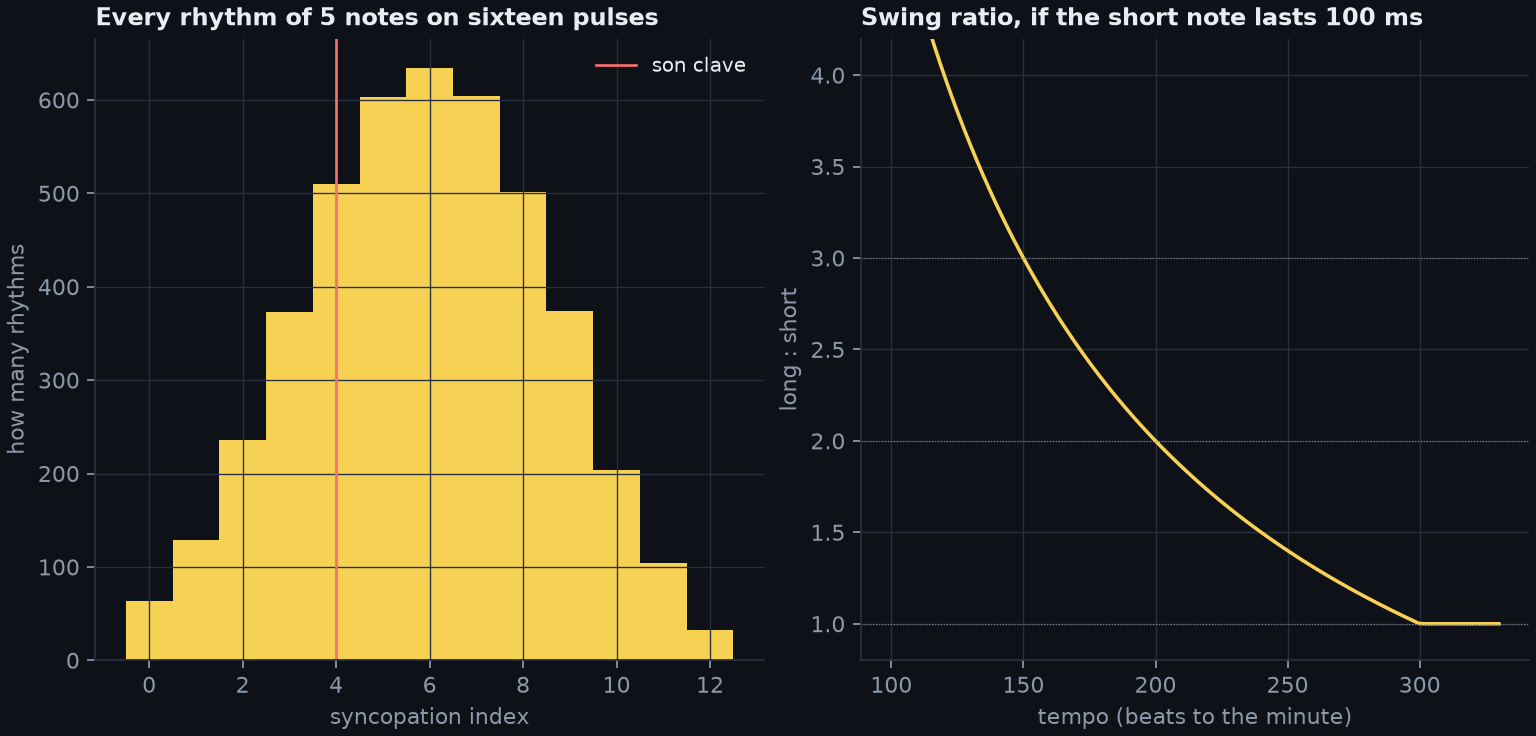
Which ratio is the real one? In 2002 two Swedish researchers measured it on jazz records, from the drummers' ride cymbals. The answer was: all of them. At slow tempos the ratio was as large as three and a half to one. At the fastest it was one to one: even eighths. The approximate trend moves through a triplet ratio in the middle; individual players, instruments and passages vary. They also reported an approximately stable short interval across part of the tempo range. From medium tempos upward the short note stayed about the same length, a tenth of a second, whatever the tempo. The drawn curve uses a hundred-millisecond short interval, capped between one and three and a half; these are model values, not plotted measurements. A tenth of a second is a useful rhythmic timescale, not a universal lower limit; it relates to the range discussed in chapter one. On this curve the ratio is exactly two at beats to the minute, and falls to one at . A fixed ratio cannot describe all swing: articulation, ensemble coordination and style matter beyond this model.
On the page a swung line looks like this: even eighth notes, and the word swing at the top. Everything we have just measured is left to the player: which ratio, at this tempo, with this band, and how the soloist leans against the drummer. The differences are a few tens of milliseconds, often omitted from the printed example, though MIDI and other event encodings can record such detail. It is that part's lesson again. The page keeps the notes. A living tradition keeps the rest, and you learn it by listening.
9Where rhythm becomes pitchFoundations3 min
What is three against two, a hundred times a second?
Now the experiment this part has been heading for. Take three against two, at less than one cycle a second, and speed it up, steadily, until it is going round a hundred times a second. Notice the moment when you stop hearing a rhythm. And what do you hear instead?
As repetition rates entered the low audio range, many listeners will have heard pitch emerge; the transition is gradual and varies with the stimulus. The clicks of each part fused into a note, as the single train did in chapter one. At the end, one part was clicking times a second and the other . Those are two notes, and Monochord measures the distance between them: cents. A perfect fifth. The interval that Part 1 found by stopping a string at two thirds of its length is three against two, played too fast to count.
So every interval of Part 1 is a polyrhythm. The octave is two against one. The fifth, three against two. The fourth, four against three. A major chord is four, five and six at once. And the reason given in Part 5 for short common periods link these simple ratios mathematically. Perceived consonance and rhythmic ease also depend on spectra, roughness, learning, tempo and task; the analogy is not a complete perceptual explanation. The composer Henry Cowell set this out in 1930, and built an instrument with Leon Theremin to play it. Slow pulse trains can be heard as rhythm, and faster periodic trains as pitch. The boundary is not a universal twenty-hertz switch. It is one phenomenon, heard at two speeds.
One step further. Those fast rhythms were even strokes. What happens to a pattern? Here are two cycles of eight pulses. A has one stroke. B has three, unevenly spaced. Slowly, they are two different rhythms. Listen to them once a second, and then a hundred and ten times a second.
Fast, both are the same note, because the cycle goes round at the same rate. But they do not sound alike. A's ideal impulse-pattern factor is equal across these harmonics. B has some strong and some nearly missing. Those bars show the normalized Fourier factor of the onset pattern; the finite click shape supplies an additional spectral envelope in the actual audio. So the rate of the cycle becomes the pitch, and the rhythm inside the cycle becomes the tone colour. The example links temporal pattern, repetition pitch and spectral colour, without making them identical perceptual quantities.
10Frontier: what the listener expectsResearch4 min
Are the simple ratios in the music, or in us?
Simple ratios everywhere: two to one, three to two. Are they in the music, or in us? One way to ask is a game of telephone, invented for rhythm by Nori Jacoby and Josh McDermott. Play a listener a rhythm of three intervals, chosen at random. Every such rhythm is a point in this triangle: near a corner, one interval is long; in the middle, all three are equal. The listener taps it back, not quite right. Play the tapping to the listener as the next rhythm, and go round again. Each time, the errors lean toward what the listener expects a rhythm to be. After a few rounds the rhythm has drifted to one of those expectations. Here is a simulated listener, and one rhythm going down the chain.
It began as a lopsided rhythm, with intervals of , and milliseconds. Five rounds later it is , and : very nearly two to one to one. Here the attraction was built into the simulated listener; the toy illustrates the procedure, not an independently discovered human bias.
Now do that with two hundred random rhythms at once, for two simulated listeners who expect different things. After five rounds the cloud has collapsed into clusters, and the clusters show what each listener expects: for A, rhythms made of ones and twos; for B, rhythms with a three in them. That is a toy, and we put the expectations in by hand. The real experiment reads them out of real people. In 2017 it was run with listeners in Boston and with the Tsimane, in the Bolivian Amazon. In 2024 it was run with thirty-nine groups of people in fifteen countries. Every group had clusters, and the clusters were at ratios of small whole numbers. But which ratios were strongest differed from group to group, and matched the music each group knew. The grid of small ratios seems to be common to people. The variation is consistent with cultural learning; these experiments alone do not isolate all developmental causes.
And who else keeps a beat? For a long time the answer seemed to be nobody. Then, in 2009, a cockatoo named Snowball was tested. He danced to pop songs, and when the experimenters sped the music up or slowed it down, he adjusted. In 2013 a sea lion named Ronan was trained to bob her head to a metronome, and then kept time to music she had never heard. Nonhuman primate performance varies by species, training and task; some experiments show predictive timing, while spontaneous flexible synchronization remains more limited than in humans. Predicting a beat is rare among animals, and why these animals can, and those cannot, is argued over.
What is not known is a good deal. Where the small ratios come from: from the timing machinery of ears and limbs, or from the music a child hears from birth. The telephone game shows the expectations. It cannot show their source. Whether microtiming matters. Players are sure that notes placed a few milliseconds off the grid give music its feel. Several careful listening experiments have found that listeners prefer the exact version, or cannot tell. Both may be true of different music. Why we move at all. Syncopation and the urge to move make an arch, but nobody can yet say why a body should enjoy supplying a missing beat. And machines. Beat tracking works well on many regular pop recordings, but generalization, tempo ambiguity and unusual material remain difficult. Finding the meter of a Balkan dance, or the pulse of a free solo, is not, and we return to that in Part 62.
Variation 11, recap and problemsAll tracks4 min
Every part ends by doing something to the Tune with what it has built. This part built ways of counting. So here is the Tune with every phrase in a different meter: in four, as we have always had it; as a waltz; in five; in seven; swung; and with a hemiola. The notes are the same forty-two. The tall marks are where the drums put the beats.
Row eleven of the ledger. seconds. The measurement is a count: its bars are counted in four, three, five and seven, and in six, two ways. Not one pitch was changed.
What did we find? Identical clicks often elicit subjective grouping: the listener adds the meter. A commonly reported beat range lies in a window, from about a quarter of a second to two seconds, and best near two to the second. A meter is pulses nested inside pulses; loud sounds begin groups, and long ones end them. Syncopation can be counted: notes on weak moments, before strong moments left silent. Beats need not be equal: seven is two, two and three. Swing timing varies with tempo and style; our short-interval rule is an illustrative model. And three against two, played a hundred times a second, is a perfect fifth. Rhythm and harmony are one scale of ratios.
Five problems. One to compute, one to prove, one for your ears, one to build, and a research problem, marked with a star. Solutions are in this part's notes. Pause here.
Where does this come back? Rhythm is half of every melody we will write. Meter decides where chords change. The circles of this part return as mathematics, where we ask which rhythms spread their notes most evenly. The cycles of Indian music and the bell patterns of West Africa get parts of their own, and so does swing. And the listener's expectations, which began this part, are the subject of a whole part on why music moves us.
And in practice. A drummer practises with a click on only two of the four beats, or one, so as to carry the grid alone. A conductor chooses which level of the meter to beat: a fast six-eight in two, a slow one in six. A producer turns a knob marked swing, which delays every second sixteenth note by a set percentage. And a dancer learns a bar of seven as quick, quick, slow, long before anybody counts it.
The books and papers this part follows. The full list, with notes, is in the README.
We can now say when. Next we ask which: which notes a piece of music chooses from. Look at a keyboard. Seven white keys and five black to every octave, on a conventional piano. Other keyboard layouts and scale traditions also exist. Why this familiar seven-and-five design? The answer starts from the same three to two that ended this part: stack fifths one on another, fold them back into an octave, and at certain numbers of notes something special happens. Next time. Part 12: Scales and Modes.
Where it goes next. Part 12 turns from when to which: the notes a piece chooses from. Rhythm returns inside melody (Part 14) and harmonic rhythm (Part 18); its mathematics, necklaces and evenness, in Part 33; tala and the timelines of West Africa in Parts 34 and 37; swing in Part 38; the listener's expectations in Part 46; and machines that find the beat in Part 62.
Key results
The part's results in one place, for revision.
Try it
Lab 11 · Rhythm, counted: metres, syncopation and the ratios a listener expects
Turn a tempo into milliseconds, weigh the pulses of a bar, find the most syncopated rhythm of five notes by trying them all, count the metres made of twos and threes, get the swing ratio from one short note, run the telephone game on random rhythms, and tell 3 + 3 from 2 + 2 + 2 by ear.
python -m videos.music.labs 11
needs numpy, scipy, matplotlib · download lab11.py ·
source on GitHub132 beats to the minute, 2 beats of 3 bar 909 ms, beat 455 ms, division 152 ms
the tempo at which the division reaches 100 ms 200 beats to the minute
weights of four-four, in sixteenths 5 1 2 1 3 1 2 1 4 1 2 1 3 1 2 1
syncopation of every beat x...x...x...x... 0
syncopation of son clave x..x..x...x.x... 4
syncopation of bossa nova x..x..x...x..x.. 6
syncopation of every off-beat ..x...x...x...x. 7
rhythms of 5 notes on 16 pulses 4368; index from 0 to 12, typically 6
the most syncopated .x.x.x...x...x.. 12
the most syncopated that sounds the downbeat xx.x.x...x...... 8
ways to fill 2..12 pulses with twos and threes 1 1 1 2 2 3 4 5 7 9 12
of the twelve ways to fill 12, those with four beats 1 (3+3+3+3); with five: 10; with six: 1
three against two, on six pulses: the gaps between strokes 2 1 1 2
swing ratio at 120 if the short note lasts 100 ms 4.00 to 1
swing ratio at 160 if the short note lasts 100 ms 2.75 to 1
swing ratio at 200 if the short note lasts 100 ms 2.00 to 1
swing ratio at 240 if the short note lasts 100 ms 1.50 to 1
swing ratio at 300 if the short note lasts 100 ms 1.00 to 1
mean distance to the nearest whole-number rhythm, rounds 0..5 0.058 0.028 0.027 0.026 0.027 0.027
ear problem, the eight bars, each played twice (listen first) 2+2+2; 2+2+2; 2+2+2; 3+3; 2+2+2; 3+3; 3+3; 3+3
A rhythm is a list of times; a metre is what a listener lays over them. Once the metre is a grid of weights, syncopation is a sum, the dances of the Balkans are compositions of twos and threes, and swing is one subtraction. What the grid cannot tell you is where the listener got it.The code (117 lines; it asserts its own result)
"""Lab 11: tempo in milliseconds, a metre's weights, syncopation by brute force, twos and threes, swing by subtraction, the telephone game, and bars to tell apart by ear."""

import math
from itertools import combinations

import numpy as np

from videos.coursekit import labs
from explainer.music.monochord import Clip, concat, mix
from explainer.music.monochord import rhythm as R
from explainer.music.monochord.instruments import drumkit as K

TITLE = "Rhythm, counted: metres, syncopation and the ratios a listener expects"
GOAL = ("Turn a tempo into milliseconds, weigh the pulses of a bar, find the most syncopated rhythm of five notes by trying "
        "them all, count the metres made of twos and threes, get the swing ratio from one short note, run the telephone "
        "game on random rhythms, and tell 3 + 3 from 2 + 2 + 2 by ear.")
TASKS = [
    "Set NOTES to 3, 4, 6 and 7. How does the largest possible index change? Is the winner always the rhythm with a note on every weakest pulse?",
    "Set SHORT to 0.08 and 0.12. At what tempo is the swing ratio exactly two? What does a drummer with a quicker hand do to the triplet feel?",
    "Set HEARING to 0.02 and 0.1 and run the telephone game. Does a listener who hears timing less exactly end up closer to the whole-number rhythms, or further?",
]
BPM, SIGNATURE = 132.0, (2, 3)     # Problem 1: a jig in six-eight, the beat a dotted quarter
NOTES = 5                          # Problem 4: how many notes in the bar of sixteen pulses
SHORT = 0.1                        # the short note of a swung pair, seconds
HEARING = 0.05                     # how blurred the listener's hearing of a rhythm is (fraction of the cycle)
SR = 48_000
FOUR = (2, 2, 2, 2)


def run(seed=0):
    rng = np.random.default_rng(seed)
    lab = labs.Lab()

    # 1. tempo on a clock (Problem 1)
    beat = 60.0 / BPM
    division = beat / SIGNATURE[1]
    lab.row(f"{BPM:g} beats to the minute, {SIGNATURE[0]} beats of {SIGNATURE[1]}", f"bar {1000 * beat * SIGNATURE[0]:.0f} ms, beat {1000 * beat:.0f} ms, division {1000 * division:.0f} ms")
    lab.row("the tempo at which the division reaches 100 ms", f"{60.0 / (0.1 * SIGNATURE[1]):.0f} beats to the minute")

    # 2. a metre's weights, and a rhythm's index
    lab.row("weights of four-four, in sixteenths", " ".join(str(w) for w in R.meter_weights(FOUR)))
    for name, p in (("every beat", "x...x...x...x..."), ("son clave", "x..x..x...x.x..."), ("bossa nova", "x..x..x...x..x.."), ("every off-beat", "..x...x...x...x.")):
        lab.row(f"syncopation of {name}", f"{p}   {R.syncopation(p, FOUR)}")

    # 3. the most syncopated rhythm of NOTES notes (Problem 4): try them all
    best, best_down = (-1, ""), (-1, "")
    hist = []
    for combo in combinations(range(16), NOTES):
        p = "".join("x" if i in combo else "." for i in range(16))
        s = R.syncopation(p, FOUR)
        hist.append(s)
        best = max(best, (s, p))
        if 0 in combo:
            best_down = max(best_down, (s, p))
    lab.row(f"rhythms of {NOTES} notes on 16 pulses", f"{len(hist)}; index from {min(hist)} to {max(hist)}, typically {np.median(hist):.0f}")
    lab.row("the most syncopated", f"{best[1]}   {best[0]}")
    lab.row("the most syncopated that sounds the downbeat", f"{best_down[1]}   {best_down[0]}")
    assert best[0] >= best_down[0] > R.syncopation("x..x..x...x.x...", FOUR) or NOTES != 5

    # 4. twos and threes (Problem 2)
    counts = [len(R.compositions(n)) for n in range(2, 13)]
    lab.row("ways to fill 2..12 pulses with twos and threes", " ".join(str(c) for c in counts))
    twelve = R.compositions(12)
    lab.row("of the twelve ways to fill 12, those with four beats", str(sum(len(c) == 4 for c in twelve)) + " (3+3+3+3); with five: " + str(sum(len(c) == 5 for c in twelve)) + "; with six: " + str(sum(len(c) == 6 for c in twelve)))
    assert all(counts[k] == counts[k - 2] + counts[k - 3] for k in range(3, len(counts))) and counts[-1] == 12

    # 5. three against two, and swing by subtraction
    p = R.polyrhythm(3, 2)
    lab.row("three against two, on six pulses: the gaps between strokes", " ".join(str(g) for g in p["gaps"]))
    for bpm in (120, 160, 200, 240, 300):
        b = 60.0 / bpm
        lab.row(f"swing ratio at {bpm} if the short note lasts {1000 * SHORT:.0f} ms", f"{max((b - SHORT) / SHORT, 1.0):.2f} to 1")

    # 6. the telephone game
    pk = np.array([R.simplex_point(r) for r in R.INTEGER_RHYTHMS])
    seeds = rng.dirichlet([1, 1, 1], 300)
    seeds = seeds[seeds.min(axis=1) > 0.12]
    weights = np.array([1.0 if set(r) <= {1, 2} else 0.02 for r in R.INTEGER_RHYTHMS])
    it = R.iterate(seeds, pk, weights, 5, seed=seed, hearing=HEARING)
    d = [float(R.nearest_ratio(it[k], pk)[:, 1].mean()) for k in range(6)]
    lab.row("mean distance to the nearest whole-number rhythm, rounds 0..5", " ".join(f"{x:.3f}" for x in d))
    assert d[5] < d[0]

    # 7. the ear problem (Problem 3): eight bars of six, grouped 3 + 3 or 2 + 2 + 2
    kinds = rng.integers(0, 2, 8)
    if kinds.min() == kinds.max():
        kinds[0] = 1 - kinds[0]
    pulse = 0.2
    bars = []
    for k in kinds:
        starts = (0, 2, 4) if k else (0, 3)
        rows = [(Clip(K.woodblock(), SR), i * pulse, -6.0) for i in range(6)] + [(Clip(K.kick(), SR), i * pulse, 0.0) for i in starts]
        bar = mix(rows, duration=6 * pulse)
        bars.append(concat([bar, bar]))
    lab.audio = concat(bars, gap=0.8).at_level(-20.0)
    lab.row("ear problem, the eight bars, each played twice (listen first)", "; ".join("2+2+2" if k else "3+3" for k in kinds))

    fig, (a, b) = labs.figure(2)
    a.hist(hist, bins=np.arange(-0.5, max(hist) + 1.5), color=labs.GOLD)
    a.axvline(R.syncopation("x..x..x...x.x...", FOUR), color=labs.RED, lw=1.2, label="son clave")
    a.set_title(f"Every rhythm of {NOTES} notes on sixteen pulses")
    a.set_xlabel("syncopation index")
    a.set_ylabel("how many rhythms")
    a.legend()
    bpm = np.linspace(100, 330, 100)
    b.plot(bpm, np.clip((60.0 / bpm - SHORT) / SHORT, 1.0, None), color=labs.GOLD, lw=1.6)
    for r in (1, 2, 3):
        b.axhline(r, color="#888", lw=0.5, ls=":")
    b.set_ylim(0.8, 4.2)
    b.set_title(f"Swing ratio, if the short note lasts {1000 * SHORT:.0f} ms")
    b.set_xlabel("tempo (beats to the minute)")
    b.set_ylabel("long : short")
    lab.fig = fig
    lab.note = ("A rhythm is a list of times; a metre is what a listener lays over them. Once the metre is a grid of weights, "
                "syncopation is a sum, the dances of the Balkans are compositions of twos and threes, and swing is one "
                "subtraction. What the grid cannot tell you is where the listener got it.")
    return lab
Now change it
- Set NOTES to 3, 4, 6 and 7. How does the largest possible index change? Is the winner always the rhythm with a note on every weakest pulse?
- Set SHORT to 0.08 and 0.12. At what tempo is the swing ratio exactly two? What does a drummer with a quicker hand do to the triplet feel?
- Set HEARING to 0.02 and 0.1 and run the telephone game. Does a listener who hears timing less exactly end up closer to the whole-number rhythms, or further?
Problems, with solutions
Try each problem before opening its solution.
-
A jig. A jig is marked 132 beats to the minute in six-eight, the beat a dotted quarter. How long, in milliseconds, is a bar, a beat and an eighth note? How fast could the tempo go before the eighth notes reached an illustrative subdivision duration of 100 ms?
Solution
A beat lasts 60/132 = 0.4545 s, or 455 ms. A bar is two beats, 909 ms; an eighth is a third of a beat, 152 ms. The eighths reach 100 ms when the beat is 300 ms, which is 200 beats to the minute. (Presto jigs are in fact played near that speed, and are felt one beat to the bar.)
-
Twos and threes. Let a(n) be the number of ways to fill n pulses with beats of two and three. Show that a(n) = a(n−2) + a(n−3), and find a(12). Which of the twelve have four beats?
Solution
Every filling begins with a beat of two, leaving n − 2 pulses to fill in a(n−2) ways, or with a beat of three, leaving n − 3 in a(n−3) ways; the two kinds are different fillings, and there are no others. With a(0) = 1, a(1) = 0, a(2) = 1: a(3) = 1, a(4) = 1, a(5) = 2, a(6) = 2, a(7) = 3, a(8) = 4, a(9) = 5, a(10) = 7, a(11) = 9, a(12) = 12. A filling of 12 with k beats has 12 − 2k threes, so k = 4 needs four threes: only 3 + 3 + 3 + 3 (twelve-eight). Five beats means two threes and three twos, in 10 orders; six beats is 2 + 2 + 2 + 2 + 2 + 2. (These are the Padovan numbers.)
-
Ear. The lab plays eight bars of six eighth notes in a random order, each grouped 3 + 3 or 2 + 2 + 2 by its accents. Say which is which.
Solution
The lab prints the order. Count the bass drum: two strokes to the bar is 3 + 3, three is 2 + 2 + 2. With practice the two feel different before they are counted: one swings in two, like a jig; the other steps in three, like a waltz at speed.
-
Build. With
rhythm.syncopation, find the rhythm of five notes on sixteen pulses with the largest index, and the largest among those that sound the downbeat. Play both: can you still feel the beat?Solution
The lab tries all 4,368. The largest index is 12, for
.x.x.x...x...x..: five notes on the weakest pulses, each followed by silence on a stronger one, and nothing on any beat. Among rhythms that sound the downbeat the largest is 8, forxx.x.x...x....... Played alone, the first is heard as a plain rhythm starting on its own first note: a listener moves the grid to fit, which is why the film plays every rhythm over a drum that keeps the beat. Syncopation exists only against a metre that something else maintains, even if that something is the listener's memory of the bar before. -
★ Where do the ratios come from? Design an experiment that could tell whether listeners' preference for small-integer rhythms comes from hearing and moving, or from the music they have heard. Who would your listeners be, and what result would settle it?
Where the frontier is. The telephone game (Jacoby and McDermott, 2017; Jacoby and others, 2024) shows that every group tested has expectations at small-integer ratios and that their weights follow local music, which argues for a shared scaffold and a learned emphasis. It cannot say where the scaffold comes from. Candidates for a decisive test: infants before much musical exposure (the method needs tapping, so it would have to be replaced by looking-time or EEG measures of surprise); people with little exposure to metric music, who are now very hard to find; other species that entrain to a beat; or training studies that try to install a non-integer category in adults and see whether it holds. Each has a flaw, and stating the flaws is the exercise. A result that would count against a purely learned origin is an integer-ratio bias for ratios absent from everything a listener has heard; the 2024 study reports hints of this and is careful about it.
Notes and sources
Sources
Books: J. London, Hearing in Time: Psychological Aspects of Musical Meter (2nd ed., 2012), for the limits of pulse and metre; F. Lerdahl and R. Jackendoff, A Generative Theory of Tonal Music (1983), ch. 4, for the metrical grid; W. A. Sethares, Rhythm and Transforms (2007); H. Cowell, New Musical Resources (1930), for rhythm and interval as one scale of ratios; P. Fraisse, Psychologie du rythme (1974); C. Brăiloiu, "Le rythme aksak", Revue de musicologie 33 (1951); G. Toussaint, The Geometry of Musical Rhythm (2013), for rhythms on a circle.
Papers: T. L. Bolton, "Rhythm", American Journal of Psychology 6 (1894); H. Woodrow, "A quantitative study of rhythm: the effect of variations in intensity, rate and duration", Archives of Psychology 14 (1909); J. R. Iversen, A. D. Patel and K. Ohgushi, "Perception of rhythmic grouping depends on auditory experience", JASA 124 (2008); H. C. Longuet-Higgins and C. S. Lee, "The rhythmic interpretation of monophonic music", Music Perception 1 (1984); D.-J. Povel and P. Essens, "Perception of temporal patterns", Music Perception 2 (1985); R. Parncutt, "A perceptual model of pulse salience and metrical accent in musical rhythms", Music Perception 11 (1994); L. van Noorden and D. Moelants, "Resonance in the perception of musical pulse", Journal of New Music Research 28 (1999); C. Drake and M.-C. Botte, "Tempo sensitivity in auditory sequences", Perception & Psychophysics 54 (1993); A. Friberg and A. Sundström, "Swing ratios and ensemble timing in jazz performance: evidence for a common rhythmic pattern", Music Perception 19 (2002); R. Brochard, D. Abecasis, D. Potter, R. Ragot and C. Drake, "The 'ticktock' of our internal clock: direct brain evidence of subjective accents in isochronous sequences", Psychological Science 14 (2003); R. Bååth, "Subjective rhythmization: a replication and an assessment of two theoretical explanations", Music Perception 33 (2015); M. A. G. Witek, E. F. Clarke, M. Wallentin, M. L. Kringelbach and P. Vuust, "Syncopation, body-movement and pleasure in groove music", PLoS ONE 9 (2014); M. Davies, G. Madison, P. Silva and F. Gouyon, "The effect of microtiming deviations on the perception of groove in short rhythms", Music Perception 30 (2013); G. Aschersleben, "Temporal control of movements in sensorimotor synchronization", Brain and Cognition 48 (2002); B. H. Repp, "Sensorimotor synchronization: a review of the tapping literature", Psychonomic Bulletin & Review 12 (2005); A. D. Patel, J. R. Iversen, M. R. Bregman and I. Schulz, "Experimental evidence for synchronization to a musical beat in a nonhuman animal", Current Biology 19 (2009); P. Cook, A. Rouse, M. Wilson and C. Reichmuth, "A California sea lion (Zalophus californianus) can keep the beat", Journal of Comparative Psychology 127 (2013); N. Jacoby and J. H. McDermott, "Integer ratio priors on musical rhythm revealed cross-culturally by iterated reproduction", Current Biology 27 (2017); N. Jacoby and others, "Commonality and variation in mental representations of music revealed by a cross-cultural comparison of rhythm priors in 15 countries", Nature Human Behaviour 8 (2024); K. Stockhausen, "… wie die Zeit vergeht …", Die Reihe 3 (1957).
- G. Cooper and L. B. Meyer, The Rhythmic Structure of Music (1960): grouping and accent before GTTM.
About this partfrom its README
Part 11 of a sixty-eight-part course in music (see the series plan and
the syllabus). Part 10 wrote down how long a note lasts; but a length on a page is only a ratio.
This part is about those ratios played in time, to a listener: the pulse and how fast it can be, metre as pulses
nested in pulses, what makes a beat strong, syncopation as a number, three against two, beats of unequal length,
swing, and what happens to a rhythm played too fast to count. The rhythm engine is Monochord's
(explainer/music/monochord/rhythm.py), the drums are Part 9's struck things cut short
(explainer/music/monochord/instruments/drumkit.py), and the pictures are in explainer/music/rhythmviz.py;
every sound is computed in compute.py. Published findings are the ones listed under Sources.
- Tick, tock. Sixteen identical strokes, often heard in groups (an ear question); measured: no difference between any two; Bolton (1894); the brain's larger response to a change on a "tick" (2003); metre is added by the listener; the plan.
- 1. A pulse. Tempo in beats per minute and in seconds; clicks from one every 2.5 seconds to fifty a second; the window of the beat (about 0.25 s to 2 s), divisions down to about 100 ms, a flutter, a tone; taps that land ahead of the click: the beat as a prediction; two tempos five per cent apart (an ear question).
- 2. Meter. One bar of four-four as five nested pulses; a pulse's weight is the number of levels it belongs to (Lerdahl and Jackendoff's grid); three-four and six-eight as two nestings of the same six eighths; a toy pulse finder, which taps the Tune at 0.55 s, the tempo it was played at, and cannot find the bar.
- 3. Accent. Every third tone louder, longer, higher; pairs that fade in (an ear question): the loud sound begins a pair, the long one ends it (Woodrow, 1909).
- 4. Dividing the beat. A beat cut in one, two, three and four; the triplet; at 109 beats to the minute, 550, 275, 183 and 138 ms; a predict-pause (a triplet at 120: 167 ms); simple and compound metres.
- 5. Syncopation. A note on a weak pulse before a silent strong one; Longuet-Higgins and Lee's index (1984), worked for the son clave (4); four rhythms scoring 0, 4, 6 and 7; two to compare (an ear question: 2 and 5); strokes that are the beat until a drum arrives between them (index 0, then 7): syncopation needs a grid that something else holds; Witek's arch (2014): the urge to move is greatest at moderate syncopation.
- 6. Three against two. Six eighths as 3 + 3 and 2 + 2 + 2, alternating: hemiola; both at once: a cycle of six with strokes 2, 1, 1, 2 apart; four against three on a cycle of twelve (3, 1, 2, 2, 1, 3); a rhythm against a late copy of itself (5, 1 and 0 strokes together at delays of 0, 2 and 8 pulses): fixed phase offsets, related to continuous phasing.
- 7. Long beats and short. Seven pulses as 2 + 2 + 3, 2 + 3 + 2 and 3 + 2 + 2; the number of ordered groupings made of twos and threes: a(n) = a(n−2) + a(n−3), so 2 for five pulses, 3 for seven, 5 for nine, 12 for twelve; four Balkan dances.
- 8. Swing. Eighth notes at one, two and three to one; Friberg and Sundström (2002): about 3.5 to 1 at slow tempos, 1 to 1 at the fastest, the short note near 100 ms; so the ratio is (beat − 100 ms)/100 ms, two to one at 200 beats to the minute in this model; what the page does not say.
- 9. Where rhythm becomes pitch. Three against two, sped up from 0.75 to 100 cycles a second (an ear question); at the end 200 Hz and 300 Hz, 702 cents: a perfect fifth; every interval of Part 1 as a polyrhythm; Cowell (1930); two patterns at 110 cycles a second: one pitch, two spectra: the pattern inside the cycle becomes the tone colour.
- 10. Frontier: what the listener expects. The telephone game on three-interval rhythms, as a simulation: one chain heard, drifting to 2 : 1 : 1; two simulated listeners with different expectations; Jacoby and McDermott (2017) and Jacoby and others (2024): small-integer ratios in every one of 39 groups, weighted by culture; a cockatoo and a sea lion that keep a beat; what is not known (the source of the ratios, microtiming, why we move, machines). ★ research problem.
- Variation 11, recap and problems. The Tune in four, as a waltz, in five, in seven, swung and with a hemiola; the ledger; what we found; five problems; where it comes back; in practice; references; Part 12.
What is computed and built
python -m videos.music.music11.compute (under a minute) fills .cache/music11/.
| Item | What it computes | Checked against |
|---|---|---|
hook |
sixteen copies of one stroke; the level of each | the largest difference is 0 dB |
tempo |
a click train whose rate grows by equal ratios; two tempos 5% apart | the rate at the start and the end |
meter |
metres as nested groupings; a pulse finder on the Tune's onsets | the tempo the Tune was played at (0.55 s); every note falls on a tap |
accent |
every third tone louder, longer, higher; loud-soft and long-short pairs with faded ends | — (the listeners' answers are Woodrow's, not computed) |
divide |
one beat cut in one to four; durations at 109 and 120 | arithmetic |
sync |
Longuet-Higgins and Lee's index for four rhythms and a pair | 0 for rhythms on the beats; the clave's 4 by hand |
hemiola |
six pulses grouped two ways; 3 : 2 and 4 : 3 on their common grids | the gaps 2 1 1 2 and 3 1 2 2 1 3 |
additive |
every composition of n into twos and threes | Padovan's recurrence |
swing |
swung eighths at three ratios; the ratio a 100 ms short note gives at each tempo | 2 : 1 at 200, 1 : 1 at 300 |
continuum |
two click trains locked 3 : 2, accelerating; the spectrum of the last two seconds | 200 Hz and 300 Hz; 702 cents |
frontier |
the telephone game for two simulated listeners; one chain as sound | the cloud gathers at the listeners' own ratios |
tune |
Variation 11 | the forty-two pitches are the Tune's |
Monochord's rhythm engine is held against these in tests/music/test_rhythm.py; this part's claims and clips in
tests/music/test_music11.py.
Sounds. Nineteen clips, labelled on screen. physical model: the kit (a bass drum, a tom, a wood block, a
clave and a rim stroke, each a set of Part 9's modes with heavy damping) and Part 7's piano. synthesized: the
click trains, the organ tones of chapter 3, and the hi-hat, which is filtered noise. There are no recordings.
What the models are, and are not. The pulse finder is a toy: it scores steady grids against the onsets of a melody and prefers periods near half a second. It finds the Tune's beat; it knows nothing of accent, harmony or loudness, and it would fail on most real music. The metric weights are Lerdahl and Jackendoff's dots, one per level; the syncopation index is Longuet-Higgins and Lee's, applied to a pattern that repeats. Other indices exist and rank some rhythms differently. Subjective rhythmization, the grouping law and the arch of syncopation against the urge to move are reported from the literature, not computed; the arch is drawn schematically, and the film says so. The swing curve is not Friberg and Sundström's data: it is the consequence of their finding that the short note stays near 100 ms, capped at the largest ratio they report. The telephone game is a simulation in which a listener's expectations are bumps at chosen whole-number rhythms, what is heard is blurred, and what is tapped is drawn from the product of the two; the two listeners' expectations were chosen by hand to differ. It illustrates the method and why it converges on a listener's expectations; it is not a model of any population. The drums mark time; they are not studies of real drums.
The timing ranges are approximate task-dependent guides, not limits on prediction, tapping or the shortest possible rhythmic event. The tapping diagram illustrates a 40 ms lead. Subjective grouping and accent preferences vary with tempo, attention, experience and musical context. The groove curve illustrates a reported association, not a complete causal explanation of pleasure.
The clave index uses a specified one-bar model grid; the familiar son-clave onset shape is commonly notated across two bars at another pulse scale. Integer polyrhythm counts should be reduced before saying that the two parts coincide once per minimal cycle. Additive counts include ordered rotations from a fixed bar start; they do not count distinct musical traditions.
The swing curve is an illustrative capped 100 ms model, not measurement points or a universal law. Printed “swing” instructions often omit precise timing; MIDI and other event encodings can record it. The fast-pattern bars show normalized Fourier factors of ideal onset patterns; the click waveform adds its own envelope. The rhythm/pitch analogy does not by itself explain consonance or rhythmic ease. Nonhuman primate predictive timing depends on species, training and task; the film avoids claiming universal inability.
Companion material in this repository
- Monochord's rhythm engine: metres, syncopation, the pulse, polyrhythm, swing, the telephone game
- A kit of struck things for marking time
The syllabus's plan for this partfrom SYLLABUS.md, the plan of record
- Hook: sixteen identical strokes, heard in pairs (an ear question) and measured; Bolton; the plan.
- A pulse: tempo; clicks from slow to fifty a second; the window of the beat; two tempos (an ear question).
- Meter: nested pulses and their weights; three-four and six-eight; a pulse finder taps the Tune.
- Accent: louder, longer, higher; which sound begins a pair (an ear question); Woodrow.
- Dividing the beat: twos, threes and fours; milliseconds (a predict-pause); simple and compound meters.
- Syncopation: Longuet-Higgins and Lee's index, worked; four rhythms; two to compare (an ear question); the arch.
- Three against two: hemiola; polyrhythm on a circle; four against three.
- Long beats and short: seven three ways; counting the meters of twos and threes; four dances.
- Swing: three ratios; the short note of 100 ms; what the page does not say.
- Where rhythm becomes pitch: three against two, sped up into a fifth (an ear question); intervals as polyrhythms.
- Frontier: the telephone game on rhythms, simulated; what fifteen countries showed; what is not known.
- Variation 11: the Tune in four, as a waltz, in five, in seven, swung, with a hemiola. Outro: problems, payoffs.
Covers: pulse, tempo and its limits; meter as nested periodicities; note values and tuplets; accent;
syncopation and how to measure it; hemiola; polyrhythm and polymeter; additive meters; swing; the rhythm–pitch
continuum.
Built and computed: the rhythm engine (monochord/rhythm.py: metric weights, a syncopation index, a pulse
finder, polyrhythms, compositions into twos and threes, swing, click trains, the telephone game); a kit of struck
things (instruments/drumkit.py); the pictures of rhythm (explainer/music/rhythmviz.py).
Variation 11: the Tune as a waltz, in five, in seven, swung, and with hemiola.
Frontier: rhythm priors across cultures (Jacoby and others, 2024); microtiming and groove.
Reading: London, Hearing in Time; Lerdahl & Jackendoff ch. 4; Sethares, Rhythm and Transforms.
Build the film
python -m videos.music.music11.compute        # the part's numbers, into .cache/music11
python tools/build.py music11                  # render and assemble the film
EXPLAINER_TTS=silent python tools/qa_scene.py music11 Hook   # one chapter, silent, with a contact sheet
Scenes: videos/music/music11. Setup: see the course page. Source of these notes: the README and the scenes' narration.
Build it
python -m videos.music.music11.compute                          # numbers and sounds (under a minute)
EXPLAINER_TTS=silent python tools/build.py music11 -q l --fps 15   # a silent-narration preview, with the sounds
python tools/qa_sound.py music11 --sync                         # the sound gates
python tools/dead_air.py renders/music11_480p.mp4 --sound music11  # no empty screen; no sound over a still one
python tools/lecture_length.py music11                          # 30 to 60 minutes, listening included
python tools/build.py music11                                   # 1080p30, narrated
python -m pytest -q tests/music                                 # Monochord against its references; this part's claims and clips
python -m videos.music.labs 11                                  # the lab (writes a figure and a short WAV)