Maqam
How does a system whose notes lie between the piano's keys organise its modes, and who decides where those notes are?
Over C an oud plays three thirds: 300, 400 and 350 cents; the last, neither major nor minor, is the third of maqam Rast. Arabic theory builds its modes from ajnas, groups of three or four notes with steps of 100, 150, 200 and 300 cents, and joins two into a maqam with a path of its own: Rast, Bayati, Hijaz, and Saba, which never reaches its octave. The half-flat is old: al-Farabi recorded Zalzal's fret at 27/22, 355 cents, and Safi al-Din built seventeen notes from a chain of fourths. Twenty-four equal steps fit the neutral intervals within five cents; fifty-three, the Turkish grid, fit the just ones within two. In Cairo in 1932 a congress set out to fix the scale and could not agree; musicians place the same written note differently from maqam to maqam. Turkish Rast puts its third at 17 of 53 commas, 385 cents, close to a pure major third; the Persian dastgah is a repertory of melodies more than a scale. Rhythmic cycles of 8, 9 and 10 beats, the taqsim, and instruments built to play between the keys complete the picture. The Tune is heard in Rast, Bayati and Hijaz.
What you need. Part 5 for roughness; Part 6 for commas and temperaments; Part 12 for scales; Part 33 for temperaments as maps; Part 34 for raga and the drone. Ratios and cents, equal divisions, approximation errors.
- Ideas, mathematics and history
- al-Fārābī and Ṣafī al-Dīn, ajnas, neutral intervals, sayr and modulation, Turkish commas, Persian dastgah, rhythmic cycles, the 1932 Cairo congress
- What we build, compute and hear
- maqam in cents against measured practice; the Tune in Rast, Bayati and Hijaz
What you will be able to do
Foundations
- Hear a three-quarter tone and a neutral third, and recognise jins Rast, Bayati and Hijaz.
- Explain how a maqam is built from ajnas and why it is more than a scale.
- Tell an 8-, 9- and 10-beat cycle apart.
Full course
- Compute maqamat in cents and their errors on 24 and 53 equal steps.
- Build Safi al-Din's 17-tone gamut and Turkish Rast in commas.
- Evaluate a tuning grid against medieval ratios and measured practice.
Research
- Design a study of where musicians place neutral notes, and on what that depends.
Practice
- Retune instruments and software for maqam, and choose a grid knowingly.
Contents
Each chapter has a home level. Choose a track to see what to read and watch: Foundations 28 min · Full course 31 min · Research 34 min · Practice 31 min.
- 0Between the keysFoundations2 min
- 1Ajnas: the building blocksFoundations3 min
- 2Maqamat and their pathsFoundations3 min
- 3Neutral intervals, old and newFoundations4 min
- 4Cairo, 1932Foundations3 min
- 5Turkish makam in commasPractice3 min
- 6The Persian dastgahFoundations2 min
- 7Rhythmic cyclesFoundations3 min
- 8Taqsim and modulationFoundations2 min
- 9The instrumentsFoundations3 min
- 10Frontier: measuring makamResearch2 min
- Variation 35, recap and problemsAll tracks2 min
Also on this page: Lecture · Key results · Try it · Lab · Problems · Notes and sources · Build the film.
Lecture
The text of each chapter is the film's narration, as it is spoken, so you can read along or revise without the film. The pictures are in the film. A dashed box stands for a number the film computes when it is rendered (hover over it to see what is computed); the README's figures for each chapter, where it lists them, follow the chapter's text.
Between the keysFoundations2 min
Start with your ears. An oud plays C, then a third above it, then both together, then a short phrase. Three times, with three different thirds. One is the piano's E, one is its E flat, and one lies exactly between them, a note the piano does not have. Which is the one between, A, B or C?
C lies between: three hundred and fifty cents, half way from E flat to E. It is the simplified twenty-four-step third used for our Rast example, an important Arabic maqam, and it is neither major nor minor. Musicians call such notes half-flat. This part is about a music whose notes lie between the piano's keys.
In 1932 a Congress of Arab Music met in Cairo, with musicians and scholars from Egypt, Syria, Iraq, Turkey and Europe, Béla Bartók and Paul Hindemith among them. One committee was asked to fix the Arab scale, perhaps as twenty-four equal quarter tones. By the accounts of its work, the intervals that musicians actually played did not fit such a grid; and the committee could not agree on a single standard. It is the same question as Part 34's shrutis: theory's grid, or the musicians' practice?
Here is the plan. The ajnas, the four-note building blocks. The maqamat, built from ajnas and each with a path of its own. Neutral intervals, from a medieval treatise to twenty-four and fifty-three equal steps. Turkish makam, theorised in commas, and the Persian dastgah. Rhythmic cycles, and the improvised prelude called taqsim. The instruments, and the machines now measuring this music.
Maqam is not one country's music. It lives across the Arab world from Morocco to Iraq, in Turkey, in Iran and Azerbaijan, and in Central Asia; in mosques and churches, synagogues and Sufi lodges, cafes and concert halls. The Jewish communities of the Middle East sing their liturgy in maqam. Related systems go by related names: maqam, makam, mugham, shashmaqam, dastgah. Many languages, religions and centuries share one family of musical ideas.
1Ajnas: the building blocksFoundations3 min
What is a maqam made of?
Arabic theory builds its modes from small pieces. A jins, plural ajnas, is a group of three or four notes, usually spanning a fourth. It descends from the Greek tetrachord, inherited and transformed by al-Kindi, al-Farabi and Ibn Sina. Each jins has its own flavour and name: Rast, Bayati, Hijaz, Saba. A maqam joins them, one jins on the tonic and another higher up. Here the steps are written on the twenty-four-step grid of modern Arabic theory, a quarter tone being fifty cents; chapter four asks how real that grid is.
Here are eight ajnas, each from C, each played up and down on the oud. Rast: whole tone, then two three-quarter tones. Bayati: three-quarter, three-quarter, whole. Sikah, three notes, starting on a half-flat. Hijaz: a semitone, a wide step of three semitones, a semitone. Saba, which stops short of the fourth. And three with only piano steps: Nahawand, Kurd and Ajam. Listen for the three-quarter tones, the steps the piano cannot make.
Look at the steps. There are three main sizes: a semitone, about one hundred cents; a three-quarter tone, about one hundred and fifty; and a whole tone, two hundred. Hijaz adds a wide augmented second, about three hundred. The three-quarter tone is the signature of the system, a neutral second, neither minor nor major. A whole tone plus a three-quarter tone makes the Rast neutral third in this grid; two three-quarter tones make three hundred cents, a minor third. Part 12's familiar scales had two step sizes; these have three or four.
A jins is a shape, not a fixed set of pitches. Here is jins Bayati on D, then on G, then on A: the same steps, three-quarter, three-quarter, whole, at three heights. Maqamat place ajnas on different notes, and a modulation often means moving a jins to a new note, or swapping one jins for another on the same note.
The names tell a history. Rast is Persian for straight or right: the basic mode. Hijaz is the region of western Arabia, and Nahawand a city in Iran. Kurd and Ajam refer to the Kurds and the Persians, and Saba is the east wind. The names record centuries of travel between peoples and cities, and Persian numbers survive in note names such as chahargah, the fourth place.
2Maqamat and their pathsFoundations3 min
Is a maqam a scale?
Join two ajnas and you have a maqam. Rast is jins Rast on C and jins Rast again on G, giving C, D, E half-flat, F, G, A, B half-flat, C. Bayati is jins Bayati on D with jins Nahawand on G. Hijaz is jins Hijaz on D, again with Nahawand on G. Saba is jins Saba on D with Hijaz on F, and one common ascending form reaches a lowered octave degree. An important secondary pivot, often where an upper jins begins, is called the ghammaz, a second centre of the maqam.
Hear four of them, each up and down on the oud: Rast on C, then Bayati, Hijaz and Saba on D. Each row shows the notes in cents above the tonic, with the piano's twelve keys as faint marks: watch the gold, blue and pink ticks that fall between them.
Paths can change the notes themselves. Rast climbs with B half-flat, but on the way down it often uses B flat: the upper jins becomes Nahawand instead of Rast. Listen to Rast up and down, and to the B that moves.
Saba is the exception that shows how much a maqam is built from ajnas rather than octaves. Climb it from D in one common form, and where the octave D would be, the scale reaches D flat. The jins structure continues, in this selected outline; other phrases can include the tonic octave, so this is not a prohibition on it. Listen to the climb.
As with raga, a maqam is more than a scale. It has a sayr, a typical path through its notes: where to begin, which notes to stress, where to rest, how to climb to the upper jins, and where to modulate, for each maqam has neighbours it customarily visits. Part 34's ragas had their ascents and characteristic phrases: the same insight in another tradition. Johnny Farraj and Sami Abu Shumays's book Inside Arabic Music describes these paths in detail.
The maqamat come in families. They are grouped by their lower jins, the Rast family, the Bayati family and so on: Rast, Suznak and Nairuz in one, Bayati and Husayni in another. Members of a family differ in their upper jins, or in their path. Modern lists name some sixty to eighty maqamat in common use. The families are a teaching map, like Part 34's thaats.
Maqamat have customary neighbours. From Bayati, players go to Saba by lowering one note, to Rast on the ghammaz, or to Hijaz. From Rast, to Nahawand on the fifth, or to Bayati on the second. A modulation usually changes one jins and keeps a shared note. Musicians know these paths as a map of neighbours, much as Part 15's keys have their near and distant relations.
3Neutral intervals, old and newFoundations4 min
Where did the half-flat come from?
The half-flat is old. In the tenth century the philosopher al-Farabi, in his Great Book of Music, a major medieval treatise, described the frets of the oud. Among them was the fret of the eighth-century lutenist Zalzal, at a ratio of twenty-seven to twenty-two above the open string: three hundred and fifty-five cents, a neutral third. On the ruler it sits between the equal-tempered minor and major thirds shown here. Al-Farabi also gives a neutral second, twelve elevenths, about one hundred and fifty cents.
Three centuries later Safi al-Din al-Urmawi organised the scale differently. His gamut has seventeen notes to the octave, made by a chain of pure fourths, so that every whole tone is split into two limmas and a comma: ninety, ninety and twenty-four cents. The program builds it and lists the steps. Some notes land near just intervals, one hundred and eighty and three hundred and eighty-four cents, close to ten ninths and five fourths, while Zalzal's neutral third falls between its notes. It became the basis for theory in the Persian and Ottoman worlds.
This theory has Greek roots. Al-Kindi, in the ninth century, wrote some of the earliest surviving Arabic treatises on music, drawing on Greek sources. Greek theory had three kinds of tetrachord, diatonic, chromatic and enharmonic, and Ptolemy's lists included an even tetrachord with steps of about neutral size. Arabic theorists measured and classified ajnas in that tradition and went far beyond it. The same Greek sources fed medieval European theory, as Part 23 showed.
Two modern grids try to capture all this. Arabic theory in the twentieth century adopted twenty-four equal steps to the octave, quarter tones; a common numerical approximation to Turkish comma theory uses fifty-three, as the next chapters show. Measure each against the old ratios. Twenty-four steps fits the neutral intervals well, within five cents, but misses the just thirds by up to sixteen. Fifty-three fits the Pythagorean and just thirds within a cent or two, but misses the neutral intervals by about eight. Neither grid is the music; each is a choice of what to approximate.
How much do these differences matter to the ear? Here are three neutral thirds over C: the twenty-four-step three hundred and fifty, Zalzal's three hundred and fifty-five, and fifty-three steps' three hundred and sixty-two. They span twelve cents, with no single detection threshold: audibility depends on timbre, duration, task and the listener. Listen for whether the colour changes.
Why would a music choose neutral intervals? They are found far beyond the Arab world, in Persian, Turkish and Central Asian music and some African musics. On harmonic tones a neutral third is rougher than a pure one, as Part 5 would predict, but in melody, heard against a tonic, it is a colour of its own. Listeners raised with this music hear it as stable and expressive. Consonance depends on timbre; melodic intervals depend on culture as well.
Europe discovered quarter tones too. Twentieth-century composers such as Alois Hába and Ivan Wyschnegradsky wrote quarter-tone music and had quarter-tone pianos and clarinets built. For them the quarter tone was a new colour; maqam notation uses quarter-tone inflections, while actual tuning and typical melodic steps vary. The spectral composers of Part 30 later used such intervals to follow the harmonic series. The same interval, in two musical worlds.
4Cairo, 1932Foundations3 min
Can a living tradition be standardized?
The twenty-four-step grid is a nineteenth-century idea. The Damascus scholar Mikhail Mushaqa described the octave as twenty-four equal quarter tones. It was a theorist's simplification, easy to write and to teach, and by the twentieth century it was the standard way to notate Arabic music, with a half-flat sign for notes a quarter tone low. But the grid names the notes; it does not say exactly where musicians put them.
The question came to a head in Cairo. In 1932 King Fuad's government invited musicians and scholars to a Congress of Arab Music, with committees on scales, instruments, recording, education and history. Among the European guests were Bartók, Hindemith, Erich von Hornbostel, Robert Lachmann, Henry George Farmer and Curt Sachs. The scale committee heard and discussed many tunings and did not settle on a single equal grid. The congress also recorded ensembles from across the region, an early archive of the music of its time.
What do musicians actually do? They report, and measurements agree, that the same half-flat note is not fixed from maqam to maqam: the E half-flat of Rast is often described as higher than that of Bayati, and it may shift within a phrase, higher when rising, lower when falling. Intonation belongs to the maqam, as gamaka belongs to the raga in Part 34. The grid is a map; the music is the territory.
European ears were part of the story. Bartók had collected Arab folk music in Algeria in 1913. At the congress he urged recording village musicians, not only city ensembles. Hindemith and others debated whether Western instruments such as the piano should be admitted. The Europeans were guests; the decisions were Egyptian and Arab. The recordings made then are now studied for how the music has changed since.
Here is what such a difference sounds like, as an illustration with values of our own, not a measurement: a Rast phrase on C with its E half-flat at three hundred and sixty cents, then a Bayati phrase on D with the same notated E half-flat at three hundred and forty. Twenty cents, a comma: one sign on the page, two pitches in the music.
The twentieth century standardized anyway. Conservatories, radio orchestras and notated arrangements spread. The qanun gained small levers to play the grid's notes. Keyboards and electronic instruments now offer Arabic scale presets. Some teachers worry that fixed tunings flatten the music's nuance. Standardization helps teaching and ensembles; it can also erase part of what makes a tradition what it is.
The twentieth century made a new sound. Cairo's radio and film industry built the firqa, a large orchestra with violin sections, qanun, oud, ney and percussion, and later electric instruments. Singers such as Umm Kulthum and Muhammad Abd al-Wahhab reached the whole Arab world through it. Many violins playing in unison blur fine distinctions of intonation, which favoured a shared grid. Media change tuning, a theme Part 60 returns to.
5Turkish makam in commasPractice3 min
Why fifty-three?
Turkish theory went another way. In the early twentieth century the theorists Arel, Ezgi and Uzdilek used a nearly Pythagorean comma-based interval system, often approximated by fifty-three equal steps. This film uses that equal-step approximation, about twenty-two and a half cents each. A whole tone is nine commas, and intervals of one, four, five, eight and nine commas each have names. Turkish Rast steps nine, eight, five, nine, nine, eight, five. Its third note, segah, is seventeen commas up, cents: contrasting with our simplified Arabic grid value of three hundred and fifty, but close to a pure major third.
A question for your ears. The lower half of Rast, up and down, and then its tonic, third and fifth sounded together, twice. One uses the Arabic third of three hundred and fifty cents; the other the Turkish segah of three hundred and eighty-five. Which third is higher, A or B?
B is higher in these theoretical sketches: the comma-grid segah. Thirty-five cents is a third of a semitone, and with the tonic and fifth sounding the difference is plain: A has the neutral colour, B sounds almost like a major chord. The two traditions share names, Rast and segah among them, but not always the same pitches.
Here too theory and practice part. Turkish musicians often play differently from the fifty-three-comma theory, and Barış Bozkurt, Ozan Yarman and others, measuring recordings, found some theoretical pitches several commas away from what performers play. Alternatives have been proposed, such as Yarman's seventy-nine-tone system, or simply describing the measured distributions. The theory grew from a desire for system; the practice from an oral tradition. It is Cairo's question again, argued in commas.
The commas reach the page. Turkish notation has special accidentals for one, four, five and eight commas, so a score shows the theory's pitches. Teachers say the signs are reminders, not instructions to tune exactly. It is notation as memory again, as in Parts 10 and 34, and the debate is partly about what notation is for.
Turkish theory grew from a long court tradition. Ottoman court music had its composers, treatises and a large repertory of vocal and instrumental forms. Around 1700 the Moldavian prince Dimitrie Cantemir devised a notation and wrote down hundreds of pieces. The Mevlevi order's ceremony joined the ney with the whirling dance. Much was passed on orally until the notations of the twentieth century: the same tension again, written theory and oral practice.
6The Persian dastgahFoundations2 min
Is a mode a scale, or a repertory?
Persia has a related system with a different organisation. Its classical music has seven dastgahs and five avazes: Shur, Homayun, Segah, Chahargah, Mahur, Rast-Panjgah and Nava. A dastgah is not a scale but a family of melodies, gushehs, each with its own range and centre. A performance travels through the gushehs, rising in register, and returns to the opening mode: more like a raga's path or a maqam's sayr than a single scale.
The repertory has a name. The radif is the canonical collection of gushehs, learned by heart; Mirza Abdollah's radif, of the late nineteenth century, is the best known for instruments. A student memorises it and then improvises from it for life, by recombining and varying the learned models. Part 42 asks how improvisers in every tradition draw on memorised material.
The tuning question appears here too. In the early twentieth century Ali-Naqi Vaziri proposed twenty-four quarter tones and two signs, koron to lower a note and sori to raise it. A koron lowers a note by roughly a quarter tone, but by how much exactly varies. Hormoz Farhat's study of 1990 found the intervals flexible rather than fixed quarter tones. It is the same pattern as Cairo and Istanbul: a grid for notation, flexibility in performance. Three traditions, one lesson about tuning theories.
Here is a phrase of our own on D in the Persian manner, using one koron note: E lowered by about a quarter tone, placed here at one hundred and fifty cents above D. It is the same interval as the Arabic Bayati's second step, and in practice it is placed differently from player to player and phrase to phrase.
Persian classical music is bound to poetry. The avaz is unmetred singing of classical poems, by Hafez, Rumi or Saadi. Its signature ornament is tahrir, a rapid, yodel-like break in the voice. An instrument answers the singer phrase by phrase, and the poem's metre and meaning shape the melody. Part 40 turns to song across traditions.
7Rhythmic cyclesFoundations3 min
How many beats in a Turkish song?
Rhythm in this music is organised in cycles too. The Arabic iqa, the Turkish usul, is a cycle of strong and weak strokes. Dum is the low stroke at the centre of the drum, tek the high stroke at the rim. Maqsum, shown here as eight equal subdivisions of its usual four-beat cycle, dum tek, tek dum, tek, is the commonest Arabic cycle. There are cycles of nine, aksak, of ten, samai thaqil, and far longer. The drum keeps the cycle; the melody moves freely over it.
A question for your ears. Three cycles on the darbuka, each three times round. We count subdivision slots: one has eight, one nine, one ten. Which has ten? Count from each deep stroke that begins a cycle.
B has ten: samai thaqil, a slow, stately cycle used for an instrumental form of the same name. A was maqsum, eight slots representing four main beats; C was aksak, nine, the limping cycle of Turkish music, two, two, two, three.
Two cycles of eight can differ by a single stroke. Maqsum’s second subdivision slot here is tek, a light stroke; baladi's is dum, a heavy one, which gives it a weightier, earthier feel, the rhythm of much popular and folk music. Listen to both, three cycles each.
The cycles can be very long. Ottoman usul reach twenty-eight, thirty-two, even one hundred and twenty beats. The long cycles carry slow vocal forms, the short ones dances and songs. And the cycle shapes the melody: phrases begin and end with its strong strokes. Part 34's tala, Part 33's timelines, and these: cycles everywhere. Part 37 compares them across the world.
These cycles are spoken before they are played. Students learn them as syllables, dum, tek, ka; teachers clap the strong strokes and tap the weak ones; Turkish students beat usul on their knees, saying düm and tek. They are Part 34's bols in another language. Rhythm you can say is rhythm you can remember.
Many of these cycles belong to dances. The dabke, a line dance of the Levant, and raqs sharqi each have their rhythms, and the darbuka player both follows and leads the dancer. The riq keeps the cycle with its jingles, the daf marks the strong strokes, and the same cycle can be played plainly or filled with rolls and ornaments. Part 37 hears timelines as the backbone of dance music worldwide.
8Taqsim and modulationFoundations2 min
How does an improviser travel?
The taqsim is where a player shows the maqam. It is an improvised solo, usually without a fixed beat, revealing the maqam step by step: its lower jins, then the ghammaz, then the upper register. And it travels, modulating to related maqamat through a shared note, and coming home. A good taqsim prepares the listener for the song that follows. Part 34's alap does the same work in another tradition.
Here is a short taqsim of our own on the oud, in Bayati on D, drawn as pitch against time. It dwells on the tonic, rises to the fourth, G, and falls back. Then it changes one note: G becomes G flat, and the sketch suggests Saba through the lowered fourth; the expressive effect depends on the phrase and context, a common move from Bayati. It climbs to A through the new note, and finally returns to Bayati's G and comes home to D.
And a second taqsim of ours, in Hijaz on D. Listen to the wide step between E flat and F sharp, the jins Hijaz's signature, which many listeners outside the tradition hear as the sound of the whole region. The taqsim dwells on it, climbs to A and B flat, and comes back down through it to D.
Why does it matter so much? Arabic has a word, tarab, for the ecstatic state music can produce. The ethnomusicologist A. J. Racy described it as an experience shared by performers and listeners. Audiences respond aloud after a fine phrase, and the singer repeats and varies a line until the room is moved. Umm Kulthum's concerts could last for hours, shaped by the audience's response.
How does one learn to improvise like this? Students learn songs and pieces in a maqam before they improvise in it, absorbing its path from the repertory: typical openings, cadences and modulations. A taqsim recombines these learned gestures in new orders. The Persian radif and the raga's phrases work the same way. Improvisation within a tradition is fluency, not invention from nothing.
9The instrumentsFoundations3 min
How do you play between the keys?
The central instrument is the oud. It is a short-necked lute with no frets, so the player's finger places every note, and any pitch is available. Its fretted ancestors are what al-Farabi described, Zalzal's fret among them. The European lute descends from it: the name comes from al-ud, the wood. The oud in this film is a plucked-string model through Part 7's guitar body.
The qanun solves the problem mechanically. It is a plucked zither of about twenty-six triple courses of strings, and under each course small levers, mandals, shorten the string by small steps. Arabic qanuns often have quarter-tone steps; Turkish ones finer steps, close to commas. The player flips levers in the middle of a phrase to change maqam: modulation by hand. A fixed-pitch instrument made flexible, lever by lever.
The oud's tuning suits the ajnas. It has five or six courses of paired strings, tuned mostly in fourths, for example C, F, A, D, G, C in one common Arabic tuning. Fourths put a whole jins under one position of the hand, and with no frets the player can bend a note by sliding or pressing. Part 7's strings, with the frets taken away.
Here is what the levers do, with our oud model standing in for one qanun course. C, then the third above it, lowered one step at a time: four hundred, three hundred and seventy-five, three hundred and fifty, three hundred and twenty-five, three hundred cents. A qanun player does this with a flick of the thumb, in the middle of a phrase.
The rest of the ensemble. The ney is an end-blown reed flute, breathy and close to the voice, the instrument of Sufi music, its pitch bent by the lips and partly covered holes. Bowed strings include the kemençe and the violin; Persian music has the tar, setar, santur and kamancheh. Percussion: the darbuka, the riq tambourine and the daf frame drum. And above all the voice, which every instrument imitates.
For the ney's colour, a sketch rather than a model: four harmonics with filtered breath noise, playing jins Bayati up and down. A real ney's tone comes from an air jet across the rim, the physics of Part 8, and its player bends every note.
10Frontier: measuring makamResearch2 min
What do pitch histograms say about theory?
Computers have measured this music too. Barış Bozkurt and colleagues, and later the CompMusic project, tracked pitch in recordings, found the tonic and drew pitch histograms for each makam. Comparing histogram peaks with theory's pitches, they found several notes differing by a comma or more. They also recognised makams automatically from the histograms, with reported above-chance results on specific datasets and makam candidate sets. Part 34's raga studies used the same tools.
The debate continues. Standardization has defenders: notation, teaching, ensembles and software all need it. It has critics, who fear a flexible, living intonation replaced by a grid. Some propose data-driven tunings that follow measured practice. But whose practice: which singer, which city, which decade? A measurement describes; it does not decide what the music should be.
A concrete version. Collect recordings of one maqam by many musicians, across regions and decades. Measure each note's pitch in its context: rising and falling, stressed and passing. Model how a note's pitch depends on the maqam, the direction, the performer and the era. What determines where a musician places a neutral note? The answer would turn half-flat from a sign into a description.
Studying a living tradition fairly takes care. Work with musicians from the start, using their categories as well as ours. Record many performers, regions and generations, not only the famous. Share data and credit, and return results to the community. Measure intonation in its context, with its uncertainty, before drawing any grid. Part 67 sets out how to do research in music well.
Machines are entering this music. There is software for maqam: tuning tables, and notation programs with half-flat signs. Recognition systems trained on recordings can name the maqam of a piece, and generative models can produce maqam-like melodies. The risk is that models trained on a few famous recordings narrow the tradition they imitate. Parts 61 to 66 build these tools; this part shows what they must respect.
Variation 35, recap and problemsAll tracks2 min
Every part ends by doing something to the Tune with what it built. First a short taqsim of ours in Rast. Then the Tune's first two phrases three times over the darbuka's maqsum: in Rast on C, where its E becomes E half-flat; in Bayati on D, where its second and third degrees both drop; and in Hijaz on D, with the augmented second between the second and third degrees. The melody's shape stays; its colour changes completely.
Row thirty-five of the ledger: seconds; the measurement is how many of the Tune's notes move in each maqam.
What did we find? Ajnas of three or four notes with steps of one hundred, one hundred and fifty, two hundred and three hundred cents. Maqamat built from two ajnas, each with its own path. Neutral intervals going back to al-Farabi, fitted by twenty-four equal steps, while fifty-three fit the just ones. Cairo's congress, where the grid met the musicians. Turkish commas and Persian dastgahs, the same question answered differently. And rhythmic cycles, the taqsim, and instruments built to play between the keys.
Five problems. One to compute, one to prove, one for your ears, one to build, and a research problem, marked with a star. Solutions are in this part's notes. Pause here.
Where does this come back? Next, in gamelan, with tunings of its own. In timelines and cycles. In improvisation and memory. In what all musics share. And in the pitch tracking that measures them.
And in practice. Oud players place each note by ear, maqam by maqam. Qanun players flip levers mid-phrase to modulate. Producers retune keyboards and software for maqam. And teachers teach paths and improvisation by imitation, not only by scale.
The books and papers this part follows. The full list, with notes, is in the README.
Where it goes next. Gamelan's tunings in Part 36; timelines in Part 37; improvisation in Part 42; universals in Part 47; pitch tracking in Part 61.
Key results
The part's results in one place, for revision.
Try it
Lab 35 · Maqam, computed
Build maqamat from ajnas in cents; measure how well equal divisions approximate neutral and just intervals; compare Arabic and Turkish Rast; and hear the difference a three-quarter tone makes.
python -m videos.music.labs 35
needs numpy, scipy, matplotlib · download lab35.py ·
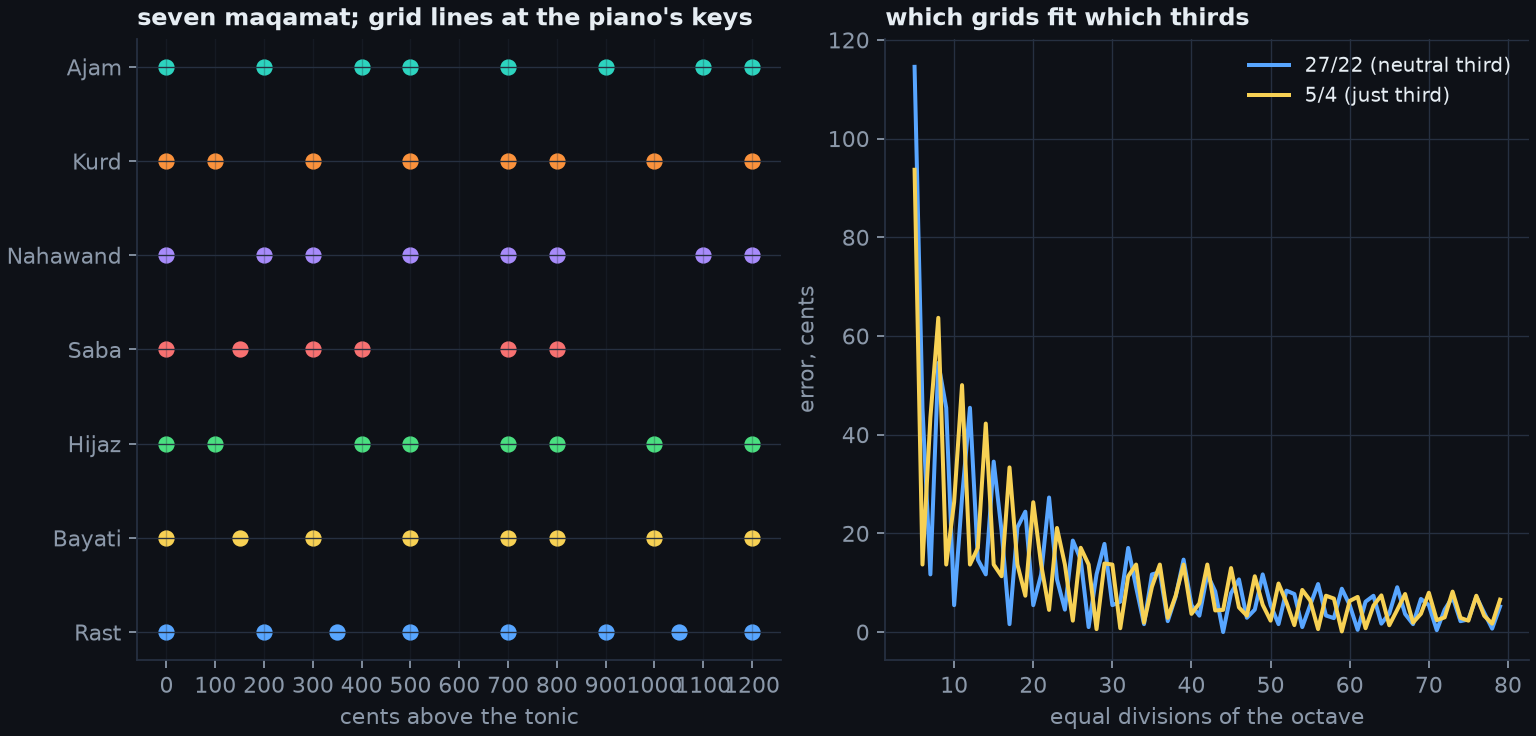
source on GitHubSaba: notes in cents 0, 150, 300, 400, 700, 800
Saba: nearest steps of 24 and errors 0 (+0), 3 (+0), 6 (+0), 8 (+0), 14 (+0), 16 (+0)
Saba: nearest steps of 53 and errors 0 (+0.0), 7 (+8.5), 13 (-5.7), 18 (+7.5), 31 (+1.9), 35 (-7.5)
divisions under 80 fitting 27/22 and 5/4 within 5 cents [34, 37, 44, 47, 65, 68, 71, 72, 74, 75, 77, 78]
Turkish Rast in commas; segah in cents [0, 9, 17, 22, 31, 40, 48, 53]; 384.9
Safi al-Din's 17 notes (cents) 0, 90, 180, 271, 294, 384, 475, 498, 588, 678, 769, 792, 882, 973, 996, 1086, 1176
ear problem: the maqam of each phrase, in order (listen first) Hijaz, Bayati, Bayati, Rast, Rast, Rast
Neutral steps sit between the piano's keys; 24 equal steps fits them, 53 fits the just intervals, and the smallest division fitting both the neutral third 27/22 and the just third 5/4 within five cents is 34.The code (68 lines; it asserts its own result)
"""Lab 35: maqam, computed: ajnas and maqamat in cents, medieval ratios against 24 and 53 equal steps, Safi al-Din's
seventeen tones, Turkish Rast in commas, and phrases to name by ear."""

import numpy as np

from videos.coursekit import labs
from explainer.music.monochord import SR, Clip, concat, mix
from explainer.music.monochord import maqam as Q

TITLE = "Maqam, computed"
GOAL = ("Build maqamat from ajnas in cents; measure how well equal divisions approximate neutral and just intervals; "
        "compare Arabic and Turkish Rast; and hear the difference a three-quarter tone makes.")
TASKS = [
    "Choose MAQAM. List its notes in cents, and the nearest steps of 24 and of 53 equal divisions for each.",
    "Change N, the number of equal steps. Which N under 80 fits both 27/22 and 5/4 within 5 cents?",
    "Define a new jins in AJNAS (four notes within a fourth) and build a maqam from it. Does it close at the octave?",
]
MAQAM = "Saba"
N = 24


def run(seed=0):
    rng = np.random.default_rng(seed)
    lab = labs.Lab()
    sc = Q.maqam_scale(MAQAM)
    lab.row(f"{MAQAM}: notes in cents", ", ".join(f"{c:.0f}" for c in sc))
    lab.row(f"{MAQAM}: nearest steps of {N} and errors", ", ".join(f"{Q.edo_error(c, N)[0]} ({Q.edo_error(c, N)[1]:+.0f})" for c in sc))
    lab.row(f"{MAQAM}: nearest steps of 53 and errors", ", ".join(f"{Q.edo_error(c, 53)[0]} ({Q.edo_error(c, 53)[1]:+.1f})" for c in sc))
    good = [n for n in range(5, 80) if abs(Q.edo_error(1200 * np.log2(27 / 22), n)[1]) < 5 and abs(Q.edo_error(1200 * np.log2(5 / 4), n)[1]) < 5]
    lab.row("divisions under 80 fitting 27/22 and 5/4 within 5 cents", str(good))
    tr = Q.turkish_rast()
    lab.row("Turkish Rast in commas; segah in cents", f"{tr['commas']}; {tr['cents'][2]:.1f}")
    lab.row("Safi al-Din's 17 notes (cents)", ", ".join(f"{c:.0f}" for c in Q.safi_17()))
    assert len(Q.safi_17()) == 17

    # Problem 3: phrases in Rast, Bayati or Hijaz on D
    names, clips = [], []
    for i in range(6):
        name = ["Rast", "Bayati", "Hijaz"][int(rng.integers(3))]
        s_ = Q.maqam_scale(name)
        seq = [s_[k] for k in (0, 1, 2, 3, 4, 3, 2, 1, 0)]
        parts = [(Clip(Q.oud(293.66 * 2 ** (c / 1200), 0.7), SR), j * 0.3, 0.0) for j, c in enumerate(seq)]
        clips.append(Clip(mix(parts, duration=len(seq) * 0.3 + 0.8).y, SR).at_level(-20.0))
        names.append(name)
    lab.audio = concat(clips, gap=1.0)
    lab.row("ear problem: the maqam of each phrase, in order (listen first)", ", ".join(names))

    fig, (a, b) = labs.figure(2)
    for i, k in enumerate(["Rast", "Bayati", "Hijaz", "Saba", "Nahawand", "Kurd", "Ajam"]):
        s_ = Q.maqam_scale(k)
        a.scatter(s_, [i] * len(s_), s=40)
    a.set_yticks(range(7))
    a.set_yticklabels(["Rast", "Bayati", "Hijaz", "Saba", "Nahawand", "Kurd", "Ajam"])
    a.set_xticks(range(0, 1300, 100))
    a.grid(axis="x", alpha=0.3)
    a.set_xlabel("cents above the tonic")
    a.set_title("seven maqamat; grid lines at the piano's keys")
    ns = list(range(5, 80))
    b.plot(ns, [abs(Q.edo_error(1200 * np.log2(27 / 22), n)[1]) for n in ns], label="27/22 (neutral third)")
    b.plot(ns, [abs(Q.edo_error(1200 * np.log2(5 / 4), n)[1]) for n in ns], label="5/4 (just third)")
    b.set_xlabel("equal divisions of the octave")
    b.set_ylabel("error, cents")
    b.legend(frameon=False)
    b.set_title("which grids fit which thirds")
    lab.fig = fig
    lab.note = ("Neutral steps sit between the piano's keys; 24 equal steps fits them, 53 fits the just intervals, and the "
                "smallest division fitting both the neutral third 27/22 and the just third 5/4 within five cents is 34.")
    return lab
Now change it
- Choose MAQAM. List its notes in cents, and the nearest steps of 24 and of 53 equal divisions for each.
- Change N, the number of equal steps. Which N under 80 fits both 27/22 and 5/4 within 5 cents?
- Define a new jins in AJNAS (four notes within a fourth) and build a maqam from it. Does it close at the octave?
Problems, with solutions
Try each problem before opening its solution.
-
Compute. Build maqam Saba on D in cents, and find the nearest steps of 24 and of 53 equal divisions for each note.
Solution
Saba = jins Saba on D (0, 150, 300, 400) and jins Hijaz on F (300, 400, 700, 800): 0, 150, 300, 400, 700, 800. In 24 steps: 0, 3, 6, 8, 14, 16, exactly. In 53: 0, 7, 13, 18, 31, 35, with errors of +8.5, −5.7, +7.5, +1.9 and −7.5 cents. The lab prints any maqam.
-
Prove. Prove that a chain of 17 pure fourths, folded into the octave, gives steps of only two sizes plus one comma.
Solution
By the three-gap theorem (Part 33) the folded points leave at most three gap sizes, the largest the sum of the other two. Computing them: the limma (256/243, 90.2 cents) and the Pythagorean comma (23.5 cents) appear, and their sum, the apotome (113.7 cents), would be the third size; with 17 points the gaps are 12 limmas and 5 commas, since 12 × 90.2 + 5 × 23.5 = 1200 (to rounding).
-
Ear. The lab plays phrases in Rast, Bayati and Hijaz; name the maqam of each.
Solution
The lab prints them. Hijaz has the wide step (300 cents) between its second and third notes; Bayati starts with a three-quarter tone; Rast starts with a whole tone and then a three-quarter tone.
-
Build. Add mandal levers to the oud model's qanun cousin: a string set that retunes mid-phrase.
Where to look. Give each course a list of lever positions in cents (for an Arabic qanun, quarter tones; for a Turkish one, finer steps) and a schedule of lever changes; render with
maqam.oudat the course's current pitch, and play a taqsim that modulates from Bayati to Saba by moving one lever. -
★ What determines where a musician places a neutral note?
Where the frontier is. Collect recordings of one maqam by many performers across regions and decades; track pitch and segment notes; model each note's pitch as a function of maqam, melodic direction, metrical position, performer and era, with uncertainty; and test the model's predictions against musicians' own descriptions.
Notes and sources
Sources
- S. Marcus, Music in Egypt (2007); H. H. Touma, The Music of the Arabs (1996); A. J. Racy, Making Music in the Arab World (2003); J. Farraj and S. Abu Shumays, Inside Arabic Music (2019).
- al-Fārābī, Kitāb al-Mūsīqī al-Kabīr (10th century); O. Wright, The Modal System of Arab and Persian Music, A.D. 1250–1300 (1978), on Ṣafī al-Dīn.
- Recueil des travaux du Congrès de musique arabe (Cairo, 1934); A. J. Racy, "Historical worldviews of early ethnomusicologists: an East-West encounter in Cairo, 1932" (1991).
- K. Signell, Makam: Modal Practice in Turkish Art Music (1977); B. Bozkurt, O. Yarman, M. K. Karaosmanoğlu and C. Akkoç, "Weighing diverse theoretical models on Turkish maqam music against pitch measurements", Journal of New Music Research (2009).
- H. Farhat, The Dastgah Concept in Persian Music (1990).
- Part 5 for roughness; Part 6 for commas; Part 33 for temperaments; Part 34 for raga.
About this partfrom its README
Part 35 of a sixty-eight-part course in music (see the series plan and
the syllabus), the second part of Act VI. Cairo, 1932: a congress meets to settle the Arab scale,
perhaps as equal quarter tones, and cannot agree, because the best musicians do not play a grid. A thousand years
earlier al-Fārābī had written one of the most advanced treatises on tuning in the world. This part learns a system
whose notes lie between the piano's keys: ajnas and maqamat, neutral intervals from al-Fārābī and Ṣafī al-Dīn to 24
and 53 equal steps, the Cairo congress, Turkish theory in commas, the Persian dastgah, rhythmic cycles, the taqsim,
the instruments, and what measurement can and cannot settle. The engine is Monochord's
(explainer/music/monochord/maqam.py); the oud is a plucked string retuned to exact pitches (within a fraction of a
cent) through Part 7's guitar body, the darbuka Part 9's membrane. Every phrase is ours. Published findings are the
ones listed under Sources.
- Between the keys. An ear question (C with thirds of 300, 400 and 350 cents: which lies between?); the Cairo congress; where maqam lives; the plan.
- 1. Ajnas: the building blocks. The jins and its Greek roots; eight ajnas from C, heard; the step sizes (100, 150, 200, 300 cents); jins Bayati on D, G and A, heard; what the names mean.
- 2. Maqamat and their paths. Rast, Bayati, Hijaz and Saba as two ajnas joined, heard; Rast up with B half-flat and down with B flat, heard; Saba, which reaches D flat where its octave would be, heard; sayr; where maqamat travel; families.
- 3. Neutral intervals, old and new. Zalzal's fret at 27/22 (355 cents), recorded by al-Fārābī; the Greek inheritance; Ṣafī al-Dīn's seventeen notes from a chain of fourths (steps of 90, 90 and 24 cents); the old ratios against 24 and 53 equal steps (24 fits the neutral intervals within five cents, 53 the just and Pythagorean ones within two); three neutral thirds (350, 355, 362), heard; quarter tones in the West; why neutral intervals.
- 4. Cairo, 1932. Mushāqa's 24-step grid; the congress; Bartók and the European guests; what musicians do, with an illustration (values ours) of one written E half-flat placed at 360 cents in Rast and 340 in Bayati, heard; the twentieth-century orchestra; after the congress.
- 5. Turkish makam in commas. Arel–Ezgi–Uzdilek's 53 commas; Turkish Rast (9, 8, 5, 9, 9, 8, 5 commas; segah at 385 cents); an ear question (Arabic or Turkish third?); Ottoman music; writing commas down; theory against practice.
- 6. The Persian dastgah. Seven dastgahs and five avazes; the radif; Vaziri's koron and sori and Farhat's measurements; a phrase of ours with a koron, heard; song and poetry.
- 7. Rhythmic cycles. Dum and tek; an ear question (maqsum, samai thaqil, aksak: which has ten beats?); maqsum and baladi, one stroke apart, heard; rhythm and dance; speaking the cycles; long Ottoman cycles.
- 8. Taqsim and modulation. The taqsim; a taqsim of ours in Bayati visiting Saba, heard and drawn; learning to improvise; a second, in Hijaz, heard; tarab.
- 9. The instruments. The oud; tuning the oud; the qanun and its levers, with a course lowered lever by lever, heard; the ney and the ensemble; a ney-like tone, heard.
- 10. Frontier: measuring makam. Computational makam analysis; standards and their critics; machines and maqam; studying a living tradition fairly; ★ research problem: what determines where a musician places a neutral note?
- Variation 35, recap and problems. A short taqsim in Rast, then the Tune's first two phrases in Rast on C (2 of 14 notes leave the piano's keys), Bayati on D (6 change) and Hijaz on D (4 change), over maqsum; the ledger; what we found; five problems; where it comes back; in practice; references; Part 36.
What is computed and built
python -m videos.music.music35.compute (about ten seconds) fills .cache/music35/.
| Item | What it computes | Checked against |
|---|---|---|
hook, thirds3, ehalf |
thirds of 300, 400, 350; three neutral thirds; an illustration of context-dependent placement | — |
ajnas, tonics, maqamat, descent, saba |
ajnas and maqamat in cents, heard | the scale definitions (tests) |
neutral, safi |
medieval ratios; errors in 24 and 53 equal steps; the 17-tone gamut | the chain of fourths |
turkish |
Rast in Arel–Ezgi–Uzdilek commas against the Arabic Rast | 53 commas to the octave |
iqa, baladi |
maqsum, baladi, samai thaqil, aksak on the darbuka | cycle lengths |
taqsim, hijaz, koron |
taqsims and a phrase of ours | — |
mandal, ney |
a course lowered by lever steps; a ney-like tone | — |
tune, variation |
Variation 35 | — |
Monochord's tools are held in tests/music/test_maqam.py (including the oud's pitch, within two cents); this part's
claims and clips in tests/music/test_music35.py.
Sounds. The oud is Part 7's Karplus–Strong string generated at four times the output rate and read back at the rate that puts it exactly on pitch, through Part 7's guitar body (a physical model); the darbuka is Part 9's membrane; the ney-like tone is synthesized. There are no recordings.
What the models are, and are not. The ajnas are given on the 24-step grid, as modern Arabic theory writes them; musicians' intonation differs by maqam, phrase and performer, and the film's one illustration of that uses values of its own, not measurements. The oud has no fingered slides or vibrato. The rhythms are bare cycles; in practice they are filled and ornamented. The phrases are ours, written to show the features named.
Notes
The twenty-four-step and fifty-three-step grids are teaching approximations, not fixed performer tunings or a shared system for every regional tradition. The Arel–Ezgi–Uzdilek interval theory is approximated here by equal steps rather than equated with that tuning. Rast’s 350-cent third is an illustrative value. Two 150-cent steps make a 300-cent minor third; Rast’s neutral third uses 200 + 150 cents in this grid. Saba’s lowered octave degree describes the chosen ascent, not a ban on the tonic octave. Maqsum’s eight displayed slots divide a usual four-beat cycle; the other cycles use the indicated subdivision units. No universal pitch-discrimination threshold or emotional meaning is established. Automatic recognition results depend on recordings, candidate sets and held-out splits.
Companion material in this repository
The syllabus's plan for this partfrom SYLLABUS.md, the plan of record
- Hook: an ear question (which third lies between?); the Cairo congress; where maqam lives; the plan.
- Ajnas: the jins and its Greek roots; eight ajnas heard; step sizes; one jins on three tonics heard; names.
- Maqamat and their paths: four maqamat heard; Rast's descent heard; Saba's missing octave heard; sayr; modulation; families.
- Neutral intervals: Zalzal's fret; the Greek inheritance; Ṣafī al-Dīn's 17; 24 and 53 against the old ratios; three neutral thirds heard; the West; why.
- Cairo, 1932: Mushāqa's grid; the congress; European ears; what musicians do (an illustration heard); the orchestra; after.
- Turkish makam in commas: Arel–Ezgi–Uzdilek; an ear question (Arabic or Turkish third?); Ottoman music; accidentals; theory and practice.
- The Persian dastgah: system; radif; koron and sori; a koron phrase heard; song and poetry.
- Rhythmic cycles: dum and tek; an ear question (which has ten beats?); maqsum and baladi heard; dance; spoken cycles; long cycles.
- Taqsim and modulation: the taqsim; Bayati to Saba heard; learning to improvise; Hijaz heard; tarab.
- The instruments: the oud; its tuning; the qanun's levers heard; the ney and ensemble; a ney-like tone heard.
- Frontier: measuring makam; standards; machines; fair study; the research problem.
- Variation 35: the Tune in Rast, Bayati and Hijaz after a taqsim. Outro: problems, payoffs.
Covers: al-Fārābī and Ṣafī al-Dīn's seventeen tones; the ajnas; the maqam families and their paths; neutral
intervals; modulation and the taqsim; Turkish theory in commas; the Persian dastgah; rhythmic cycles; the
instruments.
Built and computed: monochord/maqam.py: ajnas and maqamat in cents; medieval ratios against 24 and 53 equal
divisions (24 within five cents of the neutral ones, 53 within two of the just ones); Ṣafī al-Dīn's gamut by a chain
of fourths; Turkish Rast in commas (segah 385 cents); an oud tuned within a fraction of a cent; darbuka cycles.
Variation 35: a study: the Tune in Rast, Bayati and Hijaz with a taqsim opening.
Frontier: computational makam analysis; standardization and its critics; where musicians place neutral notes.
Rights: every sound is the film's own model (§2.4); the phrases are ours; the one illustration of placement uses
values of ours and says so.
Reading: Marcus; Touma; Farhat; Signell; Bozkurt et al.
Build the film
python -m videos.music.music35.compute        # the part's numbers, into .cache/music35
python tools/build.py music35                  # render and assemble the film
EXPLAINER_TTS=silent python tools/qa_scene.py music35 Hook   # one chapter, silent, with a contact sheet
Scenes: videos/music/music35. Setup: see the course page. Source of these notes: the README and the scenes' narration.
Build it
python -m videos.music.music35.compute                          # numbers and sounds (about ten seconds)
EXPLAINER_TTS=silent python tools/build.py music35 -q l --fps 15   # a silent-narration preview, with the sounds
python tools/qa_sound.py music35 --sync                         # the sound gates
python tools/dead_air.py renders/music35_480p.mp4 --sound music35  # no empty screen; no sound over a still one
python tools/lecture_length.py music35                          # 30 to 60 minutes, listening included
python tools/build.py music35                                   # 1080p30, narrated
python -m pytest -q tests/music                                 # Monochord against its references; this part's claims and clips
python -m videos.music.labs 35                                  # the lab (writes a figure and a short WAV)