Consonance
Why do some notes belong together: is it number, beating, fusion, or habit, and can the answer be computed?
A timbre is played in which an exact octave grinds and one eighty-four cents too wide is smooth. Six answers to why some notes belong together are then computed in turn. Pythagoras's small ratios and Euler's formula of 1739 rank the intervals almost as musicians do, and are defeated by a fifth five cents wide, whose ratio is enormous and whose sound is hardly changed. Galileo's coinciding pulses turn out to be the same arithmetic, and a rhythm of three against two, played a hundred times faster, becomes a fifth. Two close tones beat at the difference of their frequencies, which is how tuners work; beats too fast to follow are roughness, and Helmholtz made roughness the cause of dissonance. Plomp and Levelt measured it in 1965: worst a quarter of a critical band apart, and for pure tones indifferent to ratios. Summed over the partials of two notes, their curve has valleys exactly at the just ratios, and Sethares's stretched partials move the valleys, which explains the opening. Stumpf's fusion, Rameau's fundamental bass and Part 4's pitch model give a second cause, harmonicity, which separates the major from the minor triad where roughness cannot. The Tsimane' show that the preference itself is learned. The frontier is a composite model and a quarter of a million judgments collected online. The Tune is played in a bent timbre, in intervals that only that timbre makes smooth.
What you need. Parts 1, 3 and 4: partials, the spectrum, critical bands and the pitch of a set of partials. Ratios and prime factors. The sum-to-product identity for two sines.
- Ideas, mathematics and history
- Pythagoras, Galileo, Euler, Rameau, Helmholtz's beats, Plomp and Levelt, Sethares's curves, harmonicity, the Tsimane' experiment
- What we build, compute and hear
- dissonance curves that find the just ratios; a timbre whose "octave" is 2.1
What you will be able to do
Foundations
- Name the just ratios of the consonant intervals and say what Pythagoras, Galileo and Euler claimed.
- Explain beats and use them to tune one note to another.
- Say why consonance depends on timbre, and why a major and a minor triad differ.
Full course
- Compute Euler's gradus and the beat rate of two tones.
- Compute a dissonance curve from Plomp and Levelt's curve and a set of partials, and find its minima.
- Find the fundamental bass of a chord of exact ratios and relate it to harmonicity.
Research
- Compare interference, harmonicity and familiarity as predictors of consonance ratings.
- Describe what cross-cultural and large online experiments have and have not settled.
Practice
- Voice chords for smoothness: wide in the bass, and aware of each instrument's partials.
- Design a scale for an inharmonic timbre, or a timbre for a given scale.
- Diagnose roughness between two parts in a mix as competition inside a critical band.
Contents
Each chapter has a home level. Choose a track to see what to read and watch: Foundations 32 min · Full course 44 min · Research 47 min · Practice 44 min.
- 0An octave that sounds wrongFoundations3 min
- 1NumberFoundations4 min
- 2Pulses that coincideFoundations3 min
- 3BeatsFoundations4 min
- 4Roughness, measuredPractice3 min
- 5A curve with no ratios in itFoundations5 min
- 6Bend the timbrePractice4 min
- 7One note or two?Foundations5 min
- 8Major and minorFoundations4 min
- 9What is learnedPractice4 min
- 10Frontier: one model for all of itResearch3 min
- Variation 5, recap and problemsAll tracks5 min
Also on this page: Lecture · Key results · Try it · Lab · Problems · Notes and sources · Build the film.
Lecture
The text of each chapter is the film's narration, as it is spoken, so you can read along or revise without the film. The pictures are in the film. A dashed box stands for a number the film computes when it is rendered (hover over it to see what is computed); the README's figures for each chapter, where it lists them, follow the chapter's text.
An octave that sounds wrongFoundations3 min
Two notes sounding together, twice. In the first pair, the upper note has exactly twice the frequency of the lower: an octave, the simplest interval there is, widely treated as the same pitch class, though octave equivalence varies across listeners and musical cultures. In the second pair the upper note is too high, by most of a semitone. And yet the first pair is the sour one. The exact octave grinds, and the mistuned one is smooth. The labeled ratios of the fundamental frequencies are exact. The surprise comes from the internal partial structure of these tones, and roughness is only one aspect of consonance. By the end of this part you will know what it was, why it can make this exact octave rough, and how to do it yourself.
This part is about one question, the oldest in the science of music. Why do some notes belong together? Why is a fifth restful and a tritone tense? Pythagoras said: number. Consonances are small whole ratios. Galileo said: because their pulses strike the eardrum together. Rameau: because they are the partials of one sounding body. Euler wrote a formula for it. Helmholtz said it was the absence of beats. And Carl Stumpf said that consonant notes are simply the ones that fuse into one. Six answers in two and a half thousand years, each from one of the best minds of its time. With a string, a spectrum and an ear, we can now compute every one of them, and listen to where each one breaks.
Here is the plan. First the theories of number, and a small test of exact integer-complexity measures. Then beats: what two tones do when they are nearly the same, and how every piano tuner uses them. Then roughness, measured in a laboratory, and how it follows the bands of the ear that we found in Part 4. From that we will draw a curve that contains no ratios, and watch Pythagoras's ratios fall out of it. Then we will move them. We will find the single pitch hidden inside a chord, and use it to tell major from minor. And we will ask how much of all this is learned. Every curve in this part is computed by Monochord, from the ear of Part 4.
1NumberFoundations4 min
Is consonance a property of the ratio?
Part 1 began where the science of music began: with a string and a movable bridge. Stop the string at half its length, and the stopped portion sounds an octave above the open string. At two thirds of the original length, a fifth above the open string. At three quarters, a fourth. Two to one, three to two, four to three. The Pythagoreans noticed that these use only the numbers one, two, three and four, which add up to ten and can be laid out as a triangle. They concluded that consonance simply is small whole numbers, and that the universe is built on the same plan. Two thousand years later, when thirds had become the sweetest sounds in music, theorists stretched the rule to the numbers up to six, which lets in five to four and six to five. The rule changed. The idea did not: the simpler the ratio, the sweeter the sound.
In 1739 Leonhard Euler, the most productive mathematician who ever lived, tried to make the idea exact. He wanted a single number for the sweetness of any interval. His recipe: write the ratio in lowest terms, then take the least common multiple of its two integers. Split it into primes. Add up the primes, taking one off each, and add one at the end. For the fifth, three to two, the smallest common multiple is six, which is two times three. One, plus two, plus one: four. The lower the number, the sweeter the interval. Try it. What is Euler's number for the major third, five to four?
Five and four both divide twenty, which is two times two times five. One, and one, and four, and one more: seven. A little less sweet than the fifth, consistent with the usual ranking in Western tonal music.
Here is Euler's number for thirteen intervals, in order, coloured by what musicians have called them for five hundred years. It is impressive. The octave scores two, the fifth four, the fourth five. Then come the thirds and sixths, at seven and eight. The dissonances are on the right, and last of all the tritone, at fourteen. A formula written by a mathematician has put almost everything in the order that ears had already chosen. Almost. The whole tone, nine to eight, scores eight: exactly as sweet as a minor third. That conflicts with the usual Western tonal classification. But that is a quibble. There is a much deeper problem, and it is a problem for exact integer-complexity measures without any tolerance for tuning deviations.
Here is the test. Two fifths. One of them is exactly three to two. The other is not. Which is which, and how much worse does the other one sound?
A was the pure one. B is five hundredths of a semitone too wide, and if you listened closely you heard it swell and fade, about times a second. But it is plainly still a fifth, and hardly any worse. Now ask the arithmetic. A rational approximation using denominators no larger than four hundred is to . Euler's number leaps from to . Under this exact integer-complexity measure, that approximation is ranked among the most complex intervals. A different rational approximation can give another large score, so the result depends on how the ratio is represented. That cannot be right. A small change in a sound cannot be a huge change in its sweetness. Real instruments drift and are tuned only to finite accuracy. Whatever the ear is doing, it is not arithmetic on whole numbers. It must be something smooth, something that can be a little bit off. We need a physical cause.
2Pulses that coincideFoundations3 min
Does the ear count?
A century before Euler, Galileo had already looked for one. In his last book, written under house arrest at the age of seventy-four, he proposed that a sound is a train of pulses striking the eardrum, and that what matters is how the pulses of two notes fall against each other. In an octave, every pulse of the lower note arrives together with a pulse of the upper. The eardrum is never, as he put it, kept in perpetual torment, bending two ways at once. In a fifth, the pulses meet at every second pulse of the lower note. In a minor second, sixteen against fifteen, they meet so rarely that the ear receives a tangle. It is the first physical theory of consonance: order in time.
You can hear Galileo's idea directly, and it gives away something remarkable. Here are two trains of clicks. One clicks three times while the other clicks twice: a rhythm, three against two. Over nine seconds both speed up together, a hundred times over. Listen to what the rhythm turns into.
It began as a rhythm and ended as a chord. Somewhere around twenty or thirty clicks a second the separate clicks ran together into two buzzing notes, and the two notes are a perfect fifth. A rhythm of three against two, played a hundred times faster, is the interval three to two. Rhythm and harmony are one thing at two speeds. Composers have built pieces on that idea, and we will come back to it when we reach rhythm, in Part 11.
So Galileo's measure of an interval is the length of its pattern. An octave repeats with every cycle of the lower note, a fifth every two, a fourth every three, a major third every four. The tritone of forty-five to thirty-two repeats only every thirty-two. The shorter the pattern, the sweeter. It is the same ranking as before, because it is the same arithmetic. And it has the same flaw. Widen the fifth by five cents and its pattern never repeats exactly in this ideal mathematical model. A rational approximation does repeat, but after a much longer period. There was also an objection in Galileo's own century: how could the ear possibly follow three hundred pulses a second? To that one, we now have an answer. In Part 4 we saw that the auditory nerve does fire in time with the wave, up to a few thousand hertz. The pulses are there, in the nerve. So do not throw this idea away. It will come back in chapter seven, repaired. First, the theory that replaced it.
3BeatsFoundations4 min
What do two tones do when they are almost the same?
Take two pure tones that are almost the same, and add them. In this illustrative one-second plot, one makes twenty cycles while the other makes twenty-two. At the start they move together, and the sum is twice as big. A quarter of the way along, the faster one has gained half a cycle. Now one pushes while the other pulls, and they cancel. Then they are back in step, then opposed again. The sum has a rapid carrier and a slow amplitude envelope. Its spectrum still contains the two original frequencies. Those are beats, and one line of trigonometry gives the whole story. The sum of two sines is a sine at the average frequency, multiplied by a slow cosine at half the difference. The loudness peaks twice in each turn of that cosine, so the beats come at exactly the difference of the two frequencies. Two more cycles in one tone than the other: two beats.
Listen to it. Three pairs of pure tones near the A above middle C. The first pair is one hertz apart, the second four, the third twelve.
At one a second you can follow each swell. At four you can still count. At twelve the beats have become a flutter, too fast to count but easy to hear.
A worked example, and it is the oldest precision measurement in music. A string sounds at two hundred and twenty hertz. Its neighbour, which is supposed to match it, is at two hundred and twenty-two. What does the tuner hear? Pause, and say.
Two beats a second. And that tells the tuner exactly what to do: change the tension, and listen. If the beats speed up, turn the other way. If they slow down, keep going, until they stop. Here is a tone being lowered onto another, from six hertz sharp. Listen to the beats slow down and vanish.
No instrument is needed to do that, only patience. A tuner can match two strings to a fraction of a hertz by ear, which is finer than any pitch you could name. Joseph Sauveur was using beats to measure frequencies in 1700, before anyone could count vibrations any other way. And beats are how we will tune an entire keyboard, in Part 6.
What happens when the beats go faster still? You heard it in Part 4. A few beats a second are a gentle swell, even a pleasant one: it is the shimmer of a choir or of an accordion. Past ten or so they become a flutter. And somewhere beyond twenty a second you can no longer hear them as separate events at all. What is left is a harsh buzzing quality in the sound: roughness. In 1863 Helmholtz made that buzz into a theory. Dissonance, he said, is nothing but roughness: beats too fast to follow, grating on the ear. And consonance is nothing but its absence. It is a physical cause, and it is smooth: a sound can be a little rough. It is exactly the kind of thing chapter one told us to look for. The question is whether it is true.
4Roughness, measuredPractice3 min
How far apart must two tones be to sound smooth?
For a hundred years Helmholtz's theory was argued about, mostly by musicians judging chords on pianos and organs. In 1965 two Dutch psychologists, Reinier Plomp and Willem Levelt, did the simple thing. They took listeners with no musical training, played them pairs of pure tones, and asked listeners to judge consonance. The fitted curve models sensory roughness, not every aspect of liking. This is the shape they found, in the form that later workers fitted to it. In unison, smooth. Pull the tones apart, and the sound roughens quickly to a worst point. Then it recovers, and beyond a certain separation the two tones are entirely smooth again. Now the important part. The worst separation is not a fixed number of hertz, and it is not a fixed musical interval. It is a quarter of a critical band, the width of the ear's filter that we measured in Part 4. And the roughness is gone at about one whole band. Roughness is what you hear when two tones land on the same stretch of the membrane. Near hertz, the worst gap is about hertz.
You can run their experiment in twelve seconds. Two pure tones. One stays where it is, at five hundred hertz. The other starts in unison with it and climbs steadily through a whole octave. The question: when is the sound roughest? Near the start, in the middle, or at the end?
Near the start. The roughness peaked in the first second, when the tones were about semitones apart, and it was gone before they were a minor third apart. But notice what did not happen. The climbing tone passed through the tritone, the most notorious dissonance in music, and nothing happened. It passed through the fifth, and nothing happened. It arrived at the octave, and there was no moment of arrival. For nine seconds the sound was simply smooth.
To be sure, here they are standing still. A fifth, and then a tritone, each made of two pure tones.
Both are smooth. A little strange, perhaps, the second one, but there is no grinding in it. Monochord's roughness for the two is a fraction of one percent of the worst case, and two percent. So here is where a careful measurement leaves Helmholtz. Roughness is real, and it depends on the ear's bands. But for pure tones it knows nothing about ratios. At this pitch, sufficiently separated pure tones have little modeled roughness; the required separation changes with frequency and level. The fifth is not special. The octave is not special. So where do the ratios come from? The answer is that most instrumental tones contain several partials, though nearly pure tones and sine-wave instruments are useful exceptions.
5A curve with no ratios in itFoundations5 min
What happens when each note is a whole set of partials?
Most instrumental tones contain a row of partials, with the fundamental sometimes weak or absent. For this model we give each note seven harmonic partials. That was Parts 1 and 3. So when two instruments play two notes, the ear does not receive two tones. With seven partials each, there are fourteen partial contributions, some of which may share a frequency. In this pairwise model we consider every pair among the fourteen contributions. That is ninety-one pairs. For each pair, Plomp and Levelt's curve gives a roughness, which depends on how far apart the two partials are, measured in bands of the ear. Helmholtz's proposal, in modern form, is one line long: add them all up.
A worked example will show what that sum does. Take the fifth. If the lower note's partials are at one, two, three, and so on, the upper note's are at one and a half, three, four and a half. Which partials of the two notes land in exactly the same place? Pause and find them.
The third partial of the lower note and the second of the upper are both at three. The sixth and the fourth are both at six. Two partials at the same frequency cannot beat. And every other pair in a fifth is at least half the lower note's frequency apart, which is too far to be very rough. Now the tritone. Nothing coincides. Instead, partials that would have met in a fifth miss each other narrowly. The third partial of the lower note and the second of the upper are hertz apart. The fourth and the third are apart. Both pairs sit inside a single band of the ear, near its roughest spacing. Add everything up, and the tritone is more than twice as rough as the fifth. Not because of its ratio. Because of where its partials fall.
Now do that sum for every interval, from unison to a little beyond the octave, and plot it. This is Monochord's curve. It starts low, climbs steeply as the two notes separate, and then, instead of falling smoothly as it did for pure tones, it is cut by valleys. Look at where the valleys are. Six to five. Five to four. Four to three. Three to two. Five to three. Two to one. The minor third, the major third, the fourth, the fifth, the major sixth, the octave: the consonances of Western music, with the octave and the fifth the deepest of all. No preferred musical interval was hard-coded into the roughness rule. The harmonic partial ratios were part of the input timbre. It contains two things only: a note with harmonic partials, and the width of the ear's filter. The ratios came out. They are the places where partials of one note fall exactly onto partials of the other. There are three more valleys, shallower, at ratios with a seven in them. They are called the septimal minor third, septimal tritone and harmonic seventh, outside the usual five-limit just-intonation table. Barbershop quartets sing one of them anyway, and we will meet them in the next part. And notice what has become of chapter one's test. A fifth that is five cents wide is a point just beside the bottom of a valley: a little rougher, no more. This theory can be a little bit off.
Hear the curve. The lower note stays on middle C. The upper note climbs slowly from unison to just past the octave, and the dot follows it along the curve. Listen for the valleys: the moments when the grinding clears, and the two notes lock together.
The clearest moments were the fifth, about two thirds of the way through, and the octave at the end, where several strong partials coincide and the remaining upper partials are widely separated. You have just heard Pythagoras's discovery, with the reason attached.
6Bend the timbrePractice4 min
If the ratios come from the partials, can we move them?
If that is right, it makes a prediction that no theory of numbers could make, and in 1993 an engineer named William Sethares spelled it out. The valleys are where the partials of two notes line up. So they depend on where the partials are. An ordinary tone has its partials at one, two, three, four times the fundamental. But a computer can make a tone with its partials anywhere. Take every doubling in that series and stretch it, so that the second partial is not at two but at , the fourth not at four but at squared, and the others in proportion. It is still one tone with a clear pitch. It sounds a little like a bell. If Helmholtz and Plomp are right, this tone should have its own set of consonances, and they should not be the ratios of Pythagoras.
Monochord can check that in a second. Here again is the curve for the ordinary tone, with its valleys on the just ratios. And here is the same calculation for the bent tone. Nothing has changed except where the partials are. Every valley has moved to the right. The prominent octave-region valley is now at to one: an interval that an ordinary musician would call a badly out-of-tune octave. And at two to one, where the true octave is, the curve stands on a peak. The rule is simple. Each valley has moved to its old ratio, stretched by the same amount as the partials were. Prediction and calculation agree to four decimal places.
A calculation is not a sound. So here are four sounds. First, in the ordinary tone, an exact octave, and then the wide one. Then the same two intervals again, in the bent tone. In each pair, decide which is the smooth one.
In the ordinary tone, the exact octave is smooth and the wide one grinds, as you would expect. In the bent tone it is the other way round. The exact octave is the rough one, by a factor of in Monochord's sum, and the wide one is smooth. That was the sound that opened this part. Its partials had been stretched, so its low-roughness octave-like spacing had moved, and a true two to one put fourteen partials in each other's way. An interval is not consonant or dissonant. An interval on a particular timbre is. Pythagoras's ratios are not a law of number. They are a fact about strings, pipes and voices: things whose partials are whole multiples.
This is not a curiosity of computer music. A piano's strings are stiff, and in Part 1 we saw that stiffness pushes the upper partials sharp. So a piano's own octaves are slightly wider than two to one, and every tuner stretches them to match. The partials of a bell are not a harmonic series at all, and bell founders tune the lowest five of them one by one. The bronze bars and gongs of a Javanese gamelan have partials of their own, and the gamelan's scales are not the scales of the West. Sethares argued that each fits the other. And a composer with a synthesizer can now go the other way: choose the partials first, and let the scale follow from them. The instrument and the scale are made for each other. Change one, and the other has to move.
7One note or two?Foundations5 min
Is roughness the whole story?
Roughness explains a great deal. But a younger contemporary of Helmholtz thought it explained the wrong thing. The psychologist Carl Stumpf pointed out that a chord played very softly, or spread across registers so that nothing beats, is still a consonance. So he ran a different experiment. He played two notes together to people with no musical training, and asked a simple question. Is that one tone, or two? For an octave, his listeners very often said one. For a fifth, less often. For a fourth, less often still. For thirds, rarely, and for seconds, almost never. It is the old ranking again, from a completely different measurement. Stumpf called it fusion. Consonant notes, he said, are the ones that melt together into a single thing.
What could make two notes melt into one? Part 4 has the answer ready. A harmonic complex can evoke a shared residue pitch, even when the bottom of the series is missing. So try this. Three high pure tones, sounding together. Then a single low tone. Then the three again. The second time, listen for the low note inside the chord.
Most people can, once they know where to listen. It is not in the sound: the chord has no energy down there. The three tones are at four, five and six times the low note's frequency. They are a major triad, and they are also three neighbouring partials of one harmonic series. Give those three tones to the pitch model of Part 4, and it reports hertz: middle C, two octaves below the chord's own lowest note. A musician worked this out without any of our machinery. In 1722 Jean-Philippe Rameau proposed a fundamental bass to organize chord roots and inversions. Our common-series calculation is related, but its mathematical fundamental is not necessarily a chord's musical root. What he had found was the ear's habit of looking for one source.
So here is a second measure of consonance, quite separate from roughness. Give two notes to the pitch model, and ask what single pitch it finds, and how strongly. For an octave it finds the lower note itself, very strongly: several strong upper partials coincide with partials of the lower already. For a fifth it finds a note an octave below the lower one, less strongly. For a fourth, a note at a third of the frequency, weaker again. For a major third, a quarter, weaker still. The pattern is exact. The simpler the ratio, the sooner the two notes come back into step, and the more firmly the nerve's timing locks onto one period. This is Galileo's theory of coinciding pulses, come back as promised. The ear cannot count pulses. But the auditory nerve can keep time with them, and a brain that is looking for one source will find one more easily in a fifth than in a tritone. Stumpf's fusion, Rameau's bass and Galileo's pulses are related ideas, not identical theories. Modern harmonicity models quantify how well a sound fits one harmonic series.
There is a way to pull the two theories apart, and if you have headphones on you can take part. Roughness happens when two tones land on the same stretch of one membrane. So put one tone in each ear. Here is a minor second, first with both tones in both ears, and then with one tone on the left and the other on the right.
On headphones, the grinding disappears. Neither ear receives both tones, so there is nothing on either membrane to beat. And yet intervals presented this way are still judged more and less consonant. So roughness cannot be everything. In 2010 Josh McDermott and his colleagues tested the two ideas against each other, listener by listener. People differ in how strongly they prefer consonant chords. That strength turned out to go with how much they liked harmonic sounds over inharmonic ones, and not at all with how much they disliked beating. We now have two physical causes, and they are not rivals. One comes from the membrane, the other from the nerve.
8Major and minorFoundations4 min
Why do two chords made of the same intervals sound so different?
Now a test that separates the two causes inside music itself. Take three notes. From the bottom note to the middle one, a major third; from the middle to the top, a minor third; so that the outer two are a fifth apart. That is chord A. For chord B, swap the two thirds: minor below, major above. The same three intervals, in a different order. Do the two chords sound alike?
Nobody mistakes one for the other. A is a major chord, B is a minor chord, and the difference between them is the most famous difference in Western music. But ask Monochord for their roughness, and it answers and : the same to within percent. That near equality is specific to these parameters: the interval types match, but their absolute frequencies and partial interactions differ. This aggregate roughness score does not explain the major-minor character.
A harmonicity measure can distinguish these examples. The common-series fundamental we calculate is an arithmetic period, not necessarily a chord's musical root or an audible bass note. Write each chord as whole numbers. The major triad is four to five to six. Its three notes are neighbouring partials of one series, whose fundamental lies exactly two octaves below the chord's lowest note. That is the note you heard inside it in the last chapter. The whole chord repeats every four cycles of its lowest note. The minor triad is ten to twelve to fifteen. It fits a harmonic series too, but only as its tenth, twelfth and fifteenth partials, of a fundamental more than three octaves down. It takes ten cycles to repeat. The ear's search for a single source succeeds at once on the major chord, and only weakly on the minor. Two more chords complete the family. Listen to all four.
The diminished triad, two minor thirds, and the augmented, two major thirds. Both are rougher than the first two, and both fit a harmonic series only very high up: twenty-five to thirty to thirty-six, and sixteen to twenty to twenty-five. Rough, and hard to fuse. Composers have always used them as chords that must move on. But here is a warning. Both of our measures put the diminished chord last. In listening experiments it is usually the augmented chord that people like least. Two causes explain a great deal, and not everything.
With a formula for roughness we can do something no theorist before the computer could: lay out a sampled range of three-note chords. Across, the interval from the bottom note to the middle one. Up, the interval from the middle to the top. Bright is smooth, dark is rough. The dark bands along the edges are chords containing a semitone or a tone. And the bright spots, the valleys of this landscape, are chords with names. Near four and three semitones: the major triad. Three and four: the minor. And around them the same two chords with their notes in another order, which musicians call inversions. One valley has no place in classical harmony: two fourths stacked. Roughness rates it as smooth as a major triad. But as whole numbers it is nine to twelve to sixteen, and it fuses poorly. Classical composers treated it as a dissonance. Jazz pianists, four centuries later, made it a signature sound. The map shows what the ear's hardware allows. What a culture does with it is another matter.
9What is learnedPractice4 min
Is the taste for consonance built in?
If consonance came entirely from the ear, it would not have a history. It has one. For the ancient Greeks, and for the theorists of the early Middle Ages who followed them, the major third was a dissonance. By the sixteenth century it was central to much European harmony. By the 1920s a jazz band could end a piece on a chord with a seventh in it, which an earlier age would have had to resolve. And twentieth-century composers and jazz musicians made stable sounds out of stacked fourths and clusters. Part of that change has a physical cause, and you can hear it. The third that those early theorists were judging was not our third. It was built from four pure fifths, and it comes out as eighty-one to sixty-four. Here it is, followed by the pure third, five to four.
The medieval third is cents wider than the pure one, and on these notes its partials beat times a second. It has a restless edge. The theorists who called it a dissonance were describing what they heard. Changes in tuning helped thirds come out closer to pure, alongside changes in musical practice and theory. That story is Part 6. But tuning cannot explain the rest of the timeline. Something else moved: what listeners were used to.
How much is learned? For a century the evidence was limited, because most listeners who were tested had substantial exposure to Western harmony. In 2016 Josh McDermott and his colleagues went to the Tsimane', a people of the Bolivian Amazon who farm and forage, whose own music is sung one voice at a time, and who at that time rarely heard anything else. They played them chords, and asked how pleasant each one was. Listeners in the United States preferred the consonant chords, strongly. Bolivians in the capital and in a nearby town preferred them too, less strongly. The Tsimane' rated consonant and dissonant chords as equally pleasant. It was not that they heard differently, or did not understand the question. They disliked rough sounds, much as Westerners do, and they rated laughter and gasps as everyone else does. They simply had no preference between a fifth and a tritone. The Western preference for consonance, in these tests, depends strongly on musical exposure. This does not show that every preference is entirely learned.
So the six answers settle into three layers. At the bottom, the membrane. Partials that share a band of the ear grind against each other. This is a broadly shared auditory response; it explains why the just ratios are special for instruments with harmonic partials, and it moves when the timbre moves. Above it, the nerve. Partials that fit one harmonic series fuse into one pitch. This uses shared auditory machinery too; it is how we hear voices. But whether a fused sound is preferred is not given. And on top, the listener. What you have heard all your life is what sounds right, and that differs from one culture to the next and from one century to the next. Pythagoras, Galileo and Euler were describing the first two layers by their arithmetic. Helmholtz found the first. Stumpf investigated fusion; Rameau organized chord roots. None of them was wrong. Each had one layer of the answer.
10Frontier: one model for all of itResearch3 min
Can the three layers be put into one calculation? In 2020 Peter Harrison and Marcus Pearce collected the models of a century, twenty of them, and ran every one against the same sets of listeners' judgments. The best account was not any single theory. It was a sum: a roughness term, a harmonicity term, and a familiarity term. The third is the new one. They measured familiarity by counting how often each chord occurs in more than a hundred thousand pieces of written music. Each term explained something that the other two could not. After twenty-five centuries, the answer to which theory is right turns out to be: all three, in proportions that can be measured.
And the experiment that this part has been leading to has now been done on people, at a scale no laboratory could manage. In 2024 Raja Marjieh, Peter Harrison and their colleagues ran twenty-three experiments online, with more than four thousand participants in the United States and South Korea, and collected nearly a quarter of a million judgments. Instead of testing a dozen named intervals, they mapped pleasantness across the whole continuum, for many different timbres. When the partials were stretched or squeezed, the intervals people preferred moved with them, as the curves of chapter six predict. When the tones were given the partials of a bonang, a gong-chime of the Javanese gamelan, people who had never heard a gamelan preferred intervals close to the steps of a gamelan scale. And there was a surprise. Listeners liked intervals a little better when they were slightly out of tune. Slow beats, it seems, are not a flaw. They can be pleasant, as many accordion maker and every string section already knew.
Here is where the knowledge runs out. Major and minor. Harmonicity separates them, but nothing in this part explains why Western listeners hear one as bright and the other as dark. That is a question about emotion, and we will take it up much later. The augmented chord. Listeners rank it below the diminished one. Roughness and harmonicity both say the opposite. Infants. Infant studies ask how early a consonance preference appears. Babies already have prenatal and early listening experience. Early studies reported a preference. Later ones, which controlled for what the babies had just been listening to, did not. It is still argued over. And chords in motion. Everything in this part was about a chord standing still. In a piece of music the same chord can be a place of rest or a point of tension, depending on what came before. That is not a property of the chord at all, and it is where harmony begins.
Variation 5, recap and problemsAll tracks5 min
Every part ends by doing something to the Tune with what it has built. This part built a way of moving consonance, so here is the Tune in the bent tone, on a scale that has been stretched to match it. Two phrases alone. Then two phrases with a second voice above the melody, at the bent tone's own fifth, which is cents: half a semitone wider than a real one. For this timbre it is smooth. Then, for one phrase, exactly the same notes with ordinary partials. And then the bent tone again.
Row five of the ledger. seconds. In Monochord's sum, the fifth phrase, with ordinary partials, is times as rough as the same notes in the bent tone. The intervals did not change. The partials did.
What did we find? The theories of number put the intervals in nearly the right order, and are defeated by a fifth that is five cents wide. Two close tones beat at the difference of their frequencies, and beats too fast to follow are heard as roughness. Roughness is greatest a quarter of a critical band apart, and for pure tones it knows nothing about ratios. Add it up over all the partials of two notes, and the valleys of the curve are the just ratios. Change the partials, and the valleys move. Harmonicity and fusion add information beyond roughness. They distinguish some aspects of major and minor without explaining their whole musical character. And the preference for consonance depends strongly on musical exposure. Three layers: the membrane, the nerve, and the listener.
Five problems. One to compute, one to prove, one for your ears, one to build, and a research problem, marked with a star. Solutions are in this part's notes. Pause here.
Where does this come back? At once, in Part 6: every tuning system is a way of sharing out beats, and it only works because the valleys can be a little off. Inharmonic partials return with stiff strings, with bells, with the gamelan, and in synthesis. The fundamental bass becomes the theory of chords. The handling of dissonance, how it is prepared and where it must go, is the whole craft of counterpoint. And what is learned returns when we study expectation, and the musics of the world.
And in practice. A piano tuner counts beats between partials for a living, and stretches each instrument's octaves to suit its strings. An arranger spaces chords wide in the bass, where the ear's bands are wide and close notes grind. A designer of bells or of synthesizer sounds chooses the partials and the scale together. And a mixing engineer knows that two parts which sound rough together are competing for the same bands of the ear.
The books and papers this part follows. The full list, with notes, is in the README.
One last sound. Start on C and go up by a pure fifth, three to two. Then another, and another, folding back down by octaves whenever you go too high. After twelve fifths you have visited every note on the keyboard, and you are back at C. Here is the C you started from, the C you arrived at, and then the two together.
They are not the same note. They differ by cents, about a quarter of a semitone, and together they beat. Twelve pure fifths overshoot seven octaves. The circle does not close, and no arithmetic will ever make it close, because no power of three is a power of two. So the purest intervals this part has found cannot all be had at once. Every keyboard, every fretted instrument, every choir has to decide where to hide the error. That decision is Part 6: Tuning.
Where it goes next. Beats, and valleys that tolerate small errors, are the whole basis of tuning (Part 6). Inharmonic partials and their scales return with stiff strings (Part 7), bells (Part 9), the gamelan (Part 36) and synthesis (Part 52). The fundamental bass becomes the theory of chords and progressions (Parts 13 and 18); the treatment of dissonance is counterpoint (Parts 16 and 17). What is learned returns in expectation (Part 46) and in the musics of the world (Parts 34 to 37, 47).
Key results
The part's results in one place, for revision.
Try it
Lab 5 · Consonance, computed: where the valleys are, and how to move them
Rank the intervals by Euler's formula, draw the roughness of two tones against their interval, find its valleys, and do the same for a timbre whose partials are not whole multiples.
python -m videos.music.labs 5
needs numpy, scipy, matplotlib · download lab05.py ·
source on GitHubEuler, sweetest first unison 1, octave 2, fifth 4, fourth 5, major sixth 7, major third 7
Euler, problem 1 16:9 scores 9, 7:4 scores 9
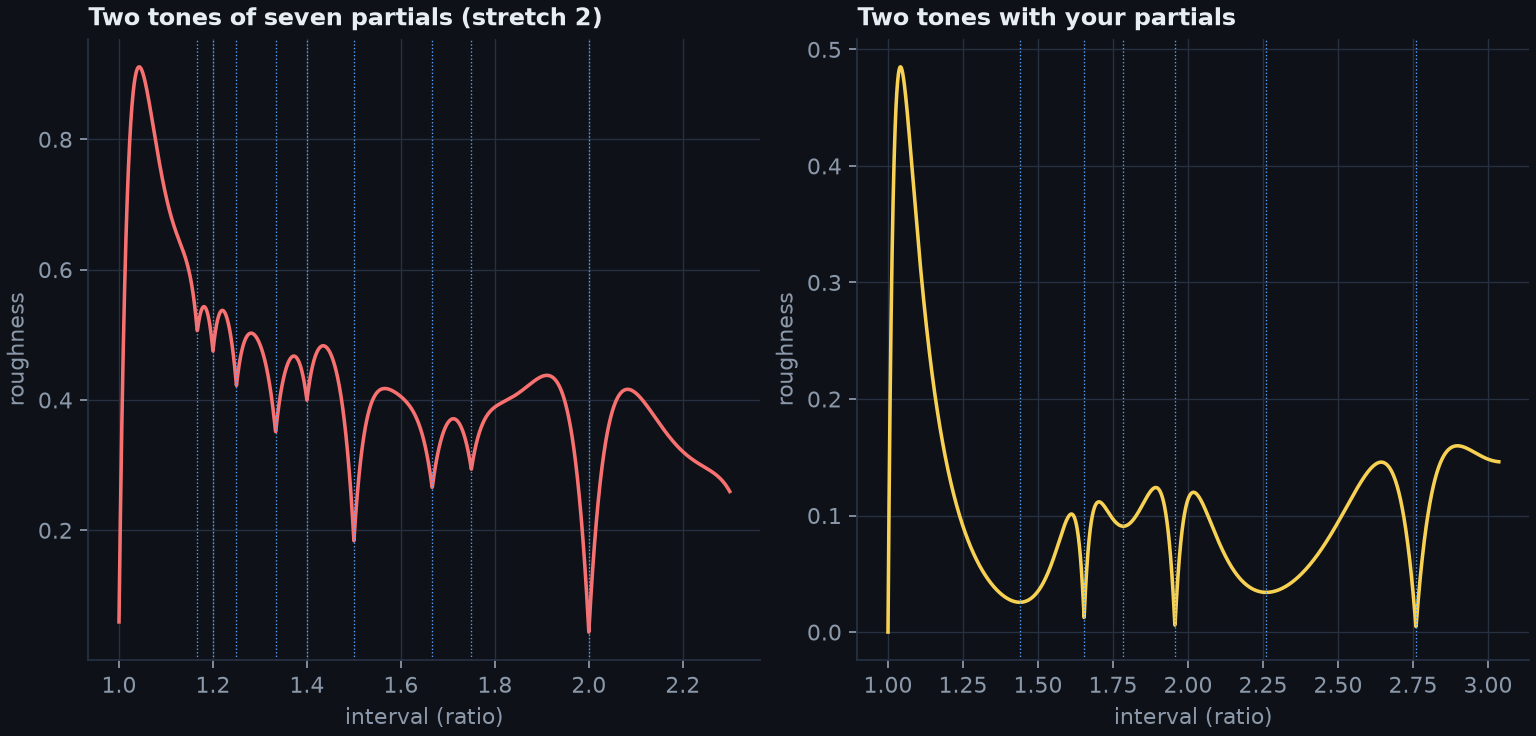
seven partials, stretch 2
valleys of the curve 1.166, 1.200, 1.250, 1.333, 1.400, 1.500, 1.666, 1.750, 2.000
as ratios 7:6, 6:5, 5:4, 4:3, 7:5, 3:2, 5:3, 7:4, 2:1
your partials 1, 2.76, 5.4, 8.93
ratios between its partials 1.654, 1.957, 2.760
valleys where two partials meet 1.654, 1.956, 2.760
valleys where nothing is close 1.439, 1.785, 2.261
ear problem (listen first) the interval is 2.1 : 1; roughness 0.41 in the ordinary tone, 0.02 in the stretched one
Wherever a partial of one tone lands on a partial of the other, the curve has a sharp valley: at the just ratios for a harmonic tone, at other intervals for any other timbre. Broad valleys also lie where no two partials are close.The code (102 lines; it asserts its own result)
"""Lab 5: Euler's numbers, a dissonance curve and its valleys, a timbre of your own, and an interval to judge by ear."""

import math

import numpy as np

from videos.coursekit import labs
from explainer.music.monochord import Clip, concat
from explainer.music.monochord import consonance as K

TITLE = "Consonance, computed: where the valleys are, and how to move them"
GOAL = ("Rank the intervals by Euler's formula, draw the roughness of two tones against their interval, find its "
        "valleys, and do the same for a timbre whose partials are not whole multiples.")
TASKS = [
    "Set PARTIALS to [1, 2, 3] and then to [1, 2, 3, 4, 5, 6, 7, 8, 9, 10]. Which valleys appear as partials are added?",
    "Set STRETCH to 1.9 (compressed octaves). Where is the deepest valley now? Check it against 2 ** log2(1.9) = 1.9.",
    "Set F0 to 65 Hz (two octaves down). Which valleys survive? Why do thirds sound muddy in the bass?",
]
F0 = 261.63                      # the lower note
STRETCH = 2.0                    # 2.0: partials at whole multiples; 2.1: every octave of the series stretched
PARTIALS = [1, 2.76, 5.40, 8.93]  # your own timbre: a uniform bar struck at its middle (Problem 4)
SR = 48_000


def tone(freqs, amps, seconds=1.6):
    t = np.arange(int(seconds * SR)) / SR
    return sum(a * np.sin(2 * np.pi * f * t) for f, a in zip(freqs, amps) if f < 0.45 * SR)


def curve_for(freqs, amps, ratios):
    return np.array([K.roughness(np.concatenate([freqs, r * freqs]), np.concatenate([amps, amps])) for r in ratios])


def run(seed=0):
    rng = np.random.default_rng(seed)
    lab = labs.Lab()

    # 1. Euler's numbers
    order = sorted(K.JUST, key=lambda n: (K.euler_gradus(*K.JUST[n]), K.tenney(*K.JUST[n])))
    lab.row("Euler, sweetest first", ", ".join(f"{n} {K.euler_gradus(*K.JUST[n])}" for n in order[:6]))
    lab.row("Euler, problem 1", f"16:9 scores {K.euler_gradus(16, 9)}, 7:4 scores {K.euler_gradus(7, 4)}")
    assert K.euler_gradus(3, 2) == 4 and K.euler_gradus(5, 4) == 7

    # 2. the curve for a tone with partials at f0 * k^(log2 STRETCH)
    r = np.linspace(1.0, 2.3, 2601)
    f, a = K.harmonic_partials(F0, 7, 0.88, STRETCH)
    c = curve_for(f, a, r)
    valleys = K.minima(r, c, depth=0.01)
    lab.row("seven partials, stretch", f"{STRETCH:g}")
    lab.row("valleys of the curve", ", ".join(f"{v:.3f}" for v in valleys))
    if STRETCH == 2.0 and F0 > 200:
        want = [7 / 6, 6 / 5, 5 / 4, 4 / 3, 7 / 5, 3 / 2, 5 / 3, 7 / 4, 2.0]
        assert len(valleys) == len(want) and all(abs(x - y) < 0.004 for x, y in zip(valleys, want)), "the just ratios"
        lab.row("as ratios", ", ".join("%d:%d" % K.nearest_ratio(v, 9) for v in valleys))
    else:
        assert abs(valleys[-1] - STRETCH) < 0.01 or F0 < 200, "the deepest valley is the stretched octave"

    # 3. your own timbre
    pf = F0 * np.asarray(PARTIALS, dtype=float)
    pa = 0.8 ** np.arange(len(pf))
    r2 = np.linspace(1.0, max(PARTIALS[1] * 1.1, 2.3), 3001)
    c2 = curve_for(pf, pa, r2)
    v2 = K.minima(r2, c2, depth=0.005)
    lab.row("your partials", ", ".join(f"{p:g}" for p in PARTIALS))
    ratios_of_partials = sorted({round(x / y, 3) for x in PARTIALS for y in PARTIALS if 1 < x / y <= r2[-1]})
    sharp = [v for v in v2 if min(abs(v - q) for q in ratios_of_partials) < 0.01]
    broad = [v for v in v2 if v not in sharp]
    lab.row("ratios between its partials", ", ".join(f"{x:.3f}" for x in ratios_of_partials))
    lab.row("valleys where two partials meet", ", ".join(f"{v:.3f}" for v in sharp))
    lab.row("valleys where nothing is close", ", ".join(f"{v:.3f}" for v in broad) or "none")
    assert len(sharp) == len(ratios_of_partials), "every ratio between two partials is a valley"

    # 4. the ear problem (Problem 3): one interval, in an ordinary tone and in a stretched one
    interval = float(rng.choice([2.0, 2.1]))
    plain, bent = K.harmonic_partials(F0, 7, 0.88, 2.0), K.harmonic_partials(F0, 7, 0.88, 2.1)

    def dyad(parts):
        fr, am = parts
        return Clip(tone(fr, am) + tone(interval * fr, am)).fade(0.03, 0.1).at_level(-18.0)

    lab.audio = concat([dyad(plain), dyad(bent)], gap=0.5)
    rough = [K.dyad_roughness(interval, F0, 7, 0.88, s) for s in (2.0, 2.1)]
    lab.row("ear problem (listen first)", f"the interval is {interval:g} : 1; roughness {rough[0]:.2f} in the ordinary tone, {rough[1]:.2f} in the stretched one")
    assert (rough[0] < rough[1]) == (interval == 2.0)

    fig, (ax, bx) = labs.figure(2)
    ax.plot(r, c, color=labs.RED, lw=1.6)
    for v in valleys:
        ax.axvline(v, color=labs.BLUE, lw=0.6, ls=":")
    ax.set_title(f"Two tones of seven partials (stretch {STRETCH:g})")
    ax.set_xlabel("interval (ratio)")
    ax.set_ylabel("roughness")
    bx.plot(r2, c2, color=labs.GOLD, lw=1.6)
    for v in v2:
        bx.axvline(v, color=labs.BLUE, lw=0.6, ls=":")
    bx.set_title("Two tones with your partials")
    bx.set_xlabel("interval (ratio)")
    bx.set_ylabel("roughness")
    lab.fig = fig
    lab.note = ("Wherever a partial of one tone lands on a partial of the other, the curve has a sharp valley: at the just ratios "
                "for a harmonic tone, at other intervals for any other timbre. Broad valleys also lie where no two partials are close.")
    return lab
Now change it
- Set PARTIALS to [1, 2, 3] and then to [1, 2, 3, 4, 5, 6, 7, 8, 9, 10]. Which valleys appear as partials are added?
- Set STRETCH to 1.9 (compressed octaves). Where is the deepest valley now? Check it against 2 ** log2(1.9) = 1.9.
- Set F0 to 65 Hz (two octaves down). Which valleys survive? Why do thirds sound muddy in the bass?
Problems, with solutions
Try each problem before opening its solution.
-
Two sevenths. Compute Euler's number for the minor seventh 16:9 and for the "harmonic seventh" 7:4. Which does his formula prefer? Which sits in a valley of this part's roughness curve?
Solution
lcm(16, 9) = 144 = 2⁴·3², so Γ = 1 + 4·1 + 2·2 = 9. lcm(7, 4) = 28 = 2²·7, so Γ = 1 + 2·1 + 6 = 9. Euler's formula cannot choose between them. The roughness curve can: 7:4 (969 cents) is one of its valleys, because the seventh partial of the lower note meets the fourth of the upper, while 16:9 (996 cents) lies on the slope beside it. The formula charges a prime its full size however it is used; this model rewards coinciding partials. (The lab prints both numbers.)
-
Which partials meet. Two notes have harmonic partials and stand in the ratio p:q in lowest terms. Show that partial m of the upper coincides with partial n of the lower exactly when m is a multiple of q and n the same multiple of p. What fraction of the upper note's partials coincide?
Solution
The upper note's partials are at m·(p/q)·f and the lower's at n·f, so they coincide when mp = nq. Since p and q share no factor, q must divide m: m = kq, and then n = kp. So the coinciding partials of the upper note are numbers q, 2q, 3q …: one in every q. For a fifth (3:2) every second partial of the upper note meets a partial of the lower; for a major third (5:4) every fourth; for 45:32, every thirty-second, which with seven partials means none. Galileo's "repeats every q cycles" and the count of coinciding partials are the same number.
-
Ear. The lab (
python -m videos.music.labs 5) plays one interval twice: once in an ordinary tone, once in a tone whose partials were stretched. Say which version is smoother, and so whether the interval is an octave or a stretched octave.Solution
If the ordinary tone is the smooth one, the interval is 2:1; if the stretched tone is, it is 2.1:1. The lab prints the interval and Monochord's roughness for both versions (0.04 against 0.40, or 0.41 against 0.02) after you have listened.
-
Build. Compute the dissonance curve of a tone with partials at 1, 2.76, 5.40 and 8.93 (the first four free-bar bending-mode ratios), and list its valleys. Build a five-note scale from them and play the Tune on it.
Solution
Solution sketch. The lab does the first half with
PARTIALS = [1, 2.76, 5.40, 8.93]. Sharp valleys lie wherever a partial of one tone meets a partial of the other, at the ratios between the partials: 1.654 (8.93/5.40), 1.957 (5.40/2.76) and 2.76; broad ones lie where no two partials are close (near 1.44, 1.79 and 2.26). A five-note scale could take 1, 1.44, 1.654, 1.957 and 2.26 within a "pseudo-octave" of 2.76, with the Tune's degrees 1, 2, 3, 4, 5, 6 mapped to scale steps in order and its "octave" to 2.76. This is how Sethares derives scales for bars and bells; a marimba maker does the opposite, carving an arch under each bar to pull 2.76 up to 4. -
★ Research. Fit weights for roughness, harmonicity and familiarity to published ratings of the twelve intervals, and predict the rating of every triad. Where is the fit worst, and what would a fourth term have to measure?
Pointers. Ratings for dyads and triads are tabulated in Bowling et al. (2018) and reanalysed by Harrison and Pearce (2020), whose R package
inconimplements sixteen models. Monochord supplies the first two terms; for familiarity, count chord types in a corpus of chorales (Part 18 builds one). The augmented triad is the known failure of roughness and harmonicity together (Johnson-Laird et al., 2012, propose tonal context; Cook and Fujisawa, 2006, propose a "tension" term for equal stacked intervals). An open question is whether such a term is acoustic or learned: the experiments of Marjieh et al. (2024) with altered timbres are one way to test it.
Notes and sources
Sources
Books: H. von Helmholtz, On the Sensations of Tone (1863; tr. Ellis), part II; W. A. Sethares, Tuning, Timbre, Spectrum, Scale (2nd ed., 2005); J. Tenney, A History of 'Consonance' and 'Dissonance' (1988); D. Deutsch (ed.), The Psychology of Music (3rd ed., 2013), ch. 4 (W. F. Thompson, "Intervals and scales"); C. Stumpf, Tonpsychologie, vol. 2 (1890); J.-P. Rameau, Traité de l'harmonie (1722); G. Zarlino, Le istitutioni harmoniche (1558); Galileo Galilei, Discorsi e dimostrazioni matematiche intorno a due nuove scienze (1638; tr. Crew and de Salvio), First Day, for the pulses and the "perpetual torment" of the eardrum.
Papers: L. Euler, Tentamen novae theoriae musicae (1739); J. Sauveur, Mémoires de l'Académie royale des sciences (1701), for beats as a measure of frequency; R. Plomp and W. J. M. Levelt, "Tonal consonance and critical bandwidth", JASA 38 (1965); W. A. Sethares, "Local consonance and the relationship between timbre and scale", JASA 94 (1993); J. H. McDermott, A. J. Lehr and A. J. Oxenham, "Individual differences reveal the basis of consonance", Current Biology 20 (2010); P. N. Johnson-Laird, O. E. Kang and Y. C. Leong, "On musical dissonance", Music Perception 30 (2012); N. D. Cook and T. X. Fujisawa, "The psychophysics of harmony perception", Empirical Musicology Review 1 (2006); J. H. McDermott, A. F. Schultz, E. A. Undurraga and R. A. Godoy, "Indifference to dissonance in native Amazonians reveals cultural variation in music perception", Nature 535 (2016); D. L. Bowling, D. Purves and K. Z. Gill, "Vocal similarity predicts the relative attraction of musical chords", PNAS 115 (2018); P. M. C. Harrison and M. T. Pearce, "Simultaneous consonance in music perception and composition", Psychological Review 127 (2020); R. Marjieh, P. M. C. Harrison, H. Lee, F. Deligiannaki and N. Jacoby, "Timbral effects on consonance disentangle psychoacoustic mechanisms and suggest perceptual origins for musical scales", Nature Communications 15 (2024); L. J. Trainor and B. M. Heinmiller, "The development of evaluative responses to music: infants prefer to listen to consonance over dissonance", Infant Behavior and Development 21 (1998); J. Plantinga and S. E. Trehub, "Revisiting the innate preference for consonance", Journal of Experimental Psychology: Human Perception and Performance 40 (2014).
- J. G. Roederer, The Physics and Psychophysics of Music (4th ed., 2008): the standard bridge from acoustics to perception for music students.
About this partfrom its README
Part 5 of a sixty-eight-part course in music (see the series plan and
the syllabus). With a string (Part 1), a spectrum (Part 3) and an ear (Part 4), the oldest question
in the science of music can be computed: why do some notes belong together? Six answers have been given in 2,500
years. This part runs each of them as a calculation (explainer/music/monochord/consonance.py), plays the sound on
which each one fails, and ends with three layers: the membrane, the nerve, and the listener. Every sound is computed
in compute.py. Dates and attributions are the published ones, listed under Sources.
- An octave that sounds wrong. Two notes exactly an octave apart that grind, and two 84 cents too far apart that are smooth; six answers in 2,500 years (Pythagoras, Galileo, Rameau, Euler, Helmholtz, Stumpf); the plan.
- 1. Number. The monochord's ratios and the tetractys; Zarlino's six; Euler's gradus suavitatis (1739), a worked example (3:2 scores 4; 5:4 scores 7); his number for thirteen intervals against what musicians call them; an ear question: a fifth of 3:2 and one five cents wide, approximated by 173:115 when the denominator is limited to 400 and whose Euler number is 199. A small change in a sound cannot be a huge change in its sweetness.
- 2. Pulses that coincide. Galileo (1638); two trains of clicks, three against two, a hundred times faster by the end: a rhythm becomes a fifth; the length of the repeating pattern as a measure; the same flaw; and why to keep the idea (Part 4: the nerve fires in time with the wave).
- 3. Beats. Two close tones have a rapid carrier and an envelope that swells at the difference of their frequencies; their spectrum still has two lines (the sum-to-product identity); 1, 4 and 12 beats a second; a worked example (220 and 222 Hz: two beats a second), and one tone lowered onto another until the beats stop; from flutter to roughness; Helmholtz's theory.
- 4. Roughness, measured. Plomp and Levelt (1965): roughest a quarter of a critical band apart, smooth beyond one band; an ear question: two pure tones, one climbing an octave (roughest in the first second, and little modeled roughness at the tritone, fifth or octave for these pitches); a pure fifth and a pure tritone, both smooth.
- 5. A curve with no ratios in it. Seven partials each, ninety-one pairs; a worked example (in a fifth, partials 3 and 2, and 6 and 4, coincide; in a tritone they miss by 49 and 57 Hz); the dissonance curve, whose valleys are 6:5, 5:4, 4:3, 3:2, 5:3 and 2:1 (and 7:6, 7:5, 7:4) to within a cent; the curve heard as one note climbs through an octave.
- 6. Bend the timbre. Sethares (1993): partials stretched so that each doubling is 2.1; every valley moves to its old ratio raised to log₂2.1 (to four decimal places); an ear question: an octave and a wide octave in the ordinary tone and in the bent one; pianos, bells, the gamelan, synthesizers.
- 7. One note or two? Stumpf's fusion (1890); an ear question: three high pure tones at 4:5:6 and the low note they imply (Part 4's pitch model: 261.6 Hz, middle C); Rameau's fundamental bass (1722); the model's single pitch for an octave, fifth, fourth and third, weaker as the common period grows: Galileo's pulses, counted by the nerve; for headphones, a minor second in both ears and then one tone to each; McDermott, Lehr and Oxenham (2010).
- 8. Major and minor. An ear question: two chords of the same three intervals; roughness 0.97 and 0.99; as whole numbers 4:5:6 and 10:12:15, with common-series fundamentals two and 3.3 octaves down (not necessarily musical roots); the diminished and augmented triads, and the warning that listeners rank those two the other way round; a sampled map of three-note chords, whose valleys are the major and minor triads, their inversions, and two stacked fourths.
- 9. What is learned. A history of what counted as consonant; the major third of the early theorists (81:64) beside the pure one (5:4); the Tsimane' (McDermott et al., 2016); three layers.
- 10. Frontier: one model for all of it. Harrison and Pearce (2020): roughness, harmonicity and familiarity together; Marjieh et al. (2024): 235,440 judgments online, preferences that move with the partials; what is not known (major and minor as bright and dark, the augmented chord, infants, chords in motion). ★ research problem.
- Variation 5, recap and problems. The Tune in a bent tone on a stretched scale, alone, then in parallel "fifths" of 751 cents, then the same notes with ordinary partials (3.7 times as rough), then bent again; the ledger; what we found; five problems; where it comes back; in practice; references; twelve pure fifths against seven octaves, and Part 6.
What is computed and built
python -m videos.music.music5.compute (a few seconds) fills .cache/music5/.
| Item | What it computes | Checked against |
|---|---|---|
bent |
an exact octave and one of 2.1:1 in a tone with stretched partials | roughness 0.40 against 0.02 |
number |
Euler's gradus, Galileo's coincidences and Tenney's height for thirteen just intervals; a fifth 5 cents wide | Euler's own table (2, 4, 5, 7, 8 … 14) |
pulses |
two click trains, 3 and 2 a second, accelerated a hundredfold | they end at 300 and 200 Hz |
beats |
pairs of pure tones 1, 4 and 12 Hz apart; a tone lowered onto another | the envelope 2|cos π(f₁−f₂)t| bounds the sum |
plomp |
Plomp and Levelt's curve; two pure tones gliding apart; a pure fifth and tritone | the peak at a quarter of a band; under 2% of it at both |
curve |
the dissonance curve of a tone of seven partials; its minima; one note climbing an octave | Sethares's minima: 7:6, 6:5, 5:4, 4:3, 7:5, 3:2, 5:3, 7:4, 2:1 |
worked |
every pair of partials of a fifth and of a tritone that share a band | 3 = 2 × 1.5 and 6 = 4 × 1.5 coincide |
stretched |
the same curve with partials at k^(log₂2.1) | each minimum at its old ratio ^ log₂2.1 (0.0003) |
fusion |
Part 4's pitch model on dyads and on 4:5:6 in pure tones; a minor second, diotic and dichotic | the common-series fundamental, within 5 cents |
triads |
roughness and common-series fundamental of four triads; roughness of every three-note chord on a grid | major and minor within 1.5% of each other |
culture |
a major third of 81:64 against 5:4 | 21.5 cents; 16 beats a second on middle C |
tune |
Variation 5 and the roughness of its dyads in both timbres | 3.7 times |
nextpart |
middle C and the C twelve pure fifths on | the Pythagorean comma, 23.46 cents |
Monochord's consonance layer is held against Euler's table, Sethares's minima and the fundamental bass in
tests/music/test_consonance.py; this part's claims and clips in tests/music/test_music5.py.
Sounds. Fifteen clips, all synthesized and labelled on screen: sums of sines with seven partials in the
proportions 1, 0.88, 0.88² …, either at whole multiples of the fundamental or stretched; pairs of pure tones; two
trains of clicks. One clip (the minor second, one tone to each ear) needs headphones and says so. There are no
recordings.
What the models are, and are not. Roughness is Plomp and Levelt's curve in Sethares's parameterisation, summed over pairs of partials with the weaker amplitude of each pair; it ignores masking and level. With it, the diminished triad is rougher than the augmented, which is not how listeners rank them, and the film says so. Harmonicity is measured by Part 4's summary autocorrelation with a taper towards the longest period that is still heard as a pitch (30 Hz); it is a fair account of dyads wider than a critical band and says nothing sensible about seconds, where the two notes share a band. Stumpf's bar chart shows the order he reported, with schematic heights. The Tsimane' results are described in words, from the paper's abstract and figures; no data from it are plotted.
Companion material in this repository
The syllabus's plan for this partfrom SYLLABUS.md, the plan of record
- Hook: an exact octave that grinds and a wide one that is smooth; six answers; the plan.
- Number: the monochord's ratios; Euler's gradus (a worked example) for thirteen intervals; a fifth five cents wide (an ear question).
- Pulses that coincide: Galileo; three against two, sped up into a fifth; the same flaw, and why to keep the idea.
- Beats: the sum of two close tones; 1, 4 and 12 a second; tuning by beats (a worked example); roughness.
- Roughness, measured: Plomp and Levelt's curve and the critical band; two pure tones gliding apart (an ear question); a pure fifth and a pure tritone.
- A curve with no ratios in it: the partials of two notes; a fifth and a tritone (a worked example); the dissonance curve and its valleys; the curve heard.
- Bend the timbre: stretched partials move every valley; four sounds (an ear question); pianos, bells, gamelan.
- One note or two: fusion; the note inside 4:5:6 (an ear question); the fundamental bass; harmonicity from Part 4's pitch model; one tone to each ear.
- Major and minor: the same intervals (an ear question); 4:5:6 and 10:12:15; four triads; a map of all triads.
- What is learned: a history of the third; the Tsimane'; three layers.
- Frontier: a composite model; a quarter of a million judgments online; what is not known.
- Variation 5: the Tune in a bent timbre. Outro: problems, payoffs, and twelve fifths that do not close.
Covers: ratio theories (Pythagoras, Zarlino, Euler, Tenney); Galileo's coincidence theory; beats and roughness;
the critical band and the Plomp–Levelt curve; dissonance curves for harmonic and inharmonic timbres; harmonicity,
fusion and the fundamental bass; why major and minor triads differ though their intervals match; familiarity and
culture.
Built and computed: Monochord's consonance layer (monochord/consonance.py): Euler's gradus, beats, the
Plomp–Levelt curve in Sethares's form, dissonance curves whose minima fall on the just ratios, a timbre with
stretched partials for which a 2.1:1 "octave" is the smooth one, harmonicity from Part 4's pitch model, a
roughness map of all triads.
Variation 5: the Tune in a bent timbre, in parallel intervals that are consonant only for that timbre.
Frontier: composite models (Harrison & Pearce 2020); large online experiments on timbre and consonance (Marjieh
et al. 2024); what remains unexplained.
Reading: Helmholtz, On the Sensations of Tone; Sethares, Tuning, Timbre, Spectrum, Scale; McDermott et al.
(2016).
Build the film
python -m videos.music.music5.compute        # the part's numbers, into .cache/music5
python tools/build.py music5                  # render and assemble the film
EXPLAINER_TTS=silent python tools/qa_scene.py music5 Hook   # one chapter, silent, with a contact sheet
Scenes: videos/music/music5. Setup: see the course page. Source of these notes: the README and the scenes' narration.
Build it
python -m videos.music.music5.compute                          # numbers and sounds (a few seconds)
EXPLAINER_TTS=silent python tools/build.py music5 -q l --fps 15   # a silent-narration preview, with the sounds
python tools/qa_sound.py music5 --sync                         # the sound gates
python tools/dead_air.py renders/music5_480p.mp4 --sound music5   # no empty screen; no sound over a still one
python tools/lecture_length.py music5                          # 30 to 60 minutes, listening included
python tools/build.py music5                                   # 1080p30, narrated
python -m pytest -q tests/music                                # Monochord against its references; this part's claims and clips
python -m videos.music.labs 5                                  # the lab (writes a figure and a short WAV)