Timelines
Why is one bell pattern heard from Ghana to Cuba to Brazil, and how can an ensemble play a melody that none of its players plays?
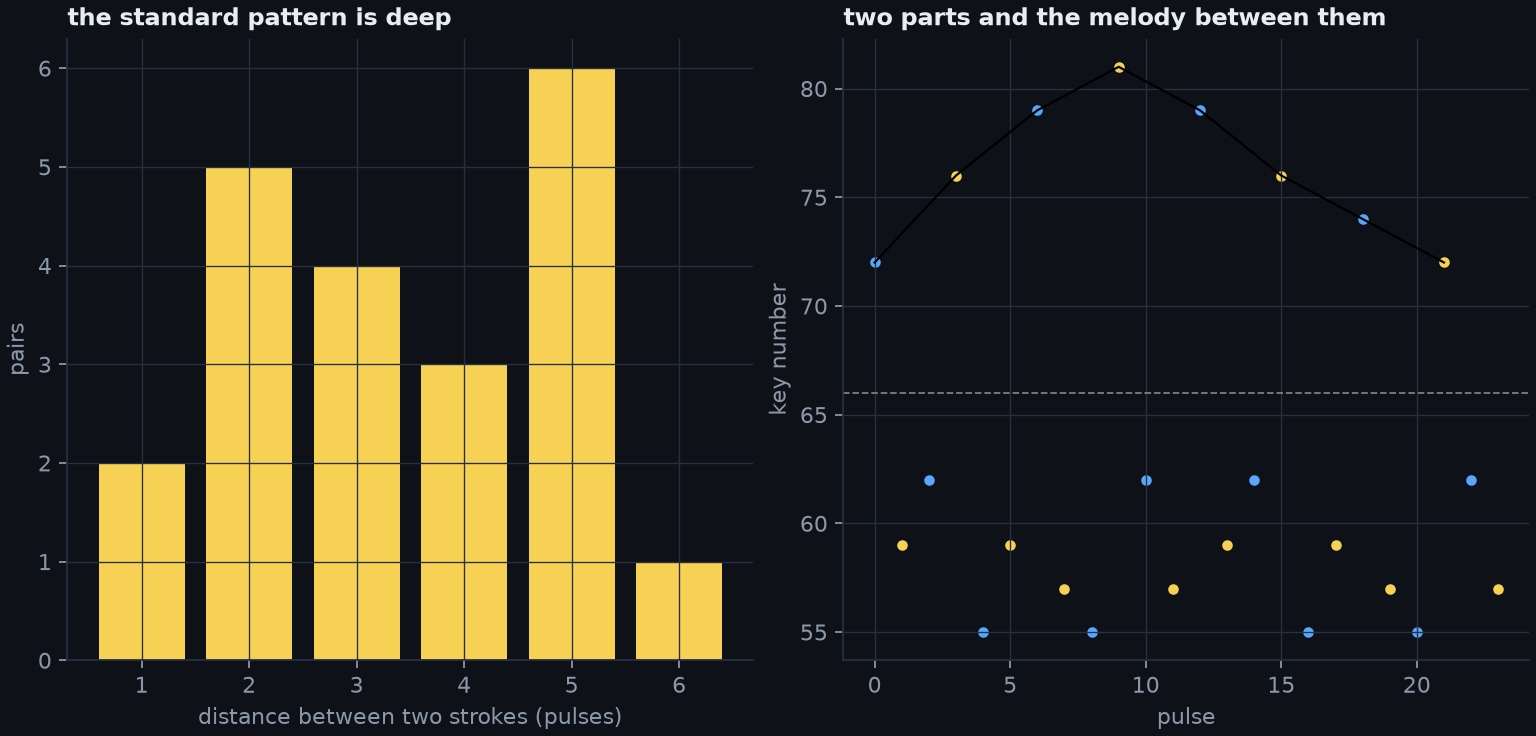
The standard pattern, seven strokes in twelve pulses, has the steps of the major scale, 2 2 1 2 2 2 1, and its rotations are the seven modes; both are maximally even and both are deep, every distance between strokes occurring a different number of times (2 5 4 3 6 1). Timelines can be measured: evenness, Euclidean or not, Arom's oddity, Toussaint's off-beatness (the standard pattern strikes three of the four off-beat pulses), and centrality, by which son clave is the nearest of six five-stroke claves to the others. An ensemble of ours in the manner of the Ewe defines every part against the bell, and twelve pulses carry four beats and six at once; scholars from Jones to Agawu have argued over how to write that down. Hocket shares a melody among players by pitch, on panpipes and single-pitch pipes. The mbira's tines are clamped bars whose second partial lies 6.27 times the first, so their notes are nearly pure; two interlocking parts make inherent patterns that a simple streaming model predicts, and that vanish when the parts are slowed. The tresillo, the clave and the anticipated bass of son, samba's batucada and call and response carry these ideas through the Americas, and measurements of Malian drumming show that a beat need not be divided equally. The Tune is played as an inherent pattern of two mbira parts, neither of which plays it.
What you need. Part 9 for bars and membranes; Part 11 for meter; Part 12 for modes; Part 16 for streams; Part 33 for Euclidean rhythms and evenness; Part 36 for interlocking parts. Bjorklund's algorithm, swap distances, auditory streaming.
- Ideas, mathematics and history
- the standard pattern and the diatonic scale, Ewe ensembles, 3:2, the mbira's inherent patterns, interlocking, clave, samba
- What we build, compute and hear
- timeline geometry measured; the Tune emerging from parts nobody plays
What you will be able to do
Foundations
- Hear the standard pattern against four beats and against six, and explain its likeness to the major scale.
- Hear an ensemble built part by part against a timeline, and hocket on pipes.
- Hear an inherent pattern appear at speed and disappear when slowed.
Full course
- Compute evenness, oddity, off-beatness and interval content for any timeline.
- Compute swap distances and find the most central of a family of rhythms.
- Design two interlocking parts whose combined high stream is a given melody.
Research
- Design a study of how rhythm categories, including uneven subdivisions, are learned.
Practice
- Write interlocking parts for an ensemble, so that beginners make one melody together.
Contents
Each chapter has a home level. Choose a track to see what to read and watch: Foundations 34 min · Full course 38 min · Research 42 min · Practice 38 min.
- 0Seven strokes in twelve pulsesFoundations3 min
- 1The standard patternFoundations4 min
- 2Measuring timelinesFoundations4 min
- 3An Ewe ensembleFoundations4 min
- 4Three against twoFoundations4 min
- 5Interlocking and hocketFoundations3 min
- 6The mbiraFoundations4 min
- 7Inherent patternsPractice4 min
- 8The claveFoundations3 min
- 9Samba, and call and responseFoundations3 min
- 10Frontier: timing measuredResearch4 min
- Variation 37, recap and problemsAll tracks3 min
Also on this page: Lecture · Key results · Try it · Lab · Problems · Notes and sources · Build the film.
Lecture
The text of each chapter is the film's narration, as it is spoken, so you can read along or revise without the film. The pictures are in the film. A dashed box stands for a number the film computes when it is rendered (hover over it to see what is computed); the README's figures for each chapter, where it lists them, follow the chapter's text.
Seven strokes in twelve pulsesFoundations3 min
One bell pattern is heard from Ghana and Togo to Cuba and Brazil. Here it is. An iron bell plays one short pattern, over and over. Clap or tap along with it, however feels natural. How many beats do you feel in each turn of the pattern?
There is no single right answer, and that is the point. Many listeners feel four beats in each turn, three pulses to a beat. Here is the bell with a drum on those four.
Others feel six beats, two pulses to a beat. Here is the same bell with a clap on those six. Listen to how the bell's strokes seem to change their meaning, though not one of them has moved.
In four, the bell seems to pull against the beat; in six, it seems to sit on it for a while and then slip away. In the music this pattern comes from, dancers' feet usually mark the four, while other parts of the ensemble stress the six, and the pattern lives in the tension between them.
This pattern of seven strokes in twelve pulses is one of the most widespread rhythms in the world. It is heard in the music of the Ewe of Ghana and Togo, of the Yoruba of Nigeria, and far beyond. It crossed the Atlantic with enslaved Africans, and is heard in Cuban bembé and in Brazilian candomblé. Musicologists call it the standard pattern; the Ghanaian scholar Kwabena Nketia called such patterns time lines. Written as steps between strokes, it reads two, two, one, two, two, two, one. Those are the steps of the major scale. A scale turned into time, which chapter one explains.
Here is the plan. The standard pattern, and why it is the major scale in time. How to measure a timeline: its evenness, its oddity, its off-beatness, and how central it sits among its relatives. An ensemble in the manner of the Ewe, and the idea of three against two. Hocket, one melody shared among many players. The mbira, and melodies that nobody plays but everybody hears. And the clave, samba, and call and response. Every part played is ours; the timelines are the well-known ones, as they are usually written down.
1The standard patternFoundations4 min
Why do a bell's strokes match the major scale?
Write the bell pattern as a row of twelve pulses, with a filled box wherever the bell strikes. Count the pulses from each stroke to the next: two, two, one, two, two, two, and one back round to the start. Now take a piano octave, twelve semitones, and mark the major scale, C D E F G A B. Count the semitones from each note to the next: two, two, one, two, two, two, one. The same seven numbers in the same order. A cycle of twelve pulses and a cycle of twelve semitones, each divided into seven steps of one and two, the ones as far apart as they can be.
Hear the correspondence. First the bell, twice round. Then the major scale on a marimba, one note on each of the bell's strokes, so the scale's steps of pitch become steps of time. Then both together.
Start the pattern on a different stroke and the steps rotate. Starting on the second stroke gives two, one, two, two, two, one, two: the steps of the Dorian mode, D to D on the white keys. On the third, Phrygian; the fourth, Lydian; and so on through all seven modes of Part 12. Each rotation of the timeline is a rotation of the scale. Several of these rotations are played as bell patterns in their own right, and musicians who share one pattern may still disagree about which stroke is the start.
Two rotations, heard. The pattern started on its second stroke, with the Dorian mode on D played on its strokes, and then started on its sixth stroke, with the Aeolian mode on A, the natural minor.
Why should a scale and a bell pattern agree? Because both solve the same problem: spread seven points as evenly as twelve places allow, which Part 33 called maximal evenness. Bjorklund's algorithm, run with seven and twelve, gives a rotation of this very pattern. Jeff Pressing in 1983, and Jay Rahn in 1996, traced such likenesses between pitch and time across many musics. Evenness is shared by many of the world's favourite scales and timelines. Chapter two measures it, and its rivals.
Here is a subtler likeness. Take every pair of the bell's seven strokes, twenty-one pairs, and measure the distance between them around the cycle, from one to six pulses. Distance one occurs twice, two five times, three four times, four three times, five six times, and six once. Every distance occurs a different number of times. The major scale's intervals, counted the same way in semitones, have exactly the same counts: it has six fifths and only one tritone. A set with this property is called deep, after Terry Winograd's 1966 study of such scales. Each distance has a different count, an exact combinatorial property. These rotation-invariant counts do not by themselves locate the downbeat or demonstrate how listeners orient in the cycle.
A caution before we go further. A likeness of structure is not a likeness of meaning. Ewe musicians learn the bell by its syllables and by the dance, not as a scale. The Ghanaian theorist Kofi Agawu has warned against hearing African rhythm only through European theory, and against treating it as exotic. The mathematics says what this pattern shares with others, not what it is for. Chapter three puts the bell back in its ensemble.
2Measuring timelinesFoundations4 min
Can a rhythm's quality be measured?
How might one measure a timeline? Here are five measures from the mathematical study of rhythm. Evenness: how far the strokes lie from perfectly even spacing, zero meaning perfectly even. Whether the rhythm is Euclidean: whether Bjorklund's algorithm from Part 33 produces it, up to rotation. Oddity, a property the ethnomusicologist Simha Arom found in particular Central African repertoires: no two strokes cut the cycle into two equal halves. Off-beatness, from the computer scientist Godfried Toussaint, counting strokes that fall on pulses no regular polygon through the starting pulse can reach. And centrality: how close a rhythm lies, on average, to its relatives.
Here are ten well-known timelines, measured by Monochord. The standard pattern and the soli pattern from Guinea in twelve pulses; six five-stroke patterns in sixteen: son clave and rumba clave from Cuba, the bossa nova from Brazil, gahu from Ghana, soukous from Congo, and shiko from Nigeria; and the tresillo and cinquillo in eight. Bossa nova is the most even of the sixteen-pulse patterns and is Euclidean; soukous is the least even. Son clave, rumba clave and bossa nova have the oddity property; the standard pattern does not, since its strokes on the sixth and twelfth pulses face each other across the cycle. And the standard pattern has the most off-beat strokes, three, as Toussaint observed.
Off-beatness deserves a picture. Place twelve pulses on a circle and draw the proper regular beat polygons through the first pulse, excluding the full twelve-sided pulse grid: the diameter, the triangle, the square, the hexagon. Those are the grids of two, three, four and six beats a cycle. They reach every pulse except four: the second, sixth, eighth and twelfth, which lie one, five, seven and eleven pulses after the start, numbers that share no factor with twelve. A stroke on one of those pulses belongs to none of the beat grids. The standard pattern strikes three of the four, which is part of why it feels as though it is always leaning against the beat, whichever beat you choose.
Four of the sixteen-pulse patterns, heard on claves over a soft beat, two cycles each: son clave, rumba clave, which delays its third stroke by one pulse, bossa nova, which delays its last, and gahu, which pushes its last stroke later still. Listen to how much one moved stroke changes the feel.
Now centrality. Toussaint asked why son clave, of all the five-stroke patterns, spread around the world. He measured the distance between two rhythms by the swap distance: the fewest swaps of a stroke with a neighbouring empty pulse that turn one into the other. Son and rumba clave are one swap apart. Add up each pattern's distances to the other five. Son clave's total is six, the smallest; bossa nova's is eight; the rest are ten or twelve. Son clave sits at the centre of these six selected patterns under this particular distance, the pattern from which the others are fewest steps away. Toussaint called it the rhythm that conquered the world, and his suggestion is that centrality may be useful for variation; this selected comparison does not prove why a rhythm spread or what listeners prefer.
What can such measures not say? No single measure predicts which rhythms people choose. And the measures were designed by looking at rhythms already loved, which risks circular reasoning. History, dance, language and the instruments themselves shape timelines at least as much as geometry does. What the measures do well is give exact, testable descriptions that can be compared across musics. Chapter ten asks how rhythm is actually played and heard.
3An Ewe ensembleFoundations4 min
How do six parts fit around one bell?
The standard pattern is the backbone of much Ewe music. The Ewe live in southeastern Ghana, southern Togo and Benin, and speak a tonal language, which matters for drums. Their dance-drumming is music, dance and song as a single event, at funerals, festivals and gatherings. Agbadza, once a war dance, is among the most widely played today; gahu came west from Nigeria and Benin in the twentieth century. An ensemble has a bell, a rattle, supporting drums, a lead drum, singers and dancers. What follows are parts of our own in that manner, not a transcription of any one piece.
Here are the six parts, each drawn on the twelve-pulse cycle. The iron double bell, gankogui, plays the timeline, the reference for everyone. The axatse, a gourd rattle in a net of beads, strikes down on the thigh on the four beats and up against the hand with the bell. Kagan, the smallest drum, plays muted pairs between the beats. Kidi mixes open tones and muted presses, and sogo, a bigger drum, answers it. Over them the lead drum, atsimevu, the tallest, plays phrases that change, call to the other drums, and cue the dancers. Its row is left empty here, because its phrase is different each time round; it will light as it plays.
Now hear them enter one by one: the bell for two cycles, then the rattle, kagan, kidi and sogo, and finally the lead drum for four cycles. Watch each row light where its part strikes, and try to keep hold of the bell as the texture thickens.
How do the players stay together? Parts are commonly learned through their relation to the bell, dance and other parts; explicit counting and teaching methods also vary. The parts are short and repeat; the music lies in how they interlock. A part played alone can sound like a different rhythm altogether: its meaning is its relation to the others. The bell is the one fixed point; teachers stress that to lose the bell is to lose your place. Part 11's meter, here distributed across a whole ensemble.
The lead drum is different. It plays phrases that change, and the supporting drums respond. Because Ewe is a tonal language, drum strokes of high and low pitch can follow the tones of speech, and phrases are often learned with words. The lead drummer signals changes of section and cues the dancers. It is improvisation within a repertoire of known phrases, much like the tabla player of Part 34. Call and response returns in chapter nine.
How is this learned? By ear and by syllables: each part has a spoken mnemonic. Ewe master drummers have taught at universities in Ghana, the United States and Europe since the nineteen-sixties, and David Locke's studies of gahu and agbadza write the parts down against the bell. But transcription is itself an argument, as chapter four shows. The lab lets you mute and solo each of our parts.
4Three against twoFoundations4 min
How many beats are there, and who decides?
Twelve is a generous number: it is two sixes, three fours, four threes and six twos. So a twelve-pulse cycle can carry four beats of three pulses, six beats of two, or three beats of four, all at once. The bell agrees with each only partly: it strikes on two of the four beats, three of the six, and two of the three. Against the four it pulls; against the six it sits for half a cycle and then lets go. Four against six is three against two at twice the speed, and three against two is the generating idea of much of this music: two grids heard at once, neither one the whole truth.
Hear it. Four beats on a low drum, then six on a high drum, then both together, which is three against two, and finally both with the bell, which belongs to neither and to both.
European music knows this effect as hemiola, from the Greek for one and a half: two bars of three heard as three of two. Baroque cadences slow into a hemiola, as Part 25 showed, and Brahms built whole passages on it. There it is a moment of friction. Here it is the ground the music stands on. A dancer's feet often take the four, while the hands, the shoulders or the song take the six. The body holds both grids at once.
How should this be written down? The question has divided scholars for seventy years. A. M. Jones, in his Studies in African Music of 1959, wrote each part with its own bar lines, as though several meters ran at once: polymeter. Kwabena Nketia described the time line as the guide for the whole ensemble. Gerhard Kubik and Simha Arom wrote a fast pulse and a cycle, without measures or an imposed downbeat. Kofi Agawu, in 2006, argued for one shared meter given by the dance, with the bell heard against it, close to David Locke's view that every player feels the four main beats.
Here is the difference in a picture, with three of our parts over two cycles. In the manner of Jones, each part is barred where its own figure begins, and the bar lines do not line up: three meters, it seems. In the manner of Agawu, one bar line serves everyone, placed by the dance, and each part is heard as off or on its beats. The notes are identical; what differs is the claim about what the players feel. Agawu's point is that this is an empirical question, about people, not about notation.
Even where the cycle starts is debated. Which of the bell's strokes is one? Ewe teachers, Cuban players and scholars do not all agree. Studies with motion capture, of dancers' steps and players' bodies, now test such claims directly. The answer may differ by piece, by region and by person: there need be no single meter. Chapter ten returns to measuring how this music is felt.
5Interlocking and hocketFoundations3 min
Can one melody belong to several players?
The Ewe parts interlock in time. A stronger kind of interlocking shares out a melody itself. This is hocket, from the Latin for a hiccup: a melody split so that each player sounds only some of its notes. In thirteenth- and fourteenth-century Europe, two voices traded notes and rests, as Part 23 heard. In the Andes, the siku panpipe is split into two rows held by two people. In Central Africa there are ensembles of horns that each sound one or two pitches. And in Bali there is kotekan, from Part 36; in a handbell choir, one bell per player.
A siku is a panpipe in two halves. One row, called ira, has every other note of the scale, here C, E, G and B; the other, arka, has the notes between, D, F, A and C. Each row is held by a different player, so no melody that moves by step can be played by one person. Here is the Tune's opening on two model panpipes: the ira player alone, the arka player alone, and then both.
Alone, each part is a stutter of notes and silences. Together, they are one melody, and the shared melody may fuse perceptually, depending on timbre, timing and attention. Andean siku bands are large, and every pair of players shares its melodies this way.
Push the idea further: five pipes, each with one pitch only. Each player has a short rhythm of their own on a single note, and the melody exists only between them. The pipes enter one at a time: first A, alone for two cycles, then G, E, D and C, and then all five for three more cycles.
How can anyone write such music down? The Banda-Linda of the Central African Republic play in ensembles of up to eighteen horns, each sounding one or two pitches, so that the polyphony exists only in the whole. Simha Arom's solution, from the nineteen-seventies, was to record each player separately while they heard the others on headphones, so that every part could be written down exactly and the whole rebuilt from its parts. The results are in his African Polyphony and Polyrhythm.
Why make music this way? For breath: a pipe player can rest between notes. For speed: two players together can play faster than either alone. For sound: similar pipes close in pitch fuse into one line in the ear, as Part 16 explained. And for society: the complete line depends on coordinated contributions; that says nothing by itself about authorship or social ownership, which exists only if everyone plays. The next chapters hear an instrument on which one player's two hands do this, and the ear does the rest.
6The mbiraFoundations4 min
How does a box of metal keys make so many voices?
The Shona of Zimbabwe play an instrument called the mbira dzavadzimba, the mbira of the ancestors. It has twenty-two to twenty-eight metal keys on a wooden board, often played inside a large gourd that acts as a resonator. Bottle caps or shells fixed to the board buzz with every note. It belongs to a large family of African lamellophones, with names such as likembe, sanza and kalimba. And its physics is Part 9's bar, held at one end.
A key held at one end vibrates like a diving board. An ideal uniform cantilever beam, the simplified model used here, has its first three mode frequencies in the ratio one, six point two seven, and seventeen point five five, from the same beam equation as Part 9's free bar, with one end clamped. So the second partial lies more than two and a half octaves above the first, far from where a string's harmonics would be, and it dies quickly. Our decaying model leaves a nearly sinusoidal tail; real shaped tines and resonators have instrument-specific partials, so this is not a universal account of mbira blending. The buzzers add the opposite: a wash of noise that follows each note. Hear one tine, plain and then with its buzz.
How is it played? With two thumbs and the right index finger. The left thumb takes the lowest keys, and the right hand plays above, the thumb striking down and the finger plucking up. Each hand plays its own repeating pattern, and the patterns interlock. A piece is a cycle, often forty-eight pulses long in four phrases, repeated with variations for a long time. So a single player already makes counterpoint; add a second player and it multiplies.
Two mbira players divide a piece into a leading part, kushaura, and an interweaving part, kutsinhira. Ours are short: a cycle of twenty-four pulses, with low and high notes alternating. The second part plays a pulse later than the first, a step lower in its upper notes, and fills every gap the first one leaves. Hear the leading part alone, the interweaving part alone, and both.
Together the parts fill every pulse, at twice the speed of either. And something else happens: listen to the highest notes, which now come from both players at once and seem to form lines of their own. That is the subject of the next chapter.
The mbira's home is the bira, an all-night ceremony in which the music calls the ancestral spirits. The music is repetitive by design: its variations deepen over hours, not minutes. Pieces such as Nyamaropa and Nhemamusasa are shared by players across generations, and singing, clapping and gourd shakers called hosho join the mbira. Paul Berliner's The Soul of Mbira, from 1978, records the music as Shona master players taught it to him.
The mbira has travelled. In the nineteen-fifties Hugh Tracey commercialized a factory-built lamellophone under the name kalimba, drawing on existing regional instrument names and designs. From the nineteen-seventies Thomas Mapfumo's chimurenga music moved mbira patterns onto the electric guitar. The mbira had been discouraged by missionaries and colonial rule, and its revival became a sign of independence. Shona teachers have taught it in the United States and Europe since the nineteen-seventies. Part 40 follows such patterns into the popular song, as riffs and loops.
7Inherent patternsPractice4 min
Can you hear a melody that nobody plays?
In 1959 the young Austrian scholar Gerhard Kubik began studying the amadinda, a large xylophone of the Buganda kingdom in Uganda. Two players interlock at great speed, each doubling their notes in octaves, and neither alone plays the composite inherent pattern. Yet listeners, and the players too, hear melodies that are in nobody's part. Kubik called them inherent patterns, and in amadinda music a third player picks one out and doubles it. The same happens between the mbira's hands, and between its players.
A question for your ears. You will hear two interlocking parts of our own on model mbira tines, each alone and then both together, ten notes a second. When both play, listen to the high notes. Afterwards you will choose which of three melodies they made.
Which melody did the high notes make: A, B or C? Decide before the answer.
The answer is B. Here is melody B alone. Neither part contains it: part A plays its first, third and fifth notes and so on, part B the others, and the ear joins them across the two players.
Why does this happen? When notes come fast and leap widely, the ear stops hearing one line jumping up and down, and hears two lines instead, a high one and a low one: auditory streaming. Leon van Noorden mapped in 1975 how the split depends on the rate and on the size of the leaps. Monochord's simplest streaming model puts every note above a split point into one stream. Combine the two parts, draw the split, and keep the high stream. It is melody B, note for note. That is how the parts were designed: as a target melody shared out between two players, with low notes filling the gaps.
Now the same notes, slowly: about three a second instead of ten. Does melody B still stand out, or do you hear one line leaping up and down?
At this slower rate the high line may be less compelling, although listeners can still attend to it. This informal example measures no majority response or necessary speed threshold. Performance tempo also belongs to musical and social practice; this synthesis does not establish its cause.
A split point is the crudest possible model, and it leaves a great deal out. Real streaming depends on rate, separation, timbre, loudness and attention, as Albert Bregman's Auditory Scene Analysis of 1990 sets out. Between two boundaries lies a zone where listeners can choose what they hear. Several inherent patterns can be heard in the same music, one at a time, and players who know the patterns hear differently from newcomers. Part 45 builds a fuller model of auditory scenes.
Composers listened. Steve Reich studied drumming in Ghana in 1970, and his Drumming followed in 1971. His phase pieces make inherent patterns appear as two identical parts slowly drift apart. György Ligeti heard Simha Arom's Central African recordings in the nineteen-eighties, and his piano Études owe them much. Both transformed techniques and material encountered through particular musicians and recordings; influence and attribution require the specific historical context. Part 30 met Reich's phasing, and Part 42 composes with these ideas.
8The claveFoundations3 min
How can two sticks organise a whole band?
The clave belongs to a family that begins with a simpler figure: three strokes in eight pulses, grouped three, three, two. In Cuba it is called the tresillo, and it is Bjorklund's three in eight. Fill it in and you get the cinquillo, five strokes in eight. Add one stroke to the tresillo, on the middle beat, and you get the habanera, the rhythm of a nineteenth-century Cuban dance. Hear the tresillo and the cinquillo on claves, four bars each, and then the habanera on a bass, over the tresillo.
The tresillo travelled further than almost any rhythm. The habanera crossed to Spain and back to the Americas, and Argentina's tango grew from it. In New Orleans, Jelly Roll Morton called it the Spanish tinge, and said you could not play real jazz without it. The three-three-two grouping runs under rhythm and blues, rock and roll, and much later dance music. It is one of the most widespread rhythmic cells in the music of the Americas. Part 38 meets it in the blues.
Son clave has two halves: one with three strokes, which is a tresillo, and one with two. Played starting with the three, it is three-two clave; starting with the two, two-three. The strokes are the same; what differs is which half lines up with the start of the melody's phrase. A band's arrangement is said to be in clave when its phrases fit one side consistently, and crossed when they do not. Hear three-two, then two-three, three cycles each.
In Cuban son the bass does something unusual. It plays on the and of beat two, and then on beat four, where it already plays the root of the next chord and holds it over the bar line. On beat one, where most basses land, it is silent. This anticipated bass, the bajo anticipado, makes every chord seem to arrive early, and gives son its forward lean.
Now a son texture of our own, built over three-two clave: the clave alone, then the anticipated bass, a conga with a slap on beat two and two open tones at the end of the bar, and a guitar figure between the beats, each entering in turn. Every part fits the clave, and none of them doubles it.
Son grew in eastern Cuba and reached Havana around 1910, mixing Spanish song and African rhythm. The clave itself is two hardwood sticks, the higher struck against the lower, which rests on the fingers of a cupped hand. In New York in the nineteen-sixties and seventies son and its relatives became salsa. And clave acts as a rule even when nobody plays it: arrangers, singers and dancers stay in clave. A timeline as a law of composition.
9Samba, and call and responseFoundations3 min
How does a parade of hundreds play as one?
Across the Atlantic in Brazil, a different ensemble music grew. Samba took shape in Rio de Janeiro around 1900, among Afro-Brazilian families who had come from Bahia. In 1917 Pelo Telefone, registered by the composer Donga, became a landmark early commercially recorded samba, often called the first, although earlier recordings and genre labels complicate that claim. From 1928 samba schools were founded to parade at Carnival, and today a school's bateria, its percussion section, can number two or three hundred players. Many layers, each simple, all locked to one beat.
Here is a batucada of our own, in sixteen pulses, two bars of two beats. Two surdos, the big bass drums, play the beat between them. The caixa, a snare drum, plays every pulse with accents between the beats, and the chocalho, a shaker, plays every pulse too. The tamborim, a small frame drum struck with a stick, plays a syncopated figure, and the agogô, a double bell, plays a two-tone pattern. Real baterias have more, the repinique that leads and the cuíca that sings, but these will do.
Hear it build: the surdos, then the caixa, the shaker, the tamborim and the agogô, and then everything for three more cycles.
Listen again to the surdos. The deeper one, the primeira, marks the second beat; the higher, the segunda, marks the first. So samba's weight falls on beat two, the opposite of a march. A third surdo often plays between them, varying its part. The bass line is a conversation, a question on one and an answer on two. Which is the shape of the music this chapter turns to now.
Call and response: a leader sings a line and a group answers. It is found across sub-Saharan Africa, in Ewe songs, in Shona songs at a bira, in work songs. In the Americas it shapes spirituals and gospel, samba's partido alto, and the montuno section of a son, where the singer improvises over a repeated chorus. The leader may improvise; the response stays the same and holds the group together. Part 38's blues is built from it.
A call and response of our own, over the standard pattern on the bell and a drum on the four beats. A leader's phrase fills one cycle, the chorus answers in the next, three times. The third time, the leader varies the call, and the chorus comes in early.
That early entry is typical. In much African practice the parts overlap: the chorus enters before the leader has finished. So there is never silence at the join, and the cycle has no seam. The leader's freedom and the chorus's constancy are another kind of interlocking. The bell, the parts, the call and the response: cycles inside cycles. Chapter ten asks how such music is measured, and by whom.
10Frontier: timing measuredResearch4 min
Is a beat always divided into equal parts?
Every timeline in this part was written on equal pulses. Are they played that way? In 2010 Rainer Polak published measurements of jembe drumming from Mali, stroke by stroke. In some pieces the three parts of each beat were systematically unequal, in proportions that were consistent within and across performances. Polak and Justin London argued in 2014 that such an uneven grid can be a meter in its own right. It is not sloppiness, and not swing as Part 38 will measure it, but a learned and shared template.
A question for your ears. A drum divides each beat into three strokes, and plays twice: once with the three parts equal, once with them unequal, short, medium and long, in proportions of our own that are not a measurement of any piece. Which is the unequal one, the first or the second?
The second is the unequal one. Here are both, drawn to scale: in the first the three parts of each beat are the same width; in the second they grow, short, medium, long.
Listeners accustomed to equal subdivisions may hear the second as uneven, or settle onto its repeating grid; responses vary and were not measured here. Experienced musicians may learn particular unequal templates; our invented proportions are not a claim about any one tradition’s correct timing.
How much of meter is learned? Erin Hannon and Sandra Trehub found in 2005 that six-month-old infants notice changes to Balkan meters that North American adults miss, and that by twelve months infants have tuned to the meters of their own culture. Nori Jacoby and Josh McDermott showed in 2017 that when people reproduce random rhythms, over and over, their reproductions are drawn towards simple ratios. And a study of fifteen countries led by Jacoby in 2024 found such pulls everywhere, but towards different ratios in different cultures. Part 47 asks what is universal in music and what is learned.
A concrete version. Record players and listeners from several traditions, with motion capture of the dance. Measure the timing of every stroke, and where each body places the beat. Run the reproduction experiment starting from uneven grids, and see where people's rhythms drift. How are rhythm categories learned, and how fast can they change? The answer would say how much of a timeline lives in the ear, and how much in the body.
Studying this music raises questions of ownership. Hugh Tracey recorded across southern and central Africa from the nineteen-twenties, and his archive, the International Library of African Music, is in Makhanda in South Africa. Projects now return copies of such recordings to the communities they came from. Solomon Linda's Mbube, recorded in 1939, became a world hit under other names, and disputes over credit and royalties led to a major settlement for his heirs in 2006. Credit, consent and royalties are part of studying music; the people are not data. Part 67 sets out how to do research with traditions well.
Variation 37, recap and problemsAll tracks3 min
Every part ends by doing something to the Tune with what it built. Here the Tune's first two phrases become an inherent pattern. The program places each of its fourteen notes on a grid of forty-eight pulses, three to a beat, and shares the pulses between two mbira parts, even and odd, filling the rest with a low figure. Part A holds of the Tune's notes and part B ; neither plays the Tune. Hear each part alone, then both together, eight notes a second, then both over the standard pattern on claves with a drum on the four beats.
Row thirty-seven of the ledger: seconds; the measurement is how the Tune's fourteen notes are shared between the parts, and the speed that makes them one melody.
What did we find? The standard pattern's steps are the major scale's, and both are maximally even and deep. Timelines can be measured, and son clave is the most central of its family of six. An Ewe ensemble defines each part against the bell, and four beats run against six. Hocket shares a melody among players by pitch. The mbira's tines are nearly pure, and its parts make melodies nobody plays, which a streaming model predicts. And the tresillo and clave, samba and call and response carry these ideas through the Americas, while measurement shows that the grid itself need not be even.
Five problems. One to compute, one to prove, one for your ears, one to build, and a research problem, marked with a star. Solutions are in this part's notes. Pause here.
Where does this come back? Next, in swing, the blues and the tresillo. In the riff and the loop. In composing with patterns that emerge. In auditory streaming, in full. And in meter and the question of universals.
And in practice. Drummers learn their parts by syllables, always against the bell. Arrangers write in clave, even when no one plays it. Producers program the tresillo and the clave into drum machines. And teachers use interlocking parts so that beginners make music together from the first day.
The books and papers this part follows. The full list, with notes, is in the README.
Where it goes next. Swing, the blues and the tresillo in Part 38; the riff and the loop in Part 40; composing with emergent patterns in Part 42; auditory streaming in Part 45; meter and universals in Part 47.
Key results
The part's results in one place, for revision.
Try it
Lab 37 · Timelines, computed
Measure timelines four ways and by their distance to each other; listen to an ensemble part by part; and design interlocking parts whose combined high notes spell a melody that neither part plays.
python -m videos.music.labs 37
needs numpy, scipy, matplotlib · download lab37.py ·
source on GitHubstandard pattern (12): from even, Euclidean, odd, off-beat 0.76, True, False, 3
son clave (16): from even, Euclidean, odd, off-beat 0.89, False, True, 1
bossa nova (16): from even, Euclidean, odd, off-beat 0.63, True, True, 2
your rhythm x..x.x..x.x..x..: from even, Euclidean, odd, off-beat 0.78, False, False, 3
total swap distance to the other five claves son clave: 6, rumba clave: 10, bossa nova: 8, gahu: 12, soukous: 10, shiko: 10
the standard pattern's interval content (distances 1 to 6) [2, 5, 4, 3, 6, 1]
your melody, as heard in the high stream of the two parts [72, 76, 79, 81, 79, 76, 74, 72] (matches: True)
high notes in part A / part B [72, 79, 79, 74] / [76, 81, 76, 72]
ear problem: notes a second in each version, in order (listen first) 8, 3, 5, 12
Son clave is the most central of the six five-stroke claves; the standard pattern shares the major scale's steps and interval content; and an inherent melody separates from its low filler only at speed.The code (80 lines; it asserts its own result)
"""Lab 37: timelines, computed: evenness, oddity, off-beatness and centrality for any rhythm; an ensemble whose parts
can be muted and soloed; interlocking parts designed so that a melody of your own appears in their high notes."""

import numpy as np

from videos.coursekit import labs
from explainer.music.monochord import SR, Clip, concat, mix
from explainer.music.monochord import timelines as T
from videos.music.music37 import compute as C

TITLE = "Timelines, computed"
GOAL = ("Measure timelines four ways and by their distance to each other; listen to an ensemble part by part; and "
        "design interlocking parts whose combined high notes spell a melody that neither part plays.")
TASKS = [
    "Add a RHYTHM of your own (x for a stroke, . for a rest). Is it Euclidean? Odd? How off-beat?",
    "Change SOLO to any of bell, rattle, kagan, kidi, sogo, lead. How does each part sound alone against the bell?",
    "Write your own MELODY (key numbers above 66) and design its parts. At what speed does it appear?",
]
RHYTHM = "x..x.x..x.x..x.."
SOLO = ["bell", "kidi", "sogo"]
MELODY = [72, 76, 79, 81, 79, 76, 74, 72]
LOW = [55, 59, 62, 57]


def run(seed=0):
    rng = np.random.default_rng(seed)
    lab = labs.Lab()
    for name in ("standard pattern (12)", "son clave (16)", "bossa nova (16)"):
        m = T.metrics(T.TIMELINES[name])
        lab.row(f"{name}: from even, Euclidean, odd, off-beat", f"{m['evenness']:.2f}, {m['euclidean']}, {m['oddity']}, {m['offbeat']}")
    m = T.metrics(RHYTHM)
    lab.row(f"your rhythm {RHYTHM}: from even, Euclidean, odd, off-beat", f"{m['evenness']:.2f}, {m['euclidean']}, {m['oddity']}, {m['offbeat']}")
    cent = T.centrality()
    assert min(cent, key=cent.get) == "son clave (16)"
    lab.row("total swap distance to the other five claves", ", ".join(f"{k.split(' (')[0]}: {v}" for k, v in cent.items()))
    lab.row("the standard pattern's interval content (distances 1 to 6)", str(list(T.interval_content(T.TIMELINES["standard pattern (12)"]).values())))

    # the ensemble, with only the SOLO parts, four cycles
    parts = []
    for name in SOLO:
        if name == "lead":
            C.lead_layer(parts, 0.0, 4)
        else:
            C.ewe_layer(parts, name, 0.0, 4)
    ens = Clip(mix(parts, duration=4 * 12 * C.P12 + 1.0).y, SR).at_level(-20.0)

    # interlocking parts for MELODY, and the ear problem: the parts at several speeds, in a random order
    a, b, target = T.design_inherent(MELODY, LOW, 3)
    heard = [p for _, p in T.inherent([a, b], 66)]
    assert heard == MELODY or max(MELODY) <= 66 or min(LOW) > 66, "the high stream should spell the melody"
    lab.row("your melody, as heard in the high stream of the two parts", f"{heard} (matches: {heard == MELODY})")
    lab.row("high notes in part A / part B", f"{[p for _, p in a if p > 66]} / {[p for _, p in b if p > 66]}")
    rates = list(rng.permutation([3.0, 5.0, 8.0, 12.0]))
    clips = []
    for r in rates:
        pr = []
        for part in (a, b):
            for rep in range(2):
                for i, mm in part:
                    pr.append((Clip(C.tine(mm, 0.12, 0.8), SR), (rep * len(target) * 3 + i) / r, -1.5 if mm > 66 else 0.0))
        clips.append(Clip(mix(pr, duration=2 * len(target) * 3 / r + 0.8).y, SR).at_level(-20.0))
    lab.audio = concat([ens] + clips, gap=1.0)
    lab.row("ear problem: notes a second in each version, in order (listen first)", ", ".join(f"{r:g}" for r in rates))

    fig, (ax1, ax2) = labs.figure(2)
    ax1.bar(range(1, 7), [T.interval_content(T.TIMELINES["standard pattern (12)"])[d] for d in range(1, 7)], color=labs.GOLD)
    ax1.set_xlabel("distance between two strokes (pulses)")
    ax1.set_ylabel("pairs")
    ax1.set_title("the standard pattern is deep")
    for part, col in ((a, "C0"), (b, "C1")):
        ax2.scatter([i for i, _ in part], [p for _, p in part], s=14, color=col)
    ax2.plot([i for i, _ in target], [p for _, p in target], color="k", lw=1)
    ax2.axhline(66, color="grey", ls="--", lw=0.8)
    ax2.set_xlabel("pulse")
    ax2.set_ylabel("key number")
    ax2.set_title("two parts and the melody between them")
    lab.fig = fig
    lab.note = ("Son clave is the most central of the six five-stroke claves; the standard pattern shares the major scale's "
                "steps and interval content; and an inherent melody separates from its low filler only at speed.")
    return lab
Now change it
- Add a RHYTHM of your own (x for a stroke, . for a rest). Is it Euclidean? Odd? How off-beat?
- Change SOLO to any of bell, rattle, kagan, kidi, sogo, lead. How does each part sound alone against the bell?
- Write your own MELODY (key numbers above 66) and design its parts. At what speed does it appear?
Problems, with solutions
Try each problem before opening its solution.
-
Compute. Compute the swap distances among the six five-stroke claves, and each one's total.
Solution
Writing each as its onsets (son 0 3 6 10 12, rumba 0 3 7 10 12, bossa 0 3 6 10 13, gahu 0 3 6 10 14, soukous 0 3 6 10 11, shiko 0 4 6 10 12), the swap distance is the sum of the differences between corresponding onsets. Son is 1 from rumba, bossa, soukous and shiko and 2 from gahu: total 6, the least. Bossa nova totals 8; rumba, soukous and shiko 10; gahu 12. The lab prints the totals.
-
Prove. Prove that pulse k of an n-pulse cycle lies on a regular polygon through pulse 0 (a diameter counts) exactly when gcd(k, n) > 1.
Solution
A regular polygon through pulse 0 with its vertices on pulses has vertices at the multiples of some step s that divides n, with s < n so that it has at least two vertices. If k is a vertex then s divides both k and n, so gcd(k, n) ≥ s > 1. Conversely, if g = gcd(k, n) > 1, the polygon with step g has n/g ≥ 2 vertices (n/g = 1 would mean g = n, so k = 0, which is on every polygon) and k is a multiple of g. So the off-beat pulses are exactly those with gcd(k, n) = 1: in twelve, pulses 1, 5, 7 and 11 after the start.
-
Ear. The lab plays interlocking parts at several speeds; say when the inherent melody appears.
Solution
The lab prints the speeds in the order played. At three notes a second most listeners hear one leaping line; by eight or twelve the high notes separate into the melody. Where the change happens for you depends on the size of the leaps, and on whether you are listening for it.
-
Build. Design two interlocking parts whose high notes spell a melody of your own; check them with the streaming model.
Where to look. Use
timelines.design_inherent(orinterlock_melodyfor a melody with its own rhythm), keep the melody above the split and the filler at least an octave below, and check thattimelines.inherentreturns your melody while neither part's high notes alone do. Then render both parts at several speeds withtimelines.mbira. -
★ How are rhythm categories learned, and how fast can they change?
Where the frontier is. Record players and listeners from several traditions, with motion capture of the dance; measure the timing of every stroke and where each body places the beat; run iterated-reproduction experiments that start from uneven grids as well as even ones; and follow learners over months, to see how their categories move.
Notes and sources
Sources
- K. Agawu, Representing African Music (2003); "Structural analysis or cultural analysis? Competing perspectives on the 'standard pattern' of West African rhythm", Journal of the American Musicological Society (2006).
- A. M. Jones, Studies in African Music (1959); J. H. K. Nketia, African Music in Ghana (1962) and Drumming in Akan Communities of Ghana (1963).
- D. Locke, Drum Gahu (1987).
- S. Arom, African Polyphony and Polyrhythm (1985; English 1991).
- G. Kubik, "The phenomenon of inherent rhythms in East and Central African instrumental music", African Music (1962); P. Berliner, The Soul of Mbira (1978).
- G. T. Toussaint, The Geometry of Musical Rhythm (2013; 2nd ed. 2020); "The rhythm that conquered the world: what makes a 'good' rhythm good?", Percussive Notes (2011); J. Pressing, "Cognitive isomorphisms between pitch and rhythm in world musics", Studies in Music (1983); J. Rahn, "Turning the analysis around: Africa-derived rhythms and Europe-derived music theory", Black Music Research Journal (1996).
- L. P. A. S. van Noorden, Temporal Coherence in the Perception of Tone Sequences (1975); A. S. Bregman, Auditory Scene Analysis (1990).
- R. Polak, "Rhythmic feel as meter: non-isochronous beat subdivision in jembe music from Mali", Music Theory Online (2010); R. Polak and J. London, "Timing and meter in Mande drumming from Mali", Music Theory Online (2014).
- E. E. Hannon and S. E. Trehub, "Metrical categories in infancy and adulthood", Psychological Science (2005); N. Jacoby and J. H. McDermott, "Integer ratio priors on musical rhythm revealed cross-culturally by iterated reproduction", Current Biology (2017); N. Jacoby and others, "Commonality and variation in mental representations of music revealed by a cross-cultural comparison of rhythm priors in 15 countries", Nature Human Behaviour (2024).
- Part 9 for bars and membranes; Part 11 for meter; Part 16 for streams; Part 33 for Euclidean rhythms; Part 36 for interlocking parts.
About this partfrom its README
Part 37 of a sixty-eight-part course in music (see the series plan and
the syllabus), the fourth part of Act VI. One bell pattern, seven strokes in twelve pulses, is heard
from Ghana to Cuba to Brazil; written as steps it reads 2-2-1-2-2-2-1, the major scale turned into time. This part
studies musics organized around such timelines: how to measure them, how an Ewe ensemble builds its parts against a
bell, three against two and the argument over how to write it, hocket, the mbira and the melodies that form in the
listener's ear though nobody plays them, the clave, samba, and call and response. The tools are Monochord's
(explainer/music/monochord/timelines.py); the instruments are its models: an iron bell by modal synthesis, Part 9's
membranes for drums and its bar for claves and mbira tines (held at one end), Part 8's flute for pipes, Part 35's
retuned plucked string for guitar and bass, and Part 17's model choir. Every part, pattern and melody played is ours;
the timelines are the well-known ones, as they are commonly transcribed. Published findings are the ones listed under
Sources.
- Seven strokes in twelve pulses. An ear question (how many beats a cycle?); the bell with four beats and with six, heard; where the pattern is heard; the plan.
- 1. The standard pattern. Its steps and the major scale's (2 2 1 2 2 2 1); bell, scale and both, heard; the seven rotations as the seven modes; Dorian and Aeolian, heard; maximal evenness and Bjorklund's E(7,12); a deep set (each distance between strokes occurs 2, 5, 4, 3, 6 and 1 times, as the diatonic scale's intervals do); a caution.
- 2. Measuring timelines. Five measures; ten timelines measured (bossa nova the most even of the sixteen-pulse ones, soukous the least; son clave, rumba clave and bossa nova odd; the standard pattern on three of the four off-beat pulses); the off-beat pulses drawn; four claves, heard; centrality by swap distance (son clave 6, bossa nova 8, the rest 10 or 12); what the measures cannot say.
- 3. An Ewe ensemble. The Ewe; six parts of ours (bell, rattle, kagan, kidi, sogo, lead drum); the parts entering, heard; a part is a relation; the lead drum; learning the parts.
- 4. Three against two. Four, six and three beats in twelve pulses (the bell on 2 of 4, 3 of 6, 2 of 3); four, six, both and the bell, heard; hemiola; Jones, Nketia, Kubik, Arom, Agawu and Locke on notation; two notations drawn; where is one?
- 5. Interlocking and hocket. Hocket from medieval Europe to the Andes and Central Africa; the Tune's opening on two model panpipes, each alone and together, heard; five single-pitch pipes entering, heard; Arom's playback method; why hocket.
- 6. The mbira. The mbira dzavadzimba; a clamped tine's partials (1 : 6.27 : 17.55), heard plain and buzzing; how it is played; kushaura and kutsinhira of ours, heard; the bira; the mbira travels.
- 7. Inherent patterns. Kubik and the amadinda; an ear question (two parts at ten notes a second: which of three melodies do the high notes make?); the streaming model, which recovers the melody note for note; the same notes at about three a second, heard; what the model leaves out; Reich and Ligeti.
- 8. The clave. Tresillo, cinquillo and habanera, heard; the tresillo travels; son clave three-two and two-three, heard; the anticipated bass; a son texture of ours, layer by layer, heard; son and salsa.
- 9. Samba, and call and response. Samba; a batucada of ours drawn and heard; two surdos in conversation; call and response; a call and response of ours, heard; no seam.
- 10. Frontier: timing measured. Non-isochronous subdivision (Polak; Polak and London); an ear question (which beat is divided unequally?); meter across cultures (Hannon and Trehub; Jacoby and McDermott; Jacoby and colleagues); ★ research problem: how are rhythm categories learned, and how fast can they change?; archives and ethics.
- Variation 37, recap and problems. The Tune's first two phrases as an inherent pattern: its fourteen notes on a grid of 48 pulses, three to a beat, shared between two mbira parts on even and odd pulses with a low filler (8 of its notes in one part, 6 in the other, neither playing the Tune); each part alone, both together, then over the standard pattern on claves; the ledger; what we found; five problems; where it comes back; in practice; references; Part 38.
What is computed and built
python -m videos.music.music37.compute (about ten seconds) fills .cache/music37/.
| Item | What it computes | Checked against |
|---|---|---|
hook, scale |
the standard pattern in four and six; its steps, rotations, modes and interval content | the major scale (tests) |
metrics |
evenness, Euclidean test, oddity, off-beatness for ten timelines; swap distances and centrality | breadth-first swaps (tests) |
ewe, threetwo |
six parts of ours against the bell; four beats against six | — |
hocket |
the Tune split between two panpipe rows by pitch; five single-pitch pipes | every note in one part only |
mbira |
a clamped tine with and without buzz; two interlocking parts | the beam's eigenvalues |
inherent |
two designed parts; the streaming model's high stream; fast and slow | the target melody, note for note |
clave, son |
tresillo, cinquillo, habanera; son clave both ways; a son texture | — |
samba, callresp |
a batucada; call and response with model voices | — |
uneven |
a beat divided equally and unequally (illustrative proportions) | — |
tune, variation |
Variation 37 | the Tune, note for note |
Monochord's tools are held in tests/music/test_timelines.py; this part's claims and clips in
tests/music/test_music37.py.
Sounds. The iron bell and agogô are modal models with designed ratios; the drums are Part 9's membrane (open,
muted and slapped strokes); the claves and mbira tines are Part 9's bars; rattles, shakers, snare and claps are
filtered noise; the pipes are Part 8's flute; the guitar and bass are Part 35's retuned plucked string through Part 7's
body; the voices are Part 17's choir (labelled synthesized). There are no recordings.
What the models are, and are not. The ensembles (Ewe, son, samba) are parts of our own in the manner of those musics, not transcriptions of any piece; real performances vary their parts, and the lead drum's language is far richer than four phrases. The timelines are given as they are usually transcribed; musicians may start them elsewhere and play them with uneven timing. The streaming model is a single split point: real streaming depends on rate, separation, timbre, loudness and attention. The uneven subdivision uses illustrative proportions of our own, not measurements.
Notes
Deep interval counts do not by themselves identify a downbeat. Centrality refers to six selected patterns under a specified distance, not every five-stroke rhythm or a causal account of popularity. Off-beatness excludes the full pulse polygon. The simplified cantilever model is not a measured spectrum of every mbira. The inherent melody was constructed in the parts; no population listening result or necessary tempo threshold is established. Traditional teaching and ensemble reference systems vary. The samba and kalimba histories involve earlier recordings, existing names and regional practices. Linda’s 2006 settlement is not presented as his family’s first-ever payment. Invented unequal proportions illustrate a task rather than document a tradition.
The son ensemble uses sixteenth-note subdivisions: its standard 3–2 clave spans 32 subdivisions (two 4/4 bars), with three strokes in the first bar and two in the second. Bass, conga and guitar align to that same clock.
Companion material in this repository
The syllabus's plan for this partfrom SYLLABUS.md, the plan of record
- Hook: an ear question (where is the beat?); the pattern in four and in six, heard; where it is heard; the plan.
- The standard pattern: its steps and the major scale's; bell, scale and both heard; seven rotations, seven modes; Dorian and Aeolian heard; maximal evenness; a deep set (2 5 4 3 6 1); a caution.
- Measuring timelines: five measures; ten timelines measured; off-beat pulses drawn; four claves heard; centrality by swap distance; what the measures cannot say.
- An Ewe ensemble: the Ewe; six parts of ours; the parts entering, heard; a part is a relation; the lead drum; learning the parts.
- Three against two: four, six and three beats in twelve; four, six, both and the bell heard; hemiola; the debate over notation; two notations drawn; where is one?
- Interlocking and hocket: hocket; the Tune on two panpipes, heard; five single-pitch pipes, heard; Arom's method; why hocket.
- The mbira: the instrument; a clamped tine's partials, heard plain and buzzing; how it is played; kushaura and kutsinhira, heard; the bira; the mbira travels.
- Inherent patterns: Kubik and the amadinda; an ear question (which melody do the high notes make?); the streaming model; the same notes slowly, heard; what the model leaves out; composers who listened.
- The clave: tresillo, cinquillo and habanera heard; the tresillo travels; three-two and two-three heard; the anticipated bass; a son texture heard; son and salsa.
- Samba, and call and response: samba; a batucada of ours drawn and heard; two surdos in conversation; call and response; a call and response of ours heard; no seam.
- Frontier: non-isochronous subdivision; an ear question (which beat is divided unequally?); meter across cultures; the research problem; archives and ethics.
- Variation 37: the Tune as an inherent pattern of two mbira parts, then over the standard pattern on claves. Outro: problems, payoffs.
Covers: the standard pattern; Ewe ensemble parts; three against two as a generating idea; the debate over how
to write and count it; interlocking and hocket; the mbira and its inherent patterns; the clave; samba; call and
response.
Built and computed: monochord/timelines.py: evenness, Euclidean test, oddity and off-beatness for a table of
ten timelines; swap distances and centrality (son clave the most central of six, total 6); interval content (the
standard pattern's 2 5 4 3 6 1); rotations as modes; hocket by pitch sets; a clamped tine (1 : 6.27 : 17.55) with
buzz; a streaming model and interlocking parts designed so that a target melody is their high stream.
Variation 37: a study: the Tune emerging as an inherent pattern from two interlocking mbira parts (8 of its
notes in one part, 6 in the other); then over the standard pattern on claves.
Frontier: non-isochronous subdivision measured; meter across cultures; archives and ethics.
Rights: every part, pattern and melody played is ours; the timelines are the well-known ones, as commonly
transcribed (§2.4); every sound is the film's own model.
Reading: Agawu, Representing African Music; Locke; Berliner, The Soul of Mbira; Arom; Toussaint.
Build the film
python -m videos.music.music37.compute        # the part's numbers, into .cache/music37
python tools/build.py music37                  # render and assemble the film
EXPLAINER_TTS=silent python tools/qa_scene.py music37 Hook   # one chapter, silent, with a contact sheet
Scenes: videos/music/music37. Setup: see the course page. Source of these notes: the README and the scenes' narration.
Build it
python -m videos.music.music37.compute                          # numbers and sounds (about ten seconds)
EXPLAINER_TTS=silent python tools/build.py music37 -q l --fps 15   # a silent-narration preview, with the sounds
python tools/qa_sound.py music37 --sync                         # the sound gates
python tools/dead_air.py renders/music37_480p.mp4 --sound music37  # no empty screen; no sound over a still one
python tools/lecture_length.py music37                          # 30 to 60 minutes, listening included
python tools/build.py music37                                   # 1080p30, narrated
python -m pytest -q tests/music                                 # Monochord against its references; this part's claims and clips
python -m videos.music.labs 37                                  # the lab (writes a figure and a short WAV)