Sound Itself
What happened when composers stopped arranging notes and started arranging sound, chance and process?
In 1948 Pierre Schaeffer closed the groove of a disc of train noises and heard music. Tape let sounds be re-speeded, reversed and cut: without its first quarter-second a bell hardly sounds like a bell. Cage gave his choices to chance and, in 4'33'', to the room. Cologne built sounds from sine waves; Stockhausen's Studie II used 81 frequencies, each the 25th root of 5 above the last. Xenakis composed the statistics of clouds: their onsets form a Poisson process, whose per-second counts match Poisson's law and clump in a way the ear hears at once, and his sieves build scales from residue classes, one repeating only every 35 semitones. Clusters beat about eight times a second, which is why sound masses are rough. Two loops of one figure pass through twelve alignments, symmetric about the middle; a brass note's sixteen harmonics, given to an ensemble, rebuild it between the piano's keys. The Tune is phased against itself, turned into a cloud of glissandi, and played on a string's harmonics, where its A is 59 cents flat.
What you need. Part 1 for the string's harmonics; Part 2 for tape speed; Part 3 for Fourier; Part 5 for beats and roughness; Part 7 for the instruments; Part 8 for the lips and the voice; Part 9 for bells. The Poisson process, residue classes, the Chinese remainder theorem, harmonic analysis.
- Ideas, mathematics and history
- musique concrète, chance, the electronic studio, Xenakis's stochastic music, Ligeti's clouds, Reich's phasing, spectral music
- What we build, compute and hear
- a phasing engine; the Tune as a glissando cloud and as a spectrum
What you will be able to do
Foundations
- Hear what tape speed, reversal and a cut attack do to a sound.
- Hear a random cloud against an even one, a cluster against an open chord, and two loops drifting apart.
- Explain spectral orchestration and why it needs pitches between the piano's keys.
Full course
- Simulate a Poisson process and check its counts against Poisson's law.
- Build scales from sieves, and count a phased figure's alignments.
- Measure a tone's harmonics and orchestrate them by register.
Research
- Design an experiment on when sonification beats a plot.
- Analyse a process piece as a walk through a finite set of states.
Practice
- Build a unit-generator patch, and use random processes with controlled statistics in sound design.
Contents
Each chapter has a home level. Choose a track to see what to read and watch: Foundations 29 min · Full course 32 min · Research 34 min · Practice 32 min.
- 0A groove that closesFoundations1 min
- 1Music from recordingsFoundations4 min
- 2Chance and silenceFoundations3 min
- 3The electronic studioFoundations3 min
- 4Xenakis: clouds and sievesFoundations4 min
- 5Sound massesFoundations3 min
- 6Process and phasingFoundations3 min
- 7A spectrum, orchestratedFoundations4 min
- 8The computer singsPractice3 min
- 9Frontier: composing with machines, listening to dataResearch2 min
- Variation 30, recap and problemsAll tracks3 min
Also on this page: Lecture · Key results · Try it · Lab · Problems · Notes and sources · Build the film.
Lecture
The text of each chapter is the film's narration, as it is spoken, so you can read along or revise without the film. The pictures are in the film. A dashed box stands for a number the film computes when it is rendered (hover over it to see what is computed); the README's figures for each chapter, where it lists them, follow the chapter's text.
A groove that closesFoundations1 min
Paris, 1948. Pierre Schaeffer, an engineer at French radio, records locomotives at a railway station and brings the discs back to the studio. He cuts one groove so that it closes on itself, and the needle plays the same second of sound over and over. Repeated, a noise stops being a train: it becomes a rhythm, a colour, a shape. His Railway Study was broadcast that year, music made from recordings rather than notes. He called it musique concrète, music made directly in sound.
The film cannot use Schaeffer's discs, so here is a closed groove of our own: one fragment, a second and a half of a woodblock, a drum and a low bowed note from earlier parts, looped eight times. Listen for the moment it stops sounding like objects being struck, and starts sounding like a pattern.
Here is the plan. First, what a tape machine does to a sound. Then chance, silence, and the electronic studios. Xenakis's clouds, modeled here with independent Poisson-process onsets, and his sieves. Masses of sound that beat, and two loops of one figure drifting apart. A single spectrum given to an ensemble, and the first computer to sing. And at the frontier, composing with machines and listening to data.
1Music from recordingsFoundations4 min
What is left of a bell without its strike?
Discs gave way to magnetic tape. From 1951 the Paris studio could cut tape with a razor blade, splice it and loop it. Played twice as fast, a sound goes up an octave and lasts half as long, as Part 2's waves predicted. Played backwards, its decay comes first and its attack last. And its attack can simply be cut away. With filters, echo and layering, the studio itself became an instrument.
Hear the first operation. The Tune's first phrase on Part 7's piano, recorded; then the same recording played twice as fast, an octave higher and half as long; then at half speed, an octave lower and twice as long. On tape, pitch and time cannot be changed separately: later processing methods can decouple them; digital techniques made this especially flexible, which Part 50 builds. Listen too to the piano's character changing.
A question for your ears. A bell from Part 9, four ways: untouched, played backwards, at half speed, and with its first quarter of a second cut away, in some order. Which one is the bell as it was struck? Listen to how each one begins.
C is the untouched bell: a sharp strike, then a long ringing decay. B is the same sound backwards, swelling to a sudden stop. D is an octave lower and twice as long. And A, the one with its strike removed, is the surprise: without its first quarter-second the bell’s attack cue is weakened, though its remaining spectrum can still suggest a bell. Schaeffer found that the attack carries much of what tells us what made a sound.
From such experiments Schaeffer built a theory. A sound object is a sound heard for itself, apart from what caused it. Reduced listening attends to its shape, grain and mass, not to the door or the bell behind it. His Treatise on Musical Objects, of 1966, classifies sounds by how they behave in time. The cut attack is the key experiment: much of a sound's identity lives in its first moments, as Part 4's ear suggested. Pierre Henry, Éliane Radigue and the Paris research group carried the tradition on.
Tape music spread. In London, Daphne Oram and Delia Derbyshire worked at the BBC Radiophonic Workshop, founded in 1958, and Derbyshire's realization of the Doctor Who theme, in 1963, built every sound and spliced it by hand. In Cairo, Halim El-Dabh had made a piece from manipulated recordings as early as 1944. In California, Pauline Oliveros helped found the San Francisco Tape Music Center in 1962. Tape music is the ancestor of sampling, which Parts 52 and 53 build.
Tape could also turn a room into an instrument. In Alvin Lucier's I am sitting in a room, of 1969, a spoken paragraph is recorded, played back into the room and recorded again, over and over. Each pass strengthens the room's own resonant frequencies and weakens everything else, until only the room's tones remain, and the speech has become music. Mathematically it is one filter applied many times, which Part 49 builds.
2Chance and silenceFoundations3 min
What is left when the composer stops choosing?
In America, John Cage went another way. He had studied with Schoenberg in Los Angeles, and in 1940 he invented the prepared piano, with screws, bolts and rubber wedged between the strings. Through Zen Buddhism and the Chinese I Ching he set out to remove his own likes and dislikes from his music. In Music of Changes, of 1951, every note was chosen by tossing coins and consulting the I Ching's tables. For Cage chance was a discipline, a way of letting sounds be themselves, not a careless shortcut.
Then came the most famous piece of the century in which nothing is played. At Woodstock, New York, in August 1952, the pianist David Tudor sat at a piano, opened the lid, and played nothing for four minutes and thirty-three seconds, marking three movements by closing and opening the keyboard lid. The music was what the audience heard: wind in the trees, rain on the roof, people talking and leaving. Cage had visited an anechoic room at Harvard and still heard two sounds, one high and one low; he reported being told they were his nervous system and his blood; this anecdote is not a verified physiological diagnosis. His conclusion: there is no such thing as silence, only sounds we have not chosen to hear.
Here is the idea, in a sketch of our own. The materials are the Tune's six notes. Everything else, which note comes next, its octave, its length and the silence after it, is decided by a random number generator, the film's coin. Twenty throws. Listen for what the ear does with it: it still hunts for patterns, and finds some.
Chance came in two kinds. Cage used it in composing; others, Morton Feldman, Earle Brown, Stockhausen, left choices to the performer. Brown's December 1952 is a single page of lines and rectangles. Stockhausen's Piano Piece Eleven, of 1956, lets the pianist play its nineteen fragments in any order the eye happens to fall on. Performances can be different realizations of the same work, which raises questions about a work’s identity across different realizations. Part 42 asks what composing is, and Part 65 what a machine's random choices add.
Chance led beyond the concert hall. At Black Mountain College in 1952, Cage staged a simultaneous performance of music, dance, poetry and painting, often called the first happening. From 1962 the Fluxus movement, George Maciunas, Yoko Ono, Nam June Paik, La Monte Young, wrote event scores: short written instructions that anyone could perform. Yoko Ono's book Grapefruit, of 1964, is a collection of such instruction pieces. The line between music, art and everyday life was blurred on purpose.
3The electronic studioFoundations3 min
What if every sound were built from sine waves?
Cologne answered Paris. In 1951 West German Radio founded a studio for electronic music, led by Herbert Eimert, which rejected recordings altogether and made every sound from electronic oscillators. The idea is Part 3's Fourier: any steady sound is a sum of sine waves, so a composer can build sounds from sines, one partial at a time. Karlheinz Stockhausen's Study Two, of 1954, is made of mixtures of sine tones on a scale of his own. His Song of the Youths, of 1956, joins a boy's voice to electronic sounds, sent round the hall through five groups of loudspeakers.
Stockhausen's scale for Study Two divides the interval of five to one, two octaves and a major third, into twenty-five equal steps, each a little more than a semitone: a hundred and eleven cents. Eighty-one frequencies from a hundred hertz. Each of his sounds is a mixture of five sine tones at equal steps on this scale. Here are five mixtures of our own: mixtures that can be heard as timbres or as multiple tones, depending on spacing, envelopes and listening, each a small synthetic spectrum.
Edgard Varèse had been calling for the liberation of sound since the 1920s; his Ionisation, of 1931, is written for thirteen percussionists. At the Brussels World's Fair of 1958 the Philips company built a pavilion, designed in Le Corbusier's office by the young engineer Iannis Xenakis, and inside it Varèse's Electronic Poem played through hundreds of loudspeakers, around four hundred by the usual account. Some two million visitors heard it: electronic music's first mass audience. Parts 54 and 55 build loudspeakers and rooms.
The new sounds appeared in many places at once. In Tokyo the national broadcaster NHK opened an electronic studio in 1955, where Toshiro Mayuzumi worked, and Toru Takemitsu made tape pieces. In Copenhagen, Else Marie Pade became Denmark's first electronic composer, at Danish radio. In America, Bebe and Louis Barron made the score of the film Forbidden Planet, in 1956, entirely from electronic circuits. The radio station, not the concert hall, was electronic music's first home. Much of this history was written late, and is still being recovered.
Studios multiplied. In New York, from 1959, the Columbia-Princeton Electronic Music Center housed the room-sized RCA Mark Two synthesizer, programmed with punched paper tape, so that many pitches, envelopes and timbral parameters could be specified within the machine’s finite controls. Babbitt wrote serial works for it, and so did Bülent Arel, Mario Davidovsky and Halim El-Dabh. Radio studios opened in Tokyo, Milan, Utrecht and Warsaw. In the mid-1960s Robert Moog and Don Buchla built voltage-controlled synthesizers, which Part 51 builds.
4Xenakis: clouds and sievesFoundations4 min
Can a composer write a cloud?
The sharpest critic of total serialism was an engineer. Iannis Xenakis fought in the Greek resistance, was badly wounded, and reached Paris as a refugee in 1947, where he worked as an engineer for Le Corbusier and studied composition with Messiaen. His Metastaseis, of 1954, uses a sixty-one-player ensemble with a prominent mass of independently moving string glissandi, drawn as the same ruled surfaces, curves made of straight lines, that he would use for the Philips Pavilion's roof. He called the method stochastic music: compose the statistics of a mass of sound, not each of its notes.
Here is a cloud of glissandi of our own, forty of them, each a few harmonics sliding together, with random starting times, lengths and slopes. Drawn as Xenakis drew his, every line is a sliding pitch. Listen to the mass rather than the lines: its density, its register, the way it thickens and thins.
A question for your ears. Two clouds of the same plucked notes from Part 1's string. In one, the notes come at random moments; in the other they are evenly spaced in time. Which is the random one, A or B?
A is random. Random moments are not evenly spread: they clump together and leave gaps, and the ear hears the clumps as bursts. B, the same notes at equal spacing, is heard at once as a pulse. Randomness, to the ear, sounds lumpier than people expect.
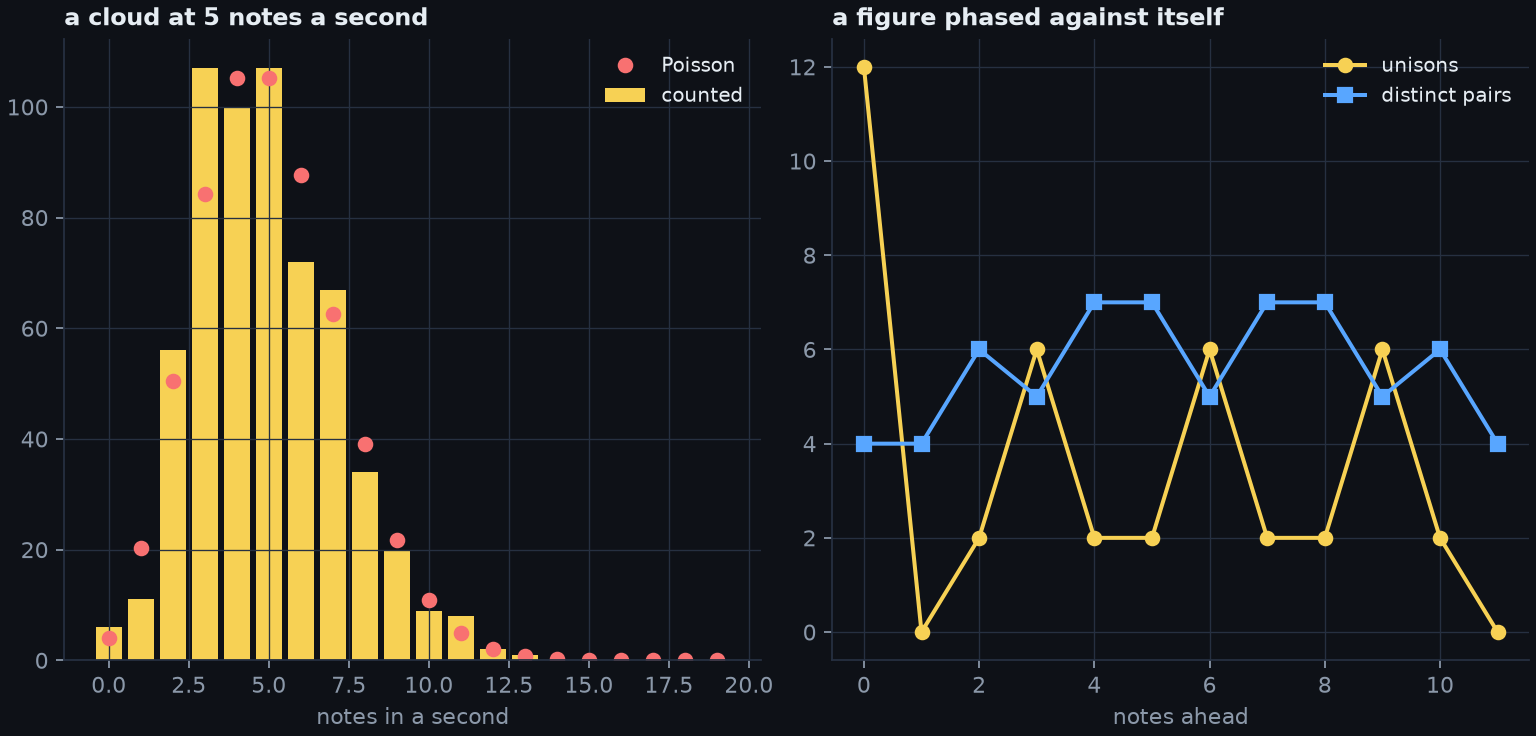
Xenakis governed his clouds with a law from probability. Let the cloud run for ten minutes at an average of five notes a second, and count the notes in each second. The gold bars are the counts. The pink points are Poisson's law, the count distribution for the specified homogeneous Poisson-process model; the two agree. The gaps between notes vary as much as their average length, which is why the cloud clumps. In Achorripsis, of 1957, Xenakis chose the average density for each cell of his score and used probabilistic distributions in a composed density framework, not an assertion that all his music follows this one process.
In Xenakis's music density itself becomes a melody. Here a cloud of plucks whose rate rises steadily from one note a second to twenty-four over twelve seconds; every note's moment and pitch is random, but the rate is composed. Listen for the cloud thickening from separate drops to rain. The counts per second, below, wobble around the rising line, as Poisson's law says they should.
Xenakis also built scales and rhythms with sieves: unions and intersections of arithmetic sequences, a n plus b. Every second semitone is the whole-tone scale; every third, together with every third shifted by one, the octatonic. C major can be written with sequences of steps three and four, but needs seven terms, one for each note. Sieves come into their own for scales that do not repeat at the octave. Every fifth semitone, together with every seventh shifted by two, makes a scale that repeats only every thirty-five semitones. Here it is over three octaves.
Xenakis also built a machine for composing by drawing. UPIC, finished in 1977, let a composer draw on a large tablet: lines became pitches moving in time, and drawn shapes became waveforms and envelopes. His Mycènes Alpha, of 1978, was drawn entirely this way. UPIC was used in workshops with children, composition without notation. It made the drawn glissandi of Metastaseis audible directly.
5Sound massesFoundations3 min
What happens when notes are too close to be notes?
In Poland and Hungary composers wrote masses of sound. Krzysztof Penderecki's Threnody for the Victims of Hiroshima, of 1960, sets fifty-two strings in clusters of quarter tones. György Ligeti's Atmosphères, of 1961, foregrounds slowly changing texture over conventional melodic lines or a regular pulse, only a slowly changing texture. Ligeti called it micropolyphony: dozens of lines, too close together and too many to be heard one by one. The cluster becomes a sound in itself, a band of pitches heard as a colour. Millions heard Atmosphères in Stanley Kubrick's film 2001, in 1968, where it was used without Ligeti's permission.
Here is a cluster of our own. Eight of Part 7's bowed strings, each half a semitone above the last, entering one by one until the band is three and a half semitones wide. Listen to what happens as it thickens: the separate notes disappear, and a single rough, shimmering band takes their place.
Why does a cluster sound rough? Neighbouring strings half a semitone apart near middle C differ by about eight hertz, so they beat about eight times a second. Part 5 showed that beating around eight hertz can remain audible as flutter or pulses; roughness depends on component spacing, frequency, level and auditory filtering. With eight strings, seven neighbouring pairs beat at once, and every more distant pair adds its own faster beating. Multiple fundamental and partial interactions can contribute to this model’s roughness; perception is not determined by one beat rate alone.
Close spectral spacing contributes to roughness; the number, levels and spectra of strings also matter. The same eight bowed strings, first as the cluster, half a semitone apart, then spread out in fifths and fourths across four octaves. The second is smooth and open: the more widely spaced fundamentals reduce some interactions, though their partials can still overlap.
Others went inside a single sound. Giacinto Scelsi wrote whole pieces on a single note, explored through its tuning, timbre and dynamics; his Four Pieces, each on one note, date from 1959. Morton Feldman's late music is very quiet and very long; his Second String Quartet, of 1983, lasts some six hours. La Monte Young sustained just intervals for hours, in drone music. Pauline Oliveros made attention itself the material, in what she called deep listening. From the note to the sound, and from the sound to listening itself.
How do you write a mass down? Penderecki drew it: black bands as wide as the cluster, wavy lines for vibrato, arrows for the highest note possible. Ligeti did the opposite, writing out up to fifty-six separate string parts exactly, each line precise, the mass emerging from their sum. Two answers: notate the result, or notate every line and let the result appear. Either way the score stops looking like what it sounds like. It is Part 10's question again: what is a notation for?
6Process and phasingFoundations3 min
What happens when two copies of one loop drift apart?
In 1965 Steve Reich recorded a street preacher in San Francisco saying it's gonna rain. He made two tape loops of the phrase and played them on two machines that ran at slightly different speeds. The loops began in unison, became an echo, then a canon, then an emergent texture produced by a deliberately chosen compositional process. In Piano Phase, of 1967, two pianists play the same figure, and one slowly pulls ahead of the other. Reich called it music as a gradual process: a process you can hear happening, the opposite of a hidden row.
Here is the process with a figure of our own, twelve notes built from the Tune's first notes. Two pianos start together. The second plays a little faster, gaining one note on the first every four times round, so you will hear the unison smear into an echo, then lock into a new pattern, then smear again. Watch the second line slide.
The process is a walk through twelve alignments, one for each number of notes the second piano is ahead. For each, the program counts the unisons, both pianos on the same note: twelve at the start, none one note later, six at three, six and nine notes ahead, where the figure's repeated three-note cells line up. And it counts the distinct pairs of notes sounding together, a simple combinatorial diversity count, not a measured richness judgment: richest at four, five, seven and eight notes ahead. The pattern is symmetric, because being k notes ahead is the same as being twelve minus k behind.
Process music became a movement. Terry Riley's In C, of 1964, and Philip Glass's Music in Twelve Parts, of the early 1970s, and Reich's Music for Eighteen Musicians, of 1976, built from a cycle of eleven chords. Glass grew figures by adding one note at a time, the additive rhythm of Part 28, reborn. Within a decade minimalism had reached rock, ambient music and film. Part 33 treats phase patterns as mathematics.
Reich later turned recorded speech itself into melody. In Different Trains, of 1988, recorded voices speak, and a string quartet doubles the rise and fall of their phrases. The voices remember train journeys in America and in wartime Europe, in the speakers' own words. Each spoken phrase's pitch contour is transcribed as notes, so that the closed groove of 1948 and the tape loop of 1965 become melody. Part 40 hears speech and song as one continuum.
Glass's version of process is additive. A figure of five notes, played twice with one note, twice with two, and so on up to five, the pulse never changing. The ear keeps re-hearing where the cycle begins, which is the music's whole drama.
7A spectrum, orchestratedFoundations4 min
Can an ensemble play the inside of one note?
In Paris in the 1970s a group of young composers took the spectrum itself as their material. In Gérard Grisey's Partiels, of 1975, the starting point is the spectrum of a low trombone note, analysed by machine, and each of its harmonics is given to an instrument, at its own loudness, so that the ensemble rebuilds the note. The harmony is the harmonic series of Part 1: based on selected spectral relationships, often differing from the equal-tempered keyboard. It was a reply to serialism: compose with sound as it is, not with rows.
Hear the idea with the series' own instruments. A low brass note, from Part 8's model of lips buzzing on a long bore, and the same note's sixteen harmonics handed to an ensemble of piano, bowed strings and a synthetic voice, each at the harmonic's own frequency and loudness. Which is the ensemble, A or B?
B is the ensemble. Its attack gives it away: the instruments begin with their own strikes and bows, and for a moment you hear separate sounds; then they fuse into something close to one note, a little like the brass tone of A but not the same. That fusing and splitting is what spectral composers wrote with.
Here is how the ensemble was built. The program measures the level of each of the brass tone's first sixteen harmonics: the bars, from forty decibels below the strongest up. Each harmonic becomes a note at exactly its frequency, and is given to an instrument by register: the lowest to the piano, the middle to the bowed strings, the highest to the voice, each sounding at its harmonic's level.
Partiels itself begins this way, the spectrum assembling in time. Here are our sixteen harmonics entering one by one, lowest first, each on its instrument. Listen for the moment the separate pitches stop being a chord and start fusing into one low, buzzing tone.
Why can a piano not play this chord? When the fundamental is on an equal-tempered key, its octave harmonics one, two, four, eight and sixteen also fall on keys. But the fifth harmonic is fourteen cents flatter than the piano's major third, and the third two cents sharper than its fifth. The seventh is thirty-one cents flat; the eleventh lies almost exactly between two keys; the thirteenth is forty-one cents above the key below it. So spectral composers wrote quarter tones and eighth tones, Part 6's tuning differences, heard as harmony rather than as error.
The approach spread. Tristan Murail's Gondwana, of 1980, builds orchestral spectra from models of bells and brass. The Finnish composer Kaija Saariaho analysed and transformed spectra by computer at IRCAM, the institute in Paris that Pierre Boulez opened in 1977 so that composers and scientists could work side by side. The computer became an ear: Part 3's analysis turned into the composer's material. Part 61 builds such analysis tools, and Part 52 synthesis from models.
The movement got its name in 1979, from the composer and philosopher Hugues Dufourt. Horațiu Rădulescu built spectra from piano strings bowed and struck from inside the instrument. Georg Friedrich Haas's in vain, of 2000, plays chords from the harmonic series with the hall's lights going down to near darkness. Harmonic spectra can promote fusion, while consonance and roughness still depend on voicing, level and context, and the tempered scale as one tuning among many. Part 33 asks which tunings are possible at all.
8The computer singsPractice3 min
When did a computer first make music?
Computers made sound almost as soon as they existed. In 1951 machines in Sydney and Manchester played tunes by switching a loudspeaker on and off. In 1957 Max Mathews at Bell Telephone Laboratories wrote MUSIC, a program that computes every sample of a sound, built from what he called unit generators, oscillators, envelopes and filters as blocks of code. It was slow: minutes of computing for seconds of sound, written to tape and played back. It is the same idea this series runs on, every sound computed, and Part 48 starts it from the bottom.
Mathews's idea is still one influential modular synthesis architecture. Connect unit generators: an oscillator making a sawtooth wave, full of harmonics; an envelope that shapes its loudness over time; a filter that removes the higher harmonics, here more and more as the note dies away. Hear the oscillator alone, then with the envelope, then through the filter: three blocks, and a raw buzz becomes something like a plucked bass.
In 1961 a computer sang. At Bell Labs a computer performed the song Daisy Bell, its voice computed by John Kelly and Carol Lochbaum and its accompaniment by Max Mathews, from a model of the vocal tract as a chain of tubes, Part 8's two-tube mouth extended. The writer Arthur C. Clarke heard the demonstration, and in Stanley Kubrick's 2001 the computer HAL sings Daisy as it is shut down. The synthetic voice in this series is a distant descendant.
Then came a discovery that reached everyone. At Stanford, John Chowning found that letting one sine wave bend another's frequency produces a whole spectrum, cheaply. Stanford licensed it to Yamaha, and the DX7 synthesizer of 1983 became the sound of a decade's pop music. Chowning's own Turenas, of 1972, moved sounds through space by computing the Doppler shift of a moving source. Part 52 builds frequency modulation, grains and physical models.
Synthesizers reached a wide public quickly. Wendy Carlos's Switched-On Bach, of 1968, played Bach on a Moog synthesizer and became one of the best-selling classical records of its time. At Bell Labs, Laurie Spiegel composed with algorithms; her album The Expanding Universe appeared in 1980. Suzanne Ciani, Éliane Radigue and Isao Tomita each made the synthesizer a voice of its own. By the 1980s the electronic studio had become a widely marketed instrument, though cost and access still varied. Part 51 builds the analogue synthesizer.
What changed after 1945? Music came to be made of sound, chance, process and statistics, not only of notes, with new instruments, the tape machine, the oscillator, the computer, and new kinds of listening, to texture, density, roughness and the inside of a sound. Every one of these ideas runs through the studio music of today. The series comes back to the ear in Act Eight, and to electric sound and the studio in Acts Nine and Ten.
9Frontier: composing with machines, listening to dataResearch2 min
What can sound tell us that a graph cannot?
The frontier has two sides. The first is composing with machines. Composers now write processes, constraints and spectral analyses directly in code, in environments like OpenMusic, Max and SuperCollider, and the machine computes the notes from which the composer chooses. In live coding, the code itself is written and changed during the performance. Which choices are then the composer's is a real question, which Part 65 takes up with machines that learn.
The second side turns the studio around: sound as a way of reading data. In sonification, data become sound so that the ear can find their patterns. A Geiger counter can approximate a Poisson counting process under steady conditions; detector dead time and changing sources affect it, made audible. Heartbeats, earthquake records and gravitational waves have been sped up into the audible range. The ear is very good at rhythm, periodicity and change, things a static graph can hide. But careful evidence of when sonification really helps, compared with a picture, is still thin.
And the studio itself is changing again. Neural networks now generate audio directly, sample by sample or from learned codes, and can transfer timbre, giving one instrument's sound another's performance. Schaeffer's question returns: what is a sound object when a machine invents it? Composers already use these systems as new studios. Part 66 builds generative audio, and asks what it has learned.
A concrete version. Make data series with a known hidden pattern: a weak periodicity, a change of rate, a rare burst. Present them to many people as a plot, as sound, and as both. Measure how often and how quickly each pattern is found, against chance. For which patterns does listening beat looking? This part's Poisson clouds and drifting loops are natural test cases: a change of density, a slow change of phase.
Variation 30, recap and problemsAll tracks3 min
Every part ends by doing something to the Tune with what it built. This time, three sounds. The Tune's first phrase phased against itself, two pianos drifting apart. A cloud of thirty glissandi drawn towards its first two phrases, so that the melody is a tendency of the mass rather than a line. And the Tune played on the harmonics of Part 1's low C string, eighth to thirteenth, so that its F and its A are not the piano's.
Row thirty of the ledger: seconds. The measurement: on C's harmonics the Tune's A is cents flatter than the piano's, and its F cents sharper: the harmonic series and the keyboard disagree.
What did we find? Tape can speed, reverse and cut a sound, and without its attack a bell is hardly a bell. Chance and silence gave the composer's choices away. Studie Two built sounds from eighty-one sine frequencies, and Xenakis's clouds follow Poisson's law. Close tones and their partials create multiple interactions; beating near eight hertz can sound like flutter as well as contribute to a complex texture. Two loops of one figure pass through twelve alignments, symmetric about six. And one brass note can be rebuilt by an ensemble, if it plays between the piano's keys.
Five problems. One to compute, one to prove, one for your ears, one to build, and a research problem, marked with a star. Solutions are in this part's notes. Pause here.
Where does this come back? In the next part's mathematics of transformations. In the mathematics of loops and even rhythms. In the ear's scene, where masses and streams form. In synthesis, oscillators, frequency modulation, grains and physical models. In the studio's samplers and sequencers. And in generative audio, near the end.
And in practice. Producers loop, reverse, re-pitch and cut attacks every day. Sound designers build clouds and masses for film and games. Composers write processes and orchestrate spectra. And scientists listen to data, and test when that helps.
The books and papers this part follows. The full list, with notes, is in the README.
Where it goes next. Transformations in Part 31; the mathematics of loops and rhythm in Part 33; the auditory scene in Part 45; filters in Part 49; synthesis in Parts 51 and 52; the studio in Part 53; generative audio in Part 66.
Key results
The part's results in one place, for revision.
Try it
Lab 30 · Sound itself, computed
Speed, reverse and cut a recorded sound; find the alignments two loops of a figure pass through; check a random cloud against Poisson's law; build scales from sieves; and hear random and even timing apart.
python -m videos.music.labs 30
needs numpy, scipy, matplotlib · download lab30.py ·
source on GitHuba bell's attack time: as struck / reversed / attack cut (s) 0.011 / 1.923 / 0.030
figure (0, 2, 4, 0, 2, 4, 7, 4, 2, 0, 2, 4): unisons at each shift 12 0 2 6 2 2 6 2 2 6 2 0
distinct pairs at each shift (richness) 4 4 6 5 7 7 5 7 7 5 6 4
sieve [[(5, 0)], [(7, 2)]]: first notes, and its period in semitones [0, 2, 5, 9, 10, 15, 16, 20, 23, 25, 30, 35] ..., 35
cloud at 5 a second for ten minutes: mean and variance of per-second counts 4.91, 4.99 (Poisson: both 5)
beat rates in a quarter-tone cluster of five around A4 (Hz) 12.2, 12.5, 12.9, 13.3
ear problem: the six clouds in the order played (listen first) even, random, even, random, random, even
A tape machine changes pitch and time together; a phased figure walks through a fixed set of alignments, symmetric about the middle; and a random cloud's counts have a variance equal to their mean.The code (94 lines; it asserts its own result)
"""Lab 30: sound itself, computed: tape operations on a bell, a phasing engine for any figure, a Poisson cloud checked
against its law, a sieve of your own, a cluster's beats, and six clouds, random or even, sorted by ear."""

import numpy as np

from videos.coursekit import labs
from explainer.music.monochord import SR, Clip, concat
from explainer.music.monochord import soundmass as S
from explainer.music.monochord.instruments import percussion as PC
from explainer.music.monochord.partkit import organ_tone

TITLE = "Sound itself, computed"
GOAL = ("Speed, reverse and cut a recorded sound; find the alignments two loops of a figure pass through; check a random "
        "cloud against Poisson's law; build scales from sieves; and hear random and even timing apart.")
TASKS = [
    "Choose a FIGURE of pitch classes. Through how many different alignments does it pass when phased against itself, and which are richest?",
    "Choose a SIEVE as (modulus, residue) terms. What scale does it make, and after how many semitones does it repeat?",
    "Change RATE, the cloud's notes per second. How does the spread of the per-second counts grow with the rate?",
]
FIGURE = (0, 2, 4, 0, 2, 4, 7, 4, 2, 0, 2, 4)
SIEVE = [[(5, 0)], [(7, 2)]]
RATE = 5.0


def tick(m, seconds=0.25):
    return organ_tone(440 * 2 ** ((m - 69) / 12), seconds, partials=5, rolloff=0.6, decay=10.0) * 0.3


def cloud(times, pitches, seconds=6.0):
    y = np.zeros(int((seconds + 0.6) * SR))
    for t, p in zip(times, pitches):
        s = tick(p)
        i = int(t * SR)
        y[i:i + len(s)] += s[: len(y) - i]
    return Clip(y, SR).fade(0.01, 0.2).at_level(-20.0)


def run(seed=0):
    rng = np.random.default_rng(seed)
    lab = labs.Lab()

    # 1. tape operations on a bell
    bell = np.asarray(PC.bell(392.0, seconds=2.0), float)
    lab.row("a bell's attack time: as struck / reversed / attack cut (s)",
            f"{S.attack_time(bell):.3f} / {S.attack_time(S.reverse(bell)):.3f} / {S.attack_time(S.cut_attack(bell, 0.25)):.3f}")

    # 2. phasing
    pats = S.phase_patterns(FIGURE)
    lab.row(f"figure {FIGURE}: unisons at each shift", " ".join(str(p["unisons"]) for p in pats))
    lab.row("distinct pairs at each shift (richness)", " ".join(str(p["distinct"]) for p in pats))

    # 3. sieves
    sv = S.sieve(SIEVE, 72)
    period = next((p for p in range(1, 72) if all((x + p in sv) for x in sv if x + p < 72)), None)
    lab.row(f"sieve {SIEVE}: first notes, and its period in semitones", f"{sv[:12]} ..., {period}")

    # 4. a Poisson cloud
    on = S.poisson_onsets(RATE, 600.0, rng)
    counts = S.counts_per_cell(on, 600.0, 1.0)
    lab.row(f"cloud at {RATE:g} a second for ten minutes: mean and variance of per-second counts",
            f"{counts.mean():.2f}, {counts.var():.2f} (Poisson: both {RATE:g})")
    assert abs(counts.mean() - RATE) < 0.5

    # 5. a cluster
    lab.row("beat rates in a quarter-tone cluster of five around A4 (Hz)", ", ".join(f"{b:.1f}" for b in S.beat_rates(S.cluster(69, 2.0, 5))))

    # 6. Problem 3: six clouds, random or even
    kinds = list(rng.permutation(["random"] * 3 + ["even"] * 3))
    clips = []
    for k in kinds:
        t = S.poisson_onsets(4.0, 6.0, rng)
        if k == "even":
            t = np.linspace(0, 6.0, len(t), endpoint=False)
        clips.append(cloud(t, rng.uniform(60, 84, len(t))))
    lab.audio = concat(clips, gap=1.0)
    lab.row("ear problem: the six clouds in the order played (listen first)", ", ".join(kinds))

    fig, (a, b) = labs.figure(2)
    hist = np.bincount(counts, minlength=20)[:20]
    from math import exp, factorial
    a.bar(range(20), hist, color=labs.GOLD, label="counted")
    a.plot(range(20), [600 * exp(-RATE) * RATE ** k / factorial(k) for k in range(20)], "o", color=labs.RED, label="Poisson")
    a.set_xlabel("notes in a second")
    a.legend(frameon=False)
    a.set_title(f"a cloud at {RATE:g} notes a second")
    b.plot([p["shift"] for p in pats], [p["unisons"] for p in pats], "o-", color=labs.GOLD, label="unisons")
    b.plot([p["shift"] for p in pats], [p["distinct"] for p in pats], "s-", color=labs.BLUE, label="distinct pairs")
    b.set_xlabel("notes ahead")
    b.legend(frameon=False)
    b.set_title("a figure phased against itself")
    lab.fig = fig
    lab.note = ("A tape machine changes pitch and time together; a phased figure walks through a fixed set of alignments, "
                "symmetric about the middle; and a random cloud's counts have a variance equal to their mean.")
    return lab
Now change it
- Choose a FIGURE of pitch classes. Through how many different alignments does it pass when phased against itself, and which are richest?
- Choose a SIEVE as (modulus, residue) terms. What scale does it make, and after how many semitones does it repeat?
- Change RATE, the cloud's notes per second. How does the spread of the per-second counts grow with the rate?
Problems, with solutions
Try each problem before opening its solution.
-
Compute. A tape is played at 1.5 times its speed. By how many cents does every pitch rise, and how long does a 3-second sound last?
Solution
1200 log₂ 1.5 ≈ 702 cents, a perfect fifth (just); the sound lasts 3 / 1.5 = 2 seconds.
-
Prove. Show that for a Poisson process of rate λ the gaps between events have mean and standard deviation 1/λ.
Solution
The gaps are exponential with density λe^(−λt). The mean is ∫ t λe^(−λt) dt = 1/λ; the second moment is ∫ t² λe^(−λt) dt = 2/λ², so the variance is 2/λ² − 1/λ² = 1/λ² and the standard deviation 1/λ.
-
Ear. The lab plays six clouds; some at Poisson times, some evenly spaced. Sort them.
Solution
The lab prints the order. Even clouds are heard as a pulse within a second or two; Poisson clouds clump and pause.
-
Build. Write the phasing engine for any figure, and find the figures whose alignments are distinct after identifying k with 12 − k.
Where to look.
soundmass.phase_patternsgives the pairs at each shift; describe each alignment by its multiset of pairs up to the symmetry k ↔ 12 − k, and search figures (for instance, all sequences over a small pitch set) for those whose seven alignment classes are pairwise different. With unordered simultaneous pairs, opposite shifts necessarily match, so twelve distinct textures are impossible under this descriptor. -
★ For which patterns in data does listening beat looking?
Where the frontier is. Generate series with planted patterns (a weak periodicity, a change of rate, a rare burst, a slow phase drift), present them as plots, as sound and as both, measure detection rate and time against chance, and model which properties of a pattern predict an advantage for the ear; report effects with intervals.
Notes and sources
Sources
- I. Xenakis, Formalized Music (1963; rev. 1992); S. Reich, Writings on Music, 1965–2000 (2002); J. Fineberg (ed.), "Spectral music: history and techniques", Contemporary Music Review (2000); A. Ross, The Rest Is Noise (2007).
- P. Schaeffer, Traité des objets musicaux (1966); J. Cage, Silence (1961); K. Stockhausen, Studie II score (1956), for the scale.
- M. V. Mathews, "The digital computer as a musical instrument", Science (1963); J. L. Kelly and C. C. Lochbaum, "Speech synthesis" (1962); J. M. Chowning, "The synthesis of complex audio spectra by means of frequency modulation", JAES (1973).
- T. Hermann, A. Hunt and J. G. Neuhoff (eds.), The Sonification Handbook (2011).
- Part 1 for the string; Part 2 for tape speed; Part 3 for Fourier; Part 5 for beats; Parts 7–9 for the instruments.
About this partfrom its README
Part 30 of a sixty-eight-part course in music (see the series plan and
the syllabus), the third part of Act V. Part 29 ordered pitch with rows, and total serialism ordered
everything else; this part follows the composers who stopped arranging notes and started arranging sound, chance and
process, from Schaeffer's closed groove in 1948 to the computer that sang in 1961 and the spectral composers of the
1970s. The tools are Monochord's (explainer/music/monochord/soundmass.py). The music of this era is in copyright, so
every sound in the film is the film's own, made from the series' instruments (SYLLABUS §2.4); the works are described.
- A groove that closes. Schaeffer in 1948; a closed groove of our own (Part 9's woodblock and drum over a low bowed string), heard; the plan.
- 1. Music from recordings. Tape and its operations; the Tune at normal, double and half speed, heard; an ear question (a bell four ways: which is untouched?); the sound object and reduced listening; Lucier's room; Oram, Derbyshire, El-Dabh, Oliveros.
- 2. Chance and silence. Cage, the prepared piano and the I Ching; 4'33''; the Tune's notes by dice, heard; happenings and Fluxus; open works.
- 3. The electronic studio. Cologne and sine waves; five mixtures on Studie II's scale (81 frequencies, 111.45 cents apart), heard; Tokyo, Copenhagen, the Barrons; Varèse and the Philips Pavilion; Columbia-Princeton.
- 4. Xenakis: clouds and sieves. The engineer; a cloud of forty glissandi, heard; an ear question (random or even?); ten minutes of a cloud counted against Poisson's law; a cloud thickening from 1 to 24 notes a second, heard; UPIC; sieves (whole-tone, octatonic, the diatonic in seven terms, 5n ∪ 7n+2 with period 35, heard).
- 5. Sound masses. Penderecki and Ligeti; eight bowed strings half a semitone apart, heard; their beats (about 8 a second); the same strings as an open chord, heard; notating a mass; Scelsi, Feldman, Young, Oliveros.
- 6. Process and phasing. Reich; a twelve-note figure of ours phased against itself, heard; its twelve alignments (unisons 12, 0, 2, 6, ...; richest at 4, 5, 7, 8 notes ahead); Different Trains; minimalism; an additive figure, heard.
- 7. A spectrum, orchestrated. Grisey's Partiels; an ear question (a brass tone from Part 8's lips, or its sixteen harmonics played by piano, bowed strings and voice?); the harmonics measured and assigned; the spectrum assembling, heard; harmonics against the piano's keys; Dufourt, Rădulescu, Haas; Murail, Saariaho, IRCAM.
- 8. The computer sings. CSIRAC, Ferranti, Mathews's MUSIC; a unit-generator patch (oscillator, envelope, filter), heard; Daisy Bell; Carlos, Spiegel, Ciani, Radigue, Tomita; Chowning's FM; what changed.
- 9. Frontier: composing with machines, listening to data. Computer-assisted composition; learned sound; sonification; ★ research problem: for which patterns in data does listening beat looking?
- Variation 30, recap and problems. The Tune's first phrase phased against itself; a cloud of thirty glissandi drawn to its first two phrases; the phrases on the harmonics of Part 1's low C string (its A 59 cents flat, its F 51 sharp); the ledger; what we found; five problems; where it comes back; in practice; Part 31.
What is computed and built
python -m videos.music.music30.compute (about a minute) fills .cache/music30/.
| Item | What it computes | Checked against |
|---|---|---|
hook, tape, speeds |
a looped fragment; a bell untouched, reversed, halved and cut; the Tune re-speeded; attack times | the tape law (tests) |
chance, studie |
the Tune's notes by dice; sine mixtures on the 5^(1/25) scale | — |
clouds, density, gliss |
Poisson and even clouds; ten minutes of counts against Poisson's law; a rising rate; glissandi | Poisson's law |
sieves, mass, spread |
sieve scales and periods; a cluster's beat rates; the open chord | the Chinese remainder theorem |
phasing, additive |
a figure's twelve alignments and the drifting loops; an additive figure | symmetry (tests) |
spectral, buildup |
a brass tone's harmonic levels, orchestrated; the spectrum assembling | — |
unitgen |
a sawtooth oscillator, envelope and falling low-pass filter | — |
tune |
Variation 30 | — |
Monochord's tools are held in tests/music/test_soundmass.py; this part's claims and clips in
tests/music/test_music30.py.
Sounds. Part 1's string; Part 7's piano and bowed string; Part 8's lips on a long bore; Part 9's bells, woodblock and drums (physical models). The glissandi, sine mixtures, unit-generator patch and synthetic voice are synthesized. There are no recordings.
What the models are, and are not. The brass tone is Part 8's lips on a trumpet-shaped bore stretched to a trombone's length, not a measured trombone; its spectrum is the model's. The ensemble's harmonics are played at their exact frequencies by instruments whose own timbres add partials of their own, which is part of why the result does not quite fuse. The clouds are random with stated rates; Xenakis's own clouds were computed cell by cell with his own parameters. The phasing figure is ours; Reich's patterns are his. The cluster's beats are between neighbours only; all pairs beat.
Notes
Eight-hertz beating can sound like flutter or pulses; roughness depends on spectral spacing, level and auditory filtering. Wider-spaced fundamentals can still have interacting partials. Poisson clouds assume a steady rate and independent events; they illustrate one model, not every Xenakis process. Phase-pair diversity is a combinatorial descriptor, not a listener rating. Historical studio controls specify parameters within a finite machine, and the 1961 Daisy example is attributed to a Bell Labs computer without an uncertain model number.
Companion material in this repository
The syllabus's plan for this partfrom SYLLABUS.md, the plan of record
- Hook: Paris 1948; a closed groove of our own heard; the plan.
- Music from recordings: tape; the Tune at three speeds heard; an ear question (which bell is untouched?); the sound object; the room as instrument; tape elsewhere.
- Chance and silence: Cage; 4'33''; the Tune by dice heard; happenings and Fluxus; open works.
- The electronic studio: Cologne; Studie II's sine mixtures heard; studios elsewhere; Varèse; Columbia-Princeton.
- Xenakis: the engineer; a cloud of glissandi heard; an ear question (random or even?); Poisson's law; a thickening cloud heard; drawing sound; sieves heard.
- Sound masses: Penderecki and Ligeti; a cluster heard; its beats; cluster against open chord heard; writing a mass down; inside the sound.
- Process and phasing: Reich; a figure phased heard; its twelve alignments; speech becomes melody; minimalism; an additive figure heard.
- A spectrum, orchestrated: Grisey; an ear question (which is the ensemble?); the harmonics measured; the spectrum assembling heard; harmonics against keys; the name; after Grisey.
- The computer sings: the first computer music; a unit-generator patch heard; Daisy Bell; synthesizers reach the public; FM; what changed.
- Frontier: composing with machines; learned sound; listening to data; the research problem.
- Variation 30: phased, a cloud of glissandi, on a string's harmonics. Outro: problems, payoffs.
Covers: musique concrète; chance and indeterminacy; the electronic studio; Xenakis's stochastic music and
sieves; sound masses; minimalism and phasing; spectral music (a spectrum orchestrated); early computer music.
Built and computed: monochord/soundmass.py: tape operations (speed, reversal, loops, the cut attack); a phasing
engine and the twelve alignments a figure passes through; Poisson clouds checked against Poisson's law; sieves (the
diatonic by the Chinese remainder theorem, a non-octave scale of period 35); cluster beat rates; the spectrum of a brass
tone from Part 8's lips on a long bore, measured and orchestrated for piano, bowed strings and voice; Studie II's scale;
a unit-generator patch.
Variation 30: the Tune phased against itself; as a cloud of glissandi; as the spectrum of Part 1's string.
Frontier: computer-assisted composition; sonification.
Rights: every sound is the film's own (§2.4); the works are described.
Reading: Xenakis, Formalized Music; Reich, Writings on Music; Fineberg (ed.) on spectral music; Ross, The
Rest Is Noise.
Build the film
python -m videos.music.music30.compute        # the part's numbers, into .cache/music30
python tools/build.py music30                  # render and assemble the film
EXPLAINER_TTS=silent python tools/qa_scene.py music30 Hook   # one chapter, silent, with a contact sheet
Scenes: videos/music/music30. Setup: see the course page. Source of these notes: the README and the scenes' narration.
Build it
python -m videos.music.music30.compute                          # numbers and sounds (about a minute)
EXPLAINER_TTS=silent python tools/build.py music30 -q l --fps 15   # a silent-narration preview, with the sounds
python tools/qa_sound.py music30 --sync                         # the sound gates
python tools/dead_air.py renders/music30_480p.mp4 --sound music30  # no empty screen; no sound over a still one
python tools/lecture_length.py music30                          # 30 to 60 minutes, listening included
python tools/build.py music30                                   # 1080p30, narrated
python -m pytest -q tests/music                                 # Monochord against its references; this part's claims and clips
python -m videos.music.labs 30                                  # the lab (writes a figure and a short WAV)