Twelve Tones
What replaced the key when Schoenberg gave it up, and what mathematics lies under the twelve-tone method?
In 1908 a soprano in Schoenberg's Second String Quartet sang of the air of another planet, and the key dissolved. His Piano Pieces Op. 19 (1911), played here from the encoding, keep a centre made of an interval, G and B, while all twelve notes are used. Set theory names such music: transposition and inversion make 224 set classes, counted by brute force and by Burnside's lemma, as in Forte's table; 23 pairs share an interval vector without being the same chord; and every hexachord has its complement's interval vector, checked on all 924 and proved by counting pairs. The twelve-tone row has 48 forms; Webern's canon Dormi Jesu inverts every one of its 45 intervals exactly. Of all rows starting on C, 3,856 use every interval once, and in each the first and last notes are a tritone apart, because 1 + 2 + ... + 11 = 66. Six hexachords are all-combinatorial. Total serialism followed, and the critics said it sounded like a cloud of points; listening experiments find that people follow contour and texture far better than rows. The Tune becomes a row grown from its own intervals, then a pointillist variation.
What you need. Part 3 for the Fourier transform; Part 12 for Burnside's lemma; Part 15 for keys; Part 22 for hierarchy; Part 27 for chromaticism; Part 28 for symmetric sets. The dihedral group, Burnside's lemma, permutations, depth-first search, double counting.
- Ideas, mathematics and history
- free atonality, pitch-class sets, the interval vector and the Z-relation, the hexachord theorem, rows and combinatoriality, can rows be heard
- What we build, compute and hear
- the set classes derived by Burnside; all all-interval rows enumerated
What you will be able to do
Foundations
- Hear free atonal music and say what holds it together.
- Find a chord's prime form and interval vector, and the forms of a row.
- Hear an inversion and a retrograde, and judge whether a line is a form of a row.
Full course
- Count set classes by brute force and by Burnside's lemma, and enumerate Z-relations.
- Prove the hexachord theorem by double counting, and the tritone property of all-interval rows.
- Enumerate all-interval rows by search and test hexachords for combinatoriality.
Research
- Relate homometric sets in crystallography to Z-related sets via the discrete Fourier transform.
- Design a perception study separating interval content from surface features.
Practice
- Verify an exhaustive claim by enumeration, then prove it, and say what each establishes.
Contents
Each chapter has a home level. Choose a track to see what to read and watch: Foundations 30 min · Full course 32 min · Research 35 min · Practice 32 min.
- 0The air of another planetFoundations2 min
- 1Atonality, freeFoundations3 min
- 2Pitch-class setsFoundations3 min
- 3Counting the chordsPractice3 min
- 4Same intervals, different setsFoundations3 min
- 5The row and its forty-eight formsFoundations5 min
- 6All-interval rowsFoundations3 min
- 7CombinatorialityFoundations3 min
- 8Total serialismFoundations3 min
- 9Can anyone hear it?Foundations4 min
- 10Frontier: homometry and perceptionResearch2 min
- Variation 29, recap and problemsAll tracks3 min
Also on this page: Lecture · Key results · Try it · Lab · Problems · Notes and sources · Build the film.
Lecture
The text of each chapter is the film's narration, as it is spoken, so you can read along or revise without the film. The pictures are in the film. A dashed box stands for a number the film computes when it is rendered (hover over it to see what is computed); the README's figures for each chapter, where it lists them, follow the chapter's text.
The air of another planetFoundations2 min
Vienna, 1908. In the last two movements of Arnold Schoenberg's Second String Quartet a soprano joins the four strings, singing a poem by Stefan George that begins: I feel the air of another planet. As she sings it, the music leaves its key behind. At the first performance, that December, parts of the audience laughed and jeered. For more than a decade Schoenberg wrote without keys, and then looked for a rule to take their place. That rule, and the mathematics that theorists later found underneath it, are this part.
Here is what music without a key sounded like three years later. The last of Schoenberg's Six Little Piano Pieces, written in 1911, whole: nine very slow bars, read from the encoding and played on Part 7's piano. Two soft chords sound like distant bells, and a few quiet notes move above and below them. There is no tonic to arrive at, and nothing resolves; the piece simply stops.
Here is the plan. First, what free atonality is made of. Then the theory built to describe it: sets of pitch classes, their names and interval vectors, and all two hundred and twenty-four of them, counted two ways. A theorem about hexachords, proved. Schoenberg's row and its forty-eight forms, and a canon by Webern in which one line is the other upside down. All-interval rows, combinatoriality and total serialism. And the question that hangs over all of it: can anyone hear it?
1Atonality, freeFoundations3 min
What holds music together without a key?
What did leaving the key mean? Schoenberg called it the emancipation of the dissonance: a dissonant chord no longer needs to resolve to a consonant one. Part 27 measured the result: in his Opus 19 a quarter of the sounding time is outside any key, and the key-finder's best fit drops to about 0.55. What holds such music together is small cells of intervals, repeated, transposed and turned upside down, and brevity: without a key to return to, long forms were hard to hold together, and many pieces of these years last a minute or two. Schoenberg disliked the word atonal; he preferred pantonal, a term expressing his objection to the negative implication of atonal; it does not mean every passage literally sounds all keys simultaneously.
Hear the second piece of the set, whole, nine bars. A single interval, a major third from G to B, pulses in even eighth notes almost all the way through, and chords gather around it and dissolve again. The third is what the ear holds on to; there is no key for it to belong to.
Count the sounding time on each pitch class. G and B, the pulsing third, tower over the rest. But every one of the twelve pitch classes is used. The piece has a centre, but the centre is an interval, not a tonic with a scale around it: one of the ways free atonality holds together.
Go back to the piece the part began with. Its first chord, high in the piano, is A, F sharp and B, with prime form zero two five. The second, lower, is G, C and F, stacked fourths with prime form zero two seven, a different set class. Sounding together they make a six-note set, spread widely in register; its heard grouping depends on spacing and context. The piece is built from these two bell-like chords, a small cell repeated and varied, one example of motivic and textural organization in free atonality.
Around these pieces grew a whole repertory. Erwartung, of 1909, is a half-hour monodrama for soprano and orchestra with almost no repeated material. Pierrot lunaire, of 1912, sets twenty-one poems for a voice that half speaks and half sings, with five players. His pupils Alban Berg and Anton Webern went their own ways: Berg toward the opera Wozzeck, Webern toward pieces a few seconds long. The movement around them, in painting as well as music, is called Expressionism: inner states, anxiety, dreams. By about 1920 Schoenberg wanted a method that would let him write long forms again.
2Pitch-class setsFoundations3 min
When are two chords the same chord?
Theorists after Schoenberg needed names for the cells he used. They treat a chord as a set of pitch classes on the twelve-hour clock, ignoring octave and order. Transposing a set adds the same number to every member: on the clock, a rotation. Inverting it turns every interval upside down: x goes to minus x, a reflection across the line through C and F sharp. Two sets related by these operations are said to belong to the same set class; their interval content is the same.
A question for your ears. Two four-note chords, each struck and then broken upwards. B is either A transposed, or A turned upside down. Which? Listen to the order of the small and large steps as each chord is broken.
B is the inversion. A, broken upwards, climbs by one, three and two semitones; B climbs by two, three and one, the same steps in the reverse order, which is what turning a chord upside down does. Both have the same prime form, zero one four six, and so the same set class.
Each set class gets one name, its prime form: rotate the set to its most compact arrangement, do the same for its inversion, take the more compact of the two and start it on zero. The major and minor triads have the same prime form, zero three seven: one is the other upside down. So do the dominant seventh and the half-diminished seventh. And Wagner's Tristan chord, from Part 27, has the half-diminished seventh's prime form, zero two five eight: set theory hears no difference, though Wagner's context does.
The second tool is the interval vector. Fold intervals into six classes, counting an interval and its inversion as one, so that five semitones and seven are both class five. Then count each class among all the pairs of notes in the set. A major triad has three pairs: one minor third, one major third, one fourth or fifth. The set zero one four six has six pairs, one of every class, which is why it is called the all-interval tetrachord. The vector describes pairwise interval-class content; it does not uniquely determine perceived harmonic color, unchanged by transposition and inversion.
One more idea, which later parts build on. The theorist David Lewin argued, in 1987, that what matters is often the operation, not the sets. The twelve transpositions and twelve inversions form a group of twenty-four operations, the symmetries of a twelve-sided polygon. A passage that moves from one set to another by an inversion is about that inversion. The same group acts on major and minor triads, related to, but distinct from, the neo-Riemannian group acting on those triads. Part 31 builds this theory.
3Counting the chordsPractice3 min
How many different chords are there?
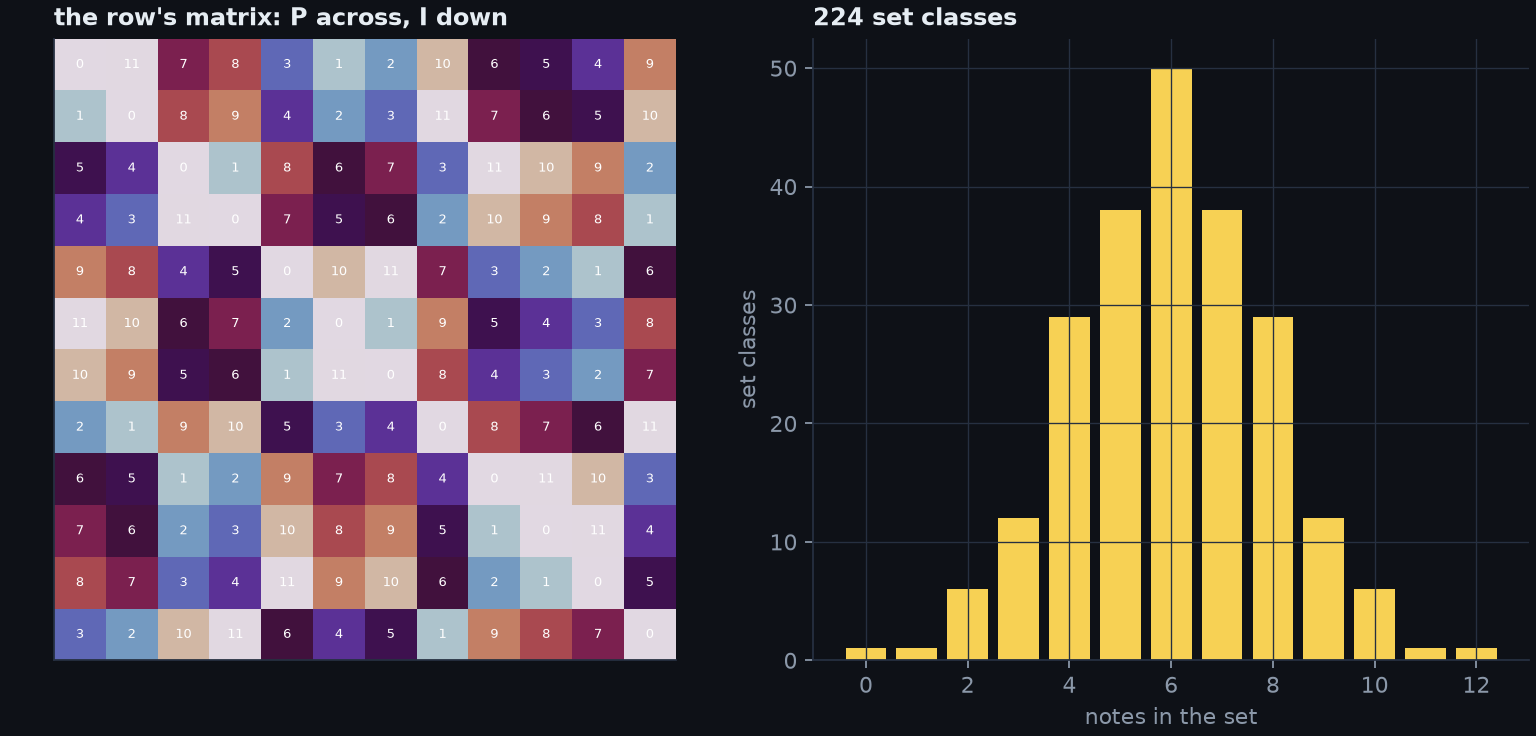
How many set classes are there? The blunt way is to compute the prime form of every one of the four thousand and ninety-six sets and count the different answers. There are . Most have five, six or seven notes: hexachords, pentachords, tetrachords and trichords. Part 28 counted three hundred and fifty-two shapes under transposition alone; inversion folds most of them in pairs.
Here are all twelve classes of three-note chord, each in prime form, played as a close chord on middle C. From the cluster of three semitones, through chords built of seconds and fourths, to the familiar ones near the end: the diminished triad, the major and minor triad, which are one class, and the augmented triad. Every set of three distinct pitch classes in twelve-tone equal temperament belongs to one of these classes; register, doubling and tuning are omitted.
The elegant way needs no listing at all. Burnside's lemma, which Part 12 used, says the number of classes is the average, over all the operations, of how many sets each operation leaves unchanged. A transposition by k leaves unchanged the sets that repeat every greatest common divisor of k and twelve: two to the power of that divisor of them. An inversion has either no fixed pitch classes or two, and swaps the rest in pairs, so it leaves two to the seventh or two to the sixth sets alone. Add the twenty-four counts and divide by twenty-four: two hundred and twenty-four. The brute-force count agrees.
In 1973 Allen Forte published names for every class of three to nine notes, names like four z fifteen or six twenty. His table lists twelve trichords, twenty-nine tetrachords, thirty-eight pentachords and fifty hexachords, with the larger sets as their complements, and the counts the program found match it exactly. Analysis in this tradition names the classes a piece uses and how they are related. The names are a tool; which notes count as a set in a real piece is still the analyst's decision, as Part 28's frontier warned.
4Same intervals, different setsFoundations3 min
Can two different chords have exactly the same intervals?
Two chords with exactly the same intervals but no way to turn one into the other: listen. First zero one four six, then zero one three seven. Each has six pairs of notes, and in each the six pairs cover all six interval classes once. Yet no rotation or reflection of the clock carries one onto the other. Forte called such pairs Z-related.
How common are such twins? The program groups every set class by its interval vector. There are Z-related pairs in all, and among four-note chords only the one pair just heard. Hexachords have fifteen pairs. And the counts are symmetric, four and eight notes, five and seven, for a reason the next theorem explains. Interval content does not determine a chord.
Here is the theorem. Take any six pitch classes, and the six that are left over, its complement. Their interval vectors are always identical. This is Milton Babbitt's hexachord theorem, from the 1950s. The program checks all six-note sets: it holds for every one. When the complement is in a different set class, the two form one of the fifteen Z-related pairs.
Hear the example. The hexachord, then the six notes it leaves out, each as one chord. Their interval vectors are identical, three two two three three two, but they are not the same chord in any transposition or inversion: this pair is one of the fifteen Z-related hexachord pairs. Do they sound alike to you?
Why is it true? Fix an interval class, say a minor third. Each of the twelve pitch classes has exactly two partners a minor third away, one above and one below. So round the clock there are twelve such pairs, and each lies inside the set, inside the complement, or across. Count partners from the set's side: its notes have twice six partners, which is twice the pairs inside the set plus the pairs across. Do the same from the complement's side; since both have six notes, the pairs inside each must be equal. The tritone works the same way with half the pairs, and for sets of other sizes the argument gives the difference exactly, which is why Z-relations come in complementary sizes.
5The row and its forty-eight formsFoundations5 min
What did Schoenberg put in place of the key?
Schoenberg's answer came around 1921 to 1923. He called it a method of composing with twelve tones related only to one another. A piece is built from a row: all twelve pitch classes in a fixed order, each appearing once in the row itself; performed music can repeat notes, double octaves and overlap row forms. The row may be transposed, inverted, played backwards, which is called retrograde, or backwards and inverted. Melody and harmony both come from it, as notes in succession or several sounded together. His Piano Suite, Opus 25, is among the first pieces built wholly this way.
Who was the man behind the method? Arnold Schoenberg was largely self-taught, and a painter as well as a composer. In 1925 he was appointed to teach composition at the Prussian Academy of Arts in Berlin. In 1933 the new regime dismissed him as a Jew; he left Germany and formally returned to the Jewish faith. From 1934 he lived in Los Angeles, teaching at the University of Southern California and at UCLA. He saw his method as continuing Bach and Brahms, not breaking with them; his essay on Brahms is called Brahms the Progressive.
Here is the row of the Piano Suite, Opus 25, once up the keyboard: E, F, G, C sharp, F sharp, E flat, A flat, D, B, C, A, B flat. Schoenberg used it in groups of four notes: the second group is the all-interval tetrachord of chapter two, the third a chromatic cluster. And it begins and ends a tritone apart, E and B flat, a fact the suite exploits by starting forms of the row on either note.
Composers lay out a row's forms in a twelve by twelve grid. Across the top, the row itself, here one of our own, starting on C. Down the side, its inversion. Every row of the grid is then a transposition of the row, every column a transposition of its inversion, and reading right to left gives the retrogrades. Twelve transpositions of four kinds: forty-eight forms, and for this row all forty-eight are different.
Listen. Our row, then two of its forms, its retrograde, played backwards, and its inversion, upside down, in some order. Which one is the inversion, A or B? A hint: listen to the second note, and compare it with the row's.
B is the inversion. The row's second note is B, a semitone below C, played here in the same octave; the inversion's second note is C sharp, a semitone above, and every later step is flipped the same way, counted in pitch classes. A is the row backwards, beginning on its last note, A.
Webern took the method's symmetries in distinctive ways. In Dormi Jesu, a short Latin song for voice and clarinet from 1924, the program compares the two lines in the encoding. The clarinet starts a bar ahead, and the voice follows with the same line upside down: every one of the forty-five pitch-class intervals compared in this encoding is the clarinet's interval inverted, and every one of its forty-six durations is the same. It is a strict canon in inversion, from first note to last.
Here it is, whole, from the encoding. The synthetic voice sings on oo rather than the Latin words, and Part 7's bowed string stands in for the clarinet, so the colours are not Webern's; the lines are. Listen for the clarinet's leaps answered, a bar later, by the voice leaping the other way.
A word about Webern himself. He was trained as a musicologist and earned his living conducting, including workers' choirs in Vienna. His published works, all together, last only a few hours, full of canons, palindromes and rows with internal symmetries. Under the Nazis his music was banned as degenerate, and in September 1945, in occupied Austria, he was shot dead by an American soldier in a tragic mistake. After the war his music became the model for a whole generation.
6All-interval rowsFoundations3 min
Can a row use every interval exactly once?
Alban Berg's Lyric Suite for string quartet, of 1926, opens its first movement on a remarkable row. Here it is, once up the keyboard. Measure each step upward in semitones, wrapping round the octave: eleven, eight, nine, ten, seven, six, five, two, three, four, one. Every interval from one to eleven appears exactly once. It is an all-interval row.
How many all-interval rows are there? A depth-first search finds them all: start on C, try each unused interval in turn, never repeat a pitch class, and back up when stuck. It finds of them starting on C. The number was first computed in the 1960s, and the search agrees with it. of them, played backwards, turn out to be the same row a tritone higher. Out of almost forty million rows starting on C, that is about one in ten thousand.
Questions like these are made for machines. A row is a permutation of twelve pitch classes: there are almost four hundred and eighty million of them. Composers searched for rows with special properties by hand, sometimes for weeks. In 1957 Lejaren Hiller and Leonard Isaacson at the University of Illinois had a computer compose a string quartet, the Illiac Suite, generating notes and testing them against rules: an early landmark of computer-assisted algorithmic composition, with much older algorithmic precedents. Part 65 follows the machines that compose.
They share one property, and it has a one-line proof. The eleven intervals are one to eleven in some order. Their sum is sixty-six. So the last note lies sixty-six semitones above the first, which is six more than five octaves. In every all-interval row, the first and last notes are a tritone apart: in Berg's, F and B. The program checks all .
Berg was the warmest of the three Viennese composers. His opera Wozzeck, of 1925, is atonal, and audiences took to it. The Lyric Suite was later found to hide a programme, a secret love affair, with initials spelled out in notes. His Violin Concerto, of 1935, uses a row built from interlocking triads, and quotes a Bach chorale. A row can sound tonal if its pieces are tonal; the method does not fix the style.
7CombinatorialityFoundations3 min
Can two forms of a row fill all twelve notes together?
Schoenberg soon discovered a way to keep all twelve notes circulating even with two forms of the row at once. He paired the row with an inversion chosen so that the inversion's first six notes are exactly the row's last six. Then the two first halves, sounded together, contain all twelve pitch classes, an aggregate, and so do the two second halves. The American composer Milton Babbitt named this combinatoriality and asked which hexachords allow it. The condition is that the row's first hexachord maps onto its own complement under some transposition or inversion.
Here is a row of our own over its combinatorial inversion, one note of each at a time. Each half of the passage, left and right of the dashed line, contains every one of the twelve pitch classes exactly once between the two lines. Listen for how evenly the chromatic is filled: no note comes back before all the others have sounded.
Babbitt found that only six kinds of hexachord map onto their complements under transposition and under inversion as well; he called them all-combinatorial. The program finds the same six by testing all fifty hexachord classes. They are the chromatic hexachord, two less familiar shapes, the hexatonic scale from Part 28, the hexachord of five fifths in a row, and the whole-tone scale. These sets have the specified complement-mapping properties, which need not mean a smaller transposition period.
Babbitt himself was a composer who thought like a mathematician. His most famous essay appeared in 1958 under the headline Who cares if you listen?, a title chosen by the magazine's editor; his own was The Composer as Specialist. He argued that advanced music, like advanced science, is written for specialists. He worked with the RCA synthesizer at Princeton and Columbia, which let him specify many sound parameters with unusual precision, as Part 30 will show. His influence shaped a whole American academic tradition.
Webern pushed symmetry further than anyone. In his Symphony, Opus 21, of 1928, the row's second half is its first half backwards and transposed, so its retrograde is a transposition of itself, and has only twenty-four different forms instead of forty-eight. The theme of the second movement's variations reads the same forwards and backwards around its middle. Symmetry at every scale: the interval, the row, the movement. The generation after 1945 took Webern, not Schoenberg, as its model.
8Total serialismFoundations3 min
What if everything were a series?
After 1945 the young avant-garde pushed the method to its limit. They admired Webern's late music, few notes, wide leaps, silences and symmetry. Messiaen's piano study Mode de valeurs et d'intensités, of 1949, gives each pitch its own fixed duration, loudness and attack. Pierre Boulez's Structures Ia, of 1952, derives pitch, duration, dynamics and attack all from series. With Stockhausen and Nono and the summer courses at Darmstadt, it became the sound of the 1950s avant-garde. Series constrain selected parameters; composers still choose mappings, registers, structures and exceptions.
Here is the idea in miniature, ours. Twelve notes: their pitch classes from a row, their durations from a series of one to twelve sixteenths, their loudness from a third series, and their octaves scattered. The result is pointillist: single notes, isolated in register and time, each with its own weight. Listen for what you group; the example has no measured listener result.
Critics came from inside the avant-garde. Iannis Xenakis argued in 1955 that total serialism sounds like a cloud of points, and that it would be more honest to compose the cloud directly, with statistics. György Ligeti analysed Boulez's Structures in 1958 and concluded that its serial order cannot be heard; what can be heard is its density. John Cage, from the other side, used chance operations from the I Ching to remove his own taste. The paradox: when everything is determined, the result can sound random. Part 30 follows Xenakis into sound itself.
Even the method's old opponents took it up. After Schoenberg's death in 1951, Stravinsky, then nearly seventy, began to use rows himself, in the ballet Agon of 1957 and the Lamentations of Jeremiah, Threni, of 1958, serial and still unmistakably his. His young assistant Robert Craft had introduced him to Webern's music. Aaron Copland tried the method in his late works too. By the 1960s it was a common language, used in many styles.
The strongest reaction came from young Americans. Terry Riley's In C, of 1964, is fifty-three short figures over a steady pulse, firmly in C. Steve Reich's It's Gonna Rain, of 1965, lets two tape loops of the same phrase drift slowly out of phase. Minimalism made the process audible, consonant and repetitive. Reich wrote that he wanted processes the listener can hear happening, the opposite of a row hidden in the score. Part 33 measures phasing and even rhythms.
9Can anyone hear it?Foundations4 min
Do listeners perceive a row?
A test for your ears. Our row, then two more lines of twelve notes. One is a genuine form of the row, transposed, inverted and reversed. The other keeps the row's notes but reorders its first half. Which is the form of the row, A or B? This is hard, and that is the point.
B is the form: the retrograde inversion starting on F. A shares the row's second half exactly and so sounds closer, but it is not a form at all. If you chose A, you may have prioritized shared content or contour; this informal question does not diagnose your strategy or establish a population result: shared content and shared contour, not the abstract identity of the forms.
Psychologists have asked the same question. Robert Francès, in 1958, found that even trained musicians could not reliably tell which row a passage used. Carol Krumhansl and colleagues, in 1987, found some sensitivity to a row's order, mostly in listeners with training. Listeners follow contour, register, rhythm and texture far better than the identity of a row's forms. Listeners can respond to tonal cues and their absence, with task, training and context affecting the result, the constant circulation of all twelve notes, and a characteristic harmonic colour. A composer's method need not be a listener's experience; Part 46 takes up what listeners expect.
The composer and theorist Fred Lerdahl turned these findings into an argument. In a 1988 essay on cognitive constraints on compositional systems, he started from the hierarchies listeners build, some events stable and others elaborating them, as Part 22's reductions showed. Serial organization, he argued, gives the ear no basis for such a hierarchy among pitches. The grammar a composer uses and the grammar a listener uses can come apart. Composers can respond by building hierarchy from register, rhythm and texture instead, which is what many of the best serial pieces do.
There is a numerical way to see the gap. Ask how often a random ordering of the twelve notes happens to share the row's first six. Exactly one time in nine hundred and twenty-four, and a simulation agrees. So an analyst with the score who finds a shared hexachord has a selective match under this fixed-hexachord uniform-row null; searching many boundaries and transformations increases chance matches. A listener gets the same evidence spread over seconds and registers, with no score to look back at. The gap between analysis and perception is partly a gap in what is available.
Audiences meet this music in other places. Leonard Rosenman's score for The Cobweb, of 1955, is often called Hollywood's first twelve-tone score, and Jerry Goldsmith's music for Planet of the Apes, in 1968, used serial and percussive writing for an alien world. Jazz players wrote twelve-tone tunes and used rows to improvise. In these settings atonality is a sign, of anxiety, of the alien, of the uncanny. Listeners who would never sit through a serial concert hear it every week at the cinema.
10Frontier: homometry and perceptionResearch2 min
What does a crystal have to do with a chord?
The hexachord theorem has a surprising relative. In X-ray crystallography the diffraction pattern reveals the distances between atoms, not their positions. In 1944 the crystallographer Lindo Patterson showed that two different arrangements can have exactly the same distances; such sets are called homometric. On a circle of twelve points, homometric sets are exactly the Z-related sets of chapter four, and the hexachord theorem is a statement physicists also know: on this finite cyclic twelve-point universe, a six-note subset and its complement are homometric. Music theory and physics found the same fact from different ends.
The modern way to say it uses the Fourier transform from Part 3. Write a set as twelve zeros and ones round the circle and take its discrete Fourier transform. The interval vector turns out to be determined by the set's size and the magnitudes of its six Fourier coefficients. Homometric sets have the same magnitudes and different phases. David Lewin noticed this in 1959; Ian Quinn and Emmanuel Amiot have since built a theory of harmonic quality on those magnitudes. It is Part 3's spectrum, applied to a circle of twelve notes.
The usual story has one inventor. It had several. In Britain, Elisabeth Lutyens wrote serial music early, and was nicknamed Twelve-Tone Lizzie. In America, Ruth Crawford Seeger's String Quartet of 1931 followed her own rules of dissonant counterpoint. In Vienna, Josef Matthias Hauer had worked out a twelve-tone system of his own, before and beside Schoenberg's. And in Los Angeles, where Schoenberg taught after fleeing Germany in 1933, his pupils included John Cage. The method had more than one inventor, and many voices.
A concrete version of the frontier. Play listeners pairs of chords that are Z-related, in the same class, or unrelated. Measure how similar they judge them, and compare with the Fourier magnitudes and with the interval vectors. Control for register, spacing and loudness, which the theory ignores. Do listeners hear interval content at all, or only surface features? The answer would say how much of set theory is perception, and how much is bookkeeping.
Variation 29, recap and problemsAll tracks3 min
Every part ends by doing something to the Tune with what it built. This time the Tune becomes a row. Follow its intervals in order, up a fifth, up a whole step, down, down, skipping any step that would repeat a pitch class, and fill in what is left: zero, seven, nine, eleven, one, two, four, six, eight, ten, three, five. Then a pointillist variation on three of its forms, scattered across the registers, on the piano and the bowed string.
Row twenty-nine of the ledger: seconds. The measurement is the row itself, and notes drawn from three of its forty-eight forms.
What did we find? Our free-atonal example emphasizes an interval and uses all twelve pitch classes; that is not a definition covering every atonal piece. There are two hundred and twenty-four set classes, by brute force and by Burnside's lemma, with Forte’s counts in the catalogued cardinalities and 224 over all cardinalities. Twenty-three Z-related pairs, and a hexachord theorem checked on all nine hundred and twenty-four hexachords and proved. A row's forty-eight forms, and a canon by Webern in which every interval is inverted. Three thousand eight hundred and fifty-six all-interval rows, whose ends are always a tritone apart. Six all-combinatorial hexachords. And listeners hear contour and texture far more than rows.
Five problems. One to compute, one to prove, one for your ears, one to build, and a research problem, marked with a star. Solutions are in this part's notes. Pause here.
Where does this come back? Next, in music made of sound itself. In the theory of transformations, which treats these operations as a group. In the geometry of chords. In the Fourier view of sets and rhythms. And in what listeners expect, and how it can be measured.
And in practice. Composers build rows with the properties they want. Analysts name sets and check their segmentations against chance. Programmers enumerate, and then prove what the enumeration shows. And listeners follow contour and texture when the key is gone.
The books and papers this part follows. The full list, with notes, is in the README.
Where it goes next. Sound itself in Part 30; transformations in Part 31; the geometry of chords in Part 32; Fourier views of sets and rhythms in Part 33; expectation in Part 46; machines that compose in Part 65.
Key results
The part's results in one place, for revision.
Try it
Lab 29 · Twelve tones, computed
Name any chord by its set class and interval vector, count all the set classes two ways, check the hexachord theorem, lay out a row's forty-eight forms, find every all-interval row, and hear which lines are forms of a row.
python -m videos.music.labs 29
needs numpy, scipy, matplotlib · download lab29.py ·
source on GitHubchord (0, 1, 4, 6): normal order, prime form, interval vector (0, 1, 4, 6), (0, 1, 4, 6), (1, 1, 1, 1, 1, 1)
its Z-related twin (same interval vector, different class) (0, 1, 3, 7)
set classes by brute force / by Burnside's lemma 224 / 224
hexachord theorem: checked, holds, complement in the same class 924, True, 372
row (0, 11, 7, 8, 3, 1, 2, 10, 6, 5, 4, 9): distinct forms, all-interval? 48, False
first hexachord: prime form, combinatorial under T / I (0, 1, 4, 5, 6, 8), [] / [5]
all-interval rows starting on 0; first and last a tritone apart 3856; 3856
ear problem: the row, then eight lines (listen first) R3, not a form, not a form, P6, P10, P2, not a form, not a form
Set classes, interval vectors and rows are exact objects that a program can enumerate and check; whether a listener follows them is a separate, empirical question.The code (93 lines; it asserts its own result)
"""Lab 29: twelve tones, computed: any chord's prime form and interval vector, every set class counted two ways, the
hexachord theorem checked, a row's forty-eight forms and matrix, the all-interval rows found by search, combinatorial
partners, and eight lines, some forms of a row and some not, sorted by ear."""

import numpy as np

from videos.coursekit import labs
from explainer.music.monochord import SR, Clip, concat
from explainer.music.monochord import atonal as A
from explainer.music.monochord.partkit import organ_tone

TITLE = "Twelve tones, computed"
GOAL = ("Name any chord by its set class and interval vector, count all the set classes two ways, check the hexachord "
        "theorem, lay out a row's forty-eight forms, find every all-interval row, and hear which lines are forms of a row.")
TASKS = [
    "Choose a CHORD (pitch classes). What is its prime form and interval vector, and does it have a Z-related twin?",
    "Choose a ROW. Are all its 48 forms different? Is it all-interval? Which hexachord does it start with, and is that combinatorial?",
    "Change the lab's ear problem SEED and try again: which cues let you hear a form of the row, and which mislead you?",
]
CHORD = (0, 1, 4, 6)
ROW = (0, 11, 7, 8, 3, 1, 2, 10, 6, 5, 4, 9)
SEED = 0


def tone_line(row, unit: float = 0.28) -> Clip:
    y = np.zeros(int((len(row) * unit + 0.6) * SR))
    for i, pc in enumerate(row):
        seg = organ_tone(440 * 2 ** ((60 + pc - 69) / 12), unit * 1.1, partials=6, rolloff=0.7, decay=3.0) * 0.3
        j = int(i * unit * SR)
        y[j:j + len(seg)] += seg[: len(y) - j]
    return Clip(y, SR).fade(0.01, 0.2).at_level(-20.0)


def run(seed=SEED):
    rng = np.random.default_rng(seed)
    lab = labs.Lab()

    # 1. the chord
    pf, iv = A.prime_form(CHORD), A.interval_vector(CHORD)
    twins = [p for pair in A.z_pairs() for p in pair if pf in pair and p != pf]
    lab.row(f"chord {CHORD}: normal order, prime form, interval vector", f"{A.normal_order(CHORD)}, {pf}, {iv}")
    lab.row("its Z-related twin (same interval vector, different class)", str(twins[0]) if twins else "none")

    # 2. counting
    sc = A.set_classes()
    lab.row("set classes by brute force / by Burnside's lemma", f"{len(sc)} / {A.burnside_ti()}")
    h = A.hexachord_theorem()
    lab.row("hexachord theorem: checked, holds, complement in the same class", f"{h['checked']}, {h['holds']}, {h['complement_same_class']}")
    assert h["holds"]

    # 3. the row
    f = A.forms(ROW)
    lab.row(f"row {ROW}: distinct forms, all-interval?", f"{A.distinct_forms(ROW)}, {A.is_all_interval(ROW)}")
    lab.row("first hexachord: prime form, combinatorial under T / I", f"{A.prime_form(ROW[:6])}, {A.combinatorial(ROW[:6])['T']} / {A.combinatorial(ROW[:6])['I']}")
    ai = A.all_interval_rows()
    lab.row("all-interval rows starting on 0; first and last a tritone apart", f"{len(ai)}; {sum((r[-1] - r[0]) % 12 == 6 for r in ai)}")

    # 4. Problem 3: eight lines, four of them forms
    names = list(f)
    lines, truth = [], []
    for k in range(8):
        if k % 2 == 0:
            name = names[int(rng.integers(len(names)))]
            lines.append(f[name])
            truth.append(name)
        else:
            r = list(ROW)
            i, j = sorted(rng.choice(12, 2, replace=False))
            r[i], r[j] = r[j], r[i]
            lines.append(r)
            truth.append("not a form")
    order = rng.permutation(8)
    lab.audio = concat([tone_line(ROW)] + [tone_line(lines[k]) for k in order], gap=0.8)
    lab.row("ear problem: the row, then eight lines (listen first)", ", ".join(truth[k] for k in order))

    fig, (a, b) = labs.figure(2)
    m = np.array(A.matrix(ROW))
    a.imshow(m, cmap="twilight")
    for r in range(12):
        for c in range(12):
            a.text(c, r, str(m[r, c]), ha="center", va="center", fontsize=6, color="white")
    a.set_title("the row's matrix: P across, I down")
    a.set_xticks([])
    a.set_yticks([])
    sizes = [sum(1 for p in sc if len(p) == k) for k in range(13)]
    b.bar(range(13), sizes, color=labs.GOLD)
    b.set_xlabel("notes in the set")
    b.set_ylabel("set classes")
    b.set_title("224 set classes")
    lab.fig = fig
    lab.note = ("Set classes, interval vectors and rows are exact objects that a program can enumerate and check; whether a "
                "listener follows them is a separate, empirical question.")
    return lab
Now change it
- Choose a CHORD (pitch classes). What is its prime form and interval vector, and does it have a Z-related twin?
- Choose a ROW. Are all its 48 forms different? Is it all-interval? Which hexachord does it start with, and is that combinatorial?
- Change the lab's ear problem SEED and try again: which cues let you hear a form of the row, and which mislead you?
Problems, with solutions
Try each problem before opening its solution.
-
Compute. Find the prime form and interval vector of {2, 5, 9, 11}. Which familiar chord is it?
Solution
D, F, A, B: rotated to B, D, F, A it spans 10 semitones as 0, 3, 6, 10; its inversion packs tighter as 0, 2, 5, 8, the prime form. The vector is [012111]. It is the half-diminished seventh on B (and, as a set class, also the dominant seventh).
-
Prove. Show that a hexachord and its complement have the same number of tritones.
Solution
The twelve pitch classes form six tritone pairs. Let t pairs lie inside the hexachord, t′ inside the complement and a across. Counting the hexachord's six notes, 2t + a = 6; counting the complement's, 2t′ + a = 6. So t = t′.
-
Ear. The lab plays a row and then eight lines; four are forms of it and four are the row with two notes swapped. Which are forms?
Solution
The lab prints the answer. Swapped lines keep most of the row's contour and so sound closer than many true forms; listen for the intervals between neighbours rather than for the notes.
-
Build. Write a program that finds, in a twelve-tone piece's encoding, which forms of its row each passage uses.
Where to look. Read the notes with
romantic.parse_all, take each voice's pitch classes in order, and slide a window of twelve along them, testing againstatonal.forms(row)withatonal.find_formfor partial matches at the edges; allow repeated notes and chords, which composers use freely, by collapsing immediate repetitions and reading chords in register order. -
★ Do listeners hear interval content, or only surface features?
Where the frontier is. Choose chord pairs that are Z-related, in the same class, or unrelated, voice them with matched register, spacing and loudness, collect similarity judgements from trained and untrained listeners, and fit a model in which similarity depends on the interval vectors (or the Fourier magnitudes) and on surface features; report how much each explains, with intervals.
Notes and sources
Sources
- J. N. Straus, Introduction to Post-Tonal Theory (4th ed., 2016); A. Forte, The Structure of Atonal Music (1973); J. Rahn, Basic Atonal Theory (1980); D. Lewin, Generalized Musical Intervals and Transformations (1987).
- A. Schoenberg, "Composition with twelve tones" (1941), in Style and Idea; M. Babbitt, "Some aspects of twelve-tone composition" (1955) and Collected Essays (2003).
- A. L. Patterson, "Ambiguities in the X-ray analysis of crystal structures", Physical Review (1944); E. Amiot, Music Through Fourier Space (2016); I. Quinn, "General equal-tempered harmony", Perspectives of New Music (2006–07).
- C. L. Krumhansl, G. J. Sandell and D. C. Sergeant, "The perception of tone hierarchies and mirror forms in twelve-tone serial music", Music Perception (1987); R. Francès, La perception de la musique (1958); F. Lerdahl, "Cognitive constraints on compositional systems" (1988).
- M. S. Cuthbert and C. Ariza, "music21" (ISMIR 2010), whose corpus holds the Schoenberg and Webern encodings.
- Part 3 for the Fourier transform; Part 12 for Burnside's lemma; Part 22 for hierarchy; Part 27 for chromaticism; Part 28 for symmetric sets.
About this partfrom its README
Part 29 of a sixty-eight-part course in music (see the series plan and
the syllabus), the second part of Act V. Part 28 loosened the key with symmetric scales and new
rhythms; this part follows Vienna, where Schoenberg gave the key up and then looked for a law to replace it. It builds
the mathematics theorists later found underneath, pitch-class sets, their classes and interval vectors, Z-relations, the
hexachord theorem, rows, all-interval rows and combinatoriality, verifying every count by enumeration and proving the
theorems on screen, and asks whether listeners can hear any of it. The tools are Monochord's
(explainer/music/monochord/atonal.py). Three pieces are played from the music21 corpus's encodings, both now in the
public domain: Schoenberg's Six Little Piano Pieces, Op. 19, Nos. 2 and 6 (1911), and Webern's canon Dormi Jesu,
Op. 16 No. 2 (1924). The rows of Schoenberg's Op. 25 and Berg's Lyric Suite are shown as rows; every other example is
ours.
- The air of another planet. Schoenberg's Second String Quartet (1908); Op. 19 No. 6, whole, heard; the plan.
- 1. Atonality, free. The emancipation of the dissonance; Op. 19 No. 2, whole, heard; its pitch classes counted (G and B tower, all twelve used); the two bell chords of No. 6, with different classes (0 2 5) and (0 2 7); Vienna's expressionism.
- 2. Pitch-class sets. Transposition and inversion on the clock; an ear question (is B a transposition or an inversion of A?); prime forms (the Tristan chord and the half-diminished seventh share (0 2 5 8)); Lewin's operations; interval vectors.
- 3. Counting the chords. 224 set classes by brute force; the twelve trichords heard; Burnside's lemma, (4096 + ...)/24 = 224; Forte's table matched (12, 29, 38, 50, 38, 29, 12).
- 4. Same intervals, different sets. The two all-interval tetrachords heard; 23 Z-pairs (15 among hexachords); the hexachord theorem, checked on all 924 hexachords; a hexachord and its complement heard; the proof by double counting, with the general difference (12 − 2k)(1,1,1,1,1,½).
- 5. The row and its forty-eight forms. The method; Schoenberg's life; the Op. 25 row heard (three tetrachords, ends a tritone apart); the matrix; an ear question (retrograde or inversion?); Webern's Dormi Jesu analysed (all 45 intervals inverted, all 46 durations equal, the clarinet a bar ahead), Webern's life, and the canon heard whole.
- 6. All-interval rows. Berg's row heard; rows and machines (the Illiac Suite); 3,856 all-interval rows found by search, 176 equal to their own retrograde a tritone higher; the one-line proof that first and last notes are a tritone apart; Berg.
- 7. Combinatoriality. Aggregates; a row of ours and its combinatorial inversion heard; the six all-combinatorial hexachords; Webern's Op. 21 row (24 forms, not 48); Babbitt.
- 8. Total serialism. Messiaen, Boulez, Darmstadt; a pointillist passage of ours heard; minimalism's reaction; Stravinsky and Copland turn serial; Xenakis, Ligeti and Cage on the cloud of points.
- 9. Can anyone hear it? An ear question (which line is a form of the row?); Francès, Krumhansl and colleagues; Lerdahl's cognitive constraints; rows in film and jazz; a shared hexachord by chance, 1 in 924.
- 10. Frontier: homometry and perception. Patterson's homometric sets; Lutyens, Crawford Seeger, Hauer, Cage; the Fourier view (Lewin, Quinn, Amiot); ★ research problem: do listeners hear interval content, or only surface features?
- Variation 29, recap and problems. A row grown from the Tune's intervals (0 7 9 11 1 2 4 6 8 10 3 5) and a pointillist variation on three of its forms; the ledger; what we found; five problems; where it comes back; in practice; Part 30.
What is computed and built
python -m videos.music.music29.compute (about a minute) fills .cache/music29/.
| Item | What it computes | Checked against |
|---|---|---|
hook, op19 |
Op. 19 Nos. 6 and 2 from the encodings; pitch-class time; simultaneities' set classes | Part 27's measures |
sets, classes, trichords |
two chords related by inversion; prime forms and vectors; 224 classes two ways; the twelve trichords | Forte's table |
zhex, hexpair |
Z-pairs; the hexachord theorem on all 924 hexachords; an example pair | the proof |
row, op25 |
a row's 48 forms and matrix; Webern's canon compared line against line; the Op. 25 row | the encoding |
allint, combin |
all 3,856 all-interval rows; the six all-combinatorial hexachords; a combinatorial pair | published counts |
total, hear |
a pointillist passage; a form against a reordering; the chance of a shared hexachord | 1/924 |
tune |
Variation 29 | — |
Monochord's tools are held in tests/music/test_atonal.py; this part's claims and clips in
tests/music/test_music29.py.
Sounds. Part 7's piano and bowed string (physical models); Part 17's synthetic voice singing a vowel for the soprano of Dormi Jesu (synthesized). There are no recordings.
What the models are, and are not. Prime forms follow Rahn's packing rule, which differs from Forte's for a handful of sets; the counts do not depend on the rule. Op. 19 is played at a fixed tempo without Schoenberg's dynamics and pedal. Webern's canon is sung on a vowel, not the Latin text, and the clarinet is replaced by Part 7's bowed string. The row forms are played in one octave, so an interval and its complement can sound alike. The perception claims are those of the published studies; the film's ear questions are illustrations, not experiments.
Companion material in this repository
The syllabus's plan for this partfrom SYLLABUS.md, the plan of record
- Hook: Vienna 1908; Schoenberg's Op. 19 No. 6 heard whole; the plan.
- Atonality, free: the emancipation of the dissonance; Op. 19 No. 2 heard; its pitch classes counted; the bell chords; Vienna's expressionism.
- Pitch-class sets: T and I on the clock; an ear question (transposition or inversion?); prime forms; operations as objects; the interval vector.
- Counting the chords: 224 by brute force; the twelve trichords heard; Burnside's lemma; Forte's names.
- Same intervals, different sets: the Z-related tetrachords heard; Z-pairs counted; the hexachord theorem; a hexachord and its complement heard; the proof.
- The row: the method; Schoenberg; the Op. 25 row heard; the matrix; an ear question (which is the inversion?); Webern's canon in inversion analysed; Webern; the canon heard.
- All-interval rows: Berg's row heard; rows and machines; 3,856 counted; the tritone theorem; Berg.
- Combinatoriality: the idea; a row and its partner heard; the six hexachords; Webern's symmetries; Babbitt.
- Total serialism: serialize everything; twelve points heard; the reaction; the old masters turn serial; the cloud of points.
- Can anyone hear it?: an ear question (which line is a form?); what experiments found; Lerdahl's argument; rows on screen; evidence for the eye and the ear.
- Frontier: crystallography and homometry; others in the room; the Fourier view; the research problem.
- Variation 29: a row from the Tune's intervals, scattered in points. Outro: problems, payoffs.
Covers: free atonality; pitch-class sets under transposition and inversion; prime form; the interval vector;
Z-related sets; the hexachord theorem; rows and their forty-eight forms; invariance and combinatoriality; total
serialism; whether listeners can hear any of it.
Built and computed: monochord/atonal.py: prime forms and interval vectors; the 224 set classes by brute force and by
Burnside's lemma, checked against Forte's table; the 23 Z-pairs; the hexachord theorem checked on all 924 hexachords
and proved on screen; rows, their 48 forms and matrices; the 3,856 all-interval rows by search, with the tritone theorem;
the six all-combinatorial hexachords; Webern's Op. 16 No. 2 and Schoenberg's Op. 19 Nos. 2 and 6 read from the
music21 corpus (both now in the public domain) and heard.
Variation 29: the Tune's intervals as the source of a row; a pointillist variation.
Frontier: homometric sets; perception studies of serial music.
Reading: Straus, Introduction to Post-Tonal Theory; Forte (1973); Babbitt's essays.
Build the film
python -m videos.music.music29.compute        # the part's numbers, into .cache/music29
python tools/build.py music29                  # render and assemble the film
EXPLAINER_TTS=silent python tools/qa_scene.py music29 Hook   # one chapter, silent, with a contact sheet
Scenes: videos/music/music29. Setup: see the course page. Source of these notes: the README and the scenes' narration.
Build it
python -m videos.music.music29.compute                          # numbers and sounds (about a minute)
EXPLAINER_TTS=silent python tools/build.py music29 -q l --fps 15   # a silent-narration preview, with the sounds
python tools/qa_sound.py music29 --sync                         # the sound gates
python tools/dead_air.py renders/music29_480p.mp4 --sound music29  # no empty screen; no sound over a still one
python tools/lecture_length.py music29                          # 30 to 60 minutes, listening included
python tools/build.py music29                                   # 1080p30, narrated
python -m pytest -q tests/music                                 # Monochord against its references; this part's claims and clips
python -m videos.music.labs 29                                  # the lab (writes a figure and a short WAV)