New Scales, New Rhythms
What did composers build when they left the major and minor scales, and how can a claim about a scale be tested?
At the 1889 Paris Exposition Debussy heard a Javanese gamelan, and within twenty-five years composers had rebuilt their scales and rhythms. The whole-tone scale has one step size and only two transpositions, so it has no home; of the 352 shapes a set of pitch classes can take, just 15 map onto themselves under some transposition, every one a pattern repeated every 1, 2, 3, 4 or 6 semitones, and Messiaen's seven modes are the large ones. Planing slides one chord shape under a melody; the octatonic scale holds C major and F sharp major together, and a key-finder shows two clear keys making one unclear one. Displaced accents keep the pulse and lose the metre; Bartók's additive rhythms are counted by the Padovan numbers, and a golden-section claim with ten loose landmarks succeeds by chance 61 times in 100. A four-note passage fits some octatonic scale by chance 42 times in 100 and some diatonic one 49 times, which is why the octatonic debate needs long passages and null models. The Tune is planed in whole-tone chords, then set over an octatonic ostinato with accents placed by chance.
What you need. Part 6 for equal temperament; Part 9 for bars and gongs; Part 11 for syncopation and polyrhythm; Part 12 for scales and Burnside's count; Part 15 for key profiles; Part 21 for the golden section. Group actions on Z12, cosets, recurrences, exact null models.
- Ideas, mathematics and history
- Debussy and the gamelan, whole-tone and octatonic collections, Stravinsky's accents, Bartók's fieldwork and symmetry, Messiaen's modes
- What we build, compute and hear
- every scale of limited transposition, enumerated; the golden-section claim tested
What you will be able to do
Foundations
- Hear the whole-tone scale, planing, the octatonic, displaced accents and additive rhythm.
- Explain why the whole-tone and octatonic scales have no home key.
- Recognize bitonality and say what makes two layers sound like two keys.
Full course
- Enumerate the pitch-class sets with limited transposition and prove they are unions of cosets.
- Compute the exact chance that a k-note set fits a scale, and count additive and palindromic rhythms.
- Test a golden-section claim against a null model with landmarks and tolerance.
Research
- Design a corpus test of the octatonic in Stravinsky with rival explanations and a chance baseline.
- Evaluate the historical evidence for the 1913 'riot'.
Practice
- Turn a pattern-finding claim into a test with a stated null model, fixed before looking.
Contents
Each chapter has a home level. Choose a track to see what to read and watch: Foundations 29 min · Full course 33 min · Research 36 min · Practice 33 min.
- 0A gamelan in ParisFoundations2 min
- 1A scale without a homeFoundations4 min
- 2Every symmetric scaleFoundations4 min
- 3Chords that slideFoundations3 min
- 4The octatonicFoundations2 min
- 5Rhythm set looseFoundations3 min
- 6Bartók: fieldwork, symmetry, proportionPractice4 min
- 7Two keys at onceFoundations3 min
- 8Messiaen: modes and palindromesFoundations3 min
- 91913, and afterFoundations3 min
- 10Frontier: is it octatonic?Research3 min
- Variation 28, recap and problemsAll tracks2 min
Also on this page: Lecture · Key results · Try it · Lab · Problems · Notes and sources · Build the film.
Lecture
The text of each chapter is the film's narration, as it is spoken, so you can read along or revise without the film. The pictures are in the film. A dashed box stands for a number the film computes when it is rendered (hover over it to see what is computed); the README's figures for each chapter, where it lists them, follow the chapter's text.
A gamelan in ParisFoundations2 min
Paris, 1889. The Exposition Universelle has just opened, under a brand-new Eiffel Tower, and on the Esplanade there is a Javanese village with its own gamelan orchestra. Claude Debussy, aged twenty-six, goes back to hear it again and again. Bronze bars and gongs, tuned to scales that no European piano could play. Years later he wrote that, beside it, Western percussion sounded like the din of a fairground. Within twenty-five years, European composers had rebuilt both their scales and their rhythms.
This is not Javanese music; it is the film's own sketch, built from what Part 9 built. A core melody, one note to a beat, on metal bars tuned to five nearly equal steps, about two hundred and forty cents apart. An elaboration above it, twice as fast. Small gongs mark every fourth beat, and the great gong ends the cycle, where in Javanese music the cycle would begin again.
Here is the plan. First, a scale whose symmetric pitch collection does not uniquely privilege a home note, the whole-tone scale. Then every scale that shares its symmetry, all of them, enumerated, with Messiaen's famous seven among them. Chords that slide in parallel, the octatonic scale, and two keys at once. Rhythm set loose, from displaced accents to additive metres. The golden section in Bartók, tested against chance. And a question at the frontier: when analysts call a passage octatonic, how often would any passage of that size fit?
1A scale without a homeFoundations4 min
What happens when every step is the same size?
Put the twelve pitch classes round a clock, as Part 12 did. The major scale uses two sizes of step, whole and half, and that unevenness distinguishes its scale positions, though it does not alone choose a tonic among modes: each of its twelve transpositions is a different set of notes, and context helps listeners interpret the half steps and establish a tonic. The whole-tone scale uses one size of step only. Turn it by a whole step and it lands on itself; there are only two different whole-tone scales in all. Every note is in the same position as every other: no half steps, no diatonic leading tone or built-in unique tonic; a bass pedal and other context can still establish a center.
Hear the difference. The Tune's first phrase twice: once in C major, and once with each degree of the scale moved onto the same degree of the whole-tone scale. Which version has no half steps at all, A or B?
B is whole-tone. The leap that was a perfect fifth, C up to G, becomes C up to G sharp, an augmented fifth, and the phrase no longer sounds as if it is going anywhere. It floats.
Debussy built a whole piece on the idea. Voiles, which can mean veils or sails, is from his first book of Preludes, published in 1910. Almost all of it uses a single whole-tone scale, over a B flat held in the bass, with a short middle section on the five black keys, a pentatonic scale. The held bass note gives the ear somewhere to stand when the scale gives it nowhere. The scale was not new, Glinka and Liszt had used it for magic and menace, but Debussy made a whole piece of it.
In Moscow, Alexander Scriabin took the same idea further. His Prometheus, of 1910, grows from a single six-note chord, C, F sharp, B flat, E, A and D, a stack of fourths of different sizes. Five of its six notes lie in one whole-tone scale; only the A does not. The score even has a part for a colour organ, meant to bathe the hall in light. Like Debussy's, it is a harmony that floats, reached by a different road.
The black keys hold the other scale Paris heard. The pentatonic, five notes with no half steps, which Part 12 found in music on every continent, became in Debussy and Ravel a colour for the exotic and the pastoral. But slendro, the gamelan's five-note tuning, is closer to five equal steps than to the piano's pentatonic, so the piano could only approximate what Debussy heard: this black-key approximation is one compositional response, not an equivalence with gamelan tuning. Act VI hears these musics on their own terms.
Some composers went beyond the piano's twelve notes. In 1907 Ferruccio Busoni asked why the octave should have only twelve, and imagined thirds and sixths of a tone. In Prague, Alois Hába built quarter-tone pianos and wrote a quarter-tone opera. In Mexico, Julián Carrillo's Sonido Trece divided the whole step into as many as sixteen parts. The twelve-note equal octave of Part 6 was a choice, not a law. Part 33 asks which divisions of the octave are good, and why.
Hear how far the approximation is. The hook's core melody twice: first on bars tuned to five equal steps of two hundred and forty cents, then moved degree for degree onto the piano's black keys, whose steps are two hundred and three hundred cents. The two scales differ by up to eighty cents, most of a semitone, on the third degree. The tune is recognizably the same; its colour is not.
2Every symmetric scaleFoundations4 min
How many scales map onto themselves?
How many scales could a composer choose from? Any set of the twelve pitch classes is a candidate: two to the twelfth, four thousand and ninety-six of them. Count sets that differ only by transposition as one shape, and there are , which Part 12 counted with Burnside's lemma. Most have five, six or seven notes. Now ask of each shape: does some transposition, other than by an octave, map it onto itself?
Only of the shapes do, leaving out the empty set and all twelve notes. The small ones are familiar chords: the tritone, the augmented triad, the diminished seventh, and a few six-note sets. The highlighted ones are Messiaen’s selected seven scales, rather than all sets above a unique size threshold; these are the scales that Olivier Messiaen listed in 1944 as his modes of limited transposition: the whole-tone scale is his first mode, the octatonic his second. Each label gives how many different transpositions the shape has: two, three, four or six, never twelve.
Here are Messiaen's first three modes, each rising from C: the whole-tone scale, with steps of two; the octatonic, alternating one and two; and the third mode, nine notes in the pattern two, one, one, repeated three times. Each has a colour that does not change when it is transposed by its own period.
Why so few? A short proof. If transposing by t semitones maps a set onto itself, so does transposing by two t, three t, and so on. So the set also maps onto itself under the smallest of those steps, d, the greatest common divisor of t and twelve, which must be one, two, three, four or six. The scale is then one pattern of d semitones copied twelve over d times round the octave. The whole-tone scale is a single note every two semitones; the octatonic is a half step, the pair zero and one, every three; Messiaen's third mode the pattern zero, two, three every four. The program checks that every one of the fifteen shapes is built this way.
One of the smaller symmetric sets has its own story. The hexatonic scale alternates a half step and a minor third: zero, three, four, seven, eight, eleven, a transposition of the canonical shape. It holds three major and three minor triads, a major third apart. The theorist Richard Cohn calls the move from C major to A flat minor, the two triads in it that share no notes, a hexatonic pole, and hears it as the sound of the uncanny, in Wagner and in film scores. Symmetric sets give chords that are close in notes and far apart in keys. Part 32 maps that closeness as a geometry.
Messiaen arrived at them by ear. He set them out in his Technique of my Musical Language, of 1944, and called their symmetry a charm of impossibilities: they cannot be transposed more than a few times without coming back to themselves. He heard them as colours; by his own account he had a form of synaesthesia. The second and third modes run through his music from the 1930s to the end of his life. It is a small theorem, used by a composer; this film does not establish priority for a mathematical discovery.
3Chords that slideFoundations3 min
What if a chord is a colour, not a function?
The new scales came with a new way of using chords. In functional harmony every chord has a job, tonic, subdominant, dominant, as Part 18 said, and voice-leading conventions often favor smooth motion and restrict parallel perfect intervals, without requiring a unique shortest path, as in Part 17. Planing puts one chord shape under every note of a melody and slides it along in parallel. Parallel motion can emphasize color over conventional function, though planed chords can retain contextual roles; it thickens the line, like an organ stop adding a colour. The rule against parallels is broken on purpose, in every chord.
Listen for it. The Tune's first phrase twice. In one, every melody note carries the same chord shape, a major triad, sliding along with it. In the other, the chords change by function, tonic and subdominant. Which is planed, A or B?
A is planed: look at the picture, and every line moves exactly as the tune does. The major triads are not in one key: under C the chord is F major, under G it is C major, under A it is D major, with F sharp. B stays in C, its chords chosen for their jobs. A sounds like one thick voice; B sounds like harmony.
Debussy's best-known planing is in La cathédrale engloutie, the sunken cathedral, of 1910, a church that rises from the sea in a legend and sinks back. Its chords of open fifths and octaves slide in parallel, like an organ heard from far away, and they ring like bells, because a planed chord of fifths and octaves is close to the overtones of a single note, which Part 3 drew. The technique went on to become a sound of jazz piano and of film. One note on what you will hear: the examples in this part are the film’s own sketches, keeping the construction explicit, built on the Tune.
Planing outlived Debussy. Jazz arrangers double a melody in block chords that move with it. Modal jazz, from 1959, slides chords built in fourths up and down a scale. Film composers plane triads for wonder, distance and ritual. There are two kinds: diatonic planing, which keeps the chords inside a key and so changes their quality, and chromatic planing, which keeps the exact shape and leaves the key behind, as our quiz did. This part's Variation planes whole-tone chords along a whole-tone melody, so that nothing in it is outside the scale.
4The octatonicFoundations2 min
What scale holds two chords a tritone apart?
The second of Messiaen's modes had a long life before him. Alternate half steps and whole steps, and after eight notes you are back where you began. Like the whole-tone scale it is symmetric: there are only three different octatonic scales. It contains four major triads, a minor third apart, on C, E flat, F sharp and A, and four minor ones. So C major and F sharp major, as far apart as two keys can be, live inside one scale. The name octatonic, eight-note, is the theorist Arthur Berger's, from 1963.
Hear the four major triads of one octatonic scale, one after another: C, E flat, F sharp, A, each a minor third above the last. In a key, these chords would be distant relatives; here they are neighbours in one collection, which is why music built on it can move between them without ever leaving.
Three things to hear. The scale itself, rising from C. Then C major and F sharp major sounded together, the pair of chords that became famous in Stravinsky's ballet Petrushka of 1911, first as one chord and then broken into arpeggios. Then an ostinato of our own that circles the scale low in the strings.
The scale has a Russian history. Nikolai Rimsky-Korsakov used it from the 1860s for magic and the fantastic, and in Russia it is still called his scale. His pupil Igor Stravinsky used it in The Firebird, Petrushka and The Rite of Spring, and the Petrushka chord, C major and F sharp major at once, sits in the two hands of a pianist, white keys against black. Bartók and Messiaen used it, and jazz improvisers know it as the diminished scale. How much of Stravinsky's music is really octatonic is still argued, and chapter ten weighs the argument with numbers.
5Rhythm set looseFoundations3 min
Where is the downbeat?
The most famous rhythmic shock of the century came in 1913. Stravinsky's ballet The Rite of Spring, a vision of pagan Russia, was first danced in Paris on the twenty-ninth of May. In one of its dances a single dissonant chord is repeated in even pulses by the strings, while eight horns punch accents in places the ear cannot predict. In its last dance the metre changes almost every bar. And the music is built from ostinatos, short figures repeated and set side by side in blocks. The film describes the work and plays its own sketch so the construction remains explicit.
The film's sketch. One chord on the strings, repeated in even pulses, twice. Once the accents fall on every fourth pulse; once they fall wherever chance put them. In which one can you not find the downbeat, A or B?
In A the accents fall at random, and seven of the eight land off the beat of a four-four bar: these accents conflict with the chosen four-four grid; listeners may still infer metre from other cues. In B the metre announces itself after two accents. The pulse never changed; only the accents moved.
Why does the ear give up? Part 11 measured syncopation as accents on weak pulses followed by silence on strong ones. Random accents can conflict with a specified metre, but syncopation depends on the pattern, the metric model and other cues. This can make metric prediction harder, without implying that every listener stops predicting: the pulse is still there, but the accents provide less consistent evidence for this hierarchy. It is a new kind of rhythmic energy, surprise in place of swing. Part 46 measures what listeners predict and what surprises them.
Other devices followed. Changing metres, where the bar line follows the music rather than the music the bar line. Ostinatos as building blocks, figures of different lengths repeating against each other. Polyrhythms, three against two or four against three, which Part 11 drew. The ostinato runs from Stravinsky to the minimalism of Steve Reich and Philip Glass, and to the loops of electronic dance music. In Part 53 the sequencer makes it a tool.
Layered ostinatos make a texture that keeps changing although nothing in it changes. Three figures, three, four and five pulses long, start together. Each repeats exactly; but their combination does not repeat until all three come round together, after sixty pulses, the least common multiple of three, four and five. Listen for the shifting pattern of coincidences.
6Bartók: fieldwork, symmetry, proportionPractice4 min
Did Bartók compose with the golden section?
In Hungary the new materials came from fieldwork. From 1906 Béla Bartók and Zoltán Kodály travelled through villages recording peasant songs on phonograph cylinders, Hungarian, Slovak and Romanian at first, later Turkish and Arab, and Bartók transcribed thousands of melodies. He found old modes, pentatonic tunes, and dances whose beats come in uneven groups of two and three pulses. His aim, he wrote, was not to quote these tunes but to absorb them until they became a composer's mother tongue. The examples here are original sketches of the stated procedures.
Here are such rhythms, on Part 9's drums. The quick pulse never changes; what changes is how the pulses are grouped, a low drum on the first pulse of each group. Two plus three, five. Two plus two plus three, seven. Three plus three plus two, eight pulses that do not fall into fours. And two plus two plus two plus three, nine. Bartók called these Bulgarian rhythms, after the dances where he heard them.
How many such rhythms are there? Count the ways to fill n pulses with groups of two and three. Seven pulses can be grouped ways: two two three, two three two, three two two. Twelve pulses, ways. Each count is the sum of the counts two and three places back, because a grouping of n pulses ends with a group of two or a group of three. Mathematicians call these the Padovan numbers; a dancer just calls them the dances.
Lendvai also proposed a symmetric map of keys. In his axis system, keys a minor third apart do the same job. The tonic axis is C, E flat, F sharp and A, the four triads chapter four found inside one octatonic scale; the dominant axis is G, B flat, C sharp and E, and the subdominant F, A flat, B and D. A key's opposite pole, a tritone away, can stand in for it. Like the golden section, the system is disputed, but it names something real: Bartók's keys do move by minor thirds and tritones.
Bartók's music also became the centre of a numerical claim. The Hungarian analyst Ernő Lendvai argued, from the 1950s on, that Bartók built his forms on the golden section and the Fibonacci numbers. His showpiece was the first movement of the Music for Strings, Percussion and Celesta, of 1936: eighty-nine bars, a Fibonacci number, with the climax at bar fifty-five, another. Critics, Roy Howat among them, pointed out that the score has eighty-eight bars, and that which events count as landmarks is flexible. Bartók himself left no word that he used the golden section at all. Part 21 asked the same question of other music; here is the null model.
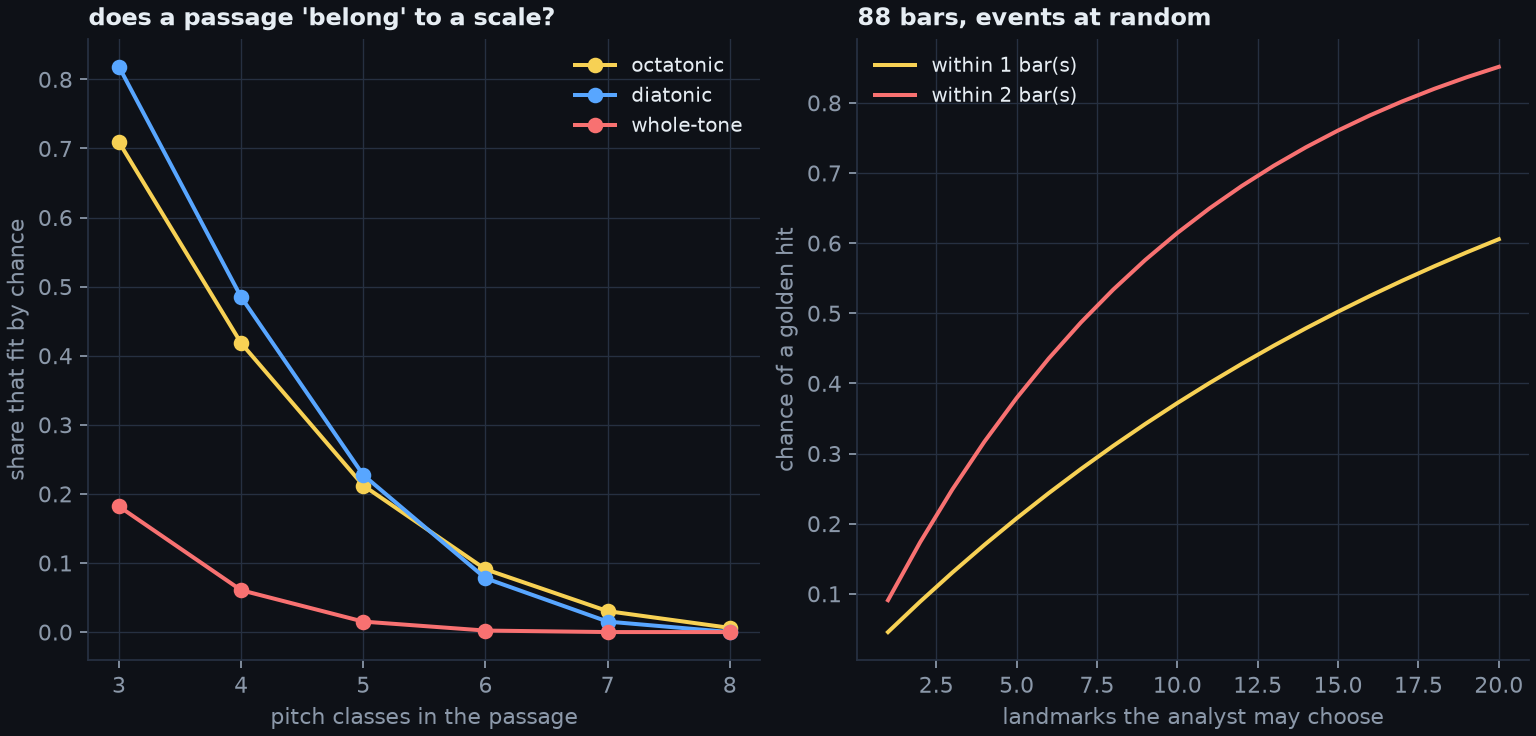
Suppose events fall at random bars in an eighty-eight-bar movement. How often does one of them land within a bar of a golden point, at 0.382 or 0.618 of the way through? For a single, pre-chosen landmark, about times in a hundred: rare. But an analyst can choose among many landmarks, climaxes, entries, changes of texture. With five to choose from, the chance is in a hundred. Allow two bars either way and ten landmarks, and it is in a hundred: more likely than not. A golden-section claim is stronger evidence when landmarks and tolerances are specified independently, or when selection and multiple testing are modeled explicitly.
7Two keys at onceFoundations3 min
Can a piece be in C and F♯ at the same time?
The Petrushka chord raised a question. What if two keys sound together, each one clear? Darius Milhaud, back in Paris from Brazil, wrote piano dances in 1920 with each hand in its own key. In America, Charles Ives had already written music that remembers two marching bands passing each other in a parade. Is that really two keys, or one strange one? Part 15's key-finder can be asked.
Here is the experiment, on the Tune. Its first two phrases in C major, on the white keys, over a sustained F sharp major chord, on the black keys: the two keys a tritone apart, as in the Petrushka chord. Listen for whether you hear two layers, or one.
Ask the key-finder. The tune alone: C major, with a correlation of , about as clear as a key gets. The chords alone: F sharp major, . Both together: the best single key it can find is , which is neither, and its correlation is . The combined distribution produces a different best profile; correlation is not a calibrated measure of perceptual clarity. Whether a listener hears two keys or one strange one depends on keeping the layers apart, by register, by instrument and by rhythm, which is what Part 45's auditory scene is about.
Americans had got there by another road. Charles Ives ran an insurance agency in New York and composed in his spare time. His father, a Connecticut bandmaster, was remembered for marching two bands past each other playing different tunes. In The Unanswered Question, of 1908, strings play slow triads, a trumpet asks the same phrase again and again, and a group of flutes answers with contrasting, increasingly unsettled pitch material and tempo. Layers in different keys and tempos, heard at once, years before Paris. Most of it went unperformed for decades; his Third Symphony won a Pulitzer Prize in 1947.
Paris kept experimenting. After 1918 a group of young composers, Les Six, took Erik Satie as their mascot and turned against Wagner's weight and Debussy's mist. Satie's music had long been plain, ironic and repetitive; his Gymnopédies date from 1888. Ravel's Boléro, of 1928, is two principal melodic strains over a repeating rhythmic ostinato, made into a long crescendo of orchestration. Jazz arrived, and Milhaud put it into a ballet, La création du monde, in 1923. The new scales and rhythms were becoming ordinary tools, in concert music and popular music alike.
8Messiaen: modes and palindromesFoundations3 min
What is a rhythm that cannot be reversed?
Olivier Messiaen turned symmetry into a whole language. He was organist of a Paris church for some sixty years and a devout Catholic, and in 1940, as a prisoner of war, he wrote the Quartet for the End of Time, first played in the camp in January 1941. He transcribed birdsong in the field and took rhythms from Greek metres and from a medieval Indian list of rhythms, the deśītālas. To his symmetric modes he added symmetric rhythms. His music is in copyright, so the example is ours, built by his rules.
A non-retrogradable rhythm is a palindrome: it reads the same forwards and backwards, so reversing its duration sequence changes nothing; pitches and articulation need not be palindromic. Here, durations of one, two, three, two and one sixteenths, mirrored about the middle. Each duration carries a chord drawn from Messiaen's second mode, the octatonic, and the whole figure is played twice.
How rare are they? Count every rhythm of a given length made of durations from one to four sixteenths, on a logarithmic scale. Sixteen sixteenths, one four-four bar, can be filled in ways. Only of them are palindromes. A palindrome is decided by its first half alone, so their number grows like the square root of the total. Rarity under this enumeration does not by itself make the mirror audible: recognition and prediction depend on context and listener experience.
And his added value, heard. Eight even notes on a woodblock. Then the same eight with a sixteenth slipped into two of them, in pink. Nothing else changes, but the even pattern is broken twice, and the second version will not settle into a bar.
He had other techniques. Added values: a short note, a dot or a rest added to a regular rhythm to throw it off balance. Rhythmic canons, with augmentation by uneven ratios. And birdsong, transcribed in the field and harmonized, in the Catalogue of Birds of the 1950s. His pupils included Pierre Boulez, Karlheinz Stockhausen and Iannis Xenakis, who lead into the next part's serialism and Part 30's sound itself. Symmetry, a theorem in pitch and a palindrome in time, had become a composer's material.
91913, and afterFoundations3 min
Was there really a riot?
The Rite's first night has become a legend. On the twenty-ninth of May 1913 Sergei Diaghilev's Ballets Russes danced it at the new Théâtre des Champs-Élysées, in choreography by Vaslav Nijinsky: dancers stamping, feet turned inwards, none of ballet's grace. Pierre Monteux conducted, and parts of the audience laughed, whistled and shouted back at each other, so loudly, by several accounts, that Nijinsky stood on a chair in the wings calling out the counts to the dancers. Less than a year later the score was played in concert, without the dancing, and cheered.
Before the Rite, a word about labels. Debussy's music is often called impressionist, after the painters, a word he disliked. His allies were poets, Mallarmé and Verlaine and the Symbolists, and his Prelude to the Afternoon of a Faun, of 1894, follows a poem by Mallarmé. Their ideal was suggestion rather than statement: a harmony that does not resolve, a form that does not announce itself. Such labels come later; the music was argued about as it appeared.
How much of the legend is true? The accounts we have were mostly written down later, some of them decades later, and they disagree with each other. Much of the uproar may have been provoked by the dancing rather than the music. And the riot grew in the retelling into a founding myth of musical modernism. It is a historian's question, of how many independent witnesses there are and how soon they wrote, the same question the series asked of the chant legends in Part 23 and of Beethoven's metronome in Part 26.
What came after? The war of 1914 to 1918 ended the world of the Ballets Russes' first seasons. Stravinsky turned to what was called neoclassicism, Baroque forms in dry textures, beginning with Pulcinella in 1920. Bartók's six string quartets combine symmetry, folk rhythm and strict counterpoint. The new scales passed into film scores, jazz and popular song. And in Vienna, Schoenberg's circle gave a different answer: give up the key entirely. That is the next part.
The usual story leaves people out. Lili Boulanger, in 1913, the year of the Rite, became the first woman to win the Prix de Rome for composition; she died at twenty-four. Her sister Nadia taught a century of composers, from Aaron Copland to Philip Glass. Germaine Tailleferre was the one woman of Les Six. In America, Ruth Crawford Seeger wrote dissonant counterpoint and then devoted herself to transcribing American folk song. The period's history is still being widened.
10Frontier: is it octatonic?Research3 min
How would you know a passage was written in a scale?
Chapter four promised an argument. The theorist Pieter van den Toorn, in 1983, and the historian Richard Taruskin made the octatonic scale a key to Stravinsky's music, finding long passages whose notes all lie in one octatonic collection. In 2002 Dmitri Tymoczko argued that many of those passages fit other explanations as well or better, for instance two diatonic layers laid on top of each other. Underneath is a statistical question: how often would a passage fit a scale by chance?
Here is the chance, computed exactly. Take every possible set of k pitch classes, and ask what share of them lies inside some octatonic scale, some diatonic scale, or some whole-tone scale. A passage using four pitch classes fits an octatonic scale times in a hundred by chance, and a diatonic one times. With six pitch classes, and . With seven, the octatonic still catches in a hundred and the diatonic hardly any. So a short passage that fits a scale proves little; many distinct pitch classes fitting one collection is more selective under this uniform-set null; musical controls and segmentation choices still matter.
This kind of counting has a history in music theory. In 1973 Allen Forte named and numbered pitch-class sets in his catalogued cardinalities, up to transposition and inversion: two hundred and twenty-four classes when all cardinalities, including empty and full sets, are counted, against the three hundred and fifty-two chapter two counted without inversion. His analysis depends on segmentation, deciding which notes belong together, and the analyst decides. Computational studies now segment automatically and compare whole corpora, and the same caution applies to them: a pattern found must be compared with what chance would find.
A concrete version. Cut a score into passages and find, for each, the collection that holds the most of its sounding time. Compare with a null: the same passages with their pitch classes shuffled, or music by other composers. Weigh the rival explanations, one octatonic collection, two diatonic layers, a mode, by how well each fits and how much it assumes. How much of a repertoire is octatonic beyond chance, and where? A model comparison rather than a list of examples would settle part of an old argument.
Variation 28, recap and problemsAll tracks2 min
Every part ends by doing something to the Tune with what it built. This time, symmetry. First the Tune moved onto the whole-tone scale, with an augmented triad, itself a whole-tone chord, planed under every note: nothing in it is not whole-tone. Then the Tune on the octatonic scale, bowed, over a piano ostinato whose accents chance has placed, in pink.
Row twenty-eight of the ledger: seconds. The measurement: augmented triads planed, and accents placed by chance on ostinato notes.
What did we find? The whole-tone scale has one step size, two transpositions, and no uniquely privileged tonic within its collection alone. Of possible scale shapes, are symmetric, and Messiaen’s seven are a selected subset. Planing, the octatonic and two keys at once were heard, and a key-finder showed two clear keys making one unclear one. Displaced accents keep the pulse and can weaken the chosen metric cues. A golden-section claim with loose landmarks succeeds by chance more often than not. And a short passage fits a scale by chance so often that cardinality, null model and segmentation matter as well as duration.
Five problems. One to compute, one to prove, one for your ears, one to build, and a research problem, marked with a star. Solutions are in this part's notes. Pause here.
Where does this come back? Next, in music that gives up the key altogether. In the mathematics of symmetry, transformations and the geometry of chords. In the mathematics of rhythm and scale. In the gamelan and other musics, heard on their own terms. And in the studio, where the ostinato becomes a loop.
And in practice. Composers choose a collection and know its symmetries. Jazz players reach for the diminished scale over a dominant chord. Drummers group fast pulses in twos and threes. And analysts test a claim against what chance would give.
The books and papers this part follows. The full list, with notes, is in the README.
Where it goes next. Twelve tones in Part 29; transformations and the geometry of chords in Parts 31 and 32; rhythm and scale as mathematics in Part 33; the gamelan in Part 36; loops and sequencers in Part 53.
Key results
The part's results in one place, for revision.
Try it
Lab 28 · New scales and new rhythms, computed
Find any scale's symmetries, measure how often a passage would fit a scale by chance, count additive and palindromic rhythms, test a golden-section claim against a null model, and hear accents displaced.
python -m videos.music.labs 28
needs numpy, scipy, matplotlib · download lab28.py ·
source on GitHubthe set (0, 1, 4, 5, 8, 9): transpositions, Messiaen mode 4, None
contained in some octatonic / diatonic / whole-tone / pentatonic scale False / False / False / False
shapes up to transposition; symmetric ones 352; 15
chance a k-note set fits some octatonic scale, k = 3..8 0.709, 0.418, 0.212, 0.091, 0.030, 0.006
chance a k-note set fits some diatonic scale, k = 3..8 0.818, 0.485, 0.227, 0.078, 0.015, 0.000
ways to group 12 pulses in 2s and 3s 12: 2+2+2+2+2+2 2+2+2+3+3 2+2+3+2+3 2+2+3+3+2 2+3+2+2+3 2+3+2+3+2 ...
rhythms of length 12 from durations 1-4; palindromes among them 1490; 52
88 bars, within 1 bar(s), 5 landmarks: chance of a 'golden' hit 0.208 (one landmark: 0.045)
ear problem: the eight ostinatos in the order played (listen first) regular, displaced, regular, displaced, displaced, regular, regular, displaced
Symmetric scales are rare and are all built from a repeated pattern; short passages fit common scales by chance; and a golden-section claim is only as good as the landmarks fixed before looking.The code (92 lines; it asserts its own result)
"""Lab 28: new scales and new rhythms, computed: any pitch-class set's symmetry and Messiaen mode, the chance that a
passage of k pitch classes fits a scale, additive and palindromic rhythms counted, the golden section against its null
model, and eight ostinatos, regular or displaced, sorted by ear."""

import numpy as np

from videos.coursekit import labs
from explainer.music.monochord import SR, Clip, concat
from explainer.music.monochord import modern as MD
from explainer.music.monochord.partkit import organ_tone

TITLE = "New scales and new rhythms, computed"
GOAL = ("Find any scale's symmetries, measure how often a passage would fit a scale by chance, count additive and "
        "palindromic rhythms, test a golden-section claim against a null model, and hear accents displaced.")
TASKS = [
    "Choose a SET of pitch classes. How many transpositions does it have, is it one of Messiaen's modes, and which scales contain it?",
    "Change BARS, TOL and LANDMARKS. How many landmarks does an analyst need before a golden-section 'hit' is likely by chance?",
    "Change PULSES. How fast do the additive rhythms grow, and how fast the palindromes?",
]
SET = (0, 1, 4, 5, 8, 9)
BARS, TOL, LANDMARKS = 88, 1.0, 5
PULSES = 12


def hit(acc: bool, seconds: float = 0.16) -> np.ndarray:
    y = sum(organ_tone(440 * 2 ** ((m - 69) / 12), seconds, partials=5, rolloff=0.6, decay=12.0) for m in (52, 56, 59, 63))
    return y * (0.35 if acc else 0.08)


def ostinato(accents, pulses: int = 32, unit: float = 0.17) -> Clip:
    y = np.zeros(int((pulses * unit + 0.5) * SR))
    for i in range(pulses):
        s = hit(i in accents)
        j = int(i * unit * SR)
        y[j:j + len(s)] += s[: len(y) - j]
    return Clip(y, SR).fade(0.005, 0.1).at_level(-20.0)


def run(seed=0):
    rng = np.random.default_rng(seed)
    lab = labs.Lab()

    # 1. a set's symmetry
    lab.row(f"the set {SET}: transpositions, Messiaen mode", f"{MD.transpositions(SET)}, {MD.messiaen_mode(SET)}")
    lab.row("contained in some octatonic / diatonic / whole-tone / pentatonic scale",
            " / ".join(str(MD.fits(SET, s)) for s in (MD.OCTATONIC, MD.DIATONIC, MD.WHOLE_TONE, MD.PENTATONIC)))
    c = MD.census()
    lab.row("shapes up to transposition; symmetric ones", f"{c['classes']}; {c['n_symmetric']}")

    # 2. chance fits
    for name, sc in (("octatonic", MD.OCTATONIC), ("diatonic", MD.DIATONIC)):
        lab.row(f"chance a k-note set fits some {name} scale, k = 3..8",
                ", ".join(f"{MD.chance_fits(k, sc):.3f}" for k in range(3, 9)))

    # 3. rhythms
    lab.row(f"ways to group {PULSES} pulses in 2s and 3s", f"{len(MD.additive(PULSES))}: " + " ".join("+".join(map(str, r)) for r in MD.additive(PULSES)[:6]) + " ...")
    lab.row(f"rhythms of length {PULSES} from durations 1-4; palindromes among them",
            f"{len(MD.compositions(PULSES, (1, 2, 3, 4)))}; {MD.count_palindromes(PULSES)}")

    # 4. the golden section
    lab.row(f"{BARS} bars, within {TOL:g} bar(s), {LANDMARKS} landmarks: chance of a 'golden' hit",
            f"{MD.golden_chance(BARS, TOL, LANDMARKS):.3f} (one landmark: {MD.golden_chance(BARS, TOL, 1):.3f})")
    assert 0.0 <= MD.golden_chance(BARS, TOL, LANDMARKS) <= 1.0

    # 5. Problem 3: eight ostinatos, regular or displaced
    kinds = list(rng.permutation(["regular"] * 4 + ["displaced"] * 4))
    clips = []
    for k in kinds:
        acc = list(range(0, 32, 4)) if k == "regular" else MD.accents(32, 8, rng)
        clips.append(ostinato(set(acc)))
    lab.audio = concat(clips, gap=0.8)
    lab.row("ear problem: the eight ostinatos in the order played (listen first)", ", ".join(kinds))

    fig, (a, b) = labs.figure(2)
    ks = list(range(3, 9))
    for name, sc, col in (("octatonic", MD.OCTATONIC, labs.GOLD), ("diatonic", MD.DIATONIC, labs.BLUE), ("whole-tone", MD.WHOLE_TONE, labs.RED)):
        a.plot(ks, [MD.chance_fits(k, sc) for k in ks], "o-", color=col, label=name)
    a.set_xlabel("pitch classes in the passage")
    a.set_ylabel("share that fit by chance")
    a.legend(frameon=False)
    a.set_title("does a passage 'belong' to a scale?")
    ms = np.arange(1, 21)
    for tol, col in ((1.0, labs.GOLD), (2.0, labs.RED)):
        b.plot(ms, [MD.golden_chance(BARS, tol, int(m)) for m in ms], color=col, label=f"within {tol:g} bar(s)")
    b.set_xlabel("landmarks the analyst may choose")
    b.set_ylabel("chance of a golden hit")
    b.legend(frameon=False)
    b.set_title(f"{BARS} bars, events at random")
    lab.fig = fig
    lab.note = ("Symmetric scales are rare and are all built from a repeated pattern; short passages fit common scales by "
                "chance; and a golden-section claim is only as good as the landmarks fixed before looking.")
    return lab
Now change it
- Choose a SET of pitch classes. How many transpositions does it have, is it one of Messiaen's modes, and which scales contain it?
- Change BARS, TOL and LANDMARKS. How many landmarks does an analyst need before a golden-section 'hit' is likely by chance?
- Change PULSES. How fast do the additive rhythms grow, and how fast the palindromes?
Problems, with solutions
Try each problem before opening its solution.
-
Compute. How many different transpositions does the set {0, 1, 4, 5, 8, 9} have? Name the pattern it repeats.
Solution
Transposing by 4 maps it onto itself (0→4, 1→5, 4→8, 5→9, 8→0, 9→1), and no smaller step does, so it has 4 different transpositions. It repeats the pattern {0, 1} every 4 semitones: the hexatonic scale.
-
Prove. Show that the number of ways to group n pulses into 2s and 3s satisfies a(n) = a(n−2) + a(n−3).
Solution
Every grouping of n pulses ends with a group of 2 or a group of 3. Removing it leaves a grouping of n−2 or of n−3 pulses, and every such grouping extends in exactly one way, so the two kinds are counted by a(n−2) and a(n−3), with a(0) = 1, a(1) = 0, a(2) = 1.
-
Ear. The lab plays eight short ostinatos, some with an accent on every fourth pulse, some with accents at random. Sort them.
Solution
The lab prints the order. The regular ones let you tap a four-pulse beat after two accents; the random ones keep defeating the attempt.
-
Build. Write a program that finds, for any passage, the scale collection holding the most of its sounding time, with a chance baseline.
Where to look.
modern.best_fitscores each transposition of a scale by duration; for the baseline, keep the passage's rhythm and register and shuffle its pitch classes (or draw passages of the same length from other music), and report how often the shuffled passage fits as well as the real one. -
★ How much of a repertoire is octatonic beyond chance, and where?
Where the frontier is. Segment a corpus of scores (by phrase, by texture change, or by a fixed window), find each segment's best-fitting collection under rival models (one octatonic collection; two diatonic layers; a mode), compare them by likelihood with a penalty for flexibility, and compare the real corpus with shuffled and with other composers' music; report the share of music that is octatonic beyond chance, with an interval, and where in the pieces it lies.
Notes and sources
Sources
- R. Taruskin, The Oxford History of Western Music, vol. 4 (2005), and Stravinsky and the Russian Traditions (1996); P. van den Toorn, The Music of Igor Stravinsky (1983); A. Berger, "Problems of pitch organization in Stravinsky", Perspectives of New Music (1963); D. Tymoczko, "Stravinsky and the octatonic: a reconsideration", Music Theory Spectrum (2002).
- E. Antokoletz, The Music of Béla Bartók (1984); E. Lendvai, Béla Bartók: An Analysis of his Music (1971); R. Howat, "Bartók, Lendvai and the principles of proportional analysis", Music Analysis (1983).
- O. Messiaen, Technique de mon langage musical (1944); R. Cohn, Audacious Euphony (2012), for hexatonic poles; A. Forte, The Structure of Atonal Music (1973).
- F. Busoni, Sketch of a New Esthetic of Music (1907).
- Part 6 for temperaments; Part 9 for bars and gongs; Part 11 for syncopation and polyrhythm; Part 12 for scales and Burnside's count; Part 15 for key profiles; Part 21 for the golden section.
About this partfrom its README
Part 28 of a sixty-eight-part course in music (see the series plan and
the syllabus), the first part of Act V. Part 27 ended with a jump in chromaticism after 1900; this
part follows the composers who loosened the key with other scales and other rhythms, from the gamelan Debussy heard in
1889 to Messiaen. It enumerates every scale with limited transposition, hears planing, the octatonic, displaced accents,
additive rhythm and two keys at once, and tests two famous analytical claims, the golden section in Bartók and the
octatonic in Stravinsky, against what chance would give. The tools are Monochord's
(explainer/music/monochord/modern.py). Most of the period's music is still in copyright, so every example in the film
is an original sketch built on the Tune or on a stated rule (SYLLABUS §2.4); the works themselves are described.
- A gamelan in Paris. The 1889 Exposition; a gamelan texture of our own in an idealized slendro (Part 9's bars and gongs), heard; the plan.
- 1. A scale without a home. The whole-tone clock (2 transpositions, no half steps); an ear question (the Tune in C major and in whole tones: which has no half steps?); Scriabin's mystic chord; Debussy's Voiles; the pentatonic; the same melody on five equal steps and on the black keys, heard (they differ by up to 80 cents); Busoni, Hába, Carrillo.
- 2. Every symmetric scale. 4,096 sets, 352 shapes up to transposition; the 15 with limited transposition, of which seven form Messiaen’s selected modes; modes 1 to 3 heard; the hexatonic and Cohn's hexatonic poles; the proof that every symmetric set repeats a pattern every 1, 2, 3, 4 or 6 semitones; Messiaen's Technique.
- 3. Chords that slide. Planing; an ear question (planed major triads or functional chords?); planing in jazz and film; La cathédrale engloutie.
- 4. The octatonic. The scale and its four major triads, heard; C and F♯ major together, broken, and an octatonic ostinato, heard; Rimsky-Korsakov, Stravinsky, the Petrushka chord.
- 5. Rhythm set loose. The Rite of Spring; an ear question (accents on every fourth pulse or at random: where is the downbeat?); why the ear gives up; changing metres; ostinatos of 3, 4 and 5 pulses layered, realigning after 60, heard.
- 6. Bartók: fieldwork, symmetry, proportion. Bartók and Kodály's collecting; additive rhythms of 5, 7, 8 and 9 pulses, heard, and counted (the Padovan numbers); Lendvai's axis system; Lendvai's golden-section claim and Howat's critique; the null model (88 bars, one fixed landmark within a bar: 4.5 in 100; five: 21; ten within two bars: 61).
- 7. Two keys at once. Bitonality; Ives; the Tune in C over F♯ major, heard; the key-finder fits the tune (C major, 0.96) and the chords (F♯ major, 0.83) but finds no single key for both (best B♭ minor, 0.74); Paris between the wars.
- 8. Messiaen: modes and palindromes. The Quartet for the End of Time; a non-retrogradable rhythm with mode 2 chords, heard; palindromes counted (193 of 20,569 rhythms of sixteen sixteenths); an added value, heard; more techniques.
- 9. 1913, and after. Not impressionism; the first night of the Rite; how much of the riot is legend; after the Rite; Lili and Nadia Boulanger, Tailleferre, Crawford Seeger.
- 10. Frontier: is it octatonic? Van den Toorn, Taruskin and Tymoczko; the exact chance that a k-note passage fits a scale (four notes: octatonic 42, diatonic 49 in 100; seven: 3 and 1.5); Forte's set classes (224 up to inversion); ★ research problem: how much of a repertoire is octatonic beyond chance, and where?
- Variation 28, recap and problems. The Tune on the whole-tone scale with augmented triads planed under every note, then on the octatonic scale over an ostinato whose accents chance placed; the ledger; what we found; five problems; where it comes back; in practice; Part 29.
What is computed and built
python -m videos.music.music28.compute (about a minute) fills .cache/music28/.
| Item | What it computes | Checked against |
|---|---|---|
hook, slendro |
a gamelan texture of our own; its core melody on equal steps and on the black keys | — |
wholetone, modes, census |
the Tune moved degree for degree; Messiaen's modes 1–3; every set's period and shape | the theorem (tests) |
planing, octatonic, triads |
planed and functional harmony; the scale, its triads, the Petrushka chord, an ostinato; chance fits | exact enumeration |
accents, blocks, bartok |
regular and random accents; layered ostinatos; additive rhythms and their counts; the golden-section null | the recurrence (tests) |
polychord, messiaen, added |
the Tune over F♯ with key fits; a palindrome with mode 2 chords and palindrome counts; added values | Part 15's profiles |
tune |
Variation 28 | — |
Monochord's tools are held in tests/music/test_modern.py; this part's claims and clips in
tests/music/test_music28.py.
Sounds. Part 7's piano and bowed string; Part 9's bars, gongs, drums and woodblock (physical models). There are no recordings, and no copyrighted music is played.
What the models are, and are not. The gamelan is a sketch in an idealized slendro of five equal steps; real Javanese tunings vary from set to set and are not equal, and real gamelan pieces are organized far more richly. The octatonic and diatonic chance fits count pitch-class sets, not passages: a real passage's notes are not chosen at random, which is why the research problem calls for a null built from music. The golden-section null places landmarks uniformly at random; real landmark distributions need not be uniform; their location and dependence can change the hit rate in either direction. The accents of the Rite-like example are placed by a random generator, not taken from the score. The bitonal key fits weight every note by its duration.
Notes
The 352 transposition classes include the empty and full sets; 15 nontrivial limited-transposition classes remain when those two symmetric cases are excluded. Messiaen’s seven are a selected subset, not uniquely the seven largest by cardinality. The C-major/A-flat-minor hexatonic-pole example uses {0,3,4,7,8,11}, a transposition of canonical {0,1,4,5,8,9}.
Whole-tone symmetry does not uniquely privilege a tonic, but context can establish one. Major-scale asymmetry alone also does not choose a tonic among relative modes. Random accents can weaken a specified grid’s cues without universally destroying metre. Profile correlations are model fits, not calibrated perceptual clarity or proof that listeners hear two keys. A palindromic duration sequence need not have palindromic pitches or be perceptually recognized.
The scale-fit probabilities use uniformly selected distinct pitch-class sets. Cardinality, segmentation, musical sampling and model complexity matter; long duration alone does not establish significance. Forte’s total of 224 TnI classes refers to all cardinalities including empty and full sets, rather than the scope of the original catalog alone. Boléro uses two principal melodic strains. The musical examples here are original constructions.
Companion material in this repository
The syllabus's plan for this partfrom SYLLABUS.md, the plan of record
- Hook: Paris 1889; a gamelan texture of our own heard; the plan.
- A scale without a home: the whole-tone clock; an ear question (which has no half steps?); Scriabin's chord; Voiles; the pentatonic; slendro against the black keys heard; smaller steps.
- Every symmetric scale: 352 shapes; the 15 symmetric ones; Messiaen's first three modes heard; the hexatonic; why so few; Messiaen's modes.
- Chords that slide: planing; an ear question (which is planed?); planing after Debussy; the sunken cathedral.
- The octatonic: the scale; its four triads heard; scale, chord and ostinato heard; Rimsky-Korsakov and Stravinsky.
- Rhythm set loose: the Rite; an ear question (where is the downbeat?); why the ear gives up; changing metres; layered ostinatos heard.
- Bartók: fieldwork; additive rhythms heard; counted; the axis system; the golden section claimed; its null model.
- Two keys at once: bitonality; Ives; the Tune over F sharp heard; one key and two fitted; Paris between the wars.
- Messiaen: the Quartet; a palindrome heard; palindromes counted; an added value heard; more techniques.
- 1913, and after: not impressionism; the first night; the legend; after the Rite; others in the room.
- Frontier: the octatonic debate; fits by chance; sets as data; the research problem.
- Variation 28: whole-tone planing, an octatonic ostinato. Outro: problems, payoffs.
Covers: whole-tone, pentatonic and octatonic collections; planing; ostinato and displaced accents; polychords;
Bartók's fieldwork, symmetry and additive rhythm; Messiaen's modes of limited transposition and non-retrogradable
rhythms; the golden-section claims.
Built and computed: monochord/modern.py: every one of the 4,096 pitch-class sets examined (352 shapes, 15 with
limited transposition, each a union of cosets, Messiaen's seven among them); the exact chance that a k-note set fits an
octatonic, diatonic or whole-tone scale; one key against two fitted to a bitonal texture; additive rhythms (the Padovan
numbers) and palindromes counted; the golden section against a null model with landmarks and tolerance.
Variation 28: the Tune in whole-tone planing, then as an octatonic ostinato with moving accents.
Frontier: the octatonic debate; computational analysis of early modernism.
Rights: analysis and original pastiche where a work is in copyright (§2.4); every example in the film is ours.
Reading: Taruskin vol. 4; Antokoletz; Tymoczko (2002).
Build the film
python -m videos.music.music28.compute        # the part's numbers, into .cache/music28
python tools/build.py music28                  # render and assemble the film
EXPLAINER_TTS=silent python tools/qa_scene.py music28 Hook   # one chapter, silent, with a contact sheet
Scenes: videos/music/music28. Setup: see the course page. Source of these notes: the README and the scenes' narration.
Build it
python -m videos.music.music28.compute                          # numbers and sounds (about a minute)
EXPLAINER_TTS=silent python tools/build.py music28 -q l --fps 15   # a silent-narration preview, with the sounds
python tools/qa_sound.py music28 --sync                         # the sound gates
python tools/dead_air.py renders/music28_480p.mp4 --sound music28  # no empty screen; no sound over a still one
python tools/lecture_length.py music28                          # 30 to 60 minutes, listening included
python tools/build.py music28                                   # 1080p30, narrated
python -m pytest -q tests/music                                 # Monochord against its references; this part's claims and clips
python -m videos.music.labs 28                                  # the lab (writes a figure and a short WAV)