Waves in Air
What is it that travels from an instrument to your ear, how fast, and why does it bend round walls, hum in a bottle and drop in pitch as it passes?
Krakatoa's explosion in 1883 was heard 4,800 kilometres away four hours later, and barographs caught its pressure pulse circling the planet at the speed of sound. Boyle's jar shows that sound needs air; a row of simulated parcels shows that what travels is a push, not the air. The speed comes out of the gas law: Newton's value is 15 percent short, Laplace's adiabatic correction repairs it, and parcels given each law run at 280 and 331 metres a second. Loudness is counted in decibels, and ten strings are ten decibels more than one, on average. Sound spreads by the inverse-square law; its wavelength decides whether it bends round a wall (the simulation lands within two decibels of Maekawa's chart) and stripes the space between two sources. A pipe has the notes n c/2L or (2n-1) c/4L, a bottle is a mass on a spring, a flare hands sound to the air where a sudden opening throws it back, and a passing source glides in pitch. The frontier is sound loud enough to steepen into shocks, as in a trombone. The Tune is played on six bottles tuned by their water.
What you need. Part 1 for waves, modes and the wave equation. School physics: pressure, density, the gas law. Logarithms for the decibel.
- Ideas, mathematics and history
- pressure waves, the speed of sound (Newton's error, Laplace's fix), decibels, the inverse-square law, diffraction, standing waves, Helmholtz resonators, Doppler
- What we build, compute and hear
- a 2-D acoustic simulator; the Tune blown on tuned bottles
What you will be able to do
Foundations
- Say what moves and what travels in a sound wave, and how small the motion is at ordinary levels.
- Convert between pressure, intensity and decibels, and apply +3, +6, +10 dB and the inverse-square law.
- Compute a wavelength and predict whether an obstacle will shadow a sound or be bent round.
Full course
- Derive the speed of sound from the adiabatic gas law and explain Newton's 15 percent error.
- Derive the resonances of open and stopped pipes and Helmholtz's formula for a bottle.
- Compute the reflection at a change of impedance and the Doppler shift of a passing source.
Research
- Explain why a finite-amplitude wave steepens, estimate its shock distance, and state the Fubini solution.
- Describe how nonlinear propagation makes brass brassy, and what thermoacoustics adds.
Practice
- Predict how far a pipe goes sharp as it warms, and tune accordingly.
- Estimate the loss behind a barrier from the path difference and the wavelength.
- Explain comb filtering between two loudspeakers and why a horn or a port is an impedance match.
Contents
Each chapter has a home level. Choose a track to see what to read and watch: Foundations 27 min · Full course 38 min · Research 41 min · Practice 38 min.
- 0KrakatoaFoundations3 min
- 1Sound needs airFoundations2 min
- 2What movesFoundations4 min
- 3The speed of soundFoundations3 min
- 4How loudFoundations3 min
- 5Spreading outFoundations2 min
- 6Round the cornerPractice3 min
- 7Two sourcesPractice3 min
- 8Air in a pipeFoundations4 min
- 9A bottleFoundations3 min
- 10Why a string needs a boxPractice3 min
- 11A source that movesPractice3 min
- 12Frontier: when sound is too loud to be linearResearch3 min
- Variation 2, recap and problemsAll tracks4 min
Also on this page: Lecture · Key results · Try it · Lab · Problems · Notes and sources · Build the film.
Lecture
The text of each chapter is the film's narration, as it is spoken, so you can read along or revise without the film. The pictures are in the film. A dashed box stands for a number the film computes when it is rendered (hover over it to see what is computed); the README's figures for each chapter, where it lists them, follow the chapter's text.
KrakatoaFoundations3 min
No string this time. Six bottles, each with a different amount of water in it, and the only thing making that sound is air. By the end of this part you will know how much water goes in each one. But first, the loudest sound anyone has ever written down.
On the twenty-seventh of August, 1883, the volcano Krakatoa, between Java and Sumatra, blew itself apart. In Batavia, a hundred and sixty kilometres away, the pressure gauge at the gasworks leapt off its scale. In Perth, three thousand kilometres away, people heard what they took for artillery. And on the island of Rodrigues, four thousand eight hundred kilometres across the Indian Ocean, the chief of police wrote down a sound like the distant roar of heavy guns. It reached him about hours after the explosion.
Then something stranger. Weather stations keep barographs: pens that trace the pressure of the air on a slowly turning drum. Over the next five days, pens all round the world twitched, and twitched again: seven times in all. It was the same pulse of pressure, running out to the far side of the planet and back, each lap taking about hours. Divide the distance by the time, and you get a little over three hundred metres a second. That is the speed of sound.
So what was it that travelled? Not the air: no wind crosses an ocean in four hours. Why that speed, and no other? And why does sound do the odd things it does: fade with distance, bend round corners, hum one note in a bottle, and drop in pitch as it goes by?
This is Part 2 of Music, Built. In Part 1 we found out why a string has a pitch. A string on its own is nearly silent, though. What reaches your ear is the air. In this part: what a sound wave is, and how small. Where its speed comes from. How loudness is measured. What wavelength does to sound at a wall and between two sources. Why a pipe and a bottle each have notes of their own. And three things the simple picture leaves out.
1Sound needs airFoundations2 min
What happens to a sound when the air is taken away?
Start with the experiment that showed sound needs something to travel in. In 1660 Robert Boyle hung a ticking watch by a thread inside a glass jar, and had Robert Hooke's pump draw the air out. The watch went on ticking. He could see it. But as the air thinned, the ticking faded, until he could hear nothing at all. Let the air back in, and the sound came back.
We can do Boyle's experiment with the string from Part 1. A small vibrating thing sends out sound power in proportion to the density of the air it pushes on. So a tenth of the air means a tenth of the power. Here is our monochord in the jar, with all the air, then a tenth, a hundredth, and a thousandth.
Each step is ten times less power. We will give that step a name in chapter four. For now, the point is Boyle's: no air, no sound. Whatever sound is, it is something the air does.
Boyle's jar shows that sound needs a medium. It does not have to be air. Anything that springs back when it is squeezed will carry sound, and the springier and lighter it is, the faster the sound goes. In air, about metres a second: we will see where that number comes from in chapter three. In helium, which is seven times lighter, nearly three times as fast. That is why a voice full of helium sounds like a cartoon, and the reason turns out to be subtler than a change of pitch: we will come back to it in Part 8. In water, about fifteen hundred. And along a steel rod, : put your ear to a railway line and you hear the train long before the sound arrives through the air. Space, with nothing in it to squeeze, is silent, whatever the films say.
2What movesFoundations4 min
If the air does not travel, what does?
Picture the air in a long tube as a row of small parcels, each one touching the next. Push the first one. It crowds its neighbour. The crowded air pushes back, and pushes forward, so the neighbour moves, and crowds the next. The push runs down the row. But watch the marked parcel. It is shoved forward, and then it stops, and it stays about where it was. That is the answer to the Krakatoa question. What crossed the Indian Ocean was not air. It was a push, handed from each parcel of air to the next.
Now push and pull the end of the row steadily, as a vibrating string or a loudspeaker would. Bands of crowding move down the tube, with bands of thinning between them. Underneath is the pressure along the tube: above normal where the parcels are crowded, below normal where they are spread. That travelling pattern of pressure is the sound. Each parcel only swings back and forth about its own place, along the direction the sound is going. A wave like that is called longitudinal. The string of Part 1 moved across its length; the air moves along it.
There is one relation between the push and the motion that we will need again and again. A parcel speeds up when the pressure behind it is higher than the pressure in front: that is Newton's law. In a plane wave travelling in one direction, the pattern slides at the speed of sound, so a change in time is the same as a change in place. Put the two together and the pressure is simply the density, times the speed of sound, times the speed of the air. In a room that product is about , so a pressure swing of one pascal rms gives a particle velocity of millimetres a second rms. Instantaneous intensity is pressure times particle velocity. Average it in time and you get rms pressure squared, over rho c. That is the relation for this progressive plane wave; reflections can change it. It is why sound level will use rms pressure, squared.
How big is this motion? Astonishingly small. Ordinary speech changes the pressure of the air by about two hundredths of a pascal rms: one part in million of the atmosphere's own pressure. A one-kilohertz tone at that level has a peak parcel displacement of about nanometres: around a hundred atoms' width. At an orchestra's hundred-decibel level, the same tone would move the air about a thousandth of a millimetre. And a sound loud enough to hurt is still less than a thousandth of an atmosphere. So for music, the disturbance is tiny compared with the air it rides on. That is why sounds pass through each other untouched, and why the simple wave equation of Part 1 works so well. In the last chapter we will see what happens when it is not tiny.
3The speed of soundFoundations3 min
Why 340 metres a second, and not some other number?
On a string, the speed of a wave was the square root of the tension over the mass per unit length: what pulls the string back, over what has to be moved. Newton made the same argument for air in 1687. What pushes a squeezed parcel back is the pressure. What has to be moved is the density. Put in the numbers for air at freezing, and you get metres a second. The measured speed is 331. Newton was percent short, he knew it, and nobody could say why for more than a century.
The answer came from Laplace in 1816. Squeeze air and it warms. In a sound wave the squeezing and releasing happen hundreds of times a second: far too fast for the heat to leak away. Warm air pushes back harder, so the air is stiffer than Newton assumed, by a factor of one point four. That gives metres a second. We can check both with the row of parcels from the last chapter. One row obeys Newton's gas law, the other Laplace's. Same push, six metres of tube. The first pulse travels at metres a second. The second at .
Notice what is not in Laplace's formula once you use the gas law: the pressure. Only the temperature is left. Here T is in kelvin and R air is the specific gas constant for air, about 287 joules per kilogram per kelvin. Sound goes about six tenths of a metre a second faster for every degree. That matters to anyone who plays a wind instrument, because, as we will see in chapter eight, the note of a pipe is set by the time sound takes to run along it. Here is one pipe, cold and then warm.
cents: three quarters of a semitone, from a change of twenty-five degrees. About cents for every degree. This is why an orchestra tunes after the players have warmed their instruments, and why an organ and a piano that agree in winter can disagree in summer. It also settles a detail of Krakatoa. The pulse went round the world at about 313 metres a second. In uniform air that corresponds to roughly thirty degrees below zero. This is an equivalent temperature, not a measurement of one atmospheric layer: the real pulse travels through a stratified, moving atmosphere.
4How loudFoundations3 min
How do you put a number on loudness?
The honest measure of a sound's strength is its intensity: the power it carries through each square metre. The trouble is the range. The faintest sound a young ear can detect carries a millionth of a millionth of a watt per square metre. A sound that hurts carries ten watts. That is thirteen powers of ten, and the ear takes them all in its stride. So we count the powers of ten instead. Ten times the intensity is one bel, named for Alexander Graham Bell by telephone engineers in the nineteen twenties. A tenth of that is the decibel. Zero decibels uses a reference near the threshold of a young ear at its most sensitive frequencies. For a progressive plane wave in air, intensity goes as rms pressure squared, so approximately the same level is twenty times the logarithm of the pressure.
Three rules of thumb are worth carrying for the rest of this series. Ten decibels is ten times the power. Three decibels is twice the power. And six decibels is twice the pressure, which is four times the power. Here is our string four times, each time with half the pressure of the time before: six decibels down, at every step.
Now a question with a surprising answer. If one string makes a certain level, what do ten strings make? Strings that are not exactly in step add their powers, not their pressures. So two strings give twice the power: three decibels. Ten give ten decibels. Listen: one, two, ten.
Ten strings, and the level rose by decibels, not by ten. Was the rule wrong? No. Strings that are nearly in tune add like dice. One group lands a little high, another a little low. Average different groups and you get and . Either way, ten players are nowhere near ten times as loud as one. Why ten decibels sounds only about twice as loud is a question about ears, and that is Part 4.
A question for your ears. Two pairs of notes. In one pair the second note has twice the power of the first. In the other it has four times. Which pair is which?
was the bigger step: six decibels, four times the power. A was three. If you found that hard, good. A change of one decibel is about the smallest you can notice at all, and three is a small step. Mixing engineers work in exactly these units.
5Spreading outFoundations2 min
Why is it quieter at the back?
Give the air one push at a point, and the disturbance runs outward in every direction at once. The energy in that first push never grows. It only has more and more room. In open space the room is the surface of a sphere, and the surface of a sphere grows as the square of its radius. Twice as far from the source, the same power is spread over four times the area. Three times as far, nine times the area.
So the intensity is the power divided by the area of the sphere, four pi r squared. That is the inverse-square law. In decibels: every doubling of the distance costs six. Our simulation agrees. Following one ray of a spherical wave outward, the pressure falls as the distance to the power : decibels per doubling. One caution about this part's pictures. They show sound in a flat sheet of air, seen from above, and in a sheet the energy spreads round a circle, not over a sphere. There, the loss is only about three decibels per doubling.
Here is what that sounds like. Our string, heard from one metre, then two, four and eight. Every step doubles the distance.
One worked example. A trumpeter in a town square measures decibels at one metre. You are metres away, with no walls nearby. How loud is the trumpet where you are? Pause, and work it out.
Thirty-two is one, doubled five times. Five doublings at six decibels each is thirty. So decibels: the level of someone talking beside you.
That is outdoors, with nothing to send the sound back. Indoors, the walls return most of what would have escaped, which is the whole reason for a concert hall, and the subject of Part 55. And notice what the law does not say. It says how the level falls. It says nothing about which sounds get past an obstacle. For that, we need one more number.
6Round the cornerPractice3 min
Why can you hear the bass through a wall of people?
The number is the wavelength: how far the sound travels during one vibration. It is the speed divided by the frequency. And for sound, wavelengths are the size of the things around us. The lowest note we hear is seventeen metres long: the length of a house. A double bass's low E is eight metres. The A an orchestra tunes to is seventy-eight centimetres. The top of a piccolo is eight centimetres, and the highest sound we hear, seventeen millimetres. A thousand to one, and you are somewhere in the middle of that range. So a person, a pillar or a wall is a small thing to a bass note and a large thing to a high one.
Here is a wall, four metres high, seen from the side, with a source on one side and a listener on the other. On the left, a low tone, with a wavelength of two metres. On the right, a tone three octaves higher, with a wavelength of twenty-five centimetres. The low tone pours over the top of the wall and fills the space behind it. The high tone goes on in nearly straight lines, and leaves a shadow. Christiaan Huygens had the picture in 1678: every point a wave reaches becomes a small source of its own. A long wave spreads from the wall's edge in all directions. A short one mostly cancels itself, except straight ahead.
How much gets round? We ran the simulation with the wall and without it, and compared what the listener receives at every frequency. At hertz the wall costs decibels. At a thousand it costs . Each octave up, the wall works a few decibels better. The green points are the chart that engineers have used since 1968 to design noise barriers along motorways. Our simulation knows nothing about that chart, and lands within decibels of it.
Now apply that measured curve to a sound. The Tune's first phrase, on the string from Part 1: first in the open, then from behind the wall.
It is quieter, by decibels overall. But listen to how it is quieter. The low part of each note survives and the brightness goes, so the string sounds dull and far away. That is the sound of every party heard from the next room, and of a band heard from outside the hall. You have known what diffraction sounds like all your life.
7Two sourcesPractice3 min
What happens where two sounds meet?
Sound waves are small, so two of them in the same air simply add. Where both push, the air is pushed twice as hard. Where one pushes and the other pulls, nothing happens. Here are two sources sounding the same tone, a little over a metre apart. And here, on the right, is how loud the tone is at each place. The space is striped. Along the bright bands the two waves arrive in step. Along the dark ones they arrive exactly out of step, and a listener standing there hears almost nothing, with two sources playing at full strength.
The rule is simple geometry. Pick a place and measure its distance from each source. If the two distances are equal, or differ by a whole number of wavelengths, the waves arrive in step. If they differ by half a wavelength, crest meets trough. Thomas Young worked this out for light in 1801, and used it to argue that light was a wave. For sound you can check it by walking about.
Take a microphone along the dashed line, at a metre a second. The curve is the pressure it should find. The simulation and the exact formula for two sources agree to within percent of the peak. The quietest spot is decibels below the loudest. Listen to the walk.
One tone, two sources, and a listener who hears it come and go eight times in six metres.
A worked example. Two loudspeakers play the same music, and your seat is thirty-four centimetres nearer to one of them than to the other. Assume the sources are in phase, with equal amplitudes at your seat. Which frequency is cancelled where you sit? Pause, and work it out.
The one whose half wavelength is thirty-four centimetres: hertz, about the C above middle C. And every odd multiple of it as well. The music reaches you with a row of notches cut out of it, like the teeth of a comb, and the notches fall somewhere else in the next seat. That is why the same recording sounds different from every seat when it comes from two loudspeakers, a problem Part 59 has to deal with. Noise-cancelling headphones use the same principle by timing a second wave to oppose the unwanted sound at your ear.
8Air in a pipeFoundations4 min
What are the notes of a tube?
Send a pulse of pressure down a pipe and it comes back from the end, whether the end is closed or open. At a closed end the air has nowhere to go, and the pressure piles up. At an open end the pressure is pinned to that of the room outside, so the pulse returns upside down. In a pipe open at both ends the pressure can only swing in between, and the patterns that fit are the ones we met on the string: one half-wave, two, three. Their frequencies are whole multiples of the first. Now stop one end. The pressure swings most at the stopped end and not at all at the open one, so only a quarter of a wave fits. The lowest note is an octave lower than before, from the same length of pipe. And the next patterns are three quarter-waves and five: only the odd multiples. The even ones are missing.
Here is that pipe, given one sharp push of air: first open at both ends, then with one end stopped.
And the same two pipes with a breath blown across the end. The breath is noise: a hiss with every frequency in it. The pipe keeps its own.
A worked example, with two real instruments. A flute is a pipe open at both ends, about sixty-six centimetres long. The formula gives 262 hertz: middle C, which is indeed a flute's lowest note. A clarinet is nearly the same length, but the reed closes one end. Predict its lowest note.
A stopped pipe sounds c over four L: hertz, nearly an octave below the flute. A real clarinet's bottom note is the D at . Two instruments of the same size, an octave apart at the bottom, and all because of what happens at one end.
One correction, which every flute and organ builder has to make. The pressure is not pinned exactly at the open end. Here is a stopped pipe in open air, in section. The air just outside the mouth moves with the air inside, so the pipe behaves as if it were a little longer than it is. Our sixty-centimetre pipe should sound hertz. It sounds : the note of a pipe centimetres long. For a real, round pipe the extra length is about six tenths of the radius at each open end. That is also where the sound gets out: the little that leaks from the mouth is all you hear.
A question for your ears. Two pipes sounding the same note. One is open at both ends. The other is half as long, and stopped at one end. Which is the stopped one?
. Same note, but with the second, fourth and sixth partials missing, which gives a stopped pipe its hollow, woody sound. A clarinet behaves like a stopped pipe, a flute like an open one, and that difference is a large part of why you can tell them apart. We will build both in Part 8.
9A bottleFoundations3 min
Why does a bottle hum one note, and such a low one?
Blow across a bottle and it hums one low note. That is strange. Our bottle is eighteen centimetres from top to bottom. As a stopped pipe it should sound near hertz. It hums at : more than an octave lower. Hermann von Helmholtz explained it. The bottle is not acting as a pipe at all. The air in the neck moves in and out as one lump: a mass. The air in the body is squeezed and released by it: a spring. The mass is the density times the volume of the neck. The spring is the stiffness of the air in the body: push the plug in, and the pressure inside rises. A mass on a spring has one frequency, and here it is. A wider neck raises the note. A longer neck or a bigger body lowers it.
Our bottle holds a third of a litre. Helmholtz's formula says hertz. Treat the neck and the body properly, as two tubes joined together, and the exact answer is . The simulation, which knows neither formula, gives . So the famous formula is half a semitone sharp for a bottle this shape: the body is not small enough to count as a simple spring. Here is the bottle, slapped on the mouth twice, and then blown.
Now pour water in. Water takes up room, the spring of air gets smaller and therefore stiffer, and the note goes up. The curve is the note against how full the body is: the exact two-tube answer as a line, the simulation as dots, Helmholtz's formula dashed. Empty, a third full, and nearly two thirds full.
So that is how the bottles at the start of this part were tuned: by solving this curve for six notes. And the same mass on a spring is hiding in a great many instruments. The air inside a guitar or a violin is a Helmholtz resonator, with the sound hole as its neck. So is an ocarina. So is the port on the front of a bass loudspeaker.
10Why a string needs a boxPractice3 min
What happens when sound meets a change?
Part 1 ended on a puzzle: a string on its own is almost silent. The reason is the same reason a pulse came back from the open end of a pipe. Watch a pulse of pressure travel down a narrow pipe whose cross-sectional area suddenly becomes four times larger. Part goes on. Part comes back, upside down. Nothing was in the way. The pulse met a change in how hard the air is to push, and that is enough. The quantity that changed is called impedance: the pressure it takes to produce a given volume flow. For a travelling plane wave, pressure divided by particle velocity is rho c. Divide by the pipe's area to get pressure divided by volume flow. A change can turn some of the wave back, and how much is a simple formula, which the simulation confirms.
Now the extreme case. Sound in air arrives normally at the surface of water. Water is eight hundred times as dense and far stiffer: its impedance is three and a half thousand times that of air. Only about a thousandth of the energy gets in. The rest bounces off. That is why poolside voices can be hard to hear from under water. Your own ear has an impedance problem to solve, because the inner ear is full of fluid. A string has the same problem the other way round. It is thin, dense and stiff; the air is light and soft. The string swings, and the air just slips round it.
The cure is to make the change gradual. Here is a narrow pipe opening into one sixteen times its area: on top suddenly, below through a flare a metre long. The same pulse goes down both. From the sudden opening, percent of the energy enters the wider tube. Through the flare, percent. These are transmitted pulse energies in this pipe model, not measured radiation efficiencies of a trumpet. That is what the bell of a trumpet is for, and a megaphone, and the horn of an old gramophone. And it is what the box of the monochord does for the string: a wide wooden plate, driven through the bridge, is a far better match to the air than a wire is. A musical instrument is two things. Something that vibrates, and something that hands the vibration to the air.
11A source that movesPractice3 min
Why does the pitch drop as it passes?
One last thing wavelength explains. Let the source move. Each crest spreads out in a circle from where the source was when it made it. So ahead of the source the crests are crowded together, and behind it they are stretched apart. By how much? Between one crest and the next, the sound travels the speed of sound divided by the frequency, and the source follows it by its own speed divided by the frequency. The gap between crests is the difference. Crowded crests arrive more often, so the pitch you hear is the speed of sound over that shorter gap. Behind the source the sign changes, and the pitch is lower. The source itself has not changed its note at all. Christian Doppler worked this out in 1842.
It was tested three years later in Holland, in the only way available. Christoph Buys Ballot put trumpeters on an open railway wagon, stood musicians beside the track, and had the players hold one note as the train went by. The listeners judged it about a semitone sharp as it came and a semitone flat as it went. For that, the formula needs kilometres an hour, which is about what a locomotive of 1845 could do. Here is a horn passing six metres away at that speed.
The pitch does not jump. It slides, because what matters is how fast the source is closing on you, and that changes smoothly as it goes by. You hear its true note at one instant only: just after it is level with you.
A question for your ears. Two cars pass you, sounding the same horn. One is doing fifty kilometres an hour, the other a hundred. Which is the fast one?
. Its horn fell by nearly three semitones; the slow one's by less than one and a half. Your ear measured a speed. Police radar measures a car's speed the same way, ultrasound measures the speed of blood, and astronomers measure the speed of galaxies. In music the effect is built into one famous instrument: the rotating loudspeaker of an electric organ, which we will meet in Part 49.
12Frontier: when sound is too loud to be linearResearch3 min
What happens when the disturbance is not small?
Everything so far assumed that sound is a tiny ripple on the air. For music it almost always is. But make the ripple large and something new happens. The squeezed part of the wave is hotter, so sound travels faster there, and it is also moving forward with the air. The crests catch up with the troughs. Here is a very loud pure tone in our row of parcels, looked at further and further down the tube. The front of each wave gets steeper and steeper, heading for a vertical cliff: a shock. A steeper wave is a brighter sound. New harmonics appear that the source never made. Fubini's 1935 solution gives their sizes in a weakly nonlinear, lossless model before shock formation. Our gas parcels' first three harmonic amplitudes agree to within of the source amplitude.
Is anything in music that loud? Inside a brass instrument, yes. In a trombone played softly, our lossless constant-bore estimate needs twenty-five metres to break, and the tube is under three. Played as loudly as possible, it breaks in little more than one. In 1996 a group in Eindhoven and Le Mans measured exactly that: shock waves coming out of a trombone. The hard, brilliant edge of loud brass develops partly in the air of the tube, in addition to the harmonics generated by the player's lips. Here is the simulated wave before and after steepening, played at the same loudness, so that all you hear is the change of shape.
This is live research. Instrument makers now compute a number, called brassiness, that says how soon a given bore will go bright. Beyond music, the link between sound and heat runs both ways: a flame in a tube will sing, and a loud enough sound in a tube will pump heat, which gives engines and refrigerators with no moving parts. The same effect, unwanted, can shake a rocket engine apart. And Krakatoa has a modern relative: the eruption in Tonga in 2022 sent a pressure pulse round the world that thousands of barometers recorded. The research problem for this part is the trombone.
Variation 2, recap and problemsAll tracks4 min
Every part ends by doing something to the Tune with what it has built. This part built air in a bottle. So here are six bottles of the same shape, each holding the amount of water that the two-tube formula asks for, from empty up to about two thirds full. Each one is struck on the mouth. This is Variation 2.
Row two of the ledger. seconds, six bottles, and every bottle within cent of its note. Sixty-six rows to go.
What did we find? Sound is a push, handed from each parcel of air to the next. The air stays; the pattern travels. Its speed comes out of the gas law and depends on temperature at fixed gas composition. Level is counted in decibels: three for twice the power, six for twice the pressure, and six lost for every doubling of distance from a point source in the open. Wavelength decides what an obstacle does, and two sources stripe a room with loud and quiet. A pipe has a ladder of notes, complete if it is open, odd-numbered if it is stopped, and a bottle is a mass on a spring. Sound passes where impedances match, shifts in pitch when the source moves, and steepens when it is loud enough.
Five problems. One to compute, one to derive, one for your ears, one to build, and one research problem, marked with a star. Solutions are in this part's notes. Pause here.
Where does this come back? The decibel is with us for the rest of the series, and Part 4 asks what the ear makes of it. Pipes and their end corrections are Part 8, where we build a flute, a clarinet and a voice. Helmholtz's resonator is inside the guitar of Part 7 and the loudspeaker of Part 54. And the simulator that drew this part's pictures will design a concert hall in Part 55.
And in practice. A wind player warms the instrument before tuning, because of three cents a degree. A live sound engineer plans for six decibels per doubling and knows the treble will not reach behind a pillar. Makers of instruments and loudspeakers work with end corrections, ports and flares. And anyone who designs a noise barrier starts from the chart our simulation matched.
The books and papers this part follows. The full list, with notes, is in the README.
Twice now we have explained a sound by taking it apart. A plucked string was a stack of partials. Two pipes played the same note, and you told them apart by which partials were there. We have been leaning on that idea without ever justifying it. Can every sound be taken apart like this? What do you lose when you do? And is that list of partials really all there is to the difference between a flute and a violin? That is Part 3: The Spectrum.
Where it goes next. The decibel returns in Part 4 (what the ear makes of it) and Part 57 (meters). Pipes, end corrections and odd partials are Part 8; the Helmholtz resonator is inside the guitar of Part 7 and the loudspeaker port of Part 54; impedance explains soundboards (Part 7) and the middle ear (Part 4). The 2-D simulator returns for drums (Part 9) and rooms (Part 55), and the question the part ends on, whether every sound can be taken apart into partials, is Part 3.
Key results
The part's results in one place, for revision.
Try it
Lab 2 · Air: its speed from the gas law, and a bottle's note
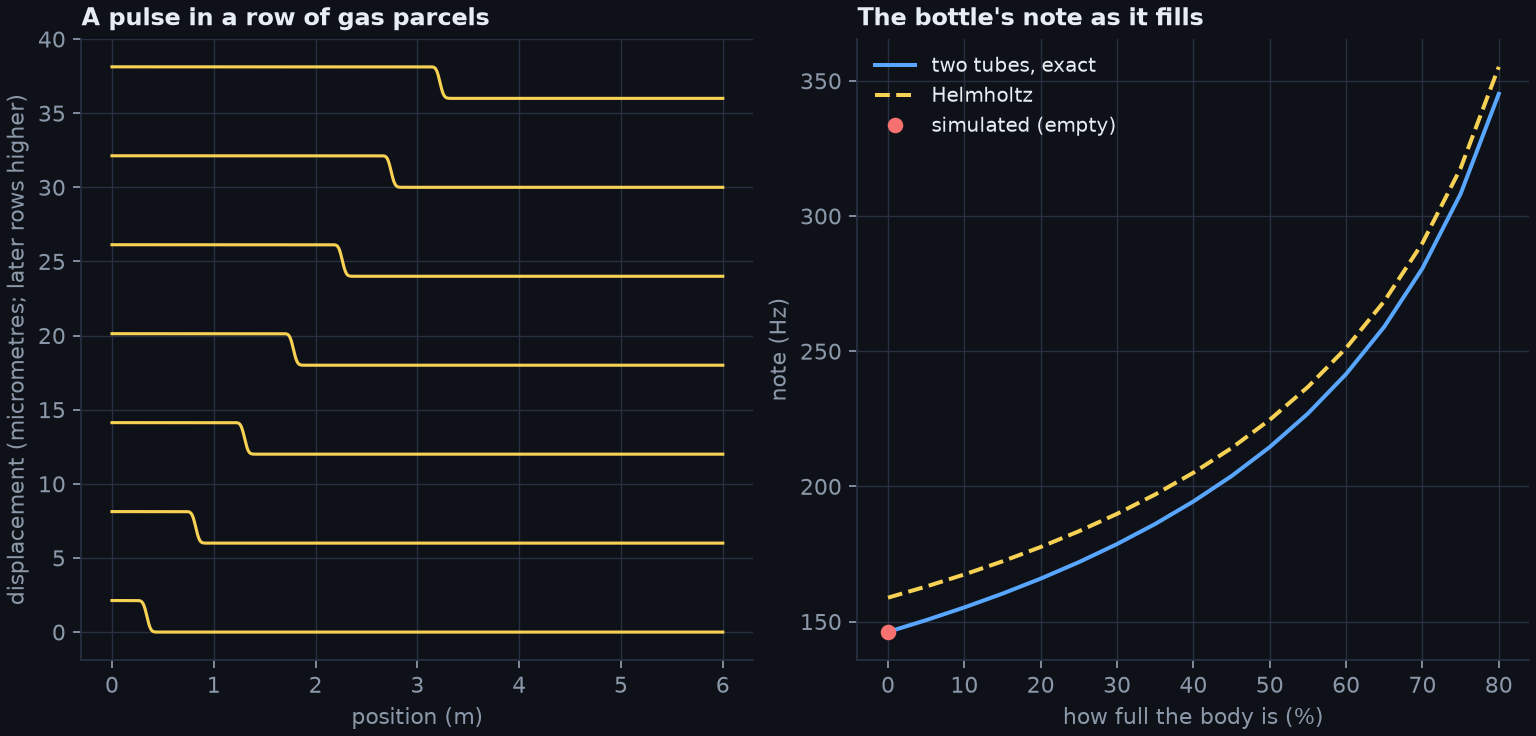
Let a row of gas parcels carry a pulse and read the speed of sound off their motion; then simulate a bottle as a neck on a body and compare its note with Helmholtz's formula and with the exact two-tube root.
python -m videos.music.labs 2
needs numpy, scipy, matplotlib · download lab02.py ·
source on GitHubair at 20.5 C, parcels obeying the adiabatic gas law
speed of the pulse in the simulation 343.4 m/s
sqrt(gamma P / rho) 343.5 m/s
bottle 616 ml, neck 17 mm wide and 4.2 cm long (no end corrections)
Helmholtz's formula 158.8 Hz
two tubes, exact 146.2 Hz
simulated 146.1 Hz (-0.7 cents from exact)
ear problem, the order (listen first) 10 m/s, 20 m/s, 35 m/s
the fastest falls by 354 cents
Parcels that know only the gas law carry a pulse at sqrt(gamma P / rho). A bottle is a mass of air on a spring of air; Helmholtz's formula runs a little sharp because the body is not a point.The code (91 lines; it asserts its own result)
"""Lab 2: the speed of sound from the gas law alone, a bottle against Helmholtz's formula, and three horns for the ear."""

import math

import numpy as np

from videos.coursekit import labs
from explainer.music.monochord import Clip, concat
from explainer.music.monochord.partkit import resample
from explainer.music.monochord.physics import air

TITLE = "Air: its speed from the gas law, and a bottle's note"
GOAL = ("Let a row of gas parcels carry a pulse and read the speed of sound off their motion; then simulate a bottle "
        "as a neck on a body and compare its note with Helmholtz's formula and with the exact two-tube root.")
TASKS = [
    "Change LAW to 'isothermal'. What speed do the parcels give now, and what fraction of Laplace's is it?",
    "Halve the bottle's neck length. Predict the new note from Helmholtz's formula before you run it.",
    "Make the body very short and wide (same volume). Does Helmholtz's formula get better or worse, and why?",
]
LAW = "adiabatic"
SR = 48_000


def run(seed=0):
    rng = np.random.default_rng(seed)
    lab = labs.Lab()

    # 1. the speed of sound: no wave speed is written into the chain of parcels
    celsius = float(rng.uniform(-5, 35))
    run_ = air.gas_chain(6.0, 3001, lambda t: 0.01 * math.exp(-((t - 0.4e-3) / 0.12e-3) ** 2), 0.017, law=LAW,
                         celsius=celsius, probes=(500, 2000), snapshot_every=600)
    times = []
    for v in run_.velocity:
        i = int(np.argmax(v))
        a, b, c = v[i - 1], v[i], v[i + 1]
        times.append((i + 0.5 * (a - c) / (a - 2 * b + c)) * run_.dt)
    got = 1500 * run_.h / (times[1] - times[0])
    want = air.speed(celsius, LAW)
    lab.row("air at", f"{celsius:.1f} C, parcels obeying the {LAW} gas law")
    lab.row("speed of the pulse in the simulation", f"{got:.1f} m/s")
    lab.row("sqrt(gamma P / rho)" if LAW == "adiabatic" else "sqrt(P / rho)", f"{want:.1f} m/s")
    assert abs(got / want - 1) < 3e-3, "the gas law sets the speed of sound"

    # 2. a bottle: Helmholtz's formula, the exact two-tube root, and a simulation
    rn, ln = rng.uniform(0.007, 0.012), rng.uniform(0.04, 0.09)
    rb, vol = rng.uniform(0.028, 0.04), rng.uniform(250e-6, 700e-6)
    a_n, a_b = math.pi * rn ** 2, math.pi * rb ** 2
    lb = vol / a_b
    lumped, exact = air.helmholtz(a_n, ln, vol), air.bottle_exact(a_n, ln, a_b, lb)
    cells = range(max(8, int(ln / 0.0016)), int(ln / 0.00095))          # a cell of 1 to 1.6 mm: stable at 384 kHz
    k = min(cells, key=lambda j: abs(lb / (ln / j) - round(lb / (ln / j))))
    h = ln / k
    nb = int(round(lb / h))
    sim = air.tube(lambda x: a_b if x < nb * h else a_n, (nb + k) * h, 0.5, air.ricker(300.0), where=0.3 * lb,
                   left="closed", right="open", probe=0.2 * lb, n=nb + k, sr=384_000, radiation=0.006, q_loss=4.0)
    f_sim = float(air.resonances(sim.pressure, sim.sr, 1, 40, 900)[0])
    lab.row("bottle", f"{vol * 1e6:.0f} ml, neck {2000 * rn:.0f} mm wide and {100 * ln:.1f} cm long (no end corrections)")
    lab.row("Helmholtz's formula", f"{lumped:.1f} Hz")
    lab.row("two tubes, exact", f"{exact:.1f} Hz")
    lab.row("simulated", f"{f_sim:.1f} Hz   ({1200 * math.log2(f_sim / exact):+.1f} cents from exact)")
    assert abs(1200 * math.log2(f_sim / exact)) < 8 and lumped > exact

    # 3. three horns passing, in a shuffled order (Problem 3)
    speeds = np.array([10.0, 20.0, 35.0])
    order = rng.permutation(3)
    passes = [Clip(air.passing_source(392.0, speeds[j], 6.0, 5.0, harmonics=(1.0, 0.5, 0.33, 0.2))[0]).fade(0.3, 0.3)
              for j in order]
    lab.audio = concat(passes, gap=0.5).at_level(-18.0)
    lab.row("ear problem, the order (listen first)", ", ".join(f"{speeds[j]:.0f} m/s" for j in order))
    up, down = air.doppler(392.0, 35.0)
    lab.row("the fastest falls by", f"{1200 * math.log2(up / down):.0f} cents")

    fig, (a, b) = labs.figure(2)
    x = np.arange(run_.snaps.shape[1]) * run_.h
    for i, row in enumerate(run_.snaps[1:8]):
        a.plot(x, row * 1e6 + 6 * i, color=labs.GOLD, lw=1.4)
    a.set_title("A pulse in a row of gas parcels")
    a.set_xlabel("position (m)")
    a.set_ylabel("displacement (micrometres; later rows higher)")
    fills = np.linspace(0, 0.8, 17)
    b.plot(100 * fills, [air.bottle_exact(a_n, ln, a_b, lb * (1 - f)) for f in fills], color=labs.BLUE, label="two tubes, exact")
    b.plot(100 * fills, [air.helmholtz(a_n, ln, vol * (1 - f)) for f in fills], "--", color=labs.GOLD, label="Helmholtz")
    b.plot([0], [f_sim], "o", color=labs.RED, label="simulated (empty)")
    b.set_title("The bottle's note as it fills")
    b.set_xlabel("how full the body is (%)")
    b.set_ylabel("note (Hz)")
    b.legend()
    lab.fig = fig
    lab.note = ("Parcels that know only the gas law carry a pulse at sqrt(gamma P / rho). A bottle is a mass of air "
                "on a spring of air; Helmholtz's formula runs a little sharp because the body is not a point.")
    return lab
Now change it
- Change LAW to 'isothermal'. What speed do the parcels give now, and what fraction of Laplace's is it?
- Halve the bottle's neck length. Predict the new note from Helmholtz's formula before you run it.
- Make the body very short and wide (same volume). Does Helmholtz's formula get better or worse, and why?
Problems, with solutions
Try each problem before opening its solution.
-
An organ pipe. A pipe open at both ends sounds 440 Hz at 20 °C. How long is it (ignore the end correction)? What does it sound at 10 °C, and how many cents flat is that?
Solution
At 20 °C, c = √(γRT) = 343.2 m/s, and an open pipe sounds c/2L, so L = 343.2 / 880 = 0.390 m. At 10 °C, c = 337.3 m/s and the pipe sounds 337.3 / 0.780 = 432.4 Hz. The interval is 1200 log₂(337.3 / 343.2) = −30 cents: nearly a third of a semitone flat. (In general the pitch moves by half the relative change in absolute temperature: about 3 cents per degree.)
-
Helmholtz's formula. Derive it from the mass of the air in the neck and the adiabatic stiffness of the air in the body, and show that it is the long-wavelength limit of tan(kLₙ) tan(k L_b) = Aₙ / A_b.
Solution
The air in the neck has mass m = ρ Aₙ Lₙ. Push it in by x: the body's volume falls by Aₙ x, and adiabatically its pressure rises by γP Aₙ x / V = ρc² Aₙ x / V. The force back on the plug is that pressure times Aₙ, so the spring constant is k = ρc² Aₙ² / V and ω² = k/m = c² Aₙ / (V Lₙ): f = (c/2π) √(Aₙ / (V Lₙ)). For the two-tube model, the body (closed at the bottom) presents the impedance −i (ρc/A_b) cot(k L_b) to the neck. With volume flow defined away from the junction into each branch, the open neck presents i (ρc/Aₙ) tan(k Lₙ). The two outward flows sum to zero, so these branch impedances sum to zero, giving tan(kLₙ) tan(k L_b) = Aₙ / A_b. When both lengths are much shorter than a wavelength, tan θ ≈ θ and k² Lₙ L_b = Aₙ / A_b, that is k² = Aₙ / (Lₙ V) with V = A_b L_b: Helmholtz's formula. The next term of the tangent makes the true root lower, which is why the formula runs sharp (56 cents for the film's bottle).
-
Ear. The lab (
python -m videos.music.labs 2) plays a horn passing three times. Put the passes in order of speed, and estimate the fastest from the interval it falls by.Solution
The horn passes at 10, 20 and 35 m/s in an order the lab prints after you have listened. The whole fall, from approach to retreat, is 1200 log₂((c + v)/(c − v)) cents: 101, 202 and 354 cents, so the three are a semitone, a whole tone and a minor third and a half. Turning it round, a fall by the ratio r gives v = c (r − 1)/(r + 1); a fall of 354 cents is r = 1.227 and v = 35 m/s (126 km/h).
-
Build. Give
air.tubea side hole (a short open branch) and find where to drill one in a 60 cm pipe to raise its note by a whole tone.Solution
Solution sketch. A branch is one more cell joined to a face: its flow leaves the main pipe there, and its far end is open (pressure zero). A hole as wide as the bore is nearly an open end, so the pipe sounds as if it stopped at the hole: for a whole tone (9 : 8) in a pipe open at both ends, the sounding length must be 8/9 of 60 cm, and the hole goes 6.7 cm from the end. A narrower or deeper hole is a weaker short circuit (it is a small mass of air, as in the bottle's neck), so it must be drilled further up to do the same job; your simulation should approach 6.7 cm as the hole widens and move toward the top as it narrows. This is the first step of Part 8's flute.
-
★ Research. Model a trombone's bore with nonlinear propagation and a radiating bell, and predict the playing level at which its spectrum turns brassy.
Pointers. Start from the gas chain of this part with a varying cross-section (the quasi-one-dimensional Euler equations), add wall losses, and terminate it with a bell whose radiation impedance you take from the literature. Hirschberg et al. (1996) give measured mouthpiece pressures; Gilbert, Campbell, Myers and Pyle's "brassiness potential" (2007 onward) is the design number to reproduce; Msallam et al. (2000) is a time-domain model to compare with. Open questions: how much of the brightness is steepening and how much is the lips; and how bore profile trades brassiness against intonation.
Notes and sources
Sources
Books: L. E. Kinsler, A. R. Frey, A. B. Coppens and J. V. Sanders, Fundamentals of Acoustics (4th ed., 2000); A. D. Pierce, Acoustics (3rd ed., 2019); T. D. Rossing, F. R. Moore and P. A. Wheeler, The Science of Sound (3rd ed., 2002); N. H. Fletcher and T. D. Rossing, The Physics of Musical Instruments (2nd ed., 1998), ch. 6–8; H. von Helmholtz, On the Sensations of Tone (1863; tr. Ellis) for the resonator.
History: R. Boyle, New Experiments Physico-Mechanicall, Touching the Spring of the Air (1660), experiment 27; I. Newton, Principia (1687), Book II, prop. 49–50 (979 feet a second); P.-S. Laplace, "Sur la vitesse du son dans l'air et dans l'eau", Annales de chimie et de physique 3 (1816); C. Huygens, Traité de la lumière (written 1678); T. Young, Bakerian lecture (1801); C. Doppler (1842) and C. H. D. Buys Ballot, "Akustische Versuche auf der Niederländischen Eisenbahn", Annalen der Physik 66 (1845); G. J. Symons (ed.), The Eruption of Krakatoa and Subsequent Phenomena (Royal Society, 1888), for the distances, the seven passages and the speed of the pulse.
Papers: H. Levine and J. Schwinger, "On the radiation of sound from an unflanged circular pipe", Physical Review 73 (1948) 383–406; Z. Maekawa, "Noise reduction by screens", Applied Acoustics 1 (1968) 157–173; E. Fubini, "Anomalie nella propagazione di onde acustiche di grande ampiezza", Alta Frequenza 4 (1935) 530–581; A. Hirschberg, J. Gilbert, R. Msallam and A. P. J. Wijnands, "Shock waves in trombones", JASA 99 (1996) 1754–1758; G. W. Swift, "Thermoacoustic engines", JASA 84 (1988) 1145–1180.
About this partfrom its README
Part 2 of a sixty-eight-part course in music (see the series plan and
the syllabus). A string on its own is nearly silent; what reaches the ear is the air. This part
asks what a sound wave is, why it travels at the speed it does, how its strength is measured, and why it bends round
walls, hums in a bottle and drops in pitch as it passes. Every picture of air in it is simulated by Monochord's
second layer (explainer/music/monochord/physics/air.py), and every sound is computed in compute.py. Dates and
attributions are the published ones, listed under Sources.
- Krakatoa. The Tune's first phrase on six bottles; the eruption of 27 August 1883, heard at Batavia (160 km), Perth (3,110 km) and Rodrigues (4,800 km, about four hours later); the pressure pulse recorded by barographs seven times in five days, at 674 to 726 miles an hour (the Royal Society's report): the speed of sound. The part's questions.
- 1. Sound needs air. Boyle's watch in the jar (1660); a small source radiates power in proportion to the density round it; the monochord in the jar with all, a tenth, a hundredth and a thousandth of the air; sound in other media (helium 1,007 m/s, water 1,481, a steel rod about 5,000): speed = √(stiffness / density).
- 2. What moves. A row of simulated parcels carries a push and each parcel stays home; pressure against displacement in a steady tone; longitudinal waves; how small the motion is (speech: 0.02 Pa, 11 nm at 1 kHz).
- 3. The speed of sound. Newton's √(P/ρ) (1687), 15 percent short; Laplace's adiabatic correction (1816); the two gas laws raced in the simulation (280 and 331 m/s, no speed written into the code); c = √(γRT); a pipe 25 degrees warmer is 74 cents sharper; why Krakatoa's pulse ran at 313 m/s.
- 4. How loud. Intensity and its range; the bel and the decibel; +10, +3 and +6 dB; four notes 6 dB apart; one string, two and ten (this group +7.9 dB, the average of 24 groups +9.8); an ear question (3 dB or 6 dB?).
- 5. Spreading out. The inverse-square law from the area of a sphere; the simulated spherical ray falls as r^−1.000, 6.02 dB per doubling (in the plane of our pictures, about 3); a string at 1, 2, 4 and 8 metres.
- 6. Round the corner. Wavelength, from 17 m to 17 mm; a four-metre wall at 170 Hz and at 1,360 Hz (Huygens, 1678); the loss behind it at each frequency, within 2 dB of Maekawa's chart (1968); the Tune in the open and behind the wall.
- 7. Two sources. Waves add; the striped field of two sources 1.2 m apart at 850 Hz; path differences of whole and half wavelengths (Young, 1801); a walk across the pattern, simulated against the exact field.
- 8. Air in a pipe. Reflection at closed and open ends; f = n c/2L and (2n − 1) c/4L, simulated to a hundredth of a cent; the pipes struck and blown; the end correction measured on a pipe in the plane (and 0.61 r for a round pipe: Levine and Schwinger, 1948); an ear question (open or stopped?).
- 9. A bottle. Helmholtz's resonator as a mass on a spring; a 330 ml bottle by the formula (177.4 Hz), by the exact two-tube root (171.8) and simulated (171.7); its note as it fills; where the same resonator hides.
- 10. Why a string needs a box. Impedance; a pulse at a pipe four times as wide (−0.59 comes back; formula −0.60); air to water (0.11 percent gets in); a flare against a sudden opening (98 percent against 22).
- 11. A source that moves. Crowded and stretched wavefronts (Doppler, 1842); Buys Ballot's trumpeters on the Utrecht–Maarssen line (1845) and the 71 km/h a semitone each way needs; why the pitch glides; an ear question (which car was faster?).
- 12. Frontier: when sound is too loud to be linear. Steepening; the gas chain against Fubini's solution (1935) to 0.0001; shock waves in trombones (Hirschberg et al., 1996) and the "brassy" sound; thermoacoustics; Tonga 2022. ★ research problem.
- Variation 2, recap and problems. The Tune on six bottles, tuned by their water; the ledger; what we found; five problems; where it comes back; in practice; references; Part 3.
What is computed and built
python -m videos.music.music2.compute (about two minutes) fills .cache/music2/.
| Item | What it computes | Checked against |
|---|---|---|
krakatoa |
travel times at the reported speed of the pulse; the Tune's first phrase on bottles | the Royal Society's figures (cited) |
vacuum |
the level of a small source at 1, 1/10, 1/100, 1/1000 atmosphere | power ∝ density |
parcels |
a pulse and a tone in a row of gas parcels; pressure, velocity and displacement at 30 to 130 dB | p = ρc u |
speed |
the pulse's speed under Boyle's law and under the adiabatic law; a pipe at 5 and 30 °C | √(P/ρ) and √(γP/ρ) (to 0.1%); c ∝ √T |
decibel |
steps of 6 dB; one, two and ten strings, one group and the mean of 24 | 10 log₁₀ k |
spread |
pressure against distance on a spherical ray and in the plane | r⁻¹ (exponent −1.000) and r^−½ |
diffraction |
the field round a 4 m wall; the loss at the listener from 80 Hz to 1.7 kHz | Maekawa's chart (within 2.1 dB) |
interfere |
the field of two sources and its rms along a line | the exact two-source field (Hankel functions), within 8% of the peak |
tubes |
resonances of open and stopped pipes; a stopped pipe radiating in the plane | n c/2L, (2n − 1) c/4L (0.01 cents); the end correction, measured |
bottle |
a neck on a body by simulation; its note at nine fillings | the exact two-tube root (0.6 cents); Helmholtz's formula (56 cents sharp) |
impedance |
reflection at a 1 : 4 step; energy through a 1 : 16 opening, sudden and flared | (S₁ − S₂)/(S₁ + S₂); 4r/(1 + r)² |
doppler |
a passing source by retarded time; the picture of a moving source in the plane | f c/(c ∓ v) |
nonlinear |
a 161 dB tone steepening in the gas chain; harmonics at four distances | Fubini's solution (to 0.0001); the shock distance |
tune |
Variation 2: six fillings from the two-tube root, each bottle simulated and its pitch measured | its note (within 1 cent) |
The simulators are held against their references in tests/music/test_air.py; this part's claims and clips in
tests/music/test_music2.py.
Sounds. Nineteen clips, all labelled on screen. physical model: the monochord's string from Part 1 (at
computed levels), and pipes and bottles given one push of air or a breath of noise, heard as the simulated flow at
the mouth. synthesized: the tone walked through the interference pattern and the passing horn, whose level and
pitch come from the computed field and from retarded time. There are no recordings. Short, sharp sounds (struck
pipes and bottles) are set by their peaks, not their loudness, so that nothing passes the peak ceiling.
Three things the film simplifies. The pictures of sound "from above" are two-dimensional: sound in a sheet of air spreads as r^−½, not r⁻¹, which chapter 5 says on screen. The pipes and bottles are struck or fed with noise; a blown pipe is a self-sustained oscillation, which Part 8 builds. The radiation losses of the pipes and the bottle are chosen (a quality factor of about 33), as the string's losses were in Part 1.
Companion material in this repository
The syllabus's plan for this partfrom SYLLABUS.md, the plan of record
- Hook: the Tune on six bottles; Krakatoa heard at Rodrigues four hours later; seven passages on the barographs.
- Sound needs air: Boyle's jar (1660); the monochord at a thousandth of an atmosphere; sound in helium, water, steel.
- What moves: a row of gas parcels; pressure and displacement; p = ρcu; how small audible motion is.
- The speed of sound: Newton's 15% error, Laplace's adiabatic correction, both run as simulations; temperature and the pitch of a pipe.
- How loud: intensity, the bel and the decibel; one string and ten; an ear question (3 dB or 6 dB).
- Spreading: the inverse-square law, simulated on a spherical ray; a string at 1, 2, 4, 8 m; a worked example.
- Round the corner: wavelength; a wall at 170 Hz and at 1,360 Hz; the loss against Maekawa's chart; the Tune behind the wall.
- Two sources: interference, Young's rule, a walk through the pattern; comb filtering between two loudspeakers.
- Air in a pipe: open and stopped pipes, simulated; the end correction; flute and clarinet; an ear question.
- A bottle: Helmholtz's resonator, the exact two-tube root and the simulation; filling it.
- Why a string needs a box: impedance; a step, air to water, a flare against a sudden opening.
- A source that moves: Doppler's formula derived; Buys Ballot's train; an ear question.
- Frontier: steepening against Fubini's solution; shock waves in trombones; thermoacoustics; Tonga 2022.
- Variation 2: the Tune on six bottles tuned by their filling. Outro: problems, payoffs. Can every sound be taken apart?
Covers: Boyle's bell in a vacuum; pressure and particle velocity; the speed of sound, Newton's 15% error and Laplace's adiabatic correction; intensity and the decibel; the inverse-square law; wavelengths from 17 m to 17 mm and diffraction; interference; standing waves in open and stopped tubes; the Helmholtz resonator; impedance; the Doppler effect. Built and computed: a chain of gas parcels, a 2-D finite-difference acoustic simulator and a variable-area tube; tube and bottle resonances against the formulas. Variation 2: the Tune on bottles tuned by their filling. Frontier: nonlinear propagation and the "brassy" trombone; thermoacoustics. Reading: Kinsler et al.; Pierce, Acoustics; Rossing, Moore & Wheeler.
Build the film
python -m videos.music.music2.compute        # the part's numbers, into .cache/music2
python tools/build.py music2                  # render and assemble the film
EXPLAINER_TTS=silent python tools/qa_scene.py music2 Hook   # one chapter, silent, with a contact sheet
Scenes: videos/music/music2. Setup: see the course page. Source of these notes: the README and the scenes' narration.
Build it
python -m videos.music.music2.compute                          # numbers and sounds (about two minutes)
EXPLAINER_TTS=silent python tools/build.py music2 -q l --fps 15   # a silent-narration preview, with the sounds
python tools/qa_sound.py music2 --sync                         # the sound gates
python tools/dead_air.py renders/music2_480p.mp4 --sound music2   # no empty screen; no sound over a still one
python tools/lecture_length.py music2                          # 30 to 60 minutes, listening included
python tools/build.py music2                                   # 1080p30, narrated
python -m pytest -q tests/music                                # Monochord against its references; this part's claims and clips
python -m videos.music.labs 2                                  # the lab (writes a figure and a short WAV)