Strings, Hammers and Bows
What turns a vibrating string into a guitar, a piano or a violin, and why is one of them so much harder to play than the others?
In blind tests, players and soloists preferred new violins to Stradivaris and could not tell which was which; so what is a violin? The part builds three instruments round the string of Part 1. A string is too thin to move air, so every instrument fastens it to a body, which takes its energy, radiates it and filters it. A guitar's body is a flexible plate on a bottle of air: two resonances that push each other apart. A plucked string is, to a computer, a loop of numbers and an average (Karplus and Strong). The piano replaces the pluck by a thrown hammer whose felt stiffens as it is squeezed, so a harder blow is shorter and brighter; its thick steel strings are partly bars, and their partials run sharp; and its notes have three strings each, which, tuned a hair apart, give a loud beginning and a long tail (Weinreich). The violin replaces the pluck by a bow: rosin grips and lets go, Helmholtz's corner runs round the string, and the bridge feels a sawtooth. That motion exists only between a largest and a smallest bow force (Schelleng's wedge), which is why the violin is hard. A violin's body has sharp resonances, so vibrato changes the colour of a note as well as its pitch, and a resonance that is too strong makes a wolf. The Tune is played by all three.
What you need. Part 1 for the string, its partials and stiffness; Part 2 for the bottle; Part 3 for a sawtooth's spectrum; Parts 4 to 6 for the missing fundamental, roughness and stretched octaves. Newton's second law; decibels.
- Ideas, mathematics and history
- guitar bodies, the piano's hammer and inharmonicity, Helmholtz motion of the bowed string, the Schelleng diagram, the blind tests of Stradivari
- What we build, compute and hear
- plucked, struck and bowed physical models; Schelleng's wedge found by simulation
What you will be able to do
Foundations
- Explain why a string needs a body, and what the body does to the sound.
- Say how plucking, striking and bowing each decide a string's partials.
- Describe stick and slip, the Helmholtz motion and the limits on bow force.
Full course
- Use the two-mass model to place a guitar's two lowest resonances.
- Compute a stiff string's partials, and the slip time and flyback speed of a bowed string.
- Write Karplus and Strong's algorithm and predict its pitch.
Research
- Say what blind tests of old and new violins did and did not show.
- Name what the standard models of rosin, felt and the bow leave out.
Practice
- Trade bow speed, force and contact point for loudness and brightness.
- Voice a hammer or tune a unison knowing what each changes.
- Choose between a sample and a physical model for a string sound.
Contents
Each chapter has a home level. Choose a track to see what to read and watch: Foundations 35 min · Full course 46 min · Research 50 min · Practice 46 min.
- 0Which is the Stradivari?Foundations3 min
- 1Why a string needs a radiatorFoundations3 min
- 2A plate, a hole and a box of airFoundations4 min
- 3A pluck in three linesFoundations3 min
- 4The hammerFoundations5 min
- 5A string that is also a barFoundations3 min
- 6Three strings for one noteFoundations4 min
- 7Stick and slipFoundations6 min
- 8How hard to pressPractice6 min
- 9The violin's boxPractice4 min
- 10Frontier: what makes a great violin?Research4 min
- Variation 7, recap and problemsAll tracks4 min
Also on this page: Lecture · Key results · Try it · Lab · Problems · Notes and sources · Build the film.
Lecture
The text of each chapter is the film's narration, as it is spoken, so you can read along or revise without the film. The pictures are in the film. A dashed box stands for a number the film computes when it is rendered (hover over it to see what is computed); the README's figures for each chapter, where it lists them, follow the chapter's text.
Which is the Stradivari?Foundations3 min
The same four notes, three times. A string that was plucked. A string that was struck. A string that was bowed. No instrument was recorded for those sounds. Each one is Monochord's string, the one this series began with, set going in a different way and attached to a different box. For six parts that string has been plucked, and we have listened to it directly. This part builds real instruments around it: a guitar, a piano and a violin.
Start with the most famous of them. In 2010, in a hotel room in Indianapolis with the lights turned down, twenty-one experienced violinists put on welder's goggles and tried six violins. Three were new. Two were by Stradivari and one by Guarneri, together worth about ten million dollars. Each player was asked one question: which would you take home? Thirteen of the twenty-one chose a new violin. The least popular instrument of the six was a Stradivari. The violin world objected: a hotel room is not a concert hall, and these were not soloists. So in 2012 the same researchers, led by Claudia Fritz and the violin maker Joseph Curtin, did it again near Paris, with ten international soloists, six new violins and six old Italian ones, in a rehearsal room and then in a concert hall. Six of the ten chose a new violin. And when the players were asked to say which instruments were old and which were new, their old/new judgments were not reliably above chance in these tests. These selected instruments and settings do not establish that every old and new violin is equivalent.
None of that means a Stradivari is not a wonderful violin. It means that whatever makes a violin wonderful is not a secret that died in Cremona. It is physics, and makers alive today have it. So what is it? What makes a violin, or a guitar, or a piano, sound the way it does? To find out we will build all three. First, why a string needs a box at all, and what the box does. Then the guitar's box, which turns out to be the bottle of Part 2 with a flexible lid. A way of plucking a string in a computer that takes three lines of code. The piano: a felt hammer, a string so thick that it is partly a bar, and one, two or three strings per note, depending on register. And the violin, where a bow holds the string, lets it go and catches it again, hundreds of times a second. At the end we will come back to that hotel room.
1Why a string needs a radiatorFoundations3 min
Why does a string need a box?
Here is something we have been ignoring for six parts. A string by itself is almost silent. It is a millimetre wide. When it moves, the air in front of it simply slips round to the back, and hardly any sound is launched. Stretch a guitar string between two nails in a brick wall, pluck it, and you will barely hear it. Many acoustic string instruments use a similar solution. The string passes over a bridge, the bridge drives a soundboard or membrane, and the plate, which is broad enough to push on the air properly, does the talking. What the plate feels is the force of the string on the bridge. That force is what Monochord has been computing all along. And there is a bargain to be struck, the one from Part 2. A plate that takes the string's energy quickly makes a loud sound that is over soon: that is a banjo. A solid plank that takes almost none leaves the string ringing for a long time, very quietly: that is an electric guitar, which needs an amplifier. Every instrument maker chooses a point between the two.
So what does a box do to a sound? Listen. One plucked note, an A on a guitar's fifth string. First the bare force on the bridge, the way we have always played it. Then exactly the same force, passed through Monochord's model of a guitar body.
The bare force is thin and wiry, almost electric. Through the body the same note is rounder and warmer, with a soft thump at the start. The picture shows why. The string offers the same row of partials both times. The body does not pass them equally. It has resonances of its own, and a partial that falls on one comes out strong, while one that falls between two comes out weak. A body is a filter, and a fixed one: its peaks stay where they are whatever note is played. That is the difference between the timbre of a string and the timbre of an instrument.
You can hear a body's resonances without any string at all. Knock on the bridge of a guitar with a knuckle. Here is that knock on our model, twice.
A soft thud, with a pitch you could almost sing: somewhere near the G at the bottom of a man's voice. That pitch belongs to the two lowest peaks of this curve, near a hundred and near two hundred hertz. Many guitars show this characteristic pair, at frequencies that vary between instruments. Guitar makers and violin makers have always tapped their plates and listened as they carve; this curve is what they are tuning by ear. So where does that pair of peaks come from? From something we have already built.
2A plate, a hole and a box of airFoundations4 min
Where do a guitar's two lowest resonances come from?
Look at a guitar from the side, and forget the strings. It is a box of air with a hole in it. In Part 2 we built exactly that, and called it a bottle: the air in the neck is a mass, the air in the body is a spring, and it has one note of its own. A guitar's box holds about fourteen litres, and its soundhole is eight and a half centimetres across. If its walls were rigid, Part 2's formula would give it a note of hertz. But one wall is not rigid. The top is a thin plate of spruce, and it is a mass on a spring as well, with a note of its own: with the hole taped shut, about hertz. And the two share the same air. When the plate moves in, it squeezes the air, and the air pushes the plug in the hole out. Two oscillators coupled by a spring do not keep their own notes. They push each other apart: one resonance drops to hertz, the other rises to . Those are the two peaks you heard in the knock.
The coupling obeys a rule that is simple enough to use at a workbench. The squares of the two resonances you get add up to the squares of the two you started with. So here is a test. A guitar's lower resonance measures hertz. Cover the hole with a piece of card, and the plate with trapped air rings at . The box, treated as a bottle, should be at . Where is the upper resonance? Pause, and work it out.
squared plus squared, less squared, and take the square root: hertz. This identity is exact for the two-mode model. More body modes, damping and leaks can shift real measurements; makers use it to find out what a plate is doing inside an instrument they cannot open.
Here is the sound the two of them radiate together, against frequency. Two peaks. At the lower one the plate and the air in the hole move in opposite directions: the plate goes in as the air goes out, like breathing. At the upper one they move together. And between the two, near hertz, there is a hole in the response. There the hole's air moves against the plate so exactly that the two cancel: it is the bottle's own note, the one frequency at which the guitar is nearly dumb. Now look where the guitar's lowest note is: the open sixth string, eighty-two hertz. It is below the lowest peak. The model body responds less strongly there than near its resonances. So the fundamental of a guitar's bottom notes is weak, and what you hear as their pitch is, in good part, supplied by your ear from the partials above: the missing fundamental of Part 4. A guitar is too small for its own lowest notes, and gets away with it.
3A pluck in three linesFoundations3 min
How little does it take to compute a plucked string?
Before we go on to hammers and bows, a detour into a computer, because it shows how little a plucked string really is. In 1983 Kevin Karplus and Alex Strong published an efficient way to make a plucked-string sound without the expense of the detailed simulations of Part 1. What they found takes three lines. Take a strip of memory as long as one period of the note you want, and fill it with random numbers. Play the number at the end. Then put it back in at the beginning, averaged with its neighbour. And go round again, for ever. That is the whole algorithm: no multiplication, no sine, no table.
Here it is, on a G. The picture is what the strip of memory holds, numbers, lap after lap. Then you will hear the opening of the Tune, played the same way.
It starts as a burst of noise, bright and sharp, and within a few dozen laps the jagged line has been smoothed into something close to a sine wave: the brightness fades and a clear pitch is left. Which is just what a plucked string does. It became an influential method for plucked sounds in computer music and the video games of the nineteen eighties.
Why does it work? Because each line of it is a piece of physics we already know. The strip of memory is d'Alembert's travelling wave from Part 1: a shape going down the string and back, once in each period. The noise is a simplified excitation, which puts energy into every partial at once. And the average is the loss at the bridge, which takes a little from every partial on every lap, and most from the highest. It has a flaw. The strip is a whole number of samples long, so most pitches come out slightly wrong: asked for a hundred and ninety-six hertz, it plays . Parts 5 and 6 tell you that this matters. The cure is a small filter that delays by a fraction of a sample. With that, with a better loss filter and with a second strip for the wave going the other way, the toy becomes a serious method: the digital waveguide, worked out by Julius Smith in the same building. Its strength is that you can put something in the middle of the string. A finger. A hammer. A bow. Related numerical methods are used for the rest of this part's instruments are made.
4The hammerFoundations5 min
What happens when a string is hit instead of plucked?
Now the piano. A harpsichord plucks its strings with a quill. Key speed gives much less direct control of loudness than on a piano; articulation, timing and registration still matter. Around 1700, in Florence, Bartolomeo Cristofori, who looked after the Medici's instruments, built a harpsichord that could play soft and loud. Instead of a quill, each key threw a small leather-covered hammer at the string. Modern pianos use felt. Thrown is the word. The hammer is not pushed against the string: the mechanism lets go of it just before it arrives, so that it flies the last few millimetres freely, strikes, and bounces off. For an isolated strike with fixed action and pedal settings, the main variable as the key goes down is how fast the hammer is travelling when it leaves. Many audible changes in attack timbre follow from that speed; pedals, timing and string state also matter. Let us see how much is in it.
Here is Monochord's middle C: sixty-two centimetres of steel wire under the weight of kilograms, and a hammer of three grams of wood covered in felt. The felt is the interesting part. It is not an ordinary spring. The more it is squeezed, the stiffer it gets: its force rises as the squeeze to the power two and a half. Throw that hammer at the string at half a metre a second, a gentle touch. The felt meets the string, compresses, and is thrown back off: the two are in contact for thousandths of a second, and the force between them peaks at about newtons. Now a firm touch, and then a hard one, eight times as fast as the first. The force does not grow eight times. It grows times, and the blow gets shorter: milliseconds. A harder blow is a sharper blow, because the felt has turned hard.
And a sharper blow puts more of its energy into the high partials. Here is the recipe of the note for each of the three touches, and here is how they sound: soft, medium, hard.
The loud note is not the soft note turned up. Its brightness, the average frequency of its partials, has gone from hertz to . On a piano, loud means bright. That is not a choice the pianist makes; it is built into the felt. It is why a recording of a quiet piano, played back loud, does not sound like a loud piano, and why piano technicians spend hours pricking hammer felt with needles to soften it: they are altering contact properties, approximated here by that power of two and a half.
Test your ear on that. Two notes, adjusted to the same modeled loudness. One was struck hard and then turned down. The other was struck softly and turned up. Which is which?
A was the hard blow. You did not need its loudness to know. The ear reads the force of a blow from its brightness, on a piano, on a drum, and in a voice that is shouting.
A worked example, and you have met it before. In Part 1, a string plucked at one fifth of its length had no fifth partial. Our hammer strikes at twelve percent of the length, about one eighth of the way along. Which partial does it leave out? Pause, and say.
The eighth. That partial has a node at one eighth of the length, a point that stays still, and a blow at a point that stays still cannot set it going. Here is how much of a blow at this point each partial can take up. Our hammer is not exactly on the node, so the eighth partial is not silent, but it is decibels down, and its neighbours, the seventh and the ninth, are held back too, by and . In the finished note this sits on top of what the felt does, which you have just heard: a gentle blow puts very little above the seventh partial anyway. Pianos have been struck between a seventh and a ninth of the way along for two centuries. Helmholtz's explanation was this one: it holds back the seventh and ninth partials, which affect timbre. Part 5's harmonic-seventh valley also shows that a seventh partial is not inherently outside musical consonance.
5A string that is also a barFoundations3 min
What does a thick steel string do to its own partials?
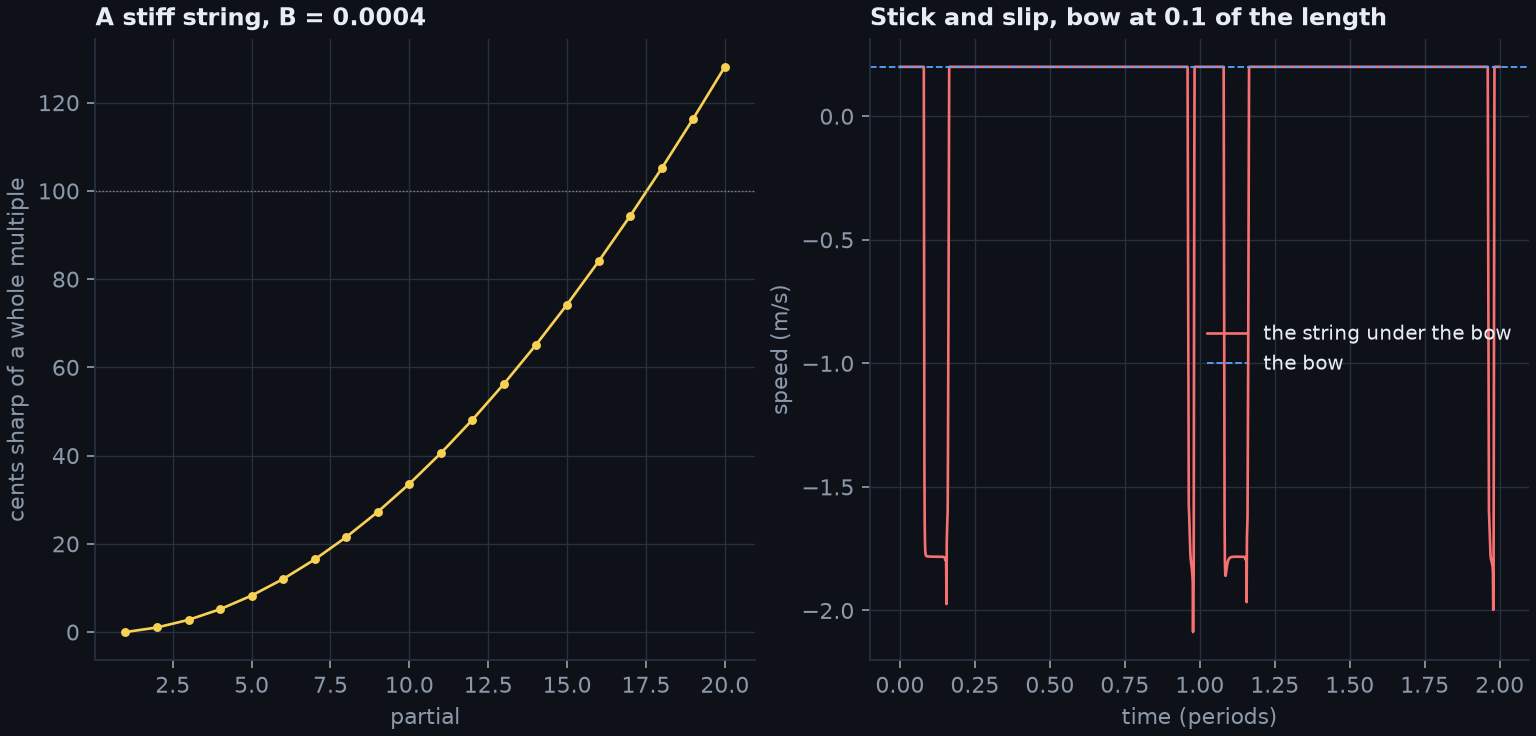
There is a second thing about a piano string that a guitar string hardly has. In Part 1 we saw that an ideal string is held straight by its tension alone. But a steel wire a millimetre thick also resists being bent, the way a bar does. And bending matters most where the string is most sharply curved: in the short waves, the high partials. So the high partials feel an extra stiffness, and vibrate a little faster than they should. The formula from Part 1: the n-th partial is n times the fundamental, times a factor that grows with n squared. The single number B says how stiff the string is. For our middle C it is about four parts in ten thousand. That sounds like nothing. Work it out for the tenth partial. Pause here.
A hundred times B is nought point nought three eight. The square root of the factor is one point nought one eight six, and that is cents: a third of a semitone. Here are all of them. The seventh partial is cents sharp. The sixteenth is cents sharp, most of a semitone. A piano string's partials are not a harmonic series. They are a stretched one.
Can you hear it? Here is our middle C twice. In one version the partials are where the stiff string puts them. In the other, the same partials, with the same strengths and the same decays, have been moved onto exact whole multiples. Which is the stiff-string model?
B was the stiff-string model. The difference is small on a single note in the middle of the keyboard: the stiff-string model has a faint shimmer, a liveliness, where the straightened one is smooth and a little dead, like an electric organ. Listeners asked to choose prefer some stretch: it is part of what says piano. In the bass, where the strings are thickest, it is far from small.
Stiffness shapes the whole instrument. To reduce inharmonicity at practical tension, a plain steel string for the lowest note of a piano could need several metres; seven metres is an illustrative design estimate. So the bass strings are a thin steel core wrapped in copper wire: the wrapping adds mass, which lowers the pitch, with much less added bending stiffness than a solid wire of the same mass. It is why pianos are big. A longer string can be thinner for the same note, and so less stiff. A concert grand is nearly three metres long for the sake of its bass, and a small upright's shorter bass strings give it different inharmonicity and radiation properties. It decides the tuning: the stretched octaves of Part 6 are these partials, followed by a tuner's ear. And by Part 5, an instrument with stretched partials has stretched consonances. A piano is, very slightly, in a tuning of its own.
6Three strings for one noteFoundations4 min
Why does a piano note die away in two stages?
Open the lid of a piano and you find a third oddity. For most notes the hammer strikes not one string but three, tuned to the same pitch and passing over the same bridge. The obvious reason is loudness, and it is true as far as it goes. But it hides a puzzle. A piano has to do two things that pull against each other. A note must be loud, so the strings must give their energy to the soundboard quickly. And a note must sing, so the strings must keep their energy for a long time. Somehow a piano does both: every note falls away quickly for the first second or so, and then lingers. The answer was found in 1977, by Gabriel Weinreich.
Listen first. The same note three ways. One string alone. Then two strings in perfect unison. Then two strings tuned one cent apart, a hundredth of a semitone. Which starts loudest? And which lasts longest?
Two strings start louder than one, as you would expect. But in perfect unison the pair is gone almost at once: after one second it is decibels down, where the single string has fallen only . The pair tuned a cent apart does something neither of the others does. It drops just as fast at first, dips, and then comes back and settles into a slow decay: about decibels a second instead of . After five seconds it is by far the loudest of the three. This simplified coupled-string model produces a two-stage decay from a hundredth of a semitone. Real pianos also have reactive bridge motion and two string polarizations.
Weinreich's explanation is one idea. The strings of a note are not independent. They share a bridge, and the bridge moves a little. If two strings move together, up and down in step, both push on the bridge at once. The bridge moves twice as far, the soundboard gets a loud sound, and the strings lose their energy twice as fast. If the two strings move oppositely, one up while the other is down, their pushes cancel. The bridge hardly moves. Almost nothing reaches the soundboard, and so the strings keep their energy and ring on. The hammer starts the strings moving together: that is the loud, fast beginning. If they are perfectly in tune they stay together, and the note simply dies. But tune them a hair apart, and they slowly slide out of step into the opposite motion, the one that lasts. That is the singing tail. A piano tuner can shape tiny unison differences, and chooses how imperfect by listening to how the note dies. And the soft pedal on a grand shifts the hammers sideways to strike two strings instead of three: the third string, left unstruck, is pulled into the opposite motion at once, and the note is not just quieter. Its decay and timbre can also change.
7Stick and slipFoundations6 min
How does a bow keep a string going?
A plucked string and a struck string have one thing in common. They are given their energy at the start, and after that they can only die away. A violin can hold a note for as long as the bow lasts. Something is feeding the string, continuously, and yet the bow only ever moves one way. How does a steady pull make a vibration? The secret is in the rosin. A bow is a ribbon of horsehair rubbed with dried pine resin, and rosin has a peculiar kind of friction. As long as the string is not sliding against the hair, rosin grips it hard: in this simplified friction law, friction can rise to eight tenths of the force pressing them together. But once the string starts to slide, the grip collapses, to about three tenths. It is sticky when still and slippery when moving. Related friction instabilities can make hinges squeak and brakes squeal; real rosin also depends on temperature and contact history.
Put that friction on Monochord's string, a tenth of the way from the bridge, and draw the bow at twenty centimetres a second. This is the speed of the string at the point under the hair, through two periods of the note. For most of each period the string is stuck to the hair, and simply rides along with it, at the bow's own speed. All that time the bow is dragging the string sideways, and the string is pulling back harder and harder. Then the grip fails. The string breaks free and flies back the other way, times as fast as the bow was carrying it. Sliding fast, it feels little friction. And then it is caught again, and the cycle repeats: stick, slip, stick, slip, a hundred and ninety-six times a second. Notice the proportions. The string slips for percent of each period, and the bow is percent of the way along the string. That is not a coincidence.
What is the whole string doing meanwhile? Helmholtz found out in the eighteen sixties, by sticking a grain of starch to a bowed string and watching it through a microscope whose lens vibrated in time with the note. He expected something like the smooth curves of Part 1. What he saw was this. In this idealized Helmholtz motion, the string forms two straight segments meeting at a corner, and the corner races round the string, out along one side and back along the other, once in every period. Watch the point under the bow. While the corner makes its long journey to the far end and back, that point moves steadily one way: it is stuck to the hair. When the corner passes it, heading for the bridge, the string snaps free; and when the corner comes back from the bridge it is caught again. The slip lasts exactly as long as the corner takes to visit the bridge and return. Hence the tenth of the period. Real stiffness and losses round that corner. This ideal Helmholtz motion is a central regime for violinists, violists and cellists, alongside other bowing regimes.
And the force on the bridge? As the corner travels, the slope of the string at the bridge changes steadily; when the corner arrives and bounces, the slope flips. A steady climb and a sudden drop: a sawtooth. Here the climb is a staircase, and in a moment you will see why. Fourier, in Part 3, gave us a sawtooth's recipe: every partial present, the n-th at one n-th of the first. Monochord's bowed string agrees with that to a fraction of a decibel, with one exception. The tenth partial is missing. The bow is at a tenth of the length, a node of that partial, just as with the pluck and the hammer. A sawtooth with its tenth, twentieth and thirtieth partials taken out is a staircase of ten steps. Compare the quantities carefully. For an ideal triangular pluck, displacement partials have a one over n squared envelope. Bridge force depends on the string's slope and adds a factor of n. Here the bowed bridge-force amplitudes fall approximately as one over n. The sustained bow keeps supplying energy, while a plucked or struck note decays. Listen to this bare bridge force, and then to the same force through a violin's body.
The first is a buzz, like a cheap synthesizer. The second is recognisably a violin. Once again the string supplies the raw material and the box decides the voice. We will open that box in chapter nine. First, the player.
8How hard to pressPractice6 min
What limits a steady bowed note?
For an isolated piano strike, a central variable is the hammer's speed. A violinist's bow arm chooses three, and goes on choosing them for as long as the note lasts. How fast to draw the bow. How hard to press it into the string. And where on the string to put it: how far from the bridge. The Helmholtz motion of the last chapter exists only for some combinations of the three.
Hear what happens outside them. One note, bowed three times, at the same speed and the same place. Only the force changes. One has too much, one about the right amount, one too little. Which is which?
A had too much. The string could not break free on time, so each cycle took too long: the sound is a growl, and the pitch has fallen. B was right. C had too little. The bow could not hold on, and the string slipped times in every period instead of once: a thin, glassy whistle that players call surface sound. Every beginner's violin makes both of those noises, often in the same bar.
In 1973 John Schelleng, a retired radio engineer and an amateur cellist, drew the map. Across: where the bow is, as a fraction of the string's length from the bridge. Up: the force on the bow. Both scales are logarithmic. There is a largest force. When Helmholtz's corner comes by, it gives the string a jolt, and that jolt has to be enough to break the rosin's grip. Press harder than the jolt can overcome and the string stays stuck too long: the growl. The limit is proportional to the bow's speed, divided by its distance from the bridge. The red dots are where Monochord's simulated string actually gave up; the dashed line is Schelleng's formula. There is a smallest force. All through the sticking part of the cycle, the string's energy is leaking away into the bridge, which is the point of the instrument, and the bow has to hold on against the wobble that leaves behind. Press too lightly and the string breaks away early. That limit rises faster towards the bridge: as one over the distance squared, in Schelleng's formula. Monochord's string needs about times his minimum, and its slope is steeper, rather than two. The formula was only ever meant as a guide. Between the two limits is a wedge, and the Helmholtz motion lives inside it. With the bow a fifth of the way along the string, the wedge is wide: the largest force is times the smallest. At four percent, close to the bridge, it has all but closed: a factor of .
And here are the three notes you just heard. A, far above the wedge. C, far below it. B, in the middle. A violinist's right arm spends its life steering inside this wedge without looking at it.
A worked example. A violinist moves the bow from a tenth of the string's length to a twentieth, twice as close to the bridge, keeping the same speed. By Schelleng's two rules, what happens to the largest force, to the smallest, and to the room between them? Pause, and work it out.
The largest force goes as one over the distance: it doubles. The smallest goes as one over the distance squared: four times as large. So the whole window moves up, and the room inside it halves. The player must press harder, and more exactly. What is the reward? The sawtooth on the bridge is proportional to bow speed over distance, so its amplitude doubles too: six decibels more bridge-force level in this idealization. Real near-bridge playing can also strengthen high partials through changes in the rounded corner and contact dynamics. That is how string players make a loud, brilliant sound: near the bridge, with weight. And a soft, veiled one: out over the fingerboard, with almost none. Composers write both into the score, in Italian: sul ponticello, on the bridge, and sul tasto, on the fingerboard.
One more difficulty, and Monochord ran into it before I did. Schelleng's map is for a note that is already sounding. Started from rest, with a small steady force inside the wedge, Monochord's string never found the Helmholtz motion at all. It slipped several times a period, and stayed that way. What worked was what players do: press firmly for the first instant, then ease off. The string settles into one slip a period, and then keeps it, even at forces where it could never have started. Violinists call it the bite at the start of the stroke. The attack has a map of its own, drawn by Knut Guettler in 2002: bow force against bow acceleration, with a narrow triangle inside which the first few slips arrive on time. These coupled controls make bowing demanding. A piano also requires precise control; the bow additionally sustains the oscillation through continuous speed, force and position choices. That is the price of a sound that can swell, fade and change its colour for as long as it lasts.
9The violin's boxPractice4 min
What does the body add that the string did not have?
Back to the box. In chapter two a guitar's body turned out to be a filter with two strong resonances. A violin's body is the same kind of thing with more going on, and this is our model's response: how strongly it answers when the bridge is pushed at each frequency. Lowest, near two hundred and seventy-five hertz, is the air in the box, moving in and out through the f-holes: the bottle again. Next, between four and six hundred hertz, a pair of resonances in which the whole wooden body bends and breathes. Violin makers call these three the signature modes, and can tell you their frequencies for an instrument on the bench. Above them the peaks crowd together into a thicket, and between two and three thousand hertz the whole thicket rises in a broad hill, shaped by the bridge and the wood beneath it. Part 4 showed that the ear is at its most sensitive just there. That hill is the violin's brilliance, its ability to be heard over an orchestra. Now look where the strings are. The lowest note of the violin, the open G, is below the strongest modeled resonances. The box radiates its fundamental less efficiently. You hear a low G anyway, for the reason Part 4 gave: the ear rebuilds a missing fundamental from the partials above it.
All those narrow peaks do something that no smooth filter could. A violinist's left hand rocks on the string, five or six times a second, and the pitch of the note slides up and down by a fraction of a semitone. That is vibrato. Here is the note A, with its ten partials standing on the body's response. Slide the pitch a little, and every partial slides along the curve. One that sits on the upward side of a peak gets louder as the pitch rises. Its neighbour, on the downward side of another peak, gets quieter at the same moment. So with every wobble of the finger the recipe of the note changes: some partials swell while others fade, in this model by up to decibels. Listen to the same bowed note, first held still and then with vibrato, and watch the partials.
The first note holds a steady pitch and colour. The second shimmers, and what changes is both pitch and it is the tone colour, changing six times a second. In 1973 Max Mathews, the father of computer music, built an electronic violin whose body was a bank of electrical resonances, and found that without sharp peaks like these it did not sound like a violin, however good the string. The lumpiness of the box is not a defect. It is the instrument.
One last thing about the box: it talks back to the string. Remember the bargain from the first chapter. A body has to take energy from the string, or there is no sound. But the bowed string's motion depends on waves coming back from the bridge almost undiminished. Play the very note of the body's strongest resonance, and the bridge moves so much that the usual nearly fixed-bridge approximation fails. Coupling can destabilize the Helmholtz motion: it can switch between regimes as string and body exchange energy, several times a second: a stuttering howl called the wolf. One simplified account is that the usable force window narrows; it is not always an exact meeting of Schelleng's two limits. Most cellos have one, near F or F sharp, and cellists tame it with a small weight clamped to the string behind the bridge. So a violin maker, carving and tapping the plates, is steering between two failures: resonances too weak to sing, and resonances strong enough to howl.
10Frontier: what makes a great violin?Research4 min
What can measurement say about a great instrument, and what can it not?
So, back to the hotel room, with everything this part has built. In Indianapolis, thirteen players of twenty-one preferred a new violin. Near Paris, six soloists of ten chose a new one to take on tour, and the single favourite of the twelve instruments was new. The last objection was that a soloist's violin is made for the back row of a hall, not for the player's ear. So the same team put a hundred and thirty-seven listeners in two concert halls, in Paris and in New York. The listeners judged that the new violins carried better, they preferred them, and they could not tell which were old. In the terms of this part, every one of those violins was the same machine: a sawtooth from a bowed string, sent through a wooden box with a few hundred resonances. What the players said they wanted was a box that is loud under the ear, that answers easily, that is even from string to string. These tests did not show reliable identification of age, or establish equivalence of every old and new violin.
Here is where knowledge runs out. No generally reliable measurement rule can predict every player's preference. In careful experiments each player turns out to be consistent, choosing the same instruments again on another day, but different players choose differently. There is no single best box. Nobody fully understands rosin. In this part its friction depended only on how fast the string was sliding. Measurements in the year 2000 showed that this is wrong: rosin warms and softens during every slip, a few hundred times a second, and its grip depends on its temperature a moment ago. Models with warm rosin behave more like real strings, and they are still being worked out. Even Schelleng's diagram is unfinished. When it was finally measured with a bowing machine, in 2008, the smallest force did not depend on the bow's speed in the way his formula says. And piano felt has a memory. Squeezed, it pushes back less on the way out than on the way in, and it has not fully recovered when the next blow comes. The power law we used is the first approximation. Piano technicians still voice hammers by ear.
And one frontier that is moving fast. Every sound in this part was computed. In 1983 that meant Karplus and Strong's loop: numbers and an average. Through the nineteen nineties it meant what our bow uses: waves travelling along a string, and a careful treatment of the one point where something touches it. Now it means whole instruments laid out on a grid: every string, the soundboard, the box and the air around it, millions of numbers advanced forty-eight thousand times a second. A few years ago that took hours for each second of sound. On today's graphics processors parts of it run as fast as you can play. That matters for more than convenience. A model is a hypothesis that you can listen to. When the simulated violin sounds wrong, its physics, parameter choices or excitation may be incomplete, and the ear, which Part 4 showed to be a superb instrument, tells you so at once. Much of what this part has shown was found that way.
Variation 7, recap and problemsAll tracks4 min
Every part ends by doing something to the Tune with what it has built. This part built three instruments out of one string, so here they are, playing it. First each one alone: the guitar, the piano, the violin. Then the violin with each of the others. And for the last phrase, all three.
Row seven of the ledger. seconds of music, three instruments, and no recording of any of them. The measurement that goes in the ledger is the bowed string's: the force it put on the bridge matched Fourier's sawtooth, partial by partial, to within a fraction of a decibel.
What did we find? A string by itself moves almost no air. An instrument's body takes the string's energy, radiates it, and colours it on the way. A guitar's box is a flexible plate on a bottle of air, and the two push each other's resonances apart. A plucked string is, to a computer, a delay and an average. A piano's felt stiffens as it is squeezed, so a harder blow is a shorter and brighter one. Its thick strings stretch their own partials, and its unisons, tuned a hair apart, die away in two stages. And a bow works by sticking and slipping: a corner runs round the string, the bridge feels a sawtooth, and the player's force must stay inside a wedge that narrows towards the bridge.
Five problems. One to compute, one to prove, one for your ears, one to build, and a research problem, marked with a star. Solutions are in this part's notes. Pause here.
Where does this come back? In the very next part, the bow's trick of turning a steady push into a vibration returns with air in place of rosin: in reeds, in a trumpeter's lips, in the voice. The stiffness that bent the piano's partials becomes the whole story in bars and bells. The three ways of playing a string become colours for an orchestrator. Karplus and Strong's loop becomes the comb filter and the reverberator. Physical models return as a way of building synthesizers. And a body's resonances decide where a recording engineer puts the microphone.
And in practice. A guitar maker taps the top, listens for the two resonances of chapter two, and shaves the braces to move them. A piano technician needles the felt to set how bright a loud note is, and tunes each unison by listening to how it dies. A string player trades speed, weight and contact point against each other all day long. And a sound designer reaches for a model, instead of a recording, when the sound has to respond the way an instrument responds to a player.
The books and papers this part follows. The full list, with notes, is in the README.
Look once more at what the bow does, because it is the most important machine in this part. A steady push. Something that grips, and then lets go. And a resonator, the string, that sends back a signal saying when to let go next. That loop is not special to strings. Replace the bow by a player's breath, the rosin by a sliver of cane, and the string by a column of air, and you have a clarinet. Replace the cane by two folds of tissue in your throat, and you have the oldest instrument there is. Flutes, reeds, brass and the human voice: that is Part 8, Pipes, Reeds and Voices.
Where it goes next. The bow's loop, a steady push turned into vibration by something that grips and lets go, returns with air in place of rosin in reeds, lips and the voice (Part 8). Stiffness without tension is a bar or a bell (Part 9). Plucked, struck and bowed become colours for an orchestrator (Part 41); Karplus and Strong's loop becomes the comb filter and the reverberator (Part 49), and the models of this part become synthesizers (Part 52).
Key results
The part's results in one place, for revision.
Try it
Lab 7 · Strings, computed: a loop, a stiff wire and a bow
Write Karplus and Strong's plucked string yourself and find its pitch, compute how far a stiff string's partials are from whole multiples, bow Monochord's string and check Helmholtz's two rules, and rank five bow forces by ear.
python -m videos.music.labs 7
needs numpy, scipy, matplotlib · download lab07.py ·
source on GitHuba loop of 244 numbers sounds at 196.32 Hz; the loop alone would give 196.72, the loop and its average 196.32
its level after 1.4 seconds -7.2 dB
partial 2 of a string with B = 0.0004 524.3 Hz, 1.0 cents sharp of 524
partial 4 of a string with B = 0.0004 1051.1 Hz, 5.2 cents sharp of 1048
partial 8 of a string with B = 0.0004 2122.2 Hz, 21.5 cents sharp of 2096
bowed at 0.1 of its length Helmholtz: it slips for 10.6% of each period (Helmholtz: 10.0%)
its speed while slipping -8.4 times the bow's (Helmholtz: -9.0)
ear problem, the order of forces (listen first) 1.60 N; 0.90 N; 0.03 N; 0.50 N; 8.00 N
what each one is 0.03 N: multiple slips; 0.50 N: Helmholtz; 0.90 N: Helmholtz; 1.60 N: Helmholtz; 8.00 N: raucous
A loop of numbers with an average in it is a string. A real string is stiff, so its partials are sharp; and under a bow it does one thing, sticking for most of each period and flying back for the fraction of it that the bow is from the bridge, but only while the bow's force stays between two limits.The code (117 lines; it asserts its own result)
"""Lab 7: a plucked string in three lines, a stiff string's partials, Helmholtz's corner under a bow, and five bow forces to rank by ear."""

import math

import numpy as np

from videos.coursekit import labs
from explainer.music.monochord import Clip, concat
from explainer.music.monochord.instruments import strings as S

TITLE = "Strings, computed: a loop, a stiff wire and a bow"
GOAL = ("Write Karplus and Strong's plucked string yourself and find its pitch, compute how far a stiff string's partials "
        "are from whole multiples, bow Monochord's string and check Helmholtz's two rules, and rank five bow forces by ear.")
TASKS = [
    "Set N to 122 and to 488. What happens to the pitch, and to how long the note lasts? Why does the high note die sooner?",
    "Set B to 0.004, the size found in a piano's top octave. How sharp is the 8th partial now? Would you still call the tone harmonic?",
    "Set BETA to 0.05 and to 0.2. Check the slip fraction and the flyback speed against Problem 2 each time.",
]
N = 244          # numbers in Karplus and Strong's loop
B = 0.0004       # the string's stiffness (Problem 1)
F1 = 262.0       # its fundamental, Hz
BETA = 0.1       # where the bow is: fraction of the string from the bridge
SR = 48_000


def pluck(n: int, seconds: float, rng) -> np.ndarray:
    """Karplus and Strong: a loop of n random numbers; each output is read from the loop and replaced by the average of
    itself and the number read just before it."""
    loop = rng.uniform(-1, 1, n)
    out = np.empty(int(seconds * SR))
    before = 0.0
    for i in range(len(out)):
        out[i] = loop[i % n]
        loop[i % n], before = 0.5 * (loop[i % n] + before), loop[i % n]
    return out


def pitch_of(y: np.ndarray, guess: float) -> float:
    """The pitch of a nearly periodic sound, from the peak of its autocorrelation near a guess (parabolic interpolation)."""
    y = y[: int(0.5 * SR)] - np.mean(y[: int(0.5 * SR)])
    lags = np.arange(int(SR / guess * 0.9), int(SR / guess * 1.1) + 1)
    ac = np.array([float(np.dot(y[:-k], y[k:])) for k in lags])
    i = int(np.clip(np.argmax(ac), 1, len(ac) - 2))
    a, b, c = ac[i - 1], ac[i], ac[i + 1]
    return SR / (lags[i] + 0.5 * (a - c) / (a - 2 * b + c))


def run(seed=0):
    rng = np.random.default_rng(seed)
    lab = labs.Lab()

    # 1. a pluck in three lines
    y = pluck(N, 1.5, rng)
    hz = pitch_of(y, SR / N)
    lab.row(f"a loop of {N} numbers", f"sounds at {hz:.2f} Hz; the loop alone would give {SR / N:.2f}, the loop and its average {SR / (N + 0.5):.2f}")
    early, late = float(np.sqrt(np.mean(y[: SR // 10] ** 2))), float(np.sqrt(np.mean(y[-SR // 10:] ** 2)))
    lab.row("its level after 1.4 seconds", f"{20 * math.log10(late / early):+.1f} dB")
    assert abs(1200 * math.log2(hz / (SR / (N + 0.5)))) < 1.0           # the average is half a sample of extra delay

    # 2. a stiff string (Problem 1)
    def partial(n):
        return n * F1 * math.sqrt((1 + B * n * n) / (1 + B))

    for n in (2, 4, 8):
        lab.row(f"partial {n} of a string with B = {B:g}", f"{partial(n):.1f} Hz, {1200 * math.log2(partial(n) / (n * F1)):.1f} cents sharp of {n * F1:.0f}")
    if B == 0.0004 and F1 == 262.0:
        assert abs(1200 * math.log2(partial(8) / (8 * F1)) - 21.5) < 0.1

    # 3. Helmholtz's corner (Problem 2)
    limit = S.schelleng(BETA, 0.2, 0.25, 0.97)[1]
    bow = S.Bow(speed=0.2, force=0.28 * limit, at=BETA)
    d = S.bowed(196.0, bow, seconds=1.5)
    r = S.bow_regime(d)
    p = int(round(d["period"]))
    v = d["v"][-2 * p:]
    slipping = d["slipping"][-2 * p:] > 0.5
    flyback = float(v[slipping].mean()) / bow.speed
    lab.row(f"bowed at {BETA:g} of its length", f"{r['kind']}: it slips for {100 * r['slip_fraction']:.1f}% of each period (Helmholtz: {100 * d['beta']:.1f}%)")
    lab.row("its speed while slipping", f"{flyback:.1f} times the bow's (Helmholtz: {-(1 - d['beta']) / d['beta']:.1f})")
    if BETA == 0.1:
        assert r["kind"] == "Helmholtz" and abs(r["slip_fraction"] - d["beta"]) < 0.02 and abs(flyback + 9) < 1.0

    # 4. the ear problem (Problem 3): one note at five bow forces
    body = S.violin_body()
    top = S.schelleng(0.1, 0.2, 0.25, 0.97)[1]
    forces = [0.014 * top, 0.25 * top, 0.45 * top, 0.8 * top, 4.0 * top]
    order = rng.permutation(5)
    notes, kinds = [], []
    for f in forces:
        b5 = S.Bow(speed=0.2, force=f, at=0.1)
        kw = dict(press=f) if f < 0.05 * top else {}
        kinds.append(S.bow_regime(S.bowed(196.0, b5, seconds=1.2, **kw))["kind"])
        notes.append(Clip(body.play(S.bowed_note(196.0, 1.2, b5, **kw)), SR).at_level(-20.0))
    lab.audio = concat([notes[j] for j in order], gap=0.35)
    lab.row("ear problem, the order of forces (listen first)", "; ".join(f"{forces[j]:.2f} N" for j in order))
    lab.row("  what each one is", "; ".join(f"{forces[j]:.2f} N: {kinds[j]}" for j in range(5)))
    assert kinds[1:4] == ["Helmholtz"] * 3 and kinds[0] != "Helmholtz" and kinds[4] != "Helmholtz"

    fig, (a, b) = labs.figure(2)
    ns = np.arange(1, 21)
    a.plot(ns, [1200 * math.log2(partial(int(n)) / (n * F1)) for n in ns], "o-", color=labs.GOLD, ms=3, lw=1.2)
    a.axhline(100, color="#888", lw=0.6, ls=":")
    a.set_title(f"A stiff string, B = {B:g}")
    a.set_xlabel("partial")
    a.set_ylabel("cents sharp of a whole multiple")
    t = np.arange(2 * p) / p
    b.plot(t, v, color=labs.RED, lw=1.2, label="the string under the bow")
    b.axhline(bow.speed, color=labs.BLUE, lw=0.8, ls="--", label="the bow")
    b.set_title(f"Stick and slip, bow at {BETA:g} of the length")
    b.set_xlabel("time (periods)")
    b.set_ylabel("speed (m/s)")
    b.legend()
    lab.fig = fig
    lab.note = ("A loop of numbers with an average in it is a string. A real string is stiff, so its partials are sharp; and "
                "under a bow it does one thing, sticking for most of each period and flying back for the fraction of it that "
                "the bow is from the bridge, but only while the bow's force stays between two limits.")
    return lab
Now change it
- Set N to 122 and to 488. What happens to the pitch, and to how long the note lasts? Why does the high note die sooner?
- Set B to 0.004, the size found in a piano's top octave. How sharp is the 8th partial now? Would you still call the tone harmonic?
- Set BETA to 0.05 and to 0.2. Check the slip fraction and the flyback speed against Problem 2 each time.
Problems, with solutions
Try each problem before opening its solution.
-
A stiff string. A piano string has B = 0.0004 and a fundamental of 262 Hz. Find the frequencies of its 2nd, 4th and 8th partials, and how many cents sharp each is of a whole multiple.
Solution
f_n = n f₁ √((1 + Bn²)/(1 + B)). For n = 2 the factor is √(1.0016/1.0004) = 1.00060, so the partial is at 524.3 Hz, 1.0 cent sharp of 524. For n = 4: √(1.0064/1.0004) = 1.00299, 1051.1 Hz, 5.2 cents. For n = 8: √(1.0256/1.0004) = 1.01252, 2122.2 Hz, 21.5 cents. The sharpness grows nearly as n² − 1: each doubling of n multiplies it by about four. An octave tuned so that the upper note's fundamental matches this string's second partial is 1 cent wide; tuned to the fourth partial of the note two octaves down, 5 cents. (The lab computes all three.)
-
Helmholtz's corner. For a string in Helmholtz motion bowed at a fraction β of its length from the bridge, show that it slips for the fraction β of each period, and that it flies back (1 − β)/β times as fast as the bow.
Solution
The corner travels at the wave speed c and goes once round the string, a distance 2L, in one period T = 2L/c. The string under the bow slips while the corner is between the bow and the bridge: it passes the bow going towards the bridge, travels βL, reflects and travels βL back, which takes 2βL/c = βT. For the remaining (1 − β)T the string sticks and moves with the bow at speed v, a distance v(1 − β)T. In a steady motion the string must be back where it began after one period, so the slip covers the same distance the other way in the time βT: its speed is v(1 − β)T / (βT) = v(1 − β)/β. At β = 1/10 that is nine times the bow's speed; Monochord's simulated string, with rounded corners, manages 8.6.
-
Ear. The lab plays one bowed note at five bow forces, in a random order. Put them in order of force, and say which lie outside Schelleng's wedge.
Solution
The lab prints the order and the regime of each. Too little force gives a thin, whistling tone an octave or more above the note mixed with it (several slips a period); too much gives a growl at a lower, unsteady pitch. Within the wedge the pitch is steady and the model notes can differ in spectral balance: more force, a sharper corner, more high partials. Two of the lab's five are outside, one on each side.
-
Build. Add a second polarisation to
strings.pair: each string can also move parallel to the soundboard, where the bridge hardly yields. Does one string alone now decay in two stages?Solution
Yes, if the hammer's blow is not exactly perpendicular to the soundboard or the bridge couples the two directions slightly. The motion perpendicular to the board drives the bridge hard and decays quickly; the motion parallel to it meets a nearly rigid bridge and decays slowly. One string is then itself a pair of oscillators with a fast and a slow mode, and its level against time has the same knee as the mistuned pair's. Weinreich (1977) gives both mechanisms; in a real piano the polarisations account for the two-stage decay of single-strung bass notes, and the mistuned unisons shape it in the rest of the compass.
-
★ Warm rosin. Replace the bow's friction curve by one that depends on the rosin's temperature, warmed by sliding and cooled by conduction. How do Schelleng's limits and the starting transient change?
Where the frontier is. Smith and Woodhouse (2000) measured rosin's friction in a stick-slip rig and found that it is not a function of sliding speed: plotted against speed it traces a loop, and a model in which the friction depends on the temperature of a thin layer of rosin fits much better. Woodhouse (2003) put that model into a bowed-string simulation; it is more ready to settle into the Helmholtz motion, as real strings are. Galluzzo and Woodhouse (2014) measured both Schelleng's and Guettler's diagrams with a bowing machine and compared them with the two models: each gets some features right and neither gets them all. A model of the contact that predicts both diagrams for a real string, with a finite width of hair and with torsion, remains an active modeling problem; the cited models do not capture all those effects.
Notes and sources
Sources
Books: N. H. Fletcher and T. D. Rossing, The Physics of Musical Instruments (2nd ed., 1998), chs. 9–12, for the guitar's two-mass model, the bowed string and the piano; L. Cremer, The Physics of the Violin (1984); A. Chaigne and J. Kergomard, Acoustics of Musical Instruments (2016); S. Bilbao, Numerical Sound Synthesis (2009); H. von Helmholtz, On the Sensations of Tone (1863; trans. Ellis), ch. 5 and appendix 6, for the vibration microscope and the bowed string's motion; S. Pollens, The Early Pianoforte (1995), for Cristofori and the Medici inventory of 1700.
Papers: G. Weinreich, "Coupled piano strings", JASA 62 (1977); H. Fletcher, "Normal vibration frequencies of a stiff piano string", JASA 36 (1964); D. E. Hall, "Piano string excitation in the case of small hammer mass", JASA 79 (1986), and its sequels; A. Chaigne and A. Askenfelt, "Numerical simulations of piano strings", I and II, JASA 95 (1994); K. Karplus and A. Strong, "Digital synthesis of plucked-string and drum timbres", and D. A. Jaffe and J. O. Smith, "Extensions of the Karplus-Strong plucked-string algorithm", Computer Music Journal 7 (1983); O. Christensen and B. B. Vistisen, "Simple model for low-frequency guitar function", JASA 68 (1980); C. V. Raman, "On the mechanical theory of the vibrations of bowed strings", Bulletin of the Indian Association for the Cultivation of Science 15 (1918); J. C. Schelleng, "The bowed string and the player", JASA 53 (1973); M. E. McIntyre, R. T. Schumacher and J. Woodhouse, "On the oscillations of musical instruments", JASA 74 (1983); K. Guettler, "On the creation of the Helmholtz motion in bowed strings", Acta Acustica united with Acustica 88 (2002); E. Schoonderwaldt, K. Guettler and A. Askenfelt, "An empirical investigation of bow-force limits in the Schelleng diagram", Acta Acustica united with Acustica 94 (2008); J. H. Smith and J. Woodhouse, "The tribology of rosin", Journal of the Mechanics and Physics of Solids 48 (2000); J. Woodhouse, "Bowed string simulation using a thermal friction model", Acta Acustica united with Acustica 89 (2003); P. M. Galluzzo and J. Woodhouse, "High-performance bowing machine tests of bowed-string transients", Acta Acustica united with Acustica 100 (2014); M. V. Mathews and J. Kohut, "Electronic simulation of violin resonances", JASA 53 (1973); J. Woodhouse, "The acoustics of the violin: a review", Reports on Progress in Physics 77 (2014); A. Stulov, "Hysteretic model of the grand piano hammer felt", JASA 97 (1995); C. Fritz, J. Curtin, J. Poitevineau, P. Morrel-Samuels and F.-C. Tao, "Player preferences among new and old violins", PNAS 109 (2012); C. Fritz et al., "Soloist evaluations of six Old Italian and six new violins", PNAS 111 (2014); C. Fritz et al., "Listener evaluations of new and Old Italian violins", PNAS 114 (2017); C. Saitis, B. L. Giordano, C. Fritz and G. P. Scavone, "Perceptual evaluation of violins: a quantitative analysis of preference judgments by experienced players", JASA 132 (2012).
About this partfrom its README
Part 7 of a sixty-eight-part course in music (see the series plan and
the syllabus). For six parts the series has had one instrument, a plucked string, heard directly.
This part builds real instruments round it: a guitar, a piano and a violin. A string can be set going in three
ways, by plucking, striking and bowing, and each way is a different piece of physics; and a bare string radiates weakly, while a body or membrane can couple it more effectively to air. The instruments are Monochord's (explainer/music/monochord/instruments/strings.py);
every sound is computed in compute.py, and no instrument was recorded. Dates and attributions are the published
ones, listed under Sources.
- Which is the Stradivari? Four notes three times: plucked, struck, bowed, all from one string; the blind tests of Indianapolis (2010: thirteen of twenty-one players would take a new violin home) and Paris (2012: six of ten soloists); the plan.
- 1. Why a string needs a radiator. A string is too thin to move air; a body takes its energy and radiates it; an ear question (the force on the bridge, bare and through a guitar's body: what did the body do?); the body as a filter with peaks; a knuckle on the bridge; the bargain a body makes (loud or long).
- 2. A plate, a hole and a box of air. A guitar's two lowest resonances: Part 2's bottle with a flexible lid; the two-mass model; a worked example (cover the hole and the plate rings at 185 Hz, the air alone at 130: the pair appears at 98 and 204, pushed apart, and the squares add up); the dip between them; where the low E falls.
- 3. A pluck in three lines. Karplus and Strong (1983): a loop of random numbers and an average; listening to the loop round by round; why three lines are enough (the loop is a string: a delay for the travelling wave, an average for the loss of high partials); the loop's length is the pitch, and why it is 2.8 cents out.
- 4. The hammer. Cristofori (c. 1700): a hammer that is thrown; felt whose force rises as the squeeze to the power 2.5; three touches (contact 2.5, 2.1 and 1.9 ms; force 2, 7 and 20 N; brightness 380, 471 and 559 Hz); an ear question (struck hard and turned down, or struck softly and turned up?); a worked example (struck near an eighth of its length, the string takes up little of the blow in its eighth partial: 18 dB down).
- 5. A string that is also a bar. Stiffness sharpens the high partials: f_n = n f₁ √((1 + Bn²)/(1 + B)); a worked example (B = 0.00038: the tenth partial is 32 cents sharp); an ear question (the real string, or its partials straightened?); wound bass strings, why pianos are long, the stretched octaves of Part 6.
- 6. Three strings for one note. Loud or long; an ear question (one string; two in perfect unison; two a cent apart); Weinreich (1977): strings that move together are heard and die, strings that move oppositely radiate weakly and last in the simplified symmetric model; the two-stage decay (31 dB a second, then 3); the tuner's imperfect unison; the soft pedal.
- 7. Stick and slip. Rosin: sticky when still, slippery when sliding; the string's speed under the bow (stuck for nine tenths of the period, flying back for one tenth, 8.6 times as fast); Helmholtz's corner (1863); the force on the bridge is a sawtooth (partials as 1/n, to 0.2 dB), in ten steps because the bow sits at a tenth of the length; the bare force and the same force through a violin's body.
- 8. How hard to press. Speed, force and place; an ear question (too much, right, too little); Schelleng's diagram (1973), with Monochord's own limits beside his formulas; a worked example (twice as near the bridge: the largest force doubles, the smallest quadruples, ideal bridge-force amplitude rises by 6 dB; real brightness changes involve the contact dynamics); sul ponticello and sul tasto; the note has to be started (the bite; Guettler's diagram, 2002).
- 9. The violin's box. The body's response: the air (275 Hz), the two body modes (460 and 540 Hz), the hill between 2 and 3 kHz; the open G below every resonance; vibrato moves each partial along the curve, so the recipe changes six times a second (by up to 7 dB); the wolf note.
- 10. Frontier: what makes a great violin? The hotel room again, and the concert halls (137 listeners, 2017); what nobody can do yet: predict a preference, explain rosin, draw the true wedge, model felt; instruments made of arithmetic, from 244 numbers to millions. ★ research problem.
- Variation 7, recap and problems. The Tune on a guitar, a piano and a violin, alone, in pairs and together; the ledger; what we found; five problems; where it comes back; in practice; references; the bow's loop with air in place of rosin, and Part 8.
What is computed and built
python -m videos.music.music7.compute (about fifteen seconds) fills .cache/music7/.
| Item | What it computes | Checked against |
|---|---|---|
three |
four notes by a plucked, a struck and a bowed model | every clip labelled and inside the loudness window |
body |
a plucked string's bridge force, bare and through a guitar body; the body's response; a tap | peaks of the response at the body's modes |
twomass |
a plate coupled to a Helmholtz resonator: the two coupled resonances and the dip | f₋² + f₊² = f_h² + f_p², to rounding |
ks |
Karplus–Strong, lap by lap; its pitch | the loop's true period, N + ½ samples: 2.8 cents |
hammer |
a felt hammer (F = K xᵖ) on a stiff, lossy string, by modal time-stepping, at three speeds | contact about 2 ms and shorter when harder (Hall; Chaigne and Askenfelt); little above the seventh partial |
stiff |
the partials of the stiff string; the same note with them straightened | Fletcher's formula; B = 0.00038 for middle C |
unison |
two strings on one yielding bridge: one, a perfect pair, a pair a cent apart | Weinreich: a pair in unison decays twice as fast; mistuned, in two stages |
bow |
a bowed string with a friction curve, by travelling waves: speed under the bow, bridge force | slip for the fraction β; flyback (1 − β)/β; partials as 1/n to 0.2 dB |
schelleng |
the largest and smallest bow force at eight bow positions; three notes | Schelleng's formulas: slopes −1.1 and −2.5 against −1 and −2 |
violin |
a violin body's response; one bowed note held still and with vibrato | signature modes at 275, 460 and 540 Hz; a hill at 2.5 kHz |
tune |
Variation 7: the Tune for the three instruments | the plan of who plays each phrase |
Monochord's string instruments are held against these references in tests/music/test_strings.py; this part's
claims and clips in tests/music/test_music7.py.
Sounds. Twelve clips, labelled on screen. physical model: the plucked, struck and bowed strings and the bodies
they drive. synthesized: Karplus and Strong's loop, which is noise in a delay line. The straightened note of chapter 5 is
the struck-string model with its partials moved onto whole multiples. There are no recordings.
What the models are, and are not. The string is Part 1's: stiff, lossy, linear. The guitar and violin bodies are filters: a sum of resonances with chosen frequencies, strengths and dampings (a guitar's first two from the two-mass model; a violin's signature modes and hill at typical published values), not a solved wooden box, and they radiate in no particular direction. The hammer is the standard power-law felt with no hysteresis. The paired strings are two modes coupled through a purely resistive bridge, the simplest case of Weinreich's analysis; a real bridge is also reactive, and a real string has two polarisations (Problem 4). The bow is a point, with a friction that depends only on sliding speed, on a string without torsion: the model of McIntyre, Schumacher and Woodhouse, which reproduces the Helmholtz motion and Schelleng's limits in outline but is known to be wrong in detail (chapter 10). Its minimum bow force is two to six times Schelleng's, and was found by easing the force down from a note already sounding, because the motion is hysteretic. Vibrato is the bowed force read at a wavering speed and then filtered by the body, which is the right order. The violins of the blind tests are not modelled at all: the film reports the published results.
Companion material in this repository
The syllabus's plan for this partfrom SYLLABUS.md, the plan of record
- Hook: four notes plucked, struck and bowed, all from one string; the blind tests; the plan.
- A string cannot be heard: why a string needs a body (an ear question); the body as a filter; a tap; loud or long.
- A plate, a hole and a box of air: the guitar's two-mass model (a worked example); the dip; the low E.
- A pluck in three lines: Karplus and Strong; the loop lap by lap; why it is a string; its pitch.
- The hammer: Cristofori; felt that stiffens; three touches (an ear question); the striking point (a worked example).
- A string that is also a bar: stiffness and sharp partials (a worked example; an ear question); living with it.
- Three strings for one note: loud or long (an ear question); Weinreich's coupled strings; the two-stage decay.
- Stick and slip: rosin; the string under the bow; Helmholtz's corner; the sawtooth on the bridge.
- How hard to press: speed, force and place (an ear question); Schelleng's diagram; nearer the bridge (a worked example); starting the note.
- The violin's box: the body's response; vibrato as a change of colour; the wolf.
- Frontier: the blind tests again; what nobody can do yet; instruments made of arithmetic.
- Variation 7: the Tune for a guitar, a piano and a violin. Outro: problems, payoffs, and the bow's loop in air.
Covers: why a string needs a body; the guitar's air and plate resonances; Karplus–Strong; the piano's hammer,
stiffness and inharmonicity, paired strings and the double decay; the bowed string's stick-slip, Helmholtz
motion, the Schelleng diagram and the wolf note; a violin's signature modes and bridge hill; vibrato.
Built and computed: instruments/strings.py: Karplus–Strong; a felt hammer on a stiff string; two strings on a
yielding bridge; a bowed string with friction that reproduces the Helmholtz corner and, in outline, Schelleng's
limits; guitar and violin bodies as banks of resonances; the two-mass guitar.
Variation 7: the Tune for plucked, struck and bowed strings, alone, in pairs and together.
Frontier: what violin measurements do and do not explain; rosin that warms; the measured Schelleng diagram;
hammer-felt hysteresis; real-time finite-difference instruments.
Reading: Fletcher & Rossing; Cremer; Woodhouse's papers on the bowed string; Weinreich (1977); Fritz et al.
(2012, 2014, 2017).
Build the film
python -m videos.music.music7.compute        # the part's numbers, into .cache/music7
python tools/build.py music7                  # render and assemble the film
EXPLAINER_TTS=silent python tools/qa_scene.py music7 Hook   # one chapter, silent, with a contact sheet
Scenes: videos/music/music7. Setup: see the course page. Source of these notes: the README and the scenes' narration.
Build it
python -m videos.music.music7.compute                          # numbers and sounds (about fifteen seconds)
EXPLAINER_TTS=silent python tools/build.py music7 -q l --fps 15   # a silent-narration preview, with the sounds
python tools/qa_sound.py music7 --sync                         # the sound gates
python tools/dead_air.py renders/music7_480p.mp4 --sound music7   # no empty screen; no sound over a still one
python tools/lecture_length.py music7                          # 30 to 60 minutes, listening included
python tools/build.py music7                                   # 1080p30, narrated
python -m pytest -q tests/music                                # Monochord against its references; this part's claims and clips
python -m videos.music.labs 7                                  # the lab (writes a figure and a short WAV)