The Dissertation
Was Kant right that psychology could never become a science?
The series ends as a doctorate does. A question where Part 24 and Part 59 collide (is a robust effect, the mental-rotation slope, a reliable measure of a person?) is taken through a registered report: the plan written as code and hashed before the analysis, a design check on simulated people, reviews, Stage 2 on open data with one reported deviation, and a result reported as it fell (inconclusive for the paradox, leaning against it). Then Psyche sits the Battery, the complete Ledger is read by act, the Homunculus is drawn one last time, and Kant's three objections are answered, with a fourth he did not make.
What you need. Every earlier part; Part 3's reliability, Part 4's registered reports and Part 59's paradox above all.
- Hook
- back to Kant
- Ideas, models and mathematics
- how research is done: ethics, a question, a registered report from Stage 1 to Stage 2, the final Ledger, Psyche's Battery scorecard, the Homunculus's remaining parts, the open problems
- Psyche gains
- the thesis
- On you
- the last experiment
What you will be able to do
Psych 101 and the major
- Explain how a registered report protects a result, and what a reported deviation is.
- Give the verdict on each of Kant's objections, with evidence from the series.
Graduate
- Compute split-half reliability with a bootstrap interval, and a design check by simulation.
Research
- Write a Stage 1 registered report for an open problem from any part's frontier.
Practice
- Choose a role and the parts that prepare for it, and commission research that will hold up.
Contents
Each chapter has a home level. Choose a track to see what to read and watch: Psych 101 and the major 14 min · Graduate 19 min · Research 28 min · Practice 19 min.
- 0Kant's three objections, againPsych 101 and the major2 min
- 1On you: the last experiment, and four numbersPsych 101 and the major1 min
- 2How research is donePsych 101 and the major2 min
- 3Ethics as practicePsych 101 and the major2 min
- 4The registered report, Stage 1Research2 min
- 5Peer review, shownResearch2 min
- 6Stage 2: the dataResearch3 min
- 7Writing itResearch2 min
- 8Psyche's scorecardPractice2 min
- 9The Ledger, completePsych 101 and the major2 min
- 10The Homunculus, last drawingPsych 101 and the major1 min
- 11The verdict on KantPsych 101 and the major2 min
- 12Where to goPractice1 min
- 13The Ledger: the last rowPractice1 min
- 14In practice: the rolesPractice1 min
- 15Frontier: the open problems of sixty-two partsResearch1 min
- The endAll tracks3 min
Also on this page: Lecture · Key results · Try it · Lab · Problems · Notes and sources · Build the film.
Lecture
The text of each chapter is the film's narration, as it is spoken, so you can read along or revise without the film. The pictures are in the film. A dashed box stands for a number the film computes when it is rendered (hover over it to see what is computed); the README's figures for each chapter, where it lists them, follow the chapter's text.
Kant's three objections, againPsych 101 and the major2 min
In Part 1, Immanuel Kant explained in 1786 why there could never be a science of the mind. First: mathematics can't be applied to what goes on in the mind. Second: you can't experiment on it, because its contents can be told apart in thought but not held apart and recombined at will. Third: observing your own mind alters and distorts the thing observed. Sixty-one parts later, it's time to answer him. Was Kant right?
The series ends as a doctorate does. One question, left open by two earlier parts, is taken through a registered report. It's reviewed before the data are analysed, run, and reported whatever it shows. Then the accounts are closed. Psyche sits the Battery, the Ledger is read from top to bottom, and the Homunculus is drawn one last time. And Kant's three objections are answered, one at a time.
This is Part 62 of Psychology, Built: the dissertation. We'll find a question worth asking, and practise research ethics. We'll write a registered report: theory, hypotheses, a design check and a decision rule. We'll answer reviewers, run Stage 2, and report a deviation honestly. We'll read Psyche's scorecard and the complete Ledger. We'll give the verdict on Kant's objections, and name a fourth. And we'll choose where to go next, among sixty-two parts' open problems.
What it does: The objections; the question; objectives
1On you: the last experiment, and four numbersPsych 101 and the major1 min
Same, or mirror?
First, the last experiment on you, the one that opens this part's question. Each pair shows the letter R on the left, and on the right either the same R turned, or its mirror image turned. Say same or mirror aloud for each one, as fast as you can. Here they come.
Here are the answers. Most people take longer the further the letter is turned. That's Part 24's mental rotation, about a tenth of a second for every ten degrees with three-dimensional shapes. The slope of time against angle is everyone's: a robust effect. But is your slope a stable fact about you? That's this dissertation's question.
Now the last four numbers of the series. One: mental-rotation slopes rose for fifty-three of fifty-four people in Part 24. Is one person's slope a reliable measure, with a split-half reliability above zero point seven, or below? Two: the Ledger has three hundred and twenty-two rows. What share held up? Three: Psyche can sit seven of the Battery's thirteen tasks with one set of parameters. How many match their published signatures? And four: Kant made three objections. How many survive? Pause here, and write them down.
What it does: Rotated letters; four predictions
2How research is donePsych 101 and the major2 min
Where does a question come from? From a collision: two results that can't both be right in general. Here, Part 24's robust rotation slopes and Part 59's reliability paradox. From a frontier: every part of this series ends with open problems, and each is a dissertation. It must be answerable: data you can get, an analysis you can specify, and an answer that would change what someone believes. And it should be small. A first project answers one question well, not a field's question badly.
Before adding to a literature, read it. Start from the best recent review or meta-analysis, then read its strongest and its weakest studies in full. For each study, ask Part 4's questions: how many people, preregistered or not, what was measured and how reliably, and what the effect would be after Part 50's corrections. Search the registries and preprints for what was run and never published. That's the denominator. And write down, before designing anything, what the field would believe if your study came out either way. If nothing would change, choose another question.
Then the craft. Reading, with the Ledger's habit: for each claim, the original, the record, and the date it was checked. The pilot: run the procedure on a few people, or on simulated ones, to find what breaks. Advisers and collaborators: people who will tell you what's wrong while it can still be fixed. And a contribution: something the field didn't know, stated so that it could be shown false.
What it does: Finding a question; the craft
3Ethics as practicePsych 101 and the major2 min
What does a researcher owe the people studied? The Belmont Report of 1979 named three principles. Respect for persons: informed consent, the right to stop, and extra protection for those who can't consent for themselves. Beneficence: minimize harm, and weigh what remains against what will be learned. Justice: the burdens and benefits of research shared fairly, not borne by whoever is convenient. And today, data: open data that protects people, with consent for sharing, identifiers removed, and access rules for what can't be made safe. This dissertation uses only data that was published openly, with consent, for reuse.
Ethics continues after the session ends. Open data needs consent that says so: participants agree to what will be shared, with whom, and for how long. Removing names isn't the same as anonymity. Age, postcode and one rare answer can identify a person, so share at the coarsest level the analysis needs. This part's analysis uses trial-level data that the original authors posted openly, fetched and checked, and never copied into the course. And from the participant's side: report back what was found, in plain words, to the people who gave their time.
The profession has failed, and its codes record the failures. Part 2 met the studies that changed the rules: deception without debriefing, and distress without consent. In 2015 an independent review commissioned by the American Psychological Association found that its officials had kept its ethics policy in line with military interrogation practice. The association then changed its policy to bar psychologists from national-security interrogations. Codes exist because good intentions weren't enough. Ethics is a practice, checked by others.
What it does: The Belmont principles applied; the profession's failures and codes
4The registered report, Stage 1Research2 min
What must be fixed before the data are analysed? First the theory and hypotheses. The theory is Part 59's reliability paradox: an effect almost everyone shows may leave little difference between people to measure, and a slope, like a difference, doubles trial noise. H1, the risky prediction: the split-half reliability of a person's rotation slope is below zero point seven. H2, the corollary: a person's mean time on the same trials is more reliable than the slope. And the alternative: rotation speed is a stable spatial ability, Part 32's subject, with a reliability of zero point seven or more.
Then the plan, written as code. The data: Ganis and Kievit's open study, fifty-four people with ninety-six trials each, already public, and its reliability never computed in this series. The trials: correct same trials between two hundred milliseconds and ten seconds, from people with at least four usable trials per angle in each half. The analysis: each person's slope in odd and in even trials, the correlation of the halves, the Spearman-Brown correction, and a bootstrap interval over people. The decision: supported if the interval lies below zero point seven, refuted if it lies above, and otherwise inconclusive. And the plan's fingerprint, a SHA-256 hash recorded before the analysis ran. Any change afterwards would show.
What it does: Theory and hypotheses; the plan as code
5Peer review, shownResearch2 min
What do reviewers ask, and how do you answer?
Before review, the design check, run on simulated people from the Pool. Fifty-four simulated people, two hundred simulated studies at each true reliability, and the registered rule applied to each. If the truth is zero point four, the rule says supported about two thirds of the time. At zero point eight five, it says refuted about three quarters of the time. Near zero point seven it's almost always inconclusive. Fifty-four people can't pin a reliability down to within a tenth. So the report must say in advance that an inconclusive result is a likely outcome, not a failure.
Now three reviews. They were written for this film, to show what a Stage 1 review asks, and the plan you saw already carries the answers. Reviewer one: the design can't detect a reliability near zero point seven. The response: agreed, and the design check states it, so an inconclusive result is expected, not explained away. Reviewer two: why odd and even trials, and why a minimum of four per cell? The response: odd and even trials balance practice and fatigue, and the minimum keeps the slopes estimable. Reviewer three: report the mean time's reliability, as a check that the data aren't simply noisy. The response: that's H2. And the editor gives in-principle acceptance: the paper will be published whatever the result.
What it does: The design check; three reviews written for the film
6Stage 2: the dataResearch3 min
What did the data say?
The plan met the data, and the first thing to report is a deviation. The registered rule, at least four usable trials per angle in each half, kept nobody: zero of fifty-four people. The data have fewer same trials per angle than the plan assumed, as few as three in a half before errors. The change was decided on those counts alone, before any reliability was computed: a minimum of two, which kept forty people. It's reported here, in the paper and in the code, with the original rule beside it. A registered report doesn't forbid changes. It makes every change visible.
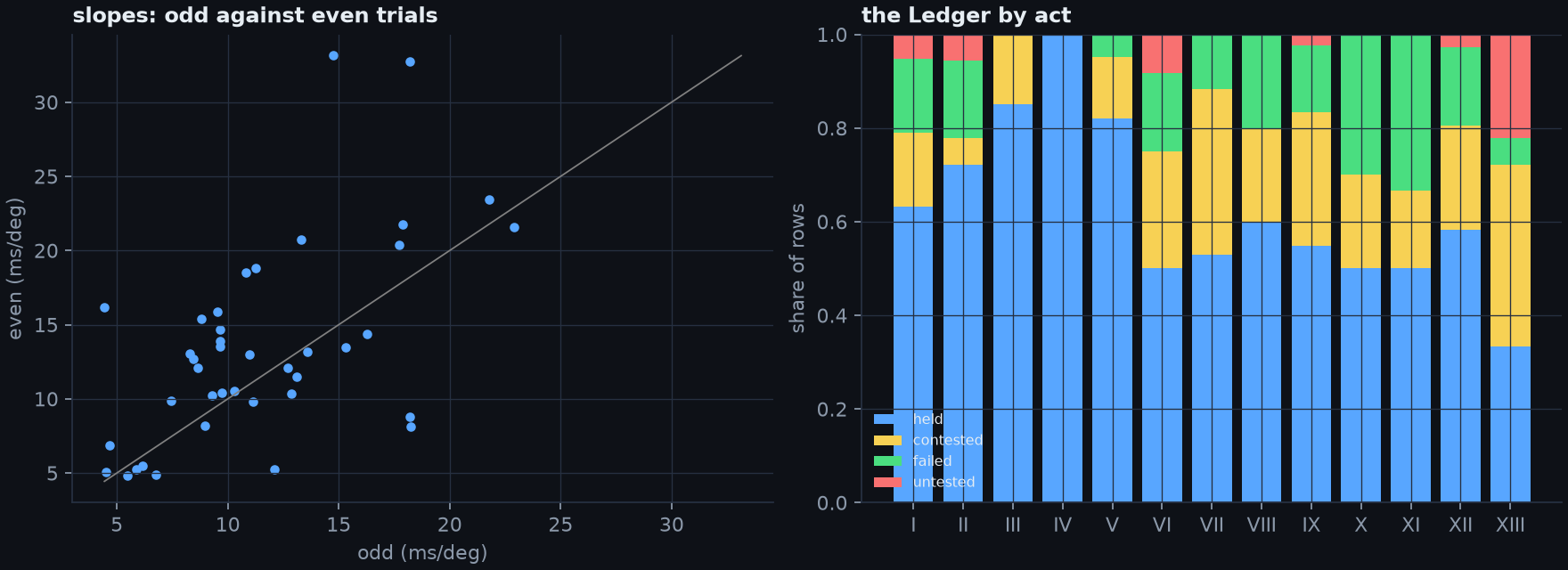
Now the result. Forty people, with a median slope of about twelve milliseconds per degree: the robust effect, again. Here's each person's slope in the odd trials against the even ones. The halves correlate zero point five eight, and corrected for length the slope's reliability is zero point seven four. The ninety-five percent interval runs from zero point five one to zero point eight seven. It contains zero point seven. And the mean time's reliability is zero point nine four, clearly higher.
So here's the verdict, by the rule fixed in advance. H1, that the slope's reliability is below zero point seven: inconclusive. H2, that the mean time is more reliable than the slope: supported. The paradox's strong prediction was not supported, and not refuted, and the estimate leans against it. The corollary held. That's the result, and the narration follows it.
What does a reliability of zero point seven four cost a study? Suppose a person's rotation speed truly correlates zero point four with some criterion, measured with a reliability of zero point eight. The numbers are illustrative. With perfect measures, about forty-seven people detect it. The mean time's reliability lowers the observed correlation to about zero point three five, and needs about sixty-three people. The slope's lowers it to about zero point three one, and needs about eighty. So a reliability of zero point seven four is usable. It costs about seventy percent more people. It isn't a lost cause. The paradox bites at reliabilities near zero point three.
What it does: The deviation; each person's slope; the verdict
7Writing itResearch2 min
How is a result written so that it can be trusted?
Then the exploratory analyses, labelled as such. With all fifty-four people, and mirror trials included, the reliability is zero point seven three, from zero point five seven to zero point eight three: the same answer. Why didn't the paradox bite? People's slopes really differ, with a standard deviation of about four milliseconds per degree around a mean of about twelve. Part 59's Stroop-like effect had a spread about a quarter of its mean. Rotation's is about a third, and each person gives many trials per angle. So robustness alone doesn't doom reliability. The ratio of real differences to trial noise does.
Here is the abstract as it would be written. Is a robust effect a reliable measure of a person? We tested the mental-rotation slope in a registered report, with the analysis written as code and hashed before the data were opened. In open trial-level data, forty people after one reported deviation, the slope's split-half reliability was zero point seven four, with an interval from zero point five one to zero point eight seven. The mean response time's was zero point nine four. The registered test of the reliability paradox was inconclusive, and the estimate leans against it. The slope is usable for individual differences at moderate cost. Limits: one dataset, one task, one sample. A larger replication with the same plan would settle it.
Then the paper. The introduction: the two results that collide, and the question, with the design's limits stated before the result. The method: the registered plan, its hash, and the deviation with the original rule. The results: registered first, exploratory after, and every person's data in one figure. The discussion: what the result changes, that the paradox is a ratio, not a law about robust effects, and what it doesn't. And the limits: one data set, forty people, one session. Split-half reliability isn't test-retest reliability over weeks.
What it does: Exploratory, and labelled; the paper
8Psyche's scorecardPractice2 min
Can one model with one set of parameters do it all?
Now Psyche sits the Battery, the twelve tasks and one questionnaire fixed in Part 1, through one shared interface, with one set of default parameters. Reaction time, the threshold, Stroop, change detection and risky choice match their published signatures. Two don't. Visual search's target-absent slope is three and a half times the present slope, not about twice; and in free recall with default parameters, recency runs back over most of the list, so the first item is recalled no better than the middle. Part 20's fitted parameters fix recall, but then it's a different Psyche. Six more tasks were only ever modelled inside their own parts. So: of with one set of parameters, and a unified Psyche is still the open problem Part 58 named.
Here are the two failures, drawn. Visual search first. Feature search is flat, about half a second at every set size, as it should be. Conjunction search rises by about ten milliseconds an item when the target is there, and by about thirty-five when it's absent. People's absent slopes are about twice their present ones, and Psyche's are three and a half times as steep. Free recall. The last items are recalled best, but the advantage runs back over most of the list, and the first item is recalled no better than the eighth. People's curves have a short recency, a flat middle and a clear primacy. Each failure names a fix: a different quitting rule for search, and rehearsal for the first items. And each fix then has to be tested on every other task, because a change made for one task can break another. That's the price of one model.
What it does: The Battery, task by task
9The Ledger, completePsych 101 and the major2 min
What held?
Here's the complete Ledger: rows, read by act. Green held: replicated, replicated but smaller, or a finding that stands while the textbook story of it doesn't. Yellow is contested, red failed or was retracted, and grey has never been directly tested. Across the series, rows held, about percent, and of those are smaller than first reported. Sixty-four are contested, forty-two failed, and four were retracted.
Here are the same rows sorted another way. By the year the original study appeared. Green held, gold is contested, red failed or was retracted, and grey is untested. Before nineteen fifty, ninety-six percent held. Since twenty ten, forty-two percent, with thirty-seven percent still contested. Part of that is survivorship. Old findings that failed were dropped from courses long ago, so a course teaches the old ones that survived. Part is time. A recent finding hasn't yet had its large replication, and many gold bars will turn green or red. And part is method. Small samples and flexible analyses were at their height around twenty ten, as Part 4 showed.
What's the pattern? What held best: the senses, learning and the machinery of thought, Acts Three to Five. Those effects were measured many times, in many people, with strong manipulations. What was contested or failed most: social, clinical, methodological and applied claims, in Acts Nine to Twelve, with small samples, subtle manipulations, and outcomes far from the manipulation. The frontier is mostly open. Its rows are young, and many are untested. And there's a date on every row. The Ledger is a record of a moment, to be checked again.
What it does: 322 rows by act; the pattern
10The Homunculus, last drawingPsych 101 and the major1 min
What is still a little person?
In Part 1 the Homunculus was a little person inside the head, doing all the work. Each part replaced a piece of it with mechanism. Here it is, drawn one last time. Mechanism now: the neuron and the synapse, thresholds and signal detection, early vision, conditioning and reward prediction, and decision as the accumulation of evidence. Partly mechanism: attention, working memory, episodic memory, language comprehension and emotion. Still a little person: consciousness, from Part 27; open-ended thought; a unified architecture, from Part 58; and the individual case, from Parts 47 and 59. The parts still drawn as a person are the syllabus of the next fifty years.
What it does: What is mechanism, and what is still a person
11The verdict on KantPsych 101 and the major2 min
Was he right?
So, was Kant right? On mathematics: answered. Weber's and Fechner's laws, Hick's logarithm, signal detection, the diffusion model and the Rescorla-Wagner rule are equations about the mind that predict measurements. On experiment: answered. Minds are randomized, manipulated and recombined every day, from Donders's subtraction in Part 1 to the registered report you just saw. On observation, Kant was right, and it was answered anyway. Observing does disturb: demand characteristics, Clever Hans, placebo, and the limits of introspection. And the field learned to measure the disturbance and control it, with blinding, control groups and behavioural measures.
Before the verdict, what Kant got right. That measurement is the hard part. Sixty-two parts later, reliability and validity are still where most findings live or die. That observing changes the observed. Demand, expectation, and the grain of truth in the Hawthorne story are designed around, not wished away. That a science of mind needs more than introspection. Every chapter here rests on behaviour, physiology, or models scored against data. His error was to treat these as reasons it couldn't be done, rather than as the problems the methods would have to solve.
There's a fourth objection Kant didn't make. The observer's incentives: researchers are rewarded for positive, new and striking results, as Parts 4, 50 and 61 showed. It produced the failed rows of the Ledger, not because minds can't be studied, but because the people studying them are people. It too is being answered, with registered reports, open data, big teams, and a Ledger with dates. So here's the verdict. A science of the mind is possible. It's hard. And it has to be a science of its own scientists too.
What it does: Three objections answered; the fourth
12Where to goPractice1 min
What next? Here is reading, by direction. For the brain: Kandel and colleagues' Principles of Neural Science, and Dayan and Abbott's Theoretical Neuroscience. For the mind's models: Busemeyer and Diederich's Cognitive Modeling, and Farrell and Lewandowsky's Computational Modeling of Cognition and Behavior. For measurement: Borsboom's Measuring the Mind, and McElreath's Statistical Rethinking. For people and societies: Henrich's The WEIRDest People in the World, and Kahneman's Thinking, Fast and Slow, read with this series' Ledger beside it. And for the clinic: Barlow's Clinical Handbook of Psychological Disorders, with the care chapters of Parts 39 to 42 and 57.
What travels from this course, whatever you do next? Design: a comparison that rules out the boring explanations, with randomization, blinding and the right control, from Part 2. Measurement: asking how reliable and how valid before asking how big, from Part 3. Inference: power, intervals, forking paths and the denominator, from Parts 4 and 50. Models: writing an idea as code, fitting it, and asking what it rules out, from Part 48. And judgement: reading any claim, your own included, against its Ledger row.
What it does: Reading by direction
13The Ledger: the last rowPractice1 min
Why does the series end on an open row? Every row in the Ledger began like this one: a single study, honestly reported. Whether it holds is decided by the studies that come after, not by the one that made it. The data and the code are open, so anyone can rerun it, or run it on new people. The Ledger isn't finished. It has a date, and the next row is yours.
What it does: The dissertation's row; why the series ends on an open row
14In practice: the rolesPractice1 min
Where does this series lead, as work? To research, in universities and in industry: Acts One, Eleven and Thirteen. To the clinic: clinical psychology and the allied professions, each with its own training and licensing, prepared for by Act Ten and Part 57. To people and products: user research, human factors and design, Parts 51 and 52. To organizations and policy: selection, education, behavioural policy and law, Parts 53 to 56. And to measurement and data: psychometrics, experimentation, and the evaluation of AI, Parts 44 to 50 and 60.
What it does: Roles, and the parts that prepare for them
15Frontier: the open problems of sixty-two partsResearch1 min
What is not known?
What isn't known? Here are eight open problems, gathered from every part's frontier chapter. Consciousness: which theory, if any, survives an adversarial test. A unified model: one Psyche, with one set of parameters, doing every task. Learning in the brain: which learning rule cortex uses. The individual: measures reliable enough to describe and help one person. The causes of disorder: mechanisms that predict who becomes ill, and who recovers. Development: how a child learns so much from so little. Culture: which findings are human, and which are local. And the field itself: incentives that select for rigour. Each one is a dissertation, or a career.
What it does: Eight open problems
The endAll tracks3 min
First, your last four numbers. A person's rotation slope had a reliability of zero point seven four, with an interval from zero point five one to zero point eight seven: inconclusive. of the Ledger's rows held, about percent. One Psyche matched of the Battery tasks it can sit. And none of Kant's objections survives as he stated it. The third was right, and answered.
Part sixty-two in twelve lines. A question came from a collision of two results. Ethics is a practice, checked by others. The plan was written as code, and hashed before the analysis. A design check says what the design can decide. Reviews come before results. A deviation was reported with the original rule beside it. The answer was inconclusive, leaning against the paradox. Exploratory analyses were labelled. One Psyche did five of seven tasks. In the Ledger, about three rows in five held. Kant was answered, and a fourth objection named. And the next row is yours.
The last seven problems, with full solutions in this part's README. One corrects a split half. One sizes a replication. One asks what a reviewer could have caught. One asks why the Ledger's share isn't a replication rate. One tests Psyche's search. One states Kant's fourth objection. And the last, with the star, asks you to write your own Stage 1 report. Pause here if you'd like to try them.
The books and papers behind this part are listed here and in the README. Chambers's book is the best account of what went wrong and of registered reports; the Belmont Report is short and still the foundation of research ethics; and Kant's preface is where this series began.
That's the end of the series. It began with Kant's never: no mathematics, no experiment, no observation that doesn't disturb. Sixty-two parts later there are equations that predict measurements, experiments run every day, a field that measures its own disturbances, and a Ledger of what held, with a date on every row. The open problems are on the course site, with every lab, every experiment, and the code. The next row is yours. Thank you for watching.
Where it goes next. The open problems of every part's frontier, gathered; the next row of the Ledger is the reader's.
Key results
The part's results in one place, for revision.
Try it
Lab 62 · The Dissertation
Rerun the registered report on Ganis and Kievit's open data, check what the design could decide, and read the complete Ledger by act.
python -m videos.psychology.labs 62
needs numpy, scipy, matplotlib · download lab62.py ·
source on GitHubthe registered plan's SHA-256 1ee2fa7b1189547d...
people kept; slope reliability (95% interval) 40; 0.74 (0.52 to 0.87)
mean-time reliability 0.94
verdict H1 inconclusive, H2 supported
design check: supported / inconclusive / refuted at 0.4, 0.7, 0.85 0.73/0.27/0.00; 0.05/0.88/0.07; 0.00/0.27/0.73
Ledger rows held / total 203 / 322
A registered report decides what the data can decide, reports what changed, and ends with a row that the next study will settle.The code (64 lines; it asserts its own result)
"""Lab 62: the dissertation: the registered report rerun, its design check, and the Ledger by act."""

import numpy as np

from videos.coursekit import labs
from explainer.psychology import ledger, opendata
from explainer.psychology.psyche import thesis as Th

TITLE = "The Dissertation"
GOAL = ("Rerun the registered report on Ganis and Kievit's open data, check what the design could decide, and read "
        "the complete Ledger by act.")
TASKS = [
    "Apply the registered minimum (4 trials per cell) and confirm that it excludes everyone. What rule would you "
    "have registered instead?",
    "Split the trials into first and second halves instead of odd and even. Does the reliability change? Why might it?",
    "Run the design check with 160 people. How often is a true reliability of 0.6 now decided?",
]


def run(seed=0):
    out = labs.Lab()
    assert Th.plan_hash().startswith("1ee2fa7b")
    out.row("the registered plan's SHA-256", Th.plan_hash()[:16] + "...")
    if opendata.available("ganis_kievit_2015"):
        d = opendata.mental_rotation()
        h = Th.person_halves(d, min_per_cell=Th.DEVIATION["used_min_per_cell"])
        r = Th.analyse(h, boots=2000, seed=62)
        out.row("people kept; slope reliability (95% interval)",
                f"{r['n']}; {r['slope_rel']:.2f} ({r['slope_ci'][0]:.2f} to {r['slope_ci'][1]:.2f})")
        out.row("mean-time reliability", f"{r['mean_rel']:.2f}")
        out.row("verdict", ", ".join(f"{k} {v}" for k, v in Th.verdict(r).items()))
        so, se = h["slope_odd"], h["slope_even"]
    else:
        out.row("open data", "not cached here; the design check runs on simulated people")
        hh = Th.simulate_halves(true_rel=0.74, seed=seed)
        so, se = hh["slope_odd"], hh["slope_even"]
    p = Th.power(true_rels=(0.4, 0.7, 0.85), reps=60, seed=seed)
    out.row("design check: supported / inconclusive / refuted at 0.4, 0.7, 0.85",
            "; ".join("/".join(f"{x:.2f}" for x in row) for row in p["table"]))
    b = Th.ledger_by_act(ledger.rows())
    held = b["table"][:, 0].sum()
    out.row("Ledger rows held / total", f"{held} / {b['table'].sum()}")

    out.note = ("A registered report decides what the data can decide, reports what changed, and ends with a row "
                "that the next study will settle.")

    fig, ax = labs.figure(2, size=(11, 4.0))
    ax[0].scatter(so, se, s=14)
    lim = [min(so.min(), se.min()), max(so.max(), se.max())]
    ax[0].plot(lim, lim, color="grey", lw=0.8)
    ax[0].set(title="slopes: odd against even trials", xlabel="odd (ms/deg)", ylabel="even (ms/deg)")
    frac = b["table"] / b["table"].sum(1, keepdims=True)
    bottom = np.zeros(len(b["acts"]))
    for j, g in enumerate(b["groups"]):
        ax[1].bar(b["acts"], frac[:, j], bottom=bottom, label=g)
        bottom += frac[:, j]
    ax[1].set(title="the Ledger by act", ylabel="share of rows")
    ax[1].legend(fontsize=7)
    out.fig = fig
    return out


if __name__ == "__main__":
    print(run())
Now change it
- Apply the registered minimum (4 trials per cell) and confirm that it excludes everyone. What rule would you have registered instead?
- Split the trials into first and second halves instead of odd and even. Does the reliability change? Why might it?
- Run the design check with 160 people. How often is a true reliability of 0.6 now decided?
Problems, with solutions
Try each problem before opening its solution.
-
Spearman-Brown. Halves correlate 0.58. The Spearman-Brown reliability of the full test?
Solution
2 x 0.58 / 1.58 = 0.73 (0.74 with the unrounded correlation).
-
A narrower interval. A reliability of 0.74 from 40 people. Roughly how many people to make the 95% interval half as wide?
Solution
Interval width shrinks roughly as one over the square root of the sample: four times as many people, about 160.
-
What a reviewer could have asked. The registered minimum excluded everyone. List two things a Stage 1 reviewer could have asked to catch it.
Solution
For the number of 'same' trials per angle in the published data (it is in the data descriptor), and for a pilot of the exclusion rule on simulated data with the real trial counts; or a pre-registered fallback rule if too many people were excluded.
-
Not a replication rate. Of 322 Ledger rows, 203 held. Why is that number not "the replication rate of psychology"?
Solution
The rows are not a random sample of psychology's findings: they were chosen because they were taught, famous or disputed, and their statuses mix direct replications with meta-analyses and judgment. The share describes this series' Ledger, not the field.
-
Serial self-terminating search. Psyche's search slopes: 10 ms per item present, 35 absent. What would a serial self-terminating search predict?
Solution
On target-present trials the searcher stops halfway through on average, so the absent slope should be about twice the present slope; 35 against 10 is steeper, and points to a model that rechecks items or terminates conservatively.
-
The fourth objection. Write Kant's fourth objection in one sentence, and the evidence that it is being answered.
Solution
"The people who study the mind are rewarded for striking results, and that distorts what is published." It is being answered by registered reports (far more null results), open data and code, big team replications, and ledgers with dates.
-
★ A Stage 1 report. Choose an open problem from any part's Frontier and write its Stage 1 registered report.
Solution
A question from a frontier chapter; the theory as a model that makes a prediction the alternative forbids; data and exclusion rules (piloted on the real trial counts); the analysis as code; a design check on simulated people; a decision rule with an inconclusive region; the plan's hash.
Notes and sources
Sources
- I. Kant, Metaphysische Anfangsgruende der Naturwissenschaft (1786), Preface; translated by E. B. Bax (1883).
- G. Ganis and R. Kievit (2015); C. Hedge, G. Powell and P. Sumner (2018); J. N. Rouder and J. M. Haaf (2019).
- National Commission for the Protection of Human Subjects of Biomedical and Behavioral Research, The Belmont Report: Ethical Principles and Guidelines for the Protection of Human Subjects of Research (1979); D. H. Hoffman et al., Report to the Special Committee of the Board of Directors of the American Psychological Association: Independent Review Relating to APA Ethics Guidelines, National Security Interrogations, and Torture (2015).
- C. D. Chambers, The Seven Deadly Sins of Psychology (Princeton University Press, 2017); C. D. Chambers and L. Tzavella, The past, present and future of Registered Reports, Nature Human Behaviour 6 (2022) 29-42; A. M. Scheel, M. R. M. J. Schijen and D. Lakens (2021); C. K. Soderberg et al. (2021).
- E. R. Kandel et al., Principles of Neural Science; P. Dayan and L. F. Abbott, Theoretical Neuroscience (MIT Press, 2001); J. R. Busemeyer and A. Diederich, Cognitive Modeling (Sage, 2010); S. Farrell and S. Lewandowsky, Computational Modeling of Cognition and Behavior (Cambridge University Press, 2018); D. Borsboom, Measuring the Mind (Cambridge University Press, 2005); R. McElreath, Statistical Rethinking (CRC Press, 2020); J. Henrich, The WEIRDest People in the World (Farrar, Straus and Giroux, 2020); D. Kahneman, Thinking, Fast and Slow (Farrar, Straus and Giroux, 2011); D. H. Barlow (ed.), Clinical Handbook of Psychological Disorders (Guilford).
About this partfrom its README
The series ends as a doctorate does. One question, left open where two earlier parts collide, is taken through a registered report: the plan written as code and its SHA-256 recorded before the analysis ran, a design check on simulated people, reviews, Stage 2 on open data, and the result reported whatever it showed. Part 24 found mental-rotation slopes rising for 53 of 54 people in Ganis and Kievit's open data, a robust effect; Part 59's reliability paradox says a robust effect is often a poor measure of individuals. Is a person's rotation slope a reliable measure of that person? Then the accounts are closed: Psyche sits the Battery, the Ledger is read from top to bottom, the Homunculus is drawn one last time, and Kant's three objections are answered one at a time.
The viewer takes a last experiment (a rotated letter, same or mirror) and predicts four numbers. Then how research is done; ethics as practice; Stage 1 (theory, hypotheses, the plan as code); the design check and three reviews written for the film; Stage 2, with one deviation reported; the exploratory analyses, labelled; writing the paper; Psyche's scorecard; the Ledger complete; the Homunculus; the verdict on Kant and a fourth objection; where to go; the last Ledger row; the roles; and eight open problems gathered from every part's frontier.
What is computed and built
explainer/psychology/psyche/thesis.py: the registered plan and its hash, the reported deviation, split-half reliability of slopes with bootstrap intervals, the decision rule, a design check on simulated people, Psyche's Battery scorecard and the Ledger by act. Tested intests/psychology/test_thesis.py.- The Ledger gains its last row, the dissertation's own result.
- The course's interactive: the last experiment, mental rotation on you, with your slope and its split-half reliability.
Chapter notes
| # | Chapter | What it does |
|---|---|---|
| 0 | Kant's three objections, again | The objections; the question; objectives |
| 1 | On you: the last experiment, and four numbers | Rotated letters; four predictions |
| 2 | How research is done | Finding a question; the craft |
| 3 | Ethics as practice | The Belmont principles applied; the profession's failures and codes |
| 4 | The registered report, Stage 1 | Theory and hypotheses; the plan as code |
| 5 | Peer review, shown | The design check; three reviews written for the film |
| 6 | Stage 2: the data | The deviation; each person's slope; the verdict |
| 7 | Writing it | Exploratory, and labelled; the paper |
| 8 | Psyche's scorecard | The Battery, task by task |
| 9 | The Ledger, complete | 322 rows by act; the pattern |
| 10 | The Homunculus, last drawing | What is mechanism, and what is still a person |
| 11 | The verdict on Kant | Three objections answered; the fourth |
| 12 | Where to go | Reading by direction |
| 13 | The Ledger: the last row | The dissertation's row; why the series ends on an open row |
| 14 | In practice: the roles | Roles, and the parts that prepare for them |
| 15 | Frontier: the open problems of sixty-two parts | Eight open problems |
| The end | Your numbers; twelve lines; problems; references; the end |
Notes
- Plan.
explainer/psychology/psyche/thesis.py,PLAN; SHA-2561ee2fa7b1189547d57863b673b825ff6d434d63461032bd0d718fd6919aee462, recorded at 14:57 UTC on 16 November 2026, before the data were read for this analysis. - H1 (the paradox's risky prediction): the Spearman-Brown corrected odd/even split-half reliability of a person's rotation slope is below 0.70. H2: the person's mean time on the same trials is more reliable than the slope. Decision: H1 supported if the 95% bootstrap interval (4,000 resamples over people, seed 62) lies below 0.70, refuted if it lies above, otherwise inconclusive; H2 supported if the paired difference's interval lies above 0.
- Design check. 54 simulated people, 200 studies per true reliability: at 0.40 the rule says supported 67% of the time; at 0.55, 30%; at 0.70 it is inconclusive 94% of the time; at 0.85 it says refuted 75%.
- Deviation. The registered minimum of 4 usable trials per angle in each half kept none of the 54 people (the
data have as few as three 'same' trials per angle in a half, before errors). It was lowered to 2, a decision made on
those counts alone, before any reliability was computed (
thesis.DEVIATION). - Result. 40 people kept (14 excluded); median slope 11.9 ms per degree; halves correlate 0.58; slope reliability 0.74 (95% interval 0.51 to 0.87): H1 inconclusive. Mean time 0.94 (0.88 to 0.97); the paired difference's interval 0.07 to 0.44: H2 supported.
- Exploratory. All 54 people with mirror trials included: 0.73 (0.57 to 0.83). Between-person SD of the slope about 4.3 ms per degree around a mean of 12.5 (a third of the mean), against a quarter in Part 59's simulated Stroop effect: robustness alone does not doom reliability; the ratio of real differences to trial noise does.
NotesWhere the numbers come from
| What | Source |
|---|---|
| Ganis and Kievit's mental rotation study: 54 people, 96 trials each, at 0, 50, 100 and 150 degrees | Ganis and Kievit (2015), Journal of Open Psychology Data (CC BY 4.0), fetched by explainer.psychology.opendata and checked by SHA-256, as in Part 24; items stage2 and explore |
| The design check | Psyche (thesis.power), item power |
| Psyche's scorecard: reaction time, threshold, Stroop, change detection and risky choice match their signatures with one set of default parameters; visual search (absent slope 3.5 times the present one) and free recall (with default parameters recency runs back over most of the list: first item 0.44, the eighth 0.44, the last 0.84) do not; six tasks were modelled only inside their own parts | Psyche (thesis.scorecard, through battery.run), item scorecard |
| The complete Ledger: 322 rows; held 203 (replicated 167, smaller 23, story and record 13), contested 64, failed 42, retracted 4, not directly tested 9; by act | the Ledger (explainer/psychology/ledger.py), item board |
| The two failures, drawn: search times at set sizes 4, 8, 16 and 32 (feature about 507 ms throughout; conjunction present 547 to 832 ms, absent 669 to 1,659 ms) and the serial-position curve of 16-item free recall (0.44, falling to 0.26 at positions 3 and 4, rising to 0.84) | Psyche (battery.run, default parameters), item failures |
| Every published number on screen | the studies listed under Sources, quoted as reported |
Notes
| Finding | Original | Status |
|---|---|---|
| A person's mental-rotation slope (response time per degree), though the effect is nearly universal, is an unreliable measure of that person (split-half reliability below 0.70), as the reliability paradox predicts. | Psychology, Built (Part 62, a registered report) 2026 | not directly tested |
Shown without a row, with the reason recorded in explainer/psychology/ledger.py: the Belmont Report; Hoffman and
colleagues; Ganis and Kievit (whose data the row analyses); Kant's objections.
Notes
The web-search budget for this session was spent on earlier parts, so the facts in this part come from the standard literature and were not re-checked online today; each is listed here to be checked against its source: Ganis and Kievit's journal and design (as in Part 24); the Belmont Report's date and principles; the 2015 Hoffman review's findings and the APA's policy change; Chambers and Tzavella (2022); Scheel et al. (2021); Soderberg et al. (2021); the editions of the books in Sources; and every page range in Sources. Chapter six's cost of a reliability of 0.74 uses an illustrative true correlation (0.4) and criterion reliability (0.8); chapter nine's tally by decade is computed from the Ledger's own rows.
Companion material in this repository
The syllabus's plan for this partfrom SYLLABUS.md, the plan of record
- Hook: Kant's three objections, back on screen.
- How research is done: finding a question worth asking; reading; the pilot; advisers and collaborators; what a contribution is.
- Ethics as practice: Belmont's principles applied; data privacy; the profession's failures (psychologists and coercive interrogation) and its codes.
- The registered report, Stage 1: theory as a model in Psyche that makes a risky prediction; design, power on the Pool, analysis code, the outcomes that would count against the theory.
- Peer review, shown: three reviews (written for the film), the response, the revision.
- Stage 2: data (an open dataset fixed in advance, plus the viewers' on the site), the registered analysis, the result. The narration follows the data.
- Writing it: the paper's structure; figures that show the data; limits stated.
- Psyche's scorecard: the whole Battery, model against human benchmarks, task by task. Where one model with one set of parameters does several tasks, and where it cannot.
- The Ledger, complete: what replicated, by act; the pattern; the date on every row.
- The Homunculus, last drawing: what is mechanism now, and what is still a person (consciousness, open-ended thought, a unified architecture, the individual case).
- The verdict on Kant: mathematics applies; experiment is possible; observation does disturb, and the field learned to measure the disturbance. The fourth objection he did not make: the observer's incentives.
- Where to go: reading by direction, the roles of §2.6, and the map of open problems from all sixty-two Frontier chapters.
Psyche: the thesis: a registered report executed end to end; the Battery scorecard; the final Ledger board and Homunculus map generated from the series' data. On you: the last experiment, and your Battery page on the site with every task you have taken. Ledger: the complete board. In practice: the careers map: academic research, clinical training routes (which this series is not), and the industry roles, with what each asks for. Frontier: the open-problems map. Reading: Chambers & Tzavella 2022; the Belmont Report; Hoffman et al. 2015; Platt 1964; Hamming, "You and Your Research"; Newell 1973; the reading lists of every act.
Build the film
python -m videos.psychology.psych62.compute        # the part's numbers, into .cache/psych62
python tools/build.py psych62                  # render and assemble the film
EXPLAINER_TTS=silent python tools/qa_scene.py psych62 Hook   # one chapter, silent, with a contact sheet
Scenes: videos/psychology/psych62. Setup: see the course page. Source of these notes: the README and the scenes' narration.
Build it
python -m videos.psychology.psych62.compute            # every number (a few minutes)
python tools/qa_scene.py psych62 StageTwo              # one chapter, silent, at 480p, with a contact sheet
EXPLAINER_TTS=silent python tools/build.py psych62 -q l   # the whole part, silent preview
python tools/build.py psych62                          # 1080p30 with narration
python tools/qa_scene.py psych62 Kant --lang zh        # the Chinese edition of one chapter
python tools/make.py psych62                           # both editions, with the checks a long build needs
python -m videos.psychology.labs 62                    # the lab: the registered report, rerun
python tools/check_ledger.py psych62                   # every study shown has its Ledger row, or a reason
python -m pytest tests/psychology                      # Psyche's thesis module, the Ledger, the Archive
The Chinese edition is zh_lines.py (the narration, line by line) and the series table
videos/psychology/psychology_text_zh.json (the text on screen); the terms are in
PSYCHOLOGY_ZH_GUIDE.md.