Act I · Asking a Mind a Question
Part 1 of 62Kant's Wager
Can a mind be measured, and what would it take to explain one?
The part opens in 1786 with Kant's three reasons why psychology can never be a science: mathematics does not apply to the inner sense, the mind cannot be taken apart and recombined, and observing a mental state changes it. It keeps score against them. The viewer's own simple and choice reactions come first, then Helmholtz's 1850 measurement of the speed of a nerve signal, 25 to 43 metres a second in a frog, and the fifteen-year dispute over the human value that ended by finding temperature. Donders subtracts a simple reaction from a go/no-go and a go/no-go from a choice, and gives discrimination 36 ms and choice 47 ms; the part builds his reasoning as a chain of stages, the first model of the series, and then turns on it: a rival model has the same three means, and only the distributions can test whether a stage was purely inserted. Fechner's logarithm and Ebbinghaus's forgetting data follow, then the stalemate of introspection, the behaviourists' ban on the mind, and its return in 1956 with maps, plans and bits. It ends with Marr's three levels, the homunculus that an explanation must get rid of, and the four devices of the series.
What you need. Nothing beyond school arithmetic for most chapters. Chapter 4 uses the mean and variance of a sum of independent random variables.
- Hook
- Kant 1786; Fechner's morning, 1850
- Ideas, models and mathematics
- mental chronometry, Donders' subtraction, Helmholtz's nerve speed, Wundt, Ebbinghaus, James, behaviourism, the cognitive revolution, Marr's levels
- Psyche gains
- a reaction-time stage model; the Homunculus, whole
- On you
- simple and choice reaction time
What you will be able to do
Psych 101 and the major
- State Kant's three objections to a science of the mind, and say which early measurement answers each and which is still open.
- Compute a conduction speed from two stimulation sites, and Donders' two stage durations from his three mean reaction times.
- Describe an explanation at Marr's three levels, and say why a homunculus explains nothing.
Graduate
- Write a reaction time as a sum of independent stage durations, and derive what pure insertion implies for its mean, its variance and its distribution.
- Use additive-factor logic to decide from a table of mean reaction times whether two factors act on the same stage.
Research
- Explain why three mean reaction times cannot identify the stages that produced them, and state a distributional test that can refute pure insertion.
- Say how a cascade of continuous processes can mimic additive effects, and what data would separate it from discrete stages.
Practice
- Report a timing result as a difference between conditions, and say what a constant device delay changes and what it leaves alone.
- Ask of any reaction-time claim what the number includes and which apparatus measured it.
Contents
Each chapter has a home level. Choose a track to see what to read and watch: Psych 101 and the major 38 min · Graduate 44 min · Research 48 min · Practice 40 min.
- 0Kant's wagerPsych 101 and the major4 min
- 1How fast are you?Psych 101 and the major2 min
- 2The speed of a nervePsych 101 and the major4 min
- 3Subtracting one task from anotherPsych 101 and the major3 min
- 4What subtraction assumesGraduate4 min
- 5Measuring a sensationPsych 101 and the major2 min
- 6The first laboratoriesPsych 101 and the major3 min
- 7Banning the mindPsych 101 and the major3 min
- 8The mind comes backPsych 101 and the major5 min
- 9Three levels of explanationPsych 101 and the major2 min
- 10The little person in the headPsych 101 and the major2 min
- 11What the series buildsPsych 101 and the major3 min
- 12The Ledger opensPsych 101 and the major2 min
- 13In practice: reaction time at workPractice2 min
- 14Frontier: what is a reaction time measuring?Research3 min
- Recap, problems, and the road aheadAll tracks4 min
Also on this page: Lecture · Key results · Try it · Lab · Problems · Notes and sources · Build the film.
Lecture
The text of each chapter is the film's narration, as it is spoken, so you can read along or revise without the film. The pictures are in the film. A dashed box stands for a number the film computes when it is rendered (hover over it to see what is computed); the README's figures for each chapter, where it lists them, follow the chapter's text.
Kant's wagerPsych 101 and the major4 min
In 1786 Immanuel Kant, the most influential philosopher in Europe, explained why there could never be a science of the mind. He had just set out what makes physics a science, and he measured the other fields against it. Chemistry fell short. Psychology, he said, fell further. And he gave three reasons. First: mathematics can't be applied to what goes on in the mind. A thought has no length and no weight. There's nothing to put a number on. Second: you can't experiment on it. A chemist can separate a substance into its parts and put them together again. The contents of a mind can be told apart in thought, but they can't be held apart, or recombined at will. Third: even watching your own mind changes it. The observation alters and distorts the state of the thing observed. So psychology could describe the soul, the way a naturalist describes a landscape. But it could never be a science of the soul.
These weren't foolish objections. Kant was describing the psychology of his day accurately, and each objection names a real difficulty. So think of it as a wager. If Kant is right, nobody will ever write an equation about the mind that predicts a measurement. Nobody will run an experiment on a thought. And every attempt to observe a mind will be defeated by the observing. This series is the story of how that wager was taken up: a hundred and seventy-five years of it so far. It starts on a particular morning. The twenty-second of October, 1850, in Leipzig. A physicist named Gustav Fechner is lying in bed, and it occurs to him that you might not need to measure a sensation directly. You could measure the smallest change in the world that a person can notice, and count sensation in those steps. In the same year, in Königsberg, the city where Kant had lived and died, Hermann Helmholtz was timing a signal on its way down a frog's nerve. Two measurements of the mind's machinery in a single year, sixty-four years after Kant said there could be none.
The series puts three questions to every topic. One: what happens? The phenomenon, measured, and measured first on you. Two: what would produce it? A mechanism, written as mathematics and built as a program that runs. And three: how do we know? Kant's third objection never went away, because the investigator is a mind too, and the easiest person to fool. So every finding in this series goes into a ledger, with what happened when somebody ran it again.
Part one: Kant's wager. In this part we time your reactions, and ask where the time goes. We follow Helmholtz as he measures the speed of a nerve, and Donders as he subtracts one task from another to time a thought. We find out what his subtraction assumed, and how to test it. Then the history in three steps: the first laboratories, the behaviourists who banned the mind, and the revolution that brought it back. We meet David Marr's three levels of explanation, and the homunculus, the bad explanation this series is built to get rid of. And we set up the four devices that run through all sixty-two parts.
What it does: Kant's three objections, drawn; the wager; the morning of 22 October 1850; the series' three questions; objectives
1How fast are you?Psych 101 and the major2 min
Before any history, an experiment, and you are the subject. Put one finger on the desk in front of you. In this frame there's a grey circle. At some moment it will turn green. When it does, tap, as fast as you can. Three tries. Ready.
Now a choice. If a green circle appears, tap with your right hand. If a blue square appears, tap with your left. You won't know which is coming. Four tries.
You can't see your own numbers yet. On this part's page of the course site, the same experiment runs in your browser and shows them to you. Here is what people get. A simple reaction to a light takes about a fifth of a second. In a study of adults, the average was milliseconds. A choice takes longer. And notice the shape. The times don't pile up evenly around their average. A bell curve with the same average and spread misses: it's too low at the peak, and it gives out too early on the right. Reaction times lean. There's a hump, and then a long tail of slow responses. That tail is a clue about what deciding is, and all of Part 25 is spent on it.
So here is the first puzzle of the series. Your choice took longer than your simple reaction. The same eyes, and the same finger. What were you doing with the extra time, and can it be measured? Before anyone could ask that, somebody had to show that a nervous system takes any time at all.
What it does: On you: three simple reactions and four choices. What people get: 213 ms for a simple reaction in 1,469 adults; a choice is slower and its distribution leans. The puzzle: what is the extra time?
2The speed of a nervePsych 101 and the major4 min
In the eighteen-forties the leading physiologist in Europe, Johannes Müller, taught that the speed of nervous action would probably never be measured. Feeling and willing seemed instantaneous: you decide to move a finger, and it moves. Müller's student Hermann Helmholtz, twenty-eight years old and newly a professor in Königsberg, decided to try. His preparation was a frog's calf muscle with its nerve still attached. A brief electric shock to the nerve makes the muscle twitch. The idea is simple. Shock the nerve close to the muscle, and time the twitch. Then shock it at the far end, five or six centimetres away, and time the twitch again. The muscle is the same, and the shock is the same. So if the second twitch comes later, the difference is the time the signal took to travel the extra length of nerve.
The delay was tiny: between and thousandths of a second. But divide the extra distance by the extra time, and you have a speed. Fifty millimetres in two thousandths of a second is metres a second. Sixty millimetres in one point four thousandths is . That isn't the speed of light. It isn't even the speed of sound. In a cold frog, a nerve signal travels about as fast as a car on a motorway. So a message in the nervous system is a physical event. It takes time, and the time can be measured. That's the first crack in Kant's first objection.
Helmholtz went straight on to people. He gave a mild electric shock to the skin, at the toe or higher up the leg, and asked the person to move a hand as soon as they felt it. A shock at the toe took longer to answer, and from the difference he worked out about sixty metres a second in human nerves. And here's a part the textbooks leave out. Over the next fifteen years other laboratories repeated the measurement, and kept getting about half that. Thirty-four. Twenty-six. Helmholtz began to suspect that he'd dropped a factor of two somewhere in his own calculation. He measured again, and got thirty-four himself. And then, in the summer of 1869, sixty-five. The speed of a nerve depends on its temperature. So psychology's very first measurement came with its first replication dispute. And the dispute ended the way the good ones do: by finding the variable that nobody had controlled.
The experiments on people left something behind. Take one reaction, from the shock on the skin to the movement of the hand. Subtract the time the signal spends travelling in along the nerve, and the time for the command to travel out. Helmholtz was left with about a tenth of a second that the brain itself was taking, for what he called the processes of perceiving and willing. A tenth of a second is a long time. At sixty metres a second a signal could cross the whole body three times over. So what is the brain doing with it?
What it does: Helmholtz's frog preparation and two stimulation sites; v = Δx/Δt gives 25 to 43 m/s; the human measurements from 1850 to 1869; the tenth of a second left over for the brain
3Subtracting one task from anotherPsych 101 and the major3 min
The man who took up that tenth of a second was a Dutch physiologist and eye doctor, Franciscus Donders, in Utrecht. His idea was to make the brain do a little more, and see how much longer it took. His experiment used speech. The experimenter says a syllable: ki. The subject repeats it as fast as he can. Both voices scratch their vibrations onto a turning drum, beside the trace of a tuning fork, and the tuning fork is the clock. Count its waves between one voice and the other. He ran the experiment three ways. Method a: you know the syllable in advance. It will be ki, so just repeat it. That's a simple reaction. Method b: it could be any of five syllables, and you must repeat whichever one you hear. Now you have to tell which syllable it was, and choose which one to say. And method c, the clever one. Any of the five may come, but you answer only to ki, and stay silent for the others. You still have to tell the syllables apart. But you never have to choose a response, because there's only one.
Here are Donders' own times, in thousandths of a second. The simple reaction: . Go/no-go: . Choice: . Now subtract. Method c is method a, plus telling the syllables apart. So c minus a, milliseconds, is the time it takes to tell them apart. And method b is method c, plus choosing a response. So b minus c, milliseconds, is the time of a choice. Look at what just happened. A purely mental act, choosing among five things, which nobody can see, has been given a duration: thousandths of a second. On a drum, with a tuning fork. Kant said that mathematics can't be applied to the inner sense. This is a subtraction.
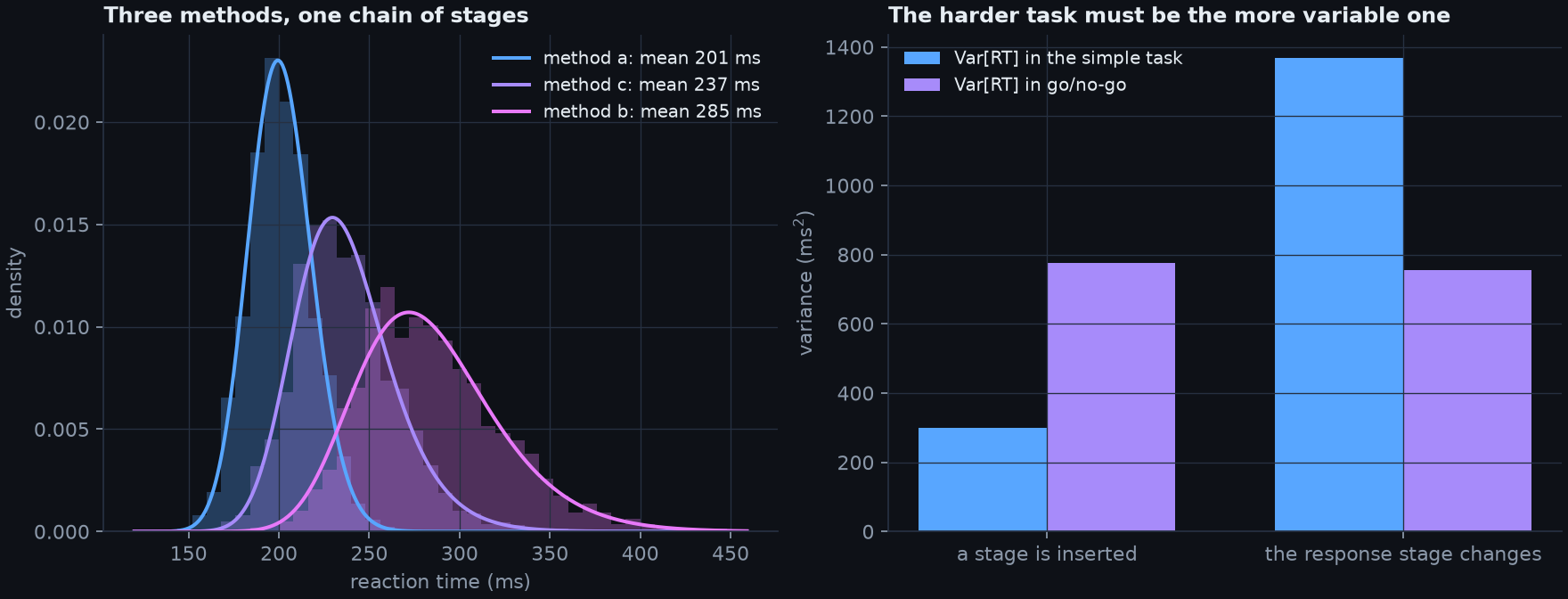
This is the first model of the series, so let's build it properly. A response is produced by a chain of stages. Each stage takes a random time, a little different on every trial, and the reaction time is their sum. That's a program, and here it is running: twenty thousand simulated trials of each method. The white lines are Donders' three averages. Subtract the model's averages, and it gives back the stage durations we built in. In this series, a model that runs is always drawn in orange, and it has a name: Psyche. Human data are always white. This is Psyche's first faculty. It can react.
What it does: Donders' drum, the three methods a, b and c, his means 201, 284 and 237 ms; c − a = 36 ms and b − c = 47 ms; Psyche's stage model reproduces them
4What subtraction assumesGraduate4 min
Donders' subtraction rests on one assumption, and it has a name: pure insertion. Going from the easier task to the harder one slips a stage into the chain, and everything else stays exactly as it was. Is that true? Wilhelm Wundt didn't think so. In method c, he pointed out, you still have to decide something: whether to speak, or keep silent. That is a choice. So c minus a is not pure discrimination, and b minus c is not the whole of choosing. Here are Donders' two harder tasks, read his way. And here is a rival reading, built on Wundt's objection. Go/no-go contains a small decision of its own. And in the choice task the response can't be prepared in advance, so it has to be programmed. Different stages, with different durations. And exactly the same three averages. Three numbers cannot tell these two stories apart. There's a postscript. In 2018 Ardi Roelofs went back to Donders' handwritten laboratory notebook, and found the data of Donders' students, which Donders never published. For the students, methods b and c took the same time.
Can the assumption be tested? Not with three averages. But a reaction time isn't one number. It's a whole distribution, and pure insertion says something strong about distributions. Suppose the harder task really is the easier one plus an extra stage, independent of the rest. Then the harder task's distribution is the easier one's, smeared out by the extra stage. Mathematicians call that a convolution: slide one curve along the other, and add. And when independent durations are added, two things follow. Their averages add: that's Donders' subtraction. And their variances add too. The spread of the harder task must be the spread of the easier one, plus the spread of whatever was inserted.
So here is a check that could fail. The harder task must be more variable than the easier one, by the variance of the stage that was inserted. In a model world where a stage is purely inserted, Psyche passes. The variance goes up, by the variance of the stage we built in. Now a second world. Here, knowing the response in advance changes how the response is made: it can be prepared, and sometimes it jumps the gun. The average difference between the two tasks is exactly what it was. But the simple task comes out more variable than the harder one. An inserted stage would need a negative variance, and no stage has that. Pure insertion is refuted, and from the shape of the data alone. That is the method of this whole series in miniature. A verbal idea, a stage is inserted, becomes a model. The model makes a prediction that could fail. And then you look.
A hundred years after Donders, Saul Sternberg found a way to study stages without inserting anything. Keep the task the same, and change two things about it. Say, make the stimulus harder to see, and increase the number of alternatives. If those two changes slow down different stages, their effects on the reaction time simply add. On a plot like this, that means parallel lines. Now change two things that both act on the same stage: more alternatives, and an awkward mapping from stimulus to response. Both make choosing harder, the effects compound, and the lines fan out. So a pattern in average reaction times, parallel or not, tells you something about the architecture inside. That's the additive factor method. It needs no subtraction of one task from another, and we'll use it ourselves in Part 19.
What it does: Pure insertion; Wundt's objection; a rival model with the same means; Donders' notebook; the convolution picture and the variance check in two model worlds; additive factors
5Measuring a sensationPsych 101 and the major2 min
Timing is one way to put a number on the mind. Fechner's was another, and it went at Kant's first objection head on. The objection was that a sensation has no size you can measure. You can't lay a ruler along how heavy something feels. Fechner's idea was to stop trying, and measure the world instead. Hold a weight. Now find the smallest extra weight that makes it feel just noticeably heavier. A physiologist in the same city, Ernst Weber, had already found the pattern. For a weight twice as heavy, you need twice as much extra. And twice as much again for the next. The just-noticeable difference is a constant fraction of what you start with.
Now Fechner's step. Treat each just-noticeable difference as one unit of sensation, and count them. Start from a light weight, and climb. Each step up in sensation is the same size, by definition. But each step along the stimulus is bigger than the last, by the same factor. Down here a step is grams. Up here it's . Equal steps of sensation for equal ratios of the stimulus: that's the signature of a logarithm. In symbols. Weber's law says the noticeable change is a fixed fraction of the stimulus. Call one noticeable change one unit of sensation. Then a small change in sensation is the change in the stimulus, divided by the stimulus. Add up the small changes, and sensation grows as the logarithm of the stimulus. That is Fechner's law. He published it in 1860, with ten years of measurements behind it.
Is the law right? That's Part 11, where you'll measure your own threshold, and meet the rival law that arrived a century later. What matters today is the move. A quantity inside the mind has been defined by things you can count outside it. So Kant's first objection now has three replies: a division, a subtraction, and a logarithm.
What it does: Weber's fraction; Fechner's count of just-noticeable steps; S = (1/k) ln(I/I₀) derived
6The first laboratoriesPsych 101 and the major3 min
By 1879 there were enough of these methods to fill a few rooms. In Leipzig, Wilhelm Wundt opened the first laboratory of experimental psychology, and students came from across Europe and America to be trained in it. It had two tools. One was Donders': the reaction time, measured with a chronoscope, a clock that reads to a thousandth of a second. The other was trained introspection: an observer who has practised describing exactly what he experiences, under controlled conditions. And Wundt himself drew a line. Sensations and reactions could be studied this way. Memory and thinking, he believed, were out of reach of experiment.
The boldest experiment of the era was done outside any laboratory, by a man working alone. Hermann Ebbinghaus set out to measure memory, the very thing Wundt had ruled out, and he did it on himself. He made up about meaningless syllables, so that nothing he already knew could help him. He learned a list of them until he could recite it without a mistake, and timed how long that took. Then he waited. Twenty minutes, an hour, a day, a month. And he learned the same list again. The second time was quicker, and the time he saved was his measure of what memory had kept. These are his numbers, from 1885. After twenty minutes, per cent saved. After an hour, . After a day, . After a month, still . He fitted a curve to them, with the logarithm of time in it, and it misses none of his seven points by more than points. This is the first quantitative law of memory, and one man's patience produced it. Parts 20 and 21 take it apart.
In 1890 William James pulled the new science together in almost fourteen hundred pages, The Principles of Psychology, which is still worth reading. But one of the field's two tools was failing. Introspection could not settle its own disputes. In Würzburg, trained observers reported thoughts with no images in them at all. At Cornell, trained observers reported that there is always an image, if you look carefully enough. Each side said the other's observers were badly trained. And no experiment could decide between them, because the only instrument was the observer. That is Kant's third objection, arriving on schedule.
What it does: Wundt's two tools; Ebbinghaus's savings after seven intervals with his own fitted curve; James; imageless thought and the stalemate of introspection
7Banning the mindPsych 101 and the major3 min
The American answer was drastic. If observing the mind can't be trusted, stop observing it. In 1913 John Watson published a manifesto. Psychology as the behaviorist views it is a purely objective experimental branch of natural science. Its theoretical goal is the prediction and control of behavior. Introspection forms no essential part of its methods. For the next forty years, in America, that was close to the rule. Study what an animal does: the stimulus going in, the response coming out, and how reward and punishment change the link between them. What happens in between was declared out of bounds. It bought a great deal. Experiments that anyone could repeat, with a rat, a lever and a counter. And laws of learning that hold from pigeons to people, which fill Part 16. But it left things it couldn't explain, and two of the sharpest came from inside the camp.
Edward Tolman let hungry rats explore a maze for ten days with no food in it. They wandered, and made plenty of wrong turns. On the eleventh day he put food at the end. Within a day or two they were running the maze as well as rats that had been fed there from the start. They had learned the layout while nothing was rewarding them. And Tolman said what a behaviourist was not supposed to say: the rat has a map of the maze in its head.
And Karl Lashley asked how a pianist plays a fast passage. A good pianist can play sixteen notes a second: about milliseconds from one note to the next. But a reaction takes longer than that. We saw it in chapter two: the brain alone needs about a tenth of a second. So the feel of one finger landing can't be what triggers the next. The signal would arrive too late. The sequence has to be planned in advance, as a whole, before it starts. A map. A plan. Those are things inside the animal. The box had contents, and the behaviourists' own experiments showed it.
What it does: Watson's manifesto; the black box; Tolman's latent learning; Lashley's pianist
8The mind comes backPsych 101 and the major5 min
What changed was a machine. By the nineteen-fifties there were computers. And a computer is a physical object, entirely mechanical, of which it makes perfect sense to say: it stores, it retrieves, it compares, it decides. Nobody calls that unscientific. So talk about what happens inside the box stopped sounding like mysticism, and started sounding like engineering. You could draw it: a box for each operation, and arrows for the flow of information between them.
If you want a birthday, George Miller offered one: the eleventh of September, 1956, the second day of a symposium on information theory at MIT. That day Allen Newell and Herbert Simon presented a program that proved theorems of logic. Noam Chomsky presented a theory of grammar that no chain of stimulus and response could produce. And Miller himself talked about the bottleneck of short-term memory, the subject of his paper of the same year, The Magical Number Seven. A reasoning machine, a grammar, a memory limit. Three things inside the box, in one day.
The same years supplied a unit. Claude Shannon's theory of communication measures information in bits: one bit for each yes-or-no question you need answered. A choice between two things is one bit. Among four, two bits. Among eight, three. The logarithm of the number of alternatives. In 1952 William Hick put that together with Donders' discovery. Suppose a person takes in information at a steady rate. Then the time to choose should grow with the bits: with the logarithm of the number of alternatives, not with the number itself. Here's what that predicts for Psyche, with the rate set from Donders' own two numbers: about milliseconds a bit, for a task as natural as repeating a syllable. Against the number of alternatives, the line bends. Against bits, it's straight. That is Hick's law. It has held up in experiment after experiment, and Part 25 derives it from a model of how a decision gets made.
By 1967 the new field had a textbook, and the textbook gave it a name: cognitive psychology. The study of what happens between the stimulus and the response. But notice what the revolution did not settle. Boxes and arrows are easy to draw. How do you know there's really a compare operation in there, and not just a label for something you don't understand? Who is doing the comparing? Answering that takes two more ideas, and they're the next two chapters.
Before those two ideas, step back. Textbooks tell this history as a parade of schools, and it helps to see them on one map. Wundt's laboratory, and Edward Titchener's at Cornell, asked what conscious experience is made of. Titchener called that structuralism. William James, and John Dewey and James Angell in Chicago, asked what the mind is for, a question from Darwin: functionalism. Sigmund Freud asked what moves us that we cannot see. Max Wertheimer, Wolfgang Köhler and Kurt Koffka asked why we see wholes, a tune rather than its notes: Gestalt psychology. Behaviourism asked what experience does to behaviour. Then Abraham Maslow and Carl Rogers called their movement a third force, against both psychoanalysis and behaviourism: humanistic psychology, which asked what lets a person grow. Then the cognitive revolution, and after it cognitive neuroscience, which asks how the brain does it, and evolutionary psychology, which asks what the mind was shaped to do. Now look at how they ended. Structuralism died with its method. Most of the others were never simply refuted and replaced, the way a theory is in physics. They narrowed into perspectives, kinds of question, and their methods became common property: the laboratory, the question of function, the demonstrations, the controlled experiment, therapy recorded and tested. This series uses all of them. How such different questions fit together is the next chapter.
What it does: The computer as a licence; 11 September 1956; bits; Hick's law as a prediction for Psyche
9Three levels of explanationPsych 101 and the major2 min
So now there are two sciences of one thing. One group opens the skull, and studies neurons. The other draws information flowing between boxes, and never touches a brain. Which of them explains the mind? The clearest answer came from David Marr, a vision scientist who died of leukaemia at thirty-five. His book came out two years later, in 1982. His answer: both, and a third thing that matters more than either.
Take a cash register. You can describe it at three levels. First: what does it compute, and why? It adds prices. Why addition, and not something else? Because of what a fair total requires. The order you ring things up shouldn't matter. Buying nothing should cost nothing. Requirements like those single out addition. Second: how does it do it? Write the prices in decimal digits, add the columns from the right, and carry. That's a representation and an algorithm, and there are others. A register that worked in Roman numerals would compute the same sums a different way. Third: what is it made of? Gear wheels in an old register, transistors in a new one. Three questions, and three different kinds of answer. You can get one right while knowing nothing about the other two.
Now your reaction time. What is computed: a decision that the light has changed, made quickly, and without too many false starts. By what algorithm: a chain of stages, if Donders is right. In what tissue: the nerves Helmholtz timed, and a brain we haven't opened yet. Every chapter card in this series carries a strip that lights the level it's working at, and the scale, from molecules up to cultures. And Marr left a warning that this series takes to heart. Trying to understand perception by studying only neurons, he wrote, is like trying to understand bird flight by studying only feathers.
What it does: Marr's cash register at three levels; reaction time at three levels; the levels strip
10The little person in the headPsych 101 and the major2 min
There's one way to fail at all three levels at once, and it's the most natural explanation there is. How do you see a tree? Well, the eye sends a picture to the brain, and then something in there looks at it. A little person, sitting in the head, watching a screen. In Latin: a homunculus. The trouble is plain as soon as it's drawn. How does the little person see? There would have to be a smaller one inside its head, and a smaller one inside that. Nothing has been explained. The whole problem has just been moved one step in. Nobody proposes this in so many words. It slips in through phrases. The brain decides. Attention selects. Memory retrieves the right fact. Each of those hides somebody clever, doing the work.
The philosopher Daniel Dennett gave the rule for doing it properly. A homunculus is only a problem if it's as clever as the person it's supposed to explain. So replace the one clever person with a committee of specialists, each of which does less. One that only detects. One that only compares. One that only remembers. Then replace each of those with simpler ones still. When the members are so simple that a machine could do the job, a gear, a switch, a line of arithmetic, the homunculus has been discharged, and something has been explained. Donders took the first step in 1868. One reactor became three: something that senses, something that tells apart, something that chooses. Each does less than the whole. This is the map of the series. Twenty things a mind does, each still drawn as a little person. Every part takes one of them, and replaces it with a mechanism that runs. Today we've made a start on the first: reacting. And whatever is still a person at the end, in Part 62, is the honest list of what psychology has not explained.
What it does: The homunculus regress; Dennett's rule; the map of twenty faculties; the first gear
11What the series buildsPsych 101 and the major3 min
Four devices run through all sixty-two parts. The first you've met. Psyche. It's the Greek word for breath, for the soul, and for a butterfly. Here it's a library of small models, one faculty for each part of the series. Each one is a program that does the same task a person does, and produces the same kind of data. Each is checked against something independent. And each earns its place by matching what people do, including their mistakes. The colours never change. People in white. Psyche in orange.
The second device is the Pool: a hundred thousand simulated people, each one a Psyche with its own settings. Faster and slower, older and younger. In a real experiment the truth is hidden. That's why you're doing the experiment. In the Pool we know the truth, because we wrote it. So of any method we can ask: does it find what's really there? Here's Donders' experiment, run on people from the Pool. On average, b minus c comes to milliseconds. So a choice takes milliseconds. Except that it doesn't, for anyone. We built the Pool on Wundt's objection. About half its people decide in the go/no-go task, so for them b and c take the same time. For the rest, the choice takes about . The average of the group describes no one in it. That will matter in every act of this series, and the Pool is how we'll see it. Whatever comes from the Pool is labelled simulated. It can show what a method does. It is never evidence about people.
The third device is the Battery: twelve classic tasks and one questionnaire, fixed for the whole series. For each there are three columns. What people do. What Psyche does. And what you do, because on the course site each part's interactive is the experiment itself, and your data never leave your browser. Today we filled in the first row. In the last part of the series, Psyche sits the whole Battery. And the fourth device is the Ledger, which gets the next chapter to itself.
And this is where we're going. Thirteen acts. First, how to ask a mind a question without fooling yourself. Then what the mind is made of, and how a world gets in. Learning, and then thinking, the longest act. Feeling, growing, the ways people differ, and other people. What happens when minds suffer, and what helps. That completes a degree. Then the graduate toolkit, psychology at work, and the frontier.
What it does: Psyche; the Pool, where the group average of b − c describes no one; the Battery; the series map
12The Ledger opensPsych 101 and the major2 min
Kant's third objection, that the observer disturbs what's observed, has a modern form. The investigator wants a result. And a hundred and fifty years of psychology have shown how reliably people find what they hope to find, in a horse, in a patient, or in their own data. Part 4 tells that story. So this series keeps a ledger. Every finding we present gets a row: what was claimed, by whom, on how many people; and then what happened when someone ran it again. There are seven verdicts. Replicated. Replicated, but smaller. Contested. Failed. Never directly tested. Retracted. And one for the cases where the finding is sound, but the story the textbooks tell about the study is wrong.
Here is a row in full. The claim: Donders' two differences are the durations of pure stages. The original study, a hollow marker: one subject, Donders himself. What happened next, in filled markers: Wundt's objection, and the notebook. The verdict: contested. And today's five rows together. The nerve signal has a finite speed: replicated, after a fifteen-year argument that ended by finding temperature. Mental operations take measurable time, simple faster than go/no-go, faster than choice: replicated, as often as almost anything in the field. Donders' reading of the differences as pure stages: contested. Hick's law, a preview of Part 25: replicated. And one more, which is the subject of the frontier chapter.
What it does: Why a ledger; the seven statuses; one row in full; today's five rows
13In practice: reaction time at workPractice2 min
Where does a reaction time earn its living? On the road. An engineer deciding how far ahead a hazard must be visible needs the driver's reaction time, and the American design standard allows two and a half seconds. At a hundred kilometres an hour, that's metres of road. It's about ten times your reaction in this video, because a real driver isn't waiting with a finger on a key. There's seeing, recognising, deciding, and moving a foot. Stages, again. On a screen. When a system answers within about a tenth of a second, it feels instantaneous. Much slower, and the user notices the wait. Interface engineers budget their latency against that figure. In the clinic. Reaction time, and especially how much it varies from one trial to the next, is part of concussion assessment, and of cognitive screening in old age. And on the track. A sprinter who leaves the blocks less than a tenth of a second after the gun is ruled to have jumped it, on the grounds that nobody can react that fast. A fact about the nervous system, written into a rulebook.
So here is this part's practice card. Who uses this: interface and human-factors engineers, road and vehicle designers, clinical neuropsychologists. What to ask of any timing claim: what does the number include, which device measured it, and is it one person's average or a group's? And what carries over from today: a difference between two conditions is safer than an absolute time, and a distribution tells you more than a mean.
What it does: Road design, interface latency, clinical screening, the false-start rule; the practice card
14Frontier: what is a reaction time measuring?Research3 min
In 2013 a paper made headlines with a startling claim. Francis Galton had measured simple reaction times on thousands of visitors to his London laboratory in the 1880s, and his young adults averaged under milliseconds. Modern studies report slower times. So, the authors argued, people have got slower since the Victorians, and since quick reactions go with high test scores, less intelligent. Two years later a group led by David Woods tested adults. Their raw average was milliseconds. Then they measured the delays in their own hardware, the time the display takes to show the stimulus and the button takes to report the press, and subtracted them. . Much closer to Galton's subjects, whose apparatus was a pendulum, with no screen and no keyboard in the loop. Different instruments, different numbers. A difference between eras, or between laboratories, or between devices, is first of all a fact about the apparatus. That's Kant's worry about measurement, turned practical.
This matters to you, because the experiments on our course site run in your browser, on your screen, and a phone is not a laboratory. Here is one person from the Pool, measured on three devices with different delays. The averages move by tens of milliseconds. Compare two people on different devices, and you're comparing the devices. But look at the difference between the choice and the simple reaction. It doesn't move at all, because a constant delay subtracts out. That's Donders' trick, working for us. So the site reports differences and slopes, and it tells you that it can't vouch for absolute times.
Three things are open. One. Is there a single mental speed, a general quickness that runs through every task? People who are fast at one thing tend to be fast at others, and speed goes with test scores. Whether that's one cause or many is unsettled, and Part 32 comes back to it. Two. Are there stages at all? In 1979 James McClelland showed that a cascade, where every level passes partial results forward continuously, can imitate the additive patterns that were supposed to prove separate stages. And three: the question from the start of this part. What is the shape of a reaction-time distribution telling us? The best current answer is that a decision is an accumulation of noisy evidence up to a threshold, and that's Part 25. This part's research problem sits between the last two. Design an experiment whose reaction-time distributions would tell stages from a cascade.
What it does: The "Victorians were faster" claim and hardware delays; one person on three devices; three open questions; the research problem
Recap, problems, and the road aheadAll tracks4 min
Part one in ten lines. Kant gave three reasons why the mind could never be a subject for science. Helmholtz showed that a signal in a nerve takes time, and measured its speed by dividing a distance by a delay. Donders subtracted one task from another, and gave a choice a duration. His subtraction assumes pure insertion, which three averages can't test, and whole distributions can. Sternberg's additive factors read the stages off a pattern instead. Fechner defined sensation by counting noticeable steps, and got a logarithm. Ebbinghaus measured memory by the time saved in relearning. The behaviourists banned the mind in 1913, and by 1956 maps, plans and bits had brought it back. Marr separated what is computed, by what algorithm, and in what tissue. And the way to explain a faculty without a little person inside is to build it.
So how does Kant's wager stand? On the first objection he has lost. Numbers apply: a division, a subtraction, a logarithm, a forgetting curve. On the second he has half a point. Tasks can be taken apart and put together again. But whether the mind's own stages can be, without changing them, is exactly the question of pure insertion, and the answer depends on the case. And on the third, that the observer disturbs what is observed, he is still ahead. Introspection failed on precisely this. And the next part begins with the most famous case of an observer disturbing the observed, without knowing it.
Almost everything here comes back. Fechner's law and your own threshold, in Part 11. Donders' subtraction, as the logic of brain imaging, in Part 8. Additive factors in Part 19, Ebbinghaus's curve in Parts 20 and 21. The shape of reaction times, and Hick's law, in Part 25, and in interface design in Part 52. The group average that describes no one, in the graduate toolkit. And Kant's third objection, in the very next part.
Seven problems, with full solutions in this part's README. One is Helmholtz's arithmetic. Two are about Donders' subtraction and what it assumes. One works out an additive-factor table by hand. One asks you to find the confounds in a claim about phones and laptops. One uses Psyche's own code. And the last, marked with a star, is the research problem. Pause here if you'd like to try them.
The books and papers this part follows are listed here and in the README: Boring's and Danziger's histories, Luce on response times, Marr and Dennett, and the original papers, from Kant's preface to the 2018 reanalysis of Donders' notebook.
That's the first gear in the head: one faculty begun, and nineteen to go. We ended on the objection Kant is still winning: the observer disturbs what is observed. In Berlin in 1904, a horse named Hans was doing arithmetic, tapping out the answers with his hoof, and a commission of thirteen experts could find no trick. There was no trick. What there was, and how one young psychologist found it, gave psychology its rules for asking a mind a question. That's Part 2: the experiment.
Where it goes next. Fechner's law is tested on your own threshold in Part 11, and the threshold is replaced by signal detection in Part 12. Donders' subtraction returns as the logic of brain imaging in Part 8 and additive factors as memory scanning in Part 19; Ebbinghaus's curve is taken apart in Parts 20 and 21. The shape of a reaction-time distribution and Hick's law are derived in Part 25. Kant's third objection is the subject of Parts 2 and 4, and the Ledger opened here gains rows in every part.
Key results
The part's results in one place, for revision.
Try it
Lab 1 · Donders' subtraction, and a check that could fail
Simulate Donders' three methods with a chain of stages, recover the stage durations by subtraction, then show that a rival model has the same three means and that only the variances can tell when a stage was not purely inserted.
python -m videos.psychology.labs 1
needs numpy, scipy, matplotlib · download lab01.py ·
source on GitHubmean RT, methods a / c / b (ms) 201.2 / 236.8 / 284.9 (built in: 201 / 237 / 284)
c - a: discrimination (ms) 35.6 +- 0.7 (built in: 36)
b - c: choice (ms) 48.1 +- 1.1 (built in: 47)
a rival model's means a / c / b (ms) 201 / 237 / 284
its discrimination and choice (ms) 6 and 52 (Donders read 36 and 47)
a stage is inserted: Var[c] - Var[a] (ms^2) +477 +- 21 mean difference 36.1 ms
the response stage changes: Var[c] - Var[a] (ms^2) -612 +- 42 mean difference 36.3 ms
Subtraction recovers a stage when the stage is purely inserted, but three means cannot show that it was: the variance of the harder task must exceed the easier one's, and here it can be checked.The code (72 lines; it asserts its own result)
"""Lab 1: subtract one task from another, then test what the subtraction assumed."""

import numpy as np

from videos.coursekit import labs
from explainer.psychology.psyche import chronometry as ch

TITLE = "Donders' subtraction, and a check that could fail"
GOAL = ("Simulate Donders' three methods with a chain of stages, recover the stage durations by subtraction, then "
        "show that a rival model has the same three means and that only the variances can tell when a stage was "
        "not purely inserted.")
TASKS = [
    "Cut the trials per method from 2,000 to 40. How wide are the standard errors of the two differences now?",
    "In prepared_models, change the go/no-go decision from 30 ms to 10 ms. Which stage durations move, and do the "
    "three means?",
    "Give the response stage of the simple task a CV of 0.2, 0.3, 0.42. At what value does the variance check "
    "first reject pure insertion with 4,000 trials?",
]


def run(seed=0):
    rng = np.random.default_rng(seed)
    lab = labs.Lab()
    n = 2000
    models = ch.donders_models()  # stages built from Donders' own means: 201, 237 and 284 ms
    rt = {k: models[k].sample(n, rng) for k in "abc"}
    sub = ch.subtraction(rt["a"], rt["b"], rt["c"])
    lab.row("mean RT, methods a / c / b (ms)", " / ".join(f"{rt[k].mean():.1f}" for k in "acb") + "   (built in: 201 / 237 / 284)")
    lab.row("c - a: discrimination (ms)", f"{sub['discriminate']:.1f} +- {sub['discriminate_se']:.1f}   (built in: 36)")
    lab.row("b - c: choice (ms)", f"{sub['choose']:.1f} +- {sub['choose_se']:.1f}   (built in: 47)")
    assert abs(sub["discriminate"] - 36) < 5 * sub["discriminate_se"], "subtraction recovers the inserted stage"
    assert abs(sub["choose"] - 47) < 5 * sub["choose_se"]

    rival = ch.prepared_models()  # go/no-go contains a decision; a choice must be programmed
    stages = {s.name: s.mean for s in rival["b"].stages}
    lab.row("a rival model's means a / c / b (ms)", " / ".join(f"{rival[k].mean:.0f}" for k in "acb"))
    lab.row("its discrimination and choice (ms)", f"{stages['discriminate']:.0f} and {stages['choose']:.0f}   (Donders read 36 and 47)")
    assert all(abs(rival[k].mean - models[k].mean) < 1e-9 for k in "abc"), "the same three means"
    assert abs(stages["choose"] - 47) > 1, "but different stages"

    # two worlds with the same difference of means between the simple task and go/no-go
    m = 4000
    worlds = {"a stage is inserted": models["a"], "the response stage changes": models["a"].with_stage("respond", cv=0.42)}
    tests = {}
    for name, short in worlds.items():
        xs, xl = short.sample(m, rng), models["c"].sample(m, rng)
        tests[name] = dict(ch.insertion_test(xs, xl, n_boot=400, seed=seed), var_short=xs.var(), var_long=xl.var())
        t = tests[name]
        lab.row(f"{name}: Var[c] - Var[a] (ms^2)", f"{t['d_var']:+.0f} +- {t['se_var']:.0f}   mean difference {t['d_mean']:.1f} ms")
    ok, bad = tests["a stage is inserted"], tests["the response stage changes"]
    assert abs(ok["d_var"] - 36 ** 2 * 0.6 ** 2) < 5 * ok["se_var"], "variances add under pure insertion"
    assert bad["d_var"] < -5 * bad["se_var"], "a negative 'stage variance' refutes pure insertion"
    assert abs(ok["d_mean"] - bad["d_mean"]) < 4, "though the means cannot tell the two worlds apart"
    lab.note = ("Subtraction recovers a stage when the stage is purely inserted, but three means cannot show that "
                "it was: the variance of the harder task must exceed the easier one's, and here it can be checked.")

    fig, ax = labs.figure(2, size=(11, 4.2))
    t = np.arange(120.0, 460.0, 1.0)
    for k, color in zip("acb", (labs.BLUE, labs.PURPLE, labs.PINK)):
        ax[0].hist(rt[k], bins=np.arange(120, 461, 8), density=True, color=color, alpha=0.3)
        ax[0].plot(t, models[k].pdf(t), color=color, label=f"method {k}: mean {rt[k].mean():.0f} ms")
    ax[0].set(title="Three methods, one chain of stages", xlabel="reaction time (ms)", ylabel="density")
    ax[0].legend()
    names = list(tests)
    x = np.arange(2)
    ax[1].bar(x - 0.18, [tests[k]["var_short"] for k in names], 0.36, color=labs.BLUE, label="Var[RT] in the simple task")
    ax[1].bar(x + 0.18, [tests[k]["var_long"] for k in names], 0.36, color=labs.PURPLE, label="Var[RT] in go/no-go")
    ax[1].set_xticks(x, names)
    ax[1].set(title="The harder task must be the more variable one", ylabel="variance (ms$^2$)")
    ax[1].legend()
    lab.fig = fig
    return lab
Now change it
- Cut the trials per method from 2,000 to 40. How wide are the standard errors of the two differences now?
- In prepared_models, change the go/no-go decision from 30 ms to 10 ms. Which stage durations move, and do the three means?
- Give the response stage of the simple task a CV of 0.2, 0.3, 0.42. At what value does the variance check first reject pure insertion with 4,000 trials?
Problems, with solutions
Try each problem before opening its solution.
1. A nerve is stimulated at two points 55 mm apart, and the twitch from the farther point begins 1.7 ms later. What speed does that give, and how long would such a signal take to travel one metre?
Solution
v = Δx/Δt = 0.055 m / 0.0017 s ≈ 32.4 m/s. One metre takes 1/32.4 s ≈ 31 ms. That is inside Helmholtz's range of 25 to 43 m/s, and it shows why conduction alone cannot account for a reaction time of 200 ms.
2. Donders' means were 201 ms (a), 237 ms (c) and 284 ms (b). Compute his two differences. Now suppose go/no-go contains a 30 ms decision, and the choice task a 25 ms stage that programs the response. What are the durations of discrimination and of choice?
Solution
Donders: c − a = 36 ms (discrimination), b − c = 47 ms (choice). In the rival model c = a + discrimination + 30, so
discrimination = 6 ms; and b = a + discrimination + choice + 25, so 284 = 201 + 6 + choice + 25 and choice = 52 ms.
The three means are the same in both models. Means alone do not identify the stages: the answer depends on which
stages you assume are present. (chronometry.prepared_models() is this model.)
3. Show that if RT_c = RT_a + D with D independent of RT_a, then Var[RT_c] = Var[RT_a] + Var[D]. A subject's variances are 900 ms² in task a and 700 ms² in task c. What follows?
Solution
Var[X + D] = Var[X] + Var[D] + 2 Cov[X, D], and the covariance of independent variables is zero. With the
subject's numbers Var[D] = 700 − 900 = −200 ms², which no random variable has. So, sampling error aside, task c is
not task a plus an independent stage: either the stages shared by the two tasks behaved differently in c (were less
variable), or the extra stage's duration is negatively related to the rest. Before concluding, put a standard
error on the difference of variances (a bootstrap, as in chronometry.insertion_test).
4. Two factors multiply the mean duration of the same 50 ms stage by 1.4 and by 1.6. Write the 2 × 2 table of mean reaction times (the other stages total 250 ms) and its interaction contrast. Repeat with the factors acting on two different 50 ms stages.
Solution
Same stage: the stage takes 50, 70, 80 or 50 × 1.4 × 1.6 = 112 ms.
| factor 2 easy | factor 2 hard | |
|---|---|---|
| factor 1 easy | 300 | 330 |
| factor 1 hard | 320 | 362 |
Interaction: 362 − 320 − 330 + 300 = 12 ms, which is 50 × 0.4 × 0.6. Different stages (two stages of 50 ms, the others totalling 200 ms so that the baseline is again 300): 300, 330, 320 and 350. Interaction: 0. Additive effects are what separate stages predict; an interaction says the factors meet somewhere.
5. A website reports that phone users have slower reaction times than laptop users. Give three explanations other than "phone users are slower", and a design that would separate them.
Solution
(i) The devices: a touch screen and a phone display add delays a keyboard and monitor do not, and a constant delay shifts every time. (ii) The response: a tap on glass and a key press are different movements with different motor stages. (iii) The people and the setting: phone users may be older or younger, and are more often walking, distracted or holding the device in one hand. (iv) Selection: who chooses to take a reaction-time test on a phone. Designs: measure each device's delay with an external sensor and subtract it; test the same people on both devices in counterbalanced order; or report a difference between two conditions (choice minus simple), which a constant delay cannot change. Random assignment of people to devices removes (iii) and (iv).
6. With explainer.psychology.psyche.chronometry: simulate 2,000 choice reaction times, fit an ex-Gaussian,
then double the mean of the choice stage and fit again. Which of μ, σ, τ move?
Solution
import numpy as np
from explainer.psychology.psyche import chronometry as ch
rng = np.random.default_rng(0)
b = ch.donders_models()["b"]
print(ch.fit_exgauss(b.sample(2000, rng)))
print(ch.fit_exgauss(b.with_stage("choose", mean=94.0).sample(2000, rng)))
With seed 0: μ goes from 254 to 279 ms, σ from 27 to 38, τ from 31 to 52. All three move. Lengthening one stage does not change one ex-Gaussian parameter: the ex-Gaussian describes the shape of the distribution well, but its parameters are not the durations of stages. That caution returns in Part 25.
7 (★, research). Design an experiment on Battery task 1 whose reaction-time distributions would separate discrete stages from a cascade.
Solution
What is known. Discrete serial stages with selectively influenced durations predict additive effects on mean RT
and, more strongly, that the effect of each factor is a convolution: the cumulants of the factor effects add
(the "summation test" on whole distributions). McClelland's cascade (1979) passes activation forward
continuously; it also produces additive means when factors change the rates of different levels, but a factor
that changes a level's asymptote rather than its rate produces interactions, and the distributional predictions
differ. How a researcher would attack it: choose two factors with good evidence of selective influence (stimulus
contrast; number of alternatives), collect enough trials per cell and per person for stable distributions (several
hundred), and test the summation prediction with the distribution-level tests of Ashby and Townsend (1980) and
Roberts and Sternberg (1993) instead of a test on means; then fit both model classes to the same trial-level data
with a recovery check (Part 48). The place to start in this repository is chronometry.insertion_test and
factorial_means, generalized from two tasks to a 2 × 2 design, with a cascade model to be written beside them.
Notes and sources
Where it comes back
- Fechner's law and your own threshold: Part 11. Signal detection replaces the threshold: Part 12.
- Donders' subtraction as the logic of brain imaging, with its pure-insertion problem: Part 8.
- Additive factors and memory scanning: Part 19. Ebbinghaus's curve: Parts 20 and 21.
- The shape of reaction-time distributions, the diffusion model and Hick's law derived: Part 25; in interfaces, Part 52.
- The group average that describes no one: Parts 47 and 48. Difference scores as measures of people: Parts 3 and 59.
- Kant's third objection: Part 2 (Clever Hans) and Part 4 (the replication crisis).
- The Homunculus's last drawing, and Psyche on the whole Battery: Part 62.
Sources
Books. E. G. Boring, A History of Experimental Psychology (2nd ed., 1950). K. Danziger, Constructing the Subject (1990). R. D. Luce, Response Times (1986). R. S. Woodworth, Experimental Psychology (1938). D. Marr, Vision (1982), ch. 1. D. C. Dennett, Brainstorms (1978). H. Gardner, The Mind's New Science (1985).
Papers and primary texts.
- I. Kant, Metaphysische Anfangsgründe der Naturwissenschaft (1786), Preface; English by E. B. Bax (1883).
- H. Helmholtz, "Vorläufiger Bericht über die Fortpflanzungsgeschwindigkeit der Nervenreizung", Archiv für Anatomie, Physiologie und wissenschaftliche Medicin (1850) 71–73.
- H. Schmidgen, "Of frogs and men: the origins of psychophysiological time experiments, 1850–1865", Endeavour 26 (2002) 142–148.
- G. T. Fechner, Elemente der Psychophysik (1860).
- F. C. Donders, "Over de snelheid van psychische processen" (1868); transl. W. G. Koster, Acta Psychologica 30 (1969) 412–431.
- A. Roelofs, "One hundred fifty years after Donders", Acta Psychologica 191 (2018) 228–233.
- H. Ebbinghaus, Über das Gedächtnis (1885); transl. Ruger and Bussenius, Memory (1913).
- J. B. Watson, "Psychology as the behaviorist views it", Psychological Review 20 (1913) 158–177.
- E. C. Tolman and C. H. Honzik (1930); E. C. Tolman, "Cognitive maps in rats and men", Psychological Review 55 (1948) 189–208.
- K. S. Lashley, "The problem of serial order in behavior" (1951).
- W. E. Hick, "On the rate of gain of information", QJEP 4 (1952) 11–26; R. Hyman (1953); R. W. Proctor and D. W. Schneider, "Hick's law for choice reaction time: a review", QJEP 71 (2018) 1281–1299.
- S. Sternberg, "The discovery of processing stages: extensions of Donders' method", Acta Psychologica 30 (1969) 276–315.
- J. L. McClelland, "On the time relations of mental processes: an examination of systems of processes in cascade", Psychological Review 86 (1979) 287–330.
- G. A. Miller, "The cognitive revolution: a historical perspective", Trends in Cognitive Sciences 7 (2003) 141–144.
- M. A. Woodley, J. te Nijenhuis and R. Murphy, Intelligence 41 (2013) 843–850; D. L. Woods et al., Frontiers in Human Neuroscience 9 (2015) 131.
About this partfrom its README
Part 1 of a sixty-two-part course in psychology (see the series plan and the syllabus), opening Act I, Asking a Mind a Question. It asks whether a mind can be measured at all, and answers with the first measurements that were made.
It opens in 1786 with Kant's three reasons why psychology could never be a science: no mathematics, no experiment, and an observer who disturbs what is observed. The part keeps score against them. From there it covers:
- your own simple and choice reaction time (the first demonstration on the viewer), and the right-skewed shape of a reaction-time distribution;
- Helmholtz's 1850 measurement of the speed of a nerve signal, his arithmetic, and the fifteen-year dispute over the human value that ended by finding temperature;
- Donders' three methods (1868), his subtraction, and the first model of the series: a chain of stages whose durations add;
- what subtraction assumes (pure insertion), Wundt's objection, a rival model with the same three means, the distributional test (variances must add), and Sternberg's additive factors;
- Fechner's law, derived from Weber's fraction by counting just-noticeable steps;
- Wundt's laboratory, Ebbinghaus's forgetting data, James, and the dispute that introspection could not settle;
- behaviourism, and the two findings from inside it that needed something in the head: Tolman's maps and Lashley's plans;
- the cognitive revolution of 1956, Shannon's bit and Hick's law;
- the textbook's schools on one map (structuralism, functionalism, psychoanalysis, Gestalt, behaviourism, the humanistic "third force", cognitive psychology, cognitive neuroscience, evolutionary psychology): what each asked, and how most narrowed into perspectives whose methods the series still uses;
- Marr's three levels of explanation, with his cash register;
- the homunculus, and Dennett's rule for discharging it;
- the series' four devices: Psyche, the Pool, the Battery and the Ledger;
- the first five rows of the Ledger; reaction time in practice; and a frontier chapter on what a reaction time measures.
Every number on screen is computed in compute.py, taken from the Archive with its source, or cited:
- Historical data (the Archive,
explainer/psychology/archive, with checks inSOURCES.md): Kant's Preface in Bax's 1883 translation; Helmholtz's nerve lengths, delays and speeds as reported by Schmidgen (2002); Donders' three means as given by Roelofs (2018); Ebbinghaus's retention table from chapter VII of Memory; the summary statistics of Woods et al. (2015). - Psyche (orange on screen): stage models of reaction time. The stage durations of the Donders model are his two differences. The choice stages used for the shape of a reaction-time distribution in Chapter 1 are illustrative and are tagged so.
- The Pool (grey-blue, tagged
simulated): Donders' experiment on 300 simulated people, and one person on three devices. The device delays are illustrative. - Schematics, tagged: the twitch curves and Donders' drum record, the Weber fraction of one tenth, the curves after Tolman and Honzik (1930), Lashley's time line.
Built in this part:
psyche.chronometry(explainer/psychology/psyche/chronometry.py): serial stage models with gamma stages (exact mean, variance and third moment; densities by convolution), Donders' models and a rival with the same means, the subtraction with standard errors, the distributional test of pure insertion, additive-factor tables, Hick's law, and the ex-Gaussian with a maximum-likelihood fit. Checked against closed forms and SciPy intests/psychology/test_chronometry.py.- The Pool (
explainer/psychology/pool.py): 100,000 simulated people with planted reaction-time stages, a general speed factor, an age slope and, for half of them, a decision inside go/no-go.tests/psychology/test_pool.pychecks that the planted values are recoverable. - The Battery (
explainer/psychology/battery.py): the list of thirteen tasks and the trial-level data format; task 1 (reaction time) runs. - The Ledger (
explainer/psychology/ledger.py) and the Archive. - The instruments (
explainer/psychology/viz.py): the Homunculus map, the On-you stage, the trial strip, stage bars, study and Ledger cards.
The Ledger gains five rows:
| Finding | Original | Status |
|---|---|---|
| The nerve signal travels at a finite, measurable speed | Helmholtz 1850 | replicated (the human value depended on temperature) |
| Mental operations take measurable time: a < c < b | Donders 1868 | replicated |
| Donders' differences are the durations of pure stages | Donders 1868 | contested (Wundt 1880; Roelofs 2018) |
| Choice time grows with the logarithm of the number of alternatives | Hick 1952 | replicated (derived in Part 25) |
| Simple reaction times have slowed since the Victorians | Woodley et al. 2013 | contested (Woods et al. 2015: hardware delays) |
Chapter notes
| # | Chapter | What it does |
|---|---|---|
| 0 | Kant's wager | Kant's three objections, drawn; the wager; the morning of 22 October 1850; the series' three questions; objectives |
| 1 | How fast are you? | On you: three simple reactions and four choices. What people get: 213 ms for a simple reaction in 1,469 adults; a choice is slower and its distribution leans. The puzzle: what is the extra time? |
| 2 | The speed of a nerve | Helmholtz's frog preparation and two stimulation sites; v = Δx/Δt gives 25 to 43 m/s; the human measurements from 1850 to 1869; the tenth of a second left over for the brain |
| 3 | Subtracting one task from another | Donders' drum, the three methods a, b and c, his means 201, 284 and 237 ms; c − a = 36 ms and b − c = 47 ms; Psyche's stage model reproduces them |
| 4 | What subtraction assumes | Pure insertion; Wundt's objection; a rival model with the same means; Donders' notebook; the convolution picture and the variance check in two model worlds; additive factors |
| 5 | Measuring a sensation | Weber's fraction; Fechner's count of just-noticeable steps; S = (1/k) ln(I/I₀) derived |
| 6 | The first laboratories | Wundt's two tools; Ebbinghaus's savings after seven intervals with his own fitted curve; James; imageless thought and the stalemate of introspection |
| 7 | Banning the mind | Watson's manifesto; the black box; Tolman's latent learning; Lashley's pianist |
| 8 | The mind comes back | The computer as a licence; 11 September 1956; bits; Hick's law as a prediction for Psyche |
| 9 | Three levels of explanation | Marr's cash register at three levels; reaction time at three levels; the levels strip |
| 10 | The little person in the head | The homunculus regress; Dennett's rule; the map of twenty faculties; the first gear |
| 11 | What the series builds | Psyche; the Pool, where the group average of b − c describes no one; the Battery; the series map |
| 12 | The Ledger opens | Why a ledger; the seven statuses; one row in full; today's five rows |
| 13 | In practice: reaction time at work | Road design, interface latency, clinical screening, the false-start rule; the practice card |
| 14 | Frontier: what is a reaction time measuring? | The "Victorians were faster" claim and hardware delays; one person on three devices; three open questions; the research problem |
| Recap, problems, and the road ahead | Ten lines; Kant's scoreboard; payoffs; problems; references; Part 2 |
Notes
Before the narrated master, read the full text of Roelofs (2018) and of Koster's translation of Donders for the
three means and the task details; neither could be retrieved when the part was written (see
SOURCES.md). The practice figures of Chapter 13 (the 2.5 s of
highway design, the 0.1 s of interface response, the 0.100 s false-start rule) are stated from the standard
references named on screen and should be checked against their current editions.
Companion material in this repository
The syllabus's plan for this partfrom SYLLABUS.md, the plan of record
- Hook: Kant, 1786. Three objections on screen. The series will keep score against them.
- On you: simple reaction time, then a choice. Your two numbers differ. Why?
- Helmholtz times the nerve impulse (1850): the apparatus, the arithmetic, 25 to 43 metres a second in the frog from his own distances and delays. Thought takes time, so it can be measured.
- Donders' subtraction method (1868): simple, go/no-go and choice reaction times; stages as additive durations. Psyche's first module runs his three tasks.
- What subtraction assumes: pure insertion. Two worlds with the same three means; the variances tell them apart. Sternberg's additive-factors repair (1969).
- Fechner's morning (1850) and the Elements (1860): measuring sensation in just-noticeable steps (paid off in Part 11).
- Wundt's laboratory (1879), Ebbinghaus (1885, his own savings table), James's Principles (1890): what an experiment on the mind looked like, and why introspection stalled (the imageless-thought dispute).
- Behaviourism: Watson 1913, Skinner. What banning the mind bought, and what it could not explain (Lashley on serial order, 1951; Tolman's maps).
- The cognitive revolution: 1956 (Miller, Newell and Simon, Chomsky), the computer as a licence to talk about inner states; Hick's law as a stage model's prediction.
- Marr's three levels (1982) with one worked example, the cash register, then reaction time itself.
- The Homunculus: why "a part of you decides" explains nothing, and the rule for discharging it. The map of twenty faculties.
- The devices: Psyche, the Pool, the Battery, the Archive, and the map of the series.
- The Ledger opens: the anatomy of a row, the seven verdicts, the first five rows.
- In practice: reaction time on the road, on a screen, in the clinic, on the track.
- Frontier: what is a reaction time measuring? Stages against cascades; the group mean that describes no one; whether the Victorians were faster; what a browser's clock can be trusted with.
Psyche: chronometry: a serial-stage simulator; Donders' three tasks reproduced; a rival with the same means
and different variances; additive factors shown as parallel lines; Hick's law; the ex-Gaussian fit.
On you: simple and choice reaction time; the published norm revealed (Woods et al. 2015, 1,469 adults).
Ledger: nerve conduction speed (replicated); the ordering of Donders' three tasks (replicated); his differences
as pure stages (contested); Hick's law, a preview (replicated); "the Victorians were faster" (contested).
In practice: reaction time is still the workhorse measure of UX latency budgets, road design, sports timing and
cognitive screening.
Frontier: is there a single "mental speed"? Stage models against cascade and accumulator models; what
millisecond timing can and cannot be trusted to in a browser.
Reading: Kant, Metaphysical Foundations of Natural Science, Preface; Boring, A History of Experimental
Psychology; Donders 1868/1969; Sternberg 1969; Marr 1982 ch. 1; Miller 2003; Danziger 1990; Dennett 1978;
Roelofs 2018.
Build the film
python -m videos.psychology.psych1.compute        # the part's numbers, into .cache/psych1
python tools/build.py psych1                  # render and assemble the film
EXPLAINER_TTS=silent python tools/qa_scene.py psych1 Hook   # one chapter, silent, with a contact sheet
Scenes: videos/psychology/psych1. Setup: see the course page. Source of these notes: the README and the scenes' narration.
Build it
python -m videos.psychology.psych1.compute            # every number (a few seconds), into .cache/psych1/
python tools/qa_scene.py psych1 Donders               # one chapter, silent, at 480p, with a contact sheet
EXPLAINER_TTS=silent python tools/build.py psych1 -q l   # the whole part, silent preview
python tools/build.py psych1                          # 1080p30 with narration
python tools/qa_scene.py psych1 Donders --lang zh     # the Chinese edition of one chapter
python tools/make.py psych1                           # both editions, with the checks a long build needs
python tools/check_ledger.py psych1                   # every study shown has its Ledger row, or a reason
python -m pytest tests/psychology                     # Psyche, the Pool, the Ledger and the Archive
The Chinese edition is zh_lines.py (the narration, line by line) and the series table
videos/psychology/psychology_text_zh.json (the text on screen); the terms are in
PSYCHOLOGY_ZH_GUIDE.md.