The Next Psychology
What would psychology look like if it were designed today?
In 2020, 160 teams with thousands of variables tried to predict six outcomes in children's lives and barely beat a four-variable regression. The part separates explanation from prediction, reads many-labs heterogeneity, shows what samples of millions can and cannot fix, asks who is sampled, designs an experiment as a space with a surrogate model, follows machine-assisted theory and theory as code, reruns the natural selection of bad science under two publication rules, takes apart a digital-traces result, asks what research should automate, and ranks the reform proposals by evidence.
What you need. Part 2's design, Part 4's power and forking paths, Part 38's samples, Part 48's model comparison and Part 50's meta-analysis; regression and simulation.
- Hook
- 160 teams fail to predict a life
- Ideas, models and mathematics
- big team science, experiments at the scale of millions, integrative experiment design, prediction against explanation, who is sampled, the natural selection of bad science, theory building, automated discovery
- Psyche gains
- a model of a research community
- On you
- design the experiment space
What you will be able to do
Psych 101 and the major
- Explain the difference between explanation and prediction, and what a predictability ceiling is.
- Explain why a huge self-selected sample can be precisely wrong.
Graduate
- Estimate heterogeneity across labs, and fit a surrogate model over a design space.
- Run a model of a research community and compute false-discovery rates from base rates and power.
Research
- Propose a test of whether a reform (formal theory, integrative design) speeds discovery.
Practice
- Write a commissioning brief for research that will hold up.
Contents
Each chapter has a home level. Choose a track to see what to read and watch: Psych 101 and the major 13 min · Graduate 20 min · Research 28 min · Practice 20 min.
- 0A hundred and sixty teamsPsych 101 and the major2 min
- 1On you: a space of experiments, and four numbersPsych 101 and the major1 min
- 2Explanation and predictionPsych 101 and the major2 min
- 3Big team sciencePractice2 min
- 4Millions of participantsPsych 101 and the major2 min
- 5Who is sampledPsych 101 and the major2 min
- 6Integrative experiment designResearch1 min
- 7Machine-assisted theoryResearch2 min
- 8Theory as codeResearch2 min
- 9The natural selection of bad scienceResearch1 min
- 10Digital tracesPractice2 min
- 11Automating researchPractice2 min
- 12Proposals, ranked by evidencePsych 101 and the major1 min
- 13The LedgerPsych 101 and the major1 min
- 14In practice: commissioning research that holds upPractice1 min
- 15Frontier: a science that studies itselfResearch1 min
- Recap, problems, and the road aheadAll tracks3 min
Also on this page: Lecture · Key results · Try it · Lab · Problems · Notes and sources · Build the film.
Lecture
The text of each chapter is the film's narration, as it is spoken, so you can read along or revise without the film. The pictures are in the film.
A hundred and sixty teamsPsych 101 and the major2 min
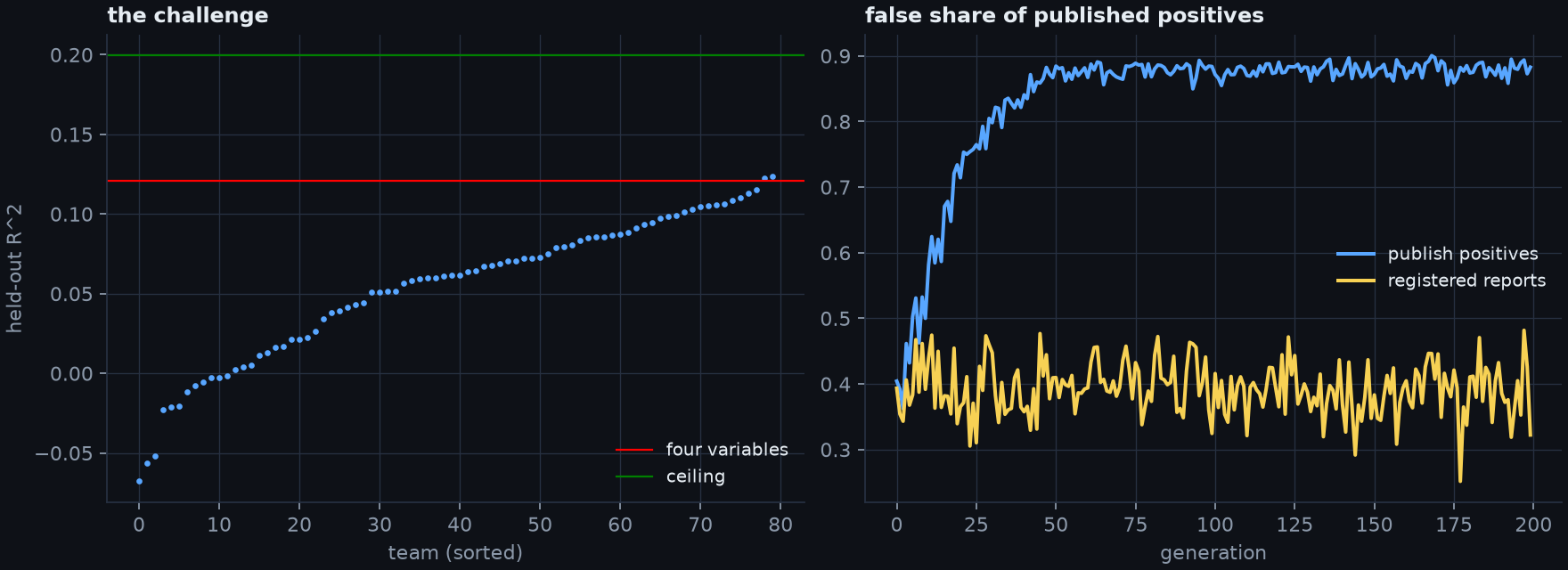
In 2020 Matthew Salganik and colleagues ran a contest. A hundred and sixty teams got thousands of variables on about four thousand families, and could use any method they liked, to predict six outcomes in the children's lives, like their grades at fifteen. The best models barely beat a regression on four variables, and explained little of the variance. Here's the same contest on a cohort Psyche simulated. The best of a hundred and sixty teams scores zero point one three, and so does the four-variable regression, under a ceiling of zero point two that no model could exceed. A field that explains much and predicts little has to decide what it's for.
So this part asks: what would psychology look like if it were designed today? Prediction, explanation, and how to have both. Bigger teams, and bigger and broader samples. Experiments designed as spaces instead of points, theories written as code, and machines that help find theories. A model of the research community itself, and the proposals ranked by the evidence that they work.
This is Part 61 of Psychology, Built: the next psychology. We'll separate explanation from prediction, and say what each buys. We'll read many-labs heterogeneity, and what big samples can and can't fix. We'll design an experiment as a space, with a surrogate model. We'll write a theory as code that makes a risky prediction. We'll run a model of a research community under two sets of incentives. And we'll rank the reform proposals by the evidence that they work.
What it does: The Fragile Families Challenge, in Psyche; the question; objectives
1On you: a space of experiments, and four numbersPsych 101 and the major1 min
Which experiment would you run?
First, an experiment on you. You're testing whether a reminder raises attendance at appointments, Part 55's question. You must make ten design choices: text or call, one reminder or three, a named sender or not, and so on. Each choice has two options, so there are a thousand and twenty-four possible experiments. Pick one in your head, as a standard study does. Now here's the true effect in every one of those experiments, in a world Psyche built. One cell, one study: the same question, a different answer. More than a quarter of the cells go the other way. Which one did you pick?
Now four numbers. One: a hundred and sixty teams with thousands of variables predict a child's school grades. What's the best held-out R squared? Two: one effect is run in forty labs, with no true difference between them. How far apart are the labs' estimates? Three: a million self-selected volunteers. Does the bias shrink along with the interval? And four: labs are copied in proportion to their publications for two hundred generations. What share of the published positive results are false? Pause here, and write them down.
What it does: Ten design choices; four predictions
2Explanation and predictionPsych 101 and the major2 min
What is psychology for? There are two goals. Explanation identifies causes and mechanisms, usually by testing whether a coefficient differs from zero in one sample. Prediction forecasts new cases accurately, judged on data the model hasn't seen. In 2017 Tal Yarkoni and Jacob Westfall argued that psychology chose explanation, and that its models often predict poorly out of sample, which should worry an explainer too. That's Part 59's lesson: in-sample fit flatters every model, explanatory ones included.
Here is the problem in one picture. Psyche's cohort has four hundred baseline variables, four with clear effects and the rest tiny. A model is fitted by least squares to a thousand people, and scored on three thousand others. In the sample, R squared rises with every variable added, to over half with all four hundred. On new people it peaks at about zero point one six with four variables, and then falls below zero: worse than just predicting the average. The true ceiling is about zero point two. Most of the outcome is noise, and no method can beat that. An explanatory paper reports the red curve. The question it should also answer is the gold one.
How do you have both? Jake Hofman and colleagues proposed integrative modelling in 2021: causal models that are also scored on held-out prediction. Report the ceiling: how predictable is the outcome at all, given the noise in it? A theory that explains a little of the variance can still be right and useful, because small causes add up across a population. And a model that predicts well can still be wrong about causes, Part 47's lesson about within and between.
What it does: Two goals; having both
3Big team sciencePractice2 min
What happens when one study is run in dozens of labs? From 2014 the Many Labs projects ran classic effects in dozens of labs worldwide with one protocol. In 2018 the Psychological Science Accelerator joined hundreds of labs in dozens of countries, with studies chosen by the network. ManyBabies pooled infant studies, Part 30's subject, across labs, where samples had always been tiny. The costs: years per study, coordination, and credit shared among hundreds of authors.
Here's what forty labs look like. Psyche's effect, a d of zero point three, is run in forty labs of a hundred people each, with no true difference between the labs. The estimates still range from about minus zero point one to zero point seven. That's sampling error alone, and your second number. With real differences between labs, the I squared rises from nineteen percent to thirty-six. In Many Labs 2, Richard Klein and colleagues found that for most of twenty-eight effects, heterogeneity across about sixty samples was small. A lab's single result mostly reflects sampling, not its culture.
What does big team science cost? Time: a protocol agreed by dozens of labs, translated, and approved by each ethics board takes years, not months. Credit: hundreds of authors on one paper, so contribution statements, saying who designed, who ran and who analysed, replace the order of the names. The choice of effect: the effects tested are the famous ones, and a consortium can still pick what's easy to run online. And what it buys: an estimate of the effect and its spread across places, which no single lab can give.
What it does: Many labs, one protocol; forty labs, one effect
4Millions of participantsPsych 101 and the major2 min
What can a sample of a million fix? Here are experiments at that scale. Sea Hero Quest, a phone game whose levels measure spatial navigation, was played by millions of people in dozens of countries, as Antoine Coutrot and colleagues reported in 2018. The Moral Machine collected about forty million decisions about whom a driverless car should spare, from two hundred and thirty-three countries and territories. And a grammar quiz taken by about six hundred and seventy thousand people was used to estimate when the ability to learn a language declines.
But size fixes only one thing. Psyche's population has a true mean of zero, and people who score higher are a little more likely to volunteer. From a hundred to a million volunteers, the ninety-five percent interval shrinks a hundredfold. It shrinks around zero point two two, not zero. That's your third number. Size fixes noise. It doesn't fix who chose to take part, or what a game measures, which is Part 3's validity.
How big is a biased million? In 2018 Xiao-Li Meng wrote the error of a sample mean as a product of three things: the correlation between taking part and the answer, the share of the population not sampled, and the spread of the answer. Without randomization, that correlation doesn't shrink as the sample grows. Worked through: a correlation of zero point zero zero five, a tiny tilt, in a population of three hundred million, with a one percent sample of three million people. Its error is that of a simple random sample of about four hundred. A small random sample can beat a huge self-selected one. For estimating a mean, how people were chosen matters more than how many.
What it does: Experiments at scale; noise shrinks, bias does not
5Who is sampledPsych 101 and the major2 min
A decade after WEIRD, who does psychology study? In Part 38, Joseph Henrich, Steven Heine and Ara Norenzayan showed that most participants are Western, educated, industrialized, rich and democratic. In 2021 Amber Gayle Thalmayer, Cecilia Toscanelli and Jeffrey Arnett found that in leading journals, samples from the United States and Europe still made up the great majority, and authors even more so. The cost was Part 38's: illusions and fairness games varied across societies. The remedies are global networks, funding for local labs, and reporting who was sampled in every paper's abstract.
There's a second default: English. In 2022 Damian Blasi and colleagues showed that most of cognitive science's work on language and thought uses English speakers. English is unusual: its spelling, its fixed word order, its few grammatical markers. Claims about reading, Part 23's subject, and about memory for words and categories rest on that one language. The test is whether a finding holds in languages unlike English, and often it has never been asked.
One remedy is to say whom the finding is about. In 2017 Daniel Simons, Yuichi Shoda and Stephen Lindsay proposed that every paper end with a statement of the constraints on generality: which people, stimuli, procedures and settings the authors expect the result to hold for, and why. A claim about people from a hundred and twenty undergraduates in one city becomes a claim about them, unless the authors argue further. It turns unstated generality into a testable prediction. A replication outside the stated range is a test, not a failure. And it makes sampling a design decision. To claim more, sample more widely, as the many-labs projects did.
What it does: A decade after WEIRD; English as the default
6Integrative experiment designResearch1 min
What if an experiment were a space, not a point? In 2024 Abdullah Almaatouq and colleagues answered Newell's complaint from Part 58 with design. List the dimensions on which experiments on a question differ. That defines a space. Sample many points of the space, often online and in parallel. Fit a surrogate model of the effect across the space, and let theories compete to predict cells nobody has run. The result is a map of where an effect holds, instead of a debate between two cells.
Here it is with the reminder experiment. Its thousand and twenty-four cells, of which a hundred and twenty are run at random, each with noise. The surrogate is a model with the ten main effects and their forty-five pairwise interactions, fitted with a ridge penalty. For the nine hundred and four cells nobody ran, its predictions correlate zero point nine nine with the truth. A single study would have reported one of these points. The space shows which choices matter, and where the effect reverses. In Psyche the effect really is this simple; real spaces may need more runs.
What it does: Beyond twenty questions; 120 cells run, 904 predicted
7Machine-assisted theoryResearch2 min
Can a machine help find a theory? In 2021 Joshua Peterson and colleagues collected choices on nearly ten thousand pairs of gambles, Part 26's choices13k, far more than any earlier study. They fitted neural networks constrained to different classes of theory, and compared them. The best learned theory contained prospect theory's pieces, and showed where they bend with context. The machine searches, and people still read and judge what it found.
Machines can also choose the next experiment. In adaptive design, after each trial or study you choose the next one that best separates the theories still standing, as Jay Myung and Mark Pitt developed. It works by computing the expected information about which theory is right, before running. It's the same idea as Part 45's adaptive testing: ask the question whose answer you can't yet predict. The guard: the theories and the stopping rule are fixed in advance, or adaptivity becomes forking paths.
Here's adaptive design in Psyche. There are two theories of forgetting, a power law and an exponential, with their parameters fixed. They nearly agree at middling delays, and part at short and long ones. Each simulated person forgets by the power law, and each trial is one recall test. A fixed design cycles through ten delays. It needs a median of twenty-five tests to be ninety-five percent sure which theory is right. The adaptive design asks, before each test, which delay is most informative. It picks the longest delay almost every time, because there the exponential predicts almost no recall, and it needs eleven tests. That's the criterion Daniel Cavagnaro, Jay Myung and Mark Pitt developed, and one of their first demonstrations used this pair of theories. The saving matters most when each test is costly, as it is with patients or infants.
What it does: Ten thousand gambles; choosing the next experiment
8Theory as codeResearch2 min
What would it take for a theory to be derivable? Verbal theories are vague. Anxiety biases attention to threat predicts a direction, not a size, a time course, or a boundary. They're flexible: almost any result can be reconciled with them after the fact. A model written as code makes predictions you can compute, including surprising ones. And this series is that idea: Psyche computes every chapter's claim from a model whose code you can read.
Here is what writing a theory as code does. The verbal version: practice makes people faster, with diminishing returns. As code, the sentence has to choose. A power law, or an exponential? That was Part 48's law that turned out to be an average. The two predict the same early trials and different late ones. The power law keeps improving after a thousand trials, and the exponential has stopped. Writing it down exposes the choice the sentence hid, and names the experiment that settles it: long practice, fitted person by person.
Theory construction can be a method. Denny Borsboom and colleagues propose starting from robust phenomena, building a formal model that would produce them, and checking that it does. Iris van Rooij and Giosue Baggio argue for theory before the test: ask whether a theory can even produce the behaviour, before testing it on data. Then comes the risky prediction: a result the theory forbids, written down before the study. That's Part 62's registered report. And what counts as a derivation? Another person runs the code and gets the prediction.
What it does: Verbal theories and their problem; theory construction
9The natural selection of bad scienceResearch1 min
What do incentives do to methods? In 2016 Paul Smaldino and Richard McElreath modelled laboratories that differ in effort. More care means fewer false positives, and also fewer studies. Only positive results are published, and labs with more publications are copied, by their students and by hiring. No one cheats. Every lab is honest, and selection does the work. Their review of statistical power in the literature found no improvement over six decades.
Here's the model run. Psyche has a hundred labs. One hypothesis in ten is true, and power is zero point eight. Publish only positive results, and copy the most published labs. Effort collapses, and eighty-eight percent of the published positive results are false. That's your fourth number. Now registered reports: methods are reviewed before the results exist, and every result is published. Effort holds, and the false share is about two in five. Only one hypothesis in ten is true, so some false positives remain. Change what is selected, and the methods follow. Exhortation alone doesn't do it.
What it does: Laboratories as organisms; two hundred generations, two rules
10Digital tracesPractice2 min
Can language online measure a population's health? In 2015 Johannes Eichstaedt and colleagues reported that the language of tweets from American counties predicted deaths from heart disease better than a model of demographic and health factors. Angry and hostile words went with more deaths, and words of engagement and optimism with fewer. In 2018 Nicholas Brown and James Coyne pointed out that the people tweeting were not the people who died, and that results changed with the counties included and the analysis chosen. It's Part 47's warning: a county-level association says little about individuals.
Here's the trap in that study's design, simulated. Psyche has three thousand counties of a thousand people. A county's income lowers both its people's hostile posting and their heart risk. Across counties, language and heart disease correlate about zero point six. Across people, about zero point zero six, and within a county, zero. A person's words say nothing about their own heart. The county correlation is real, and can still be useful for mapping. Reading it as a fact about individuals is the ecological fallacy. So a trace study has to say at which level its claim lives, and what else differs between the units.
What do digital traces need? Validity: a word count is not a feeling, so check the measure against people, as in Part 3. The right level: population claims from population data, and individual claims need individuals. Held-out tests: prediction scored on regions or people not used to build the model. And consent and harm: traces weren't given for research, and inferring health or traits can harm the people inferred about.
What it does: Tweets and the heart; what traces need
11Automating researchPractice2 min
What can machines do in a lab, and what must stay human?
What can machines do in a lab? As assistants: searching and summarizing the literature, writing analysis code, and checking it. As simulated participants: piloting materials and predicting results before a study, with Part 60's limits on silicon samples. As reviewers: checking statistics and reporting, as automated checkers of p-values already do. And the risk: fluent errors, invented references, and a literature that converges on what models already say.
Some checks a machine can run on every paper. Computational reproducibility: rerun the authors' code on their data, and compare every number in the paper. Audits of journals with data policies have found many papers that can't be reproduced this way. Consistency: statcheck, GRIM and SPRITE from Part 50, run at submission. Preregistration as code, as in Part 43: the analysis that was registered is the analysis that runs, and any deviation is printed. And what none of them checks: whether the measure was valid, the sample apt, or the question worth asking.
So what must stay human? Choosing the question: what's worth knowing, and for whom. Responsibility: a named person answers for every claim and every number. Contact with people: consent, care, and the participants' own view of the study. And judgment of evidence: the Ledger's statuses are decisions, with reasons.
What it does: Machines in research; what must stay human
12Proposals, ranked by evidencePsych 101 and the major1 min
Which reforms work? Here are the proposals, ranked by the evidence that they do. Larger samples and power analysis: strong evidence, since replication rates rise with power, as Part 4 showed. Registered reports: strong. Far more null results are published, and their quality is rated at least as high. Open data and code: good evidence. Errors are found and corrected, though uptake is still partial. Big team science: good, with precise answers about heterogeneity, but slow and costly. Preregistration alone: mixed. Plans are often vague, and deviations go unreported. Integrative design and formal theory: promising, with few tests of whether they speed discovery. And lowering the significance threshold: argued, but not tested.
What it does: Seven reforms and their evidence
13The LedgerPsych 101 and the major1 min
What the four have in common. The methods of the next psychology already have records: online labs and many-labs designs replicate. Prediction sets humbling ceilings, and digital traces need validation at the right level. What changes a field is what it selects: registered results, shared data, and big teams. So here's the answer to this part's question. Designed today, psychology would be larger, broader and formal, and it would select for rigour.
What it does: Four rows; what they have in common
14In practice: commissioning research that holds upPractice1 min
You are paying for a study. What do you ask for?
Where is this a job? In research operations: running studies at scale in companies, with panels, quality checks, and registries of what was run. On experimentation platforms, which run thousands of online experiments a year, with guardrails against peeking and forking paths. In forecasting: tournaments and markets that score predictions about which findings will hold, as in Part 50. And among funders and editors, who design the incentives: registered reports, data policies and replication grants.
You're paying for a study. What do you ask for? The decision the study will inform, and the smallest effect that would change it. A registered plan: the hypotheses, a sample size from a power analysis, the primary outcome, and the analysis code. Payment for the study, not for the result. That's the registered-report rule. The sample described: who, where, how they were recruited, and in what language. And data and code delivered, with a replication budgeted if the decision is large.
What it does: Where this is a job; a checklist
15Frontier: a science that studies itselfResearch1 min
Can a field measure its own progress? First, what's new. Metascience runs randomized trials of journal policies, peer review and training. Living reviews update meta-analyses as studies arrive, with dates like the Ledger's. Networks make cross-cultural testing the first study, not the last. And surrogate models and adaptive designs choose the next experiment.
And the open problems. How to tell a field that's accumulating knowledge from one that isn't. How to reward contributions to big teams, data and replications. Whether formal theory and integrative design speed discovery, tested as interventions. And what limits the predictability of human lives, and whether it can be raised.
What it does: What is new; open problems
Recap, problems, and the road aheadAll tracks3 min
First, your four numbers. In the real challenge the best held-out R squared was about zero point two, for two of the six outcomes, and much lower for the rest; in Psyche, zero point one three. Forty labs with no true variation gave estimates from about minus zero point one to zero point seven. A million self-selected volunteers gave an interval of plus or minus zero point zero zero two around a bias of zero point two two. And selection on publications left eighty-eight percent of positives false. Ceilings, noise, bias and incentives: four facts a redesigned field must build around.
Part sixty-one in twelve lines. Life outcomes have low ceilings of predictability. To explain and predict, score causal models out of sample. Across many labs, most heterogeneity is small. Size fixes noise, not selection or validity. Most participants and authors are still WEIRD, and English-speaking. Experiments can be spaces, with surrogate models. Machines can search the space of theories, and people judge. Theories written as code make risky predictions. Selection on publications breeds bad methods. Digital traces need validation at the right level. Automate tasks, not responsibility. And rank reforms by evidence, with power and registered reports first.
Where this comes back. Everything does, in Part 62: a registered report executed end to end, Psyche's whole Battery and the complete Ledger, and the open problems of all sixty-two parts.
Seven problems, with full solutions in this part's README. One finds a ceiling. One computes the spread of many labs. One reads a huge biased sample. One counts a design space. Two work through Smaldino and McElreath's arithmetic. And the last, with the star, asks you to write a commissioning brief. Pause here if you'd like to try them.
The books and papers behind this part are listed here and in the README. Salganik's book is the best introduction to research with digital data; Yarkoni and Westfall's paper sets out prediction's case; and Smaldino and McElreath's model shows how incentives shape methods.
Four parts of the frontier are done. This one designed the next psychology. The last part does it: one question, taken through a registered report, reviewed before the data exist, run, and reported whatever it shows. Then the accounts are closed, and Kant's objections are answered. Part 62: the dissertation.
Where it goes next. Part 62 carries one question through a registered report, then closes the series' accounts.
Key results
The part's results in one place, for revision.
Try it
Lab 61 · The Next Psychology
Run a prediction challenge under a known ceiling, map an effect across a space of experiments with a surrogate model, and watch incentives select methods.
python -m videos.psychology.labs 61
needs numpy, scipy, matplotlib · download lab61.py ·
source on GitHubbest team; four-variable baseline; ceiling 0.124; 0.121; 0.199
surrogate: held-out correlation; share of cells with a negative effect 0.99; 0.23
false share of positives: publish positives; registered reports 0.88; 0.39
A field's results depend on what it can predict, which experiments it runs, and what it rewards; each can be modelled, and changed.The code (50 lines; it asserts its own result)
"""Lab 61: the next psychology: prediction ceilings, a design space, and the natural selection of bad science."""

import numpy as np

from videos.coursekit import labs
from explainer.psychology.psyche import community as Cm

TITLE = "The Next Psychology"
GOAL = ("Run a prediction challenge under a known ceiling, map an effect across a space of experiments with a "
        "surrogate model, and watch incentives select methods.")
TASKS = [
    "Raise the strong variables' effects so the ceiling is 0.5. Do the teams pull away from the baseline?",
    "Run only 40 cells of the design space. How well does the surrogate predict the rest?",
    "Under registered reports, lower the minimum effort to 10. What happens to the false share?",
]


def run(seed=0):
    out = labs.Lab()
    c = Cm.challenge(teams=80, seed=seed)
    assert c["best"] < c["ceiling"]
    out.row("best team; four-variable baseline; ceiling", f"{c['best']:.3f}; {c['baseline']:.3f}; {c['ceiling']:.3f}")
    i = Cm.integrative(seed=seed)
    out.row("surrogate: held-out correlation; share of cells with a negative effect",
            f"{i['held_out_r']:.2f}; {i['share_negative']:.2f}")
    a = Cm.bad_science(seed=seed)
    b = Cm.bad_science(rule="registered", seed=seed)
    assert a["fdr"][-20:].mean() > b["fdr"][-20:].mean()
    out.row("false share of positives: publish positives; registered reports",
            f"{a['fdr'][-20:].mean():.2f}; {b['fdr'][-20:].mean():.2f}")

    out.note = ("A field's results depend on what it can predict, which experiments it runs, and what it rewards; "
                "each can be modelled, and changed.")

    fig, ax = labs.figure(2, size=(11, 4.0))
    ax[0].plot(np.sort(c["scores"]), ".", ms=4)
    ax[0].axhline(c["baseline"], color="red", lw=1, label="four variables")
    ax[0].axhline(c["ceiling"], color="green", lw=1, label="ceiling")
    ax[0].set(title="the challenge", xlabel="team (sorted)", ylabel="held-out R^2")
    ax[0].legend()
    ax[1].plot(a["fdr"], label="publish positives")
    ax[1].plot(b["fdr"], label="registered reports")
    ax[1].set(title="false share of published positives", xlabel="generation")
    ax[1].legend()
    out.fig = fig
    return out


if __name__ == "__main__":
    print(run())
Now change it
- Raise the strong variables' effects so the ceiling is 0.5. Do the teams pull away from the baseline?
- Run only 40 cells of the design space. How well does the surrogate predict the rest?
- Under registered reports, lower the minimum effort to 10. What happens to the false share?
Problems, with solutions
Try each problem before opening its solution.
-
A ceiling. An outcome's reliability is 0.6 and it is a sum of many small causes. What is the most any model can predict?
Solution
With reliability 0.6, at most 60% of the outcome's variance is systematic, so no model can exceed R-squared 0.6, and a sum of many small causes, most unmeasured, puts the practical ceiling far lower.
-
Many labs. 40 labs, 100 people each, \(d\) = 0.3, no true variation. The expected SD of the labs' estimates?
Solution
Each lab's SE is about sqrt(4/100 + 0.09/200) = 0.20, so with no true variation the estimates have SD about 0.20 and a 95% range of roughly 0.3 +/- 0.4.
-
A biased million. A million volunteers, mean 0.22, SD 1. The 95% interval? What would you need to know about the bias?
Solution
0.22 +/- 1.96/sqrt(1,000,000) = 0.22 +/- 0.002. The interval says nothing about the bias; you need to know how people came to take part (and a benchmark from a probability sample) to correct it.
-
A design space. A design space of 10 binary choices. How many cells, and how many parameters with all pairwise interactions?
Solution
2^10 = 1,024 cells; 1 + 10 + 45 = 56 parameters with an intercept, main effects and all pairwise interactions.
-
Smaldino's arithmetic. In Smaldino's model, \(\alpha = W/(1 + (1 - W)e)\) with \(W = 0.8\). The false-positive rate at efforts 1 and 75?
Solution
alpha = 0.8/(1 + 0.2 x 1) = 0.67 at effort 1, and 0.8/(1 + 0.2 x 75) = 0.05 at 75.
-
False positives. One hypothesis in ten is true, power 0.8, \(\alpha\) 0.05. The share of positives that are false?
Solution
True positives 0.1 x 0.8 = 0.08; false 0.9 x 0.05 = 0.045; the false share 0.045/0.125 = 0.36.
-
★ A commissioning brief. Write a commissioning brief for a study your organization will act on.
Solution
The decision and the smallest effect that would change it; a registered plan with power, primary outcome and analysis code; payment independent of the result; the sample described; data and code delivered; a replication if the stakes are high.
Notes and sources
Sources
- M. J. Salganik et al. (2020); M. J. Salganik, Bit by Bit: Social Research in the Digital Age (Princeton University Press, 2018).
- T. Yarkoni and J. Westfall, Choosing prediction over explanation in psychology: lessons from machine learning, Perspectives on Psychological Science 12 (2017) 1100-1122; J. M. Hofman et al., Integrating explanation and prediction in computational social science, Nature 595 (2021) 181-188.
- R. A. Klein et al. (2014, 2018); H. Moshontz et al., The Psychological Science Accelerator: advancing psychology through a distributed collaborative network, Advances in Methods and Practices in Psychological Science 1 (2018) 501-515; M. C. Frank et al., A collaborative approach to infant research: promoting reproducibility, best practices, and theory-building, Infancy 22 (2017) 421-435; A. Olsson-Collentine et al. (2020).
- A. Coutrot et al., Global determinants of navigation ability, Current Biology 28 (2018) 2861-2866; E. Awad et al., The Moral Machine experiment, Nature 563 (2018) 59-64; J. K. Hartshorne, J. B. Tenenbaum and S. Pinker, A critical period for second language acquisition: evidence from 2/3 million English speakers, Cognition 177 (2018) 263-277; L. Germine et al. (2012); M. J. C. Crump et al. (2013).
- J. Henrich, S. J. Heine and A. Norenzayan, The weirdest people in the world?, Behavioral and Brain Sciences 33 (2010) 61-83; A. G. Thalmayer, C. Toscanelli and J. J. Arnett, The neglected 95% revisited: is American psychology becoming less American?, American Psychologist 76 (2021) 116-129; D. E. Blasi, J. Henrich, E. Adamou, D. Kemmerer and A. Majid, Over-reliance on English hinders cognitive science, Trends in Cognitive Sciences 26 (2022) 1153-1170.
- A. Almaatouq et al., Beyond playing 20 questions with nature: integrative experiment design in the social and behavioral sciences, Behavioral and Brain Sciences 47 (2024) e33; J. C. Peterson, D. D. Bourgin, M. Agrawal, D. Reichman and T. L. Griffiths, Using large-scale experiments and machine learning to discover theories of human decision-making, Science 372 (2021) 1209-1214; J. I. Myung and M. A. Pitt, Optimal experimental design for model discrimination, Psychological Review 116 (2009) 499-518.
- D. Borsboom, H. L. J. van der Maas, J. Dalege, R. A. Kievit and B. D. Haig, Theory construction methodology: a practical framework for building theories in psychology, Perspectives on Psychological Science 16 (2021) 756-766; I. van Rooij and G. Baggio, Theory before the test: how to build high-verisimilitude explanatory theories in psychological science, Perspectives on Psychological Science 16 (2021) 682-697.
- P. E. Smaldino and R. McElreath, The natural selection of bad science, Royal Society Open Science 3 (2016) 160384; A. M. Scheel, M. R. M. J. Schijen and D. Lakens, An excess of positive results: comparing the standard psychology literature with registered reports, Advances in Methods and Practices in Psychological Science 4 (2021); C. K. Soderberg et al., Initial evidence of research quality of registered reports compared with the standard publishing model, Nature Human Behaviour 5 (2021) 990-997.
- J. C. Eichstaedt et al. (2015); N. J. L. Brown and J. C. Coyne (2018); M. B. Nuijten et al., The prevalence of statistical reporting errors in psychology (1985-2013), Behavior Research Methods 48 (2016) 1205-1226.
About this partfrom its README
In 2020, 160 teams with thousands of variables on about four thousand families, free to use any method, tried to predict six outcomes in the children's lives. The best models barely beat a regression on four variables. A field that explains much and predicts little has to decide what it is for. This part gathers the proposals for a psychology designed today: bigger teams, bigger and broader samples, experiments designed as spaces instead of points, theories written as code, and a model of the research community itself, and ranks them by the evidence that they work.
The viewer chooses one cell of a space of 1,024 experiments and sees the effect vary across the whole space, then predicts four numbers. Then explanation against prediction; big team science and heterogeneity across forty labs; experiments at the scale of millions and the bias that size does not remove; who is sampled, and English as the default; integrative experiment design with a surrogate model; machine-assisted theory and adaptive design; theory as code; Smaldino and McElreath's natural selection of bad science, rerun under two publication rules; digital traces and the tweets-and-heart-disease result taken apart; automating research and what stays human; and the reform proposals ranked by evidence.
What is computed and built
explainer/psychology/psyche/community.py: a simulated cohort and prediction challenge, many-labs heterogeneity, selected samples, a design space with a surrogate model, and Smaldino and McElreath's model. Tested intests/psychology/test_community.py.- The Ledger gains four rows.
- The course's interactive: choose a cell of the design space, then see the whole space; and run a research community under two publication rules.
Chapter notes
| # | Chapter | What it does |
|---|---|---|
| 0 | A hundred and sixty teams | The Fragile Families Challenge, in Psyche; the question; objectives |
| 1 | On you: a space of experiments, and four numbers | Ten design choices; four predictions |
| 2 | Explanation and prediction | Two goals; having both |
| 3 | Big team science | Many labs, one protocol; forty labs, one effect |
| 4 | Millions of participants | Experiments at scale; noise shrinks, bias does not |
| 5 | Who is sampled | A decade after WEIRD; English as the default |
| 6 | Integrative experiment design | Beyond twenty questions; 120 cells run, 904 predicted |
| 7 | Machine-assisted theory | Ten thousand gambles; choosing the next experiment |
| 8 | Theory as code | Verbal theories and their problem; theory construction |
| 9 | The natural selection of bad science | Laboratories as organisms; two hundred generations, two rules |
| 10 | Digital traces | Tweets and the heart; what traces need |
| 11 | Automating research | Machines in research; what must stay human |
| 12 | Proposals, ranked by evidence | Seven reforms and their evidence |
| 13 | The Ledger | Four rows; what they have in common |
| 14 | In practice: commissioning research that holds up | Where this is a job; a checklist |
| 15 | Frontier: a science that studies itself | What is new; open problems |
| Recap, problems, and the road ahead | Your numbers; twelve lines; payoffs; problems; references; Part 62 |
NotesWhere the numbers come from
| What | Source |
|---|---|
| A cohort of 4,000 with 400 variables (four with effects 0.25, 0.20, 0.15, 0.12 and the rest adding 0.06), true R-squared 0.20; 2,000 for training; 160 teams each choosing a variable subset (usually keeping the four obvious ones) and a ridge penalty: best held-out R-squared 0.13, median 0.07, four-variable least squares 0.13 | Psyche (community.challenge), item challenge |
| One effect (d = 0.3) in 40 labs of 100: no true variation gives estimates from -0.09 to 0.71 and I-squared 19% by chance; between-lab SD 0.2 gives I-squared 36% | Psyche (community.many_labs), item labs |
| A self-selected sample (log-odds of joining rise by 0.3 per SD of the score), true mean 0: at a million volunteers the estimate is 0.22 with an interval of plus or minus 0.002 | Psyche (community.selected_sample), item selection |
| A design space of ten binary choices (1,024 cells; main effects SD 0.1, pairwise interactions SD 0.05, base 0.3): true effects from -1.0 to 1.5, 28% negative; 120 cells run with SE 0.08; a ridge surrogate on 55 terms predicts the 904 others with correlation 0.99 | Psyche (community.integrative), item space |
| The natural selection of bad science: 100 labs, base rate 0.1, power 0.8, alpha = W/(1 + (1 - W)e), output 1 - 0.2 log10 e; 200 generations: effort falls from about 62 to 1, false share of published positives 88%; under registered reports (effort at least 50, every result published) effort stays near 65 and the false share is about 39% | Psyche (community.bad_science), item science |
| Adaptive design: recall tests at ten delays (1 to 60); power law 0.95(1 + t)^-0.45 against exponential 0.95e^(-0.08t), parameters fixed; 2,000 simulated people forget by the power law; to reach P(power law) of 0.95 the fixed design (shuffled cycles of the ten delays) needs a median of 25 tests and the adaptive design (most expected information before each test) 11, choosing the longest delay 97% of the time; after 80 tests 87% against over 99% of people are classified correctly | Psyche (community.adaptive_design), item adaptive |
| Every published number on screen | the studies listed under Sources, quoted as reported |
Notes
| Finding | Original | Status |
|---|---|---|
| Even with thousands of variables and any method, children's life outcomes are predicted little better than by a simple regression on a few variables. | Salganik and colleagues 2020 | not directly tested |
| When one protocol is run in many labs and countries, most effects vary little between samples beyond what sampling error produces. | Klein and colleagues (Many Labs 1) 2014 | replicated |
| Cognitive and perceptual experiments run online give results comparable to the same experiments run in the laboratory. | Germine and colleagues 2012 | replicated |
| The language of tweets from US counties predicts county deaths from heart disease better than demographic and health factors. | Eichstaedt and colleagues 2015 | contested |
Shown without a row, with the reason recorded in explainer/psychology/ledger.py: Yarkoni and Westfall; Hofman and
colleagues; Moshontz and colleagues; Awad and colleagues; Thalmayer, Toscanelli and Arnett; Blasi and colleagues;
Almaatouq and colleagues; Peterson and colleagues; Borsboom and colleagues; Smaldino and McElreath.
Notes
The web-search budget for this session was spent on earlier parts, so the facts in this part come from the standard literature and were not re-checked online today; each is listed here to be checked against its source: the Fragile Families Challenge's 160 teams, about 4,000 families, six outcomes and the best R-squared values; Yarkoni and Westfall (2017); Hofman et al. (2021); Many Labs 1's samples and Many Labs 2's 28 effects, about 125 samples and 36 countries; the Accelerator's founding; ManyBabies; Olsson-Collentine et al. (2020); Sea Hero Quest's numbers; the Moral Machine's 40 million decisions and 233 countries and territories; Hartshorne et al.'s 670,000; Germine et al. (2012); Crump et al. (2013); Thalmayer et al. (2021); Blasi et al. (2022); Almaatouq et al. (2024); Peterson et al. (2021)'s nearly 10,000 problems; Myung and Pitt (2009); that Cavagnaro, Myung and Pitt's early demonstrations of adaptive design optimization used the power and exponential retention models (Cavagnaro et al., 2010); Borsboom et al. (2021); van Rooij and Baggio (2021); Smaldino and McElreath (2016)'s model and power review; Scheel et al. (2021); Soderberg et al. (2021); Eichstaedt et al. (2015)'s counties; Brown and Coyne (2018); Nuijten et al. (2016); Meng (2018)'s identity; Simons, Shoda and Lindsay (2017) on constraints on generality; the audits of computational reproducibility in journals with data policies; and every page range in Sources. The overfitting curve, the worked Meng example (an illustrative correlation of 0.005) and the county simulation are Psyche's, with the truth known.
Companion material in this repository
The syllabus's plan for this partfrom SYLLABUS.md, the plan of record
- Hook: the Fragile Families Challenge (Salganik et al. 2020).
- Explanation against prediction (Yarkoni and Westfall 2017): what each buys, and how to have both.
- Big team science: Many Labs, the Psychological Science Accelerator, ManyBabies, ManyPrimates. Costs, credit and what they found.
- Experiments at the scale of millions: a navigation game played by millions; the Moral Machine; language learners; what a sample of that size can and cannot fix.
- Who is sampled (Part 38): a decade after WEIRD; English as the default language of cognitive science.
- On you: an experiment has ten design choices. Pick one cell, as a standard study does, then watch the effect vary across the whole space.
- Integrative experiment design (Almaatouq et al. 2024): sample the space of experiments, fit a surrogate model, and let theories compete to predict held-out cells.
- Machine-assisted theory: ten thousand risky-choice problems and a learned theory that contains the classics (Peterson et al. 2021); adaptive design optimization.
- Theory as code: formal models against verbal theories; theory construction methods; what counts as a derivation.
- The natural selection of bad science (Smaldino and McElreath 2016): laboratories as agents, publications as fitness. The model run, and then run under registered reports.
- Digital traces: phones, language, wearables; prediction of traits and states; consent and harm; a famous Twitter-and-heart-disease result taken apart.
- Automation: language models as research assistants, simulated participants and reviewers; what must stay human.
Psyche: a model of a research community on the Pool (laboratories with strategies, a publication filter,
selection on output), under alternative incentive rules; an integrative design over a parameterized experiment
with a surrogate model.
On you: the design-space exercise.
Ledger: poor predictability of life outcomes (replicated across 160 teams); many-labs heterogeneity being
small for most effects (replicated); large-scale online cognitive data matching laboratory benchmarks
(replicated).
In practice: research operations in industry, experimentation platforms, forecasting; how to commission
research that will hold up.
Frontier: the part's subject, ending on a ranked list of proposals by the evidence that they work.
Reading: Salganik et al. 2020; Yarkoni & Westfall 2017; Hofman et al. 2021; Almaatouq et al. 2024; Peterson et
al. 2021; Moshontz et al. 2018; Coutrot et al. 2018; Thalmayer, Toscanelli & Arnett 2021; Blasi et al. 2022;
Smaldino & McElreath 2016; Borsboom et al. 2021; van Rooij & Baggio 2021; Muthukrishna & Henrich 2019.
Build the film
python -m videos.psychology.psych61.compute        # the part's numbers, into .cache/psych61
python tools/build.py psych61                  # render and assemble the film
EXPLAINER_TTS=silent python tools/qa_scene.py psych61 Hook   # one chapter, silent, with a contact sheet
Scenes: videos/psychology/psych61. Setup: see the course page. Source of these notes: the README and the scenes' narration.
Build it
python -m videos.psychology.psych61.compute            # every number (seconds)
python tools/qa_scene.py psych61 Integrative           # one chapter, silent, at 480p, with a contact sheet
EXPLAINER_TTS=silent python tools/build.py psych61 -q l   # the whole part, silent preview
python tools/build.py psych61                          # 1080p30 with narration
python tools/qa_scene.py psych61 Selection --lang zh   # the Chinese edition of one chapter
python tools/make.py psych61                           # both editions, with the checks a long build needs
python -m videos.psychology.labs 61                    # the lab: prediction ceilings, design spaces, incentives
python tools/check_ledger.py psych61                   # every study shown has its Ledger row, or a reason
python -m pytest tests/psychology                      # Psyche's community module, the Ledger, the Archive
The Chinese edition is zh_lines.py (the narration, line by line) and the series table
videos/psychology/psychology_text_zh.json (the text on screen); the terms are in
PSYCHOLOGY_ZH_GUIDE.md.