Act I · Asking a Mind a Question
Part 2 of 62The Experiment
How do you ask a mind a question without telling it the answer?
Berlin, 1904: a horse named Hans answers arithmetic with his hoof, and a commission of thirteen, a circus manager and the director of the Psychological Institute among them, finds no trick. A student, Oskar Pfungst, changes one thing at a time and counts. Hans is right 98 times in 100 when the questioner knows the answer and 8 in 100 when he does not; 89 in 100 when he can see the questioner and 6 when he cannot. The questioners were giving the answer away with a movement of the head of about a millimetre, and 23 of 25 people did the same for Pfungst in the laboratory. The part builds the rules of design from that story. A game that does nothing is studied on the Pool by one group tested twice, and appears to work; a control group shows why. Campbell and Stanley's six unsound designs each find an effect where the truth is zero. Peirce and Jastrow's shuffled deck of 1884, the first randomized experiment, balances even what nobody measured and supplies its own test. Each person serving as their own control buys precision, if the order is counterbalanced. Expectations leak from experimenters to rats, pupils and police dogs, and from subjects who want to help; the blind is the remedy. The part ends with interactions and their dependence on scale, four kinds of validity, who gets studied, and the rules that protect the people in an experiment.
What you need. Means, standard deviations and the idea of a sampling distribution. The power calculations of chapter 6 use the normal curve.
- Hook
- Clever Hans, 1904–07
- Ideas, models and mathematics
- confounds, random assignment (Peirce and Jastrow 1884), within and between designs, counterbalancing, blinding, placebo, demand, expectancy, ethics
- Psyche gains
- the Pool; an experiment runner
- On you
- a cueing demonstration: are you Hans?
What you will be able to do
Psych 101 and the major
- Explain what Pfungst varied, what he found, and why a blind removes the effect.
- Name the six classical threats to a before-and-after study, and the change of design that answers each.
- Say what random assignment balances that matching cannot, and why people cannot do the randomizing themselves.
Graduate
- Derive the standard deviation of the difference between two randomized groups, and the number of people a between-person and a within-person design need for a given power.
- Carry out a randomization test, and construct a Williams square for four conditions.
- Show by example that an interaction can be removed by a change of scale, and say which interactions cannot.
Research
- Separate a treatment's effect from the effect of knowing one's assignment, and state what each available design assumes.
- Say what a measurement of demand effects licenses, and what it does not.
Practice
- Ask of any study: compared with what, who decided who got what, who knew, who dropped out, and who was studied.
- Recognize an A/B test, a clinical trial and a counterbalanced user study as the designs of this part, and name the analysis that answers attrition.
Contents
Each chapter has a home level. Choose a track to see what to read and watch: Psych 101 and the major 51 min · Graduate 53 min · Research 56 min · Practice 53 min.
- 0Clever HansPsych 101 and the major4 min
- 1Who knows the answer?Psych 101 and the major5 min
- 2On you: the pendulum and the coinPsych 101 and the major3 min
- 3Compared with what?Psych 101 and the major3 min
- 4Six ways to fool yourselfPsych 101 and the major4 min
- 5Shuffling the cardsPsych 101 and the major4 min
- 6Between people and within themPsych 101 and the major4 min
- 7The experimenter is a subject tooPsych 101 and the major6 min
- 8It dependsPsych 101 and the major2 min
- 9Four ways to be wrongPsych 101 and the major3 min
- 10The subject is a personPsych 101 and the major4 min
- 11A design is a programPsych 101 and the major3 min
- 12The LedgerPsych 101 and the major2 min
- 13In practice: who is blind?Practice2 min
- 14Frontier: when the blind cannot be keptResearch3 min
- Recap, problems, and the road aheadAll tracks4 min
Also on this page: Lecture · Key results · Try it · Lab · Problems · Notes and sources · Build the film.
Lecture
The text of each chapter is the film's narration, as it is spoken, so you can read along or revise without the film. The pictures are in the film. A dashed box stands for a number the film computes when it is rendered (hover over it to see what is computed); the README's figures for each chapter, where it lists them, follow the chapter's text.
Clever HansPsych 101 and the major4 min
Berlin, 1904. In a courtyard in the north of the city, a retired teacher of mathematics named Wilhelm von Osten is showing visitors his horse. The horse is called Hans, and von Osten has been teaching him for four years, the way you would teach a child: with a blackboard, and patience, and carrots. He asks a question. Three plus four. And Hans answers with his right forefoot. Seven. He can subtract, and multiply. He can work with fractions, tell the time, and spell out words, a tap at a time. And he answers strangers as well as his master, which is what makes it hard to dismiss. The newspapers call him Clever Hans, and the question in Berlin that summer is whether a horse can think.
So a commission is formed to settle it. Thirteen people. A circus manager, who knows every trick by which animals are made to look clever. The director of the zoo. A veterinarian. Two retired officers. A physiologist of the senses. And the director of Berlin's Psychological Institute, Carl Stumpf. They watch Hans work. They watch von Osten for signals. They have Hans questioned while von Osten is out of the yard. And on the twelfth of September they sign a report. Tricks are out of the question. Unintentional signs, of the kind they know about, are excluded too. Thirteen experts looked for the trick, and found none. They were right about one thing. Nobody was cheating. And the report's last line asks for a serious investigation, which is where this part begins.
Remember where Part 1 left Kant's wager. On his first objection, that numbers can't be applied to the mind, he had lost. On the second, about experiment, he had half a point. And the third was untouched: the observer disturbs what is observed. Kant meant watching your own mind. But the horse shows it is worse than that. Thirteen careful observers, a mind they wanted to understand, and something passed between the two that none of them could see. So here is the question for today. How do you ask a mind a question without telling it the answer? Every rule of experimental design in psychology is an answer to that, and most of them are in the story of this horse.
Part two: the experiment. We'll see how one student found what thirteen experts had missed, and the remedy he invented on the spot. Then the first question to ask of any study, compared with what, and six tempting designs that fool the people who run them. Why deciding who gets what is left to a shuffled deck of cards, a trick psychologists were the first to use. How using each person as their own control buys a great deal, and what it costs. How the experimenter and the subject each bend the result, what an interaction is, and four different ways a study can be wrong. And last, the rules for treating the subject as a person, each of which was written after somebody failed to.
What it does: The courtyard; the commission of thirteen and its report; Kant's scoreboard; the question; objectives
1Who knows the answer?Psych 101 and the major5 min
The investigation fell to a student of Stumpf's, Oskar Pfungst. And Pfungst did what the commission had not. He stopped watching for the trick, and started changing one thing at a time, and counting. His first question: does it matter whether the person asking knows the answer? He held up a card with a number on it, so that only the horse could see it. Sometimes the questioner had looked at the card first. Sometimes nobody in the yard knew what was on it. When the questioner knew the number, Hans tapped it correctly times in a hundred. When the questioner didn't know, in a hundred. So Hans can't read numbers. Whatever he's doing, he needs someone nearby who knows the answer. Pfungst called the second condition procedure without knowledge. We call it a blind, and this is the experiment that invented it.
Second question: through which sense does the answer reach him? Hearing was ruled out quickly. Hans answered questions that were only thought, and never spoken. So Pfungst put blinders on the horse, and had the questioner stand where Hans couldn't see him. Hans fought it. He strained to get the questioner back in view, which he had never done before. With the questioner in sight, per cent right. Out of sight, : two answers out of . The answer is coming in through the horse's eyes, from the person asking, and it only exists if that person knows it. So now Pfungst knew where to look. He stopped watching the horse, and watched the questioner.
And here is what he saw. When the horse begins to tap, the questioner bends forward a little, to watch the foot and keep count. Nobody notices doing it. And as the taps approach the number the questioner has in mind, the tension builds. One, two, three, four. At the right count it lets go, and the head comes up. A tiny upward jerk. Hans stops tapping when he sees it. He was never counting. He was tapping until the human relaxed. The movement is small. Pfungst measured it later in the laboratory at about a millimetre, often less, and the horse could respond to a fifth of that. Which is why thirteen people watching for a signal didn't see one.
Now Pfungst could do something the commission never could. He could predict. If Hans is reading a small movement, then moving the questioner away should make the movement harder to see. So he did. Close up, Hans is nearly perfect. Out to three and a half metres, still accurate. Then it collapses. Between four and four and a half metres, a third right. Beyond that, nothing. Von Osten, by the way, was the questioner in most of these tests, and believed they were testing the horse's hearing. We can write the idea down as a model: a cue that's detected less often as its image on the eye gets smaller. Four numbers, fitted to Pfungst's counts. It says half the cues are seen at about metres. This is a measurement of a horse's eyesight, made with arithmetic problems, and it's the same kind of curve you'll measure on yourself in Part 11.
One more experiment, and it's the one that makes this a discovery about people and not about a horse. Pfungst went back to the laboratory and played the part of Hans himself. He asked people, one at a time, to think hard of a number, while he tapped with his hand and watched them. None of them knew what he was looking for. of the gave him the same involuntary jerk of the head at the right count, and from it he could tell their number. They were sure they had given nothing away. So the commission was right that nobody cheated. Von Osten had spent four years, with no intention of doing so, teaching a horse to read his face. And everyone who asked a question and knew the answer was telling it. The remedy follows at once: put the question through someone who doesn't know the answer. Keep that in mind. It comes back in chapter seven with rats, and children, and police dogs.
What it does: Pfungst's "procedure without knowledge" (98% against 8%); blinders (89% against 6%); the cue; the questioner moved away, with the cue-reading model; Pfungst as the horse, 23 of 25
2On you: the pendulum and the coinPsych 101 and the major3 min
Two experiments, and you are the subject of both. Hans read movements his questioners didn't know they were making. Do you make them? Here's a test you can do in a minute. Pause the video if you'd like to set it up. Tie a ring, or a key, to a piece of thread about as long as your forearm. Rest your elbow on the table, and hold the thread so that the ring hangs still, just above a line drawn on a piece of paper. Now don't move your hand. Just think of the ring swinging along the line. Imagine it going back and forth. For most people, within half a minute, it does. Think of a circle instead, and it circles. The chemist Michel Chevreul studied this in 1833, when pendulums were being used to divine metals and answer questions. He found that when he looked away, the swinging stopped. The pendulum knew only what his eyes told his hand. The name for it came in 1852: ideomotor action. Thinking of a movement begins the movement, too faintly to feel. It's what moved the heads of Pfungst's twenty-three subjects, and it's what moves a ouija board.
The second experiment. Be a coin. In your head, call heads or tails, twenty times, as randomly as you can. Go.
Now think about what you did. Did you ever call the same side four times in a row? A real coin, in twenty tosses, usually does. People almost never do, because four in a row doesn't feel random. Here's a sequence of the kind people make: it switches sides about six times in ten. And here's a real coin, which switches half the time, and so it clumps. In a hundred tosses a coin's longest run is about . The switcher's is shorter. This has been found over and over since the nineteen-fifties: asked to be random, people alternate too much.
And if you're predictable, you can be read. On this part's page of the course site there's a small program that watches you press two keys at random, and before each press, guesses it. It does nothing clever. It remembers what you did the last few times you were in the same situation. Against a real coin it's right half the time, as it must be. Against a sequence that only switches a little too often, it gets per cent, and real people have more habits than that for it to find. Try it, and see your own number. So here are two facts about you, to carry through the rest of this part. You leak what you know. And you leak what you're about to do. An experimenter is a person too. So in a well-designed experiment, nothing is left to a person that a deck of cards can decide.
What it does: Chevreul's pendulum and ideomotor action; be a coin; why a program can guess you
3Compared with what?Psych 101 and the major3 min
Here's a claim of a kind you meet every week. A game: play ten minutes a day, and react faster in a week. How would you find out whether it's true? Start by saying what the claim is about. Something is changed: you play the game, or you don't. That's the independent variable. And something is supposed to change as a result: how fast you react. The dependent variable. But react faster is not yet a measurement. So we say exactly what we'll do to get the number: twenty simple reactions on the task from Part 1, averaged, in milliseconds. That's an operational definition. It turns a phrase into a procedure anyone can repeat. Whether the procedure measures what the phrase meant is a separate question, and it's the whole of the next part.
So run the obvious study. Take people from the Pool. Measure their reaction time. Have them play the game for a week. Measure again. Each line is one person, and most of them slope down. On average, milliseconds before, and after. An improvement of milliseconds, with an interval that's nowhere near zero. The game works. Except that this is the Pool, where we wrote the truth, and what we wrote is that the game does nothing at all. Every one of those people would have got faster without it. Why? Because the second time you take a test, you've taken it before.
The cure is to ask: compared with what? Run it again, and this time split the people in two. Half play the game. The other half don't, and otherwise go through exactly the same week: the same test before, the same test after. The players improve by milliseconds. The others improve by . The difference between the two groups is the game's effect, and it comes out at , give or take three: nothing, which is the truth. That second group is called a control group, and what it gives you is the answer to a question you can never ask of one person: what would have happened anyway? An experiment is a comparison, and a single group compared with its own past is the most common way to get the comparison wrong.
What it does: Variables and an operational definition; a useless game that "works" in one group tested twice; the control group
4Six ways to fool yourselfPsych 101 and the major4 min
The single group measured twice is one of a family. In 1963 Donald Campbell and Julian Stanley listed the ways a study can find an effect that isn't there, and gave them names that are still used. Let's run each of them on the Pool, with the same useless game. The green line is the truth: zero. Testing we've seen. The second test is easier than the first. milliseconds. History. Between the two tests, something else happened to everybody. Here, the laboratory bought faster keyboards. Maturation. The subjects were changing anyway. Test children two years apart, and the game appears to take milliseconds off their reactions. They grew. Regression, which gets a picture of its own in a moment. Selection. Compare people who chose to play with people who didn't. In the Pool, the ones who sign up for things are younger and quicker to begin with. milliseconds, and the game hasn't been opened yet. And attrition. Even a proper experiment goes wrong if people leave it unevenly. Here the slowest players got bored and quit, and only the finishers were measured. Six studies, six effects, every interval clear of zero, and nothing there.
Regression to the mean deserves a picture, because it fools professionals. Give people a quick test twice. Each dot is a person: first score across, second score up. A score is partly the person, and partly the day they were having. Now do what a training programme naturally does: pick the people who need it most. The slowest tenth on the first test. You've picked slow people. But you've also picked people who were having a bad day, because a bad day is one of the ways to land in that corner. Test them again, and the bad days don't repeat. As a group, they're closer to average, with no treatment at all. In the Pool that alone is worth milliseconds. Francis Galton found this in the heights of parents and children in the eighteen-eighties, and it's the reason that almost any remedy given to the worst cases seems to work.
All six have the same shape. The claim is an arrow: the game causes faster reactions. But in each study there was a third thing, which came along with the game and could move the reaction times by itself. In the volunteer study, being young and keen. In the others: practice, new keyboards, growing up, a bad day, who stayed to the end. That third thing is called a confound. And the list of possible confounds has no end, because it includes everything you didn't think to measure. So you can't beat them one at a time. You need a way to beat all of them at once, including the ones nobody has thought of. There is one, and it's the next chapter.
For comparison, here is the design from the last chapter, with one addition that we'll come to: who plays and who doesn't is decided by shuffling. Five hundred studies of the useless game. Any one of them misses zero by a few milliseconds, one way or the other. But they're centred on the truth. And per cent of them come out significant by the usual test, which is the false-alarm rate that test promises, and Part 4 explains. An unsound design is wrong on average. A sound one is wrong only by chance, and by an amount it can tell you.
What it does: Testing, history, maturation, regression, selection, attrition, each run on the Pool with the truth zero; regression to the mean; the confound; the randomized experiment 500 times
5Shuffling the cardsPsych 101 and the major4 min
Baltimore, 1884, twenty years before Hans. The philosopher Charles Peirce and his student Joseph Jastrow want to know whether a person can feel a difference in pressure so small that they'd swear they were guessing. The subject rests a fingertip under a balance. Behind a screen, the operator adds a little weight and takes it off, or takes it off and adds it, and the subject says which. But who decides the order? If the operator chooses, he'll fall into a pattern, as you did with your coin, and the subject may pick the pattern up. So they took the choice away from both of them. A pack of twenty-five playing cards, shuffled. Red: heavier first. Black: lighter first. The operator turns a card and does what it says. In their words: any possible psychological guessing of what change the operator was likely to select was avoided. A screen so the subject can't read the operator, and a deck so that nobody can predict the next trial. As far as anyone has found, it is the first randomized experiment in any science. Agriculture and medicine took up the idea forty and sixty years later.
What does a shuffle buy when the units are people? Take two hundred from the Pool, and deal them into two groups by shuffling. Then compare the groups on something, say age. Do it five thousand times. The difference between the groups is sometimes a little positive, sometimes a little negative, and centred on zero. Now the important part. Do the same for eagerness, which no experimenter measured, or even knew about. Same picture. The shuffle balances what you measured, what you didn't, and what you've never heard of, all at once. That's the answer to the endless list of confounds. Compare the alternatives. Let people choose their own group, and the groups differ in speed by standard deviations before anything is done. Let the experimenter assign them, trying to be fair but with a slight eye for who looks alert: . And the shuffle gives a second thing that neither of those can. Its spread is known in advance. With n people it's the square root of four over n. Chance is the one cause of a difference whose size you can calculate.
Here is that second gift at work. Give the game a real effect this time: in the Pool it now takes eight milliseconds off. A randomized study of two hundred people finds a difference of . Is that the game, or the luck of the shuffle? Ask what the shuffle alone can do. Suppose the game did nothing. Then each person's score would have been the same in either group, and the only thing that made the groups differ was the deal. So deal again. Shuffle the labels twenty thousand times, keeping every score where it is, and look at the differences. A difference as large as the real one comes up about times in a hundred. That's all a p value is, and the Statistics series builds this test in its tenth part. Notice what made it legitimate. We could reshuffle because the assignment really was a shuffle. If people had chosen their own groups, there'd be nothing to redo. Randomization is what gives the statistics something to stand on, and Ronald Fisher made that the foundation of experimental design in 1935.
What it does: Peirce and Jastrow, 1884; what a shuffle balances, measured or not, and by how much; the randomization test
6Between people and within themPsych 101 and the major4 min
Randomized groups get the answer right on average. But they can be slow about it. Suppose the game really does take milliseconds off a reaction time. People differ from one another by far more than that: about milliseconds either way. So in a comparison of two groups, the effect has to be seen through all the ordinary differences between people, which are three times its size. The arithmetic says you need people in each group to have four chances in five of detecting it. That's the price of comparing different people, and it's why so many small experiments find nothing, or find something that isn't there. We come back to that in Part 4.
There's a way round it, when the treatment allows. Don't compare different people. Compare each person with themselves: one session with the game, one without. Here are three hundred studies of forty people done the first way, as two groups of twenty. They scatter widely round the truth. And three hundred done the second way, each person measured both ways. The same forty people, and the estimates are more than times as tight. The reason is that a person is very like themselves. In the Pool, two sessions of the same person correlate . Subtract one from the other, and nearly everything that made that person different from everybody else cancels. For the same four chances in five, about people do the work of . This is why so much of experimental psychology, from Donders on, is done within the person.
It has a price. The two sessions happen in some order, and the second session isn't taken by quite the same person: they've done the task before. Suppose everyone does the session without the game first, and the session with it second. Then the practice from the first session is counted as the game's doing. The studies agree with one another beautifully, on milliseconds, and the truth is . Precisely wrong. The repair is called counterbalancing. Half the people, chosen by shuffle, take the game first, and half take it second. Practice still happens, but now it helps each condition equally, and cancels. Back on the truth. Some things can't be counterbalanced, of course. You can't untrain a person, or give back a memory. Then it has to be two groups.
With two conditions there are two orders. With four conditions there are twenty-four, and running all of them takes twenty-four groups of people. A Latin square does it with four. Each row is the order one group follows, and every condition turns up once in every position, so practice and fatigue fall evenly. But look at this one: B comes straight after A in three rows of the four, and never after C. If A leaves something behind, it's B that gets it. A Williams square fixes that too. Each condition appears once in each position, and each one follows every other exactly once. Four groups, and both kinds of order effect are balanced. This is a small piece of combinatorics that every within-person experiment in the series will lean on.
What it does: An effect seen through people's differences; pairing and the correlation of a person with themselves; order effects and counterbalancing; Latin and Williams squares
7The experimenter is a subject tooPsych 101 and the major6 min
Pfungst's lesson took half a century to sink in, and the man who drove it home was Robert Rosenthal. In 1963 he gave students in a laboratory course five rats each to train in a simple maze. Half the students were told their rats had been bred for brightness. The other half were told theirs had been bred to be dull. The rats were ordinary rats, and the labels had been handed out at random. Over five days, the rats called bright made correct runs a day. The rats called dull, . Half as many again, from a word on a cage. The students who thought their rats were bright rated them as more pleasant, and by their own account handled them more, and more gently. Nobody cheated, again. A caution, though, of the kind this series owes you: it was one small study, and the Ledger will have something to say about it at the end of the part.
Rosenthal's next subjects were teachers. In a California elementary school, he and the principal, Lenore Jacobson, told teachers at the start of the year that a test had picked out certain children who were about to bloom. The children had been picked at random. A year later, they reported, the named children had gained more in IQ. The book, Pygmalion in the Classroom, became one of the most famous in education, and one of the most disputed. So what happened when it was run again? By 1984 there were experiments, and Stephen Raudenbush sorted them by one thing: how long the teachers had known their pupils before they were told. Not at all: an effect of standard deviations. One week: . More than two weeks: nothing. Which makes sense of the quarrel. A teacher who has watched a child for a fortnight believes her own eyes over a researcher's list. The effect is real, and smaller and more fragile than its legend.
If you think this belongs to the nineteen-sixties, here is Clever Hans in 2011. Lisa Lit and her colleagues took certified police teams, a handler and a dog trained to find drugs or explosives, and had them search a set of rooms. There was no drug or explosive scent in any of them. In some rooms a piece of red paper was pinned up, and the handlers were told, falsely, that it marked where the scent was. The teams reported alerts. Every one was a false alarm. And the alerts gathered where the handlers believed the scent to be. The dogs were reading their handlers, or the handlers were reading alerts into their dogs. Either way, the belief at one end of the leash came out as the evidence at the other. A blind search, where the handler doesn't know the layout, is the same remedy Pfungst found.
So far the leak has run from the experimenter to the subject. It also runs the other way, and human subjects add something a horse doesn't: they think about why they're there. In 1962 Martin Orne pointed out that a person in an experiment is not a passive object. They're trying to work out what the study is about, and most of them want to be good subjects and help it succeed. He called the hints they use demand characteristics. How big is it? In 2018 three economists measured it directly, by hinting at the hypothesis on purpose. A hint moved behaviour by about a tenth of a standard deviation. Asking people outright to go along with it moved some tasks by a whole one. Medicine met the same thing earlier and called it the placebo: people who believe they've been treated report feeling better. In every case the cure is the one from the courtyard in Berlin. Arrange that the person who could leak the answer doesn't have it.
That gives a small table that's worth carrying around. For any study, ask who knows which condition each subject is in. If everyone knows, the study is open, and everything in this chapter can happen. Keep it from the subject: single blind. That handles demand and the placebo. Keep it from the experimenter as well: double blind. That handles Hans, the rats and the dogs. And keep it from the person analysing the data until the analysis is fixed, which handles a leak we haven't met yet, and which fills Part 4. The first row of that table was invented in a courtyard, for a horse.
What it does: Rosenthal and Fode's rats; Pygmalion and its record; detection dogs; demand characteristics, measured; who is blind
8It dependsPsych 101 and the major2 min
So far the question has been whether the game works. A better question is: for whom? To ask it, cross two factors in one experiment. Whether you played, and whether you're one of the quick people or one of the slow. Four cells, and three kinds of answer. The lines can be parallel. The game takes the same amount off everybody. Two effects that simply add. They can fan. The game helps slow people more than quick ones. That's called an interaction: the effect of one factor depends on the level of the other. Or they can cross. It helps one group and hurts the other, and the average effect, which might be zero, describes nobody. You met this picture in Part 1, where parallel lines meant two factors acting on different stages of a reaction. It depends is not a failure to find a law. Very often it is the law.
One warning about interactions, and it's computed, so you can check it. Suppose the game takes a tenth off anybody's reaction time. That's a single, simple effect, the same for everyone. Plot the four cell means in milliseconds. The quick people gain milliseconds, the slow gain , because a tenth of a bigger number is bigger. The lines fan, and a statistical test finds an interaction. You could write a paper: the game helps slow people more. Now plot the same data on a logarithmic scale, where equal ratios are equal distances. Both groups drop by ten per cent. Parallel. No interaction. Nothing about the people changed between those two pictures. So when an interaction is the kind where the lines only fan, ask what scale it was measured on, and whether the claim would survive another one. Lines that cross do survive. This matters all through the series, wherever one group starts higher than another.
What it does: Factorial designs; parallel, fanning and crossing lines; an interaction that vanishes on a logarithmic scale
9Four ways to be wrongPsych 101 and the major3 min
Suppose a study has done everything in the last six chapters, and reports that the game speeds reactions. There are still four separate ways it could be wrong, and it helps to keep them apart. They come from Campbell again, with Thomas Cook and William Shadish. One. Is there a difference at all, or just the luck of the draw? That's statistical conclusion validity, and it's Part 4's subject. Two. Granted a difference, was it the game that made it, in this study? Internal validity. Everything so far today has been about this one. Three. Was it really the game, and not, say, the attention the players got? And was it really reaction speed that improved, or just skill at one particular test? Construct validity: whether the labels fit the things. And four. Would it hold for people who weren't in the study, somewhere else, ten years from now? External validity. A study can be perfect on one of these and fail another, and arguments about a finding go better when people say which one they're arguing about.
External validity has a famous number attached. In 2008 Jeffrey Arnett counted where the participants came from in six leading psychology journals. Of every hundred samples, were from the United States. were from Western industrial countries, which hold about an eighth of the world's people. And within those, a great many were university students. Two years later Joseph Henrich and his colleagues gave the population a name: Western, educated, industrialized, rich and democratic. Weird. Their point was sharper than under-sampling. On several measures where other societies have been tested, these participants sit at the far end of the range. This series will say who was studied, and Part 38 asks which findings travel.
And sometimes you can't randomize at all. You can't assign people to a childhood, or a stroke, or an earthquake. Then the craft is to find a comparison that comes close. Sometimes the world has shuffled for you: a lottery, a draft number, the month you were born. Sometimes there's a cutoff, a pass mark or an age limit, and the people just either side of it are alike in everything except what the cutoff gave them. And sometimes you can compare two changes: how much the treated group changed, against how much a similar untreated group changed over the same period. Each of these stands in for the shuffle with an assumption, and the honest ones say which. The Statistics series spends three parts on them. For today the point is the ranking: a design is as good as its answer to the question, what else could explain this?
What it does: Statistical-conclusion, internal, construct and external validity; who gets studied; designs for when you cannot shuffle
10The subject is a personPsych 101 and the major4 min
Look back over this part, and something should bother you. The students with the rats were lied to. So were the teachers, and the dog handlers. A blind is a way of keeping someone in the dark, and with a horse that costs nothing. With a person it does. The case everyone knows is Stanley Milgram's, at Yale, in 1963. Forty men came for what they were told was a study of memory, and were instructed to give stronger and stronger electric shocks to another man each time he made a mistake. of the went on to the last switch on the board. There were no shocks. The other man was an actor. But the forty didn't know that, and many of them were visibly shaken. Part 34 tells what the study did and didn't show. Here the question is the other one: was it all right to do it? The argument over that began within a year, and it has not stopped.
And there are cases with no argument at all. From 1932, the United States Public Health Service followed about four hundred Black men with syphilis in Tuskegee, Alabama, to record what the disease does when it isn't treated. The men were told they were being treated. By the late nineteen-forties penicillin was the standard cure. They weren't given it. The study ran for forty years, and it stopped in 1972 because a newspaper reported it. This is the history behind every consent form you'll ever sign. The rules that follow weren't worked out from first principles. Each was written after somebody was harmed.
In 1979 a national commission in the United States, set up after Tuskegee, put the rules on three principles, and most of the world's research ethics still follows them. Respect for persons. People decide for themselves whether to take part, knowing what's involved, and they can leave whenever they like. Beneficence. Don't harm, and where some risk remains, weigh it against the benefit. And don't let the researcher be the one who does the weighing. That's what an ethics board is for. And justice. Ask who carries the burden of the research, and who gets the benefit. In Tuskegee, those were different people. Where does that leave the blind? Deception is still allowed, under conditions. Only when the question can't be asked honestly. Never about the risks. And followed by a debriefing, in which the subject is told everything. Notice that these are design constraints, like counterbalancing. A good design is one that answers the question and that you'd be willing to explain to the people in it.
This series runs experiments on you, so here are its rules. You're told what each one is before you do it. Where an experiment needs a surprise to work, the surprise is explained as soon as it's over. Nothing you do is recorded. On the course site the experiments run in your own browser, and your data never leave it. And you can skip any of them. The films still make sense.
What it does: Deception; Milgram; Tuskegee; the Belmont principles; the rules for this series' own experiments
11A design is a programPsych 101 and the major3 min
In Part 1 the series started building a model subject. Today it gets the other thing a psychology department has: a laboratory. A design answers three questions, and each is a small function. Who gets what: a shuffle. In what order: a square. Compared with what: a difference, with its uncertainty. Put together, a study is a few lines of code, and the Pool will run it as often as you like. That's how every number in this part was made. The six unsound designs are each a method you can call, and watch being wrong. It matters for the rest of the series. Whenever we show an experiment from now on, we can also show its design running on people whose truth we know, and ask the question you can never ask of a real study: would this design have found the right answer?
And the horse gets the same treatment as Donders' subject did. Explain it by building it. The model has a questioner, who gives the cue only if he knows the answer, and a reader, who sees the cue less often from farther away, misses a few even up close, and is sometimes right by accident. Four numbers. In white, Pfungst's eight conditions. In orange, the model. With knowledge and without. Seen and unseen. Near and far. It's never out by more than points, on tests of a few dozen trials each. Notice what kind of explanation this is. There's no arithmetic in the model anywhere. The horse's whole performance comes out of a detector with a threshold, and a human who can't keep still. The commission was asking whether a horse can think. The answer turned out to be a fact about perception, and the next act of the series is about that.
So where does that leave the map? One faculty has a gear in it, and that hasn't changed. No new gear today. This act of the series doesn't build faculties. It builds the laboratory, the ruler, and the rules of evidence that every later gear will be tested with. What grew today is the Pool. Its people can now be assigned to groups, tested twice, and lost to follow-up, like real ones.
What it does: The laboratory as code; Hans as four numbers against Pfungst's counts; the map
12The LedgerPsych 101 and the major2 min
Five rows today, and one of them needs care, so let's read it in full. The claim: rats labelled bright at random learn faster, because of what their experimenters expect. The original study: twelve students, sixty rats. What happened next: the same laboratory repeated it with a different apparatus, and reported the same result. And that's all we've been able to find. One small study, with one-tailed tests, confirmed by its own authors. So the verdict is: not directly tested. That's not the same as wrong. The broader point, that a handler's belief reaches an animal, is well supported, by Pfungst and by the dogs. But this famous experiment is quoted far more confidently than its record allows, and the Ledger exists to say so.
And the five together. An animal reads its handler: replicated, from a horse in 1904 to police dogs in 2011. The bright rats: not directly tested. Teachers' expectations raise IQ: replicated, but smaller, and only while the teacher has nothing else to go on. Subjects do what they think is wanted: replicated, and when it was finally measured, modest. And people can't be random: replicated for seventy years, which is why the shuffling is done by cards. That makes rows in the Ledger. Notice that two of today's five are not simply replicated. That's roughly the proportion to expect for the rest of the series.
What it does: One row in full (the bright rats); today's five rows
13In practice: who is blind?Practice2 min
None of this stayed in psychology. When a website tests a new button, it shows the new page to a random half of its visitors and the old page to the rest. That's a randomized experiment with a control group, and since the visitors don't know, it's blind as well. Large companies run thousands of them a year. A drug is approved on randomized, placebo-controlled, double-blind trials, every word of which you now know the reason for. And trials have their own answer to attrition: analyse everyone as they were randomized, including the people who dropped out. And when a design team watches people use two versions of a product, a good one has every tester try both, in a balanced order, with a session leader who didn't build either. Chapter six, and chapter seven.
So here is this part's practice card, and it's five questions long. You can put them to any study, in any field, including the ones in the news tomorrow. Compared with what? Who decided who got what? Who knew? Who dropped out? And who was studied? A study that can answer all five has earned a hearing. It hasn't yet earned belief. That takes the next two parts.
What it does: A/B tests, clinical trials, user studies; five questions for any study
14Frontier: when the blind cannot be keptResearch3 min
Everything today leaned on the blind. So here's the open problem: sometimes it can't be kept. Take a real trial from 2021, of a drug with strong and unmistakable effects, given alongside psychotherapy for post-traumatic stress. people, randomized, placebo controlled, double blind on paper. When the participants were told at the end which arm they'd been in, at least of the who had the drug had guessed wrong. And at least of the on placebo. The authors reported this themselves, and call the count informal. Even so, it leaves a large majority who had worked out what they were given. The group on the drug improved more. Now you can see the difficulty. Expecting to get better is a treatment too. If people can tell what they got, the trial has randomized two things at once, the drug and the belief, and can't separate them. The same holds for any talking therapy, where no one can be blind to having had it.
What can a designer do? You have the tools already. If two things are tangled, cross them. Give the drug or a placebo, and separately, tell people they're getting the drug or a placebo. Four cells. One cell has the drug without the belief, and one has the belief without the drug, and the factorial pulls the two effects apart. It's called the balanced placebo design. And you can see its price at once. Half the participants are told something false about what's in their bodies, which is the chapter on ethics meeting the chapter on design head on. So in practice trials use weaker tools: a placebo with noticeable effects of its own, a routine question asking everyone to guess their group, a range of doses. None of them fully solves it. It's an open problem with large consequences, since several treatments now being tested are ones nobody could mistake for a sugar pill.
Three things are open. One. How large is the experimenter's footprint in an ordinary study? It can be measured now, by hinting at the hypothesis deliberately and seeing how far behaviour moves. Hardly anyone does. Two. When a blind fails, can the design still recover the effect? Participants' guesses are rarely even collected, and there's no agreed way to use them. Three. Does a finding from one kind of people hold for another? The current answer is to run the same study in many countries at once, and Part 43 does exactly that. And this part's research problem is the second of those. Participants can tell which arm they're in. Design a study that an ethics board would pass, and that separates the treatment from the knowing.
What it does: A double-blind trial whose participants could tell; the balanced placebo design and its price; three open questions; the research problem
Recap, problems, and the road aheadAll tracks4 min
Part two in ten lines. Thirteen experts looked for the trick in a horse that did arithmetic, and found none. One student varied who knew the answer, and the ability vanished. The horse had been reading a movement of a millimetre, and the remedy was a questioner who doesn't know. An experiment is a comparison, and the control group says what would have happened anyway. Six tempting designs each found an effect where the truth was zero. Peirce and Jastrow let a shuffled deck decide, and the shuffle balances even what nobody measured. Using each person as their own control buys a great deal of precision, provided the order is balanced. Expectations leak, from experimenter to subject and back. Interactions can depend on the scale, a study can be wrong in four separate ways, and it matters who was in the room. And the subject is a person.
So how does Kant's wager stand now? His first objection was lost in Part 1. His second, that there can be no experiment on the mind, is lost today. You can't take a mind apart like a compound. But you can deal minds into groups by shuffle, treat the groups differently, and compare. That is an experiment in the full sense. And the third, the observer who disturbs, has its first real reply. The disturbance can be designed out: by a questioner who doesn't know, a subject who doesn't know, an order nobody chose. Where that's possible. Kant keeps a piece of this one, and the frontier chapter showed you which piece. And there's an observer we haven't dealt with at all: the one who analyses the data, and wants a result. That is Part 4.
Where this comes back. What a measurement measures is the next part, and the analyst as the last observer is the one after. The curve that described Hans's eyesight is Part 11, and the dogs' false alarms are Part 12. Milgram's study and its record are in Part 34, the question of which findings travel in Part 38, placebos and the trials of therapy in Part 42. And in Part 43 the series runs one experiment across many laboratories at once.
Seven problems, with full solutions in this part's README. One checks Pfungst's arithmetic. One asks you to find the threats in a study and design them out. Two are short derivations: how well a shuffle balances, and how many people a design needs. One is an interaction that depends on its scale. One uses the laboratory's code. And the last, with the star, is the open problem from the frontier. Pause here if you'd like to try them.
The books and papers behind this part are listed here and in the README. Pfungst's own account of the horse is in the public domain, and it's still one of the best descriptions there is of how to investigate something.
That's the laboratory. We can now compare minds fairly. But every comparison today came down to a number, a reaction time in milliseconds, and we took the number on trust. In 1940 a committee of British physicists and psychologists, appointed to decide whether sensation can be measured, reported after eight years that it could not agree. Some of its members held that nothing in psychology had ever been measured, in the sense that a length is measured. What a number attached to a mind means, how much of it is error, and whether it measures what its name says: that's Part 3, the measure.
Where it goes next. What a measurement measures is Part 3, and the analyst as the last unblinded observer is Part 4, where the randomization test returns. The curve fitted to Hans's eyesight is the psychometric function of Part 11, and false alarms are Part 12. Milgram's study is examined in Part 34, the reach of findings beyond Western samples in Part 38, placebo-controlled trials of therapy in Part 42, and a many-laboratory replication in Part 43. Every later part runs its designs through the laboratory built here.
Key results
The part's results in one place, for revision.
Try it
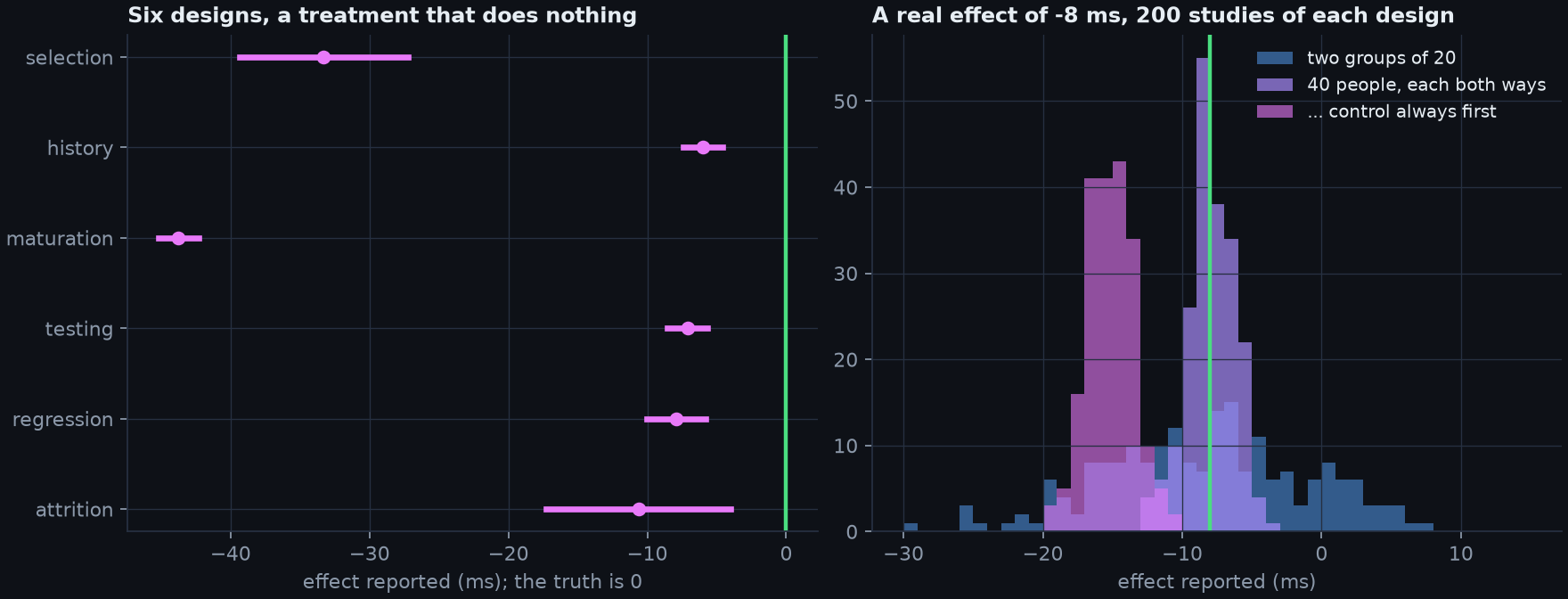
Lab 2 · Six ways to find an effect that is not there, and the shuffle that does not
Run Campbell and Stanley's six unsound designs on the Pool for a treatment whose true effect is zero, then the randomized experiment; check that a shuffle balances a trait nobody measured, and test a real effect by reshuffling the labels.
python -m videos.psychology.labs 2
needs numpy, scipy, matplotlib · download lab02.py ·
source on GitHubselection: effect reported (ms) -33.3 [-39.3, -27.2] (truth: 0)
history: effect reported (ms) -6.0 [-7.4, -4.6] (truth: 0)
maturation: effect reported (ms) -43.7 [-45.2, -42.3] (truth: 0)
testing: effect reported (ms) -7.1 [-8.5, -5.7] (truth: 0)
regression: effect reported (ms) -7.9 [-10.0, -5.8] (truth: 0)
attrition: effect reported (ms) -10.6 [-17.3, -4.0] (truth: 0)
randomized, 300 studies: mean effect (ms) +0.13 +- 0.19
... share 'significant' at 5% 6%
eagerness, shuffled groups: mean and SD of the difference (SD units) +0.007, 0.142
... predicted SD, sqrt(4 / n) 0.141
eagerness, self-selected groups +2.84
a planted effect of -8 ms: estimate (ms) -15.9 [-22.5, -9.3]
... p by reshuffling the labels, and by Welch's t 0.000, 0.000
... 300 such studies: mean and SD of the estimate (ms) -7.9, 3.3
40 people, two groups: SD of the estimate (ms) 7.2
40 people, each both ways: SD of the estimate (ms) 1.7
... control always first: mean estimate (ms) -15.2 (truth: -8)
Every unsound design found that a useless treatment works; the shuffled one did not, and it balanced a trait it never measured. Pairing sharpens the estimate, provided the order is counterbalanced.The code (105 lines; it asserts its own result)
"""Lab 2: study a game that does nothing, six wrong ways and one right way, then shuffle and reshuffle."""

import numpy as np

from videos.coursekit import labs
from explainer.psychology import lab as plab
from explainer.psychology.pool import Pool

TITLE = "Six ways to find an effect that is not there, and the shuffle that does not"
GOAL = ("Run Campbell and Stanley's six unsound designs on the Pool for a treatment whose true effect is zero, "
        "then the randomized experiment; check that a shuffle balances a trait nobody measured, and test a real "
        "effect by reshuffling the labels.")
TASKS = [
    "Give the regression design a screening test of 5, 20 and 80 trials (plab.Lab(pool, n_trials=...)). How does "
    "the spurious effect change, and why?",
    "Plant a real effect of -8 ms and run the cross-over with counterbalanced=False. By how much is it wrong, and "
    "what does that number equal?",
    "Replace randomize by alternate (assignment in turn) after sorting the people by eagerness. What happens to "
    "the balance of age?",
]


def run(seed=0):
    rng = np.random.default_rng(seed)
    out = labs.Lab()
    pool = Pool()
    L = plab.Lab(pool, seed=seed)
    n = 200

    # 1. the unsound designs, each with the true effect zero
    quick = plab.Lab(pool, seed=seed, n_trials=5)  # a short screening test regresses more
    est = {}
    for name in plab.THREATS:
        e = (quick if name == "regression" else L).threat(name, n=n)
        est[name] = e
        lo, hi = e.ci()
        out.row(f"{name}: effect reported (ms)", f"{e.effect:+.1f}   [{lo:+.1f}, {hi:+.1f}]   (truth: 0)")
        assert hi < 0, f"{name} reports an effect that is not there"

    # 2. the randomized experiment, many times
    studies = L.replicate("randomized", studies=300, n=n)
    sig = np.mean([L.randomized(n=n, study=s).p < 0.05 for s in range(300)])
    out.row("randomized, 300 studies: mean effect (ms)", f"{studies.mean():+.2f} +- {studies.std() / np.sqrt(300):.2f}")
    out.row("... share 'significant' at 5%", f"{100 * sig:.0f}%")
    assert abs(studies.mean()) < 4 * studies.std() / np.sqrt(300), "unbiased"
    assert 0.01 < sig < 0.11, "and wrong only as often as it says"

    # 3. what a shuffle balances
    ids = pool.sample(n, seed=seed + 11)
    keen = pool.keen[ids]
    z = np.array([plab.balance(keen, plab.randomize(n, 2, rng)) for _ in range(2000)])
    chosen = plab.balance(keen, (keen > np.median(keen)).astype(int))
    out.row("eagerness, shuffled groups: mean and SD of the difference (SD units)", f"{z.mean():+.3f}, {z.std():.3f}")
    out.row("... predicted SD, sqrt(4 / n)", f"{np.sqrt(4 / n):.3f}")
    out.row("eagerness, self-selected groups", f"{chosen:+.2f}")
    assert abs(z.mean()) < 0.02 and abs(z.std() - np.sqrt(4 / n)) < 0.02, "balanced in expectation, by a known amount"
    assert chosen > 1.0

    # 4. a real effect, judged by the deck that dealt it
    planted = -8.0
    pid = pool.sample(n, seed=seed + 23)
    g = plab.randomize(n, 2, rng)
    y = pool.session_rt(pid, 0, 20, seed=seed + 23, shift=planted * g)
    d = plab.difference(y, g)
    rt = plab.randomization_test(y, g, 5000, rng)
    out.row("a planted effect of -8 ms: estimate (ms)", f"{d.effect:+.1f}   [{d.ci()[0]:+.1f}, {d.ci()[1]:+.1f}]")
    out.row("... p by reshuffling the labels, and by Welch's t", f"{rt['p']:.3f}, {d.p:.3f}")
    assert abs(rt["p"] - d.p) < 0.03, "the two tests agree"
    many = L.replicate("randomized", studies=300, n=n, effect=planted)
    out.row("... 300 such studies: mean and SD of the estimate (ms)", f"{many.mean():+.1f}, {many.std():.1f}")
    assert abs(many.mean() - planted) < 4 * many.std() / np.sqrt(300), "one study wanders; the design is unbiased"

    # 5. pairing
    between = L.replicate("randomized", 200, n=40, effect=planted)
    within = L.replicate("crossover", 200, n=40, effect=planted)
    carry = L.replicate("crossover", 200, n=40, effect=planted, counterbalanced=False)
    out.row("40 people, two groups: SD of the estimate (ms)", f"{between.std():.1f}")
    out.row("40 people, each both ways: SD of the estimate (ms)", f"{within.std():.1f}")
    out.row("... control always first: mean estimate (ms)", f"{carry.mean():+.1f}   (truth: {planted:+.0f})")
    assert within.std() < 0.4 * between.std(), "pairing buys precision"
    assert abs(within.mean() - planted) < 1.0 and carry.mean() < planted - 3, "and needs a balanced order"
    out.note = ("Every unsound design found that a useless treatment works; the shuffled one did not, and it "
                "balanced a trait it never measured. Pairing sharpens the estimate, provided the order is "
                "counterbalanced.")

    fig, ax = labs.figure(2, size=(11, 4.2))
    names = list(plab.THREATS)
    ys = np.arange(len(names))[::-1]
    for y_, name in zip(ys, names):
        e = est[name]
        lo, hi = e.ci()
        ax[0].plot([lo, hi], [y_, y_], color=labs.PINK, lw=3)
        ax[0].plot(e.effect, y_, "o", color=labs.PINK)
    ax[0].axvline(0, color=labs.GREEN, lw=2)
    ax[0].set_yticks(ys, names)
    ax[0].set(title="Six designs, a treatment that does nothing", xlabel="effect reported (ms); the truth is 0")
    bins = np.linspace(-30, 15, 46)
    ax[1].hist(between, bins=bins, color=labs.BLUE, alpha=0.5, label="two groups of 20")
    ax[1].hist(within, bins=bins, color=labs.PURPLE, alpha=0.7, label="40 people, each both ways")
    ax[1].hist(carry, bins=bins, color=labs.PINK, alpha=0.6, label="... control always first")
    ax[1].axvline(planted, color=labs.GREEN, lw=2)
    ax[1].set(title="A real effect of -8 ms, 200 studies of each design", xlabel="effect reported (ms)")
    ax[1].legend()
    out.fig = fig
    return out
Now change it
- Give the regression design a screening test of 5, 20 and 80 trials (plab.Lab(pool, n_trials=...)). How does the spurious effect change, and why?
- Plant a real effect of -8 ms and run the cross-over with counterbalanced=False. By how much is it wrong, and what does that number equal?
- Replace randomize by alternate (assignment in turn) after sorting the people by eagerness. What happens to the balance of age?
Problems, with solutions
Try each problem before opening its solution.
1. Pfungst ran 42 tests in which the questioner knew the number on the card and 49 in which he did not; Hans was right in 98% and 8%. How many answers is that in each? If Hans stopped at a number from 1 to 12 chosen blindly, what share would he get right?
Solution
0.98 × 42 ≈ 41 right of 42, and 0.08 × 49 ≈ 4 right of 49. A blind stop at one of twelve counts is right one time in twelve, 8.3%. So without a questioner who knew the answer Hans did no better than a horse that stops at random, which is what Pfungst concluded: "the few exceptional cases must be regarded as fortuitous".
2. A supplement is tested on 60 volunteers: their memory score rises 4 points over eight weeks. Name four threats to the conclusion that the supplement works, and the change of design that removes each.
Solution
Any four of these. Testing: the second sitting of a memory test is easier than the first; a control group that takes the same two tests removes it. History: something else changed over the eight weeks (term ended, the season changed); a concurrent control group lives through the same weeks. Regression: people volunteer for a memory supplement when their memory seems worst, and an unusually bad stretch is followed by a more ordinary one; a control group recruited the same way regresses equally. Expectancy: they know they are taking it and expect to improve; give the control group a placebo and keep both groups, and the testers, blind. Selection: volunteers are not the general population, and if they are compared with non-volunteers the groups differed from the start; assign volunteers to supplement or placebo by shuffle. Attrition: if those who felt no benefit stopped coming, the finishers flatter the supplement; analyse everyone as randomized. One design answers all of them: a randomized, placebo-controlled, double-blind trial.
3. n people are dealt at random into two equal groups. A trait has standard deviation σ. Show that the difference between the group means has standard deviation 2σ/√n, and find n for which it is σ/20.
Solution
Each group mean is an average of n/2 values, so its variance is σ²/(n/2) = 2σ²/n. Treating the two groups as independent draws, the variances add: Var = 4σ²/n, and the standard deviation is 2σ/√n. (Dealing from one finite group makes the two means slightly negatively related; the exact result for the sample at hand is the same expression with the sample's own σ.) For σ/20 we need √n = 40, so n = 1,600. With 200 people the figure is 0.14σ, which is the spread the film shows for a trait nobody measured.
4. An effect of 8 ms; people differ with SD 24 ms; a person's two sessions correlate 0.89. For 80% power at the 5% level (z₀.₉₇₅ + z₀.₈₀ = 2.80), how many people does a two-group design need, and a within-person one? Why does a simulation ask for a few more than the second number?
Solution
d = 8/24 = 1/3. Two groups: n per group = 2(2.80/d)² = 2 × 70.6 ≈ 142, so 284 people. Within-person: the difference of a person's two scores has variance 2σ²(1 − ρ), so n = 2(1 − ρ)(2.80/d)² = 0.22 × 70.6 ≈ 16 people in all. The formula uses the normal curve, as if σ were known. With 16 people the standard deviation is estimated on 15 degrees of freedom and the test is a t test, whose 5% critical value is 2.13 and not 1.96; on the Pool the count that reaches 80% is about 19. (The film's 139 and 15 use the Pool's own values, 23.8 ms and 0.892.)
5. Cell means: quick people 200 ms without the game and 180 with it; slow people 240 and 216. Compute the interaction contrast in milliseconds and in log milliseconds. What would you report?
Solution
In milliseconds the game's effect is −20 for the quick and −24 for the slow: an interaction of −4 ms. In logs, ln(180/200) = ln(216/240) = ln 0.9 = −0.105 for both: an interaction of zero. Report the simple fact that produces both: the game cuts reaction time by a tenth for everyone. "The game helps slow people more" is true in milliseconds and says nothing about the game treating slow people differently. An interaction whose lines cross would have survived the change of scale; one whose lines only fan need not.
6. With explainer.psychology.lab: run the regression design with screening tests of 5, 20 and 80 trials
(Lab(pool, n_trials=...)). How does the spurious effect change, and why?
Solution
from explainer.psychology import lab
from explainer.psychology.pool import Pool
pool = Pool()
for k in (5, 20, 80):
    print(k, lab.Lab(pool, n_trials=k).replicate("regression", 100, n=200).mean())
About −8.0, −3.9 and −2.8 ms. A longer test averages away more of the trial-to-trial noise, so a score is less luck and more person (its retest correlation in the Pool rises from 0.82 to 0.91 to 0.93), and the slowest at screening are more nearly the truly slowest. The effect does not go to zero, because a person's mean also wobbles from day to day, and no number of trials on one day removes that. Regression to the mean is as large as the measure is unreliable, which is one reason Part 3 is about reliability.
7. ★ A trial's participants can tell which arm they are in. Design a study, acceptable to an ethics board, that separates the treatment's effect from the effect of knowing.
There is no settled answer. Things a good one weighs: (a) the balanced placebo design crosses what is given with what is said and identifies both effects and their interaction, but half the participants are told something false about what is in their bodies, which a board will rarely allow for an active drug; an authorized version tells everyone in advance that the label may be wrong. (b) An active placebo with noticeable effects of its own keeps more people guessing, but changes the comparison. (c) Several doses: belief should not track dose once people know they have had the drug, so a dose-response relation among the unblinded is evidence for the drug. (d) Measure the guesses and the expectations of everyone before the outcome, and estimate how much of the difference they carry; this needs the assumption that guesses are not themselves caused by early improvement, which is usually false, and is the hard part. (e) Outcomes rated by assessors who never meet the treatment sessions remove the rater's expectancy, not the participant's. A complete answer states its assumption and says what result would have shown the assumption wrong.
Notes and sources
Where it comes back
What a measurement measures, and construct validity: Part 3. The randomization test, and the analyst as the last
unblinded observer: Part 4. The curve fitted to Hans's eyesight, as the psychometric function: Part 11. The dogs'
false alarms, as a criterion: Part 12. Milgram's study and its record: Part 34. Which findings travel beyond
Western samples: Part 38. Placebos and the trials of therapy: Part 42. One study in many laboratories: Part 43.
The laboratory (lab.py) is used by every later part that shows a design.
Sources
Books. O. Pfungst, Clever Hans (The Horse of Mr. von Osten) (1907; transl. C. L. Rahn, 1911; in the public domain). R. Rosenthal, Experimenter Effects in Behavioral Research (1966). D. T. Campbell and J. C. Stanley, Experimental and Quasi-Experimental Designs for Research (1963). W. R. Shadish, T. D. Cook and D. T. Campbell, Experimental and Quasi-Experimental Designs for Generalized Causal Inference (2002). R. A. Fisher, The Design of Experiments (1935). The Belmont Report (1979).
Papers.
- C. S. Peirce and J. Jastrow, "On small differences in sensation", Memoirs of the National Academy of Sciences 3 (1885) 73–83 (read 1884).
- R. Rosenthal and K. L. Fode, "The effect of experimenter bias on the performance of the albino rat", Behavioral Science 8 (1963) 183–189.
- R. Rosenthal, "On the social psychology of the psychological experiment", American Scientist 51 (1963) 268–283.
- R. Rosenthal and L. Jacobson, Pygmalion in the Classroom (1968).
- S. W. Raudenbush, "Magnitude of teacher expectancy effects on pupil IQ as a function of the credibility of expectancy induction", Journal of Educational Psychology 76 (1984) 85–97.
- M. T. Orne, "On the social psychology of the psychological experiment", American Psychologist 17 (1962) 776–783.
- J. de Quidt, J. Haushofer and C. Roth, "Measuring and bounding experimenter demand", American Economic Review 108 (2018) 3266–3302.
- L. Lit, J. B. Schweitzer and A. M. Oberbauer, "Handler beliefs affect scent detection dog outcomes", Animal Cognition 14 (2011) 387–394.
- S. Milgram, "Behavioral study of obedience", Journal of Abnormal and Social Psychology 67 (1963) 371–378.
- W. A. Wagenaar, "Generation of random sequences by human subjects", Psychological Bulletin 77 (1972) 65–72; R. Falk and C. Konold, "Making sense of randomness", Psychological Review 104 (1997) 301–318.
- J. J. Arnett, "The neglected 95%", American Psychologist 63 (2008) 602–614; J. Henrich, S. J. Heine and A. Norenzayan, "The weirdest people in the world?", Behavioral and Brain Sciences 33 (2010) 61–83.
- J. M. Mitchell et al., "MDMA-assisted therapy for severe PTSD: a randomized, double-blind, placebo-controlled phase 3 study", Nature Medicine 27 (2021) 1025–1033.
About this partfrom its README
Berlin, 1904. A horse named Hans answers arithmetic with his hoof, and a commission of thirteen, with a circus manager, a zoo director and the head of Berlin's Psychological Institute among them, finds no trick. One student, Oskar Pfungst, changes one thing at a time and counts. Hans is right 98 times in 100 when the questioner knows the answer and 8 in 100 when he does not. Nobody cheated: the questioners were giving the answer away with a movement of the head of about a millimetre, too small for them to feel, and 23 of 25 people did the same for Pfungst in the laboratory.
Every rule of experimental design in psychology is a way of asking a mind a question without telling it the answer, and most of them are in that story. The part builds them one at a time on a single example, a game said to sharpen your reactions, studied on the Pool where the truth is known: the comparison, the control group, the shuffled deck (which psychologists used first, in 1884), each person as their own control, the blind, the factorial design, four kinds of validity, and the rules that protect the people in an experiment. Kant's second objection, that there can be no experiment on the mind, is answered; his third, that the observer disturbs, gets its first reply.
What is computed and built
explainer/psychology/lab.py, the laboratory: assignment by shuffle, balance, Welch and paired comparisons, the randomization test, Latin and Williams squares, power for between- and within-person designs, the interaction contrast, and aLabthat runs the randomized experiment, the cross-over and Campbell and Stanley's six unsound designs on the Pool with the truth known. Also a predictor of two-key sequences, the one the interactive uses.explainer/psychology/psyche/cueing.py: Clever Hans as a mechanism. A questioner who gives a cue only if he knows the answer; a reader whose chance of seeing it falls with distance as a psychometric function.- The Pool gains repeat sessions (practice, day-to-day variation) and an eagerness to sign up for things, which goes with being young and quick. Part 1's people are unchanged.
- No new gear on the Homunculus map. Parts 2 to 4 build the laboratory, the ruler and the rules of evidence.
Chapter notes
| # | Chapter | What it does |
|---|---|---|
| 0 | Clever Hans | The courtyard; the commission of thirteen and its report; Kant's scoreboard; the question; objectives |
| 1 | Who knows the answer? | Pfungst's "procedure without knowledge" (98% against 8%); blinders (89% against 6%); the cue; the questioner moved away, with the cue-reading model; Pfungst as the horse, 23 of 25 |
| 2 | On you: the pendulum and the coin | Chevreul's pendulum and ideomotor action; be a coin; why a program can guess you |
| 3 | Compared with what? | Variables and an operational definition; a useless game that "works" in one group tested twice; the control group |
| 4 | Six ways to fool yourself | Testing, history, maturation, regression, selection, attrition, each run on the Pool with the truth zero; regression to the mean; the confound; the randomized experiment 500 times |
| 5 | Shuffling the cards | Peirce and Jastrow, 1884; what a shuffle balances, measured or not, and by how much; the randomization test |
| 6 | Between people and within them | An effect seen through people's differences; pairing and the correlation of a person with themselves; order effects and counterbalancing; Latin and Williams squares |
| 7 | The experimenter is a subject too | Rosenthal and Fode's rats; Pygmalion and its record; detection dogs; demand characteristics, measured; who is blind |
| 8 | It depends | Factorial designs; parallel, fanning and crossing lines; an interaction that vanishes on a logarithmic scale |
| 9 | Four ways to be wrong | Statistical-conclusion, internal, construct and external validity; who gets studied; designs for when you cannot shuffle |
| 10 | The subject is a person | Deception; Milgram; Tuskegee; the Belmont principles; the rules for this series' own experiments |
| 11 | A design is a program | The laboratory as code; Hans as four numbers against Pfungst's counts; the map |
| 12 | The Ledger | One row in full (the bright rats); today's five rows |
| 13 | In practice: who is blind? | A/B tests, clinical trials, user studies; five questions for any study |
| 14 | Frontier: when the blind cannot be kept | A double-blind trial whose participants could tell; the balanced placebo design and its price; three open questions; the research problem |
| Recap, problems, and the road ahead | Ten lines; Kant's scoreboard; payoffs; problems; references; Part 3 |
NotesWhere the numbers come from
| What | Source |
|---|---|
| Hans, the commission of 12 September 1904, Pfungst's counts, the laboratory tests | Pfungst (1907; transl. 1911), read from the translation; registered in SOURCES.md |
| The shuffled deck of 1884 | Peirce and Jastrow, "On small differences in sensation" |
| The "bright" and "dull" rats, day by day | Rosenthal and Fode (1963), Table 1 |
| Teacher expectancy by weeks of contact | Raudenbush (1984) |
| Detection dogs | Lit, Schweitzer and Oberbauer (2011) |
| Demand effects, measured | de Quidt, Haushofer and Roth (2018) |
| Unblinding in a drug trial | Mitchell et al. (2021) |
| The model of Hans | explainer.psychology.psyche.cueing: four parameters fitted by maximum likelihood to Pfungst's eight conditions |
| Every study of "the game" | explainer.psychology.lab on the Pool. Simulated: the truth is planted (zero, or −8 ms), and each example study shown is the median of 101, not a chosen one |
| The run-of-four figure, the predictor's hit rates | computed in compute.py (be_random) |
Two things on screen are illustrative and say so: the scatter in the regression-to-the-mean picture, and the room in the detection-dog scene.
Notes
| Finding | Original | Status |
|---|---|---|
| An animal reads its handler | Pfungst 1907 | replicated |
| "Bright" rats learn faster | Rosenthal and Fode 1963 | not directly tested |
| Teachers' expectations raise IQ | Rosenthal and Jacobson 1968 | replicated, smaller |
| Subjects do what they think is wanted | Orne 1962 | replicated |
| People cannot be random | Wagenaar 1972 | replicated |
Notes
Before the narrated master:
- Read against the primary source: Milgram (1963), 26 of 40 continuing to 450 volts; the Tuskegee study's dates and the count of 399 men; the three principles of the Belmont Report. All three are confirmed here from secondary sources only.
- Arnett's figures on samples (68% from the United States, 96% from Western industrial countries) and the 12% of the world's population in Henrich, Heine and Norenzayan are from secondary sources; check the papers.
- Wagenaar (1972) and Falk and Konold (1997) on produced randomness are known here from summaries; the film's "six in ten" for the rate of switching should be checked against Falk and Konold's table.
- Chevreul's pendulum (1833), his observation that looking away stopped it, and Carpenter's "ideo-motor" (1852) are stated from standard histories.
- The Ledger row for the "bright" rats says we know of no independent direct replication. That is a statement about a search, made on 2026-11-13; search again before release.
Companion material in this repository
The syllabus's plan for this partfrom SYLLABUS.md, the plan of record
- Hook: Clever Hans in Berlin, 1904. The commission of thirteen and its report of 12 September.
- Pfungst's experiments: the questioner knows or does not (98% against 8%); blinders (89% against 6%); the cue, a movement of the head; the questioner moved away, with the cue-reading model; Pfungst plays the horse, and 23 of 25 people give him the signal.
- On you: Chevreul's pendulum (ideomotor action); be a coin, and why a program can guess you.
- Compared with what? Variables, operational definitions, and why one group is never enough: a useless game "works" in a group tested twice, and a control group shows why.
- Six ways to fool yourself: testing, history, maturation, regression, selection, attrition, each run on the Pool with the truth zero. Regression to the mean, drawn. The confound. The randomized experiment, 500 times.
- Shuffling the cards: Peirce and Jastrow's deck (1884), the first randomized experiment; what a shuffle balances, measured or not, and by how much (computed); the randomization test.
- Between and within designs: what pairing buys (computed), carry-over, counterbalancing, Latin and Williams squares.
- Expectancy and demand: Rosenthal and Fode's rats, Pygmalion and its record, detection dogs (Lit et al. 2011), Orne's demand characteristics measured (de Quidt et al. 2018), the placebo, single, double and triple blinds.
- Factorial designs and interactions, drawn. Why "it depends" is a finding. Scale dependence of interactions (computed).
- Validity, four kinds (Shadish, Cook and Campbell). The WEIRD sample problem as external validity (paid off in Part 38). Quasi-experiments for when randomization is impossible (link to Statistics, Built Parts 35–37).
- Ethics as design: deception, Milgram, Tuskegee, the Belmont Report (1979), consent and debriefing, the ethics board; the rules for this series' own experiments.
- The experiment runner: a design is a small program; the Pool runs it. Hans as four numbers.
- The Ledger.
- In practice: A/B tests, clinical trials, user studies; five questions for any study.
- Frontier: blinds that cannot be kept (Mitchell et al. 2021), the balanced placebo design and its price, demand measured directly, who gets studied.
Psyche: cueing (Clever Hans as a cue reader, fitted to Pfungst's counts); the Pool's sessions; and
explainer.psychology.lab: assignment, counterbalancing, the comparison and its test, power, and each threat to
validity simulated with the truth known.
On you: an ideomotor demonstration (a pendulum that answers your own thought); try to be random, against a
program that guesses your next key press.
Ledger: an animal reads its handler (replicated); the "bright" rats (not directly tested); teacher
expectancy and IQ (replicated, smaller); demand effects (replicated); people cannot be random (replicated).
The Hawthorne effect is left to Part 53.
In practice: A/B tests, clinical trials and user studies are these designs; "who is blind?" is the first question
to ask of any of them.
Frontier: demand effects measured directly (de Quidt, Haushofer & Roth 2018); when a blind cannot be kept
(psychotherapy, psychedelics), and what designs do about it; whether findings hold beyond the samples studied.
Reading: Pfungst 1907/1911; Peirce & Jastrow 1884; Shadish, Cook & Campbell 2002; Rosenthal 1966; Orne 1962;
Campbell & Stanley 1963; the Belmont Report.
Build the film
python -m videos.psychology.psych2.compute        # the part's numbers, into .cache/psych2
python tools/build.py psych2                  # render and assemble the film
EXPLAINER_TTS=silent python tools/qa_scene.py psych2 Hook   # one chapter, silent, with a contact sheet
Scenes: videos/psychology/psych2. Setup: see the course page. Source of these notes: the README and the scenes' narration.
Build it
python -m videos.psychology.psych2.compute            # every number (a few seconds), into .cache/psych2/
python tools/qa_scene.py psych2 Pfungst               # one chapter, silent, at 480p, with a contact sheet
EXPLAINER_TTS=silent python tools/build.py psych2 -q l   # the whole part, silent preview
python tools/build.py psych2                          # 1080p30 with narration
python tools/qa_scene.py psych2 Pfungst --lang zh     # the Chinese edition of one chapter
python tools/make.py psych2                           # both editions, with the checks a long build needs
python -m videos.psychology.labs 2                    # the lab: six wrong designs and one right one
python tools/check_ledger.py psych2                   # every study shown has its Ledger row, or a reason
python -m pytest tests/psychology                     # the laboratory, the Pool, the Ledger and the Archive
The Chinese edition is zh_lines.py (the narration, line by line) and the series table
videos/psychology/psychology_text_zh.json (the text on screen); the terms are in
PSYCHOLOGY_ZH_GUIDE.md. Code on screen stays as it is run; its comments are translated.