Reasoning and Problem Solving
Are people logical, and if not, what are they instead?
Four cards and one rule defeat nine people in ten; the same rule about drinking ages defeats almost no one. Psyche finds every valid syllogism by brute force, and 139 people's answers to all 64 show what logic, mental models and shortcuts each get right. Under rarity, the 'wrong' cards are the informative ones. Newell and Simon turn problems into spaces of states: the Tower of Hanoi is drawn whole, a hill-climber wanders through it, and a goal stack predicts where people pause. The nine dots are proved unsolvable inside the box. Masters see chunks, practice matters but ten thousand hours is a story, analogy maps relations, and mental rotation runs at about 93 degrees a second in open data. Causal power, everyday priors and a mind that satisfices close the part.
What you need. Part 16's contingency and Part 22's size principle. Sets, conditional probability, entropy and least squares.
- Hook
- Wason's four cards
- Ideas, models and mathematics
- deduction and its biases, mental models, problem spaces and search, insight, expertise and chunking, analogy, imagery and mental rotation, causal learning, production systems
- Psyche gains
- a production system; a mental rotator
- On you
- the selection task; mental rotation
What you will be able to do
Psych 101 and the major
- Describe the selection task, its content effects, and belief bias.
- Explain problem solving as search, insight and functional fixedness.
- Describe chunking, deliberate practice, analogy and mental rotation.
Graduate
- Decide a syllogism's validity over set models, and score accounts of people's answers on data.
- Compute each card's expected information gain under rarity.
- Fit rotation rates person by person to open data.
Research
- Derive causal power from a noisy-OR, and the posterior-median rule for everyday predictions.
- Explain why no single account of syllogistic reasoning fits, and what would decide between them.
Practice
- Judge interview puzzles against validated selection methods.
- Plan a usability test from the problem-discovery model, and say where it fails.
Contents
Each chapter has a home level. Choose a track to see what to read and watch: Psych 101 and the major 31 min · Graduate 33 min · Research 45 min · Practice 33 min.
- 0Four cardsPsych 101 and the major3 min
- 1DeductionPsych 101 and the major3 min
- 2Rules, models and shortcutsResearch3 min
- 3Why content helpsPsych 101 and the major3 min
- 4Problem solving as searchPsych 101 and the major2 min
- 5Production systemsResearch3 min
- 6InsightPsych 101 and the major6 min
- 7ExpertisePsych 101 and the major2 min
- 8AnalogyPsych 101 and the major2 min
- 9Mental imageryPsych 101 and the major3 min
- 10Reasoning about causesResearch2 min
- 11Everyday predictions, and bounded rationalityResearch3 min
- 12The LedgerPsych 101 and the major3 min
- 13In practice: puzzles, protocols, trainingPractice2 min
- 14Frontier: machines that reasonResearch2 min
- Recap, problems, and the road aheadAll tracks3 min
Also on this page: Lecture · Key results · Try it · Lab · Problems · Notes and sources · Build the film.
Lecture
The text of each chapter is the film's narration, as it is spoken, so you can read along or revise without the film. The pictures are in the film. A dashed box stands for a number the film computes when it is rendered (hover over it to see what is computed); the README's figures for each chapter, where it lists them, follow the chapter's text.
Four cardsPsych 101 and the major3 min
Let's start with a puzzle, on you. Here are four cards. Each has a letter on one side and a number on the other. And here's a rule about them: if a card has a vowel on one side, it has an even number on the other. Which cards must you turn over to find out whether the rule is true? Turn only the cards you need. Pause the video if you like, and choose.
Most people turn over the E, and many turn over the 4 as well. The answer is the E and the 7. The E, because an odd number behind it would break the rule. The 7, because a vowel behind it would break the rule too. The 4 can't break it: the rule says nothing about what's behind an even number. When Peter Wason set this task in the 1960s, about one person in ten chose the E and the 7. Students of logic did little better.
Now a second puzzle. You're checking a bar. Each card is a person: what they're drinking on one side, their age on the other. The rule: if a person is drinking beer, they must be over eighteen. Which cards must you turn over? Almost everyone sees it at once. The beer drinker, to check their age, and the sixteen-year-old, to check their drink. In 1982 Richard Griggs and James Cox found that about three people in four got this version right. Yet it has exactly the logical form of the first: if P then Q, and the cards to turn are P and not-Q.
The difference between those two puzzles is the subject of this part. We'll start with deduction, the oldest kind of reasoning, with the answers of a hundred and thirty-nine people to every syllogism there is. Then why content helps so much, and an argument that the wrong cards may not be so wrong after all. Then problem solving as search, from Newell and Simon to the moment of insight. Then expertise, analogy, and the mind's eye. And finally reasoning about causes and about everyday life, and the bounded mind that does it.
This is Part 24 of Psychology, Built, the seventh part of Act Five, on thinking: reasoning and problem solving. We'll find every valid syllogism by brute force and test four accounts of what people answer instead. We'll derive the information each card carries. We'll draw the whole space of a puzzle and watch a production system climb through it. We'll prove that the nine-dot puzzle can't be solved inside the box. We'll fit mental rotation to the open data of fifty-four people, and finish with causes, everyday predictions and the limits of a mind that has to decide in time.
What it does: The selection task on you, abstract and as a drinking rule; the questions; objectives
1DeductionPsych 101 and the major3 min
The oldest piece of formal reasoning is the syllogism. All artists are beekeepers. All beekeepers are chemists. So all artists are chemists. Each premise has one of four forms: all, some, no, and some are not. Two premises, four forms each, and four ways to arrange the terms make sixty-four syllogisms. For each there are nine possible answers: a conclusion in one of the four forms, running in either direction, or no valid conclusion at all. Aristotle catalogued the valid ones, and for two thousand years they were most of logic.
How do you know which conclusions are valid? Psyche does it by brute force. Three terms divide the world into eight kinds of thing: things that are A and B but not C, and so on. A model of the world says which of the eight kinds exist, so there are two hundred and fifty-six models. Each premise rules some of them out. All A are B empties the part of A outside B. All B are C empties the part of B outside C. A conclusion is valid if it's true in every model that's left. Here, every A that exists is inside C, so all A are C follows. Done for all sixty-four, twenty-seven syllogisms have a valid conclusion, if we assume each term names something that exists, and thirty-seven have none.
What do people do? Marco Ragni's lab gave all sixty-four syllogisms to a hundred and thirty-nine people, and the answers are open. Each square is one syllogism, green where most people were right, red where most were wrong. The pattern is anything but random: some are nearly always solved, some almost never. All A are B, all B are C: say all A are C. No A are B, all B are C. The commonest answer is no A are C, which doesn't follow. The valid answer, some C are not A, is chosen by percent. Overall, of answers are right: where a conclusion follows, and where none does.
And people reason differently about different content, even when the logic is the same. No addictive things are inexpensive. Some cigarettes are inexpensive. So some addictive things are not cigarettes. It sounds true, and it doesn't follow. In 1983 Jonathan Evans, Julie Barston and Paul Pollard gave people syllogisms whose conclusions were valid or invalid, and believable or not. Valid and believable conclusions were accepted eighty-nine percent of the time; invalid and unbelievable ones only ten. But an invalid conclusion that people believed was accepted seventy-one percent of the time, more than a valid one they didn't believe. Belief bias: what you know about the world leaks into what you think follows.
What it does: Sixty-four syllogisms; validity by brute force; 139 people's answers; belief bias
2Rules, models and shortcutsResearch3 min
How do people reason, when they do? One answer is that the mind applies rules of inference, like a logician's proof. Phil Johnson-Laird proposed instead that people imagine. Some A are B. No B are C. Imagine a few individuals that make the premises true: an A that is a B, another A, and a C, kept apart from the Bs. This first model suggests that no A are C. But a careful reasoner looks for a counterexample: a second model where the other A is also a C. The premises are still true, and no A are C is refuted. What survives in every model is that some A are not C. On this theory, the more models a syllogism needs, the harder it is, and errors come from stopping at the first one.
Others argued that most people don't reason through syllogisms at all. The oldest idea, from 1935, is atmosphere: a negative premise makes a negative conclusion feel right, and a some makes a some. Matching says people answer in the mood of the more cautious premise. And Nick Chater and Mike Oaksford's probability heuristics treat all, some and no as statements of probability, and pick the mood of the least informative premise. Take the premises from before, some A are B and no B are C. Atmosphere happens to land on the valid answer; matching and probability heuristics both say no A are C, which doesn't follow. Notice what all three have in common: they always predict a conclusion, and never that nothing follows.
Psyche scores each account against the hundred and thirty-nine people, asking how often it predicts the commonest answer to each syllogism. Where a valid conclusion exists, the shortcuts do well. Atmosphere predicts the commonest answer for of the , logic for . Where nothing follows, the picture reverses. Many people do say that no valid conclusion follows, and only logic predicts that: of the , against for every shortcut. People are neither logicians nor pure pattern-matchers, and no single account fits. In 2012 Sangeet Khemlani and Phil Johnson-Laird surveyed twelve theories of the syllogism, tested seven against the data of six studies, and found that none fitted well.
What it does: Mental models and counterexamples; atmosphere, matching and probability heuristics; four accounts scored
3Why content helpsPsych 101 and the major3 min
Why does the drinking rule help so much? Two explanations led a long debate. Patricia Cheng and Keith Holyoak proposed pragmatic reasoning schemas. People know how permissions work: if you take the action, you must meet the condition. A permission rule helps even when its content is arbitrary. Leda Cosmides proposed something more specific: that evolution built a mechanism for catching cheaters, people who take a benefit without paying its cost. With an unfamiliar rule, if a man eats cassava root he must have a tattoo on his face, people chose well when the rule was framed as a social contract, and poorly when the same rule was a description. Both say people reason with what the content means, not with the form of the rule. A third answer asks whether the abstract task was ever being judged by the right standard.
In 1994 Mike Oaksford and Nick Chater argued that people treat the selection task not as a problem in logic but as a question about the world. Is Q dependent on P, so that every P is a Q? Or are they independent? A reasoner starts undecided between these two hypotheses. Add one assumption, rarity: most properties apply to only a few things, so P and Q are both uncommon. Then ask of each card how much turning it is expected to reduce uncertainty about the two hypotheses: the entropy before, minus the expected entropy after, averaged over what might be on the back. That is the expected information gain, and a rational tester turns the cards that carry the most.
Here is the calculation. With P and Q both rare, Psyche finds the P card most informative, then Q, then not-Q, and not-P almost worthless. On the right, how often people turn each card, from Oaksford and Chater's analysis of thirteen studies and eight hundred and forty-five people. The same order. On this view, turning the Q card isn't a failure of logic. If Q is rare, Q is where the information is. The model also predicts that when Q is common, the Q card loses its value and the not-Q card overtakes it, and some experiments that make Q common find just that, though not all. The abstract task may have been testing people against the wrong standard.
What it does: Pragmatic schemas and cheater detection; optimal data selection derived; information against people's choices
4Problem solving as searchPsych 101 and the major2 min
Reasoning starts from what you know. Problem solving starts from where you are. In the late 1950s Allen Newell, Cliff Shaw and Herbert Simon described any problem the same way: a set of states, operators that move between them, and a goal. Here is the Tower of Hanoi: move the stack to the right-hand peg, one disc at a time, never putting a larger disc on a smaller one. Solving is searching through the states. Their General Problem Solver used means-ends analysis: find the biggest difference between where you are and the goal, and set up a subgoal to remove it. And their evidence came from people thinking aloud while they solved, compared step by step with what the program did.
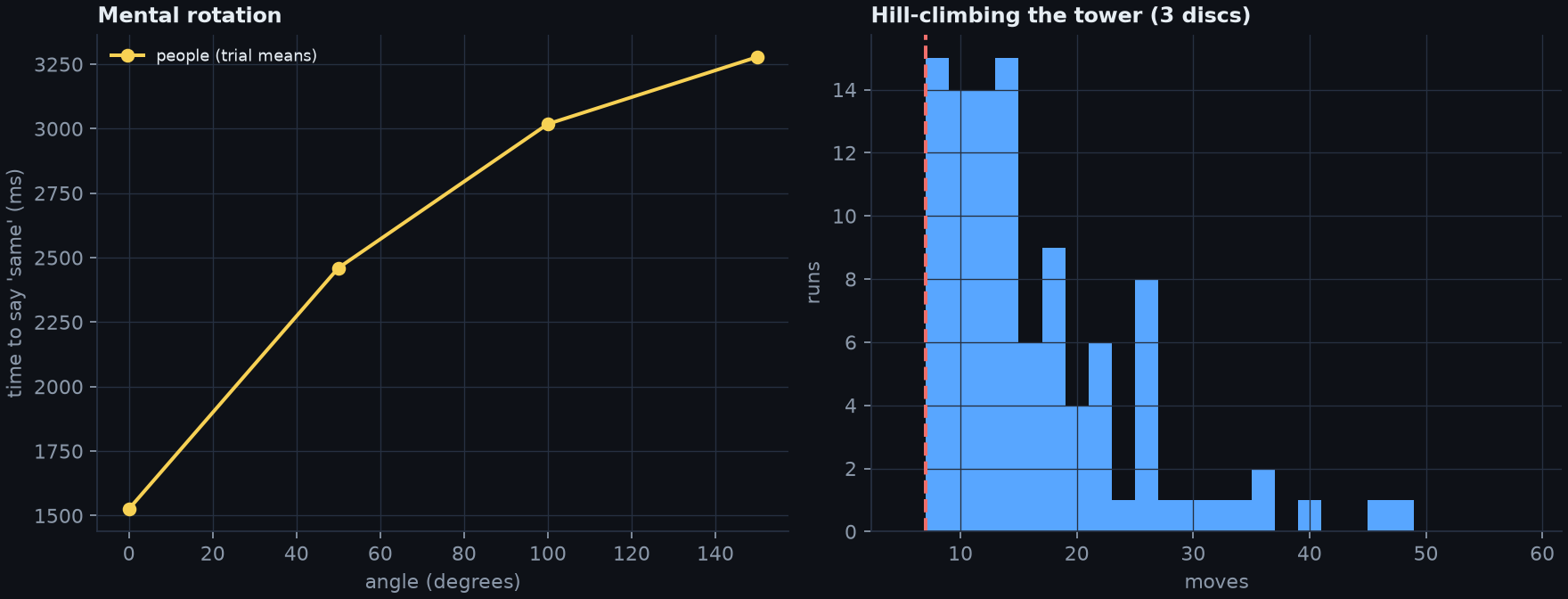
Psyche can draw the whole space. With three discs there are twenty-seven states, each a dot, and every line is a legal move. The space is a triangle of triangles. The shortest solution is seven moves, straight along one side. A hill-climber, which always prefers moves that put more of the stack on the goal peg, wanders. The median of a hundred and one runs takes moves, and only find the shortest path. With four discs and eighty-one states, its median is moves, against fifteen. The trouble is that the right move sometimes takes you away from the goal: to get the big disc across, the small ones must first go the wrong way. That is where people tend to slow down.
What it does: States, operators and means-ends analysis; the Tower of Hanoi's whole space; the shortest path and a hill-climber
5Production systemsResearch3 min
Newell and Simon's programs were written as productions: if-then rules that watch a working memory and fire when their conditions match. Here's a whole strategy for the tower in three rules. If the goal is to move a disc and a smaller disc is in the way, push a subgoal: move the smaller discs to the other peg. If nothing is in the way, move the disc and drop the goal. And when a goal is done, go back to the one beneath it. A production system is just that: a memory of goals and facts, and rules that fire one at a time. John Anderson's ACT-R grew from this idea into a theory of the whole mind, with a declarative memory, a procedural memory, and rules that fire about every fifty milliseconds. Its models predict times, errors, and even brain activity.
Rules like these make a prediction about time. Suppose each move costs one unit of time, and each subgoal set up before it costs one and a half more. With four discs, Psyche's goal stack solves the tower in fifteen moves. The pauses aren't even. The longest comes before the first move, where the whole tower of subgoals is built, then before the ninth, then before the fifth and the thirteenth. In 2001 John Anderson and Scott Douglass found that people's move times on fifteen-move problems depended on setting up and retrieving goals, retrieval most of all. The structure of the plan shows up in the clock.
How do you check that a model searches the way a person does? Ask the person to think aloud. In 1980 Anders Ericsson and Herbert Simon argued that if people are asked only to say what they're attending to, speaking barely changes the thinking. Ask them to explain why they're doing it, and it does: they slow down, and change what they do. A protocol gives the sequence of states a solver passes through, and a model must reproduce it. What a protocol can't show are the processes too fast or too automatic to put into words, which, as the next chapter shows, may be where the hardest problems are solved.
What it does: Rules that fire; ACT-R; where a goal stack predicts pauses; thinking aloud as data
6InsightPsych 101 and the major6 min
The idea that some thinking isn't step-by-step search is older than the computer. From 1913 Wolfgang Köhler, one of the Gestalt psychologists of Part 14, ran a research station for chimpanzees on Tenerife, and set them problems with fruit out of reach. Sultan, his ablest chimpanzee, had two hollow sticks, each too short to reach a banana outside the bars. After about an hour of failing, playing with them, he found he had pushed one into the other, and at once went to the bars and pulled the fruit in. Others dragged a box under fruit hung from the roof, and later stacked two or more. Köhler's book appeared in 1917, and in English as The Mentality of Apes. Against Edward Thorndike's cats, which escaped from puzzle boxes by slow trial and error, he argued for insight: a sudden change in how the situation is seen, so that a stick becomes part of a longer arm. The Gestalt word was restructuring. The record keeps the suddenness and adds a history. In 1945 Herbert Birch found that young chimpanzees with no experience of sticks mostly failed such problems, and solved them readily after a few days of playing with sticks. In 1984 Robert Epstein and colleagues trained pigeons, separately, to push a box and to climb onto one; given a toy banana out of reach, they put the two together. Insight is real as an experience, but it's built from what was learned before. Karl Duncker, who trained in Köhler's Berlin institute, took the question to people.
Some problems aren't solved by search at all, or not by any search you can report. Karl Duncker gave people a candle, a box of tacks and some matches, and asked them to fix the candle to the wall so it could burn without dripping on the table. People try to tack the candle to the wall, or glue it with melted wax. The answer is to empty the box, tack it to the wall, and stand the candle in it. Duncker called the obstacle functional fixedness: the box is seen as a container for tacks, not as a shelf. Robert Adamson found in 1952 that the problem is easier when the box is given empty, beside the tacks, not filled with them.
Duncker's obstacle lay in how an object is seen. Abraham Luchins found one in a method. In 1942 he gave people imaginary water jars. With jars that hold twenty-one, a hundred and twenty-seven and three cups, measure out exactly a hundred. The answer is to fill the big jar, pour off once into the first, and twice into the small one: B minus A minus two C. Five problems in a row yield to the same formula. Then come problems like the seventh: twenty-three, forty-nine and three, to measure twenty. The old formula works, but so does A minus C, in two steps. Most of those who had practised used the long way; groups who began at the critical problems almost always saw the short one. On the ninth, where the old formula fails and A minus C is the answer, many of the practised were stuck. Luchins called it Einstellung, a mental set: a way of working that hides a better one. Experts aren't immune. In 2008 Merim Bilalić, Peter McLeod and Fernand Gobet showed chess players a position with a familiar mate and a shorter one. Strong players missed the shorter mate, and their eyes kept going back to the familiar one even while they said they were looking for something better. Fixedness and set are obstacles with names. The most famous insight problem is harder to diagnose.
Here is the most famous insight problem. Join all nine dots with four straight lines, without lifting your pen. Psyche tries every path of four lines that turns only at points of the grid. Inside the square, there is no solution at all. Allow it to turn outside the square, and there are distinct drawings, and no more however far the grid extends. So the puzzle really does require leaving the box. Yet when Robert Weisberg and Joseph Alba told people that the lines could go outside the square, only a minority then solved it. The obstacle isn't just one hidden assumption, and that's part of what makes insight hard to explain.
Is insight a different kind of thinking, or ordinary search that you can't see? In 1987 Janet Metcalfe and David Wiebe asked people, every fifteen seconds while they worked, how close they felt to the answer. On algebra problems the feeling of warmth rose steadily. On insight problems it stayed low, and then the answer came all at once. People could also predict which algebra problems they would solve, but not which insight problems. The other side argues that insight is ordinary search after all: James MacGregor and colleagues modelled the nine dots as a search guided by how much progress each line seems to make, and predicted when people would get stuck. Both may be right: the search is ordinary, and what changes suddenly is the space being searched.
What it does: Köhler's apes; Duncker's candle; Luchins's jars; the nine dots by brute force; warmth ratings and progress monitoring
7ExpertisePsych 101 and the major2 min
What makes an expert? Chess has been the laboratory. In the 1940s the Dutch psychologist and chess master Adriaan de Groot found that grandmasters don't search more moves ahead than good club players. They consider better moves, and they can rebuild a position after a glance. In 1973 William Chase and Herbert Simon showed a master, a strong amateur and a beginner a position for five seconds, and asked them to rebuild it. From real games, the master recalled far more pieces. With the same pieces scrambled at random, the master's advantage nearly vanished. The master wasn't remembering pieces, but chunks: familiar groups, like a castled king, of which a master might know tens of thousands. Later work found that a small advantage survives even on random boards, as chunks would predict, since a few familiar groups turn up by chance.
So how do you build a library of chunks? In 1993 Anders Ericsson and colleagues studied violinists at a Berlin music academy. The best had spent the most time in deliberate practice, alone, working on what they couldn't yet do: an estimated ten thousand hours by the age of twenty. Malcolm Gladwell turned this into the ten-thousand-hour rule, a claim Ericsson himself rejected. How much does practice explain? In 2014 Brooke Macnamara, David Hambrick and Frederick Oswald pooled eighty-eight studies of more than eleven thousand people. Practice explained about a quarter of the differences in games, a fifth in music and sport, four percent in education, and under one percent in professions. And a 2019 replication of the violin study found that the best and the good violinists had practised about equally. Practice matters, but it isn't the whole story, and the Ledger records the rule as a story the record doesn't support.
What it does: De Groot, Chase and Simon; chunks; deliberate practice and how much it explains
8AnalogyPsych 101 and the major2 min
Here's another of Duncker's problems. A patient has a tumour that can be destroyed by rays. But rays strong enough to destroy it also destroy the healthy tissue they pass through, and weak rays do no harm, and no good. The answer is to send many weak rays from different directions, meeting at the tumour. In 1980 Mary Gick and Keith Holyoak found that about one person in ten finds this unaided. Before the problem they had people read a story: a general captures a fortress by splitting his army and sending it down many roads at once. After the story, about three people in ten solved the radiation problem. Told that the story might help, about three in four did. People had the answer and didn't see that it applied.
What does it take to see an analogy? Dedre Gentner proposed in 1983 that an analogy maps relations, not appearances. Objects correspond when they play the same roles. And the best mapping keeps a connected system of relations, with causes linking events, which she called systematicity. Psyche writes both stories as relations: dividing a force causes it to converge on a target, which causes the target's capture. Then it tries every one-to-one mapping of the objects and keeps the one that matches the most relations. The army maps to the rays, the fortress to the tumour, the general to the doctor. Nothing about an army looks like a ray. That's why people miss the analogy, and why a single hint is enough to make them look at the relations instead.
What it does: The radiation problem and the fortress; structure mapping computed
9Mental imageryPsych 101 and the major3 min
In 1971 Roger Shepard and Jacqueline Metzler showed people pairs of drawings of block figures. The second was the same object turned through some angle, or its mirror image. Same, or mirror? The time to answer same grew in a straight line with the angle between them: about a second for every sixty degrees. It was as if people turned a picture in their heads at a steady speed until the two lined up. The figures here are flat sketches; the originals were drawn in perspective and turned in depth as well.
Does it hold up? Giorgio Ganis and Rogier Kievit made a new set of these figures in 2015, tested people, and released every trial. Here are the mean times to say same, at four angles. They rise from seconds to , and errors on mirror pairs rise from to . Psyche fits a line to each person separately. of the slopes rise, and the median person turns about degrees a second. Psyche's own model rotates at that steady speed. It fits the trend, but not the bend: the first fifty degrees cost the most. Perhaps a pair seen from the same angle can be matched without rotating at all. The finding replicates; the simplest model of it is close, not exact.
What is a mental image? A long debate had two sides. Stephen Kosslyn argued that images are picture-like. When people memorize a map and then scan an image of it, the time grows with the distance scanned, and imagery uses parts of the brain that seeing does. Zenon Pylyshyn argued that images are descriptions, and that the timings reflect what people know about how seeing and moving work. A picture in the head, he said, would need someone in the head to look at it. And a recent twist. Adam Zeman and colleagues named aphantasia in 2015: a few percent of people report no visual imagery at all. Many of them still solve rotation problems, often more slowly, which suggests there's more than one way to do it.
What it does: Shepard and Metzler; 54 people's open data fitted; depictive or descriptive; aphantasia
10Reasoning about causesResearch2 min
Part 16 measured how strongly a cue predicts an outcome by contingency: how much more often the effect follows the cause than follows its absence. That's delta P. In 1997 Patricia Cheng pointed out a problem. A cause can only show its effect where the effect wouldn't have happened anyway. If a headache is already likely, a medicine that causes headaches has fewer chances to show it. So assume the cause produces the effect with some probability q, independently of everything else. The probability of the effect given the cause is then the background rate plus q times what's left. Solve for q, and you get causal power: delta P divided by one minus the background. Take a cause of the same strength, a half, on busier and busier backgrounds. Delta P shrinks toward zero. Power stays at a half. In many experiments people's judgements follow power more closely than delta P, though not in all.
Causal knowledge does something that correlation can't. A falling barometer predicts a storm. Seeing the needle fall should make you expect rain. But if you push the needle down with your finger, the storm is no more likely. Intervening on something cuts it off from its usual causes. Michael Waldmann and York Hagmayer gave people causal models of this kind and found that their predictions after seeing a variable change differed from their predictions after setting it, much as the models require. The mathematics of interventions on causal graphs is Part 36 of Statistics, Built.
What it does: Delta P to causal power, derived; seeing against doing
11Everyday predictions, and bounded rationalityResearch3 min
Reasoning in daily life is mostly guessing well. A film has taken forty million dollars so far. How much will it take in all? In 2006 Tom Griffiths and Josh Tenenbaum treated this as inference. You meet the film at a random moment of its run, so the chance of seeing any particular amount so far is one over the total. Small totals make what you saw less surprising, so the likelihood pulls the guess down. Your knowledge of how such totals are spread, the prior, pulls it the other way. Combine them, and the best single guess is the median of the posterior. For the film, it's eighty million dollars: twice what it has taken so far.
Different priors give different rules. Film takings follow a power law: a few films take enormous sums. Then the optimal guess is a multiple of what you've seen; for the simplest power law, twice. If totals cluster around a typical length, an Erlang prior, the rule is to add a roughly constant amount. And for life spans, roughly normal, the guess sits near the average until you're old: about for someone who is eighteen, at thirty-nine, and for someone already ninety. Griffiths and Tenenbaum found that people's median guesses fell close to the optimal curves for films, lives, poems and baking times, as if each had the right prior. But Michael Mozer and colleagues showed that group medians that good could come from people who each recall only a couple of examples. The group is well calibrated; whether each mind holds a whole distribution is contested.
So are people logical? It depends on the yardstick. Measured against logic, people fail: the selection task, syllogisms, belief bias. Measured against probability and the world people actually live in, they often do well: choosing informative evidence, guessing totals from parts. Herbert Simon offered a third view in 1955: bounded rationality. A mind with little time and limited memory can't optimize. It satisfices, stopping at the first option that's good enough. The search of chapter four, the chunks of chapter seven, and the shortcuts of chapter two are all ways of being good enough. The argument about what counts as rational returns in Part 26, on judgement and its biases.
What it does: The posterior median derived; three priors, three rules; Simon's satisficing
12The LedgerPsych 101 and the major3 min
Six rows today. The first: the selection task is solved far more often when the rule is a familiar permission than when it is abstract. The original: Griggs and Cox, 1982, with the drinking age. The record: Cheng and Holyoak's permission rules in 1985, and Cosmides's social contracts in 1989, and many studies since. The effect is robust; what causes it is still argued. Replicated.
The second: people accept believable conclusions more than unbelievable ones, most of all when they don't follow. The original: Evans, Barston and Pollard, 1983. The record: Klauer and colleagues' model of eight experiments in 2000, and Dube, Rotello and Heit's reanalysis in 2010, which reads the effect as a shift in the threshold for saying yes. One of the most reliable effects in reasoning, with its explanation argued. Replicated.
The third: the time to compare two figures grows linearly with the angle between them. The original: Shepard and Metzler, 1971, with eight people. The record: Cooper and Shepard's rotated letters, and Ganis and Kievit's open data from fifty-four people, fitted in this part. One of the steadiest effects in cognition. Replicated.
The fourth: chess experts recall positions from real games far better than novices, but not random positions. The original: Chase and Simon, 1973, with three players. The record: Gobet and Simon's finding in 1996 that a small advantage survives on random boards, and Sala and Gobet's meta-analysis in 2017, which found that small edge across fields of expertise. Replicated many times, with that small edge explained by chunks that turn up by chance. Replicated.
The fifth: expert performance is mainly the product of about ten thousand hours of deliberate practice. The original: Ericsson, Krampe and Tesch-Römer, 1993. The record: Macnamara and colleagues' meta-analysis of eighty-eight studies, and a 2019 replication of the violin study. Practice matters, but the rule is not what the study found, and not what the record supports. Story and record.
And the sixth: people's everyday predictions match the optimal Bayesian predictions for each domain. The original: Griffiths and Tenenbaum, 2006. The record: Mozer and colleagues' model of people who each recall a few examples, and Lewandowsky and colleagues' chains of learners, which found good priors in individuals. The group-level match is robust; how much each person knows is contested. Replicated.
The tally. Five rows replicated: the classic effects of reasoning are among the sturdiest in psychology. What's argued is what they mean: schemas or information, a change of reasoning or of threshold, wise crowds or wise individuals. And the one claim the record doesn't support is the one that left the laboratory and became a rule for life: ten thousand hours.
What it does: Content effects; belief bias; mental rotation; chess memory; 10,000 hours; everyday predictions
13In practice: puzzles, protocols, trainingPractice2 min
Where is this used? Start with hiring. How many golf balls fit in a school bus? Puzzle questions were once popular in interviews, because they look like tests of reasoning. In 2013 Google's head of people operations said that, in the company's own data, brainteasers were a complete waste of time. What predicts job performance better is well studied: structured interviews, samples of the actual work, and tests of general ability, though the estimates have recently been revised down. Here is each one's correlation with later job performance, as Frank Schmidt and John Hunter pooled them in 1998, and as Paul Sackett and colleagues revised them in 2022: every estimate falls, and structured interviews come out on top. Personnel selection returns in Part 53. This part says why puzzles fail: solving one depends on finding the right representation, and on chunks from experience, so a puzzle mostly measures familiarity with puzzles. The same research shapes training. John Sweller found that novices learn more from studying worked examples than from solving problems themselves, while for experts the advantage reverses.
Thinking aloud became an industry. Usability testing is Ericsson and Simon's protocol, put to work: people try a design and say what they're attending to, while a designer watches. How many people do you need? Jakob Nielsen and Thomas Landauer modelled it in 1993. If each user runs into a given problem with probability about 0.31, then n users find one minus 0.69 to the n of the problems. Five users find about eighty-four percent, which became the advice to test with a few people, fix, and test again. But that probability varies with the product and the users, and for rare problems five people miss a great deal. Designing for minds is Part 52.
What it does: Interview puzzles and selection; worked examples; usability testing computed
14Frontier: machines that reasonResearch2 min
Every problem in this part was posed to people. The frontier asks how a machine might solve them. In 2019 François Chollet published the Abstraction and Reasoning Corpus: hundreds of small puzzles, each a few examples of coloured grids and a test. Here's one invented in that style. Each coloured square spreads across its row. In 2024 Solim LeGris and colleagues tested more than seventeen hundred people. On the evaluation tasks the average person solved about sixty-four percent, and almost every task was solved by someone. One approach learns programs. Kevin Ellis's DreamCoder solves tasks by writing small programs, and grows a library of reusable pieces as it goes, rather like the chunks of an expert. By late 2024 a large reasoning model passed the average person on the original set, at great cost in computation, and harder versions followed. The open question is what lets a person find a rule from three examples with so little effort.
And analogy, the subject of chapter eight. In 2023 Taylor Webb, Keith Holyoak and Hongjing Lu found that GPT-3 matched or beat college students on text versions of matrix puzzles and on letter-string and verbal analogies: if a b c d becomes a b c e, what does i j k l become? Critics replied with new versions of the same problems, such as letter strings in a scrambled alphabet. People still solve them; the models fall back. Settling it needs tasks that can't have been seen in training, and an account of what representations a model maps between, which is exactly what structure mapping was meant to supply. Behind it all is the old argument between architectures that build in goals and rules, and end-to-end learning that learns everything. That's Part 60.
What it does: ARC, program induction and large models; analogy in language models and its critics
Recap, problems, and the road aheadAll tracks3 min
Part twenty-four in ten lines. Abstract rules defeat most people on four cards; a drinking rule defeats almost no one. Twenty-seven syllogisms have a valid conclusion, and a hundred and thirty-nine people were right on forty-one percent of their answers. Mental models, rules and shortcuts each explain part of what people do, and no single account fits. Under rarity, the wrong cards are the informative ones. Problems are spaces of states, and searching them well needs subgoals. Insight is hard to see coming, and the nine dots really do need the outside of the box. Experts see chunks; practice matters, but ten thousand hours is a story. Analogy maps relations, not looks. Mental rotation runs at about ninety-three degrees a second in fifty-four people's open data. And causes, everyday priors, and a mind that settles for good enough.
Kant's wager. The first objection, that mathematics can't apply to the mind, met validity computed for every syllogism, and information, search spaces and rotation fitted to data. The second, that the mind can't be experimented on, met four cards with one logical form and two contents: an experiment that isolates what content does. And the third, that looking inward disturbs what you look at, met answers, move times and rotation times, measured, and thinking aloud, used only where it could be checked against a model.
Where this comes back. How long a decision takes is the next part. Judgement and its biases are Part 26. Fitting and comparing reasoning models is Part 48. Usability testing is Part 52, selecting people for jobs is Part 53, worked examples and practice are Part 54, and reasoning in language models is Part 60.
Seven problems, with full solutions in this part's README. One finds the only valid conclusion of the hardest syllogism. One asks what happens without assuming the terms name anything. One finds when the not-Q card becomes worth turning. One counts the tower's states and moves. One derives causal power and its preventive twin. One fits rotation separately for mirror pairs, on the open data. And the last, with the star, asks you to tell two priors apart in a single person. Pause here if you'd like to try them.
The books and papers behind this part are listed here and in the README. Newell and Simon's Human Problem Solving is where the field's methods began, and Phil Johnson-Laird's How We Reason is the best single book on deduction by people rather than by logicians.
Today the mind reasoned, searched, and guessed well enough. Next time, it decides, against the clock. During the Second World War a statistician worked out the fastest reliable way to decide between two hypotheses: keep adding up evidence until it crosses a line. Thirty years later, psychologists found that people seem to do the same, in half a second. It's Part 25: deciding in time.
Where it goes next. Deciding in time is Part 25, judgement and bias Part 26, model comparison Part 48, usability Part 52, personnel selection Part 53, the science of learning Part 54, and reasoning machines Part 60.
Key results
The part's results in one place, for revision.
Try it
Lab 24 · Reasoning and problem solving
Find the valid syllogisms and see which account of people's answers fits; compute the information in each card; search the Tower of Hanoi; prove the nine dots need the outside of the box; and fit each person's speed of mental rotation.
python -m videos.psychology.labs 24
needs numpy, scipy, matplotlib · download lab24.py ·
source on GitHubsyllogisms with a valid conclusion (existential import) 27 of 64
commonest answer predicted: logic 43 of 64
commonest answer predicted: atmosphere 35 of 64
commonest answer predicted: matching 31 of 64
commonest answer predicted: phm 31 of 64
expected information gain, bits: p, q, not-q, not-p 0.610, 0.147, 0.052, 0.011
3 discs: states, legal moves; hill-climber median moves (shortest 7) 27, 39; 14
4 discs: goal-stack pauses longest before moves 1, 9, 13, 5
nine dots: drawings turning inside the square; outside it 0; 16
rotation: people with a rising slope; median rate 53 of 54; 93 degrees a second
Only logic predicts the 'no valid conclusion' answers, and the shortcuts do better where a conclusion follows; the p card carries the most information and not-p almost none; a hill-climber wanders where subgoals would not; the nine dots have no solution inside the square; and nearly everyone turns a picture at a steady speed.The code (85 lines; it asserts its own result)
"""Lab 24: every syllogism's validity by brute force and four accounts of people's answers scored on open data; the
information in each card of the selection task; the Tower of Hanoi's state space searched three ways; the nine
dots inside and outside the box; and mental rotation rates fitted person by person to open data."""

import numpy as np

from videos.coursekit import labs
from explainer.psychology import opendata
from explainer.psychology.psyche import reason as R

TITLE = "Reasoning and problem solving"
GOAL = ("Find the valid syllogisms and see which account of people's answers fits; compute the information in "
        "each card; search the Tower of Hanoi; prove the nine dots need the outside of the box; and fit each "
        "person's speed of mental rotation.")
TASKS = [
    "Drop the assumption that every term names something (allow empty sets in R._models). Which syllogisms lose "
    "their conclusion, and does logic's fit to people improve or worsen?",
    "Add a fifth account to R.predict that says 'no valid conclusion' whenever the two premises are both "
    "particular or both negative. How many commonest answers does it now predict?",
    "Fit rotation rates separately for 'same' and 'mirror' trials. Is a mirror pair rotated at the same speed, or "
    "do people give up early?",
]


def run(seed=0):
    out = labs.Lab()

    # 1. syllogisms
    d = opendata.syllogisms_ragni2016()
    parsed = [R.parse_ccobra(t, r) for t, r in zip(d["task"], d["response"])]
    T = R.response_table([a for a, _ in parsed], [b for _, b in parsed])
    n_valid = sum(R.valid_conclusions(t) != ["NVC"] for t in R.TASKS)
    out.row("syllogisms with a valid conclusion (existential import)", f"{n_valid} of 64")
    assert n_valid == 27
    ri = {r: k for k, r in enumerate(R.RESPONSES)}
    for acct in ("logic", "atmosphere", "matching", "phm"):
        hits = sum(int(np.argmax(T[k])) in [ri[r] for r in R.predict(t, acct)] for k, t in enumerate(R.TASKS))
        out.row(f"commonest answer predicted: {acct}", f"{hits} of 64")

    # 2. the selection task
    g = R.selection_information(0.1, 0.2)
    out.row("expected information gain, bits: p, q, not-q, not-p",
            ", ".join(f"{g[c]:.3f}" for c in ("p", "q", "not-q", "not-p")))
    assert g["p"] > g["q"] > g["not-q"] > g["not-p"]

    # 3. the Tower of Hanoi
    S, E = R.hanoi_graph(3)
    lens = np.array([len(R.hill_climb(3, rng=s)) - 1 for s in range(101)])
    lat = R.goal_stack_solver(4)["latency"]
    out.row("3 discs: states, legal moves; hill-climber median moves (shortest 7)",
            f"{len(S)}, {len(E)}; {np.median(lens):.0f}")
    out.row("4 discs: goal-stack pauses longest before moves", ", ".join(str(int(k) + 1) for k in np.argsort(-lat)[:4]))

    # 4. the nine dots
    out.row("nine dots: drawings turning inside the square; outside it", f"{len(R.nine_dots(0, 2))}; "
            f"{len(R.nine_dots(-1, 3))}")

    # 5. mental rotation
    m = opendata.mental_rotation()
    ok = m["same"] & m["correct"]
    slopes = []
    for s_ in np.unique(m["subject"]):
        f = R.rotation_fit(m["angle"][ok & (m["subject"] == s_)], m["rt"][ok & (m["subject"] == s_)])
        slopes.append(f["slope"])
    slopes = np.array(slopes)
    out.row("rotation: people with a rising slope; median rate", f"{(slopes > 0).sum()} of {len(slopes)}; "
            f"{1000 / np.median(slopes):.0f} degrees a second")

    out.note = ("Only logic predicts the 'no valid conclusion' answers, and the shortcuts do better where a "
                "conclusion follows; the p "
                "card carries the most information and not-p almost none; a hill-climber wanders where subgoals "
                "would not; the nine dots have no solution inside the square; and nearly everyone turns a picture "
                "at a steady speed.")

    fig, ax = labs.figure(2, size=(11, 4.2))
    angles = np.array([0, 50, 100, 150])
    means = [np.mean(m["rt"][ok & (m["angle"] == a)]) for a in angles]
    ax[0].plot(angles, means, "o-", color=labs.GOLD, label="people (trial means)")
    ax[0].set(title="Mental rotation", xlabel="angle (degrees)", ylabel="time to say 'same' (ms)")
    ax[0].legend(fontsize=8)
    ax[1].hist(lens, bins=range(5, 60, 2), color=labs.BLUE)
    ax[1].axvline(7, color="#ef6f6c", ls="--")
    ax[1].set(title="Hill-climbing the tower (3 discs)", xlabel="moves", ylabel="runs")
    out.fig = fig
    return out
Now change it
- Drop the assumption that every term names something (allow empty sets in R._models). Which syllogisms lose their conclusion, and does logic's fit to people improve or worsen?
- Add a fifth account to R.predict that says 'no valid conclusion' whenever the two premises are both particular or both negative. How many commonest answers does it now predict?
- Fit rotation rates separately for 'same' and 'mirror' trials. Is a mirror pair rotated at the same speed, or do people give up early?
Problems, with solutions
Try each problem before opening its solution.
1. The hardest syllogism. Use the eight kinds of thing to show that No \(A\) are \(B\); all \(B\) are \(C\) has exactly one valid conclusion, and say which.
Solution
Take the eight kinds of thing over A, B, C. No A are B empties every kind that is both A and B; all B are C empties every kind that is B but not C. B names something, so the kind B, C, not A is inhabited: there are Cs that are not As, and some C are not A is true in every model. Every other answer fails somewhere: no A are C fails if the kind A, C, not B is inhabited; some A are C and some A are not C fail depending on whether A's members lie inside C; all C are A fails because of the Bs; and the a-to-c forms have the same counterexamples. So the one valid conclusion is some C are not A, which 4% of Ragni's 139 people chose; the commonest answer, no A are C, does not follow.
2. Without existential presupposition. Without existential presupposition, which of the 27 valid syllogisms lose their conclusion? Explain why all \(A\) are \(B\); all \(B\) are \(C\) still implies some \(A\) are \(C\) only if \(A\) is nonempty.
Solution
Allow empty terms (the empty model and every model with an empty set). Then 22 of the 64 syllogisms keep a conclusion and five lose theirs: AA4, AE2, AE4, EA1 and EA4. Each needs some term to be inhabited to produce a particular conclusion: in AA4, all B are A and all B are C give some A are C only if some B exists; in EA1, the Cs that are not As are the Bs. Likewise all A are B; all B are C gives some A are C only if A is nonempty, though all A are C survives either way.
3. When not-q is worth turning. For optimal data selection with an even prior, show that the not-\(q\) card's information gain does not depend on \(P(q)\), and find where the \(q\) card falls below it when \(P(p) = 0.1\).
Solution
Under dependence (M_D) a not-q card never has p on the back; under independence (M_I) it has p with probability P(p) = a. Neither depends on P(q), so the card's expected gain, the prior entropy minus the expected posterior entropy, is a function of a alone (0.052 bits at a = 0.1). For the q card the hidden side is p with probability a/b under M_D and a under M_I; as b grows the two predictions converge and the gain falls toward zero. With a = 0.1 and an even prior, Psyche finds the q card falls below the not-q card at P(q) ≈ 0.32.
4. The tower. Show that the Tower of Hanoi with \(n\) discs has \(3^n\) states and needs \(2^n - 1\) moves, and that the goal stack's longest pause comes before the first move.
Solution
Each disc is on one of three pegs, and the order on a peg is forced (largest at the bottom), so there are 3^n states. To move n discs, the n − 1 above the largest must first go to the spare peg, the largest moves once, and the n − 1 follow: T(n) = 2T(n − 1) + 1 with T(1) = 1, so T(n) = 2^n − 1, and no shorter path exists since the largest disc must move and both transfers of the rest are themselves minimal. The goal stack pushes one subgoal for each smaller disc in the way before its first move: n − 1 of them before move 1, more than anywhere else, so the first pause is the longest (5.5 units for four discs).
5. Causal power. Derive causal power \(q = \Delta P / (1 - P(e \mid \neg c))\) from the noisy-OR model, and find the corresponding power for a cause that prevents the effect.
Solution
Suppose the background produces the effect with probability b and the cause, independently, with probability q (a noisy-OR). Then P(e | c) = 1 − (1 − b)(1 − q) = b + q(1 − b), and P(e | ¬c) = b. So q = (P(e | c) − b)/(1 − b) = ΔP/(1 − P(e | ¬c)). For a preventive cause that stops the effect with probability p, P(e | c) = b(1 − p), so p = −ΔP / P(e | ¬c): its power is measured against how often there is anything to prevent.
6. Mirror pairs. With `explainer.psychology.opendata': fit each person's rotation rate separately for same and mirror pairs. Are mirror pairs rotated at the same speed?
Solution
Fitting correct mirror trials person by person gives a median slope of 6.9 ms per degree (about 145 degrees a second), against 10.8 for same trials, but mirror pairs start slower: their mean at 0 degrees is 2,332 ms against 1,563. People seem to rotate until the shapes ought to match, find they do not, and then decide, which adds a constant and flattens the slope; a mirror pair at 0 degrees still needs the check. The rate on mirror trials is therefore not a clean measure of rotation speed.
7. ★ Two priors, one person. Design an experiment that separates a power-law prior from an Erlang prior in people's everyday predictions, person by person.
Solution
Teach each person a new quantity (say, the lifetimes of an invented machine) by showing many examples drawn from either a power law or an Erlang distribution, then ask for predictions of the total at several values of t. A power-law prior predicts totals proportional to t; an Erlang prior predicts roughly t plus a constant. Fit both rules to each person's predictions and compare them by a cross-validated score, checking with simulated people that the design can tell the rules apart at the number of trials planned. Iterated learning (Lewandowsky, Griffiths and Kalish 2009), in which each person's predictions train the next, is another way to read out an individual's prior.
Notes and sources
Sources
- P. C. Wason, Reasoning, in New Horizons in Psychology (1966); Reasoning about a rule, Quarterly Journal of Experimental Psychology 20 (1968) 273-281; R. A. Griggs and J. R. Cox, British Journal of Psychology 73 (1982) 407-420; P. W. Cheng, K. J. Holyoak, R. E. Nisbett and L. M. Oliver, Pragmatic versus syntactic approaches to training deductive reasoning, Cognitive Psychology 18 (1986) 293-328.
- P. N. Johnson-Laird, Mental Models (1983); P. N. Johnson-Laird and B. G. Bara, Syllogistic inference, Cognition 16 (1984) 1-61; R. S. Woodworth and S. B. Sells, An atmosphere effect in formal syllogistic reasoning, Journal of Experimental Psychology 18 (1935) 451-460; N. E. Wetherick and K. J. Gilhooly, 'Atmosphere', matching, and logic in syllogistic reasoning, Current Psychology 14 (1995) 169-178; N. Chater and M. Oaksford, The probability heuristics model of syllogistic reasoning, Cognitive Psychology 38 (1999) 191-258; S. Khemlani and P. N. Johnson-Laird, Theories of the syllogism: a meta-analysis, Psychological Bulletin 138 (2012) 427-457; CCOBRA, github.com/CognitiveComputationLab/ccobra.
- J. St B. T. Evans, J. L. Barston and P. Pollard, Memory & Cognition 11 (1983) 295-306; K. C. Klauer, J. Musch and B. Naumer, Psychological Review 107 (2000) 852-884; C. Dube, C. M. Rotello and E. Heit, Psychological Review 117 (2010) 831-863.
- P. W. Cheng and K. J. Holyoak, Pragmatic reasoning schemas, Cognitive Psychology 17 (1985) 391-416; L. Cosmides, The logic of social exchange, Cognition 31 (1989) 187-276; M. Oaksford and N. Chater, A rational analysis of the selection task as optimal data selection, Psychological Review 101 (1994) 608-631.
- A. Newell, J. C. Shaw and H. A. Simon, Elements of a theory of human problem solving, Psychological Review 65 (1958) 151-166; A. Newell and H. A. Simon, Human Problem Solving (1972); J. R. Anderson, Rules of the Mind (1993); J. R. Anderson and S. Douglass, Tower of Hanoi: evidence for the cost of goal retrieval, JEP: Learning, Memory, and Cognition 27 (2001) 1331-1346; K. A. Ericsson and H. A. Simon, Verbal reports as data, Psychological Review 87 (1980) 215-251, and Protocol Analysis (1993).
- W. Köhler, Intelligenzprüfungen an Menschenaffen (1917; The Mentality of Apes, 1925); E. L. Thorndike, Animal intelligence, Psychological Review Monograph Supplements 2 (1898) no. 8; H. G. Birch, The relation of previous experience to insightful problem-solving, J. Comp. Psychol. 38 (1945) 367-383; R. Epstein, C. E. Kirshnit, R. P. Lanza and L. C. Rubin, "Insight" in the pigeon, Nature 308 (1984) 61-62; A. S. Luchins, Mechanization in problem solving, Psychological Monographs 54 (1942) no. 248; M. Bilalić, P. McLeod and F. Gobet, Why good thoughts block better ones, Cognition 108 (2008) 652-661.
- K. Duncker, On problem-solving, Psychological Monographs 58 (1945) no. 270; R. E. Adamson, JEP 44 (1952) 288-291; R. W. Weisberg and J. W. Alba, An examination of the alleged role of "fixation" in the solution of several "insight" problems, JEP: General 110 (1981) 169-192; J. Metcalfe and D. Wiebe, Intuition in insight and noninsight problem solving, Memory & Cognition 15 (1987) 238-246; J. N. MacGregor, T. C. Ormerod and E. P. Chronicle, Information processing and insight: a process model of performance on the nine-dot and related problems, JEP: LMC 27 (2001) 176-201.
- A. D. de Groot, Thought and Choice in Chess (1965); W. G. Chase and H. A. Simon, Perception in chess, Cognitive Psychology 4 (1973) 55-81; F. Gobet and H. A. Simon, Psychonomic Bulletin & Review 3 (1996) 159-163; G. Sala and F. Gobet, Memory & Cognition 45 (2017) 183-193; K. A. Ericsson, R. T. Krampe and C. Tesch-Romer, Psychological Review 100 (1993) 363-406; B. N. Macnamara, D. Z. Hambrick and F. L. Oswald, Psychological Science 25 (2014) 1608-1618; B. N. Macnamara and M. Maitra, Royal Society Open Science 6 (2019) 190327.
- M. L. Gick and K. J. Holyoak, Analogical problem solving, Cognitive Psychology 12 (1980) 306-355; D. Gentner, Structure-mapping: a theoretical framework for analogy, Cognitive Science 7 (1983) 155-170.
- R. N. Shepard and J. Metzler, Mental rotation of three-dimensional objects, Science 171 (1971) 701-703; G. Ganis and R. Kievit, Journal of Open Psychology Data 3 (2015) e3; S. M. Kosslyn, T. M. Ball and B. J. Reiser, JEP: Human Perception and Performance 4 (1978) 47-60; Z. W. Pylyshyn, The imagery debate, Psychological Review 88 (1981) 16-45; A. Zeman, M. Dewar and S. Della Sala, Lives without imagery, Cortex 73 (2015) 378-380; M. Pounder et al., Only minimal differences between individuals with congenital aphantasia and those with typical imagery on neuropsychological tasks that involve imagery, Cortex 148 (2022) 180-192.
- P. W. Cheng, From covariation to causation: a causal power theory, Psychological Review 104 (1997) 367-405; M. R. Waldmann and Y. Hagmayer, Seeing versus doing, JEP: LMC 31 (2005) 216-227; J. Pearl, Causality (2000).
- T. L. Griffiths and J. B. Tenenbaum, Psychological Science 17 (2006) 767-773; M. C. Mozer, H. Pashler and H. Homaei, Cognitive Science 32 (2008) 1133-1147; S. Lewandowsky, T. L. Griffiths and M. L. Kalish, Cognitive Science 33 (2009) 969-998; H. A. Simon, A behavioral model of rational choice, Quarterly Journal of Economics 69 (1955) 99-118.
- F. L. Schmidt and J. E. Hunter, Psychological Bulletin 124 (1998) 262-274; P. R. Sackett, C. Zhang, C. M. Berry and F. Lievens, Revisiting meta-analytic estimates of validity in personnel selection, Journal of Applied Psychology 107 (2022) 2040-2068; J. Sweller and G. A. Cooper, Cognition and Instruction 2 (1985) 59-89; J. Nielsen and T. K. Landauer, A mathematical model of the finding of usability problems, Proceedings of INTERCHI (1993) 206-213.
- F. Chollet, On the measure of intelligence, arXiv 1911.01547 (2019); S. LeGris et al., H-ARC: a robust estimate of human performance on the Abstraction and Reasoning Corpus benchmark, arXiv 2409.01374 (2024); K. Ellis et al., DreamCoder, Proceedings of PLDI (2021) 835-850; T. Webb, K. J. Holyoak and H. Lu, Emergent analogical reasoning in large language models, Nature Human Behaviour 7 (2023) 1526-1541; M. Lewis and M. Mitchell, Using counterfactual tasks to evaluate the generality of analogical reasoning in large language models, arXiv 2402.08955 (2024).
- Books: A. Newell and H. A. Simon, Human Problem Solving (1972); P. N. Johnson-Laird, How We Reason (2006); K. J. Holyoak and R. G. Morrison (eds.), The Oxford Handbook of Thinking and Reasoning (2012).
About this partfrom its README
Four cards, one rule, and nine people in ten turn the wrong ones. Change the cards to drinks and ages and nearly everyone is right, although the logic has not changed. This part asks whether people are logical, and if not, what they are instead: reasoners who use what content means, testers who look for information, searchers through spaces of states, experts who see in chunks, and minds with too little time to optimize.
The selection task on you, abstract and as a drinking rule; syllogisms, their 64 forms, and validity decided by brute force over set models; 139 people's answers to every syllogism from open data, and belief bias; mental models and their search for counterexamples, three shortcuts (atmosphere, matching, probability heuristics) and all four accounts scored on the data; pragmatic schemas and cheater detection; optimal data selection derived and computed against Oaksford and Chater's meta-analysis; problems as spaces of states, the Tower of Hanoi drawn whole, a hill-climber's wandering and a goal-stack production system's pauses; think-aloud protocols; Köhler's apes on Tenerife and the record that gave insight a learning history (Birch, Epstein et al.); Duncker's candle; Luchins's water jars computed and mental set in chess experts (Bilalić et al.); the nine dots proved unsolvable inside the box, and warmth ratings; chess memory, chunks and deliberate practice; the radiation problem and structure mapping computed; mental rotation fitted person by person to open data, and the imagery debate; delta P and causal power derived, and seeing against doing; everyday predictions under three priors, and bounded rationality. The practice chapter is interview puzzles and personnel selection, worked examples and usability testing; the frontier is program induction, the Abstraction and Reasoning Corpus, and whether language models reason by analogy.
What is computed and built
explainer/psychology/psyche/reason.py: syllogisms (validity over all models of three sets, the figural effect, logic, atmosphere, matching and the probability heuristics' min-rule, CCOBRA parsing, response tables and scores); optimal data selection; the Tower of Hanoi's state graph, Sierpinski layout, shortest path, a goal-stack production system with latencies and a hill-climber; the nine dots by exhaustive search; structure mapping by brute force; rotation fits and a rotation model; delta P and causal power; posterior-median predictions. Tested intests/psychology/test_reason.py.explainer/psychology/opendata.pygains Ganis and Kievit's mental rotation workbooks (read with the standard library, nothing executed) and Ragni's syllogism data at a fixed commit.- The Ledger gains six rows; the Archive five datasets.
- The course's interactive is mental rotation on you: same or mirror, your time against the angle, your rotation speed beside the 54 people of the open data.
Chapter notes
| # | Chapter | What it does |
|---|---|---|
| 0 | Four cards | The selection task on you, abstract and as a drinking rule; the questions; objectives |
| 1 | Deduction | Sixty-four syllogisms; validity by brute force; 139 people's answers; belief bias |
| 2 | Rules, models and shortcuts | Mental models and counterexamples; atmosphere, matching and probability heuristics; four accounts scored |
| 3 | Why content helps | Pragmatic schemas and cheater detection; optimal data selection derived; information against people's choices |
| 4 | Problem solving as search | States, operators and means-ends analysis; the Tower of Hanoi's whole space; the shortest path and a hill-climber |
| 5 | Production systems | Rules that fire; ACT-R; where a goal stack predicts pauses; thinking aloud as data |
| 6 | Insight | Köhler's apes; Duncker's candle; Luchins's jars; the nine dots by brute force; warmth ratings and progress monitoring |
| 7 | Expertise | De Groot, Chase and Simon; chunks; deliberate practice and how much it explains |
| 8 | Analogy | The radiation problem and the fortress; structure mapping computed |
| 9 | Mental imagery | Shepard and Metzler; 54 people's open data fitted; depictive or descriptive; aphantasia |
| 10 | Reasoning about causes | Delta P to causal power, derived; seeing against doing |
| 11 | Everyday predictions, and bounded rationality | The posterior median derived; three priors, three rules; Simon's satisficing |
| 12 | The Ledger | Content effects; belief bias; mental rotation; chess memory; 10,000 hours; everyday predictions |
| 13 | In practice: puzzles, protocols, training | Interview puzzles and selection; worked examples; usability testing computed |
| 14 | Frontier: machines that reason | ARC, program induction and large models; analogy in language models and its critics |
| Recap, problems, and the road ahead | Ten lines; Kant's three objections; payoffs; problems; references; Part 25 |
NotesWhere the numbers come from
| What | Source |
|---|---|
| About one person in ten turns E and 7 | Wason (1966, 1968), as summarized in the literature |
| About three in four solve the drinking-age version | Griggs and Cox (1982) |
| 64 syllogisms, 27 with a valid conclusion (each term assumed to name something); 22 without that assumption | Psyche (reason.valid_conclusions, all 256 models of three sets), item syllogisms |
| 139 people, 8,896 answers: 41% right overall, 48% where a conclusion follows, 37% where none does; "no valid conclusion" 28% of answers; hardest EA1 (4%), IA2, AE2; easiest AE1, EA2, EA3 | Ragni (2016), as packaged in the CCOBRA benchmark (MIT licence), fetched by explainer.psychology.opendata and checked by SHA-256; item syllogisms |
| Commonest answers predicted: logic 18 of 27 and 25 of 37; atmosphere 23 and 12; matching and probability heuristics 19 and 12 | Psyche (reason.predict, score), item syllogisms |
| Acceptance 89, 56, 71 and 10 percent | Evans, Barston and Pollard (1983), as tabulated by Evans, Handley and Harper (2001) |
| Twelve theories surveyed, seven tested on six studies, none fits well | Khemlani and Johnson-Laird (2012) |
| Expected information gain with P(p) = 0.1, P(q) = 0.2: p 0.61, q 0.15, not-q 0.05, not-p 0.01 bits | Psyche (reason.selection_information), item selection |
| Selections in 13 studies, 34 tasks, 845 people: p 89%, q 62%, not-q 25%, not-p 16% | Oaksford and Chater (1994), Table 2, read from the paper |
| 27 states and 39 moves for three discs; the hill-climber's median of 101 runs 14 moves (7% optimal); 62 for four discs against 15 | Psyche (reason.hanoi_graph, hill_climb), item hanoi |
| The goal stack's pauses for four discs, longest before moves 1, 9, then 5 and 13 | Psyche (reason.goal_stack_solver, one unit per move, 1.5 per subgoal), item hanoi |
| Nine dots: no drawing turning inside the square; 16 outside it (the same 16 with a wider grid) | Psyche (reason.nine_dots), item ninedots |
| Luchins's eleven water-jar problems (1942): B - A - 2C solves problems 2 to 8, 10 and 11; A - C solves 7 and 9, the shorter way on 7, the only one of the two on 9 | compute.py, item jars |
| About 10%, 30% and 75% solve the radiation problem unaided, after the story, and with a hint | Gick and Holyoak (1980), as summarized in textbooks |
| The fortress mapped onto the tumour: 4 objects, 9 relations matched | Psyche (reason.structure_map), item analogy |
| Practice explains 26% of differences in games, 21% in music, 18% in sports, 4% in education, under 1% in professions | Macnamara, Hambrick and Oswald (2014) |
| 54 people, 5,184 trials: mean times on correct same trials 1,563, 2,461, 3,053 and 3,341 ms at 0, 50, 100 and 150 degrees; mirror errors 3% to 22%; 53 of 54 slopes rising; median 10.8 ms per degree (93 degrees a second) | Ganis and Kievit (2015), figshare (CC BY 4.0), fetched by explainer.psychology.opendata and checked by SHA-256; Psyche (reason.rotation_fit, rotation_model), item rotation |
| Delta P and causal power for a cause of strength 0.5 on backgrounds from 0 to 0.9 | Psyche (reason.delta_p, causal_power), item causes |
| Predictions under power-law, Erlang and normal priors; a life-span prior with mean 75 and sd 16 (illustrative) gives 71, 72 and 96 at 18, 39 and 90 | Psyche (reason.predict_total), item everyday |
| 1,729 people solved about 64% of ARC's evaluation tasks | LeGris et al. (2024) |
| Five test users find about 84% of problems when L = 0.31 | Nielsen and Landauer (1993), computed, item usability |
Notes
| Finding | Original | Status |
|---|---|---|
| The selection task is solved far more often when the rule is a familiar permission, such as a drinking age, than when it is abstract | Griggs and Cox 1982 | replicated |
| People accept believable conclusions more often than unbelievable ones with the same logical form, most of all when the conclusions do not follow | Evans, Barston and Pollard 1983 | replicated |
| The time to judge whether two figures are the same object grows linearly with the angle between them | Shepard and Metzler 1971 | replicated |
| Chess experts recall briefly seen positions from real games far better than novices, but not random ones | Chase and Simon 1973 | replicated |
| Expert performance is mainly the product of about 10,000 hours of deliberate practice | Ericsson, Krampe and Tesch-Romer 1993 | story and record |
| People's predictions about everyday quantities match the Bayesian predictions under each domain's real distribution | Griffiths and Tenenbaum 2006 | replicated |
Shown without a row, with the reason recorded in explainer/psychology/ledger.py: Wason (the task's history),
Johnson-Laird and Bara (a theory), Cheng and Holyoak and Cosmides (in the content row's record), Oaksford and Chater
(a model, computed), Newell, Shaw and Simon and Anderson (theories of search and production systems), Ericsson and
Simon (a method), Köhler, Thorndike, Birch and Epstein et al. (the history of insight in animals, drawn
schematically), Duncker and Adamson (demonstrations), Luchins and Bilalić et al. (mental set: the jars computed, the
eye-tracking study described), Metcalfe and Wiebe and MacGregor et al. (insight,
described), Gick and Holyoak (a transfer study given as rough shares), Kosslyn, Pylyshyn and Zeman et al. (the
imagery debate), Waldmann and Hagmayer (causal reasoning), Simon (bounded rationality), Evans et al. 2001 (the
belief-bias table as reprinted), Schmidt and Hunter, Sackett et al. and Sweller and Cooper (Parts 53 and 54), Ellis
et al., Chollet, LeGris et al. and Webb et al. (Part 60). Anderson and Douglass and Nielsen and Landauer appear only
beside Psyche's own computations.
Notes
Before the narrated master:
- Wason's "about one in ten" and Griggs and Cox's "about three in four" are the usually quoted shares; the film gives them as rough shares.
- Evans, Barston and Pollard's acceptance rates (89, 56, 71 and 10 percent) are from their table as reprinted by Evans et al. (2001); check them against the 1983 paper.
- Oaksford and Chater's card frequencies (.89, .62, .25, .16; 13 studies, 845 people) are from their 1994 table.
- Gick and Holyoak's shares (about 10, 30 and 75 percent) are summaries across their experiments, given as rough shares on screen and in the narration.
- Macnamara, Hambrick and Oswald's percentages are from the abstract; Schmidt and Hunter's and Sackett et al.'s validities (.51, .54, .51, .38; .31, .33, .42, .19) are from the papers' tables.
- LeGris et al.'s 1,729 people and 64% are from the paper's abstract; the 2013 "complete waste of time" is from an interview with Google's head of people operations, not a published study.
- The Ragni (CCOBRA) and Ganis and Kievit files are fetched on first use, checked by SHA-256 and never committed.
- The warmth curves, the chess recall bars, the flat block figures and the ARC-style task are schematics or inventions and say so on screen.
Companion material in this repository
The syllabus's plan for this partfrom SYLLABUS.md, the plan of record
- Hook and On you: Wason's selection task (1966, 1968), abstract, then as a drinking-age rule (Griggs and Cox 1982: about three in four right); the questions; objectives.
- Deduction: the 64 syllogisms and nine answers; validity by brute force over the 256 models of three sets (27 valid with existential presupposition, 22 without); 139 people's answers to all 64 (Ragni 2016, open data via CCOBRA: 41% right, "no valid conclusion" 28% of answers; EA1 right 4%); belief bias (Evans, Barston and Pollard 1983: 89, 56, 71, 10).
- Rules, models and shortcuts: mental models and the search for counterexamples (Johnson-Laird 1983); atmosphere, matching, the probability heuristics; all four scored on the data (atmosphere best where a conclusion follows, only logic where none does); Khemlani and Johnson-Laird's meta-analysis (2012).
- Why content helps: pragmatic schemas (Cheng and Holyoak 1985), cheater detection (Cosmides 1989); optimal data selection derived (Oaksford and Chater 1994) and computed (p .61, q .15, not-q .05, not-p .01 bits) against their Table 2 (13 studies, 845 people: 89, 62, 25, 16%).
- Problem solving as search: Newell, Shaw and Simon; states, operators, means-ends analysis; the Tower of Hanoi's 27 states drawn as a Sierpinski triangle; the 7-move path against a hill-climber (median 14 of 101 runs).
- Production systems: three rules for the tower; ACT-R in outline; a goal stack's pauses before moves 1, 9, 5 and 13 (Anderson and Douglass 2001); thinking aloud as data (Ericsson and Simon 1980, 1993).
- Insight: Duncker's candle (1945), functional fixedness (Adamson 1952); the nine dots by brute force (no drawing inside the square, 16 outside); Weisberg and Alba's hint (1981); warmth ratings (Metcalfe and Wiebe 1987) and progress monitoring (MacGregor, Ormerod and Chronicle 2001).
- Expertise: de Groot (1946); Chase and Simon (1973), game and random positions, Gobet and Simon (1996); chunks; deliberate practice (Ericsson et al. 1993), the 10,000-hour story, Macnamara et al. (2014: 26, 21, 18, 4, <1%) and the 2019 replication.
- Analogy: the radiation problem and the fortress (Gick and Holyoak 1980: about 10, 30, 75%); structure mapping (Gentner 1983) computed: army to rays, fortress to tumour, general to doctor.
- Mental imagery: Shepard and Metzler (1971); Ganis and Kievit's open data (2015: 54 people; 1.56 to 3.34 s from 0 to 150 degrees; 53 of 54 slopes rising; median 93 degrees a second) and a constant-rate model that fits the trend but not the bend; Kosslyn against Pylyshyn; aphantasia (Zeman et al. 2015).
- Reasoning about causes: delta P (Part 16) to causal power derived (Cheng 1997); seeing against doing (Waldmann and Hagmayer 2005; Statistics, Built Part 36).
- Everyday predictions and bounded rationality: the posterior median derived (Griffiths and Tenenbaum 2006); power-law, Erlang and normal priors give multiplicative, additive and regressive rules; Mozer, Pashler and Homaei's critique (2008); Simon's satisficing (1955), and the argument Part 26 continues.
- The Ledger. 13. In practice: interview puzzles against validated selection methods (Schmidt and Hunter 1998; Sackett et al. 2022); worked examples (Sweller and Cooper 1985); usability testing as protocol analysis, Nielsen and Landauer's curve computed (five users, 84%). 14. Frontier: ARC (Chollet 2019; H-ARC, LeGris et al. 2024: 64%), program induction (DreamCoder, Ellis et al. 2021), large reasoning models; analogy in language models (Webb, Holyoak and Lu 2023) and counterfactual critiques (Lewis and Mitchell 2024).
Psyche: reason: syllogisms over set models and four accounts scored; optimal data selection; the Tower of
Hanoi's graph, layout, shortest path, goal stack and hill-climber; the nine dots by exhaustive search; structure
mapping; rotation fits and a rotation model; delta P and causal power; posterior-median predictions.
opendata: Ganis and Kievit's workbooks (figshare, CC BY 4.0) and Ragni's syllogisms (CCOBRA, MIT), both checked
by SHA-256.
On you: the selection task in the film; the interactive is mental rotation (same or mirror; your slope and rate
against the 54 people).
Ledger: the selection task's content effect (replicated); belief bias (replicated); mental rotation
(replicated); chess chunking (replicated); the 10,000-hour rule (story and record); optimal everyday
predictions (replicated, individual-level interpretation contested).
In practice: interview puzzles and what they do not measure, training design, protocol analysis in UX.
Frontier: program induction as a model of thinking; whether language models reason by analogy (Part 60);
cognitive architectures against end-to-end learning.
Reading: Wason 1966; Newell & Simon 1972; Chase & Simon 1973; Shepard & Metzler 1971; Gick & Holyoak 1980;
Johnson-Laird 1983 and How We Reason; Oaksford & Chater 1994; Anderson 1993; Holyoak & Morrison (eds.), The Oxford
Handbook of Thinking and Reasoning.
Build the film
python -m videos.psychology.psych24.compute        # the part's numbers, into .cache/psych24
python tools/build.py psych24                  # render and assemble the film
EXPLAINER_TTS=silent python tools/qa_scene.py psych24 Hook   # one chapter, silent, with a contact sheet
Scenes: videos/psychology/psych24. Setup: see the course page. Source of these notes: the README and the scenes' narration.
Build it
python -m videos.psychology.psych24.compute            # every number (under a minute; fetches the open data once)
python tools/qa_scene.py psych24 Imagery               # one chapter, silent, at 480p, with a contact sheet
EXPLAINER_TTS=silent python tools/build.py psych24 -q l   # the whole part, silent preview
python tools/build.py psych24                          # 1080p30 with narration
python tools/qa_scene.py psych24 Search --lang zh      # the Chinese edition of one chapter
python tools/make.py psych24                           # both editions, with the checks a long build needs
python -m videos.psychology.labs 24                    # the lab: syllogisms to mental rotation
python tools/check_ledger.py psych24                   # every study shown has its Ledger row, or a reason
python -m pytest tests/psychology                      # Psyche's reasoning module, the Ledger, the Archive
The Chinese edition is zh_lines.py (the narration, line by line) and the series table
videos/psychology/psychology_text_zh.json (the text on screen); the terms are in
PSYCHOLOGY_ZH_GUIDE.md.