Is and Ought
metaethics
When we say that cruelty is wrong, are we stating a fact, expressing an attitude, or making a mistake?
The part opens with Mackie's five words of 1977, 'there are no objective values', and four questions about logic, metaphysics, meaning and knowledge. Hume's paragraph of 1739 becomes Hume's law, Prior's tea inference of 1960 breaks its naive form, and the Reasoner builds a logic of ought on serial Kripke models and checks eight inferences on every model of three worlds: each valid inference from is-only premises to an ought is a logical truth or has an idle ought, which is Schurz's pattern and the Wall's thirty-seventh brick. Moore's open question, realism in its two forms, Mackie's error theory and expressivism are then set out as answers, with a Price List for Mackie's triad. The part turns on the Frege-Geach problem: if 'lying is wrong' only expresses disapproval, modus ponens through a conditional equivocates, and Gibbard's norm-world pairs are built to make it valid again (eight pairs, two left by the premises). Relativism, constructivism, Street's Darwinian dilemma run as an analogy, moral psychology, and Mencius against Xunzi follow. It ends with reflective equilibrium as weighted MaxSAT on six trolley commitments, where double effect and three judgments survive until Greene's reweighting leaves only welfare and the switch.
What you need. Nothing beyond the series: truth tables from Part 2 and possible worlds from Part 6 are enough.
- The calculation
- the logic of moral language
- The wall
- Hume's law (Schurz); Frege–Geach
- Built toy
- Gibbard's norm-world semantics; evolved norms
What you will be able to do
Introductory
- State Hume's law, give Prior's counterexample to its naive form, and say what makes the ought in it idle.
- Sort a metaethical view as realist, error-theoretic or expressivist by which claim of Mackie's triad it denies.
Advanced
- Evaluate Op and Pp on a serial Kripke model and build a two-world countermodel to an invalid inference.
- Compute the pairs a judgment leaves open in Gibbard's semantics and check an argument's validity by inclusion.
- Find the heaviest consistent set of weighted commitments and say how it moves when one weight changes.
Research
- State the special Hume thesis for KD and prove it by grafting a new root onto a countermodel.
- Set out the negation problem for expressivism (Unwin, Schroeder) and what Gibbard's hyperplans and Schroeder's 'being for' each pay to solve it.
Applied
- Read a dumbfounding or trolley study and say what it does and does not show about the reliability of a moral intuition.
- Encode a set of principles and case judgments as weighted MaxSAT and report which weights the verdict depends on.
Contents
Each chapter has a home level. Choose a track to see what to read and watch: Introductory 25 min · Advanced 46 min · Research 50 min · Applied 29 min.
- 0Can an ought follow from an is?Introductory2 min
- 1Hume's lawIntroductory6 min
- 2The open questionIntroductory4 min
- 3Moral realismAdvanced5 min
- 4Error theoryIntroductory3 min
- 5ExpressivismIntroductory4 min
- 6The Frege-Geach problemResearch5 min
- 7Relativism and constructionAdvanced4 min
- 8Evolutionary debunkingAdvanced3 min
- 9Moral psychologyApplied4 min
- 10Mencius and XunziIntroductory3 min
- 11Reflective equilibriumAdvanced4 min
- Recap, problems, and where this comes backAll tracks2 min
Also on this page: Lecture · Key results · Try it · Lab · Problems · Notes and sources · Build the film.
Lecture
The text of each chapter is the film's narration, as it is spoken, so you can read along or revise without the film. The pictures are in the film.
Can an ought follow from an is?Introductory2 min
Parts 35 and 36 asked what we ought to do, and built theories precise enough to compute. This part asks what such claims are. When we say that cruelty is wrong, are we stating a fact, as when we say that water boils at a hundred degrees, or expressing an attitude, or making a mistake? John Mackie opened his book Ethics, in 1977, with a five-word sentence: there are no objective values. Metaethics is the study of whether he was right, and what follows either way.
Four questions run through the part. Logic: can an ought ever follow from premises that only say what is? Metaphysics: are there moral facts, and if so, what kind of thing are they? Meaning: when we call something wrong, do we describe it, or express an attitude toward it? And knowledge: if our moral sense was shaped by evolution and culture, can it track any truth? The is-ought gap, proved as a theorem, and a puzzle about logic that faces any view on which moral claims are not descriptions, are this part's brick in the Wall.
The plan. Hume's law, Arthur Prior's counterexamples, and Gerhard Schurz's theorem, checked by the Reasoner on every small model of a deontic logic. Moore's open question, the naturalistic fallacy, and the paradox of analysis. Moral realism, natural and non-natural, the supervenience challenge, and moral twin earth. Mackie's error theory, the companions-in-guilt reply, and the Price List. Expressivism, the Frege-Geach problem, and Allan Gibbard's norm-world pairs, built. Relativism and constructivism, and Sharon Street's Darwinian dilemma, run as an analogy. Moral psychology, from Jonathan Haidt to Joshua Greene, and Mencius against Xunzi on human nature. And reflective equilibrium, built as an optimization, with a word on moral progress.
What it establishes: Mackie (1977); four questions; the plan.
1Hume's lawIntroductory6 min
David Hume noticed something in 1739, in a famous paragraph of the Treatise. In every system of morality he had met with, the author reasons for a while in the ordinary way, about God or human affairs, when all of a sudden, instead of the usual is and is not, every proposition is connected with an ought or an ought not. This ought, Hume wrote, expresses some new relation, and a reason should be given for how it can be a deduction from others that are entirely different from it. The thesis read into the paragraph, that no ought follows from premises containing only is, came to be called Hume's law.
In 1960 Arthur Prior showed that the law, stated naively, is false. From tea-drinking is common in England, it follows by logic alone that tea-drinking is common in England, or all New Zealanders ought to be shot. Is that conclusion normative? If so, an ought has followed from an is. If not, then combine it with the premise that tea-drinking is not common in England, and the ought clause follows, from two premises neither of which is normative. The lesson is that the law needs a careful statement: what is objectionable is an ought that does real work in the conclusion.
In 1964 John Searle claimed to derive an ought from an is. Jones uttered the words, I hereby promise to pay you, Smith, five dollars. So Jones promised to pay Smith five dollars. So he placed himself under an obligation to pay. So he is under an obligation to pay. So he ought to pay Smith five dollars. Each step looks like a matter of fact, given the institution of promising, which is a social fact like money or marriage. R. M. Hare replied that the step from promising to obligation uses the institution's constitutive rule, that one ought to keep one's promises: a normative premise, hidden in the word promise. Institutional facts are facts; but to take part in an institution, to speak of obligations from inside it, is already to accept its norms. Schurz's theorem says why the ought could not have come from nowhere.
The best-known bridge between is and ought runs the other way. Ought implies can: if you ought to do something, you are able to do it, a principle usually credited to Kant. Contraposed, it says that cannot implies not ought, so a plain fact about ability settles a normative question. In the logic, it holds only if the deontically ideal worlds are among the possible ones, a bridge principle we add to the system rather than derive. And it may not match ordinary judgment: Vladimir Chituc and colleagues found in 2016 that people often say an agent still ought to keep a promise she has made herself unable to keep, when she is to blame for the inability.
To test the law properly, the Reasoner builds a logic of ought. A model is a set of worlds, with arrows from each world to the worlds that are deontically ideal from its point of view: the worlds where everything that ought to be, is. Ought phi is true at a world if phi holds in every ideal world; may phi, if it holds in some. In the standard system called KD, every world has at least one ideal world, so whatever ought to be may be. Here is a countermodel to the inference from p to ought p: p is true, but not in the ideal world. The Reasoner checks an inference by examining every model of up to three worlds over the atoms it uses: a hundred and seventy five thousand, six hundred and sixteen models.
Gerhard Schurz proved in 1997 the version of Hume's law that survives Prior. The Reasoner runs his pattern on eight inferences. Prior's tea inference is valid, and so is his second, from p to: if not p, then ought q. But in both the ought is idle: replace it with a fresh sentence, about anything at all, and the inference stays valid. From p to ought p, and from p and q to ought p and q, the inferences are invalid; each has a countermodel. From nothing at all, it follows that it ought to be that q or not q: a logical truth of the system, which follows from any premises whatever. Add a normative premise, if p then ought q, and the ought does real work; but then the premises were not purely descriptive. Ought implies may, and ought p does not imply p. So every valid inference from premises that only say what is, to a conclusion with an ought in it, is either a logical truth or carries an ought that does no work. That is Schurz's theorem, for a broad class of alethic-deontic logics.
This is the thirty seventh brick in the Wall. The dream was to derive ought from is: to read morality off the facts, by logic alone. Schurz's theorem shows that no such derivation does any work, and the Frege-Geach problem of chapter six shows that the simplest alternative, treating ought claims as not stating facts at all, has a logic problem of its own. What it forces is a choice: accept bridge principles that connect is and ought as extra premises, or give ought a non-factual meaning and then rebuild its logic.
What it establishes: Hume (1739); Prior (1960); Searle (1964); Hare; Kant; Chituc et al. (2016); Schurz (1997); the Wall's thirty-seventh brick.; Computed on screen: KD on every model of up to three worlds; eight inferences
2The open questionIntroductory4 min
G. E. Moore's Principia Ethica, of 1903, gave the twentieth century its starting point. Ask: is pleasure pleasure? The question is closed: no competent speaker can wonder about it. Now ask: is pleasure good? That question is open; a competent speaker can sensibly wonder. But if good simply meant pleasant, the two questions would be the same question. Run the test for any natural property you like, what we desire to desire, what maximizes survival: the question whether it is good stays open. So, Moore concluded, good names a simple property that is not natural, and that we know by intuition.
Moore called the mistake he had found the naturalistic fallacy. It is the error, he said, of identifying goodness with some natural property: with pleasure, as Bentham did, or with what is more evolved, as Herbert Spencer did. It is not a fallacy of inference, but a claim about meaning: that every such definition is false. William Frankena replied in 1939 that the argument assumes what it sets out to prove: that goodness is not identical with the natural property. A naturalist will say that the question only seems open. Even so, Moore's argument shaped a century: the non-naturalists and intuitionists who followed him, and, in reaction, the noncognitivists of chapter five.
Moore's positive view was as influential as his argument. What is good in itself cannot be proved, only seen; his test was isolation: would this be good if it existed quite alone? Wholes, he added, are organic unities: the value of a whole need not be the sum of the values of its parts. And the greatest goods, the last chapter of Principia said, are the pleasures of human intercourse and the enjoyment of beautiful objects. The young Keynes, Virginia Woolf and E. M. Forster of the Bloomsbury Group read it as a manifesto.
Two replies changed the debate. The first is the paradox of analysis, put by Cooper Harold Langford in 1942. A correct analysis, like a brother is a male sibling, seems uninformative; an informative one seems incorrect. The open question test would condemn every interesting analysis of anything. The second came from the philosophy of language of Part 22. Water is H two O is true, necessary, and was discovered: is water H two O? was once an open question. So goodness might be identical with some natural property, though the identity sounds open, because it is known a posteriori, not by analysing a concept. That is the opening for the naturalist realism of the next chapter.
Moore's question concerns thin concepts. Good, right and ought evaluate while saying very little about what their objects are like. Bernard Williams, in Ethics and the Limits of Philosophy, of 1985, drew attention to thick concepts such as cruel, courageous, lewd and tactful, which seem to describe and evaluate at once. If they do, the line between is and ought runs through the middle of our vocabulary. Hare held that a thick term can be disentangled into a neutral description plus a thin verdict. John McDowell replied that one cannot learn which acts count as cruel without grasping the evaluative point of the word, so no neutral description picks out the same acts. Philippa Foot had argued in 1958 that a word like rude applies only where offence is given, so facts settle whether it applies. And Pekka Väyrynen's The Lewd, the Rude and the Nasty, of 2013, argued that the evaluation carried by thick terms is often a pragmatic implication rather than part of their meaning, which would restore the gap.
What it establishes: Moore (1903); Frankena (1939); Langford (1942); Putnam; Kripke.
3Moral realismAdvanced5 min
Moral realism holds three things. Moral sentences state facts; some of them are true; and their truth does not depend on what anyone thinks of them. Non-naturalists, Moore's heirs, say the moral facts are sui generis, like the facts of logic or mathematics: Russ Shafer-Landau, David Enoch, and Derek Parfit, who argued in On What Matters that normative truths need no metaphysics at all. Naturalists say moral properties are natural properties, found by inquiry, as water was found to be H two O: Richard Boyd, David Brink and Nicholas Sturgeon, the Cornell realists. Realism is the majority view: sixty two percent of philosophers in the 2020 survey accept or lean toward it.
The naturalists answered a challenge from Gilbert Harman. Harman argued in 1977 that we need physical facts to explain why a physicist sees a vapour trail in a cloud chamber, but we need no moral facts to explain why you judge it wrong when you see boys setting a cat on fire: your upbringing explains that. Nicholas Sturgeon replied that moral facts do explain. Hitler's depravity explains what he did; remove it, and the explanation fails. Richard Boyd added a theory of reference: good refers to whatever property causally regulates our use of the word, as water refers to H two O. On this view a moral property earns its place, like any other, by figuring in our best explanations.
Peter Railton offered naturalism a different strategy in 1986. A person's non-moral good is what she would want herself to want, if she were fully informed and fully rational. Moral rightness is what would be approved from a social point of view, taking everyone's interests into account equally. This is not an analysis of what the words mean, which Moore's argument would test, but a reforming definition: a revision that keeps their point. It earns its place, Railton argued, if it helps explain moral history, for instance why social arrangements that neglect some people's interests tend to generate discontent and change.
Simon Blackburn posed a problem for the non-naturalist in 1971. Moral properties supervene on natural ones: necessarily, two acts alike in every natural respect are alike morally. No two acts can differ in rightness without differing in something else. Everyone accepts this. But if moral properties are distinct from natural ones, why must they covary, as a matter of necessity? The non-naturalist owes an explanation of a necessary connection between distinct existences, the kind of thing Hume said there cannot be. Blackburn thought his own view explains it easily: if moral judgments express attitudes, consistency in our attitudes requires treating alike what is alike.
A realist also owes an account of moral knowledge. Intuitionists say some moral truths are self-evident to a mature and attentive mind: W. D. Ross's prima facie duties of Part 35, and, more recently, Robert Audi and Michael Huemer. On Huemer's view, if it seems to you that torturing for fun is wrong, you thereby have a reason to believe it, unless something defeats the seeming. Others speak of moral perception: we can see that an act is cruel, as we see that a face is angry. A puzzle about testimony tests all of this. Deferring to an expert about geography is fine; deferring about whether eating meat is wrong seems odd, as Alison Hills and others have noted. Why should moral knowledge, if there is any, require your own understanding rather than trust? Anti-realists think the oddity is a clue.
Terry Horgan and Mark Timmons answered Boyd with a thought experiment in 1991. On Putnam's twin earth, a liquid like water is made of XYZ; their word water means something different from ours, and there is no real disagreement between us about it. Now imagine a moral twin earth, where the word good is causally regulated by deontological properties, while ours is regulated by consequentialist ones. On Boyd's theory, the two words mean different things. But when an earther and a twin earther argue over whether to break a promise for the greater good, they seem to disagree, not to talk past each other. So the meaning of good is not fixed by what causally regulates it, and the disagreement looks like a clash of attitudes: a point for the expressivists.
What it establishes: Shafer-Landau; Enoch; Parfit; Boyd; Brink; Sturgeon; Harman (1977); Railton (1986); Blackburn (1971); Huemer; Hills; Horgan and Timmons (1991).; Computed on screen: the PhilPapers share
4Error theoryIntroductory3 min
John Mackie's error theory accepts half of realism. Moral judgments do purport to describe objective facts, facts that would bind anyone; but there are no such facts, so every positive moral judgment is false, as every claim about witches is. His first argument was from relativity: moral codes vary with ways of life, and the variation is better explained by differences of custom than by different perceptions of one moral truth. His second, from queerness: objective values would be entities of a very strange sort, with to-be-pursuedness somehow built into them. And knowing them would need a special faculty of moral perception, unlike any other. Error theorists since, like Richard Joyce and Jonas Olson, have asked what to do next: treat morality as a useful fiction, or keep talking as before, knowing it is strictly false.
The strongest reply to Mackie finds him companions in guilt. Epistemic norms are categorical too: you ought to believe what your evidence supports, whatever you happen to want. If moral reasons are too queer to exist, so are epistemic ones; and then the error theorist has no reason to believe the error theory, or anything else. Terence Cuneo pressed the argument in The Normative Web, of 2007: moral and epistemic facts stand or fall together. Some error theorists, like Bart Streumer, accept the epistemic consequence, and say we cannot believe their theory though it may be true; others look for a difference between the two kinds of norm.
If the error theory is true, what should we do with moral talk? Richard Joyce's The Myth of Morality, of 2001, recommended fictionalism: keep it as a useful fiction, like talk of Sherlock Holmes, for the help it gives with self-control and cooperation. Abolitionists like Richard Garner and Ian Hinckfuss said give it up, since moral talk breeds intolerance and conflict. Jonas Olson's conservationism, of 2014, says go on believing in practice, while knowing on reflection that it is false. Compare atheists who still say thank God: the question is whether morality is a practice that can survive the loss of its metaphysics.
Three claims cannot all be true. Moral claims purport to state objective facts. There are no objective moral facts. And some moral claims are true. If the first two hold, every moral claim fails to be true. The realist denies that there are no moral facts; sixty two percent of philosophers lean that way. The expressivist denies that moral claims purport to state objective facts: they express attitudes instead, and can be true in a deflationary sense. And the error theorist denies that any moral claim is true: Mackie's own position. Together the anti-realists make up twenty six percent.
What it establishes: Mackie (1977); Cuneo (2007); Streumer; Joyce (2001); Garner; Olson (2014); the Price List.; Computed on screen: Mackie's triad's minimal conflict
5ExpressivismIntroductory4 min
In 1936 the young A. J. Ayer drew the opposite conclusion from Moore's. If I say to someone, you acted wrongly in stealing that money, I am not stating anything more than if I had simply said, you stole that money. The word wrong adds no content; it shows my disapproval, as a peculiar tone of horror would. So stealing is wrong is neither true nor false: emotivism, nicknamed the boo-hurrah theory. Ayer's motive was his verificationism, and Moore's open question too: if no natural fact can settle whether something is good, perhaps that is because goodness is not a fact at all.
Charles Stevenson's Ethics and Language, of 1944, made the view subtler. He distinguished disagreement in belief, about what is the case, from disagreement in attitude, about what to favour. Two friends who want to dine at different restaurants disagree, though no fact is in dispute between them. Moral argument mixes the two: facts can move attitudes, but a moral disagreement can survive agreement on every fact. That, Stevenson thought, is why moral disagreement feels so real and is so hard to end, and it is how the earthers and twin earthers of chapter three really disagree.
Michael Smith's The Moral Problem, of 1994, put the case for expressivism as a triad. Moral judgments express beliefs about objective matters of fact. If someone judges that she ought to act, she is, other things equal, motivated to act. And motivation needs a desire, while belief and desire are distinct existences: no belief by itself requires any desire. Together, they make moral judgments beliefs that cannot motivate, and yet do. The expressivist denies the first: moral judgments are desire-like states, so of course they motivate. The externalist, like David Brink, denies the second: an amoralist could judge that something is wrong and simply not care. And the anti-Humean, like Thomas Nagel or John McDowell, denies the third: some beliefs, about reasons, motivate by themselves. Smith's own answer was subtler: motivation is necessary only for the practically rational.
Simon Blackburn's quasi-realism took the boldest line. Start from attitudes, and earn the right to say everything the realist says. It is true that cruelty is wrong just says again that cruelty is wrong, with a minimal notion of truth. Even cruelty would be wrong if we all approved of it can be said: it expresses a further attitude we hold, against cruelty whatever anyone thinks. But if the expressivist can say everything the realist says, what is left of the difference between them? James Dreier called this the problem of creeping minimalism, in 2004. And one thing the expressivist must still explain is logic, as the next chapter shows.
A newer family of views refuses the choice. Hybrid theories say a moral judgment is both a belief and an attitude, as a slur both describes a person and expresses contempt. David Copp's realist-expressivism, of 2001, says moral sentences state facts and conventionally express attitudes as well. Michael Ridge's ecumenical expressivism combines an attitude toward a standard with a belief about what that standard requires. The hope is to get logic from the belief and motivation from the attitude, answering Smith's triad and Geach's problem at once; critics doubt that either part does all its work.
What it establishes: Ayer (1936); Stevenson (1944); Smith (1994); Brink; Nagel; McDowell; Blackburn; Dreier (2004); Copp; Ridge.; Computed on screen: Smith's triad
6The Frege-Geach problemResearch5 min
Peter Geach, developing a point of Frege's, set the expressivist a problem in 1965. Lying is wrong. If lying is wrong, then getting your little brother to lie is wrong. So getting your little brother to lie is wrong. In the first premise, lying is wrong is asserted, and on the expressivist view it expresses disapproval of lying. In the second, the same words appear inside a conditional, unasserted: someone who says the conditional need not disapprove of lying at all. So if meaning is the attitude expressed, the words mean different things in the two premises, and the argument equivocates. Yet it is plainly valid. Whatever lying is wrong means, it must mean the same embedded and unembedded, and the expressivist owes a semantics in which this argument comes out valid.
Blackburn's first answer, in 1984, was to give the conditional an attitude of its own. If lying is wrong, then getting your brother to lie is wrong, expresses a higher-order attitude: disapproval of the combination of disapproving of lying while not disapproving of getting your brother to lie. Someone who accepts both premises and rejects the conclusion has a clash of attitudes. Bob Hale objected in 1986 that a clash of attitudes is a fractured sensibility, a moral failing perhaps, but not a logical error like believing p and not p. What is needed is a semantics on which the clash simply is inconsistency, and that is what Gibbard supplied.
Allan Gibbard's answer, in Wise Choices, Apt Feelings, of 1990, and Thinking How to Live, of 2003, gives moral judgments a content that logic can work on. Pair each way the world might be with each system of norms one might adopt. A judgment is identified with the set of pairs it leaves open. Here the norms concern two acts: lying, and getting your brother to lie; and the facts concern whether your brother is gullible, which happens not to matter. Eight pairs. The first premise, lying is wrong, rules out every pair whose norms permit lying. The conditional rules out the pairs whose norms forbid lying but permit getting your brother to lie. Two of the eight pairs are left, and in both, getting your brother to lie is forbidden: the conclusion. Validity is the same as for facts: whatever survives the premises satisfies the conclusion. Accepting the premises and rejecting the conclusion would be a plan that cannot be carried out.
Even with norm-world pairs, the expressivist faces a further puzzle, set by Cian Dorr in 2002. If lying is wrong, then the soul survives death. Lying is wrong. So the soul survives death. The argument is valid, and the expressivist's semantics, like Gibbard's, makes it so. But premise one could be an ordinary factual belief, while premise two, on the expressivist view, is an attitude toward lying. So an attitude, combined with a belief, would license a new belief about a matter of fact: believing the soul survives because of how one feels about lying. Dorr argued that this is wishful thinking, which is irrational. Expressivists reply that whoever accepts the first premise is already disposed to make the inference, so the rationality of the conclusion is inherited, not created by a feeling.
Mark Schroeder showed in Being For, of 2008, that a sharper version of the problem remains, which Nicholas Unwin had found in 1999. Jon thinks murdering is wrong: on the simple view, Jon disapproves of murdering. Jon thinks not murdering is wrong: he disapproves of not murdering. Jon does not think murdering is wrong: he does not disapprove of it. But Jon thinks murdering is not wrong is a fourth thing, and there is no place left to put the negation: one attitude has only two places for not, and the sentences need three. Schroeder's own repair posits a single attitude, being for, whose contents have enough structure; Gibbard's hyperplans have that structure from the start. The price, Schroeder argued, is that expressivism ends up rebuilding the whole of truth-conditional semantics inside the mind.
What it establishes: Geach (1965); Blackburn (1984); Hale (1986); Gibbard (1990, 2003); Dorr (2002); Unwin (1999); Schroeder (2008).; Computed on screen: norm-world pairs eliminated
7Relativism and constructionAdvanced4 min
The oldest anti-realism is relativism. Descriptively, it is plainly true that moral codes differ: Herodotus tells how the Greeks, who burned their dead, were horrified to hear of the Callatians, who ate theirs, and how the Callatians were horrified in turn. The metaethical thesis says more: moral claims are true or false only relative to a framework. Gilbert Harman defended it in 1975. On his view morality rests on implicit agreements, and an inner ought judgment about someone presupposes that she shares the relevant agreement; so it is odd to say that Hitler ought not to have done what he did, though not odd to call him evil. David Wong's pluralistic relativism, of 2006, says more than one morality is true, but not every one: each must serve the needs of social cooperation in creatures like us.
Relativism faces the problem of disagreement. Ana says eating meat is wrong; Ben says it is not. If what Ana says is that it is wrong by her standards, and what Ben says is that it is not wrong by his, then both are true, and they do not contradict each other. But they seem to disagree, and to argue about something. Relativists reply that the disagreement is in attitude, as Stevenson said, or, with John MacFarlane, that truth is relative to the one who assesses a claim rather than the one who makes it, so that each can rightly call the other wrong.
Disagreement can also be treated as evidence. If informed, careful people go on disagreeing about morality, perhaps that is because there is no fact to be found. But philosophers disagree about almost everything; is there no fact about free will, or about logic? Part 12 asked whether you should lower your confidence when an equally informed peer disagrees. Applied to morality, the conciliatory answer would leave very few moral beliefs standing, which some take as a reason to reject it.
Constructivists look for a path between discovery and feeling. John Rawls's lectures on Kantian constructivism, of 1980, said that principles of justice are those that would be chosen by a suitably designed procedure, the original position of Part 38. Christine Korsgaard's The Sources of Normativity, of 1996, located obligation in the reflective structure of agency itself: to act at all, you must value your own humanity, and so, she argued, everyone's. Sharon Street's Humean constructivism says normative truths are whatever follows from within the practical point of view of a creature that values things. On each view moral truths are not discovered like stars, nor merely felt; they are made, but under constraints no agent is free to ignore.
Ronald Dworkin argued in 1996 that the whole enterprise is confused. There is, he said, no neutral standpoint outside morality from which to assess it. The claim that slavery is wrong, and would be wrong whatever anyone thought, is itself a moral claim, made from inside. So a skeptic who denies it is making a moral claim too, which must be argued as such, or is saying nothing at all. Blackburn and Street replied that the metaethicist asks a different question: not which moral claims are true, but what it is for one to be.
What it establishes: Herodotus; Harman (1975); Wong (2006); MacFarlane (2014); Rawls (1980); Korsgaard (1996); Street (2010); Dworkin (1996).
8Evolutionary debunkingAdvanced3 min
Sharon Street posed a dilemma for realists in 2006. Natural selection has shaped our evaluative tendencies: to care for our children and kin, to return favours, to be outraged by cheats. If the evaluative truths are independent of those pressures, it would be a remarkable coincidence if our values tracked them: selection rewarded fitness, not truth. If instead the truth is related to those pressures, the realist must say how, and the simplest account, that we value what helped our ancestors survive, needs no independent truth at all. Either way, Street argued, realism is in trouble, while her constructivism, on which values are made by valuers, is not.
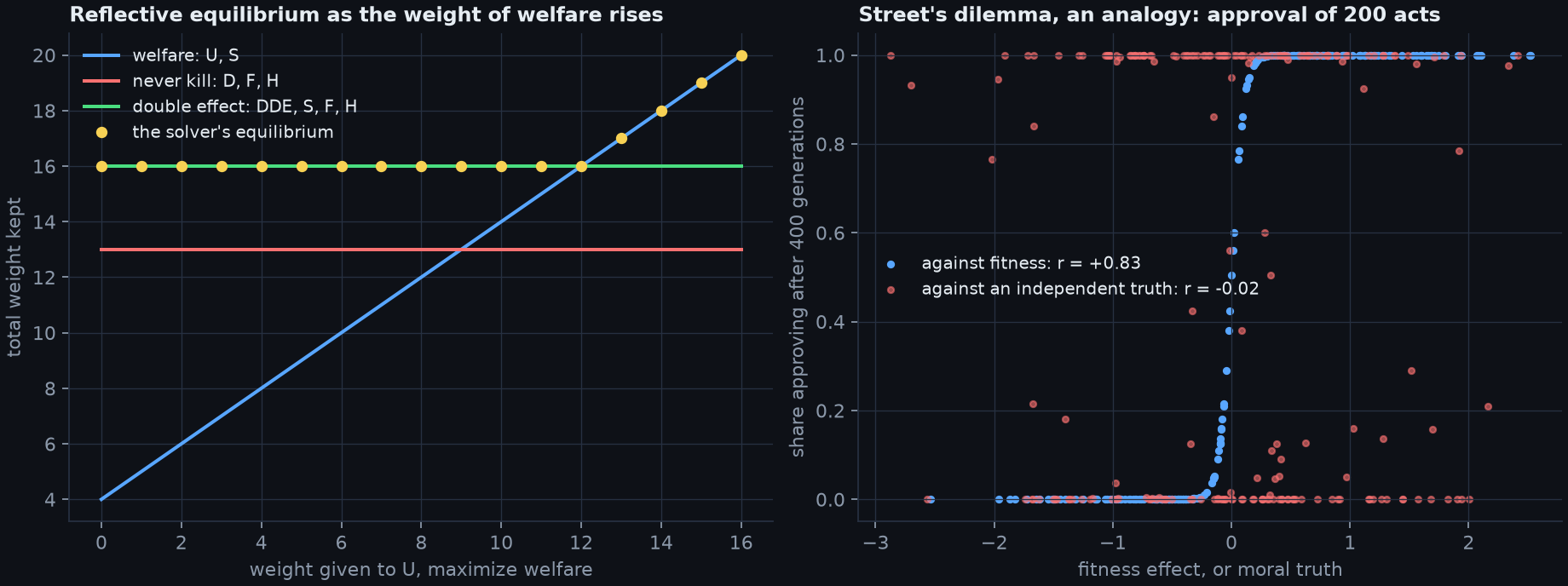
The Reasoner runs the dilemma as an analogy, which models only its structure. Two hundred kinds of act each have a fitness effect. A population's approval of each act evolves by the replicator equation of Part 19: approval of fitness-enhancing acts spreads. After four hundred generations, approval correlates with fitness at point eight three. Now suppose the moral truth about each act is independent of fitness. Then evolved approval correlates with it at minus point zero two: no better than chance. That is Street's first horn. Suppose instead the truth is tied to fitness by some third factor, for instance that survival and flourishing are good, and that what helps them is often good too. Then approval correlates with the truth at point six eight, and tracking fitness tracks value, roughly. The analogy shows exactly where the argument turns: on whether there is a reason, independent of our values, to link fitness and value.
The replies follow the analogy's fork. David Enoch, Erik Wielenberg and David Copp offered third factors: survival and flourishing are good, so selection for them roughly tracks the good. Street answered that the link is itself an evaluative judgment shaped by selection, and cannot vouch for itself. Richard Joyce's The Evolution of Morality, of 2006, argued that the genealogy undermines our justification even if it cannot show our moral beliefs false. And critics note that the same argument threatens our beliefs about logic and mathematics, which were also useful to believe: the companions in guilt of chapter four, again.
Some philosophers use debunking selectively. Debunk only the intuitions best explained by pressures unrelated to truth. Peter Singer argued in 2005 that our reluctance to push the man from the footbridge is a by-product of an evolved aversion to up-close personal violence, and should be discounted. Katarzyna de Lazari-Radek and Singer argued in 2012 that impartial benevolence survives the test, since no selection for kin and allies would produce concern for everyone. Guy Kahane replied in 2011 that a selective debunking argument needs a premise about which intuitions are reliable, and that the more global the argument, the less it leaves standing to judge with.
What it establishes: Street (2006); Enoch; Wielenberg; Copp; Joyce (2006); Singer (2005); de Lazari-Radek and Singer (2012); Kahane (2011).; Computed on screen: the dilemma as an analogy
9Moral psychologyApplied4 min
Psychologists have asked how moral judgments are actually made. Jonathan Haidt gave people a story. Julie and Mark, adult brother and sister on holiday, decide to make love once, with every precaution; no one is harmed, they keep it secret, and it brings them closer. Most people say at once that it was wrong, then search for reasons; when each reason is ruled out by the story, they keep the verdict anyway: moral dumbfounding. Haidt's social intuitionist model, of 2001, says intuition comes first and reasoning after, mostly to persuade others: the emotional dog wags its rational tail. For metaethics the question is which theory of moral content fits that psychology: expressivists find their attitudes in it, realists say intuitions can be perceptions of moral facts.
Experimental philosophers have tested Mackie's premise, that ordinary moral talk presupposes objectivity. Does it? Geoffrey Goodwin and John Darley found in 2008 that people treat many moral claims as more objective than social conventions, though less than plain matters of fact. And they attribute objectivity claim by claim: more to the wrongness of robbery than to the wrongness of abortion, with variation between people and cultures. If ordinary morality is mixed in this way, then every metaethical theory will be partly revisionary of it.
Haidt and his colleagues went on to sort moral intuitions into foundations. Care and harm; fairness and cheating; loyalty and betrayal; authority and subversion; sanctity and degradation; and later, liberty and oppression. Each comes with an evolutionary story. In the surveys of Jesse Graham, Haidt and Brian Nosek, in 2009, self-described liberals weighted care and fairness most heavily, while conservatives weighted all five more evenly. Critics say the list is a hypothesis and the measures are contested; and whatever the description, the step from what people value to what they ought to value is Hume's gap again.
Joshua Greene put the trolley problem of Part 35 in a brain scanner. In 2001 he and his colleagues reported that personal dilemmas like the footbridge engage regions associated with emotion more than impersonal ones like the switch. His dual-process theory says fast emotional responses drive deontological verdicts, and slower reasoning drives consequentialist ones; in Moral Tribes, of 2013, he argued that we should trust the slow system in unfamiliar cases. The data were disputed: a reanalysis by Jonathan McGuire and colleagues in 2009 found the effect driven by a handful of items, and later studies are mixed. Selim Berker argued in 2009 that neuroscience is normatively insignificant here: the data bear on what we ought to think only through a normative premise, such as that emotional responses are unreliable, and that premise does all the work.
John Mikhail took up a suggestion of Rawls's and made it precise. Perhaps moral judgment is a faculty like Chomsky's grammar, governed by principles we use without being able to state them. The evidence: people in many cultures distinguish harm intended as a means from harm foreseen as a side effect, and doing from allowing, in judgments about trolley cases, while unable to explain the difference. Mikhail's theory parses each act into its means and its side effects, then applies something like the doctrine of double effect of Part 35, as a computation. But even a universal moral grammar would be a fact about us, not about value; whether its verdicts are correct is Hume's question again.
What it establishes: Haidt (2001); Goodwin and Darley (2008); Graham, Haidt and Nosek (2009); Greene (2001, 2013); McGuire et al. (2009); Berker (2009); Mikhail (2011).
10Mencius and XunziIntroductory3 min
Two thousand years before Haidt, Chinese philosophers argued about where morality comes from. Mencius, in the fourth century before the common era, debated Gaozi, who said human nature is like water: it flows east or west as it is channelled. Mencius replied that water may not prefer east to west, but it does prefer down: human nature tends toward the good as water flows downhill. The child at the well, from Part 35, shows that everyone has a sprout of compassion, and sprouts of shame, deference and discernment too. Ox Mountain's trees were once lovely; axes and grazing goats stripped it bare, and people who see it bare think that is its nature. Moral growth is like farming: do not neglect the sprouts, and do not be like the farmer from Song who pulled at his shoots to help them grow, and killed them.
A generation later Xunzi disagreed. Human nature is bad, he wrote; its goodness is the result of conscious activity. Warped wood must be laid against the straightening board, steamed and forced into shape, before it becomes straight. The sage-kings created ritual and righteousness to shape human desire, as a potter shapes clay into a pot: morality is made. For metaethics, Xunzi offers something like a constructivism two thousand years early: morality as an invention, answerable to the human needs it serves.
Both Mencius and Xunzi wrote against a third school. The Mohists, followers of Mozi in the fifth century before the common era, taught inclusive care: regard other people's families as you regard your own. Doctrines were to be judged by their benefit to the people, an early consequentialism. Mencius replied that to love everyone equally is to have no father: care must be graded, beginning with one's own family and extending outward. It is the debate between impartiality and partiality of Parts 35 and 36, twenty four centuries earlier.
Philip Ivanhoe and Bryan Van Norden read the debate as two theories of moral learning. For Mencius, we start with sprouts of goodness; for Xunzi, with self-interested desire. Mencius's model is a farmer, who tends growth; Xunzi's a craftsman, who shapes material. Education develops what is there, or reforms it. For Mencius it fails through neglect or forcing; for Xunzi, through too little ritual. Their echoes run through this part: Mencius's sprouts in Haidt's intuitions and in virtue ethics, Xunzi's invention in Street and the constructivists.
What it establishes: Mencius; Gaozi; Xunzi; Mozi; Ivanhoe; Van Norden.
11Reflective equilibriumAdvanced4 min
Whatever moral claims are, we have to decide which ones to believe. Nelson Goodman suggested in 1955 that rules of inference and particular inferences are justified by being brought into agreement with each other. John Rawls applied the idea to ethics in 1971: adjust principles and considered judgments, each against the other, until they cohere. He called the result reflective equilibrium. Norman Daniels's wide version, of 1979, brings in background theories too, of persons, society and human nature. The Reasoner builds it as an optimization: weighted commitments, logical links between them, and the heaviest set that is consistent, found with the satisfiability solver of Part 2. Computer scientists call this problem weighted MaxSAT.
Here is a small equilibrium problem, from Part 35's trolleys. Three principles: maximize total welfare; never kill an innocent, even to save more; and the doctrine of double effect. Three judgments: switching is permitted; pushing the man is forbidden; the surgeon may not harvest one patient's organs for five. Each has a weight: how confident we are. The links say what each principle implies about the cases, and the red lines join the pairs that cannot both be kept: six conflicts. The Reasoner checks all sixty four subsets for consistency. The heaviest consistent set drops both absolute principles and keeps double effect with all three judgments: weight sixteen out of twenty two, and no ties. The equilibrium says that our confident judgments outweigh both simple principles, and that only a principle with structure, like double effect, fits them all.
Now change the weights, as Greene's argument from the last chapter urges. Suppose our confidence in the footbridge verdict falls from five to one, in the surgeon verdict from five to two, and in the principle of welfare rises from three to six. The heaviest consistent set is now just two commitments: maximize welfare, and switching is permitted, with weight ten. So the method's verdict is only as good as its weights, and the method itself cannot supply them. Thomas Kelly and Sarah McGrath asked in 2010 whether reflective equilibrium is enough for justification at all, or only for consistency. That question sends us back to the metaethics of the whole part.
Peter Singer attacked the method in 1974. Our considered judgments, he argued, may be the residue of discarded religion, of class interest and of evolutionary history; why give them any weight? He preferred Sidgwick's way: start from a few self-evident axioms, such as that the good of one person counts as much as the equal good of another, and let them overrule the cases. Defenders reply that axioms are judgments too, made by the same minds, so coherence is all that any method has. In the Reasoner's model, this whole argument lives in the weights: debunking lowers some, claims of self-evidence raise others.
A last test for each view: what would moral progress be? For the realist, getting closer to the moral truth, as science gets closer to the physical truth. For the expressivist, change that our improved attitudes endorse: progress by our own lights, which, the quasi-realist says, is all that progress anywhere ever was. For the constructivist, better outputs of the right procedure, or a more coherent valuing point of view. For the error theorist, no progress in truth; perhaps progress in usefulness. And every view must explain the cases that seem most clearly to be progress, like the abolition of slavery and the widening circle of concern, as more than mere change.
What it establishes: Goodman (1955); Rawls (1971); Daniels (1979); Kelly and McGrath (2010); Singer (1974).; Computed on screen: weighted MaxSAT on six commitments, twice
Recap, problems, and where this comes backAll tracks2 min
Let's gather what we built. Hume's law, Prior's tea, and Schurz's pattern checked on a hundred and seventy five thousand models: this part's brick in the Wall. Moore's open question, the naturalistic fallacy, and water as H two O. Realism, natural and non-natural, the supervenience challenge, and moral twin earth. Mackie's error theory, the companions in guilt, and the Price List, with sixty two percent of philosophers realists. Ayer, Stevenson and Blackburn, the Frege-Geach problem, and Gibbard's norm-world pairs, two of eight left by the premises. Relativism and its problem of disagreement, and the constructivists. Street's dilemma as an analogy, with its three correlations, and the psychology of Haidt and Greene. Mencius and Xunzi, and reflective equilibrium as an optimization, and how it moves when the weights do.
The Reasoner has a new module, metaethics. It checks inferences in a logic of ought on every small model and asks whether their normative parts do any work, builds Gibbard's norm-world pairs, finds reflective equilibria by weighted MaxSAT, and runs Street's dilemma as an analogy. And the Wall has its thirty seventh brick.
Six problems, with full solutions in this part's notes. Prior's tea in KD; a countermodel to is from ought; ought implies may, and why it needs the D axiom; contradiction in norm-world semantics; weights that make the absolutist principle win; and Mackie's queerness as a valid argument. Pause here, and try them.
Where this comes back. Justice as a construction, from the original position, in Part 38. Aggregating attitudes by voting, and Arrow's theorem, in Part 39. Whether judgments of beauty state facts or express attitudes, in Part 40. Whose values fairness criteria encode, in Part 41. And how to align a reasoner with values it may not share, in Part 42. Next, Part 38: justice.
The books and papers this part follows are on screen, and in the notes. Thanks for watching.
Where it goes next. Constructivism returns as the original position in Part 38, attitudes are aggregated by voting in Part 39, and the question whether a judgment states a fact or expresses a feeling is asked of beauty in Part 40. Hume's law returns as the no-free-lunch theorem for learning preferences in Part 42, where reflective equilibrium is also proposed as a process for choosing a machine's values.
Key results
The part's results in one place, for revision.
Try it
Lab 37 · No ought from is, checked on every small model
Rerun the film's eight inferences in the deontic logic KD, then draw random inferences from a satisfiable is-only premise to a conclusion of the form O(...) or P(...) and check that each valid one is a logical truth. Then find the reflective equilibrium of the six trolley commitments as one weight is raised.
python -m videos.philosophy.labs 37
needs numpy, scipy, matplotlib · download lab37.py ·
source on GitHubmodels checked per inference 175,616 (film: 175,616)
Prior's tea, p so p or Oq valid True, a logical truth False, ought idle True
random is-to-ought inferences 16 invalid (each with a countermodel), 4 valid, 4 skipped
valid ones whose conclusion is a logical truth 4 of 4 (theory: all)
Gibbard's pairs left by the two premises 2 of 8, all in the conclusion: True
reflective equilibrium, the film's weights keep DDE, S, F, H: weight 16 of 22 (film: 16 of 22)
after Greene's reweighting keep U, S: weight 10 (film: 10)
least whole weight of U at which welfare takes over 13 (by hand: the first above 16 - 4 = 12)
An is-only premise never forces a working ought: the valid cases are logical truths. Which principles a reflective equilibrium keeps is the upper envelope of a few consistent sets, so it is settled by the weights, which the method does not supply.The code (112 lines; it asserts its own result)
"""Lab 37: test Hume's law on random inferences in a logic of ought, and move a reflective equilibrium."""

import numpy as np

from videos.coursekit import labs
from explainer.philosophy.reasoner import metaethics as me

TITLE = "No ought from is, checked on every small model"
GOAL = ("Rerun the film's eight inferences in the deontic logic KD, then draw random inferences from a satisfiable "
        "is-only premise to a conclusion of the form O(...) or P(...) and check that each valid one is a logical "
        "truth. Then find the reflective equilibrium of the six trolley commitments as one weight is raised.")
TASKS = [
    "Allow a normative premise: add Cond(p, Ought(q)) to the premises of each random inference. How many "
    "conclusions now follow without being logical truths?",
    "Analyse p |- p and O(q or not q) with me.analyse. It is valid and not a theorem: is its ought idle in the "
    "module's sense, and what does Schurz's theorem replace instead?",
    "Give the principle D ('never kill an innocent') weight 9 in me.reflective_equilibrium. Which commitments "
    "survive, and at which weight does the answer change?",
]


def _formula(rng, depth):
    """A random propositional formula over p and q."""
    if depth == 0 or rng.random() < 0.25:
        return me.At("pq"[rng.integers(2)])
    kind = rng.integers(4)
    if kind == 0:
        return me.Neg(_formula(rng, depth - 1))
    return (me.Conj, me.Disj, me.Cond)[kind - 1](_formula(rng, depth - 1), _formula(rng, depth - 1))


def run(seed=0):
    rng = np.random.default_rng(seed)
    lab = labs.Lab()

    table = me.schurz_table()
    rows = {r["name"].split(":")[0]: r for r in table["rows"]}
    tea = rows["Prior's tea"]
    lab.row("models checked per inference", f"{table['models_checked']:,}   (film: 175,616)")
    lab.row("Prior's tea, p so p or Oq", f"valid {tea['valid']}, a logical truth {tea['theorem']}, ought idle {tea['idle']}")
    assert table["models_checked"] == 175616 and table["hume_pattern_holds"]
    assert tea["valid"] and tea["idle"] and not tea["theorem"], "Prior's ought does no work"
    assert not rows["is from ought"]["valid"] and rows["ought implies may"]["valid"]
    bad = me.analyse([me.At("p")], me.Ought(me.At("p")))
    assert not bad["valid"] and bad["countermodel"]["facts"]["p"], "p holds here"
    assert not all(f["p"] for f in bad["countermodel"]["ideal_facts"]), "... but not in every ideal world"

    # the special Hume thesis: a satisfiable is-only premise entails O(phi) or P(phi) only if that is a theorem
    counts = {"valid": 0, "invalid": 0, "skipped": 0}
    for _ in range(24):
        premise, body = _formula(rng, 2), _formula(rng, 2)
        concl = (me.Ought, me.May)[rng.integers(2)](body)
        if me.analyse([premise], me.BOT)["valid"]:  # an unsatisfiable premise entails everything
            counts["skipped"] += 1
            continue
        r = me.analyse([premise], concl)
        assert r["descriptive"] and r["normative_conclusion"]
        if r["valid"]:
            counts["valid"] += 1
            assert r["theorem"], f"{r['premises']} entails {r['conclusion']}, which is no theorem"
        else:
            counts["invalid"] += 1
            assert r["countermodel"] is not None
    lab.row("random is-to-ought inferences", f"{counts['invalid']} invalid (each with a countermodel), "
            f"{counts['valid']} valid, {counts['skipped']} skipped")
    lab.row("valid ones whose conclusion is a logical truth", f"{counts['valid']} of {counts['valid']}   (theory: all)")
    assert counts["invalid"] >= 5, "most random inferences should fail"

    pairs = me.norm_world_pairs()
    lab.row("Gibbard's pairs left by the two premises", f"{pairs['n_left']} of {pairs['n_pairs']}, all in the conclusion: {pairs['valid']}")
    assert pairs["n_pairs"] == 8 and pairs["n_left"] == 2 and pairs["valid"]

    ex = me.re_experiments()
    total = sum(c[3] for c in ex["commitments"])
    lab.row("reflective equilibrium, the film's weights", f"keep {', '.join(ex['base']['keep'])}: weight "
            f"{ex['base']['weight']} of {total}   (film: 16 of 22)")
    lab.row("after Greene's reweighting", f"keep {', '.join(ex['greene']['keep'])}: weight {ex['greene']['weight']}   (film: 10)")
    assert (ex["base"]["keep"], ex["base"]["weight"], total) == (["DDE", "S", "F", "H"], 16, 22)
    assert (ex["greene"]["keep"], ex["greene"]["weight"]) == (["U", "S"], 10) and len(ex["base"]["conflicts"]) == 6

    # the three maximal consistent sets, by hand, against the solver, as the weight of U rises
    w0 = {k: w for k, _, _, w in me.RE_COMMITMENTS}
    us = np.arange(0, 17)
    by_hand = {"welfare: U, S": us + w0["S"], "never kill: D, F, H": np.full(len(us), w0["D"] + w0["F"] + w0["H"]),
               "double effect: DDE, S, F, H": np.full(len(us), w0["DDE"] + w0["S"] + w0["F"] + w0["H"])}
    solver = np.array([me.reflective_equilibrium({"U": int(u)})["weight"] for u in us])
    assert np.array_equal(solver, np.max(list(by_hand.values()), axis=0)), "MaxSAT is the upper envelope"
    flip = int(us[np.argmax(by_hand["welfare: U, S"] > by_hand["double effect: DDE, S, F, H"])])
    lab.row("least whole weight of U at which welfare takes over", f"{flip}   (by hand: the first above 16 - 4 = 12)")
    assert flip == 13 and me.reflective_equilibrium({"U": 13})["keep"] == ["U", "S"]
    lab.note = ("An is-only premise never forces a working ought: the valid cases are logical truths. Which "
                "principles a reflective equilibrium keeps is the upper envelope of a few consistent sets, so it "
                "is settled by the weights, which the method does not supply.")

    deb = me.debunking(seed=2006 + seed)
    fig, ax = labs.figure(2, size=(11.5, 4.3))
    for name, color in zip(by_hand, (labs.BLUE, labs.RED, labs.GREEN)):
        ax[0].plot(us, by_hand[name], color=color, label=name)
    ax[0].plot(us, solver, "o", color=labs.GOLD, ms=5, label="the solver's equilibrium")
    ax[0].set(title="Reflective equilibrium as the weight of welfare rises", xlabel="weight given to U, maximize welfare",
              ylabel="total weight kept")
    ax[0].legend()
    f, a = np.array(deb["fitness"]), np.array(deb["approval"])
    ax[1].scatter(f, a, s=10, color=labs.BLUE, label=f"against fitness: r = {deb['corr_fitness']:+.2f}")
    ax[1].scatter(deb["t_indep"], a, s=10, color=labs.RED, alpha=0.6, label=f"against an independent truth: r = {deb['corr_independent']:+.2f}")
    ax[1].set(title="Street's dilemma, an analogy: approval of 200 acts", xlabel="fitness effect, or moral truth",
              ylabel="share approving after 400 generations")
    ax[1].legend(loc="center left")
    assert deb["corr_fitness"] > 0.7 and abs(deb["corr_independent"]) < 0.25
    assert abs(deb["corr_independent"]) < deb["corr_third_factor"] < deb["corr_fitness"]
    lab.fig = fig
    return lab
Now change it
- Allow a normative premise: add Cond(p, Ought(q)) to the premises of each random inference. How many conclusions now follow without being logical truths?
- Analyse p |- p and O(q or not q) with me.analyse. It is valid and not a theorem: is its ought idle in the module's sense, and what does Schurz's theorem replace instead?
- Give the principle D ('never kill an innocent') weight 9 in me.reflective_equilibrium. Which commitments survive, and at which weight does the answer change?
Problems, with solutions
Try each problem before opening its solution.
-
Show that p ⊢ p ∨ Oq is valid in KD, and that Oq can be replaced by any formula.
Solution
In KD, as in any normal modal logic, the propositional tautology \(p \to (p \lor X)\) holds for every formula \(X\), and modus ponens gives \(p \vdash p \lor X\). With \(X = Oq\), \(p \vdash p \lor Oq\): from a purely descriptive premise, a conclusion containing "ought". That is Prior's first counterexample to Hume's law. Since nothing about \(Oq\) was used, any formula, normative or not, can take its place, which is why Schurz's theorem counts such conclusions as only vacuously normative: the "ought" part can be replaced salva validitate.
-
Find a countermodel to Op ⊢ p with two worlds.
Solution
Two worlds: \(w_0\), the actual one, where \(p\) is false, and \(w_1\), where \(p\) is true. Let \(w_1\) be the only world ideal relative to \(w_0\) (\(w_0 R w_1\)), and let \(w_1\) see itself, so the frame is serial. At \(w_0\), \(Op\) holds (every ideal world makes \(p\) true) and \(p\) fails. So \(Op \nvdash p\): what ought to be need not be, which is the point of deontic logic dropping the T axiom.
-
Show that Op → Pp is valid in KD but not in K, where a world may have no ideal world.
Solution
\(Pp\) is \(\lnot O\lnot p\): some ideal world makes \(p\) true. In KD every world has at least one ideal world (seriality). If \(Op\) holds at \(w\), \(p\) is true at all of \(w\)'s ideal worlds, and there is at least one, so \(Pp\) holds. In K a world may have no ideal worlds. There \(Op\) is vacuously true (every ideal world, of which there are none, makes \(p\) true) and \(Pp\) is false. So \(Op \to Pp\), the D axiom, is valid in KD and not in K: in K, a dead-end world makes everything obligatory and nothing permitted.
-
In the norm-world semantics, show that "lying is wrong" and "lying is not wrong" leave no pair in common.
Solution
In Gibbard's semantics a judgment is the set of norm-world pairs it leaves open. "Lying is wrong" leaves open exactly the pairs whose norms forbid lying. "Lying is not wrong" (the negation of the whole judgment) leaves open exactly the pairs whose norms permit lying. Each pair's norm either forbids or permits lying, so every pair is in exactly one of the two sets: they are disjoint, and accepting both leaves no pair, no plan that can be carried out. That is the inconsistency the simple attitude theory could not express, and it falls out of the semantics as ordinary set complementation.
-
Give weights for which reflective equilibrium keeps D, F and H.
Solution
In the film's problem the links make \(D\) (never kill an innocent) conflict with switching (\(S\)) and with double effect (\(DDE\)), while agreeing with the footbridge (\(F\)) and the surgeon (\(H\)) judgments. Keeping \(\{D, F, H\}\) beats the default equilibrium \(\{DDE, S, F, H\}\) when \(w_D + w_F + w_H > w_{DDE} + w_S + w_F + w_H\), that is \(w_D > w_{DDE} + w_S = 6\). With \(D\) raised from 3 to 7 and everything else as in the film, the Reasoner's equilibrium is \(\{D, F, H\}\), weight 17 against 16; at \(w_D = 6\) the two tie. Confidence in the absolute principle has to outweigh the switch judgment and double effect together.
-
State Mackie's argument from queerness as a valid argument, and say which premise you would deny.
Solution
(1) If there are objective values, they are intrinsically action-guiding: knowing one would give anyone a reason to act, whatever they want. (2) Nothing else in the world is intrinsically action-guiding in that way. (3) If there were such entities, knowing them would require a special faculty of moral intuition, unlike any other way of knowing. (4) We have no such faculty, and no entity is metaphysically that strange. (5) So there are no objective values. As stated the argument is valid. The premise most worth denying is the implicit one that what is unlike anything else is therefore not real: the companions-in-guilt reply says epistemic norms ("believe what your evidence supports") are categorical and action-guiding in the same way, so premise (2) is false and queerness proves too much.
Notes and sources
About this partfrom its README
Part 37 of Philosophy, Built (series plan, syllabus), in Act VII, Value: metaethics, what moral claims are. Mackie's opening sentence (1977) and four questions (logic, metaphysics, meaning, knowledge). Hume's paragraph (1739); Prior's tea (1960) and its dilemma; Searle's derivation from promising (1964) and Hare's reply; ought implies can as a bridge, with Chituc et al. (2016); a deontic logic KD built on serial Kripke models and checked on every model of up to three worlds (175,616 models), and Schurz's pattern (1997) confirmed on eight inferences: every valid inference from is-only premises to an ought is a logical truth or has an idle ought — the Wall's thirty-seventh brick. Moore's open question (1903), the naturalistic fallacy, Frankena (1939), Moore's ideal and organic unities, the paradox of analysis (Langford 1942) and water as H₂O. Realism: non-naturalism (Shafer-Landau, Enoch, Parfit) and Cornell realism (Boyd, Brink, Sturgeon), Harman's challenge (1977) and moral explanations; Railton's reforming definition (1986); Blackburn's supervenience challenge (1971); moral knowledge (intuitionism, seemings, perception, the puzzle of moral testimony); moral twin earth (Horgan and Timmons 1991). Error theory: Mackie's relativity and queerness, the companions in guilt (Cuneo 2007), fictionalism, abolitionism and conservationism (Joyce, Garner, Olson), and a Price List for Mackie's triad with the PhilPapers 2020 shares (62% realism, 26% anti-realism). Expressivism: Ayer (1936), Stevenson's disagreement in attitude (1944), Smith's moral problem (1994) as a computed triad, Blackburn's quasi-realism and creeping minimalism (Dreier 2004), hybrid views (Copp; Ridge). The Frege–Geach problem (Geach 1965), Blackburn's higher-order attitudes and Hale's reply, Gibbard's norm-world pairs built (eight pairs, two left by the premises, all in the conclusion), Dorr's wishful thinking (2002), and the negation problem (Unwin 1999; Schroeder 2008). Relativism (Herodotus; Harman 1975; Wong 2006), the disagreement problem and MacFarlane's assessment-sensitivity, disagreement as evidence (Part 12), constructivism (Rawls 1980; Korsgaard 1996; Street 2010), and Dworkin's challenge (1996). Street's Darwinian dilemma (2006), run as an analogy (evolved approval correlates 0.83 with fitness, −0.02 with an independent truth, 0.68 with a truth tied to fitness), third-factor replies, Joyce (2006), and selective debunking (Singer; de Lazari-Radek and Singer; Kahane). Moral psychology: Haidt's dumbfounding and social intuitionism (2001), folk objectivism (Goodwin and Darley 2008), moral foundations (Graham, Haidt and Nosek 2009), Greene's dual process and the reanalysis debate (McGuire et al. 2009; Berker 2009), Mikhail's moral grammar. Mencius (性善) against Gaozi, Xunzi (性恶), Mozi's inclusive care, and two theories of moral learning. Reflective equilibrium (Goodman 1955; Rawls 1971; Daniels 1979) built as weighted MaxSAT on six trolley commitments: double effect and the three judgments survive (16 of 22); after Greene's reweighting, welfare and the switch (10); Singer's critique (1974); moral progress on each view.
The worked model results are computed by the Reasoner's new module explainer/philosophy/reasoner/metaethics.py (with
prop for the Price Lists and the satisfiability checks), tested in tests/philosophy/test_metaethics.py and cached
by compute.py.
Chapter notes
| # | Scene | What it establishes | Computed on screen |
|---|---|---|---|
| 0 | Hook |
Mackie (1977); four questions; the plan. | — |
| 1 | Hume |
Hume (1739); Prior (1960); Searle (1964); Hare; Kant; Chituc et al. (2016); Schurz (1997); the Wall's thirty-seventh brick. | KD on every model of up to three worlds; eight inferences |
| 2 | Moore |
Moore (1903); Frankena (1939); Langford (1942); Putnam; Kripke. | — |
| 3 | Realism |
Shafer-Landau; Enoch; Parfit; Boyd; Brink; Sturgeon; Harman (1977); Railton (1986); Blackburn (1971); Huemer; Hills; Horgan and Timmons (1991). | the PhilPapers share |
| 4 | Error |
Mackie (1977); Cuneo (2007); Streumer; Joyce (2001); Garner; Olson (2014); the Price List. | Mackie's triad's minimal conflict |
| 5 | Express |
Ayer (1936); Stevenson (1944); Smith (1994); Brink; Nagel; McDowell; Blackburn; Dreier (2004); Copp; Ridge. | Smith's triad |
| 6 | Geach |
Geach (1965); Blackburn (1984); Hale (1986); Gibbard (1990, 2003); Dorr (2002); Unwin (1999); Schroeder (2008). | norm-world pairs eliminated |
| 7 | Construct |
Herodotus; Harman (1975); Wong (2006); MacFarlane (2014); Rawls (1980); Korsgaard (1996); Street (2010); Dworkin (1996). | — |
| 8 | Debunk |
Street (2006); Enoch; Wielenberg; Copp; Joyce (2006); Singer (2005); de Lazari-Radek and Singer (2012); Kahane (2011). | the dilemma as an analogy |
| 9 | Psych |
Haidt (2001); Goodwin and Darley (2008); Graham, Haidt and Nosek (2009); Greene (2001, 2013); McGuire et al. (2009); Berker (2009); Mikhail (2011). | — |
| 10 | Mencius |
Mencius; Gaozi; Xunzi; Mozi; Ivanhoe; Van Norden. | — |
| 11 | Equilibrium |
Goodman (1955); Rawls (1971); Daniels (1979); Kelly and McGrath (2010); Singer (1974). | weighted MaxSAT on six commitments, twice |
| 12 | Outro |
recap; the Reasoner's module; the Wall; problems; payoffs; references. | — |
Notes
The deontic models are serial (KD); "idle" means that replacing the conclusion's outermost O- or P-subformula by a fresh atom leaves the inference valid, which by uniform substitution suffices for replacement by any formula. The debunking toy is labelled an analogy: two hundred kinds of act, replicator dynamics on approval for 400 generations; it models the structure of Street's argument, not human history. The equilibrium's links are hard constraints and its weights are invented.
Companion material in this repository
The syllabus's plan for this partfrom SYLLABUS.md, the plan of record
- Hume's law (1739): no ought from is. Prior's counterexamples (1960); Schurz's theorem (1997) on the is–ought gap in alethic-deontic logic, stated and checked on small models.
- Moore's open-question argument (1903); the naturalistic fallacy; the paradox of analysis.
- Moral realism: non-naturalism (Parfit, Enoch, Shafer-Landau); Cornell realism (Boyd, Brink); the supervenience challenge (Blackburn).
- Error theory (Mackie 1977): queerness; the companions-in-guilt reply (epistemic normativity).
- Expressivism: Ayer, Stevenson, Blackburn's quasi-realism.
- The Frege–Geach problem: "if lying is wrong, then getting your brother to lie is wrong" in a valid modus ponens.
- Gibbard's norm-world pairs (1990, 2003). Built: a semantics of factual-normative worlds that makes the inference valid; Schroeder's critique (Being For, 2008) and the negation problem.
- Relativism and moral disagreement; Harman; the moral twin earth argument (Horgan and Timmons).
- Constructivism: Rawls's Kantian constructivism, Korsgaard, Street.
- Evolutionary debunking: Street's Darwinian dilemma (2006). Built: norms evolving under fitness payoffs
track fitness, not any independent truth, in a toy model labeled
analogy. The third-factor replies. - Moral psychology: Haidt's social intuitionist model; moral foundations (data cited); Greene's dual process; the trolley fMRI debate.
- Mencius vs Xunzi: human nature good (性善) or bad (性恶), with the sprouts vs the craftsman as two learning theories.
- Reflective equilibrium (Goodman, Rawls): coherence between principles and judgments. Built: as an optimization that drops the fewest weighted commitments (MaxSAT with the Part 2 solver).
- Moral progress: what it would mean, on each metaethical view.
- Recap and Problems.
Built: reasoner.deontic (alethic-deontic models; Schurz's gap checker); reasoner.expressivism (norm-world
pairs); reflective equilibrium as weighted MaxSAT.
Wall: Schurz's is–ought theorem; Frege–Geach for simple expressivism.
Price List: Mackie's triad (moral claims purport to state objective facts; there are no such facts; some moral
claims are true), with PhilPapers 2020 shares on moral realism.
Visuals: the is–ought gap as a wall in a two-layer model; norm-world pairs eliminated by a conditional;
reflective equilibrium as a constraint network relaxing.
References: Miller, Contemporary Metaethics; Gibbard, Thinking How to Live; Schroeder, Being For and
Noncognitivism in Ethics; Mackie, Ethics; Street 2006 (Phil Studies); Schurz, The Is-Ought Problem; Ivanhoe and
Van Norden (eds.), Readings in Classical Chinese Philosophy.
Build the film
python -m videos.philosophy.philosophy37.compute        # the part's numbers, into .cache/philosophy37
python tools/build.py philosophy37                  # render and assemble the film
EXPLAINER_TTS=silent python tools/qa_scene.py philosophy37 Hook   # one chapter, silent, with a contact sheet
Scenes: videos/philosophy/philosophy37. Setup: see the course page. Source of these notes: the README and the scenes' narration.
Build it
python -m videos.philosophy.philosophy37.compute       # every computed item (seconds; .cache/philosophy37)
python tools/build.py philosophy37 -q l                # 480p preview
python tools/build.py philosophy37                     # 1080p30 -> renders/philosophy37.mp4
python tools/qa_scene.py philosophy37 Geach            # one chapter, silent, with a contact sheet