Paradise and Paradox
sets and the infinite
Are there more numbers than square numbers, are some infinities larger than others, and can the axioms of set theory settle how many real numbers there are?
Galileo pairs each number with its square and concludes that 'more' makes no sense for the infinite; Hilbert's hotel takes in one guest and then a bus when it is full; Cantor concludes that size is pairing, counts the fractions, and then flips the diagonal of any list of rows of zeros and ones to get a row the list lacks. So the reals cannot be counted, and no set can be paired with its own subsets. The part follows the paradise and its snakes: Cantor's critics, Russell's letter of 1902, which brings down Frege's system, and the axioms of Zermelo and Fraenkel that replace it. Sets are built from nothing, numbered by Ackermann's coding and stacked in the cumulative hierarchy. Ordinals count past infinity to epsilon zero, where Goodstein's sequences climb beyond reach and still return to zero, and the hydra always dies. Then the alephs, the axiom of choice with Vitali's set and the doubled ball, and the turn: Gödel's constructible universe and Cohen's forcing show that the axioms can neither prove nor refute the continuum hypothesis. The part ends with large cardinals, the Price List of the continuum (realism, provability, new axioms), and what sets are for.
What you need. Fractions, binary notation and the idea of a function; the logic of Parts 2 and 3 for the axioms.
- The calculation
- ZFC, ordinals, cardinals
- The wall
- Russell; the independence of CH
- Built toy
- hereditarily finite sets; the ordinal spiral
What you will be able to do
Introductory
- Decide whether two infinite collections have the same size by exhibiting a pairing, and count the fractions.
- Run the diagonal argument on a given list of rows and say exactly why the new row is not on the list.
- Derive Russell's paradox from the assumption that every condition defines a set.
Advanced
- Prove Cantor's theorem for an arbitrary set, and show how separation turns Russell's paradox into the theorem that there is no universal set.
- Compute with ordinals in Cantor normal form, and attach falling ordinals to a Goodstein sequence to prove that it reaches zero.
- State the axiom of choice, and explain the paradoxical decomposition of the free group behind Banach and Tarski's theorem.
Research
- Outline both halves of the independence of the continuum hypothesis: Gödel's constructible universe and Cohen's generic reals meeting dense sets.
- Place inaccessible cardinals and determinacy on the ladder of consistency strength, and state the positions of Gödel, Woodin, Hamkins and Feferman on whether the hypothesis has an answer.
Applied
- Encode pairs, numbers and finite sets as hereditarily finite sets, and say which 'junk theorems' depend on the encoding.
- Compare set theory with type theory and category theory as a foundation for a proof assistant.
Contents
Each chapter has a home level. Choose a track to see what to read and watch: Introductory 17 min · Advanced 42 min · Research 50 min · Applied 19 min.
- 0Cantor's paradiseIntroductory2 min
- 1Infinite hotelsIntroductory2 min
- 2Counting the fractionsIntroductory2 min
- 3The diagonalIntroductory3 min
- 4The absolute and its criticsAdvanced2 min
- 5Russell's letterIntroductory3 min
- 6The axiomsAdvanced2 min
- 7Sets from nothingAdvanced3 min
- 8The cumulative hierarchyAdvanced2 min
- 9Counting past infinityAdvanced3 min
- 10A sequence that must come homeIntroductory2 min
- 11Hercules and the hydraAdvanced2 min
- 12AlephsAdvanced3 min
- 13The axiom of choiceAdvanced3 min
- 14Is choice true?Advanced2 min
- 15The continuum hypothesisResearch3 min
- 16Beyond the axiomsResearch3 min
- 17Does CH have an answer?Research3 min
- 18What sets are forApplied2 min
- Recap, problems, and where this comes backAll tracks2 min
Also on this page: Lecture · Key results · Try it · Lab · Problems · Notes and sources · 中文 · Build the film.
Lecture
The text of each chapter is the film's narration, as it is spoken, so you can read along or revise without the film. The pictures are in the film. A dashed box stands for a number the film computes when it is rendered (hover over it to see what is computed); the README's figures for each chapter, where it lists them, follow the chapter's text.
Cantor's paradiseIntroductory2 min
Part 6 is about the infinite, and about the theory that tamed it: the theory of sets. In 1926 David Hilbert declared that no one would expel mathematicians from the paradise that Georg Cantor had created. The paradise was real. So were the snakes: paradoxes that brought down the first theory of sets, and questions, like the size of the continuum, that its axioms can provably never answer.
Here is the question that started it. Are there more natural numbers than square numbers? Surely yes: most numbers are not squares, and the squares thin out as they grow. Surely no: pair each number with its square, one, four, nine, sixteen, and nothing is left over on either side. Galileo saw this in 1638 and concluded that 'more' and 'as many' make no sense for infinite collections. Cantor concluded the opposite: they make perfect sense, and they lead somewhere astonishing.
Two pictures will carry us through. The first is Cantor's diagonal: a list of infinite rows of zeros and ones, and a new row built by flipping the diagonal, which differs from every row in the list. It proves there are different sizes of infinity. The second is a wall. This part lays two bricks: Russell's paradox, which shows that not every condition defines a set, and Paul Cohen's theorem of 1963, which shows that the standard axioms cannot decide how many real numbers there are.
So: first the hotel and Galileo's paradox. Then Cantor's proofs, that the fractions can be counted and the real numbers cannot. Then Cantor's critics, the paradox that broke Frege's system, and the axioms that replaced it. We build sets out of nothing, and stack them in a hierarchy. We count past infinity with ordinals, and meet a sequence of numbers that grows for longer than the universe will last, and then comes back to zero, and a monster that Hercules always defeats. Then choice, a theorem that doubles a ball, and the continuum problem. And at the end, a question for philosophers: when the axioms run out, is there still a fact of the matter?
What it establishes: Hilbert's paradise (1926); squares and numbers; the diagonal and the two bricks; the plan.; Computed on screen: the squares paired with the numbers; an 8 × 8 diagonal
1Infinite hotelsIntroductory2 min
For two thousand years the infinite was kept at arm's length. Aristotle allowed it only as a potential: you can always count one more, but you never finish, and there is no completed infinite collection. Galileo, in 1638, met the squares and the numbers, and drew the moral that comparisons of size simply do not apply to infinite totals. Cantor's revolution was to treat the infinite as actual, a completed set, an object with a size of its own.
David Hilbert, in his lectures of the 1920s, put Galileo's paradox in a hotel. The hotel has infinitely many rooms, numbered one, two, three, and every room is taken. A new guest arrives. No problem: every guest moves from room n to room n plus one. Everyone still has a room, and room one is free. A full hotel has room for one more.
Now a bus arrives with infinitely many new guests. Move the guest in room n to room two n. The old guests fill the even rooms, and every odd room, infinitely many of them, is free for the bus. With more care, even infinitely many buses of infinitely many passengers fit, as the next chapter shows.
Bernard Bolzano, in a book published after his death in 1851, insisted that such paradoxes are not contradictions. Richard Dedekind took the decisive step in 1888. What Galileo thought absurd, a part as large as the whole, he made the definition: a set is infinite exactly when it can be matched one to one with a part of itself. And Cantor's definition of size: two sets are the same size when there is a bijection, a perfect pairing, between them. The paradox became the definition, and the question changed. Not whether infinite sets can be compared, but whether all of them are the same size.
What it establishes: Aristotle's potential infinite; Galileo (1638); Hilbert's hotel: one guest, a bus; Bolzano (1851); Dedekind's definition of the infinite (1888); Cantor's definition of size.; Computed on screen: the maps n ↦ n + 1 and n ↦ 2n on the rooms
2Counting the fractionsIntroductory2 min
Infinitely many buses, each with infinitely many passengers. Can the hotel still cope? Arrange the arrivals in a grid: bus j, passenger k. Now walk the diagonals, numbering as you go: zero, one, two, and so on. Every square of the grid is reached, after finitely many steps. Cantor wrote the walk as a formula: a polynomial that pairs the grid with the natural numbers, one to one. So the pairs of natural numbers are no more numerous than the natural numbers. A set that can be listed like this is called countable.
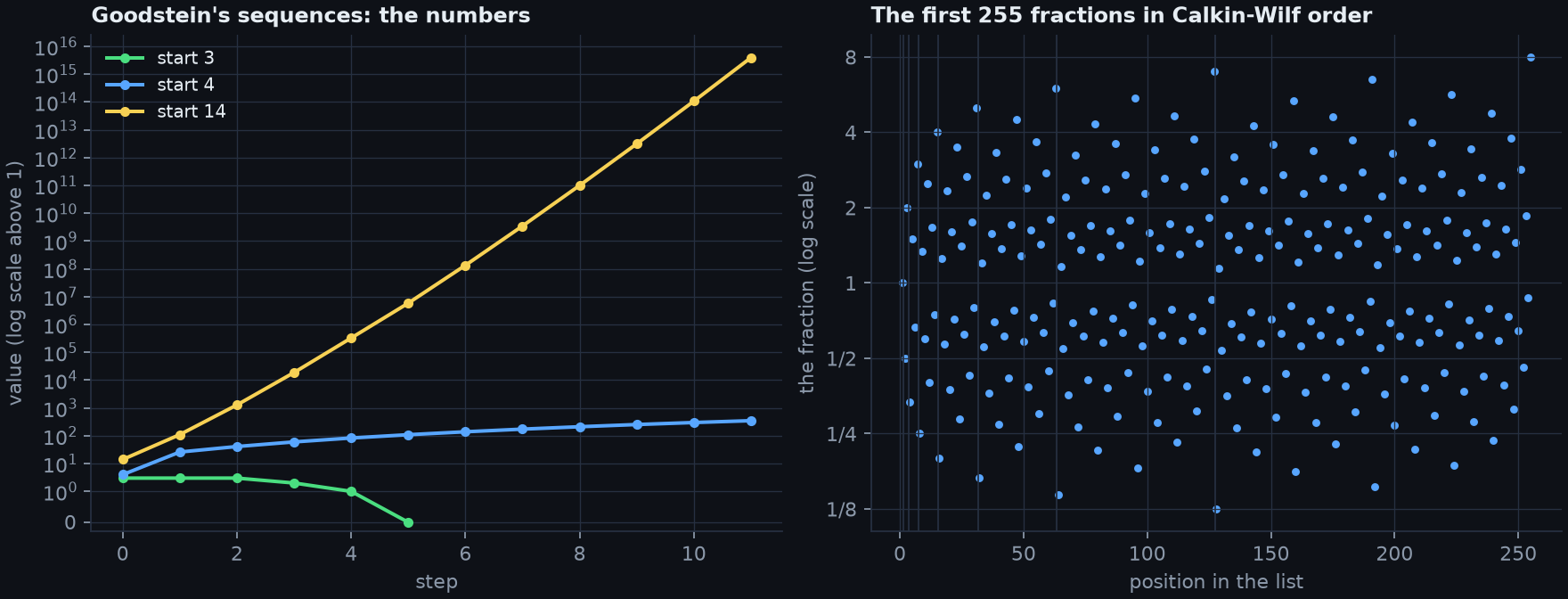
What about fractions? Between any two there are infinitely many more, so surely there are more fractions than whole numbers. Here is a tree, discovered by Neil Calkin and Herbert Wilf in 2000, though its pattern goes back to Stern and Brocot. Start with one over one. Each fraction a over b has two children: a over a plus b, and a plus b over b. Every positive fraction appears in this tree exactly once, already in lowest terms. Now read the tree row by row. That is a list of all the positive fractions: the fractions are countable. Cantor proved it in 1874, with a cruder list.
In the same paper of 1874, Cantor went further. The whole numbers and the fractions are countable. So are the algebraic numbers, the roots of polynomials with whole-number coefficients, because the polynomials themselves can be listed, size by size. But the real numbers are not countable: no list contains them all. So almost every real number is transcendental, not algebraic, a fact Cantor proved without exhibiting a single one. The next chapter gives his second, famous proof.
What it establishes: Cantor's pairing of ℕ × ℕ; infinitely many buses; the Calkin–Wilf tree (2000); ℚ and the algebraic numbers countable, ℝ not (1874).; Computed on screen: the pairing on a 6 × 6 grid; four levels of the tree and the first 15 rationals
3The diagonalIntroductory3 min
Cantor's second proof, from 1891, is one of the most famous arguments in mathematics. Suppose someone claims to have listed every infinite sequence of zeros and ones: row one, row two, row three, and so on forever. Walk down the diagonal: the first digit of row one, the second of row two, the third of row three. Flip each one. The new sequence differs from row one in the first place, from row two in the second, from every row somewhere. So it is not in the list, and the list was not complete after all. No list of such sequences can be complete, and since each sequence is the binary expansion of a real number, the real numbers are uncountable.
The diagonal works for any set, not just the natural numbers. Cantor's theorem: every set has fewer members than it has subsets. Take any function f from a set X to its subsets: here, a goes to a and b, b goes to a, c to the empty set. Ask of each element whether it belongs to its own image. a does; b and c do not. Collect the ones that do not: the diagonal set D. D cannot be the image of anything. If D were f of d, then d would belong to D exactly when it does not. So f misses D, and no function from X covers all its subsets.
A proof covers every set at once, but the Reasoner can check the small cases by brute force. For a set of n elements there are two to the n subsets, and two to the n, to the power n, functions from the set to its subsets. For n equal to four, that is sixty-five thousand, five hundred and thirty-six functions. For every one of them, the diagonal set is missed. No function is onto.
Cantor's theorem never stops. The natural numbers are smaller than their power set, which has the size of the real numbers. That is smaller than its own power set, and so on, without end. There is no largest infinity. And the diagonal trick itself will keep returning: in Russell's paradox, in a moment; in the halting problem of Part 3; and in Gödel's theorems of Part 7.
What it establishes: the diagonal argument (1891); Cantor's theorem |X| < |𝒫(X)|, with the proof drawn; the endless ladder of infinities.; Computed on screen: the diagonal of 8 listed rows; all 2, 16, 512 and 65,536 functions from sets of size 1–4 to their power sets miss the diagonal set
4The absolute and its criticsAdvanced2 min
Cantor did not see his theory as mere mathematics. He distinguished the transfinite, the infinite numbers that can always be increased, from the absolute: the totality of all of them, which cannot be increased, and which he associated with God. In a letter to Dedekind in 1899, he even anticipated the paradoxes. Some multiplicities, he wrote, cannot be thought of as a single thing without contradiction, and the collection of all ordinals is one of them. These inconsistent multiplicities are what we now call proper classes.
Not everyone was persuaded. Leopold Kronecker, in Berlin, is said to have declared that God made the integers, and all else is the work of man. He opposed Cantor's work, and Cantor believed he blocked his career. Henri Poincaré denied that there is any actual infinite, and objected to definitions that quantify over a totality including the thing defined. Hermann Weyl, in 1918, tried to rebuild analysis with only predicatively defined sets. And Brouwer, whom we met in Part 5, held that the infinite is only ever potential, as Aristotle had said.
The sharpest philosophical critic came later. In 1939, answering Hilbert directly, Ludwig Wittgenstein told his Cambridge students that he would not dream of driving anyone out of Cantor's paradise. He would try to show them it is not a paradise, so that they leave of their own accord. The diagonal, he argued, shows that no list of real numbers is complete. To read it as revealing a larger completed totality is a picture we add to the proof.
There is common ground. Read the diagonal argument as an algorithm: given any list of real numbers, it constructs a real number that is not on the list. In that form even Brouwer accepts it. So the disagreement is not about whether the proof is correct. It is about what the proof is a proof of: a fact about completed infinite totalities, or a fact about what lists can do. That question, what mathematics is about, is Part 9's.
What it establishes: Cantor's transfinite and absolute; inconsistent multiplicities (1899); Kronecker, Poincaré, Weyl, Brouwer; Wittgenstein (1939); the diagonal as an algorithm.
5Russell's letterIntroductory3 min
Part 3 began with Gottlob Frege's notation. Frege's goal was larger: to derive all of arithmetic from logic. The first volume of his Basic Laws of Arithmetic appeared in 1893. One of its axioms, Basic Law Five, says that two concepts have the same extension, the same set, exactly when they apply to the same things. In effect it gives every condition a set: the set of things that satisfy it. This is naive comprehension, and it seems as innocent as anything in mathematics.
On the sixteenth of June 1902, Bertrand Russell wrote to Frege. Consider the set of all sets that are not members of themselves. Call it R. By naive comprehension, it exists. Something belongs to R exactly when it does not belong to itself. Now ask about R itself. R belongs to R exactly when R does not belong to R. Write 'R belongs to R' as a single atom, r. Then the line says: r if and only if not r, and the SAT solver of Part 2 confirms what is obvious: no assignment of truth values satisfies it. Naive comprehension is inconsistent, and with it Frege's system.
Frege replied within a week, and his answer is a model of intellectual honesty. The discovery, he wrote, had left him thunderstruck, because it shook the ground on which he meant to build arithmetic. The second volume of his work was already at the printer. He added an appendix that begins: hardly anything more unfortunate can befall a scientific writer than to have one of the foundations of his edifice shaken after the work is finished.
Russell's was not the only paradox. Cesare Burali-Forti had found that the ordinal numbers, which we meet in Chapter 9, would form an ordinal larger than all of them. Cantor himself saw that the set of all sets would have a power set larger than itself. Russell's is the simplest. And Haskell Curry found one that needs no negation at all: a set c whose members are the things x such that, if x belongs to x, then q. Classical logic then proves q, whatever q says. The Reasoner confirms the entailment. Part 5's contraction-free logics block exactly this step. Together they are half of this part's brick in the Wall: not every condition defines a set.
What it establishes: Frege's Basic Law V (1893); Russell's letter (1902); the paradox; Frege's reply; Burali-Forti, Cantor, Curry; half of the Wall's brick.; Computed on screen: r ↔ ¬r unsatisfiable; c ↔ (c → q) ⊨ q
6The axiomsAdvanced2 min
In 1908 two answers to the paradox appeared. Russell's theory of types arranges everything in levels: individuals, sets of individuals, sets of those, and so on. A set may only contain things from the level below, so 'the set of sets that are not members of themselves' cannot even be written. This became the framework of Principia Mathematica. Ernst Zermelo took the other road: write down axioms that say exactly which sets exist, and derive the rest. His road became the foundation of modern mathematics.
Zermelo's key move is the axiom of separation. You may still collect the things that satisfy a condition, but only from inside a set you already have. So for any set A there is the set R A, of the members of A that are not members of themselves. Run Russell's argument. If R A were in A, then R A would belong to itself exactly when it does not. So R A is not in A. Every set leaves something out, and there is no set of all sets. The contradiction has become a theorem.
Here are the axioms as they settled by the 1920s, called ZFC after Zermelo, Abraham Fraenkel and choice. Extensionality: a set is nothing but its members. Pairing, union and power set build new sets from old. Separation carves out subsets by a condition, inside a given set. Infinity says there is an infinite set: the natural numbers. Replacement, added by Fraenkel and Skolem in 1922, says that the image of a set under a definable function is a set; without it, even omega plus omega cannot be built. Foundation, from von Neumann, rules out sets that contain themselves. And choice, which gets its own chapter. Notice that these are first-order axioms, in the logic of Part 3, so Skolem's paradox applies: they have countable models.
What it establishes: types (Russell 1908) and axioms (Zermelo 1908); separation turns the paradox into a theorem; ZFC axiom by axiom (Fraenkel, Skolem 1922; von Neumann 1925).
7Sets from nothingAdvanced3 min
Set theory can start from nothing at all. Zero is the empty set: a box with nothing in it. One is the set whose only member is zero. Two is the set of zero and one. Three is the set of zero, one and two. John von Neumann proposed these in 1923: each number is the set of all the numbers before it. The next number is always n together with n itself. Then 'less than' is just membership, and the number n has exactly n members.
There is a beautiful way to list all the finite sets built from nothing. Wilhelm Ackermann noticed in 1937 that each natural number can code one of them. Write the number in binary; the set has a member for each digit one, namely the set coded by that digit's position. Zero codes the empty set. One codes the set containing the empty set. Each number codes a different set, and every hereditarily finite set gets a number. Eleven is one, zero, one, one in binary: positions zero, one and three, and the set of the sets they code is von Neumann's three. The Reasoner confirms the bijection for every number below four thousand and ninety-six.
Stack the sets in stages. Stage zero is empty. Each next stage is the set of all subsets of the one before. The sizes explode: zero, one, two, four, sixteen, sixty-five thousand five hundred and thirty-six, and then two to that power, a number with almost twenty thousand digits. Here are the four sets of stage three, drawn as boxes. All the finite stages together give the hereditarily finite sets, the ones Ackermann numbered. With them, all of finite mathematics can be done.
With sets in hand, the rest of mathematics follows. An ordered pair a, b can be coded as the set of a alone and a with b: Kuratowski's trick of 1921, which the Reasoner checks on all pairs of the first sixteen sets. A function is a set of pairs. Integers and fractions are pairs, up to equivalence. And real numbers are Dedekind's cuts, sets of rationals. But notice something strange. Zermelo had his own numbers: two was the set containing the set containing nothing. Both codings work perfectly. So which set is the number two? Paul Benacerraf turned that question into an argument, in 1965, and Part 9 takes it up.
What it establishes: von Neumann's numbers (1923); Ackermann's coding (1937); V₀ … V₅; Kuratowski pairs; Zermelo's numerals; Benacerraf's question.; Computed on screen: the first 16 hereditarily finite sets as boxes; the bijection for every n < 4096; |Vₙ| = 0, 1, 2, 4, 16, 65,536; Kuratowski pairs on all 256 pairs of 16 sets
8The cumulative hierarchyAdvanced2 min
Now let the stages run on past the finite. Picture the universe of sets as a cone. At the bottom, stage zero, is the empty set. Each stage adds every subset of the stage below. After all the finite stages comes stage omega, their union: the hereditarily finite sets, countably many. The next stage takes every subset of that, and already has as many members as there are real numbers. And on it goes, through every ordinal, which climb up the middle of the cone like a spine. At a limit stage, take the union of what came before. This cone, V, is the cumulative hierarchy, and every set of ZFC lives somewhere in it.
Why believe the axioms? Zermelo in 1930, and George Boolos in a classic paper of 1971, gave the answer that most set theorists accept: the iterative conception. A set is formed at a stage, out of things formed at earlier stages. Then unions, power sets and subsets of what exists are formed at later stages: those axioms are true. No set can contain itself, since it would have to exist before it was formed: that is foundation. And Russell's set, or the set of all sets, would have to be formed after every set, including itself, which happens at no stage. On this view the axioms are not an ad hoc patch on a broken theory. They describe the cone.
What about the collections that are not sets? The universe V itself, the cone as a whole, is not a member of any stage. Neither is the collection of all ordinals, or Russell's collection, which by foundation is just V again. These are called proper classes: collections too large to be sets. Von Neumann proposed a second criterion in 1925, limitation of size: a collection is a set exactly when it is not as large as the whole universe. The two conceptions, iterative and size-limited, agree on almost everything.
What it establishes: the cumulative hierarchy; Zermelo (1930) and Boolos's iterative conception (1971); foundation; proper classes and limitation of size.
9Counting past infinityAdvanced3 min
Cantor discovered a second kind of infinite number while studying trigonometric series. Count zero, one, two, three. After all of them comes a first infinite number, omega. Then omega plus one, omega plus two, and after all of those, omega times two. With von Neumann's definition they are sets like the finite numbers. Omega is the set of all natural numbers. Omega plus one is omega together with omega itself. Each ordinal is the set of the ordinals before it, and every set of ordinals has a least member: they are well-ordered.
Here is a way to see them. Put zero at the left, and each next number halfway to the mark for omega: the ticks pile up, infinitely many, against a limit. Then omega, and after it a second, smaller copy of the same pile, up to omega times two. Then a third, smaller still. Infinitely many copies, shrinking, fill the line up to omega squared. Every ordinal below omega squared is one tick. Each tick has a next tick, but the limits, like omega and omega times two, have no tick just before them.
Arithmetic on these numbers holds surprises. One plus omega is omega: put one tick in front of an infinite pile, and you still have just a pile, the same shape. But omega plus one is bigger than omega, because now the pile has a last element. Two times omega, omega copies of a pair, is omega again. Omega times two, two copies of omega, is omega plus omega. The Reasoner's new module computes with these exactly, writing each ordinal below epsilon zero in Cantor's normal form, a finite sum of powers of omega.
Climb further. Omega squared, omega cubed, omega to the omega, omega to the omega to the omega. The Reasoner puts these in order and checks every comparison. The limit of the tower, omega to the omega to the omega forever, is called epsilon zero: the first ordinal that omega to its power cannot exceed. It will matter in a moment, and again in Part 7, as the measure of how strong arithmetic is. Ordinals support a powerful method of proof: transfinite induction. If a property passes from all the ordinals below any given one to that one, it holds for all of them, because a least counterexample cannot exist.
What it establishes: ω and beyond; all ordinals below ω² on one line; non-commutative arithmetic; Cantor normal form; ε₀; transfinite induction.; Computed on screen: 1 + ω = ω, ω + 1 > ω, 2·ω = ω, ω·2 = ω + ω; a ladder of 17 ordinals up to ω^ω^ω, each comparison checked
10A sequence that must come homeIntroductory2 min
Here is a theorem about ordinary numbers that needs the infinite ordinals to prove. Write a number in base two, as a sum of powers of two. Then write the exponents in base two as well, and their exponents, all the way down: this is hereditary base two. Reuben Goodstein's game, from 1944: write the number in hereditary base b. Replace every b by b plus one. Subtract one. Then repeat, with the next base.
Start with three. In base two, three is two plus one. Bump the base to three: three plus one, which is four. Subtract one: three. In base three, it is just three, a single digit. Bumping the base changes nothing now, and each step subtracts one: two, one, zero. The sequence from three reaches zero in five steps.
Now start with four. Four is two to the two. Bump the base: three to the three, twenty-seven, minus one is twenty-six. Then forty-one, sixty, eighty-three, one hundred and nine. The values keep climbing. In fact they climb for an unimaginably long time: the sequence from four reaches zero only after three times two to the power four hundred and two million, minus two steps. And yet Goodstein proved that every such sequence, from every starting number, eventually comes back to zero. Look at the last column for the reason.
Here is Goodstein's proof. Take each term in hereditary base, and replace the base by omega everywhere. Each number becomes an ordinal below epsilon zero. Bumping the base does not change this ordinal at all. Subtracting one always makes it smaller. So the ordinals form a strictly decreasing sequence. But the ordinals are well-ordered: there is no infinite descending sequence. So the ordinals must reach zero, and so must the numbers. In 1982 Laurie Kirby and Jeff Paris proved something remarkable: this theorem, though it is about ordinary numbers, cannot be proved from the usual axioms of arithmetic. It needs the infinite. Part 7 explains how such a thing is possible.
What it establishes: hereditary base; Goodstein's game (1944); the sequences from 3 and 4; the ordinal proof; Kirby–Paris (1982).; Computed on screen: the sequence from 3 to 0; the first terms from 4 (4, 26, 41, 60, 83, 109, 139, 173) with strictly falling ordinals
11Hercules and the hydraAdvanced2 min
Here is a second theorem of the same kind, dressed as a myth, from Laurie Kirby and Jeff Paris in 1982. The hydra is a tree. Its heads are the leaves. Hercules cuts off one head with each blow. If the head grew straight from the root, it is simply gone. Otherwise the hydra takes revenge. At the n-th blow, the neck that lost the head grows back n extra copies of itself, from the node below. The longer the fight, the faster it grows.
Watch a small battle, as the Reasoner plays it. A single neck with two heads. Hercules always cuts the rightmost head. After the first blow there are two necks; after the second, three more heads. The hydra grows. But beside it is an ordinal, computed from the tree: each neck contributes omega to the power of what grows on it. At every blow the ordinal goes down, even when the hydra gets bigger. Once it falls below omega, only bare heads remain, and they go one by one. This hydra dies after thirteen blows.
Now make the neck a little longer. With one head, three blows. With two, thirteen. With three heads, the Reasoner counts twenty-two trillion, five hundred and thirty-nine billion, nine hundred and eighty-eight million, three hundred and sixty-nine thousand, four hundred and five blows. With four, it stops counting past ten to the three thousand. And yet Hercules always wins, whatever head he cuts, against any hydra, because each blow lowers an ordinal below epsilon zero. And, like Goodstein's theorem, this cannot be proved in ordinary arithmetic.
What it establishes: Kirby and Paris's hydra; the battle and its ordinal; every strategy wins; unprovable in PA.; Computed on screen: a battle of 13 blows drawn with its ordinals; blows for a neck of k heads: 3, 13, 22,539,988,369,405, and more than 10³⁰⁰⁰
12AlephsAdvanced3 min
How big is an infinite set? The answer uses the ordinals. A set's size, its cardinal, is the first ordinal that can be matched with it. The natural numbers have size aleph zero, the first infinite cardinal, which is omega itself. Aleph one is the first ordinal that cannot be counted, omega one. Then aleph two, and so on. After all the finite alephs comes aleph omega, their limit. And there is an aleph for every ordinal. Every set that can be well-ordered has exactly one aleph as its size; with the axiom of choice, every set can be.
Arithmetic with alephs is strangely easy. Aleph zero plus aleph zero is aleph zero: the even and the odd numbers together are just the numbers. Aleph zero times aleph zero is aleph zero: that is Cantor's pairing of the grid. In general, for infinite cardinals, the sum and the product are simply the larger of the two. Only powers are hard. Two to the kappa, the number of subsets, is always bigger than kappa. But which aleph is two to the aleph zero, the number of real numbers? Cantor could not find out. Neither can anyone else, for a reason we will see.
Cantor's most startling result in this direction came in 1877. He proved that the square has no more points than its side, and wrote to Dedekind, in French: I see it, but I do not believe it. The idea is to interleave digits. A point of the square has two coordinates. Alternate their digits, and you have a single number: a point of the line. Done carefully, this is a one-to-one correspondence. Giuseppe Peano and David Hilbert then found something even stranger: continuous curves that pass through every point of the square. Here is Hilbert's, at ever finer stages. Size, it turns out, does not see dimension. What makes the square two-dimensional is its topology, as Brouwer proved in 1911: no correspondence that is continuous both ways can flatten it onto a line.
Here are the alephs on a line. Where does the size of the real numbers sit? Cantor conjectured in 1878 that it is the very next one, aleph one: no set of real numbers is strictly between the natural numbers and the reals in size. This is the continuum hypothesis. Julius König showed in 1905 that it cannot be aleph omega, or any aleph that is a countable limit of smaller ones. And William Easton showed in 1970 that, beyond restrictions of this kind, the axioms are consistent with almost any value at all. Chapter 15 explains how such a thing can be proved.
What it establishes: the alephs; infinite arithmetic (Hessenberg 1906); |ℝ²| = |ℝ| (Cantor 1877); Hilbert's curve; Brouwer's dimension theorem (1911); CH, König (1905), Easton (1970).; Computed on screen: digit interleaving; Hilbert's curve, orders 1–5
13The axiom of choiceAdvanced3 min
Bertrand Russell gave the clearest picture of the axiom of choice. From infinitely many pairs of shoes, you can choose one shoe from each pair by a rule: take the left one. From infinitely many pairs of socks, there is no rule: the two socks of a pair are indistinguishable. To choose one from each pair, you need an axiom saying that a choice exists. The axiom of choice says exactly that: for any family of nonempty sets, there is a function picking one member from each.
Zermelo made choice explicit in 1904, to prove that every set can be well-ordered, even the real numbers. The proof was controversial, but the principle turned out to be everywhere. Choice is equivalent to the well-ordering theorem, to Zorn's lemma, used throughout algebra, to the fact that every vector space has a basis, and to Tychonoff's theorem in topology. Much of modern mathematics rests on it.
But choice also builds monsters. In 1905 Giuseppe Vitali called two numbers between zero and one equivalent when they differ by a fraction, and chose one number from each equivalence class. Sliding this set along by each fraction, and wrapping around, gives countably many disjoint copies that together fill the whole interval. If the set had a length, the copies would all have that same length, adding up to one. But countably many equal lengths add up to zero or to infinity, never to one. So Vitali's set has no length at all.
The most famous monster came from Stefan Banach and Alfred Tarski in 1924: a solid ball can be cut into five pieces and reassembled, by rotations alone, into two balls the same size as the first. The heart of the proof is this tree: the free group on two moves, a and b, and their inverses. Every word in the moves is a point. Sort the words by their first letter, into four colours. Now the paradox. Take the words that start with a inverse, and apply a in front: the a cancels, and you get every word that does not start with a. Together with the words that do start with a, that is the whole group. The same works for b. So two of the four pieces make a whole copy, and the other two make another. The Reasoner checks both identities on every word up to length six. Felix Hausdorff found two rotations of the sphere that behave like a and b; choice picks the points, and the ball doubles.
What it establishes: Russell's shoes and socks; the well-ordering theorem (1904), Zorn, bases, Tychonoff; Vitali's set (1905); Banach–Tarski (1924) and the free group.; Computed on screen: the Cayley graph of F₂ to length 3; F₂ = W(a) ∪ aW(a⁻¹) = W(b) ∪ bW(b⁻¹) on all 1,457 words of length ≤ 6
14Is choice true?Advanced2 min
Zermelo's proof set off a famous exchange. In 1905 five French mathematicians exchanged letters about it. Émile Borel, René Baire and Henri Lebesgue were against: a mathematical object exists only if it can be defined, and an infinity of arbitrary choices defines nothing. Jacques Hadamard disagreed: existence is not definability, and mathematicians, Lebesgue included, had been making such choices tacitly all along.
The question could not be settled by proof. In 1938 Kurt Gödel built a model of the other axioms, the constructible universe, in which choice holds; so choice cannot be disproved. In 1963 Paul Cohen built models in which it fails; so it cannot be proved either. Choice is independent of the other axioms. Whether to accept it is a decision, and the reasons must come from somewhere other than proof.
There are intermediate positions. Countable choice lets you choose from countably many sets; it already proves that a countable union of countable sets is countable. Dependent choice, due to Paul Bernays, lets you make a sequence of choices, each depending on the last, and it is enough for nearly all of analysis. Without any choice, strange things can happen: Solomon Feferman and Azriel Lévy found a model in which the real line is a countable union of countable sets. And Robert Solovay found a model with dependent choice in which every set of real numbers has a length. No Vitali sets, and no Banach and Tarski.
A joke among mathematicians captures the mood. The axiom of choice is obviously true, the well-ordering principle obviously false, and who can tell about Zorn's lemma? The joke is that the three are equivalent. Our intuitions about the same principle differ with its packaging. Today choice is a standard axiom, used without apology. Its monsters are non-measurable sets, which no physical cutting could produce, and rejecting it would cost bases of vector spaces, maximal ideals, and much else.
What it establishes: the five letters (1905); Gödel (1938) and Cohen (1963): choice independent; countable and dependent choice; Feferman–Lévy; Solovay (1970); the verdict.
15The continuum hypothesisResearch3 min
In 1900 David Hilbert addressed the International Congress of Mathematicians in Paris with a list of twenty-three problems for the coming century. The first was Cantor's continuum problem. Is two to the aleph zero equal to aleph one? Equivalently: is every infinite set of real numbers either countable, or as large as the whole line?
The first half of the answer came from Gödel in 1938. Inside the full universe V he built a thinner one, L, the constructible universe. Where V takes every subset at each stage, L takes only the subsets that can be defined from what is already there. L satisfies all the axioms of ZF, and in L both the axiom of choice and the continuum hypothesis are true. So if the axioms are consistent, they remain consistent with the continuum hypothesis added. They cannot refute it.
The second half took twenty-five more years. In 1963 Paul Cohen invented forcing, a way to enlarge a model of set theory by adding new sets. Here is the idea for a new real number. Its binary digits are built up by finite approximations, called conditions: a tree of ever longer strings. The model already contains some reals. For each one, the set of conditions that disagree with it somewhere is dense: any condition can be extended into it. A generic path is one that enters every such dense set. So it disagrees with every real in the model: it is new. Cohen added aleph two such reals at once, and showed the axioms still hold in the enlarged model. In it, the continuum hypothesis is false. He received the Fields Medal in 1966.
This is the sixth brick in the Wall. The dream was that every collection is a set, and every question about sets has an answer. The wall: Russell's paradox kills the first half, and Gödel and Cohen together kill the second. The continuum hypothesis can be neither proved nor refuted from the axioms. What it forces is that axioms are chosen, not simply read off. A footnote that links to Part 5: Dana Scott and Robert Solovay recast forcing as a model whose truth values lie in a Boolean algebra, a many-valued logic of exactly the kind we built.
What it establishes: Hilbert's first problem (1900); Gödel's L (1938); Cohen's forcing (1963): conditions, dense sets, a generic real; the Wall's sixth brick; Boolean-valued models.; Computed on screen: a generic path that meets a dense set for each of six ground reals
16Beyond the axiomsResearch3 min
If the axioms cannot settle the continuum hypothesis, perhaps new axioms can. The most studied candidates assert the existence of very large infinite numbers. A cardinal is inaccessible if it is uncountable and cannot be reached from below, by power sets or by unions of fewer sets. Then the stage of the hierarchy at that cardinal is itself a complete model of ZFC. So ZFC cannot prove that an inaccessible exists, because then it would prove its own consistency, which Gödel's second theorem, in Part 7, forbids.
Large cardinals form a ladder. Above ZFC come the inaccessibles, then Mahlo and weakly compact cardinals, then the measurable cardinals that Stanisław Ulam introduced in 1930, then Woodin and supercompact cardinals, and more. Remarkably, the many proposals that set theorists have made fall into a single line: each rung proves the consistency of those below. Dana Scott showed in 1961 that a measurable cardinal is incompatible with Gödel's L: the universe must be wider. But Azriel Lévy and Robert Solovay proved that no large cardinal of this kind settles the continuum hypothesis. Forcing with small sets leaves them untouched.
A different kind of axiom comes from games. In 1913 Zermelo proved that every finite game of perfect information, chess for example, is determined: either one player has a winning strategy, or both can force a draw. The Reasoner checks the idea on noughts and crosses. Working backwards from every finished board, it values all five thousand, four hundred and seventy-eight positions. With best play from both sides, the game is a draw.
Now let the game go on forever. Two players take turns writing digits. Player one wins if the infinite sequence they produce lands in a given set of reals. David Gale and Frank Stewart showed in 1953 that simple, open games are determined. But with the axiom of choice one can build games that are not: neither player has a winning strategy. The hypothesis that every definable game is determined, projective determinacy, was found to settle the old open questions about definable sets of real numbers. In 1989 Donald Martin and John Steel proved that it follows from the existence of Woodin cardinals. Two independent lines of thought, games and large cardinals, met. Many set theorists take that convergence as evidence that both are true.
What it establishes: inaccessibles and Gödel's second theorem; the consistency-strength ladder; Scott (1961); Lévy–Solovay (1967); Zermelo's games (1913); Gale–Stewart (1953); projective determinacy and Martin–Steel (1989).; Computed on screen: noughts and crosses solved: 5,478 positions, a draw
17Does CH have an answer?Research3 min
Gödel himself was a realist about sets. In 1947, before Cohen, he wrote that the concepts of set theory describe a well-determined reality, in which Cantor's conjecture must be either true or false. Its independence would show only that the axioms are incomplete. We should look for new axioms, justified either by intuition or by their fruitful consequences. And he guessed that the continuum hypothesis is false.
Penelope Maddy's papers of 1988 sorted the reasons set theorists actually give. Some axioms are justified intrinsically: they follow from the concept of set, the iterative picture. ZFC is of this kind. Others are justified extrinsically, by their consequences: determinacy and the large cardinals behind it are believed because they unify, explain, and settle questions. Maddy's later naturalism says that the methods of set theory itself, not a prior metaphysics, should decide which axioms to adopt.
The debate can be laid out as a Price List. Three claims: the continuum hypothesis has a determinate truth value; every mathematical truth follows from axioms we are justified in accepting; and no new justified axiom will settle it. Given the theorem that it is independent of the axioms we have, the three are inconsistent. Gödel and Woodin deny the third: new axioms will be found. Hamkins and Feferman deny the first: there is no single fact to find. And one can deny the second: the hypothesis has an answer that we may never be able to prove, a realism without the guarantee of knowledge.
Today there are four main views. Hugh Woodin argued around 2001 that a new logic points to the continuum being aleph two, so the hypothesis is false. Later he changed course, toward a universe he calls Ultimate L, which would contain all the large cardinals and make the hypothesis true. Joel David Hamkins defends a multiverse: there are many universes of sets, each as real as the others, connected by forcing. The hypothesis is true in some and false in others, and we already know exactly how it behaves among them. And Solomon Feferman argued that it is not a definite mathematical problem at all. A question Hilbert put first in mathematics has become a question in philosophy: what are sets, and what makes a statement about them true?
What it establishes: Gödel's realism (1947); Maddy's intrinsic and extrinsic justification (1988); Price List: the continuum; Woodin, Hamkins's multiverse (2012), Feferman.; Computed on screen: the MUS {R, K, N} and its three corrections
18What sets are forApplied2 min
Why does mathematics need sets at all? Because they give it one foundation. Starting from the axioms of ZFC, the number systems are built, then functions, spaces and groups, then analysis, algebra and topology: almost all of mathematics, in one language. That is what the Bourbaki group did in its Éléments, and what textbooks still assume. Its real value is a common court of appeal: when mathematicians disagree about whether a proof is correct, they can in principle reduce it to the axioms.
But the foundation has a strange side. Coded as von Neumann's sets, the number one is a member of three. Coded as Zermelo's, it is not. Two is a member of three in both codings; zero is a member of two only in von Neumann's. The Reasoner simply checks the sets. These are junk theorems: answers the coding gives to questions mathematics never asked. No number theorist cares whether one is a member of three. What matters about the numbers is their structure: their order, and their arithmetic.
Hence the rival foundations. In 1964 William Lawvere axiomatized sets through category theory, taking functions as primitive, so that a set is known only by its maps to other sets, and junk questions cannot even be asked. Type theories, from Per Martin-Löf to the univalent foundations of Vladimir Voevodsky, build mathematics from types and constructions, with proofs as programs. And the computers have taken sides: Lean's library of formal mathematics is built on type theory, Mizar's on a set theory with large cardinals. Part 7 asks what any foundation of this kind cannot prove, and Part 9 what mathematics is about.
What it establishes: set theory as the foundation; junk theorems; ETCS (Lawvere 1964), type theory, univalence; proof assistants.; Computed on screen: four "junk theorems" under von Neumann's and Zermelo's codings
Recap, problems, and where this comes backAll tracks2 min
Let's gather what we built. The hotel, Galileo's paradox, and Dedekind's definition that turns the paradox into a property. A tree that counts the fractions, and the diagonal that shows the reals cannot be counted, nor any set's subsets by the set itself. Cantor's critics; Russell's letter, which brought down naive set theory, and the axioms that replaced it. Sets built from nothing, numbered by Ackermann, stacked in a cone. Ordinals past infinity, Goodstein's sequences that must come home, the hydra that always dies, and the alephs. Choice and its monsters, and the continuum problem, which the axioms provably cannot settle. And the search for new axioms, with the philosophical question it raises: what are sets?
The Reasoner has a module for sets. It numbers the hereditarily finite sets, builds the finite stages of the hierarchy, checks Cantor's theorem by brute force, computes with ordinals below epsilon zero, runs Goodstein's sequences, and checks the paradoxical split of the free group. Its tests compare it with known values: Goodstein's sequence from four, the sizes of the stages, and the five thousand, four hundred and seventy-eight positions of noughts and crosses. And the Wall has its sixth brick.
Six problems, with full solutions in this part's notes. Two counting arguments, a little ordinal arithmetic, a Goodstein sequence, the universal set, and an essay on the continuum. Pause here, and try them.
Where this comes back. The diagonal returns in Part 7, as the halting problem and Gödel's incompleteness theorems, and in Part 8 as the liar. What numbers are, after Benacerraf, in Part 9. Goodstein's theorem and epsilon zero measure the strength of arithmetic in Part 7. Infinite games return in Part 34, and the infinite in space and time in Part 25. Next, Part 7: the limits of proof.
The books and papers this part follows are on screen, and in the notes. Thanks for watching.
Where it goes next. The diagonal returns as the halting problem and Gödel's incompleteness theorems in Part 7 and as the liar in Part 8; Goodstein's theorem and epsilon zero measure the strength of arithmetic in Part 7; what numbers are, after Benacerraf, is Part 9; infinite games return in Part 34, and the infinite in space and time in Part 25.
Key results
The part's results in one place, for revision.
Try it
Lab 6 · The diagonal, sets from nothing, and Goodstein's sequences
Check Cantor's theorem on every function from a small set to its power set and on random tables; verify Ackermann's numbering of the hereditarily finite sets and the sizes of the first stages; then run Goodstein's sequences and compare the growing numbers with the strictly falling ordinals attached to them.
python -m videos.philosophy.labs 6
needs numpy, scipy, matplotlib · download lab06.py ·
source on GitHubfunctions X -> P(X) checked, |X| = 1 ... 4 66066 (2 + 16 + 512 + 65,536); none reaches the diagonal set
300 random tables: least distance of the flipped diagonal from a row 1 (never 0)
sizes of the stages V_0 ... V_5 [0, 1, 2, 4, 16, 65536] (each is 2 to the one before)
Ackermann's numbering on n < 4096 decode then code is the identity: True; 4096 distinct sets
Goodstein from 3 [3, 3, 3, 2, 1, 0]
Goodstein from 4 [4, 26, 41, 60, 83, 109, 139, 173] (the film's first terms)
Goodstein from 14: values 14 110 1281 18750 326591 5.86e+06 1.34e+08 ...
Goodstein from 14: ordinals strictly fall True over 12 terms
The flipped diagonal differs from every row, so no list of rows is complete; and a sequence whose numbers explode still ends, because the ordinals attached to it can only fall finitely often.The code (100 lines; it asserts its own result)
"""Lab 6: flip the diagonal of random tables, count sets built from nothing, and watch Goodstein's ordinals fall while the numbers climb."""

from math import gcd

import numpy as np

from videos.coursekit import labs
from explainer.philosophy.reasoner import sets as st

TITLE = "The diagonal, sets from nothing, and Goodstein's sequences"
GOAL = ("Check Cantor's theorem on every function from a small set to its power set and on random tables; verify "
        "Ackermann's numbering of the hereditarily finite sets and the sizes of the first stages; then run "
        "Goodstein's sequences and compare the growing numbers with the strictly falling ordinals attached to them.")
TASKS = [
    "Run st.goodstein(3, 20) and st.goodstein(5, 12). The first reaches 0 in five steps; estimate from the ordinals "
    "why the second will not within the lifetime of the universe.",
    "Print st.ackermann_decode(n) with st.show_set for n = 0 ... 20, and find the codes of the von Neumann numbers "
    "0 to 4 (st.von_neumann). What is the pattern?",
    "Compute (w + 1) * 2 and 2 * (w + 1) with st.Ord (w = st.OMEGA) and explain the difference from the "
    "definition of ordinal multiplication.",
]


def run(seed=0):
    rng = np.random.default_rng(seed)
    lab = labs.Lab()

    # Cantor's theorem, exhaustively: no f : X -> P(X) has the diagonal set among its values.
    total = 0
    for n in (1, 2, 3, 4):
        r = st.cantor_check(n)
        total += r["functions"]
        assert r["functions"] == (2 ** n) ** n and r["all_miss"]
    # ... and on random 0/1 tables, where row i is read as the set f(i).
    worst = 10 ** 9
    for _ in range(300):
        n = int(rng.integers(2, 40))
        rows = rng.integers(0, 2, size=(n, n)).tolist()
        d = st.diagonal(rows)
        dist = [sum(a != b for a, b in zip(d, row)) for row in rows]
        worst = min(worst, min(dist))
        assert all(d[i] != rows[i][i] for i in range(n)) and d not in rows
    lab.row("functions X -> P(X) checked, |X| = 1 ... 4", f"{total}   (2 + 16 + 512 + 65,536); none reaches the diagonal set")
    lab.row("300 random tables: least distance of the flipped diagonal from a row", f"{worst}   (never 0)")
    assert total == 2 + 16 + 512 + 65536 and worst >= 1

    # Sets from nothing.
    sizes = [st.V_size(n) for n in range(6)]
    codes_ok = all(st.ackermann_code(st.ackermann_decode(n)) == n for n in range(4096))
    distinct = len({st.ackermann_decode(n) for n in range(4096)})
    lab.row("sizes of the stages V_0 ... V_5", f"{sizes}   (each is 2 to the one before)")
    lab.row("Ackermann's numbering on n < 4096", f"decode then code is the identity: {codes_ok}; {distinct} distinct sets")
    assert sizes == [0, 1, 2, 4, 16, 65536] and all(sizes[k + 1] == 2 ** sizes[k] for k in range(1, 5))
    assert codes_ok and distinct == 4096
    assert all(st.rank(st.ackermann_decode(n)) <= 4 for n in range(16)) and st.transitive(st.von_neumann(5))

    # The fractions counted: the Calkin-Wilf order lists each positive rational once.
    cw = st.calkin_wilf(255)
    assert len(set(cw)) == 255 and all(gcd(a, b) == 1 for a, b in cw)
    assert all((a, b) in set(cw) for a in range(1, 9) for b in range(1, 9) if a + b <= 9 and gcd(a, b) == 1)

    # Ordinal arithmetic, and Goodstein's sequences.
    w, one, two = st.OMEGA, st.ONE, st.Ord.nat(2)
    assert one + w == w and w < w + one and two * w == w and w * two == w + w and w * two > w
    g3 = [t["value"] for t in st.goodstein(3, 20)]
    g4 = st.goodstein(4, 8)
    start = int(rng.integers(5, 16))
    g = st.goodstein(start, 12)
    values = [t["value"] for t in g if t["value"] is not None]
    ords = [t["ordinal"] for t in g]
    lab.row("Goodstein from 3", f"{g3}")
    lab.row("Goodstein from 4", f"{[t['value'] for t in g4]}   (the film's first terms)")
    lab.row(f"Goodstein from {start}: values", "  ".join(f"{v:.3g}" if v > 10 ** 6 else str(v) for v in values[:7]) + "  ...")
    lab.row(f"Goodstein from {start}: ordinals strictly fall", f"{all(b < a for a, b in zip(ords, ords[1:]))} over {len(ords)} terms")
    assert g3 == [3, 3, 3, 2, 1, 0]
    assert [t["value"] for t in g4] == [4, 26, 41, 60, 83, 109, 139, 173]
    assert all(b > a for a, b in zip(values, values[1:])), "the numbers climb"
    assert all(b < a for a, b in zip(ords, ords[1:])), "the ordinals fall, and no ordinal sequence falls forever"
    assert [st.hydra2_steps(k) for k in (1, 2, 3)] == [3, 13, 22539988369405]
    lab.note = ("The flipped diagonal differs from every row, so no list of rows is complete; and a sequence whose "
                "numbers explode still ends, because the ordinals attached to it can only fall finitely often.")

    fig, ax = labs.figure(2, size=(11, 4.2))
    for m, color in ((3, labs.GREEN), (4, labs.BLUE), (start, labs.GOLD)):
        seq = [t["value"] for t in st.goodstein(m, 12) if t["value"] is not None]
        ax[0].plot(range(len(seq)), seq, "o-", color=color, ms=4, label=f"start {m}")
    ax[0].set_yscale("symlog", linthresh=1)
    ax[0].set(title="Goodstein's sequences: the numbers", xlabel="step", ylabel="value (log scale above 1)",
              ylim=(-0.3, None))
    ax[0].legend(loc="upper left")
    qs = np.array([a / b for a, b in cw])
    ax[1].scatter(np.arange(1, 256), qs, s=9, color=labs.BLUE)
    for k in (1, 3, 7, 15, 31, 63, 127):
        ax[1].axvline(k + 0.5, color=labs.GRID, lw=0.8)
    ax[1].set(title="The first 255 fractions in Calkin-Wilf order", xlabel="position in the list",
              ylabel="the fraction (log scale)", yscale="log")
    ax[1].set_yticks([1 / 8, 1 / 4, 1 / 2, 1, 2, 4, 8], ["1/8", "1/4", "1/2", "1", "2", "4", "8"])
    ax[1].minorticks_off()
    lab.fig = fig
    return lab
Now change it
- Run st.goodstein(3, 20) and st.goodstein(5, 12). The first reaches 0 in five steps; estimate from the ordinals why the second will not within the lifetime of the universe.
- Print st.ackermann_decode(n) with st.show_set for n = 0 ... 20, and find the codes of the von Neumann numbers 0 to 4 (st.von_neumann). What is the pattern?
- Compute (w + 1) * 2 and 2 * (w + 1) with st.Ord (w = st.OMEGA) and explain the difference from the definition of ordinal multiplication.
Problems, with solutions
Try each problem before opening its solution.
-
The finite subsets of ℕ are countable. Show that the set of all finite subsets of \(\mathbb{N}\) is countable. (Hint: Ackermann.)
Solution
Send a finite set S to the number Σ_{n ∈ S} 2ⁿ. Every natural number has exactly one binary expansion, so this is a bijection between the finite subsets of ℕ and ℕ itself: S is read off from the 1-bits. (This is Ackermann's idea, applied once instead of hereditarily.) By contrast, all subsets of ℕ are uncountable (Chapter 3): the infinite ones are what the diagonal catches.
-
The functions ℕ → ℕ cannot be listed. Show by a diagonal argument that the functions from \(\mathbb{N}\) to \(\mathbb{N}\) cannot be listed.
Solution
Given any list f₀, f₁, f₂, …, define g(n) = fₙ(n) + 1. Then g differs from fₙ at the argument n, for every n, so g is not on the list. (In fact there are 2^ℵ₀ such functions: at least as many as the 0/1-valued ones, and at most as many as the subsets of ℕ × ℕ.)
-
Ordinal arithmetic. Compute \((\omega+1)\cdot 2\), \(2\cdot(\omega+1)\), \(\omega\cdot(\omega+1)\), and compare \(\omega + \omega^2\) with \(\omega^2 + \omega\).
Solution
(ω + 1)·2 = (ω + 1) + (ω + 1) = ω + (1 + ω) + 1 = ω + ω + 1 = ω·2 + 1. 2·(ω + 1) = 2·ω + 2·1 = ω + 2 (left distributivity holds; 2·ω = ω). ω·(ω + 1) = ω·ω + ω = ω² + ω. And ω + ω² = ω², since ω² absorbs the smaller ω placed before it, while ω² + ω > ω². The Reasoner's
Ordgives the same four answers. -
Goodstein's sequence from 5. Write the first five terms of Goodstein's sequence from 5, with their ordinals.
Solution
Base 2: 5 = 2² + 1, ordinal ω^ω + 1. Base 3: 3³ + 1 − 1 = 27 = 3³, ordinal ω^ω. Base 4: 4⁴ − 1 = 255 = 3·4³ + 3·4² + 3·4 + 3, ordinal ω³·3 + ω²·3 + ω·3 + 3. Base 5: 3·5³ + 3·5² + 3·5 + 3 − 1 = 467, ordinal ω³·3 + ω²·3 + ω·3 + 2. Base 6: 775, ordinal ω³·3 + ω²·3 + ω·3 + 1. Each ordinal is smaller than the last, as the proof requires.
-
No set contains every set. Use separation to show that no set contains every set. Why does the iterative conception agree?
Solution
For any set A, separation gives R_A = {x ∈ A : x ∉ x}. If R_A were in A, it would belong to itself exactly when it does not; so R_A ∉ A, and A is not the set of all sets. On the iterative conception, every set is formed at a stage from sets formed earlier, and for any set A the set {A} is formed at a later stage; a set containing every set would have to contain sets formed after it, and itself, which no stage allows.
-
(Essay) Is the continuum hypothesis true, false, or neither?
Solution
A strong answer uses Chapter 17's Price List and says which claim it gives up and at what cost. New axioms (Gödel, Woodin): the cost is to show that some candidate axiom is justified, intrinsically or by its consequences, and Lévy–Solovay rules out the large cardinals as such axioms. No fact of the matter (Hamkins, Feferman): the cost is explaining why the same doubt does not spread to arithmetic, where most of these philosophers are realists. Unknowable truth: the cost is a truth with no possible evidence, which many think makes "true" idle.
Notes and sources
Sources
Books: Enderton, Elements of Set Theory (1977); Kunen, Set Theory (2011); Jech, Set Theory (3rd ed., 2003); Kanamori, The Higher Infinite (2003); Potter, Set Theory and Its Philosophy (2004); van Heijenoort (ed.), From Frege to Gödel (1967); Hallett, Cantorian Set Theory and Limitation of Size (1984); Moore, Zermelo's Axiom of Choice (1982); Wagon, The Banach–Tarski Paradox (1985); Maddy, Defending the Axioms (2011).
Papers and texts: Galileo, Two New Sciences (1638); Bolzano, Paradoxien des Unendlichen (1851); Dedekind, Stetigkeit und irrationale Zahlen (1872) and Was sind und was sollen die Zahlen? (1888); Cantor (1874, 1877 letter, 1878, 1883, 1891, 1899 letter); Frege, Grundgesetze I (1893) and II (1903); Burali-Forti (1897); Hilbert, "Mathematical Problems" (1900) and "On the Infinite" (1926); Russell, letter to Frege (1902) and "Mathematical logic as based on the theory of types" (1908); Zermelo (1904, 1908, 1913, 1930); König (1905); Vitali (1905); Hessenberg (1906); Poincaré (1906); Brouwer (1911); Weyl, Das Kontinuum (1918); Kuratowski (1921); Fraenkel (1922); Skolem (1922); von Neumann (1923, 1925); Banach and Tarski (1924); Sierpiński and Tarski (1930); Ulam (1930); Zorn (1935); Ackermann (1937); Gödel (1938) and "What is Cantor's continuum problem?" (1947, 1964); Wittgenstein, Lectures on the Foundations of Mathematics (1939, ed. 1976); Curry (1942); Bernays (1942); Goodstein (1944); Gale and Stewart (1953); Scott (1961); Cohen (1963, 1964); Feferman and Lévy (1963); Lawvere (1964); Benacerraf, "What numbers could not be" (1965); Lévy and Solovay (1967); Easton (1970); Solovay (1970); Boolos, "The iterative conception of set" (1971); Martin-Löf (1972); Kirby and Paris, "Accessible independence results for Peano arithmetic" (1982); Maddy, "Believing the axioms" (1988); Martin and Steel (1989); Calkin and Wilf, "Recounting the rationals" (2000); Woodin, "The continuum hypothesis" (2001); Feferman, "Is the continuum hypothesis a definite mathematical problem?" (2011); Hamkins, "The set-theoretic multiverse" (2012).
About this partfrom its README
Part 6 of Philosophy, Built (series plan, syllabus): sets and the infinite. Galileo's paradox and Hilbert's hotel; Cantor's countings and his diagonal; the absolute and its critics (Kronecker, Poincaré, Weyl, Brouwer, Wittgenstein); Russell's letter and the axioms of ZFC; sets built from nothing and stacked in the cumulative hierarchy; ordinals to ε₀, Goodstein's sequences and the hydra; the alephs and the size of the continuum; choice, Vitali and Banach–Tarski; Gödel's L and Cohen's forcing; large cardinals and determinacy; realism, the multiverse and rival foundations. Its brick in the Wall is "Russell; Cohen": not every condition defines a set, and the axioms cannot settle the continuum. Its Price List is the continuum: realism, provability from justified axioms, and the hope of new axioms.
Every count, code, table, ordinal, sequence and check on screen is computed by the Reasoner's set module
(explainer/philosophy/reasoner/sets.py: hereditarily finite sets and Ackermann's coding, the finite stages of the
hierarchy, Cantor's theorem by brute force, Cantor's pairing and the Calkin–Wilf enumeration, ordinal arithmetic below
ε₀ in Cantor normal form, Goodstein's sequences with their ordinals, the hydra battle, Kuratowski pairs, the free
group's paradoxical decomposition, a generic real, and Zermelo's backward induction), tested in
tests/philosophy/test_sets.py and cached by compute.py.
Chapter notes
| # | Scene | What it establishes | Computed on screen |
|---|---|---|---|
| 0 | Hook |
Hilbert's paradise (1926); squares and numbers; the diagonal and the two bricks; the plan. | the squares paired with the numbers; an 8 × 8 diagonal |
| 1 | Hotel |
Aristotle's potential infinite; Galileo (1638); Hilbert's hotel: one guest, a bus; Bolzano (1851); Dedekind's definition of the infinite (1888); Cantor's definition of size. | the maps n ↦ n + 1 and n ↦ 2n on the rooms |
| 2 | Countable |
Cantor's pairing of ℕ × ℕ; infinitely many buses; the Calkin–Wilf tree (2000); ℚ and the algebraic numbers countable, ℝ not (1874). | the pairing on a 6 × 6 grid; four levels of the tree and the first 15 rationals |
| 3 | Diagonal |
the diagonal argument (1891); Cantor's theorem |X| < |𝒫(X)|, with the proof drawn; the endless ladder of infinities. | the diagonal of 8 listed rows; all 2, 16, 512 and 65,536 functions from sets of size 1–4 to their power sets miss the diagonal set |
| 4 | Absolute |
Cantor's transfinite and absolute; inconsistent multiplicities (1899); Kronecker, Poincaré, Weyl, Brouwer; Wittgenstein (1939); the diagonal as an algorithm. | — |
| 5 | Russell |
Frege's Basic Law V (1893); Russell's letter (1902); the paradox; Frege's reply; Burali-Forti, Cantor, Curry; half of the Wall's brick. | r ↔ ¬r unsatisfiable; c ↔ (c → q) ⊨ q |
| 6 | Axioms |
types (Russell 1908) and axioms (Zermelo 1908); separation turns the paradox into a theorem; ZFC axiom by axiom (Fraenkel, Skolem 1922; von Neumann 1925). | — |
| 7 | HF |
von Neumann's numbers (1923); Ackermann's coding (1937); V₀ … V₅; Kuratowski pairs; Zermelo's numerals; Benacerraf's question. | the first 16 hereditarily finite sets as boxes; the bijection for every n < 4096; |Vₙ| = 0, 1, 2, 4, 16, 65,536; Kuratowski pairs on all 256 pairs of 16 sets |
| 8 | Cone |
the cumulative hierarchy; Zermelo (1930) and Boolos's iterative conception (1971); foundation; proper classes and limitation of size. | — |
| 9 | Ordinals |
ω and beyond; all ordinals below ω² on one line; non-commutative arithmetic; Cantor normal form; ε₀; transfinite induction. | 1 + ω = ω, ω + 1 > ω, 2·ω = ω, ω·2 = ω + ω; a ladder of 17 ordinals up to ω^ω^ω, each comparison checked |
| 10 | Goodstein |
hereditary base; Goodstein's game (1944); the sequences from 3 and 4; the ordinal proof; Kirby–Paris (1982). | the sequence from 3 to 0; the first terms from 4 (4, 26, 41, 60, 83, 109, 139, 173) with strictly falling ordinals |
| 11 | Hydra |
Kirby and Paris's hydra; the battle and its ordinal; every strategy wins; unprovable in PA. | a battle of 13 blows drawn with its ordinals; blows for a neck of k heads: 3, 13, 22,539,988,369,405, and more than 10³⁰⁰⁰ |
| 12 | Cardinals |
the alephs; infinite arithmetic (Hessenberg 1906); |ℝ²| = |ℝ| (Cantor 1877); Hilbert's curve; Brouwer's dimension theorem (1911); CH, König (1905), Easton (1970). | digit interleaving; Hilbert's curve, orders 1–5 |
| 13 | Choice |
Russell's shoes and socks; the well-ordering theorem (1904), Zorn, bases, Tychonoff; Vitali's set (1905); Banach–Tarski (1924) and the free group. | the Cayley graph of F₂ to length 3; F₂ = W(a) ∪ aW(a⁻¹) = W(b) ∪ bW(b⁻¹) on all 1,457 words of length ≤ 6 |
| 14 | Debate |
the five letters (1905); Gödel (1938) and Cohen (1963): choice independent; countable and dependent choice; Feferman–Lévy; Solovay (1970); the verdict. | — |
| 15 | CH |
Hilbert's first problem (1900); Gödel's L (1938); Cohen's forcing (1963): conditions, dense sets, a generic real; the Wall's sixth brick; Boolean-valued models. | a generic path that meets a dense set for each of six ground reals |
| 16 | Large |
inaccessibles and Gödel's second theorem; the consistency-strength ladder; Scott (1961); Lévy–Solovay (1967); Zermelo's games (1913); Gale–Stewart (1953); projective determinacy and Martin–Steel (1989). | noughts and crosses solved: 5,478 positions, a draw |
| 17 | Realism |
Gödel's realism (1947); Maddy's intrinsic and extrinsic justification (1988); Price List: the continuum; Woodin, Hamkins's multiverse (2012), Feferman. | the MUS {R, K, N} and its three corrections |
| 18 | Foundations |
set theory as the foundation; junk theorems; ETCS (Lawvere 1964), type theory, univalence; proof assistants. | four "junk theorems" under von Neumann's and Zermelo's codings |
| 19 | Outro |
recap; the Reasoner's set module; the Wall; problems; payoffs; references. | — |
Companion material in this repository
The syllabus's plan for this partfrom SYLLABUS.md, the plan of record
- Galileo's paradox (squares vs naturals); Hilbert's hotel; Aristotle's potential vs actual infinite.
- Cantor: bijections; ℚ countable; the diagonal; Cantor's theorem |X| < |𝒫(X)|, with the proof drawn.
- Frege's Basic Law V and Russell's letter (1902). The paradox derived in four lines; Frege's reply.
- The responses: Russell's types; Zermelo 1908; Zermelo–Fraenkel axioms, each with the paradox it blocks or the object it builds.
- The iterative conception: the cumulative hierarchy V_α as a widening cone, toured in 3D (Boolos 1971).
- Ordinals: von Neumann's construction; ω, ω + 1, ω·2, ω², ω^ω, ε₀ (the ordinal spiral); transfinite induction.
- Cardinals: ℵ numbers; cardinal arithmetic; cofinality (sketch).
- The axiom of choice: Zorn and well-ordering; Banach–Tarski (the free-group paradox drawn on the hyperbolic Cayley graph); Vitali's non-measurable set.
- Is choice true? The debate, and the dependent and countable choice alternatives.
- The continuum hypothesis: Gödel's L (1938, consistency); Cohen's forcing (1963, independence), sketched with Boolean-valued models and generic filters drawn as paths through a tree of conditions.
- Large cardinals: inaccessible, measurable, the consistency-strength ladder; determinacy (Martin–Steel, Woodin).
- The philosophy: Gödel's realism ("the meaning is determinate; CH has an answer"); Hamkins's multiverse (2012); Woodin's Ultimate L; Maddy's naturalism and "Believing the Axioms".
- What sets are for: set theory as the foundation, and its rivals (categories, types; Part 9).
- Built: hereditarily finite sets as nested boxes and Ackermann's coding (n ↔ HF set); the ordinal comparator to ε₀ (Cantor normal form).
- Recap and Problems.
Built: reasoner.sets (HF sets, Ackermann coding, ordinal arithmetic in Cantor normal form).
Wall: Russell's paradox (naive comprehension is inconsistent); the independence of CH from ZFC.
Visuals: the diagonal sweeping a table; V as a cone with L inside it; the ordinal spiral; the Banach–Tarski
free-group tree splitting.
References: Kunen; Enderton, Elements of Set Theory; Potter, Set Theory and Its Philosophy; Maddy 1988 (JSL);
Hamkins 2012 (RSL); Koellner (SEP), "The Continuum Hypothesis".
中文讲义
本讲的中文部分(与英文版对应)。
习题与解答
-
ℕ的有限子集是可数的。
解答
把有限集S送到数Σ_{n ∈ S} 2ⁿ。每个自然数恰有一种二进制展开,所以这是ℕ的有限子集与ℕ本身之间的双射: S由各个为1的位读出。(这是阿克曼的想法,只用一次,而不是层层用。)相反,ℕ的全部子集是不可数的(第3章):对角线抓住的正是那些无穷子集。
-
ℕ → ℕ的函数无法列成表。
解答
给定任何列表f₀, f₁, f₂, …,定义g(n) = fₙ(n) + 1。那么对每个n,g在自变量n处与fₙ不同,所以g不在 表上。(事实上这样的函数有2^ℵ₀个:至少和取值0/1的函数一样多,至多和ℕ × ℕ的子集一样多。)
-
序数算术。 计算\((\omega+1)\cdot 2\)、 \(2\cdot(\omega+1)\)、 \(\omega\cdot(\omega+1)\), 并比较\(\omega + \omega^2\)与\(\omega^2 + \omega\)。
解答
(ω + 1)·2 = (ω + 1) + (ω + 1) = ω + (1 + ω) + 1 = ω + ω + 1 = ω·2 + 1。2·(ω + 1) = 2·ω + 2·1 = ω + 2 (左分配律成立;2·ω = ω)。ω·(ω + 1) = ω·ω + ω = ω² + ω。而ω + ω² = ω²,因为ω²吞没了放在它前面的较小的ω,而ω² + ω > ω²。 推理机的
Ord给出同样的四个答案。 -
从5开始的古德斯坦序列。
解答
底2:5 = 2² + 1,序数ω^ω + 1。底3:3³ + 1 − 1 = 27 = 3³,序数ω^ω。底4:4⁴ − 1 = 255 = 3·4³ + 3·4² + 3·4 + 3,序数ω³·3 + ω²·3 + ω·3 + 3。底5:3·5³ + 3·5² + 3·5 + 3 − 1 = 467,序数ω³·3 + ω²·3 + ω·3 + 2。底6:775, 序数ω³·3 + ω²·3 + ω·3 + 1。每个序数都比前一个小,正如证明所要求的。
-
没有集合包含每个集合。
解答
对任何集合A,分离公理给出R_A = {x ∈ A : x ∉ x}。如果R_A在A中,它就恰好在不属于自身时属于自身;所以 R_A ∉ A,A不是所有集合的集合。按迭代观念,每个集合都在某个阶段由更早形成的集合构成,而对任何集合A,集合{A}在更晚的阶段形成;一个包含 每个集合的集合,就必须包含在它之后形成的集合,以及它自己,这在任何阶段都不可能。
-
(论述题)连续统假设是真的、假的,还是两者都不是?
解答
好的回答利用第17章的代价清单,说明它放弃哪一个断言,代价是什么。新公理 (哥德尔、伍丁):代价是要表明某个候选公理是有理由的,无论是内在的还是凭其后果的,而列维–索洛维排除了把大基数当作这样的公理。 没有事实可言(汉金斯、费弗曼):代价是要解释为什么同样的怀疑不会蔓延到算术,而这些哲学家大多在算术上是实在论者。不可知的真理: 代价是一个不可能有任何证据的真理,许多人认为这使“真”变得空洞。
Build the film
python -m videos.philosophy.philosophy6.compute        # the part's numbers, into .cache/philosophy6
python tools/build.py philosophy6                  # render and assemble the film
EXPLAINER_TTS=silent python tools/qa_scene.py philosophy6 Hook   # one chapter, silent, with a contact sheet
Scenes: videos/philosophy/philosophy6. Setup: see the course page. Source of these notes: the README and the scenes' narration.
Build it
python -m videos.philosophy.philosophy6.compute        # every computed item (a few seconds; cached in .cache/philosophy6)
python tools/build.py philosophy6 -q l                 # 480p preview
python tools/build.py philosophy6                      # 1080p30 -> renders/philosophy6.mp4
python tools/qa_scene.py philosophy6 Goodstein         # one chapter, silent, with a contact sheet