The Right and the Good
normative ethics
What makes an act right: its consequences, a law it falls under, or the character it shows?
The part opens with Kant's starry heavens above and moral law within, and with three questions: what is good, what is right, how should I be. Bentham's felicific calculus is kept as a ledger, and 200,000 simulated promise cases show the noise at which calculating each act loses to a rule. Theories of welfare meet the experience machine; Harsanyi's theorem turns two mild axioms into a weighted sum, and two egalitarian rules break exactly as it predicts. Sums, priority and maximin are then set against each other on levelling down, Nozick's utility monster and Singer's pond. The film turns to Kant: a toy world of promises in which a universal lie collapses trust, the humanity formula as a consent test, and five maxims on which the universal-law test scores two hits, two false positives and a false negative. Constraints lead to the paradox of deontology, the Wall's thirty-fifth brick, and to the trolley problem's Price List. Contractualism, virtue and the holism of reasons, and care follow, and the part ends with what to do when unsure which theory is true.
What you need. School algebra and expected values. Harsanyi's theorem uses the expected utility of Part 33.
- The calculation
- Harsanyi aggregation, universalizability
- The wall
- the paradox of deontology
- Built toy
- Kant's universalizability test; moral parliament
What you will be able to do
Introductory
- State what consequentialism, deontology and virtue ethics each take to make an act right, with a case each finds hard.
- Apply the universal-law test to a maxim, and say why the lying promise fails it.
Advanced
- State Harsanyi's aggregation theorem and show how the ex-ante and the ex-post egalitarian rules each violate one of its premises.
- Compute how the sum, a prioritarian sum and maximin divide a fixed stock between people of unequal efficiency.
- Compute expected choiceworthiness under raw, range and variance normalization, and show a verdict that flips.
Research
- State the paradox of deontology, and show that an agent-relative weight k on one's own killings reproduces the constraint exactly when k exceeds the number saved.
- Set out what Harsanyi's theorem does and does not establish about utilitarianism, given Diamond's and Sen's objections.
Applied
- Compute Gini and Atkinson indices for an income distribution, and say which value judgement the Atkinson parameter encodes.
- Run a decision under moral uncertainty by expected choiceworthiness and by a parliament, and report how the answer depends on the method.
Contents
Each chapter has a home level. Choose a track to see what to read and watch: Introductory 28 min · Advanced 44 min · Research 51 min · Applied 37 min.
- 0What makes an act right?Introductory2 min
- 1The greatest happinessIntroductory5 min
- 2What is good for a person?Introductory3 min
- 3Harsanyi's theoremResearch3 min
- 4Equality and priorityApplied5 min
- 5The categorical imperativeIntroductory4 min
- 6Universalizability, testedAdvanced4 min
- 7ConstraintsResearch4 min
- 8The trolley problemIntroductory4 min
- 9ContractualismAdvanced3 min
- 10VirtueIntroductory5 min
- 11CareIntroductory3 min
- 12Moral uncertaintyApplied4 min
- Recap, problems, and where this comes backAll tracks3 min
Also on this page: Lecture · Key results · Try it · Lab · Problems · Notes and sources · Build the film.
Lecture
The text of each chapter is the film's narration, as it is spoken, so you can read along or revise without the film. The pictures are in the film.
What makes an act right?Introductory2 min
Part 34 showed that rational self-interest, left to itself, can leave everyone worse off, and asked which rules a society should choose. This part asks what makes any choice right. Immanuel Kant wrote that two things fill the mind with ever new admiration and awe: the starry heavens above, and the moral law within. Normative ethics tries to say what that law is. Three great theories answer, and each can be made precise enough to compute.
Three questions run through the part. What is good? Consequentialists say the right act is the one that makes things go best. What is right? Deontologists say some acts are required or forbidden whatever their consequences. And how should I be? Virtue ethicists say act as a person of good character would. In the PhilPapers survey of 2020, philosophers split almost evenly: thirty seven percent virtue ethics, thirty two deontology, thirty one consequentialism. Each theory has cases it gets wrong, and that is this part's brick in the Wall.
The plan. Bentham's felicific calculus, built as a ledger, Mill and Sidgwick, and a simulation of when rules beat calculation. What is good for a person, and Nozick's experience machine. Harsanyi's theorem, which turns two mild axioms into utilitarianism, with its escape routes checked. Equality, priority and maximin, Nozick's utility monster, and Peter Singer's drowning child, with the demands of impartiality priced. Kant, a toy world of promises in which a universal lie destroys itself, and the formula of humanity as a test of consent. The test applied to famous maxims, including the ones it gets wrong, and the murderer at the door. Doing and allowing, the paradox of deontology, this part's brick in the Wall, and the trolley problem with its Price List. Scanlon's contractualism and whether the numbers count, virtue and the holism of reasons, the ethics of care, and what to do when you are unsure which theory is true.
What it establishes: Kant's starry heavens; three questions; the plan.; Computed on screen: the PhilPapers split
1The greatest happinessIntroductory5 min
In 1789 Jeremy Bentham opened his Principles of Morals and Legislation with a famous sentence. Nature has placed mankind under the governance of two sovereign masters, pain and pleasure; it is for them alone to point out what we ought to do. He listed the dimensions by which to measure a pleasure or a pain: its intensity, duration, certainty and nearness; its fecundity, the further pleasures it brings, and its purity, freedom from following pains; and its extent, how many people it reaches. Each person counts for one, and no one for more than one: the egalitarian core of utilitarianism.
The Reasoner keeps Bentham's ledger for a small decision. You promised to help a friend move house, but a concert has come up. Keeping the promise costs you four mildly unpleasant hours, gives your friend four better ones, and, more remotely and less certainly, strengthens the friendship. Going to the concert gives you three good hours, costs your friend four bad ones, and probably damages the friendship. Multiply intensity by duration and certainty, discount for distance in time, and add: plus twenty six against minus twenty two. Keep the promise. The calculation is crude, and the numbers are invented; Bentham's claim is that the structure of moral reasoning is exactly this.
Bentham said that, quantity of pleasure being equal, pushpin is as good as poetry. John Stuart Mill, in Utilitarianism of 1863, disagreed. It is better to be a human being dissatisfied than a pig satisfied; better to be Socrates dissatisfied than a fool satisfied. Pleasures differ in quality as well as quantity, and the judges of quality are those who have known both kinds. His critics replied that either quality comes down to quantity after all, or Mill has admitted that something besides pleasure matters, which is the next chapter's question.
Henry Sidgwick's Methods of Ethics, of 1874, is the most careful statement of the theory. He compared three methods of deciding what one ought to do: egoism, the intuitionism of common sense, and utilitarianism. From the point of view of the universe, he wrote, the good of any one individual is of no more importance than the equal good of any other. But he could not show that egoism is irrational: both seemed to be rational, and they conflict, the dualism of practical reason. And he saw that a utilitarian society might do best not to teach utilitarianism, if fixed rules produce more good than calculation. Rule utilitarianism, later defended by Harsanyi and by Brad Hooker, grew from that thought.
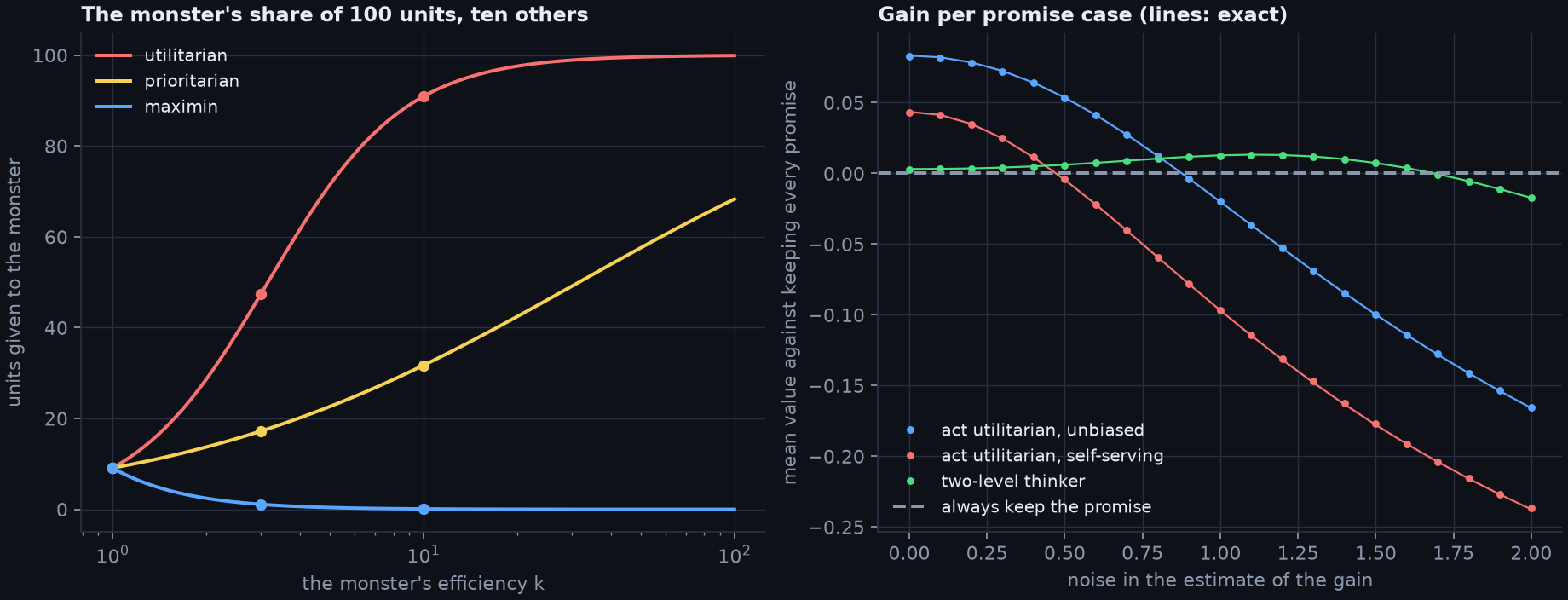
Sidgwick's worry can be made precise. The Reasoner generates two hundred thousand cases in which an agent has made a promise. Breaking it has a true net value, usually negative: on average minus one, with spread one. A perfectly informed act utilitarian breaks exactly when breaking is better, and gains point zero eight three per case over someone who always keeps her word. But real agents estimate, with noise. As the noise grows, the act utilitarian's mistakes mount, and once the noise reaches point nine it does worse than the plain rule. Add a self-serving bias of half a unit, the familiar discovery that breaking this particular promise would be for the best, and it falls below the rule at a noise of only point five. R. M. Hare's Moral Thinking, of 1981, proposed two levels. In everyday life, follow well-chosen intuitive rules; think critically, like an archangel, only in calm reflection or when the case for an exception is overwhelming. The two-level thinker here breaks a promise only when its estimated gain exceeds two, and stays above the rule until the noise passes one and a half. Brad Hooker's rule consequentialism, of 2000, goes further: an act is right if it is allowed by the code whose internalization by nearly everyone would have the best consequences. The old objection, pressed by J. J. C. Smart, who called it rule worship: if the rule exists for the sake of the good, why keep it when you know that breaking it is better?
What it establishes: Bentham (1789); Mill (1863); Sidgwick (1874); Hare (1981); Hooker (2000); Smart.; Computed on screen: the felicific ledger; act against rule under noise and bias
2What is good for a person?Introductory3 min
Consequentialism needs an account of what makes a life go well. Derek Parfit sorted the answers into three in 1984. Hedonism: a life goes well to the extent that it contains pleasure and lacks pain. Desire satisfaction: to the extent that one gets what one wants, or would want if fully informed. Objective list theories: to the extent that it contains things worth having whether or not one wants them, like knowledge, friendship and achievement. The choice matters: the instruction to maximize the good is only as clear as the theory of what is good for someone.
Robert Nozick posed the most famous test of hedonism in 1974. Suppose there were an experience machine that would give you any experience you desired, indistinguishable from the real thing. Should you plug in for life? Most people say no. We want to do things, not only to have the experience of doing them; we want to be a certain kind of person, and to be in contact with reality. If so, something besides experience matters, and hedonism is false. In the 2020 survey, seventy seven percent of philosophers would not enter, thirteen would. Felipe De Brigard turned the case around in 2010: told that their present life is already in a machine, many people would stay. Perhaps what the case measures is attachment to the status quo.
Desire theories face a problem that Jon Elster named in 1983, after Aesop's fox, who decided that the grapes he could not reach were sour anyway. The Reasoner models an agent who wants ten options equally: careers, freedoms, ways to live. At two moments, four of them are closed off. Desire for what is out of reach fades, by fifteen percent a step. Each loss knocks desire satisfaction down, after the second to a third, and each time it climbs back, to point nine eight: the agent comes to want only what she can have. Yet only two options in ten remain open. Amartya Sen observed that deprived people often come to terms with their deprivation, so that measures of satisfied desire can make injustice invisible; with Martha Nussbaum, he proposed counting capabilities, what people are actually able to do and be, as well. The fox is content, and he is still hungry.
What it establishes: Parfit (1984); Nozick (1974); De Brigard (2010); Elster (1983); Sen; Nussbaum (2000).; Computed on screen: the experience machine survey; sour grapes
3Harsanyi's theoremResearch3 min
In 1955 John Harsanyi, who later shared the Nobel prize for game theory, proved a theorem that seems to derive utilitarianism from rationality alone. Suppose each person's preferences over risky prospects satisfy the von Neumann–Morgenstern axioms of Part 33. Suppose society's preferences do too: a society should choose among risky policies as a rational agent would. And suppose the Pareto principle: if everyone is indifferent between two prospects, society is too. Then society's utility must be a weighted sum of individual utilities. Add that people count equally, and the weights are equal: utilitarianism.
The theorem has force because the alternatives fail in precise ways. Take two people, and an egalitarian who cares about the worse off. Applied before the risk is resolved, equality ranks prospects by the smaller of the two expected utilities. A sure outcome of one for the first person and nothing for the second scores zero; so does the reverse. But a fifty fifty mixture of the two scores a half, since each person then expects a half. Society strictly prefers a mixture of two prospects it ranks equal, which no von Neumann–Morgenstern agent can do. Peter Diamond argued in 1967 that this is exactly right: tossing a coin is fairer, so much the worse for the axioms. Applied after the risk is resolved, equality ranks a prospect by the expected minimum. A coin flip over the two lopsided outcomes scores zero; a sure half each scores a half. But each person expects a half from either, so each is indifferent, and society violates the Pareto principle. Harsanyi's theorem says one of these failures is unavoidable for any rule that is not a weighted sum.
Here is the geometry. The set of achievable pairs of utilities is bounded by a frontier; here the second person's utility is one minus the square of the first's. A weighted sum is a family of straight lines, and the utilitarian choice is where the highest line touches the frontier: a half for the first person and three quarters for the second. An egalitarian chooses the point on the diagonal, a little less in total. Nash's bargaining rule of Part 34 lies between. Amartya Sen objected in 1973 that the sum is indifferent to who gets what. The next chapter takes that objection seriously.
What it establishes: Harsanyi (1955); Diamond (1967); Sen (1973).; Computed on screen: two egalitarian rules broken; the frontier
4Equality and priorityApplied5 min
Utilitarianism adds up welfare and ignores how it is shared. There are three main alternatives. The utilitarian sum. The prioritarian sum, which counts a benefit for more the worse off its recipient is, here by adding square roots, as Derek Parfit proposed in 1991. Maximin, which looks only at the worst off, the core of Rawls's difference principle in Part 38. And egalitarianism, which holds inequality itself bad, measured by the Gini index or by Anthony Atkinson's index of 1970, the share of the mean one would give up for perfect equality.
The Reasoner scores three societies of five people. One where everyone has ten; one larger in total but unequal, from two to twenty six; and one mildly spread, from eight to twelve. The utilitarian prefers the unequal society, sixty against fifty. With square roots the prioritarian agrees, but only just, sixteen point one against fifteen point eight. Maximin prefers the equal society: its worst off has ten, against two. And the Gini index ranks the mild spread far above the unequal society. Each view is a different answer to how much a gain for the better off can make up for a loss to the worse off.
Derek Parfit's Lindley lecture of 1991 posed the sharpest objection to egalitarianism. Suppose four people have six and one has twenty six. Now bring the best off down to six, by some natural disaster that helps no one. No one is better off, and one person is worse off. Yet inequality has fallen from a Gini of point three two to zero. An egalitarian who thinks inequality bad in itself must say the levelled world is better in one respect. Parfit found that absurd, and proposed priority instead: what matters is not how people compare with each other, but how badly off they are. The prioritarian sum rightly ranks the levelled world lower.
Robert Nozick, in Anarchy, State, and Utopia of 1974, imagined a utility monster, who gets, in his words, enormously greater gains in utility from any sacrifice of others than these others lose. The Reasoner builds one: ten ordinary people, each with welfare the square root of their resources, and a monster whose welfare is ten times anyone's from the same resources. There are a hundred units to share. The utilitarian sum peaks when the monster takes ninety one of the hundred, leaving each of the others less than one. In closed form, the monster's share is k squared over k squared plus n, with k and n both ten. The prioritarian, who counts the square root of each person's welfare, gives it thirty two. Maximin, which looks only at the worst off, gives it a tenth of a unit, just enough to make it exactly as well off as everyone else. The monster dramatizes John Rawls's charge that utilitarianism does not take seriously the distinction between persons: it treats people as containers of welfare, and pours into whichever container is most efficient.
In 1972, after the famine and the flood of refugees in East Bengal, Peter Singer published Famine, Affluence, and Morality. If you walk past a shallow pond and see a child drowning, you ought to wade in, though it ruins your clothes. Distance, and the number of others who could help, make no moral difference, so: if it is in our power to prevent something bad from happening, without thereby sacrificing anything of comparable moral importance, we ought, morally, to do it. The Reasoner puts numbers to it, with welfare the logarithm of income. A dollar to someone living on five hundred a year is worth a hundred times a dollar to someone on fifty thousand. Between two such people, total welfare rises with every dollar given until their incomes are equal: a gift of twenty four thousand, seven hundred and fifty. In a world of ten rich and ninety poor, if every rich person complies, each gives eighty nine percent of their income; if you alone comply, ninety eight. Liam Murphy's cooperative principle, of 2000, says no one need do more than her share under full compliance; in a world this unequal, that share is still eighty nine percent. Samuel Scheffler proposed instead, in 1982, an agent-centred prerogative: you may weight your own welfare above a stranger's, by some factor M. Weighted ten times, the gift falls to four thousand and ninety one dollars; a hundred times, to nothing. The demandingness objection, and Bernard Williams's complaint of 1973 that such a theory alienates agents from their own projects, are the price consequentialism pays for impartiality.
What it establishes: Parfit (1991); Atkinson (1970); Nozick (1974); Singer (1972); Murphy (2000); Scheffler (1982); Williams (1973).; Computed on screen: five views of three societies; levelling down; the utility monster; the pond
5The categorical imperativeIntroductory4 min
Kant's Groundwork of the Metaphysics of Morals, of 1785, gave several formulations of one supreme principle. Act only on that maxim through which you can at the same time will that it become a universal law. Treat humanity, in your own person or in another's, always as an end, and never merely as a means. Regard your will as giving universal law. Act as a member of a possible kingdom of ends. The imperative is categorical: not if you want this, do that, but simply do it, binding on every rational agent whatever she happens to want.
Kant's own example of the universal law test is the lying promise, and the Reasoner can build it. The maxim: when I need money, I will promise to repay it, though I know I never will. Its purpose is to get money by means of a promise. The world: a thousand agents, of whom a tenth need money each round and promise to repay; a share f of them follow the maxim. Lenders lend only while more than half of the promises made so far have been kept. To universalize the maxim is to set f to one, and ask whether it can still achieve its purpose.
Here is what happens. The lines show the share of promises kept, round by round, for different shares of liars. Up to four tenths, lenders keep lending all forty rounds, and the liars do well. From a half, trust falls below the threshold at once, and lending stops after the first round. With everyone lying, trust ends near zero, and no one lends. The universalized maxim cannot achieve its own purpose: there is no money to be had by false promises in a world where all promises are false. That is Kant's contradiction in conception. The liar's success depends on others being honest: he wills a law for everyone, and an exception for himself.
Most Kantians now lead with the formula of humanity. Using people as means is everywhere and innocent: you use a taxi driver to get home, and she uses you to earn a living. What the formula forbids is treating anyone merely as a means. Onora O'Neill, in 1985, gave a test: you use someone merely as a means if you involve them in a scheme of action to which they could not possibly consent. Deception and coercion guarantee that, since the deceived cannot know what they would be agreeing to, and the coerced are given no say. The Reasoner runs the test on seven acts. The taxi ride and an honest sale pass. The lying promise, a confidence trick, a mugging and the push from the footbridge fail. Six of the seven verdicts match intuition on any reading. The seventh is Parfit's gangster, who regards the barista merely as a tool and would harm her if it suited him, and who buys a coffee. He treats her merely as a means in attitude, yet buying the coffee is not wrong: read as a test of attitudes the formula convicts him, read as O'Neill reads it, a test of acts, it does not. And the formula's circle stops at rational beings: Kant allowed only indirect duties to animals, a limit Christine Korsgaard's Fellow Creatures, of 2018, challenges from within Kant's own theory.
What it establishes: Kant (1785); O'Neill (1985); Parfit; Korsgaard (2018).; Computed on screen: the promise world; the consent test on seven acts
6Universalizability, testedAdvanced4 min
Kant distinguished two ways a maxim can fail. A contradiction in conception: universalized, the maxim cannot even be conceived to achieve its purpose, like the lying promise. Such maxims violate perfect duties, which allow no exceptions. A contradiction in will: the universalized world is perfectly conceivable, but no one with needs could will it. A world in which no one ever helps anyone could exist; but you, who will sometimes need help, cannot will it. Such maxims violate imperfect duties, like the duty to help others sometimes. Kant's four examples are the lying promise, suicide from self-love, neglecting one's talents, and refusing to help.
The Reasoner runs the test on five maxims, each with a small model of the universalized world. The lying promise fails in conception, as we saw. Never helping fails in will. Both verdicts match our intuitions. But play tennis at eight on Sunday mornings, because the courts are empty then: universalized, a hundred players arrive at four courts, the courts are never empty, and the maxim fails in conception. Yet it is perfectly innocent: a false positive. So does buy toy trains but never sell them, since if no one sells, no one can buy. And the test can be gamed: deceive anyone named Hans born on the third of March 1987 universalizes without contradiction, since so few people fit, but it is plainly wrong: a false negative. A mechanical test of maxims is too strict in some places and too lax in others.
In 1797 Benjamin Constant tested Kant with a case. A murderer comes to your door and asks whether your friend, whom he is pursuing, is hiding in your house. Constant said that the duty to tell the truth is owed only to those who have a right to the truth, and the murderer has none. Kant replied, in On a Supposed Right to Lie from Philanthropy, that truthfulness in all declarations is a sacred command of reason, not to be restricted by any convenience. If you lie, and your friend has meanwhile slipped out and meets the murderer on the way, you can justly be charged with his death. Few Kantians follow him here. Christine Korsgaard showed in 1986 that the universal law test itself permits the lie. The murderer is deceiving you: he expects you to take him for an innocent caller. Universalize the maxim, lie to murderers who come to the door, and it still works, because he does not think you know what he is. The humanity formula looks stricter, since a lie treats its hearer as a mere means. Korsgaard's answer is a two-level view: the formula of humanity is the ideal for a world of good will; in dealing with evil, the universal law test is the standard, and it lets you lie. The test that forbade the lying promise permits the lie almost everyone thinks right.
Kantians have answers. Christine Korsgaard argued in 1985 that the contradiction is practical: a maxim fails if, universalized, it could not serve its own purpose. That is the reading the Reasoner's toy world implements, and it still produces false positives. Barbara Herman argued that the test presupposes moral judgment about what an agent is really doing: it checks a description of an act, but it cannot choose the right description. Many turn to the humanity formula instead: wrong acts treat others in ways they could not possibly consent to. The deceived lender could not consent; the tennis players are not wronged at all. And Derek Parfit's On What Matters, of 2011, argued that the best version of Kant's theory, the best contractualism and the best consequentialism converge, climbing the same mountain on different sides.
What it establishes: Kant; Constant (1797); Korsgaard (1985, 1986); Herman (1993); Parfit (2011).; Computed on screen: five maxims universalized
7ConstraintsResearch4 min
The deontology most philosophers hold is not Kant's but W. D. Ross's, from The Right and the Good of 1930. There are several prima facie duties: fidelity, reparation, gratitude, justice, beneficence, self-improvement, and not harming others. Each gives a genuine reason; any can be outweighed by another; and no master principle ranks them, so judgment in the particular case must decide. What marks deontology off from consequentialism are constraints, limits on what you may do even to bring about the best outcome, and options, permissions not to do the best when it would cost you greatly.
Most constraints rest on the distinction between doing harm and allowing it. James Rachels challenged it in 1975 with a pair of cases. Smith will inherit a fortune if his six-year-old cousin dies, and drowns the child in the bath. Jones stands to gain in the same way and creeps in to do the same, but the child slips, hits his head and falls face down in the water. Jones watches, ready to push him back under, and does nothing. The cases differ only in killing against letting die, and both men are equally monstrous. So, Rachels concluded, the bare difference makes no moral difference. Warren Quinn's rescue cases, of 1989, point the other way. If you can save five drowning people or one, you may save the five and let the one drown. But if you can reach the five only by driving over the one, you may not. Here the difference decides everything. Shelly Kagan diagnosed the conflict in 1988 as the additive fallacy: the assumption that a factor contributes the same moral weight in every context. A factor can matter in one setting and fall silent in another. That is the holism of reasons, which returns with virtue ethics.
Constraints produce a paradox, stated by Robert Nozick in 1974 and sharpened by Samuel Scheffler in 1982. Suppose you can kill one innocent person, and thereby prevent five others from each killing one. If you kill, there is one killing; if you refrain, five. A constraint against killing says you may not. But if killing is so bad that you may not do it even to prevent worse, why is it not better to minimize killings? A constraint seems to say that you should care more about your own hands being clean than about the killings themselves.
One reply dissolves the contrast. Let each agent rank outcomes from her own point of view, counting her own killings k times as heavily as other people's. With k equal to one, killing the one is better; at five the options tie; for any k above five, refraining is better, which is exactly the constraint. James Dreier and Douglas Portmore argued that every deontological theory can be consequentialized this way, by building agent-relative values into the ranking. Critics answer that if every theory can be written so, calling a theory consequentialist says nothing about what it requires.
This is the thirty fifth brick in the Wall. The dream was a moral theory that matches every considered intuition. Harsanyi's theorem shows that two mild conditions of rationality force the utilitarian sum, with all its indifference to who gets what; deontology avoids that, but only by constraints that seem to forbid minimizing the very wrongs they condemn; and every test of maxims we built either forbids the innocent or permits the wrong. What it forces is a choice: some intuition must go.
What it establishes: Ross (1930); Rachels (1975); Quinn (1989); Kagan (1988); Nozick; Scheffler; Dreier; Portmore; the Wall's thirty-fifth brick.; Computed on screen: the paradox, and the agent-relative weight that consequentializes it
8The trolley problemIntroductory4 min
Philippa Foot introduced the case in 1967, and Judith Jarvis Thomson gave it its modern form. A runaway trolley will kill five people on the track ahead. You can switch it onto a side track, where it will kill one. Most people think you may. Now you stand on a footbridge beside a large man. Pushing him onto the track would stop the trolley and save the five, and he would die. Most people think you may not. In the 2020 survey, sixty three percent of philosophers would switch, and thirteen would not. Twenty two percent would push, and fifty six would not. One death against five, either way; why the difference?
The traditional answer is the doctrine of double effect, which goes back to Thomas Aquinas. A harm may be accepted as a foreseen side effect of a good act, but never intended as a means to the good. In the switch case the one's death is a side effect: if he escaped, so much the better. In the footbridge case it is the means: his body stops the trolley. Utilitarianism permits both acts; double effect only the first. But in Thomson's loop case, the side track loops back, and the one's body is what stops the trolley; many still judge switching permissible. And if a trapdoor drops the man onto the track at the flick of a switch, people object less than to a push, though his fall is equally a means. Joshua Greene and colleagues found in 2009 that intuitions track personal force, which seems morally irrelevant.
Four claims cannot all be true. Turning the trolley is permissible. Pushing the man is not. The cases differ only in that the one is used as a means. And harming as a means rather than as a side effect makes no moral difference. Something has to give. Thomson herself, in 2008, came to deny the first: you may not switch either. Thirteen percent of philosophers agree. Peter Singer and Joshua Greene deny the second: push, with twenty two percent. Others find a different difference: Thomson's early view that switching redirects an existing threat while pushing creates a new one, or Frances Kamm's subtler principles. And defenders of double effect and of Kant's humanity formula deny the fourth: using a person as a means is a distinct wrong.
The trolley went global. The Moral Machine, an online game run by Edmond Awad and colleagues, asked people to choose whom a driverless car should spare; it gathered forty million decisions from two hundred and thirty three countries and territories, published in 2018. Some preferences were nearly universal: spare humans over animals, more lives over fewer, the young over the old. Others varied: the preference for sparing the young was weaker in a cluster of East Asian and Islamic countries. The authors cautioned that what people prefer is not thereby right, and such dilemmas are rare on real roads. Intuitions are data for a moral theory, not the theory itself; Part 37 asks what they are evidence of.
What it establishes: Foot (1967); Thomson (1985, 2008); Aquinas; Greene et al. (2009); Kamm; Awad et al. (2018); the Price List.; Computed on screen: the trolley tetrad's minimal conflicts
9ContractualismAdvanced3 min
T. M. Scanlon's What We Owe to Each Other, of 1998, grounds morality in what we can justify to each other. An act is wrong if any principle permitting it could reasonably be rejected by someone it affects. Objections are weighed one person at a time: the strongest individual complaint decides. There is no summing across people. The separateness of persons, stressed by Rawls and Nozick, means that one person's great loss is not made up by many small gains to others. Unlike the bargainers of Part 34, Scanlon's contractors are moved not by advantage but by the wish to act on principles they can justify to everyone.
John Taurek pressed the point furthest, in Should the Numbers Count? of 1977. One person is stranded on one rock and five on another; the tide is rising, and you can reach only one rock. Most people say: save the five. Taurek said no. What is bad is what happens to each person, not a sum that happens to no one; each of the six has the same claim to be saved, so toss a fair coin. The Reasoner runs each policy a hundred thousand times. Saving the many saves five every time, but gives the lone person no chance at all. The coin gives everyone an even chance, and saves three on average. A weighted lottery, with chances in proportion to numbers, gives each of the five five sixths and the one a sixth, and saves four and a third. Frances Kamm and Scanlon answered Taurek without adding anything up: let one of the five balance the one, and the remaining four break the tie. The tie-breaking argument keeps the separateness of persons and still lets the numbers count.
Scanlon's own example tests aggregation. Jones has suffered an accident in the transmitter room during a World Cup broadcast, and is receiving agonizing shocks. Rescuing him means interrupting the broadcast for an hour. Summing everything, a billion viewers' small losses outweigh Jones's agony, and the broadcast should go on. Scanlon, comparing complaints one at a time, says save Jones, and almost everyone agrees. But pure non-aggregation goes too far: it would save Jones rather than prevent three people each breaking an arm, or even, as a toss-up, rather than save two lives. Alex Voorhoeve's relevance view, of 2014, adds up only claims at least comparable to the strongest. The Reasoner applies it: save Jones against the broadcast and the migraines; help the many against the broken arms and the two lives. Partial aggregation keeps the intuitions that full summing and pure individualism each lose.
What it establishes: Scanlon (1998); Taurek (1977); Timmermann (2004); Kamm; Voorhoeve (2014).; Computed on screen: three lotteries on the rocks; the Transmitter Room
10VirtueIntroductory5 min
Virtue ethics begins with Aristotle's Nicomachean Ethics. For each kind of feeling and action there is a mean between two vices: courage between cowardice and rashness, generosity between stinginess and prodigality, good temper between spiritlessness and irascibility, truthfulness about oneself between self-deprecation and boastfulness. A virtue is a settled disposition to feel and act rightly: at the right time, toward the right people, in the right way. The aim is eudaimonia, the flourishing life, and what finds the mean in a given case is practical wisdom, not a rule. Elizabeth Anscombe's paper of 1958 and Rosalind Hursthouse's book of 1999 revived the view: right action is what a virtuous person would characteristically do.
Aristotle said that the decision rests with perception. Jonathan Dancy's Ethics Without Principles, of 2004, turns this into a thesis about reasons. Holism: a feature that is a reason for an act in one case can be no reason, or a reason against, in another. That an act gives pleasure usually counts in its favour; that it gives a sadist pleasure counts against. A promise binds, unless it was coerced. A lie is wrong, unless it is a move in a game whose players expect it. The Reasoner builds a judge with exactly these views and asks it about all twenty seven consistent cases: fifteen permissible, twelve not. Can the judge be summed up as fixed weights on the basic reasons, in the manner of Ross's prima facie duties? Searching all three hundred and forty three integer weightings with every threshold, the best gets seventeen of the twenty seven right, by ignoring pleasure and promises altogether and saying only: do not lie. Sean McKeever and Michael Ridge's Principled Ethics, of 2006, answers that principles can carry their defeaters with them. Give each defeater a weight of its own, and a weighting from among a hundred and seventeen thousand fits every case: pleasure plus one, cruelty minus two, a promise plus one, coercion minus one, a lie minus two, a game plus two. So holism alone does not refute principles. The particularist's real claim is that the defeaters, and the defeaters of defeaters, never run out, so that no finite list can replace judgment. The same question now faces anyone who trains a machine on human moral verdicts.
Classical Chinese philosophy developed a virtue ethics of its own. Confucius made ren, humaneness, the central virtue: care for others, extending outward from the family. Li, ritual propriety, is the set of forms through which that care is expressed and trained. The ideal is the junzi, the exemplary person, whose character makes right action natural. Mencius argued that human nature is good: anyone who suddenly sees a child about to fall into a well feels alarm and compassion, not to win the parents' favour or a good name. Everyone has four sprouts, of compassion, shame, deference and a sense of right and wrong, which grow into the four virtues if they are cultivated.
Social psychology raised a challenge. In 1973 John Darley and Daniel Batson sent seminary students to give a talk, some on the parable of the Good Samaritan, and on the way they passed a man slumped in a doorway. Sixty three percent of those not in a hurry stopped to help; forty five percent of those in a moderate hurry; only ten percent of those in a great hurry. Small features of the situation predicted behaviour better than character. In Stanley Milgram's experiment of 1963, twenty six of forty subjects gave what they believed was the strongest shock. Gilbert Harman and John Doris argued that robust character traits are rare, so virtue ethics rests on a false psychology. Virtue ethicists reply that virtue is an ideal few reach, which is what Aristotle said, and that the experiments are about local behaviour, some of it poorly replicated.
What it establishes: Aristotle; Anscombe (1958); Hursthouse (1999); Dancy (2004); McKeever and Ridge (2006); Confucius; Mencius; Darley and Batson (1973); Milgram (1963); Harman; Doris.; Computed on screen: every weighting of reasons, searched
11CareIntroductory3 min
In 1982 the psychologist Carol Gilligan challenged the leading theory of moral development. Lawrence Kohlberg had asked children about Heinz, whose wife is dying, and who cannot afford the drug that might save her: should he steal it? Kohlberg scored maturity by how far the reasoning rose toward universal principles of justice and rights. An eleven-year-old girl, Amy, said they should really just talk it out and find another way, so that no one is hurt and the relationships survive, and she scored lower than a boy who weighed life against property. Gilligan argued that Amy spoke in a different voice, not at a lower stage: an ethics of care and responsibility in relationships, beside the ethics of justice.
Philosophers developed the idea into a theory. Nel Noddings, in 1984, made caring a relation: one person attends to another, who responds; ethics begins in that relation, not in principles. Virginia Held stressed that dependency is the normal human condition, in childhood, illness and age, so theories built for independent equals miss most of moral life. Eva Kittay and Joan Tronto turned care work, mostly unpaid and mostly done by women, into a question of justice. Care ethics starts from what impartial theories find hardest to explain: why I may favour those I love. Its critics worry that care for those near can neglect those far away, a question Part 36 takes up.
Bernard Williams pressed the challenge of partiality in 1976, with a case of Charles Fried's. A man can save one of two people from drowning, and one of them is his wife. An impartial theory might permit him to save her, but it owes a justification: it was my wife, and in situations of this kind it is permissible to save one's wife. Williams said that is one thought too many. The right motive is simply that it was his wife; a husband who needs the theory's permission has already lost something. Peter Railton replied in 1984 that a sophisticated consequentialist need not think in consequentialist terms: the theory says which motives are good to have, and loving motives are among them, as Hare's two levels suggested. And Susan Wolf, in Moral Saints of 1982, argued that a person who aimed at maximal moral goodness would lack the attachments that make a life worth living: a point for care ethics, and a warning for any theory that asks to be the only thing an agent cares about.
What it establishes: Kohlberg; Gilligan (1982); Noddings (1984); Held (2006); Kittay; Tronto; Williams (1976); Railton (1984); Wolf (1982).
12Moral uncertaintyApplied4 min
This part has shown that each theory gets some cases wrong. So you may well be uncertain which is true. Then you have credences in moral theories, as in empirical hypotheses. Each theory scores each option by how choiceworthy it is. One proposal is to maximize expected choiceworthiness, the analogue of expected utility from Part 33. William MacAskill, Krister Bykvist and Toby Ord developed it in Moral Uncertainty, in 2020. The hard part is comparing one theory's units with another's: how many utilitarian lives is one deontological violation worth?
The Reasoner tries it on the footbridge. Credence point six in a utilitarian theory, for which pushing saves four lives net, and point four in a deontological theory, for which pushing is a grave wrong, scored minus a hundred. Taking the numbers at face value, the grave wrong dominates: minus thirty seven point six for pushing, so do nothing. But nothing fixed the deontologist's scale. Rescale each theory to the same range, or to the same variance across the options, as MacAskill and his co-authors suggest, and pushing wins. The verdict depends on the exchange rate between theories, and a theory that announces enormous stakes can swamp all the others however little you believe it: the problem of fanaticism, which returns in Part 36.
Often there are more than two options. Add one that both theories can accept: shout a warning that saves two of the five. Now every version of expected choiceworthiness chooses it, raw, range normalized or variance normalized. A different proposal is a moral parliament, in which each theory gets seats in proportion to your credence. If the delegates simply vote for their favourites, the utilitarian majority pushes. Nick Bostrom, and Toby Newberry and Toby Ord, proposed instead that the delegates bargain, which favours compromises like the warning. The practical lesson of moral uncertainty is to look for acts that many theories can accept.
If moral uncertainty is real, moral inquiry has a value, like any other information. How much would it be worth to learn which theory is true before acting on the footbridge? Use the value of information from Part 33: the expected value of choosing after you learn, minus the value of choosing now. With the scales matched by variance and a credence of point six, choosing now is worth point two, and choosing after learning is worth one. So the information is worth point eight, four times what the best choice now is worth. The value is never negative, and it is largest where you are most torn, at even credence. On the raw scales the peak moves to a credence of ninety six percent, where the grave wrong and the four lives just balance. The lesson holds for anyone who must act under moral uncertainty, a government, a hospital or a machine: when theories disagree about large stakes, finding out which is true can matter more than any single choice.
What it establishes: MacAskill, Bykvist and Ord (2020); Bostrom (2009); Newberry and Ord (2021).; Computed on screen: expected choiceworthiness under three normalizations; a parliament; the value of moral information
Recap, problems, and where this comes backAll tracks3 min
Let's gather what we built. Bentham's ledger, Sidgwick's dualism, and two levels of moral thinking, with the noise at which calculation loses to rules. Theories of welfare, and the experience machine, which seventy seven percent of philosophers would not enter. Harsanyi's theorem, with two egalitarian rules broken in exactly the ways it predicts. Sums, priority, maximin and inequality measures, levelling down, the utility monster, and what Singer's argument asks of the rich. Kant, a world in which the universal lie collapses, the humanity formula as a consent test, five maxims tested, and the murderer at the door. Ross's duties, doing and allowing, and the paradox of deontology, this part's brick in the Wall. The trolley problem, double effect and its Price List. Taurek's numbers, Scanlon and partial aggregation, virtue, the holism of reasons against weighted rules, care, moral uncertainty, and the value of finding out which theory is true.
The Reasoner has a new module, ethics. It keeps Bentham's ledger, checks social welfare functions against Harsanyi's axioms, pits a noisy calculator against a rule, scores distributions five ways and feeds a utility monster, prices Singer's argument, runs a world of promises and tests maxims for universalizability and consent, ranks outcomes agent-relatively, sorts trolley cases by double effect, runs Taurek's lotteries, aggregates claims partially, searches every weighting of reasons, and computes expected choiceworthiness under moral uncertainty and the value of moral information. And the Wall has its thirty fifth brick.
Six problems, with full solutions in this part's notes. The ex-ante egalitarian and the independence axiom; when maximin disagrees with sums and priority; the largest share of liars a world of promises survives; a harmless maxim the test forbids; the weight that reproduces a constraint; and two normalizations that disagree. Pause here, and try them.
Where this comes back. Lives that may or may not exist, fanaticism and the far future, in Part 36. What moral claims mean, and whether they can be true, in Part 37. Justice as fairness and the difference principle, in Part 38. Aggregating votes as Harsanyi aggregated utilities, in Part 39. Fairness criteria for algorithms, in Part 41. And whose values to align a reasoner with, under moral uncertainty, in Part 42. Next, Part 36: weighing lives.
The books and papers this part follows are on screen, and in the notes. Thanks for watching.
Where it goes next. Lives that may or may not exist, fanaticism and the far future are Part 36. What moral claims mean returns in Part 37, the difference principle in Part 38, aggregation by voting in Part 39, fairness criteria for algorithms in Part 41, and whose values to align a reasoner with in Part 42.
Key results
The part's results in one place, for revision.
Try it
Lab 35 · The utility monster, and rules against calculation
Split 100 units between a utility monster and ten ordinary people under the utilitarian sum, a prioritarian sum and maximin, and check each split against its closed form; then compare an act utilitarian who misjudges promise cases with a rule follower and a two-level thinker, against the exact formula; and see moral uncertainty's verdict flip with the normalization.
python -m videos.philosophy.labs 35
needs numpy, scipy, matplotlib · download lab35.py ·
source on GitHubk = 1: units to the monster (sum, priority, maximin) 9.1 9.1 9.1 (closed forms 9.1 9.1 9.1)
k = 3: units to the monster (sum, priority, maximin) 47.4 17.2 1.1 (closed forms 47.4 17.2 1.1)
k = 10: units to the monster (sum, priority, maximin) 90.9 31.7 0.1 (closed forms 90.9 31.7 0.1)
a perfect act utilitarian's gain per promise case 0.0830 (exact 0.0833)
act utilitarian falls below the rule at noise 0.9 unbiased, 0.5 self-serving (film: 0.9, 0.5)
largest gap between simulation and formula 0.0012
two-level thinker at noise 1.5 +0.0073 (the rule: 0)
footbridge, credence 0.6 / 0.4: raw, range, variance do nothing; push; push
with a warning shout added: the three methods; a vote shout a warning every time; push
The sum gives the monster k^2/(k^2 + n) of everything; priority and maximin give it less for the same reason they give the worse off more. Calculating each case beats a rule only while the estimates are accurate and unbiased; a high bar for exceptions keeps most of the gain.The code (101 lines; it asserts its own result)
"""Lab 35: feed a utility monster under three views, and find the noise at which calculating acts loses to a rule."""

import math

import numpy as np
from scipy.stats import norm

from videos.coursekit import labs
from explainer.philosophy.reasoner import ethics

TITLE = "The utility monster, and rules against calculation"
GOAL = ("Split 100 units between a utility monster and ten ordinary people under the utilitarian sum, a "
        "prioritarian sum and maximin, and check each split against its closed form; then compare an act "
        "utilitarian who misjudges promise cases with a rule follower and a two-level thinker, against the exact "
        "formula; and see moral uncertainty's verdict flip with the normalization.")
TASKS = [
    "Give the monster k = 100. What share does each view give it, and which view's share does not depend on "
    "the total at all?",
    "In ethics.two_level, raise the two-level thinker's bar (threshold) from 2 to 4, then lower it to 0.5. "
    "Where does each version stop beating the rule?",
    "In ethics.moral_uncertainty, set the credences to (0.2, 0.8). Which normalizations still say push?",
]


def act_value(noise, bias=0.0, bar=0.0, mu=-1.0):
    """Exact mean gain per case of breaking a promise when the estimate D + bias + noise * e exceeds the bar,
    D ~ N(mu, 1): E[D 1{Z > bar}] with Z ~ N(mu + bias, 1 + noise^2) and Cov(D, Z) = 1."""
    sd = math.sqrt(1 + noise ** 2)
    z = (mu + bias - bar) / sd
    return mu * norm.cdf(z) + norm.pdf(z) / sd


def run(seed=0):
    lab = labs.Lab()
    n, total = 10, 100
    closed = {  # the monster's share: equate marginal welfare on both sides of the split
        "utilitarian": lambda k: k ** 2 / (k ** 2 + n),
        "prioritarian": lambda k: k ** (2 / 3) / (k ** (2 / 3) + n),
        "maximin": lambda k: 1 / (1 + n * k ** 2),
    }
    for k in (1.0, 3.0, 10.0):
        m = ethics.utility_monster(total=total, k=k)
        got = {name: m["best"][name]["monster"] for name in closed}
        lab.row(f"k = {k:g}: units to the monster (sum, priority, maximin)",
                "  ".join(f"{got[name]:.1f}" for name in closed) + "   (closed forms "
                + "  ".join(f"{total * closed[name](k):.1f}" for name in closed) + ")")
        for name in closed:
            assert abs(got[name] - total * closed[name](k)) < 0.02, (name, k)
        assert abs(m["utilitarian_exact"] - total * closed["utilitarian"](k)) < 1e-3
    ten = ethics.utility_monster(k=10.0)["best"]
    assert ten["utilitarian"]["monster"] > 90 and ten["maximin"]["monster"] < 0.2, "the sum feeds it, maximin starves it"

    tl = ethics.two_level(n=200000, seed=1981 + seed)
    noises = np.array(tl["noises"])
    worst = 0.0
    for bias in (0.0, 0.5):
        c = tl["curves"][str(bias)]
        worst = max(worst, np.max(np.abs(np.array(c["act"]) - [act_value(s, bias) for s in noises])),
                    np.max(np.abs(np.array(c["two_level"]) - [act_value(s, bias, tl["threshold"]) for s in noises])))
    honest, selfish = tl["curves"]["0.0"], tl["curves"]["0.5"]
    lab.row("a perfect act utilitarian's gain per promise case", f"{tl['ideal']:.4f}   (exact {act_value(0):.4f})")
    lab.row("act utilitarian falls below the rule at noise", f"{honest['act_below_rule_at']} unbiased, "
            f"{selfish['act_below_rule_at']} self-serving   (film: 0.9, 0.5)")
    lab.row("largest gap between simulation and formula", f"{worst:.4f}")
    two_at = dict(zip(tl["noises"], honest["two_level"]))
    lab.row("two-level thinker at noise 1.5", f"{two_at[1.5]:+.4f}   (the rule: 0)")
    assert abs(tl["ideal"] - act_value(0)) < 0.004 and worst < 0.006, "the simulation matches the closed form"
    assert honest["act_below_rule_at"] in (0.9, 1.0) and selfish["act_below_rule_at"] in (0.5, 0.6)
    assert all(v > 0 for s, v in two_at.items() if s <= 1.5), "the high bar keeps the two-level thinker ahead"

    mu = ethics.moral_uncertainty()
    two = {k: v["choice"] for k, v in mu["two"]["results"].items()}
    three = {k: v["choice"] for k, v in mu["three"]["results"].items()}
    lab.row("footbridge, credence 0.6 / 0.4: raw, range, variance", f"{two['raw']}; {two['range']}; {two['variance']}")
    lab.row("with a warning shout added: the three methods; a vote", f"{three['raw']} every time; {three['plurality']}")
    assert two["raw"] == "do nothing" and two["range"] == two["variance"] == "push", "the verdict flips"
    assert {three[k] for k in ("raw", "range", "variance")} == {"shout a warning"} and three["plurality"] == "push"
    lab.note = ("The sum gives the monster k^2/(k^2 + n) of everything; priority and maximin give it less for the "
                "same reason they give the worse off more. Calculating each case beats a rule only while the "
                "estimates are accurate and unbiased; a high bar for exceptions keeps most of the gain.")

    fig, ax = labs.figure(2, size=(11.5, 4.4))
    ks = np.logspace(0, 2, 80)
    for name, color in (("utilitarian", labs.RED), ("prioritarian", labs.GOLD), ("maximin", labs.BLUE)):
        ax[0].plot(ks, [100 * closed[name](k) for k in ks], color=color, label=name)
        ax[0].plot([1, 3, 10], [ethics.utility_monster(k=k)["best"][name]["monster"] for k in (1.0, 3.0, 10.0)], "o",
                   color=color, ms=5)
    ax[0].set(title="The monster's share of 100 units, ten others", xlabel="the monster's efficiency k",
              ylabel="units given to the monster", xscale="log")
    ax[0].legend(loc="upper left")
    ax[1].plot(noises, honest["act"], "o", ms=3, color=labs.BLUE, label="act utilitarian, unbiased")
    ax[1].plot(noises, selfish["act"], "o", ms=3, color=labs.RED, label="act utilitarian, self-serving")
    ax[1].plot(noises, honest["two_level"], "o", ms=3, color=labs.GREEN, label="two-level thinker")
    for bias, bar, color in ((0.0, 0.0, labs.BLUE), (0.5, 0.0, labs.RED), (0.0, tl["threshold"], labs.GREEN)):
        ax[1].plot(noises, [act_value(s, bias, bar) for s in noises], color=color, lw=1)
    ax[1].axhline(0, color=labs.MUTED, ls="--", label="always keep the promise")
    ax[1].set(title="Gain per promise case (lines: exact)", xlabel="noise in the estimate of the gain",
              ylabel="mean value against keeping every promise")
    ax[1].legend(loc="lower left")
    lab.fig = fig
    return lab
Now change it
- Give the monster k = 100. What share does each view give it, and which view's share does not depend on the total at all?
- In ethics.two_level, raise the two-level thinker's bar (threshold) from 2 to 4, then lower it to 0.5. Where does each version stop beating the rule?
- In ethics.moral_uncertainty, set the credences to (0.2, 0.8). Which normalizations still say push?
Problems, with solutions
Try each problem before opening its solution.
-
Show that W = min(E u₁, E u₂) violates the vNM independence axiom.
Solution
Take two people and two sure prospects: \(A\) gives utility 1 to the first and 0 to the second, \(B\) the reverse. \(W(A) = \min(1, 0) = 0 = W(B)\), so society is indifferent between them. The independence axiom then requires indifference between \(A\) and the half-half mixture \(\tfrac12 A + \tfrac12 B\). But in the mixture each person expects \(\tfrac12\), so \(W = \tfrac12 > 0\): society strictly prefers mixing two prospects it ranks equal, which no von Neumann–Morgenstern ranking can do. That is Diamond's coin toss.
-
Find a distribution that maximin ranks above another although both totals and priority sums are lower.
Solution
Compare \(X = (3, 3, 3)\) with \(Y = (2, 10, 10)\). Totals: 9 against 22. Priority sums with square roots: \(3\sqrt3 = 5.20\) against \(\sqrt2 + 2\sqrt{10} = 7.74\). Maximin looks only at the worst off, 3 against 2, and ranks \(X\) above \(Y\), though \(X\) is lower on both sums. Any gain for the worst off, however small, outweighs any gains for others, however large.
-
In the promise world, find the largest share of liars for which lending never stops.
Solution
In the Reasoner's seeded world (a thousand agents, 40 rounds, lenders lend while more than half of promises have been kept), lending continues through all 40 rounds for every share of liars up to 0.46. At 0.47 it stops after the first round. The threshold is just under one half: the share of promises kept is about \(1 - f\), which must stay above 0.5, and near \(f = 0.5\) random fluctuations in which agents are needy push it below and stop lending (at exactly 0.5 the seeded run happens to last 27 rounds before stopping). Below the threshold the liars do well; at and above it, no one gets money by promising.
-
Write a maxim that the universal law test forbids though it is harmless, and explain why.
Solution
"I will play tennis on Sunday mornings, because the courts are empty then." Universalized, everyone plays on Sunday mornings, the courts are full, and the maxim cannot achieve its purpose: a contradiction in conception, of the same form as the lying promise. Yet the maxim is harmless. The test catches every maxim whose success depends on others not acting on it: free-riding and deception, but also innocent strategies of timing and coordination. Kantians (Herman, Korsgaard) respond by testing the practical purpose more carefully, or by reading the test as aimed at maxims that make exceptions of oneself in a morally relevant way.
-
For what agent-relative weight k does the constraint against killing one to save n hold? (k > n.)
Solution
Count the deaths saved as worth 1 each and the agent's own killing as worth \(k\) to the agent. Killing one to save \(n\) then scores \(n - k\), and refraining scores 0. The constraint, that the agent must not kill, holds exactly when \(k > n\). Since the paradox of deontology turns on cases where killing one prevents \(n\) other killings, and a constraint that holds for every \(n\) needs \(k > n\) for all \(n\), the weight must be unbounded: in effect absolute. A finite \(k\) gives a threshold deontology, which permits the killing once \(n \ge k\).
-
Show that range normalization can reverse a verdict of variance normalization.
Solution
Credence one half in each of two theories, four options. Theory 1 scores them \((8, 8, 7, 7)\); theory 2 scores them \((0, 1, 2, 6)\). Range normalization maps theory 1 to \((1, 1, 0, 0)\) and theory 2 to \((0, \tfrac16, \tfrac13, 1)\); the expected scores are \((0.50, 0.58, 0.17, 0.50)\), and the second option wins. Variance normalization maps theory 1 to \((1, 1, -1, -1)\) (its options differ by only one point, so each point is a whole standard deviation) and theory 2 to \((-0.99, -0.55, -0.11, 1.65)\); the expected scores are \((0.01, 0.23, -0.56, 0.32)\), and the fourth option wins. Range normalization lets theory 2's single outlier set its scale; variance normalization makes theory 1's small differences count heavily.
Notes and sources
About this partfrom its README
Part 35 of Philosophy, Built (series plan, syllabus), in Act VII, Value: normative ethics, the three great theories made precise enough to compute. Three questions (what is good, what is right, how should I be) and the PhilPapers 2020 split (virtue 37%, deontology 32%, consequentialism 31%). Bentham (1789) and his felicific calculus kept as a ledger (keep the promise, +26.5 against −21.9); Mill's higher pleasures (1863); Sidgwick (1874) and the dualism of practical reason; rules against calculation, simulated on 200,000 promise cases: a perfect act utilitarian gains 0.083 a case, an unbiased one falls below the rule at noise 0.9 and a self-serving one at 0.5, while Hare's two-level thinker (1981) stays above it to noise 1.5; Hooker's rule consequentialism (2000) and Smart's rule worship. Theories of welfare (Parfit 1984), the experience machine (Nozick 1974; 77% would not enter; De Brigard 2010), and sour grapes (Elster 1983): desire satisfaction climbs back to 0.98 while the capability index stays at 0.2 (Sen; Nussbaum 2000). Harsanyi's aggregation theorem (1955), with the ex-ante and ex-post egalitarian rules each broken as it predicts (Diamond 1967), and the utility possibility frontier with its utilitarian (1/2, 3/4), egalitarian and Nash points. Distribution: sums, priority (Parfit 1991), maximin, Gini and Atkinson; levelling down; Nozick's utility monster, given 90.9 of 100 units by the sum (k²/(k² + n)), 31.7 by priority and 0.1 by maximin; Singer's pond (1972) with logarithmic welfare: equalize at a gift of 24,750, give 89% under full compliance and 98% alone, Murphy's cooperative principle (2000) still 89%, Scheffler's prerogative (1982) 4,091 at M = 10; demandingness and Williams's integrity (1973). Kant's formulas (1785) and a toy world of promises in which universal lying collapses trust to 0.008; the humanity formula as O'Neill's consent test (1985), with Parfit's gangster and Korsgaard's Fellow Creatures (2018). Universalizability tested on five maxims: two hits, two false positives, one false negative; Constant, Kant and the murderer at the door (1797), with Korsgaard's two-level reading (1986); Korsgaard, Herman and Parfit's convergence. Ross's prima facie duties (1930); doing and allowing (Rachels 1975; Quinn 1989; Kagan's additive fallacy, 1988); the paradox of deontology (Nozick 1974; Scheffler 1982) and consequentializing it (k > 5), and the Wall's thirty-fifth brick. The trolley problem (Foot 1967; Thomson 1985, 2008), double effect, the loop and the trapdoor (Greene et al. 2009), a Price List with the PhilPapers shares (switch 63%, push 22%), and the Moral Machine (Awad et al. 2018). Contractualism (Scanlon 1998); Taurek's numbers (1977), with each person's chance under saving the many, a coin and a weighted lottery (5, 3 and 4.33 saved), and the tie-breaking reply (Kamm; Scanlon); the Transmitter Room and partial aggregation (Voorhoeve 2014). Virtue: Aristotle's mean, eudaimonia and practical wisdom; particularism (Dancy 2004), where the best fixed weighting of three reasons, out of 343, judges 17 of 27 cases by ignoring pleasure and promises, and weights for the defeaters too (McKeever and Ridge 2006) fit all 27; Confucius and Mencius; situationism (Darley and Batson 1973; Milgram 1963; Harman; Doris). Care (Gilligan 1982; Noddings 1984; Held; Kittay; Tronto) and one thought too many (Williams 1976; Railton 1984; Wolf 1982). Moral uncertainty (MacAskill, Bykvist and Ord 2020): expected choiceworthiness on the footbridge flips with normalization, a compromise option wins every method while a voting parliament pushes (Newberry and Ord 2021), and the value of moral information is 0.8, four times the best choice now.
The worked model results are computed by the Reasoner's new module explainer/philosophy/reasoner/ethics.py (with prop
for the Price List), tested in tests/philosophy/test_ethics.py and cached by compute.py.
Chapter notes
| # | Scene | What it establishes | Computed on screen |
|---|---|---|---|
| 0 | Hook |
Kant's starry heavens; three questions; the plan. | the PhilPapers split |
| 1 | Utility |
Bentham (1789); Mill (1863); Sidgwick (1874); Hare (1981); Hooker (2000); Smart. | the felicific ledger; act against rule under noise and bias |
| 2 | Welfare |
Parfit (1984); Nozick (1974); De Brigard (2010); Elster (1983); Sen; Nussbaum (2000). | the experience machine survey; sour grapes |
| 3 | Harsanyi |
Harsanyi (1955); Diamond (1967); Sen (1973). | two egalitarian rules broken; the frontier |
| 4 | Distribution |
Parfit (1991); Atkinson (1970); Nozick (1974); Singer (1972); Murphy (2000); Scheffler (1982); Williams (1973). | five views of three societies; levelling down; the utility monster; the pond |
| 5 | Kant |
Kant (1785); O'Neill (1985); Parfit; Korsgaard (2018). | the promise world; the consent test on seven acts |
| 6 | Maxims |
Kant; Constant (1797); Korsgaard (1985, 1986); Herman (1993); Parfit (2011). | five maxims universalized |
| 7 | Deontology |
Ross (1930); Rachels (1975); Quinn (1989); Kagan (1988); Nozick; Scheffler; Dreier; Portmore; the Wall's thirty-fifth brick. | the paradox, and the agent-relative weight that consequentializes it |
| 8 | Trolley |
Foot (1967); Thomson (1985, 2008); Aquinas; Greene et al. (2009); Kamm; Awad et al. (2018); the Price List. | the trolley tetrad's minimal conflicts |
| 9 | Contract |
Scanlon (1998); Taurek (1977); Timmermann (2004); Kamm; Voorhoeve (2014). | three lotteries on the rocks; the Transmitter Room |
| 10 | Virtue |
Aristotle; Anscombe (1958); Hursthouse (1999); Dancy (2004); McKeever and Ridge (2006); Confucius; Mencius; Darley and Batson (1973); Milgram (1963); Harman; Doris. | every weighting of reasons, searched |
| 11 | Care |
Kohlberg; Gilligan (1982); Noddings (1984); Held (2006); Kittay; Tronto; Williams (1976); Railton (1984); Wolf (1982). | — |
| 12 | Uncertainty |
MacAskill, Bykvist and Ord (2020); Bostrom (2009); Newberry and Ord (2021). | expected choiceworthiness under three normalizations; a parliament; the value of moral information |
| 13 | Outro |
recap; the Reasoner's module; the Wall; problems; payoffs; references. | — |
Notes
The ledger's numbers and the promise cases' distribution are invented: what is computed is the structure. The two-level thinker breaks a promise only when its estimate of the gain exceeds 2. The utility monster's resources are split equally among the ten ordinary people, which is optimal for every view by symmetry and concavity. The pond's welfare is the logarithm of income; Scheffler's prerogative multiplies your own welfare by M. The particularist judge scores pleasure +1 (−1 if cruel), a promise +1 (0 if coerced) and a lie −2 (0 inside a game), and calls an act permissible when the sum is at least 0; a defeater appears only with the reason it defeats, which leaves 27 cases. The consent test counts deception and force as making consent impossible, as O'Neill does.
Companion material in this repository
The syllabus's plan for this partfrom SYLLABUS.md, the plan of record
- Three questions: what is good, what is right, what kind of person to be.
- Consequentialism: Bentham's felicific calculus; Mill's higher pleasures; Sidgwick's Methods.
- Theories of welfare: hedonism, desire satisfaction, objective lists; Nozick's experience machine.
- Harsanyi's aggregation theorem (1955): vNM individuals + Pareto + vNM society ⇒ a weighted sum of utilities; proof sketch, with the geometry of utility possibility sets.
- Interpersonal comparisons; Harsanyi vs Diamond's fairness objection (1967).
- Distribution: utilitarianism vs prioritarianism vs egalitarianism; Parfit's levelling-down objection; Gini and Atkinson computed.
- Kant: the formulas of the categorical imperative.
- Universalizability as a consistency test. Built: a toy world where maxims are universalized and checked for contradiction in conception (the lying promise collapses) and in will; the known counterexamples (the "false positives") are run too.
- Agent-relative constraints and the paradox of deontology (Scheffler); consequentializing (Portmore, Dreier).
- The trolley problem (Foot 1967; Thomson 1985): switch, footbridge, loop; the doctrine of double effect; the Moral Machine data (Awad et al. 2018, cited).
- Contractualism (Scanlon): reasonable rejection; the aggregation problem (Transmitter Room) and partial aggregation.
- Virtue ethics: Aristotle's mean, eudaimonia, practical wisdom; Confucian ren and li; Mencius's four sprouts; situationism's challenge (Doris; Harman).
- Care ethics (Gilligan, Noddings).
- Moral uncertainty: maximizing expected choiceworthiness; intertheoretic comparisons; variance normalization; the moral parliament. Built and run on test cases.
- Recap and Problems.
Built: reasoner.ethics (aggregators; inequality measures; universalizability tester; trolley variants; moral-
uncertainty aggregators).
Wall: the paradox of deontology; Harsanyi's theorem (Pareto plus rationality forces utilitarian form).
Price List: the trolley cluster (minimize deaths; don't use a person as a mere means; switch is permissible;
footbridge isn't), with PhilPapers 2020 shares on the trolley questions.
Visuals: utility possibility frontiers with weighted-sum lines; the Kantian toy world collapsing under
universalized lying; the trolley tracks with a vote tally.
References: Kagan, Normative Ethics; Shafer-Landau; Sidgwick; Kant, Groundwork; Parfit, On What Matters;
Scanlon, What We Owe to Each Other; Hursthouse, On Virtue Ethics; MacAskill, Bykvist and Ord, Moral Uncertainty;
Van Norden, Introduction to Classical Chinese Philosophy.
Build the film
python -m videos.philosophy.philosophy35.compute        # the part's numbers, into .cache/philosophy35
python tools/build.py philosophy35                  # render and assemble the film
EXPLAINER_TTS=silent python tools/qa_scene.py philosophy35 Hook   # one chapter, silent, with a contact sheet
Scenes: videos/philosophy/philosophy35. Setup: see the course page. Source of these notes: the README and the scenes' narration.
Build it
python -m videos.philosophy.philosophy35.compute       # every computed item (seconds; .cache/philosophy35)
python tools/build.py philosophy35 -q l                # 480p preview
python tools/build.py philosophy35                     # 1080p30 -> renders/philosophy35.mp4
python tools/qa_scene.py philosophy35 Maxims           # one chapter, silent, with a contact sheet