Weighing Lives
population ethics and the far future
Which outcome is better when our choice decides who will exist, and how many?
The part opens with the sentence that ends Parfit's Reasons and Persons, on how much worse the destruction of mankind would be than most people think. The total, average, critical-level and variable-value views are each written as a formula and scored on Parfit's sequence from A to Z, and they pick four different best worlds. The repugnant conclusion and the mere addition paradox are walked step by step and priced on a Price List. The turn is Arrhenius's impossibility: the Reasoner searches small populations for violations of six conditions by five views and puts a cross in every row, which is the Wall's thirty-sixth brick. The asymmetry and the non-identity problem follow, where depletion harms no one who would otherwise exist. Then the far future: the Ramsey rule derived, Stern against Nordhaus by a factor of fifty-three, the value of a point of extinction risk under constant risk and under a time of perils, a chain of long shots that forces recklessness, timidity or intransitivity, and Basu and Mitra's theorem on infinite streams, proved. It ends in practice, with quality-adjusted life years and the value of a statistical life.
What you need. School algebra, exponentials and geometric series. Fanaticism uses Part 33's expected utility; the views of distribution are Part 35's.
- The calculation
- population axiologies
- The wall
- Arrhenius; Pareto vs anonymity
- Built toy
- Parfit's bars; exhaustive Arrhenius check
What you will be able to do
Introductory
- Compute the total, average and critical-level value of a population, and state the repugnant conclusion.
- Explain the non-identity problem with the depletion case, and why no one is harmed in it.
Advanced
- Walk the mere addition paradox from A to B and say which step each view rejects.
- Derive the Ramsey rule and compute a present value under Stern's and under Nordhaus's parameters.
- Compute the value of reducing this century's extinction risk when later risk is constant and when it falls.
Research
- State the conditions of an Arrhenius-style impossibility theorem and exhibit, for each of the five views, a small population that violates one.
- Prove Basu and Mitra's theorem that no real-valued measure of infinite streams satisfies strong Pareto and finite anonymity.
Applied
- Rank interventions by cost per quality-adjusted life year, and say what fair innings and priority weights change.
- Derive a value of a statistical life from a wage-risk trade-off and use it to find a regulation's break-even point.
Contents
Each chapter has a home level. Choose a track to see what to read and watch: Introductory 21 min · Advanced 43 min · Research 51 min · Applied 36 min.
- 0Which outcomes are better when different people exist?Introductory2 min
- 1Total, average, and betweenIntroductory3 min
- 2The repugnant conclusionIntroductory4 min
- 3Mere additionIntroductory4 min
- 4ImpossibilityResearch4 min
- 5Person-affecting viewsIntroductory7 min
- 6Discounting the futureApplied5 min
- 7The long futureAdvanced4 min
- 8FanaticismAdvanced3 min
- 9Infinite ethicsResearch4 min
- 10Doing the most goodApplied4 min
- 11Pricing livesApplied5 min
- Recap, problems, and where this comes backAll tracks3 min
Also on this page: Lecture · Key results · Try it · Lab · Problems · Notes and sources · Build the film.
Lecture
The text of each chapter is the film's narration, as it is spoken, so you can read along or revise without the film. The pictures are in the film.
Which outcomes are better when different people exist?Introductory2 min
Part 35 asked what makes an act right when the people affected are fixed. This part asks what happens when our choices decide who will exist, and how many: in having children, in setting climate policy, in guarding against catastrophe. Derek Parfit ended Reasons and Persons, in 1984, with a sentence: I believe that if we destroy mankind, as we now can, this outcome will be much worse than most people think. Population ethics, the study of such choices, is young, technical, and full of theorems saying that no theory can have everything we want.
Four questions run through the part. How do we compare outcomes that contain different numbers of people? Is a world of very many lives barely worth living better than a world of fewer, flourishing ones? How much should the far future count against the present? And what follows when tiny probabilities meet enormous stakes, or the number of lives is infinite? Gustaf Arrhenius's impossibility theorems are this part's brick in the Wall.
The plan. The total, average, critical-level and variable-value views, each a formula, scored on Parfit's famous sequence. The repugnant conclusion, and the mere addition paradox with its Price List. An exhaustive search for every view's counterexamples, and Arrhenius's theorem, this part's brick in the Wall. The asymmetry, and the non-identity problem. Discounting the future: the Ramsey rule, derived, and the dispute between Nicholas Stern and William Nordhaus, computed. Existential risk, and the conditions under which reducing it is worth a great deal. Fanaticism, and infinite populations, with a theorem proved. And the tools of practice: cost-effectiveness, quality-adjusted life years, and the value of a statistical life.
What it establishes: Parfit (1984); four questions; the plan.
1Total, average, and betweenIntroductory3 min
Most of ethics compares outcomes for a fixed set of people. Derek Parfit's Reasons and Persons, in its fourth part, asked what happens when the number itself is in play. Parfit drew outcomes as blocks: the width is how many people exist, the height how well each life goes. In A, ten people live at level ten. In B, twenty people live at level six. B contains more good in total, and less per person. Which is better? For choices among outcomes with the same people, the theories of Part 35 apply. For choices that change who exists, which every policy on families, health and climate does, we need something new.
Here are the main answers, each a formula. Let w sub i be the welfare of person i, with zero the level of a life just worth living, and N the number of people. The total view adds up welfare. Henry Sidgwick saw in 1874 that it implies more happy lives are better, other things equal. The average view divides by N: only how well lives go on average matters, not how many there are. Critical-level views, developed by Charles Blackorby, Walter Bossert and David Donaldson, subtract a positive level c from each life, so that adding a life worth living, but below c, makes things worse. And variable-value views, proposed by Thomas Hurka in 1983 and Yew-Kwang Ng in 1989, multiply the average by a function of numbers that grows but is bounded: more people add value, but less and less.
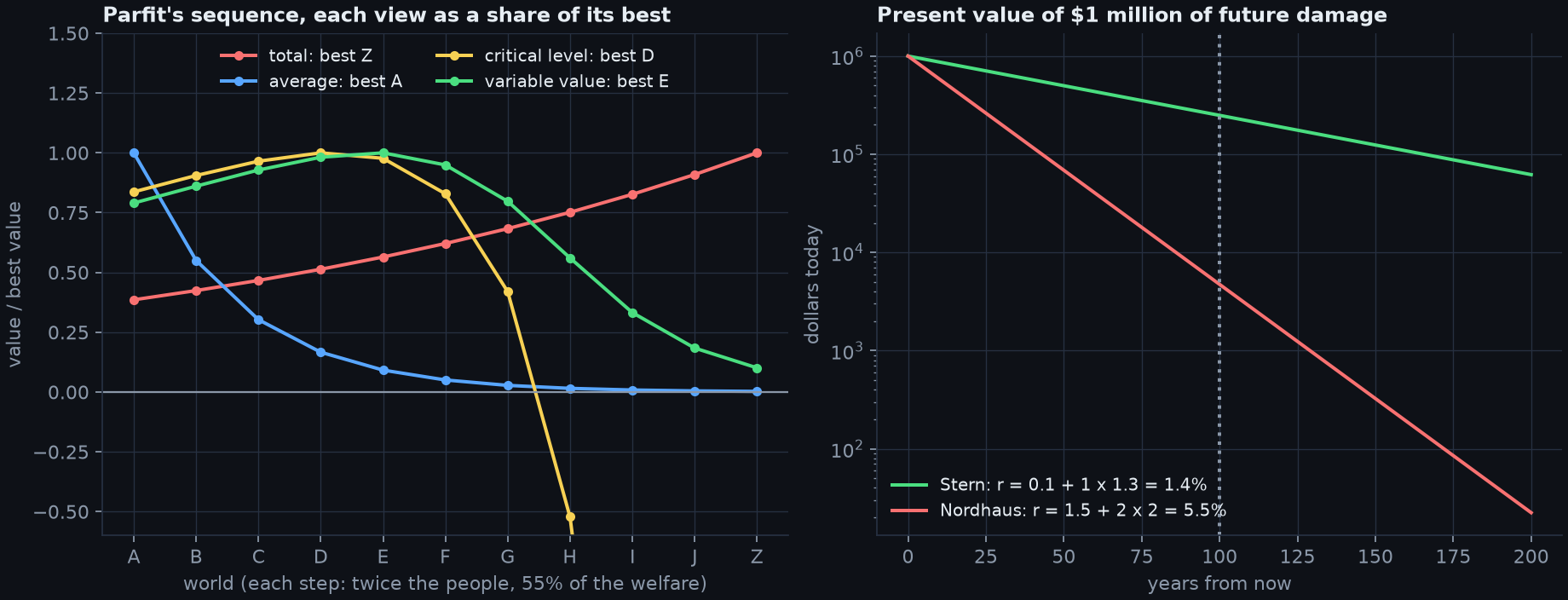
The Reasoner scores Parfit's famous sequence. World A has one unit of population, say ten billion people, each at welfare one hundred. Each next world has twice the people, each at fifty five percent of the welfare, so the total rises ten percent a step. After ten steps comes Z: a thousand and twenty four times the people, each at a quarter of a point, lives barely worth living. The total view counts every step an improvement, and ranks Z best of all. The average view ranks A best, and every step a loss. A critical level of two ranks D best: from there on, more lives below two make things worse. And variable value, whose weight on numbers grows but is bounded, peaks at E. Four views, four different best worlds, from the same data.
What it establishes: Parfit; Sidgwick (1874); Blackorby, Bossert and Donaldson; Hurka (1983); Ng (1989).; Computed on screen: Parfit's sequence under four views
2The repugnant conclusionIntroductory4 min
Parfit followed the sequence to its end. Draw each world as a block, width the number of people, height their welfare, so that the area is the total. A is ten billion people, all with a very high quality of life. B is twice as wide and a little more than half as tall; C twice as wide again; each step adds ten percent to the area. By the total view each step is an improvement. So after enough steps we reach Z: a population so large that its block runs off the screen, a thousand and twenty four times as wide as A, and so low that its lives are barely worth living. Parfit pictured them as lives with nothing in them but muzak and potatoes. By the total view, Z is better than A.
Parfit called this the repugnant conclusion, and stated it carefully. For any possible population of at least ten billion people, all with a very high quality of life, there must be some much larger imaginable population whose existence, if other things are equal, would be better, even though its members have lives that are barely worth living. He thought it should be avoided, and he returned to the problem for the rest of his life; one of his last papers, in 2016, asked whether we can avoid the repugnant conclusion at all.
Can we trust the intuition against Z? Psychologists have a name for one way it might mislead: scope insensitivity. In a study by William Desvousges and colleagues, published in 1993, people were asked what they would pay to save migrating birds from drowning in oil ponds. Told that two thousand birds were at stake, they offered about eighty dollars on average; for twenty thousand, seventy eight; for two hundred thousand, eighty eight. A hundredfold change in the good barely moved the valuation. If our feelings cannot register the difference between thousands and hundreds of thousands, they may not register what an astronomically large population of lives just worth living contains. That is the debunking argument of Tännsjö and Huemer. The reply is that the intuition concerns quality, not quantity: what Z lacks is everything that makes lives go well, and no count of potatoes supplies it.
The responses fall into families. Some accept the conclusion. Torbjörn Tännsjö and Michael Huemer argued that we cannot imagine huge numbers, or how good a life just above zero really is, so the intuition against Z is unreliable; in 2021, more than two dozen population ethicists signed a joint statement that avoiding the repugnant conclusion should not be a requirement for an acceptable theory. Others reject the total view. The average view avoids the conclusion, at costs we will compute in chapter four. Critical levels and variable value avoid it too, at other costs. And Gustaf Arrhenius found something worse that the total view accepts, the very repugnant conclusion. A world in which as many people as in A live in agony, at minus fifty, is better than A, provided enough lives barely worth living are added. The Reasoner counts how many: six hundred and one times A's population, at a quarter each.
What it establishes: Parfit (1984, 2016); Desvousges et al. (1993); Tännsjö (2002); Huemer (2008); Arrhenius.; Computed on screen: the blocks; the very repugnant conclusion
3Mere additionIntroductory4 min
Parfit's deepest argument for the conclusion does not assume the total view at all. Start with A: ten people, each at ten. Now add ten more people, each at four, living somewhere that affects no one in A: a mere addition. A plus is hard to call worse than A: the new people have lives worth living, and no one else is touched. Now compare A plus with B: the same twenty people, all at seven and a half. B has more in total, more on average, and perfect equality; it seems better than A plus. So, by transitivity, B is better than A. Now repeat: add twenty people at three, then equalize at five and a half. Each step looks harmless, and the staircase runs down to Z.
The Reasoner asks each view about each step. The total view accepts them all. The average view resists the first: since the added people are below the average, it calls A plus worse than A, though no one in A is touched and the new lives are good. The critical-level, variable-value and prioritarian views accept every step in these small worlds: the added lives at four and three are above the critical level of two, and too few to drag down a variable-value score. Followed far enough, each of them faces the same staircase, with steps of their own size.
Arrhenius and Michael Huemer sharpened the first step. Instead of a mere addition, take a benign one: from A, ten people at ten, to A plus plus, in which the same ten people are a little better off, at ten and a half, and ten new people live at four. Everyone who exists in A is better off, and every added life is good. The total rises from a hundred to a hundred and forty five, and every view the Reasoner knows prefers A plus plus, but one. The average view still calls it worse, seven and a quarter against ten. Huemer's In Defence of Repugnance, of 2008, argues that this is decisive: denying the step means denying an improvement for everyone combined with a mere addition. He follows the staircase all the way down, and accepts Z.
Four claims cannot all be true. Adding lives worth living, affecting no one else, does not make an outcome worse. A larger total, shared more equally among the same people, is better. Better than is transitive. And A is better than Z. Together, the staircase makes the first three entail that Z is better than A. Accept Z, with Tännsjö, Huemer and the total utilitarians. Deny mere addition, with the average and critical-level views: adding good lives can make things worse. Deny that B beats A plus: Parfit himself suggested a perfectionism on which losing the best things in life, the music of Mozart, is not made up by any amount of lesser goods. Or deny transitivity, as Larry Temkin did in Rethinking the Good, in 2012, and Stuart Rachels before him: better than may not be a single ranking at all.
What it establishes: Parfit (1984, 1986); Huemer (2008); Temkin (2012); Rachels (1998); the Price List.; Computed on screen: the staircase; each view's verdicts; the benign addition
4ImpossibilityResearch4 min
Every view so far has a cost. Gustaf Arrhenius showed, in 2000, that this is no accident. He listed conditions that any acceptable ranking of populations should meet, each very hard to deny: among them, avoiding the repugnant conclusion, avoiding what he called the sadistic conclusion, and a weak form of mere addition. He proved that no ranking meets them all: an impossibility theorem in the style of Arrow's theorem about voting, which Part 39 builds. His later theorems weakened the conditions further and further, and the impossibility remained. The Reasoner runs the experiment behind such theorems: six conditions, five views, and a search through small populations for a counterexample to each.
Here is the search. The columns are six conditions: no repugnant conclusion, mere addition, a preference for equality among the same number of people, non-sadism, that adding miserable lives makes things worse, and dominance, that making everyone better off is better. The total view fails only the first. The average view fails three. Critical-level and variable-value views each fail two. And the prioritarian view fails the first, like the total view: putting more weight on the worse off does not stop numbers from outweighing quality. Every row has a cross; dominance and equality are the only columns everyone keeps.
One of Arrhenius's conditions deserves a closer look. Start with one person at ten. Compare adding one life of misery, at minus one, with adding five lives worth living, at one. On a critical-level view with level two, each of the five good lives counts as minus one, because it falls short of two: five in all. The miserable life counts as minus three. So adding misery scores five, and adding good lives scores three. The view prefers to add a miserable life rather than five lives worth living. Arrhenius called this the sadistic conclusion, and every critical-level view with a positive level implies it. The total view says the opposite, fifteen against nine. Avoiding the repugnant conclusion with a critical level buys the sadistic one.
And here are some of the counterexamples it found. For the total view, a thousand lives at one beat ten lives at ten: the repugnant conclusion in miniature. For the average view, adding one person at eight to a world of one person at ten makes it worse. Worse still, adding a miserable life at minus one to a hell of one person at minus two makes it better, since it raises the average. For a critical level of two, adding one miserable life is better than adding five lives worth living at one: the sadistic conclusion. And for variable value, adding twenty lives at one to ten lives at ten makes things worse. Each condition can be kept, but not all of them at once.
This is the thirty sixth brick in the Wall. The dream was an axiology for populations that meets every adequacy condition: one that avoids the repugnant conclusion, never prefers misery, and respects mere addition and equality. Arrhenius's impossibility theorems show there is none. What it forces is a choice of which repugnant-seeming conclusion to accept; a growing number of population ethicists now accept Parfit's as the least bad.
What it establishes: Arrhenius (2000); the Wall's thirty-sixth brick.; Computed on screen: six conditions, five views, searched; the sadistic conclusion
5Person-affecting viewsIntroductory7 min
Many people find the whole question odd. Jan Narveson put the intuition in 1973: we are in favour of making people happy, but neutral about making happy people. Behind it is a person-affecting restriction: an outcome can be worse only if it is worse for someone. It comes with an asymmetry, so named by Jeff McMahan in 1981: we have strong reason not to create a life that would be miserable, but no comparable reason to create one that would be happy. The view avoids the repugnant conclusion at a stroke, since people who would merely be possible make no claims on us. But it has a puzzle at its heart: if a happy life is not good for the person who would live it, why is a miserable life bad for the person who would live that one?
John Broome, in Weighing Lives, of 2004, argued that the intuition of neutrality cannot be quite what it seems. Neutrality says that adding a person at any level within a range of good lives is equally as good as not adding her. Then A, a world of one person, is equally as good as A plus someone at four, and equally as good as A plus the same person at eight. By transitivity, those two are equally good. But the second is plainly better than the first: the same people, with one of them better off. The Reasoner tries a range of four levels, two, four, six and eight; every one of the six pairs gives a contradiction. So neutrality can hold at one level at most, which is a critical-level view, with the sadistic conclusion that comes with it. Broome concluded that the intuition, however attractive, cannot be right as it stands, and that vagueness in betterness may explain its pull.
David Benatar took the asymmetry to its limit in Better Never to Have Been, of 2006. Compare a person's existing with her never existing. If she exists, her pains are bad and her pleasures good. If she never exists, the absence of her pains is good, even though no one enjoys it, while the absence of her pleasures is not bad, because no one is deprived of them. Never existing then wins on pain and ties on pleasure, however good the life. So coming into existence is always a harm, and it would be better if no more people were born: antinatalism. Most philosophers reject the conclusion, and so must reject a premise: either the absence of pleasure is a loss if the absence of pain is a gain, or the asymmetry of this chapter was wrong from the start.
Parfit's non-identity problem tests the restriction hardest. A society chooses between depleting its resources and conserving them. Depletion gives each of us a little more, ten units, and in three centuries the people alive are worse off, at forty. Conservation gives us nothing extra, and the people then are at sixty. But which people are born depends on who meets whom, and when; a policy this large changes all of that. After three centuries, the two policies lead to entirely different people. So is anyone worse off under depletion than they would otherwise have been? The Reasoner checks each person: we are better off; the later people would not have existed at all, and their lives are worth living. The count is zero. A narrow person-affecting view must say depletion is not worse. Almost everyone thinks it is, and the total view agrees: forty one thousand against sixty thousand.
Parfit's best-known example is personal. A fourteen-year-old girl chooses to have a child now, rather than in ten years, when she could give a child a far better start. The child she has is not worse off than it would otherwise have been, because otherwise it would not have existed; yet her choice seems regrettable. Wide person-affecting views compare the people in each outcome by their places rather than their identities: whoever her child is, her first child is worse off. Parfit's own principle Q says that if the same number of people would live either way, it is worse if those who live are worse off than those who would have lived. The problem is not academic. Every large policy, on climate above all, changes who will exist, so the people it will harm are, strictly, people it creates.
Can a person-affecting view be made to work? Christopher Meacham proposed one in 2012. Match the people of different outcomes one to one, by their places, so that the first child born in one outcome is the counterpart of the first child born in the other. A person is harmed by how much better her counterpart fares in another outcome; a good life with no counterpart harms no one. Choose the outcome with the least total harm. The Reasoner runs it on depletion. The thousand later people of depletion are each harmed by twenty, against their counterparts at sixty: twenty thousand. Under conservation, the hundred of us lose ten each: a thousand. Conserve: the non-identity problem is answered. And on A against Z: in Z, the ten people who stand in the places of A's ten are harmed by ninety nine point seven five each, while in A no one is harmed. Choose A: no repugnant conclusion. The price is that the verdict can change when an outcome is added to the menu, which a ranking of outcomes should never do.
What it establishes: Narveson (1973); McMahan (1981); Broome (2004); Benatar (2006); Parfit; Meacham (2012).; Computed on screen: neutrality's contradictions; depletion; harm minimization
6Discounting the futureApplied5 min
Climate policy weighs costs now against harms a century away, and the weighing runs through a discount rate. Frank Ramsey derived it in 1928. A planner maximizes the sum over time of utility from consumption, discounted at a rate delta, with a utility function whose curvature is eta. Give up one unit of consumption now, invest it at rate r, and consume e to the r t at time t. At the optimum the planner is indifferent, so the marginal utility now equals the discounted marginal utility of the return. With consumption growing at rate g, the marginal utilities cancel, and out comes the Ramsey rule: r equals delta plus eta times g. Two very different reasons to discount appear. Eta times g says the future will be richer, and a dollar matters less to the rich: that is Part 35's diminishing marginal utility, applied across time. Delta says the future matters less just because it is later. Ramsey himself called that ethically indefensible, a practice that arises merely from the weakness of the imagination.
Two famous reports disagreed by an order of magnitude. Nicholas Stern's review of 2006 set delta at a tenth of a percent, only to allow for extinction, eta at one, and growth at one point three: a rate of one point four percent. William Nordhaus, calibrating to market interest rates, used delta one and a half, eta two and growth two: five and a half percent. The curves show what that does. A million dollars of damage in a hundred years is worth two hundred and forty nine thousand dollars today to Stern, and four thousand seven hundred to Nordhaus: fifty three times less. Stern put the social cost of carbon at about eighty five dollars a tonne of carbon dioxide; Nordhaus's figure was a small fraction of that. In 2023 the United States Environmental Protection Agency used a hundred and ninety dollars a tonne, at a two percent rate. The disagreement is mostly not about climate science. It is about delta and eta: whether later people matter less, and how much inequality between generations matters.
Here is what the disagreement does to a single decision. Today's output is a hundred. A policy costs one percent of it now, and avoids a loss of five percent of output a century from now. With Stern's growth, output in a hundred years is three hundred and sixty four, so the damage avoided is eighteen; discounted at one point four percent it is worth four and a half today, four and a half times the cost. Act. With Nordhaus's faster growth, the future is richer and the damage larger, thirty six; but discounted at five and a half percent it is worth less than a fifth of the cost. Wait. The same science, the same policy, opposite verdicts, from two choices about ethics.
Stern's small delta has a second reading, which connects this chapter to the next. He defended a positive pure rate only as the chance that there will be no future generations at all. A weight on the future, read this way, is the probability that there is one. A tenth of a percent a year means a ninety point five percent chance that humanity survives the next century, and thirty seven percent that it survives a thousand years. Toby Ord's estimate of one in six this century corresponds to an annual rate of about point one eight percent, nearly twice Stern's. On this reading delta is not impatience but probability, and Ramsey's objection does not apply. How much the far future should count and how likely it is to exist turn out to be one question, which the next chapter takes up.
Martin Weitzman added a twist in 1998. Suppose we do not know the right rate: it is one percent or five percent, equally likely. What we should average is not the rates but the discount factors, and as the horizon grows the factor at five percent vanishes, leaving the one percent to dominate. The certainty-equivalent rate starts near three percent and declines, to one point six eight percent at a hundred years and one point one seven at four hundred, approaching the lowest possible rate. Weitzman later surveyed more than two thousand economists and turned their disagreement into a declining schedule. Britain's Treasury uses one: three and a half percent for the first thirty years, falling to one percent beyond three hundred. Uncertainty about how much the future counts makes the far future count more.
What it establishes: Ramsey (1928); Stern (2006); Nordhaus (2008); EPA (2023); Weitzman (1998, 2001).; Computed on screen: the Ramsey rule; present values; one policy; δ as hazard; declining rates
7The long futureAdvanced4 min
Combine the total view with the size of the possible future, and a striking thesis follows. Hilary Greaves and William MacAskill called it strong longtermism, in 2021: if the future could hold vastly more lives than the present, and we can affect its course, then the best acts available to us are, in large part, those with the best effects on the very long run. The clearest case is existential risk, Nick Bostrom's term for a catastrophe that ends humanity or permanently curtails its potential. How large is it? Toby Ord, in The Precipice of 2020, put the chance of such a catastrophe this century at about one in six. That is one author's considered judgment, not a measurement, and others put it far lower. The lever is arithmetic: with the total view and a future this large, even tiny changes in risk carry enormous expected value. Whether they do depends on more than the size of the future, as the Reasoner shows next.
Parfit's sentence from the opening of this part came with an example. Compare three outcomes: peace; a nuclear war that kills ninety nine percent of the world's existing population; and a nuclear war that kills a hundred percent. Most people think the greater difference is between peace and the first war. Parfit thought the difference between the two wars is very much greater. The Reasoner counts lives lost. Counting only existing people, the first step costs seven point nine two billion lives and the second eighty million: the second is a hundredth of the first. Counting the future too, with Nick Bostrom's conservative figure of ten to the sixteen lives that Earth alone could support, the second step loses all of it: about one point three million times the first. Which answer is right is the whole question of this part: whether the lives that would have been lived count.
David Thorstad showed in 2023 that the answer turns on a hidden assumption. Measure value in centuries of civilization like ours, v each. If this century's risk of extinction is r one, and every later century's is r, the expected value of the future is a geometric series: v times one minus r one, over r. So cutting this century's risk by delta r one adds v delta r one over r: the gain is divided by the risk in all later centuries. If the risk stays at one in six, the expected future is only five centuries, and cutting this century's risk by a full percentage point is worth six hundredths of a century. If instead we are in a time of perils, after which risk falls to one in ten thousand, the expected future is eight thousand centuries, and the same cut is worth a hundred. The Reasoner sums the series to a hundred thousand centuries and matches the formula. The astronomical value of reducing risk requires not only a vast possible future, but a reason to think the dangerous period will end.
Longtermism has serious critics. Hilary Greaves herself described cluelessness in 2016: the long-run effects of almost anything we do are unknowable, and they may swamp the short-run effects in either direction. Christian Tarsney studied in 2023 how our ability to predict decays with time; whether longtermism survives depends on how fast. On person-affecting or average views, the merely possible people of the future carry far less weight. And the argument leans on tiny probabilities of astronomical value, which can dominate every decision. That is the problem of fanaticism, the next chapter.
What it establishes: Greaves and MacAskill (2021); Bostrom (2002); Ord (2020); Thorstad (2023); Greaves (2016); Tarsney (2023).; Computed on screen: Parfit's three outcomes; the value of a point of risk
8FanaticismAdvanced3 min
Nick Bostrom told a story in 2009. A mugger without a weapon approaches Pascal and asks for his wallet. In return he promises, by magic, an extra thousand quadrillion happy days of life. Pascal thinks this is almost certainly false; but not, surely, as unlikely as one in a thousand quadrillion. So the expected value of handing over the wallet is positive, and a maximizer of expected value must pay. Worse, whatever Pascal's doubt, the mugger can raise his offer faster than the probability falls. The same structure, small probabilities and astronomical payoffs, runs through the arguments of the last chapter.
The Reasoner builds the chain that Nick Beckstead and Teruji Thomas used to make the problem precise. Lottery zero gives one unit of value for sure. Each next lottery halves the chance of winning and multiplies the prize by ten. Every step looks like an improvement, and expected value agrees, multiplying by five each time. By transitivity, a one in four thousand chance of a trillion beats the sure thing, and the chain never stops: that is recklessness, or fanaticism. A bounded utility, here x over x plus a thousand, stops climbing: it peaks at the third lottery and declines after. It is timid: at some step it refuses to trade a small loss of probability for a vast gain in the prize. Ignoring every chance below one in a thousand stops abruptly at step ten, a step that looks exactly like the nine before it. Beckstead and Thomas proved that every theory of choice must be reckless, timid, or give up transitivity. There is no fourth way.
How should we live with the trilemma? Hayden Wilkinson, in In Defence of Fanaticism, 2022, chose recklessness. He argued that every alternative is worse: a theory that refuses the long shots must break a principle of dominance, or let the right choice depend on events far away, in distant galaxies or the distant past, that the choice cannot affect. Others accept timidity: a bounded utility, as Part 33 used against St Petersburg, or Bradley Monton's proposal of 2019 to discount small probabilities. Some question the inputs: a credence about a mugger's magic may not be a precise number at all, as Part 13 allowed. The question is practical. The case for spending on remote catastrophes rests on such probabilities, and how far to trust the arithmetic is itself a decision.
What it establishes: Bostrom (2009); Beckstead and Thomas; Wilkinson (2022); Monton (2019).; Computed on screen: a chain of long shots under three rules
9Infinite ethicsResearch4 min
If the universe is infinite, or humanity's future has no end, our rankings must compare infinite streams of welfare. Here are two: a alternates one, zero, one, zero, for ever; b alternates zero, one. The catching-up criterion, from 1965, ranks a above b if the partial sums of their difference end up non-negative. They run one, zero, one, zero: a is never behind, and b is behind infinitely often, so a is better. But b is just a with its generations relabelled, each pair swapped: an infinite permutation. If everyone counts equally whatever their position, the two should be equal. So impartiality across generations must be weakened to finite permutations, and even that, it turns out, is too much to ask of a numerical measure.
Kaushik Basu and Tapan Mitra proved in 2003 that two mild principles cannot both hold of any numerical measure of infinite streams. Suppose W gives every stream a real number, respects strong Pareto, so that a stream at least as good everywhere and better somewhere scores higher, and respects finite anonymity, so that swapping finitely many generations changes nothing. List the rational numbers between zero and one: a half, a third, two thirds, a quarter, and so on. For each real number r, let the stream x of r have a one at place n exactly when the n-th rational is below r. Here r is point three. Let y of r be x of r with one more one, at the first place whose rational is at least r. By Pareto, y of r scores more than x of r. Now take a larger s, here point four five. Move y's extra one into a place whose rational lies between r and s: a finite swap, so the score is unchanged. The swapped stream is below x of s everywhere, and strictly below where the rationals two fifths and three sevenths sit; so y of r scores less than x of s. So each real r owns an interval of scores, from x of r to y of r, and no two intervals overlap. Each contains a rational number of its own; but there are uncountably many reals and only countably many rationals. No such W exists.
What survives? Lars-Gunnar Svensson showed in 1980 that complete orderings with both principles exist, but only through the axiom of choice; William Zame showed in 2007 that none can be explicitly written down. So practical rankings, like catching up, accept incompleteness: many pairs of streams are simply not ranked. Nick Bostrom described infinitarian paralysis in 2011: if the world already contains infinitely much good and bad, no act changes the total, and an aggregative ethics seems to say that nothing we do matters. Amanda Askell and others have proposed principles that rank acts by the changes they make, region by region, rather than by totals. This is the part's second impossibility, beside Arrhenius's: impartiality, aggregation and infinity cannot all be kept.
What it establishes: Diamond (1965); Basu and Mitra (2003); Svensson (1980); Zame (2007); Bostrom (2011); Askell (2018).; Computed on screen: catching up; the Basu–Mitra construction
10Doing the most goodApplied4 min
Health systems must weigh lives every day, and they do it with a common currency. A quality-adjusted life year counts each year of life weighted by its quality, from zero for death to one for full health on this simplified scale. The weights come from surveys, by the time trade-off, how many years of full health would you accept in place of ten with this condition, or by the standard gamble, Part 33's lotteries. The disability-adjusted life year, used by the World Health Organization and the Global Burden of Disease, counts years of life lost, YLL, plus years lived with disability weighted by its severity. Here d is the disability weight, from zero for full health to one for a state equivalent to death, multiplied by the duration in years. Cost-effectiveness is extra cost over extra QALYs. The currency lets a health service compare hip replacements, vaccines and bed nets. And every weight is a value judgment: critics point out that QALYs count a year lived with a disability as worth less.
Why does the choice of intervention matter so much? The Reasoner draws two hundred interventions whose costs per QALY are spread log-normally, the heavy-tailed shape that surveys of real interventions report, and sorts them. The best costs a hundred and five dollars per QALY; the median four thousand five hundred and eighty nine; the worst over seven hundred thousand. A million dollars buys nine thousand four hundred and ninety nine QALYs at the best, and two hundred and eighteen at the median: forty four times as many. Toby Ord's analysis, in 2013, of a major survey of health interventions in poor countries found the best about fifteen thousand times as cost-effective as the worst. This is the core of effective altruism, the movement that grew from Peter Singer's argument of 1972: give, and give where it does the most good, because the differences are not a few percent but orders of magnitude.
Impartiality raises one more question: whose welfare counts? Bentham answered in a footnote of 1789: the question is not, can they reason? nor, can they talk? but, can they suffer? Peter Singer's Animal Liberation, of 1975, made equal consideration of interests the basis of a movement. Under uncertainty, a being's expected moral weight is its numbers, times the probability that it is sentient, times how much welfare it can have. The Reasoner runs a toy with invented numbers: three kinds of being, each more numerous and less likely to be sentient. Per human, the last kind, a million strong, one percent likely to feel anything, with a thousandth of our welfare range, carries ten times the expected weight of humanity. Research groups now try to estimate such numbers for real animals. Whatever they find, the structure is the one this part keeps meeting: vast numbers multiplied by small probabilities can dominate everything else.
Effective altruism has grown into a large movement, with large critics. Peter Singer's The Most Good You Can Do and William MacAskill's Doing Good Better, both of 2015, set out its method: evidence, cost-effectiveness, and impartiality between people near and far. Critics say what is easy to count crowds out what matters but is hard to count: rights, institutions, dignity. Amia Srinivasan in 2015, and Iason Gabriel in 2017, pressed the objection from systemic change: charity at the margin can leave unjust structures in place, and may even prop them up. And Alice Crary argued in 2023 that the impartial calculus misdescribes what we owe to particular others, the objection from care that Part 35 raised.
What it establishes: Singer (1972, 1975, 2015); MacAskill (2015); Ord (2013); Srinivasan (2015); Gabriel (2017); Crary (2023).; Computed on screen: a heavy-tailed portfolio; expected moral weights
11Pricing livesApplied5 min
Governments put a number on life, and the number has a precise meaning. Thomas Schelling's essay of 1968, The Life You Save May Be Your Own, separated identified lives from statistical ones. Suppose workers accept one in ten thousand more annual risk of death for twelve hundred dollars more a year. Then together they trade twelve million dollars for one expected death: the value of a statistical life. It is not the price of a person, but the rate at which people trade money for small risks, and American agencies use values of roughly ten to thirteen million dollars. Cost-benefit analysis then sorts regulations. Guard rails costing twenty million dollars that prevent two deaths pass: twenty four million in benefits. A camera rule costing forty million that prevents three fails at twelve million a life, and would pass at anything above thirteen point three. Whole regulations turn on that number.
Health systems with fixed budgets use QALYs directly. England's National Institute for Health and Care Excellence has long recommended treatments that cost up to about twenty to thirty thousand pounds per QALY gained. The logic is opportunity cost: with a fixed budget, a treatment far above the threshold displaces more health elsewhere than it creates. Against it stands what Albert Jonsen called the rule of rescue, in 1986: the imperative we feel to save an identified person in peril, whatever the cost. It is Schelling's distinction again, and Taurek's question from Part 35: should the numbers count, when the one is in front of us and the many are statistics?
Maximizing QALYs has a famous problem. One course of treatment, three patients, each of whom will die without it. A thirty-year-old would gain forty years in full health: forty QALYs. Another thirty-year-old, with a disability that the weights rate at a half, would gain the same forty years, but only twenty QALYs. A seventy-year-old would gain twelve. QALY maximization treats the first. John Harris called it double jeopardy, in 1987: the disabled patient, already unlucky, is counted as worth saving half as much. Alan Williams proposed in 1997 a fair innings weighting, which favours those who have not yet had a normal span of life; it widens the gap over the seventy-year-old, but not between the two younger patients. A prioritarian weighting, by how few QALYs each patient would have over a whole life, makes the two thirty-year-olds tie exactly, at fifty seven point one each. The choice of weight is the choice of ethics.
The value of a statistical life comes from willingness to pay, and that depends on what people can pay. Agencies that need a value for a country without its own studies transfer the American figure, scaled by relative income raised to an elasticity epsilon. With epsilon one, a country with a fifth of American income gets two point four million dollars; a twentieth, six hundred thousand; a fiftieth, two hundred and forty thousand. With an elasticity of one point two, the last falls to a hundred and ten thousand. In a global cost-benefit analysis, then, a life in the poorest country counts a fiftieth as much as an American's. When a chapter of an IPCC report did this arithmetic in 1995, valuing statistical lives in poor countries at a fraction of those in rich ones, it was widely condemned. Weight each dollar by one over the income of the person whose dollar it is, as diminishing marginal utility recommends, and with epsilon one the weighting undoes the scaling exactly: one life, one value.
The practice has critics too. Elizabeth Anderson argued in Value in Ethics and Economics, of 1993, that some goods are degraded by being priced at all. And willingness to pay rises with income, so a method built on it prices the poor low because they are poor. The equity weighting of the last section is one answer: count each dollar of benefit by one over the income of the person who receives it, exactly what Part 35's logarithmic welfare implied. The defence of pricing is simple. We already price lives whenever we set a speed limit or a budget; it is better to do it in the open, and consistently.
What it establishes: Schelling (1968); Jonsen (1986); Harris (1987); Williams (1997); Anderson (1993).; Computed on screen: a VSL; two regulations; three weightings; VSL transfer
Recap, problems, and where this comes backAll tracks3 min
Let's gather what we built. Four axiologies, with four different best worlds on Parfit's sequence. The repugnant conclusion, and the very repugnant one, at six hundred and one times A's population. The mere addition paradox, step by step, and its Price List. Six conditions and five views, with a cross in every row: Arrhenius's impossibility, this part's brick in the Wall. The asymmetry, and the non-identity problem, where the count of people harmed is zero. The Ramsey rule, derived, Stern against Nordhaus by a factor of fifty three, and Weitzman's declining rates. A point of extinction risk worth six hundredths of a century or a hundred centuries, and a chain of long shots that forces recklessness, timidity or intransitivity. Basu and Mitra's theorem, proved; QALYs and heavy tails; and a statistical life valued at twelve million dollars.
The Reasoner has a new module, population. It scores populations by four axiologies, runs Parfit's sequence and the mere addition staircase, searches small populations for violations of six conditions, counts who is harmed in a non-identity case, discounts by the Ramsey rule, values reductions in existential risk, climbs a chain of long shots, compares infinite streams, ranks interventions by cost per QALY, and derives a value of a statistical life. And the Wall has its thirty sixth brick.
Six problems, with full solutions in this part's notes. When the average view calls a mere addition worse; why every positive critical level is sadistic; the Ramsey rule for logarithmic utility; what halving this century's risk is worth when the risk stays constant; two streams that catching up cannot rank; and a break-even value of a statistical life. Pause here, and try them.
Where this comes back. Whether our intuitions about Z are evidence of anything, in Part 37. Justice between generations, and Rawls's just savings principle, in Part 38. Arrow's theorem, the model for Arrhenius's, in Part 39. Algorithms that allocate scarce care, and their fairness, in Part 41. And the long future of minds like ours, and of machines, in Part 42. Next, Part 37: is and ought.
The books and papers this part follows are on screen, and in the notes. Thanks for watching.
Where it goes next. Whether intuitions about Z are evidence of anything is taken up in Part 37, and justice between generations with Rawls's just savings principle in Part 38. Arrow's theorem, the model for Arrhenius's, is built in Part 39; algorithms that allocate scarce care return in Part 41, and the long future of minds and machines in Part 42.
Key results
The part's results in one place, for revision.
Try it
Lab 36 · Four best worlds, a cross in every row, and two discount rates
Score Parfit's sequence A to Z under the total, average, critical-level and variable-value views and recompute each view's best world from its formula; test the average view's verdict on 500 random mere additions; run the search for violations of six conditions; and check the Ramsey present values and the value of a point of extinction risk against their closed forms.
python -m videos.philosophy.labs 36
needs numpy, scipy, matplotlib · download lab36.py ·
source on GitHubbest world on Parfit's sequence, from the formulas total: Z, average: A, critical level: D, variable value: E
Z against A 1024 people at 0.25 each: total 259 against 100
average view: 'worse' exactly when the added lives are below average 500 of 500 random additions
conditions each view violates total: 1; average: 3; critical level: 2; variable value: 2; prioritarian: 1
critical level 2: add one life at -1, or five at +1 5 against 3 (total view: 9 against 15)
a million dollars in a century, today Stern (1.4%) $249,003; Nordhaus (5.5%) $4,729; ratio 53
one point less extinction risk this century is worth 0.060 centuries if risk stays 1 in 6; 100 if it then falls to 1 in 10,000
Each view is one line of arithmetic and each picks a different world; each also fails at least one condition that seems undeniable, which is what Arrhenius's theorems say must happen. How much the far future weighs then turns on two numbers: the discount rate and the risk that follows this century.The code (95 lines; it asserts its own result)
"""Lab 36: score Parfit's sequence under four views, search for each view's counterexample, and discount a century."""

import numpy as np

from videos.coursekit import labs
from explainer.philosophy.reasoner import population as pop

TITLE = "Four best worlds, a cross in every row, and two discount rates"
GOAL = ("Score Parfit's sequence A to Z under the total, average, critical-level and variable-value views and "
        "recompute each view's best world from its formula; test the average view's verdict on 500 random mere "
        "additions; run the search for violations of six conditions; and check the Ramsey present values and the "
        "value of a point of extinction risk against their closed forms.")
TASKS = [
    "Change the sequence so that each step keeps 45% of the welfare (shrink=0.45). Which views change their "
    "best world, and why does the total view no longer reach Z?",
    "Raise the critical level from 2 to 20. Where on the sequence does the critical-level view now stop, and "
    "what does the sadistic example (pop.sadistic_example) score?",
    "Discount at Weitzman's declining rate instead: average the factors exp(-0.01 t) and exp(-0.05 t). What is "
    "a million dollars in 100 and in 400 years worth, against the constant 3% rate?",
]


def run(seed=0):
    rng = np.random.default_rng(seed)
    lab = labs.Lab()
    seq = pop.parfit_sequence()
    k = np.arange(11)
    n, w = 2.0 ** k, 100 * 0.55 ** k
    mine = {"total": n * w, "average": w, "critical level": n * (w - 2), "variable value": w * 50 * (1 - np.exp(-n / 50))}
    names = [r["name"] for r in seq["rows"]]
    best = {v: names[int(np.argmax(x))] for v, x in mine.items()}
    lab.row("best world on Parfit's sequence, from the formulas", ",  ".join(f"{v}: {b}" for v, b in best.items()))
    assert best == {"total": "Z", "average": "A", "critical level": "D", "variable value": "E"}, "four views, four worlds"
    assert all(seq["best"][v] == best[v] for v in best), "the Reasoner agrees"
    for v, x in mine.items():
        assert np.allclose([r[v] for r in seq["rows"]], x, atol=1e-3), v
    z = seq["rows"][-1]
    lab.row("Z against A", f"{z['n']} people at {z['w']:.2f} each: total {z['total']:.0f} against 100")
    assert z["w"] < 0.3 and z["total"] > 2.5 * seq["rows"][0]["total"], "the repugnant conclusion, on the total view"

    agree = 0
    for _ in range(500):
        base = [(int(rng.integers(1, 30)), float(rng.uniform(-5, 15)))]
        add = (int(rng.integers(1, 30)), float(rng.uniform(-5, 15)))
        worse = pop.average(base + [add]) < pop.average(base)
        agree += worse == (add[1] < pop.average(base))
    lab.row("average view: 'worse' exactly when the added lives are below average", f"{agree} of 500 random additions")
    assert agree == 500

    table = pop.arrhenius_table()["violations"]
    lab.row("conditions each view violates", ";  ".join(f"{v}: {len(c)}" for v, c in table.items()))
    assert all(len(c) >= 1 for c in table.values()), "a cross in every row"
    assert table["total"] == ["quality"] and len(table["average"]) == 3 and "non-sadism" in table["critical level"]
    assert not any(c in ("dominance", "non-anti-egalitarianism") for cs in table.values() for c in cs)
    sad = pop.sadistic_example()
    lab.row("critical level 2: add one life at -1, or five at +1", f"{sad['with_misery']:g} against "
            f"{sad['with_good_lives']:g}   (total view: {sad['total_with_misery']:g} against {sad['total_with_good']:g})")
    assert sad["with_misery"] > sad["with_good_lives"] and sad["total_with_misery"] < sad["total_with_good"]

    ram = pop.ramsey()["views"]
    pv = {}
    for name, (delta, eta, g) in (("Stern", (0.1, 1.0, 1.3)), ("Nordhaus", (1.5, 2.0, 2.0))):
        r = delta + eta * g
        pv[name] = 1e6 / (1 + r / 100) ** 100
        assert abs(ram[name]["r"] - r) < 1e-9 and abs(ram[name]["pv"][100] - pv[name]) < 1
    lab.row("a million dollars in a century, today", f"Stern (1.4%) ${pv['Stern']:,.0f};  Nordhaus (5.5%) "
            f"${pv['Nordhaus']:,.0f};  ratio {pv['Stern'] / pv['Nordhaus']:.0f}")
    assert round(pv["Stern"]) == 249003 and round(pv["Nordhaus"]) == 4729

    ex = pop.existential()
    lab.row("one point less extinction risk this century is worth", f"{ex['constant_gain']:.3f} centuries if risk "
            f"stays 1 in 6;  {ex['perils_gain']:.0f} if it then falls to 1 in 10,000")
    assert abs(ex["constant_gain"] - 0.01 / (1 / 6)) < 1e-3 and abs(ex["perils_gain"] - 0.01 / 1e-4) < 0.5
    lab.note = ("Each view is one line of arithmetic and each picks a different world; each also fails at least "
                "one condition that seems undeniable, which is what Arrhenius's theorems say must happen. How "
                "much the far future weighs then turns on two numbers: the discount rate and the risk that "
                "follows this century.")

    fig, ax = labs.figure(2, size=(11.5, 4.4))
    for (v, x), color in zip(mine.items(), (labs.RED, labs.BLUE, labs.GOLD, labs.GREEN)):
        ax[0].plot(k, x / x.max(), "o-", ms=4, color=color, label=f"{v}: best {best[v]}")
    ax[0].axhline(0, color=labs.MUTED, lw=1)
    ax[0].set(title="Parfit's sequence, each view as a share of its best", xlabel="world (each step: twice the "
              "people, 55% of the welfare)", ylabel="value / best value", xticks=k, xticklabels=names,
              ylim=(-0.6, 1.5))
    ax[0].legend(loc="upper center", ncol=2)
    t = np.arange(0, 201)
    ax[1].plot(t, 1e6 / 1.014 ** t, color=labs.GREEN, label="Stern: r = 0.1 + 1 x 1.3 = 1.4%")
    ax[1].plot(t, 1e6 / 1.055 ** t, color=labs.RED, label="Nordhaus: r = 1.5 + 2 x 2 = 5.5%")
    ax[1].axvline(100, color=labs.MUTED, ls=":")
    ax[1].set(title="Present value of $1 million of future damage", xlabel="years from now",
              ylabel="dollars today", yscale="log")
    ax[1].legend(loc="lower left")
    lab.fig = fig
    return lab
Now change it
- Change the sequence so that each step keeps 45% of the welfare (shrink=0.45). Which views change their best world, and why does the total view no longer reach Z?
- Raise the critical level from 2 to 20. Where on the sequence does the critical-level view now stop, and what does the sadistic example (pop.sadistic_example) score?
- Discount at Weitzman's declining rate instead: average the factors exp(-0.01 t) and exp(-0.05 t). What is a million dollars in 100 and in 400 years worth, against the constant 3% rate?
Problems, with solutions
Try each problem before opening its solution.
-
Show that the average view calls a mere addition worse exactly when the added lives are below the average.
Solution
A world of \(N\) people with average welfare \(a\) gains \(M\) people with average \(b\), everyone else untouched. The new average is \((Na + Mb)/(N + M)\), and \((Na + Mb)/(N + M) < a\) exactly when \(Mb < Ma\), that is \(b < a\). So the average view calls the addition worse exactly when the added lives are below the existing average, however good they are, and better when they are above it, even if they are miserable but less so than everyone else (the hell example).
-
Show that every critical-level view with c > 0 implies the sadistic conclusion.
Solution
A critical-level view scores a population by \(\sum_i (w_i - c)\). Compare adding one miserable life at \(-\varepsilon\), which contributes \(-\varepsilon - c\), with adding \(n\) lives worth living at some level \(w\) with \(0 < w < c\), which contribute \(-n(c - w)\). The miserable life scores higher whenever \(n(c - w) > c + \varepsilon\), that is \(n > (c + \varepsilon)/(c - w)\), which some finite \(n\) always satisfies when \(c > 0\). So for every positive critical level there are cases where adding a miserable life is better than adding many lives worth living: the sadistic conclusion. (The film's case: \(c = 2\), five lives at 1 against one at \(-1\).)
-
Derive the Ramsey rule for u(c) = log c, and say what η is. (η = 1.)
Solution
The planner maximizes \(\int_0^\infty e^{-\delta t} u(c_t)\,dt\). Giving up a unit now and investing it at rate \(r\) returns \(e^{rt}\) at time \(t\); at the optimum \(u'(c_0) = e^{-\delta t} e^{rt} u'(c_t)\). With \(u(c) = \log c\), \(u'(c) = 1/c\), and with consumption growing at rate \(g\), \(c_t = c_0 e^{gt}\), so \(1/c_0 = e^{(r - \delta)t}/(c_0 e^{gt})\), hence \(r = \delta + g\). The general rule is \(r = \delta + \eta g\), where \(\eta = -c\,u''(c)/u'(c)\) is the elasticity of marginal utility; for log utility \(-c \cdot (-1/c^2)/(1/c) = 1\), so \(\eta = 1\).
-
With constant risk r after this century, show that halving this century's risk r is worth half a century, whatever r.
Solution
With risk \(r\) per century in every later century, and survival of this one, humanity's expected future (counting this century) is \(\sum_{k \ge 0}(1 - r)^k = 1/r\) centuries. If this century's risk is also \(r\), the expected number of centuries from now is \((1 - r)/r\), plus the current one. Halving this century's risk to \(r/2\) makes it \((1 - r/2)/r\). The gain is \((1 - r/2)/r - (1 - r)/r = (r/2)/r = \tfrac12\) century, whatever \(r\) is. A higher background risk makes the future shorter but this century's survival matters more, and the two cancel exactly (Ord, Thorstad).
-
Find two streams that the catching-up criterion leaves unranked.
Solution
The catching-up criterion ranks stream \(x\) at least as good as \(y\) if, from some time on, every partial sum of \(x - y\) is non-negative. Take \(x = (1, 0, 2, 0, 2, 0, \ldots)\) and \(y = (0, 2, 0, 2, 0, 2, \ldots)\). Then \(x - y = (1, -2, 2, -2, 2, \ldots)\), whose partial sums are \(1, -1, 1, -1, \ldots\) forever. They are never eventually non-negative, and neither are those of \(y - x\), so neither stream catches up with the other, and the criterion leaves them unranked.
-
A rule costs $90 million and prevents 7 expected deaths: find its break-even VSL. ($12.86 million.)
Solution
The break-even value of a statistical life is cost divided by expected deaths prevented: 90 million dollars divided by 7, about 12.86 million dollars. If the agency values a statistical life above that, the rule passes the cost-benefit test; below it, it fails. (US agencies used figures around 11 to 13 million dollars in the early 2020s, so this rule sits close to the line.)
Notes and sources
About this partfrom its README
Part 36 of Philosophy, Built (series plan, syllabus), in Act VII, Value: population ethics and the far future. Parfit's question (1984) and his blocks; the total (Sidgwick 1874), average, critical-level (Blackorby, Bossert and Donaldson) and variable-value (Hurka 1983; Ng 1989) views, each a formula, scored on Parfit's sequence A, B, …, Z (twice the people, 55% of the welfare, 10% more in total at each step): four views, four best worlds (Z, A, D, E). The repugnant conclusion, drawn and stated; scope insensitivity (Desvousges et al. 1993: $80, $78, $88 for 2,000, 20,000 and 200,000 birds) and the debunking reply (Tännsjö 2002; Huemer 2008; the joint statement of 2021); Arrhenius's very repugnant conclusion at 601 times A's population. The mere addition paradox, A → A+ → B → B+ → C, each view's verdict at each step; the benign addition, which only the average view refuses; and a Price List for the repugnant conclusion (accept Z; deny mere addition; Parfit's perfectionism; deny transitivity, with Temkin and Rachels). Arrhenius's impossibility theorems (2000), with the experiment behind them: six conditions, five views, a search over small populations that puts a cross in every row, the sadistic conclusion worked through, the counterexamples shown, and the Wall's thirty-sixth brick. Narveson's neutrality (1973) and McMahan's asymmetry (1981); Broome's argument that neutrality cannot be a range (2004: six contradictions from four levels); Benatar's asymmetry and antinatalism (2006); Parfit's non-identity problem, with depletion (no one harmed; 41,000 against 60,000) and the fourteen-year-old girl; wide views and principle Q; Meacham's harm-minimizing view (2012), which conserves and chooses A. Discounting: the Ramsey rule (1928) derived; Stern against Nordhaus (1.4% against 5.5%; a million dollars in a century worth $249,003 against $4,729); one climate policy, two verdicts; Stern's δ read as a 0.1% annual chance of extinction; Weitzman's declining rate (1998) and the Green Book's schedule. The long future: strong longtermism (Greaves and MacAskill 2021), existential risk (Bostrom 2002; Ord's estimate, labelled as an estimate), Parfit's three outcomes counted two ways, and Thorstad's point (2023): a point of risk is worth 0.06 of a century if risk stays at 1 in 6, and 100 centuries in a time of perils; cluelessness and washing out. Fanaticism: Pascal's mugging (Bostrom 2009); a chain of long shots (Beckstead and Thomas) under expected value, bounded utility and probability discounting; recklessness, timidity or intransitivity; Wilkinson (2022) and Monton (2019). Infinite ethics: catching up (1965) against an infinite permutation; Basu and Mitra's theorem (2003), proved on enumerated rationals; Svensson, Zame, Bostrom's infinitarian paralysis, Askell. Doing the most good: QALYs and DALYs; a heavy-tailed portfolio (the best intervention 44 times the median; Ord's 15,000 to one); who counts, with a toy of expected moral weights; effective altruism and its critics (Srinivasan; Gabriel; Crary). Pricing lives: Schelling's statistical lives (1968) and a $12 million VSL from a wage-risk trade-off; NICE's threshold and the rule of rescue (Jonsen 1986); QALYs against fair innings and priority (Harris 1987; Williams 1997); VSL transferred across incomes, and the equity weights that undo it; Anderson (1993).
The worked model results are computed by the Reasoner's new module explainer/philosophy/reasoner/population.py (with
prop for the Price List), tested in tests/philosophy/test_population.py and cached by compute.py;
cited figures (the birds, Stern's and the EPA's social costs of carbon, Ord's estimate, NICE's threshold, the range
of US agencies' VSLs) are labelled as such.
Chapter notes
| # | Scene | What it establishes | Computed on screen |
|---|---|---|---|
| 0 | Hook |
Parfit (1984); four questions; the plan. | — |
| 1 | Views |
Parfit; Sidgwick (1874); Blackorby, Bossert and Donaldson; Hurka (1983); Ng (1989). | Parfit's sequence under four views |
| 2 | Repugnant |
Parfit (1984, 2016); Desvousges et al. (1993); Tännsjö (2002); Huemer (2008); Arrhenius. | the blocks; the very repugnant conclusion |
| 3 | Addition |
Parfit (1984, 1986); Huemer (2008); Temkin (2012); Rachels (1998); the Price List. | the staircase; each view's verdicts; the benign addition |
| 4 | Arrhenius |
Arrhenius (2000); the Wall's thirty-sixth brick. | six conditions, five views, searched; the sadistic conclusion |
| 5 | NonIdentity |
Narveson (1973); McMahan (1981); Broome (2004); Benatar (2006); Parfit; Meacham (2012). | neutrality's contradictions; depletion; harm minimization |
| 6 | Discount |
Ramsey (1928); Stern (2006); Nordhaus (2008); EPA (2023); Weitzman (1998, 2001). | the Ramsey rule; present values; one policy; δ as hazard; declining rates |
| 7 | Longterm |
Greaves and MacAskill (2021); Bostrom (2002); Ord (2020); Thorstad (2023); Greaves (2016); Tarsney (2023). | Parfit's three outcomes; the value of a point of risk |
| 8 | Fanaticism |
Bostrom (2009); Beckstead and Thomas; Wilkinson (2022); Monton (2019). | a chain of long shots under three rules |
| 9 | Infinite |
Diamond (1965); Basu and Mitra (2003); Svensson (1980); Zame (2007); Bostrom (2011); Askell (2018). | catching up; the Basu–Mitra construction |
| 10 | Effective |
Singer (1972, 1975, 2015); MacAskill (2015); Ord (2013); Srinivasan (2015); Gabriel (2017); Crary (2023). | a heavy-tailed portfolio; expected moral weights |
| 11 | Prices |
Schelling (1968); Jonsen (1986); Harris (1987); Williams (1997); Anderson (1993). | a VSL; two regulations; three weightings; VSL transfer |
| 12 | Outro |
recap; the Reasoner's module; the Wall; problems; payoffs; references. | — |
Notes
Welfare levels are on a scale with 0 a life just worth living. The variable-value view multiplies the average by 50 (1 − e^(−N/50)); the prioritarian view sums 10 (1 − e^(−w/10)). The Arrhenius search runs over populations of one or two groups, of 1 to 20 people, at levels −4 to 10, with the repugnant conclusion tested by powers of ten up to two million lives. Meacham's view is simplified to a one-to-one matching by place. The cost-effectiveness portfolio, the moral weights and the three patients are toys; the existential-risk model values each century survived at one.
Companion material in this repository
The syllabus's plan for this partfrom SYLLABUS.md, the plan of record
- Parfit's question: which outcomes are better when different people exist?
- Total, average, critical-level, and variable-value views, each a formula.
- The repugnant conclusion.
ParfitBars, with A and Z drawn. - The mere addition paradox: A, A+, B−, B, step by step.
- Arrhenius's impossibility theorems (2000): six plausible conditions, no axiology satisfies all. Built: an exhaustive check over small populations finds the violation for each candidate view.
- The asymmetry; person-affecting views; the non-identity problem.
- Discounting the future: the Ramsey formula r = δ + ηg, derived; Stern vs Nordhaus; the social cost of carbon (published values cited).
- Longtermism (Greaves and MacAskill 2021) and existential risk; estimates as estimates (cited, labeled).
- Fanaticism and Pascal's mugging; Wilkinson's defense of fanaticism; Beckstead and Thomas's trilemma.
- Infinite ethics: Pareto and anonymity are incompatible for infinite utility streams (Diamond 1965; Basu and Mitra 2003), proved; overtaking criteria.
- Effective altruism: QALYs and DALYs; cost-effectiveness analysis; the critiques (Srinivasan; Crary).
- Industry: cost–benefit analysis, the value of a statistical life (published figures cited), health technology assessment.
- Recap and Problems.
Built: reasoner.population (axiology library; Arrhenius condition checker; discounting; infinite stream
comparisons).
Wall: Arrhenius; Pareto vs anonymity for infinite populations.
Price List: the repugnant conclusion set (mere addition doesn't make things worse; non-anti-egalitarianism;
transitivity; A is better than Z).
Visuals: Parfit's bars widening and lowering; the mere-addition staircase; infinite streams as sequences of bars
fading right.
References: Parfit, Reasons and Persons Part IV; Arrhenius, Population Ethics (draft) and 2000 (Econ & Phil);
Greaves 2017 (Phil Compass), "Population axiology"; Broome, Weighing Lives; Stern Review; Askell, Pareto Principles
in Infinite Ethics.
Build the film
python -m videos.philosophy.philosophy36.compute        # the part's numbers, into .cache/philosophy36
python tools/build.py philosophy36                  # render and assemble the film
EXPLAINER_TTS=silent python tools/qa_scene.py philosophy36 Hook   # one chapter, silent, with a contact sheet
Scenes: videos/philosophy/philosophy36. Setup: see the course page. Source of these notes: the README and the scenes' narration.
Build it
python -m videos.philosophy.philosophy36.compute       # every computed item (seconds; .cache/philosophy36)
python tools/build.py philosophy36 -q l                # 480p preview
python tools/build.py philosophy36                     # 1080p30 -> renders/philosophy36.mp4
python tools/qa_scene.py philosophy36 Arrhenius        # one chapter, silent, with a contact sheet