Justice
political philosophy
What does a society owe its members, and who gets the flute?
The part opens with Rawls's first sentence of 1971 and Sen's flute, and scores three toy societies by total, least income and Gini: each principle picks a different one. Thrasymachus, the ring of Gyges and the social contract of Hobbes, Locke and Rousseau lead to Rawls's original position, the two principles and the difference principle drawn on an incentive frontier, where (8, 6) beats both equality at (5, 5) and the utilitarian point (12.5, 3.75). Harsanyi's reply is computed on two hundred random societies: the average picks one, maximin another, and a chooser with constant relative risk aversion moves from the first to the second as eta grows. Nozick's entitlement theory is run as the Wilt Chamberlain economy with a Price List, and Dworkin's auction is built as a competitive equilibrium from equal incomes with envy checked. The part turns on Sen's liberal paradox: every assignment of two rights is searched and each is forced into a cycle with the Pareto principle, the Wall's thirty-eighth brick. Liberty, then fair division by procedure (cut and choose, Selfridge-Conway, envy-free rents, deferred acceptance), follow, and the part ends with communitarian and Confucian critics and justice beyond borders.
What you need. School algebra. Part 34's games and Part 35's utilitarianism are recalled where they are used.
- The calculation
- the original position, envy-freeness
- The wall
- Sen's liberal paradox
- Built toy
- maximin vs average utility; cake cutting; Dworkin's auction
What you will be able to do
Introductory
- State Rawls's two principles and their priority, and find the point the difference principle picks on a frontier.
- Set out the Wilt Chamberlain argument as an inconsistent set and say which claim each side denies.
Advanced
- Compute the choice behind the veil under the average, maximin and CRRA expected utility, and say which risk attitude each assumes.
- Run Selfridge-Conway on given valuations and verify that no one envies another.
- Check a competitive equilibrium from equal incomes, or a vector of rents, for envy.
Research
- Prove Sen's theorem that no social decision function with unrestricted domain satisfies weak Pareto and minimal liberalism.
- Explain how Gibbard's alienable rights and the game-form account each escape the paradox, and at what cost.
Applied
- Divide a rent or a set of goods with an envy-free rule and state what is maximized among the envy-free solutions.
- Run deferred acceptance for a school-choice problem and say for which side the result is best.
Contents
Each chapter has a home level. Choose a track to see what to read and watch: Introductory 21 min · Advanced 46 min · Research 50 min · Applied 28 min.
- 0What do we owe each other as members of one society?Introductory3 min
- 1The interest of the strongerIntroductory3 min
- 2The social contractIntroductory3 min
- 3Justice as fairnessIntroductory4 min
- 4Choosing behind the veilAdvanced3 min
- 5EntitlementIntroductory4 min
- 6Equality of what?Advanced4 min
- 7The liberal paradoxResearch4 min
- 8LibertyAdvanced4 min
- 9Fair divisionApplied7 min
- 10Community and roleAdvanced3 min
- 11Justice beyond bordersAdvanced3 min
- Recap, problems, and where this comes backAll tracks3 min
Also on this page: Lecture · Key results · Try it · Lab · Problems · Notes and sources · Build the film.
Lecture
The text of each chapter is the film's narration, as it is spoken, so you can read along or revise without the film. The pictures are in the film.
What do we owe each other as members of one society?Introductory3 min
Parts 35 to 37 asked what a person ought to do, and what claims about it are. This part asks what a society owes its members, and what they owe one another. John Rawls began A Theory of Justice, in 1971, with a sentence that sets the stakes: justice is the first virtue of social institutions, as truth is of systems of thought. A theory, however elegant, must be rejected if it is untrue; laws and institutions, however efficient, must be reformed or abolished if they are unjust.
Amartya Sen opens The Idea of Justice, of 2009, with three children and a flute. Anne says the flute should be hers, because she is the only one who can play it. Bob says it should be his, because he is so poor that he has no toys at all. Carla says it should be hers, because she made it, with her own labour. Each claim is serious, and each has a theory behind it: the utilitarian looks to Anne's enjoyment, the egalitarian to Bob's need, and the libertarian to Carla's work. Sen's point is that no one needs to be confused or selfish to disagree here.
Here is the question in its simplest form. Three societies of five people each; the bars are incomes. In society A, everyone has ten. In B, incomes run from twelve to twenty eight. In C, from six to seventy two. The Reasoner computes, for each, the total, the least income, and the Gini coefficient of inequality: fifty, ninety and a hundred and fifty in total; ten, twelve and six at the bottom; and Ginis of zero, point one seven and point four three. A principle that maximizes the total picks C. One that makes the worst-off person as well off as possible picks B. One that minimizes inequality picks A. And Robert Nozick would say that none of these numbers settles anything: what matters is how each distribution came about. Each of these four answers has a great book behind it, and this part builds them all.
The plan. Thrasymachus's challenge, the ring of Gyges, and Plato's answer in the city and the soul. The social contract, from Hobbes, Locke and Rousseau, and Hume's objection to it. Rawls's original position and his two principles, with the difference principle drawn. Maximin against the average, with two hundred societies chosen behind the veil. Nozick's entitlement theory, Wilt Chamberlain run as a toy economy, and a Price List. Equality of what: Dworkin's auction, built, Elizabeth Anderson's critique, and capabilities. Sen's liberal paradox, checked by exhaustive search, which is this part's brick in the Wall, and three ideas of liberty. And fair division, built, from cake cutting to rent; then community, role, and justice beyond borders.
What it establishes: Rawls (1971); Sen's flute (2009); four answers; the plan.; Computed on screen: three societies: totals, minima, Ginis
1The interest of the strongerIntroductory3 min
Political philosophy begins with a provocation. In the first book of Plato's Republic, the sophist Thrasymachus says justice is nothing but the advantage of the stronger: each ruling group makes laws in its own interest, and calls obedience to them just. Socrates replies that a ruler, as a ruler, is like a doctor or a ship's captain, whose craft aims at the good of those in his care. Thrasymachus is not impressed: look at life, he says, and the unjust man does better than the just, in money, office and friends. Every theory in this part is an attempt to answer him, to show that justice is more than power dressed up as principle.
In the second book Glaucon sharpens the challenge. A shepherd named Gyges finds a ring that makes him invisible; he seduces the queen, kills the king and takes the throne. No one, Glaucon says, is just willingly: give the just man such a ring, and he would act as the unjust man does. Justice is a compromise: we agree not to wrong each other because each of us fears being wronged more than we enjoy wronging. That is the first social contract theory, two thousand years before Hobbes. Socrates must show that justice is good in itself, for the just person, even when no one is watching.
Plato's answer runs through an analogy. Look first for justice writ large, in a city, and then find it in the individual. The ideal city has three classes, rulers, auxiliaries and producers; it is just when each does its own work and does not meddle with another's. The soul has three parts too, reason, spirit and appetite; a person is just when reason rules, with spirit as its ally. Injustice is a disorder of the soul, a kind of sickness, so justice pays, seen or unseen. The price of the ideal city was philosopher-kings, a noble lie about the origins of the classes, and censorship of the poets; Karl Popper, in 1945, called Plato an enemy of the open society.
Plato's pupil Aristotle gave justice its first precise analysis, in Book Five of the Nicomachean Ethics. Distributive justice is a proportion: A's share is to B's share as A's merit is to B's merit. Divide a hundred and twenty among merits of one, two and three, and the just shares are twenty, forty and sixty. Everyone agrees on the proportion; they disagree about merit. Democrats count free birth, oligarchs wealth, aristocrats virtue. Corrective justice, in transactions, is arithmetic: if one party has gained by wronging another, the judge takes away the gain and restores the equal. And in the Politics, Aristotle asks who should get the best flutes, and answers: the best players, not the best born, because flutes are for playing. Anne's claim, in Sen's story, is Aristotle's.
What it establishes: Thrasymachus; Gyges; the city and the soul; Popper (1945); Aristotle.
2The social contractIntroductory3 min
The modern social contract begins with Hobbes, whose game Part 34 solved. In the state of nature, attacking first is each person's best reply, and the result is the war of all against all. So we authorize one power to keep us all in awe, and peace becomes each person's best reply. But Hobbes's sovereign is nearly absolute: the only right kept back is the right to defend one's own life.
John Locke's Second Treatise, of 1689, gave the contract a different shape. Even before government, he argued, we have natural rights to life, liberty and estate, known by reason. We own our own labour, and by mixing it with things no one owns we make them ours, provided there is, in his words, enough, and as good, left in common for others: the Lockean proviso. Government exists by consent, to protect those rights, and a government that violates them may be resisted. Since few of us ever explicitly consent, Locke said that enjoying the protection of a state's laws counts as tacit consent to them.
Jean-Jacques Rousseau's Social Contract, of 1762, opens with its most famous sentence. Man is born free, and everywhere he is in chains. The problem is to find a form of association in which each person, uniting with all, still obeys only himself and remains as free as before. The answer is the general will: laws that express the will of citizens as citizens, aiming at the common good, not the sum of their private wills. Its danger is a phrase of Rousseau's own: whoever refuses to obey the general will shall be forced to be free.
David Hume's essay Of the Original Contract, of 1748, was the classic critique. Almost every government in history, he observed, was founded on usurpation or conquest, not consent. And tacit consent is a fiction: a poor peasant who cannot leave his country is like a man carried on board a ship while asleep, who must leap into the ocean if he would leave. We obey, Hume thought, because government is useful and because we are used to it. The contract tradition survived by changing its question, from what we did agree to, to what we would agree to under fair conditions. That is Rawls.
What it establishes: Hobbes; Locke (1689); Rousseau (1762); Hume (1748).
3Justice as fairnessIntroductory4 min
John Rawls's A Theory of Justice, of 1971, revived the social contract as a thought experiment. Which principles would free and equal persons choose to govern the basic structure of their society? Choose them behind a veil of ignorance: without knowing your class, your talents, your race or sex, your conception of the good life, or even which generation you belong to. What you do know is that you will want primary goods: rights and liberties, opportunities, income and wealth, and the social bases of self-respect, things anyone wants whatever else she wants. If the situation of choice is fair, so are the principles chosen in it: justice as fairness.
Rawls argued that the parties would choose two principles. First, each person has an equal right to the most extensive scheme of equal basic liberties compatible with a similar scheme for all. Second, offices and positions must be open to all under fair equality of opportunity, and social and economic inequalities must be to the greatest benefit of the least advantaged: the difference principle. The first principle has lexical priority over the second: no basic liberty may be traded for economic gain. His central argument was that, behind the veil, a rational person would choose as if her place would be assigned by her enemy: the maximin rule, which the next chapter puts to the test.
Rawls did not claim that maximin is rational in general; it is not, as Harsanyi pointed out. He claimed it is rational in the original position, because three conditions hold there. First, the veil is thick: there is no basis for estimating the chance of being anyone in particular. Second, the chooser cares little for what he might gain above the minimum the principles guarantee, since that minimum is a decent life. Third, the alternatives have outcomes one could hardly accept, such as slavery or persecution, if one landed in the wrong place. When all three hold, he argued, it is wise to choose as if one's enemy will assign one's place. Each condition has been disputed, and the next chapter tests what happens when they are relaxed.
Here is the difference principle, drawn. Suppose that letting the more advantaged keep more, as an incentive, raises output, and at first raises everyone's prospects; past a point, the extra goes to them alone, and the least advantaged lose. The curve shows the possibilities. Strict equality sits on the diagonal: five each. The difference principle picks the highest point for the least advantaged: eight and six. They are better off than under equality, so this inequality is justified to them. The utilitarian picks the largest sum, twelve and a half and three and three quarters, sacrificing the worst off for a larger total. Inequality, on Rawls's view, is just only if it works to the benefit of the least advantaged.
Late in life, in Justice as Fairness: A Restatement, of 2001, Rawls asked which economic system could realize his principles. Laissez-faire capitalism secures only formal equality of opportunity, and fails both. Welfare-state capitalism, surprisingly, also fails: it provides a decent minimum after the fact, but lets a small class control the economy, and through it, politics. State socialism with a command economy fails the first principle. A property-owning democracy, a term from the economist James Meade, passes: it disperses wealth and capital before the market runs, rather than redistributing afterwards. So does liberal socialism, with democratic, socially owned firms competing in markets. Which of the two suits a society depends on its history.
What it establishes: the original position; two principles; maximin's conditions; five regimes (2001).; Computed on screen: the difference principle on a frontier
4Choosing behind the veilAdvanced3 min
John Harsanyi had used the same device before Rawls, with a different result. Behind a veil, he argued in 1953 and again in 1975, a rational chooser would give herself an equal chance of being anyone, and maximize expected utility: and that is average utilitarianism, the theorem of Part 35. Harsanyi objected that maximin would refuse any gain to everyone else, however large, for the smallest gain to the worst off. Rawls replied that the conditions for maximin hold behind the veil, and added a deeper charge: utilitarianism treats society as one big person, adding up gains and losses across lives, and so ignores the separateness of persons. So the same veil yields two principles, and the disagreement is really about rational choice under uncertainty, the subject of Part 33.
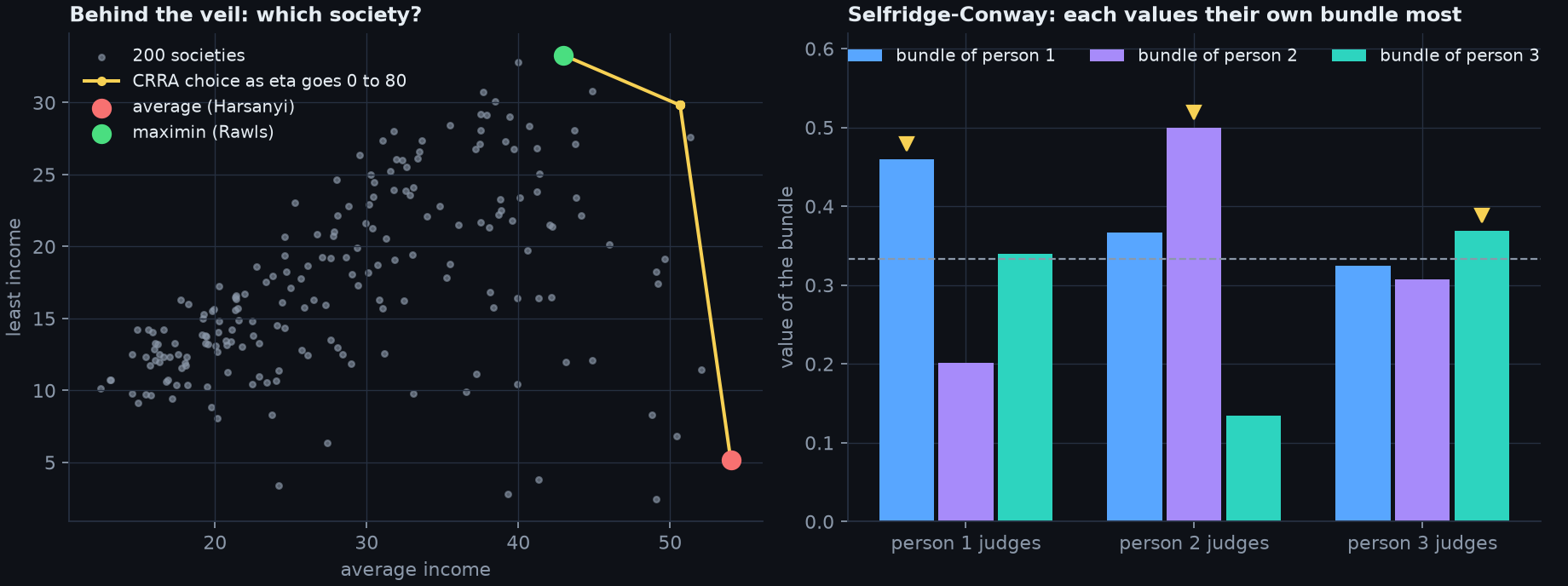
The Reasoner puts the two rules to work. It draws two hundred societies, each with five equally large classes; richer societies tend to be more unequal. Each dot is a society, placed by its average income and the income of its worst-off class. A chooser who maximizes average utility, as Harsanyi recommended, picks the richest on average: fifty four, with a worst-off class at five. Maximin picks the society whose worst-off class is best off: thirty three, with an average of forty three. Between them lies expected utility with risk aversion. With a curvature eta anywhere from half to five, the choice is a third society: average fifty point seven, worst off twenty nine point eight. From eta eight upward, it is the maximin society. Maximin is what expected utility becomes as risk aversion grows without limit.
What does the veil leave out? First, the verdict depends on the attitude to risk we give the chooser, and that is a moral decision made in advance. Rawls added the strains of commitment: the parties must choose principles they could live with, and keep in good faith, whatever position they turn out to occupy. Amartya Sen's The Idea of Justice, of 2009, objected to the search for a perfectly just society: what we need are comparisons between real alternatives, and we can know that ending a famine is more just without knowing what perfect justice is. And G. A. Cohen's Rescuing Justice and Equality, of 2008, attacked the incentive argument behind the difference principle. The talented demand higher pay to work harder; but in a society whose members really accepted the principle, they would not demand it, so the inequality it licenses reflects their choices, not a constraint on what is possible.
What it establishes: Harsanyi (1953, 1975); risk attitude; strains of commitment; Sen (2009); Cohen (2008).; Computed on screen: 200 societies under average, maximin and CRRA
5EntitlementIntroductory4 min
Robert Nozick's Anarchy, State, and Utopia, of 1974, answered Rawls from the libertarian side. Justice in holdings is historical, not patterned: a distribution is just if it arose by just steps, whatever pattern it happens to make. There are principles of just acquisition, how unowned things come to be owned, following Locke with a proviso; of just transfer, by gift or exchange; and of rectification, correcting past injustice in either. Only a minimal state is justified: protection against force, theft and fraud, and the enforcement of contracts. Taxation of earnings for redistribution, he said, is on a par with forced labour.
Nozick's most famous argument is a story, which the Reasoner runs as a toy economy. Start with whatever distribution you think just, say equality: a million people with a thousand dollars each. One of them is the basketball player Wilt Chamberlain. Wilt signs a contract: at each home game, every fan who wants to watch drops twenty five cents in a box for him. Over forty games, a million fans each pay ten dollars. Every transfer is voluntary, and no one else's holdings are touched. At the end of the season Wilt has ten million and one thousand dollars, ten thousand times anyone else, and one percent of all the wealth there is. Liberty upsets patterns, Nozick concluded: to preserve any favoured distribution, a state would have to forbid capitalist acts between consenting adults.
Four claims cannot all be true. D1, the distribution you favour, is just. Whatever arises from a just situation by voluntary exchange is just. D2 arises from D1 by voluntary exchange. And D2, with Wilt's fortune, is unjust. Something must go. Nozick accepts D2: justice is historical, a matter of how holdings came about, not of the pattern they make. G. A. Cohen denied that voluntary transfers always preserve justice: the fans did not foresee the power over others they were handing to Wilt and his heirs. Others deny that the transfers are fully voluntary against a background of unequal power, or note, with Liam Murphy and Thomas Nagel, that taxation is part of the deal under which any property is held. And one can deny that D1 was ever just in the patterned sense, which is Nozick's view again, approached from the other side.
The theory's weak points are at its foundations. The Lockean proviso, as Nozick reads it, says an appropriation is just only if it leaves others no worse off than they would have been without it. But worse off than what? Compared with a state of nature, almost any appropriation passes; compared with a fair share, almost none does. And since most present holdings descend from conquest and expropriation, Nozick himself allowed that rectifying them might require large transfers, perhaps even something like the difference principle as a rule of thumb. G. A. Cohen's Self-Ownership, Freedom, and Equality, of 1995, argued that the real premise is self-ownership, and that the left must answer it directly.
Self-ownership need not lead where Nozick took it. Thomas Paine's Agrarian Justice, of 1797, argued that the earth was originally common property, so those who own land owe a ground rent to everyone else; he proposed paying every person fifteen pounds at the age of twenty one, from a tax on inheritance. Henry George's Progress and Poverty, of 1879, proposed taxing the value of land, which no one made. Left-libertarians such as Hillel Steiner, Peter Vallentyne and Michael Otsuka combine full self-ownership with an equal claim to natural resources, which can justify substantial redistribution. And Philippe Van Parijs's Real Freedom for All, of 1995, defended an unconditional basic income, as high as can be sustained, as what real freedom requires.
What it establishes: Nozick (1974); Cohen (1995); Murphy and Nagel (2002); Paine; George; Steiner; Otsuka; Van Parijs.; Computed on screen: Wilt Chamberlain; the Price List
6Equality of what?Advanced4 min
Ronald Dworkin's essays of 1981 asked: equality of what? His answer was equality of resources, with a distribution that is ambition-sensitive, so that people bear the costs of their choices, and endowment-insensitive, so that they do not bear the costs of their circumstances. Being born blind is brute luck; losing a deliberate gamble is option luck; only the first calls for compensation. How much? As much as people would have insured themselves for, had they faced the risk of the handicap behind a thin veil. G. A. Cohen's equal access to advantage and Richard Arneson's equal opportunity for welfare refined the same idea, which came to be called luck egalitarianism.
Dworkin's device can be run as a market. Three people, Ana, Ben and Cy, each get the same budget, a hundred clamshells in Dworkin's story, here one unit of money, to spend on three divisible goods. Their values for the goods differ. The Reasoner finds the competitive equilibrium from equal incomes, which Hal Varian studied in 1974, by proportional response: each person repeatedly bids for each good in proportion to the value she gets from it. Prices settle at about one point one one, point eight nine and one. Ana buys nine tenths of good one; Ben the last tenth and all of good two; Cy good three. Then the envy test: no one prefers anyone else's bundle. Ben values Ana's bundle exactly as much as his own, four and a half, and envies no one. Equality of resources, as Duncan Foley defined envy-freeness in 1967, is achieved.
Elizabeth Anderson's What is the Point of Equality?, of 1999, attacked the whole programme. Luck egalitarianism, she argued, would abandon an uninsured driver injured by his own negligence, and would treat the disabled as objects of pity for their bad luck. The point of equality is not to neutralize luck but to end oppression: to let people stand to one another as equals in a democratic community. Her democratic equality guarantees the capabilities a person needs to function as a free and equal citizen, which leads to the next view.
Amartya Sen's lecture Equality of What?, of 1979, proposed a different currency. Not resources, which people convert into living well at very different rates, as a wheelchair user needs more resources to get around; nor utility, which adapts to deprivation, as Part 35's sour grapes showed. Functionings are the beings and doings a person has reason to value: being nourished, reading, taking part in public life. Capabilities are the real freedom to achieve them: the set of lives one could choose. Martha Nussbaum's list of ten central capabilities, from life and bodily health to play and control over one's environment, gave the idea content. And the United Nations' Human Development Index, from 1990, grew out of this view.
Two further positions complete the map. Harry Frankfurt's Equality as a Moral Ideal, of 1987, argued that what matters is not that everyone has the same, but that everyone has enough. Equality faces the levelling-down objection: if equality matters in itself, then making the better off worse off, while helping no one, is in one respect an improvement. John Roemer's Equality of Opportunity, of 1998, made luck egalitarianism precise: sort people into types by their circumstances, measure effort by a person's rank within their type, and equalize outcomes across types at each rank. And Paula Casal replied to Frankfurt that sufficiency is not enough: above any threshold, inequality and priority still matter.
What it establishes: Dworkin (1981); Cohen; Arneson; Anderson (1999); Sen (1979); Nussbaum; Frankfurt; Roemer; Casal.; Computed on screen: CEEI, envy checked
7The liberal paradoxResearch4 min
Amartya Sen's example, from 1970, uses a book once thought scandalous, Lady Chatterley's Lover. There is one copy and two people. Three options: the prude reads it, the lewd reads it, or no one does. The prude would most like no one to read it; but if someone must, he would rather read it himself than let the lewd enjoy it. The lewd would most like the prude to read it, to broaden his mind; next best, to read it himself; worst, that no one does. Now give each a small sphere of liberty. Whether the prude reads a book is his business: he prefers that no one read it to reading it himself, so society should rank n above p. Whether the lewd reads is his business: he prefers reading it to no one reading it, so l above n. And both prefer the prude reading it to the lewd reading it, so by the Pareto principle, p above l. The social ranking is a cycle: n over p, p over l, l over n. Whatever is chosen, something else is socially better.
Sen's paper, The Impossibility of a Paretian Liberal, is two pages long. A rule must work for every profile of individual rankings. Weak Pareto: if everyone prefers x to y, society ranks x above y. Minimal liberalism: at least two people are each decisive over at least one pair. No rule meets all three: some profile yields a cycle, and then nothing can be chosen. The lesson is sharp. The Pareto principle is the weakest welfarist axiom there is, accepted even by those who reject utilitarianism. Yet it already conflicts with any rights at all.
Is this a quirk of one story? The Reasoner checks every case. With two people and three options, give person one the right to decide one pair and person two the right to decide another: there are six ways. For each, it searches all thirty six combinations of strict rankings for a profile on which the two rights and the Pareto principle alone force a cycle. Every assignment has one. Nothing depends on books or prudes: whenever two people each have even one protected choice, there are preferences that make liberty and unanimity contradict.
There are four main lines of response. Allan Gibbard showed in 1974 that rights over one's own affairs can conflict even with each other, without Pareto, and proposed that rights be waivable. Sen's own suggestion was that meddlesome preferences, about what others read, should not count, which restricts the Pareto principle. Nozick replied that rights are not part of a social ranking at all: they fix which options are open, and welfare or anything else may choose among what is left. Peter Gärdenfors, Robert Sugden and others modelled rights as game forms, sets of permissible strategies, rather than as decisive pairs. And the two readers could make a contract, the lewd agreeing not to read if the prude does; but then a voluntary contract that is better for both takes away a right each would want to keep, and someone has to enforce it.
This is the thirty eighth brick in the Wall. The dream was a social ranking that respects both liberty and unanimity: that lets each person decide what is their own business, and never chooses an option everyone thinks worse than another. Sen's theorem shows that no rule does this for every possible set of preferences. What it forces is a decision about which comes first. If rights are to mean anything, they must sometimes constrain what welfare would recommend, even unanimous welfare.
What it establishes: Sen (1970); Gibbard (1974); Nozick; Gärdenfors; Sugden; Harel and Nitzan; the Wall's thirty-eighth brick.; Computed on screen: all six assignments of rights searched
8LibertyAdvanced4 min
Isaiah Berlin's lecture Two Concepts of Liberty, of 1958, set the terms of the modern debate. Negative liberty is freedom from interference: the area within which I can act unobstructed by others. Positive liberty is freedom to be one's own master: self-government, by a person or a people. Berlin warned that the positive idea can be inverted: once there is a true self, distinct from the empirical one, those who claim to know it may force people to be free, in Rousseau's phrase. Behind the warning was value pluralism: goods are many and can conflict, and there is no final harmony in which all of them coexist.
Gerald MacCallum argued in 1967 that there is really one concept of liberty. Every claim about freedom fills three places: an agent x is free from some obstacle y to do or become z. Negative theorists fix y as deliberate interference by other people. Positive theorists widen y to include ignorance, compulsion or lack of means, and z to self-realization. G. A. Cohen added that money is like a ticket: someone without it who tries to board the train will be physically stopped, so poverty is a lack of freedom even on the negative view.
Can freedom be measured? Prasanta Pattanaik and Yongsheng Xu proposed, in 1990, three axioms for ranking menus of options by the freedom they offer: all menus with a single option are equally free; a menu of two options is freer than either option alone; and adding the same new option to two menus preserves their order. They proved that these force the simplest possible measure: count the options. Sen replied that a choice among three bad options is not more freedom than a single good one, so preferences, or reasons to value options, must enter the measure. Ian Carter argued that freedom also has non-specific value, beyond the value of what it lets us do, and Matthew Kramer's The Quality of Freedom built a detailed measure on that idea.
Philip Pettit's Republicanism, of 1997, revived a third idea. Consider the slave of a kind master: never interfered with, yet plainly unfree, because he lives at another's mercy. Freedom is the absence of domination, the capacity of someone to interfere arbitrarily, whether or not it is used. Pettit and the historian Quentin Skinner traced the idea through Cicero, Machiavelli and the English Commonwealthmen. Pettit's eyeball test asks whether you can look others in the eye without reason for fear or deference.
The distinction is older than Berlin. Benjamin Constant's lecture of 1819 contrasted the liberty of the ancients, sharing in collective rule, with the liberty of the moderns, the peaceful enjoyment of private independence. John Stuart Mill's On Liberty, of 1859, stated the harm principle: power may rightly be exercised over a person against their will only to prevent harm to others. H. L. A. Hart and Joel Feinberg asked when, if ever, the law may enforce morality, or protect us from ourselves. And Richard Thaler and Cass Sunstein's libertarian paternalism, of 2008, proposed defaults and nudges that change choices without removing any, which recommender systems now apply at enormous scale.
What it establishes: Berlin (1958); MacCallum (1967); Cohen; Pettit (1997); Skinner; Constant; Mill; Pattanaik and Xu (1990); Carter; Kramer.
9Fair divisionApplied7 min
Fair division starts with the oldest procedure there is: one cuts, the other chooses. Here is a cake, the interval from zero to one, and two people who value its parts differently. Ana loves the left end, where the chocolate is; Ben loves the middle. Each one's values add up to one. Ana cuts where the two sides are worth exactly a half to her: at one sixth, since the left end is so rich. Ben compares. The left piece is worth about three hundredths to him, the right piece about ninety seven hundredths. He takes the right. Neither envies the other. Ana has exactly half by her own measure, whatever Ben does; Ben has at least half by his. The cutter's guarantee comes from cutting, and the chooser's from choosing.
For three people, an envy-free procedure eluded mathematicians until about 1960, when John Selfridge and John Conway independently found this one. Ana, Ben and Cy; Cy values the cake evenly. Ana cuts three pieces equal by her own measure: at one ninth, and at just over a quarter. Ben trims his favourite, the big right piece, until it ties with his second best, and the trimmings are set aside. Now Cy chooses first, and takes the middle piece. Ben must take the trimmed piece if it is left, and it is. Ana takes the last, which is worth a third to her, as all three were. Then the trimmings. Since Ben took the trimmed piece, Cy cuts the trimmings into three, equal by his measure, and they choose in the order Ben, Ana, Cy.
The Reasoner then computes what each person thinks each bundle is worth. By Ana's measure, her own bundle is worth about forty six hundredths, the others twenty and thirty four. By Ben's, his own is worth half, the others thirty seven and thirteen. By Cy's, his own is worth thirty seven hundredths, the others thirty two and thirty one. Every row's largest entry is on the diagonal. No one envies anyone, which is exactly what the procedure guarantees, whatever the three valuations are.
The mathematics began in occupied Poland. Hugo Steinhaus, in 1948, posed the problem for any number of people, and reported Stefan Banach and Bronisław Knaster's last diminisher procedure, which guarantees everyone a proportional share. Lester Dubins and Edwin Spanier's moving knife, of 1961: a knife sweeps slowly across the cake, and the first to call stop takes the piece. Steven Brams and Alan Taylor found a finite envy-free procedure for any number of people in 1995, but its number of steps has no bound. Haris Aziz and Simon Mackenzie gave the first bounded one in 2016, and its bound is a tower of six n's. Ariel Procaccia had shown in 2009 that at least on the order of n squared steps are needed.
The same ideas now divide real rent. Three housemates share a three bedroom flat whose rent is three thousand dollars. Each says what each room is worth to them, with values adding up to the rent. First, assign rooms to maximize the total value. The Reasoner tries all six assignments: Ana gets room one, Ben room two, Cy room three, worth three and a half thousand in all. Only such an assignment can be envy-free. Then choose prices adding up to the rent, so that no one would rather have another's room at its price. Many price vectors pass. Among them, pick the one that makes the worst-off housemate as well off as possible: rents of thirteen hundred and thirty, nine hundred and thirty five, and seven hundred and thirty five. Each housemate's surplus is at least a hundred and sixty five, and each one's best alternative is worse. This is the rule of Gal, Mash, Procaccia and Zick, of 2016, and it runs on the website Spliddit.
Some goods cannot be divided or priced: places in schools, kidneys, medical residencies. For these, the Reasoner builds David Gale and Lloyd Shapley's deferred acceptance algorithm, of 1962. Four students rank four schools, each with one seat. Each school ranks the students, by its priorities. In the first round, every student applies to her favourite school. Each school holds its best applicant so far and rejects the rest; nothing is final. Rejected students apply to their next choice, and schools trade up whenever a better applicant arrives: in round two, Cy displaces Ben at school X; in round four, Ben displaces Ana at Z. After five rounds everyone holds a seat: Ana at Y, Ben at Z, Cy at X, Dee at W.
Is the result fair? A matching is stable if no student and school would both rather have each other than what they got: there is no blocking pair, and so no justified envy. The Reasoner checks all twenty four matchings, and exactly three are stable. Gale and Shapley proved that deferred acceptance always finds a stable matching, and that when the students propose, it is the best stable matching for every student at once. Here the students get their second, third, second and first choices; when the schools propose instead, they get their third, fourth, fourth and first. Proposing students also cannot gain by misreporting their preferences. New York City has assigned high school places this way since 2003, and Boston since 2005, with designs by Atila Abdulkadiroğlu, Parag Pathak and Alvin Roth; Roth and Shapley shared the Nobel prize in economics in 2012.
Fair division has its own vocabulary. A division is proportional if each person gets at least one nth by her own measure. It is envy-free if no one prefers another's share; for two people the two ideas coincide, and for more, envy-freeness is stronger. It is equitable if each gets the same value by her own measure, and efficient if no other division is better for some and worse for none. With indivisible goods, envy-freeness can be impossible: one diamond, two heirs. Its relaxation, envy-free up to one good, can always be met, and the division that maximizes the product of utilities, the maximum Nash welfare, achieves it together with efficiency. Eric Budish's approximate competitive equilibrium from equal incomes, of 2011, allocates courses at the Wharton School: Dworkin's auction, in production.
What it establishes: Steinhaus; Dubins–Spanier; Brams–Taylor; Aziz–Mackenzie; Procaccia; Lipton et al.; Caragiannis et al.; Budish; Gale–Shapley; Roth.; Computed on screen: cut and choose; Selfridge–Conway; rent; deferred acceptance
10Community and roleAdvanced3 min
In 1982 Michael Sandel's Liberalism and the Limits of Justice began the communitarian critique. Rawls's parties, Sandel argued, are unencumbered selves who choose their ends from nowhere; but some attachments, to family, community or faith, are not chosen and constitute who we are. Alasdair MacIntyre's After Virtue, of 1981, held that justice is intelligible only within a tradition and its practices, and that modern moral argument is the debris of lost ones. Charles Taylor's essay Atomism argued that the capacities which rights protect develop only within a society that sustains them. Rawls's Political Liberalism, of 1993, partly conceded: justice as fairness is political, not metaphysical, and aims at an overlapping consensus among reasonable doctrines that disagree about the good.
Michael Walzer's Spheres of Justice, of 1983, gave the critique a positive theory. Goods mean different things in different spheres, medicine, office, love, money, and each sphere's meaning fixes its principle of distribution: need, merit, free exchange. Complex equality forbids converting success in one sphere into dominance in another: wealth may not buy office, verdicts or grace. Hence blocked exchanges: votes, exemption from military service, criminal justice, love. Sandel's What Money Can't Buy, of 2012, extended the point with evidence that markets can crowd out norms, as when the Israeli day-care centres studied by Uri Gneezy and Aldo Rustichini fined parents for lateness, and lateness rose.
Others asked who the contract had left out. Susan Moller Okin's Justice, Gender, and the Family, of 1989, argued that the family, where we first learn justice, distributes work and power unjustly, and that Rawls's heads of household hid it. Carole Pateman's The Sexual Contract, of 1988, argued that the social contract presupposed a prior contract over women. Charles Mills's The Racial Contract, of 1997, argued that the actual contract of modern European states excluded the non-white from its terms, and that ideal theory hides this. Iris Marion Young's Justice and the Politics of Difference, of 1990, moved from distribution to oppression, which has five faces: exploitation, marginalization, powerlessness, cultural imperialism and violence.
The Confucian tradition approaches justice through ritual and role. Xunzi's chapter on ritual begins: people are born with desires; if desires are not met they seek, and if seeking has no measure or limit there is strife. The former kings hated disorder and set up ritual and duty to divide things, so that goods and desires would sustain each other. Mencius held that the people are most important, the altars of the state next, and the ruler least, and that killing a tyrant is not regicide. Joseph Chan's Confucian Perfectionism, of 2014, defends a state that moderately promotes the good life. Bai Tongdong's Against Political Equality, of 2019, proposes a hybrid regime: votes for all, and offices partly by merit. Daniel Bell's The China Model, of 2015, defends political meritocracy and takes seriously its problems of corruption and legitimacy.
What it establishes: Sandel (1982); MacIntyre; Taylor; Rawls (1993); Walzer (1983); Okin; Pateman; Mills; Young; Xunzi; Mencius; Chan; Bai; Bell.
11Justice beyond bordersAdvanced3 min
Rawls's argument travels further than he wanted. If natural talents are arbitrary from the moral point of view, so, surely, is the country one happens to be born in, which, by Branko Milanović's estimate, accounts for more than half of the variation in income across the world's people. Charles Beitz, in 1979, proposed a global original position, whose parties do not know their nationality. Thomas Pogge's World Poverty and Human Rights, of 2002, argued that the rich are not merely failing to help: they violate a negative duty, by imposing a global order that foreseeably reproduces poverty. His examples are the international resource and borrowing privileges: whoever holds power in a country, however they got it, may sell its oil and borrow in its name.
The statist reply. Rawls's The Law of Peoples, of 1999, offered eight principles among peoples, including human rights and a duty of assistance to burdened societies, but no global difference principle. Thomas Nagel's The Problem of Global Justice, of 2005, argued that justice, as opposed to humanitarian duty, is owed only among those who are jointly subject to a sovereign and in whose name it acts. Michael Blake located the trigger in coercion by a shared state. Joshua Cohen and Charles Sabel replied, under the title No Justice Outside the Republic?, that global institutions, from trade law to the World Health Organization, already create the kind of ties that matter.
Two more boundaries. Joseph Carens argued in 1987 that citizenship in a rich country is the modern equivalent of feudal privilege, an inherited status that greatly enhances life chances, and that borders should be largely open. Walzer and Christopher Heath Wellman replied that political communities, like clubs and families, may decide their own membership. Across time, Rawls proposed a just savings principle: each generation should save for the next what it would have wished its predecessors to save for it. Climate change sharpens this: Henry Shue distinguished subsistence emissions from luxury emissions, and Stephen Gardiner's A Perfect Moral Storm described a problem that is global, intergenerational and theoretically unresolved, which links back to Part 36's discounting.
Justice now has to be designed into machines. Iason Gabriel's Artificial Intelligence, Values, and Alignment, of 2020, argued that since people disagree about values, AI systems need principles that people with different values can reasonably endorse, and suggested the veil of ignorance as one way to find them. Laura Weidinger and colleagues tested this in 2023: participants who chose a principle for an AI assistant behind a veil, not knowing their own position, more often chose to prioritize the worst off. Credit, bail, welfare benefits and housing are increasingly allocated by models. The rest of the series follows this thread: Part 39 asks how to aggregate many people's judgments, Part 41 meets fairness measures that cannot all hold together, and Part 42 asks whose values a machine should be aligned to.
What it establishes: Beitz; Pogge; Milanović; Rawls (1999); Nagel; Blake; Cohen and Sabel; Carens; Wellman; Shue; Gardiner; Gabriel; Weidinger et al.
Recap, problems, and where this comes backAll tracks3 min
Let's gather what we built. Thrasymachus and the ring of Gyges, Plato's city and soul, and Popper's charge against them. The social contract from Hobbes to Rousseau, and Hume's objection. The original position, and the difference principle, which prefers eight and six to five and five, and to twelve and a half and three and three quarters. Two hundred societies chosen behind the veil: the average picks one, maximin another, and moderate risk aversion a third. Wilt Chamberlain's fortune from free exchange, the Price List, and the proviso. Dworkin's auction, built and envy-free, and the debate over equality of what. Sen's paradox, forced in every assignment of rights: this part's brick in the Wall; and three ideas of liberty. Fair division from cake to rent, stable matching for schools, and the critics and extenders of the whole tradition, from Sandel to Pogge.
The Reasoner has a new module, justice. It chooses societies behind a veil under any attitude to risk, finds competitive equilibria from equal incomes, searches every assignment of rights for Sen's cycle, divides cakes and rents without envy, matches students to schools stably, and measures inequality. And the Wall has its thirty eighth brick.
Six problems, with full solutions in this part's notes. Why Sen's theorem needs two people with rights; the Gini coefficient of a society where one person has everything; the risk aversion at which a chooser switches to the equal society; why the first cutter in Selfridge and Conway's procedure never envies the trimmed piece; another envy-free rent, and its least surplus; and Nozick's argument as a Price List. Pause here, and try them.
Where this comes back. Sen's paradox is a cousin of Arrow's theorem, which Part 39 proves, along with the impossibility of a voting rule that cannot be gamed. Part 41 asks which equality a classifier should have, finds that the natural measures cannot all hold together, and uses envy-free and maximin allocation. And Part 42 asks whether the veil of ignorance can guide the alignment of an AI system. Next, Part 39: the arithmetic of democracy.
The books and papers this part follows are on screen, and in the notes. Thanks for watching.
Where it goes next. Sen's paradox is the first of the aggregation impossibilities: Arrow's theorem follows in Part 39. Equality of opportunity and the choice among fairness criteria return for machines in Part 41, and the veil of ignorance returns in Part 42 as a way to choose a machine's principles.
Key results
The part's results in one place, for revision.
Try it
Lab 38 · Behind the veil, and a cake for three
Draw two hundred societies and let a chooser who could be anyone pick one by the average, by maximin and by expected CRRA utility as the risk aversion eta grows. Then run Selfridge-Conway on forty random triples of valuations and check that nobody ever envies anybody, and recheck Sen's paradox and the rent division.
python -m videos.philosophy.labs 38
needs numpy, scipy, matplotlib · download lab38.py ·
source on GitHubaverage chooser: (average, least income) (54.0, 5.1)
maximin chooser: (average, least income) (43.0, 33.3)
CRRA chooser at eta = 2 (50.7, 29.8)
least eta tried that picks the maximin society 8 (film, seed 0: 8)
Selfridge-Conway on 40 random cakes envy in 0 of 40 (theory: never)
smallest margin, own bundle minus another's +0.0000 (theory: at least 0)
assignments of two rights forced into a cycle 6 of 6 (Sen: all)
envy-free rents 1330, 935, 735 least surplus 165 (film: 1330, 935, 735)
Rawls's and Harsanyi's choosers are the two ends of one dial, the risk aversion: the disagreement is about eta, not about the veil. And envy-freeness for three is a procedure, not a hope: it holds for every valuation tried.The code (96 lines; it asserts its own result)
"""Lab 38: choose a society behind the veil at every risk attitude, and divide a cake three ways without envy."""

import numpy as np

from videos.coursekit import labs
from explainer.philosophy.reasoner import justice

TITLE = "Behind the veil, and a cake for three"
GOAL = ("Draw two hundred societies and let a chooser who could be anyone pick one by the average, by maximin and by "
        "expected CRRA utility as the risk aversion eta grows. Then run Selfridge-Conway on forty random triples of "
        "valuations and check that nobody ever envies anybody, and recheck Sen's paradox and the rent division.")
TASKS = [
    "Call justice.veil with classes=2 and then classes=20. Does the eta at which the chooser reaches the maximin "
    "society go up or down, and why?",
    "Give two of the three cake eaters the same valuation in justice.selfridge_conway. Is the division still "
    "envy-free, and who now values their own bundle at exactly one third?",
    "Check that rents (1400, 900, 700) are also envy-free for the film's housemates, then find by hand a price "
    "vector that sums to 3000 and is not.",
]


def run(seed=0):
    rng = np.random.default_rng(seed)
    lab = labs.Lab()

    etas = [0, 0.5, 1, 2, 3, 5, 8, 12, 20, 80]
    v = justice.veil(seed=1971 + seed, etas=etas)
    path = v["by_eta"]
    lab.row("average chooser: (average, least income)", f"({v['avg']['average']:.1f}, {v['avg']['minimum']:.1f})")
    lab.row("maximin chooser: (average, least income)", f"({v['maximin']['average']:.1f}, {v['maximin']['minimum']:.1f})")
    mid = next(p for p in path if p["eta"] == 2)
    lab.row("CRRA chooser at eta = 2", f"({mid['average']:.1f}, {mid['minimum']:.1f})")
    first_max = next((p["eta"] for p in path if p["choice"] == v["maximin_choice"]), None)
    lab.row("least eta tried that picks the maximin society", f"{first_max}   (film, seed 0: 8)")
    assert path[0]["choice"] == v["avg_choice"], "eta = 0 is risk neutrality: Harsanyi's average"
    assert path[-1]["minimum"] >= 0.95 * v["maximin"]["minimum"], "large eta approaches maximin"
    assert path[-1]["minimum"] > path[0]["minimum"] and path[-1]["average"] <= path[0]["average"]
    assert v["maximin"]["minimum"] > v["avg"]["minimum"] and v["maximin"]["average"] < v["avg"]["average"]
    if seed == 0:
        assert first_max == 8 and len({p["choice"] for p in path if 0.5 <= p["eta"] <= 5}) == 1

    dp = justice.difference_principle()["points"]
    assert (dp["difference"]["uA"], dp["difference"]["uL"]) == (8.0, 6.0)
    assert (dp["utilitarian"]["uA"], dp["utilitarian"]["uL"]) == (12.5, 3.75)

    worst, n_cakes = np.inf, 40
    for _ in range(n_cakes):
        r = justice.selfridge_conway(rng.uniform(0.2, 3.0, (3, 10)).tolist())
        w = np.array(r["worth"])
        assert r["envy_free"], f"envy with valuations {r['densities']}"
        assert abs(w.sum(axis=1) - 1).max() < 1e-3, "the bundles are the whole cake"
        worst = min(worst, float((np.diag(w)[:, None] - w).min()))
        assert np.diag(w).min() > 1 / 3 - 1e-3, "envy-freeness implies a proportional share"
    lab.row(f"Selfridge-Conway on {n_cakes} random cakes", f"envy in 0 of {n_cakes}   (theory: never)")
    lab.row("smallest margin, own bundle minus another's", f"{worst:+.4f}   (theory: at least 0)")

    sen = justice.liberal_paradox()
    lab.row("assignments of two rights forced into a cycle", f"{sum(bool(r['profile']) for r in sen['results'])} of "
            f"{sen['pairs_checked']}   (Sen: all)")
    assert sen["pairs_checked"] == 6 and sen["all_cycle"]

    rent = justice.rent_division()
    V, p = np.array(rent["values"]), np.array(rent["prices"])
    surplus = V - p
    lab.row("envy-free rents", f"{', '.join(f'{x:.0f}' for x in p)}   least surplus {rent['min_utility']:.0f}   (film: 1330, 935, 735)")
    assert list(p) == [1330.0, 935.0, 735.0] and abs(p.sum() - 3000) < 1e-9
    assert all(surplus[i, rent["assign"][i]] >= surplus[i].max() - 1e-9 for i in range(3)), "no envy at these rents"
    alt = V - np.array([1400.0, 900.0, 700.0])  # problem 5: also envy-free, but a smaller least surplus
    assert all(alt[i, i] >= alt[i].max() for i in range(3)) and np.diag(alt).min() == 100 < rent["min_utility"]
    lab.note = ("Rawls's and Harsanyi's choosers are the two ends of one dial, the risk aversion: the disagreement "
                "is about eta, not about the veil. And envy-freeness for three is a procedure, not a hope: it "
                "holds for every valuation tried.")

    fig, ax = labs.figure(2, size=(11.5, 4.3))
    pts = np.array(v["points"])
    ax[0].scatter(pts[:, 0], pts[:, 1], s=9, color=labs.MUTED, alpha=0.6, label="200 societies")
    ax[0].plot([q["average"] for q in path], [q["minimum"] for q in path], "-o", color=labs.GOLD, ms=4,
               label="CRRA choice as eta goes 0 to 80")
    ax[0].scatter(*[v["avg"][k] for k in ("average", "minimum")], s=90, color=labs.RED, zorder=3, label="average (Harsanyi)")
    ax[0].scatter(*[v["maximin"][k] for k in ("average", "minimum")], s=90, color=labs.GREEN, zorder=3, label="maximin (Rawls)")
    ax[0].set(title="Behind the veil: which society?", xlabel="average income", ylabel="least income")
    ax[0].legend(loc="upper left")
    film = np.array(justice.selfridge_conway()["worth"], float)
    x = np.arange(3)
    for j, color in enumerate((labs.BLUE, labs.PURPLE, labs.TEAL)):
        ax[1].bar(x + (j - 1) * 0.26, film[:, j], 0.24, color=color, label=f"bundle of person {j + 1}")
    for i in range(3):
        ax[1].plot(i + (i - 1) * 0.26, film[i, i] + 0.02, "v", color=labs.GOLD, ms=7)
    ax[1].set_axisbelow(True)
    ax[1].axhline(1 / 3, color=labs.MUTED, ls="--", lw=1)
    ax[1].set(title="Selfridge-Conway: each values their own bundle most", xticks=x,
              xticklabels=["person 1 judges", "person 2 judges", "person 3 judges"], ylabel="value of the bundle",
              ylim=(0, 0.62))
    ax[1].legend(ncol=3, loc="upper center")
    lab.fig = fig
    return lab
Now change it
- Call justice.veil with classes=2 and then classes=20. Does the eta at which the chooser reaches the maximin society go up or down, and why?
- Give two of the three cake eaters the same valuation in justice.selfridge_conway. Is the division still envy-free, and who now values their own bundle at exactly one third?
- Check that rents (1400, 900, 700) are also envy-free for the film's housemates, then find by hand a price vector that sums to 3000 and is not.
Problems, with solutions
Try each problem before opening its solution.
-
Show that if only one person has rights, over any number of pairs, rights and Pareto never force a cycle.
Solution
Social strict preference is built from two sources: person 1's preferences on her decisive pairs, and unanimous preferences (Pareto). Every Pareto preference is also person 1's preference, since she is one of the unanimous. So every strict social preference agrees with person 1's own ranking, which is transitive, and a cycle \(x \succ y \succ z \succ x\) would be a cycle in her ranking. No cycle can be forced, however many pairs she controls. Sen's paradox needs two people with rights, each over a pair, whose preferences the Pareto principle can link into a loop.
-
Compute the Gini coefficient of the incomes (0, 0, 0, 1), and explain why it is not 1.
Solution
Using \(G = \sum_i \sum_j |x_i - x_j| / (2n^2\mu)\): the ordered pairs with different incomes contribute \(2 \times 3 \times 1 = 6\), and \(2n^2\mu = 2 \times 16 \times 0.25 = 8\), so \(G = 0.75\) (the Reasoner's formula gives the same). It is not 1 because with \(n\) people the most unequal distribution, one person with everything, has \(G = (n - 1)/n\): the one rich person is equal to herself. Only as \(n \to \infty\) does the maximum approach 1.
-
With societies (1, 9) and (4, 4), for which η does the CRRA chooser prefer the second?
Solution
With utility \(u(x) = x^{1 - \eta}/(1 - \eta)\) (\(\log x\) at \(\eta = 1\)) and an equal chance of being either person, the chooser prefers \((4, 4)\) when \(u(4) > \tfrac12[u(1) + u(9)]\). At \(\eta = 0\) the averages are 4 against 5, and \((1, 9)\) wins. At \(\eta = \tfrac12\), \(u(x) = 2\sqrt x\): \(u(4) = 4\) and \(\tfrac12(2 + 6) = 4\), a tie. For \(\eta > \tfrac12\) the concavity outweighs the higher mean (at \(\eta = 1\): \(\log 4 = 1.39\) against \(\tfrac12\log 9 = 1.10\)). So the chooser prefers the equal society exactly when \(\eta > 1/2\).
-
Show that Ana, the first cutter, never envies whoever took the trimmed piece in Selfridge–Conway.
Solution
In Ana's measure her three pieces are worth \(\tfrac13\) each, and the trimmed piece is worth less than \(\tfrac13\) by the value of its trimming, \(t\). Ana always gets an untrimmed piece, worth \(\tfrac13\) to her. Whoever took the trimmed piece then gets at most part of the trimmings, worth at most \(t\) to Ana. So in Ana's measure that person ends with at most \((\tfrac13 - t) + t = \tfrac13\), no more than Ana's untrimmed piece alone, and Ana also gets a share of the trimmings. She never envies them, whatever happens in the second round.
-
Check that rents (1400, 900, 700) are also envy-free, and find the least surplus.
Solution
Rooms are assigned as in the film (person 1 the first room, and so on), with values person 1: (1500, 1000, 500), person 2: (1300, 1100, 600), person 3: (1200, 900, 900). With rents (1400, 900, 700) the surpluses are \(1500 - 1400 = 100\), \(1100 - 900 = 200\) and \(900 - 700 = 200\). Envy checks: person 1 would get \(1000 - 900 = 100\) from room 2 (no better) and \(-200\) from room 3; person 2 would get \(-100\) from either other room; person 3 would get \(-200\) from room 1 and \(0\) from room 2. So the rents are envy-free, and the least surplus is 100, against 165 for the Reasoner's maximin prices (1330, 935, 735).
-
State the Wilt Chamberlain argument as an inconsistent set, and say which claim you would deny.
Solution
(1) D1, the equal distribution, is just. (2) Whatever arises from a just distribution by just steps is just. (3) Each fan's paying a quarter to watch Wilt is a just step. (4) D2, in which Wilt is far richer, violates the patterned principle that made D1 just, so it is unjust. The four are inconsistent. Nozick denies (4), and with it every patterned principle. I would deny (2), with Rawls: justice is a property of the basic structure, and individually fair transactions can cumulatively erode the background conditions (fair bargaining, equal political power) that made them fair, so the structure needs ongoing adjustment, such as taxation, rather than a one-off just start.
Notes and sources
About this partfrom its README
Part 38 of Philosophy, Built (series plan, syllabus), in Act VII, Value: what a society owes its members. Rawls's first sentence (1971) and Sen's flute (2009); three toy societies scored by total, least income and Gini. Thrasymachus and the ring of Gyges; Plato's city and soul and Popper's charge (1945); Aristotle's proportional and corrective justice. The social contract: Hobbes (Part 34's game), Locke (1689) and the proviso, Rousseau (1762), Hume against tacit consent (1748). Rawls's original position, primary goods, the two principles and lexical priority; the difference principle drawn on an incentive frontier ((8, 6) over (5, 5) and (12.5, 3.75)); the three conditions for maximin (§26); Rawls's five regimes (2001). Harsanyi against Rawls (1953, 1975) and the separateness of persons; two hundred societies chosen behind the veil (the average picks one, maximin another, CRRA expected utility with η from 0.5 to 5 a third, η ≥ 8 the maximin society); Sen (2009) and Cohen (2008). Nozick's entitlement theory (1974); Wilt Chamberlain as a toy economy (a Gini of 0.01 from free exchange) and a Price List for the argument; the proviso, rectification and Cohen on self-ownership (1995); left-libertarianism from Paine (1797) and George (1879) to Steiner, Otsuka and Van Parijs (1995). Dworkin's equality of resources (1981), brute and option luck; Dworkin's auction built as a competitive equilibrium from equal incomes (Varian 1974; prices 1.11, 0.89, 1; envy-free in Foley's sense, 1967); Anderson (1999); Sen's capabilities (1979) and Nussbaum (2000); Frankfurt (1987), levelling down, Roemer (1998), Casal (2007). Sen's liberal paradox (1970): Lady Chatterley's Lover as a cycle, and every assignment of two rights searched (six, each forced into a cycle) — the Wall's thirty-eighth brick; Gibbard (1974), game forms (Gärdenfors 1981; Sugden 1985; Gaertner, Pattanaik and Suzumura 1992), and contracting over rights (Harel and Nitzan 1987). Liberty: Berlin (1958), MacCallum (1967), Cohen's ticket, Pettit's non-domination (1997) and Skinner, Constant (1819), Mill (1859), Hart and Feinberg, nudges (2008), and Pattanaik and Xu's theorem on measuring freedom (1990) with Sen's reply. Fair division, built: cut and choose, Selfridge–Conway for three (every bundle valued by every person; no envy), Steinhaus (1948), Dubins–Spanier (1961), Brams–Taylor (1995), Aziz–Mackenzie (2016); envy-free rent division maximizing the least surplus (Gal, Mash, Procaccia and Zick 2016; rents 1330, 935, 735); EF1 and maximum Nash welfare; Budish's course allocation (2011); and deferred acceptance for school choice (Gale and Shapley 1962), with all 24 matchings enumerated (3 stable, the student-proposing one best for every student). Community and role: Sandel (1982), MacIntyre (1981), Taylor, Political Liberalism (1993), Walzer (1983), Okin (1989), Pateman (1988), Mills (1997), Young (1990), Xunzi on ritual, Mencius, Chan (2014), Bai (2019) and Bell (2015). Justice beyond borders: Beitz (1979), Pogge (2002), Rawls (1999), Nagel (2005), Blake (2001), Cohen and Sabel (2006), Carens (1987), Wellman (2008), just savings, Shue (1993), Gardiner (2011), and justice for machines: Gabriel (2020) and Weidinger et al. (2023).
The worked model results are computed by the Reasoner's new module explainer/philosophy/reasoner/justice.py (with
prop for the Price List), tested in tests/philosophy/test_justice.py and cached by compute.py.
Chapter notes
| # | Scene | What it establishes | Computed on screen |
|---|---|---|---|
| 0 | Hook |
Rawls (1971); Sen's flute (2009); four answers; the plan. | three societies: totals, minima, Ginis |
| 1 | Plato |
Thrasymachus; Gyges; the city and the soul; Popper (1945); Aristotle. | — |
| 2 | Contract |
Hobbes; Locke (1689); Rousseau (1762); Hume (1748). | — |
| 3 | Rawls |
the original position; two principles; maximin's conditions; five regimes (2001). | the difference principle on a frontier |
| 4 | Veil |
Harsanyi (1953, 1975); risk attitude; strains of commitment; Sen (2009); Cohen (2008). | 200 societies under average, maximin and CRRA |
| 5 | Nozick |
Nozick (1974); Cohen (1995); Murphy and Nagel (2002); Paine; George; Steiner; Otsuka; Van Parijs. | Wilt Chamberlain; the Price List |
| 6 | Luck |
Dworkin (1981); Cohen; Arneson; Anderson (1999); Sen (1979); Nussbaum; Frankfurt; Roemer; Casal. | CEEI, envy checked |
| 7 | Sen |
Sen (1970); Gibbard (1974); Nozick; Gärdenfors; Sugden; Harel and Nitzan; the Wall's thirty-eighth brick. | all six assignments of rights searched |
| 8 | Liberty |
Berlin (1958); MacCallum (1967); Cohen; Pettit (1997); Skinner; Constant; Mill; Pattanaik and Xu (1990); Carter; Kramer. | — |
| 9 | Division |
Steinhaus; Dubins–Spanier; Brams–Taylor; Aziz–Mackenzie; Procaccia; Lipton et al.; Caragiannis et al.; Budish; Gale–Shapley; Roth. | cut and choose; Selfridge–Conway; rent; deferred acceptance |
| 10 | Community |
Sandel (1982); MacIntyre; Taylor; Rawls (1993); Walzer (1983); Okin; Pateman; Mills; Young; Xunzi; Mencius; Chan; Bai; Bell. | — |
| 11 | Global |
Beitz; Pogge; Milanović; Rawls (1999); Nagel; Blake; Cohen and Sabel; Carens; Wellman; Shue; Gardiner; Gabriel; Weidinger et al. | — |
| 12 | Outro |
recap; the Reasoner's module; the Wall; problems; payoffs; references. | — |
Notes
The veil's societies are drawn at random (seed 1971): five equal classes, with richer societies tending to be more unequal; CRRA utilities are compared through the mean of w^(1−η) so that large η does not tie in floating point. The CEEI is found by proportional response dynamics (3,000 rounds). Cake valuations are piecewise constant on tenths and normalized to 1. Rent prices are searched on a $5 grid. The school-choice preferences were picked from random profiles so that deferred acceptance takes several rounds and there is more than one stable matching.
Companion material in this repository
The syllabus's plan for this partfrom SYLLABUS.md, the plan of record
- Plato's Republic and Thrasymachus: is justice the interest of the stronger?
- The social contract: Hobbes, Locke, Rousseau (callback to Part 34's games).
- Rawls's A Theory of Justice (1971): the original position, the veil of ignorance, the two principles and their lexical order.
- Maximin vs average utility (Harsanyi 1975): the debate, computed. The choice behind the veil under each rule across many distributions, and what risk attitude each assumes.
- The difference principle, drawn on a production possibility frontier.
- Nozick's Anarchy, State, and Utopia (1974): entitlement theory; Wilt Chamberlain, run as a toy economy.
- Luck egalitarianism (Dworkin, Cohen, Arneson). Dworkin's auction and envy-free allocations. Built: competitive equilibrium from equal incomes (Varian 1974), envy-freeness checked.
- Capabilities (Sen, Nussbaum).
- Sen's liberal paradox (1970): the impossibility of a Paretian liberal, proved; Lady Chatterley's Lover.
- Liberty: Berlin's two concepts; republican freedom as non-domination (Pettit).
- Fair division: cut-and-choose; Selfridge–Conway for three (drawn); bounded envy-free cake cutting (Aziz and Mackenzie 2016). Industry: rent division (Spliddit).
- Communitarians (Sandel, MacIntyre, Walzer) and the Confucian alternative (role ethics; meritocracy debates, Bai Tongdong; Chan).
- Global justice: Singer's drowning child (1972); Pogge; the cosmopolitan vs statist debate.
- Justice and AI: distributive questions about automation and compute; the Rawlsian case for alignment principles chosen behind a veil (Gabriel 2020), as a preview of Parts 41–42.
- Recap and Problems.
Built: reasoner.justice (veil-of-ignorance choice rules; envy-free equilibrium; Selfridge–Conway; Sen's
paradox checker).
Wall: Sen's liberal paradox.
Price List: Nozick's Wilt cluster (D1 is just; voluntary transfers from a just distribution preserve justice;
D2 arises by voluntary transfers; D2 is unjust).
Visuals: the veil sliding over a population; the difference principle on a frontier; the cake being cut and
trimmed in Selfridge–Conway.
References: Kymlicka; Rawls; Nozick; Dworkin, Sovereign Virtue; Sen, The Idea of Justice; Brams and Taylor,
Fair Division; Pettit, Republicanism; Bai, Against Political Equality.
Build the film
python -m videos.philosophy.philosophy38.compute        # the part's numbers, into .cache/philosophy38
python tools/build.py philosophy38                  # render and assemble the film
EXPLAINER_TTS=silent python tools/qa_scene.py philosophy38 Hook   # one chapter, silent, with a contact sheet
Scenes: videos/philosophy/philosophy38. Setup: see the course page. Source of these notes: the README and the scenes' narration.
Build it
python -m videos.philosophy.philosophy38.compute       # every computed item (seconds; .cache/philosophy38)
python tools/build.py philosophy38 -q l                # 480p preview
python tools/build.py philosophy38                     # 1080p30 -> renders/philosophy38.mp4
python tools/qa_scene.py philosophy38 Division         # one chapter, silent, with a contact sheet