What Is Mathematics About?
the philosophy of mathematics
What are numbers, and how could we know anything about them?
The part opens with Russell's joke and the enslaved boy of the Meno doubling a square: mathematics is necessary, known without experiment, and applies to the world. Platonism takes its objects at face value and meets Benacerraf's dilemma: abstract objects cause nothing, so how are they known? Frege's logicism is built on a world of four objects, where sixteen concepts fall into five numbers; Frege's theorem derives arithmetic from Hume's principle, which turns out to have no finite model, and Basic Law V is its bad company. Formalism, Brouwer's intuitionism and predicativism follow, and the Curry-Howard correspondence makes the constructive reading exact: a proof is a program, the Reasoner finds programs for seven propositions and Kripke countermodels for excluded middle, Peirce's law and double negation elimination. The part turns at Benacerraf's second dilemma, that nothing settles which sets the numbers are, and structuralism's puzzle of i and minus i. It ends with the indispensability argument and Field's science without numbers, the Price List, and mathematics in practice: univalence, Lakatos, pictures that prove and lie, and proofs by machine.
What you need. School arithmetic and geometry. The Kripke models for intuitionistic logic are those of Part 5, Cantor's theorem is from Part 6, Hilbert's program and Gentzen from Part 7.
- The calculation
- Curry–Howard
- The wall
- Benacerraf's dilemmas
- Built toy
- a proof-checking type checker; Kripke models for intuitionism
What you will be able to do
Introductory
- State Benacerraf's two dilemmas and say which one each of platonism, logicism, formalism, intuitionism, structuralism and fictionalism is built to answer.
- Sort the concepts on a small domain into Frege's numbers and explain why Hume's principle cannot hold on a finite world.
- Compute V - E + F for a polyhedron and say how Lakatos's monsters changed the theorem.
Advanced
- Write the lambda term that proves a given intuitionistic tautology and check its type by hand.
- Build a two-world Kripke model that refutes excluded middle or Peirce's law.
- Recover coordinates from betweenness and congruence facts and state how unique they are.
Research
- Outline the proof of Frege's theorem from Hume's principle in second-order logic and state the bad company objection, with Boolos's question and Fine's stability criterion.
- State univalence and explain in what sense it builds structuralism into a foundation.
Applied
- Explain what a machine-checked proof establishes, what the trusted kernel is, and what remains to a human: reading that the statement written is the statement meant.
- Read a type signature as a proposition and a program as its proof when reviewing typed code.
Contents
Each chapter has a home level. Choose a track to see what to read and watch: Introductory 30 min · Advanced 52 min · Research 63 min · Applied 34 min.
- 0What are we talking about?Introductory4 min
- 1Abstract objectsIntroductory3 min
- 2Numbers from logicIntroductory4 min
- 3Frege's theoremAdvanced4 min
- 4Bad companyResearch3 min
- 5A game with symbolsIntroductory3 min
- 6Mathematics as constructionAdvanced4 min
- 7Proofs are programsAdvanced5 min
- 8The vicious circleResearch3 min
- 9What numbers could not beIntroductory5 min
- 10Indispensable?Advanced3 min
- 11Science without numbersAdvanced3 min
- 12The Price ListIntroductory2 min
- 13Equal and equivalentResearch4 min
- 14Proofs and refutationsIntroductory2 min
- 15Pictures that prove, pictures that lieIntroductory4 min
- 16Proofs by machineApplied5 min
- Recap, problems, and where this comes backAll tracks2 min
Also on this page: Lecture · Key results · Try it · Lab · Problems · Notes and sources · 中文 · Build the film.
Lecture
The text of each chapter is the film's narration, as it is spoken, so you can read along or revise without the film. The pictures are in the film.
What are we talking about?Introductory4 min
Part 9 asks a question that sounds simple. When we do mathematics, what are we talking about? Bertrand Russell joked, in 1901, that mathematics is the subject in which we never know what we are talking about, nor whether what we are saying is true. He meant it as praise: a proof holds whatever its symbols stand for. But the joke has an edge, and this part is about the edge.
The question is old. In Plato's dialogue Meno, written about 380 BCE, Socrates draws in the sand for an enslaved boy who has never studied geometry. Here is a square of side two, with area four. Which square has twice the area? The boy doubles the side. But a square of side four has area sixteen, four times as big. Side three, then? Area nine: still too big. Socrates draws the diagonals. The square on the diagonal is made of four half-squares, so its area is eight, exactly twice four. Nobody told the boy the answer; he was only asked questions. Plato concluded that he had recollected it, from a life before this one. The answer was in him, not in the sand.
Take any simple mathematical truth, say that seven is prime. Three things are true of it. It is necessary: it could not have been otherwise, which in Part 4's terms means true in every possible world. It is a priori: we know it without looking at the world, as the boy needed no ruler. And it is applicable: mathematics runs bridges, orbits and atoms. The physicist Eugene Wigner, in 1960, called this its unreasonable effectiveness. Complex numbers, invented to solve equations, turned out to be the language of quantum mechanics. Now the puzzle. If mathematics is about the world, why is it necessary, and known without looking? If it is about something else, why does it apply to the world? And if it is about nothing at all, why is it true?
Philosophers have given six main answers, and the part takes them in turn. Mathematics is about abstract objects, outside space and time: platonism. It is logic in disguise: logicism. It is a game played with symbols: formalism. It is about constructions of the mind: intuitionism. It is about structures, not objects: structuralism. Or it is a story, false but useful: fictionalism. Each answer meets two dilemmas posed by Paul Benacerraf, one about how we could know abstract objects, and one about which objects the numbers are. They are this part's brick in the Wall.
So: first platonism, and the problem of how we could know about abstract objects. Then Frege's attempt to build numbers out of logic, its collapse, and its revival. Then mathematics as a game, and mathematics as construction. Then the discovery that proofs are programs, built and run by the Reasoner. Then the vicious circle, and the view that mathematics is about structure. Then the argument from science, the reply that mathematics is a fiction, and the Price List. And last, mathematics as it is practised: a new foundation, proofs and refutations, pictures, and proofs checked by machine.
What it establishes: Russell's joke (1901); the Meno; necessary, a priori, applicable (Wigner 1960); six answers; the plan.; Computed on screen: the boy's squares: 16, 9, and 8 on the diagonal
1Abstract objectsIntroductory3 min
The first answer is the oldest. For Plato, geometry is about the forms: the square itself, which no square drawn in the sand quite is. For Frege, in 1884, numbers are objects. They are objective, as the axis of the earth is objective, though nobody can trip over either. For Gödel, there was quite as much reason to believe in sets as in physical bodies, and mathematicians discover their properties. And most working mathematicians talk this way: we discover theorems, we do not invent them. The objects are abstract: they are not in space or time, and they neither cause anything nor are caused. So 'seven is prime' is about the number seven, just as 'Paris is a city' is about Paris.
Gödel even proposed how we know about these objects. Despite their remoteness from sense experience, he wrote in 1964, we do have something like a perception also of the objects of set theory, as is seen from the fact that the axioms force themselves upon us as being true. Mathematical intuition, on this view, is a faculty like sight, aimed at the abstract. Part 6 showed how Gödel hoped it would one day settle the continuum hypothesis.
In 1973 Paul Benacerraf turned this into a dilemma. Compare two sentences. There are at least three large cities older than New York. There are at least three perfect numbers greater than seventeen. They have the same logical form, and a good account of truth should treat them alike: each is true because certain objects exist and stand in certain relations. That is the first requirement, one semantics for all of language, and platonism meets it. The second is a believable account of knowledge. On the causal theory popular in the 1960s, to know about objects we must be causally connected to them, as we are to cities. Abstract objects cause nothing, so platonism fails it. And the accounts that make knowledge easy, for instance by saying that mathematical truth is just provability, give mathematics a different semantics from the rest of language. Either way, something gives.
The causal theory of knowledge did not last, but in 1989 Hartry Field restated the problem without it. On one side, what mathematicians believe. On the other, what is true in the realm of numbers. The two columns match remarkably well: where mathematicians are sure, they are right. The platonist owes an explanation of that match. Nothing travels from the numbers to our brains. It is as if a villager's beliefs about a distant city were always right, though no news ever reached the village. That would be a miracle, and Field asks the platonist to explain it.
What it establishes: Plato, Frege, Gödel (1944, 1964); Benacerraf's dilemma (1973); Field's reliability challenge (1989).
2Numbers from logicIntroductory4 min
The second answer is that mathematics is logic. Immanuel Kant had argued, in 1781, that seven plus five equals twelve is synthetic a priori: known without experience, yet not true by definition, because the idea of seven plus five does not already contain twelve. To get twelve we must count, in intuition, as children count on their fingers. Gottlob Frege disagreed. Arithmetic, he held, is analytic: provable from logic and definitions alone, logic unfolded. If Frege was right, mathematics is known a priori because logic is, and we need no special faculty to know it.
Frege's book of 1884, The Foundations of Arithmetic, starts from an observation. Hand someone a pile of cards and ask for its number. It is one pack, four suits, or fifty-two cards. The pile is the same; what differs is the concept we count under. A number belongs to a concept, not to a heap of things. 'Jupiter has four moons' says that the number of the concept 'moon of Jupiter' is four. Frege's count was four; today we know of more than ninety, because what falls under the concept changed. 'Venus has no moons' gives the concept 'moon of Venus' the number zero, and Frege defines zero itself as the number of a concept nothing can fall under: not identical with itself.
How do we tell when two concepts have the same number? Frege took the answer from David Hume's Treatise: when two numbers are so combined, as that the one has always a unit answering to every unit of the other, we pronounce them equal. In modern dress: the number of Fs equals the number of Gs exactly when the Fs and the Gs can be paired off one to one. This is now called Hume's principle. The Reasoner tries it on a world of four objects. A concept is any selection of them, so there are sixteen concepts. Pairing them off sorts them into five classes, one for each number from zero to four, of sizes one, four, six, four and one: the row of Pascal's triangle. And Frege's successor relation runs from each number to the next: n plus one is the number of a concept that has one more object than a concept with n.
But Frege was not satisfied. Hume's principle tells us when the number of Fs is the number of Gs. It does not tell us whether the number of Fs is Julius Caesar. Frege's example sounds silly, but the point is serious: a principle that only says when two numbers are equal does not yet say what numbers are. So Frege defined them explicitly: the number of F is the extension of the concept 'equinumerous with F', roughly the class of all concepts that pair off with F. Extensions needed his Basic Law Five, and Part 6 told what happened next: Russell's letter of 1902, and the contradiction. Logicism seemed dead for eighty years.
What it establishes: Kant (1781) and Frege (1884) on 7 + 5 = 12; numbers belong to concepts; Hume's principle; Julius Caesar and Basic Law V.; Computed on screen: 16 concepts on four objects fall into five numbers, 1-4-6-4-1, with successor running 0 → 4
3Frege's theoremAdvanced4 min
In 1983 Crispin Wright noticed something that Charles Parsons had glimpsed in 1965. Frege's own derivations of arithmetic used Basic Law Five for one thing only: to prove Hume's principle. After that, everything followed from Hume's principle alone. So drop the inconsistent law, and take Hume's principle as the axiom. With second-order logic, it yields all the Peano axioms of arithmetic. And George Boolos proved in 1987 that the system is consistent if second-order arithmetic is. The result is now called Frege's theorem: Frege had proved it, without knowing it was what mattered.
How does Hume's principle give infinitely many numbers from nothing? Zero is the number of things not identical with themselves. There are none, so zero exists. One is the number of things identical with zero, and there is exactly one: zero itself. Two is the number of things that are zero or one. Three counts zero, one and two. In general, n plus one is the number of numbers up to n. Each number counts the ones before it. No apples or stones are needed: the only objects used are the numbers already built. That is why Frege thought arithmetic could be pure logic.
Here are the key steps. First, n comes right after m when n is the number of some concept F, and m is the number of what is left when one object is taken away from F. Second, the natural numbers are the things reachable from zero by such steps. Frege defined this with the ancestral, an idea from his Begriffsschrift of 1879, whose notation we met in Part 3: n is a natural number if it has every property that zero has and that passes along each step. Then the axioms fall out. Nothing comes right before zero, since a concept with number zero has no object to take away. The relation is one to one, by Hume's principle. And every natural number has a successor: the hard step, which Frege proved in sections 82 and 83. The successor of n is the number of natural numbers up to n. Induction comes free with the definition of the natural numbers. All of Peano arithmetic, from one principle about counting, and logic.
There is a surprise inside the theorem. Suppose the world had only five objects. Concepts can have zero, one, two, three, four or five members: six different sizes. Hume's principle gives each size a number, and each number must itself be one of the objects. Six numbers will not fit in a world of five. The Reasoner tries every world size up to five, and the same thing happens every time: Hume's principle has no finite model. It needs infinitely many objects, and with infinitely many it works. Take the numbers zero, one, two and so on, and let the number of an infinite concept be zero, and of a finite concept its size plus one. The Reasoner checks every pair of finite concepts on seven objects. So a principle meant to be logic proves that the world contains infinitely many things. Is that logic?
What it establishes: Parsons, Wright (1983), Boolos (1987); numbers counting themselves; the key steps of Frege's theorem.; Computed on screen: Hume's principle fails on every world of 1–5 objects; a model on ℕ checked on all 127 finite concepts on seven objects
4Bad companyResearch3 min
Wright and Bob Hale built a philosophy on Frege's theorem, called neo-logicism. Hume's principle, they argue, is an implicit definition of the phrase 'the number of'. Like a dictionary entry, it fixes what the words mean, so anyone who understands the words knows it is true. Its left side, that two numbers are equal, is a new way of carving up the content of its right side, that two concepts pair off. If so, we know there are numbers in roughly the way we know that bachelors are unmarried, and Benacerraf's problem of access has an answer: no telescope is needed.
Hume's principle is one of a family that Frege himself described, now called abstraction principles. His own example: the direction of line a is the direction of line b exactly when a and b are parallel. Lines are drawn on paper. Directions are abstract objects, one for each class of parallel lines, and the principle introduces them by saying when two are the same. Numbers are to concepts as directions are to lines.
But not every abstraction principle is good. Basic Law Five has exactly the same form: the extension of F equals the extension of G exactly when the same things fall under them. And it is inconsistent. The Reasoner shows why, by counting. Each principle needs one object for each class of concepts it identifies. In a world of n objects, Hume's principle needs n plus one objects, which is too many for any finite world, but fine for an infinite one. Basic Law Five needs two to the n, one for every concept, which is too many for every world, finite or infinite: that is Cantor's theorem, from Part 6. Now a third principle, Wright's nuisance principle: two concepts have the same nuisance when they differ on only finitely many objects. On a finite world all concepts have the same nuisance, so it needs one object, and is fine. On an infinite world it needs more objects than there are. So the nuisance principle is consistent, but only in finite worlds, while Hume's principle is consistent only in infinite ones. Each looks like a definition; they cannot both be true.
This is the bad company objection. Michael Dummett and George Boolos argued that if a principle of the right form can be inconsistent, the form alone cannot make it a definition. Boolos asked, in 1997, whether a principle that implies there are infinitely many objects can really be analytic. Kit Fine, in The Limits of Abstraction, proposed to keep only stable principles, the ones true in every large enough world: Hume's principle passes, the nuisance principle fails. And Julius Caesar has not gone away. So logicism survives, not as a finished foundation, but as a sharp question: which ways of introducing objects by definition are legitimate?
What it establishes: neo-logicism (Hale and Wright 2001); directions; Basic Law V and the nuisance principle; Dummett, Boolos (1997), Fine (2002).; Computed on screen: objects needed by HP, BLV and NP on worlds of 1–5 objects, and on ℵ₀
5A game with symbolsIntroductory3 min
The third answer says that mathematics is about nothing at all. In the 1870s and 1880s Eduard Heine and Johannes Thomae proposed that numbers are signs, and arithmetic a game played with them, like chess. Chess has pieces, legal moves and positions; arithmetic has numerals, rules of calculation, and the equations they produce. A chess position is not true or false, and needs no objects to be about. Frege attacked the view at length in 1903. A chess position tells you nothing about the world, but arithmetic does: it tells you how many chairs to bring. It is applicability alone, he wrote, which elevates arithmetic from a game to the rank of a science.
Yet there are moments when the game runs ahead of the meaning. Take the cubic x cubed equals fifteen x plus four. Its graph crosses the axis three times, so it has three real roots. Cardano's formula of 1545 gives a root, but on the way it asks for the square root of minus one hundred and twenty-one, which in 1545 did not exist. In 1572 Rafael Bombelli simply calculated with the square root of minus one as a symbol obeying the usual rules. Two plus that symbol, cubed, comes out as two plus the square root of minus one hundred and twenty-one. So the cube roots in the formula are two plus and two minus the symbol. Add them: the imaginary parts cancel, and x is four. And four is a root: sixty-four equals sixty plus four. The Reasoner does the complex arithmetic and checks it. A real answer, reached through numbers nobody believed in. For two centuries the symbols worked before anyone could say what they meant.
David Hilbert's formalism was subtler than the game view. To Frege he wrote, in 1899: if the arbitrarily given axioms do not contradict one another with all their consequences, then they are true and the things defined by the axioms exist. Consistency is all the existence mathematics needs. In his 1925 lecture on the infinite he divided mathematics in two. Real statements are finite and checkable, such as two plus three is five. Ideal statements, about the infinite, are like Bombelli's square root of minus one: instruments that need not mean anything, as long as they lead to true real statements. The ideal part is safe if it never proves a false real statement, and a proof of consistency would show that. Part 7 told the rest: by Gödel's second theorem, no such proof exists inside the system, let alone by finite means. What survives is a modest cousin, deductivism: a mathematical theorem says only that its axioms imply it. Haskell Curry, in 1951, called mathematics the science of formal systems.
What it establishes: Heine (1872), Thomae (1880) and Frege (1903); Bombelli (1572); Hilbert's letter (1899) and ideal elements (1925); Curry (1951).; Computed on screen: (2 + i)³ = 2 + 11i, so x = 4 solves x³ = 15x + 4
6Mathematics as constructionAdvanced4 min
The fourth answer came from the Dutch topologist L. E. J. Brouwer. In his thesis of 1907 he held that mathematics is an activity of the mind, prior to language, and prior to logic, which only records its regularities. Its root is our intuition of time: one moment falling apart into two, and the two-ness repeated without end. A mathematical statement is true when we have constructed a proof of it. Part 5 met the logic of this view, the BHK reading of the connectives. On it, 'A or not A' would require a method for deciding every question, so it is not a law. This chapter shows what that does to mathematics.
Brouwer's favourite examples used the digits of pi. The Reasoner computes them with an unbounded spigot, one digit at a time in exact integer arithmetic. Here are the digits from the seven hundred and twenty-first place on. At place 762 there are six nines in a row, the stretch nicknamed the Feynman point. Brouwer asked whether the block zero, one, two, up to nine ever occurs in pi. In his day nobody knew. It is not in the first three thousand digits. In 1997 Yasumasa Kanada's team found it, more than seventeen billion digits in, so Brouwer's question has been answered. The method does not depend on the example. Use any question still open, such as Goldbach's conjecture, that every even number above two is a sum of two primes. The Reasoner checks it up to a hundred thousand; others have checked it to four billion billion. Nobody has proved it.
From an open question, Brouwer built a real number. Its n-th approximation is minus one half to the power n, unless a counterexample to Goldbach has turned up among the first n even numbers; then it freezes at minus one half to the power where the first counterexample appeared. The approximations hop from side to side of zero, closer each time. Every one is computable, and they converge, so r is a perfectly good real number. If Goldbach's conjecture is true, r is zero. If it fails first at an even place, r is positive; at an odd place, negative. So nobody can assert that r is negative, zero, or positive. Classically, one of the three holds. Constructively, saying which would settle Goldbach's conjecture. This is a weak counterexample: not a disproof of the law, but a demonstration that the law would solve open problems for free.
Brouwer went further. Take the function that is minus one for negative numbers and one from zero on. Classically, a fine function with a jump. But a real number, for Brouwer, is never finished: we only ever have finitely many of its digits. To compute the value at x, we must decide on the basis of finitely many digits. If the digits so far are all zeros, the number could still turn out negative or positive. No finite stage settles the output, so the jump function is not a total function at all. Brouwer proved, in 1924, that every total function on the reals is continuous, using his choice sequences: reals that grow by free choices, never finished. Computer science now agrees in its own terms: every computable function on the reals is continuous. And in 1967 Errett Bishop showed that most of analysis can be done constructively without Brouwer's stranger axioms. Every theorem stays classically true, and every proof carries an algorithm.
What it establishes: Brouwer (1907, 1908, 1924); the weak counterexamples; Bishop (1967).; Computed on screen: 3,000 digits of π; six 9s at place 762; Goldbach checked to 100,000; Brouwer's real
7Proofs are programsAdvanced5 min
Brouwer's reading of the connectives, the BHK reading of Part 5, turned out to be more than philosophy. Haskell Curry noticed in 1934, and wrote up with Robert Feys in 1958, that the types of his basic combinators are exactly the axioms of the logic of 'if'. William Howard extended the observation in 1969, in notes that circulated for a decade before they were published. The result is a dictionary. A proposition is a type. A proof of it is a program of that type. A proof of 'if A then B' is a function from A to B. A proof of 'A and B' is a pair. A proof of 'A or B' is a tagged value: an A or a B, together with which. Falsehood is the empty type, which has no values, so 'not A' is a function from A into the empty type. And simplifying a proof is running the program.
Here is the dictionary at work. A natural deduction proof, in Gentzen's style, that if A and B, then B and A. Assume A and B. From it, take B; from it again, take A. Put them together as B and A. Then discharge the assumption, to get the conditional. Now write beside each formula the program it corresponds to. The assumption becomes a variable, p. Taking B out of 'A and B' becomes taking the second part of the pair p. Putting B and A together becomes building a new pair. And discharging the assumption becomes lambda: a function that takes p and returns the swapped pair. The proof is the program that swaps a pair, and the formula it proves is its type.
So the Reasoner can prove things by writing programs. Its proof search takes a proposition and looks for a program of that type, then hands the program to a small type checker to make sure. For 'if A, then if B, then A', the program takes x, ignores y, and returns x: Curry's combinator K. For the next it finds S, which feeds z to both x and y. Then swapping a pair, currying, and reasoning by cases, which becomes a case analysis on a tagged value. 'A implies not not A' is the program that takes x and a refutation y, and applies y to x. The most charming is 'not not, A or not A'. Given a refutation x of 'A or not A', the program hands x a proof of 'not A'. That proof, if ever given an A, turns around and hands x the A instead. A program that changes its story when caught. But for excluded middle itself, Peirce's law, and double negation elimination, there is no program. The Reasoner finds instead the two-world Kripke model of Part 5 that refutes each one: at the root A is not yet proved, and later it is.
If proofs are programs, we can run them. Here is a proof with a detour: it proves 'B and A' by first building the swap function, then at once applying it to the pair a, b. Each step of running it removes one detour. Apply the function. Take the second part of the pair, then the first. What is left is the direct proof: the pair b, a. And every step keeps the type, B and A. This is Dag Prawitz's normalization theorem of 1965 for natural deduction, Gentzen's cut elimination from Part 7 seen in another light. For decades it seemed that only constructive proofs computed. Then Timothy Griffin showed, in 1990, that the control operator call with current continuation, a jump in the program, has the type of Peirce's law. Classical proofs are programs too, with jumps. Add the quantifiers, and you get Per Martin-Löf's dependent types: the logic inside today's proof assistants, Lean and Coq, which we will meet at the end of this part.
What it establishes: Curry and Feys (1958), Howard (1969/1980); the dictionary; a proof as a program; Prawitz (1965); Griffin (1990); Martin-Löf.; Computed on screen: proof search for ten propositions: seven programs, type-checked, and three countermodels; a proof normalized step by step
8The vicious circleResearch3 min
Henri Poincaré, in 1906, had his own diagnosis of the paradoxes. They come, he said, from definitions that are viciously circular. Russell put the principle in one line: whatever involves all of a collection must not be one of the collection. The trouble is that ordinary analysis breaks it. Take a bounded set of real numbers. It has many upper bounds. Its least upper bound is defined as the least of all of them: a definition that quantifies over all real numbers, including the one being defined. Poincaré called such definitions impredicative, and blamed them for Richard's paradox, which we met in Part 8.
Russell's own example, from Principia Mathematica, shows what goes wrong, and the Reasoner builds it. A typical Englishman is one who has every property that a majority of Englishmen have. Here are seven people and four traits. Each trait is held by five of the seven, a majority. So a typical person, judged by these traits, has all four. Exactly one person does: Edith. But being typical is itself a property. Add it, and its negation, to the list. Six of the seven are untypical, so being untypical is a majority property, and a typical person must have it. Now nobody is typical: Edith, by being typical, fails to be. And if 'property' ranges over every grouping of the seven whatever, nobody is typical either, because for each person the group of everyone else is a majority that excludes them. A definition that ranges over all properties, including the one it defines, destroys itself.
The cure is to stack the properties in levels. Russell's ramified types allow a property to be defined only from the levels below it, so 'typical' at one level never ranges over itself. Hermann Weyl, in his book The Continuum of 1918, rebuilt as much of analysis as he could on that basis. Least upper bounds survive for sequences of numbers, though not for arbitrary sets. How far can predicative mathematics go? Solomon Feferman and Kurt Schütte found the exact limit in 1964: the ordinal Gamma zero, on the ladder of Part 7. And Feferman argued, in 'Weyl vindicated', that the mathematics science actually uses fits inside that limit. Reverse mathematics, from Part 7, measures exactly which theorems need more.
Kurt Gödel saw that the dispute was philosophical. If mathematical objects are made by our definitions, a definition cannot use what is not yet made, and impredicative definitions are circular. But if the objects exist anyway, a definition only picks one of them out, and there is nothing circular in describing someone as the tallest person in this room, though the description ranges over everyone in the room, including them. So a technical rule about definitions turns on what mathematics is about. The platonist may define impredicatively; the constructivist may not.
What it establishes: Poincaré (1906), Russell (1908); the typical Englishman; Weyl (1918), Feferman–Schütte (1964), Feferman (1988); Gödel (1944).; Computed on screen: typical at level 0: Edith; at level 1 and over all 128 properties: nobody
9What numbers could not beIntroductory5 min
Benacerraf's second dilemma came first, in 1965, as a story about two children. Johnny was taught that the numbers are Zermelo's sets: zero is the empty set, and each number is the set containing the one before. Ernie was taught von Neumann's: each number is the set of all the numbers before it. Both count, add and multiply perfectly. They disagree only about questions like whether one is a member of three, the junk theorems of Part 6. If numbers really were sets, one of them would be wrong. But nothing in arithmetic could decide which. Benacerraf concluded that numbers are not sets, and more boldly, that they are not objects at all.
What is left, if numbers are not objects? Benacerraf answered: arithmetic is the science that elaborates the abstract structure that all progressions have in common merely in virtue of being progressions. Richard Dedekind had proved, in 1888, that any two progressions satisfying his axioms are isomorphic: they match point for point, with successor matching successor. The Reasoner tries two progressions of numerals, strokes and binary. The maps between them are inverse to each other, and carry successor to successor. So every truth of arithmetic, such as which numbers are even, holds in both alike. Arithmetic cannot tell them apart, and does not need to.
This is structuralism, and it comes in three kinds. For Stewart Shapiro and Michael Resnik, writing in 1997, structures themselves exist, and a number is a place in one, as shortstop is a position on a baseball team, whoever plays it. For eliminative structuralists, there are no structures over and above their instances: 'two plus two is four' says that in every progression, the place for two plus two is the place for four. And for Geoffrey Hellman's modal structuralism, not even actual progressions are needed: arithmetic says what would hold in any progression, if there were one. All three keep the mathematics. They differ on what exists.
Structuralism has its own puzzle, and the complex numbers pose it. Take the four fourth roots of one: one, i, minus one, minus i. The Reasoner looks for every rearrangement of the four that preserves multiplication, and finds two: doing nothing, and swapping i with minus i, which is complex conjugation, a reflection in the real axis. So one and minus one are fixed, but i and minus i have exactly the same structural properties. Whatever the structure says of one, it says of the other. If a number is nothing but a place in a structure, what makes i different from minus i? John Burgess and Jukka Keränen pressed the point around 2000.
The Reasoner can survey the question on small graphs. For each, it finds every symmetry: every rearrangement of the points that preserves the lines. A point that every symmetry leaves in place is one the structure itself picks out; it is coloured green. Two bare points can be swapped, so neither is picked out. A path of three fixes its middle, but not its ends. A triangle with a tail fixes two of its points. And this graph of six points has no symmetry but the trivial one, so structure alone distinguishes all six. Two replies. Shapiro, in 2008: identity is primitive, and structure need not ground it, so i and minus i are two places, with no further difference. James Ladyman, in 2005: two joined points are weakly discernible, since a relation holds between them that holds of neither to itself. The same goes for i and minus i: the relation 'adds up to zero' holds between them, but not between i and itself, since i plus i is not zero.
This is the ninth brick in the Wall. The dream: to know mathematical objects as we know tables. The wall: Benacerraf's two dilemmas. Access: abstract objects cause nothing, so how could we know them? Identification: nothing in mathematics settles which objects the numbers are. What it forces: structure, fiction, or a special faculty of knowing.
What it establishes: Benacerraf (1965); Dedekind (1888); ante rem, eliminative and modal structuralism; Burgess, Keränen, Shapiro (2008), Ladyman (2005); the Wall's ninth brick.; Computed on screen: unary and binary numerals: inverse maps respecting successor; the symmetries of {1, i, −1, −i} and of five graphs
10Indispensable?Advanced3 min
The strongest argument for platonism comes from science. Its sources are Quine's 'On what there is', of 1948, and Putnam's Philosophy of Logic, of 1971; Mark Colyvan gave it its standard form. One: we ought to believe in all and only the entities that are indispensable to our best scientific theories. Two: mathematical entities are indispensable to them, since physics cannot be stated without numbers, functions and spaces. Three: so we ought to believe in mathematical entities. Behind it stand two Quinean views. Naturalism: science is our best guide to what exists. And holism: theories meet the evidence as wholes, so the mathematics in a confirmed theory is confirmed with it. Parts 11 and 15 return to that idea.
Alan Baker gave the argument a sharper form in 2005, with an example from biology. Periodical cicadas spend thirteen or seventeen years underground, then emerge all at once. Why those numbers? Suppose predators boom on cycles of two to nine years. The Reasoner works out, for each cycle length from ten to twenty, how often an emergence coincides with a predator's peak. The prime cycles are the low points, because a prime shares no factor with a shorter cycle. Among cycles from twelve to eighteen years, the two lowest are thirteen and seventeen: exactly the cicadas'. The explanation is mathematical: the cicadas do well because thirteen and seventeen are prime. If mathematics does real explaining in science, Baker argued, it earns the same belief as electrons.
There are three main objections. Penelope Maddy pointed to practice. Chemists used atoms for a century while doubting they existed, until Jean Perrin's experiments of 1908. And frictionless planes are indispensable to mechanics, though nobody believes in them. Indispensability is not the scientists' own test of existence. Elliott Sober noted that mathematics is never the hypothesis at risk: no experiment chooses between rival arithmetics, so it is not confirmed the way electrons are. Joseph Melia proposed weaseling: use the mathematics, then take back its existential claims. Or, most ambitious, show that the mathematics can be removed from science altogether. That was Hartry Field's project.
What it establishes: Quine (1948), Putnam (1971), Colyvan (2001); Baker's cicadas (2005); Maddy (1992), Sober (1993), Melia (2000).; Computed on screen: coincidence rates for cycles of 10–20 years: the primes are the low points, 13 and 17 between 12 and 18
11Science without numbersAdvanced3 min
In 1980 Hartry Field set out to answer the indispensability argument head on. Newton's theory of gravity, as usually stated, describes a field: a function from points of space to real numbers. Field rewrote it with no numbers at all. His theory quantifies over points and regions of spacetime, which a nominalist can accept, and uses only relations among them: betweenness, congruence of segments, and comparisons of gravitational potential. The model was Hilbert's geometry of 1899, which axiomatizes points and lines with no coordinates. Mathematics then comes back as a tool. Field proved it is conservative: adding it to the physics proves no new claims about the physical world. So mathematics need not be true, only conservative: a quicker route between true claims about the world, like Hilbert's ideal elements.
The heart of Field's method is a representation theorem, and the Reasoner can run a small one. Here are five points on a line. The Reasoner is not told where they are. It is told only which point lies between which, and which segments are as long as which: twenty facts of betweenness and six of congruence. No numbers. Now it tries every way of giving the points whole-number coordinates from minus twelve to twelve, with a at zero, keeping only those that make exactly the given facts true. Four survive. Each is the same picture, reflected or stretched: x, minus x, two x, minus two x. Choose a unit and a direction, and the numbers are fixed. The numbers were never in the points. They are a way of describing the structure of the points, unique once we make two arbitrary choices. That is what measurement is, and for Field, all that numbers in physics ever were.
Field's view is called fictionalism. 'Holmes lives at 221B Baker Street' is false, since there was no Holmes, but true in the stories. 'There are infinitely many primes' is, for the fictionalist, false, since there are no numbers, but true in the story of mathematics; and the story is useful the way a good map is. Mark Balaguer and Mary Leng developed the view. It faces objections. David Malament argued in 1982 that quantum mechanics, built on spaces of functions, resists Field's treatment. Stewart Shapiro showed that the conservativeness Field needs requires either a strong logic or a semantic notion of consequence, which brings mathematics back in. So some fictionalists take an easy road: no rewriting of physics at all, only the claim that mathematical talk, like figurative speech, need not be taken literally. Either way, what we know, on this view, is which theorems follow from which axioms, and that is knowledge of logic, not of objects.
What it establishes: Field (1980) and Hilbert's geometry (1899); conservativeness; fictionalism; Malament (1982), Shapiro (1983), the easy road.; Computed on screen: five points known by 20 betweenness and 6 congruence facts: exactly four coordinate systems, x ↦ ±x, ±2x
12The Price ListIntroductory2 min
The whole debate fits one Price List. Four claims, each very plausible. 'Seven is prime' is about an object, the number seven. That object is abstract, outside space and time, with no causes. We know that seven is prime. And to know about objects, we need some connection to them that could explain why our beliefs are reliable. Together they are inconsistent, and the Reasoner confirms that any three are consistent. Give up abstractness, and numbers are concrete: John Stuart Mill made arithmetic a science of physical aggregates, and Penelope Maddy, in 1990, argued that we literally see small sets, such as the set of three eggs in a carton. Give up the objects: modal structuralism, and Charles Chihara's constructions, keep the truths and drop the things. Give up the knowledge: Field's fictionalism, for which we know only what follows from what. Or give up the demand for a connection: Gödel's intuition; the neo-logicists' knowledge by definition; Mark Balaguer's full-blooded platonism, on which every consistent theory describes some objects, so that consistency is all the access we need; and Øystein Linnebo's thin objects, whose existence asks almost nothing of the world.
Side by side: the concrete view keeps knowledge by perception, and must explain the infinite: there are not enough eggs. The modal view keeps truth without abstract objects, and must explain how we know what structures are possible. Fiction keeps the bare ontology of physics, and must explain why a story should apply so well to the world: Wigner's puzzle again. And platonism keeps truth at face value, and must answer Field's challenge. No answer is free. Notice that the modal answer only moves the puzzle, to knowledge of possibility, which Part 22 takes up.
What it establishes: Price List: the Benacerraf–Field puzzle; four answers side by side.; Computed on screen: the MUS {O, A, K, C} and its four corrections
13Equal and equivalentResearch4 min
The newest foundation for mathematics grew out of the proofs-as-programs idea. In Martin-Löf's type theory, for any two things a and b there is a type of proofs that a equals b. Martin Hofmann and Thomas Streicher showed, in 1994, that two such proofs need not be the same. Then Steve Awodey and Michael Warren, and independently Vladimir Voevodsky, saw why: proofs of equality behave like paths in a space. A proof that a equals b is a path from a to b, and there may be many. A proof that two paths are equal is a deformation of one into the other, what topologists call a homotopy. The result is called homotopy type theory.
This lets a foundation talk about shapes directly. The circle becomes a type with one point and one loop from the point to itself. Paths can stay put and come back, go round once, twice, or the other way. The Reasoner counts the turns of each: zero, one, two, minus one. Following one loop by another adds the turns. That the loops of the circle, up to deformation, are exactly the integers is a classical theorem of topology. In 2013 Daniel Licata and Michael Shulman proved it inside homotopy type theory, as a theorem about types, checked by computer.
In 2009 Voevodsky proposed a new axiom. The univalence axiom says that the type of identifications between two types is equivalent to the type of equivalences between them. In words: to identify two structures is to give an equivalence between them, and every equivalence counts. Its consequence is transport: whatever is proved about one structure holds of every structure equivalent to it, automatically. The Reasoner shows the idea in a small case. Define 'even' by recursion on stroke numerals: zero is even, and one more than an even number is not. Carry it across the equivalence to binary numerals, and it becomes a different computation, the last bit is zero, with the same answers everywhere it is checked. The theory was written up in a single collaborative book during a special year at the Institute for Advanced Study in Princeton, published in 2013.
This builds structuralism into the foundation. Zermelo's numbers and von Neumann's are equivalent structures, so in univalent foundations they are equal, and Benacerraf's identification problem cannot arise. The junk questions cannot even be asked, because every statement must transport along equivalences. And the puzzle of i and minus i? The type of identifications of the complex numbers with themselves, as an extension of the real numbers, has exactly two elements. One is the identity, another is conjugation, which swaps i and minus i. So the puzzle becomes a fact about paths: there are two different ways of identifying the structure with itself, and that is all the difference between i and minus i amounts to. In practice, Lean's large library of mathematics does not assume univalence, while cubical type theory, developed since 2015, is designed to make it compute.
What it establishes: identity as paths (Hofmann–Streicher, Awodey–Warren, Voevodsky); the circle (Licata–Shulman 2013); univalence; structuralism built in.; Computed on screen: winding numbers 0, 1, 2, −1; "even" transported from unary to binary
14Proofs and refutationsIntroductory2 min
Imre Lakatos looked at mathematics as it is actually done, and his favourite example came from Euler. In 1750 Euler noticed that for a polyhedron, the number of vertices, minus the number of edges, plus the number of faces, is two. The Reasoner counts. A tetrahedron: four minus six plus four is two. A cube: eight minus twelve plus six is two. An octahedron: six minus twelve plus eight is two. In 1813 Cauchy gave a proof. Remove one face, and stretch the rest flat on the table. Divide the faces into triangles, then remove triangles one at a time. The count never changes, and at the end a single triangle gives one. Add back the missing face, and the answer is two.
Then the counterexamples arrived, and Lakatos's book Proofs and Refutations, published in 1976 after his death, stages the history as an argument in a classroom. A picture frame: a square ring with a hole through it. The Reasoner counts sixteen vertices, thirty-two edges and sixteen faces: the answer is zero. Two tetrahedra touching at a single vertex: seven, twelve, eight, so three. And Kepler's small stellated dodecahedron, the urchin, if its faces are read as twelve star pentagons: twelve vertices, thirty edges, twelve faces, so minus six. Euler's theorem was proved, and false.
Lakatos's characters try three responses. Monster-barring: a picture frame is not really a polyhedron, so redefine the word. Exception-barring: retreat to the convex polyhedra, where the theorem is safe. And the response Lakatos favoured, lemma incorporation: find the hidden assumption in the proof. Cauchy's proof assumed that, after removing a face, the rest can be stretched flat. That fails for the frame. Make the assumption a condition of the theorem, and the counterexample becomes a new theorem. For a surface with g holes, the count is two minus two g: the frame, with one hole, gives zero. This is the Euler characteristic, and with it topology begins. Mathematics, for Lakatos, grows the way Karl Popper said science grows: by conjectures, proofs and refutations, not by piling up certainties.
What it establishes: Euler (1750), Cauchy (1813); Lakatos (1976); monster-barring, exception-barring, lemma-incorporation; χ = 2 − 2g.; Computed on screen: V − E + F for tetrahedron, cube, octahedron (2), picture frame (0), twin tetrahedra (3), the urchin (−6)
15Pictures that prove, pictures that lieIntroductory4 min
Can a picture prove something? Mathematicians in China and India thought so. The Chinese classic Zhoubi suanjing has a diagram for the hypotenuse, and in 263 Liu Hui, commenting on the Nine Chapters, stated the principle behind it: what goes out and what comes in complement each other. Cut a figure up and move the pieces, and the area stays the same. Take four copies of a right triangle with sides a and b, inside a square of side a plus b. What is left over is the square on the hypotenuse, c squared. Now move the triangles. The same square, the same four triangles, and what is left over is a square of side a and a square of side b. So a squared plus b squared is c squared. The story goes that Bhāskara, in twelfth-century India, gave a proof like this with a picture and a single word: Behold.
Pictures can do something proofs by symbols often do not: explain. The odd numbers add up to squares: one plus three plus five plus seven plus nine is twenty-five. Induction proves it: if the first k odd numbers make k squared, adding the next gives k plus one squared. Correct, but it does not show why. The picture does: each odd number is one more L-shaped layer wrapped around the last square. Mark Steiner in 1978, and Marc Lange more recently, have studied what makes some proofs explain why a theorem is true, while others only make sure that it is.
Pictures can also lie. Here are four pieces: a red triangle, a blue triangle, and two L-shaped pieces. Arranged one way, they make a triangle thirteen squares wide and five high. Arranged the other way, the same pieces make the same triangle, with one square missing. Where did it go? The Reasoner computes the slopes. The red triangle rises three in eight; the blue one, two in five; the true diagonal, five in thirteen. They are all different, so neither long side is straight. Draw the true diagonal: the first figure sags below it, the second bulges above it, each by half a square. The pieces have area thirty-two; the outlines thirty-two and thirty-three; the true triangle thirty-two and a half. The eye cannot see a bend of a few hundredths. The puzzle was invented in 1953 by Paul Curry, an amateur magician, no relation to Haskell.
Even Euclid leaned on a picture. His very first proposition builds an equilateral triangle: on a segment A B, draw the circle about A through B, and the circle about B through A. Where they meet is the third corner, C. The picture shows that the circles meet, but none of Euclid's axioms says so. In fact, take the plane of points with rational coordinates. Every one of Euclid's postulates holds there, and the circles miss each other, because the point where they should meet has a coordinate of root three over two, which is irrational. Moritz Pasch in 1882 and Hilbert in 1899 added the missing axioms of order and continuity. And Kenneth Manders showed that Euclid's use of diagrams was disciplined: he read off a figure only what survives small errors of drawing, such as which regions meet or contain each other, never exact sizes. A formal system built on that idea now checks Euclid's proofs, diagrams and all.
What it establishes: the Zhoubi and Liu Hui (263); Bhāskara; proofs that explain (Steiner 1978, Lange 2017); Curry's missing square (1953); Euclid I.1, Pasch, Hilbert, Manders.; Computed on screen: odd numbers as L-shaped layers; slopes 3/8, 2/5, 5/13 and areas 32, 33, 32½
16Proofs by machineApplied5 min
In 1976 the computer entered the proof itself. Kenneth Appel and Wolfgang Haken proved that every map can be coloured with four colours so that no two neighbouring countries share one. Their proof reduced the problem to nearly two thousand configurations, each checked by a program. No human being has read the whole proof. Thomas Tymoczko argued in 1979 that such a proof rests on an experiment with a machine, so that mathematics had become, in part, empirical. In 2005 Georges Gonthier checked the entire proof in the proof assistant Coq, and the question changed: not whether to trust a program, but which program to trust.
Proof assistants rest on an idea of Nicolaas de Bruijn, from his Automath project of 1967. Here are two theorems in Lean, a proof assistant begun by Leonardo de Moura in 2013. The proof of K is the program that takes a and ignores the rest; the proof of swap builds a new pair from the parts of the old. Chapter 7's dictionary, in daily use. De Bruijn's criterion: trust only a small kernel, a type checker short enough to read and understand. Everything else, however clever, must produce a proof that the kernel accepts. The Reasoner's own kernel, the function that checked every program in Chapter 7, is forty lines. Lean's community library, Mathlib, begun in 2017, now holds a large part of an undergraduate degree and much research mathematics. So proof search can be enormous and untrusted, as long as the certificate it produces passes the kernel.
The proof assistants have reached research mathematics. In December 2020 Peter Scholze, one of the leading mathematicians of his generation, challenged the Lean community to check a theorem he and Dustin Clausen had proved. He was not fully confident in it himself, and very few people could read it. The key step was formalized within six months, and the whole challenge was met by July 2022. The theorem was confirmed, and along the way the argument was simplified. Thomas Hales's proof of the Kepler conjecture about packing spheres left its referees ninety-nine percent certain; his Flyspeck project checked it formally by 2014. And Terence Tao has run projects in which large proofs are split among many contributors, people and programs, trusted because every piece is checked.
But what exactly does a checked proof show? Suppose we want to formalize Euclid's theorem that there are infinitely many primes: for every n there is a prime bigger than n. Suppose we slip, and write only: for every n there is a prime. The checker will happily accept a proof. The Reasoner finds the witness for each n: two, every time. The intended statement needs a new witness for each n: the next prime. A checker certifies the statement that was written, not the one that was meant. So trust in a formal proof rests on two things: a small kernel, and a human who reads the statement. Robert Pollack's paper on how to believe a machine-checked proof makes exactly this point.
And now machines find proofs, as well as check them. In 2024 Google DeepMind's systems AlphaProof and AlphaGeometry 2 solved four of the six problems at the International Mathematical Olympiad, the standard of a silver medal, and AlphaProof's proofs were written in Lean, so they are certain, whoever or whatever found them. In 2025 systems from several laboratories reached the standard of a gold medal, some writing in ordinary mathematical language, others in Lean. That raises an old question in a new form. A proof can be certain, and still not understood. William Thurston argued in 1994 that the point of mathematics is not a stock of certified theorems, but human understanding. The kernel settles that a theorem is true. Why it is true, the question of Chapter 15, is still ours to answer.
What it establishes: Appel–Haken (1976), Tymoczko (1979), Gonthier (2005); de Bruijn's criterion; Lean and Mathlib; the Liquid Tensor Experiment (2020–22); Flyspeck; AI provers (2024, 2025); Thurston (1994).; Computed on screen: the Reasoner's kernel: 40 lines; "there is a prime" certified with the witness 2
Recap, problems, and where this comes backAll tracks2 min
Let's gather what we built. The boy in the Meno, platonism, and the problem of how we could know abstract objects. Frege's numbers, built on a world of four objects; Frege's theorem; the discovery that Hume's principle needs infinitely many things; and bad company. Mathematics as a game, Bombelli's impossible numbers, Hilbert's ideal elements, and Brouwer's mathematics of construction. Proofs as programs, searched for, checked and run. The vicious circle, structuralism, and the puzzle of i and minus i. The argument from science, the cicadas, Field's numbers recovered from points, and the Price List. And mathematics in practice: a new foundation, proofs and refutations, pictures, and machines.
The Reasoner has two new modules. One treats propositions as types: it searches for proofs as programs and checks them with a forty-line kernel, runs proofs to normal form, carries a property across an equivalence, finds Kripke countermodels, and counts the turns of loops. The other builds Frege's numbers and counts what abstraction principles demand, computes pi and checks Goldbach, builds Russell's typical Englishman, finds the symmetries of structures, recovers coordinates from points, and counts Euler's polyhedra. And the Wall has its ninth brick.
Six problems, with full solutions in this part's notes. Frege's numbers on five objects; Basic Law Five and Hume's principle; a program and a countermodel; Brouwer's real number and continuity; symmetries of small structures; and an essay on the Price List. Pause here, and try them.
Where this comes back. The a priori, and Kant's synthetic a priori, in Part 10. Quine's web of belief, in Parts 11 and 15. Abstract objects and the question of what there is, in Part 20. Identity and indiscernibility, in Part 21. Knowledge of possibility, in Part 22. And machines that reason, and whether to trust them, in Parts 30 and 42. This ends the second act, on the limits of reason. Next, Part 10 opens the act on knowledge: the mind's own laws, from Descartes to Kant.
The books and papers this part follows are on screen, and in the notes. Thanks for watching.
Where it goes next. Kant's synthetic a priori is taken up in Part 10 and Quine's web of belief in Parts 11 and 15. Abstract objects return in Part 20, identity and indiscernibility in Part 21, knowledge of possibility in Part 22, and machines that reason, and whether to trust them, in Parts 30 and 42.
Key results
The part's results in one place, for revision.
Try it
Lab 9 · Proofs as programs, and what Hume's principle demands
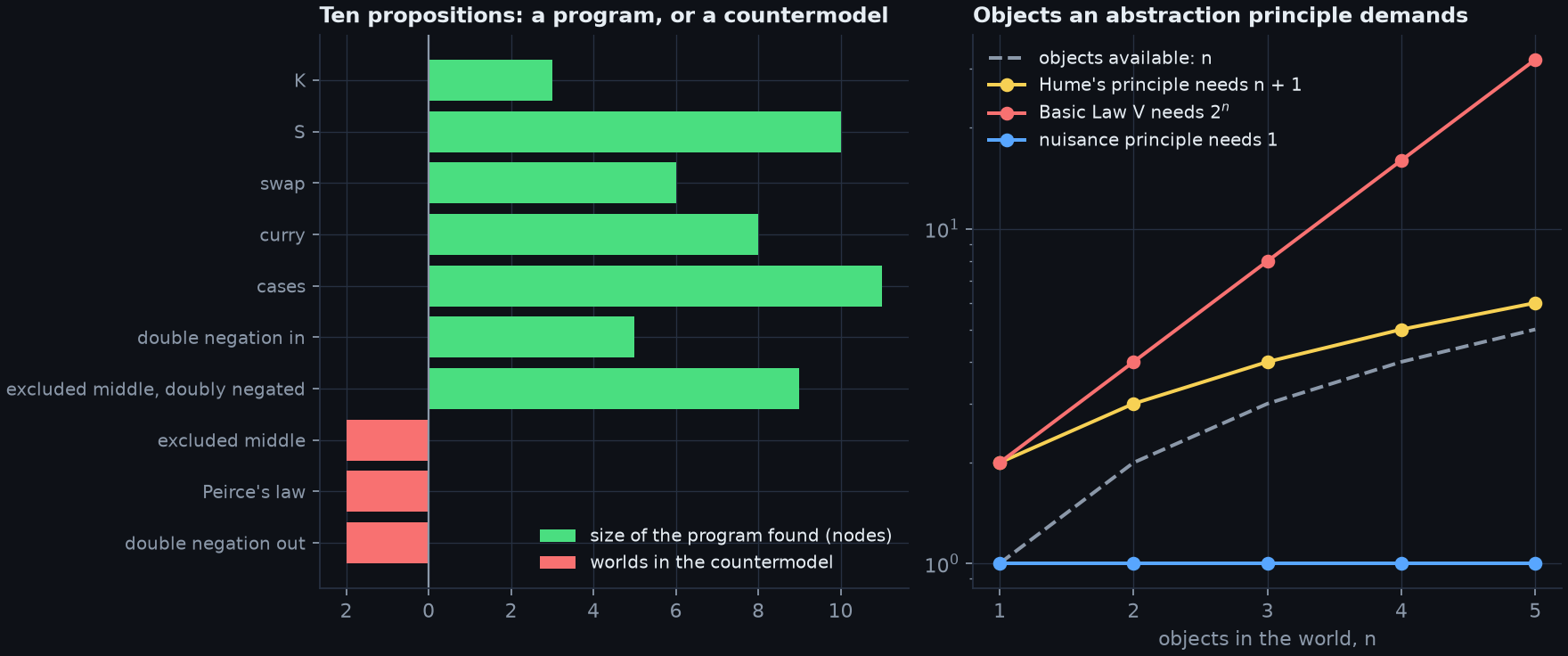
Run the Reasoner's proof search on the film's ten propositions and on random ones, check every program it finds with the type checker, and check that no proposition has both a program and a Kripke countermodel. Then count the objects that Hume's principle and Basic Law V need on a world of n objects.
python -m videos.philosophy.labs 9
needs numpy, scipy, matplotlib · download lab09.py ·
source on GitHubthe film's ten propositions 7 programs, each type-checked; 3 Kripke countermodels
A -> B -> A λx. λy. x (Curry's K)
A | ~A no program; refuted at the root of 2 worlds, A true only later
60 random propositions 19 with a program, 41 with a countermodel, 0 with neither found; never both
swap applied to ⟨a, b⟩ normal form ⟨b, a⟩ after 3 steps, type B ∧ A at every step
16 concepts on four objects fall into numbers of sizes [1, 4, 6, 4, 1]: five numbers, four objects
Every program the search returns passes the type checker, and no proposition has both a program and a Kripke countermodel: excluded middle, Peirce's law and double negation elimination have countermodels and no program. Hume's principle always needs one object more than a finite world has.The code (110 lines; it asserts its own result)
"""Lab 9: search for proofs as programs, type-check them, and refute what has no program with a Kripke model."""

import numpy as np

from videos.coursekit import labs
from explainer.philosophy.reasoner import mathphil
from explainer.philosophy.reasoner import types as ty

TITLE = "Proofs as programs, and what Hume's principle demands"
GOAL = ("Run the Reasoner's proof search on the film's ten propositions and on random ones, check every program it "
        "finds with the type checker, and check that no proposition has both a program and a Kripke countermodel. "
        "Then count the objects that Hume's principle and Basic Law V need on a world of n objects.")
TASKS = [
    "Prove '(A -> B) -> ~B -> ~A' with ty.prove, print the program with ty.show_term, and read it as contraposition.",
    "Find a countermodel to '(A -> B) | (B -> A)' with ty.countermodel(max_worlds=3). Why does it need three worlds?",
    "Call mathphil.frege_numbers(5) and compare class_sizes with a row of Pascal's triangle (Problem 1).",
]


def size(term):
    """The number of nodes of a lambda term."""
    return 1 + sum(size(x) for x in term[1:] if isinstance(x, tuple) and x and x[0] in ty._OPS)


def random_type(rng, depth):
    if depth == 0 or rng.random() < 0.25:
        return ty.BOT if rng.random() < 0.15 else ("var", "AB"[int(rng.integers(2))])
    op = ("->", "->", "&", "|")[int(rng.integers(4))]
    return (op, random_type(rng, depth - 1), random_type(rng, depth - 1))


def run(seed=0):
    rng = np.random.default_rng(seed)
    lab = labs.Lab()

    # the film's ten propositions
    found = []
    for text, name in ty.EXAMPLES:
        goal = ty.parse_type(text)
        term, model = ty.prove(goal), ty.countermodel(goal)
        assert (term is None) != (model is None), f"{name}: exactly one of a program and a countermodel"
        if term is not None:
            assert ty.type_of(term) == goal, f"{name}: the program has the wrong type"
        found.append((name, term, model))
    programs = [f for f in found if f[1] is not None]
    refuted = [f for f in found if f[2] is not None]
    assert len(programs) == 7 and [f[0] for f in refuted] == ["excluded middle", "Peirce's law", "double negation out"]
    assert all(f[2]["worlds"] == 2 for f in refuted), "each is refuted on the two-world model"
    k = ty.prove(ty.parse_type("A -> B -> A"))
    lab.row("the film's ten propositions", f"{len(programs)} programs, each type-checked; {len(refuted)} Kripke countermodels")
    lab.row("A -> B -> A", f"{ty.show_term(ty.rename(k))}   (Curry's K)")
    lab.row("A | ~A", f"no program; refuted at the root of {refuted[0][2]['worlds']} worlds, A true only later")

    # random propositions: soundness of the search against Kripke semantics
    counts = {"program": 0, "countermodel": 0, "neither found": 0}
    for _ in range(60):
        goal = random_type(rng, 3)
        term, model = ty.prove(goal), ty.countermodel(goal)
        assert term is None or model is None, f"{ty.show_type(goal)} has a program and a countermodel"
        if term is not None:
            assert ty.type_of(term) == goal
            counts["program"] += 1
        elif model is not None:
            counts["countermodel"] += 1
        else:
            counts["neither found"] += 1
    lab.row("60 random propositions", f"{counts['program']} with a program, {counts['countermodel']} with a countermodel, "
            f"{counts['neither found']} with neither found; never both")
    assert counts["program"] > 0 and counts["countermodel"] > 0

    # a proof with a detour, run to its normal form: every step keeps the type
    a, b = ("var", "A"), ("var", "B")
    swap = ("lam", "p", ("&", a, b), ("pair", ("snd", ("v", "p")), ("fst", ("v", "p"))))
    ctx = {"a": a, "b": b}
    seq = ty.normalize(("app", swap, ("pair", ("v", "a"), ("v", "b"))))
    assert all(ty.type_of(t, ctx) == ("&", b, a) for t in seq) and seq[-1] == ("pair", ("v", "b"), ("v", "a"))
    lab.row("swap applied to ⟨a, b⟩", f"normal form {ty.show_term(seq[-1])} after {len(seq) - 1} steps, type B ∧ A at every step")

    # Frege's numbers, and what abstraction principles demand
    frege = mathphil.frege_numbers(4)
    demands = mathphil.abstraction_demands(5)
    assert frege["class_sizes"] == [1, 4, 6, 4, 1] and frege["successor"] == [(0, 1), (1, 2), (2, 3), (3, 4)]
    assert all(d["HP"] == d["n"] + 1 > d["n"] and d["BLV"] == 2 ** d["n"] > d["n"] for d in demands)
    assert mathphil.hp_model_on_naturals(7) == {"ok": True, "rule": "#F = 0 if F is infinite, else |F| + 1", "checked": 127}
    lab.row("16 concepts on four objects", f"fall into numbers of sizes {frege['class_sizes']}: five numbers, four objects")
    lab.note = ("Every program the search returns passes the type checker, and no proposition has both a program and "
                "a Kripke countermodel: excluded middle, Peirce's law and double negation elimination have "
                "countermodels and no program. Hume's principle always needs one object more than a finite world has.")

    fig, ax = labs.figure(2, size=(11, 4.6))
    names = [f[0] for f in found]
    vals = [size(f[1]) if f[1] is not None else 0 for f in found]
    y = np.arange(len(found))[::-1]
    ax[0].barh(y, vals, color=labs.GREEN, label="size of the program found (nodes)")
    ax[0].barh(y, [-f[2]["worlds"] if f[2] else 0 for f in found], color=labs.RED, label="worlds in the countermodel")
    ax[0].set_yticks(y, names, fontsize=9)
    ax[0].set_xticks(range(-2, max(vals) + 1, 2), [str(abs(v)) for v in range(-2, max(vals) + 1, 2)])
    ax[0].axvline(0, color=labs.MUTED, lw=1)
    ax[0].set_axisbelow(True)
    ax[0].set(title="Ten propositions: a program, or a countermodel")
    ax[0].legend(loc="lower right")
    n = [d["n"] for d in demands]
    ax[1].plot(n, n, color=labs.MUTED, ls="--", label="objects available: n")
    ax[1].plot(n, [d["HP"] for d in demands], "o-", color=labs.GOLD, label="Hume's principle needs n + 1")
    ax[1].plot(n, [d["BLV"] for d in demands], "o-", color=labs.RED, label="Basic Law V needs $2^n$")
    ax[1].plot(n, [d["NP"] for d in demands], "o-", color=labs.BLUE, label="nuisance principle needs 1")
    ax[1].set(title="Objects an abstraction principle demands", xlabel="objects in the world, n", yscale="log", xticks=n)
    ax[1].legend()
    lab.fig = fig
    return lab
Now change it
- Prove '(A -> B) -> ~B -> ~A' with ty.prove, print the program with ty.show_term, and read it as contraposition.
- Find a countermodel to '(A -> B) | (B -> A)' with ty.countermodel(max_worlds=3). Why does it need three worlds?
- Call mathphil.frege_numbers(5) and compare class_sizes with a row of Pascal's triangle (Problem 1).
Problems, with solutions
Try each problem before opening its solution.
-
Frege's numbers on five objects. On a domain of five objects: how many concepts, how many numbers, and how many concepts in each? Why can Hume's principle not hold there?
Solution
There are 2⁵ = 32 concepts. Pairing off sorts them by size into six numbers, 0 to 5, with 1, 5, 10, 10, 5 and 1 concepts each (a row of Pascal's triangle). Hume's principle makes each number an object of the domain and different numbers different objects, so it needs six objects in a world of five: by the pigeonhole principle, it cannot hold.
-
Basic Law V and Hume's principle. Show that Basic Law V has no model of any size, and that Hume's principle has one on \(\{0, 1, 2, \dots\}\).
Solution
Basic Law V needs a one-to-one map from the concepts on a domain D (its subsets) into D itself. By Cantor's theorem (Part 6) there are more subsets than elements for every D, finite or infinite, so it has no model. Hume's principle holds on {0, 1, 2, …} with #F = 0 if F is infinite and #F = |F| + 1 if F is finite: two finite concepts get the same number exactly when they have the same size; two infinite concepts on a countable domain are both countably infinite, so equinumerous, and both get 0; and a finite and an infinite concept are neither equinumerous nor given the same number.
-
A program and a countermodel. Find a program of type \((A \to B) \to (B \to C) \to A \to C\), and a two-world countermodel to \(((A \to B) \to A) \to A\).
Solution
λf. λg. λx. g (f x), composition, has type (A → B) → (B → C) → A → C. For Peirce's law take two worlds w₀ ≤ w₁, with A true only at w₁ and B nowhere. A → B fails at w₀ and at w₁ (at w₁, A holds and B does not), so (A → B) → A holds at w₀ vacuously; A does not hold at w₀; so the root does not force ((A → B) → A) → A.
-
Brouwer's real and continuity. Why can '\(r = 0\) or \(r \neq 0\)' not be asserted constructively for Brouwer's \(r\)? Why must a computable function on the reals be continuous?
Solution
r = 0 exactly when Goldbach's conjecture is true, so a constructive proof of "r = 0 or r ≠ 0", which must say which, would decide the conjecture. A computable function on the reals reads finitely many digits of x before it outputs f(x) to a given precision; all reals that share those digits, an interval around x, get the same output to that precision, which is continuity at x.
-
Symmetry. Which points of a path of four points can structure alone pick out? Find a symmetry of the square that fixes no corner.
Solution
A path of four points has two symmetries, the identity and the reversal (the ends swap, and so do the inner points); the reversal fixes no point, so no single point is picked out by structure alone, though "an end" and "an inner point" are structural kinds. The square has eight symmetries; the rotation by a quarter turn fixes no corner.
-
(Essay) The Price List. (Essay) Which exit from the Benacerraf–Field Price List? Defend it against its strongest objection.
Solution
A strong answer uses Chapter 12's Price List and comparison table, and meets the objection its exit faces: for concrete numbers, the infinite; for modal structuralism, knowledge of possibility; for fictionalism, why the fiction applies (Wigner); for platonism, Field's reliability challenge.
Notes and sources
Sources
Books: Shapiro, Thinking about Mathematics (2000) and Philosophy of Mathematics: Structure and Ontology (1997); Linnebo, Philosophy of Mathematics (2017) and Thin Objects (2018); Benacerraf and Putnam (eds.), Philosophy of Mathematics: Selected Readings (1964, 2nd ed. 1983); Hale and Wright, The Reason's Proper Study (2001); Wright, Frege's Conception of Numbers as Objects (1983); Heck, Frege's Theorem (2011); Fine, The Limits of Abstraction (2002); Field, Science without Numbers (1980) and Realism, Mathematics and Modality (1989); Colyvan, The Indispensability of Mathematics (2001); Maddy, Realism in Mathematics (1990); Hellman, Mathematics without Numbers (1989); Balaguer, Platonism and Anti-Platonism in Mathematics (1998); Leng, Mathematics and Reality (2010); Bishop, Foundations of Constructive Analysis (1967); Sørensen and Urzyczyn, Lectures on the Curry–Howard Isomorphism (2006); the Univalent Foundations Program, Homotopy Type Theory (2013); Lakatos, Proofs and Refutations (1976); Lange, Because Without Cause (2017).
Papers and texts: Plato, Meno 82b–85b; Liu Hui, commentary on the Nine Chapters (263); Bombelli, L'Algebra (1572); Hume, Treatise I.iii.1 (1739); Kant, Critique of Pure Reason B15 (1781); Frege, Grundlagen (1884) and Grundgesetze II (1903); Dedekind (1888); Hilbert to Frege (1899), Grundlagen der Geometrie (1899), "On the infinite" (1925); Russell (1901, 1908); Poincaré (1906); Brouwer (1907, 1908, 1924); Weyl, Das Kontinuum (1918); Curry (1934), Curry and Feys (1958); Gödel (1944, 1964); Quine (1948); Wigner (1960); Benacerraf (1965, 1973); Parsons (1965); Prawitz (1965); Howard (1969, published 1980); Putnam (1971); Martin-Löf (1972, 1984); Feferman–Schütte (1964); Appel and Haken (1976); Steiner (1978); Tymoczko (1979); Malament (1982); Shapiro (1983, 2008); Boolos (1987, 1997); Feferman (1988); Griffin (1990); Maddy (1992); Sober (1993); Thurston (1994); Hofmann and Streicher (1994); Resnik (1997); Pollack (1998); Burgess (1999); Melia (2000); Keränen (2001); Gonthier (2005); Baker (2005); Ladyman (2005); Manders (2008); Awodey and Warren (2009); Licata and Shulman (2013); Avigad, "Mathematics and the formal turn" (2024).
About this partfrom its README
Part 9 of Philosophy, Built (series plan, syllabus): the philosophy of mathematics, and the end of Act II. The Meno's doubled square; platonism (Plato, Frege, Gödel), Benacerraf's "Mathematical truth" (1973) and Field's reliability challenge (1989); Kant against Frege on 7 + 5 = 12; Frege's numbers as properties of concepts, Hume's principle and the Julius Caesar problem; Frege's theorem (Wright 1983, Boolos 1987) step by step, and the discovery that Hume's principle has no finite model; neo-logicism and the bad company objection (Basic Law V, the nuisance principle, Fine's stability); game formalism and Frege's reply, Bombelli's √−1 and Hilbert's ideal elements; Brouwer, the digits of π and the weak counterexamples, and the continuity of every function; the Curry–Howard correspondence, with a proof tree turned into a program, proof search, normalization and Griffin's call/cc; predicativity, Russell's typical Englishman, Weyl and Feferman, and Gödel's defence of impredicativity; Benacerraf's "What numbers could not be" (1965), Dedekind's categoricity, three structuralisms, and the identity of i and −i; the indispensability argument (Quine, Putnam, Colyvan), Baker's cicadas and the objections; Field's Science without Numbers, a representation theorem in miniature, and fictionalism; the Price List; homotopy type theory and univalence; Lakatos's Proofs and Refutations; diagrams that prove (Liu Hui, Bhāskara) and lie (Curry's missing square, Euclid I.1); and proofs by machine, from the four-colour theorem to Lean, the Liquid Tensor Experiment and AI provers. Its brick in the Wall is "Benacerraf": we cannot know mathematical objects as we know tables. Its Price List is the Benacerraf–Field puzzle: face-value reference, abstractness, knowledge, and the need for a connection.
Every count, proof, program, symmetry and check on screen is computed by the Reasoner's new modules:
explainer/philosophy/reasoner/types.py (propositions as types: a parser, a forty-line type checker, proof search
that returns lambda terms, Kripke countermodels, normalization by reduction, transport between unary and binary
numerals, winding numbers) and explainer/philosophy/reasoner/mathphil.py (Frege's numbers on a finite domain,
abstraction principles counted, a model of Hume's principle, Bombelli's arithmetic, the digits of π by Gibbons's
spigot, Brouwer's real, Goldbach checked, Russell's typical Englishman, automorphisms of small structures, cicada
periods, Field's betweenness and congruence with every coordinate system, Euler characteristics, the missing square,
and a misstated Euclid), tested in tests/philosophy/test_types.py and cached by compute.py.
Chapter notes
| # | Scene | What it establishes | Computed on screen |
|---|---|---|---|
| 0 | Hook |
Russell's joke (1901); the Meno; necessary, a priori, applicable (Wigner 1960); six answers; the plan. | the boy's squares: 16, 9, and 8 on the diagonal |
| 1 | Platonism |
Plato, Frege, Gödel (1944, 1964); Benacerraf's dilemma (1973); Field's reliability challenge (1989). | — |
| 2 | Logicism |
Kant (1781) and Frege (1884) on 7 + 5 = 12; numbers belong to concepts; Hume's principle; Julius Caesar and Basic Law V. | 16 concepts on four objects fall into five numbers, 1-4-6-4-1, with successor running 0 → 4 |
| 3 | Theorem |
Parsons, Wright (1983), Boolos (1987); numbers counting themselves; the key steps of Frege's theorem. | Hume's principle fails on every world of 1–5 objects; a model on ℕ checked on all 127 finite concepts on seven objects |
| 4 | Company |
neo-logicism (Hale and Wright 2001); directions; Basic Law V and the nuisance principle; Dummett, Boolos (1997), Fine (2002). | objects needed by HP, BLV and NP on worlds of 1–5 objects, and on ℵ₀ |
| 5 | Formalism |
Heine (1872), Thomae (1880) and Frege (1903); Bombelli (1572); Hilbert's letter (1899) and ideal elements (1925); Curry (1951). | (2 + i)³ = 2 + 11i, so x = 4 solves x³ = 15x + 4 |
| 6 | Brouwer |
Brouwer (1907, 1908, 1924); the weak counterexamples; Bishop (1967). | 3,000 digits of π; six 9s at place 762; Goldbach checked to 100,000; Brouwer's real |
| 7 | Curry |
Curry and Feys (1958), Howard (1969/1980); the dictionary; a proof as a program; Prawitz (1965); Griffin (1990); Martin-Löf. | proof search for ten propositions: seven programs, type-checked, and three countermodels; a proof normalized step by step |
| 8 | Predicative |
Poincaré (1906), Russell (1908); the typical Englishman; Weyl (1918), Feferman–Schütte (1964), Feferman (1988); Gödel (1944). | typical at level 0: Edith; at level 1 and over all 128 properties: nobody |
| 9 | Structure |
Benacerraf (1965); Dedekind (1888); ante rem, eliminative and modal structuralism; Burgess, Keränen, Shapiro (2008), Ladyman (2005); the Wall's ninth brick. | unary and binary numerals: inverse maps respecting successor; the symmetries of {1, i, −1, −i} and of five graphs |
| 10 | Indisp |
Quine (1948), Putnam (1971), Colyvan (2001); Baker's cicadas (2005); Maddy (1992), Sober (1993), Melia (2000). | coincidence rates for cycles of 10–20 years: the primes are the low points, 13 and 17 between 12 and 18 |
| 11 | Field |
Field (1980) and Hilbert's geometry (1899); conservativeness; fictionalism; Malament (1982), Shapiro (1983), the easy road. | five points known by 20 betweenness and 6 congruence facts: exactly four coordinate systems, x ↦ ±x, ±2x |
| 12 | Price |
Price List: the Benacerraf–Field puzzle; four answers side by side. | the MUS {O, A, K, C} and its four corrections |
| 13 | Univalence |
identity as paths (Hofmann–Streicher, Awodey–Warren, Voevodsky); the circle (Licata–Shulman 2013); univalence; structuralism built in. | winding numbers 0, 1, 2, −1; "even" transported from unary to binary |
| 14 | Lakatos |
Euler (1750), Cauchy (1813); Lakatos (1976); monster-barring, exception-barring, lemma-incorporation; χ = 2 − 2g. | V − E + F for tetrahedron, cube, octahedron (2), picture frame (0), twin tetrahedra (3), the urchin (−6) |
| 15 | Pictures |
the Zhoubi and Liu Hui (263); Bhāskara; proofs that explain (Steiner 1978, Lange 2017); Curry's missing square (1953); Euclid I.1, Pasch, Hilbert, Manders. | odd numbers as L-shaped layers; slopes 3/8, 2/5, 5/13 and areas 32, 33, 32½ |
| 16 | Machines |
Appel–Haken (1976), Tymoczko (1979), Gonthier (2005); de Bruijn's criterion; Lean and Mathlib; the Liquid Tensor Experiment (2020–22); Flyspeck; AI provers (2024, 2025); Thurston (1994). | the Reasoner's kernel: 40 lines; "there is a prime" certified with the witness 2 |
| 17 | Outro |
recap; the Reasoner's two modules; the Wall; problems; payoffs; references. | — |
Companion material in this repository
The syllabus's plan for this partfrom SYLLABUS.md, the plan of record
- The puzzle: mathematics is necessary, a priori and applicable. How?
- Platonism (Frege, Gödel) and Benacerraf's epistemological dilemma (1973): causal access to abstract objects.
- Logicism: Frege's Grundlagen (1884) and the Julius Caesar problem.
- Frege's theorem: Hume's principle plus second-order logic gives the Peano axioms. Key steps on screen; neo-logicism (Wright and Hale); the bad company objection.
- Formalism: Hilbert's program after Gödel (Part 7); game formalism.
- Intuitionism: Brouwer, choice sequences; BHK; the weak counterexample (does π contain 1000 consecutive 9s?).
- Kripke semantics for intuitionistic logic: excluded middle fails at a two-node model. Built and drawn.
- Curry–Howard: propositions as types, proofs as programs. Built: a small typed λ-calculus checker that accepts proofs of A → (B → A) and rejects Peirce's law.
- Predicativism: Poincaré and Weyl; Feferman's predicative analysis; the vicious-circle principle.
- Structuralism: Benacerraf's "What Numbers Could Not Be" (1965), with Zermelo's vs von Neumann's 2; ante rem (Shapiro), eliminative, modal (Hellman).
- Indispensability (Quine and Putnam) vs fictionalism (Field's Science without Numbers, 1980); easy road nominalism.
- Reverse mathematics: the Big Five subsystems (RCA₀, WKL₀, ACA₀, ATR₀, Π¹₁-CA₀); which theorems need which axioms.
- Homotopy type theory and univalence (2013): equivalent structures are equal; structuralism built into a foundation.
- Mathematical practice: proof as explanation; visual proofs (and the times when diagrams mislead).
- Industry and frontier: Lean and Mathlib; the Liquid Tensor Experiment (2022); Tao's formalization projects; AI provers (AlphaProof 2024, IMO results cited). What a machine-checked proof shows.
- Recap and Problems.
Built: reasoner.types (a simply typed λ-calculus checker; intuitionistic Kripke models).
Wall: Benacerraf's two dilemmas (epistemic access; identification).
Price List: the Benacerraf–Field puzzle (mathematical truths are objective; they are about abstract objects; we
know them; knowledge requires a reliable connection to its objects).
Visuals: the Curry–Howard dictionary with proof trees morphing into programs; Zermelo's and von Neumann's 2 as
nested boxes; a two-node Kripke frame refusing p ∨ ¬p.
References: Shapiro, Thinking about Mathematics; Linnebo; Benacerraf and Putnam (eds.); Hamkins, Lectures;
Simpson, Subsystems of Second Order Arithmetic; the HoTT Book; Avigad, "Mathematics and the formal turn" (2024).
中文讲义
本讲的中文部分(与英文版对应)。
习题与解答
-
五个对象上的弗雷格数。
解答
共有2⁵ = 32个概念。一一配对把它们按大小分成六个数,0到5,每个数分别有1、5、10、10、5和1个概念(帕斯卡三角形的 一行)。休谟原则使每个数都是论域中的一个对象,且不同的数是不同的对象,所以在五个对象的世界里它需要六个对象:由鸽巢原理,它不能成立。
-
基本定律V与休谟原则。
解答
基本定律V需要一个从论域D上的概念(D的子集)到D自身的一一映射。由康托尔定理(第6部),对每个D,无论有限还是 无穷,子集都比元素多,所以它没有模型。休谟原则在{0, 1, 2, …}上成立:F无穷时令#F = 0,F有限时令#F = |F| + 1。两个有限概念恰好在大小相同 时得到同一个数;可数论域上的两个无穷概念都是可数无穷的,因而等数,都得到0;一个有限概念和一个无穷概念既不等数,也不得到同一个数。
-
一个程序和一个反模型。
解答
λf. λg. λx. g (f x),即复合,类型为(A → B) → (B → C) → A → C。对皮尔士定律取两个世界w₀ ≤ w₁,A只在w₁为真, B处处为假。A → B在w₀和w₁都不成立(在w₁,A成立而B不成立),所以(A → B) → A在w₀空洞地成立;A在w₀不成立;所以根世界不迫使 ((A → B) → A) → A。
-
布劳威尔的实数与连续性。
解答
r = 0恰好当哥德巴赫猜想为真,所以“r = 0或r ≠ 0”的构造性证明——它必须说出是哪一个——会判定这个猜想。实数上的 可计算函数在以给定精度输出f(x)之前只读取x的有限多位数字;所有共享这些数字的实数,即x周围的一个区间,在这一精度下得到相同的输出,这就是在x 处的连续性。
-
对称性。 四个点的路径中,哪些点能仅凭结构挑出? 找出正方形的一个不固定任何角的对称。
解答
四个点的路径有两个对称:恒等和翻转(两端互换,两个内点也互换);翻转不固定任何点,所以没有哪个单独的点能仅凭结构挑出,尽管 “端点”和“内点”是结构上的种类。正方形有八个对称;转四分之一圈的旋转不固定任何角。
-
(论述题)代价清单。 (论述题)走贝纳塞拉夫–菲尔德代价清单的哪条出路? 为它辩护,回应最强的反驳。
解答
好的回答利用第12章的代价清单和比较表,并回应其出路所面对的反驳:对具体的数,是无穷;对模态结构主义,是关于可能性的 知识;对虚构主义,是虚构为何适用(维格纳);对柏拉图主义,是菲尔德的可靠性挑战。
Build the film
python -m videos.philosophy.philosophy9.compute        # the part's numbers, into .cache/philosophy9
python tools/build.py philosophy9                  # render and assemble the film
EXPLAINER_TTS=silent python tools/qa_scene.py philosophy9 Hook   # one chapter, silent, with a contact sheet
Scenes: videos/philosophy/philosophy9. Setup: see the course page. Source of these notes: the README and the scenes' narration.
Build it
python -m videos.philosophy.philosophy9.compute        # every computed item (about half a minute; .cache/philosophy9)
python tools/build.py philosophy9 -q l                 # 480p preview
python tools/build.py philosophy9                      # 1080p30 -> renders/philosophy9.mp4
python tools/qa_scene.py philosophy9 Curry             # one chapter, silent, with a contact sheet