The Mind's Own Laws
Descartes to Kant
Does knowledge come from reason or from experience, and how could we know in advance anything that must be so?
Act III opens in the skeptical crisis of Sextus, Montaigne and Galileo's telescope. Descartes doubts everything he can, reaches the cogito, and hopes to rebuild knowledge as geometry is built; his method of normals is solved on screen. Spinoza takes the hope literally, and the Reasoner reads Part I of the Ethics as a graph of proofs: 51 items, 102 citations, no circles, a ten-step chain, and an axiom the English translation forgot to cite. Leibniz divides truths of reason from truths of fact; Locke, Berkeley and Hume answer from experience, and Hume's fork, his analysis of cause and four rules that fit eight sunrises and disagree about the ninth leave induction without a foundation. The turn is Kant's question, how synthetic judgments can be known a priori, and his answer: space, time and the categories are the mind's own forms, at the price of antinomies and unknowable things in themselves. The part ends with what became of Kant's examples (curved triangles, Eddington's eclipse, the relativized a priori), Hegel, and the empiricist trilemma.
What you need. School geometry and algebra. Frege's reply to Kant on 7 + 5 = 12 is from Part 9.
- The calculation
- Spinoza's geometric method
- The wall
- Hume's problem; Kant's antinomies
- Built toy
- the proof graph of Spinoza's Ethics
What you will be able to do
Introductory
- Retrace Descartes's three waves of doubt and say what the cogito does and does not establish.
- Sort a judgment by Hume's fork and by Kant's grid (analytic or synthetic, a priori or a posteriori), with a reason.
- Write down two rules that fit the same past observations and disagree about tomorrow, and explain why experience cannot choose between them.
Advanced
- Trace what a proposition of Spinoza's Ethics rests on by following its citations back to definitions and axioms.
- Find a normal to a parabola by Descartes's double-root method, and the least-time path across a surface, and check Snell's law there.
- Set out the thesis and antithesis of Kant's first antinomy and his diagnosis of both.
Research
- Reconstruct the structure of the transcendental deduction and of the second analogy, and compare the two-world and two-aspect readings of transcendental idealism.
- Assess the attempted formalizations of Hegel's dialectic and say where each stops.
Applied
- Compute a triangle's spherical excess and the deflection of starlight at the sun's edge, and say what each measurement could and could not show about the geometry of space.
- Distinguish the constitutive principles of a measurement framework from its empirical claims when a theory is revised.
Contents
Each chapter has a home level. Choose a track to see what to read and watch: Introductory 26 min · Advanced 44 min · Research 50 min · Applied 28 min.
- 0Where does knowledge come from?Introductory3 min
- 1The method of doubtIntroductory4 min
- 2Descartes the geometerAdvanced2 min
- 3The Ethics, in geometrical orderAdvanced3 min
- 4Sufficient reasonAdvanced4 min
- 5White paperIntroductory3 min
- 6To be is to be perceivedIntroductory4 min
- 7Impressions and ideasIntroductory2 min
- 8Custom, the great guideIntroductory4 min
- 9Kant's questionIntroductory2 min
- 10Space and timeAdvanced4 min
- 11The categoriesResearch2 min
- 12Reason against itselfAdvanced2 min
- 13Things in themselvesResearch2 min
- 14What became of Kant's examplesApplied2 min
- 15Hegel, briefly and honestlyResearch2 min
- 16The Price ListIntroductory2 min
- Recap, problems, and where this comes backAll tracks2 min
Also on this page: Lecture · Key results · Try it · Lab · Problems · Notes and sources · 中文 · Build the film.
Lecture
The text of each chapter is the film's narration, as it is spoken, so you can read along or revise without the film. The pictures are in the film.
Where does knowledge come from?Introductory3 min
Part 10 opens the act on knowledge, and it begins with a question about the mind. How much of what we know comes in from the world, and how much does the mind bring to it? Immanuel Kant's answer, at the start of his Critique of Pure Reason, is the destination of this part: all our knowledge begins with experience, but it does not all arise from experience.
In the sixteenth century certainty was in short supply. The ancient skeptics had been rediscovered. Sextus Empiricus, around the year 200, taught that every argument can be met by an equal argument against, and recorded Agrippa's trilemma: every reason needs a reason, so the chain of reasons either runs on forever, comes round in a circle, or stops at something simply assumed. In 1580 Michel de Montaigne took as his motto: what do I know? And in 1610 Galileo turned a telescope on the sky and saw mountains on the moon and moons around Jupiter. The heavens of Aristotle, taught for two thousand years, were wrong. The new science needed a foundation that could not be doubted. Where could it come from?
Two answers dominated the next century and a half. The rationalists, Descartes, Spinoza and Leibniz, looked to reason. Some ideas are innate, and some truths are seen by the natural light of reason alone, as in geometry, their model of knowledge. The empiricists, Locke, Berkeley and Hume, looked to experience. The mind begins as white paper, and everything written on it comes through the senses, as in the new experimental science. Kant tried to combine them: the mind supplies the form of knowledge, experience its content. And on the way we meet this part's brick in the Wall: Hume's problem about experience, and Kant's antinomies, where reason contradicts itself.
So: first Descartes, his doubt, his certainty, and his geometry. Then Spinoza's Ethics, which the Reasoner turns into a graph of proofs, read straight from the text. Then Leibniz and the principle of sufficient reason. Then the empiricists: Locke, a question about the newly sighted, and Berkeley. Then Hume, who woke Kant. Then Kant's system: the synthetic a priori, space and time, the categories, and the antinomies. And last, what later science did to Kant's examples, a short and honest look at Hegel, and the Price List.
What it establishes: Kant's B1 sentence; Sextus and Agrippa's trilemma, Montaigne (1580), Galileo (1610); reason and experience; the plan.
1The method of doubtIntroductory4 min
In 1641 René Descartes published his Meditations, which begin by tearing everything down. Here are some of his beliefs. First wave: the senses sometimes deceive. A distant square tower looks round. It is prudent never to trust completely what has once deceived us. Second wave: I might be dreaming. In dreams I have sat by the fire in my gown, when I was in fact undressed in bed. So even my hands and body, the earth and sky, may be a dream. Dreams, though, seem to keep arithmetic intact: asleep or awake, two and three make five. So the third wave: perhaps an evil demon, supremely powerful and cunning, deceives me even there. Everything goes.
One thing survives. I am, I exist, is necessarily true whenever it is put forward by me or conceived in my mind. Even if the demon deceives me about everything else, I am the one being deceived, so I exist. Descartes's earlier Discourse on the Method had put it as: I think, therefore I am. What am I, then? A thing that thinks: that doubts, understands, affirms, denies, wills, imagines and senses. And this thinking thing is known better than any body. A piece of wax, melted by the fire, changes every quality the senses report, yet we judge it the same wax. It is grasped by the intellect, not by the senses.
How does Descartes get the world back? The cogito is certain because he perceives it clearly and distinctly. So perhaps a general rule holds: whatever I perceive clearly and distinctly is true. But that rule is safe only if there is no deceiving demon: only if a good God exists. So he proves that God exists. He has the idea of an infinite and perfect being, and only an infinite being could be the cause of such an idea. Antoine Arnauld objected at once, in 1641. The proof of God relies on clear and distinct ideas, and their reliability relies on God. This is the Cartesian circle. One reply, popular with scholars, is that the guarantee is needed only for remembered proofs, not for what is clearly seen in the present moment.
The cogito also gave Descartes his picture of the self. I can clearly conceive my mind existing without my body, he argued, so the two are really distinct: mind is a thinking thing without extension, body an extended thing that does not think. In 1643 Princess Elisabeth of Bohemia, in a sharp exchange of letters, asked the question that has never gone away. Bodies move bodies by contact and push. How can a mind, which has no extension and touches nothing, push a body? Descartes replied that the union of mind and body is a primitive notion, understood through the senses rather than the intellect, an answer Elisabeth found hard to accept. This is the mind-body problem in its modern form, and Parts 30 and 31 take it up.
What it establishes: the Meditations (1641): three waves of doubt; the cogito; the clear-and-distinct rule; Arnauld's circle; Elisabeth (1643).
2Descartes the geometerAdvanced2 min
Descartes's certainty had a model, and he helped to build it. His Geometry of 1637 gave every point in the plane a pair of numbers, and every curve an equation. A circle becomes x squared plus y squared equals a constant. A line becomes y equals m x plus c. And the question where the line meets the circle becomes a question about the roots of a quadratic equation. Geometry turns into calculation, and calculation can be checked step by step.
With coordinates, Descartes solved an old problem: how to find the line at right angles to a curve, its normal. Take the parabola y equals x squared, and the point P at one, one. Draw a circle through P, centred somewhere on the vertical axis, at height k. Substitute the parabola into the circle, and you get a quadratic in y. Its two roots are where circle and parabola cross: one at P, and the other, in red, at height two k minus two. Now slide the centre until the two roots coincide. A double root means the circle touches the curve at P instead of cutting it. That happens when k is three halves. The line from the centre to P is then the normal, and the Reasoner checks it: its slope times the tangent's slope is minus one. A problem about curves, solved by algebra.
Descartes hoped the method of geometry would work everywhere. His Discourse on the Method gave four rules. Accept nothing as true that you do not clearly know to be so. Divide each difficulty into as many parts as possible. Proceed in order, from the simplest to the most complex. And make your enumerations so complete that nothing is left out. It is the method of the Geometry, offered for all of knowledge, and it is the same hope Leibniz would turn into the dream of calculation that opened this series.
What it establishes: La Géométrie (1637); the method of normals; the four rules of the Discourse.; Computed on screen: y = x² at (1, 1): the double-root condition gives k = 3/2, and the normal is perpendicular to the tangent
3The Ethics, in geometrical orderAdvanced3 min
Baruch Spinoza took Descartes's hope literally. His Ethics, published in 1677, just after his death, is demonstrated in geometrical order, like Euclid. Part One, Concerning God, begins with eight definitions, of things like substance, attribute, mode and God; then seven axioms; then thirty-six propositions, each with a demonstration that cites what came before. For example, Proposition 7: existence belongs to the nature of substance. Its proof cites the corollary to Proposition 6. So the book is a graph, and the Reasoner can build it. It reads the English translation of R. H. M. Elwes, from 1883, finds every citation in every demonstration, a hundred and two of them, and draws the result.
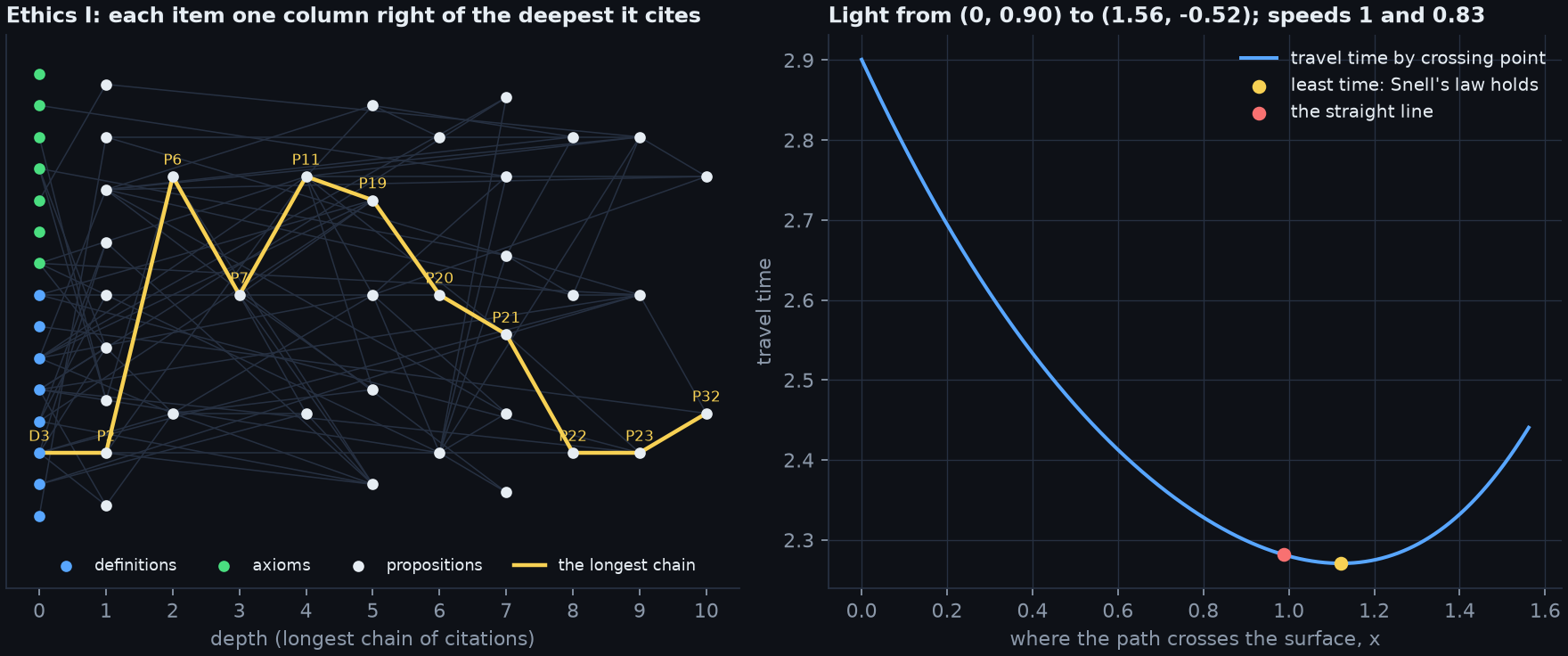
Here it is. The definitions and axioms stand in the first column, in blue and gold. Each proposition sits one column to the right of the deepest thing it relies on. The lines are the citations. The Reasoner checks the structure. There are no circles: every demonstration cites only what came before it, as in Euclid. The longest chain runs ten steps, from the definition of substance, through the proof that God exists, to Proposition 32: the will is not a free cause. The most cited items are the definition of substance, the existence of God, and the propositions that whatever is, is in God, and that infinitely many things follow from God's nature. And two axioms are never cited at all, the second and the seventh. The seventh is a translator's slip: in Spinoza's Latin, the first proof that God exists cites it, and Elwes's English leaves the citation out. A program found it by counting.
The graph also answers a question every reader of Spinoza asks: what does the proof of God's existence rest on? The Reasoner follows the citations of Proposition 11 back to their sources. Nine items: the definitions of substance and of God, three axioms, and Propositions 2, 3, 6 and 7. Nothing else in the graph is needed for it. The heart is Proposition 7: existence belongs to the nature of substance. It is an ontological argument, from the concept of a thing to its existence, of the kind Part 23 examines.
And what does the geometry prove? That besides God no substance can be or be conceived. That whatever is, is in God. That nothing in nature is contingent. And that things could not have been produced in any other way, or in any other order. Spinoza's phrase for the one substance is God, or Nature. Everything else is a mode of it, a way that it is. Freedom, for Spinoza, is not escape from this necessity, but understanding it, a thought Part 32 will weigh.
What it establishes: Ethics I (1677) in geometrical order; what the proof of God rests on; Deus sive Natura.; Computed on screen: 51 items, 102 citations, no circles, a ten-step chain, Axioms 2 and 7 never cited (7 is cited in the Latin), the nine ancestors of P11
4Sufficient reasonAdvanced4 min
Gottfried Wilhelm Leibniz, mathematician, diplomat and the inventor of the calculation dream of Part 1, rested all reasoning on two principles. The principle of contradiction: whatever implies a contradiction is false. And the principle of sufficient reason: nothing is so without a reason why it is so and not otherwise. The second is the bolder. It says the world contains no brute facts. Every truth, even the truth that this world exists rather than another, has a reason.
From the two principles come two kinds of truth. A truth of reason, Leibniz said, can be analysed into identities in finitely many steps: its denial is a contradiction. He compared it to a ratio of whole numbers. The Reasoner analyses three hundred and fifty-five over a hundred and thirteen by Euclid's algorithm: three, then seven, then sixteen, and it stops. A truth of fact, such as that Caesar crossed the Rubicon, has a reason too, but its analysis never ends; only God sees it through. Leibniz compared it to an incommensurable ratio, like the square root of two. The same algorithm gives one, then two, then two, then two, forever. The fractions it produces come closer and closer to the root of two, and never reach it. So contingent truths are not arbitrary; they are infinitely complex.
Leibniz thought the principle of sufficient reason showed up in physics. Light travels from A, in air, to B, under water, where it is slower. Which path does it take? The Reasoner tries every crossing point on the surface and times each path. The straight line is not fastest: it spends too long in the slow water. The fastest path bends at the surface, and at that point the ratio of sines equals the ratio of speeds, which is Snell's law of refraction. Fermat derived it from least time in 1662, and Leibniz in 1682 saw in it a reason in nature: of all the paths, the one actually taken is the best. Applied to everything, the same thought gives his most famous claim: God, choosing among all possible worlds, chose the best, the one richest in phenomena and simplest in laws. Part 23 returns to it, and to Voltaire's mockery of it.
Sufficient reason also shaped Leibniz's metaphysics. In the Monadology of 1714 the world consists of simple substances without extension, which he called monads. Each mirrors the whole universe from its own point of view. But the monads have no windows: nothing passes from one to another. They agree because God set them in harmony at the start, like clocks set together by the same clockmaker. And every truth about a monad, everything it will ever do, is already contained in its complete concept: the infinite analysis of a truth of fact.
In his last years Leibniz turned the principle against Newton. In letters of 1715 and 1716 with Samuel Clarke, who spoke for Newton, he imagined the whole universe moved ten feet to the east, everything keeping its relations to everything else. For Newton, space is absolute, so the shifted universe would be really different. But then, Leibniz replied, God would have had no reason to put the world here rather than there, which violates sufficient reason. So the two situations are one and the same: indiscernible things are identical. And space is nothing but the order of things that exist together. Part 25 returns to this argument, and to Newton's reply with a spinning bucket of water.
What it establishes: contradiction and sufficient reason; truths of reason and of fact; Fermat (1662) and Leibniz (1682) on least time; the Monadology (1714); Leibniz–Clarke (1715–16).; Computed on screen: 355/113 = [3; 7, 16]; √2 = [1; 2, 2, …]; the least-time crossing point obeys Snell's law
5White paperIntroductory3 min
John Locke's Essay Concerning Human Understanding, of 1689, is the founding text of the other side. Let us then suppose the mind to be, as we say, white paper, void of all characters, without any ideas: how comes it to be furnished? His answer is one word: experience. Either sensation of the world, or reflection on the mind's own operations. Against innate ideas he pointed out that children know nothing of principles like whatsoever is, is, which an innate idea should make obvious to everyone.
Locke drew a line through what the senses report. Primary qualities, solidity, extension, shape, motion and number, are in the things themselves, and our ideas of them resemble them. Secondary qualities, colour, sound, taste and warmth, are only powers in things to produce ideas in us. Nothing like redness is out there. His evidence is an experiment you can do in a kitchen. Put one hand in hot water and the other in cold, then both in the same lukewarm basin. The same water feels cold to one hand and warm to the other. Warmth cannot be in the water, which cannot be both; it is in us.
For Locke, knowledge is the perception of the agreement or disagreement of our ideas, and it comes in three degrees. Intuitive knowledge sees a connection at once: that white is not black, or that I exist. Demonstrative knowledge links intuitions in a chain, as in a proof of geometry, or, Locke thought, of God's existence. And sensitive knowledge, the lowest degree, is knowledge that a particular thing exists outside me, now. It is less certain, Locke admitted, but certain enough for all our purposes. The gap between ideas and the things outside them is where Berkeley and Hume would press.
In 1688 William Molyneux sent Locke a question that is still alive. Suppose a man born blind has learned to tell a cube from a sphere by touch. Now suppose he is made to see. Could he tell, by sight alone, before touching, which is the cube and which the sphere? Molyneux and Locke said no: the link between how things look and how they feel must be learned. Leibniz said yes: a rational being could work it out from the geometry. For three centuries it was a thought experiment. Then in 2011 Richard Held and colleagues, working with Project Prakash in India, tested five patients just after surgery gave them sight. At first they could not match what they saw with what they had felt. But within days they could. The answer was no, and then, quickly, yes.
What it establishes: the Essay (1689): white paper; primary and secondary qualities and the three basins; three degrees of knowledge; Molyneux (1688) and Held et al. (2011).
6To be is to be perceivedIntroductory4 min
George Berkeley, an Irish bishop, took empiricism one step further than Locke. Locke had argued that colour is not in things, because it varies with the observer. But shape and size vary too. A tower looks round from afar and square up close; to a mite, a human foot is enormous. So primary qualities are ideas as well, and there is no matter behind the ideas, holding them up. For unthinking things, Berkeley wrote in 1710, to be is to be perceived: esse est percipi. What, then, keeps a tree in being when no one is looking at it? God, who perceives everything.
Berkeley rested a great deal on one short argument, now called the master argument. Try to conceive of a tree that exists without anyone perceiving or conceiving it. But in trying, you are conceiving it. So you have not conceived an unconceived tree. So nothing can exist unconceived. Most readers find a slip here. To conceive of a tree that is unconceived is not to conceive of it as being conceived. I can think about a book that no one will ever read, without my thought being a reading of it. The content of a thought and the act of thinking it come apart.
Berkeley's empiricism also attacked abstraction. Locke had described the general idea of a triangle: it must be neither oblique nor rectangle, neither equilateral, equicrural nor scalenon, but all and none of these at once. Berkeley replied that no one can frame such an idea. Every triangle you picture has some particular shape. A general word, he proposed, works by standing for any particular of its kind, indifferently. A geometer proves a theorem about one triangle, using nothing special to it.
Berkeley's sharpest argument was about mathematics. In The Analyst of 1734 he examined Newton's method of fluxions, the calculus. To find how fast x squared grows, increase x by a small quantity o, subtract, and divide by o: two x plus o. Dividing by o requires that o is not zero. Then Newton lets o vanish, leaving two x. So o is assumed to be something, and then nothing. And what are these fluxions? Berkeley asked. May we not call them the ghosts of departed quantities? The Reasoner computes the quotient for smaller and smaller o at x equals three: six point one, six point zero one, and so on, approaching six and never needing o to be zero. The cure took more than a century. Cauchy and Weierstrass defined the limit with epsilon and delta, so that o never has to vanish. Berkeley's objection was right, and it improved mathematics.
Berkeley's view invites a famous reply. In 1763, according to James Boswell, Samuel Johnson kicked a large stone so hard that he rebounded from it, and said: I refute it thus. But Berkeley never denied that the stone exists, or that it is hard. He denied only that it is anything more than ideas. The kick and the pain in Johnson's foot are more ideas, arriving in the regular order God gives them. The deeper question is why we expect that order to continue. That question belongs to David Hume.
What it establishes: the Principles (1710); esse est percipi; the master argument; abstract ideas; The Analyst (1734); Johnson's stone.; Computed on screen: the difference quotient of x² at 3 for o = 0.1 … 0.0001
7Impressions and ideasIntroductory2 min
David Hume's Treatise of 1739, and his Enquiry of 1748, push empiricism to its conclusions. The contents of the mind are of two kinds: impressions, what we feel and see, which are vivid; and ideas, which are fainter copies of them. Every simple idea comes from a simple impression that it resembles. Complex ideas are built from simple ones: a golden mountain is gold and a mountain, joined in thought. This gives Hume a weapon. When a philosopher uses a word, ask: from what impression is this idea derived? If there is none, the word has no meaning.
Hume himself gave the best counterexample to his principle. Imagine someone who has seen every shade of blue but one. Set the shades out in order, from light to dark, and there is an obvious gap where the missing one belongs. Can they imagine it? Hume thought they could, though no impression gave it to them. And he shrugged: the case is so particular and singular, he wrote, that it is scarce worth our observing, and does not merit that for it alone we should alter our general maxim.
Hume then divided all reasoning in two. Relations of ideas, like Pythagoras's theorem, are known by thought alone, and denying them is a contradiction. They are certain, but they say nothing about what exists. Matters of fact, like the sun rising tomorrow, are known only by experience, and their denial is perfectly conceivable. They are about the world, but never certain. Anything that is neither is worthless. The Enquiry ends: if we take in our hand any volume of divinity or school metaphysics, and it contains no abstract reasoning concerning quantity or number, and no experimental reasoning concerning matter of fact, commit it then to the flames: for it can contain nothing but sophistry and illusion.
What it establishes: the Treatise (1739) and Enquiry (1748): impressions and ideas; the missing shade of blue; the fork.; Computed on screen: eleven shades, one left out
8Custom, the great guideIntroductory4 min
Hume's most famous analysis is of cause and effect. One billiard ball rolls into another, and the second moves off. What do we actually see? The balls touch; the first moves before the second; and in case after case, such a collision is followed by such a motion. What we never see is the necessary connection between them, the power by which the first makes the second move. Examine the impressions as closely as you like; it is not there. Where, then, does the idea come from? From habit. After many repetitions, the mind is carried by custom from the sight of one to the expectation of the other, and we project that feeling of being carried onto the world. Necessity is in the mind, not in the balls. Part 17, on causation, picks up the thread.
In the Enquiry, Hume defines a cause in a single sentence that contains two definitions. First: an object, followed by another, where all the objects similar to the first are followed by objects similar to the second. That is the regularity view: causation is nothing but constant conjunction. Then: or in other words, where, if the first object had not been, the second never had existed. That is a counterfactual, and it became David Lewis's theory of causation in 1973, which Part 17 builds. Hume thought he had said the same thing twice. He had not. Two traditions in the philosophy of causation grow from this one sentence.
Habit explains our expectations. It does not justify them. The sun has risen on every day we have observed. Will it rise tomorrow? The Reasoner writes down four rules. Always a sunrise; a sunrise until day eight, and then none; a sunrise until day ten; or a sunrise until day eight and then every other day. Every one fits all eight observations perfectly, and they disagree about tomorrow. To choose the first, we must assume that the future will resemble the past. Is that a relation of ideas? No: its denial is perfectly conceivable. Is it a matter of fact, learned from experience? Only by an argument that already assumes it. So, Hume concluded, our inferences from experience have no foundation in reason. They rest on custom, which he called the great guide of human life. Part 15 is devoted to this problem.
Hume turned the same test on the self. When I enter most intimately into what I call myself, he wrote, I always stumble on some particular perception or other, of heat or cold, light or shade, love or hatred. I never can catch myself at any time without a perception, and never can observe any thing but the perception. So the self is nothing but a bundle of perceptions, in perpetual flux. Descartes's first certainty has become a bundle. Part 21, on personal identity, takes it up.
Hume's fellow Scot Thomas Reid answered him in 1764. Hume's skepticism, Reid argued, followed from a premise shared since Descartes: that what we perceive directly is only ideas in the mind, never the things themselves. That way of ideas is the mistake. We perceive things, not pictures of things. And some principles, such as that the things we perceive exist, are first principles of common sense, to be trusted until shown otherwise. The same faculty that tells us of our ideas tells us of the world, Reid said; why trust the one and not the other? His heirs include G. E. Moore, who held up his hand to refute the skeptic, as Part 11 will show.
What it establishes: constant conjunction and habit; the two definitions; the problem of induction; the bundle self; Reid (1764).; Computed on screen: four rules that fit eight sunrises and disagree about the ninth
9Kant's questionIntroductory2 min
In Königsberg, on the Baltic, a professor who never travelled more than a few miles from home read Hume, and it changed his life's work. I freely admit, Immanuel Kant wrote, that the remembrance of David Hume was the very thing that many years ago first interrupted my dogmatic slumber. Hume had shown that necessity cannot be found in experience. Yet mathematics and Newton's physics seemed both necessary and about the world. So where does their necessity come from, if not from experience, and not from mere definitions?
Kant's question rests on two distinctions. A judgment is analytic if its predicate is already contained in its subject, like all bachelors are unmarried, or Kant's example, all bodies are extended. Otherwise it is synthetic. And it is a priori if it is known independently of experience, a posteriori if only through it. Two distinctions make four boxes. Analytic truths are a priori: we need only understand the words. Some bodies are heavy is synthetic a posteriori: we must lift them. Nothing is analytic and a posteriori. The interesting box is the last. Kant put there seven plus five equals twelve; every event has a cause; and the angles of a triangle sum to two right angles. They are about the world, yet known with necessity. How are such synthetic judgments a priori possible? That is the question of the Critique.
Kant's answer turns the problem upside down. Up to now, he wrote, it has been assumed that all our knowledge must conform to objects. On that assumption, knowledge in advance of experience is impossible: how could we know beforehand what objects will be like? So let us try assuming that objects must conform to our knowledge. Then we can know a priori whatever we ourselves contribute to experience. He compared the move to Copernicus, who explained the motions of the heavens by letting the observer move instead of the stars. What does the mind contribute? The forms of all experience: space, time, and the categories.
What it establishes: the Prolegomena (1783); the grid; the Copernican revolution (B xvi).
10Space and timeAdvanced4 min
The first part of Kant's answer concerns space and time. Newton thought them real containers; Leibniz, relations between things. Kant said neither. They are the forms of intuition: the way anything at all must be given to us. Space is the form of outer sense, time the form of inner sense. We can imagine space with no objects in it, Kant observed, but we can never imagine away space itself. So whatever is true of space in general will be true of everything we can ever perceive, because perceiving is having things in space. That is why geometry can be known in advance.
Kant gave two examples. Seven plus five equals twelve. The concept of the sum of seven and five contains only the union of the two numbers, not which number results. To get twelve, we must count on, five units, one after another, in time. So arithmetic is synthetic, and a priori because time is our form. And the angles of a triangle sum to two right angles. Nothing in the concept of a three-sided figure says so. We must construct: draw the triangle, and a line through one corner parallel to the opposite side, in space. So geometry is synthetic a priori, because space is our form, and every triangle we will ever meet is in it.
Kant had a striking example about space, from 1768. Take a flat hand, and its mirror image. The Reasoner tries every rotation of one in the plane against the other: four rotations, and none matches. Only a turn through the third dimension, flipping it over, brings them together. A left and a right hand are alike in every internal relation, every length and every angle, yet they are different, and no amount of turning makes one the other. In 1768 Kant took this to show, against Leibniz, that space is more than relations between things. Later, in the Prolegomena, he took it as evidence that space is a form of our intuition, not a property of things in themselves.
Is the angle sum really fixed in advance? On a curved surface it is not. Walk on a sphere from the north pole down to the equator, turn a right angle, go a quarter of the way round, turn again, and walk back to the pole. The triangle has three right angles: two hundred and seventy degrees. The excess over a hundred and eighty is the triangle's area divided by the square of the radius, so bigger triangles show it more. Carl Friedrich Gauss, surveying Hanover in the 1820s, measured a great triangle between three mountain tops. The Reasoner works out its spherical excess on the curved surface of the earth: about fifteen seconds of arc, roughly a two-hundred-and-fortieth of a degree. That was close to the limit of his instruments, and it concerns the earth's surface, not space itself. Whether Gauss meant to test the geometry of space is debated; either way, Kant's question was untouched until Einstein.
What it establishes: space and time as forms of intuition; 7 + 5 = 12 and the triangle; incongruent counterparts (1768); Gauss's survey.; Computed on screen: no rotation matches a flat hand to its mirror image; the octant triangle's 270°; Gauss's triangle's excess, 14.9″
11The categoriesResearch2 min
The second part of the answer concerns thought. Logic, Kant believed, had been complete since Aristotle, and it sorts every judgment along four headings: quantity, quality, relation and modality, three forms under each. To each form of judgment corresponds a pure concept of an object in general, a category. Twelve forms, twelve categories. For example, the hypothetical judgment, if p then q, corresponds to the category of cause and effect. The categorical judgment, S is P, corresponds to substance and its properties.
Why should the categories apply to the world? This is the transcendental deduction, the hardest part of the Critique, and here is the structure of its argument. The I think must be able to accompany all my representations. My experiences are all mine: they form one experience, of one self. That unity is not given; it requires that the mind combine its representations by rules. The rules of combination are the categories. So the categories hold of every object of possible experience. And so Hume's problem dissolves: every event has a cause is not something we learn from experience, and could never learn. It is a condition of having experience at all.
Kant made the argument concrete with a famous pair of examples, in the second analogy of experience. Look at a house. My eyes may run from the roof to the base, or from the base to the roof. The order of my perceptions could have been either. Nothing happened. Now watch a ship drift downstream. I see it first upstream, then downstream, and I could not have seen it the other way round. Here something happened: an event. What makes the order irreversible is not in the perceptions themselves. It is a rule: the later state follows the earlier necessarily. So to experience an event at all, as opposed to a mere sequence of perceptions, is already to apply the concept of cause. That is Kant's answer to Hume's billiard balls.
What it establishes: the table of judgments and the categories; the deduction (B131); the second analogy (the house and the ship).
12Reason against itselfAdvanced2 min
And when reason goes beyond any possible experience? Kant answered with four antinomies, pairs of arguments that prove opposite conclusions. Here is the first, as two proofs racing side by side. The thesis: the world has a beginning in time. Suppose it had none. Then up to now an infinite series of states has elapsed. But an infinite series can never be completed by successive steps. So the world had a beginning. The antithesis: the world has no beginning. Suppose it had one. Then before it there was empty time. But in empty time nothing can come to be, since no moment of it differs from any other, and so none could be the moment of creation. So the world has no beginning. Both proofs look valid. Both reason by reductio from the other's conclusion. And they contradict each other.
There are four antinomies. A beginning in time and a limit in space, or neither. Simple parts, or nothing simple. Freedom, or natural law throughout. A necessary being, or nothing necessary. Kant's diagnosis is that both sides make the same mistake: they treat the world as a completed whole, given in itself, about which there must be a fact of the matter. But the world is never given to us whole. It is only ever experienced, step by step, and the series of experiences is never complete. So in the first two antinomies both sides are false; in the last two, both may be true, of different aspects of things: nature as it appears, and things as they are in themselves.
This is the tenth brick in the Wall, and it has two halves. The dream: necessary knowledge of the world from experience. The wall: Hume's problem, that experience never shows necessity, and Kant's antinomies, that reason left to itself proves contradictions. What it forces: either the mind's own contribution to experience, as Kant proposed, or skepticism.
What it establishes: the first antinomy as two proofs; the four antinomies and Kant's diagnosis; the Wall's tenth brick.
13Things in themselvesResearch2 min
Kant's solution has a price, and he paid it openly. We know a priori what we ourselves contribute to experience. So our necessary knowledge, of geometry, arithmetic and causation, holds of things as they appear to us: in space and time, and under the categories. Of things as they are in themselves, apart from how they appear, we know nothing at all, not even whether they are in space or time. Necessary knowledge is knowledge of appearances only. Space and time, Kant said, are empirically real, since everything we meet is in them, and transcendentally ideal, since they belong to the form of our experience, not to things in themselves.
Kant saw an advantage in the price. Thus I had to deny knowledge, he wrote, in order to make room for faith. God, freedom and the immortal soul lie beyond any possible experience. So they can be neither proved nor disproved: the antinomies, and Kant's refutations of the traditional proofs of God, show reason failing in both directions. Freedom is impossible within nature, where every event has a cause, but it is not impossible for things in themselves. And morality, Kant argued in his second Critique, requires that we think of ourselves as free. Part 35 takes up his ethics.
Scholars still argue about what Kant meant. On the two-world reading, appearances and things in themselves are two different sets of objects: the table I see is a representation in my mind, caused by an unknowable thing beyond it. Peter Strawson, in 1966, found this incoherent: we could not even say that unknowable things cause anything. On the two-aspect reading, defended by Henry Allison, there is one set of objects, considered in two ways: the table as it appears to us, and the same table considered apart from the conditions of our experience. Rae Langton proposed a third: we know things only by their relations and powers, never their intrinsic natures. Kantian humility.
What it establishes: appearances and things in themselves; B xxx; two worlds or two aspects (Strawson 1966, Allison 1983, Langton 1998).
14What became of Kant's examplesApplied2 min
Kant's examples did not fare well. Within fifty years of the Critique, Nikolai Lobachevsky and János Bolyai built a geometry in which, through a point off a line, there are infinitely many parallels, and the angles of a triangle sum to less than two right angles. Bernhard Riemann, in 1854, described geometries with no parallels at all, like the sphere's, where the angles sum to more. Each is consistent if Euclid's is: the parallel postulate is independent of the other axioms. So which geometry describes physical space cannot be settled by pure intuition. It became a question for physics.
Physics answered. Einstein's general relativity, in 1915, says that space-time is curved by matter, so that light passing the sun is bent. The Reasoner computes the prediction for starlight grazing the sun's edge: one point seven five seconds of arc, twice the value that a Newtonian particle of light would give. In 1919 Arthur Eddington and Frank Dyson sent expeditions to photograph stars near the eclipsed sun, from Brazil and from an island off Africa. They reported about two seconds and one point six, and announced that Einstein was right. Physical space is not Euclidean. The geometry Kant thought we know a priori is, of the world, false, and known to be false a posteriori.
The other examples fared no better. Frege argued that arithmetic is analytic, as Part 9 showed. And quantum mechanics suggests that some events have no determining cause, as Part 26 will show. But something survives. Hans Reichenbach, in 1920, distinguished two senses of a priori: necessary and unrevisable, which relativity refuted; and constitutive, the principles that make a physical theory's measurements meaningful in the first place, which every theory has. Rudolf Carnap made the frameworks a matter of choice. And Michael Friedman, in Dynamics of Reason, argued that each science has a constitutive a priori, which changes in scientific revolutions. Kant was right that experience needs a framework the mind brings to it, and wrong that the framework can never change. Part 18 takes up the revolutions.
What it establishes: Lobachevsky, Bolyai, Riemann; general relativity and the 1919 eclipse; Reichenbach (1920), Carnap, Friedman (2001).; Computed on screen: starlight at the sun's edge: 1.75″ (Einstein), 0.88″ (Newtonian); Eddington's 1.98″ and 1.61″
15Hegel, briefly and honestlyResearch2 min
Kant's antinomies showed reason contradicting itself. Hegel made that into a method. His Science of Logic begins with the emptiest concept there is: pure being, with no further determination. Thought through, it turns out to have no content at all; it is nothing. And the passing of each into the other is becoming. The engine is what Hegel called determinate negation: each concept, thought through, reveals its own limits, and the limit points to a richer concept. One correction is owed. The formula thesis, antithesis, synthesis is not Hegel's. It comes from Fichte, and was attached to Hegel by later expositors.
A series built on formal reasoning has to ask: can the dialectic be formalized? Some read it as a paraconsistent logic, in which some contradictions are true, the view of Part 5. William Lawvere, a founder of category theory, read Hegel's unities of opposites as adjoint pairs of functors. Others read the dialectic as a process of revision, each stage correcting the last, rather like a learning system. Each reading captures something, and none is accepted as the reading. The honest summary is that Hegel's logic is not a formal logic, and does not claim to be one. Its influence runs instead through philosophy of history and society, through Marx, and into Parts 29 and 38.
What it establishes: being, nothing, becoming; determinate negation; Fichte's triad; attempted formalizations and their limits.
16The Price ListIntroductory2 min
The part fits a Price List with three claims. All our knowledge comes from experience. We know some necessary truths: seven and five could not have made anything but twelve. And experience shows only what is, never what must be. The Reasoner confirms that the three are inconsistent, and any two consistent. Give up the first, and some knowledge comes from reason itself: Descartes's and Leibniz's innate ideas, or Kant's forms of intuition and categories. Give up the second: there is no necessary knowledge, only very well confirmed generalizations. John Stuart Mill said this of arithmetic, and Quine of everything, as Part 11 will show. Or give up the third: experience can show necessity. Aristotle held that induction lets us grasp the essences of things, and some modern philosophers think we learn what is possible from what we observe.
Side by side: the rationalist gets necessary knowledge from reason alone, and must explain why reason should fit the world. Kant gets it from the mind's own forms, and must face non-Euclidean space, and the unknowable things in themselves. The radical empiricist says there is none, and must explain why logic and mathematics seem necessary. The Aristotelian gets it from experience of essences, and must explain how a few cases can show what must be so. That is the tenth brick in the Wall: Hume's problem, and the price of Kant's solution.
What it establishes: Price List: the empiricist trilemma; four answers side by side.; Computed on screen: the MUS {E, N, S} and its three corrections
Recap, problems, and where this comes backAll tracks2 min
Let's gather what we built. The skeptical crisis, and Descartes's way out of it, with its circle. Coordinates, and Descartes's method of normals, solved by algebra. Spinoza's Ethics, read by the Reasoner as a graph of proofs. Leibniz's two kinds of truth, and nature's easiest path. Locke, a question about the newly sighted that took three centuries to test, and Berkeley. Hume's fork, his analysis of cause, and the problem of induction. And Kant's answer, its price, and what became of it.
The Reasoner has a module for the early moderns. It reads Spinoza's citations from the text and analyses the graph they make; solves Descartes's tangent problem by computer algebra; runs Euclid's algorithm to the end, or forever; finds the path of least time; computes Eddington's prediction and Gauss's excess; and writes down rules that fit the past and disagree about the future. And the Wall has its tenth brick.
Six problems, with full solutions in this part's notes. Spinoza's graph; Leibniz's two analyses; Descartes's method; Hume's rival rules; Kant's grid; and an essay on the Price List. Pause here, and try them.
Where this comes back. What knowledge is, and Quine's web of belief, in Part 11. The problem of induction, in Part 15. Cause and law, in Parts 17 and 24. The self as a bundle, in Part 21. Space and time after Kant, in Part 25. And Spinoza's freedom as understood necessity, in Part 32. Next, Part 11: what is knowledge?
The books and papers this part follows are on screen, and in the notes. Thanks for watching.
Where it goes next. What knowledge is, and Quine's web of belief, are Part 11. The problem of induction is Part 15; cause and law are Parts 17 and 24; the bundle self is Part 21; space and time after Kant are Part 25; Spinoza's freedom as understood necessity is weighed in Part 32.
Key results
The part's results in one place, for revision.
Try it
Lab 10 · Spinoza's proof graph and Leibniz's least time
Build the citation graph of Ethics Part I, check that it has no circles and measure its longest chain; then send light between two random points across a surface and check that the least-time crossing obeys Snell's law.
python -m videos.philosophy.labs 10
needs numpy, scipy, matplotlib · download lab10.py ·
source on GitHubEthics I 51 items, 102 citations; every proof cites only earlier items: True
longest chain 10 steps: D3 → P2 → P6 → P7 → P11 → P19 → P20 → P21 → P22 → P23 → P32
never cited (Elwes's English) A2, A7 (Latin text: A2)
what P11 (God exists) rests on 9 items: A1, A4, A5, D3, D6, P2, P3, P6, P7
if P1 also cited P32 the Reasoner reports a circle
least-time crossing x = 1.1216 (grid search 1.1216); time 2.2707 against 2.2815 on the straight line
Snell's law there sin i / v1 = 0.778353, sin r / v2 = 0.778353
four rules fit eight sunrises forecasts for day nine: 1, 0, 1, 1
Gauss's triangle; starlight at the sun excess 14.9″; deflection 1.75″ (Newtonian 0.88″)
Spinoza's book really is ordered like Euclid's: no proof cites anything later, and the proof of God's existence rests on nine items. Light's quickest path is not the straight one, and at the quickest crossing the two sines stand in the ratio of the speeds.The code (102 lines; it asserts its own result)
"""Lab 10: read Spinoza's Ethics I as a graph of proofs, and find the path of least time."""

import math

import numpy as np

from videos.coursekit import labs
from explainer.philosophy.reasoner import modern

TITLE = "Spinoza's proof graph and Leibniz's least time"
GOAL = ("Build the citation graph of Ethics Part I, check that it has no circles and measure its longest chain; then "
        "send light between two random points across a surface and check that the least-time crossing obeys "
        "Snell's law.")
TASKS = [
    "Call modern.ethics_graph(latin=True). Which axiom stops being idle, and does the longest chain change?",
    "Print sorted(modern.ancestors(g, 'P14')) and compare with Problem 1: fourteen items.",
    "Set v2 = v1 in least_time. Where does the light cross, and what does Snell's law reduce to?",
]


def run(seed=0):
    rng = np.random.default_rng(seed)
    lab = labs.Lab()
    g = modern.ethics_graph()
    depth, chain, idle = modern.depth(g), modern.longest_chain(g), modern.unused(g)
    lab.row("Ethics I", f"{len(g['nodes'])} items, {len(g['edges'])} citations; every proof cites only earlier items: "
                        f"{modern.forward_only(g)}")
    lab.row("longest chain", f"{len(chain) - 1} steps: {' → '.join(chain)}")
    lab.row("never cited (Elwes's English)", f"{', '.join(idle)}   (Latin text: {', '.join(modern.unused(modern.ethics_graph(latin=True)))})")
    lab.row("what P11 (God exists) rests on", f"{len(modern.ancestors(g, 'P11'))} items: {', '.join(sorted(modern.ancestors(g, 'P11')))}")
    assert len(g["nodes"]) == 51 and len(g["edges"]) == 102 and modern.forward_only(g)
    assert len(chain) - 1 == 10 == max(depth.values()) and chain[0] == "D3" and chain[-1] == "P32"
    assert all((a, b) in set(g["edges"]) for a, b in zip(chain, chain[1:])), "the chain follows real citations"
    assert idle == ["A2", "A7"] and modern.unused(modern.ethics_graph(latin=True)) == ["A2"]
    assert len(modern.ancestors(g, "P11")) == 9 and len(modern.ancestors(g, "P14")) == 14

    # a circular citation must be caught: let a random item cite one of its own descendants
    props = [v for v in g["nodes"] if v.startswith("P") and any(a.startswith("P") for a in modern.ancestors(g, v))]
    later = props[int(rng.integers(len(props)))]
    earlier = sorted(a for a in modern.ancestors(g, later) if a.startswith("P"))[0]
    broken = {"nodes": g["nodes"], "edges": g["edges"] + [(later, earlier)]}
    try:
        modern.depth(broken)
        caught = False
    except ValueError:
        caught = True
    assert caught and not modern.forward_only(broken)
    lab.row(f"if {earlier} also cited {later}", "the Reasoner reports a circle")

    # least time between two random points, against a fine grid and Snell's law
    a = (0.0, float(rng.uniform(0.5, 2.0)))
    b = (float(rng.uniform(1.5, 3.0)), -float(rng.uniform(0.5, 2.0)))
    v1, v2 = 1.0, float(rng.uniform(0.5, 0.9))
    r = modern.least_time(a, b, v1, v2)
    xs = np.linspace(a[0], b[0], 20001)
    times = np.hypot(xs - a[0], a[1]) / v1 + np.hypot(b[0] - xs, b[1]) / v2
    assert abs(xs[times.argmin()] - r["x"]) < 3e-4 and r["time"] <= times.min() + 1e-12
    assert abs(r["sin_i_over_v1"] - r["sin_r_over_v2"]) < 1e-6 and r["time"] < r["straight_time"]
    lab.row("least-time crossing", f"x = {r['x']:.4f}   (grid search {xs[times.argmin()]:.4f}); time {r['time']:.4f} "
                                   f"against {r['straight_time']:.4f} on the straight line")
    lab.row("Snell's law there", f"sin i / v1 = {r['sin_i_over_v1']:.6f},   sin r / v2 = {r['sin_r_over_v2']:.6f}")

    rules = modern.rival_rules([1] * 8)
    assert all(x["fits"] for x in rules) and {x["tomorrow"] for x in rules} == {0, 1}
    excess = modern.spherical_excess(*modern.GAUSS_TRIANGLE.values())["excess_arcsec"]
    bend = modern.light_bending()
    assert abs(excess - 14.9) < 0.05 and abs(bend["einstein"] - 1.75) < 0.005 and math.isclose(bend["einstein"], 2 * bend["newton"])
    lab.row("four rules fit eight sunrises", "forecasts for day nine: " + ", ".join(str(x["tomorrow"]) for x in rules))
    lab.row("Gauss's triangle; starlight at the sun", f"excess {excess:.1f}″;  deflection {bend['einstein']:.2f}″ (Newtonian {bend['newton']:.2f}″)")
    lab.note = ("Spinoza's book really is ordered like Euclid's: no proof cites anything later, and the proof of "
                "God's existence rests on nine items. Light's quickest path is not the straight one, and at the "
                "quickest crossing the two sines stand in the ratio of the speeds.")

    fig, ax = labs.figure(2, size=(11, 4.6))
    cols = {}
    for v in g["nodes"]:
        cols.setdefault(depth[v], []).append(v)
    pos = {v: (d, (i + 0.5) / len(vs)) for d, vs in cols.items() for i, v in enumerate(vs)}
    on_chain = set(zip(chain, chain[1:]))
    for e in g["edges"]:
        (x0, y0), (x1, y1) = pos[e[0]], pos[e[1]]
        ax[0].plot([x0, x1], [y0, y1], color=labs.GOLD if e in on_chain else labs.GRID, lw=2 if e in on_chain else 0.7,
                   zorder=3 if e in on_chain else 1)
    for kind, color, name in (("D", labs.BLUE, "definitions"), ("A", labs.GREEN, "axioms"), ("P", labs.INK, "propositions")):
        vs = [v for v in g["nodes"] if v[0] == kind]
        ax[0].scatter([pos[v][0] for v in vs], [pos[v][1] for v in vs], s=22, color=color, zorder=4, label=name)
    for v in chain:
        ax[0].annotate(v, pos[v], xytext=(0, 6), textcoords="offset points", ha="center", fontsize=7.5, color=labs.GOLD)
    ax[0].plot([], [], color=labs.GOLD, lw=2, label="the longest chain")
    ax[0].set(title="Ethics I: each item one column right of the deepest it cites", xlabel="depth (longest chain of citations)",
              yticks=[], xticks=range(11), ylim=(-0.12, 1.05))
    ax[0].grid(False)
    ax[0].legend(loc="lower center", ncols=4, fontsize=8)
    ax[1].plot(xs, times, color=labs.BLUE, label="travel time by crossing point")
    ax[1].scatter([r["x"]], [r["time"]], color=labs.GOLD, zorder=3, label="least time: Snell's law holds")
    straight = a[0] + (b[0] - a[0]) * a[1] / (a[1] - b[1])
    ax[1].scatter([straight], [r["straight_time"]], color=labs.RED, zorder=3, label="the straight line")
    ax[1].set(title=f"Light from ({a[0]:.0f}, {a[1]:.2f}) to ({b[0]:.2f}, {b[1]:.2f}); speeds 1 and {v2:.2f}",
              xlabel="where the path crosses the surface, x", ylabel="travel time")
    ax[1].legend()
    lab.fig = fig
    return lab
Now change it
- Call modern.ethics_graph(latin=True). Which axiom stops being idle, and does the longest chain change?
- Print sorted(modern.ancestors(g, 'P14')) and compare with Problem 1: fourteen items.
- Set v2 = v1 in least_time. Where does the light cross, and what does Snell's law reduce to?
Problems, with solutions
Try each problem before opening its solution.
-
What Proposition 14 rests on. In the graph of Ethics I, which definitions, axioms and propositions does Proposition 14 ultimately rest on?
Solution
Following the citations back, Proposition 14 ("besides God, no substance") rests on fourteen items: Definitions 3, 5 and 6; Axioms 1, 4 and 5; and Propositions 1–7 and 11.
-
Two analyses. Run Euclid's algorithm on \(1071/462\) and on \(\sqrt{3}\). Which analysis ends? What would Leibniz say?
Solution
Euclid's algorithm on 1071/462 gives [2; 3, 7] and stops: the ratio is commensurable (the greatest common divisor is 21). On √3 it gives [1; 1, 2, 1, 2, …], repeating forever. For Leibniz the first is like a truth of reason, whose analysis ends in an identity; the second like a truth of fact, whose analysis never ends, though it has a reason that God sees whole.
-
Descartes's method. By Descartes's method, find the centre on the \(y\)-axis of the circle touching \(y = x^2\) at \((2, 4)\).
Solution
A circle centred at (0, k) through (2, 4) meets y = x² where y² + (1 − 2k)y + k² − r² = 0. For a double root at y = 4 the roots sum to 8 = 2k − 1, so k = 9/2 (and r² = 17/4). The normal from (0, 9/2) to (2, 4) has slope −1/4, the tangent 4: their product is −1.
-
Hume's rival rules. Write two rules that agree about every past sunrise and disagree about tomorrow. Why, for Hume, can no argument choose?
Solution
"The sun rises every day" and "the sun rises until today and never again" agree on every past sunrise. To prefer the first we must assume the future resembles the past. That assumption is not a relation of ideas (its denial is conceivable) and cannot be established from experience without assuming it, so no argument chooses; custom does.
-
Kant's grid. Place in Kant's grid: 'every effect has a cause'; 'every event has a cause'; 'a straight line is the shortest between two points'.
Solution
"Every effect has a cause" is analytic (an effect is by definition something caused). "Every event has a cause" is synthetic a priori for Kant (the second analogy). "A straight line is the shortest between two points" is Kant's own example of the synthetic a priori (B16); after general relativity, as a claim about physical space, it is a posteriori.
-
(Essay) The empiricist trilemma. (Essay) Which exit from the empiricist trilemma? Defend it against its strongest objection.
Solution
A strong answer uses Chapter 16's Price List and comparison table, and meets the objection its exit faces: for rationalism, why reason should fit the world; for Kant, non-Euclidean space and the unknowable things in themselves; for radical empiricism, the apparent necessity of logic and mathematics; for the Aristotelian, how a few cases could show what must be.
Notes and sources
Sources
Texts: Sextus Empiricus, Outlines of Pyrrhonism; Montaigne, Essays (1580); Galileo, Sidereus Nuncius (1610); Descartes, Discourse on the Method and La Géométrie (1637), Meditations with Objections and Replies (1641), the correspondence with Elisabeth (1643); Spinoza, Ethics (1677; Curley and Elwes trans.); Leibniz, Monadology (1714), the Leibniz–Clarke correspondence (1715–16); Locke, Essay Concerning Human Understanding (1689); Berkeley, Principles (1710), Three Dialogues (1713), The Analyst (1734); Hume, Treatise (1739), Enquiry (1748); Reid, Inquiry (1764); Kant, "On the first ground of the distinction of regions in space" (1768), Critique of Pure Reason (1781, 1787; Guyer and Wood trans.; 李秋零 译), Prolegomena (1783); Hegel, Phenomenology of Spirit (1807), Science of Logic (1812–16).
Studies and papers: Cottingham, Descartes; Curley, Behind the Geometrical Method; Garber, Leibniz: Body, Substance, Monad; Gardner, Kant and the Critique of Pure Reason (1999); Allison, Kant's Transcendental Idealism (1983); Strawson, The Bounds of Sense (1966); Langton, Kantian Humility (1998); Friedman, Dynamics of Reason (2001); Reichenbach, The Theory of Relativity and A Priori Knowledge (1920); Dyson, Eddington and Davidson (1920); Held et al., "The newly sighted fail to match seen with felt", Nature Neuroscience (2011).
About this partfrom its README
Part 10 of Philosophy, Built (series plan, syllabus): Descartes to Kant, and the start of Act III, on knowledge. The skeptical crisis (Sextus Empiricus and Agrippa's trilemma, Montaigne, Galileo's telescope); Descartes's three waves of doubt, the cogito, the clear-and-distinct rule and the Cartesian circle, and Elisabeth of Bohemia's question about mind and body; coordinates, Descartes's method of normals and the four rules; Spinoza's Ethics Part I read by the Reasoner as a graph of proofs; Leibniz's two principles, finite and infinite analysis, least time and Snell's law, the monads, and the argument with Clarke about space; Locke's white paper, primary and secondary qualities, three degrees of knowledge, and Molyneux's question with its answer of 2011; Berkeley's esse est percipi, the master argument, abstract ideas and The Analyst; Hume's impressions and ideas, the missing shade of blue, the fork, causation and its two definitions, the problem of induction, the bundle self, and Reid's reply; Kant's question and the analytic/synthetic, a priori/a posteriori grid, the Copernican revolution, space and time as forms of intuition, incongruent counterparts, the categories, the deduction and the second analogy, the antinomies, transcendental idealism and its readings; non-Euclidean geometry and Eddington's eclipse, the relativized a priori (Reichenbach, Carnap, Friedman); Hegel, briefly and honestly; and the empiricist trilemma. Its brick in the Wall is "Hume; Kant": experience cannot show necessity, and reason beyond experience contradicts itself.
Every graph, count and check on screen is computed by the Reasoner's module for the early moderns
(explainer/philosophy/reasoner/modern.py: the citations of Ethics I read from R. H. M. Elwes's translation
(Project Gutenberg #3800) by parse_ethics, with depths, the longest chain, idle axioms, the most cited items and the
ancestors of any proposition; Descartes's method of normals by computer algebra; continued fractions finite and
infinite; the path of least time; Hume's rival rules; the missing shade; Kant's grid; chirality of a plane shape;
Gauss's spherical excess; and the deflection of starlight), tested in tests/philosophy/test_modern.py and cached by
compute.py.
Chapter notes
| # | Scene | What it establishes | Computed on screen |
|---|---|---|---|
| 0 | Hook |
Kant's B1 sentence; Sextus and Agrippa's trilemma, Montaigne (1580), Galileo (1610); reason and experience; the plan. | — |
| 1 | Doubt |
the Meditations (1641): three waves of doubt; the cogito; the clear-and-distinct rule; Arnauld's circle; Elisabeth (1643). | — |
| 2 | Geometry |
La Géométrie (1637); the method of normals; the four rules of the Discourse. | y = x² at (1, 1): the double-root condition gives k = 3/2, and the normal is perpendicular to the tangent |
| 3 | Spinoza |
Ethics I (1677) in geometrical order; what the proof of God rests on; Deus sive Natura. | 51 items, 102 citations, no circles, a ten-step chain, Axioms 2 and 7 never cited (7 is cited in the Latin), the nine ancestors of P11 |
| 4 | Leibniz |
contradiction and sufficient reason; truths of reason and of fact; Fermat (1662) and Leibniz (1682) on least time; the Monadology (1714); Leibniz–Clarke (1715–16). | 355/113 = [3; 7, 16]; √2 = [1; 2, 2, …]; the least-time crossing point obeys Snell's law |
| 5 | Locke |
the Essay (1689): white paper; primary and secondary qualities and the three basins; three degrees of knowledge; Molyneux (1688) and Held et al. (2011). | — |
| 6 | Berkeley |
the Principles (1710); esse est percipi; the master argument; abstract ideas; The Analyst (1734); Johnson's stone. | the difference quotient of x² at 3 for o = 0.1 … 0.0001 |
| 7 | Hume |
the Treatise (1739) and Enquiry (1748): impressions and ideas; the missing shade of blue; the fork. | eleven shades, one left out |
| 8 | Cause |
constant conjunction and habit; the two definitions; the problem of induction; the bundle self; Reid (1764). | four rules that fit eight sunrises and disagree about the ninth |
| 9 | Kant |
the Prolegomena (1783); the grid; the Copernican revolution (B xvi). | — |
| 10 | Aesthetic |
space and time as forms of intuition; 7 + 5 = 12 and the triangle; incongruent counterparts (1768); Gauss's survey. | no rotation matches a flat hand to its mirror image; the octant triangle's 270°; Gauss's triangle's excess, 14.9″ |
| 11 | Categories |
the table of judgments and the categories; the deduction (B131); the second analogy (the house and the ship). | — |
| 12 | Antinomies |
the first antinomy as two proofs; the four antinomies and Kant's diagnosis; the Wall's tenth brick. | — |
| 13 | Idealism |
appearances and things in themselves; B xxx; two worlds or two aspects (Strawson 1966, Allison 1983, Langton 1998). | — |
| 14 | After |
Lobachevsky, Bolyai, Riemann; general relativity and the 1919 eclipse; Reichenbach (1920), Carnap, Friedman (2001). | starlight at the sun's edge: 1.75″ (Einstein), 0.88″ (Newtonian); Eddington's 1.98″ and 1.61″ |
| 15 | Hegel |
being, nothing, becoming; determinate negation; Fichte's triad; attempted formalizations and their limits. | — |
| 16 | Price |
Price List: the empiricist trilemma; four answers side by side. | the MUS {E, N, S} and its three corrections |
| 17 | Outro |
recap; the Reasoner's module; the Wall; problems; payoffs; references. | — |
Companion material in this repository
The syllabus's plan for this partfrom SYLLABUS.md, the plan of record
- The new science and the crisis of certainty (Galileo, Montaigne's skepticism, the Pyrrhonist modes of Sextus).
- Descartes's method of doubt: the senses, the dream, the demon; the cogito; the clear-and-distinct rule; the Cartesian circle.
- Descartes the geometer: coordinates as the calculus of space (the method that inspired the hope).
- Spinoza's Ethics "in geometrical order". Built: the proof dependency graph of Part I (definitions, axioms, 36 propositions), with its longest chains and its unused axioms computed.
- Leibniz: the principle of sufficient reason, monads, truths of reason vs of fact (finite vs infinite analysis), and the best of all possible worlds as an optimization (bridge to Part 23).
- Locke: ideas, primary and secondary qualities, Molyneux's problem (and the 2011 test with newly sighted patients, Held et al., cited).
- Berkeley: esse est percipi; the master argument.
- Hume: impressions and ideas; the missing shade of blue; relations of ideas vs matters of fact (Hume's fork).
- Hume on causation: constant conjunction and habit (previews Parts 15 and 17); the self as a bundle (previews Part 21).
- Kant's question: how are synthetic a priori judgments possible? The analytic/synthetic × a priori/a posteriori grid, filled in.
- 7 + 5 = 12 and Euclid's geometry as Kant's examples; the transcendental aesthetic.
- The table of judgments and the categories; the transcendental deduction (structure of the argument).
- The antinomies: the first antinomy's thesis and antithesis both "proved" (finite vs infinite world); Kant's diagnosis.
- Transcendental idealism: two-world vs two-aspect readings (Allison).
- What happened to Kant's examples: non-Euclidean geometry (Part 25), Frege's analyticity of arithmetic (Part 9), and Reichenbach's relativized a priori and Friedman's dynamics of reason.
- Hegel's dialectic, briefly and honestly, with the formal reconstructions attempted and their limits.
- Recap and Problems.
Built: the Spinoza proof graph (hand-encoded from Curley's translation, checked for cycles and dangling references). Wall: Hume's problem (no demonstrative or probable argument for induction); Kant's antinomies (reason contradicts itself when it goes beyond experience). Price List: the empiricist trilemma (all knowledge comes from experience; we know necessary truths; experience shows only what is, not what must be). Visuals: Spinoza's Ethics as a glowing DAG; Kant's 2×2 grid with examples sliding between cells; the antinomy as two proofs racing side by side. References: Descartes, Meditations; Spinoza, Ethics (Curley trans.); Leibniz, Monadology; Locke, Essay; Berkeley, Principles; Hume, Enquiry; Kant, Critique of Pure Reason (Guyer and Wood trans.; 李秋零 译); Gardner, Kant and the Critique of Pure Reason; Allison, Kant's Transcendental Idealism.
中文讲义
本讲的中文部分(与英文版对应)。
习题与解答
-
命题14依赖什么。 在*《伦理学》*第一部分的图中, 命题14最终依赖哪些定义、公理和命题?
解答
沿引用回溯,命题14(“除神之外没有实体”)依赖十四项:定义3、5、6;公理1、4、5;以及命题1–7和11。
-
两种分析。 对\(1071/462\)和\(\sqrt{3}\)运行欧几里得算法。 哪个分析会终止? 莱布尼茨会怎么说?
解答
对1071/462运行欧几里得算法得到[2; 3, 7]并停止:这个比可公度(最大公约数是21)。对√3则得到[1; 1, 2, 1, 2, …],永远重复。 对莱布尼茨来说,前者像理性真理,其分析终止于一个同一式;后者像事实真理,其分析永无尽头,尽管它有一个神能完整看见的理由。
-
笛卡尔的方法。 用笛卡尔的方法, 求\(y\)轴上的圆心,使圆在\((2, 4)\)处与\(y = x^2\)相切。
解答
以(0, k)为圆心、过(2, 4)的圆与y = x²相交于y² + (1 − 2k)y + k² − r² = 0的根处。要在y = 4处有二重根,两根之和 8 = 2k − 1,所以k = 9/2(r² = 17/4)。从(0, 9/2)到(2, 4)的法线斜率为−1/4,切线斜率为4:乘积为−1。
-
休谟的对立规则。 写出两条规则, 它们在过去每次日出上都一致, 而对明天的看法不同。 为什么在休谟看来,没有论证能作出选择?
解答
“太阳每天升起”与“太阳升到今天为止,此后再也不升”在过去的每次日出上都一致。要偏爱前者,我们必须假定未来与过去相似。 这个假定不是观念的关系(它的否定可以设想),也不能不预设它而从经验中确立,所以没有论证能作出选择;作选择的是习惯。
-
康德的方格。 把下列判断放进康德的方格: "每个结果都有原因"; "每个事件都有原因"; "直线是两点之间最短的线"。
解答
“每个结果都有原因”是分析的(结果按定义就是被引起的东西)。“每个事件都有原因”对康德来说是先天综合的(第二类比)。 “直线是两点之间最短的线”是康德自己举的先天综合的例子(B16);在广义相对论之后,作为关于物理空间的断言,它是后天的。
-
(论述题)经验论三难。 (论述题)你选择经验论三难的哪个出路? 针对它最强的反驳为它辩护。
解答
好的回答利用第16章的代价清单和比较表,并回应其出路所面对的反驳:对理性主义,是理性为何与世界相合;对康德,是 非欧空间与不可知的物自体;对激进经验论,是逻辑和数学看似具有的必然性;对亚里士多德主义者,是少数几个例子如何能显示必然如此。
Build the film
python -m videos.philosophy.philosophy10.compute        # the part's numbers, into .cache/philosophy10
python tools/build.py philosophy10                  # render and assemble the film
EXPLAINER_TTS=silent python tools/qa_scene.py philosophy10 Hook   # one chapter, silent, with a contact sheet
Scenes: videos/philosophy/philosophy10. Setup: see the course page. Source of these notes: the README and the scenes' narration.
Build it
python -m videos.philosophy.philosophy10.compute       # every computed item (a few seconds; .cache/philosophy10)
python tools/build.py philosophy10 -q l                # 480p preview
python tools/build.py philosophy10                     # 1080p30 -> renders/philosophy10.mp4
python tools/qa_scene.py philosophy10 Spinoza          # one chapter, silent, with a contact sheet