Act I · The Machinery of Reason
Part 5 of 42Beyond True and False
non-classical logics and vagueness
What happens to logic if a sentence may be neither true nor false, or both, or true to a degree, and does any of it solve the paradox of the heap?
A man with no hairs is bald, one more hair never makes the difference, and so a man with a full head of hair is bald: 102 premises for 101 men, classically unsatisfiable, every one of them needed. The part builds the logics that give up 'every sentence is true or false'. Łukasiewicz, Kleene and Bochvar add a third value; K3 and LP read the same tables as a gap and as a glut and turn out to be exact duals; Belnap and Dunn's four values serve a computer told conflicting things and Nāgārjuna's four corners alike, and the Jaina count reaches seven. Paraconsistent and relevant logics refuse explosion, Gödel shows that intuitionistic logic has no finite table, and degrees of truth drive a fuzzy controller that stops a train. Then the heap returns as this part's brick in the Wall: supervaluation, degrees, epistemicism and contextualism are computed side by side, each exit from the sorites quartet has a second price, and the borderline itself turns out to have borderline cases. The part ends with logic as resources, quantum propositions where distribution fails, the question of what makes a consequence logical, and whether there is one logic or many.
What you need. Propositional logic and the Price List of Part 2; for Chapter 13, the Kripke models of Part 4.
- The calculation
- many-valued and paraconsistent logic
- The wall
- the sorites
- Built toy
- n-valued matrix evaluator; the catuṣkoṭi as FDE
What you will be able to do
Introductory
- Evaluate a formula in a three-valued table and say whether an inference is valid in K3 and in LP, giving the countermodel when it is not.
- State the sorites as a set of jointly inconsistent claims and say which claim each theory of vagueness gives up.
- Read Nāgārjuna's four corners and the Jaina seven predications as sets of truth values.
Advanced
- Prove that K3 has no tautologies and that LP has no explosion, and derive the duality between them.
- Compute supervaluationist verdicts over a set of sharpenings and explain how 'there is a last bald man' is super-true with no super-true instance.
- Compute Łukasiewicz degrees along a sorites series and bound the loss of each modus ponens.
Research
- Model 'definitely' as a box over sharpenings, and show why a non-transitive accessibility relation gives higher-order vagueness and revenge.
- State Tarski's permutation-invariance criterion for logical notions and the collapse argument against logical pluralism.
Applied
- Write fuzzy rules with a t-norm and defuzzify them into a control signal, and say what the controller trades between comfort and precision.
- Decide whether a sequent of linear logic is provable by counting resources, and explain what dropping contraction and weakening buys a type system.
Contents
Each chapter has a home level. Choose a track to see what to read and watch: Introductory 20 min · Advanced 49 min · Research 59 min · Applied 27 min.
- 0Letting go of two valuesIntroductory3 min
- 1Three valuesIntroductory3 min
- 2Gaps and glutsIntroductory3 min
- 3Told true, told falseAdvanced4 min
- 4The four cornersIntroductory2 min
- 5Seven ways of sayingIntroductory3 min
- 6Living with contradictionAdvanced3 min
- 7RelevanceAdvanced3 min
- 8Proof instead of truthAdvanced3 min
- 9Degrees of truthApplied3 min
- 10The heapIntroductory3 min
- 11Sharpenings and degreesAdvanced3 min
- 12A sharp line no one can seeAdvanced3 min
- 13Vague about vaguenessResearch3 min
- 14Logic as resourcesApplied3 min
- 15Is logic empirical?Advanced3 min
- 16What makes it logical?Research4 min
- 17One logic or many?Research3 min
- Recap, problems, and where this comes backAll tracks2 min
Also on this page: Lecture · Key results · Try it · Lab · Problems · Notes and sources · 中文 · Build the film.
Lecture
The text of each chapter is the film's narration, as it is spoken, so you can read along or revise without the film. The pictures are in the film. A dashed box stands for a number the film computes when it is rendered (hover over it to see what is computed); the README's figures for each chapter, where it lists them, follow the chapter's text.
Letting go of two valuesIntroductory3 min
Parts 2, 3 and 4 kept one rule fixed: every sentence is true or false, and nothing else. This part asks what happens when we let go of it. Three values, four, seven, or a whole continuum. It sounds like a technicality. It is not: the reasons for letting go come from the future, from paradox, from inconsistent data, from physics, and above all from a puzzle about a heap of sand that is two and a half thousand years old and still unsolved.
Here are the five pressures. The future: is 'there will be a sea battle tomorrow' already true today? Part 4 met Aristotle's worry. Vagueness: a man with four thousand hairs on his head. Is he bald? Neither answer seems right. Paradox: 'this sentence is false', which is true if and only if it is false; Part 8 is devoted to it. Inconsistent data: two sensors disagree about whether a door is open, and a classical database that believes both believes everything. And physics: in the quantum world, propositions about where a particle is combine in ways that break a classical law.
Here is the heap, in its bald form. Line up men by the number of hairs on their heads, from none to a full head. The first is bald, the last is not. And a single hair never makes the difference: if a man is bald, so is the man with one more hair. Each claim looks undeniable. Together, in classical logic, they are inconsistent: the Reasoner checks all premises for men and finds no way to make them all true. Yet drop any single one, and the rest are consistent. That is this part's brick in the Wall.
So: first the machinery, tables with more than two values, and the two opposite ways of adding a third value: a gap or a glut. Then four values, which turn out to describe a computer that hears conflicting reports, and also a pattern of argument that is two thousand years old in India. Logics that tolerate contradiction, that demand relevance, and a first look at a logic of proof instead of truth. Degrees of truth, and a fuzzy controller we build that brings a train smoothly to a stop. Then the heap itself, and four theories of vagueness, computed side by side. Logics of resources and of quantum mechanics. And finally the question underneath it all: what makes an argument logically valid, and is there only one right logic?
What it establishes: five pressures on two values (the future, vagueness, paradox, inconsistent data, physics); the bald man; the plan; the Wall's fifth brick, previewed.; Computed on screen: the 102 premises for 101 men: classically unsatisfiable, every one needed
1Three valuesIntroductory3 min
In 1920 the Polish logician Jan Łukasiewicz published a short paper on three-valued logic. His motive was Aristotle's sea battle. If 'there will be a battle tomorrow' is already true, the future is fixed. So give such sentences a third value, one half: possible, not yet settled. Then he needed tables. Negation flips true and false and leaves one half alone. 'And' takes the smaller value, 'or' the larger. And the conditional: one, if the antecedent is no truer than the consequent; otherwise one minus the drop. So 'if p then p' is true even when p is unsettled. Łukasiewicz wanted that: whatever happens tomorrow, if there is a battle, there is a battle.
Eighteen years later, Stephen Kleene arrived at almost the same tables for a different reason. He was studying partial functions, computations that may never halt. A test whose computation has not halted has no value yet, so the middle value means 'undefined' or 'unknown'. His rule: if the inputs that are known already settle the answer, give it; 'false and unknown' is false, whatever the unknown turns out to be. Otherwise the answer is unknown. That gives exactly Łukasiewicz's negation, conjunction and disjunction. The only cell that differs is unknown implies unknown: Kleene says unknown, Łukasiewicz says true.
In the same year, Dmitri Bochvar in Moscow read the third value as 'meaningless'. A meaningless part makes the whole meaningless, so in his tables the middle value spreads to everything it touches: these are the weak Kleene tables. Paris is in France, and the number seven is sleepy: not false, but nonsense. You use one of these logics every day. The NULL of database languages is Kleene's strong unknown: NULL and FALSE is FALSE. And a query keeps only the rows whose condition comes out TRUE, which, as we will see, means that only the value one is designated.
Behind all three is one idea, made precise by Łukasiewicz and Tarski in 1930. A logical matrix is a set of values, a subset of designated values, the ones that count as 'holding', and a table for each connective. An argument is valid when every valuation that gives all the premises a designated value gives the conclusion one too. Classical logic is the matrix with two values and one designated. In 1958 Łoś and Suszko showed that matrices are enough: every well-behaved propositional logic, however strange, is characterized by them, though the values may have to be infinitely many. For a finite matrix, there are finitely many rows: three to the power of the number of atoms. So consequence is decidable, and the Reasoner's new module does it the obvious way: it writes down every row.
What it establishes: Łukasiewicz (1920) and the future; his tables; Kleene (1938) and partial functions; the one cell where they differ; Bochvar (1938) and the infectious "meaningless"; SQL's NULL; logical matrices (Łukasiewicz–Tarski 1930), designated values, consequence; Łoś–Suszko (1958).; Computed on screen: the tables of Ł3, K3 and B3; 3ⁿ rows
2Gaps and glutsIntroductory3 min
Kleene's tables can be read in two opposite ways, and the difference is only which values are designated. Designate one alone, and the middle value is a gap: a sentence that is neither true nor false. That is K3, Kleene's strong three-valued logic. Designate one and one half, and the middle value is a glut: a sentence that is both true and false, and so counts as holding. That is LP, the logic of paradox, proposed by Florencio Asenjo in 1966 and named and defended by Graham Priest in 1979. Same tables, opposite logics.
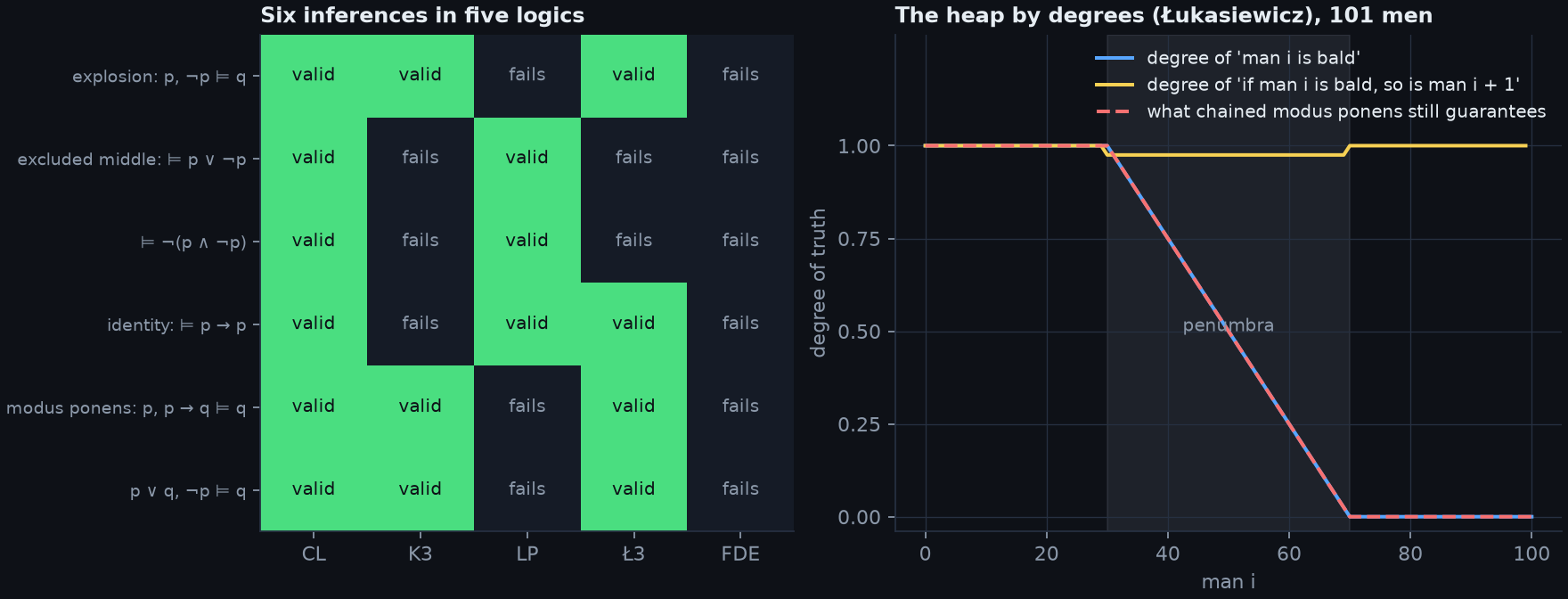
The Reasoner checks six famous inferences in five logics, row by row. Classical logic validates them all. K3 keeps explosion, modus ponens and disjunctive syllogism, but loses excluded middle, non-contradiction, and even 'if p then p'. LP is the mirror image. It keeps every classical tautology, and loses explosion, modus ponens and disjunctive syllogism. Łukasiewicz's logic keeps 'if p then p', but not excluded middle. And the four-valued logic of the next chapter loses everything here. Every failure comes with a countermodel. Here is LP's against explosion: p takes the middle value, so p and not p both hold; q is false. From a contradiction, nothing in particular follows.
Why these patterns? In K3, set every atom to one half. Every connective sends halves to a half, so every formula gets one half, which is not designated. So no formula is true on every row: K3 has no tautologies at all. Its valid arguments are inferences, not laws. In LP, the same valuation makes everything a half, and now a half is designated. So any premises whatever can all hold together: no set of premises explodes, and from a contradiction nothing in particular follows. The price shows in modus ponens. Let p be a half and q false. 'If p then q' is a half, so it holds; p holds; q does not. An LP reasoner who accepts a conditional cannot simply detach its consequent.
K3 and LP are exact mirror images, and there is a theorem that says so. A entails B in K3 if and only if not B entails not A in LP. The Reasoner checked it on all pairs drawn from twelve formulas, and found no exception. The reason is that negation turns 'designated in K3' into 'undesignated in LP'. One warning. This argument is valid in both: in K3 because its premise can never hold, in LP because its conclusion always does. Yet it fails in the four-valued logic of the next chapter, which contains gaps and gluts at once: p both true and false, q neither.
What it establishes: K3 and LP: the same tables, opposite designated sets; Asenjo (1966), Priest (1979); why K3 has no tautologies and LP no explosion; modus ponens fails in LP; the duality theorem; a gap between "valid in both" and FDE.; Computed on screen: six inferences in CL, K3, LP, Ł3, FDE with countermodels; the duality on all 144 pairs of 12 formulas; p ∧ ¬p ⊨ q ∨ ¬q valid in K3 and LP, refuted in FDE
3Told true, told falseAdvanced4 min
In 1976 Michael Dunn found an intuitive semantics for a logic Anderson and Belnap had defined by axioms, and in 1977 Nuel Belnap turned it into a design for computers. A computer that collects information from many sources is told things. About each sentence it may have been told that it is true, or that it is false. So a value is a pair: told true, yes or no, and told false, yes or no. Four values. T: told true only. F: told false only. B: told both, because two sources conflict. N: told nothing at all. Truth here is not how the world is, but the state of the computer's information.
Here is Belnap's computer at work. One source says the door is open and the safe is locked. Another says the door is not open. Nobody mentions the light. So the door is B, the safe is T, the light is N. Now ask questions. Is the door open? B. Is it both open and not open? Also B: it was told both. Is the light on or off? N: the computer was told nothing, and 'on or off' is not a fact it has been given. A surprise: 'the door is open, or the light is on' is plain T. One disjunct was told true, and nothing told the disjunction false. A classical database that believed both reports would believe everything, including that the safe is open. In the four-valued logic the conflict stays local: 'the safe is not locked' comes out F.
The four values carry two orders at once. In the truth order, F is at the bottom and T at the top; B and N sit in between, incomparable. 'And' is the meet in this order, the highest value below both, and 'or' is the join. The Reasoner checked every pair: the tables of the last chapters fall out of the picture. In the information order, N is at the bottom, knowing nothing, and B at the top, told everything. Its meet of T and F is N: what two sources agree on. Its join is B: everything either one said. Negation turns the truth order upside down and leaves information alone: denying a claim does not tell you more. A set with two such orders is a bilattice, a structure Matthew Ginsberg and Melvin Fitting developed for reasoning in artificial intelligence.
The logic of the four values is called FDE. It designates T and B: whatever the computer was told is true, whether or not it was also told the opposite. It contains the logics we already have. Remove B, and you get K3. Remove N, and you get LP. Remove both, and you are back to classical logic. FDE itself has no tautologies: make every atom N, and every formula is N. And no explosion: make p B and q F. What survives are the laws that only move information around: De Morgan's laws, double negation, and the rules for 'and' and 'or'. The name, first-degree entailment, comes from Anderson and Belnap: these are exactly the valid conditionals with no conditional inside them.
What it establishes: Dunn (1976) and Belnap (1977): values as (told true, told false); Belnap's computer; FOUR's truth and information orders; consensus and gullibility; bilattices (Ginsberg 1988, Fitting 1991); FDE contains K3, LP and classical logic; first-degree entailment (Anderson–Belnap 1975).; Computed on screen: eight queries to a database with a conflict (o ∨ l = T); ∧ and ∨ as the truth lattice's meet and join on all 16 pairs; no FDE tautologies
4The four cornersIntroductory2 min
Indian logic had four values long before Belnap. In the early Buddhist texts, and then in Nāgārjuna's Fundamental Verses on the Middle Way, around the second century, a question is answered at four corners: the catuṣkoṭi. It is. It is not. It both is and is not. It neither is nor is not. Asked whether the Tathāgata, the Buddha, exists after death, the Buddha of the sutras sets aside all four. These are the unanswered questions.
In 2010 Graham Priest gave the corners a precise reading. They are the four values of the last chapter. 'It is' is T, true only. 'It is not' is F. 'Both' is B, and 'neither' is N. On this reading the catuṣkoṭi is not a muddle about contradiction. It is an exhaustive list of the possibilities in a logic that allows gaps and gluts, and the same logic a database needs when its sources conflict.
But the Buddha rejected all four corners, and Nāgārjuna does the same, again and again. How can every value fail? Priest's answer is a fifth value, outside the four, for questions whose presuppositions are empty: emptiness, śūnyatā. In the simplest version it behaves like Bochvar's meaningless value: any compound with an empty part is empty. The Reasoner adds it and rechecks the inferences of FDE. Most survive. One does not: from p, infer p or q. If q is empty, so is the disjunction, and it is not designated. Adding a disjunct can drag a truth into emptiness.
Here is the first verse of Nāgārjuna's work, a tetralemma about causation. Nothing arises from itself, from another, from both, or from no cause. How to read such verses is disputed. Priest and Jay Garfield read them as logic with four or five values. Others read the corners as a method of refutation, each reduced to absurdity in turn, or as a rhetoric for the limits of concepts. The formal reading does not settle the interpretation. What it does show is that the four corners, and the rejection of all four, can be stated without inconsistency.
What it establishes: the catuṣkoṭi in the early sutras and Nāgārjuna (c. 150); the unanswered questions; Priest (2010): the corners are FDE's values; the fifth value, emptiness; MMK I.1 (Garfield's translation); three readings (Priest and Garfield 2003; prasaṅga; Robinson 1957, Jayatilleke 1963).; Computed on screen: five inferences in FDE and FDE with E; p ⊨ p ∨ q fails (q = E)
5Seven ways of sayingIntroductory3 min
The Jaina tradition, going back to Mahāvīra, a contemporary of the Buddha, holds that reality is many-sided: anekāntavāda. Its emblem is the story of the blind men and the elephant. One feels the trunk and says it is a snake; one the tusk, a spear; one the ear, a fan; one a leg, a pillar; one the side, a wall; one the tail, a rope. Each is right from where he stands, and wrong only in claiming the whole truth.
From many-sidedness came a doctrine of predication, syādvāda, 'the doctrine of maybe'. Every claim is qualified by syāt: in some respect. In some respect it is. In some respect it is not. In some respect it is, and it is not. In some respect it is inexpressible. And three more that combine the inexpressible with the first three. The seven, the saptabhaṅgī, were worked out by Kundakunda and Samantabhadra in the first millennium, and given their classic statement in Mallisena's commentary of 1292.
Why exactly seven? There is a precise answer. From any one standpoint, a claim takes one of three basic values: it is, it is not, or it is inexpressible. Across all the standpoints, what we can truly say is the set of values the claim takes. A set of values drawn from three, not empty: there are two to the third, minus one, and that is seven. The Reasoner lists them, and they come out in the traditional order. This reconstruction is Graham Priest's, building on Jonardon Ganeri. On it, the seven predications are not mystical. They are the complete list.
The Jaina's own example is a jar. Considered as a jar, in its own substance, it exists. Considered as cloth, it does not: a jar is not a piece of cloth. Here, in this room, it exists. And considered both ways at once, as existing and not existing together, it cannot be expressed in a single word. So the full predication is the seventh: in some respect it is, in some respect it is not, and in some respect it is inexpressible. There is no contradiction, because each value is relative to a standpoint. It is Part 4's idea of truth at a world, with standpoints in place of worlds.
What it establishes: Mahāvīra and anekāntavāda; the blind men and the elephant; syādvāda and the saptabhaṅgī (Kundakunda, Samantabhadra, Mallisena 1292); why seven (Priest 2008, Ganeri 2002); the jar.; Computed on screen: the seven nonempty subsets of three values, in the traditional order
6Living with contradictionAdvanced3 min
Why does a contradiction imply everything? The proof was known in the twelfth century, to William of Soissons, and Lewis and Langford printed it in 1932. Suppose p and not p. Then p. Then not p. From p, 'p or q', for any q at all. And from 'p or q' and 'not p', q: disjunctive syllogism. The Reasoner checks each step in LP. The first three are valid. The last is not: with p both true and false, 'p or q' and 'not p' both hold, and q may still be false. In a world with true contradictions, ruling out one disjunct does not hand you the other.
Logics without explosion were found several times. Stanisław Jaśkowski, in 1948, modelled a discussion where each participant is consistent but the discussion as a whole is not. Newton da Costa in Brazil, from 1963, built systems in which consistency is a hypothesis you add when you are entitled to it. And Graham Priest, in 1979, defended LP together with a stronger thesis. A logic is paraconsistent if a contradiction does not entail everything. Dialetheism is the view that some contradictions are in fact true. The first is a claim about logic. Most people who use paraconsistent logics, for example to query inconsistent data, reject the second.
A paraconsistent reasoner pays for safety with weakness: LP loses modus ponens and disjunctive syllogism everywhere, even where nothing is contradictory. Priest's repair, in 1991: among the models of the premises, keep only those with as few contradictions as possible. The Reasoner computes it. Where the premises are consistent, the minimal models are classical, and disjunctive syllogism and modus ponens come back. A contradiction about p still does not explode. And in the last row, p is contradictory, but reasoning about r and q is untouched: from 'r or q' and 'not r', q. The contradiction is quarantined where it is.
Are there true contradictions? Priest's candidates are of three kinds. The liar sentence, which says of itself that it is false, the subject of Part 8. The instant of change: at the moment I leave a room, am I in it or not? And bodies of law that, by accident, both require and forbid the same act. The opposition is less an argument than a refusal. David Lewis affirmed the law of non-contradiction and, against the rules of debate, declined to defend it. Quine said that whoever changes the logic changes the subject. Priest's reply, in In Contradiction, is that the paradoxes are the evidence, and that we should follow it.
What it establishes: the proof of explosion (William of Soissons; Lewis–Langford 1932) and the step LP refuses; Jaśkowski (1948), da Costa (1963), Priest (1979); paraconsistency vs dialetheism; minimally inconsistent LP (Priest 1991) and classical recapture; candidates for true contradictions; Lewis (1982), Quine (1970), In Contradiction (1987).; Computed on screen: each step of the explosion proof in LP (DS fails: p = ½, q = 0); five arguments in classical logic, LP and LPₘ
7RelevanceAdvanced3 min
Part 4 left a problem unsolved. Material implication makes 'if the moon is made of cheese, then two plus two is four' true, and Lewis's strict implication makes it necessarily true, because anything implies a necessary truth and an impossibility implies anything. Alan Anderson and Nuel Belnap set out to build a logic of real entailment, in which the premises must be relevant to the conclusion. Their test is a simple syntactic one, proved by Belnap in 1960: in a relevant logic, if A implies B is a theorem, then A and B share at least one atom. The moon and arithmetic share nothing.
A first taste comes from a three-valued matrix that Bolesław Sobociński found in 1952. It designates one and one half, like LP, but its conditional is stricter: a conditional whose antecedent is truer than its consequent is false outright. The Reasoner checks the paradoxes. 'If p, then if q then p': refuted. 'A contradiction implies q': refuted. 'p implies q or not q': refuted. Yet the laws we want survive: if p then p; modus ponens; contraposition. RM3 is only a first approximation. It still proves that a contradiction implies a tautology about something else entirely. Anderson and Belnap's logic R needs a richer semantics, and it took more than a decade to find.
The richer semantics came from Richard Routley and Robert Meyer in 1972 and 1973. Its points are not possible worlds but situations, bodies of information that may be incomplete or inconsistent. And it relates them three at a time. 'If A then B' holds at x when, whenever x relates y to z, A at y gives B at z. Read it this way: x is a rule; applied to the information in y, it yields the information in z. A conditional is information that, combined with A, produces B. Negation uses a second device, the Routley star: not A holds at a situation when A fails at its mirror image. With these two, the relevant logic R is sound and complete.
What does relevance buy? First, a conditional that means 'follows from', rather than 'is not a counterexample to'. Second, a home for naive set theory. Part 6 will show that the rule 'every condition defines a set' is inconsistent in classical logic. Ross Brady proved that, in a weak enough relevant logic, it is not even trivial. Third, mathematics with inconsistent theories that do not collapse. The price is high: the relevant logics lose disjunctive syllogism, like LP, and the ternary relation has resisted an intuitive reading. That debate is still open.
What it establishes: the paradoxes of implication; Anderson and Belnap's Entailment; variable sharing (Belnap 1960); Sobociński's RM3 (1952) and its limits; Routley–Meyer ternary semantics (1972–73) and the Routley star; naive set theory in relevant logic (Brady), inconsistent mathematics (Mortensen 1995).; Computed on screen: six formulas in classical logic and RM3 with countermodels; RM3 still proves (p ∧ ¬p) → (q ∨ ¬q)
8Proof instead of truthAdvanced3 min
The deepest challenge to classical logic came from mathematics. In 1908 the Dutch mathematician L. E. J. Brouwer published a paper on the unreliability of the logical principles. His target was excluded middle: A or not A. Take A to say that there are infinitely many twin primes. Nobody has proved it, or its negation. For Brouwer, a mathematical statement is true only when proved, so we have no right to assert 'A or not A'. For a finite search, excluded middle is harmless: in principle, look and see. For the infinite, there is nothing to look at, only proofs.
Brouwer's student Arend Heyting wrote down the logic in 1930, and the meaning of the connectives came to be called the BHK interpretation, after Brouwer, Heyting and Kolmogorov. A proof of A and B is a proof of each. A proof of A or B is a proof of one of them, together with which one. A proof of 'if A then B' is a method that turns any proof of A into a proof of B. Not A is a method that turns any proof of A into an absurdity. And a proof that something exists must produce it. On this reading, a proof of 'A or not A' would be a universal method for deciding every question. There is none, so excluded middle is not a law.
Can intuitionistic logic be given by a matrix, like the logics of this part? Heyting's three-valued table comes close. In it, excluded middle fails, and so does 'not not p, so p', while 'p, so not not p' holds, exactly as intuitionists want. But in 1932 Gödel proved that no finite matrix gives exactly intuitionistic logic. His witness is a disjunction: among n plus one atoms, some two are equivalent. In a chain of n values, it must hold, by the pigeonhole principle: n plus one atoms, n values, two atoms agree. In a chain of n plus one values, the atoms can all differ, and it fails. The Reasoner confirms it for n from two to four. So each finite chain proves too much, and intuitionistic logic needs infinitely many values, or a different semantics altogether.
The different semantics came from Kripke in 1965, with the same picture as Part 4. Points are stages of knowledge, and arrows lead to later stages, where more has been proved. Today p is unproved; later it is proved. Not p holds at a stage only when p fails at every later stage. So today, p is not established, and neither is not p, since p will be proved. Excluded middle fails today. 'Not not p' holds, but 'not not p, so p' fails. Part 9 returns to intuitionism, and to the discovery that its proofs are programs.
What it establishes: Brouwer (1908) against excluded middle; BHK (Heyting 1930, Kolmogorov 1932); Heyting's three values; Gödel (1932): no finite matrix; Kripke's semantics for intuitionistic logic (1965).; Computed on screen: LEM and ¬¬p ⊨ p fail in G3, p ⊨ ¬¬p holds; Gödel's Dₙ valid in n values and refuted in n + 1, for n = 2, 3, 4; six formulas at two stages of knowledge
9Degrees of truthApplied3 min
The middle value of Łukasiewicz can be spread into a continuum. In 1965 Lotfi Zadeh, an engineer at Berkeley, defined fuzzy sets. A classical set of tall people draws a line, say at one hundred and eighty centimetres: in or out. A fuzzy set assigns each height a degree of membership between zero and one, rising gradually. For the connectives Zadeh took the minimum for 'and', the maximum for 'or', and one minus the degree for 'not': Łukasiewicz's tables, extended to every number in between.
There is more than one way to say 'and' with degrees. Any operation that is associative, commutative, increasing, and has one as its unit will do. These are called t-norms. Here are the three basic ones, as maps: brighter means truer. The minimum, Gödel's. The product. And Łukasiewicz's, which is zero unless the two degrees together exceed one. Each comes with exactly one matching implication, its residuum, fixed by this law: c is below 'a implies b' exactly when 'a and c' is below b. The Reasoner checks the law for all three on a grid. In 1998 Petr Hájek gave the logic common to all continuous t-norms, which he called basic logic. Fuzzy logic, in this sense, is mathematical logic, with theorems and completeness proofs.
Fuzzy logic's most famous success was a train. In 1987 the Sendai subway in Japan opened with a controller designed by Hitachi engineers, Seiji Yasunobu and Shoji Miyamoto, that braked by fuzzy rules. The Reasoner builds a small one. Distance to the stop is near, middling or far, each a fuzzy set. Speed is slow, medium or fast. The brake can be none, light, firm or hard. Nine rules link them, like 'if middling and fast, brake firm'. Now the train is one hundred and twenty metres out, at fifteen metres per second. Each rule fires to the degree that both its conditions hold, the minimum of the two. Two rules fire, partly. Each fired rule clips its brake set at its degree; the clipped sets are combined, and the brake applied is the centre of the shaded area.
Run the controller on a simulated train, six hundred metres from its stop at twenty metres per second. The fuzzy controller eases the brake on, then off. Compare a two-valued rule: no brake, then full brake at the last possible moment. Both stop near the mark. The two-valued rule is even a little faster. But its braking jumps from nothing to everything at once, and the jerk, the change in braking that passengers feel, is six times worse. So the gain is comfort, not cleverness: degrees let a decision change gradually. Whether degrees of truth also explain vagueness is a different question, and Chapter 11 takes it up.
What it establishes: Zadeh (1965); the Gödel, product and Łukasiewicz t-norms; residuation; Hájek's BL (1998); the Sendai subway (1987); a Mamdani controller; comfort vs speed.; Computed on screen: the three t-norms as heat maps, residuation on a grid; nine rules at 120 m and 15 m/s (two fire, brake 0.47); two simulated stops from 600 m: error +1.4 m vs −0.8 m, worst jerk 0.8 vs 4.8 m/s³
10The heapIntroductory3 min
In the fourth century before our era, Eubulides of Miletus, a logician of the Megarian school, posed a series of puzzles. One grain of sand is not a heap. Two grains are not a heap. Adding a single grain to something that is not a heap never makes it a heap. So, one grain at a time, a million grains are not a heap. The Greek for heap, sōros, gave the puzzle its name: the sorites. Its twin is the bald man, losing his hairs one by one. Chrysippus, the Stoic, is said to have advised falling silent as the questions approached the boundary.
Here is the bald man, made precise. Line up men by the number of hairs, and let B i say that man i is bald. Man zero has no hair, and is bald. Tolerance: for each i, if man i is bald, so is man i plus one. One hair never makes the difference. And man n, with a full head, is not bald. Modus ponens, applied n times, carries baldness down the line, all the way to the man who plainly is not bald.
The Reasoner can check this exactly. With six men, there are seven premises. Together they are unsatisfiable. Drop any one of them, and the rest have a model. Drop a conditional, and the model draws the line exactly there. With a hundred and one men, there are premises. The SAT solver from Part 2 finds them unsatisfiable, and then confirms that every single premise is needed. So the sorites is a minimal inconsistent set, and the trouble is that the line it forces us to draw could be anywhere. Nothing in the meaning of 'bald' picks a place.
This is not a curiosity about sand. Almost every word we use is vague in this way: tall, red, child, rich, alive, species, mountain, cloud, reasonable doubt, and even person. The law, which needs lines, draws them by fiat: you are an adult at eighteen, not when you are mature enough. And Crispin Wright argued in 1975 that tolerance is part of what such words mean: we learn 'red' by looking, and a difference too small to see cannot make the difference between red and not red.
This is the fifth brick in the Wall. The dream: sharp concepts for a vague world, a logic in which every sentence is simply true or false. The wall: tolerance, bivalence and classical logic cannot all be kept. What it forces is a choice. Either there is a sharp cutoff after all, or some sentences fall into a gap, or we reason with a different logic. The next three chapters price each option.
What it establishes: Eubulides (4th c. BCE); Chrysippus's silence; the bald man formalized; a minimal inconsistent set; vagueness everywhere; the law's lines; Wright (1975) on tolerance; the Wall's fifth brick.; Computed on screen: 7 premises for 6 men and 102 for 101: unsatisfiable, each premise needed (CDCL)
11Sharpenings and degreesAdvanced3 min
The first theory says: 'bald' has no single boundary, but it could be made sharp in many acceptable ways. Here are twenty-one men. The first seven are clearly bald, the last eight clearly not. Between them lies the penumbra, the borderline cases. A sharpening draws a line somewhere in the penumbra. Any such line is admissible; none is the right one. Kit Fine, in 1975, following Henryk Mehlberg, defined truth for a vague language as truth on every admissible sharpening: super-truth. A sentence is super-false if false on every one, and otherwise it is neither. This is supervaluationism.
The Reasoner computes the verdicts. 'Man i is bald' is super-true for the first seven, super-false for the last eight, and neither in between. Each tolerance conditional is super-true outside the penumbra. Inside it, each one fails on exactly one sharpening, the one that draws its line there, so none of them is super-true. Tolerance, as a universal claim, is rejected. 'Man i is bald or not bald' is super-true for everyone: on every sharpening, one disjunct holds. And here is the strange verdict: 'there is a last bald man' is super-true, because every sharpening has one. Yet for no particular man is it super-true that he is the last. Excluded middle survives; bivalence, the claim that each sentence is true or false, does not.
Supervaluationism keeps every classical law, but it pays. It says there is a last bald man, while denying of each man that he is the one. So a disjunction can be true without any disjunct being true, which is not how 'or' seems to work. It keeps the classical theorems, but not all the classical rules. Timothy Williamson showed that once you add an operator for 'definitely', familiar steps such as conditional proof and contraposition fail. And the penumbra itself has sharp edges in this model. Where exactly do the borderline cases begin? That is the problem of Chapter 13.
The second theory takes degrees seriously. Being bald is a matter of degree: one, for the first thirty men; zero, from man seventy; and falling steadily in between. Then each tolerance conditional, in Łukasiewicz's logic, has degree at least . Tolerance is not true, but very nearly true, and that explains its pull. And the argument? In this logic, modus ponens guarantees only that the conclusion's degree is at least the premises' degrees added, minus one. Each step loses a little, and by man the guarantee is gone. The sorites is an argument whose premises are almost true and whose small losses add up. The standard objection: why should the degree of 'bald' be exactly this number, and not one slightly different? Degrees replace one sharp line with infinitely many.
What it establishes: penumbra and sharpenings; supertruth (Mehlberg 1958, Fine 1975); the verdicts; a true existential with no true instance; excluded middle without bivalence; Williamson's objections; degree theories and the decay of modus ponens; artificial precision.; Computed on screen: 21 men, penumbra 7–12, 7 sharpenings: statuses of B, the conditionals and LEM; "there is a last bald man" super-true, no witness; Łukasiewicz degrees on 101 men, every conditional ≥ 0.975, the guarantee used up by man 70
12A sharp line no one can seeAdvanced3 min
The third theory is the boldest, because it changes nothing in the logic. Roy Sorensen and Timothy Williamson argue that 'bald' has a sharp cutoff: one hair does make the difference, somewhere. Classical logic and bivalence are kept whole. Then why can no one say where the line is? Williamson's answer is a margin for error. To know that a man is bald, your belief must be safe: it must not be the kind of belief you would hold even if you were wrong. Our judgments of baldness cannot tell neighbours apart, so you know that man i is bald only if the men near him are bald too. The Reasoner applies the principle with a margin of . Far from the cutoff, we know. But the men nearest the line can never be known to be on either side. Vagueness, on this view, is ignorance, and an ignorance that no investigation could cure.
A fourth family of views says the line exists, but moves. Picture a cutoff between man nine and man ten. Now put those two side by side and ask about both. You will judge them alike, both bald or both not, and in that context the boundary is somewhere else. So every tolerance conditional you actually consider comes out true, because considering it moves the line away from it. Hans Kamp, Diana Raffman, Delia Graff Fara and Stewart Shapiro have developed versions of this idea. Tolerance holds wherever you look, and fails only where you are not looking.
As a Price List: four claims, inconsistent together, as the Reasoner showed in Chapter 10. Tolerance; the extremes; bivalence; and classical logic. Give up tolerance, and you have a sharp line, known or unknowable: Williamson and Sorensen. Give up bivalence, and you have gaps, as in supervaluations, or degrees. Give up classical logic, and keep tolerance with a logic in which the chain breaks: Dominic Hyde's glut theory, in LP, where modus ponens fails; or the logic ST of Cobreros, Égré, Ripley and van Rooij, where every step is valid but chaining them is not. Or give up the extremes: Peter Unger argued in 1979 that there are no bald men, and no heaps, and indeed no ordinary things at all.
The Reasoner can be more precise than the Price List, by computing each theory in its own semantics, on ten men. The epistemicist keeps everything but tolerance: one conditional is false. The supervaluationist loses bivalence, and also tolerance, since the conditionals in the penumbra are not super-true. The degree theorist, likewise: the conditionals are nearly true, but not true. The glut theorist keeps tolerance and the extremes, by giving up bivalence and modus ponens. The nihilist keeps everything except that some men are bald. So most theories pay twice. The sorites is cheap to state and expensive to answer.
What it establishes: epistemicism (Sorensen 1988, Williamson 1994) and the margin for error; contextualism (Kamp 1981, Raffman 1994, Graff Fara 2000, Shapiro 2006); Price List: the sorites quartet (Williamson; Fine, Machina, Smith; Hyde, Cobreros–Égré–Ripley–van Rooij; Unger); each theory's second price.; Computed on screen: the 6 unknowable men nearest a cutoff (margin 3); the MUS {T, E, B, L} and its four corrections; five theories in their own semantics against the four claims
13Vague about vaguenessResearch3 min
Every theory so far divides the men into three groups: clearly bald, borderline, clearly not. But where does the borderline begin? Is man seven clearly bald, or a borderline case? If the penumbra has sharp edges, we have traded one sharp line for two, and the original puzzle returns at each of them. To talk about this, add an operator, 'definitely'. A man is borderline when he is neither definitely bald nor definitely not bald. Higher-order vagueness is the claim that 'definitely bald' is itself vague.
There is a precise model, and we already have the tools: Part 4's modal logic. Let the worlds be the admissible sharpenings, each named by where it draws the line. A sharpening 'sees' the sharpenings within two of it: the ones we could not tell apart from it by anything in our use of the word. Then 'definitely' is the box: definitely phi holds at a sharpening if phi holds at every sharpening it sees. Notice the shape. Every sharpening sees itself, and seeing is symmetric, but not transitive: from seven you can see nine, and from nine eleven, but not eleven from seven. By Part 4's correspondence, axiom T holds and axiom 4 fails. That failure is where higher-order vagueness lives.
The Reasoner evaluates every man at every sharpening. 'Bald' is settled for the first seven men and the last seven, and unsettled for men to . 'Definitely bald' is also unsettled, for a shorter stretch. Whether a man is definitely bald depends on the sharpening: 'definitely bald' has borderline cases of its own. So does 'definitely definitely bald', for a shorter stretch still. And 'borderline' itself is never definitely true of anyone. There is no man of whom it is settled that he is a borderline case. The penumbra has no sharp edges, because its edges are themselves vague, all the way up.
This is the sorites taking its revenge. A three-valued theory draws a sharp line between true and indeterminate. A supervaluation draws one around the set of admissible sharpenings, unless, as in our model, the sharpenings themselves are vague. A degree theory says a man is bald to degree exactly zero point six, which is as sharp as any cutoff. Only the epistemicist escapes, by accepting the sharpest line of all, and saying we can never find it. Mark Sainsbury drew the moral in 1990: vague concepts are concepts without boundaries, and any model with a boundary misdescribes them. That is the Wall's real message. A precise model of vagueness is always precise about something.
What it establishes: the edges of the penumbra; "definitely"; a modal model of sharpenings (reflexive, symmetric, not transitive: T without 4); each level its own borderline; no definite borderline case; revenge; Sainsbury (1990).; Computed on screen: B, DB, DDB and "borderline" for 21 men at 8 sharpenings, via Part 4's modal module
14Logic as resourcesApplied3 min
Recall Gentzen's sequent calculus from Part 3. Besides a rule for each connective, it has three rules that mention no connective at all. Weakening: you may add a premise you never use. Contraction: you may use a premise twice. Exchange: the order of premises does not matter. If premises are truths, these are harmless: a truth stays true however often you cite it. But if premises are resources, like money, or memory, or energy, they are false. A dollar spent cannot be spent again.
In 1987 Jean-Yves Girard published linear logic, which drops weakening and contraction. Every premise must be used, exactly once. Its connectives split the classical ones in two. The lollipop: spend A to get B. Tensor: both, together. With: either one, your choice. Plus: one of them, but not your choice. The Reasoner's new prover runs a vending machine. A dollar, and 'a dollar buys a coffee', give a coffee. One dollar and two offers do not give a coffee and a tea, though classical logic says they do: classically, the dollar is used twice. Two dollars do. A menu, 'a dollar buys coffee with tea', lets you choose tea, but not have both. And if the machine picks for you, coffee plus tea, you cannot count on coffee.
Here is the proof the Reasoner found for two dollars. Read it from the bottom. To get a coffee and a tea, split the resources: one dollar and the coffee offer for the coffee, the other dollar and the tea offer for the tea. Each half spends its dollar, and ends in an axiom, where a single resource is exactly what is needed. Nothing is left over, and nothing is used twice. The search works because, without contraction, every rule makes the sequent smaller. For this fragment, provability is decidable.
Dropping each structural rule gives a family of logics. Without weakening, the relevance logics of Chapter 7. Without contraction, a remarkable escape: naive theories of truth and of sets, which classical logic makes inconsistent, become consistent, because the paradoxes use a premise twice. Without exchange, the Lambek calculus of 1958, in which a grammatical sentence is a proof and word order matters. Without cut, the tolerant logic of Chapter 12. And in computing, values used at most once: the ownership rules of the Rust language, typed communication protocols, and the quantum fact that an unknown state cannot be copied. A logic is partly a theory of what premises are.
What it establishes: Gentzen's structural rules; Girard (1987); ⊸, ⊗, &, ⊕; the vending machine; a proof spending each dollar once; the substructural landscape (relevance, Grišin 1974 and Zardini 2011, Lambek 1958, ST; Rust, session types, no-cloning).; Computed on screen: six sequents, linear vs classical; the 7-node proof for two dollars; contraction and weakening refuted, exchange holds
15Is logic empirical?Advanced3 min
In 1936 Garrett Birkhoff and John von Neumann asked what logic quantum mechanics obeys. A quantum proposition, such as 'the particle is in this region', corresponds to a subspace of the space of states: the states in which a measurement would certainly confirm it. 'And' is intersection, as for sets. But 'or' is not union. It is the span, the smallest subspace containing both, and the span contains superpositions, states in neither of the two subspaces. And 'not' is the orthogonal complement.
Now a classical law breaks. Take the polarization of a photon, whose states form a plane. Let p be 'polarized horizontally', q 'polarized vertically', and r 'polarized at forty-five degrees'. Each is a line through the origin. q or r is the span of two different lines: the whole plane. So p and, q or r, is just p. But p and q meet only at zero, and so do p and r. So p and q, or p and r, is zero. The distributive law, which holds in every Boolean algebra and every truth table, fails. The Reasoner computes the subspaces directly: one dimension on the left, zero on the right.
You can see this structure on a desk, with three polarizing filters. Light through a horizontal filter, then a vertical one: nothing gets through. Now slide a third filter, at forty-five degrees, between them. Light passes: one eighth of it. Adding an obstacle lets more through. Classically that is absurd. In the geometry of subspaces it is just Malus's law, applied twice: each filter projects the state onto its own line.
In 1968 Hilary Putnam drew a radical conclusion. Euclid's geometry was once thought a priori, and physics overturned it. Quantum mechanics, he argued, overturns classical logic in the same way: distributivity is simply false of the world. Michael Dummett replied that the quantum 'or' is not the 'or' we reason with, so the dispute is about meaning, not about facts. Today the lattice of subspaces is standard mathematics, studied as orthomodular lattices, but few think it replaces the logic in which physicists themselves argue. Putnam later abandoned the view. Part 26 returns to the quantum world, and to theorems about what it can and cannot be like.
What it establishes: Birkhoff and von Neumann (1936); propositions as subspaces; distributivity fails for three polarizations; three polarizers (Malus's law); Putnam (1968), Dummett (1976).; Computed on screen: p ∧ (q ∨ r) has dimension 1, (p ∧ q) ∨ (p ∧ r) dimension 0; 0 vs ⅛ of the light through crossed polarizers
16What makes it logical?Research4 min
Every logic in this part disagrees with classical logic about what follows from what. So what does 'follows' mean? Bernard Bolzano in 1837, and Alfred Tarski in 1936, gave the answer that Part 3 used. An argument is logically valid when its form guarantees the conclusion. All whales are mammals, Moby is a whale, so Moby is a mammal. Replace whale, mammal and Moby by anything you like: no reinterpretation makes the premises true and the conclusion false. But this needs a division of the vocabulary. 'All', 'is' and 'so' must be held fixed. Which words are the logical constants, and why?
In 1990 John Etchemendy argued that Tarski's definition gets the right answers by luck. It tests an argument by reinterpreting its words, within the world as it is. So suppose there were only three things in existence. Then no reinterpretation could make 'there are at least four things' true, and 'there are at most three things' would count as a truth of logic. But whether there are four things is not a matter of logic. The standard reply varies the domain as well, over all models, as Part 3 did. Etchemendy's deeper point survives: the definition tells us which arguments pass a test, not why passing it is what following consists in.
Tarski's own answer came in a lecture of 1966. A notion is logical if no permutation of the world can change it: shuffle all the objects, and a logical notion stays the same. 'Red' changes, since a shuffle can move red things to where blue things were. The Reasoner tries every binary relation on three things, all five hundred and twelve. Exactly four survive every shuffle: the empty relation, identity, distinctness, and the relation that holds between everything. And of the quantifiers, the sets of subsets, the invariant ones are exactly those that only count: for all, there exists, at least two, an even number of. Two to the n plus one of them, out of two to the two to the n. Gila Sher made this the criterion of logic in 1991. Solomon Feferman objected that it is too generous: 'uncountably many' passes the test, and so the logic inherits the hard questions of set theory.
There is a second tradition, which looks at proofs instead of models. Gentzen suggested that a connective's meaning is fixed by its introduction rule. In 1960 Arthur Prior replied with a joke connective, tonk. From A, infer A tonk B, as with 'or'. From A tonk B, infer B, as with 'and'. Then anything follows from anything. Nuel Belnap answered that a new connective must be conservative: it must prove nothing new in the old language. Dag Prawitz and Michael Dummett proposed harmony: an elimination rule may take out no more than the introduction rule puts in. Tonk fails both. On this view, the logical constants are those whose rules are in harmony, and that criterion favours intuitionistic logic, as Part 9 will explain.
What it establishes: Bolzano (1837) and Tarski (1936); the logical constants; Etchemendy (1990); Tarski's permutation invariance (1966), Sher (1991), Feferman (1999); tonk (Prior 1960), conservativeness (Belnap 1962), harmony (Prawitz, Dummett).; Computed on screen: the 4 invariant relations among 512 on three things; invariant quantifiers 4, 8, 16, 32 of 4, 16, 256, 65,536 on 1–4 things
17One logic or many?Research3 min
This part has built a dozen logics. Is one of them right? Rudolf Carnap's answer, in 1934, was his principle of tolerance: in logic there are no morals; everyone may build the logic, the form of language, that suits his purpose. Quine's reply, in 1970, was that there is no real disagreement to have: a deviant logician who rejects excluded middle has simply changed the meaning of 'not'. Change of logic, change of subject.
In 2006 JC Beall and Greg Restall defended a precise pluralism. Start from Tarski's definition, and generalize it: an argument is valid relative to a kind of case if in every such case where the premises are true, the conclusion is true. If the cases are complete, consistent worlds, you get classical logic. If they are stages of construction, like Kripke's stages in Chapter 8, intuitionistic logic. If they are situations that may be incomplete or inconsistent, a relevant logic. All three, they argue, are correct, each capturing a genuine sense of 'follows'.
The monists answer with what is called the collapse argument. Suppose classical and relevant logic are both correct. I know, about the real world, that p or q, and that not p. The real world is a case of every kind. So may I conclude q? Classical logic says yes; relevant logic says the argument is invalid. If I may, the stronger logic is the one I reason with; if not, the weaker one is. Either way, when it comes to drawing conclusions, one logic does the work. Graham Priest and Stephen Read made versions of this argument; Timothy Williamson defends classical logic as the one.
The newest view treats logic as continuous with science. Timothy Williamson and Ole Thomas Hjortland, among others, argue that we choose a logic as we choose any theory, by abduction: comparing theories for strength, simplicity and fit with the data. Strength is measurable. Of the six inferences of Chapter 2, classical logic keeps all six, Łukasiewicz four, K3 and LP three each, and FDE none. The data are mathematics, which classical logic serves superbly, our judgments about arguments, and the paradoxes, which it serves badly. On this view, the choice among the logics of this part is a live scientific question, and the next three parts collect the hardest data: sets, proof, and the liar.
What it establishes: Carnap's tolerance (1934); Quine (1970); Beall and Restall (2006) and the Generalized Tarski Thesis; the collapse argument (Priest, Read 2006); anti-exceptionalism (Williamson 2017, Hjortland 2017).; Computed on screen: each logic's strength: 6, 3, 3, 4, 0 of Chapter 2's six inferences
Recap, problems, and where this comes backAll tracks2 min
Let's gather what we built. Logical matrices, and the three-valued logics of Łukasiewicz, Kleene and Bochvar, decided by writing down every row. Gaps and gluts: the same tables, opposite designated values, and an exact duality. Four values for a computer that hears conflicting reports, and the same four in Nāgārjuna's corners, with a fifth for emptiness, and the Jaina count of seven. Logics that tolerate contradiction and recapture classical reasoning where it is safe; relevance; and Gödel's proof that intuitionistic logic has no finite table. Degrees of truth, and a train that stops smoothly. The heap: this part's brick in the Wall, five theories computed side by side, and vagueness about vagueness. Resources, quantum propositions, and the question of what makes an argument logical at all.
The Reasoner has two new modules. The matrix module decides consequence in any finite matrix, computes minimally inconsistent consequence, runs the sorites under each theory of vagueness, drives a fuzzy controller, and does the lattice algebra of subspaces. The linear module searches for proofs in linear logic. Each is tested against facts from the textbooks: the duality of K3 and LP, Gödel's disjunctions, the four invariant relations. And the Wall has its fifth brick.
Six problems, with full solutions in this part's notes. Two proofs about K3 and LP, a conditional that tells three logics apart, a query for Belnap's computer, a question about resources, a small supervaluation, and an essay on the heap. Pause here, and try them.
Where this comes back. Naive set theory, and the logics that might save it, in Part 6. The liar, with its gaps, gluts and revenge, in Part 8. Intuitionism in Part 9. Degrees of belief, which are not degrees of truth, in Part 13. Vague objects and persons in Parts 20 and 21. Quantum logic in Part 26. Next, Part 6: Cantor's paradise of sets, Russell's paradox, and the axioms chosen to escape it.
The books and papers this part follows are on screen, and in the notes. Thanks for watching.
Where it goes next. Naive set theory and the logics that might save it are Part 6; the liar, with its gaps, gluts and revenge, is Part 8; intuitionism is Part 9; degrees of belief, which are not degrees of truth, are Part 13; vague objects and persons are Parts 20 and 21; quantum logic returns in Part 26.
Key results
The part's results in one place, for revision.
Try it
Lab 5 · Gaps, gluts, and the heap
Check explosion, excluded middle, non-contradiction, identity, modus ponens and disjunctive syllogism in classical logic, K3, LP, Ł3 and FDE; test the duality 'A entails B in K3 exactly when not-B entails not-A in LP' on random formulas; then run the sorites classically, by supervaluation and by degrees.
python -m videos.philosophy.labs 5
needs numpy, scipy, matplotlib · download lab05.py ·
source on GitHubinferences kept (of 6): CL, K3, LP, Ł3, FDE [6, 3, 3, 4, 0] (the film: 6, 3, 3, 4, 0)
LP's countermodel to explosion p = 1/2, q = 0
duality on 150 random pairs of formulas agrees on 150 (50 of the pairs are valid in K3)
31 men, classically 32 premises, consistent: False, every premise needed: True
21 men, 7 sharpenings: 'man i is bald' TTTTTTTIIIIIIFFFFFFFF (T super-true, I neither, F super-false)
'there is a last bald man' super-true: True; super-true of some particular man: False
101 men by degrees: lowest tolerance conditional 0.975 (1 - 1/40 = 0.975)
modus ponens guarantees nothing from man 70 (the film: 70)
K3 and LP share their tables and keep opposite halves of classical logic; the sorites is inconsistent classically, loses tolerance under supervaluation, and under degrees is an argument whose almost-true premises leak a little at every step.The code (105 lines; it asserts its own result)
"""Lab 5: decide six inferences in five logics by their tables, test the K3/LP duality on random formulas, and run the sorites three ways."""

import numpy as np

from videos.coursekit import labs
from explainer.philosophy.reasoner import matrix as mx

TITLE = "Gaps, gluts, and the heap"
GOAL = ("Check explosion, excluded middle, non-contradiction, identity, modus ponens and disjunctive syllogism in "
        "classical logic, K3, LP, Ł3 and FDE; test the duality 'A entails B in K3 exactly when not-B entails not-A in "
        "LP' on random formulas; then run the sorites classically, by supervaluation and by degrees.")
TASKS = [
    "Add mx.G3 and mx.RM3 to the list of logics. Which of the six inferences does each keep, and what is the "
    "countermodel for the first one each loses?",
    "Change the degree theory's penumbra from men 30-70 to men 45-55. What happens to the lowest conditional and "
    "to the man at which the guarantee of modus ponens runs out?",
    "Use mx.lpm_consequence to test disjunctive syllogism from the premises 'p | q', '~p', and again after adding "
    "the premise 'p'. Where does the inference come back, and where does it stay lost?",
]

SIX = ["explosion", "LEM", "noncontradiction", "identity", "MP", "DS"]
SHOWN = {"explosion": "explosion: p, ¬p ⊨ q", "LEM": "excluded middle: ⊨ p ∨ ¬p", "noncontradiction": "⊨ ¬(p ∧ ¬p)",
         "identity": "identity: ⊨ p → p", "MP": "modus ponens: p, p → q ⊨ q", "DS": "p ∨ q, ¬p ⊨ q"}


def random_formula(rng, depth):
    """A random formula in p, q with negation, conjunction and disjunction, as a string for the Reasoner."""
    if depth == 0 or rng.random() < 0.25:
        return str(rng.choice(["p", "q"]))
    kind = rng.integers(3)
    if kind == 0:
        return f"~({random_formula(rng, depth - 1)})"
    return f"({random_formula(rng, depth - 1)}) {'&|'[kind - 1]} ({random_formula(rng, depth - 1)})"


def run(seed=0):
    rng = np.random.default_rng(seed)
    lab = labs.Lab()
    logics = [mx.CL, mx.K3, mx.LP, mx.L3, mx.FDE]
    table = mx.compare({k: mx.INFERENCES[k] for k in SIX}, logics)
    grid = np.array([[table[k][M.name][0] for M in logics] for k in SIX])
    strength = grid.sum(axis=0).tolist()
    lab.row("inferences kept (of 6): CL, K3, LP, Ł3, FDE", f"{strength}   (the film: 6, 3, 3, 4, 0)")
    cm = table["explosion"]["LP"][1]
    lab.row("LP's countermodel to explosion", ", ".join(f"{k} = {v}" for k, v in sorted(cm.items())))
    assert strength == [6, 3, 3, 4, 0]
    assert not (grid[:, 1] & grid[:, 2]).any() and (grid[:, 1] | grid[:, 2]).all(), "K3 and LP keep opposite halves"
    assert cm == {"p": mx.H, "q": 0} and not mx.consequence(["p", "p -> q"], "q", mx.LP)[0]
    assert not mx.tautology("p | ~p", mx.K3)[0] and mx.tautology("p | ~p", mx.LP)[0]

    # The duality theorem on random pairs: A entails B in K3 iff not-B entails not-A in LP.
    pairs, agree, k3_valid = 150, 0, 0
    for _ in range(pairs):
        a, b = random_formula(rng, 3), random_formula(rng, 3)
        k3 = mx.consequence([a], b, mx.K3)[0]
        lp_dual = mx.consequence([f"~({b})"], f"~({a})", mx.LP)[0]
        agree += k3 == lp_dual
        k3_valid += k3
        if mx.consequence([a], b, mx.FDE)[0]:
            assert k3 and mx.consequence([a], b, mx.LP)[0], "what FDE validates, K3 and LP validate"
    lab.row(f"duality on {pairs} random pairs of formulas", f"agrees on {agree}   ({k3_valid} of the pairs are valid in K3)")
    assert agree == pairs and 5 < k3_valid < pairs - 5

    # The sorites.
    classical = mx.sorites_classical(30)
    sv = mx.supervaluation_report(20, 6, 13)
    deg = mx.degree_report(100, 30, 70)
    out_at = deg["mp_bound"].index(0.0)
    lab.row("31 men, classically", f"{classical['premises']} premises, consistent: {classical['consistent']}, "
                                   f"every premise needed: {classical['every_premise_needed']}")
    lab.row("21 men, 7 sharpenings: 'man i is bald'", "".join(sv["bald"]) + "   (T super-true, I neither, F super-false)")
    lab.row("'there is a last bald man'", f"super-true: {sv['cutoff'] == 'T'}; super-true of some particular man: {not sv['no_witness']}")
    lab.row("101 men by degrees: lowest tolerance conditional", f"{deg['min_conditional']:.3f}   (1 - 1/40 = {1 - 1 / 40:.3f})")
    lab.row("modus ponens guarantees nothing from man", f"{out_at}   (the film: 70)")
    assert not classical["consistent"] and classical["every_premise_needed"] and classical["premises"] == 32
    assert sv["sharpenings"] == 7 and sv["bald"].count("I") == 6 and sv["conditionals"].count("I") == 7
    assert sv["cutoff"] == "T" and sv["no_witness"] and set(sv["lem"]) == {"T"}
    assert abs(deg["min_conditional"] - 0.975) < 1e-12 and out_at == 70
    lab.note = ("K3 and LP share their tables and keep opposite halves of classical logic; the sorites is "
                "inconsistent classically, loses tolerance under supervaluation, and under degrees is an argument "
                "whose almost-true premises leak a little at every step.")

    fig, ax = labs.figure(2, size=(11, 4.2), gridspec_kw={"width_ratios": [1, 1.25]})
    from matplotlib.colors import ListedColormap

    ax[0].imshow(grid, cmap=ListedColormap([labs.PANEL, labs.GREEN]), aspect="auto", vmin=0, vmax=1)
    for i in range(6):
        for j in range(5):
            ax[0].text(j, i, "valid" if grid[i, j] else "fails", ha="center", va="center", fontsize=9,
                       color=labs.BG if grid[i, j] else labs.MUTED)
    ax[0].set_xticks(range(5), [M.name for M in logics])
    ax[0].set_yticks(range(6), [SHOWN[k] for k in SIX], fontsize=8.5)
    ax[0].grid(False)
    ax[0].set(title="Six inferences in five logics")
    men = np.arange(101)
    ax[1].plot(men, deg["degrees"], color=labs.BLUE, label="degree of 'man i is bald'")
    ax[1].plot(men[:-1], deg["conditionals"], color=labs.GOLD, label="degree of 'if man i is bald, so is man i + 1'")
    ax[1].plot(men, deg["mp_bound"], color=labs.RED, ls="--", label="what chained modus ponens still guarantees")
    ax[1].axvspan(30, 70, color=labs.GREY, alpha=0.12)
    ax[1].text(50, 0.5, "penumbra", ha="center", color=labs.MUTED, fontsize=9)
    ax[1].set(title="The heap by degrees (Łukasiewicz), 101 men", xlabel="man i", ylabel="degree of truth",
              ylim=(-0.04, 1.3), yticks=[0, 0.25, 0.5, 0.75, 1])
    ax[1].legend(loc="upper right", ncols=1)
    lab.fig = fig
    return lab
Now change it
- Add mx.G3 and mx.RM3 to the list of logics. Which of the six inferences does each keep, and what is the countermodel for the first one each loses?
- Change the degree theory's penumbra from men 30-70 to men 45-55. What happens to the lowest conditional and to the man at which the guarantee of modus ponens runs out?
- Use mx.lpm_consequence to test disjunctive syllogism from the premises 'p | q', '~p', and again after adding the premise 'p'. Where does the inference come back, and where does it stay lost?
Problems, with solutions
Try each problem before opening its solution.
-
K3 has no tautologies, and LP has exactly the classical ones.
Solution
K3: give every atom the value ½. Each connective sends halves to a half (¬½ = ½, ½ ∧ ½ = ½ ∨ ½ = ½, ½ → ½ = max(½, ½) = ½), so by induction every formula takes ½, which K3 does not designate. LP: an LP tautology is true on the valuations that use only 0 and 1, where LP's tables are classical, so it is a classical tautology. Conversely, Kleene's tables are regular: replacing a ½ in the input by 0 or 1 never changes an output that was already 0 or 1. So if some LP valuation gave a classical tautology the value 0, sharpening every ½ to 0 or 1 would give a classical valuation that also gives it 0, which is impossible. So it never takes 0 in LP, and LP designates the other two values.
-
(p → q) ∨ (q → p). Is \((p \to q) \lor (q \to p)\) a tautology of K3? of Ł3? of G3? Explain the pattern.
Solution
Not a K3 tautology: with p = q = ½, both disjuncts are ½ → ½ = ½. A tautology of Ł3 and of G3: in both, a → b = 1 whenever a ≤ b, and the values form a chain, so one of p ≤ q or q ≤ p holds and one disjunct is 1. (It is classically valid but not intuitionistically: it is the axiom that turns intuitionistic logic into Gödel–Dummett logic LC, the logic of all linear Kripke frames.) The Reasoner confirms all three.
-
Belnap's computer, p = B, q = N. Belnap's computer has \(p = \mathbf{B}\) and \(q = \mathbf{N}\). Compute \((p \land \lnot p) \lor q\) and \(\lnot(p \lor q)\).
Solution
¬B = B, so p ∧ ¬p = B ∧ B = B; then B ∨ N is the join of B and N in the truth order, which is T. So (p ∧ ¬p) ∨ q = T. And p ∨ q = T, so ¬(p ∨ q) = F.
-
A ⊗ B ⊢ A & B and A & B ⊢ A ⊗ B. Neither \(A \otimes B \vdash A \mathbin{\&} B\) nor \(A \mathbin{\&} B \vdash A \otimes B\) is provable in linear logic. Which structural rule would each need?
Solution
The first: &R needs A ⊗ B ⊢ A and A ⊗ B ⊢ B, and after ⊗L the first is A, B ⊢ A, which needs weakening to discard B. The second: ⊗R must split the hypotheses between A and B, but there is only one hypothesis, A & B; you would need two copies of it, which is contraction. The Reasoner's prover finds neither, and both are classically valid (with ∧ for both ⊗ and &).
-
Men 0–4, with 0 and 1 clearly bald and 3 and 4 clearly not. Men 0–4; 0 and 1 clearly bald, 3 and 4 clearly not. Which of \(B_1 \to B_2\), \(B_2 \lor \lnot B_2\), \(\exists i\,(B_i \land \lnot B_{i+1})\) are super-true?
Solution
The admissible sharpenings put the cutoff after man 1 or after man 2. B₁ → B₂ is false on the first and true on the second: not super-true. B₂ ∨ ¬B₂ is true on both: super-true, though neither disjunct is. ∃i (Bᵢ ∧ ¬Bᵢ₊₁) is true on both (witness 1 on the first, 2 on the second): super-true, with no super-true instance. The Reasoner's
supervaluategives I, T, T. -
(Essay) An exit from the sorites quartet, and its second price.
Solution
A strong answer chooses an exit and names both prices, using Chapter 12's table. Epistemicism keeps classical logic and bivalence; its price is a sharp fact that no use of the word fixes visibly, and the burden of showing that use fixes it invisibly (Williamson's margin for error explains our ignorance, not the fact). Supervaluationism gives up bivalence, and also tolerance as a universal truth, and says "there is a last bald man" with no man who is it. Degree theory keeps tolerance only as "nearly true", and buys a precise number for every vague sentence (artificial precision). Glut and non-transitive logics keep tolerance and pay in logic: modus ponens (LP) or the chaining of valid steps (ST). Nihilism keeps the logic and loses the bald men, and with them almost everything we say. Each must then say what it does about higher-order vagueness (Chapter 13).
Notes and sources
Sources
Books: Priest, An Introduction to Non-Classical Logic: From If to Is (2nd ed., 2008); Williamson, Vagueness (1994); Keefe and Smith (eds.), Vagueness: A Reader (1996); Beall and Restall, Logical Pluralism (2006); Restall, An Introduction to Substructural Logics (2000); Hájek, Metamathematics of Fuzzy Logic (1998); Priest, In Contradiction (1987, 2nd ed. 2006) and The Fifth Corner of Four (2018); Anderson and Belnap, Entailment, vol. I (1975); Malinowski, Many-Valued Logics (1993); Garfield, The Fundamental Wisdom of the Middle Way (1995); Shapiro, Vagueness in Context (2006); Sher, The Bounds of Logic (1991); Etchemendy, The Concept of Logical Consequence (1990).
Papers and texts: Łukasiewicz, "O logice trójwartościowej" (1920); Post, "Introduction to a general theory of elementary propositions" (1921); Łukasiewicz and Tarski, "Untersuchungen über den Aussagenkalkül" (1930); Gödel, "Zum intuitionistischen Aussagenkalkül" (1932); Kolmogorov, "Zur Deutung der intuitionistischen Logik" (1932); Carnap, Logische Syntax der Sprache (1934); Tarski, "On the concept of logical consequence" (1936) and "What are logical notions?" (1966, publ. 1986); Birkhoff and von Neumann, "The logic of quantum mechanics" (1936); Bochvar (1938); Kleene, "On notation for ordinal numbers" (1938); Jaśkowski, "Rachunek zdań dla systemów dedukcyjnych sprzecznych" (1948); Sobociński (1952); Mehlberg, The Reach of Science (1958); Łoś and Suszko, "Remarks on sentential logics" (1958); Belnap, "Entailment and relevance" (1960) and "Tonk, plonk and plink" (1962); Prior, "The runabout inference-ticket" (1960); da Costa (1963); Kripke, "Semantical analysis of intuitionistic logic I" (1965); Zadeh, "Fuzzy sets" (1965); Asenjo, "A calculus of antinomies" (1966); Putnam, "Is logic empirical?" (1968); Quine, Philosophy of Logic (1970); Routley and Meyer, "The semantics of entailment" (1972–73); Fine, "Vagueness, truth and logic" (1975); Wright, "On the coherence of vague predicates" (1975); Dunn, "Intuitive semantics for first-degree entailments and 'coupled trees'" (1976); Dummett, "Is logic empirical?" (1976); Machina, "Truth, belief and vagueness" (1976); Belnap, "How a computer should think" and "A useful four-valued logic" (1977); Priest, "The logic of paradox" (1979) and "Minimally inconsistent LP" (1991); Unger, "There are no ordinary things" (1979); Kamp, "The paradox of the heap" (1981); Lewis, "Logic for equivocators" (1982); Yasunobu and Miyamoto, "Automatic train operation system by predictive fuzzy control" (1985); Girard, "Linear logic" (1987); Sorensen, Blindspots (1988); Ginsberg, "Multivalued logics" (1988); Sainsbury, "Concepts without boundaries" (1990); Fitting, "Bilattices and the semantics of logic programming" (1991); Wright, "Is higher order vagueness coherent?" (1992); Raffman, "Vagueness without paradox" (1994); Mortensen, Inconsistent Mathematics (1995); Hyde, "From heaps and gaps to heaps of gluts" (1997); Williamson, "On the structure of higher-order vagueness" (1999); Feferman, "Logic, logics, and logicism" (1999); Graff, "Shifting sands" (2000); Ganeri, "Jaina logic and the philosophical basis of pluralism" (2002); Garfield and Priest, "Nāgārjuna and the limits of thought" (2003); Read, "Monism: the one true logic" (2006); Brady, Universal Logic (2006); Priest, "Jaina logic: a contemporary perspective" (2008) and "The logic of the catuṣkoṭi" (2010); Smith, Vagueness and Degrees of Truth (2008); Zardini, "Truth without contra(di)ction" (2011); Cobreros, Égré, Ripley and van Rooij, "Tolerant, classical, strict" (2012); Williamson, "Semantic paradoxes and abductive methodology" (2017); Hjortland, "Anti-exceptionalism about logic" (2017).
About this partfrom its README
Part 5 of Philosophy, Built (series plan, syllabus): the logics that give up "every sentence is true or false". Logical matrices and the three-valued logics of Łukasiewicz, Kleene and Bochvar; gaps (K3) and gluts (LP) and their duality; Belnap and Dunn's four values, read both as a computer's state of information and as Nāgārjuna's catuṣkoṭi, with Priest's fifth value; the Jaina seven predications; paraconsistency and classical recapture; relevance; Gödel's theorem that intuitionistic logic has no finite matrix; degrees of truth and a fuzzy train controller; the sorites and four theories of vagueness computed side by side; higher-order vagueness as a modal logic; linear logic as a logic of resources; quantum logic; what makes a consequence logical; and logical pluralism. Its brick in the Wall is the sorites: tolerance, bivalence and classical logic cannot all be kept. Its Price List is the sorites quartet.
Every table, consequence, countermodel, verdict and proof on screen is computed by the Reasoner's two new modules:
explainer/philosophy/reasoner/matrix.py (any finite matrix: K3, LP, Ł3, G3, RM3, B3, FDE and Priest's FDE with a
fifth value; consequence by enumeration with countermodels; minimally inconsistent LP; FOUR's two lattice orders;
Gödel's n-valued chains; t-norms and their residua; a Mamdani fuzzy controller and a train simulation; the sorites
classically, by supervaluation, by degrees and with Williamson's margin for error, and five theories against the
quartet; the lattice of subspaces; permutation-invariant relations and quantifiers) and
explainer/philosophy/reasoner/linear.py (intuitionistic linear logic without exponentials, decided by cut-free proof
search). Higher-order vagueness reuses Part 4's modal module. All are tested in tests/philosophy/test_matrix.py and
cached by compute.py.
Chapter notes
| # | Scene | What it establishes | Computed on screen |
|---|---|---|---|
| 0 | Hook |
five pressures on two values (the future, vagueness, paradox, inconsistent data, physics); the bald man; the plan; the Wall's fifth brick, previewed. | the 102 premises for 101 men: classically unsatisfiable, every one needed |
| 1 | Matrices |
Łukasiewicz (1920) and the future; his tables; Kleene (1938) and partial functions; the one cell where they differ; Bochvar (1938) and the infectious "meaningless"; SQL's NULL; logical matrices (Łukasiewicz–Tarski 1930), designated values, consequence; Łoś–Suszko (1958). | the tables of Ł3, K3 and B3; 3ⁿ rows |
| 2 | Gaps |
K3 and LP: the same tables, opposite designated sets; Asenjo (1966), Priest (1979); why K3 has no tautologies and LP no explosion; modus ponens fails in LP; the duality theorem; a gap between "valid in both" and FDE. | six inferences in CL, K3, LP, Ł3, FDE with countermodels; the duality on all 144 pairs of 12 formulas; p ∧ ¬p ⊨ q ∨ ¬q valid in K3 and LP, refuted in FDE |
| 3 | Four |
Dunn (1976) and Belnap (1977): values as (told true, told false); Belnap's computer; FOUR's truth and information orders; consensus and gullibility; bilattices (Ginsberg 1988, Fitting 1991); FDE contains K3, LP and classical logic; first-degree entailment (Anderson–Belnap 1975). | eight queries to a database with a conflict (o ∨ l = T); ∧ and ∨ as the truth lattice's meet and join on all 16 pairs; no FDE tautologies |
| 4 | Corners |
the catuṣkoṭi in the early sutras and Nāgārjuna (c. 150); the unanswered questions; Priest (2010): the corners are FDE's values; the fifth value, emptiness; MMK I.1 (Garfield's translation); three readings (Priest and Garfield 2003; prasaṅga; Robinson 1957, Jayatilleke 1963). | five inferences in FDE and FDE with E; p ⊨ p ∨ q fails (q = E) |
| 5 | Jaina |
Mahāvīra and anekāntavāda; the blind men and the elephant; syādvāda and the saptabhaṅgī (Kundakunda, Samantabhadra, Mallisena 1292); why seven (Priest 2008, Ganeri 2002); the jar. | the seven nonempty subsets of three values, in the traditional order |
| 6 | Paracon |
the proof of explosion (William of Soissons; Lewis–Langford 1932) and the step LP refuses; Jaśkowski (1948), da Costa (1963), Priest (1979); paraconsistency vs dialetheism; minimally inconsistent LP (Priest 1991) and classical recapture; candidates for true contradictions; Lewis (1982), Quine (1970), In Contradiction (1987). | each step of the explosion proof in LP (DS fails: p = ½, q = 0); five arguments in classical logic, LP and LPₘ |
| 7 | Relevance |
the paradoxes of implication; Anderson and Belnap's Entailment; variable sharing (Belnap 1960); Sobociński's RM3 (1952) and its limits; Routley–Meyer ternary semantics (1972–73) and the Routley star; naive set theory in relevant logic (Brady), inconsistent mathematics (Mortensen 1995). | six formulas in classical logic and RM3 with countermodels; RM3 still proves (p ∧ ¬p) → (q ∨ ¬q) |
| 8 | Intuition |
Brouwer (1908) against excluded middle; BHK (Heyting 1930, Kolmogorov 1932); Heyting's three values; Gödel (1932): no finite matrix; Kripke's semantics for intuitionistic logic (1965). | LEM and ¬¬p ⊨ p fail in G3, p ⊨ ¬¬p holds; Gödel's Dₙ valid in n values and refuted in n + 1, for n = 2, 3, 4; six formulas at two stages of knowledge |
| 9 | Fuzzy |
Zadeh (1965); the Gödel, product and Łukasiewicz t-norms; residuation; Hájek's BL (1998); the Sendai subway (1987); a Mamdani controller; comfort vs speed. | the three t-norms as heat maps, residuation on a grid; nine rules at 120 m and 15 m/s (two fire, brake 0.47); two simulated stops from 600 m: error +1.4 m vs −0.8 m, worst jerk 0.8 vs 4.8 m/s³ |
| 10 | Sorites |
Eubulides (4th c. BCE); Chrysippus's silence; the bald man formalized; a minimal inconsistent set; vagueness everywhere; the law's lines; Wright (1975) on tolerance; the Wall's fifth brick. | 7 premises for 6 men and 102 for 101: unsatisfiable, each premise needed (CDCL) |
| 11 | Superval |
penumbra and sharpenings; supertruth (Mehlberg 1958, Fine 1975); the verdicts; a true existential with no true instance; excluded middle without bivalence; Williamson's objections; degree theories and the decay of modus ponens; artificial precision. | 21 men, penumbra 7–12, 7 sharpenings: statuses of B, the conditionals and LEM; "there is a last bald man" super-true, no witness; Łukasiewicz degrees on 101 men, every conditional ≥ 0.975, the guarantee used up by man 70 |
| 12 | Epistemic |
epistemicism (Sorensen 1988, Williamson 1994) and the margin for error; contextualism (Kamp 1981, Raffman 1994, Graff Fara 2000, Shapiro 2006); Price List: the sorites quartet (Williamson; Fine, Machina, Smith; Hyde, Cobreros–Égré–Ripley–van Rooij; Unger); each theory's second price. | the 6 unknowable men nearest a cutoff (margin 3); the MUS {T, E, B, L} and its four corrections; five theories in their own semantics against the four claims |
| 13 | Higher |
the edges of the penumbra; "definitely"; a modal model of sharpenings (reflexive, symmetric, not transitive: T without 4); each level its own borderline; no definite borderline case; revenge; Sainsbury (1990). | B, DB, DDB and "borderline" for 21 men at 8 sharpenings, via Part 4's modal module |
| 14 | Linear |
Gentzen's structural rules; Girard (1987); ⊸, ⊗, &, ⊕; the vending machine; a proof spending each dollar once; the substructural landscape (relevance, Grišin 1974 and Zardini 2011, Lambek 1958, ST; Rust, session types, no-cloning). | six sequents, linear vs classical; the 7-node proof for two dollars; contraction and weakening refuted, exchange holds |
| 15 | Quantum |
Birkhoff and von Neumann (1936); propositions as subspaces; distributivity fails for three polarizations; three polarizers (Malus's law); Putnam (1968), Dummett (1976). | p ∧ (q ∨ r) has dimension 1, (p ∧ q) ∨ (p ∧ r) dimension 0; 0 vs ⅛ of the light through crossed polarizers |
| 16 | Consequence |
Bolzano (1837) and Tarski (1936); the logical constants; Etchemendy (1990); Tarski's permutation invariance (1966), Sher (1991), Feferman (1999); tonk (Prior 1960), conservativeness (Belnap 1962), harmony (Prawitz, Dummett). | the 4 invariant relations among 512 on three things; invariant quantifiers 4, 8, 16, 32 of 4, 16, 256, 65,536 on 1–4 things |
| 17 | Pluralism |
Carnap's tolerance (1934); Quine (1970); Beall and Restall (2006) and the Generalized Tarski Thesis; the collapse argument (Priest, Read 2006); anti-exceptionalism (Williamson 2017, Hjortland 2017). | each logic's strength: 6, 3, 3, 4, 0 of Chapter 2's six inferences |
| 18 | Outro |
recap; the Reasoner's matrix and linear modules; the Wall; problems; payoffs; references. | — |
Companion material in this repository
The syllabus's plan for this partfrom SYLLABUS.md, the plan of record
- Why leave classical logic: future contingents, vagueness, the liar, inconsistent databases, quantum propositions.
- Logical matrices: Kleene's K3, Łukasiewicz Ł3, Priest's LP. Their designated values and the consequences they give.
- Belnap and Dunn's FDE: four values, told true and told false; the lattice FOUR; bilattices.
- The catuṣkoṭi (Nāgārjuna): true, false, both, neither, mapped onto FDE (Priest 2010); the "fifth corner".
- Jaina saptabhaṅgī: seven predications and their formal reconstructions.
- Paraconsistency: explosion (ex falso) fails in LP; inconsistency-tolerant databases.
- Relevance logic: the paradoxes of material implication; Routley–Meyer ternary semantics (sketch).
- Intuitionistic logic, previewing Part 9: no excluded middle, BHK.
- Fuzzy logic: t-norms (Gödel, product, Łukasiewicz); industrial fuzzy control (the Sendai subway 1987).
- The sorites: the paradox, stated formally; the Reasoner shows that the premises are classically inconsistent.
- Theories of vagueness: supervaluationism (Fine 1975); degree theories; epistemicism (Williamson 1994, sharp but unknowable cutoffs); contextualism. The sorites Price List.
- Higher-order vagueness.
- Substructural logics: linear logic as a logic of resources (Girard 1987); the resource interpretation.
- Quantum logic: Birkhoff–von Neumann (1936); distributivity fails on the lattice of subspaces (shown with polarizers); Putnam's "Is logic empirical?" (Part 26 returns to it).
- What is logical consequence? Tarski (1936); Etchemendy's critique; the logical constants as permutation-invariant operators (Tarski–Sher).
- Logical pluralism (Beall and Restall) vs monism; anti-exceptionalism about logic (Williamson, Hjortland).
- Recap and Problems.
Built: reasoner.matrix (any finite-valued logic from its tables, consequence checked by enumeration); a sorites
engine with supervaluation and degree semantics side by side.
Wall: the sorites; revenge for every theory of vagueness (higher-order vagueness).
Price List: the sorites quartet (tolerance; bivalence; classical logic; that there is a bald man and a non-bald
man).
Visuals: FOUR's lattice with values flowing through ∧ and ∨; a 100-man sorites with the supervaluation's
"penumbra" shaded; subspaces in 3D showing distributivity fail.
References: Priest, Introduction to Non-Classical Logic (2nd ed.); Williamson, Vagueness; Keefe and Smith
(eds.), Vagueness: A Reader; Beall and Restall; Priest, The Fifth Corner of Four.
中文讲义
本讲的中文部分(与英文版对应)。
习题与解答
-
K3没有重言式,而LP的重言式恰好是经典重言式。
解答
K3: 给每个原子赋值½。每个联结词都把½送到½(¬½ = ½,½ ∧ ½ = ½ ∨ ½ = ½, ½ → ½ = max(½, ½) = ½),所以由归纳,每个公式都取值½,而K3不指定它。LP: 一个LP重言式在只用0和1的赋值上为真,而在那里LP的真值表 就是经典的,所以它是经典重言式。反过来,克莱尼的真值表是正则的:把输入中的一个½换成0或1,从不改变一个本来就是0或1的输出。所以,如果 某个LP赋值让一个经典重言式取值0,把每个½精确化为0或1,就会得到一个也让它取值0的经典赋值,这不可能。所以它在LP中从不取值0,而LP指定 另外两个值。
-
(p → q) ∨ (q → p)。 \((p \to q) \lor (q \to p)\)是K3的重言式吗? Ł3的呢? G3的呢? 解释其中的规律。
解答
不是K3的重言式:取p = q = ½,两个析取支都是½ → ½ = ½。它是Ł3和G3的重言式:在两者中,只要a ≤ b,就有 a → b = 1,而这些值构成一条链,所以p ≤ q或q ≤ p必有一个成立,有一个析取支为1。(它经典有效,但不是直觉主义有效的:正是这条公理把 直觉主义逻辑变成哥德尔–达米特逻辑LC,即所有线性克里普克框架的逻辑。)推理机确认了这三个结论。
-
贝尔纳普的计算机,p = B,q = N。
解答
¬B = B,所以p ∧ ¬p = B ∧ B = B;而B ∨ N是B和N在真值序中的并,即T。所以(p ∧ ¬p) ∨ q = T。 又p ∨ q = T,所以¬(p ∨ q) = F。
-
A ⊗ B ⊢ A & B与A & B ⊢ A ⊗ B。 在线性逻辑中,\(A \otimes B \vdash A \mathbin{\&} B\)和\(A \mathbin{\&} B \vdash A \otimes B\)都不可证。 各自需要哪条结构规则?
解答
第一个:&R需要A ⊗ B ⊢ A和A ⊗ B ⊢ B,而经过⊗L之后,前者是A, B ⊢ A,需要弱化来丢掉B。 第二个:⊗R必须把假设分给A和B,但只有一个假设A & B;你需要它的两个副本,这就是收缩。推理机的证明器两个都找不到,而两者在经典逻辑中 都有效(⊗和&都读作∧)。
-
第0–4个人,0和1显然秃,3和4显然不秃。
解答
容许的精确化把分界放在第1个人之后,或第2个人之后。B₁ → B₂在前者上为假,在后者上为真: 不是超真的。B₂ ∨ ¬B₂在两者上都为真:超真,尽管两个析取支都不是。∃i (Bᵢ ∧ ¬Bᵢ₊₁)在两者上都为真(前者的见证是1,后者是2):超真,却 没有超真的实例。推理机的
supervaluate给出I、T、T。 -
(论述题)谷堆四元组的一条出路,以及它的第二个代价。
解答
好的回答选择一条出路,并用第12章的表说出两个代价。认知主义保留经典逻辑和 二值原则;它的代价是一个锐利的事实,没有任何对这个词的使用能明显地确定它,于是它承担着证明“使用不可见地确定了它”的负担(威廉森的误差 余地解释的是我们的无知,而不是那个事实)。超赋值主义放弃二值原则,也放弃了作为全称真理的容忍,并且说“存在最后一个秃子”,却没有哪个人 是他。程度论只把容忍保留为“接近真”,并为每个模糊句子买来一个精确的数(人为的精确)。过剩逻辑与非传递逻辑保留容忍,用逻辑来付账: 肯定前件式(LP),或者有效步骤的串联(ST)。虚无论保留逻辑,失去了秃子,也随之失去了我们所说的几乎一切。每种理论接着都必须说明它怎样 处理高阶模糊(第13章)。
Build the film
python -m videos.philosophy.philosophy5.compute        # the part's numbers, into .cache/philosophy5
python tools/build.py philosophy5                  # render and assemble the film
EXPLAINER_TTS=silent python tools/qa_scene.py philosophy5 Hook   # one chapter, silent, with a contact sheet
Scenes: videos/philosophy/philosophy5. Setup: see the course page. Source of these notes: the README and the scenes' narration.
Build it
python -m videos.philosophy.philosophy5.compute        # every computed item (about 10 s; cached in .cache/philosophy5)
python tools/build.py philosophy5 -q l                 # 480p preview
python tools/build.py philosophy5                      # 1080p30 -> renders/philosophy5.mp4
python tools/qa_scene.py philosophy5 Superval          # one chapter, silent, with a contact sheet