The Liar
truth and paradox
Is the sentence 'this sentence is not true' true, false, neither or both?
The part is about one sentence, argued over since Eubulides, the Later Mohists and the medieval schools. Tarski isolates what the paradox needs (the T-schema, self-reference, classical logic) and answers with a hierarchy of languages, which Kripke's Nixon and Jones show does not fit how we talk. Kripke's own theory is built and run: a world of thirteen sentences that speak of each other's truth, evaluated in strong Kleene logic stage by stage until nothing changes, then every fixed point, and the sorting into grounded, ungrounded and paradoxical. The turn is revenge: add 'is not true' in the sense of false or neither and the construction has no fixed point at all. The part then tries the other exits: revision sequences in which the liar flickers for ever, Curry's paradox, which needs no negation, Yablo's staircase, and Priest's true contradictions in LP. It closes with the Price List, the axiomatic theories of truth, the old question of what truth is, and two paradoxes of knowledge and belief: the surprise exam and Moore's sentence.
What you need. Nothing beyond the truth tables of Part 2; the three values t, f, n are those of Part 5's K3.
- The calculation
- Kripke's fixed points
- The wall
- revenge; Curry; Yablo
- Built toy
- Kleene-jump and revision-sequence engines
What you will be able to do
Introductory
- Derive the contradiction from the liar, the T-schema and classical logic, and say which ingredient each of the four exits gives up.
- Sort a small set of sentences about each other's truth into grounded, ungrounded and paradoxical by tracing what each depends on.
Advanced
- Compute the stages of Kripke's construction and all fixed points for a finite world in strong Kleene logic.
- Run a revision sequence from a given hypothesis and classify each sentence as stably true, stably false, dependent on the start, or unstable.
- Construct the revenge sentence for a gap theory and show that the jump has no fixed point for it.
Research
- Derive Curry's paradox from the T-schema, modus ponens and contraction, and explain how strict-tolerant logic blocks it.
- Compare the axiomatic theories TB, CT, KF and FS, and state what the conservativeness debate asks of deflationism.
Applied
- Explain a non-terminating recursive definition as an ungrounded sentence, and say what least-fixed-point semantics assigns to it.
- Diagnose a self-referential rule or specification as grounded, underdetermined or paradoxical before it is implemented.
Contents
Each chapter has a home level. Choose a track to see what to read and watch: Introductory 20 min · Advanced 42 min · Research 49 min · Applied 21 min.
- 0This sentence is not trueIntroductory2 min
- 1An old puzzleIntroductory2 min
- 2Tarski's analysisIntroductory4 min
- 3A family of paradoxesIntroductory2 min
- 4Kripke's theory of truthAdvanced3 min
- 5Grounded and paradoxicalAdvanced3 min
- 6The liar as a programApplied2 min
- 7RevengeAdvanced3 min
- 8RevisionAdvanced3 min
- 9Curry's paradoxResearch4 min
- 10Yablo's staircaseIntroductory2 min
- 11True contradictions?Advanced3 min
- 12The Price ListIntroductory1 min
- 13Truth as an axiomResearch3 min
- 14What is truth?Introductory4 min
- 15The surprise examAdvanced3 min
- 16Moore's paradoxAdvanced2 min
- Recap, problems, and where this comes backAll tracks2 min
Also on this page: Lecture · Key results · Try it · Lab · Problems · Notes and sources · 中文 · Build the film.
Lecture
The text of each chapter is the film's narration, as it is spoken, so you can read along or revise without the film. The pictures are in the film.
This sentence is not trueIntroductory2 min
Part 8 is about one sentence. This sentence is not true. It has been argued over for two thousand four hundred years, and it is still argued over today.
Call the sentence L. If L is true, then what it says is so, and it says that L is not true. If L is not true, then what it says is so after all, which makes it true. Each answer turns into the other. And the argument uses nothing but the word 'true' and the most ordinary logic. That is why it matters: Part 7 showed that the same structure, with 'provable' in place of 'true', is Gödel's theorem, and with 'true' it is Tarski's.
There are four classical ways out, and the part builds each one. A gap: the liar is neither true nor false. A glut: it is both. A hierarchy: no language can contain its own truth predicate. Or a restriction: keep classical logic and give up some instances of the schema that defines truth. Each has a price, and each, as we will see, faces a stronger liar built against it. That is this part's brick in the Wall.
So: first the liar's history, in Greece, in China and in the medieval schools. Then Tarski's analysis, and his hierarchy. Then the liar's relatives, and a pattern that unites them. Then Kripke's theory of truth, built and run by the Reasoner, and the revenge it invites. Then three more ways of thinking about paradox: revision, Curry's paradox, Yablo's infinite staircase, and the view that some contradictions are true. Then the Price List, the formal theories of truth, and the old question of what truth is. And last, paradoxes of knowledge and belief.
What it establishes: the liar, both ways round; four ways out; the plan.
1An old puzzleIntroductory2 min
The liar is Greek. Eubulides of Miletus, a rival of Aristotle, asked about a man who says that he is lying: is what he says true, or false? The Stoic Chrysippus wrote several books about it, all lost. A cousin of it reached a wider audience through the New Testament, where Paul quotes a Cretan prophet saying that Cretans are always liars. That one is not yet a paradox. If some Cretan, once, told the truth, the prophet's saying is simply false. The real liar leaves no such exit.
Chinese logicians found a relative of the liar on their own. The Later Mohist canon, from around 300 BCE, says: to say that all saying is contrary is contrary. If the claim that every claim is unacceptable were acceptable, it would be a claim, and so unacceptable. The Mohists used it against sceptics like the Daoist Zhuangzi: a doctrine that rejects every doctrine undermines itself. It is self-refutation rather than full paradox, but it is the same move, a sentence turned back on itself.
In India, the grammarian-philosopher Bhartṛhari, around the fifth century, wrestled with a close relative. The word 'unnameable'. To call something unnameable is to name it. Bhartṛhari's answer turned on the difference between what a word conveys and what it is about, a distinction modern logicians would call use and mention.
In the fourteenth century the liar became one of the insolubilia, the unsolvables, and the schools competed to solve it. Thomas Bradwardine argued that every sentence also signifies that it is true. So the liar says both that it is true and that it is not, and is simply false. John Buridan gave a related answer: every sentence virtually implies that it is true, so the liar implies both its truth and its falsehood, and is false. Others, the restrictionists, denied that a sentence can refer to itself at all. Each of these answers comes back in modern dress.
What it establishes: Eubulides, Chrysippus and Epimenides; the Later Mohists (Canon B 71); Bhartṛhari's "unnameable"; Bradwardine and Buridan.
2Tarski's analysisIntroductory4 min
Alfred Tarski, in 1933, isolated exactly what the argument uses. First, the T-schema: for every sentence A, 'A' is true if and only if A. It seems to define what truth means. Second, self-reference: there is a sentence L that says of itself that it is not true. Part 7's diagonal lemma guarantees one in any language that can talk about its own sentences. Third, classical logic, which takes the instance of the schema for L and delivers 'L is true if and only if L is not true'. As propositional logic, l if and only if not l. Part 2's SAT solver confirms that nothing satisfies it.
Tarski's paper did more than diagnose. It showed how to define truth properly for a language that does not contain its own truth predicate. Take a little model: snow, grass and coal, with the predicates white, green and black. The trick is that truth is not the notion to define step by step. 'Something is white' is built from 'x is white', which is neither true nor false until x is given a value. So Tarski defined satisfaction: when an assignment of objects to variables satisfies a formula. An atomic formula by checking the object; a negation by not satisfying; a conjunction by satisfying both; and 'there is an x' by some assignment that differs at most at x. A sentence is true when it is satisfied. The Reasoner implements the clauses and checks every sentence up to depth two: each comes out true or false, and the definition meets Convention T. The definition lives in the metalanguage, as the hierarchy requires.
Tarski's response was to give up the second ingredient for any single language. Start with a language with no truth predicate at all. Truth for its sentences is defined in a second language, the metalanguage, with a predicate true sub zero. Truth for that language needs a third, and so on up. Now the liar cannot be written: a sentence saying 'I am not true at level n' would have to contain the truth predicate for its own level, and none does. The price is that there is no single word 'true'. Tarski thought natural languages, which seem to have one, are simply inconsistent; for formal languages, the hierarchy was his answer.
Saul Kripke pointed out in 1975 why the hierarchy does not fit how we talk. Suppose Jones says that most of Nixon's assertions about Watergate are false, and Nixon says that everything Jones says about Watergate is true. On Tarski's view, each remark must sit at a level above the other, which is impossible. Yet usually there is no problem at all: if Nixon has said plenty of plainly false things, Jones is simply right. Only if Nixon's other assertions are exactly balanced, half true and half false, does the pair become a liar. Whether a sentence is paradoxical depends on the facts. Speakers cannot check levels in advance. The liar is a risk that any ordinary use of 'true' runs. Kripke's own theory, two chapters on, is built around that.
What it establishes: the T-schema, self-reference and classical logic (1933); satisfaction and Convention T; the hierarchy; Kripke's Nixon and Jones (1975).; Computed on screen: l ↔ ¬l unsatisfiable; Tarski's clauses on a three-object model, all 66 sentences to depth 2
3A family of paradoxesIntroductory2 min
In 1908 Kurt Grelling and Leonard Nelson found the liar inside the dictionary. Call an adjective autological if it describes itself, and heterological if it does not. 'Short' is a short word, so it is autological; 'long' is not long, so it is heterological. 'Polysyllabic' is polysyllabic; 'monosyllabic' is not. 'English' is English; 'German' is not. The Reasoner checks each with a little test of length, syllables and spelling. Now ask about 'heterological'. If it is heterological, it describes itself, so it is autological. If it is autological, it describes itself, so it is heterological. The Reasoner tries both answers, and neither is consistent.
Jules Richard, a schoolteacher in Dijon, gave another in 1905. List every English phrase that defines a real number between zero and one. There are only countably many phrases, so the numbers they define form a list. Now take the real whose n-th digit is one more than the n-th digit of the n-th number on the list. That number has just been defined by an English phrase, yet it differs from every number on the list: Cantor's diagonal, turned against language. Berry's paradox, which Part 7 made exact, is a third member of the family.
Graham Priest argued in 1994 that these are one paradox. Each has a totality, and a way of going beyond any part of it. Applied to the totality itself, the result must be both inside and outside it. Russell's set, beyond the sets; the ordinal above all ordinals, beyond the ordinals; the liar, beyond the true sentences; Berry's number, beyond the definable ones; the word heterological, beyond the autological. If they share a structure, Priest argued, they deserve one solution. Many logicians agree about the structure, and disagree about the solution.
What it establishes: Grelling–Nelson (1908); Richard (1905); Berry; Priest's inclosure schema (1994).; Computed on screen: eight adjectives sorted, and "heterological" with no consistent value
4Kripke's theory of truthAdvanced3 min
Kripke's own theory, in the same paper of 1975, keeps a single language that contains its own truth predicate. One predicate, T, that applies to the sentences of the very language it belongs to. The price is a third value. Some sentences are neither true nor false, using the strong Kleene logic, K3, of Part 5. Kripke described the construction as the way someone might learn the word: you may assert that a sentence is true as soon as you are entitled to assert the sentence itself. And then you repeat, applying what you have learned, until nothing new can be said.
Here is a small language, built into the Reasoner. Two plain facts: snow is white, and grass is red. Sentences about them: 's1' is true, 's2' is not true, and both of those are true. Sentences that mix: 's1' or the liar is true; 's2' or the liar is true. And the troublemakers. The liar, L, says that L is not true. The truth-teller, H, says that H is true. A says that B is true, and B says that A is not: a liar in two steps. And two more, about the liar and the truth-teller. Each arrow points to a sentence that the sentence talks about.
Now run the construction. At stage zero, the truth predicate applies to nothing, and its negation to nothing. Every sentence about truth is neither true nor false. Stage one: the facts settle themselves. Snow is white is true, grass is red is false. Stage two: now ''s1' is true' is true, ''s2' is not true' is true, and ''s1' or the liar is true' is true, because one disjunct already is. Stage three: the sentence about s3 and s4. Stage four: nothing changes. The process has reached its least fixed point. Because each stage only adds, never retracts, a fixed point must be reached: here after three steps; in a language like arithmetic, after transfinitely many. The extension of truth grows like a crystal, and the liar, the truth-teller and the cycle are never touched.
What it establishes: one language with its own truth predicate; strong Kleene; the construction as learning.; Computed on screen: a world of 13 sentences, and the jump stage by stage to the least fixed point
5Grounded and paradoxicalAdvanced3 min
The least fixed point is not the only one. The Reasoner searches every way of assigning true, false or neither to the sentences that the least fixed point leaves open, and keeps those that the construction would reproduce exactly. There are three. In all three, the grounded sentences keep their values, and the liar is neither. So is the liar cycle, A and B. The truth-teller differs. It can consistently be true, or false, or neither; and 'the truth-teller is not true' follows along. The least fixed point, the third, is the one that says only what it must.
This gives Kripke's classification. A sentence is grounded if it has a value in the least fixed point: its truth traces back, in finitely or transfinitely many steps, to facts that do not mention truth. It is ungrounded if it has no value there, though some fixed point gives it one: the truth-teller, and the sentence about it. And it is paradoxical if no fixed point gives it a value at all: the liar, the cycle, the sentence that the liar is true or not, and 's2 or the liar is true'. Notice the third of those. In Kripke's logic, the law of excluded middle fails for the liar. That is the price of the gap.
Which fixed point is truth? Kripke left the choice open. The least fixed point says only what is forced. A maximal fixed point says as much as consistency allows. And the largest intrinsic fixed point gives a sentence a value just when no fixed point gives it the opposite one. In our small world the Reasoner finds that the intrinsic point is the least one, because the truth-teller can go any way. In every case truth is a fixed point: adding 'is true' to a sentence never changes its value. That is the T-schema, rescued for every sentence that has a value.
Our small world closed after three stages. For the language of arithmetic it takes far longer. With Gödel's coding, arithmetic can say of the sentence with code n that it is true. Kripke's stages then run through the finite numbers, past omega, and on, adding truths at every stage. The process closes only at omega one Church-Kleene, the first ordinal that no program can describe. And John Burgess showed in 1986 that the least fixed point is pi one one complete: as a set of codes, it lies far beyond anything arithmetic can define. Which is Tarski's theorem again: truth for a language rich enough to talk about itself is not definable in that language.
What it establishes: every fixed point; grounded, ungrounded and paradoxical; the intrinsic fixed point; ω₁^CK and Burgess (1986).; Computed on screen: all three fixed points; Kripke's classification of the 13
6The liar as a programApplied2 min
There is another way to see Kripke's construction, which any programmer will recognise. Turn each sentence into a little function. Snow is white returns true. ''s1' is true' calls s1. ''s1' or the liar' calls s1, or else the liar. The liar returns the opposite of itself. The truth-teller returns itself. Asking whether a sentence is true becomes running it.
The Reasoner turns every sentence of the small world into a program and runs it, with a limit on how deep the calls may go. The grounded sentences return true or false. The liar never returns: it calls itself for ever. So does the truth-teller, and the cycle, and every sentence that depends on them. Put the results beside Kripke's least fixed point, and they match exactly. Neither true nor false, for a sentence, is never returning, for a program. Ungrounded means non-terminating.
This is no accident. Kripke's 'neither' is what computer scientists write as bottom, 'undefined'. In 1969 Dana Scott gave recursive programs their meaning as least fixed points, using the theorem, proved in general by Tarski in 1955, that every monotone map on a complete lattice has one. Kripke's construction is the same theorem, applied to truth. There is one subtlety. The strong Kleene 'or' is true if either side is true, even if the other side never returns: a parallel 'or'. Python's 'or' is sequential, so 'the liar or s1' would loop for ever, even though s1 is true. That matches a weaker three-valued logic, due to John McCarthy. The same mathematics gives meaning to recursion and to truth.
What it establishes: sentences as recursive programs; ungrounded = non-terminating; Tarski (1955), Scott (1969); parallel and sequential "or".; Computed on screen: the 13 run as programs, matching the least fixed point
7RevengeAdvanced3 min
Kripke's answer has a weak point, and he saw it. On his theory the liar is neither true nor false. So, in particular, the liar is not true. But 'the liar is not true' is what the liar says. Have we just asserted it? The theorist's verdict, 'neither true nor false', cannot be stated inside the language the theory is about. Kripke conceded: the ghost of the Tarski hierarchy is still with us.
The Reasoner can show the problem directly. Give the language a stronger negation, 'is not true', meaning false or neither. And take the sentence R that says: R is not true, in that strong sense. Run the construction. At stage zero, R is neither. So 'R is not true' holds, and at stage one R is true. Then it is false. Then true again. It never settles, and the Reasoner checks all three possible values: none is a fixed point. The construction only works because Kripke's logic has no way to say 'neither'. Every gap theory faces this revenge: say what the gap is, and a new liar falls into it.
The most developed gap theory today is Hartry Field's, from 2008. Field keeps the T-schema for every sentence, and gives up the law of excluded middle, with a conditional strong enough to do real reasoning. To describe the liar, he adds an operator for determinate truth: the liar is not determinately true. But then there is a sentence that says it is not determinately true, and it is not determinately determinately true. The determinacy operators form a hierarchy that never closes. The ghost is tamed, Field argues, but not exorcised.
One response takes the revenge reasoning seriously. The strengthened liar is an argument in three steps. The liar is defective, so it is not true. But 'not true' is what it says. So, we conclude, 'the liar is not true' is true. Contextualists, starting with Charles Parsons and Tyler Burge in the 1970s, and Michael Glanzberg more recently, say that the last step happens in a new context, in which the word 'true' has a wider extension than it had before. Tarski's hierarchy is real, but it is built up by the conversation as it goes, rather than fixed in advance, which answers Kripke's complaint about Nixon and Jones. The cost is the familiar one: a sentence that says it is not true in any context brings the revenge back.
This is the eighth brick in the Wall. The dream: a language that contains its own truth predicate, and can say everything there is to say about it. The wall: the liar, and its revenge, which returns against every consistent account that tries to describe its own verdicts. What it forces: a gap, a glut, or a hierarchy. The next chapters look at the other choices.
What it establishes: the strengthened liar; the exclusion liar has no fixed point; Field (2008); contextualism (Parsons, Burge 1979, Glanzberg 2004); the Wall's eighth brick.; Computed on screen: the exclusion liar's jump oscillating, and no fixed point among its three values
8RevisionAdvanced3 min
A different idea came in 1982, from Anil Gupta and, independently, Hans Herzberger, and was developed by Gupta and Nuel Belnap in 1993. Start with any guess about which sentences are true, giving every sentence one of the two classical values. Then revise: at the next stage, call a sentence true exactly when it comes out true under the current guess. Repeat, and watch which sentences settle. There are no gaps and no third value. Truth is a rule of revision, and paradox shows up as instability.
Here are two revision sequences for our small world, one starting from 'everything false', one from 'everything true'. Each column is a stage, each row a sentence, green for true and red for false. The grounded sentences settle within a few stages, and settle the same way in both. The liar flickers, true, false, true, false, for ever, and so do A and B. The truth-teller keeps whatever value it started with: false on the left, true on the right.
The Reasoner runs every one of the eight thousand, one hundred and ninety-two starting guesses. Some sentences are stably true: true from some stage on, whatever the start. Some are stably false. Some are stable but depend on the start, like the truth-teller. And some never settle: the liar, the cycle, and 's2 or the liar'. Now look at the sentence 'the liar is true or not true'. In Kripke's theory it had no value. Here it is stably true, because at every stage it is a classical instance of excluded middle. Revision theory keeps classical logic, and pays with a notion of truth that is never finished being revised.
For an infinite language, revision has to continue into the transfinite. What happens at a limit stage, after infinitely many revisions? A sentence that had settled keeps its settled value. One that had not settled must be given some value: Herzberger reset such sentences to false; Gupta allowed any value. Every revision sequence eventually cycles, and a sentence is categorically true if it is stably true in every one of them. In our finite world, the Reasoner could check all of them at once.
What it establishes: Gupta and Herzberger (1982), Gupta–Belnap (1993); limit rules.; Computed on screen: two revision sequences; verdicts over all 8,192 starting hypotheses
9Curry's paradoxResearch4 min
Haskell Curry found, in 1942, a liar that needs no negation at all. Take the sentence C: if C is true, then the moon is made of cheese. By the T-schema, C is true exactly when, if C is true, the moon is made of cheese. Suppose C is true. Then, by the schema, if C is true then the moon is cheese; and C is true; so the moon is cheese. Discharging the supposition: if C is true, the moon is cheese. But that is what C says, so C is true, and so the moon is made of cheese. Any sentence whatever can replace the cheese. The Reasoner confirms, as in Part 6, that C if and only if C implies q, entails q.
Curry's paradox is the hardest test for a theory of truth. It uses no negation, so neither denying excluded middle nor accepting contradictions is enough on its own. What it uses is contraction: the supposition that C is true is used twice. The substructural logics of Part 5, like linear logic, drop that rule. In Kripke's fixed point, the Curry sentence is simply neither true nor false, because the material conditional of Kleene's logic does not support modus ponens across gaps. So every theory of truth needs a conditional strong enough to reason with, and weak enough to survive Curry. Field's and Priest's theories are, in large part, theories of that conditional.
Curry's paradox has a twin in Part 7. The Curry sentence says: if I am true, then q. Löb's sentence said: if I am provable, then A. Run the same argument with 'true' and you prove anything at all; run it with 'provable' and the derivability conditions, and you prove Löb's theorem. The same nine lines. For truth they are a paradox; for provability, a theorem. The difference is that provability does not satisfy the T-schema: PA does not prove that whatever it proves is true.
Curry and the liar can also be blocked by giving up a structural rule that almost no one questions. In strict-tolerant logic, developed by Pablo Cobreros, Paul Égré, David Ripley and Robert van Rooij, first for vagueness, an argument is valid if, whenever its premises are strictly true, its conclusion is at least tolerantly true: true, or neither. The Reasoner checks it on the liar's fixed point. The liar is tolerantly true, so 'the liar is true' is a valid conclusion from nothing. The liar is never strictly true, so from it anything follows. But the conclusion 'q', from nothing, is not valid. Two valid steps do not chain: the rule of cut fails. And yet every classical law, excluded middle included, is valid in ST. The liar argument is stopped not by changing logic's laws, but by refusing to chain them through a paradoxical sentence.
Curry has a second flavour, which Jc Beall and Julien Murzi made famous in 2013. Take the argument pi: 'pi is valid, therefore the moon is cheese'. Suppose pi is valid. Its premise then holds, so by its own validity the moon is cheese. So the argument from 'pi is valid' to the cheese is valid: which is to say, pi is valid. And so, applying pi, the moon is cheese. No conditional appears anywhere, so the special conditionals of Field and Priest do not help. What the argument uses, once more, is the supposition twice. Contraction, or the transitivity of ST's last section, is where the remaining defences are dug.
What it establishes: Curry (1942); contraction; Curry and Löb; strict-tolerant logic (Cobreros, Égré, Ripley, van Rooij 2012); the validity Curry (Beall–Murzi 2013).; Computed on screen: c ↔ (c → q) ⊨ q; ST: ⊢ T⌜L⌝ and T⌜L⌝ ⊢ q valid, ⊢ q not
10Yablo's staircaseIntroductory2 min
Every paradox so far had a sentence that talks about itself. In 1993 Stephen Yablo asked whether that is essential. Imagine an infinite staircase of sentences. Each one says: every sentence after me is untrue. None mentions itself, and none mentions anything earlier. Suppose some sentence on the staircase were true. Then every later one is untrue. In particular the next is untrue; but everything after the next is untrue too, which is just what the next one says, so it is true. Contradiction. So every sentence is untrue. But then the first sentence is right about all the others, and it is true. A paradox, apparently with no self-reference.
The Reasoner can only build finite staircases, and that is instructive. With one sentence, two, up to eight, it checks every assignment of true and false against the schema. Each time there is exactly one consistent assignment: the last sentence is true, vacuously, since nothing comes after it, and every other one is false. No finite staircase is paradoxical. The paradox lives only in the infinite one, where there is no last step. In arithmetic, Jeffrey Ketland showed, Yablo's sequence is not contradictory but omega-inconsistent, the property we met in Gödel's first theorem.
Is the staircase really free of self-reference? Graham Priest argued in 1997 that it is not: to describe the whole staircase in a finite language, you need a predicate that is satisfied by numbers in virtue of its own extension, a circle hidden in the definition. Roy Sorensen and Roy Cook replied that with infinitely long sentences, or a careful notion of reference, no circle is needed. Either way, the lesson matches Kripke's: what makes trouble is ungroundedness, a chain of 'is true' that never reaches the facts. A loop is one way to have no foundation; an endless staircase is another.
What it establishes: Yablo's staircase (1993); finite truncations; Ketland's ω-inconsistency; Priest (1997), Sorensen, Cook (2014).; Computed on screen: every truncation to 1–8 sentences has exactly one consistent assignment
11True contradictions?Advanced3 min
Graham Priest's answer, from 1979, is the boldest. Dialetheism: some contradictions are true. The liar is both true and false, and the argument at the start of this part was sound. Everything else is kept: the T-schema for every sentence, self-reference, even excluded middle. What goes is the principle that no contradiction is true, and with it the rule of explosion. The logic is LP, the logic of paradox from Part 5, in which a contradiction does not entail everything.
Here is a pleasing fact, which the Reasoner makes visible. Run Kripke's construction, but read the middle value not as 'neither' but as 'both'. Start with every sentence both true and false, and let the facts strip away what does not hold. The grounded sentences come out exactly as before. The liar, the truth-teller, the cycle: all both true and false. The tables of K3 and LP are the same; only the reading of the middle value differs. A gap and a glut are mirror images, the duality of Part 5.
There is a sharp difference between the gap and the glut. Compute the T-biconditional for each sentence: 'A' is true if and only if A. In the least fixed point, it has value true for the grounded sentences, and the middle value for the liar and its kin. In K3, only true counts as holding, so the T-schema fails for every ungrounded sentence. Kripke's theory satisfies the T-schema only where it is safe. In LP, the middle value means both true and false, and counts as holding. So the glut theorist keeps every T-biconditional, which is exactly what Priest claims as dialetheism's advantage.
The price is real. In LP, modus ponens fails: if A is both true and false and B is false, then A and 'if A then B' are both true, yet B is not. Priest adds a stronger conditional, which must then be kept safe from Curry. Revenge returns as 'just true': a sentence that says it is false and not also true. And disagreement becomes harder to express: if asserting not A does not rule out A, how does anyone deny anything? Priest's answer is that denial is a speech act of its own. In return, dialetheism offers one solution for the whole inclosure family, sets and truth alike.
If the liar may be both true and false, why not Russell's set as well? Dialetheists have tried to keep Part 6's dream: naive comprehension, a set for every condition. Ross Brady proved in 1989 that naive set theory in a suitable relevant logic is not trivial: Russell's set both belongs to itself and does not, and the contradiction stays contained. Zach Weber has since developed ordinals and cardinals in such a theory. Whether enough of ordinary mathematics can be recovered to make the price worth paying is still being worked out.
What it establishes: dialetheism and LP (Priest 1979); the same construction read as gluts; the T-schema in K3 and LP; prices; naive set theory (Brady 1989, Weber 2010).; Computed on screen: the least fixed point read as gaps and as gluts; each T-biconditional's value
12The Price ListIntroductory1 min
The whole debate fits one Price List. Four claims, each very plausible: classical logic; the T-schema for every sentence; a language that can say 'this sentence is not true'; and no true contradictions. Together, the liar shows, they are inconsistent, and any three are consistent. Kripke and Field give up classical logic: the gap. Priest gives up consistency: the glut. Tarski gives up self-reference within one language: the hierarchy. And the classical theories, such as the Kripke-Feferman theory or Tim Maudlin's, give up some instances of the T-schema: for them the liar is not true, and yet 'the liar is not true' is not true either.
Side by side: the gap makes the liar neither, keeps the T-schema and consistency, and faces 'not determinately true'. The glut makes it both, keeps the schema and excluded middle, and faces 'just true' and Curry. The hierarchy cannot even say the liar, and loses the single word 'true'. And the restriction asserts that the liar is not true, keeps classical logic, and must accept that what it says about the liar, it cannot call true. No answer is free, and in each case the revenge arrives exactly where the price was paid.
What it establishes: Price List: the liar; four answers side by side.; Computed on screen: the MUS {C, T, S, N} and its four corrections
13Truth as an axiomResearch3 min
There is another way to study truth, developed most fully by Volker Halbach. Do not build a model of a language with truth in it. Take Peano arithmetic, which, thanks to Gödel coding, can already talk about its own sentences; add a truth predicate; and write down axioms for it. Then ask the questions of Part 7. What does the new theory prove? How strong is it? The concept of truth becomes something whose strength can be measured.
Four theories stand out. TB takes just the T-biconditionals, for sentences that do not themselves contain the truth predicate. It is conservative: it proves nothing new about numbers. CT adds Tarski's compositional clauses, true of a conjunction if true of both parts, and so on, with induction for the new predicate. CT proves that PA is consistent: by induction, every theorem of PA is true, and zero equals one is not. So truth, used compositionally, is not conservative. KF, from Solomon Feferman in 1991, axiomatizes Kripke's fixed points, and is stronger still. FS, from Harvey Friedman and Michael Sheard in 1987, follows revision theory: the truth predicate commutes with every connective. It is consistent, but, as Vann McGee showed, omega-inconsistent: it proves 'some sentence is not true' while proving each particular one true.
Here, more closely, is KF, the Kripke-Feferman theory. Its axioms describe a fixed point from the inside. An atomic sentence is true when arithmetic says so. A double negation is true when the sentence is. A conjunction is true when both parts are, and false when either part is false. And truth commutes with truth: 'A is true' is true exactly when A is, and 'A is true' is false exactly when A is false. KF uses classical logic for everything outside the truth predicate. The result is strange: it proves the liar, and it proves that the liar is not true. It asserts a sentence it calls untrue. That is the restriction's price from the Price List.
These results bear on a philosophical question. Deflationists hold that truth is thin: 'true' is just a device that lets us say 'everything he said is true' without repeating it all. If so, adding truth should teach us nothing new about the world, or about numbers: a thin truth should be conservative, like TB. But the truth we actually use is compositional, and CT is not conservative. Stewart Shapiro and Jeffrey Ketland argued in 1998 and 1999 that deflationism is therefore false. Hartry Field replied that the extra strength comes from extending induction to the new vocabulary, not from truth itself. The debate continues, with theorems on both sides.
What it establishes: TB, CT, KF, FS (Halbach); KF's axioms; conservativeness and deflationism (Shapiro 1998, Ketland 1999, Field 1999).
14What is truth?Introductory4 min
So far the question has been how truth behaves. Philosophers have also asked what it is. Aristotle's answer: to say of what is that it is, and of what is not that it is not, is true. The Later Mohists spoke of a saying fitting when its names are paired with actualities. And Tarski described his T-schema as an attempt to make Aristotle's idea precise.
There are five main answers. Correspondence: a truth fits a fact. Bertrand Russell and J. L. Austin gave versions; today's truthmaker theories are its heirs. Coherence: a truth fits a whole system of beliefs, a view of F. H. Bradley, Brand Blanshard and Otto Neurath. Pragmatism: a truth is what inquiry would settle on in the long run, for Charles Sanders Peirce, or what works, in William James's more notorious version. The identity theory: a true thought does not match a fact; it is one. And deflationism, from Frank Ramsey to Paul Horwich: there is nothing for truth to be. 'Snow is white' is true if and only if snow is white, and that is all there is to say. In the survey of 2020, about half of philosophers favoured correspondence, and about a quarter deflationism.
Tarski's work had a second life in the philosophy of language. Donald Davidson proposed in 1967 that T-sentences say what sentences mean. 'Schnee ist weiss' is true if and only if snow is white: that tells you what the German sentence means. A truth theory of Tarski's kind has finitely many clauses, one for each word and each way of combining them, and yet delivers a T-sentence for every one of infinitely many sentences. That, Davidson argued, is how a finite mind can understand an unbounded language. The program, and its principle of charity, return in Parts 27 and 28.
Correspondence theorists face a famous technical objection, called the slingshot, from Alonzo Church and Kurt Gödel in the 1940s, pressed by Donald Davidson in 1969. Start with any true sentence p. It is logically equivalent to: the object that is self-identical and such that p is the same as the object that is self-identical. If q is also true, both descriptions pick out the same object, so swap one for the other. And that is logically equivalent to q. If the fact a sentence stands for survives logical equivalence and swapping co-referring terms, then every true sentence stands for the same single fact, the Great Fact, and correspondence says nothing. The replies deny one of the moves: Russell's theory of descriptions, in Part 27, says the descriptions are not names at all.
This is where the two halves of the part meet. For the deflationist, the T-schema is the whole theory of truth. But the liar shows that the schema cannot hold for every sentence, on pain of contradiction. So the deflationist must say which instances to keep, and explain why that choice is not itself a substantial theory of truth. Horwich proposed keeping just the instances that do not generate paradox. Critics reply that saying which ones those are requires exactly the kind of theory deflationism hoped to do without.
What it establishes: Aristotle and the Mohists; correspondence, coherence, pragmatism, identity, deflation; Davidson (1967); the slingshot (Church, Gödel, Davidson); Horwich's minimalism.
15The surprise examAdvanced3 min
A teacher announces: there will be an exam next week, and you will not know the night before which day it is. The puzzle was in print by 1948, in a paper of D. J. O'Connor. The students reason. It cannot be Friday: if no exam had come by Thursday night, we would know. So Friday is out, and Thursday becomes the last day; by the same argument, not Thursday. Then not Wednesday, not Tuesday, not Monday. No surprise exam is possible. The teacher gives the exam on Wednesday. The students are completely surprised. Something in their argument went wrong, and Quine, among many others, tried to say exactly what.
Dynamic epistemic logic, the subject of Part 12, offers a precise diagnosis, given by Jelle Gerbrandy. Model the students' uncertainty as five possible days. The announcement, 'the exam will be a surprise', rules out the days on which it would be false. Before it, every day is possible. Learning it rules out Friday. If the students then treat the announcement as still true, it rules out Thursday, then Wednesday, and so on, until nothing is left: that is their argument, and the Reasoner runs it. But a single truthful announcement only removes Friday. After it, if the exam is on Wednesday, the students still cannot know it the night before. The announcement is true when it is made, and stops being true once it is learned, like Moore's sentences in the next chapter.
What makes the exam paradoxical? The announcement is about the students' own knowledge of it. David Kaplan and Richard Montague distilled that into a paradox of its own in 1960, the knower: this sentence is not known. If knowledge is factive, so that whatever is known is true, and that principle is itself known, a contradiction follows, by the liar's argument with 'known' for 'true'. It is the same diagonal as Tarski's and Gödel's. Knowledge, like truth and provability, cannot be a predicate with every property we expect of it. The literature on the surprise exam alone runs to well over a hundred papers.
Here is the knower, in five lines. By the diagonal lemma, a sentence K says: K is not known. Knowledge is factive: if K is known, K is true. So if K is known, K is not known; so K is not known; and that is K. But we have just proved K from principles we know, so K is known. Contradiction. No truth predicate was used: factivity, and knowing what we can prove, are enough.
What it establishes: the surprise exam (O'Connor 1948); Gerbrandy's announcement analysis (2007); the knower (Kaplan–Montague 1960), in five lines.; Computed on screen: the backward elimination; the announcement iterated: {1..5}, {1..4}, …, ∅
16Moore's paradoxAdvanced2 min
One more puzzle, this time about belief. G. E. Moore noticed that there is something absurd in saying: it is raining, but I don't believe that it is raining. Wittgenstein was fascinated by it. The sentence may well be true: it is raining, and I have not noticed. But I cannot sincerely say it, or believe it. It is not a contradiction. Someone else can say it of me without absurdity. The trouble is in the first person.
The modal logic of Part 4 explains why, with B for 'I believe'. The Reasoner finds a model where p holds and I do not believe p: the sentence is perfectly consistent. Now ask whether I can believe it. On every frame that is serial and transitive, the logic KD4, with up to three worlds, the Reasoner finds no model. The reason: believing the conjunction means believing p, and believing that I do not believe p. By introspection, believing p means believing that I believe it. So I would believe a contradiction, which the D axiom forbids. Jaakko Hintikka gave this analysis in 1962. Part 12 takes up the logic of knowledge and belief properly.
Moore's sentence belongs to a family. I can say to you, truly: it is raining, but you don't know it. But once you believe me, you do know it, and what I said has become false. Logicians call this an unsuccessful update: a sentence that is true when said and false once taken in. The surprise exam announcement is one, as Gerbrandy's analysis showed, and Moore's sentence is the first-person case. Wittgenstein put the point memorably: if there were a verb meaning 'to believe falsely', it would have no meaningful first person present tense.
What it establishes: Moore's paradox (1942); Hintikka's analysis (1962); unsuccessful updates.; Computed on screen: p ∧ ¬Bp satisfiable, B(p ∧ ¬Bp) unsatisfiable on every KD4 frame up to three worlds
Recap, problems, and where this comes backAll tracks2 min
Let's gather what we built. The liar's history, from Eubulides and the Mohists to the medieval schools. Tarski's three ingredients, and his hierarchy, and why it does not fit how we talk. The liar's family, and the pattern that unites it. Kripke's fixed points, built and run, and the revenge that stalks them. Revision, Curry, Yablo's staircase, and true contradictions. The Price List, the formal theories of truth, and what truth is. And the paradoxes of knowledge and belief.
The Reasoner has a module for truth. It evaluates sentences that talk about their own truth, runs Kripke's construction stage by stage, finds every fixed point and classifies each sentence, runs revision sequences from every starting guess, solves finite Yablo staircases, sorts Grelling's adjectives, and checks Moore's paradox in belief logic. And the Wall has its eighth brick.
Six problems, with full solutions in this part's notes. A pair of truth-tellers, a sentence that divides Kripke from revision theory, Grelling's paradox on the Price List, Yablo's finite staircases, the knower, and an essay on the four ways out. Pause here, and try them.
Where this comes back. Truth and proof in mathematics, and what numbers are, in Part 9. Knowledge, belief and the knower, in Part 12. Gaps and degrees, already met in vagueness, in Parts 5 and 13. Whether meaning needs truth conditions at all, in Parts 27 and 28. And agents that reason about their own reasoning, in Part 42. Next, Part 9: what is mathematics about?
The books and papers this part follows are on screen, and in the notes. Thanks for watching.
Where it goes next. Truth and proof in mathematics return in Part 9. The knower, Moore sentences and announcements that falsify themselves return in Part 12; gaps and degrees in Part 13; whether meaning needs truth conditions in Parts 27 and 28; agents that reason about their own reasoning in Part 42.
Key results
The part's results in one place, for revision.
Try it
Lab 8 · Kripke's fixed points and revision sequences, computed
Iterate Kripke's jump on the film's world of thirteen sentences and on a random world, check that the stages only ever add values and end in the least of all fixed points, and compare Kripke's verdicts with revision theory's.
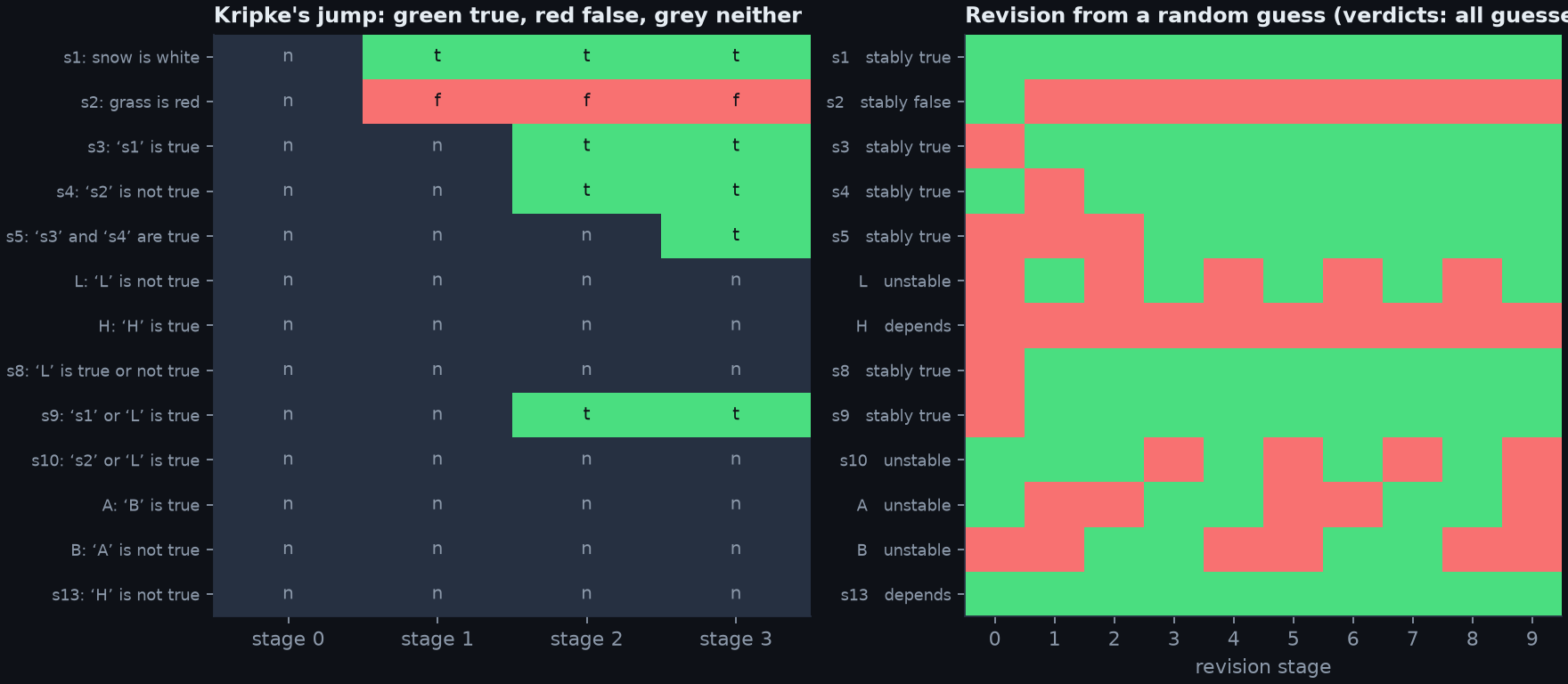
python -m videos.philosophy.labs 8
needs numpy, scipy, matplotlib · download lab08.py ·
source on GitHubthe film's world 13 sentences; the jump closes after 3 stages
fixed points 3 (the truth-teller H can be t, f or n; the liar L is n in all of them)
grounded / ungrounded / paradoxical 6 / 2 / 5
12 random worlds of 6 sentences 29 fixed points found by brute force; the staged one is least in each
the revenge sentence R stages n t f t f t f: no fixed point among t, f, n
revision, all 8,192 starting guesses L unstable, H depends, s8 stably true (Kripke: paradoxical)
Yablo's staircase cut to 1..8 sentences consistent assignments: [1, 1, 1, 1, 1, 1, 1, 1]
Kripke's stages only ever add values and stop at the least fixed point, where the liar has none; revision theory keeps two values and the liar never settles. They part on 'the liar is true or not true': no value for Kripke, stably true under revision.The code (105 lines; it asserts its own result)
"""Lab 8: run Kripke's construction and revision theory on sentences that talk about their own truth."""

import numpy as np

from videos.coursekit import labs
from explainer.philosophy.reasoner import truth

TITLE = "Kripke's fixed points and revision sequences, computed"
GOAL = ("Iterate Kripke's jump on the film's world of thirteen sentences and on a random world, check that the "
        "stages only ever add values and end in the least of all fixed points, and compare Kripke's verdicts with "
        "revision theory's.")
TASKS = [
    "Add the pair P: 'Q is true', Q: 'P is true' to the world. How many fixed points are there now, and why?",
    "Replace the liar by truth.REVENGE's sentence inside a copy of WORLD and call truth.iterate. What happens to s8?",
    "Change revision_verdicts' steps from 12 to 3. Which verdicts change, and what does that say about 'stably'?",
]


def below(a, b):
    """a is below b in the information order: b agrees with a wherever a has a value."""
    return all(a[k] == "n" or a[k] == b[k] for k in a)


def random_world(rng, size=6):
    names = [f"r{i}" for i in range(size)]
    pick = lambda: ("T", names[int(rng.integers(size))])  # noqa: E731
    world = {}
    for name in names:
        kind = int(rng.integers(6))
        world[name] = [("fact", True), ("fact", False), pick(), ("not", pick()), ("and", pick(), ("not", pick())),
                       ("or", pick(), pick())][kind]
    return world


def run(seed=0):
    rng = np.random.default_rng(seed)
    lab = labs.Lab()
    world = truth.WORLD
    stages = truth.kripke_stages(world)
    lfp, fps, kinds = stages[-1], truth.fixed_points(world), truth.classify(world)
    count = {k: sum(v == k for v in kinds.values()) for k in ("grounded", "ungrounded", "paradoxical")}
    lab.row("the film's world", f"{len(world)} sentences; the jump closes after {len(stages) - 1} stages")
    lab.row("fixed points", f"{len(fps)}   (the truth-teller H can be t, f or n; the liar L is n in all of them)")
    lab.row("grounded / ungrounded / paradoxical", f"{count['grounded']} / {count['ungrounded']} / {count['paradoxical']}")
    assert all(below(a, b) for a, b in zip(stages, stages[1:])), "the stages only add values"
    assert truth.is_fixed(world, lfp) and all(below(lfp, fp) for fp in fps), "the least fixed point is below every other"
    assert len(fps) == 3 and {fp["H"] for fp in fps} == {"t", "f", "n"} and all(fp["L"] == "n" for fp in fps)
    assert (count["grounded"], count["ungrounded"], count["paradoxical"]) == (6, 2, 5)

    # Kripke's theorem on random worlds, against brute force over all 3^6 interpretations
    checked = 0
    for _ in range(12):
        w = random_world(rng)
        st = truth.kripke_stages(w)
        brute = truth.all_fixed_points(w)
        assert all(below(a, b) for a, b in zip(st, st[1:])) and st[-1] in brute
        assert all(below(st[-1], fp) for fp in brute), "least among all fixed points"
        key = lambda d: tuple(sorted(d.items()))  # noqa: E731
        assert sorted(map(key, truth.fixed_points(w))) == sorted(map(key, brute)), "every fixed point extends the least"
        checked += len(brute)
    lab.row("12 random worlds of 6 sentences", f"{checked} fixed points found by brute force; the staged one is least in each")

    # revenge: the exclusion liar has no fixed point
    orbit = "".join(s["R"] for s in truth.iterate(truth.REVENGE, 6))
    assert truth.all_fixed_points(truth.REVENGE) == [] and orbit == "ntftftf"
    lab.row("the revenge sentence R", f"stages {' '.join(orbit)}: no fixed point among t, f, n")

    # revision theory over every starting hypothesis
    verdicts = truth.revision_verdicts(world)
    assert verdicts["L"] == "unstable" and verdicts["H"] == "depends"
    assert kinds["s8"] == "paradoxical" and verdicts["s8"] == "stably true", "where Kripke and revision disagree"
    assert all(verdicts[n] in ("stably true", "stably false") for n, k in kinds.items() if k == "grounded")
    assert all((verdicts[n] == "stably true") == (lfp[n] == "t") for n, k in kinds.items() if k == "grounded")
    lab.row("revision, all 8,192 starting guesses", f"L {verdicts['L']}, H {verdicts['H']}, s8 {verdicts['s8']} (Kripke: {kinds['s8']})")
    yablo = [len(truth.yablo_solutions(n)) for n in range(1, 9)]
    assert yablo == [1] * 8
    lab.row("Yablo's staircase cut to 1..8 sentences", f"consistent assignments: {yablo}")
    lab.note = ("Kripke's stages only ever add values and stop at the least fixed point, where the liar has none; "
                "revision theory keeps two values and the liar never settles. They part on 'the liar is true or not "
                "true': no value for Kripke, stably true under revision.")

    from matplotlib.colors import ListedColormap
    fig, ax = labs.figure(2, size=(11, 4.8))
    names = list(world)
    code = {"n": 0, "f": 1, "t": 2}
    cmap = ListedColormap([labs.GRID, labs.RED, labs.GREEN])
    grid = np.array([[code[s[n]] for s in stages] for n in names])
    ax[0].imshow(grid, cmap=cmap, vmin=0, vmax=2, aspect="auto")
    for i, n in enumerate(names):
        for j, s in enumerate(stages):
            ax[0].text(j, i, s[n], ha="center", va="center", color=labs.BG if s[n] != "n" else labs.MUTED, fontsize=9)
    ax[0].set_xticks(range(len(stages)), [f"stage {j}" for j in range(len(stages))])
    ax[0].set_yticks(range(len(names)), [f"{n}: {truth.GLOSS[n]}" for n in names], fontsize=8)
    ax[0].set(title="Kripke's jump: green true, red false, grey neither")
    start = {n: bool(rng.integers(2)) for n in names}
    seq = truth.revision(world, start, 9)
    grid = np.array([[2 if h[n] else 1 for h in seq] for n in names])
    ax[1].imshow(grid, cmap=cmap, vmin=0, vmax=2, aspect="auto")
    ax[1].set_xticks(range(len(seq)), [str(j) for j in range(len(seq))])
    ax[1].set_yticks(range(len(names)), [f"{n}   {verdicts[n]}" for n in names], fontsize=8)
    ax[1].set(title="Revision from a random guess (verdicts: all guesses)", xlabel="revision stage")
    for a in ax:
        a.grid(False)
    lab.fig = fig
    return lab
Now change it
- Add the pair P: 'Q is true', Q: 'P is true' to the world. How many fixed points are there now, and why?
- Replace the liar by truth.REVENGE's sentence inside a copy of WORLD and call truth.iterate. What happens to s8?
- Change revision_verdicts' steps from 12 to 3. Which verdicts change, and what does that say about 'stably'?
Problems, with solutions
Try each problem before opening its solution.
-
Two truth-tellers. Find all fixed points of the world \(A\): '\(B\) is true', \(B\): '\(A\) is true'. Which are classical?
Solution
A says "B is true", B says "A is true". The jump gives A the value of B and B the value of A, so the fixed points are exactly the assignments with A = B: both t, both f, or both n. Two are classical. The least fixed point leaves both n, so both are ungrounded but not paradoxical, like the single truth-teller.
-
Kripke versus revision. Show that 'the liar is true or the liar is not true' has no value in any Kripke fixed point, but is stably true in revision theory.
Solution
Let S be "the liar is true or the liar is not true", T⌜L⌝ ∨ ¬T⌜L⌝. In every fixed point the liar is n (Chapter 5), so S has value n ∨ ¬n = n in every fixed point: it is paradoxical, and excluded middle fails for it. In revision theory every hypothesis gives the liar a classical value, so S is a classical instance of excluded middle at every stage after the first: stably true. (The Reasoner's verdicts agree: s8 is paradoxical in Chapter 5 and stably true in Chapter 8.)
-
Grelling on the Price List. Give the four steps of the Grelling paradox, and say which of the Price List's claims each uses.
Solution
(i) Every adjective is autological or heterological (classical logic); (ii) an adjective is heterological iff it does not apply to itself (the defining biconditional, a T-schema for "applies to"); (iii) "heterological" is an adjective of the language (self-reference); (iv) it cannot be both (consistency). Steps (i)–(iv) yield: heterological iff not heterological. Each Price List exit removes one step.
-
Finite Yablo. Prove that every finite Yablo sequence has exactly one consistent assignment.
Solution
With Y₁…Yₙ, Yₙ says nothing, so it is true. Then Yₙ₋₁ ("Yₙ is untrue") is false, and every earlier Yₖ is false because Yₙ is a true later sentence. That assignment satisfies every biconditional, and it is forced: by backward induction from Yₙ, each value is determined. So there is exactly one.
-
The knower. Derive a contradiction from the knower: 'this sentence is not known', with \(K\varphi \to \varphi\) known.
Solution
Let K ↔ ¬Kn⌜K⌝. From Kn⌜K⌝ → K (factivity) and K → ¬Kn⌜K⌝ we get ¬Kn⌜K⌝, hence K. That derivation used only known principles, so its conclusion K is known: Kn⌜K⌝. Contradiction.
-
(Essay) Gap, glut, hierarchy or restriction?
Solution
A strong answer uses Chapter 12's Price List and the comparison table, and meets its own revenge: for a gap, "not determinately true"; for a glut, "just true" and Curry; for a hierarchy, the single word "true" and Nixon and Jones; for a restriction, asserting sentences one calls untrue.
Notes and sources
Sources
Books: Kripke, "Outline of a theory of truth" (1975); Gupta and Belnap, The Revision Theory of Truth (1993); Field, Saving Truth from Paradox (2008); Priest, In Contradiction (1987, 2nd ed. 2006) and Beyond the Limits of Thought (1995); Halbach, Axiomatic Theories of Truth (2011); Beall, Glanzberg and Ripley, Formal Theories of Truth (2018); Maudlin, Truth and Paradox (2004); Sorensen, A Brief History of the Paradox (2003); Cook, The Yablo Paradox (2014); Chow, "The surprise examination or unexpected hanging paradox" (1998).
Papers and texts: Mojing, Canon B 71; Aristotle, Metaphysics Γ 7; Bhartṛhari, Vākyapadīya; Bradwardine, Insolubilia (c. 1324); Buridan, Sophismata; Richard (1905); Russell (1908); Grelling and Nelson (1908); Ramsey (1927); Tarski (1933, 1944, 1955); Curry (1942); Moore (1942); O'Connor (1948); Quine (1953); Kaplan and Montague (1960); Hintikka (1962); Davidson, "Truth and meaning" (1967) and "True to the facts" (1969); Scott (1969); Parsons (1974); Burge (1979); Priest (1979, 1994, 1997); Gupta (1982); Herzberger (1982); McGee (1985); Burgess (1986); Friedman and Sheard (1987); Brady (1989); Horwich (1990); Feferman (1991); Yablo (1993); Houben (1995); Shapiro (1998); Ketland (1999, 2005); Field (1999); Glanzberg (2004); Gerbrandy (2007); Weber (2010); Cobreros, Égré, Ripley and van Rooij (2012); Beall and Murzi (2013).
About this partfrom its README
Part 8 of Philosophy, Built (series plan, syllabus): truth and paradox. Eubulides, the Later Mohists, Bhartṛhari and the medieval insolubilia; Tarski's three ingredients, his satisfaction definition and his hierarchy, and Kripke's Nixon–Jones objection; Grelling, Richard, Berry and Priest's inclosure schema; Kripke's fixed points, built and run, with grounded, ungrounded and paradoxical sentences, the intrinsic fixed point and the transfinite construction over arithmetic; the liar as a non-terminating program and least-fixed-point semantics; revenge, Field's determinacy hierarchy and contextualism; revision theory; Curry's paradox, its kinship with Löb's theorem, strict-tolerant logic and the validity Curry; Yablo's staircase; dialetheism, LP and naive set theory; the Price List; the axiomatic theories TB, CT, KF and FS and the conservativeness debate; correspondence, coherence, pragmatism, identity and deflation, Davidson's truth-conditional semantics and the slingshot; the surprise exam in dynamic epistemic logic and the knower; and Moore's paradox. Its brick in the Wall is "The liar": a language cannot hold its own truth predicate without a gap, a glut or a hierarchy. Its Price List is the liar: classical logic, the T-schema, self-reference, and no true contradictions.
Every value, fixed point, revision sequence, staircase, run and check on screen is computed by the Reasoner's truth
module (explainer/philosophy/reasoner/truth.py: strong Kleene evaluation of a language with its own truth
predicate, Kripke's jump and its stages, every fixed point and Kripke's classification, the exclusion-negation
revenge, revision sequences over every starting hypothesis, finite Yablo staircases, Grelling's adjectives, Tarski's
satisfaction clauses on a small model, strict-tolerant consequence, the T-biconditionals in K3 and LP, the surprise
exam as public announcement, the sentences run as recursive programs, and Moore's paradox in KD4), tested in
tests/philosophy/test_truth.py and cached by compute.py.
Chapter notes
| # | Scene | What it establishes | Computed on screen |
|---|---|---|---|
| 0 | Hook |
the liar, both ways round; four ways out; the plan. | — |
| 1 | Ancient |
Eubulides, Chrysippus and Epimenides; the Later Mohists (Canon B 71); Bhartṛhari's "unnameable"; Bradwardine and Buridan. | — |
| 2 | Tarski |
the T-schema, self-reference and classical logic (1933); satisfaction and Convention T; the hierarchy; Kripke's Nixon and Jones (1975). | l ↔ ¬l unsatisfiable; Tarski's clauses on a three-object model, all 66 sentences to depth 2 |
| 3 | Family |
Grelling–Nelson (1908); Richard (1905); Berry; Priest's inclosure schema (1994). | eight adjectives sorted, and "heterological" with no consistent value |
| 4 | Kripke |
one language with its own truth predicate; strong Kleene; the construction as learning. | a world of 13 sentences, and the jump stage by stage to the least fixed point |
| 5 | Fixed |
every fixed point; grounded, ungrounded and paradoxical; the intrinsic fixed point; ω₁^CK and Burgess (1986). | all three fixed points; Kripke's classification of the 13 |
| 6 | Programs |
sentences as recursive programs; ungrounded = non-terminating; Tarski (1955), Scott (1969); parallel and sequential "or". | the 13 run as programs, matching the least fixed point |
| 7 | Revenge |
the strengthened liar; the exclusion liar has no fixed point; Field (2008); contextualism (Parsons, Burge 1979, Glanzberg 2004); the Wall's eighth brick. | the exclusion liar's jump oscillating, and no fixed point among its three values |
| 8 | Revision |
Gupta and Herzberger (1982), Gupta–Belnap (1993); limit rules. | two revision sequences; verdicts over all 8,192 starting hypotheses |
| 9 | Curry |
Curry (1942); contraction; Curry and Löb; strict-tolerant logic (Cobreros, Égré, Ripley, van Rooij 2012); the validity Curry (Beall–Murzi 2013). | c ↔ (c → q) ⊨ q; ST: ⊢ T⌜L⌝ and T⌜L⌝ ⊢ q valid, ⊢ q not |
| 10 | Yablo |
Yablo's staircase (1993); finite truncations; Ketland's ω-inconsistency; Priest (1997), Sorensen, Cook (2014). | every truncation to 1–8 sentences has exactly one consistent assignment |
| 11 | Glut |
dialetheism and LP (Priest 1979); the same construction read as gluts; the T-schema in K3 and LP; prices; naive set theory (Brady 1989, Weber 2010). | the least fixed point read as gaps and as gluts; each T-biconditional's value |
| 12 | Price |
Price List: the liar; four answers side by side. | the MUS {C, T, S, N} and its four corrections |
| 13 | Axioms |
TB, CT, KF, FS (Halbach); KF's axioms; conservativeness and deflationism (Shapiro 1998, Ketland 1999, Field 1999). | — |
| 14 | Theories |
Aristotle and the Mohists; correspondence, coherence, pragmatism, identity, deflation; Davidson (1967); the slingshot (Church, Gödel, Davidson); Horwich's minimalism. | — |
| 15 | Exam |
the surprise exam (O'Connor 1948); Gerbrandy's announcement analysis (2007); the knower (Kaplan–Montague 1960), in five lines. | the backward elimination; the announcement iterated: {1..5}, {1..4}, …, ∅ |
| 16 | Moore |
Moore's paradox (1942); Hintikka's analysis (1962); unsuccessful updates. | p ∧ ¬Bp satisfiable, B(p ∧ ¬Bp) unsatisfiable on every KD4 frame up to three worlds |
| 17 | Outro |
recap; the Reasoner's truth module; the Wall; problems; payoffs; references. | — |
Companion material in this repository
The syllabus's plan for this partfrom SYLLABUS.md, the plan of record
- Epimenides and Eubulides; the medieval insolubilia (Buridan, Bradwardine).
- Tarski's T-schema and Convention T; the object language vs metalanguage hierarchy.
- The semantic paradoxes: Grelling, Berry, Richard. Priest's inclosure schema unifies them with Russell and Burali-Forti.
- Kripke (1975): the strong Kleene jump on a language with its own truth predicate. Built: the least fixed point computed by iteration; grounded vs ungrounded sentences (the truth-teller vs the liar).
- Fixed points beyond the least: intrinsic, maximal; the liar is undefined in all of them.
- Revenge: "this sentence is not true in the fixed point."
- Revision theory (Gupta and Belnap 1993). Built: revision sequences; the liar oscillates, the truth-teller stabilizes on its starting value.
- Curry's paradox: no negation needed; why it threatens paraconsistent answers.
- Yablo's paradox (1993): an infinite sequence with no self-reference? The debate (Priest, Cook).
- Dialetheism: the liar is both true and false (Priest); LP as its logic.
- Axiomatic theories of truth: TB, CT, KF, FS; their proof-theoretic strength (Halbach).
- Theories of truth: correspondence, coherence, pragmatist, identity; deflationism (Ramsey, Quine's disquotation, Horwich's minimalism) and the conservativeness debate (Shapiro, Ketland).
- The surprise-exam paradox, formalized in epistemic logic (Kaplan and Montague 1960; Chow 1998).
- Moore's paradox ("it's raining but I don't believe it") previews Part 12.
- Recap and Problems.
Built: reasoner.truth (a toy language with T; Kleene jump iteration; revision sequences).
Wall: Tarski's undefinability; revenge for every consistent account.
Price List: the liar set (classical logic; the T-schema; self-reference; consistency).
Visuals: the extension of T growing stage by stage like a crystal; the liar flickering in revision; Yablo's
infinite staircase.
References: Kripke 1975 (JPhil); Gupta and Belnap, The Revision Theory of Truth; Field, Saving Truth from
Paradox; Halbach, Axiomatic Theories of Truth; Priest, In Contradiction; Beall, Glanzberg and Ripley, Formal
Theories of Truth.
中文讲义
本讲的中文部分(与英文版对应)。
习题与解答
-
两个真话者。 找出世界 \(A\):‘\(B\)为真’, \(B\):‘\(A\)为真’ 的所有不动点。 哪些是经典的?
解答
A说“B是真的”,B说“A是真的”。跳跃给A以B的值、给B以A的值,所以不动点恰好是A = B的那些指派:都为t、都为f或都为n。 其中两个是经典的。最小不动点让两者都为n,所以两者都是无根的但不是悖论的,就像单个的真话者。
-
克里普克与修正论。 证明‘说谎者为真或说谎者不为真’在任何克里普克不动点中都没有值, 但在修正论中稳定为真。
解答
设S为“说谎者为真或说谎者不为真”,即T⌜L⌝ ∨ ¬T⌜L⌝。在每个不动点中说谎者都是n(第5章),所以S在每个不动点中 的值都是n ∨ ¬n = n:它是悖论的,排中律对它不成立。在修正论中,每个假设都给说谎者一个经典值,所以S在第一阶段之后的每个阶段都是排中律的 一个经典实例:稳定地真。(推理机的裁决与此一致:s8在第5章是悖论的,在第8章是稳定地真的。)
-
代价清单上的格雷林悖论。
解答
(i) 每个形容词要么自谓要么他谓(经典逻辑);(ii) 一个形容词是他谓的当且仅当它不适用于自身(定义性的双条件句, 即“适用于”的T模式);(iii) “他谓的”是这门语言中的一个形容词(自指);(iv) 它不能两者都是(一致性)。由(i)–(iv)得出:他谓的当且仅当 不是他谓的。代价清单上的每条出路各去掉其中一步。
-
有限的亚布罗序列。
解答
对Y₁…Yₙ,Yₙ什么都没说,所以为真。于是Yₙ₋₁(“Yₙ不真”)为假,而每个更早的Yₖ都为假,因为Yₙ是一个为真的后续句子。 这个指派满足每个双条件句,而且是被迫的:从Yₙ逆向归纳,每个值都被确定。所以恰有一个。
-
知者悖论。 从知者句推出矛盾: ‘这个句子不被知道’, 且\(K\varphi \to \varphi\)被知道。
解答
设K ↔ ¬Kn⌜K⌝。由Kn⌜K⌝ → K(事实性)和K → ¬Kn⌜K⌝得¬Kn⌜K⌝,从而K。这个推导只用到已知的原则,所以它的结论K是被知道的: Kn⌜K⌝。矛盾。
-
(论述题)空隙、过剩、层级还是限制?
解答
好的回答利用第12章的代价清单和比较表,并回应它自己的复仇:对空隙,是“不确定地为真”;对过剩,是 “仅仅为真”和柯里;对层级,是单一的“真”字以及尼克松与琼斯;对限制,是断言自己称为不真的句子。
Build the film
python -m videos.philosophy.philosophy8.compute        # the part's numbers, into .cache/philosophy8
python tools/build.py philosophy8                  # render and assemble the film
EXPLAINER_TTS=silent python tools/qa_scene.py philosophy8 Hook   # one chapter, silent, with a contact sheet
Scenes: videos/philosophy/philosophy8. Setup: see the course page. Source of these notes: the README and the scenes' narration.
Build it
python -m videos.philosophy.philosophy8.compute        # every computed item (a few seconds; cached in .cache/philosophy8)
python tools/build.py philosophy8 -q l                 # 480p preview
python tools/build.py philosophy8                      # 1080p30 -> renders/philosophy8.mp4
python tools/qa_scene.py philosophy8 Kripke            # one chapter, silent, with a contact sheet