Orchestration
What does an orchestrator control, and can a computer orchestrate a sound?
Ravel called Boléro (1928) a piece for orchestra without music: one tune in two halves, stated eighteen times over one snare-drum rhythm, with only the instruments changing. In one statement a horn, a celesta and two piccolos sit on the tune's harmonics and fuse into a colour no single player owns: additive synthesis with players. The part builds an orchestra from the series' own physical models, measuring sixteen harmonics on each and resynthesising them, and asks what an orchestrator controls: ranges, registers and transposition; loudness and brightness (a trumpet blown hard is brighter, not just louder, its centroid nearly doubling); sections, where eight violins are 10.6 dB above one, between the incoherent 9 and coherent 18; doubling, blend and balance; spacing, where the same C major chord is three times rougher close and low than open; textures and the melody of timbres. Then it turns Ravel around: a solver fits non-negative loudnesses to 42 candidates and keeps the best four, spelling a sung vowel within 7.1 dB a band but a bell only within 31.5, because a bell's partials are not harmonics. The Tune is heard in eight orchestrations, the last matched to a vowel.
What you need. Part 3 for spectra and additive synthesis; Part 5 for roughness; Parts 7-9 for the instrument models; Part 17 for voicing and the voice; Part 20 for counterpoint. Least squares, decibels.
- Ideas, mathematics and history
- ranges and registers, blend and balance, why sixteen violins are not one loud violin, Boléro's synthetic organ, orchestration as optimization
- What we build, compute and hear
- a solver that orchestrates a target spectrum; the Tune eight ways
What you will be able to do
Foundations
- Hear instrument families and registers, and tell a clarinet from a flute on one note.
- Hear brightness rise with effort, and a section's chorus against one player.
- Hear a doubling fuse, and a chord muddy in a low close voicing.
Full course
- Measure an instrument's harmonics on a physical model and resynthesise it additively.
- Compute the level of n coherent and incoherent players, and a combination's fusion on a harmonic series.
- Orchestrate a target spectrum by non-negative least squares and subset search.
Research
- Design a study that predicts blend and layering from the score and the instruments' spectra.
Practice
- Voice and double for balance and clarity, and mock up an orchestration before rehearsal.
Contents
Each chapter has a home level. Choose a track to see what to read and watch: Foundations 28 min · Full course 31 min · Research 34 min · Practice 31 min.
- 0A piece for orchestra without musicFoundations2 min
- 1An orchestra from physical modelsFoundations4 min
- 2Ranges, registers and transpositionFoundations3 min
- 3Loudness and brightnessFoundations3 min
- 4Sections and the chorus effectFoundations3 min
- 5Doubling, blend and balanceFoundations3 min
- 6SpacingFoundations2 min
- 7Textures and the melody of timbresFoundations2 min
- 8Ravel's harmonicsFoundations3 min
- 9Orchestration as searchPractice4 min
- 10Frontier: timbre measuredResearch3 min
- Variation 41, recap and problemsAll tracks2 min
Also on this page: Lecture · Key results · Try it · Lab · Problems · Notes and sources · Build the film.
Lecture
The text of each chapter is the film's narration, as it is spoken, so you can read along or revise without the film. The pictures are in the film. A dashed box stands for a number the film computes when it is rendered (hover over it to see what is computed); the README's figures for each chapter, where it lists them, follow the chapter's text.
A piece for orchestra without musicFoundations2 min
In 1928 Maurice Ravel wrote what he called a piece for orchestra without music. Listen before we explain. A short phrase on a horn, and then the same phrase again. The second time, how many instruments are playing: one, two, or four?
Four: a horn, a celesta two octaves up, and two piccolos, one a twelfth up and one two octaves and a major third up, all moving together. The combination can suggest one composite instrument, an organ-like colour no single player owns, because each added instrument sits on a harmonic of the horn's notes: the fourth, the third and the fifth. How completely they fuse depends on performance and listening context.
That combination is Maurice Ravel's, from Boléro of 1928: two alternating melodic strains, with eighteen statements over one unchanging rhythm on the snare drum. Ravel called it a piece for orchestra without music: orchestration, density and dynamics drive most of the change. In one statement he puts a horn, a celesta and two piccolos on the tune's harmonics, which is Part 3's additive synthesis done with players instead of oscillators. This part is about orchestration: which instruments play which notes, and why. What you heard was our own phrase, on our own instruments, with Ravel's idea.
Here is the plan. An orchestra built from the series' own physical models. Ranges, registers, and instruments that read one note and sound another. Loudness and brightness, and why a section is not one loud player. Blend, doubling, balance and spacing. Textures, the melody of timbres, and Ravel's harmonics. And orchestration as search: a solver that matches a vowel with instruments.
1An orchestra from physical modelsFoundations4 min
What is an instrument's sound made of?
The orchestra grew. Haydn's, in the 1760s, had about thirty players: strings with oboes and horns, sometimes flutes and bassoons. Beethoven added trombones and piccolo, and Berlioz, from 1830, wrote for ninety players and more. Mahler and Strauss, around 1900, wrote for the largest regular orchestras, four or more of each wind. It has four families, woodwinds, brass, percussion and strings, each with its own physics, from Parts 7 to 9. Berlioz's influential Treatise on Instrumentation of 1844 helped codify an established craft.
Our orchestra is built from the series' own instruments. Part 8's flute, clarinet, saxophone and trumpet models and Part 7's bowed string were each run once, and the strengths of their first twelve harmonics read off. The flute is nearly a pure tone with a little third harmonic. The clarinet's odd harmonics are strong and its even ones weak, as Part 8 explained for a cylinder closed at one end. The saxophone's cone gives all harmonics, falling steadily. The trumpet blown softly is dark, and blown hard is bright, a difference chapter three returns to. And the bowed string's harmonics fall slowly, with a gap at the tenth, because the bow sits a tenth of the way along the string, Part 7's Helmholtz motion.
Hear the definition of timbre at work: one note, middle C, at the same level and length, on eight of our instruments in turn. Only the spectrum and the attack differ, so compare the cues available for identifying each simplified model. The celesta's bars sit between the harmonics: a struck bar's partials are not a harmonic series.
A question for your ears. Three notes, all middle C, all at the same level: a violin, a clarinet and a flute, in some order. Which is the clarinet, the first, the second or the third?
The second. The violin came first, and the flute last. The clarinet gives itself away by its hollow sound: its bore, closed at the reed, favours the odd harmonics, so the third and fifth are strong while the second and fourth are weak, as its spectrum showed a moment ago. The flute is nearly a pure tone, and the violin's harmonics fall away smoothly. Timbre is identity, even on one note.
With those spectra, any instrument can play any note, by adding up its harmonics with an attack and, for the strings and flutes, a vibrato. Here is a tour: the same phrase on piccolo, flute, clarinet, saxophone, trumpet, horn, violin and cello. The grey bars are the instruments' ranges; the gold marks show where the phrase sits, in a comfortable part of each.
Orchestration is also writing for people. Wind players must breathe, so a phrase longer than a breath needs a rest or a second player. Brass players tire, so high, loud passages need rests. String players change bow, so a long loud note needs several bows, felt as tiny pulses. Writing that lies under the fingers sounds easy, and sounds better. Our additive players never tire; real ones always do.
Be clear about what this orchestra is. It keeps each instrument's average spectrum, its attack and its vibrato. It loses how the spectrum changes with pitch and loudness, the noise of breath and bow, and the room. Real orchestration manuals rely on exactly those things: registers, dynamics, articulation. So this is a model good enough to reason with, not to replace players. Chapter two asks where each instrument can play.
2Ranges, registers and transpositionFoundations3 min
Where can each instrument play?
Here is the orchestra laid out by the notes it can sound, from the double bass's low E to the piccolo's top C, against the keys of the piano. Woodwinds in gold, brass in pink, strings in blue. The displayed ranges are approximate practical guides, with technique and individual players affecting the extremes: the bottom of a flute is weak and breathy, the top of a trumpet strained, the top of a cello thin. An orchestrator writes in the middle unless the extreme is the point.
Within its range, an instrument changes colour: it has registers. The clarinet has a dark low register called the chalumeau, a weaker throat around B flat, and a bright clarion register above. The flute is breathy and soft at the bottom and brilliant at the top. The physics is Part 8's: a different set of the bore's modes takes over in each register. Our additive orchestra uses one spectrum per instrument, so it cannot show this; the physical models can.
The physical model shows a register change directly. Here is Part 8's clarinet, blown the same way twice, first with its register hole closed and then open. The small hole spoils the bore's lowest mode, so the reed locks onto the next one, three times the frequency: a twelfth higher, not an octave, because the ideal cylinder closed at one end has odd resonances; real bore geometry and tone holes modify them. A different register, and a different colour.
Some instruments read one note and sound another. A clarinet in B flat, reading C, sounds the B flat a tone below. A horn in F, reading C, sounds the F a fifth below. The piccolo sounds an octave higher than written, the double bass an octave lower. Why? So that the same written note means the same fingering on every size of the instrument: a player can move from a B flat clarinet to an A clarinet, or from alto to tenor saxophone, without relearning. The score is written for the hands, not for the ear.
There is history in this too. Natural horns and trumpets once played only the notes of one harmonic series, Part 1's series, and players changed a length of tubing, a crook, for each key. Valves, from about 1815, made them chromatic, but the transposed notation stayed. A modern score may be printed in C, every part at sounding pitch, for the conductor. History kept in notation, Part 10's lesson again. Chapter three asks what happens when an instrument plays louder.
3Loudness and brightnessFoundations3 min
Is a loud note just a soft note turned up? A question for your ears. Part 8's trumpet model, the physical model itself, plays one note twice, and both are played back at exactly the same level. One was blown softly and turned up, the other blown hard and turned down. Which was blown hard, the first or the second?
The second. Blown softly, the note is almost only its fundamental; blown hard, the upper harmonics rise by tens of decibels, and turning it down does not take them away. The brightness, measured as the spectral centroid, roughly doubles. Your ear heard the effort, not the level.
Why? In real brass at high pressure, the sound wave steepens as it travels down the tube, almost into shock fronts: the brassy blare. In our model, which has no such steepening, harder blowing makes the lips close more abruptly, and sharper pulses carry more harmonics. And the ear judges loudness partly by brightness: brightness can influence inferred effort and loudness, but the relation depends on the spectrum and level. So a fortissimo cannot be faked by turning up a pianissimo; the colour gives it away. Part 4's loudness and Part 3's spectrum, working together.
Hear a swell on one note: the trumpet model's breath rising from soft to hard, made from three simulations at rising pressures, crossfaded. The brightness climbs from about to hertz as the note grows louder: the colour changes with the dynamic.
How wide is the orchestra's dynamic range? A single flute or violin spans perhaps thirty or forty decibels from its softest to its loudest. Brass reach much higher levels: a trombone section at full power can exceed a hundred and ten decibels nearby. A full orchestra can span a very wide dynamic range, depending on the work, room and measurement position, so the orchestrator controls loudness by the number and choice of instruments, not only by the markings. Part 57 measures loudness, and Part 55 the hall that carries it.
That makes balance an orchestrator's problem. Instruments differ in power: a trumpet at forte can cover a whole woodwind section. Dynamic markings are relative, so the same forte means different levels on a flute and on a trombone. Orchestrators mark the loud instruments down and the soft ones up, and manuals since Rimsky-Korsakov's give rules of thumb for how many of one instrument balance another. Chapter four asks what happens when many players share one part.
4Sections and the chorus effectFoundations3 min
Why do eight violins not sound like one loud violin?
Eight violins are louder than one, but by how much? If eight players moved in perfect lockstep, their waves would add, eight times the amplitude, eighteen decibels. But real players are never exactly together: their pitches differ by a few cents and their vibratos drift, so their phases tend to decorrelate, so an incoherent-power approximation is useful: eight times the power, nine decibels. Our section of eight, each with its own small detuning, vibrato and timing, measures decibels louder than one player. Under that approximation and equal individual levels, doubling the players adds about three decibels.
So a section is not one loud player; it is a different sound. Here is a phrase on one violin, and then on eight, turned to the same level so that only the difference in sound remains. Listen for the shimmer in the second.
The contrast of one against many is a resource in itself, the basis of the concerto. Hear a phrase on one violin, answered an octave lower by twelve violins and six cellos: the soloist's line is clear and personal, the section's broad and anonymous.
That shimmer is the chorus effect. Slightly different pitches beat against each other, many beats at once. The result is a smoother, wider sound, and one player's vibrato is hidden in the crowd. It is the physics of Part 36's paired gamelan instruments and of the piano's three strings in Part 7. Studios fake it with a delay line whose delay wobbles: the chorus effect of Part 49. A section's sound, more than its loudness, is why orchestras have sections.
Hear the chorus grow: one held note on one violin, then two, four, eight and sixteen, each version turned to the same level, so that only the texture changes. The numbers show how much louder each would have been: about three decibels for every doubling, not six.
Where the sections sit matters too. The usual modern plan puts the violins to the conductor's left, the cellos and violas to the right, and the basses behind them. The woodwinds sit in the centre behind the strings, with brass and percussion at the back. Older plans split the first and second violins left and right, so that their dialogues cross the stage. Seating changes balance and blend: the hall mixes what the score separates. Part 55's rooms and Part 43's ensembles return to this.
This sets the orchestra's proportions. A modern string section has about sixteen first violins, fourteen seconds, twelve violas, ten cellos and eight basses, with wind complements varying by score, often two to four of each in a large modern orchestra: the strings are many because each is quiet. A solo violin against the section is the concerto's contrast, one against many. Dividing a section, divisi, thins it: half the players, three decibels less, and less shimmer. Chapter five turns to different instruments sharing one line.
5Doubling, blend and balanceFoundations3 min
What happens when two instruments play the same line?
Doubling: two instruments on the same line. Hear one held C, on the flute, on the clarinet, on both in unison, and then on the flute with a trumpet playing six decibels louder, as a trumpet at forte would.
Measure them. A unison doubling makes a new timbre: this calculation adds their spectral powers, an incoherent approximation rather than a phase-resolved waveform prediction, so its brightness lies between theirs, and the flute and clarinet each carry half the power. With the loud trumpet the flute carries only per cent of the power: that power ratio can contribute to masking, but does not by itself establish whether the flute is perceptually covered. Blend and balance are different questions: does it fuse, and can every part be heard?
Why is a part covered? Part 4's masking: a loud sound hides a softer one near it in frequency. A melody is covered when the accompaniment's partials sit in the same critical bands. So orchestrators give the melody its own register, or thin the accompaniment around it. Balance is a question of bands, not only of decibels, and Part 56's mixing engineers solve the same problem with equalisers.
Doubling need not be at the unison. An octave above, an instrument adds even harmonics to the lower one, so the line sounds brighter and fuller. A flute an octave above the violins sits on their second harmonic, a classic colour. At the fifth or the twelfth it builds Ravel's organ-like mixtures, chapter eight's subject. Doublings in octaves let a melody carry over a full orchestra, and the pipe organ's stops do exactly this with pipes, as Part 8 described.
Hear an octave doubling: a phrase on the violin, then with a flute an octave above, a little quieter. The flute is hardly heard as a second instrument; the violin seems to grow brighter and more present.
What makes instruments blend? In 1995 Gregory Sandell had listeners rate pairs of instruments playing in unison, and blend was rated higher when the pair's overall brightness was lower, and when the instruments began together. Later, Sven-Amin Lembke and Stephen McAdams found that players adjust their own brightness to blend with a partner. So blend is partly in the sound and partly in the playing. Chapter six turns to how the notes of a chord are spaced.
6SpacingFoundations2 min
Why are low notes spread wide and high notes close together?
Part 1's harmonic series is also a guide to spacing. Its intervals are wide at the bottom, an octave, then a fifth, a fourth, and close at the top, thirds and smaller. Orchestrators voice chords the same way, octaves and fifths in the bass, thirds above, and such spacing can promote spectral coherence without guaranteeing perceptual fusion.
Hear one C major chord three ways on string sections: close and low, C, E, G in the cellos' low register; open, C, G and E spread over two octaves; and close and high, in the violins.
Part 5 explains why. Compute the sensory roughness of each chord from the strings' measured partials. Close and low is the roughest, : low thirds put partials within a critical band of each other. Spread open, the roughness falls to , and the same close chord high up is smoothest of all, , because critical bands are wider in semitones at the bottom of hearing. Low thirds sound muddy for a reason the ear's filters explain.
Spacing also works on a larger scale. An orchestral texture is usually layered by register: a bass, a middle harmony, a melody, a high colour. Each layer gets its own instruments, and the ear separates them as streams, Part 45's subject. Gaps between layers keep the texture clear, and crowding one register muddies it. It is the harmonic series' lesson again: space at the bottom, density at the top. Chapter seven turns to how the layers move in time.
From this come rules of spacing. Low-interval-limit charts are rules of thumb for particular voicings, timbres and dynamics, rather than an absolute ban on thirds below C three. The outer voices carry the chord, bass and melody, with the inner parts filling between. And spacing changes colour: the same notes, close or open, are different sounds. These are Part 17's voicing rules for choirs, rediscovered with instruments. Chapter seven turns to how parts are arranged in time.
7Textures and the melody of timbresFoundations2 min
How many ways can one tune be dressed?
Texture is how the parts relate in time. Hear the Tune's first phrase four ways: in unison and octaves, three instruments as one line; as a melody on the flute over a string accompaniment; as a brass chorale, every part moving together; and as a canon in three parts, each entering two beats after the last.
Those are the four basic textures. Monophony and unison: one line, however many players. Melody and accompaniment: a foreground and a background. Homophony: chords moving together, as in Part 17's chorales. Polyphony: independent lines, as in Part 20's canons and fugues. An orchestrator chooses the texture first, and then the instruments.
Put together, an orchestrator works in an order. First, decide the texture and the layers, usually from a piano sketch. Second, give each layer a family, and the melody a colour that carries. Third, check ranges, registers and breathing for every part. Fourth, balance by the number of players and the dynamics, doubling what must be heard. And fifth, hear it in rehearsal, and revise.
Now a stranger texture. The same phrase, with each note on a different instrument: flute, clarinet, horn, violin, saxophone, cello and trumpet. Then all of it on the clarinet. The first is a melody of pitches and of timbres at once.
The idea has a name. In his Harmonielehre of 1911, Schoenberg wrote of Klangfarbenmelodie, a melody of tone colours. One of his Five Orchestral Pieces, of 1909, is a slowly changing chord whose colour moves among the instruments. Webern's orchestration of the six-part Ricercar from Bach's Musical Offering, in 1935, passes each fragment of the subject among instruments. Timbre became a dimension of composition, like pitch and rhythm in Part 29. Chapter eight builds timbre itself from instruments.
8Ravel's harmonicsFoundations3 min
Can instruments become the partials of a new instrument?
Here is Ravel's trick, drawn. The horn's C and its first six harmonics. The celesta plays two octaves up, on the fourth harmonic. One piccolo plays a twelfth up, on the third. The other plays two octaves and a major third up, on the fifth. Each instrument doubles a partial the horn already has, so the ear groups them all into one tone, louder in those partials: a new timbre built by hand.
Hear it assembled one instrument at a time: the horn alone; with the celesta; with the first piccolo; with the second. Listen for the point at which the sum stops sounding like several instruments and starts sounding like one.
How well do they fit? The celesta's octaves are exact. The piccolo on G is two cents flat of the third harmonic, a small mistuning whose audibility depends on context. The piccolo on E is fourteen cents sharp of the fifth harmonic, in this equal-tempered model; real players can adjust intonation, Part 6's comma made audible. Monochord's harmonicity proxy, the share of power within twenty cents of one harmonic series, is almost exactly one; the small mistuning of the E gives the mixture a slight shimmer, which may be part of its charm.
Ravel was not the first. The pipe organ's mixture stops sound octaves, fifths and thirds above every key: built-in harmonics. Organ builders did additive synthesis in pipes for centuries. Later, Messiaen wrote chords as colours, and the spectral composers of Part 30 wrote chords from analysed spectra. Harmonic alignment can promote fusion, but attacks, level, register and listening context also matter; inharmonic sounds can still be heard as single sources. The boundary between harmony and timbre is perceptual, with harmonicity one cue among several.
The whole piece is built the same way. Boléro states its tune eighteen times, always in C, until a final lurch to E near the end. A snare drum plays one two-bar rhythm a hundred and sixty-nine times, from very soft to very loud. Orchestration, dynamics and density dominate the development: more instruments, new combinations, more volume. A fifteen-minute crescendo made of timbre. Ravel wrote it as a ballet, for the dancer Ida Rubinstein.
Here is that plan in miniature: our phrase four times, with one, two, four and six instruments, each pass a little louder.
9Orchestration as searchPractice4 min
Can a computer orchestrate a sound?
Now turn Ravel's idea around. Given a sound, which instruments, on which notes, would make it? The candidates are each instrument playing each harmonic of the target's pitch, within its range. Fit loudnesses so the sum's spectrum is close to the target's, and search small subsets of a pruned candidate list for a match. Our target is a sung vowel, ah, on C three.
How does the solver work? Put each candidate's spectrum, measured in bands, into a column of a matrix A, and the target's spectrum into a vector b. Then find loudnesses w, none negative, since an instrument cannot play less than silence, that make A times w as close to b as possible: non-negative least squares. An orchestra cannot use every candidate at once, so the solver then tries every small group of the most promising, and refits each: sparsity by brute force. And it judges the fit in decibels per band, a convenient spectral error metric rather than a validated perceptual quality score.
Here is the target's spectrum, in thirty-two bands from eighty hertz to eight kilohertz, the kind of resolution the ear's filters have. The two humps are the vowel's formants, near seven hundred and thirty and a thousand and ninety hertz, from Part 8.
The solver has candidates. It fits all of them at once by non-negative least squares, keeps the most promising, and then tries every group of one, two, three and four, refitting each. With one instrument the best match is decibels off per band; with four, . The best four put instruments on the harmonics that carry the formants, and one low instrument for the fundamental: a vowel spelled with an orchestra.
Now a harder target: Part 9's church bell, whose partials include a minor third above the strike note, the tierce. The solver's best four instruments are decibels off per band, against for the vowel, because this restricted search places candidates near harmonics of one base pitch; an orchestra with arbitrary pitches can approximate inharmonic spectra. Hear the bell, and then the best the orchestra can do.
That is why composers who imitate bells with an orchestra write dissonant chords: a bell's spectrum is itself a dissonant chord.
Hear the target, sung by Part 17's model bass voice, and then the solver's matches with one, two and four instruments, their spectra laid over the vowel's. The match will not sound like a voice, because a voice also moves, breathes and articulates; but listen for the vowel colour arriving as instruments are added.
This is a toy of a real research field. IRCAM's tools, Orchidée, Orchids and Orchidea, search large libraries of recorded instrument samples, and match how a spectrum moves in time, not only its average. Composers use them for unusual targets: a bell, a bird, a recorded noise. The search proposes; the orchestrator chooses what can be played and balanced. Part 42 treats composing itself as search.
10Frontier: timbre measuredResearch3 min
What is timbre, in numbers?
What is timbre? The standard definition is by elimination: what distinguishes two sounds of the same pitch, loudness and duration. In 1977 John Grey, and later Stephen McAdams and colleagues in 1995, had listeners rate how different pairs of instrument sounds were, and turned the ratings into a map by multidimensional scaling: a timbre space. Its axes correlate with the attack time, the spectral centroid, and how the spectrum changes over a note. Part 45 builds a timbre space from Monochord's own instruments.
Here is our own orchestra placed in two of those dimensions: attack time across, brightness up. The struck instruments, celesta and harp, sit far to the left with near-instant attacks; the clarinet sits high, bright with its odd harmonics; the soft and loud trumpet are far apart vertically, the same instrument in two places. A real timbre space, built from listeners' judgements, needs a third dimension at least, and that is Part 45's task.
Timbre is also identity. We recognise instruments and voices in a fraction of a second, using the attack, the spectrum, and how both change with pitch and loudness. An instrument is not one timbre but a family of them across its range, which is why our one-spectrum orchestra sounds alike from note to note. Part 52 synthesises instruments whose spectra change as real ones do.
The orchestration treatises, Berlioz's of 1844, Rimsky-Korsakov's of 1913 and Samuel Adler's of 1982, teach by examples and rules of thumb. A project led from McGill University, Analysis, Creation and Teaching of Orchestration, maps their claims to perception, testing blend, the separation of an orchestra into layers, and contrast, with listeners and scores. The treatises turn out to be hypotheses about hearing: some hold, and some are style. A theory of orchestration grounded in perception is still being built.
Machines have joined in. Computer-aided orchestration searches sample libraries for combinations that match a target, as chapter nine did in miniature. Learned models now propose orchestrations of piano scores. Judging them is hard, because there is no single right orchestration. Success might mean a target matched, an expert's preference, or a performance that works. Part 65 returns to machines that compose.
A concrete version. Collect orchestral excerpts with scores and recordings, and listeners' judgements of what blends and what forms separate layers. Predict those judgements from the score and the instruments' spectra: harmonicity, onsets, brightness. Test the predictions on new excerpts and new listeners. Can blend and layering be predicted from the score alone? An answer would turn the treatises' rules into a tested theory.
Variation 41, recap and problemsAll tracks2 min
Every part ends by doing something to the Tune with what it built. Here, its first phrase in eight orchestrations: strings; woodwinds; brass; flute and clarinet in unison; Ravel's horn, celesta and piccolos; a melody of timbres; a tutti in octaves; and last, each note voiced like the vowel ah, by the instruments the solver chose, on the same harmonics of every note.
Row forty-one of the ledger: seconds; the measurement is how closely the solver matched the vowel.
What did we find? An orchestra can be resynthesised from the series' physical models. Instruments have ranges, registers, and sometimes transposed parts. Louder is brighter, and eight players are about ten decibels louder than one, not eighteen. Doubling makes new timbres, and balance is a separate question. Spacing follows the harmonic series, because low thirds are rough. And harmonic alignment can encourage a composite timbre, so a solver can spell a vowel with an orchestra.
Five problems. One to compute, one to prove, one for your ears, one to build, and a research problem, marked with a star. Solutions are in this part's notes. Pause here.
Where does this come back? In composing as search. In performing together. In music for picture and play. In the auditory scene and timbre space. And in synthesis from physical models.
And in practice. Orchestrators choose the texture, then the instruments, then check the balance in rehearsal. Film composers mock up their scores with sample libraries before an orchestra plays a note. Arrangers double melodies in octaves so they carry, and keep low intervals wide. And conductors rebalance in the hall, where the room changes everything.
The books and papers this part follows. The full list, with notes, is in the README.
Where it goes next. Composing as search in Part 42; performing together in Part 43; music for picture in Part 44; the auditory scene and timbre space in Part 45; synthesis from physical models in Part 52; the hall in Part 55.
Key results
The part's results in one place, for revision.
Try it
Lab 41 · Orchestration, computed
Put instruments on each other's harmonics and measure how well they fuse; voice a chord and measure its roughness; and ask the solver to orchestrate a target of your choosing.
python -m videos.music.labs 41
needs numpy, scipy, matplotlib · download lab41.py ·
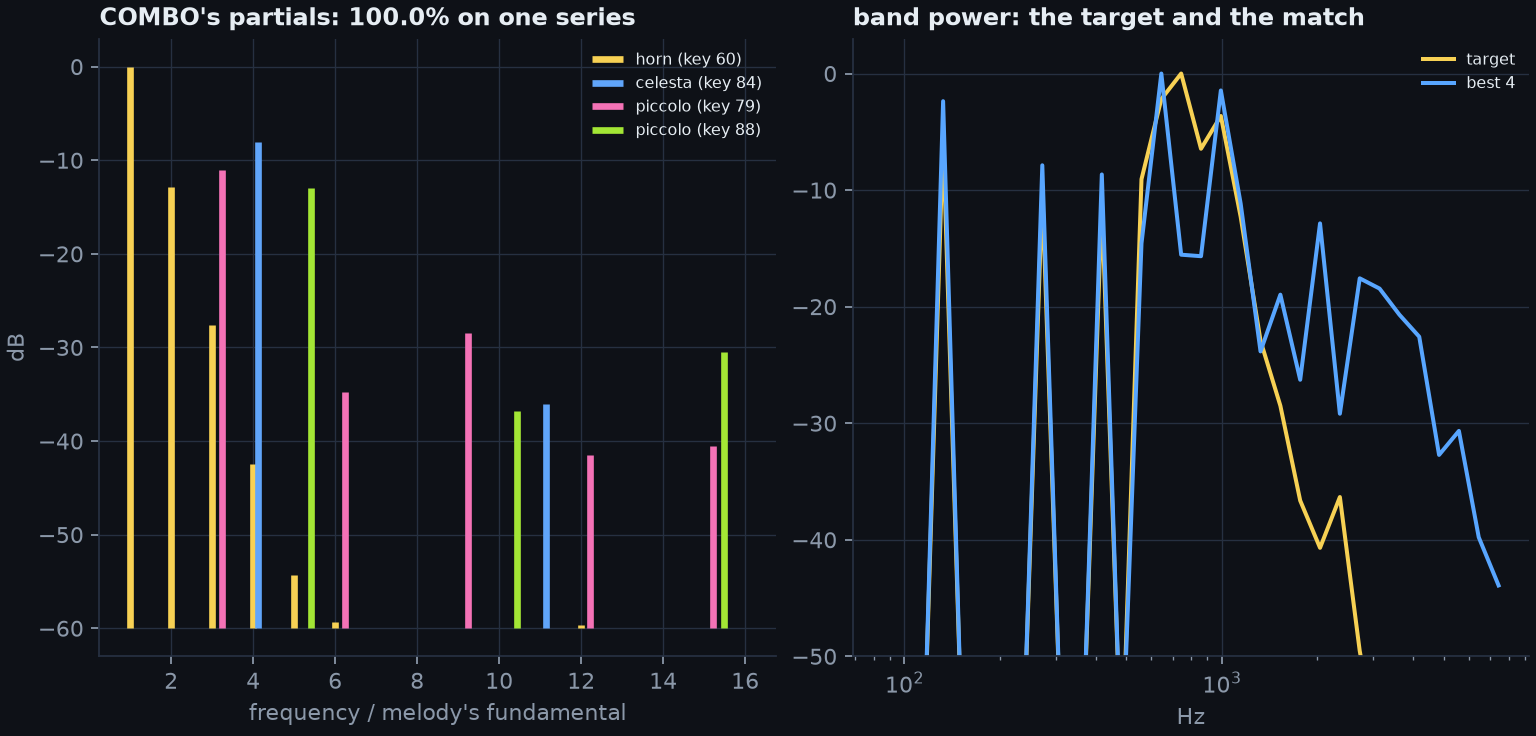
source on GitHubCOMBO: share of power within 20 cents of the melody's harmonic series 100.0%
celesta on key 84: frequency ratio to the melody 4.000 (nearest harmonic 4)
piccolo on key 79: frequency ratio to the melody 2.997 (nearest harmonic 3)
piccolo on key 88: frequency ratio to the melody 5.040 (nearest harmonic 5)
COMBO: brightness (spectral centroid) of the melody alone / of the whole (Hz) 275 / 442
VOICING [48, 52, 55]: roughness on strings (open C-G-E is 0.96) 0.75
solver: candidates, then error by number of instruments (dB a band) 42; 1: 18.3, 2: 10.7, 3: 8.2, 4: 7.1
solver: the best group piccolo on harmonic 8; piccolo on harmonic 5; cello on harmonic 1; clarinet on harmonic 3
ear problem: players in each held G4, in order (listen first) 12, 3, 3
An instrument on a harmonic of another adds only partials the series already has, so they fuse; the solver fits loudnesses by nonnegative least squares and keeps the best small group.The code (87 lines; it asserts its own result)
"""Lab 41: orchestration, computed: instruments resynthesised from measured spectra, fusion on a harmonic series,
sections, the roughness of spacings, and a solver that spells a target spectrum with instruments."""

import numpy as np

from videos.coursekit import labs
from explainer.music.monochord import SR, Clip, concat, mix
from explainer.music.monochord import orchestra as O

TITLE = "Orchestration, computed"
GOAL = ("Put instruments on each other's harmonics and measure how well they fuse; voice a chord and measure its "
        "roughness; and ask the solver to orchestrate a target of your choosing.")
TASKS = [
    "Edit COMBO (instrument, key number, level in dB). Which combinations fuse above 99%? Detune one by a semitone.",
    "Change VOICING. Find the lowest close-position triad whose roughness is below the open voicing's.",
    "Change FORMANTS (the target vowel) and BUDGET. How many instruments does the error need to fall below 10 dB?",
]
COMBO = [("horn", 60, 0.0), ("celesta", 84, -8.0), ("piccolo", 79, -11.0), ("piccolo", 88, -13.0)]
VOICING = [48, 52, 55]
FORMANTS = (730.0, 1090.0, 2440.0)        # 'ah'; try (270, 2290, 3010) for 'ee'
BUDGET = 4


def run(seed=0):
    rng = np.random.default_rng(seed)
    lab = labs.Lab()
    f0 = O.hz(COMBO[0][1])
    fus = O.fusion([(n, m, 10 ** (g / 20)) for n, m, g in COMBO], f0, cents=20)
    assert 0.0 <= fus <= 1.0
    lab.row("COMBO: share of power within 20 cents of the melody's harmonic series", f"{fus:.1%}")
    for n, m, _ in COMBO[1:]:
        k = 2 ** ((m - COMBO[0][1]) / 12)
        lab.row(f"  {n} on key {m}: frequency ratio to the melody", f"{k:.3f} (nearest harmonic {max(1, round(k))})")
    def bright(combo):
        ps = [p for n, m, g in combo for p in O.partials(n, m, 10 ** (g / 20))]
        return sum(f * a * a for f, a in ps) / sum(a * a for _, a in ps)
    lab.row("COMBO: brightness (spectral centroid) of the melody alone / of the whole (Hz)", f"{bright(COMBO[:1]):.0f} / {bright(COMBO):.0f}")
    r = O.voicing_roughness(VOICING)
    lab.row(f"VOICING {VOICING}: roughness on strings (open C-G-E is {O.voicing_roughness([36, 43, 52]):.2f})", f"{r:.2f}")
    tgt = O.vowel_target(FORMANTS, f0=130.81)
    res = O.match(tgt, 130.81, budget=BUDGET)
    lab.row("solver: candidates, then error by number of instruments (dB a band)",
            f"{res['candidates']}; " + ", ".join(f"{k}: {v:.1f}" for k, v in res["error_by_size"].items()))
    lab.row("solver: the best group", "; ".join(f"{c['instrument']} on harmonic {c['harmonic']}" for c in res["chosen"]))

    # sound: the combination, then the solver's match; ear problem: sections of random sizes, level-matched
    beat = 0.5
    mel = [(0, 0.0, 1.0), (0, 1.0, 1.0), (7, 2.0, 1.0), (7, 3.0, 1.0), (9, 4.0, 1.0), (9, 5.0, 1.0), (7, 6.0, 2.0)]
    parts = []
    for n, m, g in COMBO:
        for dm, a, d in mel:
            parts.append((Clip(O.note(n, m + dm, d * beat * 0.97), SR), a * beat, g))
    combo = Clip(mix(parts, duration=8 * beat + 0.6).y, SR).at_level(-20.0)
    match = Clip(mix([(Clip(O.note(c["instrument"], c["key"], 2.0), SR), 0.0, 20 * np.log10(max(c["gain"], 1e-4))) for c in res["chosen"]],
                     duration=2.4).y, SR).at_level(-20.0)
    sizes, clips = [], []
    for i in range(3):
        k = int(rng.choice([1, 3, 12]))
        clips.append(Clip(O.section("violin", 67, 2.0, players=k, seed=10 + i), SR).at_level(-20.0))
        sizes.append(str(k))
    lab.audio = concat([combo, match] + clips, gap=0.8)
    lab.row("ear problem: players in each held G4, in order (listen first)", ", ".join(sizes))

    fig, (ax1, ax2) = labs.figure(2)
    cols = [labs.GOLD, "#60A5FA", "#F472B6", "#A3E635", "#22D3EE", "#F59E0B"]
    for j, (n, m, g) in enumerate(COMBO):
        ps = [p for p in O.partials(n, m, 10 ** (g / 20)) if p[0] / f0 < 17]
        ax1.vlines([p[0] / f0 + 0.12 * j for p in ps], -60, [max(-60, 20 * np.log10(p[1] + 1e-9)) for p in ps], lw=3,
                   color=cols[j % len(cols)], label=f"{n} (key {m})")
    ax1.set_xlabel("frequency / melody's fundamental")
    ax1.set_ylabel("dB")
    ax1.set_title(f"COMBO's partials: {fus:.1%} on one series")
    ax1.legend(fontsize=7)
    e = O.ERB_EDGES
    c = np.sqrt(e[1:] * e[:-1])
    tb = np.array(res["target_bands"])
    ax2.semilogx(c, 10 * np.log10(tb / tb.max() + 1e-6), color=labs.GOLD, label="target")
    approx = sum(O.band_power(O.partials(ch["instrument"], ch["key"], np.sqrt(max(ch["gain"], 0)))) for ch in res["chosen"])
    ax2.semilogx(c, 10 * np.log10(approx / max(approx.max(), 1e-12) + 1e-6), color="C0", label=f"best {BUDGET}")
    ax2.set_ylim(-50, 3)
    ax2.set_xlabel("Hz")
    ax2.set_title("band power: the target and the match")
    ax2.legend(fontsize=7)
    lab.fig = fig
    lab.note = ("An instrument on a harmonic of another adds only partials the series already has, so they fuse; the "
                "solver fits loudnesses by nonnegative least squares and keeps the best small group.")
    return lab
Now change it
- Edit COMBO (instrument, key number, level in dB). Which combinations fuse above 99%? Detune one by a semitone.
- Change VOICING. Find the lowest close-position triad whose roughness is below the open voicing's.
- Change FORMANTS (the target vowel) and BUDGET. How many instruments does the error need to fall below 10 dB?
Problems, with solutions
Try each problem before opening its solution.
-
Compute. How many violins does it take to be 6 dB louder than four violins?
Solution
Independent players add in power, so n players are 10 log₁₀ n dB above one. Six decibels more than four needs 10 log₁₀(n/4) = 6, n = 4 × 10^0.6 ≈ 16. Our measured sections give 12.7 dB for sixteen and 5.5 for four: 7.2 dB, close to the 6 predicted.
-
Prove. Prove that n incoherent equal sources are 10 log₁₀ n dB louder than one, and coherent ones 20 log₁₀ n.
Solution
Coherent copies add in amplitude: the sum is n times the amplitude, n² times the power, 20 log₁₀ n dB. With independent random phases the cross terms average to zero, so the powers add: n times the power, 10 log₁₀ n dB. Eight violins: 18.1 and 9.0 dB; our section, with small detunings and onsets, measured 10.6.
-
Ear. The lab plays one held note on sections of different sizes; say how many players each time.
Solution
The lab prints the sizes. The levels are matched, so listen for the chorus: one player has a clean, steady vibrato; three a slow beating; twelve a broad shimmer with no single pitch line.
-
Build. Give the solver a target of your own (another vowel, a bell) and compare budgets.
Where to look. Set
FORMANTSandBUDGETinvideos/music/labs/lab41.py, or callorchestra.matchwith any list of (frequency, amplitude). Harmonic targets fall below 10 dB with two or three instruments; inharmonic ones do not, because every candidate is harmonic. -
★ Can blend and layering be predicted from the score alone?
Where the frontier is. Collect orchestral excerpts with scores, recordings and listeners' judgements of what blends and what forms separate layers; predict them from the score and the instruments' spectra (harmonicity, onset synchrony, brightness); test on new excerpts and new listeners.
Notes and sources
Sources
- M. Ravel, Boléro (1928); H. Berlioz, Grand traité d'instrumentation et d'orchestration modernes (1844); N. Rimsky-Korsakov, Principles of Orchestration (1913); S. Adler, The Study of Orchestration (1982).
- J. M. Grey, "Multidimensional perceptual scaling of musical timbres", JASA (1977); S. McAdams, S. Winsberg, S. Donnadieu, G. De Soete and J. Krimphoff, "Perceptual scaling of synthesized musical timbres", Psychological Research (1995).
- G. J. Sandell, "Roles for spectral centroid and other factors in determining 'blended' instrument pairings in orchestration", Music Perception (1995); S.-A. Lembke and S. McAdams, "The role of spectral-envelope characteristics in perceptual blending of wind-instrument sounds", Acta Acustica united with Acustica (2015).
- A. Schoenberg, Harmonielehre (1911); A. Webern, orchestration of Bach's six-part Ricercar (1935).
- P. Esling, G. Carpentier and others on computer-aided orchestration (Orchidée, Orchids, Orchidea), IRCAM.
- W. A. Sethares, Tuning, Timbre, Spectrum, Scale (2nd ed., 2005), for the roughness model.
About this partfrom its README
Part 41 of a sixty-eight-part course in music (see the series plan and
the syllabus), the first part of Act VII, The Craft. Ravel called Boléro (1928) a piece for
orchestra without music: two alternating melodic strains, stated eighteen times over one snare-drum rhythm, with orchestration, density and dynamics driving most of the change. In one statement a horn, a celesta and two piccolos sit on the tune's harmonics and fuse into an
organ-like colour no single player owns: additive synthesis with players. This part builds an orchestra from the
series' own physical models and asks what an orchestrator controls: ranges and registers, loudness and brightness,
sections and the chorus effect, doubling and balance, spacing, texture, and the melody of timbres; then it turns
Ravel's idea around and lets a solver orchestrate a target spectrum. The tools are Monochord's
(explainer/music/monochord/orchestra.py). Every instrument heard is resynthesised from spectra measured on Parts 7–9's
models, or is one of those models itself. Published findings are the ones listed under Sources.
- A piece for orchestra without music. An ear question (a phrase on a horn, then again: one, two or four instruments?); Ravel's experiment; the plan.
- 1. An orchestra from physical models. The orchestra's history in brief; sixteen harmonics measured on each model; one middle C on eight instruments, heard; an ear question (which of three Cs is the clarinet?); the Tune's phrase on each instrument, heard; the players; what the resynthesis leaves out.
- 2. Ranges, registers and transposition. The ranges chart; registers; Part 8's clarinet model in its two registers (its strongest peak moving from 140 to 433 Hz), heard; transposing instruments; why they transpose.
- 3. Loudness and brightness. An ear question (one trumpet note at one playback level, blown soft and hard: which was blown hard?); the centroid nearly doubling (357 to 651 Hz); why louder is brighter; a swell, heard; dynamic range across the orchestra; balance.
- 4. Sections and the chorus effect. The arithmetic of n players (coherent 20 log n, incoherent 10 log n); one violin and eight, heard (+10.6 dB measured, between 9 and 18); solo and tutti, heard; the chorus effect; 1, 2, 4, 8 and 16 violins at one level, heard; seating; section sizes.
- 5. Doubling, blend and balance. A held C on flute, clarinet, both, and flute with a louder trumpet, heard; measured (the flute's share of the power falling from one half to one fifth); masking; doubling at the octave, heard; blend studies (Sandell; Lembke and McAdams).
- 6. Spacing. The harmonic series as a guide; one C major chord three ways, heard; their roughness (1.33 close and low, 0.96 open, 0.19 close and high); registral layers; rules of spacing.
- 7. Textures and the melody of timbres. The Tune's phrase in four textures, heard; the four textures; an orchestrator's order of work; a melody of timbres, heard; Schoenberg's Klangfarbenmelodie and Webern's Ricercar.
- 8. Ravel's harmonics. The horn's series and where the celesta and piccolos sit; the combination assembled one instrument at a time, heard; the tempered notes' errors (0, −2.0 and +13.7 cents); the organ's mixture stops; Boléro's plan; its crescendo in miniature, heard.
- 9. Orchestration as search. The problem; the solver (non-negative least squares over 42 candidates, then every group of up to four); the target, a sung "ah" on C3; errors of 18.3, 10.7, 8.2 and 7.1 dB a band for one to four instruments; a bell as a harder target (31.5 dB with four), heard; the vowel and its matches, heard; IRCAM's tools.
- 10. Frontier: timbre measured. Timbre space (Grey; McAdams and colleagues); our orchestra mapped by attack and brightness; timbre as identity; the treatises tested (the ACTOR project); machines; ★ research problem: can blend and layering be predicted from the score alone?
- Variation 41, recap and problems. The Tune in eight orchestrations (strings; woodwinds; brass; flute and clarinet in unison; Ravel's combination; a melody of timbres; tutti in octaves; matched to the vowel "ah"); the ledger; what we found; five problems; where it comes back; in practice; references; Part 42.
What is computed and built
python -m videos.music.music41.compute (about a minute) fills .cache/music41/.
| Item | What it computes | Checked against |
|---|---|---|
hook, build, cresc |
Ravel's combination; its tempered errors; its fusion | the harmonic series (tests) |
same, which, tour |
one C on eight instruments; the clarinet quiz; the phrase on each | the measured spectra (tests) |
registers, bright, swell |
Part 8's clarinet in two registers; the trumpet soft and hard; a swell | spectral peaks and centroids (tests) |
section, sizes, solo |
one player against eight; 1 to 16 violins; solo and tutti | 10 log n and 20 log n (tests) |
blend, octave |
unison and octave doublings and their power shares | the centroids (tests) |
spacing |
three voicings and their roughness | Part 5's roughness (tests) |
texture, klang |
four textures; a melody of timbres | — |
match, bell, space |
the solver on a vowel and a bell; attack and brightness | errors shrinking with budget (tests) |
tune, variation |
Variation 41 | the ledger (tests) |
Monochord's tools are held in tests/music/test_orchestra.py; this part's claims and clips in tests/music/test_music41.py.
Sounds. The flute, clarinet, saxophone, trumpet and bowed string are Parts 7–8's physical models, measured once
(sixteen harmonics each) and resynthesised additively, with attacks and vibrato by family; the horn, piccolo and cello
are derived from those spectra; the celesta is a struck bar's inharmonic partials (Part 9); the voice is Part 17's model.
These clips are labelled synthesized. The soft and loud trumpet notes, the swell and the clarinet's registers are the
physical models themselves. There are no recordings.
What the models are, and are not. One spectrum per instrument: a real instrument's spectrum changes with pitch, loudness and time, so ours sound alike from note to note (Part 52 builds better ones). The horn, piccolo and cello are derived, not modelled. The solver matches an average spectrum in 32 bands, not how it moves in time.
Notes
Ranges and balance ratios are approximate guides, not universal limits. Incoherent power addition predicts about 3 dB per doubling under stated assumptions. The blend fraction and 20-cent harmonicity proxy are descriptive models, not measured listener fusion or masking probabilities. Boléro alternates two strains and changes dynamics and density as well as instrumentation. Tempered pitch errors refer to this model; players adjust intonation. The solver prunes candidates before subset search, fits linear band powers, and ranks fits by an RMS dB metric. It is not a global orchestration optimum or a perceptual quality test. Its restricted harmonic candidate list, rather than an inability of orchestras to play inharmonic collections, limits its bell match.
Companion material in this repository
- Monochord's orchestra: measured spectra, sections, fusion, spacing roughness and the matching solver
The syllabus's plan for this partfrom SYLLABUS.md, the plan of record
- Hook: an ear question (one, two or four instruments?); Ravel's experiment; the plan.
- An orchestra from physical models: history; sixteen measured harmonics each; one C on eight instruments; an ear question (which is the clarinet?); the tour; the players; what is left out.
- Ranges, registers and transposition: the chart; registers; the clarinet model's two registers heard; transposing instruments; why.
- Loudness and brightness: an ear question (same level, which was blown hard?); why louder is brighter; a swell heard; dynamic range; balance.
- Sections and the chorus effect: the arithmetic of n players; one against eight heard; solo and tutti; the chorus effect; 1 to 16 violins heard; seating; sizes.
- Doubling, blend and balance: four doublings heard; power shares measured; masking; the octave heard; blend studies.
- Spacing: the harmonic series as a guide; three voicings heard; their roughness; registral layers; rules.
- Textures and the melody of timbres: four textures heard; the kinds; an orchestrator's order of work; a melody of timbres heard; Schoenberg and Webern.
- Ravel's harmonics: the series drawn; the combination built up, heard; tempered errors; mixture stops; Boléro's plan; its crescendo in miniature.
- Orchestration as search: the problem; non-negative least squares and subsets; the vowel target; errors by budget; a bell; the matches heard; IRCAM's tools.
- Frontier: timbre space; our orchestra mapped; timbre as identity; the treatises tested; machines; the research problem.
- Variation 41: the Tune in eight orchestrations, the last matched to a vowel. Outro: problems, payoffs.
Covers: ranges, registers and transposition; loudness and brightness; blend, doubling and balance; why a
section is not one loud player; spacing; textures; melody of timbres; orchestration as a search problem.
Built and computed: monochord/orchestra.py: spectra measured once on Parts 7–8's models (flute, clarinet,
saxophone, trumpet soft and loud, bowed string) and resynthesised additively; sections with detuning and onset
scatter (eight violins +10.6 dB, between the incoherent 9.0 and coherent 18.1); a fusion measure (Ravel's
combination: all its power within 20 cents of one series; tempered errors 0, −2.0, +13.7 cents); spacing roughness
(1.33, 0.96, 0.19); a solver (NNLS over 42 candidates, then subsets) matching a sung "ah" within 18.3, 10.7, 8.2 and
7.1 dB a band with one to four instruments, and a bell only within 31.5.
Variation 41: the Tune in eight orchestrations, the last matched to a vowel (7.1 dB a band with four instruments).
Frontier: timbre space and blend research; computer-aided orchestration (open: predicting blend and layering from
the score).
Reading: Adler; Rimsky-Korsakov; Berlioz; Grey (1977); McAdams et al. (1995); Sandell (1995); Lembke and McAdams.
Build the film
python -m videos.music.music41.compute        # the part's numbers, into .cache/music41
python tools/build.py music41                  # render and assemble the film
EXPLAINER_TTS=silent python tools/qa_scene.py music41 Hook   # one chapter, silent, with a contact sheet
Scenes: videos/music/music41. Setup: see the course page. Source of these notes: the README and the scenes' narration.
Build it
python -m videos.music.music41.compute                          # numbers and sounds (about a minute)
EXPLAINER_TTS=silent python tools/build.py music41 -q l --fps 15   # a silent-narration preview, with the sounds
python tools/qa_sound.py music41 --sync                         # the sound gates
python tools/dead_air.py renders/music41_480p.mp4 --sound music41  # no empty screen; no sound over a still one
python tools/lecture_length.py music41                          # 30 to 60 minutes, listening included
python tools/build.py music41                                   # 1080p30, narrated
python -m pytest -q tests/music                                 # Monochord against its references; this part's claims and clips
python -m videos.music.labs 41                                  # the lab (writes a figure and a short WAV)