Pipes, Reeds and Voices
Why does a reed lower a pipe by an octave, how does a tube with no holes play a tune, and what makes a vowel?
Two pipes of the same length, one blown across its end and one through a reed, sound an octave apart; and a singer in Tuva sings two notes at once. One idea covers both: a column of air that resonates, and a valve that lets breath through in time with it. A pipe open at both ends has every harmonic; a reed closes one end, so a clarinet sounds an octave lower and has the odd ones. The reed is a valve that pressure closes, and it feeds the pipe only above a third of the pressure that shuts it. Holes shorten the pipe, and a register hole hands the note to the next resonance: an octave for a flute, a twelfth for a clarinet. A cone, with a mouthpiece in place of its missing tip, has every harmonic: the oboe and the saxophone. A brass player's lips are a valve with a frequency of their own, and a bell and a mouthpiece bend a stopped pipe's odd resonances into a whole series. A flute's valve is a jet of air whose crossing must take half a period, so blowing harder finds the octave; an organ's stops add partials one rank at a time. The voice is a source and a filter: the folds set the pitch, the tube above them sets the vowel, and a vowel is a place on a map of two formants. Singers move the filter on purpose: for ring, for a soprano's high notes, and for a second note drawn out of the first. The Tune is played by five valves on five columns of air.
What you need. Part 2 for waves in tubes and the bottle; Part 3 for harmonics and a square wave; Part 4 for fusion and the missing fundamental; Part 7 for a valve that feeds a resonator. Trigonometry; decibels.
- Ideas, mathematics and history
- bores and impedance, why a clarinet lacks even harmonics, the reed as a valve, brass bells and mouthpieces, the source-filter voice, formants, overtone singing
- What we build, compute and hear
- a clarinet model, a brass model and a voice that sings vowels
What you will be able to do
Foundations
- Explain the resonances of open and stopped pipes, cones and a trumpet's bore.
- Describe how a reed, a pair of lips and a jet each feed a column of air.
- Explain the voice as a source and a filter, and a vowel as a pattern of formants.
Full course
- Compute a bore's input impedance by transfer matrices, with an end correction.
- Derive the reed's threshold from its flow curve.
- Find the formants of a tube, and place a vowel on the map of two formants.
Research
- Say what the simple models of folds, lips, jets and loud brass leave out.
- Describe how players and singers tune the vocal tract.
Practice
- Place and size a tone hole; correct a valve combination.
- Use formants: for intelligibility, for a singer's ring, for a synthetic voice.
- Choose registers and dynamics on a wind instrument knowing what each does to the tone.
Contents
Each chapter has a home level. Choose a track to see what to read and watch: Foundations 45 min · Full course 50 min · Research 53 min · Practice 50 min.
- 0Two pipes of the same lengthFoundations3 min
- 1A column of airFoundations4 min
- 2A valve that pressure closesFoundations5 min
- 3HolesFoundations5 min
- 4ConesFoundations4 min
- 5Lips and brassFoundations6 min
- 6A jet and an edgeFoundations5 min
- 7The voice: a source and a filterFoundations3 min
- 8VowelsFoundations4 min
- 9What singers doPractice5 min
- 10Frontier: what these models leave outResearch3 min
- Variation 8, recap and problemsAll tracks5 min
Also on this page: Lecture · Key results · Try it · Lab · Problems · Notes and sources · Build the film.
Lecture
The text of each chapter is the film's narration, as it is spoken, so you can read along or revise without the film. The pictures are in the film. A dashed box stands for a number the film computes when it is rendered (hover over it to see what is computed); the README's figures for each chapter, where it lists them, follow the chapter's text.
Two pipes of the same lengthFoundations3 min
Two pipes. They are the same length, sixty centimetres, and nearly the same width. One will be blown across its open end, the way you blow across a bottle. The other has a reed fixed to one end, and will be blown through that. Listen to both, and judge how far apart their notes are.
An octave. The first pipe sounds at hertz; the second at , half as fast, from the same length of air. And they differ in colour too. The lower one has that hollow, woody sound, and if you measure it, even harmonics are weak in this low-register model; real clarinets vary with pitch and dynamics. The first pipe is a flute, more or less. The second is a clarinet. Why should a reed lower a pipe by an octave and hollow out its tone?
A second puzzle, from the other end of the world of wind instruments. In Tuva, in southern Siberia, herders sing in a way that outsiders at first refuse to believe. One singer holds a low, steady note, and above it, at the same time, whistles a tune. One throat, two notes. Here are the harmonics of a single sung note, the way Part 3 would draw them. Listen to what a throat can do with them. This is not a recording of a Tuvan singer. It is Monochord, the instrument this series builds, singing.
The low note never moved. The whistle above it was not a second voice. It was one harmonic of that low note at a time, the eighth, the ninth, the tenth, the twelfth, made so loud that the ear hears it as a note of its own. How a throat picks out one harmonic is the last thing this part will explain, and it turns out to be the same idea as the flute and the clarinet.
Here is that idea. These instruments couple a vibrating source to resonating air. A column of air has resonances. Reeds, lips and jets turn a player's steady breath into oscillating flow. Vocal folds usually set their own pitch while the vocal tract shapes the sound. Part 7 ended on the bow, which grips and lets go in time with a string. This part is that loop again, with air. We will find out why one pipe has two notes, and what a reed is doing. How holes turn one pipe into a scale. What changes when the pipe is a cone. How a brass player gets a tune from a tube with no holes. How a flute works with no valve at all. And then the oldest instrument, the one you are listening now: the voice.
1A column of airFoundations4 min
Why does the same pipe have two different notes?
In Part 2 we blew across a bottle and found that air in a container has notes of its own. A pipe has a whole family of them, and which family depends on its ends. At an open end, the air inside meets the air of the room, so the acoustic pressure there is small: in the ideal boundary model it stays at the pressure outside. At a closed end the air has nowhere to go, and the pressure swings most. Open the pipe at both ends. The pressure must be quiet at each end and can swell in the middle: half a wave fits. So do two halves, and three. The pipe's notes are a frequency f and all its multiples. Now close one end. The pressure swings most at the closed end and not at all at the open one: only a quarter of a wave fits, a wave twice as long, so a note an octave lower. The next shape that fits is three quarters, then five. Only the odd multiples. And that is the clarinet. A reed leaves only a hair's breadth of opening, so as far as the air column can tell, its end of the pipe is shut. For an ideal cylindrical low-register model, an octave lower with odd resonances. Even harmonics in actual clarinet sound need not vanish.
Monochord can measure this. Take the sixty-centimetre pipe, push air in and out at one end at every frequency in turn, and ask how hard the air column pushes back. Physicists call the answer the impedance. It has peaks: frequencies at which a small push of air meets a large swing of pressure. A reed, which needs pressure to work against, plays at a peak: hertz, then , then . Odd multiples, as promised. Between the peaks are valleys, where the air moves freely and the pressure hardly changes. That is the condition at an open end, so a flute, open at its mouth hole, plays in the valleys: , , . Every multiple. One curve, two instruments. One detail. The simple rule for this pipe predicts hertz for the lowest peak, and the curve says . The air just outside an open end moves with the air inside, so a pipe behaves as if it were a little longer than it is: by about six tenths of its radius, here millimetres. Instrument makers call it the end correction, and no flute could be built in tune without it.
A worked example. Sound travels three hundred and forty-three metres a second. How long must a pipe open at both ends be, to sound middle C, at two hundred and sixty-two hertz? And how long a pipe closed at one end, for the D below it, at a hundred and forty-seven? Pause, and work them out.
Half a wave of middle C has to fit: the speed over twice the frequency, centimetres. This is the ideal acoustic length before end corrections; a C-foot concert flute reaches middle C, while B-foot instruments extend lower. For the closed pipe, a quarter of a wave: the speed over four times the frequency, centimetres. A standard B-flat clarinet reaches concert D at its written low E. Its ideal quarter-wave length is about sixty centimetres; bore, mouthpiece and end corrections affect the physical dimensions. So the three small woodwinds of the orchestra are nearly the same length, and one of them goes most of an octave lower than the others. Now you know which, and why.
2A valve that pressure closesFoundations5 min
What is the reed doing?
So a reed closes one end of the pipe. But it does a second job, and that is the one that makes the sound. A clarinet's reed is a thin blade of cane, held against the mouthpiece so that a narrow gap is left. The player's breath has to get through that gap. Blow, and the pressure in the mouth pushes air through; but the same pressure also pushes on the back of the reed and bends it towards the mouthpiece, narrowing the gap. Plot the flow of air against the pressure difference across the reed. At first, more pressure means more flow, as through any hole. But the gap is closing all the while, and beyond a certain point the narrowing wins: more pressure means less flow. Push hard enough and the reed is flat against the mouthpiece, and nothing gets through. In this quasi-static linear-reed and Bernoulli-flow model, the top is at one third of the pressure that shuts the reed. Remember that number. And remember where you have seen this shape: it is the rosin of Part 7, whose grip fell as the string began to slide. A valve that passes less when pushed harder is what turns a steady push into a vibration.
Put that valve on the end of the pipe, and follow one puff. A little extra pressure in the mouthpiece runs down the pipe. At the open end it is reflected upside down, as suction, and runs back. When the suction reaches the mouthpiece, the pressure difference across the reed changes, the flow through the gap responds, and what is sent back down the pipe is suction again. That returns as pressure. Down, back, down, back: four trips of the pipe for one full cycle. Here is Monochord's reed on the sixty-centimetre pipe. The pressure in the mouthpiece flips between high and low: very nearly a square wave, at hertz. And a square wave, Part 3 showed, is made of odd harmonics only. Inside this model mouthpiece, the even ones are more than fifty decibels down; a real radiated spectrum also depends on register, holes and radiation. So the clarinet's hollow sound is not something added to it. It is the shape of a wave that spends half its time high and half its time low.
What does the player control? In this demonstration we vary one thing: blowing pressure. Real players also control embouchure, tonguing and vocal-tract shape. So listen to Monochord's clarinet being blown steadily harder for five seconds, from almost nothing. When does the sound begin? And once it has begun, what changes, besides the loudness?
For the first second and a half there is breath and no note. Then, quite suddenly, the clarinet speaks. For this start-up condition there is a threshold, below which small disturbances decay. And after it speaks, the note does not only get louder. It starts as something close to a pure tone and grows an edge. Just above the threshold the fifth harmonic is decibels below the first; at full breath it is . As with the piano's hammer, loud is bright. A clarinettist who wants a soft, dark sound plays just above the threshold, and a great deal of the art is living there without falling off.
Where is the threshold? Here is every blowing pressure Monochord tried, and the size of the note that resulted. Nothing, nothing, nothing; and then, at of the pressure that shuts the reed, a note. A third, and a little more. That is the top of the flow curve, and now you can see why. Below a third, the reed is on the rising side of its curve. When a pulse of pressure comes back up the pipe, the pressure difference across the reed drops, and so does the flow: the valve works against the wave, and any disturbance dies. Above a third, on the falling side, the same returning pulse makes the flow go up. The valve lets in air exactly when the pressure is already high. It feeds the wave. The little extra, between a third and where our pipe actually spoke, is what the walls of the pipe and its open end take away on each trip. The valve has to pay that back before anything is left over to grow.
3HolesFoundations5 min
How does one pipe play a scale?
A pipe has one length, and a tune needs many notes. The oldest answer is at least forty thousand years old: cut holes in the side. Here is our clarinet pipe with every hole shut, sounding at hertz. Saw it off at three quarters of its length and it sounds at : a fourth higher. Now, instead of sawing, open a hole at that point, as wide as the pipe itself. To the air column, a hole that wide is very nearly the end of the pipe: the pressure escapes there, and the wood beyond it hardly matters. Monochord gets hertz. But large holes can be difficult to cover and reach directly; keys and pads help. Make the hole smaller, and it lets the pressure out less completely. At eight millimetres the note is cents flat of the sawn pipe; at four millimetres, cents, nearly a whole tone. A small hole behaves like a big hole further down. So a maker has two things to play with for every note: where the hole is, and how big. That is how the holes of a recorder can sit under the fingers of one hand, instead of where the arithmetic first puts them.
A worked example. Take a flute's pipe, open at both ends, with every hole shut, and suppose its holes are as wide as the pipe, so that an open hole is as good as a saw. Where must a hole be, to sound the note a fifth above the pipe's own? And where for the octave? Pause, and say.
The frequency of a pipe goes as one over its length. A fifth is three halves the frequency, so the pipe must end at two thirds of its length. The octave is twice the frequency: half the length. And the notes between follow: eight ninths for a tone, four fifths for a third, three quarters for a fourth. You have seen these fractions before. They are where the bridge of the monochord stood in Part 1. A flute is a monochord made of air; these are ideal just-intonation ratios expressed as effective lengths, not a literal construction plan for every tin whistle. Real flutes then cheat, hole by hole, in the way you have just seen, to bring the holes within reach.
Seven or eight finger holes give a scale of seven or eight notes. To go on upwards, every woodwind does the same thing: it jumps to the pipe's next resonance and uses the same holes again. A flute's next resonance is twice the first, so many second-octave fingerings resemble those of the first. But a clarinet's next resonance is three times the first: an octave and a fifth above, nineteen semitones. To get there, a clarinet has a register key, which opens a pinhole about a quarter of the way down the pipe. Here is what the pinhole does to the pipe. The lowest resonance moves from hertz to , where its harmonics no longer line up with anything. The second resonance barely moves: to . The lowest resonance persists but is shifted and weakened. It has been put out of tune with its helpers, and the reed, which needs a whole family of resonances behind it, gives up on it and takes the next. Listen.
From hertz to : three times the frequency, a twelfth. In this simple model it comes out cents wide; real clarinets are shaped, bore and holes together, to pull it back. The price of that twelfth is paid by every clarinettist. Between the top of the first register and the bottom of the second there are nineteen semitones to cover, not twelve, so a clarinet needs more holes and more keys than a flute or an oboe, and the same fingering means a different note in each register. Players call the join the break, and spend years smoothing it.
4ConesFoundations4 min
Why does an oboe not sound like a clarinet?
An oboe has a reed, like a clarinet, and is about as long. It sounds nothing like one, it plays most of an octave higher, and when it overblows it jumps an octave, not a twelfth. Saxophones and bassoons also overblow approximately an octave. What they share is the shape of the pipe. A clarinet's bore is a cylinder: the same width all the way down. These are cones: narrow at the reed, widening steadily to the bell. Here is the cylinder's response again, sixty centimetres long, with its peaks at , and hertz: one, three, five. And here is a cone of the same length. Its peaks are at , , and : one, two, three, four. Every multiple, and starting most of an octave higher. The cone is closed at the reed, just as the cylinder is, and yet it has the notes of a pipe open at both ends. The reason is the spreading. In a cone a wave is a piece of a sphere, and as it runs towards the narrow end it is squeezed into less and less room. The arithmetic of that squeezing happens to gives an ideal complete cone a harmonic frequency series, like an open cylindrical pipe. This does not make the cone's apex a pressure-release boundary. Its point is not literally an open end.
There is a catch. A cone that ran all the way to its point would leave nowhere to put a reed. So the point is cut off. And a cone without its tip no longer has its resonances in the ratios one, two, three, four. Monochord's cut-off cone has them at one, , , : each one a little sharper than the last. That matters, because of what we saw with the register hole: a reed needs resonances that line up with the harmonics of its note. The cure is two centuries old. Replace the missing tip with a mouthpiece, a chamber whose low-frequency acoustic compliance approximately replaces the missing conical volume. Its shape, reed compliance and higher-frequency behavior still matter. The ratios come back: one, , , . A saxophone's mouthpiece is sized by this rule, and so is the space inside an oboe's double reed.
So what does the cone do to the sound? Here is the same note on two of Monochord's reed instruments. One has a cylinder for a bore, the other a cone. Which is the cylinder?
B was the cylinder: hollow, the even harmonics nearly gone. A was the cone: full and reedy, with every harmonic present, because every harmonic has a resonance of the pipe behind it. And look at the lengths. For this one note the cylinder is centimetres long and the cone . That is the trade a maker faces. A cylinder reaches low notes with a short pipe and gives the clarinet's colour and its awkward twelfth. A cone needs most of twice the length, and gives a full spectrum and an octave. In 1846 Adolphe Sax patented a wide metal cone with a clarinet's mouthpiece on it, and got a new instrument.
5Lips and brassFoundations6 min
How does a tube with no holes play a tune?
A trumpet, a horn, a trombone, a tuba. Many natural brass instruments use one fixed tube without finger holes. Trombones have used slides for centuries; modern valves appeared about two centuries ago. No reed is needed: the valve is the player's own lips, pressed into a small cup at the end of the tube and blown through until they buzz. Lips are a different kind of valve. A reed is pushed shut by the breath. Our reed model neglects its inertia, so the pipe strongly guides the note; real reed inertia and embouchure can also matter. Lips are pushed open by the breath. Their mass and elasticity give them a frequency of their own, low when they are slack and high when they are tight. So on a brass instrument the choice of note is shared. The player sets the lips to buzz near a frequency, and the tube joins in if it has a resonance close by. If it has not, the note cracks, or does not come at all. Everything depends on where the tube's resonances are.
And at first sight the resonances are in the wrong places. A brass tube is closed at the lips and open at the far end, like a clarinet. A plain tube as long as a trumpet's has its resonances at , , , hertz: one, three, five, seven. The notes of a bugle call are not in there. Now put a schematic trumpet-like profile on it: a cup and a narrow throat at one end, and at the other a bell that flares. Monochord computes the resonances again: , , , , . Those are very nearly two, three, four, five and six times hertz, which is the B flat that a trumpet is named after. The shape has moved every resonance, the low ones up and the high ones down, until an odd series became a whole one. How? A low note turns back early in the flare, where the bell is still narrow, so for low notes the tube is short. A high note travels further out before the bell lets it go. The tube is a different length for every note, and four centuries of makers found by trial the flare that makes the lengths come out right. Except for one. The lowest resonance is at hertz, nowhere near . Hold that thought.
Now let the lips choose. Monochord has a model of a pair of lips, a mass on a spring that the breath blows open, and here it is on the trumpet, with the lips set to one frequency after another. The note that sounds does not follow the lips smoothly. It climbs a staircase. Each step is one of the tube's resonances, shown as a dashed line, and the note sits a little above the frequency of the lips themselves. Tighten the lips gradually and the horn jumps from one resonance to the next. Real buglers also coordinate airflow, tongue and embouchure. Listen to eight notes on one length of tube.
Three, four, five, six times the B flat: members of the harmonic family used in familiar bugle calls. And look at the two stray points at the bottom of the staircase. Twice, while climbing, the model dropped to hertz, where this model has no nearby strong bore resonance at all. That is the note brass players call the pedal. The low-frequency bore response is not literally zero, but the stronger upper resonances help organize this regime. But its second harmonic sits on one resonance, its third on the next, its fourth on the next, and between them they hold the lips to a rhythm whose fundamental the tube does not support. This is a nonlinear oscillation supported by upper resonances, related to Part 4's common-period idea but distinct from the ear's missing-fundamental percept, and nobody told the model to do it.
A bugle's notes have gaps. To fill them, around 1818, makers added valves, and each valve switches an extra loop of tubing into the horn. A worked example. To lower any note by a semitone, the tube must become five point nine percent longer. The second valve adds that much. The first adds enough for two semitones, the third for three. Now press the first and third together, to go down five semitones. How much tube have you added, how much did you need, and is the note sharp or flat? Pause, and work it out.
The two loops add percent. Five semitones need . Percentages multiply; loops of tube only add. The horn is too short, by about centimetres in this example trumpet, and the note is cents sharp: a third of a semitone, far too much to leave. Many piston trumpets use a finger ring or trigger to move the third-valve slide for those combinations. Adjustment mechanisms differ among instruments. A trombone has no such trouble. Its slide is the whole instrument.
6A jet and an edgeFoundations5 min
What plays a flute without a flexible reed?
And then there is the flute, which is the strangest of all, because it has no flexible oscillator inside it. No reed, no lips inside the instrument. The player's lips make a thin ribbon of air, a jet, and aim it across the mouth hole at the hole's far edge. When the pipe is sounding, air sloshes in and out of that hole, and the sloshing pushes the jet sideways where it leaves the lips. The sideways push does not act at once. It rides along the jet, like a wave along a flag, and when it reaches the edge it tips the jet one way or the other: into the pipe, or out over the top. Into the pipe, out, in, out. The jet is the valve, and it is made of the same air as the breath. For the puffs to arrive at the right moment, the ride along the jet has to take about half a period of the note. John Coltman's measurements in the nineteen sixties helped establish this timing in this regime. It is an approximate phase guide, not a complete rule for every register.
Blow harder, and the jet moves faster. The ride to the edge takes less time. So what should happen, on one fingering, if a flute is blown steadily harder? Listen, and follow the pitch.
The note creeps sharp, by cents, as the jet gets ahead of the pipe. Flute players know that well: blowing harder raises the pitch, and they correct it by rolling the flute. Then it breaks, and lands on the octave. The jet has become too quick for the pipe's first resonance, whose half period is long, and closer to the phase condition for the second, whose half period is half as long. Blow harder still and it will find the third. A flautist plays the second octave with many similar fingerings, while adjusting jet speed, angle, embouchure and, for some notes, the fingering.
You now know enough to tell two instruments apart by a single leap. Each of these plays its lowest note and then overblows. One is a flute and one is a clarinet. Which is the flute?
B was the flute: it leapt an octave. A leapt an octave and a fifth, the clarinet's twelfth. You can hear the difference between a pipe open at both ends and a pipe closed at one, in a single interval.
One last family using jets: an organ's flue pipes. Organs also have reed pipes. An organ pipe is a flute with its lips built in, and since it cannot be fingered, an organ has one pipe for every note. And then, since the fifteenth century, more than one. Each stop on an organ switches on another whole rank of pipes. An eight-foot rank has normal pitch; the name refers approximately to an open rank's lowest pipe length. Stopped ranks can be physically shorter for the same pitch. A four foot rank has pipes half as long and sounds an octave higher: the second harmonic. Two and two thirds feet: the third harmonic. Two feet, the fourth. One and three fifths, the fifth. The separate pipes from these stops can fuse into one complex tone. The organist is adding harmonically related components, one pipe for each, and building a tone colour by hand. It is the additive synthesis of Part 3, centuries before the computer. Hold down one key, and draw the stops one at a time.
By the end there were five pipes sounding, each a plain, flute-like tone, and what you heard was one note that had become bright and reedy. The ear did what Part 4 said it does: it took partials that fit one harmonic series and fused them into a single sound.
7The voice: a source and a filterFoundations3 min
What makes a voice?
Now the instrument everyone owns. Your voice begins at two small folds of tissue stretched across the top of the windpipe. Breath from the lungs blows them apart. Elastic recoil, tissue motion and time-varying aerodynamic forces bring them back together. Apart, together, apart: a valve, like a brass player's lips, letting the breath through in puffs. Our example uses pulses per second. Adult speaking pitches vary widely with age and individual, with overlapping ranges. Here is an idealized Rosenberg pulse, drawn rather than solved from tissue motion. Its flow rises as they part, falls faster as they snap shut, and stops while they are closed. And its harmonics. Their spectral envelope falls roughly by about decibels for every octave. By itself this is a buzz, and you will hear it in a minute. Here is a useful approximation. In ordinary voiced speech, vocal-fold tension, mass and airflow largely set pitch, while the tract shapes the spectrum. The tract can feed back on the folds, especially near strong resonances; pitch and vowel are not perfectly independent. Our source-filter model separates them to show their roles.
The filter is the tube from the folds to the lips: the throat and the mouth. Like any tube it has resonances, but losses at the walls and openings broaden them. For the representative adult male ah model used here, the first three are near , and hertz. Speech scientists call them formants. What comes out of the mouth is the buzz of the folds with each harmonic scaled by this curve: the harmonics near a formant come through strong, the ones between are held down. Notice what the formants are not. They are tract resonance frequencies, not additional harmonic tones generated by the source. They are places where the tube helps. Change the pitch, and the harmonics slide about underneath; the curve stays fixed if tract shape stays fixed. The stems are normalized to their own peak; the curve shows tract gain. Our output also includes the high-frequency emphasis of radiation at the lips. That fixed curve is what you recognise as ah.
Hear it built. First the pulses of the folds alone, as they would sound if you could take the throat and mouth away. Then the same pulses through the filter for ah, then for ee, then for oo. The pulses never change. Only three numbers do.
A buzz, and then, unmistakably, a person saying ah, ee, oo. Three resonances are enough to make a vowel. That discovery, made piece by piece between Helmholtz in the eighteen sixties and Gunnar Fant in 1960, is a foundation for many speech-coding and synthesis systems, including voice applications. It will come back when we compress sound for the ear, in Part 58.
8VowelsFoundations4 min
Where do the formants come from? From the first chapter of this part. A worked example. Relax your tongue and let your mouth hang slightly open. One simple reference model replaces the tract with a uniform tube, seventeen and a half centimetres long as an adult male reference, closed at the folds and open at the lips. Where are its first three resonances? Pause, and work them out.
A tube closed at one end: a quarter of a wave, and the odd multiples. The speed of sound over four times the length is hertz; three times that is ; five times, . Monochord's tube, with its end correction, gives , and . That approximates a familiar vowel. It is the one in the unstressed start of about, and often in the word the. This is an acoustic approximation to schwa, not a universal anatomical resting position. It approximates a neutral vowel. Five hundred, fifteen hundred, twenty-five hundred: resonances like a stopped tube seventeen centimetres long; the model vocal pitch is set separately.
Now move the tongue. Speaking is the art of changing the tube's shape, and the simplest change is to make one half of it narrow and the other half wide. Pull the tongue down and back: the throat narrows and the mouth opens wide. Monochord computes the resonances of that two-part tube: , and hertz. The white dots are the formants of ah, measured from thirty-three men in 1952. Push the tongue up and forward instead: a wide throat behind a narrow gap at the roof of the mouth. The first resonance drops to hertz and the second leaps to . That is ee. Two tubes of two widths are a cartoon of a mouth, and they land within a semitone or so of real ones. A rough articulatory guide: opening the jaw raises the first formant; moving the tongue forward raises the second.
Put every vowel on one map: the first formant across, the second upward. In 1952 Gordon Peterson and Harold Barney had seventy-six people say ten words, heed, hid, head, had, and so on, into a spectrograph. These are the averages for the men. Heed, with the tongue high and forward, is at the top left. Hod, with the jaw dropped, is at the far right. Who'd, with the tongue back and the lips rounded, is at the bottom left. The map of formants is a map of the mouth. For these speaker averages, a useful vowel summary is: not a pitch, not a set of harmonics, but a place on this map. Your ear uses formants together with duration, context and other spectral cues; they do not uniquely determine the anatomy. These patterns help it recognize vowels.
Test it. Monochord will sing one note on three vowels: the ones in heed, hod and who'd, in some order. The pitch is the same each time. Which is which?
Who'd, hod, heed. You did not have to think. Now the other way round: one vowel, three different pitches.
Still ah, every time, although the harmonic grids changed; some individual lines can still coincide. The filter stayed still while the source moved under it. Hold on to that picture, because singers break it on purpose.
9What singers doPractice5 min
How does one voice carry over an orchestra, and how does one throat sing two notes?
An opera singer stands in front of eighty instruments, with no microphone, and is heard at the back of the hall. How? Here is one sung note twice, at matched modeled loudness. Which of these two voices has more high-frequency ring, which may help projection?
B, the one with the edge on it. Singers call it ring. Here are the two filters. A is the tube of an ordinary speaking voice. B is a model of a trained classical singer's tract on the same vowel. The first two formants, which make the vowel, are nearly the same. The difference is higher up: the singer has drawn the third, fourth and fifth resonances together into one cluster near three thousand hertz, and the filter is decibels stronger there. Johan Sundberg traced it in 1974 to the epilaryngeal region: a relatively narrow tube below a wider pharynx can create a cluster of higher resonances. Lowering the larynx can help this configuration; the effect varies with voice and technique. Now put an orchestra on the same axes. Its average spectrum is strongest near five hundred hertz and falls away steadily above. At three thousand it has little left. And three thousand hertz, Part 4 found, is where the ear is most sensitive. The singer does not sing louder than the orchestra. The singer puts energy where the orchestra's average energy is often lower and the ear is listening hardest.
High voices have a different problem. A soprano singing the A above the staff is at eight hundred and eighty hertz, so her harmonics are eight hundred and eighty hertz apart. Suppose she sings ee as she would say it, with its first formant near hertz. There is no harmonic down there for the formant to help. Her strongest partial, the note itself, sits in the valley beyond it. So she drops her jaw, which raises the first formant, until it sits on the note. In this simple model that gains decibels; real gains depend on losses and vocal configuration, and the number is not a measured gain or a guarantee of projection in a real hall. In 2004 this was measured directly, in eight sopranos: above about five hundred hertz, the first resonance of the mouth follows the note as it climbs. The price is the words. Moving the first formant is changing the vowel. At high pitches several vowels may move towards more open configurations and become harder to distinguish. They do not necessarily become identical; consonants, context and technique still contribute to intelligibility.
And now back to Tuva. A soprano moves one formant onto her note. An overtone singer does something more extreme with two. The folds hold a low drone, rich in harmonics. With the tongue the singer makes two narrowings in the mouth, and shapes them until the second and third resonances of the tube sit almost on top of each other. Together they make one peak, far sharper than any vowel's, and the singer slides that peak onto a single harmonic of the drone. In Monochord's version that harmonic stands decibels above its neighbours. A magnetic resonance scanner watched a Tuvan singer do exactly this in 2020. The ear, which normally fuses harmonics into one sound, can hear a sufficiently prominent harmonic as a separate pitch alongside the drone. And the notes on offer are the harmonics themselves: the eighth, ninth and tenth make C, D, E; the twelfth is G. The eleventh falls between F and F sharp, cents above the F of Part 1's scale, and the thirteenth is an A cents flat. Here is the Tune's first phrase, sung using selected harmonics of this fixed drone.
Twinkle, twinkle, little star, with a last note flat of our equal-tempered reference when the drone is fixed, because it is the thirteenth harmonic and that is where the thirteenth harmonic is. So the two puzzles this part began with have one answer. A flute and a clarinet differ in which resonances their column of air has. A singer in Tuva is choosing, with the tongue, where the resonances of a much shorter column fall. A source, and a resonator that shapes it.
10Frontier: what these models leave outResearch3 min
What do these models leave out, and who is working on it?
Every model in this part works, in the sense that it plays. Here is what they leave out. The voice began with a pulse that I drew. Real vocal folds are layers of soft tissue, driven by the air rushing between them and pushing back on it. The first mechanical model, two masses on springs, dates from 1972; today the folds are simulated in three dimensions, air and tissue together. Reliable prediction from a scan alone remains difficult: researchers aim to predict the voice that will come out of it, which is what a surgeon would like to know before operating. Our reed had a tube on one side only. A real reed sits between two: the instrument, and the player's own mouth and throat. In 2008 measurements inside saxophonists' mouths showed that professionals reach the instrument's highest notes by tuning that second tube to them, and that amateurs who cannot play those notes do not. The glide at the opening of Gershwin's Rhapsody in Blue is played the same way. Our bore propagation is linear, even though the reed and lip exciters are nonlinear and can change brightness. In a real trombone at full volume the pressure wave steepens as it travels, exactly as Part 2 said a loud enough wave must, and by the bell it is a shock wave. That was photographed in 1996. This adds a propagation-driven component of brassiness, which our model omits. And the flute's jet is turbulent air striking a sharp edge. Our two delays and a curve are a reduced model, rather than a full fluid calculation.
One frontier is moving quickly, and it uses exactly the tool of this part. Give Monochord a shape, and it returns the resonances. Makers once found the shape of a trumpet's bell by building trumpets. Now the calculation is run backwards: ask for the resonances you want, let a computer adjust the shape thousands of times until it has them, and print the instrument. Flutes with holes where no hand could reach, horns for players with one hand, copies of museum instruments too fragile to blow. What the computer still needs is a useful target, and there is no universal target for all preferences. Which set of resonances a player will find easy, and which a listener will find beautiful, is the same open question we met with the violins of Part 7, and it is still decided the old way: by playing.
Variation 8, recap and problemsAll tracks5 min
Every part ends by doing something to the Tune with what it has built. This part built five instruments, each combining an excitation with resonating air: a jet, a reed on a cylinder, a reed on a cone, a pair of lips, and the vocal folds. Here they are, a phrase each, and then all five together.
Row eight of the ledger. seconds. Each wind instrument was tuned the way a maker tunes one: built, blown, measured and trimmed, until every note was within cents of its pitch.
What did we find? An ideal uniform pipe open at both ends has resonances at all integer multiples. Closed at one end, its lowest resonance is an octave lower and its resonance series contains odd multiples. A reed is a valve that the pressure closes, whose ideal small-signal threshold is one third of the closing pressure, with losses raising it here. Holes shorten the pipe, and a register hole hands the note to the next resonance: an octave up for a flute or an oboe, a twelfth for a clarinet. A complete ideal cone has a harmonic resonance series, and a brass instrument's bell and mouthpiece bend an odd series into a whole one. A flute is played by a jet whose crossing takes roughly half a period in this regime, so that blowing harder finds the octave. And a voice is a source and a filter, with the pitch in one and the vowel in the other: until a singer moves the filter on purpose, for power or for a second note.
Five problems. One to compute, one to prove, one for your ears, one to build, and a research problem, marked with a star. Solutions are in this part's notes. Pause here.
Where does this come back? Next, in instruments whose overtones are not harmonic at all. The colours of flute, reed and brass become an orchestrator's palette. The organ's stops and the voice's filter become the two oldest ways of building a synthesizer: add partials, or carve them from a rich source. The loop of delay returns as a way to model anything. The source and the filter become tools for speech codecs that transmit compact parameters rather than every waveform sample each second. And the voice returns when we ask where music came from.
And in practice. A woodwind maker places each hole against a computed curve, and then undercuts it by hand until the registers agree. A brass player learns to buzz the note before the horn confirms it. A singing teacher coordinates resonance and vowel choices as the pitch rises; text setting and vowel modification involve tradeoffs on high notes. And a speech engineer may separate voiced pitch and tract filtering; noise and residual components are also needed. Such parameters can be stored or changed alone.
The books and papers this part follows. The full list, with notes, is in the README.
Everything we have built so far, in this part and the last, has had one thing in common. A string and a column of air are long and thin, and nearly nondispersive waves on an ideal tensioned string or uniform air column give regularly spaced resonances, often integer multiples, or an odd-multiple series. Stiffness and real boundaries shift them. That is why they have a clear pitch, and why Parts 5 and 6 could build consonance and tuning on them. But hit a drum. An ideal uniform circular head has modes at one point five nine, two point one four, two point three times its lowest mode frequency, with excitation depending on strike position: an inharmonic series. Bars and bells have different inharmonic patterns too. So what note is a bell playing? And how did makers, long before anyone could compute it, persuade bars and bells to play in tune? That is Part 9: Drums, Bars and Bells.
Where it goes next. Strings and air columns are long and thin and nearly harmonic; drums, bars and bells are not (Part 9). The colours of the winds return in orchestration (Part 41); adding partials and filtering a rich source become two kinds of synthesis (Part 51), and loops of delay a third (Part 52). The source and the filter return as the way speech is coded (Part 58), and the voice when we ask where music came from (Part 47).
Key results
The part's results in one place, for revision.
Try it
Lab 8 · Winds, computed: a column of air and a valve
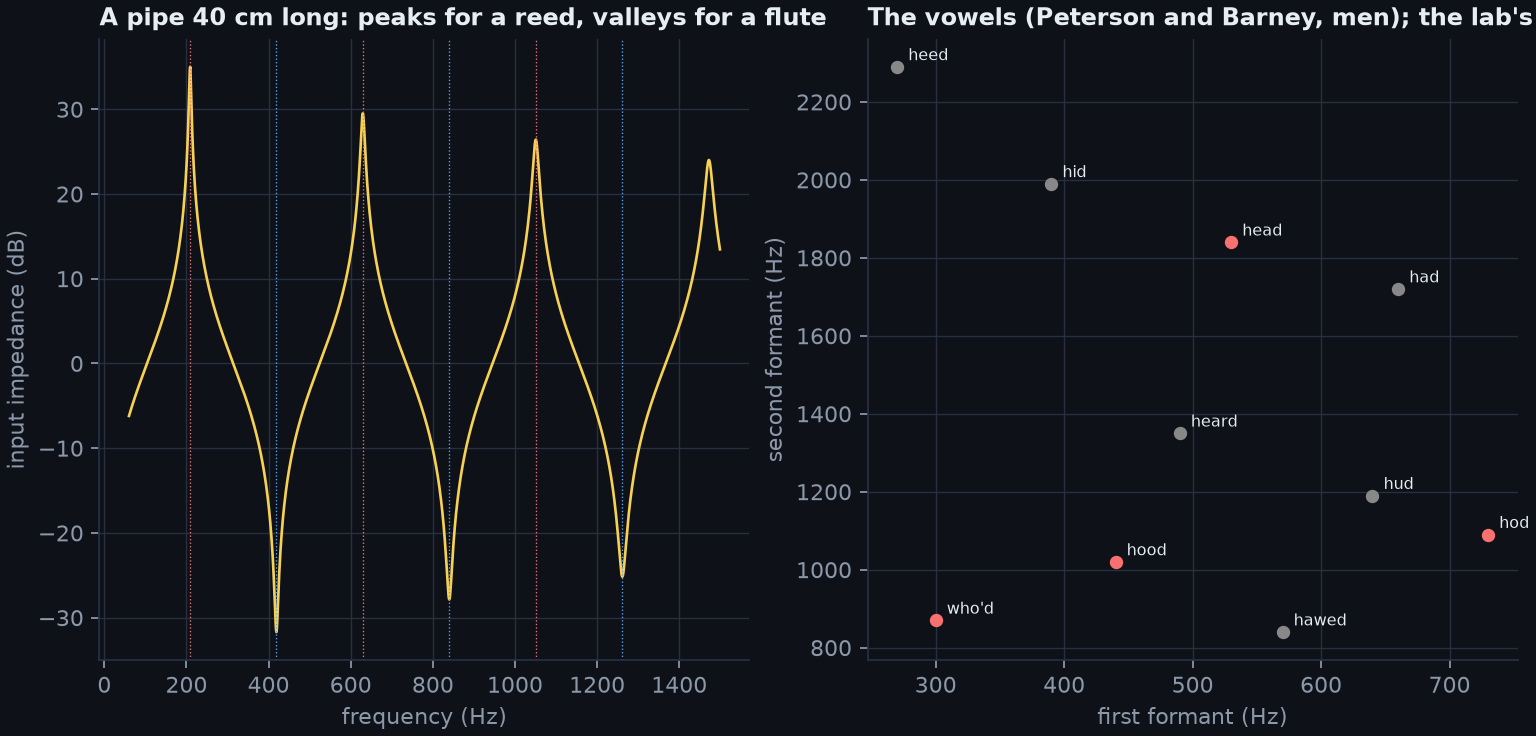
Find a pipe's resonances with and without its end correction, find the blowing pressure at which a reed begins to sound, place six holes for a major scale, and name four sung vowels from their formants.
python -m videos.music.labs 8
needs numpy, scipy, matplotlib · download lab08.py ·
source on GitHubopen at both ends: no correction; corrected; computed 429, 858, 1286; 416, 832, 1248; 419, 840, 1261 Hz
closed at one end: no correction; corrected; computed 214, 643, 1072; 211, 633, 1056; 209, 629, 1051 Hz
the flow through a reed is greatest at 0.333 of the pressure that shuts it
a reed on this pipe speaks at about 0.36 of that pressure
holes for a major scale, cm from the reed re 51.5; mi 45.9; fa 42.8; so 37.6; la 33.5; ti 29.3
each hole, cm above where a saw would cut re 2.8; mi 2.9; fa 3.0; so 3.0; la 3.0; ti 3.1
ear problem, the four words (listen first) hod; hood; head; who'd
their first two formants hod 730, 1090; hood 440, 1020; head 530, 1840; who'd 300, 870
A wind instrument is a column of air and a valve. The column's resonances come from its shape, by arithmetic; the valve decides whether, and how brightly, they sound; and a voice is the one instrument in which the two are set independently, so that a vowel is a place on a map of two formants.The code (106 lines; it asserts its own result)
"""Lab 8: a pipe's resonances, the pressure at which a reed speaks, holes for a scale, and four vowels to name by ear."""

import math

import numpy as np

from videos.coursekit import labs
from explainer.music.monochord import Clip, concat
from explainer.music.monochord.instruments import winds as W

TITLE = "Winds, computed: a column of air and a valve"
GOAL = ("Find a pipe's resonances with and without its end correction, find the blowing pressure at which a reed begins "
        "to sound, place six holes for a major scale, and name four sung vowels from their formants.")
TASKS = [
    "Set RADIUS to 0.02. How much do the resonances fall, and why does a fat pipe need a bigger end correction?",
    "Set ZETA to 0.2 (a tighter embouchure). Does the reed speak at a higher or a lower pressure? Why does the lossless answer, 1/3, not change?",
    "Set HOLE to 0.002 and to 0.0075. Which holes move furthest from where a saw would cut, the small ones or the large?",
]
LENGTH = 0.40      # the pipe of Problem 1, metres
RADIUS = 0.01      # and its radius
ZETA = 0.35        # the reed's embouchure parameter
HOLE = 0.004       # radius of the finger holes, metres
SR = 48_000


def run(seed=0):
    rng = np.random.default_rng(seed)
    lab = labs.Lab()

    # 1. a pipe's resonances (Problem 1)
    pipe = W.cylinder(LENGTH, RADIUS)
    plain_open = [n * W.C / (2 * LENGTH) for n in (1, 2, 3)]
    corr_open = [n * W.C / (2 * (LENGTH + 2 * 0.6133 * RADIUS)) for n in (1, 2, 3)]
    plain_shut = [n * W.C / (4 * LENGTH) for n in (1, 3, 5)]
    corr_shut = [n * W.C / (4 * (LENGTH + 0.6133 * RADIUS)) for n in (1, 3, 5)]
    got_open = [p[0] for p in pipe.peaks(1500, admittance=True)][:3]
    got_shut = [p[0] for p in pipe.peaks(1500)][:3]
    fmt = lambda xs: ", ".join(f"{x:.0f}" for x in xs)     # noqa: E731
    lab.row("open at both ends: no correction; corrected; computed", f"{fmt(plain_open)}; {fmt(corr_open)}; {fmt(got_open)} Hz")
    lab.row("closed at one end: no correction; corrected; computed", f"{fmt(plain_shut)}; {fmt(corr_shut)}; {fmt(got_shut)} Hz")
    assert all(abs(1200 * math.log2(a / b)) < 25 for a, b in zip(got_open, corr_open))
    assert all(abs(1200 * math.log2(a / b)) < 25 for a, b in zip(got_shut, corr_shut))

    # 2. where the reed's flow is greatest (Problem 2), and where a reed on this pipe begins to speak
    dp = np.linspace(0.0, 1.0, 3001)
    top = float(dp[int(np.argmax(W.reed_flow(dp, ZETA)))])
    lab.row("the flow through a reed is greatest at", f"{top:.3f} of the pressure that shuts it")
    assert abs(top - 1 / 3) < 1e-3
    lo, hi = 0.30, 0.50
    for _ in range(4):
        mid = 0.5 * (lo + hi)
        if W.playing(W.reed_tone(pipe, mid, 1.2, zeta=ZETA)["p"])["amp"] > 0.02:
            hi = mid
        else:
            lo = mid
    lab.row("a reed on this pipe speaks at about", f"{0.5 * (lo + hi):.2f} of that pressure")
    assert lo >= 0.30 and hi <= 0.50

    # 3. six holes for a major scale (Problem 4)
    clar, a = 0.60, 0.0075
    f0 = W.cylinder(clar, a).peaks(400)[0][0]
    rows = []
    for name, ratio in (("re", 9 / 8), ("mi", 5 / 4), ("fa", 4 / 3), ("so", 3 / 2), ("la", 5 / 3), ("ti", 15 / 8)):
        target = f0 * ratio
        x_lo, x_hi = 0.15, clar - 0.01                       # a hole nearer the reed gives a higher note
        for _ in range(18):
            x = 0.5 * (x_lo + x_hi)
            f1 = W.Bore().tube(x, a).hole(HOLE, 0.003).tube(clar - x, a).peaks(1.5 * target, df=0.5)[0][0]
            if f1 > target:
                x_lo = x
            else:
                x_hi = x
        saw = (W.C / (4 * target)) - 0.6133 * a
        rows.append((name, x, saw))
    lab.row("holes for a major scale, cm from the reed", "; ".join(f"{n} {100 * x:.1f}" for n, x, _ in rows))
    lab.row("  each hole, cm above where a saw would cut", "; ".join(f"{n} {100 * (s - x):.1f}" for n, x, s in rows))
    assert all(x < s for _, x, s in rows)                    # a hole is never as good as a saw: it must sit higher up

    # 4. the ear problem (Problem 3): one note, four vowels
    vowels = list(W.VOWELS)
    pick = [vowels[j] for j in rng.permutation(len(vowels))[:4]]
    lab.audio = concat([Clip(W.voice(131.0, W.VOWELS[v], 1.2, seed=k), SR).fade(0.03, 0.08).at_level(-20.0) for k, v in enumerate(pick)], gap=0.4)
    lab.row("ear problem, the four words (listen first)", "; ".join(W.VOWEL_WORDS[v] for v in pick))
    lab.row("  their first two formants", "; ".join(f"{W.VOWEL_WORDS[v]} {W.VOWELS[v][0]}, {W.VOWELS[v][1]}" for v in pick))

    fig, (p, q) = labs.figure(2)
    f = np.arange(60.0, 1500.0, 1.0)
    p.plot(f, 20 * np.log10(np.abs(pipe.impedance(f))), color=labs.GOLD, lw=1.2)
    for x in got_shut:
        p.axvline(x, color=labs.RED, lw=0.6, ls=":")
    for x in got_open:
        p.axvline(x, color=labs.BLUE, lw=0.6, ls=":")
    p.set_title(f"A pipe {100 * LENGTH:.0f} cm long: peaks for a reed, valleys for a flute")
    p.set_xlabel("frequency (Hz)")
    p.set_ylabel("input impedance (dB)")
    for v, fm in W.VOWELS.items():
        q.plot(fm[0], fm[1], "o", color=labs.RED if v in pick else "#888", ms=5)
        q.annotate(W.VOWEL_WORDS[v], (fm[0], fm[1]), textcoords="offset points", xytext=(5, 3), fontsize=7)
    q.set_title("The vowels (Peterson and Barney, men); the lab's four in colour")
    q.set_xlabel("first formant (Hz)")
    q.set_ylabel("second formant (Hz)")
    lab.fig = fig
    lab.note = ("A wind instrument is a column of air and a valve. The column's resonances come from its shape, by arithmetic; "
                "the valve decides whether, and how brightly, they sound; and a voice is the one instrument in which the two "
                "are set independently, so that a vowel is a place on a map of two formants.")
    return lab
Now change it
- Set RADIUS to 0.02. How much do the resonances fall, and why does a fat pipe need a bigger end correction?
- Set ZETA to 0.2 (a tighter embouchure). Does the reed speak at a higher or a lower pressure? Why does the lossless answer, 1/3, not change?
- Set HOLE to 0.002 and to 0.0075. Which holes move furthest from where a saw would cut, the small ones or the large?
Problems, with solutions
Try each problem before opening its solution.
-
Two pipes. A pipe is 40 cm long and 2 cm wide. Find its three lowest resonances when it is open at both ends, and when it is closed at one, with and without the end correction of 0.61 of the radius for each open end.
Solution
Open at both ends: c/2L = 343/0.8 = 429 Hz, and its multiples 858 and 1286. Each open end adds 0.61 × 1 cm, so the effective length is 41.2 cm: 416, 832, 1248 Hz, half a semitone lower. Closed at one end: c/4L = 214 Hz and the odd multiples 643 and 1072; with one open end corrected, L = 40.6 cm: 211, 633, 1056. The correction matters more for a short fat pipe than a long thin one, which is why organ builders cannot scale a rank of pipes by length alone. (The lab computes all twelve numbers, and Monochord's own values with wall losses, which are a few hertz lower still.)
-
A third. The flow through a reed is u = ζ(1 − Δ)√Δ, where Δ is the pressure across it as a fraction of the closing pressure. Show that u is greatest at Δ = 1/3, and explain the one-third small-signal threshold in this ideal quasi-static reed model.
Solution
du/dΔ = ζ[(1 − Δ)/(2√Δ) − √Δ] = ζ(1 − 3Δ)/(2√Δ), which is zero at Δ = 1/3, positive below and negative above. With the player blowing at a steady pressure, Δ is that pressure less the pressure in the mouthpiece, so a small rise p in the mouthpiece lowers Δ by p and changes the flow by −(du/dΔ)p. Below a third the flow falls when the mouthpiece pressure rises: the reed takes energy from the wave, like a resistor. Above a third the flow rises with the pressure: the reed gives energy to the wave. In a pipe with no losses that is the threshold exactly; with losses the reed must also supply what the walls and the open end remove, and the threshold moves up a little (0.37 for Monochord's pipe).
-
Ear. The lab sings one note on four vowels, in a random order. Name the four words, and say which formant told you each.
Solution
The lab prints the words and their first two formants. A high second formant (above 1700 Hz) means the tongue is forward: heed, hid, head, had, in order of a rising first formant as the jaw opens. A low second formant with a low first means who'd or hood; with a high first, hod or hawed. Most listeners sort front from back vowels instantly and then need the first formant to choose within the group.
-
Build. With
winds.Bore, put six holes of 4 mm radius in the 60 cm clarinet so that opening them in turn gives a major scale. How far are they from where a saw would cut?Solution
For each note, slide one open hole along the pipe until the first impedance peak is at the note (bisection: a hole nearer the reed gives a higher note). The lab finds holes at 51.5, 45.9, 42.8, 37.6, 33.5 and 29.3 cm from the reed, each about 3 cm above the place where a saw would cut the pipe for the same note. A hole of 2 mm radius must sit about 7 cm above the cut, and a hole as wide as the bore about 1.5 cm. In a real instrument the open holes below the first also matter (they form a lattice with a cutoff frequency that shapes the tone), and the same holes must serve the upper register, so makers adjust position, diameter and undercutting together.
-
★ The player's tract. Give the reed a second tube, upstream: the player's vocal tract. When does a resonance of the tract capture the note, and can the model bend a clarinet's pitch the way players do?
Where the frontier is. The pressure across the reed is the mouth pressure less the mouthpiece pressure, so the two tubes act in series and the reed sees the sum of their impedances. Fritz and Wolfe (2005) measured clarinettists' tracts and found resonances that players move; Scavone, Lefebvre and da Silva (2008) and Chen, Smith and Wolfe (2008, 2009) measured the pressure on both sides of the reed while people played, and showed that in the saxophone's altissimo register and in the clarinet's glissando the tract's peak is as tall as the bore's and takes control. A model needs the tract's impedance as the player shapes it, which is not known in advance, and a reed with mass, since the effect is strongest where the reed's own resonance is near. Whether tuning the tract is a matter of pitch alone or also of tone is still argued.
Notes and sources
Sources
Books: A. H. Benade, Fundamentals of Musical Acoustics (1976), chs. 20–22 for woodwinds and brass, including the trumpet's bell and the pedal note; N. H. Fletcher and T. D. Rossing, The Physics of Musical Instruments (2nd ed., 1998), chs. 13–17; A. Chaigne and J. Kergomard, Acoustics of Musical Instruments (2016), for transfer matrices, the reed's characteristic and its threshold; J. Sundberg, The Science of the Singing Voice (1987); G. Fant, Acoustic Theory of Speech Production (1960), for the source-filter theory and the two-tube vowels; H. von Helmholtz, On the Sensations of Tone (1863), ch. 5, for reed pipes and the vowels.
Papers: J. Backus, "Small-vibration theory of the clarinet", JASA 35 (1963); T. A. Wilson and G. S. Beavers, "Operating modes of the clarinet", JASA 56 (1974); M. E. McIntyre, R. T. Schumacher and J. Woodhouse, "On the oscillations of musical instruments", JASA 74 (1983); J.-P. Dalmont, J. Gilbert, J. Kergomard and S. Ollivier, "An analytical prediction of the oscillation and extinction thresholds of a clarinet", JASA 118 (2005); H. Levine and J. Schwinger, "On the radiation of sound from an unflanged circular pipe", Physical Review 73 (1948); A. N. Norris and I. C. Sheng, "Acoustic radiation from a circular pipe with an infinite flange", Journal of Sound and Vibration 135 (1989); J. W. Coltman, "Sounding mechanism of the flute and organ pipe", JASA 44 (1968); P. R. Cook, "A meta-wind-instrument physical model, and a meta-controller for real-time performance control", Proc. ICMC (1992); S. Adachi and M. Sato, "Trumpet sound simulation using a two-dimensional lip vibration model", JASA 99 (1996); A. E. Rosenberg, "Effect of glottal pulse shape on the quality of natural vowels", JASA 49 (1971); G. E. Peterson and H. L. Barney, "Control methods used in a study of the vowels", JASA 24 (1952); D. H. Klatt, "Software for a cascade/parallel formant synthesizer", JASA 67 (1980); K. Ishizaka and J. L. Flanagan, "Synthesis of voiced sounds from a two-mass model of the vocal cords", Bell System Technical Journal 51 (1972); J. Sundberg, "Articulatory interpretation of the 'singing formant'", JASA 55 (1974); E. Joliveau, J. Smith and J. Wolfe, "Tuning of vocal tract resonance by sopranos", Nature 427 (2004); C. Bergevin et al., "Overtone focusing in biphonic Tuvan throat singing", eLife 9 (2020); A. Hirschberg, J. Gilbert, R. Msallam and A. P. J. Wijnands, "Shock waves in trombones", JASA 99 (1996); C. Fritz and J. Wolfe, "How do clarinet players adjust the resonances of their vocal tracts for different playing effects?", JASA 118 (2005); G. P. Scavone, A. Lefebvre and A. R. da Silva, "Measurement of vocal-tract influence during saxophone performance", JASA 123 (2008); J.-M. Chen, J. Smith and J. Wolfe, "Experienced saxophonists learn to tune their vocal tracts", Science 319 (2008), and "Pitch bending and glissandi on the clarinet: roles of the vocal tract and partial tone hole closure", JASA 126 (2009).
- D. M. Campbell and C. A. Greated, The Musician's Guide to Acoustics (1987).
About this partfrom its README
Part 8 of a sixty-eight-part course in music (see the series plan and
the syllabus). Part 7 ended on the bow, which turns a steady pull into a vibration by gripping
and letting go in time with a string. This part follows resonating air coupled to reeds, lips or jets, then the approximate
source–filter separation of the voice. The flute, the clarinet, the oboe and saxophone, the trumpet, the
organ and the voice differ in the shape of the column and in the kind of valve. The instruments are Monochord's
(explainer/music/monochord/instruments/winds.py); every sound is computed in compute.py, and nothing was
recorded. Dates and attributions are the published ones, listed under Sources.
- Two pipes of the same length. An ear question: a pipe 60 cm long blown across its end and blown through a reed (281 and 140 Hz: an octave apart, and the lower one hollow); one voice, two notes at once; the plan.
- 1. A column of air. Open ends and closed ends; a pipe open at both ends (every multiple) and closed at one (an octave lower, the odd multiples); a reed closes its end; Monochord's input impedance of the pipe (peaks at 139, 421, 703 Hz for a reed; valleys at 280, 562, 844 Hz for a flute); the end correction; a worked example (a ideal acoustic length for middle C is 65.6 cm; a B-flat clarinet for concert D below, 58.4 cm).
- 2. A valve that pressure closes. The reed's flow against the pressure across it: it rises, tops out at a third of the closing pressure and falls; one puff followed four times along the pipe; the mouthpiece pressure, nearly a square wave, with odd harmonics; an ear question (blown steadily harder: silence, then a note that brightens); why a third (below it the valve fights the wave, above it the valve feeds it); 0.37 with losses.
- 3. Holes. A hole as wide as the pipe is nearly a saw cut; smaller holes act like holes further down (32, 81 and 184 cents flat of the cut); an ideal just-intonation worked example (where the holes go: 8/9, 4/5, 3/4, 2/3, 3/5, 1/2: a flute is a monochord made of air); the register hole, which weakens and shifts the lowest resonance so that the reed takes the next (140 to 433 Hz: a twelfth); the clarinet's nineteen semitones and the break.
- 4. Cones. A cone closed at the reed has the notes of an open pipe (231, 463, 701 Hz against the cylinder's 139, 421, 703); the missing tip and the mouthpiece that replaces its volume (1 : 2.06 : 3.16 becomes 1 : 2.01 : 3.04); an ear question (one note on a cone and on a cylinder); lengths (72 cm against 43); Sax.
- 5. Lips and brass. A valve that the breath opens, with a frequency of its own; a plain tube (60, 183, 307, 431 Hz: odd) against a trumpet's shape (230, 348, 473, 593, 704 Hz: 2 to 6 times 116 Hz); what the bell does; the lips set to one frequency after another climb a staircase of resonances; a call of eight notes on one length of tube; the pedal note, which the model found unasked; a worked example (valves 1 and 3 together add 31.2% where 33.5% is needed: 30 cents sharp).
- 6. A jet and an edge. The flute's valve is a ribbon of air; its travel time is about half a period in the illustrated regime (Coltman); blown harder, the note creeps sharp and then breaks to the octave; an ear question (which overblows an octave, which a twelfth?); the organ: five stops at 8, 4, 2⅔, 2 and 1⅗ feet are harmonics 1 to 5.
- 7. The voice: a source and a filter. The vocal folds; the glottal pulse and its spectrum (falling 13 dB an octave); why the folds, unlike a reed, choose their own pitch; formants; the vowel ah as source times filter; the pulses alone and through three filters.
- 8. Vowels. A worked example (an ideal uniform 17.5 cm tract: 490, 1470, 2450 Hz, the vowel approximating schwa in unstressed "about" and often "the"); two-tube shapes for ah and ee against Peterson and Barney's measurements; the map of two formants; an ear question (who'd, hod, heed on one note); one vowel on three notes.
- 9. What singers do. An ear question (which voice carries?); the singer's formant: the third, fourth and fifth resonances drawn together near 3 kHz (+17 dB), where average orchestral energy is often lower and the ear acute; a soprano's high A and the first formant raised onto it; overtone singing: two resonances merged onto one harmonic, and the Tune's first phrase on harmonics 8, 12 and 13.
- 10. Frontier: what these models leave out. The folds themselves; the player's own vocal tract; shock waves in loud brass; the jet; instruments designed by running the calculation backwards. ★ research problem.
- Variation 8, recap and problems. The Tune for a flute, a clarinet, a saxophone, a trumpet and a voice, a phrase each and then together; the ledger; what we found; five problems; where it comes back; in practice; references; overtones that are not harmonics, and Part 9.
What is computed and built
python -m videos.music.music8.compute (about five minutes; three of them tuning the instruments of the
Variation) fills .cache/music8/.
| Item | What it computes | Checked against |
|---|---|---|
hook |
a jet and a reed on pipes 60 cm long; a model voice whose overtones are picked out one at a time | the octave between an open and a stopped pipe |
column |
input impedance of the pipe by transfer matrices, with wall losses and a radiating end | odd multiples of c/4L and all multiples of c/2L, with the end correction |
reed |
the reed's flow curve; mouthpiece pressure and flow; a scan of blowing pressure; a crescendo | the flow's maximum at 1/3; threshold just above 1/3; a square wave's odd harmonics |
holes |
one open hole of three sizes against a cut tube; the pipe with and without a register hole | the cut tube; the second resonance at three times the first |
cone |
resonances of a cylinder, a truncated cone and a cone with a mouthpiece; a reed on each | a complete cone's harmonic series; the mouthpiece-volume rule |
lips |
a trumpet's profile and resonances; lips set to 43 frequencies; a call; valve arithmetic | resonances 2 to 8 within 35 cents of multiples of 116.2 Hz (B flat is 116.5) |
jet |
the flute model's register against blowing pressure; a crescendo; five organ ranks | octave, then twelfth; hysteresis |
voice |
Rosenberg's glottal pulse and its spectrum; three formant filters; their output | a source slope near −12 dB an octave |
vowels |
formants of a plain tube and of two-tube shapes; the ten vowels | Peterson and Barney's averages for 33 men, within a semitone |
singers |
a filter with a singer's formant; a first formant moved onto a high note; overtone singing | a boost near 3 kHz of the size Sundberg reports |
tune |
Variation 8; every wind note measured after tuning | each within 8 cents of its pitch |
Monochord's wind instruments are held against these references in tests/music/test_winds.py; this part's
claims and clips in tests/music/test_music8.py.
Sounds. Fifteen clips, labelled on screen. physical model: the reed, lip and jet instruments, radiated
through their own bores. synthesized: the voice, which is a drawn pulse through formant filters. There are no
recordings.
What the models are, and are not. The bores carry plane waves, with wall losses and a radiating open end (Levine and Schwinger's result in Norris and Sheng's fit); cones and bells are cut into short cylinders; a side hole is a short open tube. There are no tone-hole lattices, pads or bends, and the trumpet's dimensions are plausible ones chosen so that its resonances come out near a B flat instrument's, not measurements of a particular trumpet (its tube is 1.37 m; a real one is 1.48 m with a differently shaped bell). The reed is the quasi-static valve of McIntyre, Schumacher and Woodhouse, with no mass and no upstream tube; time is stepped with the bore's reflection function. Its register hole gives a twelfth 50 cents wide; real clarinets are voiced to correct that. The saxophone is a cone with a mouthpiece of the missing tip's volume. The lips are one mass on a spring, blown open, which is the simplest model that plays; real lips also move along the flow. The pedal note appears in the model at two lip frequencies without being asked for. The flute is schematic: a loop of delay for the pipe and a second, shorter delay with smoothing and a saturating curve for the jet. It illustrates a restricted operating regime (the approximate half-period condition, the sharpening with blowing pressure, the breaks to the octave and the twelfth, hysteresis) using a reduced delay-loop calculation rather than a resolved fluid simulation. The voice uses an approximate source–filter separation: Rosenberg's pulse with a little jitter, shimmer and breath, through a cascade of resonators at Peterson and Barney's formants; the two-tube mouths are Fant's cartoons. The soprano example's 36 dB filter gain is a model result, not a measured hall gain; real gains depend on tract shape, losses and source interaction. The film states that distinction. The orchestra's spectrum in chapter 9 is a schematic slope after Sundberg, and is labelled as one.
Companion material in this repository
The syllabus's plan for this partfrom SYLLABUS.md, the plan of record
- Hook: two pipes of one length (an ear question); one voice, two notes; the plan.
- A column of air: open and closed ends; odd and whole series; the impedance of a pipe; the end correction; how long is a flute (a worked example).
- A valve that pressure closes: the reed's flow curve; one puff, four trips; a square wave; blowing harder (an ear question); why a third.
- Holes: a hole against a saw; where the holes go (a worked example); the register hole and the twelfth.
- Cones: a cone has every harmonic; the missing tip and the mouthpiece; cone or cylinder (an ear question).
- Lips and brass: a valve with its own frequency; what a bell and a mouthpiece do; the staircase and a call; the pedal note; three valves (a worked example).
- A jet and an edge: the flute's valve; overblowing; octave or twelfth (an ear question); the organ's stops.
- The voice, a source and a filter: the folds; the pulse; formants; a source through three filters.
- Vowels: a mouth at rest (a worked example); two tubes for ah and ee; the map of two formants; three vowels (an ear question).
- What singers do: ring (an ear question); a soprano's tuned resonance; overtone singing.
- Frontier: the folds, the player's own tract, shock waves in brass, the jet; instruments designed backwards.
- Variation 8: the Tune for five valves on five columns of air. Outro: problems, payoffs, and overtones that are not harmonics.
Covers: cylinders and cones; input impedance; the reed as a pressure-controlled valve and its threshold; tone
holes and register holes; brass lips, the bell and mouthpiece and the pedal note; valves; the flute's jet and
overblowing; the organ as additive synthesis; the voice: folds, source and filter, formants and vowels, the
singer's formant, a soprano's resonance tuning, overtone singing.
Built and computed: instruments/winds.py: bore impedances by transfer matrices and reflection functions; a
reed, a lip and a jet model on any bore; a source-filter voice; formants of tubes.
Variation 8: the Tune for a flute, a clarinet, a saxophone, a trumpet and a voice.
Frontier: vocal-fold models; the player's vocal tract; nonlinear propagation in brass; computed and printed
bores.
Reading: Benade; Fletcher & Rossing; Sundberg, The Science of the Singing Voice; McIntyre, Schumacher &
Woodhouse (1983).
Build the film
python -m videos.music.music8.compute        # the part's numbers, into .cache/music8
python tools/build.py music8                  # render and assemble the film
EXPLAINER_TTS=silent python tools/qa_scene.py music8 Hook   # one chapter, silent, with a contact sheet
Scenes: videos/music/music8. Setup: see the course page. Source of these notes: the README and the scenes' narration.
Build it
python -m videos.music.music8.compute                          # numbers and sounds (about five minutes)
EXPLAINER_TTS=silent python tools/build.py music8 -q l --fps 15   # a silent-narration preview, with the sounds
python tools/qa_sound.py music8 --sync                         # the sound gates
python tools/dead_air.py renders/music8_480p.mp4 --sound music8   # no empty screen; no sound over a still one
python tools/lecture_length.py music8                          # 30 to 60 minutes, listening included
python tools/build.py music8                                   # 1080p30, narrated
python -m pytest -q tests/music                                # Monochord against its references; this part's claims and clips
python -m videos.music.labs 8                                  # the lab (writes a figure and a short WAV)