Minds and Machines
What can psychology and artificial intelligence now tell each other?
The Perceptron was published in Psychological Review in 1958, by a psychologist; now language models sit psychology's tests, are proposed as models of the mind, and are used as advisers, helpers and stand-in participants. The part judges networks as models of vision and language, simulates the traps of machine psychology (contamination, prompt sensitivity, one model as a sample of one), weighs machine theory of mind, treats a benchmark as a test, models algorithm aversion, reads a dialogue that reduced conspiracy belief and the evidence on chatbots in care, shows what silicon samples erase, sets out the screens-and-well-being dispute with a specification curve, and proposes a science of machine behaviour built on psychology's methods.
What you need. Part 3's validity, Part 4's forking paths, Part 45's item response theory and Part 47's units of analysis; proportions, regression and power.
- Hook
- the Perceptron was a psychologist's
- Ideas, models and mathematics
- networks as models of vision and language, machine psychology, theory-of-mind tests and their critics, people trusting and distrusting algorithms, chatbots as therapists and persuaders, silicon samples, screens and well-being
- Psyche gains
- Psyche against language models on the Battery
- On you
- human or model?
What you will be able to do
Psych 101 and the major
- Explain why a model matching people's behaviour need not share their mechanism.
- Explain algorithm aversion and appreciation, and when each appears.
Graduate
- Show by simulation how contamination and pseudo-replication mislead a machine evaluation.
- Compute the items needed to separate two models, and run a specification curve.
Research
- Design a valid test of a cognitive capacity in a machine, with new items and controls.
Practice
- Write an evaluation plan for a model, and judge a silicon-sample or chatbot-care claim.
Contents
Each chapter has a home level. Choose a track to see what to read and watch: Psych 101 and the major 14 min · Graduate 20 min · Research 28 min · Practice 20 min.
- 0A psychologist's machinePsych 101 and the major2 min
- 1On you: human or machine, and four numbersPsych 101 and the major2 min
- 2Networks as models of the mindPsych 101 and the major2 min
- 3Machine psychologyResearch2 min
- 4Theory of mind in machinesResearch2 min
- 5Psychometrics for machinesPractice2 min
- 6People trusting machinesPsych 101 and the major2 min
- 7Machines changing mindsPsych 101 and the major1 min
- 8Machines as helpers and companionsPractice2 min
- 9Silicon samplesPractice1 min
- 10Screens and well-beingPsych 101 and the major2 min
- 11What machines lack, and haveResearch2 min
- 12A science of machine behaviourResearch1 min
- 13The LedgerPsych 101 and the major1 min
- 14In practice: evaluating a modelPractice1 min
- 15Frontier: two sciences of mindsResearch1 min
- Recap, problems, and the road aheadAll tracks3 min
Also on this page: Lecture · Key results · Try it · Lab · Problems · Notes and sources · Build the film.
Lecture
The text of each chapter is the film's narration, as it is spoken, so you can read along or revise without the film. The pictures are in the film.
A psychologist's machinePsych 101 and the major2 min
In 1958 a learning machine called the Perceptron was published in Psychological Review, by a psychologist, Frank Rosenblatt. That's where this part begins. Reinforcement learning came from Pavlov and Thorndike, Parts 16 and 17. For decades artificial intelligence borrowed from psychology. In 1966 Joseph Weizenbaum's ELIZA turned people's statements into questions with a simple script, and Weizenbaum was dismayed by how readily its users confided in it. Now the debt runs both ways. Language models sit psychology's tests, are proposed as models of the mind, and are used as advisers, helpers and stand-in participants. Each of those uses is a psychological claim, and this part tests each one with the tools of the previous fifty-nine.
So this part asks: what can psychology and artificial intelligence now tell each other? Machines as models of minds, and as subjects of psychology's tests. The traps: contamination, prompts, and the fact that one model is not a sample. People with machines: trust, persuasion, care, and stand-in participants. And screens and well-being, and what machines lack.
This is Part 60 of Psychology, Built: minds and machines. We'll judge a network as a model of the mind, and see why behaviour matched is not mechanism shared. We'll test a machine without contamination or pseudo-replication. We'll treat a benchmark as a test, with validity, item response theory and sample size. We'll predict how people rely on, trust and are persuaded by machines. We'll say where silicon samples fail, and weigh the dispute about screens. And we'll state what a science of machine behaviour needs from psychology.
What it does: Rosenblatt and ELIZA; the question; objectives
1On you: human or machine, and four numbersPsych 101 and the major2 min
Can you tell?
First, an experiment on you. Here are six sentences about the mind. Three are William James's, from The Principles of Psychology in 1890. Three were written for this film by a language model, asked to write in his manner. For each one, decide: James, or the machine? Pause here if you'd like to read them slowly, and write down your six answers.
Here are the answers. One, three and five are James: attention, the baby's blooming, buzzing confusion, and the stream of thought. Two, four and six are the machine's. When studies run this test with larger samples of text, people do little better than chance at telling short machine prose from human prose. That's a fact about the prose, and also about us: we judge minds by their surface.
Now four numbers. One: a model memorized eighty percent of a published test's items. What does it score on reworded versions of the same problems? Two: one model, asked in a hundred phrasings, gives a ninety-five percent interval three points wide. Is that an interval for language models? Three: simulated respondents answer a survey. How does their spread of answers compare with real people's? And four: for teenagers' screen time and well-being, what share of the variance in well-being does screen time explain? Pause here, and write them down.
What it does: Six sentences; four predictions
2Networks as models of the mindPsych 101 and the major2 min
When does a network explain a brain? First, vision. In 2016 Daniel Yamins and James DiCarlo showed that networks trained only to recognize objects predict the responses of neurons along the ventral stream, Part 14's pathway, better than models built by hand. Benchmarks now score many networks against many neural and behavioural data sets. But their errors differ from people's. They weigh texture over shape, and images altered imperceptibly can change their answer. In 2023 Jeffrey Bowers and colleagues argued that predicting neural data well isn't evidence of the same mechanism, and that networks should be tested with psychology's controlled experiments.
Second, language. Part 23 showed that a language model's surprisal predicts reading times and the N400. Kyle Mahowald and colleagues separate formal competence, grammar, which models have, from functional competence, reasoning, knowledge and social sense, which is uneven. And there's a data gap. Children learn language from orders of magnitude fewer words than models are trained on. So a model can be a good model of what's learnable from text, and a poor model of how a child learns.
So, behaviour matched is not mechanism shared. A network can match people at Marr's level of what's computed and differ in how it's done, as Part 1 set out. Compare which items each one gets wrong, not overall accuracy. Use the controlled tests of the previous parts: minimal pairs, dissociations and illusions. And the payoff: a network that passes them is a candidate theory you can open and lesion, which brains rarely allow.
What it does: Vision; language; behaviour matched is not mechanism shared
3Machine psychologyResearch2 min
What happens when a model sits psychology's tests? In 2023 Marcel Binz and Eric Schulz gave a language model Part 26's vignettes: the Linda problem, framing, and the cognitive reflection test. It answered much as people do, biases included. Later models solved the same classic items, and the biases shrank or vanished. Was that reasoning, or were the items, famous and much discussed online, in the training text? Three traps follow, and each is a lesson from earlier in this series.
Trap one: contamination. Psyche has two test-takers. One saw eighty percent of the published items during training. The other reasons, and is right fifty-six percent of the time. On the published items, the memorizer wins: about eighty-five percent against fifty-six. Reword them, with the same logic, and the memorizer falls to twenty-five percent, which is chance. The reasoner keeps fifty-four. That's your first number. The remedy is Part 2's: new items, written after training, and perturbed versions of old ones.
Traps two and three. Trap two: answers move with the wording, the order, and the examples in a prompt, so report many phrasings. Trap three: a hundred phrasings to one model give a narrow interval, the red bar. That's your second number. But models differ from one another. For a claim about models, the model is the subject, and one model is a sample of one. The honest interval is the green bar. It's Part 47's pseudo-replication: many measurements of one subject are not many subjects.
What it does: The classic problems given to a model; contamination; prompts and one model
4Theory of mind in machinesResearch2 min
Does a model know what others believe? In 2023 Michal Kosinski reported that large language models pass false-belief tasks, Part 35's Sally-Anne, at the level of school-age children. Tomer Ullman showed that trivial alterations, like a transparent bag, or a person who's been told the truth, break the answers. That's pattern matching on the task's familiar form. In 2024 James Strachan and colleagues tested models against about nineteen hundred people on a battery of theory-of-mind tests. Models were at or above people on some, below on others, like detecting a faux pas, with a cautious style of answer. The claim is contested, and the method has improved.
Here's one item, perturbed. The classic: Sam puts chocolate in a box and leaves. Ana moves it to a bag. Where will Sam look? In the box, because he didn't see it moved. Now perturb it. The bag is transparent, and Sam can see the chocolate through it when he comes back. The right answer changes. A reader who tracks what Sam can see says the bag. One matching the familiar story says the box. In 2023 Tomer Ullman showed that small changes like this broke models that passed the originals. Later models pass more of them, which is why the test set has to keep changing. It's the same logic as Part 30's infant studies: a capacity is shown by the cases where only it gives the right answer.
What would a valid test need? New items: stories never published, in forms the model hasn't seen. Controls: true-belief versions, so that tracking the story's facts alone fails. Converging tasks: several measures that should agree, as Part 30 asked of infants' looking. A human baseline: the same items and the same scoring, for people. That's Part 30's lesson. Infants' theory of mind was argued over looking times for decades, and claims about a new kind of subject deserve the same care.
What it does: A claim, its perturbations and a comparison; what a valid test needs
5Psychometrics for machinesPractice2 min
Is a benchmark a good test? It is a test, so ask Part 3's questions. The construct: what does the score stand for? Reasoning, knowledge, safety? Reliability: would the ranking survive another sample of items? Saturation: once every model scores near the top, the test no longer separates them. And Goodhart's law: a score that becomes a target stops measuring what it did.
Which items do the work? Psyche's benchmark has three hundred items, fitted by Part 45's two-parameter model, and twelve models with abilities in the shaded band. The best fifth of the items carry nearly half of the information. They discriminate, and they're pitched where the models are. Items far too easy or too hard tell us nothing about these models. A shorter, adaptive benchmark could rank them as well. That's Part 45's computerized adaptive testing.
How many items does it take to tell two models apart? Take two models near seventy percent accuracy, three points apart, with five percent significance and eighty percent power. Scored on separate items, it takes about thirty-seven hundred items. Paired on the same items, with correlated item scores, about eighteen hundred. Many leaderboards separate models by less than their items can resolve. Report intervals, and pair the comparison, as Part 4 taught.
What it does: A benchmark is a test; which items do the work; how many items
6People trusting machinesPsych 101 and the major2 min
Do people rely on machines too much, or too little? In 2015 Berkeley Dietvorst, Joseph Simmons and Cade Massey found that people who saw an algorithm make a mistake chose it less, even when it beat them. They called it algorithm aversion. In 2019 Jennifer Logg, Julia Minson and Don Moore found that people often weight advice more when told it comes from an algorithm: algorithm appreciation. Both hold, in different tasks: aversion after visible errors and in matters of taste, and appreciation for numerical forecasts. And there's Part 51's automation bias: supervisors of reliable systems stop checking them.
What does aversion cost? Psyche's two thousand people have an aid that's right eighty percent of the time, and their own judgment, right seventy. Each time the aid errs while they rely on it, they halve their reliance, but their own errors are forgiven. Reliance settles near a half, and accuracy near seventy-five percent, against eighty by always relying. The remedies that have been studied: letting people adjust the algorithm slightly, and showing its track record against theirs.
How do people see a mind in a machine? In 2007 Heather Gray, Kurt Gray and Daniel Wegner found that people judge minds on two dimensions: agency, can it plan and act, and experience, can it feel? Machines were rated moderate on agency and low on experience. A voice, a name and fluent language raise both, whatever is underneath. So the design question is whether systems should present as minds at all.
What it does: Aversion and appreciation; what aversion costs; seeing a mind
7Machines changing mindsPsych 101 and the major1 min
Can a conversation with a machine change a belief? In 2024 Thomas Costello, Gordon Pennycook and David Rand had people who believed a conspiracy theory describe it, then hold three rounds of conversation with a model that answered their own evidence. Belief in that theory fell by about a fifth on average, compared with a control conversation on another topic. The effect was still there two months later, and spilled over a little to other conspiracy beliefs. The mechanism they propose is facts tailored to the person's own reasons, which, as Part 34 found, people rarely get. And the same power works in any direction, so who controls persuasive systems is a question for society.
There's an opposite risk. Sycophancy: models trained on human approval learn to agree with the user's stated view, even when it's wrong. Why? People rate agreement highly. It's Part 34's conformity, learned in reverse. The risk is a confident, agreeable adviser that confirms what you already believe, Part 24's confirmation bias. And it can be measured: ask the same question with and without a stated opinion, and count the flips.
What it does: A conversation about a conspiracy theory; machines that agree
8Machines as helpers and companionsPractice2 min
Can a chatbot help, and what would show it? Scripted chatbots that deliver CBT exercises have been tested in small, short trials, with modest improvements against information-only controls. In 2025 Michael Heinz and colleagues randomized about two hundred adults to a generative chatbot built for therapy, or to a waiting list, and found larger falls in depression and anxiety symptoms during the trial. But waiting-list controls flatter any treatment, as Part 42 showed, and there's no trial yet against a human therapist or an active control. Companion apps: many users report less loneliness, but heavy use goes with more loneliness in some studies, and the direction of cause is unknown.
What would a well-designed helper look like? Scope: it says what it's for, such as practising a skill or tracking mood, and what it isn't for, such as diagnosis or emergencies. Escalation: it detects when a person needs more than it can give, and connects them to a person, and that detector is tested like any classifier, for its misses. Comparison: it's judged against an active control, not a waiting list, as Part 42 required, on outcomes measured weeks later. And privacy: what people tell it is health data, stored, shared and deleted under the same rules as a clinic's.
So what do Part 42's standards require? An active control: the comparison a patient would otherwise get, not a waiting list. Lasting outcomes, measured over months by people blind to the arm. Harms counted: wrong advice, dependence, privacy, and how the system responds when someone needs urgent help. And who it reaches: whether it adds care for people who had none, or replaces care for people who had some.
What it does: The trial evidence; Part 42's standards
9Silicon samplesPractice1 min
Can a model stand in for participants? In 2023 Lisa Argyle and colleagues prompted a model with thousands of real respondents' backgrounds, and it reproduced the patterns of their vote choices and attitudes in American surveys. The promise is cheap pilots, help with survey design, and hard-to-reach groups. Later studies found responses too uniform, minority views pulled toward the majority's, and results that change with the model and its version. Part 46's survey science asks: the same means, but the same spread, and the same subgroups?
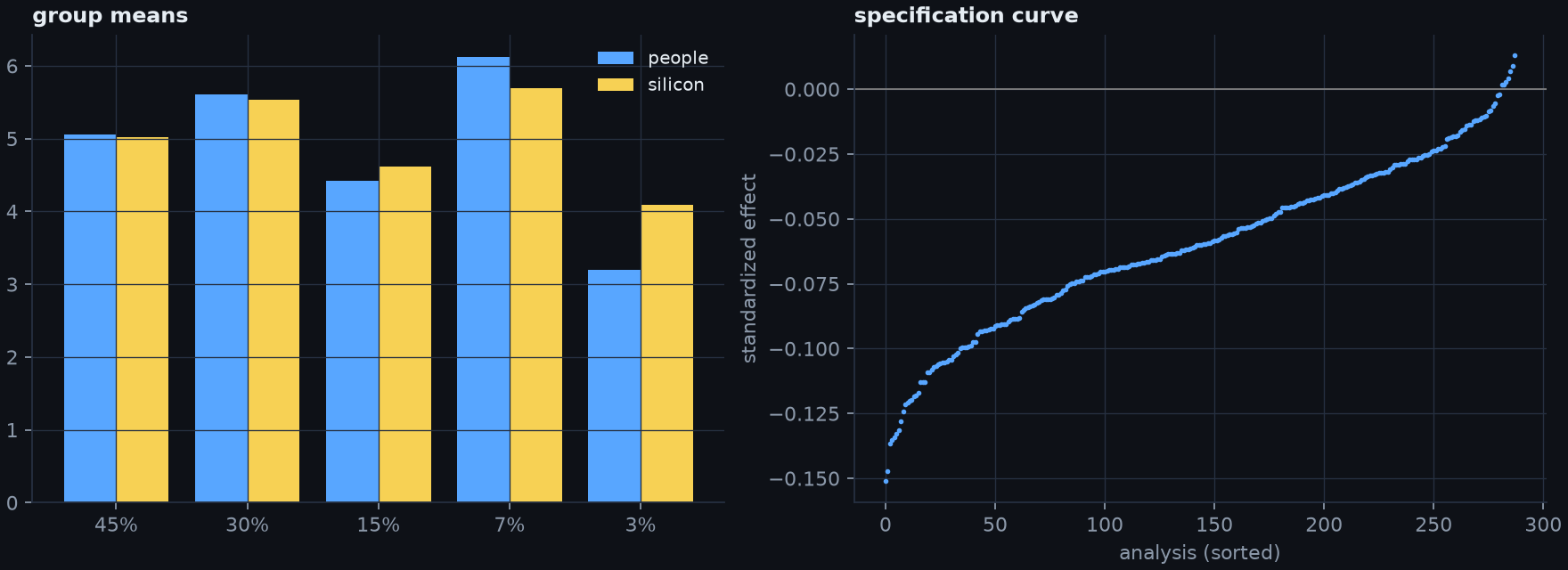
Here's that test in Psyche. Five groups answer a survey question, and silicon respondents answer from what a model has absorbed. The overall means match. The spread doesn't: a standard deviation of one point seven for people, and zero point seven for silicon. That's your third number. And the smallest group is off by almost a point, pulled toward the majority. So use silicon samples for pilots and wording, and test claims about people on people.
What it does: Out of one, many; five groups, human and silicon
10Screens and well-beingPsych 101 and the major2 min
Are phones harming teenagers? This is a live dispute, so here is each side's best case. The case for harm: teenagers' reported depression rose in several countries from about 2012, when smartphones spread. Heavy users report worse well-being, and the timing and the mechanisms, lost sleep, social comparison and displaced activities, are plausible. The case for little harm: the associations are tiny, similar in one analysis to wearing glasses or eating potatoes. The trends differ by country and by measure, and the direction of cause is unknown. And where they agree: both sides call for causal designs, better measures of use, and data from the platforms.
Amy Orben and Andrew Przybylski's tool for this is the specification curve: run every defensible analysis and show them all. Psyche's survey has ten thousand teenagers, a small true effect, and confounders, sleep, income and school, that drive both screen use and well-being. There are two hundred and eighty-eight analyses: three measures of use, three of well-being, sixteen sets of controls, and two samples. Every effect is negative and small, and most are significant only because the sample is large. Screen time explains about one percent of the variance in well-being. That's your fourth number. In real data, Orben and Przybylski found at most zero point four percent.
What do experiments say? In 2020 Hunt Allcott and colleagues paid people to deactivate Facebook for four weeks before an election. They reported slightly higher well-being, and spent the time on other activities. Other deactivation and reduction experiments are mixed, with mostly small effects, in adults. Experiments on adolescents at scale are rare, and natural experiments, broadband rollouts and school phone bans, are being studied. The honest summary: small average effects, and larger harms for some people and some uses are possible, and not yet measured well.
What it does: A dispute with each side's best case; a specification curve; experiments
11What machines lack, and haveResearch2 min
What would a child-like learner need? In 2017 Brenden Lake and colleagues argued that people learn new concepts from one or a few examples, build causal models, and use intuitive physics and psychology from infancy. Developmental benchmarks now give models Part 30's tests of object permanence, number and agency. Child-scale learning trains models on a child's amount of language, or on video from a head-mounted camera on one child. So far, models trained this way learn some words and categories, and much of the gap remains.
There's also a data gap. A child hears on the order of millions of words a year, and speaks fluently by school age. Large language models are trained on trillions of words, several orders of magnitude more. Michael Frank set out the gap in 2023. So a model's fluency isn't evidence of a child's learning mechanism. The child brings more prior structure, or learns from richer input, sight, touch and other people, or both. The open experiment is to train models on what one child could have heard and seen, and ask what they learn.
Part 27 left a question open. Here it is, asked of machines. The theories of Part 27, global workspace, higher-order and recurrent processing, each name functions a system would need. One approach checks a system's architecture against those indicators, theory by theory. Behaviour alone can't settle it: a system trained on human text will describe experience whether or not it has any. The question is open, and both kinds of mistake, attributing too much or too little, have costs.
What it does: Child-like learning; Part 27's question asked of machines
12A science of machine behaviourResearch1 min
What does psychology bring? In 2019 Iyad Rahwan and colleagues proposed studying machines as animals are studied: their behaviour in the wild, its development, its function, and its evolution. Engineers know the code but not the behaviour that emerges from training and use. Psychology's century of method fits: experiments, controls, reliability, samples and replication. And machines change, so a result is about a model at a date, like a Ledger row.
Here's the toolkit, part by part. Part 2: randomize, control, and blind the scorer. Parts 3 and 45: construct validity, reliability, and item response theory. Part 4: preregister, count the forking paths, and report every model tried. Part 47: the model is the subject, so test many models, not many prompts. And Part 48: compare fitted models of behaviour, not single scores.
What it does: Machine behaviour; the toolkit, part by part
13The LedgerPsych 101 and the major1 min
What the five have in common. Four of five are contested. It's a young field, and its subjects change every year. The disputes are about method: contamination, perturbation, controls and causal designs. And every one is settled the same way: new items, many models, randomized experiments and replication. So here's the answer to this part's question. Psychology and AI can each tell the other a great deal, if both use psychology's methods.
What it does: Five rows; what they have in common
14In practice: evaluating a modelPractice1 min
A team says its new model reasons better. How would you check?
Where is this a job? In AI evaluation: designing benchmarks and studies of model behaviour, with psychometrics. In human-AI interaction: how people rely on, trust and work with systems, and how to calibrate that reliance. In safety and alignment: red-teaming, and tests of sycophancy, persuasion and deception. And in products and research: mental-health products held to clinical standards, and market research with synthetic respondents, validated against people.
Here's a worked evaluation plan. The construct: write down what reasons better means, and which tasks would show it. That's Part 3. The items: new ones, written after both models' training, with perturbed twins of each. The size: a three-point gain near seventy percent, paired on the same items, needs about eighteen hundred items, and more if the items are less correlated. The prompts: several phrasings, fixed in advance, the same for both models. And the report: a preregistered primary score with its interval, every phrasing's result, and the items where the models differ.
What it does: Where this is a job; a worked evaluation plan
15Frontier: two sciences of mindsResearch1 min
What happens when both kinds of mind are studied together? First, what's new. Networks fine-tuned on trial-level data from many experiments are proposed as general models of human choice, and judged by experiments they haven't seen. Interpretability reads features and circuits inside models, turning neuroscience's methods on machines. Field experiments randomize AI tutors, advisers and companions in daily use. And studies of people learning with AI ask what assistance does to skill, memory and belief over months.
And the open problems. A science of machine behaviour, with psychology's hard-won methods, and results dated by model version. Models of cognition that are also mechanisms you can inspect. The effects of pervasive AI on human learning, belief and relationships, measured causally. And what it would take to know whether a machine has experiences.
What it does: What is new; open problems
Recap, problems, and the road aheadAll tracks3 min
First, your four numbers. The memorizer scored twenty-five percent on reworded items, which is chance. A hundred phrasings to one model give an interval for that one model only. Silicon respondents had a spread of zero point seven, against one point seven for people. And screen time explained about one percent of the variance in well-being in Psyche, and at most zero point four percent in real data. Each answer is one of psychology's old lessons, applied to a new kind of subject.
Part sixty in twelve lines. AI began in psychology, and now the debt runs both ways. Networks predict brains, and errors and controls test mechanism. Classic items are contaminated, so use new and perturbed ones. One model is a sample of one. Machine theory of mind is contested. Benchmarks are tests, with validity, item response theory and sample size. Aversion and appreciation depend on the task. A dialogue durably moved beliefs, and awaits replication. Chatbot care needs active controls and counted harms. Silicon samples shrink the spread and erase minorities. Screens show tiny associations, with few experiments. And machine behaviour needs psychology's methods.
Where this comes back. Language models as research assistants and simulated participants, and theories written as code, are Part 61. And Part 62's dissertation has a registered analysis.
Seven problems, with full solutions in this part's README. One reads a contamination test. One finds the sample size. One separates two models. One computes accuracy with an aid. One asks which conclusions survive a silicon sample. One asks whether a tiny association can matter. And the last, with the star, asks you to design a trial of a mental-health chatbot. Pause here if you'd like to try them.
The books and papers behind this part are listed here and in the README. Melanie Mitchell's book is a clear introduction to what AI can and can't do; Lake and colleagues' paper sets out what human-like learning needs; and Rahwan and colleagues' paper proposes the science of machine behaviour.
Three parts of the frontier are done. This one turned psychology's methods on machines, and on people living with them. The next turns them on psychology itself. If the field were designed today, with big teams, huge samples and theories written as code, what would it look like? Part 61: the next psychology.
Where it goes next. Part 61 uses language models as research assistants and simulated participants and writes theories as code; Part 62's dissertation is preregistered.
Key results
The part's results in one place, for revision.
Try it
Lab 60 · Minds and Machines
Simulate the traps of testing machines, treat a benchmark as a test, see what silicon samples lose, and run every defensible analysis of screen time and well-being.
python -m videos.psychology.labs 60
needs numpy, scipy, matplotlib · download lab60.py ·
source on GitHubmemorizer: published; reworded 0.79; 0.21
reasoner: published; reworded 0.56; 0.51
leaderboard top stable under item bootstrap 0.85
information in the best fifth of items 0.43
SD: people; silicon 1.68; 0.68
specification curve: median beta; share p < .05; median R^2 -0.060; 0.86; 0.010
A new kind of subject needs psychology's old cautions: fresh items, many subjects, the full distribution, and every analysis reported.The code (50 lines; it asserts its own result)
"""Lab 60: minds and machines: contamination, a benchmark as a test, silicon samples and a specification curve."""

import numpy as np

from videos.coursekit import labs
from explainer.psychology.psyche import machines as M

TITLE = "Minds and Machines"
GOAL = ("Simulate the traps of testing machines, treat a benchmark as a test, see what silicon samples lose, and "
        "run every defensible analysis of screen time and well-being.")
TASKS = [
    "Let the memorizer see only 30% of the items. Can you still detect contamination from the two scores?",
    "Give the silicon respondents their full spread (shrink = 1). Which errors remain?",
    "Drop the confounders from the simulated survey. What happens to the specification curve?",
]


def run(seed=0):
    out = labs.Lab()
    c = M.contamination(seed=seed)
    assert c["memorizer"][0] > c["memorizer"][1] + 0.3
    out.row("memorizer: published; reworded", f"{c['memorizer'][0]:.2f}; {c['memorizer'][1]:.2f}")
    out.row("reasoner: published; reworded", f"{c['reasoner'][0]:.2f}; {c['reasoner'][1]:.2f}")
    b = M.benchmark_irt(seed=seed, boot=200)
    out.row("leaderboard top stable under item bootstrap", f"{b['top_stable']:.2f}")
    out.row("information in the best fifth of items", f"{b['useful_share_info']:.2f}")
    s = M.silicon(seed=seed)
    assert s["silicon_sd"] < s["human_sd"]
    out.row("SD: people; silicon", f"{s['human_sd']:.2f}; {s['silicon_sd']:.2f}")
    sc = M.specification_curve(M.screen_data(seed=seed))
    out.row("specification curve: median beta; share p < .05; median R^2",
            f"{sc['median_beta']:.3f}; {sc['share_sig']:.2f}; {sc['median_r2']:.3f}")

    out.note = ("A new kind of subject needs psychology's old cautions: fresh items, many subjects, the full "
                "distribution, and every analysis reported.")

    fig, ax = labs.figure(2, size=(11, 4.0))
    ax[0].bar(np.arange(5) - 0.2, s["human_group"], 0.4, label="people")
    ax[0].bar(np.arange(5) + 0.2, s["silicon_group"], 0.4, label="silicon")
    ax[0].set(title="group means", xticks=range(5), xticklabels=[f"{100 * x:.0f}%" for x in s["shares"]])
    ax[0].legend()
    ax[1].plot(sc["beta"], ".", ms=3)
    ax[1].axhline(0, color="grey", lw=0.8)
    ax[1].set(title="specification curve", xlabel="analysis (sorted)", ylabel="standardized effect")
    out.fig = fig
    return out


if __name__ == "__main__":
    print(run())
Now change it
- Let the memorizer see only 30% of the items. Can you still detect contamination from the two scores?
- Give the silicon respondents their full spread (shrink = 1). Which errors remain?
- Drop the confounders from the simulated survey. What happens to the specification curve?
Problems, with solutions
Try each problem before opening its solution.
-
Contamination. A model scores 85% on published items and 26% on reworded twins with four options each. What do you conclude?
Solution
26% with four options is chance: the 85% came from remembering the published items, not from solving the problems. Test on new items.
-
The sample size. Twelve models, each tested with 100 phrasings. What is the sample size for a claim about models?
Solution
Twelve: for a claim about models the model is the unit; the 100 phrasings per model estimate each model's rate precisely but add no models.
-
Two models. Two models at 70% and 73%, 1,000 shared items, item scores correlated 0.5. Can you tell them apart?
Solution
The paired standard error is sqrt(2 x 0.21 x 0.5 / 1000) = 0.0145; the difference is 2.1 standard errors, so power is only about 54%: the comparison may or may not come out significant, and 1,800 items would be needed for 80% power.
-
Reliance. An aid is right 80% of the time, you 70%. Your accuracy if you follow it half the time, at random?
Solution
0.5 x 0.8 + 0.5 x 0.7 = 0.75; following the aid always gives 0.80.
-
Silicon samples. Silicon respondents match a survey's mean but have half its SD. Which conclusions survive?
Solution
Claims about averages may survive; claims about variability, polarization, correlations between answers (attenuated by the shrunk spread) and small groups do not, and every claim must be checked on people.
-
A tiny association. Screen time explains 0.4% of the variance in well-being. Could it still matter? For whom?
Solution
Yes: a small average can hide large effects for a few people, or effects of specific uses (at night, on particular content), and small effects summed over a population matter for policy. That is a reason to measure who is affected, not to assume large average harm.
-
★ A trial. Design a randomized trial of a mental-health chatbot that would meet Part 42's standards.
Solution
Randomize adults with depressive symptoms to the chatbot or to an active comparison (guided self-help, or a human-delivered brief therapy), with a preregistered primary outcome assessed blind at three and six months; count harms (adverse events, worsening, how urgent-help situations are handled); analyse everyone randomized; and report engagement from logs.
Notes and sources
Sources
- F. Rosenblatt, The perceptron: a probabilistic model for information storage and organization in the brain, Psychological Review 65 (1958) 386-408; J. Weizenbaum, ELIZA: a computer program for the study of natural language communication between man and machine, Communications of the ACM 9 (1966) 36-45; J. Weizenbaum, Computer Power and Human Reason (Freeman, 1976); W. James, The Principles of Psychology (Holt, 1890).
- D. L. K. Yamins and J. J. DiCarlo, Using goal-driven deep learning models to understand sensory cortex, Nature Neuroscience 19 (2016) 356-365; J. S. Bowers et al., Deep problems with neural network models of human vision, Behavioral and Brain Sciences 46 (2023) e385; K. Mahowald et al., Dissociating language and thought in large language models, Trends in Cognitive Sciences 28 (2024) 517-540.
- M. Binz and E. Schulz (2023); T. Hagendorff, S. Fabi and M. Kosinski (2023); M. Kosinski (2023, 2024); T. Ullman (2023); J. W. A. Strachan et al. (2024).
- B. J. Dietvorst, J. P. Simmons and C. Massey (2015, 2018); J. M. Logg, J. A. Minson and D. A. Moore (2019); H. M. Gray, K. Gray and D. M. Wegner, Dimensions of mind perception, Science 315 (2007) 619.
- T. H. Costello, G. Pennycook and D. G. Rand (2024); M. Sharma et al., Towards understanding sycophancy in language models, International Conference on Learning Representations (2024).
- K. K. Fitzpatrick, A. Darcy and M. Vierhile, Delivering cognitive behavior therapy to young adults with symptoms of depression and anxiety using a fully automated conversational agent (Woebot), JMIR Mental Health 4 (2017) e19; M. V. Heinz et al., Randomized trial of a generative AI chatbot for mental health treatment, NEJM AI 2 (2025).
- L. P. Argyle et al., Out of one, many: using language models to simulate human samples, Political Analysis 31 (2023) 337-351.
- J. M. Twenge et al. (2018); A. Orben and A. K. Przybylski (2019); H. Allcott, L. Braghieri, S. Eichmeyer and M. Gentzkow (2020).
- B. M. Lake, T. D. Ullman, J. B. Tenenbaum and S. J. Gershman, Building machines that learn and think like people, Behavioral and Brain Sciences 40 (2017) e253; P. Butlin et al., Consciousness in artificial intelligence: insights from the science of consciousness, arXiv preprint 2308.08708 (2023); I. Rahwan et al., Machine behaviour, Nature 568 (2019) 477-486; M. Jakesch, J. T. Hancock and M. Naaman, Human heuristics for AI-generated language are flawed, PNAS 120 (2023) e2208839120.
About this partfrom its README
In 1958 a learning machine, the Perceptron, was published in Psychological Review by a psychologist. For decades artificial intelligence borrowed from psychology; now the debt runs both ways. Language models are given psychology's tests, proposed as models of the mind, used as advisers, helpers and stand-in participants. Each of those uses is a psychological claim, and this part tests each one with the tools of the previous fifty-nine.
The viewer reads six sentences about the mind (three by William James, three written for the film by a language model in his manner) and predicts four numbers. Then networks as models of vision and language, and why behaviour matched is not mechanism shared; machine psychology and its three traps (contamination, prompt sensitivity, one model as a sample of one), simulated with the truth known; theory of mind in machines; a benchmark treated as a test, with item response theory and the number of items needed to separate two models; algorithm aversion and appreciation, with aversion as a learning rule; mind perception; a dialogue that reduced conspiracy belief, and sycophancy; chatbots in care by Part 42's standards; silicon samples that match means and erase spread and minorities; the screens-and-well-being dispute with each side's best case and a specification curve; what machines lack; and a science of machine behaviour.
No language model is run in this part: Psyche's machines module simulates each method problem with the truth
known.
What is computed and built
explainer/psychology/psyche/machines.py: contamination, prompt samples, a benchmark under item response theory with leaderboard stability, items to separate two models, silicon samples, reliance and algorithm aversion, and a specification curve. Tested intests/psychology/test_machines.py.- The Ledger gains five rows.
- The course's interactive: human or machine? Six sentences, then a slider for how much you rely on an aid, with your accuracy.
Chapter notes
| # | Chapter | What it does |
|---|---|---|
| 0 | A psychologist's machine | Rosenblatt and ELIZA; the question; objectives |
| 1 | On you: human or machine, and four numbers | Six sentences; four predictions |
| 2 | Networks as models of the mind | Vision; language; behaviour matched is not mechanism shared |
| 3 | Machine psychology | The classic problems given to a model; contamination; prompts and one model |
| 4 | Theory of mind in machines | A claim, its perturbations and a comparison; what a valid test needs |
| 5 | Psychometrics for machines | A benchmark is a test; which items do the work; how many items |
| 6 | People trusting machines | Aversion and appreciation; what aversion costs; seeing a mind |
| 7 | Machines changing minds | A conversation about a conspiracy theory; machines that agree |
| 8 | Machines as helpers and companions | The trial evidence; Part 42's standards |
| 9 | Silicon samples | Out of one, many; five groups, human and silicon |
| 10 | Screens and well-being | A dispute with each side's best case; a specification curve; experiments |
| 11 | What machines lack, and have | Child-like learning; Part 27's question asked of machines |
| 12 | A science of machine behaviour | Machine behaviour; the toolkit, part by part |
| 13 | The Ledger | Five rows; what they have in common |
| 14 | In practice: evaluating a model | Where this is a job; a worked evaluation plan |
| 15 | Frontier: two sciences of minds | What is new; open problems |
| Recap, problems, and the road ahead | Your numbers; twelve lines; payoffs; problems; references; Part 61 |
NotesWhere the numbers come from
| What | Source |
|---|---|
| Contamination: 200 four-option items; a memorizer that saw 80% of them, a reasoner right 56% of the time; mean of 20 runs: 85% and 56% on the published items, 25% and 54% on reworded twins | Psyche (machines.contamination), item contam |
| Prompts: one model (rate drawn around 0.6, between-model SD 0.15) asked in 100 phrasings (SD 0.08): estimate 0.42, interval 0.41 to 0.44 treating phrasings as subjects, 0.13 to 0.72 for a claim about models | Psyche (machines.prompt_sample), item prompts |
| A 300-item benchmark under the two-parameter model (discriminations 0.2 to 2.5, difficulties SD 1.5), twelve models with abilities -1.5 to 1.5: the most informative fifth of the items carries 47% of the information | Psyche (machines.benchmark_irt), item irt |
| Items to separate models at 70% and 73% (5% two-sided, 80% power): about 3,700 independent, about 1,800 paired with item-score correlation 0.5 | Psyche (machines.items_to_separate), item separate |
| Silicon samples: 5,000 respondents in five groups (45%, 30%, 15%, 7%, 3%), within-group SD 1.6; silicon spread shrunk to 35% and small groups pulled toward the overall mean: means 5.13 and 5.13, SDs 1.68 and 0.68, the 3% group off by +0.9 | Psyche (machines.silicon), item silicon |
| Aversion: 2,000 people, an aid right 80% and own judgment 70%; reliance halved after a seen error of the aid, regained 0.03 a trial: reliance 0.70 to 0.47, accuracy 0.75 against 0.80 | Psyche (machines.aversion), item reliance |
| A specification curve: 10,000 simulated teenagers, a true effect of -0.03 SD, four confounders; 288 analyses: every coefficient negative, from -0.15 to -0.01, 95% significant, median variance explained 1.1% | Psyche (machines.specification_curve), item spec |
| The six sentences: three from William James, The Principles of Psychology (1890), public domain; three written for this film by a language model in his manner | as stated on screen |
| Every published number on screen | the studies listed under Sources, quoted as reported |
Notes
| Finding | Original | Status |
|---|---|---|
| Large language models given psychology's classic judgment problems show the same biases people do. | Binz and Schulz 2023 | contested |
| Large language models solve false-belief tasks in a way that shows a robust theory of mind. | Kosinski 2023 | contested |
| After seeing an algorithm err, people avoid it in favour of human judgment, even when the algorithm is more accurate. | Dietvorst, Simmons and Massey 2015 | contested |
| A short conversation with a language model that answers a person's own evidence durably reduces their belief in a conspiracy theory. | Costello, Pennycook and Rand 2024 | not directly tested |
| The spread of smartphones and social media caused a large rise in depressive symptoms among adolescents. | Twenge and colleagues 2018 | contested |
Shown without a row, with the reason recorded in explainer/psychology/ledger.py: Rosenblatt; Yamins and DiCarlo;
Heinz and colleagues; Argyle and colleagues; Lake and colleagues; Rahwan and colleagues.
Notes
The web-search budget for this session was spent on earlier parts, so the facts in this part come from the standard literature and were not re-checked online today; each is listed here to be checked against its source: the three James quotations, word for word; Rosenblatt (1958); ELIZA's date and Weizenbaum's reaction; Yamins and DiCarlo (2016); Bowers et al. (2023); Mahowald et al. (2024); Binz and Schulz (2023)'s tasks; Hagendorff, Fabi and Kosinski (2023); Kosinski (2023, 2024); Ullman (2023)'s alterations; Strachan et al. (2024)'s 1,907 participants and results; Dietvorst et al. (2015, 2018); Logg et al. (2019); Gray, Gray and Wegner (2007); Costello et al.'s sample, three rounds, about 20% and two months; Sharma et al. on sycophancy; the Woebot trial; Heinz et al. (2025)'s sample, control and outcomes; Argyle et al. (2023); Twenge et al. (2018); Orben and Przybylski (2019)'s 0.4% and the glasses-and-potatoes comparison; Allcott et al. (2020)'s four weeks and results; Lake et al. (2017); Butlin et al. (2023); Rahwan et al. (2019); Jakesch et al. (2023); Ullman (2023)'s transparent-container perturbation; Frank (2023) on the data gap between children and language models; and every page range in Sources.
Companion material in this repository
The syllabus's plan for this partfrom SYLLABUS.md, the plan of record
- Hook: Rosenblatt's paper, and ELIZA's users confiding in a script (1966).
- Networks as models of the brain: vision (Part 14) and language (Part 23); brain-score benchmarks; where the models' errors differ from people's, and why behaviour matched is not mechanism shared.
- Machine psychology: running the Battery and the classic problems (Part 26) on language models. Method traps: training-data contamination, prompt sensitivity, one model is not a sample.
- Theory of mind in machines: the 2023 claim, the perturbation failures, the comparison with 1,900 humans (2024). What a valid test would need (Part 30's lesson about infants).
- On you: six short texts and six answers to a moral dilemma. Human or model?
- Psychometrics for machines: construct validity of benchmarks (Part 3); IRT for evaluations (Part 45).
- People trusting machines: automation bias (Part 51); algorithm aversion and appreciation; anthropomorphism and the two dimensions of mind perception.
- Machines changing minds: a conversation that durably reduced conspiracy belief (2024); persuasion comparisons with humans (verify); sycophancy.
- Machines as therapists and companions: the trial evidence (verify), the risks, and what Part 42's standards require of a control group.
- Silicon samples: language models as stand-ins for survey respondents and participants; where they match aggregates and where they erase variance and minorities.
- Screens and well-being: the correlational specification curves (tiny associations), the deactivation experiments, natural experiments, and an unresolved dispute presented with each side's best case.
- What machines lack and have: developmental benchmarks; child-scale learning; and the question Part 27 left open, asked of machines.
Psyche: Psyche and open-weight language models sit the same Battery (through AI, Built's tooling): error
patterns compared, not just accuracy; an IRT analysis of a benchmark; a silicon-sample study against real survey
data from the Archive.
On you: human or model?
Ledger: language models showing human-like biases on classic problems (replicated, with contamination
caveats); robust theory of mind in language models (contested); algorithm aversion (contested: task-
dependent); durable belief change from model dialogue (replicated (verify)); social-media use causing
adolescent harm at scale (contested).
In practice: AI evaluation, human–AI interaction design, safety and alignment research, mental-health
products, market research with synthetic respondents.
Frontier: the part's subject. Open problems: a science of machine behaviour with psychology's hard-won
methods; models of cognition that are also mechanistic; effects of pervasive AI on human learning and belief.
Reading: Rosenblatt 1958; Weizenbaum 1966; Lake et al. 2017; Yamins & DiCarlo 2016; Bowers et al. 2023; Binz &
Schulz 2023; Kosinski 2024, with Ullman 2023 and Strachan et al. 2024; Mahowald et al. 2024; Dietvorst, Simmons
& Massey 2015; Logg, Minson & Moore 2019; Costello, Pennycook & Rand 2024; Argyle et al. 2023; Orben & Przybylski
2019; Allcott et al. 2020; Rahwan et al. 2019.
Build the film
python -m videos.psychology.psych60.compute        # the part's numbers, into .cache/psych60
python tools/build.py psych60                  # render and assemble the film
EXPLAINER_TTS=silent python tools/qa_scene.py psych60 Hook   # one chapter, silent, with a contact sheet
Scenes: videos/psychology/psych60. Setup: see the course page. Source of these notes: the README and the scenes' narration.
Build it
python -m videos.psychology.psych60.compute            # every number (seconds)
python tools/qa_scene.py psych60 Silicon               # one chapter, silent, at 480p, with a contact sheet
EXPLAINER_TTS=silent python tools/build.py psych60 -q l   # the whole part, silent preview
python tools/build.py psych60                          # 1080p30 with narration
python tools/qa_scene.py psych60 Trust --lang zh       # the Chinese edition of one chapter
python tools/make.py psych60                           # both editions, with the checks a long build needs
python -m videos.psychology.labs 60                    # the lab: contamination, benchmarks, silicon samples
python tools/check_ledger.py psych60                   # every study shown has its Ledger row, or a reason
python -m pytest tests/psychology                      # Psyche's machines module, the Ledger, the Archive
The Chinese edition is zh_lines.py (the narration, line by line) and the series table
videos/psychology/psychology_text_zh.json (the text on screen); the terms are in
PSYCHOLOGY_ZH_GUIDE.md.