Social Cognition
How do you read a mind, including your own?
In 1959 students paid one dollar to call a dull task interesting came to like it more than students paid twenty. Festinger called it dissonance; Bem said people read their own attitudes from their behaviour as an observer would. The part follows that reading: Kelley's cube as an analysis of variance, the Castro essays and a rational observer of them, the 2024 test of dissonance in 39 laboratories that found no effect of choice, LaPiere's road trip and when attitudes predict, the self's flattering illusions and a Dunning-Kruger graph rebuilt from regression to the mean, faces judged in a tenth of a second, and two famous collapses, behavioural priming and power posing, with the winner's curse that explains them. Then the false-belief localizer, inverse planning (a goal read from a path by Bayes' rule with a planner inside), Nisbett and Wilson's stockings and choice blindness, and theory of mind in language models.
What you need. Part 3's measurement, Part 4's false positives and power, Part 17's planner, and Part 30's false-belief tasks. Bayes' rule, analysis of variance, the bivariate normal and the truncated normal.
- Hook
- one dollar or twenty
- Ideas, models and mathematics
- attribution, dissonance and self-perception, attitudes and behaviour, the self and its illusions, first impressions, priming and its collapse, Bayesian theory of mind
- Psyche gains
- an inverse planner
- On you
- Heider and Simmel's triangles
What you will be able to do
Psych 101 and the major
- Describe attribution, the correspondence bias, dissonance and self-perception, and what the 2024 multi-laboratory test found.
- Explain when attitudes predict behaviour, and describe the better-than-average, false-consensus and Dunning-Kruger effects.
- Describe the elderly-priming and power-posing studies, their replications, and which kinds of priming are solid.
Graduate
- Decompose Kelley's cube as an analysis of variance, and infer an attitude from a forced essay by Bayes' rule.
- Derive the Dunning-Kruger graph from regression to the mean, and the winner's curse from a truncated normal.
- Infer an agent's goal from its path with an inverse planner, step by step.
Research
- Evaluate claims that language models have a theory of mind, and design controls that separate reasoning about minds from familiarity with the tasks.
- Explain why a brain region that responds to a task is not yet a region for that task.
Practice
- Design interviews, reviews and user research that guard against snap impressions, the correspondence bias and people's theories about their own behaviour.
Contents
Each chapter has a home level. Choose a track to see what to read and watch: Psych 101 and the major 28 min · Graduate 32 min · Research 34 min · Practice 30 min.
- 01959: one dollar or twentyPsych 101 and the major3 min
- 1On you: shapes and numbersPsych 101 and the major2 min
- 2Explaining behaviourPsych 101 and the major4 min
- 3Dissonance or self-perceptionPsych 101 and the major2 min
- 4Attitudes and behaviourPsych 101 and the major2 min
- 5The self's illusionsPsych 101 and the major3 min
- 6First impressionsPsych 101 and the major2 min
- 7Priming and its collapsePsych 101 and the major2 min
- 8Power posingPsych 101 and the major2 min
- 9Thinking about thinkingPsych 101 and the major2 min
- 10Mind reading as inverse planningGraduate1 min
- 11Knowing ourselvesPsych 101 and the major2 min
- 12The LedgerPsych 101 and the major1 min
- 13In practice: judging people, asking peoplePractice2 min
- 14Frontier: minds in machinesResearch2 min
- Recap, problems, and the road aheadAll tracks3 min
Also on this page: Lecture · Key results · Try it · Lab · Problems · Notes and sources · Build the film.
Lecture
The text of each chapter is the film's narration, as it is spoken, so you can read along or revise without the film. The pictures are in the film. A dashed box stands for a number the film computes when it is rendered (hover over it to see what is computed); the README's figures for each chapter, where it lists them, follow the chapter's text.
1959: one dollar or twentyPsych 101 and the major3 min
In the late 1950s, male students signed up for an experiment and spent an hour on tasks designed to be dull. They turned pegs on a board a quarter turn at a time, over and over. Then the experimenter asked a favour. The next student was waiting outside. Would they tell the newcomer the tasks had been interesting? Some were paid one dollar to say it. Others were paid twenty, a lot of money in 1959. Afterwards, each one rated how much they had really enjoyed the tasks.
Common sense says the twenty-dollar students should have come away liking the task more. It was the other way round. Those paid one dollar rated the tasks as more enjoyable than those paid twenty. Leon Festinger's reading was cognitive dissonance. I said it was interesting, and it was boring, clash. With twenty dollars, the money explains the lie. With one dollar nothing does, so the belief moves to fit what was said. There's another reading: people watch what they did, and infer what they must think, just as an observer would. Either way, this part is about how people read minds, other people's and their own.
Festinger had already watched dissonance in the wild. In 1954 a small group in Chicago believed a flood would end the world on the twenty-first of December, and that its members would be rescued. Festinger, Henry Riecken and Stanley Schachter joined the group to watch what happened when the prophecy failed. When the day passed, the most committed members became more committed, and the book they wrote reports that they began to seek converts. Later studies of failed prophecies did not find that turn to recruiting, and the study's methods have been criticized. It's a story worth holding loosely.
So this part asks how you read a mind, including your own. People explain behaviour with theories about hidden causes: traits, situations, beliefs and wants. They use the same theories on themselves, and their reports about themselves can be wrong. In the middle of the part is the area of psychology hit hardest by the replication crisis. And at the end, reading a mind is written down as inference, by Bayes' rule.
This is Part 35 of Psychology, Built: social cognition, the second part of Act Nine. We'll treat attribution as Kelley did, as an analysis of variance, and meet the correspondence bias. We'll set dissonance against self-perception, and read a replication run in thirty-nine laboratories. We'll weigh attitudes against behaviour, and the self's flattering illusions, the Dunning-Kruger effect included. We'll see first impressions formed in a tenth of a second, and what thin slices predict. We'll follow two collapses, behavioural priming and power posing. And we'll write mind reading as inverse planning, and test the limits of introspection.
What it does: The pegs; the result; the prophecy that failed; the question; objectives
1On you: shapes and numbersPsych 101 and the major2 min
Before anything else, watch three shapes for a few seconds. A big triangle and a circle are inside a room. A small triangle arrives outside. The circle edges toward the door. The big triangle swings across to block it. The small triangle darts in, the big one turns to chase it, and the circle slips out through the door. The small triangle follows, and the two leave together. You probably saw a bully, a friend and a rescue. You were shown three shapes moving. In 1944 Heider and Simmel made a short film like this, and the people who watched it described the shapes as people with intentions and feelings. Reading minds is so automatic that we do it to triangles.
Now four numbers to write down before the part answers them. One: in 1930s America, a Chinese couple stopped at two hundred and fifty-one hotels and restaurants. How many refused to serve them? Two: six months later the same places were asked by letter whether they would serve Chinese guests. What share of those who replied said no? Three: people who scored in the bottom quarter on a test of logic or grammar. At what percentile did they place themselves? And four: what share of American students rated themselves more skilful than the median driver? Pause here, and write them down.
What it does: Three moving shapes; four predictions
2Explaining behaviourPsych 101 and the major4 min
In 1958 Heider described people as naive scientists, explaining behaviour by hidden causes. Kelley made the science explicit in 1967. Explain a behaviour the way a scientist explains an effect, by what it varies with: persons, entities and occasions. Three cues. Consensus: do other people do it too? Distinctiveness: does it happen only with this entity? Consistency: does it happen every time? Low consensus, low distinctiveness, high consistency points to the person. All three high points to the entity. Low consistency points to the occasion. Psyche reads each pattern as an analysis of variance. The main effect that carries the variance is the cause.
People don't always use the cube well. In 1967 Jones and Harris had students read an essay for or against Fidel Castro, and judge the writer's true attitude. When they were told the writer had chosen the side, they inferred a matching attitude, as anyone would. When they were told the side had been assigned, they still did, less strongly, but clearly. Inferring a disposition from behaviour that the situation explains is called the correspondence bias. In 1995 Daniel Gilbert and Patrick Malone's review traced it to four causes, from not seeing the situation to correcting for it too little.
But is that a bias at all? Here's Psyche's observer. A writer who chooses argues for the side they hold. An assigned writer's essay might still show their view, if the assignment didn't fully bind them. With no doubt that the assignment bound the writer, nothing is inferred. With some doubt, thirty percent here, the essay still moves the estimate. So part of the correspondence bias is reasonable inference under uncertainty about the situation, as Walker, Smith and Vul argued in 2022. The bias lies in how much people trust the behaviour over the situation, not in using it at all.
Textbooks file the correspondence bias in a list of attribution biases, and the list has fared unevenly. In 1977 Lee Ross named it the fundamental attribution error. The Castro essays reproduce, but the word fundamental hasn't held: the bias is weaker when the situation is made plain, and in several studies of East Asian participants. In 1971 Edward Jones and Richard Nisbett added a twist. Actors, they proposed, explain their own behaviour by the situation, while observers explain the same behaviour by the actor's character. It was taught for thirty years. Then in 2006 Bertram Malle pooled a hundred and seventy-three studies, and taken overall the asymmetry was close to zero. The self-serving bias, taking credit for success and blaming circumstances for failure, is the opposite case. In 2004 Amy Mezulis and colleagues pooled the studies and found it large and robust, though smaller in East Asian samples: a cousin of chapter five's better-than-average effect. And in 1966 Melvin Lerner and Carolyn Simmons had students watch a young woman apparently receive painful shocks for her mistakes. When they could do nothing to help her, they thought less of her. Lerner traced it to a belief in a just world: if the world is fair, victims must deserve what happens to them. Blaming innocent victims has reappeared in many experiments, but a 2005 review by Carolyn Hafer and Laurent Bègue found many of the theory's tests loose. Four entries in one list, and four different records. A list of biases is a list of claims, each to be checked on its own.
What it does: Kelley's cube as an analysis of variance; the Castro essays; a rational observer
3Dissonance or self-perceptionPsych 101 and the major2 min
There are two explanations of the one-dollar result. Dissonance theory says that holding two clashing thoughts is unpleasant, like hunger, and people reduce it, often by changing the belief that is easiest to change. Self-perception theory says people often don't know their attitudes directly. They infer them from their own behaviour and its circumstances, as an outside observer would. Both predict the one-dollar result: an act with no outside explanation, and an attitude that moves to match it. They differ on what drives the change. Dissonance says an unpleasant arousal; self-perception says no arousal is needed, only inference. In 1967 Bem played observers a tape of a man praising the peg task, and told them he'd been paid one dollar or twenty. The observers inferred the same attitudes the real participants had reported. In 1977 Fazio, Zanna and Cooper proposed that each theory is right in its own range: dissonance for acts far from what a person accepts, self-perception for acts close to it.
Sixty-five years later, the classic design was tested at scale. In 2024 Vaidis and colleagues ran a preregistered replication of induced compliance in thirty-nine laboratories in nineteen countries, with four thousand eight hundred and ninety-eight people. Participants wrote an essay against their own view, under high or low choice, or a neutral essay. Writing the counter-attitudinal essay did shift attitudes, compared with writing a neutral one. But high choice made no difference, and that is the very comparison dissonance theory needs. The authors concluded that this paradigm may not give robust evidence for cognitive dissonance.
What it does: Two theories; Bem's simulation; where each holds; the 39-lab test
4Attitudes and behaviourPsych 101 and the major2 min
The idea that attitudes drive behaviour had an early warning. In the early 1930s the sociologist LaPiere travelled across the United States with a young Chinese couple, at a time of open prejudice, and recorded how two hundred and fifty-one hotels and restaurants treated them. They were refused once. About six months later he wrote to the same places, asking whether they would accept Chinese guests. Of the hundred and twenty-eight that replied, ninety-two percent said they would not. It became the classic example of the gap between saying and doing, though the people who served the couple were not necessarily the ones who answered the letter.
So when do attitudes predict? In 1991 Ajzen's theory of planned behaviour put three things before an act: the attitude toward that specific act, what others expect, and how much control a person feels they have. Together they shape an intention, which predicts the act. In 2006 Glasman and Albarracín pooled studies of attitudes and later behaviour. Attitudes predicted better when they were easy to call to mind, stable, formed by direct experience, and held with confidence. And the attitude has to match the act. LaPiere asked about a whole category of people. The innkeepers faced two particular guests at their door.
What it does: LaPiere's road trip and letter; when attitudes predict
5The self's illusionsPsych 101 and the major3 min
People read their own minds with a thumb on the scale. In 1981 Ola Svenson asked students to compare their driving with other drivers in their group. Ninety-three percent of an American sample rated themselves more skilful than the median driver, and about sixty-nine percent of a Swedish sample. Only half can be above the median. It's called the better-than-average effect. A preregistered replication in 2023, with twelve hundred people, found the same majority. And in 2004 Mezulis and colleagues pooled two hundred and sixty-six studies: people credit their successes to themselves and their failures to circumstances, a large effect, weaker in depression and in some cultures.
People also assume others are like them. In 1977 Lee Ross and colleagues asked students to walk around campus for half an hour wearing a sandwich board that said Eat at Joe's. Those who agreed thought most others would agree. Those who refused thought most others would refuse. It's called the false consensus effect: people take their own choice as evidence of what others would do. In 1985 Mullen and colleagues pooled a hundred and fifteen tests of it and found an effect of about point three. Using your own case as one data point isn't irrational. The error is weighting it too much.
The most famous illusion of self-knowledge has a name. In 1999 Kruger and Dunning gave students tests of humour, grammar and logic, and asked them to estimate their percentile. The bottom quarter scored around the twelfth percentile, and placed themselves around the sixty-second. Their reading was a double curse: the skills you need to do well are the skills you need to know you did badly.
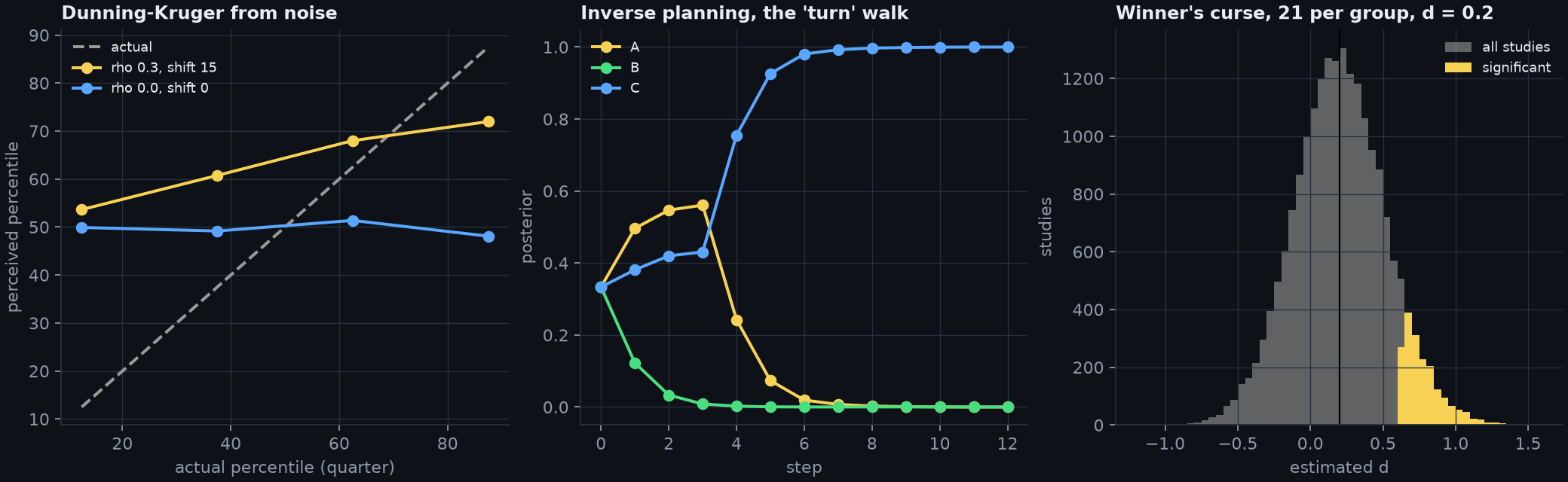
But the picture can be made from noise. Here are four thousand of Psyche's people whose self-estimates correlate only point three with their real scores, and who all add fifteen points of better-than-average. Group them by actual quartile. The bottom quarter estimates the percentile and the top quarter the . It's the famous shape, and there's no extra ignorance at the bottom built in. A weak correlation pulls every group's estimate toward the middle. It's regression to the mean. In 2016 and 2017 Nuhfer and colleagues showed that random numbers mimic the graph. The pattern itself replicates; how much of it is a failure of self-knowledge, rather than statistics, is still argued.
What it does: Better than average; false consensus; Dunning-Kruger and the same picture from noise
6First impressionsPsych 101 and the major2 min
People read minds from faces, and fast. In 2006 Willis and Todorov showed people faces for a tenth of a second, half a second or a whole second. Judgments of trustworthiness, competence, likeability, aggressiveness and attractiveness made after a tenth of a second agreed closely with judgments made with no time limit. More time made people more confident, and their impressions more differentiated, but not different. Notice what was measured, though: people agreeing with each other. Whether a face reveals character is another question.
Snap impressions also have consequences. In 2005 Todorov and colleagues showed people pairs of unfamiliar political candidates, for as little as a second, and asked which looked more competent. The candidate judged more competent had won sixty-eight point eight percent of the 2004 United States Senate races. The judges had never seen the candidates before. The faces alone carried the prediction. So a snap impression of a face may move votes, whatever the face does or doesn't say about the candidate.
Brief impressions of behaviour do better than faces. In 1993 Ambady and Rosenthal had strangers watch three silent ten-second clips of a college teacher, under half a minute in all. Their ratings predicted the teacher's end-of-semester evaluations by students who had sat through the whole course. In a second study, similar ratings of high-school teachers predicted their principal's ratings. Thin slices carry real information about how people come across. Part 53 asks what that's worth in a job interview.
What it does: A tenth of a second; faces and votes; thin slices of behaviour
7Priming and its collapsePsych 101 and the major2 min
The most famous claims of social cognition in the 1990s were about priming. In 1996 Bargh, Chen and Burrows had students unscramble sentences. For some of them, the words evoked old age. When they left, those students walked down the hallway more slowly, timed by an experimenter with a stopwatch. It became the most famous example of behavioural priming: a concept, activated without your knowing, steering what you do.
Then people tried to repeat it. In 2012 Doyen and colleagues ran the same study, but timed walking speed with infrared sensors. There was no effect. A slowing appeared only when the experimenters had been led to expect it. The likely source of the original effect was the people doing the measuring. Later that year Daniel Kahneman, who had featured priming in his best-selling book, wrote to priming researchers that he saw a train wreck looming, and asked them to replicate their own findings.
So what's left? Semantic priming is solid. The word doctor speeds the recognition of nurse by tens of milliseconds, measured by computer, as in Part 22. So is repetition priming. What failed, or was never shown, is behavioural priming of the dramatic kind: words about old age slowing walking, money making people selfish, thinking of a professor making them smarter. The effects were large, the samples small and the measures loose. The line isn't between priming existing and not existing. It's between fast, measured effects inside a task, and large effects on distant behaviour.
What it does: The walk to the elevator; infrared beams and expectations; what kind of priming is solid
8Power posingPsych 101 and the major2 min
The second collapse was more public. In 2010 Carney, Cuddy and Yap had forty-two people hold expansive or contracted poses for a few minutes. The expansive posers showed more testosterone, less cortisol, and more appetite for risk. A talk about it became one of the most watched talks of its kind. In 2015 Ranehill and colleagues repeated it with two hundred people. People felt more powerful, but there was no effect on hormones or on behaviour. In 2016 the first author, Carney, posted that she no longer believed the effects were real, and had stopped studying them. What remains is a small effect on how powerful people say they feel. Cuddy maintains that posture feeds back on feelings.
Why do small studies with striking results so often shrink? Psyche runs twenty thousand studies of a real but small effect, with twenty-one people per group, about the size of the 2010 study, and with a hundred. With twenty-one per group, only reach significance, and those report an average effect nearly four times the truth. With a hundred per group, do, and they overestimate by much less. A small study that clears the bar must have overestimated. It's called the winner's curse, Part 4's lesson, and it means a larger replication looks like a failure even when the effect is real.
What it does: A pose, a talk and a reversal; why small significant studies look big
9Thinking about thinkingPsych 101 and the major2 min
Part 30 showed children working out that other people can believe something false. Adults do it constantly, without noticing. Where in the brain does it happen? You need a careful comparison. Here's a story that needs a false belief. A woman leaves her keys in the drawer. While she's out, her flatmate moves them to the shelf. Where will she look? And here's one that's just as hard but has no mind in it. A photograph shows the keys in the drawer. Afterwards they're moved. Where are they in the photograph? Both are representations that have fallen out of date. Only one of them is a mind.
In 2003 Rebecca Saxe and Nancy Kanwisher put both kinds of story in the scanner. A region where the temporal lobe meets the parietal responded to the stories about false beliefs. It didn't respond to the false photographs, or to stories about mechanical causes. The false-belief stories became a standard way to find the mentalizing network in any brain, used in a great many later studies.
But is that region for minds? In 2008 Jason Mitchell scanned the same people on the false-belief stories and on a task with no minds in it: shifting attention to an unexpected spot, Part 18's cueing. The two engaged overlapping parts of the right junction. Later studies with finer scans found neighbouring but distinct patches. It's Part 8's lesson. A region that responds isn't yet a region that is for something. The comparison task decides what you've found.
What it does: Two kinds of false story; the temporoparietal junction; specific or shared
10Mind reading as inverse planningGraduate1 min
Now the computational idea. How do you know where someone is going, before they get there? Part 17 built a planner: an agent that picks moves bringing it closer to its goal, mostly, with a little noise, a softmax over the values of its moves. Run it backwards. Watch the moves, and ask which goal would make them likely. That's Bayes' rule, with the planner as the likelihood. In 2009 Baker, Rebecca Saxe and Joshua Tenenbaum proposed that this is how people read goals from movement.
Is it how people do it? Baker and colleagues had people watch agents move through mazes and rate, step by step, which goal each was heading for. The inverse-planning model's inferences tracked people's closely. In the 2007 conference version, the correlation was point nine six, across a hundred stimuli. The fit held across three experiments. In 2017 the same group, with Jara-Ettinger, had an agent looking for its favourite food truck. People inferred what it wanted, what it believed and what it could see, all at once, from its movement. It's a computational account of mind reading: assume others are roughly rational, and invert.
What it does: Run the planner backwards; two walks; the model against people
11Knowing ourselvesPsych 101 and the major2 min
The part ends by turning the question round. We read other minds by inference. Do we read our own any differently? In 1977 Richard Nisbett and Timothy Wilson had shoppers choose the best of four pairs of stockings. The pairs were identical. The rightmost pair was chosen far more often than the leftmost. Asked why, people cited the knit, the sheerness, the feel. Nobody mentioned the position. Nisbett and Wilson concluded that we often explain our own behaviour with plausible theories, not by looking inward.
A sharper version came in 2005. Johansson, Hall and colleagues had people choose the more attractive of two faces on cards, fifteen times. On some trials the experimenter, by sleight of hand, gave back the card they had not chosen. Fewer than one switch in ten was noticed at once. Asked why they had chosen it, people gave reasons for the face they had turned down. A reason can be built after the choice, for whatever choice we're shown.
Put it together with chapter three. To read others, we watch what they do and the situation, and infer the attitude, goal or belief that best explains it. To read ourselves we often run the same inference, with more data. That was Bem's self-perception, and it's the stockings and the swapped faces. Not always. People know their own feelings and plans in ways no observer can, and Part 3 showed when self-reports are good measurements. But for the causes of our own behaviour, we're often in the observer's seat.
What it does: Four identical pairs; choice blindness; the observer inside
12The LedgerPsych 101 and the major1 min
The tally. What holds: reading attitudes into forced acts, seeing ourselves in others, rating ourselves above average, and reading goals from movement. What failed: the choice effect in dissonance, the elderly walk, and power posing's hormones. What's argued: why the unskilled misjudge themselves. The failures share a shape. Small samples, large effects on distant behaviour, and loose measures. The findings that held were about judgments people make, measured as judgments.
What it does: Eight rows and the tally
13In practice: judging people, asking peoplePractice2 min
Every finding in this part has a price at work. In interviews, impressions form in a tenth of a second and judges agree on them. Structured interviews, with the same questions scored the same way, predict job performance better than a conversation does. Part 53 measures how much better. In performance reviews, a bad quarter reads as a bad employee. That's the correspondence bias. Ask what the territory, the team and the year made easy or hard. In self-assessment, almost everyone is above average. Calibrate against outcomes, not confidence. And in post-mortems, people explain their own decisions with plausible theories. Keep records written at the time the decision was made.
User research meets chapter four every day. Asking people whether they'd use something is LaPiere's letter. Asking why they chose something is the stockings. Asking is good for what people want, feel and understand. Watching what they click, where they hesitate and what they come back to is LaPiere's road trip. It's good for what people do, and in which situation. The field's oldest rule, watch what they do, not what they say, is LaPiere's lesson. And when you do ask, ask about the specific act, in the specific situation.
Machines read minds too. In 2000 Andrew Ng and Stuart Russell described inverse reinforcement learning: recover the reward an agent is pursuing from its behaviour. It's chapter ten's idea as an algorithm. Recommenders, assistants and robots that learn from demonstration all infer goals from actions. And they inherit the observer's problems. A click forced by the layout, read as a preference, is the correspondence bias in software. A system that assumes people are rational will misread them exactly where Parts 25 and 26 showed they aren't.
What it does: Judging people at work; what users say and do; machines that infer what you want
14Frontier: minds in machinesResearch2 min
The newest minds to be read are machines. In 2024 Michal Kosinski gave large language models forty false-belief tasks of the kind in chapter nine, each with controls, six hundred and forty prompts in all. A 2023 version of GPT-4 solved seventy-five percent of the tasks. GPT-3.5 solved twenty percent. His claim was that tracking false beliefs may have emerged in language models as a by-product of learning language. The claim was disputed.
How would you check? Take a standard task. A bag full of popcorn is labelled chocolate. She has never seen inside. What does she think it holds? Now make a small change. The bag is clear plastic, so she can see the popcorn. In 2023 Tomer Ullman showed that alterations like this, which keep the principles of theory of mind intact, flipped GPT-3.5's answers. His point was that passing standard tasks is weak evidence when the tasks are in the training data. The default should be scepticism. It's chapter nine's rule again: the comparison task decides what you've found. Part 60 returns with larger tests.
So, open questions. What survives of social priming when every study is large, preregistered, and timed by machine? Is the correspondence bias an error, or a reasonable bet in a world where situations are hard to see? How much of the Dunning-Kruger graph is insight, and how much is noise? Can inverse planning scale from mazes to the plans of real people over days? And what would count as evidence that a machine models minds, rather than text about minds?
What it does: False-belief tasks for language models; small changes; open questions
Recap, problems, and the road aheadAll tracks3 min
First, your four numbers. Places that refused the Chinese couple in person: one, of two hundred and fifty-one. Letter replies that said they would refuse: ninety-two percent. Where the bottom quarter placed themselves: about the sixty-second percentile. And American students who rated themselves above the median driver: ninety-three percent. What people say about others, and about themselves, is a guess built from a theory.
Part thirty-five in eleven lines. We see minds in moving shapes, automatically. Kelley's cube makes attribution an analysis of variance. The correspondence bias replicates, and may be a rational bet. Self-perception rivals dissonance, and the test in thirty-nine laboratories found no effect of choice. Attitudes predict the acts that match them in kind. Almost everyone is above average, and much of the Dunning-Kruger graph is regression to the mean. Faces are judged in a tenth of a second, and thin slices of behaviour carry real information. Behavioural priming and power posing's hormones failed, while semantic priming holds. A small study that reaches significance has overestimated: the winner's curse. Mind reading is inverse planning, Bayes' rule with a rational planner inside. And we often explain ourselves the way an observer would.
Kant's wager. The first objection, that mathematics can't apply to the mind, met Kelley's analysis of variance, a Bayesian observer and an inverse planner: social inference written as mathematics. The second, that the mind can't be experimented on, met one dissonance study rerun in thirty-nine laboratories, and two famous effects tested until they failed. And the third, about introspection. Here Kant's doubt returns in a new form. People's accounts of why they acted are often theories, not observations. Amber.
Where this comes back. Groups, stereotypes and bias scores are next, in Part 36. Cooperation and trust are Part 37, and attribution across cultures Part 38. Interviews and performance reviews are measured in Part 53, and theory of mind in machines is Part 60.
Seven problems, with full solutions in this part's README. One runs Kelley's cube. One builds the rational observer of the essays. One derives the Dunning-Kruger graph from regression. One finds Dawes's two thirds in false consensus. One computes the winner's curse. One updates an inverse planner by hand. And the last, with the star, asks you to design the experiment that separates dissonance from self-perception. Pause here if you'd like to try them.
The books and papers behind this part are listed here and in the README. Fiske and Taylor's Social Cognition is the field's textbook; Festinger's book is where dissonance began; and Timothy Wilson's Strangers to Ourselves is chapter eleven at book length.
Act Nine goes on. This part asked how we read single minds. The next asks what happens when we read people as members of groups. Schoolboys divided by a meaningless preference between two painters favoured their own group at once. Part 36: us and them.
Where it goes next. Groups, stereotypes and bias scores are Part 36; cooperation and trust Part 37; attribution across cultures Part 38; interviews and performance reviews Part 53; theory of mind in machines Part 60.
Key results
The part's results in one place, for revision.
Try it
Lab 35 · Social Cognition
Decompose Kelley's cube into main effects and read consensus, distinctiveness and consistency from it; infer a writer's attitude from an essay by Bayes' rule; rebuild the Dunning-Kruger graph from a modest correlation and a flattering shift; infer an agent's goal from its path with an inverse planner; and watch small significant studies overestimate a true effect.
python -m videos.psychology.labs 35
needs numpy, scipy, matplotlib · download lab35.py ·
source on GitHubKelley, only person 1 reacts: person share; consensus, distinctiveness, consistency 1.00; 0, 0, 1
Kelley, everyone reacts to entity 1: entity share; consensus, distinctiveness, consistency 1.00; 1, 1, 1
P(pro | pro essay) when the assignment held with probability 1.0 0.500
P(pro | pro essay) when the assignment held with probability 0.7 0.588
P(pro | pro essay) when the assignment held with probability 0.3 0.769
P(pro | pro essay) when the assignment held with probability 0.0 1.000
Dunning-Kruger, rho 0.3, shift 15: perceived by quarter 54, 61, 68, 72
Dunning-Kruger, rho 1.0, shift 0: perceived by quarter 13, 38, 63, 87
Dunning-Kruger, rho 0.0, shift 0: perceived by quarter 50, 49, 51, 48
inverse planning, the 'up' walk: P(A) after 0, 1, 2 and 3 steps 0.33, 0.67, 0.91, 0.98
winner's curse, d = 0.2, 21 per group: share significant; their mean d 0.093; 0.78
winner's curse, d = 0.2, 100 per group: share significant; their mean d 0.293; 0.37
Attribution is an analysis of variance over people, things and occasions; an essay is evidence about its writer unless the observer is sure it was forced; regression to the mean and a flattering shift draw the Dunning-Kruger graph with no insight in it; a goal is read from a path by Bayes' rule with a planner as the likelihood; and studies too small for their effect overestimate it whenever they succeed.The code (108 lines; it asserts its own result)
"""Lab 35: Kelley's cube as an analysis of variance, a rational observer of forced essays, the Dunning-Kruger plot
from regression to the mean, inverse planning in a gridworld, and the winner's curse."""

import numpy as np

from videos.coursekit import labs
from explainer.psychology.psyche import social as S

TITLE = "Social Cognition"
GOAL = ("Decompose Kelley's cube into main effects and read consensus, distinctiveness and consistency from it; infer "
        "a writer's attitude from an essay by Bayes' rule; rebuild the Dunning-Kruger graph from a modest correlation "
        "and a flattering shift; infer an agent's goal from its path with an inverse planner; and watch small "
        "significant studies overestimate a true effect.")
TASKS = [
    "Set the Dunning-Kruger correlation to 0.6 and the shift to 0. Which quarter now overestimates, which "
    "underestimates, and by how much? What does this say about reading the famous graph as a lack of insight?",
    "Give the inverse planner a prior of 0.8 on goal B and rerun the 'up' walk. How many steps does it take for A "
    "to pass 0.9? Then lower beta to 0.2: what does a noisier agent do to the observer's certainty?",
    "Rerun the winner's curse with 50 people per group. What share reaches significance, and how large do they look?",
]

SHAPE = (7, 9)
WALLS = [(r, 4) for r in range(1, 6)]
GOALS = [(0, 8), (6, 8), (3, 0)]
UP = [(3, 3), (2, 3), (1, 3), (0, 3), (0, 4), (0, 5), (0, 6), (0, 7), (0, 8)]
TURN = [(3, 6), (2, 6), (1, 6), (0, 6), (0, 5), (0, 4), (0, 3), (1, 3), (2, 3), (3, 3), (3, 2), (3, 1), (3, 0)]


def curse(n, d=0.2, reps=20000, seed=0, full=False):
    """Two-group studies of a true effect d with n per group: the share significant at 5% (two-sided t, positive
    direction), and their mean estimated d."""
    from scipy import stats
    rng = np.random.default_rng(seed)
    x = rng.normal(d, 1, (reps, n))
    y = rng.normal(0, 1, (reps, n))
    sp = np.sqrt((x.var(axis=1, ddof=1) + y.var(axis=1, ddof=1)) / 2)
    dh = (x.mean(axis=1) - y.mean(axis=1)) / sp
    t = dh * np.sqrt(n / 2)
    sig = t > stats.t.ppf(0.975, 2 * n - 2)
    if full:
        return dh, sig
    return float(sig.mean()), float(dh[sig].mean())


def run(seed=0):
    out = labs.Lab()

    person = np.zeros((2, 2, 2))
    person[0] = 1
    k = S.kelley(person)
    out.row("Kelley, only person 1 reacts: person share; consensus, distinctiveness, consistency",
            f"{k['shares']['person']:.2f}; {k['consensus']:.0f}, {k['distinctiveness']:.0f}, {k['consistency']:.0f}")
    assert np.isclose(k["shares"]["person"], 1.0)
    entity = np.zeros((2, 2, 2))
    entity[:, 0, :] = 1
    k = S.kelley(entity)
    out.row("Kelley, everyone reacts to entity 1: entity share; consensus, distinctiveness, consistency",
            f"{k['shares']['entity']:.2f}; {k['consensus']:.0f}, {k['distinctiveness']:.0f}, {k['consistency']:.0f}")

    for pi in (1.0, 0.7, 0.3, 0.0):
        out.row(f"P(pro | pro essay) when the assignment held with probability {pi:.1f}", f"{1 / (1 + pi):.3f}")

    for rho, shift in ((0.3, 15), (1.0, 0), (0.0, 0)):
        dk = S.dunning_kruger(n=4000, rho=rho, shift=shift, seed=seed + 35)
        out.row(f"Dunning-Kruger, rho {rho}, shift {shift}: perceived by quarter",
                ", ".join(f"{v:.0f}" for v in dk["perceived"]))

    post = S.goal_posterior(UP, SHAPE, WALLS, GOALS, beta=0.7)
    out.row("inverse planning, the 'up' walk: P(A) after 0, 1, 2 and 3 steps",
            ", ".join(f"{p:.2f}" for p in post[:4, 0]))
    assert post[3, 0] > 0.9

    for n in (21, 100):
        power, dsig = curse(n, seed=seed)
        out.row(f"winner's curse, d = 0.2, {n} per group: share significant; their mean d", f"{power:.3f}; {dsig:.2f}")

    out.note = ("Attribution is an analysis of variance over people, things and occasions; an essay is evidence about "
                "its writer unless the observer is sure it was forced; regression to the mean and a flattering shift "
                "draw the Dunning-Kruger graph with no insight in it; a goal is read from a path by Bayes' rule with a "
                "planner as the likelihood; and studies too small for their effect overestimate it whenever they "
                "succeed.")

    fig, ax = labs.figure(3, size=(13, 4.0))
    q = np.array([12.5, 37.5, 62.5, 87.5])
    ax[0].plot(q, q, color="0.6", ls="--", label="actual")
    for rho, shift, col in ((0.3, 15, labs.GOLD), (0.0, 0, labs.BLUE)):
        dk = S.dunning_kruger(n=4000, rho=rho, shift=shift, seed=seed + 35)
        ax[0].plot(q, dk["perceived"], "o-", color=col, label=f"rho {rho}, shift {shift}")
    ax[0].set(title="Dunning-Kruger from noise", xlabel="actual percentile (quarter)", ylabel="perceived percentile")
    ax[0].legend(fontsize=8)
    post = S.goal_posterior(TURN, SHAPE, WALLS, GOALS, beta=0.7)
    for j, (name, col) in enumerate(zip("ABC", (labs.GOLD, labs.GREEN, labs.BLUE))):
        ax[1].plot(post[:, j], "o-", color=col, label=name)
    ax[1].set(title="Inverse planning, the 'turn' walk", xlabel="step", ylabel="posterior")
    ax[1].legend(fontsize=8)
    dh, sig = curse(21, seed=seed, full=True)
    bins = np.linspace(-1.2, 1.6, 57)
    ax[2].hist(dh, bins=bins, color="0.6", alpha=0.6, label="all studies")
    ax[2].hist(dh[sig], bins=bins, color=labs.GOLD, label="significant")
    ax[2].axvline(0.2, color="k", lw=1)
    ax[2].set(title="Winner's curse, 21 per group, d = 0.2", xlabel="estimated d", ylabel="studies")
    ax[2].legend(fontsize=8)
    out.fig = fig
    return out


if __name__ == "__main__":
    print(run())
Now change it
- Set the Dunning-Kruger correlation to 0.6 and the shift to 0. Which quarter now overestimates, which underestimates, and by how much? What does this say about reading the famous graph as a lack of insight?
- Give the inverse planner a prior of 0.8 on goal B and rerun the 'up' walk. How many steps does it take for A to pass 0.9? Then lower beta to 0.2: what does a noisier agent do to the observer's certainty?
- Rerun the winner's curse with 50 people per group. What share reaches significance, and how large do they look?
Problems, with solutions
Try each problem before opening its solution.
-
Kelley's cube. Kelley's cube: a person reacts (1) or not (0) to an entity on an occasion, with 2 people, 2 entities and 2 occasions. If only person 1 ever reacts, show that the person main effect carries all the variance, and say which of consensus, distinctiveness and consistency are high and which low.
Solution
If only person 1 reacts, the response is 1 on every cell of person 1's slab and 0 elsewhere, so every cell equals the grand mean plus the person effect: the entity, occasion and interaction terms are zero and the person effect carries all the variance. Consensus is low (nobody else reacts), distinctiveness is low (person 1 reacts to every entity) and consistency is high (on every occasion): Kelley's pattern for blaming the person.
-
The rational observer. An observer thinks a writer's attitude is pro with probability \(1/2\). A pro writer writes a pro essay; an anti writer does too if assigned, which the observer thinks happened with probability \(\pi\). Show \(P(\text{pro} \mid \text{pro essay}) = 1/(1 + \pi)\), and explain why it exceeds \(1/2\) unless \(\pi = 1\).
Solution
P(pro essay | pro) = 1 and P(pro essay | anti) = π, so by Bayes' rule P(pro | pro essay) = (1/2)/(1/2 + π/2) = 1/(1 + π). It exceeds 1/2 whenever π < 1: unless the observer is certain the assignment fully constrained the essay, the essay is some evidence about the writer, and inferring an attitude is reasonable.
-
Dunning-Kruger from regression. Skill \(X\) and self-estimate \(Y\) are on a scale with mean 50 and equal spreads, with \(E[Y \mid X] = 50 + s + \rho\,(X - 50)\). Show that the bottom quarter's mean estimate is \(50 + s + \rho\,(E[X \mid \text{bottom}] - 50)\), and draw the graph for \(\rho = 0\).
Solution
Averaging E[Y | X] over the bottom quarter gives 50 + s + ρ(E[X | bottom] − 50). For a uniform skill percentile E[X | bottom] = 12.5, so the bottom quarter estimates 50 + s − 37.5ρ. With ρ = 0 every quarter estimates 50 + s: a flat line above the diagonal for the bottom and below it for the top, the famous picture with no insight in it at all.
-
Dawes's two thirds. Dawes's false consensus: the share \(p\) who agree is uniform on \([0, 1]\), and you agree. Show your posterior mean for \(p\) is \(2/3\), and compare it with Ross, Greene and House's estimates.
Solution
With a uniform prior on p and one observation (you agree), the posterior is Beta(2, 1), with mean 2/3. Ross, Greene and House's agreers estimated about 62% and refusers about 67% for their own choice: close to what an observer with one data point, themselves, should say.
-
The winner's curse. A study estimates \(d\) with standard error \(\sigma\) and reports it only if \(\hat d / \sigma > 1.96\). For a true \(d = 0.2\) and \(\sigma = 0.31\), show that the expected reported \(\hat d\) is about four times \(d\).
Solution
Reported only when d̂ > 1.96σ, d̂ is a normal truncated below at 1.96σ, with mean d + σφ(a)/(1 − Φ(a)), where a = 1.96 − d/σ = 1.31. Then φ(a) = 0.169, 1 − Φ(a) = 0.095, and the mean is 0.2 + 0.31 x 1.78 = 0.75: about 3.8 times the truth. The simulation's 0.78 differs because each study also estimates its own standard deviation.
-
One step of inverse planning. In a gridworld, an agent's step is equally likely under goals A and C, and impossible under B. Show that the posterior ratio of A to C does not change, and that B drops to zero.
Solution
The posterior is prior x likelihood, normalized. Equal likelihoods for A and C multiply both by the same number, so their ratio is unchanged; a zero likelihood sends B to zero, and A and C split B's share in their old ratio.
-
★ Dissonance against self-perception. Design an experiment that separates dissonance from self-perception, and say which result would favour each.
Solution
Self-perception needs no arousal and works only where the attitude was weak or ambiguous; dissonance predicts arousal, and change mainly for acts well outside the person's view. One design: have people write essays near or far from their own position, with high or low choice, and offer half a pill said to cause tension (a misattribution cue). Dissonance predicts that the pill removes the attitude change for far essays under high choice; self-perception predicts no effect of the pill. This is the logic of Zanna and Cooper's misattribution studies and of Fazio, Zanna and Cooper's division of the territory.
Notes and sources
Sources
- L. Festinger and J. M. Carlsmith, Cognitive consequences of forced compliance, Journal of Abnormal and Social Psychology 58(2) (1959) 203-210.
- L. Festinger, H. W. Riecken and S. Schachter, When Prophecy Fails (1956).
- F. Heider and M. Simmel, An experimental study of apparent behavior, American Journal of Psychology (1944).
- H. H. Kelley, The processes of causal attribution, American Psychologist (1973).
- E. E. Jones and V. A. Harris, The attribution of attitudes, Journal of Experimental Social Psychology 3 (1967).
- D. T. Gilbert and P. S. Malone, The correspondence bias, Psychological Bulletin 117(1) (1995) 21-38.
- D. E. Walker, K. A. Smith and E. Vul, The "fundamental attribution error" is rational in an uncertain world, Decision (2022).
- D. J. Bem, Self-perception: an alternative interpretation of cognitive dissonance phenomena, Psychological Review 74(3) (1967) 183-200.
- R. H. Fazio, M. P. Zanna and J. Cooper, Dissonance and self-perception: an integrative view of each theory's proper domain of application, Journal of Experimental Social Psychology (1977).
- D. C. Vaidis et al., A multilab replication of the induced-compliance paradigm of cognitive dissonance, Advances in Methods and Practices in Psychological Science 7(1) (2024).
- R. T. LaPiere, Attitudes vs. actions, Social Forces 13 (1934).
- I. Ajzen, The theory of planned behavior, Organizational Behavior and Human Decision Processes 50 (1991) 179-211.
- L. R. Glasman and D. Albarracín, Forming attitudes that predict future behavior, Psychological Bulletin (2006).
- O. Svenson, Are we all less risky and more skillful than our fellow drivers?, Acta Psychologica 47(2) (1981) 143-148; L. Koppel et al., a preregistered replication, Meta-Psychology (2023).
- A. H. Mezulis, L. Y. Abramson, J. S. Hyde and B. L. Hankin, Is there a universal positivity bias in attributions?, Psychological Bulletin 130(5) (2004) 711-747.
- L. Ross, D. Greene and P. House, The false consensus effect, Journal of Experimental Social Psychology 13 (1977); B. Mullen et al., a meta-analysis of 115 hypothesis tests, Journal of Experimental Social Psychology 21 (1985).
- J. Kruger and D. Dunning, Unskilled and unaware of it, Journal of Personality and Social Psychology 77(6) (1999); E. Nuhfer et al., Numeracy (2016, 2017); R. D. McIntosh et al., Journal of Experimental Psychology: General (2019).
- J. Willis and A. Todorov, First impressions: making up your mind after a 100-ms exposure to a face, Psychological Science (2006).
- A. Todorov, A. N. Mandisodza, A. Goren and C. C. Hall, Inferences of competence from faces predict election outcomes, Science (2005).
- N. Ambady and R. Rosenthal, Half a minute, Journal of Personality and Social Psychology (1993).
- J. A. Bargh, M. Chen and L. Burrows, Automaticity of social behavior, Journal of Personality and Social Psychology 71(2) (1996); S. Doyen, O. Klein, C.-L. Pichon and A. Cleeremans, Behavioral priming: it's all in the mind, but whose mind?, PLOS ONE (2012).
- D. R. Carney, A. J. C. Cuddy and A. J. Yap, Power posing, Psychological Science 21(10) (2010); E. Ranehill et al., Assessing the robustness of power posing, Psychological Science 26(5) (2015).
- R. Saxe and N. Kanwisher, People thinking about thinking people, NeuroImage (2003); J. P. Mitchell, Activity in right temporo-parietal junction is not selective for theory-of-mind, Cerebral Cortex 18(2) (2008) 262-271.
- C. L. Baker, R. Saxe and J. B. Tenenbaum, Action understanding as inverse planning, Cognition 113(3) (2009) 329-349; C. L. Baker, J. Jara-Ettinger, R. Saxe and J. B. Tenenbaum, Nature Human Behaviour 1 (2017) 0064.
- R. E. Nisbett and T. D. Wilson, Telling more than we can know, Psychological Review 84(3) (1977) 231-259.
- P. Johansson, L. Hall, S. Sikström and A. Olsson, Failure to detect mismatches between intention and outcome in a simple decision task, Science (2005).
- A. Y. Ng and S. Russell, Algorithms for inverse reinforcement learning, ICML (2000).
- M. Kosinski, Evaluating large language models in theory of mind tasks, PNAS (2024); T. Ullman, Large language models fail on trivial alterations to theory-of-mind tasks, arXiv 2302.08399 (2023).
About this partfrom its README
In 1959 Festinger and Carlsmith had 71 men turn pegs for an hour, then paid some of them one dollar and others twenty to tell a waiting student that the task had been interesting. The men paid one dollar later rated the task more enjoyable. Festinger called it dissonance: a lie told for too little money has to be justified from the inside. Eight years later Bem gave a different explanation, that people read their own attitudes from their behaviour the way they read anyone else's. This part is about that reading: how people explain each other, judge each other in a tenth of a second, flatter themselves, and work out what someone wants from where they walk; and about the famous findings of the field that did not survive being checked.
The hook is the peg board, the dollar and the prophecy that failed; the viewer watches three shapes move, as in Heider and Simmel's film, and predicts four numbers. Then Kelley's cube as an analysis of variance (computed), Jones and Harris's Castro essays and a rational observer of them; the textbook's four attribution biases with their records (the fundamental attribution error, the actor-observer asymmetry that Malle's meta-analysis found near zero, the self-serving bias, belief in a just world); dissonance against self-perception, Bem's simulation, Fazio, Zanna and Cooper's reconciliation and the 2024 test in 39 laboratories; LaPiere's road trip and letter, the theory of planned behaviour and when attitudes predict; Svenson's drivers, self-serving attributions, false consensus, and the Dunning-Kruger graph rebuilt from regression to the mean (computed); faces judged in a tenth of a second, competence and Senate races, and thin slices of teaching; the elderly walk and its failure, Kahneman's letter, and which priming is solid; power posing, its replication, and the winner's curse that explains both (computed); the false-belief localizer and its overlap with attention; inverse planning in a gridworld (computed) and against people; and Nisbett and Wilson's stockings and choice blindness. The practice chapter is judging people at work, user research and machines that infer what users want; the frontier is theory of mind in language models.
What is computed and built
explainer/psychology/psyche/social.py(committed with Part 34): the inverse planner (grid_distances,action_probs,goal_posterior), Kelley's cube (kelley) and the Dunning-Kruger plot from noise (dunning_kruger); and, written ahead for Part 36, Tajfel's allocation matrices (tajfel_matrix,allocate), an IAT as two blocks of diffusion decisions (iat_d,iat_study), the list experiment (list_experiment), a promotion ladder (pipeline) and an illusory-correlation model (illusory_correlation). Tested intests/psychology/test_social.py.- The Ledger gains eight rows.
- The course's interactive is goal inference: watch an agent walk part of the way through a maze, say which of three goals it is heading for, and compare your answers with the inverse planner's posterior.
Chapter notes
| # | Chapter | What it does |
|---|---|---|
| 0 | 1959: one dollar or twenty | The pegs; the result; the prophecy that failed; the question; objectives |
| 1 | On you: shapes and numbers | Three moving shapes; four predictions |
| 2 | Explaining behaviour | Kelley's cube as an analysis of variance; the Castro essays; a rational observer |
| 3 | Dissonance or self-perception | Two theories; Bem's simulation; where each holds; the 39-lab test |
| 4 | Attitudes and behaviour | LaPiere's road trip and letter; when attitudes predict |
| 5 | The self's illusions | Better than average; false consensus; Dunning-Kruger and the same picture from noise |
| 6 | First impressions | A tenth of a second; faces and votes; thin slices of behaviour |
| 7 | Priming and its collapse | The walk to the elevator; infrared beams and expectations; what kind of priming is solid |
| 8 | Power posing | A pose, a talk and a reversal; why small significant studies look big |
| 9 | Thinking about thinking | Two kinds of false story; the temporoparietal junction; specific or shared |
| 10 | Mind reading as inverse planning | Run the planner backwards; two walks; the model against people |
| 11 | Knowing ourselves | Four identical pairs; choice blindness; the observer inside |
| 12 | The Ledger | Eight rows and the tally |
| 13 | In practice: judging people, asking people | Judging people at work; what users say and do; machines that infer what you want |
| 14 | Frontier: minds in machines | False-belief tasks for language models; small changes; open questions |
| Recap, problems, and the road ahead | Your numbers; eleven lines; Kant's three objections; payoffs; problems; references; Part 36 |
NotesWhere the numbers come from
| What | Source |
|---|---|
| Kelley's cube, 2 people x 2 entities x 2 occasions: a person pattern puts all the variance in the person main effect (consensus 0, distinctiveness 0, consistency 1); an entity pattern in the entity effect; a circumstance pattern leaves 89% in the interaction | Psyche (social.kelley), item kelley |
| A rational observer of the essays: the inferred attitude is ±0.71 when the writer chose, ±0.21 when the observer thinks the assignment held with probability 0.7, and 0 when sure it held | Psyche (Bayes' rule), item essays |
| The Dunning-Kruger plot from 4,000 simulated people: with a correlation of 0.3 and a 15-point flattering shift, the quarters estimate 54, 61, 68 and 72; with a perfect correlation and no shift, they estimate their true places; with none, about 50 | Psyche (social.dunning_kruger), item dk |
| Inverse planning on a 7 x 9 grid with a wall and three goals, softmax planner with beta 0.7: one walk gives goal A 67% after one step; the other holds A at 56% and C at 43% for three steps, then C takes over | Psyche (social.goal_posterior), item goals |
| The winner's curse: 20,000 two-group studies of d = 0.2; with 21 per group, 9.5% reach significance and report d = 0.78 on average; with 100 per group, 28% reach it and report 0.37 | Psyche (simulated), item curse |
| Every published number on screen | the studies listed under Sources, quoted as reported |
Notes
| Finding | Original | Status |
|---|---|---|
| Observers infer a person's attitude from what they say or do even when the situation forced it | Jones and Harris 1967 | replicated |
| Freely choosing to argue against your own view moves your attitude toward what you argued, more than being told to | Festinger and Carlsmith 1959 | failed |
| People overestimate how many others share their own choices and opinions | Ross, Greene and House 1977 | replicated |
| The least skilled overestimate their standing the most, because they lack the skill to see their errors | Kruger and Dunning 1999 | contested |
| Most people rate themselves above the median on desirable traits and skills | Svenson 1981 | replicated |
| Reading words about old age makes people walk more slowly afterwards | Bargh, Chen and Burrows 1996 | failed |
| Holding an expansive pose for two minutes raises testosterone, lowers cortisol and increases risk-taking | Carney, Cuddy and Yap 2010 | failed |
| People infer an agent's goal from its movement as a Bayesian observer of a roughly rational planner would | Baker, Saxe and Tenenbaum 2009 | replicated |
Shown without a row, with the reason recorded in explainer/psychology/ledger.py: Festinger, Riecken and
Schachter, Heider and Simmel, Bem and Fazio, Zanna and Cooper, LaPiere, Ajzen and Glasman and Albarracín, Mezulis et
al., Willis and Todorov, Todorov et al., Ambady and Rosenthal, Saxe and Kanwisher, Mitchell, Ng and Russell,
Kosinski and Ullman.
Notes
Checked against the articles, their abstracts or official pages, or named secondary summaries of them (2026-11-16): Festinger and Carlsmith's 71 men and the one and twenty dollars; When Prophecy Fails, the flood predicted for 21 December 1954 and the follow-ups; Jones and Harris's means (59.6, 17.4, 44.1 and 22.9); Gilbert and Malone's four mechanisms; the 2017 Philippine replication; Walker, Smith and Vul; Bem's simulation; Fazio, Zanna and Cooper; Vaidis et al.'s 39 labs, 19 countries and 4,898 people; LaPiere's 251 places, one refusal, 128 replies and 92%; Ajzen; Glasman and Albarracín's moderators; Svenson's 93% and 69%; Koppel et al.'s 1,203; Mezulis et al.'s 266 studies and d = 0.96; Ross, Greene and House; Mullen et al.'s 115 tests; Kruger and Dunning's 12th and 62nd percentiles; Nuhfer et al. and McIntosh et al.; Willis and Todorov's exposures and traits; Todorov et al.'s 68.8%; Ambady and Rosenthal's clips and the principals; Bargh, Chen and Burrows; Doyen et al.'s infrared sensors and expectations; Kahneman's 2012 letter; Carney, Cuddy and Yap's 42; Ranehill et al.'s 200; Carney's 2016 statement; Saxe and Kanwisher; Mitchell's overlap with attentional reorienting; Baker, Saxe and Tenenbaum's three experiments and r = .96 in the 2007 version; the food trucks; Nisbett and Wilson's stockings; Johansson et al.'s 15 pairs and under one detection in ten; Kosinski's 40 tasks, 640 prompts, 75% and 20%; Ullman's alterations.
Still to recheck against the full texts before the final cut:
- Ross, Greene and House's 62% and 67%, from secondary summaries (used only in problem 4's solution).
- Nisbett and Wilson's reported reasons (knit, sheerness) and the size of the position effect ("far more often"; about four times, in secondary sources).
- That the power-posing talk was "one of the most watched of its kind", and that Kahneman had featured priming in Thinking, Fast and Slow, both widely reported but not checked against a primary source here.
- Choice blindness's total detection rate, which sources report differently; the film quotes only "fewer than one in ten noticed at once".
- Bargh, Chen and Burrows's sample sizes and timing procedure; the film says only that an experimenter timed the walk with a stopwatch.
- Ng and Russell (2000), cited from the standard reference; Ullman's popcorn example, as summarized.
Companion material in this repository
The syllabus's plan for this partfrom SYLLABUS.md, the plan of record
- Hook: Festinger and Carlsmith (1959). The prophecy that failed (1956).
- On you: Heider and Simmel's animation (1944). Two triangles and a circle; you will see a bully.
- Attribution: Heider; Kelley's covariation cube as an analysis of variance; the correspondence bias (Jones and Harris 1967) and its cultural variation (Part 38).
- Dissonance against self-perception: the predictions that separate them; the 2024 multi-laboratory replication of induced compliance (verify).
- Attitudes and behaviour: LaPiere's road trip (1934); when attitudes predict (specificity, strength); planned behaviour.
- The self's illusions: better-than-average, self-serving attributions, false consensus. The Dunning–Kruger effect, and how much of its famous graph noise alone produces (computed).
- First impressions: a tenth of a second (Willis and Todorov 2006); faces predicting elections; the validity of thin slices.
- Automatic social behaviour: the elderly-walking study (Bargh et al. 1996), the 2012 failure, Kahneman's "train wreck" letter. What kinds of priming are solid (semantic, Part 22) and what were not.
- Power posing: the 2010 paper, the larger replication, a co-author's public reversal.
- Thinking about thinking: theory of mind in adults; the mentalizing network (Saxe).
- Mind reading as inverse planning: a rational agent in a gridworld; infer its goal from its path by Bayes' rule (Baker, Saxe and Tenenbaum 2009). The model's ratings against people's.
- Knowing others' minds better than our own? Introspection's limits revisited (Part 3).
Psyche: social: an inverse planner (Part 17's planner run backwards); Kelley's cube; a simulation of the
Dunning–Kruger plot from regression to the mean plus a better-than-average shift.
On you: the Heider–Simmel film; goal inference trials.
Ledger: correspondence bias (replicated; culturally variable); induced-compliance dissonance (contested);
false consensus (replicated); Dunning–Kruger (replicated as a pattern; explanation contested); behavioural
priming of the elderly-walking kind (failed); power posing's hormonal and behavioural effects (failed; a
small effect on self-reported feeling remains); inverse-planning accounts of goal inference (replicated).
In practice: interviewing and performance review biases (Part 53), user research ("what people say against what
they do"), negotiation, AI systems that model users.
Frontier: what survives of social priming; theory of mind in language models (Part 60); computational models of
the self.
Reading: Festinger & Carlsmith 1959; Bem 1967; Heider 1958; Kelley 1973; Jones & Harris 1967; Kruger & Dunning
1999; Bargh, Chen & Burrows 1996; Doyen et al. 2012; Baker, Saxe & Tenenbaum 2009; Fiske & Taylor, Social
Cognition; Nisbett & Wilson 1977.
Build the film
python -m videos.psychology.psych35.compute        # the part's numbers, into .cache/psych35
python tools/build.py psych35                  # render and assemble the film
EXPLAINER_TTS=silent python tools/qa_scene.py psych35 Hook   # one chapter, silent, with a contact sheet
Scenes: videos/psychology/psych35. Setup: see the course page. Source of these notes: the README and the scenes' narration.
Build it
python -m videos.psychology.psych35.compute            # every number (a few seconds)
python tools/qa_scene.py psych35 Inverse               # one chapter, silent, at 480p, with a contact sheet
EXPLAINER_TTS=silent python tools/build.py psych35 -q l   # the whole part, silent preview
python tools/build.py psych35                          # 1080p30 with narration
python tools/qa_scene.py psych35 Attribution --lang zh # the Chinese edition of one chapter
python tools/make.py psych35                           # both editions, with the checks a long build needs
python -m videos.psychology.labs 35                    # the lab: Kelley's cube, Dunning-Kruger, inverse planning
python tools/check_ledger.py psych35                   # every study shown has its Ledger row, or a reason
python -m pytest tests/psychology                      # Psyche's social module, the Ledger, the Archive
The Chinese edition is zh_lines.py (the narration, line by line) and the series table
videos/psychology/psychology_text_zh.json (the text on screen); the terms are in
PSYCHOLOGY_ZH_GUIDE.md.