Health and Care
How does the mind get into the body, and how does help get to the people who need it?
In 1991 volunteers who reported more stress were more likely to catch a cold from nose drops, in a dose-response line. The part weighs stress and illness and the limits of correlation, separates the placebo's real effect from regression to the mean, models expectation as a prior on bodily signals, treats chronic pain, adherence, diabetes prevention and insomnia as behaviour, reads mindfulness's evidence, simulates the treatment gap and stepped care, and covers measurement-based care, lay counsellors, digital therapeutics, Type A and a mindset study. It opens with the care card.
What you need. Part 10's stress loop and sleep model, Part 14's inference, Part 39's prevalence and Part 42's treatments; averages and queues.
- Hook
- stress and the common cold
- Ideas, models and mathematics
- stress and illness, placebo and nocebo, pain, adherence, lifestyle trials, sleep treatment, stepped care, measurement-based care, digital therapeutics, task sharing
- Psyche gains
- a stepped-care simulator
- On you
- open-label placebo: what would you predict?
What you will be able to do
Psych 101 and the major
- Separate a placebo's real effect from natural recovery, and explain why placebos affect pain most.
- Explain why behaviour change is a treatment, with adherence and diabetes prevention as examples.
Graduate
- Model placebo analgesia as Bayesian inference and predict when it is largest.
- Simulate a stepped-care service and match capacity to flow.
Research
- Design a study that could test a causal effect of stress on disease.
Practice
- Plan a stepped-care service's capacity and its outcome monitoring, and evaluate a digital therapeutic.
Contents
Each chapter has a home level. Choose a track to see what to read and watch: Psych 101 and the major 16 min · Graduate 28 min · Research 29 min · Practice 23 min.
- 0Nose drops and stressPsych 101 and the major2 min
- 1On you: a pill with nothing in it, and four numbersPsych 101 and the major1 min
- 2Stress and illnessPsych 101 and the major1 min
- 3PlaceboPsych 101 and the major3 min
- 4Expectation as a priorGraduate1 min
- 5Chronic painGraduate1 min
- 6Behaviour is the treatmentPsych 101 and the major4 min
- 7Sleep, treatedPsych 101 and the major1 min
- 8MindfulnessPsych 101 and the major1 min
- 9The treatment gapPractice2 min
- 10Measurement-based carePractice2 min
- 11Help at scalePractice1 min
- 12Personality and the heartGraduate1 min
- 13The LedgerGraduate1 min
- 14In practice: a stepped-care service, plannedPractice1 min
- 15Frontier: care in the momentResearch1 min
- Recap, problems, and the road aheadAll tracks3 min
Also on this page: Lecture · Key results · Try it · Lab · Problems · Notes and sources · Build the film.
Lecture
The text of each chapter is the film's narration, as it is spoken, so you can read along or revise without the film. The pictures are in the film.
Nose drops and stressPsych 101 and the major2 min
Before we start. This part is about health, illness and care, including mental health services. It's education, not diagnosis or treatment. If any of it touches your own life, talk to a doctor, a counsellor, or someone you trust. If you're in danger now, call your local emergency number. In the United States you can call or text nine eight eight. In the UK and Ireland, Samaritans are on one one six, one two three. And find a helpline dot com lists free, confidential lines in other countries.
In 1991 Sheldon Cohen, David Tyrrell and Andrew Smith ran an unusual experiment. About four hundred healthy volunteers rated their stress, then took nose drops containing a cold virus, and were quarantined. The more stress they'd reported, the more of them developed a cold, in a dose-response line, with health habits and immunity controlled. The bars show the pattern, from about a quarter to about half. They're approximate. This part's first half is how psychological states change bodies. Its second half is how help reaches the people who need it.
So this part asks: how does the mind get into the body, and how does help get to the people who need it? Stress, placebo and expectation. Pain, behaviour, sleep and mindfulness. The treatment gap, stepped care and feedback. And help at scale, and what failed.
This is Part 57 of Psychology, Built: health and care, the last part of Act Twelve. We'll weigh stress and illness, and the limits of correlation. We'll see what survives of the placebo, and why. We'll treat expectation as a prior on the body's signals. We'll make behaviour the treatment, for diabetes and for sleep. We'll simulate the treatment gap and stepped care. And we'll meet lay counsellors, digital therapeutics, and the personality that was said to cause heart attacks.
What it does: The care card; the cold studies; the question; objectives
1On you: a pill with nothing in it, and four numbersPsych 101 and the major1 min
Can a pill work if you know it is empty?
First, a prediction. In an open-label placebo trial, patients are told that the pills are inert, like sugar pills, and that placebos have helped other people. On the course site, predict whether these patients improved more than patients who got nothing, then see the trial. The answer comes in chapter four, along with why it's contested. Nothing you enter is stored or sent.
Now four numbers. One: patients with irritable bowel syndrome are told openly that their pill contains nothing. Do they improve more than untreated patients? Two: people at high risk of diabetes. How much did an intensive lifestyle programme cut new cases? Three: patients prescribed long-term medicines. Roughly what share take them as prescribed? And four: a mental health service where everyone waits for full therapy. What share recover within six months? Pause here, and write them down.
What it does: The open-label prediction; four predictions
2Stress and illnessPsych 101 and the major1 min
Does a hard life make a body ill? Part 10 built the stress loop. A threat raises cortisol and arousal, and then the loop switches itself off. Repeated for years, it doesn't fully switch off. Bruce McEwen called the wear allostatic load: blood pressure, inflammation and metabolism, measured together. Michael Marmot's Whitehall studies of British civil servants found that the lower the grade, the higher the death rate, at every step of the ladder. And in 1998 Vincent Felitti and colleagues found that the more kinds of childhood adversity people reported, the more adult disease they had, in a graded relation.
What can't the correlations say? Most of this evidence is observational. Stress comes with poverty, smoking, poor sleep and poor care, which is Part 2's confounding. The cold studies are an experiment for the virus, not for the stress, which was measured, not assigned. The strongest designs are the viral challenge, natural experiments, and trials that reduce stress and measure a biological outcome. And a childhood-adversity score describes groups well and predicts poorly for one person, as Part 47 would warn. It isn't a screening test.
What it does: From a stress response to a life; what the correlations cannot say
3PlaceboPsych 101 and the major3 min
What do sugar pills really do? In 1955 Henry Beecher's paper The powerful placebo reported that about thirty-five percent of patients improved on placebo across trials. But improvement on placebo includes natural recovery and regression to the mean, because people enrol when their symptoms are at their worst. That's Part 2. In 2001 Asbjorn Hrobjartsson and Peter Gotzsche pooled trials that had both a placebo arm and a no-treatment arm. They found little effect on objective or yes-or-no outcomes, and a small one on subjective outcomes like pain. The placebo's real effect is the difference between placebo and no treatment, not placebo against baseline.
Here's how much improvement comes from nothing. Psyche simulates twenty thousand people, each with a stable level of pain plus day-to-day variation, and gives no treatment at all. A trial enrols those scoring seven or more on the screening day, about fifteen percent of them. A week later the enrolled average about six point two, down from eight, and two thirds improved by more than a point. They were chosen on a bad day, and bad days pass. That's regression to the mean, from Part 2, and a placebo arm on its own mistakes it for a placebo effect. Only a no-treatment arm, enrolled the same way, separates the two.
So what survives? In 1978 Jon Levine, Newton Gordon and Howard Fields gave patients a placebo after dental surgery, and they reported less pain. Naloxone, which blocks opioid receptors, abolished part of the effect. The brain's own opioids carry part of placebo pain relief. That's a mechanism, not just a bias in reporting. Imaging and pharmacology since then have found expectation changing how pain is processed, with effects that vary greatly between people. Placebo effects are largest for symptoms that are themselves inferences: pain, nausea and fatigue.
And the answer to your first number. In 2010 Ted Kaptchuk and colleagues gave eighty patients with irritable bowel syndrome either no treatment or pills openly described as inert, with an encouraging explanation. After three weeks, more of the placebo group reported adequate relief: about fifty-nine percent against thirty-five. Later small trials in back pain and fatigue found similar results. But the outcomes are self-reported, and no one can be blind to taking a pill. So it's contested. Is it a real benefit from ritual and expectation, or reports shaped by attention and hope? Larger, longer trials are needed.
What it does: The powerful placebo reconsidered; placebo analgesia; open-label placebo
4Expectation as a priorGraduate1 min
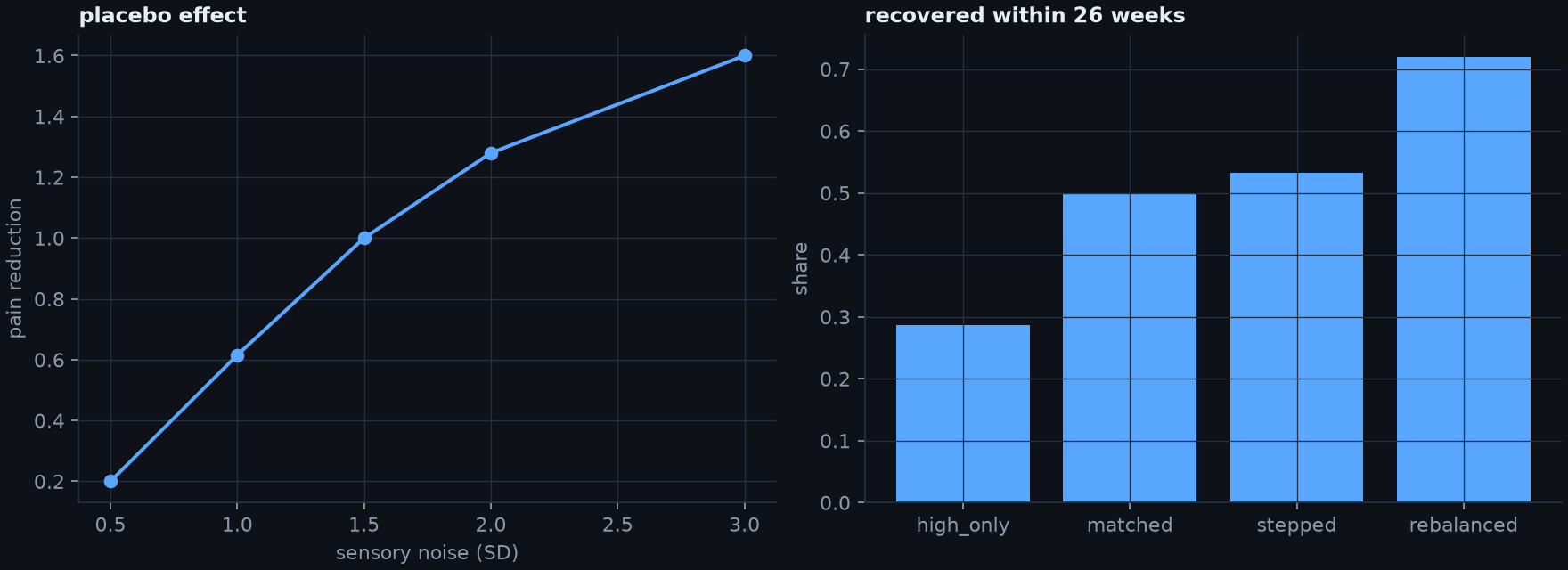
Why would a belief change a sensation? Part 14's observer, applied to the body: the felt intensity combines the signal with an expected level, each weighted by its precision. Take a stimulus at six, with the expectation lowered from six to four. The felt pain falls to about five point four, because the expectation carries a weight of about a third. The noisier the bodily signal, the more the expectation counts. The effect grows from a fifth of a point to more than a point and a half. So placebos move vague, internal symptoms most, and a broken bone least.
Expectation cuts both ways. Nocebo: expecting harm produces symptoms, and the side effects reported on placebo in drug trials often match the drug's warning label. In a 2020 trial in which each patient alternated between statins, placebo and no tablets, most of the muscle symptoms people felt on statins they also felt on placebo. Sham surgery: in 2002 Bruce Moseley and colleagues found that knee arthroscopy for arthritis did no better than a sham operation. The lesson is that how a warning or a procedure is framed is part of the treatment, and part of the harm.
What it does: Pain as inference; nocebo and sham
5Chronic painGraduate1 min
When does pain outlast its injury? Acute pain signals damage. Chronic pain, lasting months, often persists after the tissue has healed. The fear-avoidance model: pain, then fear of movement, then avoidance, deconditioning, and more pain. That's Part 16's avoidance, maintained by relief. Central sensitization: the nervous system's gain turns up, and Part 14's priors predict pain. Psychological factors predict which back pain becomes chronic better than scans do.
How is it treated? Cognitive behavioural and acceptance-based therapies have modest, real effects on pain and disability, small on average. Graded activity is exposure for movement: the feared activity, step by step, like Part 42's exposure. Pain education explains pain as a protective output of the brain, which reduces fear, with small effects. And what to avoid: long-term opioids for chronic pain not caused by cancer, which bring little benefit and real harm.
What it does: Pain that stays; treating it
6Behaviour is the treatmentPsych 101 and the major4 min
What if the medicine is what people do? The World Health Organization's 2003 report found that in rich countries, adherence to long-term therapies averages about fifty percent. Increasing adherence, it argued, might do more for health than any improvement in specific treatments. The reasons are Part 26's and Part 55's: costs now and benefits later, forgetting, side effects, and doubt. What helps is simpler regimens, reminders, packaging, and asking about it without blame.
Adherence is arithmetic. Take an illustrative drug that cuts the risk of a heart attack by thirty percent in the people who take it. If half of those prescribed it take it as directed, the risk falls by only about fifteen percent across everyone prescribed it. Raising adherence from fifty to seventy percent would add as much benefit as a new drug forty percent stronger. What helps is simpler regimens, one pill a day, reminders, and the habit cues of Part 52. What doesn't is information alone. So a behavioural trial of adherence can be worth more than a pharmacological one. The drug already works.
Why do people do, or not do, what would keep them well? Health psychology's textbooks answer with models. The oldest, the health belief model, came from Irwin Rosenstock and colleagues at the United States Public Health Service, puzzling over why so few people came for free screening for tuberculosis. People act, it says, when they believe they are at risk, that the illness is serious, that acting helps, and that the barriers are low. Reviews find that the benefits and the barriers predict best, and perceived risk only weakly. The theory of planned behaviour, from Part 35, puts intention at the centre. And the stages of change, from James Prochaska and Carlo DiClemente in 1983, said that people move from not thinking about a change, to thinking about it, preparing, acting and keeping it up, and that help should match the stage. It became one of the most used models in health promotion. But when Jonathan Bridle and colleagues reviewed the trials in 2005, help matched to the stage did little better than help that wasn't. Intentions do matter. In 2006 Thomas Webb and Paschal Sheeran pooled experiments that changed people's intentions and then measured what they did. A medium-to-large change in intention produced a change in behaviour about half as big. So the newer frameworks, like Susan Michie's COM-B, add what intentions leave out: whether people are able to act, and whether their surroundings let them. That is Part 55's lesson about nudges, from the other side.
The clearest example is diabetes. In 2002 the Diabetes Prevention Program reported on three thousand two hundred adults at high risk, randomized to placebo, the drug metformin, or an intensive lifestyle programme. The lifestyle programme aimed at seven percent weight loss and a hundred and fifty minutes of activity a week, with a coach and sixteen lessons. New cases fell by fifty-eight percent with lifestyle and thirty-one percent with metformin, against placebo. Weight returned for many over the following years, Part 28's set points and habits, but the reduction in new cases partly persisted.
What it does: Adherence; preventing diabetes
7Sleep, treatedPsych 101 and the major1 min
Can insomnia be treated without pills? Cognitive behavioural therapy for insomnia starts with sleep restriction: time in bed is cut to the time actually slept, then lengthened. That's Part 10's sleep pressure, built up deliberately. Stimulus control: the bed is only for sleep, and you get up if you're awake. That's Part 16's conditioning, re-learned. Cognitive work: worry about sleep keeps people awake, so beliefs about the costs of a bad night are tested. Trials find large improvements that last beyond the end of treatment, and guidelines recommend it before sleeping pills. The gap is that there are few trained therapists. Digital versions have trial evidence, with the usual drop-out.
Why does it work? In Part 10's model, Alexander Borbely's two processes: sleep pressure builds with time awake, and the circadian clock opens the gate. Spending long hours in bed awake spreads sleep thin, so pressure is low at bedtime. Restriction concentrates it: more pressure, faster sleep and fewer awakenings. Then the window grows. It's a model of the mind turned into a treatment, which is the series' theme, in one clinic.
What it does: CBT for insomnia; why it works in Part 10's model
8MindfulnessPsych 101 and the major1 min
How much of the mindfulness boom is evidence? For people with recurrent depression, mindfulness-based cognitive therapy reduces relapses, by about as much as maintenance antidepressants, in trials and a meta-analysis. In 2014 Madhav Goyal and colleagues found that meditation programmes had small to moderate effects on anxiety, depression and pain, similar to other active treatments. Much of the wider research compares mindfulness with nothing, not with an equally credible activity. That's chapter three's placebo problem. And adverse effects, rarely asked about in trials, do occur for some participants.
Then came the schools. The MYRIAD trial in 2022 randomized about eight thousand secondary students in eighty-four UK schools to school-based mindfulness training or usual social-emotional teaching. There was no benefit on depression, wellbeing or social-emotional outcomes at one year. Few students practised outside the lessons. An intervention that helps adults who choose it and are at risk may do nothing when it's given to everyone. That's Part 55's scaling, in schools.
What it does: The clinical evidence; mindfulness in schools
9The treatment gapPractice2 min
How many people who need help get it? From Part 39: in a year, roughly one adult in five has a diagnosable mental disorder. The World Mental Health surveys found that a minority of them receive any treatment, and in low-income countries, a small minority. Treatments that work exist, as Part 42 showed. The bottleneck is trained people, money and access. So the question becomes logistics: who gets what, when, and how do we know it worked?
Here are three ways to run a service. Psyche's service gets a hundred referrals a week. Each week, seventy can start six weeks of guided self-help and thirty can start twelve weeks of therapy. Thirty percent of people are severe. If everyone waits for therapy, the waiting list grows, the average wait is almost a year, and only about three in ten recover within six months. Matched care, with the severe going to therapy, gets about half. Stepped care, where everyone starts with self-help and non-responders step up, gets a little more, but now people wait fourteen weeks for the first step. Give self-help a hundred places and therapy sixty, enough for the six in ten who step up, and the first wait falls below a week, with about three quarters recovered within six months. Capacity has to match the flow at every step.
One country built this at scale. In 2008 England began Improving Access to Psychological Therapies, now NHS Talking Therapies, built on the economist Richard Layard's case and the psychologist David Clark's design. It offers stepped care for depression and anxiety disorders, with thousands of newly trained therapists. Its distinguishing rule: symptom questionnaires at every session, so outcomes are known for nearly every patient, not a sample. About half of those who finish treatment are reported as recovered, and the data also expose the services and groups that do worse. There's no control group, so the recovery rate includes natural recovery, and comparing services needs care.
What it does: Prevalence against capacity; three ways to run a service; a national programme that counts
10Measurement-based carePractice2 min
Do therapists know when a patient is getting worse? Often not. Therapists overestimate their patients' improvement, and rarely predict who will deteriorate. Michael Lambert's system gives a short questionnaire every session and compares it with the expected course for similar patients. Patients who are off track trigger a signal to the therapist, with suggestions. Trials and meta-analyses find that feedback improves outcomes, mostly for the off-track patients, and reduces deterioration. It's Part 51's alarm, in a clinic. A signal is only useful if it's calibrated and someone acts on it.
What does measurement-based care need? Short, sensitive measures, questionnaires that change with recovery, kept short by Part 45's item response theory. Expected trajectories, from thousands of earlier patients, which are Part 47's growth curves. A culture in which therapists see the data as help, not as an audit, or it's ignored. And honesty about noise. One bad week isn't a trend, which is Part 47's single-case lesson.
When is a change real? In 1991 Neil Jacobson and Paula Truax defined a reliable change: one larger than the measurement could produce by chance. Work it through with illustrative numbers: a depression scale with a standard deviation of five and a reliability of zero point eight five. The standard error of one score is about one point nine, and of a difference about two point seven. So a change of more than about five point four points is reliable. A patient four points worse might be noise, and one six points worse isn't. That's Part 3's reliability at the bedside, and the alert a monitoring system raises should use it.
What it does: Routine outcome monitoring; what it needs
11Help at scalePractice1 min
Who else can deliver care? Zimbabwe has very few psychiatrists. Dixon Chibanda trained lay health workers, often older women, to deliver problem-solving therapy on a wooden bench outside clinics. In 2016 Chibanda and colleagues reported a cluster-randomized trial in Harare. At six months, far fewer people in the Friendship Bench arm still had high symptom scores than with enhanced usual care. This is task-sharing: trained, supervised non-specialists delivering structured therapy, tested in trials across many countries. The evidence for task-sharing is among the strongest answers to the treatment gap.
And digital therapeutics? Internet-delivered CBT with some human guidance works about as well as face-to-face therapy for depression and anxiety, in trials. But there's an engagement cliff. Outside trials, most people who download a mental health app stop using it within weeks. A company whose prescription app was cleared by the US regulator went bankrupt in 2023. Evidence didn't guarantee payment. And in 2023 the US Federal Trade Commission acted against an online therapy company for sharing users' health information with advertisers.
What it does: The Friendship Bench; digital therapeutics
12Personality and the heartGraduate1 min
Does a hurried, competitive personality cause heart attacks? In the nineteen fifties two cardiologists, Meyer Friedman and Ray Rosenman, described the Type A pattern: hurried, competitive and hostile. The Western Collaborative Group Study followed about three thousand men, and Type A men had about twice the rate of heart disease. Later and larger studies found no reliable association for Type A as a whole. Hostility, one component, kept a smaller association. And some of the early research was later found to have been funded by the tobacco industry, which favoured personality explanations. The Ledger says failed, with hostility remaining, weaker.
Here's a newer claim about mindset and the body. In 2007 Alia Crum and Ellen Langer told hotel room attendants that their work met the recommendations for exercise. Over four weeks they lost a little weight and their blood pressure fell. But there were eighty-four women in seven hotels, assigned by hotel, with no measure of what they actually did at work or after it. It's a striking idea, widely cited, and never replicated at a larger scale. The Ledger says contested. The expectation account of chapter four makes it plausible, and plausible isn't tested.
What it does: Type A; exercise by mindset
13The LedgerGraduate1 min
What the seven have in common. Mind affects body through mechanisms that can be measured: stress hormones, opioids and behaviour. The effects that hold are modest and specific. The sweeping ones, a powerful placebo or a personality that breaks hearts, failed. The largest health effect in the list is a behaviour, changed by a programme. So here's the answer to this part's question. The mind gets into the body in measurable, modest ways, and help gets to people through systems, not single techniques.
What it does: Seven rows; what they have in common
14In practice: a stepped-care service, plannedPractice1 min
How many therapists does a town need?
Where is this a job? In health psychology: behaviour change in chronic illness, adherence, rehabilitation and pain. In behavioural medicine: psychological treatment inside medical care, for insomnia, diabetes prevention and smoking. In service design: capacity, waiting and pathways in mental health services. And in digital health evaluation: trials, engagement data, and privacy review for apps and programmes.
Here's a worked capacity plan. Demand is a hundred referrals a week, about seventy percent mild to moderate and thirty severe, and the target is for most people to start treatment within two weeks. In the flow, everyone starts at the step that suits them: guided self-help courses of six weeks and therapy of twelve, with about six in ten stepping up. For capacity, each week's starts must at least match each week's arrivals at each step, or a queue grows without limit. That means about a hundred self-help starts and about sixty therapy starts a week. Psyche's check: with a hundred self-help starts and sixty therapy starts, the first wait falls to under a week, and about three quarters recover within six months. Then measure every session, flag the off-track, and publish the service's own recovery rates.
What it does: Where this is a job; a worked capacity plan
15Frontier: care in the momentResearch1 min
Can help arrive exactly when it is needed?
Can help arrive exactly when it's needed? Just-in-time adaptive interventions use phone sensors and brief questions to decide when to offer help, and they're tested by Part 47's micro-randomized trials. Chatbots offer support and therapy exercises, with early trials, and Part 60's questions about safety and trust. Natural experiments and genetic designs are separating stress from what comes with it. And precision care would predict who benefits from which step, instead of trying each in turn.
And the open problems. Engagement: why people stop using help that works, and what keeps them. Placebo, used ethically: how to harness expectation without deception. Measurement: outcomes people care about, measured cheaply, every week. And equity: who the systems miss, and why.
What it does: What is new; open problems
Recap, problems, and the road aheadAll tracks3 min
First, your four numbers. Open-label placebo patients reported relief more often than untreated ones, fifty-nine percent against thirty-five, though it's contested. Lifestyle cut new diabetes cases by fifty-eight percent. About half of long-term medicines are taken as prescribed. And in Psyche's service where everyone waits for therapy, about three in ten recover within six months. Modest effects in the body, and large effects from systems that deliver what works.
Part fifty-seven in twelve lines. Stress raises susceptibility to infection. Observational stress research can't separate causes. The placebo effect is small, subjective, and partly opioid. Open-label placebo is promising and contested. Expectation is a prior on bodily signals, and so is the nocebo. Chronic pain is learned and maintained. Behaviour is the treatment, for adherence and for diabetes. CBT for insomnia comes before pills. Mindfulness is real for some, and null in schools. Capacity must match the flow. Measure every session, and flag the off-track. And lay counsellors and apps help, with their limits.
Where this comes back. The predictive brain, and the body's signals, are Part 58. Computational psychiatry is Part 59. Chatbots and minds are Part 60. And Part 62's dissertation can test a health intervention.
Seven problems, with full solutions in this part's README. One finds the placebo effect. One computes a felt pain. One counts diabetes cases prevented. One sizes a service. One dilutes a drug's effect by adherence. One asks what would persuade a sceptic of open-label placebo. And the last, with the star, asks you to plan the evaluation of a mental health app. Pause here if you'd like to try them.
The books and papers behind this part are listed here and in the README. Sapolsky's book is the best introduction to stress and the body; Benedetti's is the reference on placebo; and Clark's paper describes a national service that counts its outcomes.
Psychology at work is complete. Seven parts took the science into cockpits, interfaces, offices, classrooms, governments, courts and clinics. Act Thirteen goes to the frontier, where the questions are open. It begins with the idea that the brain is a prediction machine. Part 58: the efficient, predictive brain.
Where it goes next. Act XIII begins with the predictive brain (Part 58) and computational psychiatry (Part 59); Part 60 takes up chatbots in care.
Key results
The part's results in one place, for revision.
Try it
Lab 57 · Health and Care
Model placebo analgesia as a prior on a noisy bodily signal, and find the capacity a stepped-care service needs to keep its waiting lists from growing.
python -m videos.psychology.labs 57
needs numpy, scipy, matplotlib · download lab57.py ·
source on GitHubfelt pain without and with placebo 6.00; 5.38
placebo effect by sensory noise 0.20, 0.62, 1.00, 1.28, 1.60
high_only: wait (weeks); recovered in 26 weeks 34.7; 0.29
matched: wait (weeks); recovered in 26 weeks 0.7; 0.50
stepped: wait (weeks); recovered in 26 weeks 11.8; 0.53
rebalanced: wait (weeks); recovered in 26 weeks 0.5; 0.72
Expectation matters most where the body's signal is vague; services fail most often not by choosing the wrong treatment but by queues that capacity cannot clear.The code (46 lines; it asserts its own result)
"""Lab 57: health and care: placebo analgesia as inference, and a stepped-care service's capacity."""

import numpy as np

from videos.coursekit import labs
from explainer.psychology.psyche import work as Wk

TITLE = "Health and Care"
GOAL = ("Model placebo analgesia as a prior on a noisy bodily signal, and find the capacity a stepped-care service "
        "needs to keep its waiting lists from growing.")
TASKS = [
    "Make the expectation more confident (prior SD 0.8). How large is the placebo effect now?",
    "Raise the share of severe referrals to 50%. Which step runs out of places first?",
    "Halve natural recovery while waiting. Which policy suffers most?",
]


def run(seed=0):
    out = labs.Lab()
    p = Wk.placebo_pain()
    assert 0 < p["effect"] < 2
    out.row("felt pain without and with placebo", f"{p['no_placebo']:.2f}; {p['placebo']:.2f}")
    b = Wk.placebo_by_noise()
    assert np.all(np.diff(b["effect"]) > 0)
    out.row("placebo effect by sensory noise", ", ".join(f"{e:.2f}" for e in b["effect"]))
    res = {k: Wk.stepped_care(k, weeks=78, seed=seed + 1) for k in ("high_only", "matched", "stepped")}
    res["rebalanced"] = Wk.stepped_care("stepped", weeks=78, low_slots=100, high_slots=60, seed=seed + 1)
    for k, r in res.items():
        out.row(f"{k}: wait (weeks); recovered in 26 weeks", f"{r['mean_wait']:.1f}; {r['recovered_26']:.2f}")
    assert res["rebalanced"]["mean_wait"] < res["stepped"]["mean_wait"] < res["high_only"]["mean_wait"]
    assert res["rebalanced"]["recovered_26"] > res["stepped"]["recovered_26"]

    out.note = ("Expectation matters most where the body's signal is vague; services fail most often not by "
                "choosing the wrong treatment but by queues that capacity cannot clear.")

    fig, ax = labs.figure(2, size=(11, 4.0))
    ax[0].plot(b["sensory_sd"], b["effect"], "o-")
    ax[0].set(title="placebo effect", xlabel="sensory noise (SD)", ylabel="pain reduction")
    ax[1].bar(list(res), [r["recovered_26"] for r in res.values()], color=labs.BLUE)
    ax[1].set(title="recovered within 26 weeks", ylabel="share")
    out.fig = fig
    return out


if __name__ == "__main__":
    print(run())
Now change it
- Make the expectation more confident (prior SD 0.8). How large is the placebo effect now?
- Raise the share of severe referrals to 50%. Which step runs out of places first?
- Halve natural recovery while waiting. Which policy suffers most?
Problems, with solutions
Try each problem before opening its solution.
-
The placebo effect. Placebo against no treatment: 40% and 30% improve. Placebo against baseline: 40%. Which number is the placebo effect?
Solution
Placebo against no treatment: 40% - 30% = 10 points. The 40% against baseline includes natural recovery and regression to the mean.
-
Pain as inference. Pain as inference: stimulus 7, expectation 5, sensory SD 1, prior SD 2. The felt intensity?
Solution
The weight on expectation is (1/4)/(1/4 + 1) = 0.2; felt = 0.2 x 5 + 0.8 x 7 = 6.6.
-
Cases prevented. Diabetes: 11 cases per 100 person-years on placebo, 58% fewer on lifestyle. Cases prevented per 100 person-years?
Solution
11 x 0.58 = 6.4 cases per 100 person-years.
-
Little's law. A service gets 80 referrals a week; therapy lasts 10 weeks. How many therapy places must be open at once?
Solution
Places in use = arrivals x duration = 80 x 10 = 800 at once (if everyone needs therapy).
-
Adherence. Adherence 50%; a drug halves risk in those who take it. The effect in everyone prescribed it?
Solution
Half the people get half the risk: 0.5 x 1 + 0.5 x 0.5 = 0.75, a 25% reduction in everyone prescribed.
-
Open-label placebo. An open-label placebo trial: why can it not be blinded, and what outcome would persuade a sceptic?
Solution
Patients know whether they take a pill, so self-reports can carry expectation and gratitude; an objective or observer-rated outcome that also improved, with an active comparison (an equally attentive no-pill condition), would persuade more.
-
★ An app's evaluation. Plan an evaluation of a mental health app for a health system: trial, engagement, outcomes, and privacy.
Solution
A randomized trial against usual care with a pre-registered outcome; engagement measured from logs (and the outcome analysed for everyone randomized); outcomes at follow-up; adverse events; and a privacy review of what data leave the device and to whom.
Notes and sources
Sources
- S. Cohen, D. A. J. Tyrrell and A. P. Smith (1991); S. Cohen et al. (1998, 2012); B. S. McEwen, Protective and damaging effects of stress mediators, New England Journal of Medicine 338 (1998) 171-179; M. G. Marmot et al., Health inequalities among British civil servants: the Whitehall II study, Lancet 337 (1991) 1387-1393; V. J. Felitti et al., Relationship of childhood abuse and household dysfunction to many of the leading causes of death in adults, American Journal of Preventive Medicine 14 (1998) 245-258.
- H. K. Beecher (1955); A. Hrobjartsson and P. C. Gotzsche (2001, 2010); J. D. Levine, N. C. Gordon and H. L. Fields (1978); F. Benedetti et al. (2005); T. J. Kaptchuk et al. (2010); C. Carvalho et al. (2016); M. von Wernsdorff et al. (2021).
- F. Wood et al., N-of-1 trial of a statin, placebo, or no treatment to assess side effects, New England Journal of Medicine 383 (2020) 2182-2184; J. B. Moseley et al., A controlled trial of arthroscopic surgery for osteoarthritis of the knee, New England Journal of Medicine 347 (2002) 81-88.
- J. W. S. Vlaeyen and S. J. Linton, Fear-avoidance and its consequences in chronic musculoskeletal pain, Pain 85 (2000) 317-332; A. C. de C. Williams, E. Fisher, L. Hearn and C. Eccleston, Psychological therapies for the management of chronic pain (excluding headache) in adults, Cochrane Database of Systematic Reviews (2020) CD007407.
- World Health Organization, Adherence to Long-Term Therapies (2003); J. Tuomilehto et al. (2001); Diabetes Prevention Program Research Group (2002, 2009).
- A. A. Borbely, A two process model of sleep regulation, Human Neurobiology 1 (1982) 195-204; A. Qaseem et al., Management of chronic insomnia disorder in adults, Annals of Internal Medicine 165 (2016) 125-133.
- W. Kuyken et al., Efficacy of mindfulness-based cognitive therapy in prevention of depressive relapse, JAMA Psychiatry 73 (2016) 565-574; M. Goyal et al., Meditation programs for psychological stress and well-being, JAMA Internal Medicine 174 (2014) 357-368; W. Kuyken et al., Effectiveness and cost-effectiveness of universal school-based mindfulness training compared with normal school provision (MYRIAD), Evidence-Based Mental Health 25 (2022) 99-109.
- R. C. Kessler et al., the World Mental Health surveys; D. M. Clark, Realizing the mass public benefit of evidence-based psychological therapies: the IAPT program, Annual Review of Clinical Psychology 14 (2018) 159-183.
- M. J. Lambert, J. L. Whipple and M. Kleinstauber, Collecting and delivering progress feedback, Psychotherapy 55 (2018) 520-537.
- D. Chibanda et al., Effect of a primary care-based psychological intervention on symptoms of common mental disorders in Zimbabwe, JAMA 316 (2016) 2618-2626; A. Baumel, F. Muench, S. Edan and J. M. Kane, Objective user engagement with mental health apps, Journal of Medical Internet Research 21 (2019) e14567; US Federal Trade Commission, the 2023 order against an online therapy provider.
- M. Friedman and R. H. Rosenman, Association of specific overt behavior pattern with blood and cardiovascular findings, Journal of the American Medical Association 169 (1959) 1286-1296; R. H. Rosenman et al. (1975); R. B. Shekelle et al. (1985); Y. Chida and A. Steptoe (2009); A. J. Crum and E. J. Langer (2007); A. J. Crum et al. (2011).
About this partfrom its README
In 1991 volunteers rated their stress, took nose drops containing a cold virus and were quarantined; the more stress they had reported, the more of them caught the cold, in a dose-response line. The first half of this part is the evidence that psychological states change physical health and that sugar pills change pain. The second half is logistics: most people with a treatable condition get no treatment, and the solutions are systems. The part opens with the care card (education, not diagnosis or treatment, and where help is found).
The viewer predicts the result of an open-label placebo trial and four numbers. Then stress and illness, allostatic load, status and childhood adversity, and the limits of the correlations; the powerful placebo reconsidered, placebo analgesia and open-label placebo; expectation as a prior on bodily signals, nocebo and sham surgery; chronic pain and its treatment; adherence; the health belief model, stages of change and the intention-behaviour gap with their records, and COM-B; the Diabetes Prevention Program; CBT for insomnia in Part 10's model; mindfulness's clinical evidence and the school null; the treatment gap and three ways to run a service, simulated; England's national programme; measurement-based care; the Friendship Bench and digital therapeutics; and Type A and a mindset study.
What is computed and built
explainer/psychology/psyche/work.pygains an expectation model of placebo analgesia and a stepped-care simulator with waiting lists and stepping up. Tested intests/psychology/test_work.py.- The Ledger gains seven rows.
- The course's interactive: predict the open-label placebo trial's result, then see it, and try the stepped-care service with your own capacities.
Chapter notes
| # | Chapter | What it does |
|---|---|---|
| 0 | Nose drops and stress | The care card; the cold studies; the question; objectives |
| 1 | On you: a pill with nothing in it, and four numbers | The open-label prediction; four predictions |
| 2 | Stress and illness | From a stress response to a life; what the correlations cannot say |
| 3 | Placebo | The powerful placebo reconsidered; placebo analgesia; open-label placebo |
| 4 | Expectation as a prior | Pain as inference; nocebo and sham |
| 5 | Chronic pain | Pain that stays; treating it |
| 6 | Behaviour is the treatment | Adherence; preventing diabetes |
| 7 | Sleep, treated | CBT for insomnia; why it works in Part 10's model |
| 8 | Mindfulness | The clinical evidence; mindfulness in schools |
| 9 | The treatment gap | Prevalence against capacity; three ways to run a service; a national programme that counts |
| 10 | Measurement-based care | Routine outcome monitoring; what it needs |
| 11 | Help at scale | The Friendship Bench; digital therapeutics |
| 12 | Personality and the heart | Type A; exercise by mindset |
| 13 | The Ledger | Seven rows; what they have in common |
| 14 | In practice: a stepped-care service, planned | Where this is a job; a worked capacity plan |
| 15 | Frontier: care in the moment | What is new; open problems |
| Recap, problems, and the road ahead | Your numbers; twelve lines; payoffs; problems; references; Part 58 |
NotesWhere the numbers come from
| What | Source |
|---|---|
| Pain as inference: stimulus 6, expectation 6 or 4 (placebo), sensory SD 1, prior SD 1.5; felt pain 6.0 and 5.4 (weight on expectation 0.31); the placebo effect 0.2, 0.6, 1.0, 1.3, 1.6 points as the sensory SD goes from 0.5 to 3 (illustrative precisions) | Psyche (work.placebo_pain, placebo_by_noise), item placebo |
| A service: 100 referrals a week (30% severe); 70 guided self-help starts (6 weeks) and 30 therapy starts (12 weeks) a week; recovery 45% after self-help (halved if severe) and 55% after therapy; 1% a week naturally while waiting; two years simulated, outcomes for the first year's referrals. Therapy only: mean wait 47 weeks, 29% recovered within 26 weeks, 62% by the end; matched: 1 week, 49%, 49%; stepped: 14 weeks, 53%, 77%; stepped with 100 and 60 starts (enough for the six in ten who step up): under a week, 73%, 73% | Psyche (work.stepped_care), item care |
| The cold-study bars (about 27% to 47% across five stress levels) and the Diabetes Prevention Program's incidence (about 11.0, 7.8 and 4.8 per 100 person-years) | as reported, approximately |
| Every published number on screen | the studies listed under Sources, quoted as reported |
Notes
| Finding | Original | Status |
|---|---|---|
| People under more psychological stress are more likely to develop a cold after exposure to a cold virus. | Cohen, Tyrrell and Smith 1991 | replicated |
| Placebos reduce reported pain, partly through the brain's own opioids. | Levine, Gordon and Fields 1978 | replicated |
| Placebo treatments produce large improvements in clinical conditions generally, including objective outcomes. | Beecher 1955 | failed |
| Placebos given openly, with patients told they are inert, still improve symptoms. | Kaptchuk and colleagues 2010 | contested |
| An intensive lifestyle programme reduces the incidence of type 2 diabetes in people at high risk. | Tuomilehto and colleagues (Finnish Diabetes Prevention Study) 2001 | replicated |
| The Type A behaviour pattern (hurried, competitive, hostile) causes coronary heart disease. | Rosenman and colleagues (Western Collaborative Group Study) 1975 | failed |
| Telling hotel workers that their work counts as exercise improves their weight and blood pressure. | Crum and Langer 2007 | contested |
Shown without a row, with the reason recorded in explainer/psychology/ledger.py: Cohen, Tyrrell and Smith;
Felitti and colleagues; Hrobjartsson and Gotzsche; the Diabetes Prevention Program; Goyal and colleagues; Kuyken
and colleagues; Clark; Lambert and colleagues; Chibanda and colleagues; Friedman and Rosenman.
Notes
The web-search budget for this session was spent on earlier parts, so the facts in this part come from the standard literature and were not re-checked online today; each is listed here to be checked against its source: Cohen, Tyrrell and Smith's sample, quarantine and rates; McEwen's allostatic load; the Whitehall gradients; Felitti et al.'s findings; Beecher's 35% and 15 trials; Hrobjartsson and Gotzsche (2001, 2010); Levine, Gordon and Fields (1978); Benedetti et al. (2005); Kaptchuk et al.'s 80 patients, three weeks, 59% and 35%; Carvalho et al. (2016); von Wernsdorff et al. (2021); the 2020 statin n-of-1 trial; Moseley et al. (2002); the fear-avoidance model and the Cochrane review; the WHO's 50%; Tuomilehto et al. (2001); the Diabetes Prevention Program's 3,234 adults, goals, 58% and 31% and the ten-year follow-up; Borbely (1982); the ACP guideline; Kuyken et al. (2016) on MBCT; Goyal et al. (2014); MYRIAD's 8,000 students, 84 schools and results; the World Mental Health surveys' treatment rates; IAPT's start, design and recovery rate; Lambert et al. (2018); Chibanda et al.'s trial and results; Baumel et al. on app retention; the prescription-app company's bankruptcy; the FTC action; Friedman and Rosenman; the Western Collaborative Group Study's 3,000 men and twofold risk; MRFIT; Chida and Steptoe (2009); tobacco-industry funding of Type A research; Crum and Langer's 84 women and seven hotels; Jacobson and Truax (1991); and every page range in Sources. The regression-to-the-mean simulation, the adherence arithmetic (a drug illustratively 30% effective) and the reliable-change example (an illustrative scale with SD 5 and reliability 0.85) are worked illustrations, not data.
Companion material in this repository
The syllabus's plan for this partfrom SYLLABUS.md, the plan of record
- Hook: the cold studies (Cohen, Tyrrell and Smith 1991).
- Stress and illness: Part 10's loop over years; allostatic load; status and health in civil servants; adverse childhood experiences; the limits of the correlational evidence.
- Placebo: the "powerful placebo" (1955) and the regression-to-the-mean critique (2001); what survives: placebo analgesia, blocked by an opioid antagonist (1978).
- On you: an open-label placebo. People are told the pill is inert. Predict the result.
- Expectation as a prior on bodily signals (Parts 14, 15); nocebo effects and side-effect warnings; sham surgery trials.
- Pain: chronic pain as a learned state; fear-avoidance; psychological treatment's modest, real effects.
- Behaviour is the treatment: adherence near half; the lifestyle trial that cut diabetes incidence by 58%; why weight returns (Part 28).
- Sleep, treated: CBT for insomnia as first-line care (Part 10's model, applied).
- Mindfulness: the clinical evidence, the school-based null, and the hype.
- The treatment gap: prevalence against capacity; stepped care; a national programme that reports outcomes for every patient.
- Measurement-based care: feedback to therapists improves outcomes for those off track.
- Scale: lay-counsellor programmes (the Friendship Bench); digital therapeutics: trial evidence, engagement cliffs, a regulated product whose company failed, and privacy enforcement.
Psyche: psyche.work: a stepped-care simulator on the Pool (capacity, waiting, allocation rules, outcome
monitoring); an expectation model of placebo analgesia from Part 14's observer.
On you: the open-label placebo prediction.
Ledger: stress and susceptibility to infection (replicated); placebo analgesia (replicated); placebo
effects on objective outcomes (failed, mostly); open-label placebo (replicated in small trials; contested);
lifestyle intervention preventing diabetes (replicated); Type A personality and heart disease (failed;
hostility remains, weaker); hotel-maids mindset and health (contested).
In practice: health psychology, behavioural medicine, service design in mental health, digital health
evaluation; a worked stepped-care capacity plan.
Frontier: just-in-time adaptive interventions; chatbots in care (Part 60); causal evidence on stress and
disease.
Reading: Cohen, Tyrrell & Smith 1991; Beecher 1955, with Hróbjartsson & Gøtzsche 2001; Levine, Gordon & Fields
1978; Kaptchuk et al. 2010; Diabetes Prevention Program Research Group 2002; Engel 1977; Clark 2018; Chibanda et
al. 2016; Lambert et al. 2018; Sapolsky.
Build the film
python -m videos.psychology.psych57.compute        # the part's numbers, into .cache/psych57
python tools/build.py psych57                  # render and assemble the film
EXPLAINER_TTS=silent python tools/qa_scene.py psych57 Hook   # one chapter, silent, with a contact sheet
Scenes: videos/psychology/psych57. Setup: see the course page. Source of these notes: the README and the scenes' narration.
Build it
python -m videos.psychology.psych57.compute            # every number (seconds)
python tools/qa_scene.py psych57 Gap                   # one chapter, silent, at 480p, with a contact sheet
EXPLAINER_TTS=silent python tools/build.py psych57 -q l   # the whole part, silent preview
python tools/build.py psych57                          # 1080p30 with narration
python tools/qa_scene.py psych57 Placebo --lang zh     # the Chinese edition of one chapter
python tools/make.py psych57                           # both editions, with the checks a long build needs
python -m videos.psychology.labs 57                    # the lab: placebo as inference, stepped care
python tools/check_ledger.py psych57                   # every study shown has its Ledger row, or a reason
python -m pytest tests/psychology                      # Psyche's work module, the Ledger, the Archive
The Chinese edition is zh_lines.py (the narration, line by line) and the series table
videos/psychology/psychology_text_zh.json (the text on screen); the terms are in
PSYCHOLOGY_ZH_GUIDE.md.