Psychology and Law
How much should a court trust a memory, a confession or an expert?
Mistaken identification figures in about three quarters of the first 250 DNA exonerations in the United States. The part models the line-up as signal detection, shows why the sequential line-up was adopted on its diagnosticity ratio and abandoned on its ROC, separates initial confidence (diagnostic under clean procedure) from confidence inflated by feedback, and covers the reforms, false confessions, lie detection at chance, context bias in forensic experts, children's suggestibility, juries and the hungry judges, a calibrated risk score that cannot have equal error rates across groups, and the IQ standard error in Hall v. Florida.
What you need. Part 12's signal detection, Part 21's memory, Part 3's standard error and Part 39's actuarial prediction; Bayes's rule.
- Hook
- the line-up
- Ideas, models and mathematics
- eyewitness identification as signal detection, confidence and accuracy, false confessions, lie detection, expert bias in forensics, juries, risk assessment, memory wars, the standard error in the Supreme Court
- Psyche gains
- a line-up ROC
- On you
- pick from a line-up
What you will be able to do
Psych 101 and the major
- Explain why a confident witness can be wrong, and when initial confidence can be trusted.
- List the line-up reforms and the reason for each.
Graduate
- Compare line-up procedures by ROC and partial area rather than diagnosticity ratio.
- Show why a calibrated risk score cannot have equal error rates across groups with different base rates.
Research
- Design a field study that could estimate the accuracy of real identifications.
Practice
- Weigh an identification by its likelihood ratio, and write a line-up protocol.
Contents
Each chapter has a home level. Choose a track to see what to read and watch: Psych 101 and the major 15 min · Graduate 26 min · Research 27 min · Practice 20 min.
- 0A certain witnessPsych 101 and the major2 min
- 1On you: a line-up, and four numbersPsych 101 and the major1 min
- 2The line-up as signal detectionPsych 101 and the major1 min
- 3Simultaneous against sequentialGraduate1 min
- 4ConfidencePsych 101 and the major1 min
- 5System variables and the reformsPsych 101 and the major1 min
- 6False confessionsPsych 101 and the major2 min
- 7Detecting liesPsych 101 and the major1 min
- 8Experts are peopleGraduate2 min
- 9Children, suggestion and implanted memoriesPsych 101 and the major2 min
- 10Juries and judgesGraduate2 min
- 11Risk assessmentPractice2 min
- 12Numbers in courtPractice2 min
- 13The LedgerGraduate1 min
- 14In practice: weighing an identificationPractice2 min
- 15Frontier: machines, interviews and toolsResearch1 min
- Recap, problems, and the road aheadAll tracks3 min
Also on this page: Lecture · Key results · Try it · Lab · Problems · Notes and sources · Build the film.
Lecture
The text of each chapter is the film's narration, as it is spoken, so you can read along or revise without the film. The pictures are in the film.
A certain witnessPsych 101 and the major2 min
A witness picks a man from a line-up, and she's certain. The jury believes her, and he goes to prison. Years later, DNA testing shows the crime was committed by someone else. When Brandon Garrett studied the first two hundred and fifty DNA exonerations in the United States, about three quarters involved a mistaken eyewitness identification. The psychology of the courtroom is Part 12's signal detection and Part 21's memory, with a person's liberty attached. For once, research changed practice. Then it changed its own mind about one of its reforms.
So this part asks: how much should a court trust a memory, a confession or an expert? The line-up: detection, procedure and confidence. Confessions and lie detection. Experts, children and juries. And risk tools and numbers in court.
This is Part 56 of Psychology, Built: psychology and law. We'll treat the line-up as signal detection, with ROC curves. We'll see why sequential line-ups were adopted, and then abandoned. We'll ask when a witness's confidence can be trusted. We'll look at false confessions and the limits of lie detection. We'll see context bias in forensic experts, and memories that suggestion can create. And we'll meet risk tools, the impossibility result for fairness, and the error around an IQ score that became constitutional law.
What it does: The exonerations; the question; objectives
1On you: a line-up, and four numbersPsych 101 and the major1 min
Would you recognize him?
First, a line-up. On the course site there's a short staged event, then a six-person line-up, and you give your confidence. Among Psyche's witnesses, when the culprit is present, about fifty-six percent pick him, thirty-one percent pick a filler, and thirteen percent pick no one. When the culprit is absent, sixty-four percent still pick someone, and if the suspect is innocent, eleven percent pick him. A fair line-up spreads mistaken picks over fillers, known-innocent people whose choice clears the suspect.
Now four numbers. One: in a line-up where the culprit is absent, how often does a witness pick someone anyway? Two: when people judge whether others are lying, what share of their judgements are right? Three: in a laboratory, students falsely accused of crashing a computer are asked to sign a confession. What share sign? And four: an IQ score of seventy-one, from a test with reliability zero point nine seven. What's the ninety-five percent interval? Pause here, and write them down.
What it does: The line-up; four predictions
2The line-up as signal detectionPsych 101 and the major1 min
What is a witness deciding? Each face gives a memory-match signal. Innocent faces cluster around zero, and the culprit higher, here by one and a half standard deviations. The witness picks the best match, if it passes a criterion. That's the model of Steven Clark, and of John Wixted and Laura Mickes. A lax criterion picks more culprits, and more innocent suspects. A strict one picks fewer of both. So a procedure has to be judged by the whole trade-off, an ROC curve as in Part 12, not by one pair of rates.
Gary Wells divided the factors into two kinds. Estimator variables lower d prime, and the justice system can't control them. Viewing conditions: distance, light and duration. A glimpse at thirty metres isn't a look at three. Stress and weapons: attention drawn to a weapon leaves less for the face. That's weapon focus, and Part 18's attention. The cross-race effect: faces of other groups are recognized less accurately, with more false identifications. And delay: Part 21's forgetting, over the weeks between the crime and the line-up.
What it does: Six faces, one criterion; estimator variables
3Simultaneous against sequentialGraduate1 min
Which line-up procedure is better?
In 1985 a reform was proposed. Rod Lindsay and Gary Wells introduced the sequential line-up: one face at a time, a yes or no for each, and no going back. Studies found fewer false identifications of innocent suspects, and fewer correct ones, but a higher ratio of correct to false, called the diagnosticity ratio. Many American police departments adopted sequential line-ups. But that ratio depends on where the witness's criterion sits, not only on how well a procedure separates the guilty from the innocent.
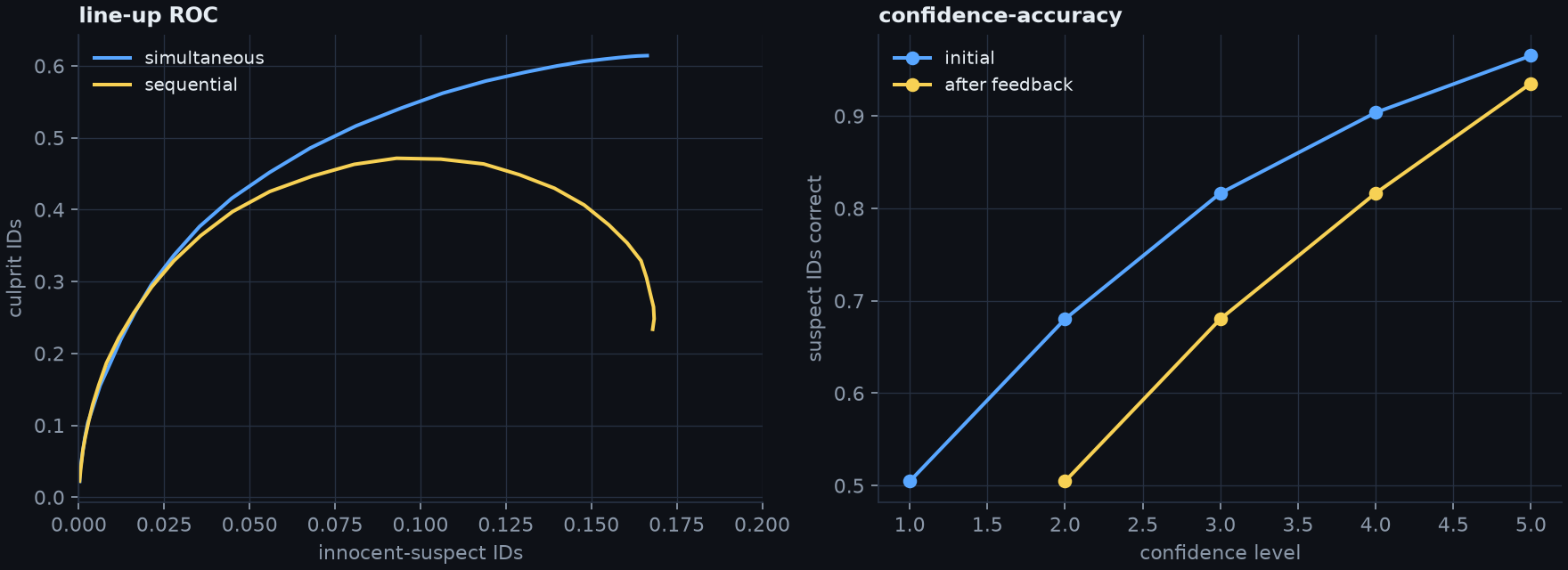
The ROC curve reversed it. Here are two typical operating points. Simultaneous, with a diagnosticity ratio of about five. Sequential, more cautious, with about seven and a half. By the ratio, sequential looks better. Now the whole curves. At every rate of false identifications, the simultaneous line-up gives more correct ones. John Wixted and Laura Mickes made this argument in 2014, and laboratory and field data since agree: the sequential procedure mostly shifts the criterion, and loses a little discrimination. The 2020 recommendations no longer prefer sequential line-ups. A reform the field had championed was reversed by its own better measurement.
What it does: A reform adopted; the ROC reverses it
4ConfidencePsych 101 and the major1 min
Can a witness's certainty be trusted? The old view said confidence is nearly useless, because overall the correlation between confidence and accuracy is low. The better question asks: among identifications made with high confidence, what share are right? That's the confidence-accuracy characteristic. In Psyche, about half are right at the lowest confidence, and ninety-six percent at the highest. John Wixted and Gary Wells concluded in 2017 that a high-confidence initial identification, made under clean procedure, is highly diagnostic, and a low-confidence one is a warning.
But confidence grows after the fact. In 1998 Gary Wells and Amy Bradfield found that witnesses told good, you identified the suspect became more confident, and remembered having a better view. In Psyche, the same feedback raises every suspect-picker by about one level. At the top level, accuracy falls from ninety-six percent to ninety-three, and the top level now holds twice as many identifications. By the trial, months later, a witness who said maybe number three says I'll never forget that face. So the confidence that counts is the first one, recorded at the line-up, in the witness's own words.
What it does: Initial confidence under clean procedure; confidence grows after the fact
5System variables and the reformsPsych 101 and the major1 min
What can the police control?
System variables are the ones the justice system controls, and the reforms target them. Double-blind administration: the officer running the line-up doesn't know who the suspect is. That's Part 2's Clever Hans, removed. Instructions that the person may or may not be present, which give permission to pick no one. Fair fillers: the suspect shouldn't stand out, and fillers match the witness's description. The first statement of confidence, recorded in the witness's own words, before any feedback. And one line-up only. A witness shown the same suspect twice has seen him before, so the second test is contaminated. Gary Wells and colleagues' 2020 recommendations set these out.
What about real line-ups? In the field the truth is usually unknown, but one kind of error is visible: a filler picked is always a mistake. In John Wixted and colleagues' study of a Houston police department's line-ups, filler picks were common at low confidence and rare at high confidence. That's the pattern the laboratory predicts. A clean first identification made with high confidence is usually of the person the witness saw. And the cases that went wrong in the exonerations mostly involved low or unrecorded initial confidence, suggestive procedure, or repeated identifications.
What it does: What the system controls; real line-ups
6False confessionsPsych 101 and the major2 min
Why would an innocent person confess? In 1996 Saul Kassin and Katherine Kiechel had students type letters, warned that pressing the ALT key would crash the computer. It crashed, and they were accused. None had pressed it. Asked to sign a confession, about two thirds signed. When a confederate said she'd seen them press it, false evidence, and the pace was fast, nearly all signed, and some came to believe it. A laboratory confession costs nothing. The point is the mechanism: false evidence and pressure change what people say, and sometimes what they remember.
How does interrogation produce false confessions? Isolation and time: confessions in the exoneration cases followed long interrogations. The false evidence ploy: lying about evidence is legal in some countries, including the United States, and it shifts the suspect's sense of what is hopeless. Minimization: suggesting leniency without promising it, like anyone would have done it. Young people and those with intellectual disability confess falsely more often. And then the jury: a confession weighs with jurors more than almost any other evidence, even when they're told it was coerced.
What's the alternative? After false confessions in the nineteen seventies and eighties, police in England and Wales adopted the PEACE model in the early nineteen nineties, with interviews recorded. PEACE stands for preparation and planning, engage and explain, account, closure, and evaluate. The aim is information, not a confession. In 2014 Christian Meissner and colleagues reviewed the experiments: information-gathering interviews kept true confessions and reduced false ones, compared with accusatory methods. And a full recording lets a court see what was said to the suspect, not only what the suspect said.
What it does: The ALT key; how interrogation produces them
7Detecting liesPsych 101 and the major1 min
Can anyone tell when someone is lying? In 2006 Charles Bond and Bella DePaulo pooled two hundred and six studies with about twenty-four thousand judges. They were right fifty-four percent of the time, where fifty is chance. People judge truths better than lies: a truth bias, Part 12's criterion set toward believing. Police officers and other professionals do little better, and they're more confident. The cues people use, averted gaze and fidgeting, are barely related to lying. The signal is weak, so no criterion can do much.
And machines? The polygraph records arousal: breathing, sweating and heart rate. But arousal isn't deception. In 2003 the US National Research Council's review found it better than chance in testing about a specific incident, far from perfect, and unsound for screening many people for a few spies. The screening problem is Part 51's alarm: at a low base rate, most alarms are false. Brain-scan lie detection, Part 8's row, hasn't done better outside the laboratory. The most promising methods ask what a suspect knows, not whether they're nervous.
What it does: Fifty-four percent; the polygraph
8Experts are peopleGraduate2 min
Does an expert see what the context leads them to see? In 2004 the FBI misidentified a lawyer in Oregon as the source of a fingerprint from the Madrid train bombings, and three examiners agreed. In 2006 Itiel Dror, David Charlton and Ailsa Peron showed five experienced examiners, without their knowing it, prints they had themselves matched years before, with the context that these were the Madrid misidentification. Four of the five changed their conclusion. Later studies found the effect mostly on difficult prints. Context fills in where the data are ambiguous, as Part 14's priors do.
Forensic science has been reviewed. In 2009 the US National Research Council concluded that, apart from DNA, few forensic methods had been shown to identify a single source reliably. In 2016 the President's science advisers asked for error rates measured in black-box studies, examiner by examiner. Examiners surveyed in 2017 mostly agreed that bias affects forensic judgement, and mostly denied that it affected their own. That's the bias blind spot, which is why training alone isn't enough. And black-box studies have found low but real false-positive rates for fingerprints, and higher ones for some other methods.
The remedy is the one psychology gave medicine: blinding. Itiel Dror and colleagues proposed linear sequential unmasking: examine and document the crime-scene trace first, before seeing the suspect's sample. Then compare, and record any change of mind with its reason. The order stops the suspect's print from guiding what is seen in the smudge. A case manager filters what reaches the examiner: no confession, no detective's hunch, only what the comparison needs. And blind proficiency tests, slipped into casework, measure the error rate the court should hear.
What it does: The same fingerprints, again; forensic science reviewed
9Children, suggestion and implanted memoriesPsych 101 and the major2 min
Can questioning create a memory? In the nineteen eighties a series of American day-care abuse prosecutions rested on children's accounts, produced by repeated, leading interviews. In Stephen Ceci and Maggie Bruck's experiments, young children asked repeatedly about events that never happened came to report them, with detail. The interviews in the cases used exactly the techniques the experiments showed were dangerous: repetition, rewards for answers, and the other children told us. Most of the convictions were later overturned. Preschoolers were the most suggestible. Older children and adults are less so, though not immune.
So how should a child be interviewed? The NICHD protocol, developed by Michael Lamb and colleagues, builds rapport, practises telling a neutral event in detail, and then invites free recall: tell me everything that happened. Open prompts, like tell me more about that, draw longer and more accurate accounts than yes-or-no and option questions. No repeated questions, no rewards for answers, and no other children told us. The day-care cases' errors are removed by design. Field studies of trained interviewers found more information from open prompts, and young children can give reliable accounts when they're asked this way.
This led to the memory wars. Part 21 entered the rows: the misinformation effect, and false memories for whole events, like being lost in a shopping mall as a child. In the nineteen nineties, therapy that searched for repressed memories of abuse produced accusations, some later retracted. The research doesn't show that real abuse is rarely forgotten, or often falsely remembered. It shows that suggestive techniques can create detailed, confident, false memories. For a court, how a memory was obtained matters as much as how confident it is. That's chapter four's lesson, again.
What it does: The day-care cases; the memory wars
10Juries and judgesGraduate2 min
How are verdicts and sentences reached? Nancy Pennington and Reid Hastie's story model: jurors build a story from the evidence, and choose the verdict that fits it best. Evidence presented in story order persuades more. Anchoring: Birte Englich, Thomas Mussweiler and Fritz Strack found that experienced judges' sentences moved toward a number from a die they'd thrown themselves. That's Part 26. Deliberation: groups correct some individual errors, and amplify others, as in Part 34's group polarization. And jurors told to ignore evidence often can't.
Then there are the hungry judges. In 2011 Shai Danziger, Jonathan Levav and Liora Avnaim-Pesso reported that Israeli parole boards granted about sixty-five percent of requests after a food break, falling to near zero just before the next. Read as mental fatigue or hunger, it became one of psychology's most quoted findings. But Keren Weinshall-Margel and John Shapard noted that the order of cases wasn't random. Prisoners without lawyers, who were usually refused, were heard last in each session. And Andreas Glockner's simulations showed that the boards' practice of ending a session before an expected long case could produce much of the pattern by itself. The Ledger says contested. The decline is real in the data, and what causes it is not settled.
What it does: The story model, anchoring and deliberation; hungry judges
11Risk assessmentPractice2 min
Can a formula predict who will reoffend, fairly?
Can a formula predict who'll reoffend, and fairly? Part 39's Meehl found that a formula combining a few factors usually predicts at least as well as a clinician's judgement. Risk tools for bail, sentencing and parole score age, criminal history and other factors. Their accuracy is moderate, with areas under the ROC curve around zero point seven. Julia Dressel and Hany Farid found in 2018 that untrained people online predicted reoffending about as accurately as a commercial tool, around sixty-five percent. So the question isn't machine against human. It's what the tool's errors are, and who bears them.
Here's why fairness is hard. Take one risk score, calibrated in both groups, so the same score means the same chance of reoffending. The base rates are thirty and fifty percent, and the tool flags anyone above fifty percent risk. The false-positive rates are ten percent in group A and twenty-eight in group B, and the false negatives run the other way. Alexandra Chouldechova, and Jon Kleinberg and colleagues, proved in 2016 and 2017 that with unequal base rates, no score can be calibrated and have equal error rates in both groups. ProPublica's 2016 analysis and the tool's makers were each right, by a different definition. Choosing the definition is a decision about values. Statistics, Built's Part 63 works it through.
What it does: Actuarial against clinical; calibrated and unequal
12Numbers in courtPractice2 min
Can a standard error decide a life? In 2002 the US Supreme Court ruled that people with intellectual disability may not be executed, and left the states to set the tests. Florida treated an IQ score above seventy as conclusive, so a man scoring seventy-one couldn't show disability. Part 3's standard error says otherwise. With a reliability of zero point nine seven, the standard error is about two and a half points, and a ninety-five percent interval for seventy-one runs from sixty-six to seventy-six. In 2014 the Court held that a state must consider the standard error, and other evidence, when a score is near the line. Psychometrics became constitutional law.
There's a second number in these cases. Part 32's Flynn effect: scores on a test rise over the years after its norms were set, by about a third of a point a year for many tests in the twentieth century. So a person tested on old norms scores higher than on new ones. A seventy-two on a test normed fifteen years earlier is roughly sixty-seven and a half on current norms. Courts have split over whether to adjust. The arithmetic is simple. Whether an average trend applies to one person isn't, which is Part 47's question. The general lesson: a score in court is an estimate, with an error and a date, not a fact about a person.
What it does: Hall v. Florida; the Flynn effect in capital cases
13The LedgerGraduate1 min
What the six have in common. The reliable findings are about procedure: what a line-up, an interrogation or an examination does to the evidence. The failures came from measuring a procedure by one number, or reading a pattern without its design. The law took up the research, and then took up its correction. So here's the answer to this part's question. A court should trust a memory, a confession or an expert as far as the procedure that produced it deserves.
What it does: Six rows; what they have in common
14In practice: weighing an identificationPractice2 min
How much should one identification move a jury?
Where is this a job? In police procedure: line-up protocols, interview training and recording. In expert testimony: psychologists explaining memory, confession and risk research to courts. In forensic laboratories: blinding, proficiency testing and error-rate studies. And in forensic assessment: competence, risk and capacity evaluations, with tests whose errors are stated.
Here's a worked case: the weight of one identification. Bayes's rule, from Part 14: the posterior odds of guilt are the prior odds times the likelihood ratio of the evidence. Take an identification of the suspect under Psyche's moderate criterion. The correct-identification rate is about zero point five six, and the rate of picking an innocent suspect about zero point one one, so the likelihood ratio is about five. Prior odds of one to ten become about one to two. That's important evidence, not proof. With high initial confidence the ratio is far larger. With low confidence, a biased line-up or repeated viewing, it's much smaller. An expert's job is to give the court the procedure's error rates and the confidence first recorded, not a verdict.
The same pick means different things in different investigations. The horizontal axis is how strong the case against the suspect was before the line-up. That's the investigation, not the witness. With the moderate witness, a suspect who was fifty percent likely to be the culprit becomes eighty-four percent likely. One who was ten percent likely becomes only thirty-seven percent. A line-up built around a weak suspect turns a good witness into weak evidence. Most of the identification's meaning came from the police work before it. A strict witness, one with high confidence at the first viewing, moves the same prior much further. So record that confidence, in the witness's own words, at once.
What it does: Where this is a job; the likelihood ratio of a pick
15Frontier: machines, interviews and toolsResearch1 min
What will change in the courtroom? Machine face recognition is far better than people in good images, worse in poor ones, and has error rates that differ across groups. A match is a lead, not an identification. In some face-matching studies, examiners and algorithms combined did better than either alone. Interviewing methods like the cognitive interview and PEACE get more correct detail without more errors. And risk tools are coming under laws that require validation and bias audits, as hiring tools are.
And the open problems. Field ground truth: how accurate are real identifications? Exonerations are a biased sample. Memory over months: what a year of retelling does to a witness's account. Juries and statistics: how to present a likelihood ratio so that jurors use it correctly. And which fairness: what a risk tool owes each group when base rates differ.
What it does: What is new; open problems
Recap, problems, and the road aheadAll tracks3 min
First, your four numbers. When the culprit was absent, sixty-four percent of Psyche's witnesses still picked someone. Lie judgements are right fifty-four percent of the time. About two thirds of falsely accused students signed a confession. And an IQ of seventy-one, from a test with reliability zero point nine seven, has an interval from sixty-six to seventy-six. Evidence is as good as the procedure that produced it.
Part fifty-six in twelve lines. Most early DNA exonerations involved a mistaken witness. A line-up is signal detection, so judge it by its ROC. Sequential line-ups shift the criterion. Initial high confidence is diagnostic, and later confidence isn't. Run line-ups double-blind, with fair fillers and confidence recorded. False evidence produces false confessions. Lie detection runs at fifty-four percent. Context bends experts on ambiguous evidence. Suggestion can create detailed false memories. Hungry judges may be the order of cases. Calibration and equal error rates can't both hold. And a score in court has an error and a date.
Where this comes back. Assessment and care in health are Part 57. Prediction and risk in psychiatry are Part 59. Fairness in machines is Part 60. And the incentives that shape science itself are Part 61.
Seven problems, with full solutions in this part's README. One weighs an identification by Bayes's rule. One finds how often a fair line-up catches an innocent suspect. One explains why a better ratio can mean a worse curve. One computes lie-detection accuracy. One puts an interval on an IQ score. One explains the impossibility result. And the last, with the star, asks you to write a line-up protocol for a police force. Pause here if you'd like to try them.
The books and papers behind this part are listed here and in the README. Garrett's book tells the exoneration cases; Wixted and Wells's review is the modern account of confidence; and the 2020 recommendations are the procedure.
Six parts of Act Twelve are done. This one weighed memories, confessions and experts by the procedures that produced them. The last part of the act goes to health and care. How can psychology reach everyone who needs help? Part 57: health and care.
Where it goes next. Part 57 takes assessment into health care; Part 59 takes prediction into psychiatry; Part 60 returns to fairness in machines.
Key results
The part's results in one place, for revision.
Try it
Lab 56 · Psychology and Law
Compare line-up procedures by their whole ROC rather than one ratio, see confidence inflate after feedback, and find why a calibrated risk score cannot have equal error rates across groups.
python -m videos.psychology.labs 56
needs numpy, scipy, matplotlib · download lab56.py ·
source on GitHubpartial ROC area: simultaneous; sequential 0.079; 0.065
top-level accuracy: initial; after feedback 0.965; 0.935
false-positive rate, base 0.3; base 0.5 0.10; 0.28
IQ 71, reliability 0.97: 95% interval 65.9 to 76.1
A procedure is judged by the trade-off it offers, not one ratio; the first confidence is the useful one; fairness definitions conflict whenever base rates differ.The code (53 lines; it asserts its own result)
"""Lab 56: psychology and law: simultaneous and sequential line-ups by ROC, confidence and feedback, a calibrated
risk score across groups, and the error around a test score."""

import numpy as np

from videos.coursekit import labs
from explainer.psychology.psyche import work as Wk

TITLE = "Psychology and Law"
GOAL = ("Compare line-up procedures by their whole ROC rather than one ratio, see confidence inflate after feedback, "
        "and find why a calibrated risk score cannot have equal error rates across groups.")
TASKS = [
    "Lower the culprit's memory strength (d' = 1.0). Does the simultaneous advantage grow or shrink?",
    "Make the feedback boost two levels. What happens to accuracy at the top confidence level?",
    "Give the two groups equal base rates. Do the error rates now match?",
]


def run(seed=0):
    out = labs.Lab()
    s = Wk.lineup_roc("simultaneous", n=60000, seed=seed + 1)
    q = Wk.lineup_roc("sequential", n=60000, seed=seed + 2)
    up = float(min(s["fa"].max(), q["fa"].max()))
    ps, pq = Wk.partial_auc(s["fa"], s["hit"], up), Wk.partial_auc(q["fa"], q["hit"], up)
    assert ps > pq
    out.row("partial ROC area: simultaneous; sequential", f"{ps:.3f}; {pq:.3f}")
    c = Wk.confidence_feedback(n=100000, seed=seed + 3)
    assert c["initial"][-1] > c["after"][-1]
    out.row("top-level accuracy: initial; after feedback", f"{c['initial'][-1]:.3f}; {c['after'][-1]:.3f}")
    r = Wk.risk_groups(n=200000, seed=seed + 4)
    assert r[0.5]["fpr"] > r[0.3]["fpr"]
    out.row("false-positive rate, base 0.3; base 0.5", f"{r[0.3]['fpr']:.2f}; {r[0.5]['fpr']:.2f}")
    iv = Wk.score_interval(71, 0.97)
    out.row("IQ 71, reliability 0.97: 95% interval", f"{iv['lo']:.1f} to {iv['hi']:.1f}")

    out.note = ("A procedure is judged by the trade-off it offers, not one ratio; the first confidence is the useful "
                "one; fairness definitions conflict whenever base rates differ.")

    fig, ax = labs.figure(2, size=(11, 4.0))
    ax[0].plot(s["fa"], s["hit"], label="simultaneous")
    ax[0].plot(q["fa"], q["hit"], label="sequential")
    ax[0].set(xlim=(0, 0.2), title="line-up ROC", xlabel="innocent-suspect IDs", ylabel="culprit IDs")
    ax[0].legend()
    ax[1].plot(c["levels"], c["initial"], "o-", label="initial")
    ax[1].plot(c["levels"][1:], c["after"][1:], "o-", label="after feedback")
    ax[1].set(title="confidence-accuracy", xlabel="confidence level", ylabel="suspect IDs correct")
    ax[1].legend()
    out.fig = fig
    return out


if __name__ == "__main__":
    print(run())
Now change it
- Lower the culprit's memory strength (d' = 1.0). Does the simultaneous advantage grow or shrink?
- Make the feedback boost two levels. What happens to accuracy at the top confidence level?
- Give the two groups equal base rates. Do the error rates now match?
Problems, with solutions
Try each problem before opening its solution.
-
Weighing a pick. A line-up: correct-ID rate 0.60, innocent-suspect rate 0.05. The diagnosticity ratio, and the posterior odds from prior odds 1:4?
Solution
The diagnosticity ratio is 0.60/0.05 = 12; posterior odds = 1/4 x 12 = 3, about 3 to 1 for guilt (75%), if the procedure was clean.
-
A fair line-up. Six faces, culprit absent, a fair line-up and a witness who picks someone 60% of the time: how often is the innocent suspect picked?
Solution
In a fair culprit-absent line-up each face is equally likely to be picked: 0.60/6 = 0.10.
-
Ratio against curve. Why can a higher diagnosticity ratio come with a worse ROC? Draw two curves.
Solution
The diagnosticity ratio rises as the criterion becomes stricter, along any one ROC; a procedure that only makes witnesses more cautious moves down its curve to a higher ratio, while its curve can lie below another procedure's everywhere.
-
Lie judgements. Lie judgements: 61% of truths and 47% of lies judged correctly. Overall accuracy with equal numbers?
Solution
(0.61 + 0.47)/2 = 0.54.
-
An interval. IQ 69, reliability 0.95, SD 15: the SEM and the 95% interval.
Solution
SEM = 15 sqrt(0.05) = 3.35; 69 +/- 1.96 x 3.35 = 62.4 to 75.6.
-
Impossibility. Base rates 0.2 and 0.4, one calibrated score: explain why the false-positive rates must differ.
Solution
If the same score means the same risk in both groups, the higher base-rate group has more people at high scores, so more of its non-reoffenders are flagged too: its false-positive rate must be higher at any shared threshold, unless prediction is perfect.
-
★ A protocol. Write the line-up protocol for a police force, with the reason for each rule.
Solution
Double-blind administration (no cueing); unbiased instructions ("may or may not be present"); one suspect per line-up with fillers matching the description; an immediate confidence statement in the witness's words, recorded; video of the procedure; no repeated line-ups with the same suspect; no feedback.
Notes and sources
Sources
- B. L. Garrett, Convicting the Innocent (Harvard University Press, 2011).
- S. E. Clark, A memory and decision model for eyewitness identification, Applied Cognitive Psychology 17 (2003) 629-654; J. T. Wixted and L. Mickes, A signal-detection-based diagnostic-feature-detection model of eyewitness identification, Psychological Review 121 (2014) 262-276; G. L. Wells, Applied eyewitness-testimony research: system variables and estimator variables, Journal of Personality and Social Psychology 36 (1978) 1546-1557.
- R. C. L. Lindsay and G. L. Wells (1985); L. Mickes, H. D. Flowe and J. T. Wixted (2012); G. L. Wells et al. (2020).
- P. Juslin, N. Olsson and A. Winman (1996); G. L. Wells and A. L. Bradfield (1998); J. T. Wixted et al. (2016); J. T. Wixted and G. L. Wells (2017).
- S. M. Kassin and K. L. Kiechel (1996); M. B. Russano et al. (2005); S. M. Kassin et al. (2010).
- C. F. Bond and B. M. DePaulo (2006, 2008); M. Hartwig and C. F. Bond (2011); National Research Council, The Polygraph and Lie Detection (2003).
- I. E. Dror, D. Charlton and A. E. Peron (2006); I. E. Dror and D. Charlton (2006); J. Kukucka and S. M. Kassin (2014); National Research Council, Strengthening Forensic Science in the United States (2009); President's Council of Advisors on Science and Technology, Forensic Science in Criminal Courts (2016).
- S. J. Ceci and M. Bruck, Jeopardy in the Courtroom (American Psychological Association, 1995); E. F. Loftus and J. E. Pickrell, The formation of false memories, Psychiatric Annals 25 (1995) 720-725.
- N. Pennington and R. Hastie, Evidence evaluation in complex decision making, Journal of Personality and Social Psychology 51 (1986) 242-258; B. Englich, T. Mussweiler and F. Strack, Playing dice with criminal sentences, Personality and Social Psychology Bulletin 32 (2006) 188-200; S. Danziger et al. (2011); K. Weinshall-Margel and J. Shapard (2011); A. Glockner (2016).
- J. Dressel and H. Farid, The accuracy, fairness, and limits of predicting recidivism, Science Advances 4 (2018) eaao5580; A. Chouldechova, Fair prediction with disparate impact, Big Data 5 (2017) 153-163; J. Kleinberg, S. Mullainathan and M. Raghavan, Inherent trade-offs in the fair determination of risk scores (2016); J. Angwin, J. Larson, S. Mattu and L. Kirchner, Machine bias, ProPublica (2016).
- Atkins v. Virginia, 536 U.S. 304 (2002); Hall v. Florida, 572 U.S. 701 (2014).
About this partfrom its README
A witness picks a man from a line-up and is certain; years later DNA shows it was someone else. Mistaken identification figures in about three quarters of the first 250 DNA exonerations in the United States. The psychology of the courtroom is Parts 12 and 21 with a person's liberty attached, and for once the research changed the practice. Then it changed its own mind about one of its reforms.
The viewer takes a line-up and predicts four numbers. Then the line-up as signal detection and the estimator variables; simultaneous against sequential line-ups, and the ROC analysis that reversed a reform; confidence, its calibration and its inflation; the system variables and the 2020 recommendations, with field data; false confessions and interrogation; lie detection at 54% and the polygraph; context bias in forensic experts and the reviews of forensic science; children's suggestibility and the memory wars; the story model, anchoring and the hungry judges; risk tools and the impossibility result; and the standard error of an IQ score in Hall v. Florida.
What is computed and built
explainer/psychology/psyche/work.pygains simultaneous and sequential line-ups by signal detection with ROC curves, diagnosticity ratios and partial areas, confidence and feedback inflation, a calibrated risk score's error rates across groups, and score intervals. Tested intests/psychology/test_work.py.- The Ledger gains six rows.
- The course's interactive: a staged event, a six-person line-up with confidence, and the reader's pick set beside the model's rates.
Chapter notes
| # | Chapter | What it does |
|---|---|---|
| 0 | A certain witness | The exonerations; the question; objectives |
| 1 | On you: a line-up, and four numbers | The line-up; four predictions |
| 2 | The line-up as signal detection | Six faces, one criterion; estimator variables |
| 3 | Simultaneous against sequential | A reform adopted; the ROC reverses it |
| 4 | Confidence | Initial confidence under clean procedure; confidence grows after the fact |
| 5 | System variables and the reforms | What the system controls; real line-ups |
| 6 | False confessions | The ALT key; how interrogation produces them |
| 7 | Detecting lies | Fifty-four percent; the polygraph |
| 8 | Experts are people | The same fingerprints, again; forensic science reviewed |
| 9 | Children, suggestion and implanted memories | The day-care cases; the memory wars |
| 10 | Juries and judges | The story model, anchoring and deliberation; hungry judges |
| 11 | Risk assessment | Actuarial against clinical; calibrated and unequal |
| 12 | Numbers in court | Hall v. Florida; the Flynn effect in capital cases |
| 13 | The Ledger | Six rows; what they have in common |
| 14 | In practice: weighing an identification | Where this is a job; the likelihood ratio of a pick |
| 15 | Frontier: machines, interviews and tools | What is new; open problems |
| Recap, problems, and the road ahead | Your numbers; twelve lines; payoffs; problems; references; Part 57 |
NotesWhere the numbers come from
| What | Source |
|---|---|
| Line-ups: six faces, the culprit's memory strength N(1.5, 1), others N(0, 1); simultaneous (max rule) and sequential (first face past the criterion) procedures, 100,000 simulated line-ups each, 33 criteria; at the criteria shown, simultaneous correct-ID 0.56 and innocent-suspect 0.11 (diagnosticity 5.3), sequential 0.43 and 0.06 (7.5); partial areas up to a false-ID rate of 0.16: 0.078 against 0.065 | Psyche (work.lineup_roc, partial_auc), item roc |
| The on-you line-up at a moderate criterion: culprit present 56% culprit, 31% filler, 13% no one; culprit absent 64% pick someone, 11% the innocent suspect | Psyche, item onyou |
| Confidence-accuracy: five confidence levels; initially 52%, 68%, 82%, 90% and 96% of suspect IDs correct; after feedback raising every suspect-picker one level, 93% at the top level, which holds twice as many IDs | Psyche (work.confidence_feedback), item cac |
| One calibrated risk score (d = 1.2) in groups with base rates 0.3 and 0.5, flagging above 50% risk: false-positive rates 10% and 28%, false-negative rates 54% and 27% | Psyche (work.risk_groups), item risk |
| IQ 71 with reliability 0.97: SEM 2.6, 95% interval 66 to 76 | Psyche (work.score_interval), item iq |
| Every published number on screen | the studies listed under Sources, quoted as reported |
Notes
| Finding | Original | Status |
|---|---|---|
| Sequential line-ups, one face at a time, are better than simultaneous ones at separating guilty from innocent suspects. | Lindsay and Wells 1985 | failed |
| Under fair, double-blind procedures, an eyewitness's initial high-confidence identification is usually accurate. | Juslin, Olsson and Winman 1996 | replicated |
| Innocent people accused of a minor laboratory offence often sign a confession, especially when presented with false evidence. | Kassin and Kiechel 1996 | replicated |
| People judging whether others are lying are only slightly better than chance. | Bond and DePaulo 2006 | replicated |
| Forensic examiners' conclusions can be changed by irrelevant contextual information. | Dror, Charlton and Peron 2006 | replicated |
| Judges grant parole far more often after a food break, and almost never just before one. | Danziger, Levav and Avnaim-Pesso 2011 | contested |
Shown without a row, with the reason recorded in explainer/psychology/ledger.py: Garrett; Lindsay and Wells; Wells
and colleagues; Kassin and colleagues; Ceci and Bruck; Englich, Mussweiler and Strack; Dressel and Farid.
Notes
The web-search budget for this session was spent on earlier parts, so the facts in this part come from the standard literature and were not re-checked online today; each is listed here to be checked against its source: Garrett's share of the first 250 exonerations; Clark (2003); Wells's system and estimator variables; Lindsay and Wells (1985); Mickes, Flowe and Wixted (2012); the field comparison of procedures; the 2020 recommendations and their list; Juslin et al. (1996); Wells and Bradfield (1998); the Houston field study; Kassin and Kiechel's 79 students and shares; Russano et al. (2005); Kassin et al. (2010); PEACE; Bond and DePaulo's 206 studies, 24,000 judges, 54%, 61% and 47%; the 2003 polygraph review; the Mayfield case; Dror, Charlton and Peron's five examiners and four changes; Kukucka and Kassin (2014); the 2009 and 2016 reviews; Ceci and Bruck's experiments; the day-care cases and convictions overturned; the NICHD protocol; Pennington and Hastie; Englich et al.'s dice; Danziger et al.'s 1,112 rulings and 65%; the replies; Dressel and Farid's 65%; Chouldechova and Kleinberg et al.; ProPublica's analysis; Atkins and Hall; the Flynn rate of about 0.3 points a year; machine face recognition and the human-machine combination studies; the PEACE model's adoption in England and Wales and its stages; Meissner et al. (2014); Dror et al. (2015) on linear sequential unmasking; the NICHD protocol's field studies (Lamb and colleagues); Kassin and Sukel (1997) on the weight jurors give a coerced confession; Kukucka, Kassin, Zapf and Dror (2017) on forensic examiners' bias blind spot; the age gradient in children's suggestibility (Ceci and Bruck); and every page range in Sources. Chapter fourteen's posterior curves use Psyche's simulated line-up rates at three criteria.
Companion material in this repository
The syllabus's plan for this partfrom SYLLABUS.md, the plan of record
- Hook and On you: a staged event, then a six-person line-up.
- The line-up as signal detection (Part 12): culprit-present and culprit-absent line-ups; hits and false identifications of the innocent.
- Simultaneous against sequential: the diagnosticity-ratio argument for sequential line-ups, and the ROC analysis that reversed it (sequential mostly shifts the criterion).
- Confidence: once thought nearly useless; now, initial high confidence under clean procedures is highly diagnostic, and confidence inflates with feedback.
- System variables against estimator variables; the reforms: double-blind administration (Part 2's horse), fair fillers, recorded confidence.
- False confessions: the laboratory paradigm in which most innocent students sign; interrogation tactics and the false evidence ploy; documented cases.
- Lie detection: people at 54%; the polygraph's record; why cue-based detection fails.
- Experts are people: fingerprint examiners changing their own earlier conclusions when given context; the 2009 and 2016 reviews of forensic science; linear sequential unmasking.
- Children as witnesses and suggestibility; the day-care cases; implanted memories (Part 21) and the memory wars.
- Juries: the story model; anchoring in sentencing; the "hungry judges" finding and its artefact.
- Risk assessment: actuarial against clinical prediction (Part 39); a risk tool's error rates across groups and the impossibility result (link to Statistics, Built Part 63).
- Numbers in court: the standard error of an IQ score becomes constitutional law (Hall v. Florida, 2014); the Flynn effect and capital cases.
Psyche: psyche.work: a line-up model on Part 12's observer and Part 21's memory (simultaneous and sequential
procedures, ROC and confidence–accuracy curves); an interrogation decision model.
On you: the line-up, with your confidence.
Ledger: sequential line-up superiority (failed on ROC analysis); high-confidence initial identifications
being accurate under good procedure (replicated); the laboratory false-confession effect (replicated);
human lie detection near chance (replicated); contextual bias in forensic examiners (replicated); the
hungry-judges effect (contested: case ordering explains much of it).
In practice: police procedure, expert testimony, forensic laboratories, forensic assessment; a worked
evaluation of an identification's evidentiary weight.
Frontier: machine face recognition beside human witnesses; interviewing methods that work; risk tools under
scrutiny.
Reading: Wells et al. 1998, 2020; Wixted & Wells 2017; Wixted & Mickes 2014; Kassin et al. 2010; Kassin &
Kiechel 1996; Bond & DePaulo 2006; Dror, Charlton & Péron 2006; National Research Council 2009, 2014; Ceci &
Bruck 1995; Garrett, Convicting the Innocent.
Build the film
python -m videos.psychology.psych56.compute        # the part's numbers, into .cache/psych56
python tools/build.py psych56                  # render and assemble the film
EXPLAINER_TTS=silent python tools/qa_scene.py psych56 Hook   # one chapter, silent, with a contact sheet
Scenes: videos/psychology/psych56. Setup: see the course page. Source of these notes: the README and the scenes' narration.
Build it
python -m videos.psychology.psych56.compute            # every number (a minute)
python tools/qa_scene.py psych56 Sequential            # one chapter, silent, at 480p, with a contact sheet
EXPLAINER_TTS=silent python tools/build.py psych56 -q l   # the whole part, silent preview
python tools/build.py psych56                          # 1080p30 with narration
python tools/qa_scene.py psych56 Confidence --lang zh  # the Chinese edition of one chapter
python tools/make.py psych56                           # both editions, with the checks a long build needs
python -m videos.psychology.labs 56                    # the lab: line-up ROCs, confidence, risk across groups
python tools/check_ledger.py psych56                   # every study shown has its Ledger row, or a reason
python -m pytest tests/psychology                      # Psyche's work module, the Ledger, the Archive
The Chinese edition is zh_lines.py (the narration, line by line) and the series table
videos/psychology/psychology_text_zh.json (the text on screen); the terms are in
PSYCHOLOGY_ZH_GUIDE.md.