Chemistry and Clocks
Why is the same mind so different at four in the afternoon and at four in the morning?
In 1938 two men live for a month in a cave on a day of twenty-eight hours. One man's temperature rhythm follows the schedule; the other's keeps to twenty-four hours, with no sun to copy. The body has a clock. Left alone it runs at 24.18 hours, which the same 28-hour trick showed sixty years later; it sits above the crossing of the optic nerves, each of its cells a loop of genes that switch themselves off; and a model of it locks to days of 23 to 25 hours and no others. Light sets it through cells in the eye that make no pictures: later if it falls before the temperature's low point, earlier if after, so a flight leaves the clock behind for days. In the laboratory sleep turns out to have stages in ninety-minute cycles, one of them with darting eyes and dreams. Two processes time it: a pressure that rises over eighteen hours awake and falls over four asleep, and thresholds the clock moves. Together they give an eight-hour night, a recovery sleep only half an hour longer after forty hours awake, and a second wind the next afternoon. The viewer works out a chronotype. Two weeks on six hours a night impair attention as much as two nights awake, and the sleepers do not know it. Cueing a memory in deep sleep strengthens it a little; what dreams are for is open. Hormones are a broadcast: the stress loop's product shuts off its own source, unless the brake is worn. A drug mimics a transmitter, blocks its receptor, keeps it in the gap or turns the receptor up; occupancy follows one formula, which also explains why caffeine has a half-life and alcohol does not. And the body answers back: an opposing process that grows with use is tolerance while the drug is there and withdrawal when it is gone, and part of it is learned, so the same dose in a new room kills twice as many rats.
What you need. Part 2's random assignment, Part 4's effect sizes and shrinking effects, Part 6's synapse and Part 7's double dissociation and hippocampus. The clock is two differential equations used as a tool; exponentials and logarithmic axes are assumed.
- Hook
- Kleitman in Mammoth Cave, 1938
- Ideas, models and mathematics
- the clock inside and what light does to it, sleep's stages, the two-process model and a night without sleep, chronotype, sleep loss that goes unnoticed, sleep and memory, dreams, the stress loop, four ways to change a synapse, dose and response, half-lives, tolerance and withdrawal as one process
- Psyche gains
- a body: a clock, a sleep pressure, a stress loop, a dose
- On you
- a vigilance task beside your own rating of alertness
What you will be able to do
Psych 101 and the major
- Say what shows that the body keeps time by itself, where the clock is, and how light sets it.
- Describe the stages of a night's sleep and what the two-process model adds to them.
- Name four ways a drug can change a synapse, and what tolerance and withdrawal have in common.
Graduate
- Compute a clock's daily drift, a chronotype and a social jetlag.
- Work the two-process model by hand: the pressure after a time awake, and the sleep that removes it.
- Use the occupancy formula with and without a blocker, and do half-life arithmetic for repeated doses.
Research
- Explain from the phase response curve why evening light delays the clock and morning light advances it, and what that implies for a traveller or a shift worker.
- Explain why a feedback loop whose product inhibits its source returns to rest, and what changes when the inhibition weakens.
Practice
- Read a claim about sleep and health and say whether sleep was assigned or only observed.
- Plan the timing of light, sleep and caffeine for a given schedule, and say what the models do not cover.
Contents
Each chapter has a home level. Choose a track to see what to read and watch: Psych 101 and the major 52 min · Graduate 56 min · Research 59 min · Practice 56 min.
- 0A month in a cavePsych 101 and the major4 min
- 1A clock insidePsych 101 and the major4 min
- 2Light sets the clockPsych 101 and the major4 min
- 3Sleep, found in the laboratoryPsych 101 and the major3 min
- 4Two processesPsych 101 and the major5 min
- 5On you: your chronotypePsych 101 and the major2 min
- 6What sleep loss doesPsych 101 and the major3 min
- 7What sleep is forPsych 101 and the major4 min
- 8The stress loopPsych 101 and the major5 min
- 9Four ways to change a synapsePsych 101 and the major3 min
- 10Dose and responsePsych 101 and the major5 min
- 11Tolerance and withdrawalPsych 101 and the major3 min
- 12The LedgerPsych 101 and the major3 min
- 13In practice: schedules, schools and insomniaPractice4 min
- 14Frontier: why do we sleep?Research4 min
- Recap, problems, and the road aheadAll tracks5 min
Also on this page: Lecture · Key results · Try it · Lab · Problems · Notes and sources · Build the film.
Lecture
The text of each chapter is the film's narration, as it is spoken, so you can read along or revise without the film. The pictures are in the film. A dashed box stands for a number the film computes when it is rendered (hover over it to see what is computed); the README's figures for each chapter, where it lists them, follow the chapter's text.
A month in a cavePsych 101 and the major4 min
In the early summer of , two men walked into Mammoth Cave in Kentucky, and stayed for days. Nathaniel Kleitman was a physiologist at the University of Chicago, years old, and one of very few scientists anywhere who studied sleep. With him was his student Bruce Richardson, who was . Deep in the cave no daylight reaches, and the temperature never changes. The question they took down with them was simple. Everyone's body runs on a daily rhythm. Body temperature, for one, is lowest before dawn and highest in the evening. Is that rhythm a habit, copied from the sun and the clocks? Or does the body keep time by itself? So they changed the length of the day. They lived by a day of hours: six of their days to seven of everyone else's. They ate, worked and slept by that schedule, and took their temperatures around the clock. If the rhythm is a habit, a month should be enough to retrain it.
Here's what the thermometers showed, drawn as a sketch. The dashed lines are the cave's days. Richardson's rhythm stretched. During the month it came to run close to the cave's hours, with its low point at the same place in each cave day. Kleitman's didn't move. His temperature kept its twenty-four-hour course for the whole month, rising and falling in step with a sun he couldn't see. He grew sleepy at about ten each evening, whatever the cave's schedule said he should be doing. Two men, two answers. As an experiment it's hopeless: with two people, anything could explain the difference. The newspapers suggested age. But Kleitman's stubborn curve was a sign of something that took sixty more years to pin down. Something inside him was keeping time, with no sun and no clock to copy.
Nine parts so far have built the neuron, the circuit, the brain, the instruments that read it, and the genes that vary it. All of them treated the brain as if it were the same at every hour of the day. It isn't. The brain lives in a body. There's a clock in it, and today we'll build one. There's a pressure to sleep that grows through every waking hour, and we'll build that too. There are hormones: signals carried in the blood, slower than any nerve. And there are drugs: molecules from outside that work the brain's own machinery. Each of the four changes what a mind can do, hour by hour. And each can be written down as a small model, with numbers that can be checked. So the question for this part is: what is the same mind doing at four in the afternoon and at four in the morning, and why is it so different?
Part ten: chemistry and clocks. We'll build the clock inside: its period, where it sits, and why a twenty-eight-hour day defeats it. We'll see how light sets the clock, and what a flight across time zones does to it. We'll go into the sleep laboratory, for the stages, the cycles and the dreams. We'll put two processes together to decide when you sleep, and see what losing sleep does, and why you don't notice. We'll meet the hormones, through one loop that switches itself off. And we'll take the drugs: where they act, how much is enough, and why the body fights back.
What it does: The cave and its 28-hour day; two temperature rhythms; the brain lives in a body; objectives
1A clock insidePsych 101 and the major4 min
Sixty years after the cave, a team at Harvard led by Charles Czeisler settled the question, and they did it with Kleitman's own trick. Put people on a -hour day, in dim light, for about a month. The body's clock can't follow a day that long. So it runs at its own pace, and the pace can be read off the body's temperature and its hormones. In people, young and old, the clock's own period averaged hours: twenty-four hours and eleven minutes, and nearly the same in everyone. Earlier experiments had said twenty-five. In those, people switched their own lamps on and off, and the lamps were pushing the clock. At the top is Psyche's clock. It's two equations: an oscillator of a kind engineers have used for a century, with its period set near the published one. Left in the dark, its low point comes a little later each day. Its period is hours. So the clock is real, it's built in, and it's wrong. It loses about ten minutes a day, and something has to set it.
Where is it? Follow the optic nerves back from the eyes, to the point where they cross. Just above that crossing sits a pair of tiny clusters of cells, about twenty thousand neurons in all. It's called the suprachiasmatic nucleus, which means the nucleus above the crossing. Destroy it in a rat, and the animal still sleeps and wakes, but at all hours. The daily rhythm is gone. Transplant one from a hamster bred to have a short day, and the host animal takes on the donor's period. The clock went with the tissue. And it isn't the wiring that keeps time. Each cell does. Inside each one, a set of genes makes proteins that build up over the hours, and then switch their own genes off. The proteins decay, the genes come back on, and the loop goes round again: about once a day. Remember the shape of that. A signal that shuts off its own source, after a delay. A brake that arrives late makes a loop swing. We'll meet it again before the end of this part, in a different tissue.
Now give the clock a day: sixteen hours of ordinary room light, and eight of darkness. It locks on. Its period becomes twenty-four hours exactly, and its low point settles at twenty past four in the morning. That's close to where the low point of body temperature sits in someone who sleeps from eleven to seven. Nobody set that time. It's where the pushes from the light balance out. But light can only pull the clock so far. Shorten the day, or lengthen it, and ask whether the clock follows. Twenty-three hours: yes. Twenty-five: yes. Twenty-two, or twenty-six and beyond: no. So on the cave's -hour day, the model does what Kleitman did. It ignores the schedule, and runs at about hours. And Richardson? The model has one clock, and people's clocks differ: in their period, and in how hard light pushes them. Whether that's why the younger man adapted, nobody can say from two people. What we can say is that Kleitman's result is the one that a clock like this predicts.
What it does: 24.18 hours, and the model clock's drift; where the clock is and the loop inside each cell; locking to a day, and the days it cannot follow
2Light sets the clockPsych 101 and the major4 min
How does light reach the clock? Not through the cells you see with. The retina has rods and cones, which Part 13 will take apart. Around the year 2000 a third kind of light-sensitive cell turned up there: a small number of the retina's output cells, which carry a pigment of their own, most sensitive to blue light. They don't make pictures. They report how bright the world is, and their fibres run straight to the clock. The clock passes the news on. One of its outputs reaches the pineal gland, which releases the hormone melatonin during the night, and stops when light hits the eye. Melatonin is the body's signal that it's dark. So light in the evening does two things. It shuts off the night signal. And, as we'll now see, it moves the clock.
Here's the experiment, on Psyche's clock. Keep it in the dark. Give it three hours of bright light at one time of its day, and measure how far its rhythm has moved. Then repeat, at every other time. The curve that comes out is called a phase response curve, and it has two halves. Light that falls before the low point, in the evening and the first part of the night, moves the clock later: by up to hours. Light after the low point, in the early morning, moves it earlier: by up to . The same light, opposite effects, and the changeover comes in the small hours. Experiments on people give a curve of this shape. Now put two facts together. The clock runs slow, by ten minutes or so a day. Morning light pulls it earlier. So every ordinary morning, daylight makes up the difference, and that's what locking on means. And every evening spent under bright lamps, or in front of a bright screen, pushes the other way.
And now fly somewhere. Cross six time zones, and the sun, the lamps and the meal times all jump six hours at once. The clock doesn't. It's where you left it, and light has to drag it across, an hour or so a day. In the model, six zones take to days, and nine zones take up to . For those days the clock calls for sleep in the afternoon, and for breakfast at midnight. That's jet lag. Nothing is wrong with you except the time. One caution. In this model, flying east comes out easier than flying west. Most travellers report the opposite. The answer depends on exactly when the traveller sees light, before the low point or after it, and the model's traveller keeps a fixed schedule that real ones don't. So take the timescale from the model, days and not hours, and don't take the direction. And think what this means for someone who works nights three days a week. They cross eight time zones on Monday, and come back on Thursday, every week, without leaving town.
What it does: The eye's third kind of light cell and melatonin; a phase response curve, computed; a flight across time zones
3Sleep, found in the laboratoryPsych 101 and the major3 min
Kleitman's laboratory made one more discovery, and it's the one he's remembered for. In the early nineteen-fifties his graduate student, Eugene Aserinsky, spent his nights watching sleepers' eyes. He taped electrodes beside the eyes, and let the pen recorders run all night. For most of the night the pens barely moved. But several times a night, for minutes on end, they went wild. The eyes were darting about under closed lids, quickly and jerkily, as if the sleeper were watching something. So they woke people up, and asked. Woken during the eye movements, sleepers told a detailed dream on of occasions. Woken while the eyes were still, they mostly had nothing to tell. The paper was two pages long. Before it, sleep was thought of as the brain idling, like an engine left ticking over. After it, sleep was something the brain does: an active state, with parts, on a schedule.
Add the E E G of Part 8, with its electrodes on the scalp, and the night falls into stages. Awake, the brain's waves are small and fast. In light sleep they slow down, with short bursts of a faster rhythm called spindles. About half the night is spent here. In deep sleep the waves are large and slow, about one a second, as great numbers of cortical neurons fall silent together and then fire together. It's called slow-wave sleep, and it's the hardest to wake from. And then the stage that Aserinsky found. The brain's waves look almost like waking. The eyes dart. And the muscles of the body are switched off: the brainstem holds them paralysed, which keeps the dreamer from acting out the dream. It's called REM sleep, for rapid eye movement. Its other name is paradoxical sleep: a brain that looks awake, in a body that can't move.
Put the stages on a time line, and a night has an architecture. Down into deep sleep within the first hour. Back up. And a first, short period of REM. Then round again. Each cycle takes about ninety minutes, and there are four or five in a night. The deep sleep comes early. Most of it is over by the middle of the night. The REM comes late. Its periods grow longer toward morning, which is why the dream you remember is usually the last one. This picture has been drawn from thousands of nights, in sleep laboratories everywhere, and it's one of the most repeated observations in psychology. But it's a description. It says what sleep looks like. It doesn't say when sleep comes, or what it's for. Those are the next four chapters.
What it does: The eyes of sleepers and 20 dreams in 27 awakenings; four stages; the architecture of a night
4Two processesPsych 101 and the major5 min
In 1982 the Swiss sleep scientist Alexander Borbély proposed that the timing of sleep comes from two processes, and only two. The first he called process S, for sleep. It's a pressure. While you're awake it rises, quickly at first and then more slowly, toward a ceiling. While you're asleep it falls, about four times as fast. And it isn't a figure of speech. It was measured, from the slow waves of deep sleep. The longer someone has been awake, the larger the slow waves at the start of their sleep, and through the night they die away along this falling curve. The time constants are the published ones: about hours on the way up, and about on the way down. What the pressure is made of is still argued over. One ingredient is a molecule called adenosine, which builds up in the brain during waking. Keep that name in mind. We'll need it in chapter nine.
The second is process C, for circadian: the clock of chapter one. In the model, the clock moves two thresholds up and down through the day. They're lowest in the small hours, and highest around the middle of the day. When the pressure climbs to the upper threshold, sleep begins. When it has fallen to the lower one, sleep ends. So a pressure that would put you to sleep at four in the morning isn't enough to do it at noon. Run it, and the model sleeps from about eleven at night to seven in the morning: hours a night. That by itself proves little, because the thresholds were set so that an ordinary night comes out right. The test of a model is what it says about the nights it wasn't set on.
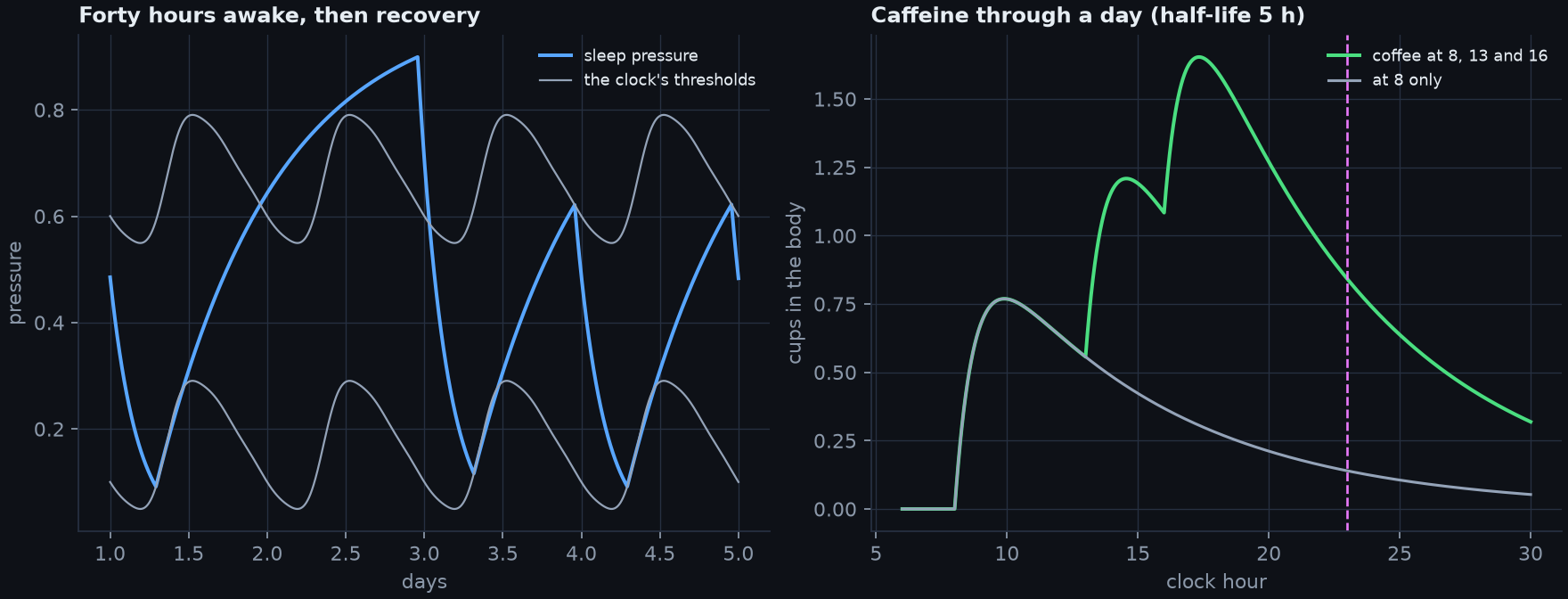
So keep the model awake. It wakes at seven, skips a night, and goes to bed at eleven the next evening, after hours. The pressure keeps climbing, far past the level where sleep would normally begin. And the sleep that follows lasts hours. Not sixteen. It lost a whole night, and it sleeps about minutes longer than usual. There are two reasons, and both are in the curves. The pressure falls fastest when it's highest. So a large debt is paid off mostly in depth, in more and larger slow waves, and only a little in length. And the clock ends the sleep in the morning, whatever is still owed. That's what sleepers do. After a lost night people sleep somewhat longer, and much more deeply. The model was built to predict the slow waves of that recovery night, and it does it with two time constants. For a model with almost nothing in it, that's a success.
One more prediction, and you may have tested it yourself. Put the two processes together as alertness: the clock's push to stay awake, minus the pressure to sleep. Now follow it through that night without sleep. Through the evening and the night it falls, and it's lowest at about twenty past five in the morning, when the pressure is high and the clock's push is at its weakest. And then it comes back up. With no sleep at all, the model is more alert the next afternoon than it was at dawn. Anyone who has stayed up all night knows this as the second wind. And one process couldn't produce it. If sleepiness were only a matter of time awake, it could only get worse. It also says where the danger is. In the hours before dawn the two processes are at their worst together, and that's the stretch that people who study accidents on the night shift worry about most.
What it does: The pressure and its two time constants; the clock's gate; a night without sleep and the recovery; the second wind
5On you: your chronotypePsych 101 and the major2 min
Your turn, and you'll need four numbers. On days when you work or study: about what time do you fall asleep, and what time do you wake? And on free days, when no alarm rings: when do you fall asleep, and when do you wake by yourself? Take a few seconds, and settle on all four.
Here's how to read your numbers. Take the middle of your sleep on free days. This sleeper is asleep at half past midnight and awake at nine, so the midpoint is a quarter to five. That midpoint is called your chronotype, and it's a fair guide to where your clock sits. Now the same for work days: half past eleven to seven, with its midpoint at a quarter past three. The distance between the two midpoints, an hour and a half here, has a name: social jetlag. It's how far your timetable sits from your clock. An early sleeper hardly moves between work days and free days: forty-five minutes. A late sleeper's free-day midpoint is past seven in the morning, and work drags it back by more than three hours. Every Monday that person flies three time zones east, and every Friday night flies back. And look at the lengths of the bars: six hours on work nights, eight and a half when free. The pressure of chapter four is being paid off at the weekend. So where's yours? Chronotypes differ between people by hours. They're partly inherited. And they move with age: later and later through the teens, latest at about to , and then slowly earlier for the rest of life. That last fact comes back in chapter thirteen.
What it does: Four numbers; the middle of sleep; three sleepers and their social jetlag
6What sleep loss doesPsych 101 and the major3 min
Part 2's rule was: don't ask, assign. In 2003 Hans Van Dongen and David Dinges, in Philadelphia, did that with sleep. Healthy adults moved into the laboratory for two weeks. By lot, each was given eight hours in bed a night, or six, or four. Several times a day they did the simplest attention task there is. Watch a screen. When a light comes on, at a moment you can't predict, press a button. Keep that up for ten minutes. A rested person almost never misses. The measure is the number of lapses: responses so slow that, for a moment, the person had stopped attending.
With eight hours in bed, nothing much happened. With six hours, lapses grew, day after day, in nearly a straight line, with no sign of levelling off. With four hours they grew about twice as fast. After two weeks on six hours a night, people were as impaired as people in a fourth group, who'd been kept awake for up to nights running. And six hours isn't an extreme. Plenty of people call it a normal week. The rule that fitted the data is simple. Every hour of wakefulness beyond about sixteen in a day, by their estimate, adds to the deficit, and the deficits add up. The picture here is that rule, drawn. Its vertical scale is arbitrary, but the ratio isn't. Four hours in bed is hours over the line each day. Six hours is . So the four-hour line climbs times as fast. And twenty-four minus leaves a little over eight hours: the sleep it takes to stay level.
And here's the finding that matters most. Alongside the task, people rated how sleepy they felt. For the first few days the ratings rose with the lapses. Then the ratings levelled off, while the lapses kept climbing. By the end, the people on six hours were performing like someone who'd missed a night or two, and reporting that they felt only slightly sleepy. This is Part 1 again. Introspection uses the very instrument that sleep loss has degraded, so the report can't be trusted. A ten-minute task and a stopwatch can. So when someone tells you they do fine on six hours, they may be one of the few people who do. Or they may be telling you exactly what this experiment says they would.
What it does: Sleep assigned by lot; two weeks of lapses; ratings that level off
7What sleep is forPsych 101 and the major4 min
What is all this for? There are many proposals, and one of them has experiments behind it: memory. In 2007 Björn Rasch and Jan Born, in Germany, had volunteers learn where pairs of cards lay on a board, as in the children's game, in a room that smelled of roses. That night, in deep slow-wave sleep, some of them were given the smell of roses again. They didn't wake, and they didn't know. Next morning they remembered more of the card locations than sleepers who'd had no odour. Then the controls, which make it an experiment and not an anecdote. The odour in REM sleep: no gain. The odour while awake: no gain. The odour in deep sleep, when there had been none during learning: no gain. So it isn't the smell, and it isn't sleep in general. It's a reminder, delivered in deep sleep. The idea behind it is that during slow-wave sleep the hippocampus, from Part 7, replays the day's new memories to the cortex, and that the odour prompted the replay.
One study is one study. By 2020 there were experiments of this kind, with two thousand people, cueing memories in sleep with sounds or smells. Pooled, the effect in non-REM sleep is of a standard deviation, somewhere between and . In REM sleep, and in waking: nothing. So the finding holds. Now look at its size. These two curves are that far apart. Cueing in sleep moves the average a little, and the two groups mostly overlap. And for a neighbouring method, playing clicks timed to the slow waves to make them larger, the reported effects have shrunk year by year as the studies got bigger. Part 4 told you to expect that. So sleep helps hold on to what you learned. That much is as solid as anything in this part. Whether that's what sleep is for is another question, and it's waiting at the frontier.
And dreams? Here there's no agreement, so here are the two sides. In 1977 Allan Hobson and Robert McCarley, at Harvard, proposed that a dream begins in the brainstem. During REM sleep it fires signals up into the forebrain, more or less at random, and the forebrain does what it always does with its input: it makes a story. On that view, the plot of a dream is the cortex making the best of noise. In 2000 the neuropsychologist Mark Solms answered with patients. Damage in the brainstem that abolishes REM sleep can leave dreaming intact. And damage in parts of the forebrain can abolish dreaming, and leave REM sleep untouched. That's the pattern Part 7 taught you to look for: a double dissociation. It says REM sleep and dreaming are run by different machinery, even though they usually keep company. And people woken from the other stages report dreams too, only less often. Hobson revised his theory, Solms pressed his, and the argument isn't over. What dreams are for, or whether they're for anything, nobody can yet say. So it goes on the screen as it is: open.
What it does: Roses in deep sleep and four controls; 91 experiments; two accounts of dreaming
8The stress loopPsych 101 and the major5 min
The nervous system isn't the only way one part of the body tells another what to do. A synapse, as Part 6 showed, passes a chemical across a gap of twenty millionths of a millimetre, to one neighbouring cell, in about a thousandth of a second. It's a private message. A hormone is a chemical released into the blood. It goes everywhere, and every cell that carries the right receptor responds. It takes seconds to arrive, and its effects last from minutes to hours. It's a broadcast. You've met one already: melatonin, the signal for night. Now for the one that psychology has studied most: cortisol, the hormone of stress.
The stress system is a chain of three glands. A threat, or just the clock in the morning, makes the hypothalamus release a first hormone. That makes the pituitary, the gland just beneath it, release a second into the blood. And that makes the adrenal glands, which sit on top of the kidneys, release cortisol. Cortisol frees up energy, and holds back the things that can wait: digestion, growth, repair. It's a budget for an emergency. And then the important part. Cortisol acts back on the hypothalamus and the pituitary, and turns them down. The end of the chain is a brake on its start. Left alone, the loop follows the clock. In the model, cortisol peaks at about half past seven, around waking, and it's lowest in the evening: a -fold swing, every day. You wake up on a tide of it.
Now stress it. At ten in the morning: one hour of something alarming. Cortisol rises above its daily curve, it peaks, and then the brake takes hold. Within hours of the end, it's back where it would have been. That's what a stress response is for: on, and then off. Now wear the brake down, to thirty percent of its strength. The same stressor produces a bigger rise and a slower return. And across the whole day, the cortisol level is percent higher, with no stressor at all. That's the worry about stress that never stops. The danger isn't the response. It's a response that can't switch off, because then the things cortisol holds back are held back all the time. A weakened brake in this loop is one of the oldest biological findings in severe depression, and it's waiting in Part 40. And notice the design. A signal that shuts off its own source, after a delay. It's the clock gene's loop from chapter one, in a different tissue, at a different speed. Biology uses it everywhere, and now you can recognise it.
Two more things about hormones, briefly, because both will come back. First: hormones do two different jobs, at two times of life. In 1959 a team in Kansas gave testosterone to pregnant guinea pigs. Their daughters, as adults, behaved differently in mating, and permanently. Given to adult females, the same hormone didn't do that. So early in life, during a window, a hormone can organize the nervous system for good. Later it can only activate what's there, and the effect wears off with the hormone. In people the evidence for organizing effects is indirect, and Parts 30 and 31 will handle it with care. Second: a warning about a famous curve. Every textbook has it. Performance is best at moderate arousal, and falls away on both sides. It's called the Yerkes-Dodson law. The experiment was done in 1908, on mice, in small groups, learning to pick the right one of two boxes under electric shocks of different strengths. The word arousal isn't in the paper. The smooth curve was drawn by later writers. The idea may well be right. But its evidence isn't that experiment, and Part 28 will go looking for better.
What it does: A synapse against a hormone; three glands and a brake; a stressor with the brake whole and worn; organizing and activating, and the Yerkes-Dodson curve
9Four ways to change a synapsePsych 101 and the major3 min
A drug that changes the mind has to change the brain, and for nearly all of them that means changing a synapse. Here's Part 6's synapse again. The sending cell releases a transmitter into the gap. The transmitter binds to receptors on the receiving cell. And then it's cleared away, mostly by pumps that carry it back into the cell it came from. That gives a drug four places to act. One. It can mimic the transmitter, and switch the receptor on by itself. Nicotine does that, at the receptors for acetylcholine. Morphine does it at the receptors for the body's own opioids. Two. It can sit in the receptor and do nothing, which keeps the transmitter out. Caffeine does that, at the receptors for adenosine. Naloxone does it at the opioid receptors, which is how it reverses an overdose within minutes. Three. It can keep the transmitter in the gap, by blocking the pump. The commonest antidepressants do that for serotonin. Cocaine does it for dopamine. Four. It can leave the transmitter alone and turn the receptor up, so that the same signal counts for more. Alcohol does that, among other things, and so do the sedatives called benzodiazepines. Their receptor is the one for GABA, the brain's main signal for inhibition.
Take caffeine, because you probably have. Chapter four said that one carrier of sleep pressure is adenosine, building up in the brain through the waking day. Adenosine's receptors are how the brain reads the pressure. Caffeine blocks them. So the pressure goes on climbing exactly as before, and the brain can't read it. That's the whole trick. Caffeine doesn't give you energy, and it doesn't pay off any sleep. It covers the gauge. And when the caffeine has cleared, the pressure is all still there, which is the slump you know. The size of the effect in this picture is an illustration. The logic isn't.
One warning, before the arithmetic. Knowing where a drug acts isn't knowing what it does to a mind. An antidepressant of the common kind blocks its pump within hours of the first dose. If mood lifts, it lifts after weeks. Something slow happens in between, and what it is hasn't been settled. So the tidy story, this drug raises this chemical, so this chemical must have been too low, doesn't follow. For depression, that simple story hasn't held up well, and the argument belongs to Parts 40 and 42. For today: the receptor tells you where a drug starts. It doesn't tell you where it ends.
What it does: Mimic, block, hold, amplify; caffeine and the pressure gauge; where a drug starts is not where it ends
10Dose and responsePsych 101 and the major5 min
How much drug does it take? Start with one kind of receptor, and a drug at concentration D. Free receptors capture the drug at a rate that grows with D, and with the share of receptors still free. Occupied receptors let go at a steady rate. At balance, the two are equal. Solve for p, the share of receptors occupied, and out comes one of the most used formulas in biology: D over D plus K. K is the concentration that fills half the receptors. Plot it against dose on a scale where each step is ten times the last, and it's an S. Half the receptors at K. Ninety percent takes nine K. Ninety-nine percent takes ninety-nine. So the curve says two things you can use. Below about a tenth of K, a drug does almost nothing. And near the top, doubling the dose buys almost nothing more, except side effects, which have curves of their own.
Now add a blocker: a second molecule that fits the same receptor and does nothing there. Caffeine at the adenosine receptor. Naloxone at the opioid one. The formula gains one factor. The blocker makes the drug's K look bigger. With the blocker at nine times its own K, the whole curve slides to the right, by a factor of . Nothing is destroyed. Enough drug still gets to the top. It's a competition, and that cuts both ways. An antidote can be out-competed. And if the antidote is cleared from the body first, the overdose comes back. One more shape. Some receptors only open when several molecules bind at once, and then the curve steepens. With three, the climb from a tenth of the effect to nine tenths takes about a -fold increase in dose. The plain curve needs eighty-one. A steep curve means a narrow margin between a dose that does nothing, and a dose that does everything.
Then the drug has to leave. For most drugs the body clears a constant fraction every hour. That gives a half-life: the time for the level to fall by half, whatever the level is. Caffeine's is about hours in a typical adult. Nicotine's is about two. After one half-life a half is left. After two, a quarter. After three, an eighth. Alcohol is the exception everyone has met. It leaves at a nearly constant amount per hour, however much is there. Two drinks take about twice as long to clear as one, and the last of a heavy evening is still there in the morning. And the reason is the same curve again. The enzyme that breaks alcohol down binds it as a receptor would, and its speed follows D over D plus K. At a drinker's concentrations it's far above its K: saturated, working flat out, and it can't go faster. Far below K, the same formula gives a constant fraction, and a half-life. One formula, and both behaviours.
So put the two halves together, for the commonest drug on earth. Three coffees: at eight, at one, and at four. Each is absorbed within the hour, and then halves every five hours. They stack. The peak, in the late afternoon, is cups' worth: more than any single cup. At eleven at night, of a cup is still in the body. That's half of the day's peak, sitting on the adenosine receptors at the moment you want the pressure to be read. With only the morning coffee, it's . So the question about coffee and sleep isn't how many. It's when the last one was. And these are averages. The half-life of caffeine differs severalfold from person to person: with genes, with pregnancy, with smoking. That's a Part 9 kind of fact.
What it does: Occupancy from mass action; a blocker and a steeper curve; half-lives and alcohol's constant rate; three coffees
11Tolerance and withdrawalPsych 101 and the major3 min
The body isn't a passive container. In 1974 Richard Solomon and John Corbit proposed a simple account of what it does back, called the opponent process theory. A drug produces a direct effect. Call it process a. It comes on with the drug, and goes off with it. The nervous system defends its balance. It answers with an opposite process, b, which is slow to rise and slow to fade. What's felt is the difference. At first, the full effect. Then less, as b catches up. And when the drug is gone, b is still running, alone. So the effect doesn't return to zero. It passes through zero, to the opposite. After the lift, a low. After the calm, the jitters.
Now repeat the dose, once a day, for ten days. The theory makes one more assumption: the reply is strengthened by use. With each dose, b is larger. So the effect that's felt shrinks: from of the full effect on the first day, to on the tenth. That's tolerance. And the low afterwards deepens: from below zero, to . That's withdrawal. They aren't two things. They're one process, seen at two times: while the drug is there, and after it has gone. And look at what the tenth dose is for. The first was taken to feel better than normal. The tenth is taken to get back up to normal. The theory was built for more than drugs, and Parts 28 and 41 will come back to it.
And here's the part that makes this psychology, and not only pharmacology. The reply is partly learned. In 1982 Shepard Siegel made rats tolerant to heroin, always giving it in the same room. Then every rat got one large dose. Of rats with no history of the drug, percent died. Of tolerant rats, dosed in the usual room: percent. And of tolerant rats given the same dose in a different room: percent. Same rats, same history, same dose. Twice the deaths. Siegel's account is Pavlov's, which Part 16 will build. The room has always come before the drug. So the room itself comes to switch on the body's reply, in advance. Take away the room, and part of the tolerance isn't there. In Psyche's version, the learned reply cancels three quarters of a lethal dose in the usual room, and less than half in a new one, and the deaths come out at , and percent. Those settings were chosen to fit, so that's no test. It shows that the account hangs together. What it means outside the laboratory is grim, and practical. For an experienced user, some overdoses aren't a larger dose. They're the usual dose, in an unusual place.
What it does: The opponent process; ten doses; the same dose in a different room
12The LedgerPsych 101 and the major3 min
Four rows today. The first. The claim: sleep contains recurring periods of rapid eye movement, and people woken from them usually report a dream. The original: Aserinsky and Kleitman, 1953. Twenty detailed dreams, from twenty-seven awakenings. The record: sleep laboratories ever since, on thousands of recorded nights, have found the same stages, in cycles of about ninety minutes. One part didn't hold: that dreaming happens only in REM sleep. Dreams are reported from the other stages too, less often and less vividly. Replicated.
The second. The claim: too little sleep, night after night, impairs sustained attention, and the impairment accumulates. The original: Van Dongen and colleagues, 2003. Eight, six or four hours in bed for two weeks, assigned by lot. The record: in the same year an army laboratory gave people three, five, seven or nine hours in bed for a week, and found the same graded decline. And the note that matters: people rated themselves only slightly sleepy, while their performance kept falling. Replicated.
The third. The claim: reactivating a memory during slow-wave sleep strengthens it. The original: Rasch and colleagues, 2007, with the smell of roses. The record: ninety-one experiments, pooled in 2020. A small effect in non-REM sleep, and none in REM sleep or in waking. So it's there, and it's small. And for a neighbouring method, the reported effects have been shrinking. Replicated, smaller.
And the fourth, which is here because you've read it in headlines. The claim: sleeping too little shortens your life. The evidence: sixteen studies, pooled in 2010. One point four million people reported their usual sleep and were followed for years. Short sleepers were twelve percent more likely to die during the follow-up. But look at the other half of that line. Long sleepers were thirty percent more likely to die. If lost sleep were the cause, why would extra sleep be worse? Because this is Part 2's problem. Nobody assigned these people their sleep. Illness changes sleep years before it kills, and the sleep was reported by the sleepers. The association is real. The causal reading isn't established. Contested. That makes rows. And notice what separates the second row from the fourth. One assigned sleep by lot, to a small group, for two weeks. The other observed more than a million people, for years. The small experiment is the one you can believe.
What it does: REM sleep, sleep loss and attention, sleep and memory, short sleep and death
13In practice: schedules, schools and insomniaPractice4 min
Three places where this part is put to work. First, schools. Chapter five ended on a fact: through the teens the clock moves later, and it's latest at about twenty. A sixteen-year-old who can't fall asleep before midnight isn't being difficult. So a school day that starts before eight cuts the end off their night, every night. Seattle moved the start of its high schools minutes later, from ten to eight to a quarter to nine. Researchers put activity monitors on the wrists of students at two schools, in the spring before and the spring after. Sleep went up by minutes a night. The students didn't just go to bed later. They kept most of the extra time as sleep. And grades were percent higher. Now read it the way Part 2 taught you. It compares two different years of students, before and after, in two schools. It isn't an experiment, and the authors don't claim that the sleep caused the grades. But the direction is what the two processes predict, and school districts have been acting on it.
Second, insomnia: the commonest sleep complaint there is. The treatment that guidelines put first isn't a pill. It's a short course of behavioural therapy, and each of its parts is something from this lecture. Spend less time in bed. It sounds cruel, and it works by building up the pressure: process S. Get up at the same time every day, and get light in the morning. That anchors the clock: process C. And use the bed only for sleep. Someone who has lain awake there for months has learned to be awake there. That's conditioning, and it's Part 16. randomized trials, pooled in 2015: people fell asleep minutes sooner, and spent minutes less awake during the night. Those are modest numbers, honestly reported, and Part 42 will ask what a number like that means for a patient.
And third, work. Anyone whose job runs through the night is fighting both processes at once, and the people who schedule them now use models. Airlines, railways, hospitals and armies roster their crews with descendants of the two-process model. They take in a person's recent sleep and the time of day, and put out a predicted level of alertness. Sleep clinics employ psychologists to deliver the insomnia treatment, and technologists who score each night into its stages. And drug development runs on chapter ten. Every trial of every psychiatric drug begins with a dose-response curve and a half-life. For yourself, the part compresses into three lines. Get up at the same time, and get light early: that's the clock. Don't carry a debt you can't feel: that's the pressure. And do the caffeine arithmetic. With a five-hour half-life, a coffee at five in the afternoon is still percent there at eleven.
What it does: Seattle's school start; a treatment built from the two processes; rosters, clinics and drug trials
14Frontier: why do we sleep?Research4 min
Here's the frontier, and it's a strange one. A third of this part has been about sleep: its stages, its timing, the cost of losing it. And nobody can say what it's for. It isn't an accident. Every animal that has been studied closely sleeps, or does something very like it: flies, worms, even jellyfish, which have no brain. And it's dangerous. An animal asleep can't eat, can't mate, and can't watch for whatever eats it. Evolution keeps nothing that costly without a reason. There are four main candidates. To fix memories: that's chapter seven, real and small. To turn synapses back down. On this idea, a day of learning strengthens synapses across the brain, which costs energy and room, and sleep scales them back while keeping their differences. The pressure of chapter four would be the bill. To clear waste. We'll look at that one next. And to save energy, which is the oldest idea. They aren't rivals, necessarily. Sleep may do all four. But none of them has been shown to be the reason an animal can't do without it.
Take the third, because you've met it in headlines: sleep washes the brain. In 2013 a team in Rochester reported that in mice, asleep or anaesthetized, the space between brain cells widened by percent, and that fluid flushed through it and carried waste away faster. It was a beautiful result, and it had an obvious meaning: sleep is when the brain takes out the rubbish. It went into every popular book on sleep. In 2024 another team measured clearance in mice a different way, and found the opposite. Clearance was slower during sleep, and slower still under anaesthesia. The argument now is about what counts as clearance, and how to measure fluid moving through a living brain without changing how it moves. Both studies are in mice. In people the evidence is thin. So this one doesn't go in the Ledger yet. It's a finding and a counter-finding, a decade apart, with no verdict. A claim can be in every popular book, and still be open.
Three more open questions to carry out of this part. First: who is hit hardest? In the sleep-loss experiments, some people fall apart after one bad night, and some barely change. Bring them back to the laboratory, and it's the same people each time. The difference is large, it's stable, and nobody can yet predict it from anything simpler. Second: what is the pressure made of? Adenosine is part of it. Synapses may be part of it. A model with one variable called S has worked for forty years, without anyone knowing what S is. Third: is REM sleep for anything? Some drugs suppress it for years, and the people who take them don't obviously lose anything. And the starred problem is the Ledger's fourth row. Short sleepers die sooner. So do long sleepers. Design the study that could tell sleep as a cause from sleep as a symptom.
What it does: Four proposals; does sleep wash the brain; open questions
Recap, problems, and the road aheadAll tracks5 min
Part ten in ten lines. Two men spent a month in a cave. One man's rhythm followed a twenty-eight-hour day, and the other's kept to twenty-four. The body has a clock. It runs about ten minutes slow, and it locks to days near twenty-four hours and to no others. Light sets it: later if it falls before the low point, earlier if after, and a flight leaves it behind for days. Sleep has stages, in cycles of ninety minutes, and one of them comes with dreams. Two processes decide when you sleep: a pressure that builds, and a gate that the clock opens and closes. Six hours a night for two weeks impairs you as much as two nights awake, and you won't know it. A memory cued in deep sleep is strengthened, a little, and what dreams and sleep are for is open. The stress loop switches itself off, unless its brake is worn. A drug mimics, blocks, holds or amplifies, by one formula for occupancy. And the body answers back, which is tolerance while the drug is there, and withdrawal when it's gone.
Kant's wager. Today spoke most directly to the third objection: that observing a mental state disturbs it. Chapter six showed something worse. Sleep loss degrades the observer. People's ratings of their own sleepiness levelled off, while their lapses kept climbing. The reply is the same as in Part 1: don't ask the instrument to inspect itself. Time it. On the second objection, that the mind can't be experimented on: a cave, a day of twenty-eight hours, sleep handed out by lot, and an odour delivered to a sleeping brain. And on the first, that the mind admits no mathematics: an oscillator, with a curve for what light does to it. Two exponentials that predict the night after a lost night. And one formula that covers a receptor and an enzyme.
Where this comes back. The retina, and the cells that see without making pictures, are Part 13. Conditioning, and the room that switches on tolerance, is Part 16. Reward, dopamine and what drugs take over are Part 17. What it means to consolidate a memory is Part 20. Motivation, arousal and the opponent process are Part 28. Adolescence, and the late clock, are in Part 31. Depression, the stress loop and addiction are Parts 40 and 41. And whether drugs and therapies work is Part 42.
Seven problems, with full solutions in this part's README. One does the clock's arithmetic. One works the two-process model by hand, and finds out why a lost night isn't repaid hour for hour. One compares two weeks on six hours with two weeks on seven. One fills receptors, with a blocker and without. One does the arithmetic of coffee and of alcohol. One uses Psyche's body module to find what the clock can follow. And the last, with the star, is the frontier's problem. Pause here if you'd like to try them.
The books and papers behind this part are listed here and in the README. Kleitman's own book is still worth opening, and Aserinsky's paper is two pages long.
That finishes the second act. Six parts on the wet machine: the neuron, the synapse and the circuit, the brain, the instruments that read it, the genes that vary it, and now the body that it lives in. From here the series goes back to where psychology began: to the mind itself, starting at its edge, with the senses. And it begins with Kant's first objection, that nothing in the mind can be measured. On the morning of the twenty-second of October, 1850, a physicist in Leipzig called Gustav Fechner was lying in bed, when he saw how it could be done. You can't put a ruler to a sensation. But you can count the smallest differences a person is able to notice, and build a scale from those. What he built, and how well it has lasted, is Part 11: the threshold.
Where it goes next. The retina and its cells are Part 13; conditioning, and the room that switches on tolerance, is Part 16; reward and what drugs take over is Part 17; consolidation is Part 20; arousal and the opponent process come back in Part 28; adolescence and the late clock in Part 31; depression, the stress loop and addiction in Parts 40 and 41; whether drugs and therapies work in Part 42.
Key results
The part's results in one place, for revision.
Try it
Lab 10 · A clock, a pressure, a brake and a dose: four small models of the body the brain lives in
Run Psyche's clock in darkness and on days of different lengths, and find which it can follow; measure what a pulse of light does at each hour and how long a flight's shift takes to make up; let the two-process model sleep, then keep it awake for forty hours and time the recovery; count lapses over two weeks of short sleep; stress the cortisol loop with its brake whole and worn; fill receptors with a drug, with and without a blocker; follow three coffees to bedtime; and give ten doses to an opponent process.
python -m videos.psychology.labs 10
needs numpy, scipy, matplotlib · download lab10.py ·
source on GitHubthe clock's own period, in darkness (published for people: 24.18 h) 24.15 h
on a 24-hour day with 16 h of room light: period; low point 24.0 h; 4:20
day lengths the clock locks to, of 22, 23, 24, 25, 26 and 28 h 23, 24, 25
its period on the cave's 28-hour day (Kleitman's stayed near 24) 24.2 h
three hours of bright light: largest delay; largest advance -1.2 h; +0.8 h
average shift for light before the low point; in the six hours after it -0.64 h; +0.71 h
six time zones: hours wrong on days 0, 2, 4; days to come within an hour 5.2, 2.7, 1.4; 4
the model's ordinary night: asleep, awake, hours 23.0 h, 7.0 h, 8.1
after 40 hours awake: the pressure reached; the recovery sleep 0.90; 8.6 h
a night awake: alertness lowest at; at dawn against 15:00 the next day 5.4 h; -1.00 against -0.70
lapses after 14 days on 8, 6 and 4 hours in bed (the scale is arbitrary) 1.3, 5.5, 9.7
sleep that keeps the count level 8.16 h
cortisol's daily peak; its swing 7.5 h; 3.0-fold
a one-hour stressor: the rise; hours after its end to come back 0.13; 3.4
the same with the brake at 30%: the rise; hours; the daily level 0.18; 3.8; +19%
receptors occupied at K, 9K and 99K 50%, 90%, 99%
dose for 80%: alone; with a blocker at four times its own K 4 K; 20 K
... and the occupancy that dose of 4 K gives once the blocker is there 44%
dose ratio from 10% to 90% of the effect: one site; three sites 81-fold; 4.3-fold
three coffees (8:00, 13:00, 16:00): the peak; left at 23:00; with the first only 1.65; 0.84; 0.14 cups
a dose after 0, 2, 4, 6, 8 h: a half-life of 5 h; a constant 0.15 an hour 1.00, 0.76, 0.57, 0.44, 0.33; 1.00, 0.70, 0.40, 0.10, 0.00
ten daily doses: the effect felt, first and tenth; the low afterwards, first and tenth 0.84, 0.24; -0.23, -1.07
deaths from one large dose: usual room, new room, no history (published: 32, 64, 96%) 32%, 66%, 91%
social jetlag of a sleeper on 1:00 to 7:00 at work and 3:00 to 11:30 when free 3.25 h
The clock keeps its own time, a little slow, and follows days of 23 to 25 hours but not the cave's 28. Light before its low point moves it later and light after moves it earlier, and a shift of six hours takes days to make up. A pressure that rises over 18 hours and falls over 4, gated by the clock, gives an eight-hour night and a recovery sleep only a little longer after a lost night, with alertness coming back the next afternoon before any sleep. Lapses add up with every hour awake beyond about sixteen. A loop whose product shuts off its source returns to rest after a stressor, and more slowly with its brake worn. Occupancy follows D/(D+K); a blocker multiplies K. Three coffees leave most of a cup at bedtime. An opponent process that strengthens with use turns a lift into a debt.The code (135 lines; it asserts its own result)
"""Lab 10: a clock that light can set, two processes that time sleep, a loop that switches itself off, and a dose."""

import numpy as np

from videos.coursekit import labs
from explainer.psychology.psyche import body as B

TITLE = "A clock, a pressure, a brake and a dose: four small models of the body the brain lives in"
GOAL = ("Run Psyche's clock in darkness and on days of different lengths, and find which it can follow; measure "
        "what a pulse of light does at each hour and how long a flight's shift takes to make up; let the "
        "two-process model sleep, then keep it awake for forty hours and time the recovery; count lapses over two "
        "weeks of short sleep; stress the cortisol loop with its brake whole and worn; fill receptors with a drug, "
        "with and without a blocker; follow three coffees to bedtime; and give ten doses to an opponent process.")
TASKS = [
    "In entrain, raise the light from 300 to 3,000 lux and find the day lengths the clock now locks to. Why does "
    "brighter light widen the range, and what would that have meant for the lamps in Kleitman's cave?",
    "In two_process, keep the model awake for 16, 28, 40, 52 and 64 hours (keep_awake) and record the recovery "
    "sleep. Why does it not grow in proportion, and why is a sleep begun at eleven in the morning shorter than one "
    "begun at eleven at night?",
    "In dosing, move the last of the three coffees from 16:00 to 12:00 and find what is left at 23:00. Then halve "
    "and double the half-life. Which matters more for bedtime: when the last cup was, or whose liver it is?",
]


def run(seed=0):
    out = labs.Lab()
    c = B.Clock()

    # 1. the clock
    free = B.free_running_period(c)
    home = B.entrain(c)
    out.row("the clock's own period, in darkness (published for people: 24.18 h)", f"{free:.2f} h")
    out.row("on a 24-hour day with 16 h of room light: period; low point", f"{home['period']:.1f} h; "
            f"{int(home['minimum_at'])}:{int(round(60 * (home['minimum_at'] % 1))):02d}")
    locked = [d for d in (22, 23, 24, 25, 26, 28) if B.entrain(c, day=float(d))["locked"]]
    cave = B.entrain(c, day=28.0, lux=40.0)
    out.row("day lengths the clock locks to, of 22, 23, 24, 25, 26 and 28 h", ", ".join(str(d) for d in locked))
    out.row("its period on the cave's 28-hour day (Kleitman's stayed near 24)", f"{cave['period']:.1f} h")
    assert abs(free - 24.18) < 0.1 and locked == [23, 24, 25] and not cave["locked"]

    # 2. light
    p = B.phase_response(c, steps=12)
    out.row("three hours of bright light: largest delay; largest advance", f"{p['shift'].min():+.1f} h; {p['shift'].max():+.1f} h")
    before = p["shift"][p["hours_from_minimum"] < -1].mean()
    after = p["shift"][(p["hours_from_minimum"] > 0.5) & (p["hours_from_minimum"] < 6)].mean()
    out.row("average shift for light before the low point; in the six hours after it", f"{before:+.2f} h; {after:+.2f} h")
    j = B.jet_lag(6, c)
    out.row("six time zones: hours wrong on days 0, 2, 4; days to come within an hour",
            f"{abs(j['hours_off'][0]):.1f}, {abs(j['hours_off'][2]):.1f}, {abs(j['hours_off'][4]):.1f}; {j['days_to_adjust']:.0f}")
    assert before < 0 < after and 2 <= j["days_to_adjust"] <= 9

    # 3. two processes
    r = B.two_process(hours=144.0, s0=0.5)
    usual = float(np.mean([e - s for s, e in r["episodes"][2:]]))
    lost = B.two_process(hours=144.0, s0=0.5, keep_awake=[(40.0, 71.0)])
    recovery = [e - s for s, e in lost["episodes"] if s >= 70.9][0]
    out.row("the model's ordinary night: asleep, awake, hours", f"{r['episodes'][3][0] % 24:.1f} h, {r['episodes'][3][1] % 24:.1f} h, {usual:.1f}")
    out.row("after 40 hours awake: the pressure reached; the recovery sleep", f"{lost['S'].max():.2f}; {recovery:.1f} h")
    al = B.alertness(lost["t"], lost["S"])
    night = (lost["t"] >= 31) & (lost["t"] < 71)
    low = float(lost["t"][night][al[night].argmin()] % 24)
    at = lambda h: float(al[np.argmin(np.abs(lost["t"] - h))])  # noqa: E731
    out.row("a night awake: alertness lowest at; at dawn against 15:00 the next day", f"{low:.1f} h; {at(48 + low):.2f} against {at(63.0):.2f}")
    assert 7.5 < usual < 8.6 and recovery < usual + 1.5 and at(63.0) > at(48 + low)

    # 4. sleep loss
    six, four = B.lapses(6.0, 14), B.lapses(4.0, 14)
    out.row("lapses after 14 days on 8, 6 and 4 hours in bed (the scale is arbitrary)",
            f"{B.lapses(8.0, 14)[-1]:.1f}, {six[-1]:.1f}, {four[-1]:.1f}")
    out.row("sleep that keeps the count level", f"{24 - 15.84:.2f} h")
    assert abs((four[-1] - 1) / (six[-1] - 1) - (20 - 15.84) / (18 - 15.84)) < 1e-6

    # 5. the stress loop
    base, hit = B.hpa(hours=96.0), B.hpa(hours=96.0, stress=[(58.0, 1.0, 3.0)])
    worn0, worn = B.hpa(hours=96.0, feedback=0.3), B.hpa(hours=96.0, feedback=0.3, stress=[(58.0, 1.0, 3.0)])
    day = (base["t"] >= 48) & (base["t"] < 72)
    extra, extra_w = hit["cortisol"] - base["cortisol"], worn["cortisol"] - worn0["cortisol"]
    gone = lambda e: float(base["t"][np.where(e > 0.1 * e.max())[0][-1]] - 59.0)  # noqa: E731
    out.row("cortisol's daily peak; its swing", f"{base['t'][day][base['cortisol'][day].argmax()] % 24:.1f} h; "
            f"{base['cortisol'][day].max() / base['cortisol'][day].min():.1f}-fold")
    out.row("a one-hour stressor: the rise; hours after its end to come back", f"{extra.max():.2f}; {gone(extra):.1f}")
    out.row("the same with the brake at 30%: the rise; hours; the daily level", f"{extra_w.max():.2f}; {gone(extra_w):.1f}; "
            f"{100 * (worn0['cortisol'][day].mean() / base['cortisol'][day].mean() - 1):+.0f}%")
    assert extra_w.max() > extra.max() and gone(extra_w) > gone(extra)

    # 6. dose and response
    out.row("receptors occupied at K, 9K and 99K", ", ".join(f"{100 * B.occupancy(k):.0f}%" for k in (1.0, 9.0, 99.0)))
    d80 = 4.0  # p = D / (D + K) = 0.8 at D = 4 K
    out.row("dose for 80%: alone; with a blocker at four times its own K", f"{d80:.0f} K; {d80 * 5:.0f} K")
    out.row("... and the occupancy that dose of 4 K gives once the blocker is there", f"{100 * B.with_antagonist(d80, 4.0):.0f}%")
    out.row("dose ratio from 10% to 90% of the effect: one site; three sites", f"{81:.0f}-fold; {81 ** (1 / 3):.1f}-fold")
    caf = B.dosing([8.0, 13.0, 16.0], hours=48.0, half_life=5.0)
    one = B.dosing([8.0], hours=48.0, half_life=5.0)
    at23 = lambda d: float(d["level"][np.searchsorted(d["t"], 23.0)])  # noqa: E731
    out.row("three coffees (8:00, 13:00, 16:00): the peak; left at 23:00; with the first only", f"{caf['level'].max():.2f}; "
            f"{at23(caf):.2f}; {at23(one):.2f} cups")
    t = np.array([0.0, 2.0, 4.0, 6.0, 8.0])
    out.row("a dose after 0, 2, 4, 6, 8 h: a half-life of 5 h; a constant 0.15 an hour",
            ", ".join(f"{v:.2f}" for v in B.first_order(t, 1.0, 5.0)) + "; " + ", ".join(f"{v:.2f}" for v in B.zero_order(t, 1.0, 0.15)))
    assert abs(B.occupancy(9.0) - 0.9) < 1e-9 and abs(B.with_antagonist(20.0, 4.0) - 0.8) < 1e-9 and at23(caf) > 4 * at23(one)

    # 7. the body answers back
    o = B.opponent(doses=10)
    out.row("ten daily doses: the effect felt, first and tenth; the low afterwards, first and tenth",
            f"{o['felt'][0]:.2f}, {o['felt'][-1]:.2f}; {o['troughs'][0]:.2f}, {o['troughs'][-1]:.2f}")
    m = B.conditioned_tolerance(1.6, 0.75, 0.45, rng=np.random.default_rng(seed + 1))
    out.row("deaths from one large dose: usual room, new room, no history (published: 32, 64, 96%)",
            f"{100 * m['usual']:.0f}%, {100 * m['new']:.0f}%, {100 * m['none']:.0f}%")
    out.row("social jetlag of a sleeper on 1:00 to 7:00 at work and 3:00 to 11:30 when free", f"{B.social_jetlag(1.0, 7.0, 3.0, 11.5):.2f} h")
    assert o["felt"][-1] < 0.5 * o["felt"][0] and o["troughs"][-1] < 2 * o["troughs"][0] and m["usual"] < m["new"] < m["none"]
    out.note = ("The clock keeps its own time, a little slow, and follows days of 23 to 25 hours but not the cave's "
                "28. Light before its low point moves it later and light after moves it earlier, and a shift of six "
                "hours takes days to make up. A pressure that rises over 18 hours and falls over 4, gated by the "
                "clock, gives an eight-hour night and a recovery sleep only a little longer after a lost night, "
                "with alertness coming back the next afternoon before any sleep. Lapses add up with every hour "
                "awake beyond about sixteen. A loop whose product shuts off its source returns to rest after a "
                "stressor, and more slowly with its brake worn. Occupancy follows D/(D+K); a blocker multiplies K. "
                "Three coffees leave most of a cup at bedtime. An opponent process that strengthens with use turns "
                "a lift into a debt.")

    fig, ax = labs.figure(2, size=(11, 4.2))
    k = (lost["t"] >= 24) & (lost["t"] <= 120)
    ax[0].plot(lost["t"][k] / 24, lost["S"][k], color=labs.BLUE, lw=1.8, label="sleep pressure")
    ax[0].plot(lost["t"][k] / 24, lost["upper"][k], color=labs.GREY, lw=1.0, label="the clock's thresholds")
    ax[0].plot(lost["t"][k] / 24, lost["lower"][k], color=labs.GREY, lw=1.0)
    ax[0].set(title="Forty hours awake, then recovery", xlabel="days", ylabel="pressure")
    ax[0].legend(loc="upper right", fontsize=8)
    kk = (caf["t"] >= 6) & (caf["t"] <= 30)
    ax[1].plot(caf["t"][kk], caf["level"][kk], color=labs.GREEN, lw=1.8, label="coffee at 8, 13 and 16")
    ax[1].plot(one["t"][kk], one["level"][kk], color=labs.GREY, lw=1.4, label="at 8 only")
    ax[1].axvline(23, color=labs.PINK, lw=1.2, ls="--")
    ax[1].set(title="Caffeine through a day (half-life 5 h)", xlabel="clock hour", ylabel="cups in the body")
    ax[1].legend(loc="upper right", fontsize=8)
    out.fig = fig
    return out
Now change it
- In entrain, raise the light from 300 to 3,000 lux and find the day lengths the clock now locks to. Why does brighter light widen the range, and what would that have meant for the lamps in Kleitman's cave?
- In two_process, keep the model awake for 16, 28, 40, 52 and 64 hours (keep_awake) and record the recovery sleep. Why does it not grow in proportion, and why is a sleep begun at eleven in the morning shorter than one begun at eleven at night?
- In dosing, move the last of the three coffees from 16:00 to 12:00 and find what is left at 23:00. Then halve and double the half-life. Which matters more for bedtime: when the last cup was, or whose liver it is?
Problems, with solutions
Try each problem before opening its solution.
1. A clock left in the dark has a period of 24.18 hours. How many minutes a day does it drift, and which way? After how many days is it twelve hours out? What must morning light do each day to hold it at 24 hours?
Solution
It runs 0.18 hours long, so each day its low point comes 0.18 × 60 = 10.8 minutes later by the wall clock. It is twelve hours out after 12 / 0.18 ≈ 67 days: a person kept in constant dim light for two months would be sleeping through the day. To hold it at 24 hours, light has to advance it by those eleven minutes every day, and advances come from light after the low point, that is, in the morning. This is why the loss of morning light (a dark winter commute, a curtained room) lets a clock slide later.
2. In the two-process model the pressure rises as 1 − (1 − S₀)e^(−t/18.18) and falls as S₀e^(−t/4.2) (t in hours). From S = 0.17 on waking, find S after 16 hours and after 40 hours awake. From each, how long must sleep last to return to 0.17? Why is recovery sleep not proportional to the time awake?
Solution
After 16 hours: 1 − 0.83 e^(−0.880) = 1 − 0.83 × 0.415 = 0.656. After 40 hours: 1 − 0.83 e^(−2.200) = 1 − 0.83 × 0.111 = 0.908. Falling back to 0.17 takes t = 4.2 ln(S / 0.17): 4.2 ln 3.86 = 5.7 hours from 0.656, and 4.2 ln 5.34 = 7.0 hours from 0.908. Twenty-four more hours awake cost 1.4 more hours of sleep. Two things flatten the relation. The pressure saturates: it approaches a ceiling, so the second day awake adds less than the first. And it decays exponentially, so the time to pay it off grows only with the logarithm of its height. (The film's figures, 8.1 and 8.6 hours, differ from these because there the waking threshold moves with the clock.)
3. Lapses grow each day by 0.15 for every hour awake beyond 15.84. Compare fourteen days on 6 hours in bed with fourteen days on 7. How much sleep keeps the count level?
Solution
On 6 hours a person is awake 18, which is 2.16 over the line: 0.324 lapses more each day, 4.5 more after fourteen days. On 7 hours, 17 awake and 1.16 over: 0.174 a day, 2.4 after fourteen. One hour less sleep nearly doubles the deficit (2.16 / 1.16 = 1.86), because what counts is the excess over about sixteen hours and not the total. The count stays level at 24 − 15.84 = 8.16 hours of sleep.
4. A drug has K = 2 mg/L. What concentration occupies 80% of its receptors? With a blocker present at four times its own K_B, what concentration gives the same 80%? With three sites that must all be filled, p = D³/(D³ + K³): what is the ratio of the doses that give 90% and 10%?
Solution
D / (D + 2) = 0.8 gives D = 8 mg/L, four times K. The blocker multiplies K by 1 + 4 = 5, so K behaves as 10 mg/L and the dose for 80% is 40 mg/L: five times as much, for any target occupancy. With three sites, p = 0.9 needs D³ = 9K³ and p = 0.1 needs D³ = K³/9, so the ratio of doses is 81^(1/3) = 4.3, against 81 for one site. The margin between "barely works" and "nearly everything" is some twenty times narrower.
5. Caffeine's half-life is 5 hours. You take 100 mg at 8:00 and 100 mg at 14:00 (absorbed at once). How much is left at 23:00? When would a single 200 mg dose have to be taken to leave the same? Alcohol leaves at a constant rate r: what doubles when the dose doubles?
Solution
The morning dose has had 15 hours, three half-lives: 12.5 mg. The afternoon dose has had 9 hours, 1.8 half-lives: 100 × 2^(−1.8) = 28.7 mg. Together 41.2 mg, of which the later cup supplies 70%. A single 200 mg leaves 41.2 mg after 5 log₂(200 / 41.2) = 11.4 hours, so it would have to be taken at about 11:35. For alcohol the time to clear a dose is dose / r, so doubling the dose doubles the time. For a drug with a half-life, doubling the dose adds one half-life and no more.
6. With explainer.psychology.psyche.body: use entrain to find the day lengths the clock locks to at 300
lux and at 3,000 lux. Then use two_process with keep_awake to plot recovery sleep against hours awake.
Solution
At 300 lux the clock locks to days of 23, 24 and 25 hours; at 3,000 lux to days from 21 to 27, and still not to 28. Brighter light pushes harder, so it can make up a larger daily difference; a cave lit like an office could not have held anyone to a 28-hour day by light alone. Keeping the model awake for 16, 28, 40, 52 and 64 hours from a 7:00 waking gives recovery sleeps of 8.0, 4.7, 8.6, 5.6 and 8.7 hours. It does not grow in proportion (problem 2), and it zigzags: after 28 or 52 hours the model goes to bed at eleven in the morning, and the clock's rising threshold wakes it within five hours although the pressure is far from paid off. That is the night worker's short daytime sleep.
7. ★ Short sleepers die sooner, and so do long sleepers. Design the study that could tell sleep as a cause from sleep as a symptom, and say what result would count against a causal effect.
A sketch. No one can assign decades of short sleep, so combine designs with different weak points, as in Part 9. (a) A cohort with sleep measured by a wrist monitor and not by self-report, with illness recorded at entry, and the analysis repeated after dropping deaths in the first five or ten years: if short sleep is a symptom of disease already under way, the association should weaken as those deaths are removed. (b) Mendel's lottery: gene variants that shift habitual sleep by a few minutes are assigned at conception and cannot be caused by later illness, so compare lifespans across them (and within families, to remove stratification). (c) Randomized trials that extend the sleep of habitual short sleepers for months and measure intermediate outcomes such as blood pressure and glucose control. Fix beforehand the outcomes and the size of effect that would matter. Against a causal effect: an association that vanishes once early deaths are excluded, no gradient across the genetic variants, and no change in the intermediate outcomes when sleep is extended. The long sleepers are the control that keeps everyone honest: nobody proposes that an extra hour in bed kills, so whatever explains their excess (undiagnosed illness, most plausibly) is a candidate explanation for the short sleepers' too.
Notes and sources
Where it comes back
The retina and the cells that see without pictures: Part 13. Conditioning, and the room that switches on
tolerance: Part 16. Reward, dopamine and what drugs take over: Part 17. What it means to consolidate a memory:
Part 20. Dreaming and consciousness: Part 27. Motivation, arousal, the Yerkes-Dodson curve and the opponent
process: Part 28. Adolescence and the late clock: Part 31. Depression, the stress loop and addiction: Parts 40
and 41. Whether drugs and therapies work: Part 42. Psyche's body module supplies the clock, the sleep pressure
and the dose-response curves those parts use.
Sources
Books. N. Kleitman, Sleep and Wakefulness (revised ed., 1963). K. Miller, Mapping the Darkness (2023). T. Roenneberg, Internal Time (2012). J. S. Meyer and L. F. Quenzer, Psychopharmacology: Drugs, the Brain, and Behavior (2nd ed., 2013).
Papers.
- N. Kleitman, Sleep and Wakefulness (1939), for the cave; "Science: Cave Men", Time, 18 July 1938.
- C. A. Czeisler et al., "Stability, precision, and near-24-hour period of the human circadian pacemaker", Science 284 (1999) 2177–2181.
- E. Aserinsky and N. Kleitman, "Regularly occurring periods of eye motility, and concomitant phenomena, during sleep", Science 118 (1953) 273–274.
- W. Dement and N. Kleitman, "Cyclic variations in EEG during sleep and their relation to eye movements, body motility, and dreaming", Electroencephalography and Clinical Neurophysiology 9 (1957) 673–690.
- A. A. Borbély, "A two process model of sleep regulation", Human Neurobiology 1 (1982) 195–204; S. Daan, D. G. M. Beersma and A. A. Borbély, "Timing of human sleep: recovery process gated by a circadian pacemaker", American Journal of Physiology 246 (1984) R161–R178; A. A. Borbély, S. Daan, A. Wirz-Justice and T. Deboer, "The two-process model of sleep regulation: a reappraisal", Journal of Sleep Research 25 (2016) 131–143.
- H. P. A. Van Dongen, G. Maislin, J. M. Mullington and D. F. Dinges, "The cumulative cost of additional wakefulness", Sleep 26 (2003) 117–126.
- G. Belenky et al., "Patterns of performance degradation and restoration during sleep restriction and subsequent recovery", Journal of Sleep Research 12 (2003) 1–12.
- T. Roenneberg et al., "A marker for the end of adolescence", Current Biology 14 (2004) R1038–R1039; M. Wittmann, J. Dinich, M. Merrow and T. Roenneberg, "Social jetlag: misalignment of biological and social time", Chronobiology International 23 (2006) 497–509.
- B. Rasch, C. Büchel, S. Gais and J. Born, "Odor cues during slow-wave sleep prompt declarative memory consolidation", Science 315 (2007) 1426–1429.
- X. Hu, L. Y. Cheng, M. H. Chiu and K. A. Paller, "Promoting memory consolidation during sleep: a meta-analysis of targeted memory reactivation", Psychological Bulletin 146 (2020) 218–244.
- J. A. Hobson and R. W. McCarley, "The brain as a dream state generator", American Journal of Psychiatry 134 (1977) 1335–1348; M. Solms, "Dreaming and REM sleep are controlled by different brain mechanisms", Behavioral and Brain Sciences 23 (2000) 843–850.
- F. P. Cappuccio, L. D'Elia, P. Strazzullo and M. A. Miller, "Sleep duration and all-cause mortality", Sleep 33 (2010) 585–592.
- C. H. Phoenix, R. W. Goy, A. A. Gerall and W. C. Young, "Organizing action of prenatally administered testosterone propionate on the tissues mediating mating behavior in the female guinea pig", Endocrinology 65 (1959) 369–382.
- R. M. Yerkes and J. D. Dodson, "The relation of strength of stimulus to rapidity of habit-formation", Journal of Comparative Neurology and Psychology 18 (1908) 459–482; K. H. Teigen, "Yerkes-Dodson: a law for all seasons", Theory & Psychology 4 (1994) 525–547.
- R. L. Solomon and J. D. Corbit, "An opponent-process theory of motivation: I. Temporal dynamics of affect", Psychological Review 81 (1974) 119–145.
- S. Siegel, R. E. Hinson, M. D. Krank and J. McCully, "Heroin 'overdose' death: contribution of drug-associated environmental cues", Science 216 (1982) 436–437.
- G. P. Dunster et al., "Sleepmore in Seattle", Science Advances 4 (2018) eaau6200.
- J. M. Trauer et al., "Cognitive behavioral therapy for chronic insomnia: a systematic review and meta-analysis", Annals of Internal Medicine 163 (2015) 191–204.
- L. Xie et al., "Sleep drives metabolite clearance from the adult brain", Science 342 (2013) 373–377; A. Miao et al., "Brain clearance is reduced during sleep and anesthesia", Nature Neuroscience 27 (2024) 1046–1050.
About this partfrom its README
In the early summer of 1938 two men walked into Mammoth Cave in Kentucky and stayed for thirty-two days. Nathaniel Kleitman, a physiologist of forty-three, and his student Bruce Richardson, who was twenty-five, lived there by a day of twenty-eight hours, to find out whether the body's daily rhythm is a habit copied from the sun or something the body keeps by itself. Richardson's temperature rhythm stretched toward the cave's schedule. Kleitman's kept its twenty-four-hour course for the whole month. As an experiment on two people it settles nothing, and it was still the first sign of a clock that took sixty more years to pin down.
This part is about the body the brain lives in, and why the same mind is so different at four in the afternoon and at four in the morning. The route: the clock (its period, where it sits, and why a 28-hour day defeats it); how light sets it, and what a flight across time zones does; sleep as the laboratory found it, with its stages, cycles and dreams; the two processes that decide when sleep comes, and what they predict for a night without sleep; the viewer's own chronotype; what two weeks of short sleep do to attention, and why the sleeper does not notice; what sleep is for, where one answer has experiments behind it and the rest is argument; hormones, through a stress loop that switches itself off; four ways a drug can change a synapse; dose and response, half-lives and three coffees; and tolerance and withdrawal as one process seen at two times. The practice chapter covers school start times, the treatment of insomnia and rosters; the frontier is the question of why animals sleep at all.
It closes Act II, The Wet Machine.
What is computed and built
explainer/psychology/psyche/body.py: the clock (free running, entrained, a phase response curve, re-entrainment after a shift); the two-process model with forced waking, and an alertness curve from it; lapses under short sleep; a three-stage hormone loop with feedback; receptor occupancy with a competitive blocker and a Hill coefficient; first- and zero-order elimination and repeated dosing; an opponent process that strengthens with use; tolerance tied to a place; midsleep and social jetlag. Tested intests/psychology/test_body.py.- The Ledger gains four rows and the Archive sixteen datasets.
- The course gains its first interactive that measures the reader over time: a vigilance task set beside the reader's own rating of their alertness.
Chapter notes
| # | Chapter | What it does |
|---|---|---|
| 0 | A month in a cave | The cave and its 28-hour day; two temperature rhythms; the brain lives in a body; objectives |
| 1 | A clock inside | 24.18 hours, and the model clock's drift; where the clock is and the loop inside each cell; locking to a day, and the days it cannot follow |
| 2 | Light sets the clock | The eye's third kind of light cell and melatonin; a phase response curve, computed; a flight across time zones |
| 3 | Sleep, found in the laboratory | The eyes of sleepers and 20 dreams in 27 awakenings; four stages; the architecture of a night |
| 4 | Two processes | The pressure and its two time constants; the clock's gate; a night without sleep and the recovery; the second wind |
| 5 | On you: your chronotype | Four numbers; the middle of sleep; three sleepers and their social jetlag |
| 6 | What sleep loss does | Sleep assigned by lot; two weeks of lapses; ratings that level off |
| 7 | What sleep is for | Roses in deep sleep and four controls; 91 experiments; two accounts of dreaming |
| 8 | The stress loop | A synapse against a hormone; three glands and a brake; a stressor with the brake whole and worn; organizing and activating, and the Yerkes-Dodson curve |
| 9 | Four ways to change a synapse | Mimic, block, hold, amplify; caffeine and the pressure gauge; where a drug starts is not where it ends |
| 10 | Dose and response | Occupancy from mass action; a blocker and a steeper curve; half-lives and alcohol's constant rate; three coffees |
| 11 | Tolerance and withdrawal | The opponent process; ten doses; the same dose in a different room |
| 12 | The Ledger | REM sleep, sleep loss and attention, sleep and memory, short sleep and death |
| 13 | In practice: schedules, schools and insomnia | Seattle's school start; a treatment built from the two processes; rosters, clinics and drug trials |
| 14 | Frontier: why do we sleep? | Four proposals; does sleep wash the brain; open questions |
| Recap, problems, and the road ahead | Ten lines; what today adds to the reply to Kant; payoffs; problems; references; Part 11 |
NotesWhere the numbers come from
| What | Source |
|---|---|
| Mammoth Cave, 1938: 32 days on a 28-hour day; the student (25) adapted, Kleitman (43) did not and grew sleepy at about ten each evening | Kleitman (1939), from the 1938 magazine report, a National Park Service account and a book excerpt; registered in SOURCES.md |
| The clock's own period: 24.18 hours in 24 people, young and old, on a 28-hour day for about a month; earlier estimates near 25 hours came from self-selected light | Czeisler et al. (1999), from the abstract |
| 20 detailed dream reports from 27 awakenings during eye movements | Aserinsky and Kleitman (1953), from a reprint of the text |
| Sleep pressure rises with a time constant of 18.18 hours and falls with 4.2 | Borbély (1982); Daan, Beersma and Borbély (1984), from the figure legend of the model's 2016 reappraisal |
| 8, 6 or 4 hours in bed for 14 days, or none for 3; lapses rise with every hour awake beyond 15.84; six hours for two weeks matched up to two nights without sleep; sleepiness ratings levelled off | Van Dongen et al. (2003), from the abstract |
| 66 people on 3, 5, 7 or 9 hours in bed for a week (the Ledger's record) | Belenky et al. (2003), from the abstract |
| An odour present at learning and given again in slow-wave sleep improved memory for card locations; not in REM sleep, not awake, not without the odour at learning | Rasch et al. (2007), from the abstract |
| 91 experiments, 2,004 people: g = 0.29 (0.21 to 0.38) in non-REM sleep, none in REM sleep or waking | Hu et al. (2020), from the abstract |
| Activation-synthesis (1977), and the dissociation of dreaming from REM sleep (2000) | Hobson and McCarley (1977); Solms (2000), from summaries |
| 16 studies, 1.4 million people: short sleepers 12% more likely to die in the follow-up, long sleepers 30% | Cappuccio et al. (2010), from the abstract |
| Chronotype latest at about 19.5 (women) and 21 (men); social jetlag | Roenneberg et al. (2004); Wittmann et al. (2006) |
| Testosterone before birth and adult behaviour in guinea pigs: organizing against activating | Phoenix et al. (1959), from reviews |
| The Yerkes-Dodson experiment of 1908 and the later history of its "law" | Teigen (1994), from summaries |
| Opponent processes | Solomon and Corbit (1974), from summaries |
| One large dose of heroin (15 mg/kg): deaths of 32% in the usual room, 64% in another room, 96% with no history | Siegel et al. (1982), from the paper's table as quoted |
| Seattle: start moved 55 minutes, from 7:50 to 8:45; 34 minutes more sleep; grades 4.5% higher | Dunster et al. (2018), from the university's summary |
| Behavioural therapy for insomnia: 20 trials, 1,162 people; asleep 19 minutes sooner, 26 minutes less awake, +9.9 points of sleep efficiency | Trauer et al. (2015), from the abstract |
| In mice the space between brain cells widened by 60% in sleep (2013); clearance measured otherwise was lower in sleep (2024) | Xie et al. (2013); Miao et al. (2024), from the abstracts |
Everything else is computed by compute.py with Psyche's body module, and is a model's behaviour, tagged as
such on screen. The clock is a van der Pol oscillator driven by light, of the kind Kronauer's group fitted to
people, with its period set near the published one (it comes out at 24.15 hours); it was not fitted to anything
here. The two-process model uses the published time constants and thresholds chosen to give an ordinary night, so
its eight hours are a setting and its recovery sleep and second wind are predictions. The lapse curves draw the
published rule (lapses in proportion to hours awake beyond 15.84) on an arbitrary vertical scale. The stress loop,
the opponent process and the tolerance simulation are illustrations whose constants were chosen for shape; the
three death rates of the tolerance model were fitted to Siegel's three, and the film says so. Half-lives are five
hours for caffeine and about two for nicotine. Drawings that are not data (the cave's temperature curves, the
eye-movement trace, the four brain-wave traces, the typical night, the ratings that level off, the pattern of
individual differences) carry a note saying so.
Two things the models are not used for. In the clock model a flight east is made up faster than a flight west, the opposite of what travellers usually report; the film shows this as a caution and takes only the timescale from the model. And the alertness curve has no dip in the early afternoon, so the film claims none.
Notes
| Finding | Original | Status |
|---|---|---|
| Sleep contains recurring periods of rapid eye movement, and people woken from them usually report a dream | Aserinsky and Kleitman 1953 | replicated |
| Too little sleep, night after night, impairs sustained attention, and the impairment accumulates | Van Dongen and colleagues 2003 | replicated |
| Reactivating a memory during slow-wave sleep strengthens it | Rasch and colleagues 2007 | replicated, smaller |
| Sleeping too little shortens your life | Cappuccio and colleagues 2010 | contested |
Shown without a row, with the reason recorded in explainer/psychology/ledger.py: the cave (an experiment on two
people, told as history), the clock's period (physiology), the two-process model (a model, tested against its own
predictions), the two accounts of dreaming (an open dispute, entered with consciousness in Part 27), chronotype
across life (a survey description; Part 31), the guinea pigs (animal physiology), the Yerkes-Dodson history (the
law is examined in Part 28), the opponent process (a theory; Part 41), Siegel's rats (conditioning is entered in
Part 16), the Seattle schools (a before-and-after comparison, described as that), the insomnia trials (therapies
are entered in Part 42), and the two mouse studies of clearance (a finding and its dispute).
Notes
Before the narrated master:
- Kleitman's cave: no primary source was read. The dates within 1938 ("early summer"; the magazine report is dated 18 July), "one of very few scientists anywhere who studied sleep" and "the newspapers suggested age" rest on the magazine report and a book excerpt found by search. Sources differ on the cave's depth, which is not given. The temperature curves on screen are a drawing of the reported pattern.
- The clock model's form and constants are from memory of Kronauer's light-driven van der Pol models; they were chosen so that the free period, the entrained phase and the phase response curve have the published shapes, and were not checked against the papers. "An oscillator of a kind engineers have used for a century" refers to van der Pol's work of the 1920s.
- The suprachiasmatic nucleus: "about twenty thousand neurons" is twice the per-side figure of about ten thousand given for rodents in a review; the lesion studies (1972) and the hamster transplants (1990) were confirmed from reviews, and their authors are not named in the film. That each cell keeps time by a loop of genes whose proteins switch them off is the textbook account (the work honoured in 2017).
- The light-sensitive ganglion cells were established in 2002; the film says "around the year 2000". "Experiments on people give a curve of this shape" refers to human phase response curves (Khalsa et al. 2003), from memory. "Most travellers report the opposite" (west easier than east) is the usual statement in reviews, from memory.
- Aserinsky: "graduate student", the pen recorders and "two pages" are from histories; the paper's count for awakenings during ocular quiet (19 of 23 with no recall, from memory) is not given. The number of sleepers differs between sources and is not given. "Before it, sleep was thought of as the brain idling" is a summary.
- The stages: "about half the night" in light sleep, cycles of "about ninety minutes", "four or five in a night" and the paralysis of the body's muscles in REM sleep are textbook figures. The traces and the typical night are drawings.
- The two-process model: the thresholds (0.67 and 0.17, moved by 0.12 of a skewed daily wave) follow Daan et al. (1984) from memory and are described in the film as set to make an ordinary night come out right. Adenosine as "one ingredient" of sleep pressure is from memory of the animal work of the 1990s. "After a lost night people sleep somewhat longer, and much more deeply" is the textbook summary of recovery sleep.
- "The stretch that people who study accidents on the night shift worry about most" is a general statement; no accident statistics are shown.
- Van Dongen et al. (2003): the sample size was not confirmed and is not given. "Philadelphia", the ten-minute task and the definition of a lapse as a response slower than half a second (used in the course interactive) are from memory of the psychomotor vigilance task. Belenky et al. (2003) found that the 5- and 7-hour groups levelled off at a reduced level while the 3-hour group kept declining; the Ledger's record line says so.
- Rasch et al. (2007): "in Germany" and the hippocampal replay "idea" (recordings in rats in the 1990s) are from memory; the paper's sample sizes and percentages are not given. The year-by-year decline for sounds timed to slow waves was found by search (a 2023 analysis) and is not in the Archive.
- Hobson "revised his theory" (the later AIM model) is from memory.
- Hormones: cortisol's actions and the anatomy are textbook. In people cortisol is lowest around midnight; the model's lowest point is earlier (19:44), and the film says "lowest in the evening". "A weakened brake in this loop is one of the oldest biological findings in severe depression" refers to dexamethasone non-suppression, from memory; it is examined in Part 40. "A team in Kansas" for Phoenix et al. is from memory.
- The drugs' sites of action (nicotine, morphine, caffeine, naloxone, the serotonin reuptake inhibitors, cocaine, alcohol and the benzodiazepines) are textbook pharmacology and were not checked against a current text. That an overdose can return when naloxone clears first is standard clinical teaching, from memory. "For depression that simple story has not held up well" refers to reviews of the serotonin hypothesis, from memory, and is deferred to Parts 40 and 42.
- Half-lives: about five hours for caffeine and two for nicotine were found by search in secondary sources; that caffeine's differs severalfold with genes, pregnancy and smoking is from memory. No number is given for alcohol's rate.
- Solomon and Corbit's theory is described from secondary sources. "Some overdoses are the usual dose in an unusual place" is Siegel's proposal; his interviews with overdose survivors were not checked.
- Seattle: the year of the change is not stated in the film; the grades figure is the median in the classes studied, as the university's summary gives it.
- "The treatment that guidelines put first" (behavioural therapy before drugs for chronic insomnia) is from memory of the American College of Physicians' 2016 guideline. That transport and military organizations use descendants of the two-process model for rosters is from memory of the fatigue-modelling literature.
- The frontier: sleep-like states in flies, worms and jellyfish (the jellyfish study of 2017 was confirmed by search); the synaptic downscaling proposal is described from memory; the stability of individual differences in vulnerability to sleep loss was confirmed from a review, and the picture of it is a drawing; "some drugs suppress REM sleep for years" (many antidepressants) is from memory.
- Fechner's insight "on the morning of 22 October 1850, lying in bed" is the traditional account, confirmed from histories; Part 11 should give it as his own later telling.
Companion material in this repository
The syllabus's plan for this partfrom SYLLABUS.md, the plan of record
- Hook: the cave (Kleitman 1939); two temperature rhythms, drawn; four things in the body that change the mind.
- A clock inside: 24.18 hours in 24 people on a 28-hour day (Czeisler et al. 1999), and why earlier estimates said 25; Psyche's clock (a light-driven van der Pol oscillator) runs at 24.15; the suprachiasmatic nucleus and the loop of genes in each cell; on a 24-hour day the model locks, with its low point at 4:20; it follows days of 23 to 25 hours and not 22 or 26 to 28, so on the cave's day it does what Kleitman did.
- Light sets the clock: the retina's third kind of light cell and melatonin; a phase response curve, computed (delays of up to 1.2 hours before the low point, advances of up to 0.8 after); a flight of six time zones takes 4 to 7 days to make up, with a caution that the model's direction is not the travellers'.
- Sleep, found in the laboratory: 20 dream reports in 27 awakenings (Aserinsky and Kleitman 1953); four stages, drawn; a night's architecture in ninety-minute cycles.
- Two processes (Borbély 1982): a pressure rising over 18.2 hours and falling over 4.2; thresholds moved by the clock; an eight-hour night; after 40 hours awake a recovery sleep of 8.6 hours, not sixteen; alertness lowest at 5:22 and higher the next afternoon without any sleep.
- On you: chronotype as the midpoint of sleep on free days, and social jetlag; three example sleepers (45 minutes, 1 h 30, 3 h 15); chronotype latest at about twenty (Roenneberg et al. 2004).
- What sleep loss does: 8, 6 or 4 hours in bed for two weeks, by lot (Van Dongen et al. 2003); lapses add up with every hour awake beyond 15.84; ratings of sleepiness level off while lapses climb.
- What sleep is for: an odour in slow-wave sleep and its four controls (Rasch et al. 2007); 91 experiments, g = 0.29 (Hu et al. 2020); dreams: activation-synthesis (1977) against Solms (2000), a double dissociation.
- The stress loop: a synapse against a hormone; hypothalamus, pituitary, adrenal and the brake; cortisol's day; a one-hour stressor is gone in 3.4 hours, and with the brake at 30% it is larger, slower, and the daily level 19% higher; organizing against activating (Phoenix et al. 1959); the Yerkes-Dodson curve's thin beginning (Teigen 1994; Part 28).
- Four ways to change a synapse: mimic, block, hold, amplify (nicotine, caffeine, the reuptake blockers, alcohol); caffeine covers the gauge of sleep pressure; where a drug starts is not where it ends.
- Dose and response: occupancy D/(D + K) from mass action; a blocker shifts the curve tenfold; three sites steepen it (4.3-fold against 81-fold); half-lives against alcohol's constant rate, from the same formula; three coffees leave 0.84 of a cup at 23:00.
- Tolerance and withdrawal: the opponent process (Solomon and Corbit 1974); ten doses (the effect felt falls from 0.84 to 0.24, the low afterwards deepens to 1.07); the same dose in a different room (Siegel et al. 1982: 32%, 64%, 96%).
- The Ledger. 13. In practice: schedules, schools and insomnia. 14. Frontier: why do we sleep?
Psyche: body (explainer/psychology/psyche/body.py): the clock (free running, entrained, a phase response
curve, re-entrainment after a shift); the two-process model with forced waking and an alertness curve; lapses
under short sleep; a three-stage hormone loop with feedback; receptor occupancy with a blocker and a Hill
coefficient; first- and zero-order elimination and repeated dosing; an opponent process; tolerance tied to a
place; midsleep and social jetlag. The clock and the two-process model use published constants and are not
fitted here; the model makes no claim about an afternoon dip or about the direction of jet lag.
On you: four sleep times give a chronotype and a social jetlag, in the film. The interactive is a vigilance
task (watch for a light, respond, lapses counted) set beside the reader's own rating of how alert they feel,
block by block.
Ledger: REM sleep and dreaming (replicated); sleep loss and sustained attention (replicated); cueing a
memory in slow-wave sleep (replicated, smaller); short sleep and an early death (contested). Shown without
rows, with reasons: the cave, the clock's period, the two-process model, the two accounts of dreaming (due in
Part 27), chronotype across life (Part 31), the guinea pigs, the Yerkes-Dodson history (Part 28), the opponent
process (Part 41), Siegel's rats (Part 16), the Seattle schools, the insomnia trials (Part 42) and the two mouse
studies of clearance.
In practice: Seattle's later school start (34 minutes more sleep; a before-and-after comparison); behavioural
therapy for insomnia read as the two processes plus conditioning (20 trials: asleep 19 minutes sooner, 26 minutes
less awake); rosters built on descendants of the two-process model; caffeine arithmetic.
Frontier: why animals sleep at all (memory, synaptic downscaling, clearance, energy); does sleep wash the brain
(Xie et al. 2013 against Miao et al. 2024); who is hit hardest by sleep loss; what the pressure is made of;
whether REM sleep is for anything.
Reading: Kleitman, Sleep and Wakefulness; Miller, Mapping the Darkness; Roenneberg, Internal Time;
Borbély 1982; Daan, Beersma & Borbély 1984; Van Dongen et al. 2003; Solomon & Corbit 1974; Siegel et al. 1982;
Meyer & Quenzer, Psychopharmacology.
Build the film
python -m videos.psychology.psych10.compute        # the part's numbers, into .cache/psych10
python tools/build.py psych10                  # render and assemble the film
EXPLAINER_TTS=silent python tools/qa_scene.py psych10 Hook   # one chapter, silent, with a contact sheet
Scenes: videos/psychology/psych10. Setup: see the course page. Source of these notes: the README and the scenes' narration.
Build it
python -m videos.psychology.psych10.compute            # every number (about a minute), into .cache/psych10/
python tools/qa_scene.py psych10 TwoProcess            # one chapter, silent, at 480p, with a contact sheet
EXPLAINER_TTS=silent python tools/build.py psych10 -q l   # the whole part, silent preview
python tools/build.py psych10                          # 1080p30 with narration
python tools/qa_scene.py psych10 TwoProcess --lang zh  # the Chinese edition of one chapter
python tools/make.py psych10                           # both editions, with the checks a long build needs
python -m videos.psychology.labs 10                    # the lab: a clock, a pressure, a brake and a dose
python tools/check_ledger.py psych10                   # every study shown has its Ledger row, or a reason
python -m pytest tests/psychology                      # Psyche's body module, the Pool, the Ledger, the Archive
The Chinese edition is zh_lines.py (the narration, line by line) and the series table
videos/psychology/psychology_text_zh.json (the text on screen); the terms are in
PSYCHOLOGY_ZH_GUIDE.md.