Does Therapy Work?
How would you know that talking to someone helped?
In 1952 Hans Eysenck concluded that about two thirds of neurotic patients improve with or without psychotherapy. Answering him needed controls and a way to add up studies; in 1977 Smith and Glass pooled 375 studies with meta-analysis and found an average effect of 0.68. The part shows why everyone improves (regression to the mean, computed on the Pool), how the control sets the effect, and how researcher allegiance tilts comparisons; builds a random-effects meta-analysis by hand; weighs the dodo bird, the alliance and specific ingredients; compares therapy with medication and relapse after each; measures publication bias in drug and therapy trials; derives Jacobson and Truax's reliable change and cut-off; and ends with treatments that harm, lobotomy and ECT, and the dose-response curve.
What you need. Part 3's standard error of measurement, Part 4's file drawer and Part 12's base rates; weighted means, the normal distribution and conditional expectation.
- Hook
- Eysenck's challenge, 1952
- Ideas, models and mathematics
- the therapy trial and its controls, regression to the mean, meta-analysis born, the dodo bird, CBT and exposure, medication, placebo, publication bias, clinical significance
- Psyche gains
- a therapy trial simulator
- On you
- spot the regression to the mean
What you will be able to do
Psych 101 and the major
- Explain why treated people improve even when treatment does nothing, and why a control is needed.
- Describe the evidence for psychotherapy, the dodo bird debate, the alliance, and treatments that harm.
- Judge whether one person changed reliably and clinically, from two scores.
Graduate
- Simulate a therapy trial with different controls and show how the effect size depends on them.
- Compute a DerSimonian-Laird random-effects meta-analysis by hand.
- Show how a significance filter inflates the published effect, and by how much.
Research
- Design a trial that separates a specific ingredient from common factors and tests the order of mechanism and outcome.
Practice
- Set up session-by-session outcome monitoring with reliable-change rules, and decide when to change course.
Contents
Each chapter has a home level. Choose a track to see what to read and watch: Psych 101 and the major 25 min · Graduate 26 min · Research 27 min · Practice 26 min.
- 01952: two thirds recover anywayPsych 101 and the major3 min
- 1On you: two graphs, and four numbersPsych 101 and the major1 min
- 2The trial, and the control problemPsych 101 and the major2 min
- 3Meta-analysis is bornPsych 101 and the major1 min
- 4The dodo birdPsych 101 and the major3 min
- 5The therapiesPsych 101 and the major1 min
- 6Pills, talk, or bothPsych 101 and the major1 min
- 7How big is it really?Psych 101 and the major2 min
- 8Clinical significancePsych 101 and the major2 min
- 9Treatments that harmPsych 101 and the major2 min
- 10The body treatmentsPsych 101 and the major1 min
- 11How much therapy?Psych 101 and the major1 min
- 12The LedgerPsych 101 and the major
- 13In practice: guidelines, choices and monitoringPractice1 min
- 14Frontier: mechanisms, matching and psychedelicsResearch1 min
- Recap, problems, and the road aheadAll tracks4 min
Also on this page: Lecture · Key results · Try it · Lab · Problems · Notes and sources · Build the film.
Lecture
The text of each chapter is the film's narration, as it is spoken, so you can read along or revise without the film. The pictures are in the film.
1952: two thirds recover anywayPsych 101 and the major3 min
Before we start. This part is about whether therapy works, and it touches on trauma and self-harm. It's education, not diagnosis or treatment. If any of it touches your own life, talk to a doctor, a counsellor, or someone you trust. If you're in danger now, call your local emergency number. In the United States you can call or text nine eight eight. In the UK and Ireland, Samaritans are on one one six, one two three. And find a helpline dot com lists free, confidential lines in other countries.
In 1952 the psychologist Hans Eysenck threw down a challenge. He gathered the outcome reports of the day for neurotic patients, people with anxiety and depression. About two thirds improved within two years with eclectic therapy. And about as many improved in custodial care, with no therapy at all. His conclusion: the studies failed to show that psychotherapy helps. The challenge stood for twenty-five years. Answering it needed proper control groups, and a way to add up many studies.
The answer came in 1977. Mary Lee Smith and Gene Glass pooled three hundred and seventy-five controlled studies with a new method, meta-analysis, and found the average treated client better off than about three quarters of untreated ones. Then came the harder questions. Better than what? Through which ingredient? And how much of the published effect is real? Eysenck's deeper point survives. People improve anyway, and only a control group can say how much of the improvement therapy caused.
So this part asks how you would know that talking to someone helped. It starts with the trial: randomization, and the choice of control. Then meta-analysis, the dodo bird, and the alliance between client and therapist. Then the therapies, medication, and the published effect against the real one. And finally clinical significance, treatments that harm, and how much therapy is enough.
This is Part 42 of Psychology, Built: does therapy work? We'll see why everyone improves, through regression to the mean and natural recovery. We'll see how the control condition sets the effect. We'll do a meta-analysis by hand, and meet the dodo bird and the alliance. We'll weigh the therapies, and therapy against medication. We'll measure publication bias, and derive clinical significance. And we'll end with treatments that harm, the body treatments, and the dose of therapy.
What it does: The care card; Eysenck's challenge; an answer and harder questions; the question; objectives
1On you: two graphs, and four numbersPsych 101 and the major1 min
First, two graphs. In graph A, clients start therapy with high symptom scores and end much lower. In graph B, the same clients, and a group who waited for the same time. Both improve; the clients in therapy improve more. Which graph shows that the therapy worked? Only B. Graph A would look just the same if therapy did nothing, because people come for help at their worst, and improve anyway. The waiting group shows how much.
Now four numbers to write down before the part answers them. One: Smith and Glass pooled three hundred and seventy-five studies of psychotherapy. What was the average effect size? Two: of the antidepressant trials the American regulator held, about half were positive. What share of the published ones were? Three: across nearly three hundred studies, what's the correlation between the client-therapist alliance and outcome? And four: by how many sessions have half of clients improved? Pause here, and write them down.
What it does: Which graph shows therapy working; four predictions
2The trial, and the control problemPsych 101 and the major2 min
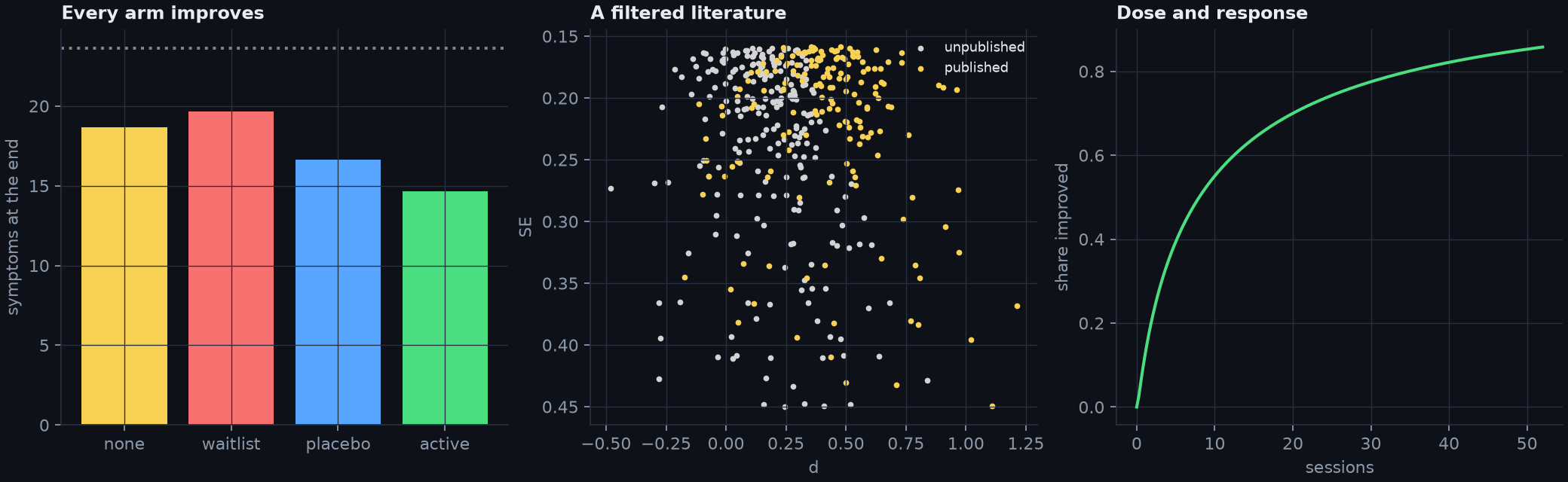
Why does everyone improve? In Psyche, each person's score wanders around their own average, and they come for help when it reaches twenty or more, at their worst. With no treatment at all, the group's average falls by more than five points. That's regression to the mean. A score picked for being high is followed, on average, by a lower one. And real episodes end on their own as well. So the improvement of treated people is no evidence that treatment works. Only a comparison is.
So compare. But with what? Psyche runs the same active therapy against three controls, in two thousand people per arm. Against a waiting list the effect is biggest, partly because waiting may itself do harm, holding people back from seeking help elsewhere. Against no treatment it's smaller. And against a credible placebo therapy, with a warm listener but no specific technique, it's less than half as big. Patients can't be blind to talking therapy, and researchers often favour their own. The effect is a property of the comparison, not of the therapy alone.
One more bias. Psyche runs sixty trials comparing two equally good therapies. Each trial is run by a team loyal to one of them, and loyalty adds a little to its own side's result, through better training, more enthusiasm, or kinder analysis. Pooled across all the trials, the advantage is almost exactly zero, the truth. But trials by one side's loyalists find their therapy ahead, and so do the other side's. In real meta-analyses too, researcher allegiance predicts the results of comparisons between therapies.
What it does: Everyone improves; the control sets the effect; whose therapy wins?
3Meta-analysis is bornPsych 101 and the major1 min
To answer Eysenck, the studies had to be put on one scale. In 1976 Gene Glass named the method meta-analysis, the analysis of analyses. Every outcome, on every scale, becomes a standardized difference: the gap between the groups, in units of the spread. Smith and Glass applied it to three hundred and seventy-five controlled studies. The average effect was zero point six eight. The average treated client ended better off than three quarters of the untreated. Eysenck called it mega-silliness: good studies and bad mixed together, apples with oranges. The answer to that would be to weigh studies by their quality, and by their size.
Here's a meta-analysis by hand. Twelve simulated trials, each drawn as a square sized by its weight, with its ninety-five percent interval. Small trials have wide intervals. The random-effects model of DerSimonian and Laird lets each trial have its own true effect, spread by a standard deviation tau. Each trial is weighted by one over its variance plus tau squared. The pooled effect, the green diamond, lands close to the true value of a half. The mathematics, and how to read heterogeneity, is Part 50.
What it does: One scale for every study; a forest plot, by hand
4The dodo birdPsych 101 and the major3 min
Which therapy works best? In Alice in Wonderland, the dodo judges a race and declares that everybody has won, and all must have prizes. In 1936 Saul Rosenzweig suggested that different therapies may work equally well, through factors they share. In 1975 Lester Luborsky and colleagues reviewed the comparisons, found few differences, and borrowed the dodo's verdict. In 1997 Bruce Wampold and colleagues meta-analysed direct comparisons of bona fide therapies, ones meant to help, and found differences of about zero on average. The Ledger marks it contested: near-equivalence on average, with exceptions.
The boldest answer to what therapies share came from a therapist who thought it was the whole of therapy. Carl Rogers, the humanistic psychologist of Part 1's third force, called his method client-centred: the client, not the therapist, directs the work. He was also one of the first to record therapy sessions so that they could be studied. In 1957 he named three conditions in the therapist: empathy, understanding the client's world as the client sees it; unconditional positive regard, warmth that does not depend on what the client says or does; and congruence, being genuine rather than playing a role. These, he claimed, were necessary and sufficient for change. Sixty years later, meta-analyses led by Robert Elliott found that therapist empathy correlates with outcome at about point two eight. Positive regard and genuineness show smaller, positive correlations. Sufficient is another matter: for some disorders, as the next screens show, specific treatments add to what any good relationship gives. Later researchers widened Rogers's three conditions into one idea.
What could the shared factors be? A warm, credible therapist, a shared rationale for the problem, hope, and agreement on goals and tasks: together, the working alliance. In 2018 Christoph Flückiger and colleagues pooled two hundred and ninety-five studies. Alliance and outcome correlated about zero point two eight. That's modest. It explains about eight percent of the variance in outcome. And the direction is argued. Early improvement may build the alliance, rather than the reverse.
But the dodo isn't always right. For some problems the specific technique clearly matters: exposure, for phobias, panic and obsessive-compulsive disorder, as Part 40 showed. In 2010 David Tolin found that cognitive behavioural therapy did a little better than other therapies for anxiety and depression. The debate goes on because both sides are partly right. Common factors carry much of the effect, and specific ones add to it where the mechanism is known. The best test is a dismantling study: remove one ingredient, and see what's lost.
What it does: "Everybody has won"; the alliance; where ingredients matter
5The therapiesPsych 101 and the major1 min
The therapies come in four families. Behavioural therapies change what's done: exposure, activation, reinforcement, from Parts 16 and 40. Cognitive therapy, Aaron Beck's, has people notice, test and revise the thoughts that keep distress going. The third wave, acceptance and commitment therapy and mindfulness-based cognitive therapy, changes a person's relation to their thoughts, not their content. And psychodynamic therapy works on patterns from the past repeated in relationships, including the one with the therapist. It has fewer trials, some of them positive. Most trials test cognitive behavioural therapy, so its evidence is the largest. More evidence isn't the same as more effect.
One therapy was built for a problem other therapies struggled with. In 1991 Marsha Linehan described dialectical behaviour therapy, for women with borderline personality disorder and repeated self-harm. It combines acceptance with change, skills groups, and coaching between sessions. Against treatment as usual for a year, it brought fewer and less severe acts of self-harm, and fewer days in hospital. In 2006, against treatment by experienced community therapists, the rate of suicide attempts was about halved. Later meta-analyses find smaller effects, and the Ledger marks it replicated.
What it does: Four families; a therapy built for self-harm
6Pills, talk, or bothPsych 101 and the major1 min
How does therapy compare with medication? For depression, in trials that compare them directly, cognitive therapy and antidepressants do about equally well in the short term. Combining them does somewhat better than either alone. People differ. Some prefer one; some respond to one and not the other; and preference itself affects who stays in treatment. Which to choose is a shared decision, not a contest.
The difference shows when treatment stops. In 2005 Steven Hollon and colleagues followed, for a year, people who had responded to cognitive therapy or to an antidepressant. After therapy ended, about thirty percent relapsed. After the drug was replaced by a placebo, about three quarters did. With the drug continued, under half. Therapy's effect seemed to outlast it, as if a skill had been learned. The drug's effect lasted while it was taken. It's one trial, with modest numbers, and later studies broadly agree that therapy lowers relapse.
What it does: Head to head; after treatment stops
7How big is it really?Psych 101 and the major2 min
How big is the effect really? Drug trials show the problem most clearly. In 2008 Erick Turner and colleagues compared the seventy-four trials of twelve antidepressants registered with the American regulator against what was published. By the regulator's own reading, about half were positive. In the journals, ninety-four percent appeared positive. Negative trials went unpublished, or were written up as if they were positive, and the apparent effect grew by about a third. It's Part 4's file drawer, in an industry. And the same question applies to psychotherapy.
Psyche shows what a filter does. Four hundred trials of a therapy whose true effect is zero point three, some small and some large. The significant ones are published, and a fifth of the rest. A random-effects meta-analysis of the published trials finds an effect near zero point four three. Of all of them, close to the truth. The missing trials are the small, unlucky ones, which leaves a gap in the funnel. Part 50 builds the tools that see it.
And for psychotherapy? In 2015 Ellen Driessen and colleagues tracked the psychotherapy trials for depression funded by the American National Institutes of Health. About a quarter had never been published, and adding them shrank the effect. In 2019 Pim Cuijpers and colleagues asked, in the title of their paper, whether Eysenck was right after all. All trials of therapy for adult depression averaged near zero point seven. Restricted to trials at low risk of bias, without waiting lists, and adjusted for publication bias, the effect was considerably smaller. Their answer to their own question: no. Therapy works. But the effect is smaller than the literature suggests. The Ledger: therapy against no treatment, replicated. The published size, replicated, and smaller.
What it does: Two piles of trials; a filtered literature, computed; was Eysenck right after all?
8Clinical significancePsych 101 and the major2 min
A group's average says little about one person. In 1991 Neil Jacobson and Paula Truax proposed two questions for each client. First, is the change bigger than measurement error? It's Part 3's standard error of measurement, applied to a difference of two scores. Divide the change by it, and call it reliable if the ratio passes one point nine six. For a scale with a standard deviation of seven and a reliability of zero point eight five, a change must exceed about seven and a half points. Second, did the person end nearer the well than the ill? The cut-off sits between the two distributions, weighted by their spreads. Here, about sixteen and a half.
Here are four clients. The first went from thirty to fourteen: a reliable change, and across the cut-off. Recovered. The second, thirty to twenty-five: no reliable change. The third, twenty-two to fifteen: across the cut-off, but by less than measurement error. The fourth, thirty-four to twenty: a reliable change, but still on the ill side. Improved, not recovered. Outcome monitoring with these two rules shows clinician and client, session by session, who is on track.
Now apply both rules to everyone in chapter two's trial. Psyche classifies two thousand people in each arm as recovered, improved, unchanged or deteriorated. With no treatment at all, about a third count as recovered. Regression to the mean fools individual rules too. With placebo therapy, under half; with the active therapy, over half. So a clinic's recovery rate means little on its own. The comparison with a control is still what shows the therapy's share.
What it does: Two questions about one person; four clients; recovered without treatment
9Treatments that harmPsych 101 and the major2 min
Therapy can also harm. Psychological debriefing: a single session soon after a trauma, retelling it in detail. Trials found it didn't prevent post-traumatic stress, and in a three-year follow-up of road-accident victims, those debriefed did worse. Scared Straight: young offenders taken into prisons to be confronted by inmates. Randomized trials found more offending afterwards, not less. Recovered-memory techniques: hypnosis and guided imagery used to recover memories of abuse. As Part 21 showed, they can create false ones. And conversion therapy, attempts to change sexual orientation. There's no evidence that it works, there's evidence of harm, and professional bodies oppose it. Scott Lilienfeld collected such cases in 2007.
Why does harm go unseen? Because everyone improves anyway, as chapter two showed, a harmful treatment can look helpful without a control group. A minority of clients get worse in any therapy, often put at five to ten percent, and therapists tend not to notice. And trials rarely measure harms with the care they give to benefits. So the same tools that test benefit, controls and monitoring, are needed to find harm.
Could a clinic see the harm for itself? Psyche gives a therapy that leaves people three points worse than no treatment at all. Reliable deterioration rises from about two percent to about six: a handful of clients in a busy caseload. And about one in six of its clients still count as recovered, because people come at their worst. One therapist, watching clients one at a time, would see mostly improvement. Harm shows only against a control.
What it does: Good intentions, bad outcomes; why harm goes unseen; could a clinic see the harm?
10The body treatmentsPsych 101 and the major1 min
The body treatments have a darker history. In 1935 the neurologist Egas Moniz in Lisbon began cutting connections to the frontal lobes of psychiatric patients. In 1949 he received the Nobel Prize in medicine for it. In the United States, Walter Freeman spread a quick version done through the eye socket, sometimes in an office, and tens of thousands of operations followed. Chlorpromazine, from Part 41, and growing evidence of harm ended it. It was judged by clinicians' impressions, with no controls. A treatment that blunted people was counted as calming them.
Electroconvulsive therapy went the other way. In 1938 Ugo Cerletti and Lucio Bini in Rome induced a seizure with an electric current to treat psychosis. Early ECT was given without anaesthesia, sometimes as punishment, and its image never recovered. Modern ECT is given under general anaesthesia with a muscle relaxant. For severe depression it does better than simulated ECT, in which only the anaesthetic is given. Its cost is memory loss, mostly around the treatment period. It's a choice for severe illness that hasn't responded to other treatment.
What it does: A Nobel Prize; ECT, then and now
11How much therapy?Psych 101 and the major1 min
How much therapy is enough? In 1986 Kenneth Howard and colleagues pooled many samples. About half of clients had improved by eight sessions, and three quarters by twenty-six. Psyche draws it as a log-normal curve through those two points. Each extra session adds less. Later work suggests that clients often stop when they feel good enough, so the curve partly reflects who stays. And some don't respond at all, which is where monitoring and a change of plan matter.
And most people get none. Part 39's treatment gap: most people with a common mental disorder receive no treatment, and few receive therapy that matches what the trials tested. Trained therapists are scarce and expensive, and waits are long. The responses include guided self-help, group and digital programmes, and lay counsellors trained to deliver simple therapies, each tested in trials of its own. How well these scale, and for whom, is Part 57's question.
What it does: The dose-response curve; most people get none
12The LedgerPsych 101 and the major
The tally. What holds: therapy beats no therapy, the alliance tracks outcome, and dialectical behaviour therapy reduces self-harm. What shrank, or is argued: the published size of the effect, and the dodo bird. What failed: debriefing and Scared Straight, both of which did harm.
What it does: Seven rows and the tally
13In practice: guidelines, choices and monitoringPractice1 min
In practice, evidence reaches a person in steps. Guidelines: panels grade the trials and recommend. In stepped care, the least intensive treatment likely to help comes first. Choosing: the evidence for the problem, the person's preference, and what's available. A credible therapist matters as much as the brand. Monitoring: a short questionnaire every session, read with chapter eight's reliable-change rules. Feedback to therapists about clients going off track reduces deterioration. Changing course: no reliable change after several sessions is a reason to change the plan, not to persist. And for a client: ask what the therapy is, what it's for, how progress will be judged, and what happens if it isn't working.
What it does: From evidence to a person
14Frontier: mechanisms, matching and psychedelicsResearch1 min
At the frontier, three ideas. Mechanisms: therapies claim to work by changing thoughts, skills or relationships. But showing that the change comes first, and causes the improvement, is rare. Matching: models that predict, from a person's characteristics, which of two treatments will suit them better. They're promising, and still to be tested prospectively. That's Part 59. Psychedelics: psilocybin and MDMA, given with therapy. Participants nearly always know whether they had the drug, so blinding fails, and in 2024 the American regulator declined to approve MDMA-assisted therapy for post-traumatic stress. Each frontier needs what this part used: a good control, an unfiltered record, and outcomes that matter to the person.
So, open questions. How much of therapy's effect is common factors, and how much specific technique? What's the right placebo for a talking therapy? Why do some clients get worse, and can it be predicted? Can simpler, cheaper therapies close the treatment gap without losing the effect? And can trials of psychedelic therapy be made blind, or should they be judged differently?
What it does: Three frontiers; open questions
Recap, problems, and the road aheadAll tracks4 min
First, your four numbers. Smith and Glass's average effect size: zero point six eight. Published antidepressant trials that looked positive: ninety-four percent, against about half at the regulator. The alliance-outcome correlation: about zero point two eight. And the sessions by which half of clients have improved: about eight. Therapy works. The published effect is too big. And the control sets the size.
Part forty-two in eleven lines. Eysenck, in 1952: people improve anyway, and only a control can say how much therapy adds. Regression to the mean: people enrol at their worst, so every arm improves. The control sets the effect: waiting list, no treatment, placebo therapy. Meta-analysis puts studies on one scale and weighs them; Smith and Glass found zero point six eight. The dodo bird: bona fide therapies are near-equal on average, with exceptions. The alliance correlates about zero point two eight with outcome, and its direction is argued. Therapy and medication do about equally well, and therapy's effect outlasts it. Publication bias inflates the effect; the real one is smaller, and real. Reliable change and a cut-off say whether one person got better. Some treatments harm: debriefing, Scared Straight, recovered memories. And half of clients improve by about eight sessions, while most people get no therapy at all.
Kant's wager. The first objection, that mathematics can't apply to the mind, met regression to the mean, random effects, reliable change and a publication filter, all computed. The second, that the mind can't be experimented on, met randomized trials of talking, with controls chosen to answer different questions. And the third, about introspection: outcomes are mostly self-reports, and patients can't be blind to therapy. Amber.
Where this comes back. One study replicated from start to finish is next, in Part 43, the capstone. Meta-analysis and its biases, properly, are Part 50. Closing the treatment gap is Part 57. And matching treatments to people is Part 59.
Seven problems, with full solutions in this part's README. One computes regression to the mean. One turns end scores into effect sizes against three controls. One does a small meta-analysis by hand. One finds reliable change. One finds the cut-off. One works out what a significance filter does to the published effect. And the last, with the star, asks you to design a trial that separates a specific ingredient from the common factors. Pause here if you'd like to try them.
The books and papers behind this part are listed here and in the README. Wampold and Imel's The Great Psychotherapy Debate makes the case for common factors; Valenstein's Great and Desperate Cures tells the history of lobotomy; and Smith, Glass and Miller's book is the full meta-analysis that answered Eysenck.
Act Ten is complete. It asked what a disorder is, built fear and sadness, psychosis and addiction from the series' own models, and weighed the evidence for therapy. The next part is the capstone of the degree. One classic effect from the Ledger, replicated properly on screen, from the choice of target to the report, with the viewer as a participant. Part 43: the replication.
Where it goes next. The capstone replication is Part 43, meta-analysis and bias properly Part 50, the treatment gap Part 57 and matching treatments to people Part 59.
Key results
The part's results in one place, for revision.
Try it
Lab 42 · Does Therapy Work?
Run a therapy trial in which everyone enrols at their worst; compare one therapy with three controls; let loyal teams compare two equal therapies; pool trials with DerSimonian and Laird; filter a literature by significance; and decide whether one client changed reliably.
python -m videos.psychology.labs 42
needs numpy, scipy, matplotlib · download lab42.py ·
source on GitHubarm 'none': mean at entry; at the end 23.6; 18.6
arm 'waitlist': mean at entry; at the end 23.6; 19.6
arm 'placebo': mean at entry; at the end 23.6; 16.6
arm 'active': mean at entry; at the end 23.6; 14.6
active therapy against waitlist: d (2,000 per arm) 0.80
active therapy against none: d (2,000 per arm) 0.63
active therapy against placebo: d (2,000 per arm) 0.31
allegiance: pooled; by A's loyalists; by B's +0.02; +0.22; -0.19
three trials by hand: fixed estimate; Q; tau^2; random-effects estimate 0.463; 2.42; 0.0073; 0.451
400 trials of d = 0.3: published; pooled published effect; pooled all 167; 0.42; 0.28
reliable change for SD 7, reliability 0.85; cut-off for 28 (6) against 7 (5) 7.5 points; 16.5
RCI for 26 to 20 -1.56
Every arm improves because people enrol at their worst; the effect depends on the control; loyal teams find their own therapy ahead; random-effects weights pool trials; a significance filter inflates the published effect; and the reliable change index separates change from measurement error.The code (79 lines; it asserts its own result)
"""Lab 42: a therapy trial with four arms and regression to the mean, the effect against each control, researcher
allegiance, a random-effects meta-analysis by hand, a publication filter, and reliable change."""

import numpy as np

from videos.coursekit import labs
from explainer.psychology.psyche import clinic as K

TITLE = "Does Therapy Work?"
GOAL = ("Run a therapy trial in which everyone enrols at their worst; compare one therapy with three controls; let "
        "loyal teams compare two equal therapies; pool trials with DerSimonian and Laird; filter a literature by "
        "significance; and decide whether one client changed reliably.")
TASKS = [
    "Lower the enrolment threshold from 20 to 14 (everyone enrols). How much does the untreated arm improve now?",
    "Make every trial in the publication filter four times larger. How much of the inflation remains, and why?",
    "Find the reliability a scale needs for a 5-point change to count as reliable when its SD is 7.",
]


def run(seed=0):
    out = labs.Lab()

    for a in K.ARMS:
        r = K.therapy_trial(a, seed=seed)
        out.row(f"arm '{a}': mean at entry; at the end", f"{r['pre'].mean():.1f}; {r['post'].mean():.1f}")
    none = K.therapy_trial("none", seed=seed)
    assert none["change"] < -3
    for b in ("waitlist", "none", "placebo"):
        out.row(f"active therapy against {b}: d (2,000 per arm)", f"{K.trial_effect('active', b, n=2000, seed=seed):.2f}")

    al = K.allegiance(seed=seed)
    out.row("allegiance: pooled; by A's loyalists; by B's",
            f"{K.random_effects(al['d'], al['v'])['mu']:+.2f}; "
            f"{K.random_effects(al['d'][al['loyal'] > 0], al['v'][al['loyal'] > 0])['mu']:+.2f}; "
            f"{K.random_effects(al['d'][al['loyal'] < 0], al['v'][al['loyal'] < 0])['mu']:+.2f}")

    small = K.random_effects([0.4, 0.6, 0.2], [0.04, 0.02, 0.05])
    out.row("three trials by hand: fixed estimate; Q; tau^2; random-effects estimate",
            f"{small['fixed']:.3f}; {small['Q']:.2f}; {small['tau2']:.4f}; {small['mu']:.3f}")
    assert abs(small["fixed"] - 44 / 95) < 1e-9

    p = K.publication_filter(seed=seed)
    allr, pub = K.random_effects(p["d"], p["v"]), K.random_effects(p["d"][p["published"]], p["v"][p["published"]])
    out.row("400 trials of d = 0.3: published; pooled published effect; pooled all",
            f"{int(p['published'].sum())}; {pub['mu']:.2f}; {allr['mu']:.2f}")
    assert pub["mu"] > allr["mu"]

    thr = 1.96 * np.sqrt(2) * 7 * np.sqrt(1 - 0.85)
    out.row("reliable change for SD 7, reliability 0.85; cut-off for 28 (6) against 7 (5)",
            f"{thr:.1f} points; {K.jt_cutoff(28, 6, 7, 5):.1f}")
    out.row("RCI for 26 to 20", f"{float(K.reliable_change(26, 20, 7, 0.85)):.2f}")

    out.note = ("Every arm improves because people enrol at their worst; the effect depends on the control; loyal "
                "teams find their own therapy ahead; random-effects weights pool trials; a significance filter "
                "inflates the published effect; and the reliable change index separates change from measurement "
                "error.")

    fig, ax = labs.figure(3, size=(13, 4.0))
    names = list(K.ARMS)
    ax[0].bar(range(4), [K.therapy_trial(a, seed=seed)["post"].mean() for a in names],
              color=[labs.GOLD, labs.RED, labs.BLUE, labs.GREEN])
    ax[0].axhline(none["pre"].mean(), color="grey", ls=":")
    ax[0].set_xticks(range(4), names)
    ax[0].set(title="Every arm improves", ylabel="symptoms at the end")
    se = np.sqrt(p["v"])
    ax[1].scatter(p["d"][~p["published"]], se[~p["published"]], s=6, color="lightgrey", label="unpublished")
    ax[1].scatter(p["d"][p["published"]], se[p["published"]], s=6, color=labs.GOLD, label="published")
    ax[1].invert_yaxis()
    ax[1].set(title="A filtered literature", xlabel="d", ylabel="SE")
    ax[1].legend(fontsize=8)
    s = np.linspace(0, 52, 200)
    ax[2].plot(s, K.dose_response(s), color=labs.GREEN)
    ax[2].set(title="Dose and response", xlabel="sessions", ylabel="share improved")
    out.fig = fig
    return out


if __name__ == "__main__":
    print(run())
Now change it
- Lower the enrolment threshold from 20 to 14 (everyone enrols). How much does the untreated arm improve now?
- Make every trial in the publication filter four times larger. How much of the inflation remains, and why?
- Find the reliability a scale needs for a 5-point change to count as reliable when its SD is 7.
Problems, with solutions
Try each problem before opening its solution.
-
Regression to the mean. Each person's mean symptom score is \(N(14, 5^2)\) and each occasion adds \(N(0, 5^2)\). Someone enrols with a score of 24. What is their expected score next time, with no treatment?
Solution
Given a screened score x, the expected mean is 14 + (25/50)(x - 14) = 19 for x = 24, and the next score's expectation is the same: 19. Five points of improvement are expected with no treatment.
-
Three controls. At the end of a trial the waiting list averages 18.85, placebo therapy 15.85 and active therapy 13.85, with SD 6.7 in each arm. Find the active therapy's \(d\) against each control.
Solution
Against the waiting list d = (18.85 - 13.85)/6.7 = 0.75; against placebo therapy (15.85 - 13.85)/6.7 = 0.30; the same therapy has an effect less than half as large against the stronger control.
-
A small meta-analysis. Three trials find \(d\) = 0.4, 0.6 and 0.2, with variances 0.04, 0.02 and 0.05. Find the fixed-effect estimate, its SE, \(Q\) and the DerSimonian-Laird \(\hat\tau^2\).
Solution
Weights 25, 50, 20 (sum 95): the fixed-effect estimate is (10 + 30 + 4)/95 = 0.463 with SE 1/√95 = 0.103. Q = 25(0.063)² + 50(0.137)² + 20(0.263)² = 2.42 on 2 df, so τ² = (2.42 - 2)/(95 - 3525/95) = 0.42/57.9 = 0.0073.
-
Reliable change. A scale has SD 7 and reliability 0.85. Find the change needed for reliable change, and say whether a client who goes from 26 to 20 has changed reliably.
Solution
S_diff = √2 × 7 × √0.15 = 3.83, so a reliable change exceeds 1.96 × 3.83 = 7.5 points. From 26 to 20, RCI = -6/3.83 = -1.56: not reliable.
-
The cut-off. The clinical group averages 28 (SD 6) and the well group 7 (SD 5). Find Jacobson and Truax's cut-off \(c\).
Solution
c = (6 × 7 + 5 × 28)/(6 + 5) = 182/11 = 16.5.
-
A significance filter. A therapy's true effect is \(d = 0.3\), trials have 20 people per arm, and only significant results are published. Find the power, and the average published effect.
Solution
With 20 per arm, SE ≈ √(2/20) = 0.316, so significance needs d > 1.96 × 0.316 = 0.62. Power = P(Z > 1.96 - 0.3/0.316) = P(Z > 1.01) ≈ 0.16. The published mean is the mean of a normal (0.3, 0.316) above 0.62: 0.3 + 0.316 × φ(1.01)/(1 - Φ(1.01)) = 0.3 + 0.316 × 0.240/0.156 ≈ 0.79, more than two and a half times the truth.
-
★ Ingredient against common factors. Design a trial that could separate a therapy's specific ingredient from its common factors, and show which comes first, the change in the mechanism or the improvement.
Solution
Randomize to the full therapy, the same therapy without the ingredient (a dismantling arm, delivered with equal warmth, rationale and time), and a credible placebo therapy; rate the alliance and measure the proposed mechanism every session; preregister that the ingredient's arm should beat the dismantled one, that mechanism change should precede symptom change within people (a lagged multilevel model, Part 47), and that the alliance alone should not account for the difference.
Notes and sources
Sources
- H. J. Eysenck, The effects of psychotherapy: an evaluation, Journal of Consulting Psychology 16 (1952) 319-324; G. V. Glass, Primary, secondary, and meta-analysis of research, Educational Researcher 5 (1976) 3-8; M. L. Smith and G. V. Glass, Meta-analysis of psychotherapy outcome studies, American Psychologist 32 (1977) 752-760; M. L. Smith, G. V. Glass and T. I. Miller, The Benefits of Psychotherapy (1980); H. J. Eysenck, An exercise in mega-silliness, American Psychologist 33 (1978) 517.
- R. DerSimonian and N. Laird, Meta-analysis in clinical trials, Controlled Clinical Trials 7 (1986) 177-188.
- S. Rosenzweig, Some implicit common factors in diverse methods of psychotherapy, American Journal of Orthopsychiatry 6 (1936) 412-415; L. Luborsky, B. Singer and L. Luborsky (1975); B. E. Wampold et al. (1997); D. F. Tolin (2010); B. E. Wampold and Z. E. Imel, The Great Psychotherapy Debate (2nd edition, 2015).
- A. O. Horvath and B. D. Symonds (1991); C. Flückiger et al. (2018).
- A. T. Beck, Cognitive Therapy and the Emotional Disorders (1976); M. M. Linehan et al. (1991, 2006); C. R. DeCou, K. A. Comtois and S. J. Landes (2019).
- S. D. Hollon et al., Prevention of relapse following cognitive therapy vs medications in moderate to severe depression, Archives of General Psychiatry 62 (2005) 417-422.
- E. H. Turner, A. M. Matthews, E. Linardatos, R. A. Tell and R. Rosenthal, Selective publication of antidepressant trials and its influence on apparent efficacy, New England Journal of Medicine 358 (2008) 252-260; E. Driessen et al. (2015); P. Cuijpers et al. (2019).
- N. S. Jacobson and P. Truax, Clinical significance: a statistical approach to defining meaningful change in psychotherapy research, Journal of Consulting and Clinical Psychology 59 (1991) 12-19.
- J. T. Mitchell (1983); S. Rose et al. (2002); R. A. Mayou, A. Ehlers and M. Hobbs (2000); A. Petrosino et al. (2013); S. O. Lilienfeld, Psychological treatments that cause harm, Perspectives on Psychological Science 2 (2007) 53-70.
- E. Moniz, Tentatives opératoires dans le traitement de certaines psychoses (Masson, 1936); E. S. Valenstein, Great and Desperate Cures (1986); U. Cerletti, Old and new information about electroshock, American Journal of Psychiatry 107 (1950) 87-94; UK ECT Review Group, Efficacy and safety of electroconvulsive therapy in depressive disorders, Lancet 361 (2003) 799-808.
- K. I. Howard, S. M. Kopta, M. S. Krause and D. E. Orlinsky, The dose-effect relationship in psychotherapy, American Psychologist 41 (1986) 159-164.
About this partfrom its README
The part opens with the care card: this is education, not diagnosis or treatment, and here is where help is found; it touches on trauma and self-harm. In 1952 Hans Eysenck surveyed the outcome studies and concluded that about two thirds of neurotic patients improve with or without psychotherapy. The claim was infuriating and nearly impossible to answer without proper controls and a method for adding up studies. In 1977 Smith and Glass used that method, meta-analysis, to answer him. Then came the harder questions: compared with what, by which ingredient, and how much of the published effect is real.
The viewer is shown two graphs and asked which one shows therapy working, and predicts four numbers. Then the trial: regression to the mean on the Pool, how the control sets the effect, and researcher allegiance (computed); meta-analysis from Glass's standardized difference to a random-effects forest plot built by hand; the dodo bird, the Rogers's three conditions and their meta-analytic record; the alliance and specific ingredients; the four families of therapy and dialectical behaviour therapy; therapy against medication, and relapse after each stops; the registered and published antidepressant trials, a filtered literature (computed) and "Was Eysenck right after all?"; Jacobson and Truax's reliable change and cut-off, derived and applied to four clients; treatments that harm; lobotomy and ECT; and the dose-response curve and the treatment gap.
What is computed and built
explainer/psychology/psyche/clinic.pygains the therapy-trial simulator, the effect against each control, the publication filter, DerSimonian and Laird's random-effects meta-analysis, researcher allegiance, Jacobson and Truax's reliable change index, cut-off and categories, and the dose-response curve. Tested intests/psychology/test_clinic.py.- The Ledger gains seven rows; the deferred declarations of Parts 2, 6 and 10 about treatments are resolved.
- The course's interactive is the two-graphs problem, case by case: six study designs, each judged as able, or not able, to show that a therapy worked.
Chapter notes
| # | Chapter | What it does |
|---|---|---|
| 0 | 1952: two thirds recover anyway | The care card; Eysenck's challenge; an answer and harder questions; the question; objectives |
| 1 | On you: two graphs, and four numbers | Which graph shows therapy working; four predictions |
| 2 | The trial, and the control problem | Everyone improves; the control sets the effect; whose therapy wins? |
| 3 | Meta-analysis is born | One scale for every study; a forest plot, by hand |
| 4 | The dodo bird | "Everybody has won"; the alliance; where ingredients matter |
| 5 | The therapies | Four families; a therapy built for self-harm |
| 6 | Pills, talk, or both | Head to head; after treatment stops |
| 7 | How big is it really? | Two piles of trials; a filtered literature, computed; was Eysenck right after all? |
| 8 | Clinical significance | Two questions about one person; four clients; recovered without treatment |
| 9 | Treatments that harm | Good intentions, bad outcomes; why harm goes unseen; could a clinic see the harm? |
| 10 | The body treatments | A Nobel Prize; ECT, then and now |
| 11 | How much therapy? | The dose-response curve; most people get none |
| 12 | The Ledger | Seven rows and the tally |
| 13 | In practice: guidelines, choices and monitoring | From evidence to a person |
| 14 | Frontier: mechanisms, matching and psychedelics | Three frontiers; open questions |
| Recap, problems, and the road ahead | Your numbers; eleven lines; Kant's three objections; payoffs; problems; references; Part 43 |
NotesWhere the numbers come from
| What | Source |
|---|---|
| The trial simulator: each person's mean score N(14, 5²), each occasion N(0, 5²); 200 people per arm enrol at a score of 20 or more (mean 23.5) and are scored again; end means 18.9 (waiting list, a small harm of 1 point), 17.9 (no treatment), 15.9 (placebo therapy, 2 points of common factors) and 13.9 (active therapy, 4 points); the active arm's d is 0.75 against the waiting list, 0.59 against no treatment and 0.27 against placebo therapy (2,000 per arm) | Psyche (clinic.therapy_trial, trial_effect), item arms |
| Researcher allegiance: 60 comparisons of two equally good therapies, half run by each side's loyal team (bias 0.25): pooled advantage +0.01; by A's loyalists +0.28, by B's -0.25 | Psyche (clinic.allegiance), item allegiance |
| A forest plot: twelve simulated trials of a true effect of 0.5 (between-trial SD 0.15); DerSimonian-Laird estimate 0.51, SE 0.07, tau² 0.010, I² 18% | Psyche (clinic.random_effects), item forest |
| A filtered literature: 400 trials of a true effect of 0.3, 10 to 80 per arm; 173 published (the significant ones and a fifth of the rest), 69% of them significant; pooled published effect 0.43, all trials 0.29 | Psyche (clinic.publication_filter, random_effects), item bias |
| Reliable change for a scale with SD 7 and reliability 0.85: a change of 7.5 points; the cut-off between a clinical group (28, SD 6) and a well group (7, SD 5): 16.5; four clients (30 to 14, 30 to 25, 22 to 15, 34 to 20) with RCI -4.17, -1.30, -1.83, -3.65 | Psyche (clinic.reliable_change, jt_cutoff), item rci |
| Jacobson and Truax's categories in 2,000 people per arm of the trial simulator (SD 7.07, reliability 0.85, cut-off 20.8 between the enrolled and the population): recovered 30% with no treatment, 26% on the waiting list, 43% with placebo therapy and 56% with active therapy; a therapy 3 points worse than none: reliable deterioration 5.7% against 2.2%, and 16% still recovered | Psyche (clinic.jt_categories), item categories |
| The dose-response curve: a log-normal through half improved by 8 sessions and three quarters by 26 | Psyche (clinic.dose_response), item dose |
| Every published number on screen | the studies listed under Sources, quoted as reported |
Schematic panels (the alliance scatter, the two-graphs problem's lines, Eysenck's bars at his reported percentages, the relapse bars at Hollon and colleagues' percentages) are labelled or described as such; where a value is shown on them, it is the published value.
Notes
| Finding | Original | Status |
|---|---|---|
| People who receive psychotherapy end better off than comparable people who receive none | Smith and Glass (meta-analysis) 1977 | replicated |
| Psychotherapy for adult depression has a large effect, near g = 0.7 against control conditions, as the whole published literature suggests | Cuijpers and colleagues (all trials) 2019 | replicated, smaller |
| All bona fide psychotherapies are about equally effective | Luborsky, Singer and Luborsky 1975 | contested |
| The quality of the working alliance between client and therapist correlates with how well therapy goes | Horvath and Symonds (meta-analysis) 1991 | replicated |
| Dialectical behaviour therapy reduces self-harm in people with borderline personality disorder | Linehan and colleagues 1991 | replicated |
| A single session of psychological debriefing soon after a trauma prevents post-traumatic stress | Mitchell 1983 | failed |
| Taking young offenders to visit prisons, to be confronted by inmates, deters them from crime | Scared Straight!, the programme and the documentary 1978 | failed |
Shown without a row, with the reason recorded in explainer/psychology/ledger.py: Eysenck; Driessen and colleagues;
Hollon and colleagues; Turner and colleagues; Moniz; Cerletti and Bini; Howard and colleagues.
Notes
The web-search budget for this session was spent on earlier parts, so the facts in this part come from the standard literature and were not re-checked online today; each is listed here to be checked against its source: Eysenck's figures (44% for psychoanalysis, 64% for eclectic therapy, 72% for custodial care) and his "two thirds"; Glass's naming of meta-analysis (1976); Smith and Glass's 375 studies and 0.68, and "better off than 75%"; Eysenck's "mega-silliness" (1978); Rosenzweig (1936); Luborsky et al. (1975) and the dodo quotation; Wampold et al. (1997); Tolin (2010); Horvath and Symonds' 0.26; Flückiger et al.'s 295 studies and 0.28; Linehan et al. (1991: 44 women, and the outcomes described) and (2006: 101 women, about half the rate of suicide attempts); DeCou et al. (2019); the equivalence of cognitive therapy and antidepressants in the short term and the advantage of combining them; Hollon et al.'s relapse rates (about 31%, 76% and 47%); Turner et al.'s 74 trials, twelve drugs, 51% and 94%, and an inflation of about a third; Driessen et al.'s quarter of unpublished trials; Cuijpers et al. (2019), the overall g near 0.7 and the smaller adjusted effect; the evidence that waiting lists may harm; Jacobson and Truax's formulas; Mitchell (1983), Rose et al. (2002) and Mayou et al.'s three-year result; Petrosino et al. (2013) on Scared Straight; the evidence on recovered-memory techniques and conversion therapy; the share of clients who deteriorate (5 to 10%); Moniz's dates (1935 operations, 1936 publication, 1949 Nobel Prize) and the scale of Freeman's operations; Cerletti and Bini (1938) and modern ECT's evidence against sham; Howard et al.'s half by 8 sessions and three quarters by 26; the "good enough level" findings; stepped care; the evidence that outcome feedback reduces deterioration; treatment-selection models; the 2024 decision on MDMA-assisted therapy; and every page range in Sources.
Companion material in this repository
The syllabus's plan for this partfrom SYLLABUS.md, the plan of record
- Hook: Eysenck's challenge.
- On you: clients enter therapy at their worst and improve. Two graphs; which one shows the therapy working? Regression to the mean and natural recovery (computed on the Pool).
- The trial: randomization, and the control problem. Waiting lists (which may make people worse), placebo therapy, treatment as usual; no blinding of the patient; researcher allegiance.
- Meta-analysis is born: Glass (1976); Smith and Glass's 375 studies and an average effect of 0.68. A forest plot built study by study (the mathematics is Part 50).
- The dodo bird: "everybody has won" (Rosenzweig 1936; Luborsky 1975). Common factors, the therapeutic alliance and its correlation near 0.28 with outcome; the case for specific ingredients (exposure for anxiety).
- The therapies: behavioural methods (Part 40); cognitive therapy (Beck); the third wave; psychodynamic therapy and its trial evidence; DBT for self-harm (Linehan 1991).
- Medication against therapy against both; relapse after stopping.
- How big is it really? Publication bias in antidepressant trials (94% positive in journals, 51% at the regulator); the same correction applied to psychotherapy trials; effects against waiting list, against placebo, against usual care.
- Clinical significance: the reliable change index and the recovered proportion (Jacobson and Truax 1991), derived.
- Treatments that harm: critical-incident debriefing, "scared straight", recovered-memory techniques, conversion therapy.
- The history of the body treatments: lobotomy and a Nobel Prize (1949); ECT then and now.
- The dose–response curve of sessions; who does not respond; the treatment gap (to Part 57).
Psyche: clinic: a therapy-trial simulator on the Pool (natural recovery, regression to the mean, control-
condition choice, allegiance, publication filter); a random-effects meta-analysis by hand; the reliable change
index.
On you: the two-graphs problem.
Ledger: psychotherapy beats no treatment (replicated); the published effect size (replicated, smaller after
bias correction); equivalence of bona fide therapies (contested); the alliance–outcome correlation
(replicated; causal direction contested); debriefing after trauma (failed, possibly harmful).
In practice: how treatment guidelines are written; choosing a therapy; outcome monitoring.
Frontier: mechanisms of change; personalized treatment selection (Part 59); psychedelic-assisted therapy and
the unblinding problem.
Reading: Eysenck 1952; Smith & Glass 1977; Wampold & Imel, The Great Psychotherapy Debate; Cuijpers et al.
2010, 2019; Turner et al. 2008; Jacobson & Truax 1991; Lilienfeld 2007; Linehan et al. 1991; Flückiger et al.
2018; Valenstein, Great and Desperate Cures.
Build the film
python -m videos.psychology.psych42.compute        # the part's numbers, into .cache/psych42
python tools/build.py psych42                  # render and assemble the film
EXPLAINER_TTS=silent python tools/qa_scene.py psych42 Hook   # one chapter, silent, with a contact sheet
Scenes: videos/psychology/psych42. Setup: see the course page. Source of these notes: the README and the scenes' narration.
Build it
python -m videos.psychology.psych42.compute            # every number (a few seconds)
python tools/qa_scene.py psych42 Trial                 # one chapter, silent, at 480p, with a contact sheet
EXPLAINER_TTS=silent python tools/build.py psych42 -q l   # the whole part, silent preview
python tools/build.py psych42                          # 1080p30 with narration
python tools/qa_scene.py psych42 Bias --lang zh        # the Chinese edition of one chapter
python tools/make.py psych42                           # both editions, with the checks a long build needs
python -m videos.psychology.labs 42                    # the lab: trials, controls, meta-analysis, bias, change
python tools/check_ledger.py psych42                   # every study shown has its Ledger row, or a reason
python -m pytest tests/psychology                      # Psyche's clinic module, the Ledger, the Archive
The Chinese edition is zh_lines.py (the narration, line by line) and the series table
videos/psychology/psychology_text_zh.json (the text on screen); the terms are in
PSYCHOLOGY_ZH_GUIDE.md.