Behaviour Change at Scale
How much can a small change in how a choice is presented change what millions of people do?
Opt-out organ donation and automatic pension enrolment made the nudge government policy; then the accounting found the average published nudge near nine percentage points and the average nudge-unit trial near one and a half. The part solves the algebra of a default, opens the toolbox, simulates a megastudy with its winner's curse and shrinkage, reproduces the published-against-practice gap with a publication filter, and weighs heterogeneity, incentives, backfires, persuasion, misinformation, a fabricated nudge and the ethics of steering.
What you need. Part 26's choice, Part 34's norms and Part 50's filtered literatures; proportions and a little Bayes.
- Hook
- the default that made donors
- Ideas, models and mathematics
- defaults and nudges, megastudies, the gap between papers and nudge units, heterogeneity, incentives, norms, persuasion and its small effects, advertising measurement, misinformation, the ethics of steering
- Psyche gains
- a megastudy simulator
- On you
- choose the winning nudge
What you will be able to do
Psych 101 and the major
- Explain why defaults work and why most nudges are smaller than reported.
- Recognize sludge and the disclosure test for manipulation.
Graduate
- Correct a megastudy's winner by shrinkage and size a trial for a small effect.
- Show how a publication filter inflates an average effect.
Research
- Design a study of which interventions transfer across sites.
Practice
- Design and preregister a behavioural trial with its power, persistence and cost per unit of change.
Contents
Each chapter has a home level. Choose a track to see what to read and watch: Psych 101 and the major 13 min · Graduate 25 min · Research 26 min · Practice 18 min.
- 0One sentence on a formPsych 101 and the major2 min
- 1On you: five ways to the gym, and four numbersPsych 101 and the major1 min
- 2Why defaults workPsych 101 and the major2 min
- 3The toolboxPsych 101 and the major1 min
- 4The megastudyPractice2 min
- 5The reckoningPractice2 min
- 6Heterogeneity is the findingGraduate2 min
- 7IncentivesGraduate1 min
- 8When nudges backfirePsych 101 and the major1 min
- 9Persuasion at scaleGraduate1 min
- 10MisinformationGraduate1 min
- 11A nudge that never wasPsych 101 and the major1 min
- 12Ethics and limitsPsych 101 and the major1 min
- 13The LedgerGraduate1 min
- 14In practice: a trial, designedPractice1 min
- 15Frontier: predicting what works whereResearch1 min
- Recap, problems, and the road aheadAll tracks2 min
Also on this page: Lecture · Key results · Try it · Lab · Problems · Notes and sources · Build the film.
Lecture
The text of each chapter is the film's narration, as it is spoken, so you can read along or revise without the film. The pictures are in the film.
One sentence on a formPsych 101 and the major2 min
Here's one sentence on a form. In 2003 Eric Johnson and Daniel Goldstein compared European countries. Where people had to opt in to organ donation, consent rates were low. Where they had to opt out, nearly everyone was a donor. The difference was a default. An online experiment agreed: the same choice, framed as opting in or opting out, roughly doubled consent. The bars are approximate country averages, as they're usually quoted.
Then the accounting arrived. Consent on a register isn't organs donated. Families, hospitals and logistics decide that, and opt-out countries don't uniformly donate more. Still, the nudge became policy: Richard Thaler and Cass Sunstein's book in 2008, and nudge units in governments around the world. In published papers, the average nudge moved behaviour by almost nine percentage points. Across everything two government units actually ran, it moved it by about one and a half, as Stefano DellaVigna and Elizabeth Linos found in 2022. This part is that gap: what changes behaviour at scale, by how much, and how we know.
So this part asks: how much can the way a choice is presented change what millions of people do? Defaults, the toolbox, and a megastudy. The reckoning: published against practice, and for whom. Incentives, backfires, persuasion and misinformation. And a retraction, and the ethics of steering people.
This is Part 55 of Psychology, Built: behaviour change at scale. We'll see why defaults work, and solve their algebra. We'll open the toolbox of framing, reminders, commitment and norms. We'll run a megastudy, and correct its winner. We'll set published nudges against what nudge units found, and ask for whom. We'll look at incentives, backfires, persuasion and misinformation. And we'll weigh sludge, autonomy, and changing the system instead of the person.
What it does: Organ-donation defaults; the accounting; the question; objectives
1On you: five ways to the gym, and four numbersPsych 101 and the major1 min
Which nudge would you bet on?
First, a bet. On the course site you'll rank five interventions to get people to the gym: a text reminder before each planned workout, bonus points for coming back after a missed one, a message that most members go more than you, a signed pledge, and a small cash reward per visit. Then you'll see your ranking against the outcome, and against experts' forecasts. The descriptions are simplified versions of the kinds of arms that were tested.
Now four numbers. One: retirement saving with automatic enrolment instead of opting in. Participation went from thirty-seven percent to what? Two: a megastudy's best-looking intervention is estimated at plus seven points. What's its true effect, roughly? Three: the average published nudge moves behaviour about nine points. What's the average across government nudge-unit trials? And four: campaign contact in an American general election, by canvassing, mail or ads. What's its average persuasion effect? Pause here, and write them down.
What it does: The ranking; four predictions
2Why defaults workPsych 101 and the major2 min
Why does a pre-ticked box matter so much?
The cleanest default is in retirement saving. In 2001 Brigitte Madrian and Dennis Shea studied a company that switched new employees from opting in to automatic enrolment. Participation rose from thirty-seven percent to eighty-six. Here's a simple reading. A share q of people stay with whatever is set, and of the rest, a share p want in. Solving the two equations: q is about a half, and p about three quarters. Half the workforce goes with the default. But most also stayed at the default contribution rate and fund, which were low. The default sets what people save, not only whether.
Why does a pre-ticked box matter so much? Effort: changing it takes a form, a decision and time, and inertia wins when the stakes feel distant. Endorsement: a default reads as a recommendation, as if the designer must know best. And reference point: the default becomes what you have, and leaving it feels like a loss. That's Part 26's loss aversion. The lesson: choosing no default is impossible. Every form has one, so choose it deliberately.
Defaults can also move over time. In 2004 Richard Thaler and Shlomo Benartzi had employees commit in advance to raise their saving rate at each future pay rise. It used three of Part 26's biases: present bias, because the cost comes later; loss aversion, because take-home pay never falls; and inertia, because it continues unless stopped. In the first company, participants' saving rates rose from about three and a half percent to about thirteen and a half over four years. Automatic escalation is now common in pension law. The evidence is strongest where people would otherwise save too little.
What it does: Automatic enrolment and its algebra; three reasons; Save More Tomorrow
3The toolboxPsych 101 and the major1 min
What else can be changed besides the default?
Defaults are one tool among several. Framing: ninety percent survive against ten percent die, Part 26's frames, the same fact and a different choice. Salience and simplification: put the cost in the headline, cut the form to one page. College aid applications pre-filled from tax data raised enrolment. Reminders and planning prompts: a text the day before, or asking when and where you'll get your flu shot. Commitment devices lock in a choice: a savings account you can't touch, or a pledge with a stake. And social norms, most of your neighbours do this, which are Part 34's descriptive norms, sent as letters.
The best-measured norm nudge is a letter. A utility's mailed report compares each household's energy use with similar neighbours', with a smiley face for the efficient. Hunt Allcott found that across about six hundred thousand households in randomized trials, use fell by about two percent. That's small per home, and cheap. Across millions of homes it adds up, and part of it persisted after the letters stopped. The effect was larger for heavy users, and the first sites chosen for the programme showed larger effects than later ones. That's site selection, a lesson for chapter six.
What it does: Choice architecture; home energy reports
4The megastudyPractice2 min
What if you test fifty nudges at once? In 2021 Katherine Milkman and colleagues randomized about sixty-one thousand members of a gym chain to fifty-three four-week interventions, or a control. Reminders, rewards, planning, norms and commitments, every arm measured on the same outcome: weekly visits. Many arms helped a little. The best-performing one paid small bonus points for returning after a missed workout. Neither behavioural scientists nor laypeople forecast well which arms would work. And the winner's estimate is biased upwards, simply because it won.
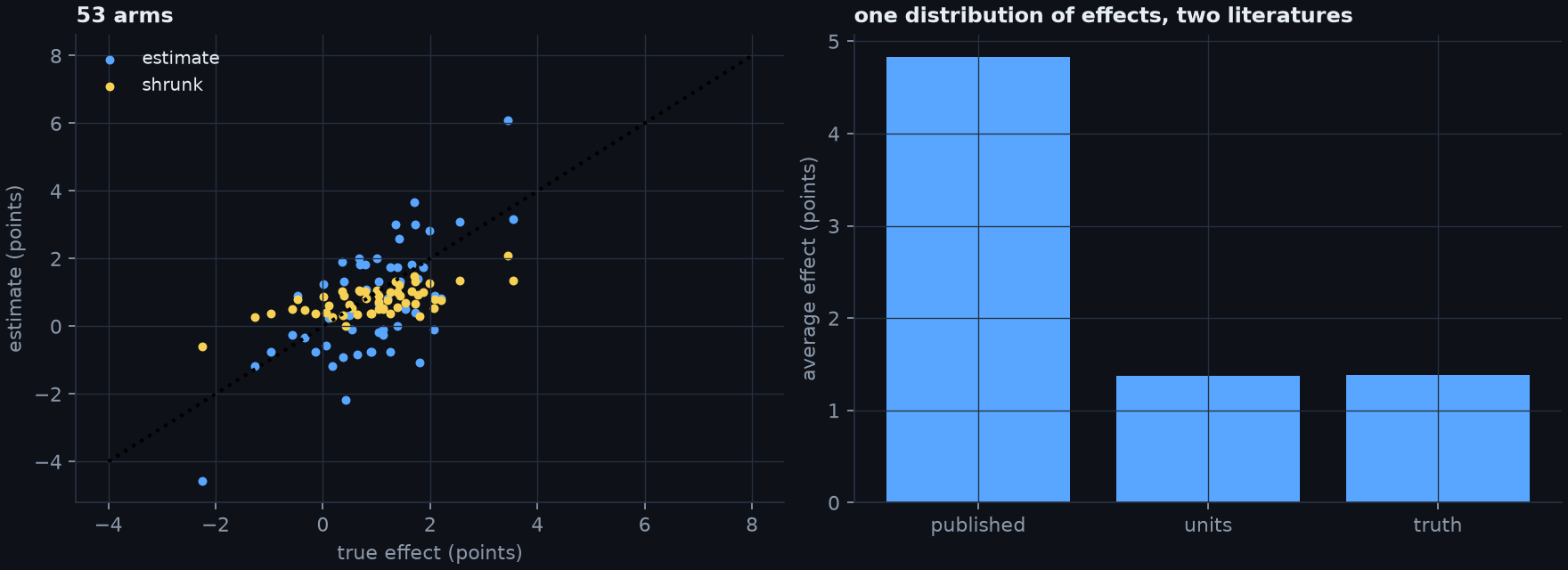
Here's the winner's curse. Psyche's megastudy has fifty-three arms, with true effects of about one point on average, and twelve hundred people in each arm. Each estimate is the truth plus noise, and the arm that looks best is usually one whose noise happened to be high. Here the winner is estimated at seven points, and truly about one and a half. Selecting the maximum selects the luckiest. It's Part 50's filter, inside a single study.
The fix is shrinkage. Empirical Bayes, from Statistics, Built's Part 25, pulls each estimate toward the average of all arms, by how noisy it is relative to the real spread. Here the weight on each arm's own estimate is under a half, and the winner's seven points become about four. Over four hundred simulated megastudies, the winner averages about five points estimated, about three true, and a little over two once shrunk. Shrinkage cuts the winner's squared error by a factor of about four. That's why megastudies report shrunk estimates.
What it does: Fifty-three ways to the gym; the winner's curse; shrinkage
5The reckoningPractice2 min
How big is the average nudge? In 2022 Stefano DellaVigna and Elizabeth Linos collected one hundred and twenty-six trials by two American nudge units, every one of them, and compared them with the published academic literature. About eight point seven percentage points in journals. About one point four across the units' trials. In Psyche, with one distribution of true effects averaging one point four, small academic trials published when significant average almost five, and large trials, all reported, average one point four. Selection alone triples the published average. The rest of the real gap came from what academic trials tested, and on whom.
Why couldn't the academic studies see effects this small? Take a two-arm trial on an outcome with a thirty percent base rate, at the usual five percent and eighty percent power. To detect the journals' average, eight point seven points, takes about four hundred and sixty people per arm. To detect the units' average, one point four points, takes about seventeen thousand. The sample grows with the square of the shrinkage. A typical academic study of a few hundred could only ever see the big effects, and those are the ones that reached print. Nudge units can run trials of tens of thousands because the letters, texts and forms are being sent anyway. They're the cheapest large experiments in social science.
Then came the meta-analysis, and its correction. In 2022 Stephanie Mertens and colleagues pooled over two hundred choice-architecture studies, and found an average effect of about zero point four three standard deviations. Maximilian Maier and colleagues corrected the same data for publication bias, and no evidence for an overall effect remained. Barnabas Szaszi and colleagues argued that the evidence is heterogeneous, and that the question do nudges work has no single answer. The honest summary: some nudges, defaults above all, work reliably. The average published nudge was smaller than it looked.
What it does: Published against practice; the meta-analysis and its correction
6Heterogeneity is the findingGraduate2 min
For whom, and where?
Christopher Bryan, Elizabeth Tipton and David Yeager argued in 2021 that heterogeneity is the finding. Behavioural science has treated an average effect as the effect, and variation as noise. But interventions work for some people in some places, and not others. Part 54's mindset study worked only in some schools. Their call: plan studies to estimate who benefits, with samples that span the population, and report the spread, not just the mean. It's Part 47 in policy form. An average describes a population, and may describe no one in it.
Here is what heterogeneity looks like in a trial. A reminder is tested on a hundred and sixty thousand simulated people, and the average effect is about one and a quarter points. Split by a baseline score, the true effects, the gold dots, run from zero point two to three point four points. The reminder works on the people who would have forgotten. The most forgetful quarter holds sixty-one percent of the whole benefit. Target them, and most of the gain comes at a quarter of the cost. But even with a hundred and sixty thousand people, each quarter's interval is about plus or minus one point. The lower two can't be told from zero, or from each other. So subgroups have to be named before the data, and powered for. A subgroup found afterwards, among many tried, is Part 4's garden of forking paths.
Why do effects shrink when they scale? Site selection: the first sites are chosen because they look promising, and later ones are the rest. Allcott's energy reports showed it. Voltage drop: the original team's care isn't delivered by a large organization's busy staff. Ceilings: the people who respond easily responded first, and the rest are harder to move. And the filter of chapter five: the pilot that got scaled was the one that looked best.
What it does: Bryan, Tipton and Yeager; why effects shrink at scale
7IncentivesGraduate1 min
Does paying people to change work, and does it last? In 2009 Kevin Volpp and colleagues offered employees up to seven hundred and fifty dollars to quit smoking. They quit about three times as often as those given information alone. In 2015 Scott Halpern and colleagues compared deposit contracts, with the smoker's own money at stake. Fewer people took them up, but they worked well for those who did. Abstinence fell after the payments ended, but a gap persisted. Money works when the behaviour can be checked and the payment comes soon. That's Part 16's reinforcement, and Part 41's contingency management.
What about exercise? In 2009 Gary Charness and Uri Gneezy paid students to go to the gym eight times in a month, and they went more afterwards too, mostly those who hadn't gone before. Later and larger studies found smaller persistence. Most of the extra visits stop when the money does. Part 52's habits take months, and a month of payment is short. So the design question is the ending: taper, hand over to a commitment device, or accept a temporary effect.
What it does: Paying smokers to quit; paying for exercise
8When nudges backfirePsych 101 and the major1 min
Can a well-meant message make things worse? Texas displayed the year's road death toll on motorway message boards, one week each month. In 2022 Jonathan Hall and Joshua Madsen found that crashes rose in the stretches after the signs, in the weeks they showed the toll, and more when the number was larger. Their reading: the message distracted drivers, a load on attention at the wrong moment. That's Part 18. A message is also a stimulus. It costs attention whether or not it persuades.
Norms can license the wrong behaviour. In the energy studies of Wesley Schultz and colleagues, households told they used less than their neighbours began to use more. The fix was a smiley face for the efficient: an injunctive norm, approval, on top of the descriptive one. A message that many people evade taxes tells people evasion is normal. And pressure that feels like control invites doing the opposite. Psychologists call it reactance.
What it does: Fatality counts on highway signs; norms that license
9Persuasion at scaleGraduate1 min
How much do campaigns and ads change minds?
How much do campaigns change minds? In 2018 Joshua Kalla and David Broockman pooled forty-nine field experiments on campaign contact in American elections. In general elections, the average persuasion effect of canvassing, mail and calls was essentially zero. Effects appeared early in a campaign and vanished by election day, or appeared where candidates took unusual positions. Turnout is easier to move than choice, and preferences in a polarized election are hard to shift.
And advertising? In 2015 Randall Lewis and Justin Rao analysed twenty-five large online advertising experiments. The effect on sales was so small relative to the noise in sales that most were nearly impossible to measure. A campaign that pays for itself may need millions of people per arm to show it. And search ads for a famous brand mostly reached people who'd have clicked the free link anyway, as Thomas Blake, Chris Nosko and Steven Tadelis found. It's Part 4's power analysis, applied to marketing. Most claimed returns were never measurable.
What it does: Campaign contact; advertising
10MisinformationGraduate1 min
Can people be nudged toward truth? In 2021 Gordon Pennycook and colleagues found that asking people to rate the accuracy of one headline made them more discerning about what they then chose to share. The claim is that people share falsehoods less from belief than from inattention to accuracy. Replications and a meta-analysis found the effect, smaller than first reported, and weaker in some groups and countries. In a field experiment on a social platform, accuracy messages slightly improved the quality of what users shared.
A second approach is inoculation. Expose people to a weakened manipulation technique, with the refutation, before they meet the real thing. Short games and videos improve people's ability to spot manipulative techniques in test items. But some of the gain is more scepticism of everything, true items included. That's Part 12's criterion, shifted, rather than sensitivity gained. And effects decay over weeks, though boosters help.
What it does: Accuracy prompts; inoculation
11A nudge that never wasPsych 101 and the major1 min
What happens when a celebrated nudge was never real? In 2012 a paper reported that signing an honesty pledge at the top of a form, rather than the bottom, reduced cheating, including in an insurer's mileage reports. It was cited in government guidance and copied into forms. In 2020 the original authors and others ran a large replication, and found no effect. In 2021 analysts showed that the mileage data were fabricated, as Part 50 described, and the paper was retracted. The field's safeguards did work, eventually: a replication, and open data.
Another famous result has been contested rather than retracted. In 2000 Sheena Iyengar and Mark Lepper found that shoppers offered twenty-four jams stopped more often, but bought far less often, than those offered six. Choice overload became a design rule: fewer options sell more. But in 2010 Benjamin Scheibehenne and colleagues' meta-analysis found an average effect near zero, with wide variation. Alexander Chernev and colleagues found that overload appears when choosers lack clear preferences, when options are hard to compare, or when the decision is complex. Conditions, not a law.
What it does: Signing at the top; too many jams
12Ethics and limitsPsych 101 and the major1 min
Who decides which way to steer? Thaler and Sunstein's defence was libertarian paternalism: steer, but leave every option open and cheap to choose. Transparency is one test. A nudge that would fail if disclosed is closer to manipulation, and most defaults survive disclosure. Sludge is the reverse: friction that steers people against their own interest, like cancellations by phone only, or rebates that need a form and a stamp. Those are Part 52's dark patterns. And who benefits: the same tool serves a pension saver or a subscription seller.
There's a larger criticism. In 2023 Nick Chater and George Loewenstein argued that behavioural science focused on nudging individuals, and so helped frame problems like obesity, pensions and carbon as personal failings. The largest changes, they argued, come from rules, prices and products, the system frame, and nudges can distract from them. Their critics replied that the two frames are complements, and that psychology also designs better rules. For a practitioner the question is whether the problem is the person's choice, or the choices they're given.
What it does: Autonomy, transparency and sludge; the individual frame and the system
13The LedgerGraduate1 min
What the six have in common. The structural changes, defaults and reports sent to everyone, replicate. The clever one-line effects shrink, depend on conditions, or were never there. The gap between journals and practice is a filter, and in one case fraud. So here's the answer to this part's question. A small change in how a choice is presented can move millions of people, by a little, unless it changes what happens when nobody chooses.
What it does: Six rows; what they have in common
14In practice: a trial, designedPractice1 min
How would you test a letter to a million people?
Where is this a job? In behavioural insights teams: government units that redesign letters, forms and services, and test them by trial. In growth and retention, where product teams run onboarding, reminder and pricing experiments. In public health: vaccination reminders, screening invitations, smoking cessation. And in policy evaluation: what persists after the trial, and what it costs per unit of change.
Here's a worked trial: reminders for unpaid fines. The question: does a redesigned reminder letter raise payment within thirty days? The primary outcome, preregistered: paid in full within thirty days, from administrative records. One outcome and one analysis, written down first. Power: a plausible effect is one or two points on a base of about thirty percent. To detect two points with eighty percent power takes about eighty-four hundred people per arm. The arms: the old letter, the new letter, and the new letter with a norm line, randomized by person, with balance checked. Report the effect with its interval, whatever it is. Check who it worked for only as planned, and follow up at six months for persistence. Then compute the cost per extra payment, and decide.
What it does: Where this is a job; a worked trial
15Frontier: predicting what works whereResearch1 min
Can we know in advance which nudge will work? Forecasting: experts and the public predicting megastudy results, mostly poorly, though calibration improves with feedback. Targeting: models learned from large trials of who responds, used to send each person the message that works for them. But targeting can give help to those easiest to move, not those who need it most. And living evidence: pooled trial registries, updated as trials finish, instead of one meta-analysis a decade.
And the open problems. External validity: what features of a site predict whether an effect transfers? Persistence: which changes last after the nudge stops, and why? General equilibrium: when everyone sends reminders, do reminders still work? And the system frame: how to weigh a cheap nudge against a costly rule that would do more.
What it does: What is new; open problems
Recap, problems, and the road aheadAll tracks2 min
First, your four numbers. Automatic enrolment took participation from thirty-seven percent to eighty-six. The megastudy's winner at plus seven was truly about one and a half. Nudge-unit trials averaged about one and a half points. And campaign contact in general elections persuaded about nobody, on average. Structure moves millions. Messages move a few, a little, and less than the journals said.
Part fifty-five in twelve lines. A default is a decision someone already made. It works through inertia, endorsement and loss aversion. The toolbox adds framing, reminders, commitment and norms. A megastudy's winner is inflated, so shrink it. Journals say eight point seven points, and nudge units one point four. For whom and where is the finding. Money works while it's paid. Messages cost attention and can backfire. Campaigns and ads are barely measurable. Accuracy prompts and inoculation help a little. A celebrated nudge was fabricated. And steer transparently, and fix the system too.
Where this comes back. Behaviour and the law are Part 56. Health behaviour and stepped care are Part 57. The incentives of science itself are Part 61. And Part 62's dissertation can be a preregistered trial.
Seven problems, with full solutions in this part's README. One solves the default algebra. One shrinks a megastudy arm. One sizes a trial. One estimates a filtered average. One prices energy savings. One separates a nudge from manipulation. And the last, with the star, asks you to design a trial of a reminder for a public service. Pause here if you'd like to try them.
The books and papers behind this part are listed here and in the README. Nudge is the book that started it; DellaVigna and Linos are the accounting; and Chater and Loewenstein are the argument about what nudges leave out.
Five parts of Act Twelve are done. This one asked how far a choice's presentation moves millions, and found the honest answer smaller and more interesting. The next goes to court. How can a confident witness be wrong, and when is confidence worth trusting? Part 56: psychology and law.
Where it goes next. Part 56 takes behaviour into court; Part 57 into health care; Part 61 turns incentives on science itself.
Key results
The part's results in one place, for revision.
Try it
Lab 55 · Behaviour Change at Scale
Solve a default for its inertia, watch a megastudy crown a lucky winner and shrink it back, and see how a publication filter triples the average effect.
python -m videos.psychology.labs 55
needs numpy, scipy, matplotlib · download lab55.py ·
source on GitHubdefault: inertia q; preference p 0.49; 0.73
megastudy winner: estimate; truth; shrunk (points) +6.1; +3.5; +2.1
150 megastudies: mean winner estimate, truth, shrunk +5.2, +2.9, +2.4
published academic average; nudge units (points) 4.8; 1.4
Selecting the best arm, or the significant study, selects luck; shrinkage and complete reporting take it back out.The code (58 lines; it asserts its own result)
"""Lab 55: behaviour change at scale: the algebra of a default, a megastudy's winner's curse and shrinkage, and a
publication filter that separates journals from nudge units."""

import numpy as np

from videos.coursekit import labs
from explainer.psychology.psyche import work as Wk

TITLE = "Behaviour Change at Scale"
GOAL = ("Solve a default for its inertia, watch a megastudy crown a lucky winner and shrink it back, and see how a "
        "publication filter triples the average effect.")
TASKS = [
    "Double the people per arm in the megastudy. How much smaller is the winner's curse?",
    "Make every arm's true effect zero. What does the winner look like, and what does shrinkage do?",
    "Let academic trials publish every result. How close do the two literatures come?",
]


def run(seed=0):
    out = labs.Lab()
    d = Wk.default_inertia(0.37, 0.86)
    assert abs(d["inertia"] - 0.49) < 1e-9
    out.row("default: inertia q; preference p", f"{d['inertia']:.2f}; {d['prefer']:.2f}")
    m = Wk.megastudy(seed=seed + 1)
    out.row("megastudy winner: estimate; truth; shrunk (points)",
            f"{100 * m['winner_est']:+.1f}; {100 * m['winner_true']:+.1f}; {100 * m['winner_shrunk']:+.1f}")
    est, tru, shr = [], [], []
    for r in range(150):
        mm = Wk.megastudy(seed=seed + 100 + r)
        est.append(mm["winner_est"]); tru.append(mm["winner_true"]); shr.append(mm["winner_shrunk"])
    est, tru, shr = map(np.array, (est, tru, shr))
    assert est.mean() > tru.mean() and np.mean((shr - tru) ** 2) < np.mean((est - tru) ** 2)
    out.row("150 megastudies: mean winner estimate, truth, shrunk",
            f"{100 * est.mean():+.1f}, {100 * tru.mean():+.1f}, {100 * shr.mean():+.1f}")
    g = Wk.publication_gap(seed=seed + 2)
    assert g["academic"]["mean_reported"] > 2 * g["units"]["mean_reported"]
    out.row("published academic average; nudge units (points)",
            f"{100 * g['academic']['mean_reported']:.1f}; {100 * g['units']['mean_reported']:.1f}")

    out.note = ("Selecting the best arm, or the significant study, selects luck; shrinkage and complete reporting "
                "take it back out.")

    fig, ax = labs.figure(2, size=(11, 4.0))
    ax[0].scatter(100 * m["true"], 100 * m["est"], s=12, label="estimate")
    ax[0].scatter(100 * m["true"], 100 * m["shrunk"], s=12, label="shrunk")
    lim = [-4, 8]
    ax[0].plot(lim, lim, "k:")
    ax[0].set(title="53 arms", xlabel="true effect (points)", ylabel="estimate (points)")
    ax[0].legend()
    ax[1].bar(["published", "units", "truth"], [100 * g["academic"]["mean_reported"], 100 * g["units"]["mean_reported"],
                                                100 * g["truth"]], color=labs.BLUE)
    ax[1].set(title="one distribution of effects, two literatures", ylabel="average effect (points)")
    out.fig = fig
    return out


if __name__ == "__main__":
    print(run())
Now change it
- Double the people per arm in the megastudy. How much smaller is the winner's curse?
- Make every arm's true effect zero. What does the winner look like, and what does shrinkage do?
- Let academic trials publish every result. How close do the two literatures come?
Problems, with solutions
Try each problem before opening its solution.
-
The default algebra. Opt-in enrolment 40%, opt-out 90%: solve the two-type model for \(q\) and \(p\).
Solution
q = 0.9 - 0.4 = 0.5; p = 0.4/(1 - 0.5) = 0.8.
-
Shrinkage. A megastudy arm estimated at +5 points with SE 1.5; arms' true effects have mean +1 and SD 1. Shrink it.
Solution
The weight on the arm's own estimate is 1/(1 + 1.5^2) = 0.31; shrunk = 1 + 0.31 x (5 - 1) = +2.2 points.
-
A trial's size. A trial: base rate 30%, effect 2 points, 80% power, 5% two-sided: people per arm?
Solution
n = (1.96 + 0.84)^2 (0.3 x 0.7 + 0.32 x 0.68)/0.02^2 = about 8,400 per arm.
-
A filtered average. Academic trials with SE 4 points are published only if significant. True effect 1.5. Roughly what is the average published estimate?
Solution
Published only if the estimate exceeds 1.96 x 4 = 7.8 points; the mean of N(1.5, 4) above 7.8 is 1.5 + 4 phi(1.57)/(1 - Phi(1.57)) = about 9.5 points, six times the truth.
-
Cost per kWh. Energy use falls 2% per home at a cost of $1 a letter. A home uses 10,000 kWh a year. Cost per kWh saved, if one letter a month for a year?
Solution
Twelve letters cost $12 a year; 2% of 10,000 kWh is 200 kWh; $0.06 per kWh saved.
-
Nudge or manipulation. Give one test that separates a nudge from manipulation, and apply it to a pre-ticked box.
Solution
The disclosure test: would it still work if the person were told exactly what was done and why? A pre-ticked enrolment box with a plain statement ("we have enrolled you; untick to opt out") still works in studies that disclosed it, so it passes; a hidden subscription renewal does not.
-
★ A trial design. Design a trial of a new reminder for a public service: outcome, arms, power, preregistration, persistence and cost.
Solution
One primary outcome from administrative data, preregistered; arms for the current reminder, the new one and a variant; randomization by person with a power calculation from the base rate and the smallest effect worth having; the interval reported whatever it shows; planned subgroup checks only; a follow-up for persistence; and the cost per unit of change.
Notes and sources
Sources
- E. J. Johnson and D. Goldstein, Do defaults save lives?, Science 302 (2003) 1338-1339; R. H. Thaler and C. R. Sunstein, Nudge (Yale University Press, 2008; final edition, Penguin, 2021).
- B. C. Madrian and D. F. Shea (2001); J. J. Choi et al. (2004); J. Beshears et al. (2009); R. H. Thaler and S. Benartzi, Save More Tomorrow, Journal of Political Economy 112 (2004) S164-S187.
- P. W. Schultz et al. (2007); H. Allcott (2011); H. Allcott and T. Rogers (2014); E. P. Bettinger, B. T. Long, P. Oreopoulos and L. Sanbonmatsu, The role of application assistance and information in college decisions, Quarterly Journal of Economics 127 (2012) 1205-1242.
- K. L. Milkman et al., Megastudies improve the impact of applied behavioural science, Nature 600 (2021) 478-483.
- S. DellaVigna and E. Linos (2022); S. Mertens et al. (2022); M. Maier et al. (2022); B. Szaszi et al., No reason to expect large and consistent effects of nudge interventions, Proceedings of the National Academy of Sciences 119 (2022) e2200732119.
- C. J. Bryan, E. Tipton and D. S. Yeager, Behavioural science is unlikely to change the world without a heterogeneity revolution, Nature Human Behaviour 5 (2021) 980-989.
- K. G. Volpp et al., A randomized, controlled trial of financial incentives for smoking cessation, New England Journal of Medicine 360 (2009) 699-709; S. D. Halpern et al., Randomized trial of four financial-incentive programs for smoking cessation, New England Journal of Medicine 372 (2015) 2108-2117; G. Charness and U. Gneezy, Incentives to exercise, Econometrica 77 (2009) 909-931.
- J. D. Hall and J. M. Madsen, Can behavioral interventions be too salient? Evidence from traffic safety messages, Science 376 (2022) eabm3427.
- J. L. Kalla and D. E. Broockman, The minimal persuasive effects of campaign contact in general elections, American Political Science Review 112 (2018) 148-166; R. A. Lewis and J. M. Rao, The unfavorable economics of measuring the returns to advertising, Quarterly Journal of Economics 130 (2015) 1941-1973; T. Blake, C. Nosko and S. Tadelis, Consumer heterogeneity and paid search effectiveness, Econometrica 83 (2015) 155-174.
- G. Pennycook et al. (2021); J. Roozenbeek et al. (2021); G. Pennycook and D. G. Rand (2022); J. Roozenbeek, S. van der Linden, B. Goldberg, S. Rathje and S. Lewandowsky, Psychological inoculation improves resilience against misinformation on social media, Science Advances 8 (2022) eabo6254.
- L. L. Shu et al. (2012, retracted 2021); A. S. Kristal et al. (2020); S. S. Iyengar and M. R. Lepper (2000); B. Scheibehenne et al. (2010); A. Chernev et al. (2015).
- N. Chater and G. Loewenstein, The i-frame and the s-frame, Behavioral and Brain Sciences 46 (2023) e147.
About this partfrom its README
In countries where people had to opt in to organ donation, few were donors; where they had to opt out, nearly everyone was. A change of default, one sentence on a form, and the nudge became government policy around the world. Then the accounting arrived: in published papers the average nudge moved behaviour by almost nine percentage points; across every trial two government nudge units ran, by about one and a half. This part is that gap: what changes behaviour at scale, by how much, and how we know.
The viewer ranks five ways to get people to the gym and predicts four numbers. Then automatic enrolment and the algebra of a default; why defaults work and Save More Tomorrow; the toolbox and home energy reports; a megastudy with its winner's curse and shrinkage; published nudges against nudge units, the meta-analysis and its correction; heterogeneity and why effects shrink at scale; incentives for quitting and exercise; nudges that backfired; campaigns and advertising; accuracy prompts and inoculation; a celebrated nudge that was fabricated, and choice overload; and the ethics of steering.
What is computed and built
explainer/psychology/psyche/work.pygains the two-type default algebra, a megastudy simulator with the winner's curse and empirical-Bayes shrinkage, and a publication filter that reproduces the gap between published nudges and nudge-unit trials. Tested intests/psychology/test_work.py.- The Ledger gains six rows.
- The course's interactive: rank five gym interventions, then see the megastudy's pattern, its winner shrunk, and a comparison with forecasts.
Chapter notes
| # | Chapter | What it does |
|---|---|---|
| 0 | One sentence on a form | Organ-donation defaults; the accounting; the question; objectives |
| 1 | On you: five ways to the gym, and four numbers | The ranking; four predictions |
| 2 | Why defaults work | Automatic enrolment and its algebra; three reasons; Save More Tomorrow |
| 3 | The toolbox | Choice architecture; home energy reports |
| 4 | The megastudy | Fifty-three ways to the gym; the winner's curse; shrinkage |
| 5 | The reckoning | Published against practice; the meta-analysis and its correction |
| 6 | Heterogeneity is the finding | Bryan, Tipton and Yeager; why effects shrink at scale |
| 7 | Incentives | Paying smokers to quit; paying for exercise |
| 8 | When nudges backfire | Fatality counts on highway signs; norms that license |
| 9 | Persuasion at scale | Campaign contact; advertising |
| 10 | Misinformation | Accuracy prompts; inoculation |
| 11 | A nudge that never was | Signing at the top; too many jams |
| 12 | Ethics and limits | Autonomy, transparency and sludge; the individual frame and the system |
| 13 | The Ledger | Six rows; what they have in common |
| 14 | In practice: a trial, designed | Where this is a job; a worked trial |
| 15 | Frontier: predicting what works where | What is new; open problems |
| Recap, problems, and the road ahead | Your numbers; twelve lines; payoffs; problems; references; Part 56 |
NotesWhere the numbers come from
| What | Source |
|---|---|
| The two-type reading of a default: opt-in (1 - q) p = 0.37 and opt-out q + (1 - q) p = 0.86 give q = 0.49 and p = 0.73 | Madrian and Shea's rates; Psyche (work.default_inertia), item inertia |
| A megastudy: 53 arms, true effects N(1 point, 1.2), base rate 30%, 1,200 people an arm and a control four times as large; the winner estimated at +7.0 points, truly +1.5, shrunk to +4.2 (weight 0.45 on its own estimate) | Psyche (work.megastudy), item mega |
| The winner's curse over 400 simulated megastudies: estimated +5.1, true +2.8, shrunk +2.3; shrinkage cuts the squared error by a factor of 4.0 | Psyche, item curse |
| A publication filter: 4,000 trials from one distribution of true effects (mean 1.4 points, SD 1.5); academic trials of 60 to 300 per arm, published if significant (and 10% of the rest), average 4.9 points as published (15% published); nudge-unit trials of 2,000 to 20,000 per arm, all reported, average 1.4 | Psyche (work.publication_gap), item gap |
| The power calculation in the worked trial: base 30%, two points, 80% power, 5% two-sided: about 8,400 per arm | the normal approximation |
| Every published number on screen | the studies listed under Sources, quoted as reported; the donation bars are approximate |
Notes
| Finding | Original | Status |
|---|---|---|
| Making enrolment in a retirement plan the default greatly increases participation. | Madrian and Shea 2001 | replicated |
| Mailing households a comparison of their energy use with their neighbours' reduces their consumption. | Schultz, Nolan, Cialdini, Goldstein and Griskevicius 2007 | replicated |
| Choice-architecture interventions change behaviour by about as much as the published studies report. | Mertens, Herberz, Hahnel and Brosch 2022 | replicated, smaller |
| Signing an honesty pledge at the top of a form, rather than the bottom, reduces dishonest reporting. | Shu, Mazar, Gino, Ariely and Bazerman 2012 | retracted |
| Offering more options reduces the likelihood of choosing and satisfaction with the choice. | Iyengar and Lepper 2000 | contested |
| Prompting people to think about accuracy improves the quality of the news they share. | Pennycook and colleagues 2021 | replicated, smaller |
Shown without a row, with the reason recorded in explainer/psychology/ledger.py: Johnson and Goldstein;
DellaVigna and Linos; Thaler and Benartzi; Milkman and colleagues; Bryan, Tipton and Yeager; Volpp and colleagues;
Charness and Gneezy; Hall and Madsen; Kalla and Broockman; Lewis and Rao; Chater and Loewenstein.
Notes
The web-search budget for this session was spent on earlier parts, so the facts in this part come from the standard literature and were not re-checked online today; each is listed here to be checked against its source: Johnson and Goldstein's country rates and online experiment; evidence on opt-out and actual donation rates; Madrian and Shea's 37% and 86% and the default contribution rate; Choi et al. (2004) and Beshears et al. (2009); Save More Tomorrow's rates (3.5% to 13.6% over four years); Bettinger et al.'s aid-form result; Allcott's 600,000 households and 2%; Allcott and Rogers on persistence; Schultz et al.'s boomerang; Milkman et al.'s 61,000 members, 53 arms, the best arm and the forecasts; DellaVigna and Linos's 126 trials, 8.7 and 1.4; Mertens et al.'s d = 0.43 and number of studies; Maier et al.'s correction; Szaszi et al. (2022); Bryan, Tipton and Yeager (2021); Volpp et al.'s $750 and the tripling; Halpern et al. (2015); Charness and Gneezy (2009); Hall and Madsen's Texas signs; Kalla and Broockman's 49 experiments; Lewis and Rao's 25 experiments; Blake, Nosko and Tadelis (2015); Pennycook et al. (2021) and the replications and meta-analysis; the inoculation studies; the signing study's 2020 replication, 2021 analysis and retraction; Iyengar and Lepper's jams and percentages; Scheibehenne et al.'s 50 experiments; Chernev et al.'s moderators; Chater and Loewenstein (2023); and every page range in Sources.
Companion material in this repository
The syllabus's plan for this partfrom SYLLABUS.md, the plan of record
- Hook: the donation defaults (Johnson and Goldstein 2003), and what defaults do and do not change downstream.
- Why defaults work: effort, implied endorsement, loss aversion (Part 26). Retirement enrolment from 37% to 86%; Save More Tomorrow.
- The toolbox: framing, salience, reminders, simplification, commitment devices, social norms (energy reports and a 2% reduction).
- On you: five interventions to raise gym attendance. Rank them. Then the megastudy's results and the experts' forecasts.
- The megastudy: dozens of interventions in one population (Milkman et al. 2021); why the winner's estimate is inflated and how shrinkage corrects it (link to Statistics, Built Part 25).
- The reckoning: academic nudges against nudge-unit trials (DellaVigna and Linos 2022); the meta-analysis and its bias-corrected re-analysis.
- Heterogeneity is the finding: effects depend on who and where (Bryan, Tipton and Yeager 2021).
- Incentives: paying people to quit smoking or exercise; what persists.
- When nudges backfire: highway fatality signs that increased crashes; norm messages that licensed the below-average.
- Persuasion at scale: campaign contact's near-zero average effect in general elections; advertising returns that are almost impossible to measure; search-ad experiments.
- Misinformation: accuracy prompts and inoculation; effect sizes in the field.
- Ethics and limits: autonomy, transparency and sludge; individual-level fixes against changing the system.
Psyche: psyche.work: a megastudy simulator on the Pool (many arms, small true effects, winner's curse and
shrinkage); a publication filter that reproduces the academic–practice gap.
On you: the ranking exercise.
Ledger: default effects on enrolment (replicated); social-norm energy reports (replicated, small); the
average published nudge (replicated, smaller in practice); signing at the top for honesty (retracted; failed
replication, then fabricated data); choice overload from more options (contested: meta-analytic mean near
zero); accuracy prompts (replicated, smaller).
In practice: behavioural insights teams, product growth and retention, public-health campaigns; a worked trial
design with a preregistered primary outcome.
Frontier: predicting which interventions work where; forecasting tournaments; personalization against fairness.
Reading: Thaler & Sunstein 2008/2021; Johnson & Goldstein 2003; Madrian & Shea 2001; Milkman et al. 2021;
DellaVigna & Linos 2022; Mertens et al. 2022, with Maier et al. 2022; Bryan, Tipton & Yeager 2021; Allcott 2011;
Kalla & Broockman 2018; Lewis & Rao 2015; Hall & Madsen 2022; Chater & Loewenstein 2023.
Build the film
python -m videos.psychology.psych55.compute        # the part's numbers, into .cache/psych55
python tools/build.py psych55                  # render and assemble the film
EXPLAINER_TTS=silent python tools/qa_scene.py psych55 Hook   # one chapter, silent, with a contact sheet
Scenes: videos/psychology/psych55. Setup: see the course page. Source of these notes: the README and the scenes' narration.
Build it
python -m videos.psychology.psych55.compute            # every number (seconds)
python tools/qa_scene.py psych55 Megastudy             # one chapter, silent, at 480p, with a contact sheet
EXPLAINER_TTS=silent python tools/build.py psych55 -q l   # the whole part, silent preview
python tools/build.py psych55                          # 1080p30 with narration
python tools/qa_scene.py psych55 Reckoning --lang zh   # the Chinese edition of one chapter
python tools/make.py psych55                           # both editions, with the checks a long build needs
python -m videos.psychology.labs 55                    # the lab: defaults, the megastudy, the publication filter
python tools/check_ledger.py psych55                   # every study shown has its Ledger row, or a reason
python -m pytest tests/psychology                      # Psyche's work module, the Ledger, the Archive
The Chinese edition is zh_lines.py (the narration, line by line) and the series table
videos/psychology/psychology_text_zh.json (the text on screen); the terms are in
PSYCHOLOGY_ZH_GUIDE.md.