Memory II: Forgetting and Inventing
Why do we forget, and why do we remember things that never happened?
In 1974 one word in a question, smashed or hit, changes how fast people say two cars were going, and a week later those who heard smashed remember broken glass that was never there. Ebbinghaus's curve, repeated by three people up to 2015, is fast and then slow; a power law fits it best, with a warning that averaged exponentials make power laws too. Much forgetting is interference, from earlier lists, later lists, and even from remembering. Memories consolidate from hippocampus to cortex, helped by sleep's replay, and reopen when recalled; a fast learner and a slow one joined by replay can learn the penguin without losing the robin. Spacing and testing are the two best ways to remember more, each with a model fitted to a landmark study. Recall blends a trace with a schema, biased and more accurate on average; a memory that sums similar experiences recognises a word that was never shown; suggestion implants whole events in a minority; verbal overshadowing, replicated by 53 sets of labs, is real and smaller than first reported. A witness's first confidence, under good procedures, is strong evidence; their later confidence is not.
What you need. Part 12's signal detection, Part 14's cue combination, Part 17's replay and Part 20's ACT-R, Hopfield network and context model. Logarithms and power laws, least squares, and a little probability (the gamma distribution, the normal).
- Hook
- "smashed" or "hit"?
- Ideas, models and mathematics
- four forgetting laws fitted to Ebbinghaus and three replications, Jost's law and the averaging artefact, interference and retrieval-induced forgetting, consolidation in two stores, replay and reconsolidation, complementary learning systems and the penguin, spacing and testing with models fitted, schemas and the category adjustment model, the DRM illusion by global matching, misinformation and implanted memories, verbal overshadowing pooled from 53 replications' open data, flashbulb memories and line-up confidence by signal detection, half-life regression
- Psyche gains
- forgetting laws, an associator, two stores, a semantic network, a spacing model, the bifurcation model, category adjustment, global matching, a line-up, half-life regression
- On you
- the DRM lists: remember, know or new
What you will be able to do
Psych 101 and the major
- Describe the forgetting curve, decay and interference, consolidation and reconsolidation.
- Explain the spacing and testing effects and why students prefer re-reading.
- Describe Bartlett's schemas, the DRM illusion, misinformation and implanted memories.
Graduate
- Fit four forgetting laws and compare them by AIC; derive Jost's law from the hazard.
- Show that a gamma mixture of exponentials is a power function.
- Fit the bifurcation model to the testing effect, and derive the category adjustment model's weight.
Research
- Explain catastrophic interference and the complementary-learning-systems answer to it.
- Derive the confidence-accuracy characteristic of a line-up from signal detection.
Practice
- Design a study schedule from the spacing ridgeline, and fit half-life regression to practice data.
- Specify a line-up and interview procedure that keeps memory evidence uncontaminated.
Contents
Each chapter has a home level. Choose a track to see what to read and watch: Psych 101 and the major 37 min · Graduate 42 min · Research 67 min · Practice 42 min.
- 0Smashed or hit?Psych 101 and the major4 min
- 1The shape of forgettingResearch5 min
- 2Why we forgetPsych 101 and the major4 min
- 3ConsolidationPsych 101 and the major5 min
- 4Two ways to learnResearch4 min
- 5SpacingResearch5 min
- 6TestingPsych 101 and the major4 min
- 7Remembering as rebuildingResearch4 min
- 8Words that were never therePsych 101 and the major4 min
- 9SuggestionPsych 101 and the major5 min
- 10Confidence and accuracyResearch4 min
- 11Remembering too muchPsych 101 and the major3 min
- 12The LedgerPsych 101 and the major4 min
- 13In practice: study, apps, line-upsPractice4 min
- 14Frontier: editing memoryResearch3 min
- Recap, problems, and the road aheadAll tracks4 min
Also on this page: Lecture · Key results · Try it · Lab · Problems · Notes and sources · Build the film.
Lecture
The text of each chapter is the film's narration, as it is spoken, so you can read along or revise without the film. The pictures are in the film. A dashed box stands for a number the film computes when it is rendered (hover over it to see what is computed); the README's figures for each chapter, where it lists them, follow the chapter's text.
Smashed or hit?Psych 101 and the major4 min
In 1974, at the University of Washington, Elizabeth Loftus and John Palmer showed students short films of traffic accidents. Afterwards came a questionnaire, and one question mattered: about how fast were the cars going when they hit each other? Except that not everyone read hit. Some read smashed into, some collided with, bumped, or contacted. One word, and nothing else, differed. The estimates followed the word. Smashed gave about miles an hour; contacted, about . The same films, seen by the same kind of people, and a single verb moved the speed by nine miles an hour.
That alone might be a bias in judging speed. So in a second experiment, a hundred and fifty students saw a film of a multiple-car crash, fifty heard smashed, fifty heard hit, and fifty were not asked about speed at all. A week later they came back and answered one more question: did you see any broken glass? Of those who had heard smashed, of fifty said yes. Of those who had heard hit, . Of those not asked, . There was no broken glass in the film. A word in a question had become, a week later, a memory of something seen.
Before we go on, an experiment on you, as in the last part. Fifteen words will appear, one every second and a half. Just watch them, and try to remember them. Here they come.
Now six words. For each one, decide: was it in the list or not? And for every word you say yes to, decide one more thing. Do you remember it, can you bring back the moment it was on the screen? Or do you just know it was there? Pause the video and write down your answers. We'll come back to them in chapter eight.
Last time, memory was a search, and a remarkably good one. This part is about its two failures, and they are not the same failure. Memory loses what it had: we'll fit the laws of forgetting, and ask why it happens at all. We'll see how memories settle into the brain over time, and why a brain might need two ways of learning. Then the two best-established ways of remembering more: spacing and testing, each with a model you can fit. And memory gains what it never had: the schema, the word that was never on the list, the suggestion that becomes a memory. Which leaves the practical question: when should anyone trust a memory, in a courtroom, a clinic, or a classroom?
This is Part 21 of Psychology, Built, the fourth part of Act Five, on thinking: memory, forgetting and inventing. We'll fit four laws of forgetting to Ebbinghaus's curve and to three people who repeated his experiment, one of them in 2015. We'll watch interference happen in a network, consolidation in two stores, and a network that learns about penguins and forgets about robins. We'll fit models of the spacing and the testing effects. Then reconstruction: Bartlett's schemas, a model in which memory leans toward the typical, and the illusion you just took part in, explained by one equation. Then suggestion, implanted memories, and the open data from fifty-three replications of one experiment. And finally confidence: when it predicts accuracy and when it doesn't, and the model a language app uses to decide when you'll forget a word.
What it does: Loftus and Palmer's two experiments; the DRM list and test on you; the questions; objectives
1The shape of forgettingResearch5 min
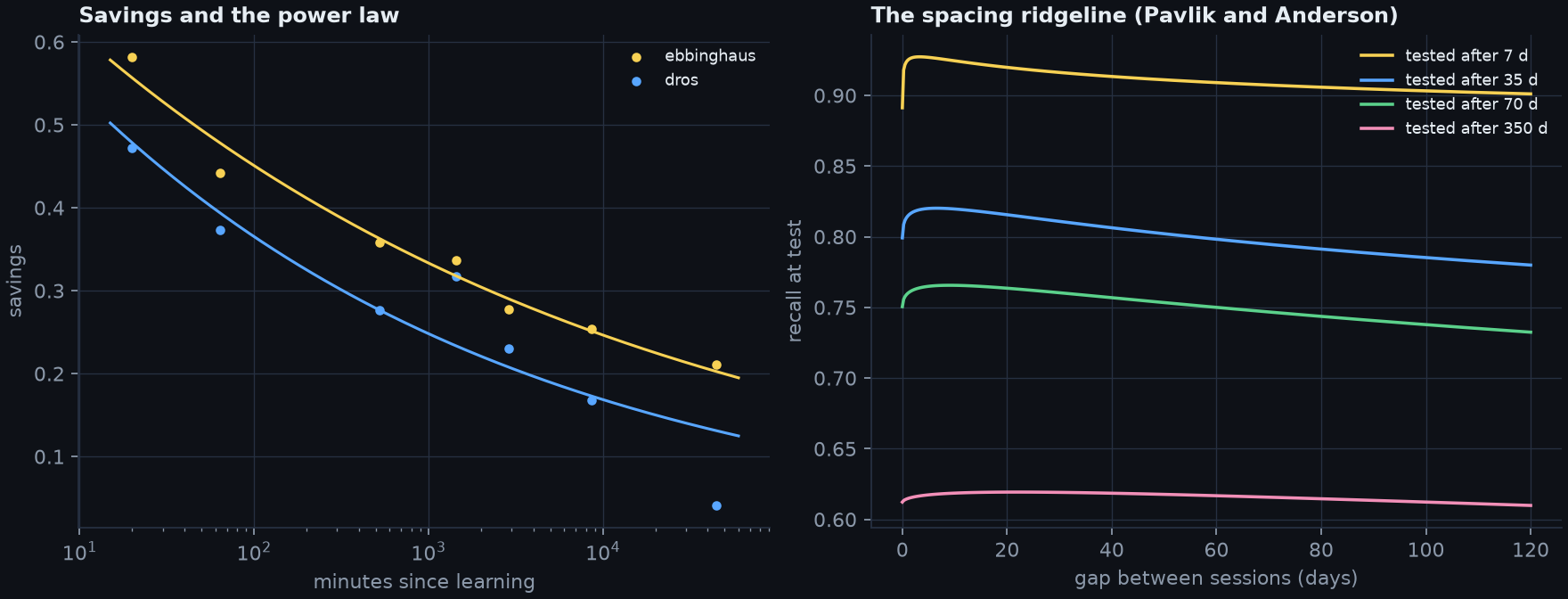
In the last part we met Ebbinghaus's curve. Is it a fact about memory, or a fact about Ebbinghaus? It has been checked. In 1991 a German study by Otto Heller and colleagues repeated the experiment with two subjects, Mack and Seitz. And in 2015 Jaap Murre and his student Joeri Dros did it again in Amsterdam: Dros spent about seventy hours learning and relearning lists of nonsense syllables, at Ebbinghaus's seven intervals, from twenty minutes to a month. Here are all four. The levels differ a little; the shape does not. Forgetting is fast at first, then slower, and slower again. And the curves are not quite smooth. Between nine hours and a day, where they should keep falling, two of them rise and the others pause. A day is the first interval with a night's sleep in it. That irregularity in Ebbinghaus's table is what led John Jenkins and Karl Dallenbach to study sleep and forgetting in 1924, and Murre and Dros's fits find a jump at a day. Whether sleep causes it, they say, this kind of experiment has yet to show. We'll come back to sleep.
What law is it? Four have been proposed. A power function, a times t to the minus b. An exponential, the law of radioactive decay. A logarithm, which is what Ebbinghaus himself fitted. And Wickelgren's, a power function with one more parameter that keeps it finite at time zero. Fitted to Ebbinghaus's seven points, the exponential is plainly wrong: it can't fall fast and then flatten. The other three are hard to tell apart by eye. So compare them by Akaike's criterion, which charges for parameters. The power law wins for three of the four people, the logarithm for Dros, whose last point falls steeply, and the exponential for none. With seven points each, that's not a verdict, and the reason the power law is believed is larger datasets: John Wixted and Ebbe Ebbesen in 1991, and many since, found power-like forgetting across materials, measures and species.
There's a deeper reason to prefer the power law, found by Adolf Jost in 1897. Take two memories that are equally strong right now, one learnt an hour ago and one learnt two days ago and since refreshed to the same strength. Which will you still have next week? Jost's law says the older one. Under the power law, that's what happens. The rate at which a memory is lost, the slope of the log of its strength, is b over t: it falls as the memory ages. A memory that has lasted is one that will last. An exponential can't do this. Its rate of loss is constant, one over tau, whatever the memory's age, so the two memories fade identically, the dashed line on top of the solid one. Forgetting is not radioactive decay. Jost's law is one reason the power law isn't just a good fit but a good idea: it says the memory system treats age as evidence of need, the argument of Anderson and Schooler from the last part.
But here's a warning that every model fitter should know. Suppose every single memory fades exponentially, but each at its own rate, lambda: some fast, some slow. Average them, and the average is not an exponential. If the rates follow a gamma distribution, the integral can be done exactly, and it's one plus theta t, to the power minus k: a power function, Wickelgren's form. Twenty thousand exponentials, averaged, sit right on the dashed curve. So a power law in averaged data does not show that any single memory obeys it. Richard Anderson and Ryan Tweney made this point in 1997. And it applies even to Ebbinghaus, one person, because his savings are averaged over syllables and lists. The shape of the curve is a fact. What it says about one memory is a question for the models of the next chapter.
What it does: Four people's savings; four laws and AIC; Jost's law from the hazard; the averaging artefact derived
2Why we forgetPsych 101 and the major4 min
Why does a memory get weaker? There are two classic answers. Decay: the trace itself fades with time, like a footprint in sand. Or interference: the trace is still there, but other memories compete with it at retrieval, or overwrite it. In 1924, at Cornell, John Jenkins and Karl Dallenbach put this to a test with two subjects, who learnt lists of ten nonsense syllables to mastery, and then either went to sleep or stayed awake, for one, two, four or eight hours, before recall. After sleep they forgot much less than after the same hours awake. If time alone did the forgetting, the two would be equal. What happens during the time matters. Jenkins and Dallenbach took it as evidence for interference: the sleeper meets nothing new. Today we'd add that sleep does something positive too, which is the next chapter.
The strongest evidence for interference came from looking back at the old experiments. In 1957 Benton Underwood gathered the studies in which people learnt a list and recalled it a day later. Why did some find that people forgot most of a list in a day, and others very little? The answer was what the subjects had done before. The more lists they had already learnt in the same experiment, the more of the new list they forgot. Take away that earlier learning, Underwood estimated, and forgetting in a day falls from about seventy-five percent to about twenty-five. This is the shape of his summary, drawn schematically. The old lists, not time, did most of the forgetting. That's proactive interference: earlier learning harms later. And think of Ebbinghaus, who had learnt thousands of lists of syllables. Some of the steepness of the most famous curve in psychology may be the interference of all the lists before.
Interference can also work backwards: new learning harms old. And it's easy to see why in a network. Learn twenty pairs, A to B, in a linear associator, the simplest memory network, where Hebb's rule adds each pair's outer product into one weight matrix. Then learn a second list, A prime to C, and test A. All the pairs live in the same weights. When the second list's cues are unrelated to the first's, the new pairs add a little noise, and recall of B barely falls. As the cues overlap more, the same cue now points to two answers, and recall of B falls steadily, toward a blend of the two. This is the A-B, A-C design that verbal learning researchers ran for decades. In the network the old trace is not erased; it's mixed with the new one in the same connections.
A last kind of interference is the strangest: remembering can make you forget. In Michael Anderson, Robert Bjork and Elizabeth Bjork's procedure, people study category and member pairs: fruit, orange; fruit, banana; drink, vodka. Then they practise retrieving half the members of half the categories, filling in fruit, o r blank, again and again. On the final test, the practised items are recalled best, of course. But the unpractised members of the practised categories, banana and cherry, are recalled worse than members of categories never practised at all. Retrieving orange hurt banana. Anderson's account is that when banana competes with orange during practice, it is suppressed, and stays suppressed: forgetting is a tool that retrieval uses. A meta-analysis by Kou Murayama and colleagues found the effect reliable across many studies, larger in some tests than others, and whether it truly is inhibition, rather than a kind of blocking, is still argued.
What it does: Decay or interference; the sleepers; proactive interference; an associator's retroactive interference; retrieval-induced forgetting
3ConsolidationPsych 101 and the major5 min
Jenkins and Dallenbach's sleepers point to an older idea. In 1900, in Göttingen, Georg Müller and Alfons Pilzecker found that a second list learnt soon after the first harmed it more than one learnt later. They concluded that a trace is fragile at first and takes time to set, and gave the process its name: consolidation. Twenty years earlier, Théodule Ribot had described what happens to memory after injury to the brain: the newest memories go first, and the oldest last. Henry Molaison, H.M., showed it too. Besides losing the ability to learn, he lost memories of some years before his operation, and kept his childhood. The same gradient appears after electroconvulsive therapy, head injury, and in early Alzheimer's disease. The natural reading is that a memory changes where it lives: at first it needs the hippocampus, and with time it comes to depend on the cortex instead. Let's build that as a model.
Two stores, three lines. A memory is laid down in the hippocampus with strength h, which fades fast, at rate a. While it lasts, it teaches the cortex: the cortical trace c grows in proportion to h, and fades slowly, at rate b. The equations solve in closed form. c rises, peaks, and then declines slowly, long after h has gone. Retrieval strength is the sum, h plus c, and it falls the way a forgetting curve does: fast, then slow. Now remove the hippocampus. Only c is left. The newest memories, which had not yet taught the cortex, are lost entirely. Old memories, which by now live almost wholly in the cortex, are barely touched. That's Ribot's gradient, from a model of the same shape as Pablo Alvarez and Larry Squire's network of 1994. The numbers here are schematic. The real gradient in people can stretch over years, and one rival, multiple trace theory, holds that vivid episodic detail never stops needing the hippocampus at all.
How does the hippocampus teach the cortex? One answer came from recording rats. In 1994 Matthew Wilson and Bruce McNaughton recorded place cells, the hippocampal cells that fire at particular spots, as a rat ran a track. In its sleep afterwards, the cells that had fired together on the track fired together again. The day was being replayed. Replay in sleep runs many times faster than the original run, and is coordinated with activity in the cortex. In people it can be steered. In 2007 Björn Rasch and colleagues had people learn the locations of card pairs while a smell of roses was in the air. When the same smell was given again during deep, slow-wave sleep, memory for the locations was better the next day. The smell while awake, or in dreaming sleep, did nothing. So Jenkins and Dallenbach were half right. Sleep is time without interference, and it's also when the hippocampus rehearses the day to the rest of the brain.
If consolidation is a process that ends, then an old memory should be safe. In 2000, Karim Nader, Glenn Schafe and Joseph LeDoux showed it isn't. Rats learnt that a tone meant a shock. A day later the tone was played once, alone, to reactivate the memory, and straight afterwards a drug that blocks protein synthesis was injected into the amygdala. The next day, the rats no longer feared the tone. Without the reminder, the same drug did nothing, and given six hours after the reminder, nothing either. Recalling the memory had made it fragile again, and it had to be stored anew: reconsolidation. In animals the finding is robust. In people, the behavioural version, changing a memory by new learning soon after a reminder, has been harder to pin down: Tom Hardwicke, Mona Taqi and David Shanks ran experiments in 2016 modelled on an influential study of motor skills, and found no reconsolidation effect. Still, the idea that a memory is rewritten every time it's used is the bridge to the second half of this part.
What it does: Müller and Pilzecker, Ribot and H.M.; two stores derived; replay and targeted reactivation; reconsolidation
4Two ways to learnResearch4 min
Chapter two's network blended an old memory with a new one. In bigger networks it can be much worse. In 1989 Michael McCloskey and Neal Cohen trained a network, by back-propagation, on the ones addition facts, one plus one up to one plus nine, and then on the twos. Learning the twos destroyed the ones, almost completely, after a few rounds. No person forgets their ones on learning their twos. The reason is that all the facts share the same weights, and gradient descent on the new facts alone moves those weights wherever the new facts want, with nothing to hold the old ones in place. They called it catastrophic interference. It looked like a fatal flaw in distributed networks as models of memory. And under the name catastrophic forgetting it's still a central problem in machine learning.
In 1995 James McClelland, Bruce McNaughton and Randall O'Reilly turned the flaw into a theory. Here's their example. David Rumelhart's network takes an item, such as robin, and a relation, such as can, and has to switch on every true answer: grow, move, fly. There are eight items, four relations and thirty-five attributes, and the network is trained slowly, on all the facts at once, over and over. It learns more than the facts. Its hidden codes come to mirror the hierarchy of living things: robin and canary end up with similar codes, birds near fish, plants far from both. This is the kind of slow, structured learning we'll meet again for concepts in the next part.
Now teach the trained network something new: the penguin, a bird that swims and can't fly. First, the way McCloskey and Cohen taught the twos: the penguin's facts alone, over and over. The error on the penguin falls fast. And the error on everything the network knew rises. Ask it what a robin can do. It now says a robin can fly only , and can swim . In learning that one bird swims, it has changed its mind about birds. Second way: the penguin's facts interleaved with all the old ones. The penguin is learnt, more slowly, and the old knowledge stays where it was. The robin still flies, at . Slow, interleaved learning works. But you can't put your whole life on repeat each time you meet a penguin.
McClelland, McNaughton and O'Reilly's answer is that this is exactly why the brain has two learning systems. The hippocampus learns at once, from a single episode, using the sparse, separated codes of the last part, so that one new memory doesn't overwrite another. The cortex learns slowly, from many episodes, in overlapping codes that capture what they have in common: structure, categories, skills. And the hippocampus teaches the cortex by replay, in sleep, mixing today's episodes in with older memories: interleaving, done for free, at night. The cortex learns the penguin without forgetting the robin. It explains both why there are two systems and why consolidation is slow: it has to be slow to be safe. And it's the same answer engineers reached. Programs that learn to play games from experience keep a buffer of past experience and replay it into training.
What it does: Catastrophic interference; Rumelhart's network; the penguin, focused or interleaved; complementary learning systems
5SpacingResearch5 min
Now the first of two ways to forget less. Give two groups the same amount of study and the same test. One studies all at once; the other spreads the same study out. The spread-out group remembers far more. Ebbinghaus saw this too: thirty-eight repetitions of a list spread over three days did as well as sixty-eight crammed into one. In 2006 Nicholas Cepeda and colleagues reviewed the experiments of a century, hundreds of them, and spacing beat massing almost everywhere, for words, facts, skills, children and adults. It's one of the largest and most general effects in psychology, and one of the least used. Schools teach a topic in a block and move on, and students cram the night before.
So when should you study again? In 2008 Cepeda, Edward Vul, Doug Rohrer, John Wixted and Hal Pashler ran the study that answers it. More than thirteen hundred people, online, learnt thirty-two obscure facts. After a gap of anything from zero to a hundred and five days, they studied them again. And after a retention interval of a week, five weeks, ten weeks or almost a year, they were tested. For each retention interval there was a best gap. Too short was worse, and so was too long. And the best gap grew with the time you need to remember, but more slowly than it: about twenty to forty percent of a one-week interval, and about five to ten percent of a year. Cepeda called it the temporal ridgeline. To remember for an exam next week, review in a day or two. To remember for a year, review after a month or so.
Why should a gap help? Philip Pavlik and John Anderson extended ACT-R's activation from the last part. Each time you study something, at time t j, you leave a trace that decays as a power of its age, and the memory's activation is the log of the sum of its traces. Their new idea is the second line. The decay rate of each new trace depends on how active the memory was at the moment you studied it. Study it again while it's still strong, and the new trace decays fast. Wait until it has weakened, and the new trace decays slowly. So cramming buys a quick boost that's soon gone, and spacing a slower one that lasts. And a logistic of the activation gives the chance of recall.
Run the model on Cepeda's design. Study once, study again after a gap, and test after each of the four retention intervals. For each interval there's a best gap, and recall falls on both sides of it. On the right are the best gaps: the ones Cepeda interpolated from his data, about three, eight, twelve and twenty-seven days, and the model's. The peak moves later as the interval grows, and more slowly than the interval: percent of a week, percent of almost a year. The model's parameters weren't fitted to these data. The ridgeline falls out of one idea: a trace laid down on a weakened memory lasts longer. But look at the size. In the data, the best gap beat studying twice in a row by percent at a week and by more than a hundred percent at ten weeks. In the model, by percent at most. It gets the timing right and the size wrong, and fitting it to Cepeda's recall is one of this part's lab tasks.
Why does it work? There are three classic accounts. Deficient processing: a repetition right after the first feels familiar, so it gets less attention. Encoding variability, which the last part's drifting context makes precise: spaced repetitions bind the item to more different contexts, so more future cues will find it. And study-phase retrieval: the second study reminds you of the first, and a reminder that takes effort, after a gap, strengthens more. That's Pavlik and Anderson's rule in words. They aren't exclusive, and the last of them leads to the next chapter. If retrieving a memory is what strengthens it, then the best way to study may be to test yourself.
What it does: The effect; Cepeda's ridgeline; Pavlik and Anderson's model and its ridge; three accounts
6TestingPsych 101 and the major4 min
We think of a test as a measurement, a thermometer for memory. In 2006 Henry Roediger and Jeffrey Karpicke showed that the thermometer changes the temperature. A hundred and twenty students read a short passage, about the sun or about sea otters. Then they either read it again, or wrote down everything they could remember, with no feedback on what they'd missed. Tested five minutes later, the students who had re-read did better, which is what anyone would expect: they had seen the whole passage twice. But two days later, and a week later, it was the other way round. The students who had been tested remembered fourteen points more. The lines cross. A test is not only a measurement of memory. Retrieving something is itself a powerful way to learn it.
Their second experiment pushed it further. A hundred and eighty students had four short periods with a passage. Some studied it four times; some studied three times and recalled once; some studied once and recalled it three times. Five minutes later, the more studying, the better. A week later, the order flipped: for those who were tested three times, for those who only studied, though they had read the passage about times. Then the twist. Before the final test, everyone was asked how well they'd remember the passage in a week. Those who had only studied were the most confident. Re-reading makes a text feel fluent, and fluency feels like learning. It's a metacognitive illusion, and it's why students choose re-reading over testing themselves.
Why would the lines cross? Nate Kornell, Robert Bjork and Michael Garcia proposed a simple model in 2011. Think of the items in a passage as having strengths, spread out like a bell curve. Re-reading adds a little strength to every item. A test is different. The items strong enough to be recalled get a large boost: retrieving them strengthens them much more than reading does. The items you fail to recall get nothing, because there's no feedback. So testing splits the distribution in two. It bifurcates. Now let time pass, and every strength falls. After five minutes, the re-read items are mostly still above the line, including the weak ones re-reading lifted. After a week, only items with a large margin survive, and those are the ones that were tested. One mechanism gives both halves of the crossover.
Here's the model fitted to Roediger and Karpicke's six points. It has five parameters, so fitting six points closely proves little by itself. The real check is a number it was not fitted to. The model says the first test should have recalled of the items. The students recalled about seventy percent of the passage's idea units. And the fitted gains are telling: a successful retrieval adds about times as much strength as reading the passage again. And it makes a prediction you could test: give feedback after the test, so the failed items gain too, and the bifurcation closes up. Then testing should beat re-reading even at short delays. That's one of this part's problems.
What it does: Roediger and Karpicke's crossover and the illusion; the bifurcation model derived and fitted
7Remembering as rebuildingResearch4 min
Reconsolidation said that a memory is rewritten when it's used. Frederic Bartlett had said something like it, from a very different kind of evidence. In Cambridge, in the 1910s, he gave students a folk tale from the Pacific Northwest, The War of the Ghosts, a story whose logic was strange to them. They retold it, and retold it again, sometimes months or years later. The retellings grew shorter. What was strange became familiar, and the supernatural was explained away. The story was turned, step by step, into the kind of story an English student expected. His conclusion, in his 1932 book Remembering, was that remembering is not the re-excitation of fixed traces but an imaginative reconstruction, built from an organised body of past knowledge, which he called a schema. In 1999 Erik Bergman and Henry Roediger repeated the procedure with the same story. Errors grew with each delay, and new details crept in. A caution, though. Bartlett's method was informal, and other work finds memory for real events more faithful than his students' memory for a strange tale.
Bartlett's schemas can be made precise, in a much simpler task. Janellen Huttenlocher, Larry Hedges and Susan Duncan flashed a dot inside a circle and, a moment later, asked people to show where it had been. People were biased in a systematic way: they put the dot nearer the centre of its quadrant than it really was, and away from the imaginary lines dividing the circle. And on their account, the less certain the fine-grained memory, the stronger the pull should be. Their account: memory holds two things, the fine-grained position and the category it fell in, the quadrant, and recall blends the two. That blend can be derived.
Write it as inference. The trace, y, is the true position x plus noise with variance sigma y squared. And you know something about where dots in that quadrant tend to be: around its centre, rho, with spread sigma c. The estimate that minimises squared error is a weighted average of the trace and the category's centre, with a weight lambda that gives each its reliability. It's a posterior mean, exactly the cue combination of Part 14, with the category as one cue and the trace as the other. And here's the point. The estimate is biased toward the centre, but its expected squared error is lambda times the trace's, which is smaller. Leaning on the schema makes each memory wrong in a predictable direction, and right, on average, more often. That's Bartlett's distortion, as a rational strategy.
Here's the model in numbers, for a quadrant of ninety degrees. For a precise trace, lambda is , and the bias is small. As the trace gets noisier, lambda falls and the pull toward forty-five degrees grows: dots below the centre are remembered too high, dots above it too low, the S-shape Huttenlocher found. And the root-mean-square error with the blend is smaller than the trace's alone, degrees instead of for the noisiest. The more you've forgotten, the more the schema helps, and the more it distorts.
What it does: Bartlett and its replication; Huttenlocher's dots; the category adjustment model derived and computed
8Words that were never therePsych 101 and the major4 min
Take out your answers from the start of this part. Here's the list you saw. And here are the six test words. Tired, nap and bed were in the list. Butter and doctor were not. And sleep was never shown. Look at the list again: every word in it is an associate of sleep. The list was built around the one word it leaves out. If you said yes to sleep, and especially if you said you remembered seeing it, you're in the majority.
The lists go back to James Deese in 1959. Henry Roediger and Kathleen McDermott revived them in 1995, and found an illusion of unusual strength. Thirty-six students heard six lists of twelve words, each list made of associates of one word that was never presented, and recalled each list straight after. They recalled the missing word on of the lists, about as often as a word from the middle of the list they had actually heard. And on a recognition test afterwards, they called it old of the time, against for the words really studied. In a second experiment with more lists, the false recall rose to . And asked whether they remembered the word being presented, or just knew it had been, people said they remembered it for of the lures they called old. A vivid memory of an event that never happened, in a few minutes, in the lab.
Why would the lure feel so familiar? A global-matching model, like those of Part 12's recognition memory, gives a one-line answer. Jason Arndt and Elliot Hirshman made this argument in 1998 with Douglas Hintzman's MINERVA model. Write each studied word as a vector: a share a i of the theme, g, which is the lure's meaning, and the rest its own features. Memory is their sum, M. A test word's familiarity is how well it matches the whole sum. A studied word matches itself perfectly, and every other word a little. The lure matches nothing perfectly, but it matches every word a little, through the theme. Add up those little matches over the list, and the lure's familiarity comes out close to a studied word's. Set one criterion so that of studied words are accepted, as in the experiment, and the lure is accepted of the time; unrelated words, . Nothing went wrong in this memory. It did exactly what summing similar experiences does: it extracted the gist.
There are three main accounts of the illusion, and they're not exclusive. Global matching: the lure resembles the list as a whole, so it feels familiar. Activation and monitoring: as you hear each word, it brings sleep to mind; later you can't tell the word you thought of from the words you heard, a failure of source monitoring we'll meet in the next chapter. And fuzzy-trace theory, from Charles Brainerd and Valerie Reyna: you keep both a verbatim trace and the gist, and the gist, sleep, lasts longer than the verbatim. They share one lesson. A memory built to keep the meaning of experience will sometimes remember meanings that were never presented. And it's robust: the illusion appears in older adults, in experts, and, as we'll see, in people with extraordinary memories. It's weaker in young children, whose grasp of the gist is weaker, which is just what fuzzy-trace theory predicts.
What it does: Your test scored; Roediger and McDermott; global matching derived; three accounts
9SuggestionPsych 101 and the major5 min
Loftus and Palmer's broken glass was the start of a programme. In 1978 Loftus, David Miller and Helen Burns showed people slides of a car accident: a red car at a stop sign. Then they asked questions, and for half the people one question mentioned a yield sign instead, in passing, as if it had been there. Later everyone saw two slides and had to choose which they had seen. Those who had heard about the yield sign were more likely to choose the slide with the yield sign. Information after the event had become part of the memory of the event. Hundreds of studies have followed, and the effect is robust. Its size depends on how plausible the suggestion is, how long after the event it comes, and whether people notice the discrepancy. What happens to the original stop sign is still argued: whether it's overwritten, as reconsolidation might suggest, or still there, but losing the competition at test.
Marcia Johnson, Shahin Hashtroudi and Stephen Lindsay gave these errors a framework in 1993. A memory does not come with a label saying where it came from: something seen, something you were told, something you imagined, or dreamt. The source has to be inferred when you remember, from the memory's qualities: how much perceptual detail it has, its context, how much effort it took to bring back. Usually that works. But an imagined event, rehearsed until it's vivid and detailed, can pass for a perceived one. The DRM lure and the yield sign are both source errors: something thought of, or heard about, remembered as seen.
Could a whole event be implanted? In 1995 Loftus and Jacqueline Pickrell tried. Each participant got a booklet of four events from their childhood, supplied by a relative. Three were true. One was false: being lost in a shopping mall at about five, crying, and being rescued by an elderly person. They wrote what they remembered of each, and were interviewed twice over the following weeks. Of twenty-four people, about a quarter came to remember being lost in the mall, in part or in full. In 2017 Alan Scoboria and colleagues pooled eight implantation studies, four hundred and twenty-three people, and found about thirty percent with a false memory; and a preregistered replication by Gillian Murphy and colleagues in 2023 found thirty-five. How much of this is memory, rather than belief, depends on how the reports are coded, and that's argued. And it's important to say what this does not show. It doesn't show that memories of abuse are false, or that every recovered memory is. It shows that a detailed, confident memory can be false, which is reason for care, not dismissal.
Suggestion can come from another person. Can it come from yourself? In 1990 Jonathan Schooler and Tonya Engstler-Schooler showed people a video of a robbery. After a filler task, some spent five minutes describing the robber's face in as much detail as they could; others named American states and their capitals. Then everyone tried to pick the robber from a line-up. Describing the face lowered correct identifications by points. That's surprising. Trying to remember usually helps memory. Here, putting a face into words seemed to damage the memory of it: verbal overshadowing. It mattered for the law, because police routinely take a description before a line-up. But later studies found smaller effects, and some none. So in 2014 it became the subject of the first Registered Replication Report: one protocol, approved in advance with the original author's help, run by dozens of labs, with every lab's data published.
Here are the data, from the open files. Each line is one lab: the difference between the describers and the controls in correct identifications, with its ninety-five percent interval. These are the labs that followed the original timing, describing the face after a twenty-minute filler task. Most of the labs' intervals cross zero: one lab of about a hundred people can't pin down an effect this size. Pooled, the effect is points, against in the original. And there was a second set of labs, run first, whose protocol had people describe the face straight after the video, before the filler. There the effect was only points. So verbal overshadowing is real, smaller than the first report, and depends on timing: something the original study, with its few dozen people, could not have known. That's what a replication done this way can teach.
What it does: Misinformation; source monitoring; lost in the mall and its replications; verbal overshadowing, lab by lab
10Confidence and accuracyResearch4 min
We now know that memory can be wrong. The practical question is whether we can tell when. Does feeling sure mean being right? In 1977 Roger Brown and James Kulik described flashbulb memories: where you were when you heard shocking news seems to be burned in, as by a flash. Ulric Neisser and Nicole Harsch tested it. The morning after the Challenger shuttle exploded in 1986, students wrote down how they had heard. Years later, many gave a quite different account, with high confidence, and some, shown their own original account, preferred the new version. On the twelfth of September 2001, Jennifer Talarico and David Rubin asked students to write down how they had heard about the attacks the day before, and also an everyday memory from the same days. They retested them after one, six or thirty-two weeks. The two kinds of memory became inconsistent at the same rate. What differed was belief: people stayed sure of their September the eleventh memories, and vivid in them, as they drifted. Their title says it: confidence, not consistency, characterises flashbulb memories. The curves here are a schematic of that pattern.
The question matters most in court. In many of the convictions in the United States later overturned by DNA evidence, a mistaken eyewitness was part of the case. In 1984, in North Carolina, Jennifer Thompson picked Ronald Cotton as the man who had attacked her. By the trial she was certain, and he was convicted. In 1995 DNA evidence cleared him, after more than ten years in prison. Her very first identification, from photographs, had been slow and hesitant. That detail is the key to a 2017 review by John Wixted and Gary Wells. Confidence at trial means little: it's inflated by everything that happens after the first identification, feedback, repetition, the investigation. But initial confidence, recorded at once, under good procedures, is highly informative. Good procedures mean one suspect in a fair line-up, a warning that the culprit may not be there, a tester who doesn't know which face is the suspect, and the witness's confidence written down immediately.
Why should initial confidence be informative? Signal detection, from Part 12, gives the answer. Each face in a line-up of six produces a signal: how well it matches the witness's memory. The culprit's signal is drawn from a normal distribution with mean d prime; every other face, from one with mean zero. The witness picks the best-matching face, if its match passes a criterion, and otherwise says the culprit isn't there. A better match passes more criteria, and that's confidence. Now run line-ups where the culprit is present and line-ups where the suspect is innocent, equally often. At each level of confidence, ask: of the suspects picked with this confidence, what share were the culprit? That's the confidence-accuracy characteristic, the analysis Laura Mickes introduced, and the model of the line-up is John Wixted and Mickes's.
Here's the result for three strengths of memory. At every strength, accuracy climbs with confidence. For the strongest memory here, a low-confidence identification is right of the time, a high-confidence one . Even for weak memories, the highest-confidence identifications are mostly right, because to reach that criterion the match has to be very good, and an innocent face rarely matches that well. That's the scientific basis for Wixted and Wells's conclusion, and for the field data it agrees with: a high-confidence first identification is strong evidence, and a hesitant one, like Jennifer Thompson's, is weak. The model also says what breaks it: a line-up where the suspect stands out, feedback after the choice, a second line-up. All of those raise confidence without raising the match.
What it does: Flashbulb memories; the witness in court; a line-up by signal detection; the confidence-accuracy characteristic
11Remembering too muchPsych 101 and the major3 min
So far forgetting has been the enemy. What would a memory that didn't forget be like? In Moscow, from the 1920s, the neuropsychologist Alexander Luria studied a journalist he called S., for thirty years. S. could repeat long tables of numbers and lists of nonsense, forwards or backwards, and recall them again when Luria tested him years later. Every word arrived with images, colours, even tastes, a synaesthesia so strong that a voice could seem to him to have a colour. His problem was the opposite of ours. He tried to forget, writing things down and burning the paper, without success. And he found abstraction hard. A story read aloud became a crowd of images that got in each other's way; metaphors and poetry troubled him, and faces were hard to recognise because they kept changing expression. Remembering every particular, he struggled with the general.
There are people today with a different kind of exceptional memory. In 2006 Elizabeth Parker, Larry Cahill and James McGaugh described a woman, AJ, who could tell you what she had done on almost any date since she was a teenager, and what day of the week it was, details they checked against her diaries. A few dozen such people have been found since. Their memory for word lists and laboratory tasks is often quite ordinary: what's exceptional is memory for their own lives. Are their memories exact recordings? In 2013 Lawrence Patihis and colleagues gave of them, and people of ordinary memory, the DRM lists and a misinformation task. They were just as susceptible: as many false recognitions of lures, as many details taken in from a misleading account. Even the most remarkable autobiographical memories are reconstructed.
S.'s difficulties suggest that forgetting is not only a failure. In 2017 Blake Richards and Paul Frankland argued that the goal of memory is not to carry information through time, but to help you make good decisions. In a world that changes, old details mislead: where you parked last month, a colleague's old phone number. Forgetting them lets the new ones count. And a memory that keeps every detail fits the noise in its experiences. Here are sixteen noisy experiences of one regularity. A memory that keeps every particular joins up every point, noise and all; a memory that keeps only the gist smooths them. On new experiences of the same regularity, the gist makes the smaller error. Machine learning calls this regularisation. Ebbinghaus's power law, read through Anderson and Schooler, calls it the odds of need. Both say that a good memory forgets, and forgets the right things.
What it does: S.; superior autobiographical memory and false memory; why a good memory forgets
12The LedgerPsych 101 and the major4 min
Eight rows today. The first: memory, measured by savings, falls fast at first and then ever more slowly. The original: Ebbinghaus, 1885, one subject. The record: Heller, Mack and Seitz's two subjects, Wixted and Ebbesen's power functions across measures, and Dros's seventy hours in 2015. The shape replicates every time. Which law fits a single memory is a separate question, because averaging can make a power law out of exponentials. Replicated.
The second: study spread over time beats the same study massed together, and the best gap grows with how long you need to remember. The original: Ebbinghaus again. The record: Cepeda and colleagues' review of the experiments of a century, and their study of more than thirteen hundred people over a year. One of the most general effects in experimental psychology, and one of the least used. Replicated.
The third: retrieving material improves long-term memory more than studying it again. The original, for the modern literature: Roediger and Karpicke, 2006. The record: Christopher Rowland's meta-analysis, about half a standard deviation, and Olusola Adesope and colleagues' meta-analysis, which found it in classrooms too. Robust, and largest after a delay. How far it reaches to complex material that has to be understood is argued. Replicated.
The fourth: after a list of associates, people recall and recognise the missing word, and say they remember it. The original: Roediger and McDermott, 1995. The record: David Gallo's review of fifteen years of the illusion, and Patihis's people with superior memory. One of the most reproducible results there is; how far it speaks to memories of real events is argued. Replicated.
The fifth: misleading information after an event gets into people's reports of the event. The original: Loftus and Palmer's broken glass, 1974. The record: Loftus, Miller and Burns's stop sign, and thirty years of studies reviewed by Loftus in 2005. The effect on reports is robust; what happens to the original detail is still argued. Replicated.
The sixth: suggesting a false childhood event leads a substantial minority to remember it. The original: Loftus and Pickrell, 1995, twenty-four people. The record: Scoboria's pooled analysis of eight studies, and Murphy's preregistered replication. The rate depends on how a report is coded. It shows false memories can be made, not that any given memory is false. Replicated.
The seventh: reactivating a human memory makes it open to change by new learning. The original: Matthew Walker and colleagues, 2003, with a finger-tapping skill. The record: Daniela Schiller and colleagues' fear that did not return after extinction inside the window, in 2010; Merel Kindt and Marieke Soeter's attempt to repeat it, in which the fear came back; and Hardwicke, Taqi and Shanks's seven experiments, with no effect. In animals reconsolidation is robust; in people, the behavioural version has been hard to reproduce. Contested.
And the eighth: describing a face makes it harder to pick from a line-up. The original: Schooler and Engstler-Schooler, 1990. The record: Meissner and Brigham's meta-analysis, and the two Registered Replication Reports, sixteen points and four. Real, smaller than first reported, and sensitive to timing. Replicated, smaller.
What it does: The forgetting curve; spacing; testing; DRM; misinformation; implantation; reconsolidation in people; verbal overshadowing
13In practice: study, apps, line-upsPractice4 min
Three places where this part's science is put to work. The first is study. In 2013 John Dunlosky, Katherine Rawson, Elizabeth Marsh, Mitchell Nathan and Daniel Willingham rated ten techniques students use, by how well each works across learners, materials, kinds of test and delays. Two came out at the top: practice testing and distributed practice, chapters five and six. And at the bottom, among others, the two that students use most: re-reading and highlighting. Students choose by how study feels, and as Roediger and Karpicke showed, that feeling misleads.
The second is software. If the best time to review depends on how strong a memory is, a computer can keep track for you. The oldest scheme is Sebastian Leitner's boxes, from the 1970s: flashcards sit in boxes reviewed at doubling intervals. Get a card right and it moves up a box; get it wrong and it goes back to the start. Programs like SuperMemo and Anki set each card's interval from how hard it has been for you. And in 2016 Burr Settles and Brendan Meeder described the model Duolingo built, half-life regression: a forgetting curve for every word and every learner, whose half-life is learnt from the practice data of millions.
Here's the model. The chance of recalling a word falls by half every h days: p equals two to the minus delta over h, a forgetting curve with one number, the half-life. The half-life is two to the power theta dot x, where x describes the learner's history with the word: the square roots of how many times they've got it right and how many times wrong, and a constant. In the paper, x also holds features of the word itself. Fit theta by least squares on whether each practice was recalled. We can't use Duolingo's data here, so this fit is to simulated learners whose true theta we know. The fit recovers it: right answers lengthen the half-life, by doublings per root of a right answer, and wrong ones shorten it, by . And the curves show the result: the more times you've got a word right, the longer you can wait before you're likely to forget it.
The test of a model like this is prediction, on practice it never saw. We held out every fifth practice event. Group them by the predicted chance of recall: when the model says eighty percent, about eighty percent were recalled. The predictions are calibrated. And its error is lower than a single average, and lower than Leitner's boxes. On real data, thirteen million practice traces, Settles and Meeder reported errors forty-five percent or more below those of the baselines, and when Duolingo used it to schedule practice, daily engagement went up by twelve percent. It's Ebbinghaus's curve, a hundred and thirty years on, estimated for every learner and every word.
The third place is the justice system, and the clinic. The line-up procedures of chapter ten are now the field's formal recommendations, set out by Gary Wells and colleagues in 2020, and the United States Department of Justice adopted many of them in 2017. Above all: record the witness's confidence at the first identification, in their own words, before anyone says anything. In interviews, open questions first, and none that lead, as in the cognitive interview of the last part. And in therapy, a caution. Maryanne Garry and colleagues showed in 1996 that just imagining a childhood event makes people more confident it happened, so techniques that ask people to imagine, or to recover, memories carry that risk. Wixted and Wells put the principle simply: memory is like trace evidence. It can be contaminated, and good procedures prevent that.
What it does: Ten techniques rated; Leitner, SuperMemo and half-life regression fitted and checked; line-ups, interviews, therapy
14Frontier: editing memoryResearch3 min
Three open questions. The first: if recalling a memory reopens it, can a harmful memory be weakened? In 2009 Merel Kindt, Marieke Soeter and Bram Vervliet taught people to fear a picture that came with a mild shock. A day later, some took propranolol, a common blood-pressure drug that blocks noradrenaline, before seeing the picture once as a reminder. The next day, their startle response to the picture was gone, though they could still say that it had predicted a shock. The feeling went; the knowledge stayed. In 2018 Alain Brunet and colleagues ran a randomised trial in post-traumatic stress disorder: propranolol before recalling the trauma, once a week, improved symptoms more than placebo. But other attempts have failed, and nobody yet knows reliably when a memory reopens and when it doesn't. And if it works, there's a question that isn't scientific: which memories should anyone be allowed to weaken?
The second question goes back to chapter two: when a memory is forgotten, is it gone, or just lost? In 2015 Tomás Ryan, Dheeraj Roy, Michele Pignatelli, Autumn Arons and Susumu Tonegawa tagged the cells active as mice learnt a fear, the engram cells of Part 5. Then they gave the mice a drug that blocks consolidation, and the mice behaved as if they had forgotten. But switching the tagged cells on with light brought the fear right back. The memory was still stored. What had been lost was the route to it. It's the old question of decay or interference, now asked of cells: is forgetting a loss of storage, or of access? How much ordinary forgetting is of this kind, and whether it could ever be reversed in people, is open.
And the third question is about machines. Chapter four's penguin, at scale: a network trained on one task after another forgets the earlier ones. In 2017 James Kirkpatrick and colleagues at DeepMind proposed elastic weight consolidation. When learning a new task, add a penalty for moving the weights that mattered for old tasks, each in proportion to its Fisher information, the curvature of the old task's likelihood. It was explicitly inspired by synaptic consolidation in the brain. The brain's other answer, replay, is the other main approach in machine learning: keep or regenerate old examples and mix them in. And machines face the reverse problem too. Unlearning means removing what a model learnt from data it shouldn't keep, without retraining from the beginning. Open: whether real synapses stiffen the way this penalty does, and whether forgetting on purpose can be made reliable, in brains or machines.
What it does: Weakening fear by reconsolidation; silent engrams; elastic weight consolidation, replay and unlearning
Recap, problems, and the road aheadAll tracks4 min
Part twenty-one in ten lines. Forgetting is fast and then slow, in every attempt to repeat Ebbinghaus, and a power law describes it, with a caution about what averages can hide. Much forgetting is interference: from what you learnt before, what you learnt after, and even from remembering itself. Memories consolidate, moving from the hippocampus toward the cortex, with sleep's help, and become fragile again when they're recalled. A fast learner and a slow one, joined by replay, can learn about penguins without forgetting about robins. Space your study, with the gap set by how long you'll need it. Test yourself, because retrieval strengthens, and the fluent feeling of re-reading misleads. Recall blends a trace with a schema: biased, and on average more accurate. A memory that sums similar experiences will remember a word that was never there. Suggestion becomes memory, and verbal overshadowing is real, and smaller than first reported. And a witness's first confidence, under good procedures, tells you a lot; their later confidence, very little.
Kant's wager. The first objection, that mathematics can't apply to the mind, met laws of forgetting compared by their likelihood, a model of spacing that predicts the best gap, and a model of testing that predicts the crossover. And the second, that the mind can't be experimented on, met an experiment repeated in fifty-three sets of laboratories at once, with every lab's data open for anyone to pool.
Where this comes back. Concepts and categories, and the penguin again, are the next part. Memory across the lifespan is Part 31. Fear, trauma and their treatment come in Part 40. Fitting and comparing models is Part 48. Spacing, testing and the classroom are Part 54. Witnesses, line-ups and the courtroom are Part 56. And memory in machines is Part 60.
Seven problems, with full solutions in this part's README. One fits the power law and derives its hazard. One proves the averaging result. One solves the two-store model. One adds feedback to the bifurcation model. One derives the category adjustment model's optimal weight. One pools the overshadowing replication from the open data. And the last, with the star, asks you to design a line-up study that could tell whether feedback changes the memory, or only the words. Pause here if you'd like to try them.
The books and papers behind this part are listed here and in the README. Daniel Schacter's The Seven Sins of Memory is the best short tour of how memory fails, and Make It Stick, by Peter Brown, Henry Roediger and Mark McDaniel, turns chapters five and six into advice.
Today the penguin taught a network to forget about robins. Next time it raises a deeper question. Is a penguin a bird? Is a tomato a fruit? You'll answer faster for some birds than for others, and that difference is the key to what a concept is: a definition, an average, or a memory of every example you've met. It's Part 22: concepts and categories.
Where it goes next. Concepts and categories, and the penguin again, are Part 22, the lifespan Part 31, fear and trauma Part 40, model comparison Part 48, the science of learning Part 54, line-ups and the courtroom Part 56, and forgetting in machines Part 60.
Key results
The part's results in one place, for revision.
Try it
Lab 21 · Memory: forgetting and inventing
Fit and compare forgetting laws; see a power law appear from averaged exponentials; watch interference, consolidation and the spacing ridgeline come out of small models; fit the bifurcation model to the testing effect; make a memory lean toward its category; produce a false memory by summing similar traces; read a witness's confidence by signal detection; fit a scheduler's forgetting curve; and pool 22 labs' replication.
python -m videos.psychology.labs 21
needs numpy, scipy, matplotlib · download lab21.py ·
source on GitHubebbinghaus: AIC power, exponential, log, Wickelgren -51.4, -29.6, -45.2, -49.4
mack: AIC power, exponential, log, Wickelgren -40.0, -31.6, -38.5, -38.0
seitz: AIC power, exponential, log, Wickelgren -46.6, -35.1, -44.8, -44.6
dros: AIC power, exponential, log, Wickelgren -38.5, -37.2, -43.5, -38.5
mean of exponentials at t = 1, 5, 20; (1 + 0.4 t)^-1.5 0.603, 0.192, 0.037; 0.604, 0.192, 0.037
recall of list 1 after list 2: cues unrelated, cues the same 0.91, 0.66
share of retrieval strength left after a lesion, by age 0.00, 0.48, 0.99, 1.00
best gap as a share of the retention interval (7, 35, 70, 350 days) 0.48, 0.18, 0.12, 0.06
bifurcation fit: re-read and tested at 5 min, 2 d, 1 wk 0.81/0.75, 0.54/0.66, 0.41/0.56
predicted share recalled on the first test (observed: about 0.70) 0.75
bias at 5 and 85 degrees; error blended and raw +12.9, -12.7; 12.8, 15.0
called old: studied, lure, unrelated 0.86, 0.81, 0.00
line-up accuracy by confidence, 1 to 5 (d' = 1.5) 0.52, 0.68, 0.82, 0.90, 0.96
half-life regression: theta fitted (true 0.9, -0.6, 2.2) 0.96, -0.79, 2.20
overshadowing (RRR 2): labs, mean difference, original 22, -0.160, -0.250
Power-like forgetting in every replication, and a power law from averaged exponentials. Interference grows with shared cues; a lesion spares old memories; the best gap shrinks relative to the retention interval; testing loses at five minutes and wins at a week; a blended memory is biased and more accurate; the DRM lure is called old almost as often as a studied word; high-confidence line-up choices are mostly right; half-life regression recovers its parameters.The code (134 lines; it asserts its own result)
"""Lab 21: four forgetting laws fitted to Ebbinghaus and three replications, compared by AIC; the averaging artefact;
interference in a linear associator; a two-store model of consolidation and Ribot's gradient; Pavlik and Anderson's
spacing ridgeline; the bifurcation model fitted to the testing effect; the category adjustment model; the DRM
illusion by global matching; a line-up's confidence-accuracy characteristic; half-life regression; and the
verbal-overshadowing replication pooled from its open data."""

import numpy as np

from videos.coursekit import labs
from explainer.psychology import archive, opendata
from explainer.psychology.psyche import memory as M

TITLE = "Memory: forgetting and inventing"
GOAL = ("Fit and compare forgetting laws; see a power law appear from averaged exponentials; watch interference, "
        "consolidation and the spacing ridgeline come out of small models; fit the bifurcation model to the testing "
        "effect; make a memory lean toward its category; produce a false memory by summing similar traces; read a "
        "witness's confidence by signal detection; fit a scheduler's forgetting curve; and pool 22 labs' replication.")
TASKS = [
    "Fit `c`, `a`, `threshold` and `s` of `memory.spacing_ridge` to Cepeda's optimal gaps (3, 8, 12, 27 days) and "
    "gains (10 to 111%). Can one setting get both the timing and the size?",
    "In `memory.bifurcation`, give the failed items a gain too (feedback). How small a gain removes the crossover?",
    "Pool the first overshadowing replication (description straight after the video) with random effects. Is the "
    "between-lab spread larger or smaller than in the second?",
]


def run(seed=0):
    out = labs.Lab()
    rng = np.random.default_rng(seed)

    # 1. four laws, four people
    s = archive.SAVINGS_REPLICATIONS.data
    t = np.array(s["minutes"], float)
    for who in ("ebbinghaus", "mack", "seitz", "dros"):
        a = {law: M.fit_law(law, t, s[who])["aic"] for law in M.LAWS}
        out.row(f"{who}: AIC power, exponential, log, Wickelgren",
                ", ".join(f"{a[k]:.1f}" for k in ("power", "exponential", "log", "wickelgren")))
        assert a["power"] < a["exponential"]  # fast, then slow

    # 2. averaged exponentials are a power function
    rates = rng.gamma(1.5, 0.4, 100_000)
    tt = np.array([1.0, 5.0, 20.0])
    mc = np.exp(-np.outer(rates, tt)).mean(0)
    out.row("mean of exponentials at t = 1, 5, 20; (1 + 0.4 t)^-1.5",
            ", ".join(f"{v:.3f}" for v in mc) + "; " + ", ".join(f"{v:.3f}" for v in M.gamma_mixture(tt, 1.5, 0.4)))
    assert np.allclose(mc, M.gamma_mixture(tt, 1.5, 0.4), rtol=0.02)

    # 3. interference
    lo = M.associator_interference(overlap=0.0, rng=rng)["both"]
    hi = M.associator_interference(overlap=1.0, rng=rng)["both"]
    out.row("recall of list 1 after list 2: cues unrelated, cues the same", f"{lo:.2f}, {hi:.2f}")
    assert lo > hi

    # 4. consolidation
    age = np.array([0.0, 5.0, 20.0, 100.0])
    spared = M.two_store(age, lesion=True) / M.two_store(age)
    out.row("share of retrieval strength left after a lesion, by age", ", ".join(f"{v:.2f}" for v in spared))
    assert np.all(np.diff(spared) > 0)  # Ribot: the older, the safer

    # 5. spacing
    gaps = np.unique(np.r_[np.linspace(0, 2, 9), np.geomspace(2, 120, 40)])
    ri = np.array([7.0, 35.0, 70.0, 350.0])
    R = M.spacing_ridge(gaps, ri, c=1.0, a=0.1)
    best = gaps[R.argmax(1)]
    out.row("best gap as a share of the retention interval (7, 35, 70, 350 days)",
            ", ".join(f"{v:.2f}" for v in best / ri))
    assert np.all(np.diff(best / ri) < 0)

    # 6. testing
    r = archive.ROEDIGER_KARPICKE_2006.data
    f = M.fit_bifurcation({"restudy": r["exp1_restudy"], "test": r["exp1_test"]})
    m = f["model"]
    out.row("bifurcation fit: re-read and tested at 5 min, 2 d, 1 wk",
            ", ".join(f"{a:.2f}/{b:.2f}" for a, b in zip(m["restudy"], m["test"])))
    out.row("predicted share recalled on the first test (observed: about 0.70)", f"{m['initial_test']:.2f}")
    assert m["restudy"][0] > m["test"][0] and m["test"][2] > m["restudy"][2]

    # 7. category adjustment
    ca = M.category_adjustment(np.linspace(5, 85, 9), 15.0, 22.0, rng=rng)
    out.row("bias at 5 and 85 degrees; error blended and raw",
            f"{ca['bias'][0]:+.1f}, {ca['bias'][-1]:+.1f}; {ca['rmse'].mean():.1f}, {ca['rmse_trace'].mean():.1f}")
    assert ca["rmse"].mean() < ca["rmse_trace"].mean()

    # 8. DRM
    d = M.drm_global_matching(lists=100, assoc=0.095, rng=rng)["familiarity"]
    crit = float(np.quantile(d["studied"], 0.14))
    yes = {k: float(np.mean(v > crit)) for k, v in d.items()}
    out.row("called old: studied, lure, unrelated", f"{yes['studied']:.2f}, {yes['lure']:.2f}, {yes['unrelated']:.2f}")
    assert yes["lure"] > 3 * yes["unrelated"]

    # 9. line-ups
    cac = M.lineup_cac(1.5, n=60_000, rng=rng)
    out.row("line-up accuracy by confidence, 1 to 5 (d' = 1.5)", ", ".join(f"{v:.2f}" for v in cac["cac"]))
    assert cac["cac"][-1] > cac["cac"][0]

    # 10. half-life regression
    sim = M.hlr_simulate(learners=200, rng=rng)
    h = M.fit_hlr(sim["x"], sim["gap"], sim["recalled"])
    out.row("half-life regression: theta fitted (true 0.9, -0.6, 2.2)", ", ".join(f"{v:.2f}" for v in h["theta"]))
    assert h["theta"][0] > 0 > h["theta"][1]

    # 11. the overshadowing replication, if the open data can be fetched
    if opendata.available("overshadowing_rrr2"):
        o = opendata.overshadowing_rrr(2)
        v, c = o["verbal"], o["control"]
        diff = v[:, 0] / v[:, 1] - c[:, 0] / c[:, 1]
        out.row("overshadowing (RRR 2): labs, mean difference, original",
                f"{len(diff)}, {diff.mean():+.3f}, {o['original'][0, 0] / o['original'][0, 1] - o['original'][1, 0] / o['original'][1, 1]:+.3f}")
        assert diff.mean() < 0
    else:
        out.row("overshadowing (RRR 2)", "the open data could not be fetched")

    out.note = ("Power-like forgetting in every replication, and a power law from averaged exponentials. Interference "
                "grows with shared cues; a lesion spares old memories; the best gap shrinks relative to the retention "
                "interval; testing loses at five minutes and wins at a week; a blended memory is biased and more "
                "accurate; the DRM lure is called old almost as often as a studied word; high-confidence line-up "
                "choices are mostly right; half-life regression recovers its parameters.")

    fig, ax = labs.figure(2, size=(11, 4.2))
    tt = np.geomspace(15, 60000, 200)
    for who, col in (("ebbinghaus", labs.GOLD), ("dros", labs.BLUE)):
        p = M.fit_law("power", t, s[who])["params"]
        ax[0].scatter(t, s[who], color=col, s=14, label=who)
        ax[0].plot(tt, M.law_curve("power", p, tt), color=col, lw=1.4)
    ax[0].set_xscale("log")
    ax[0].set(title="Savings and the power law", xlabel="minutes since learning", ylabel="savings")
    ax[0].legend(fontsize=8)
    for i, col in enumerate((labs.GOLD, labs.BLUE, "#5bd18b", "#f28fb8")):
        ax[1].plot(gaps, R[i], color=col, lw=1.6, label=f"tested after {int(ri[i])} d")
    ax[1].set(title="The spacing ridgeline (Pavlik and Anderson)", xlabel="gap between sessions (days)",
              ylabel="recall at test")
    ax[1].legend(fontsize=8)
    out.fig = fig
    return out
Now change it
- Fit `c`, `a`, `threshold` and `s` of `memory.spacing_ridge` to Cepeda's optimal gaps (3, 8, 12, 27 days) and gains (10 to 111%). Can one setting get both the timing and the size?
- In `memory.bifurcation`, give the failed items a gain too (feedback). How small a gain removes the crossover?
- Pool the first overshadowing replication (description straight after the video) with random effects. Is the between-lab spread larger or smaller than in the second?
Problems, with solutions
Try each problem before opening its solution.
1. The power law and its hazard. Fit \(S = a t^{-b}\) to Ebbinghaus's savings by least squares on \(\log S\) against \(\log t\), and show that its hazard \(-d \ln S / dt\) is \(b/t\).
Solution
log S = log a − b log t is linear in log t, so least squares on the logs gives b as minus the slope; on Ebbinghaus's seven savings it is about 0.13 (the curve-space fit of chapter 1 weights the points differently and gives a similar value). −d ln S/dt = −d/dt(ln a − b ln t) = b/t, which falls with age: Jost's second law. An exponential's hazard is 1/τ, the same at every age.
2. Averaged exponentials. Prove that if \(\lambda \sim \mathrm{Gamma}(k, \theta)\), then \(E\,e^{-\lambda t} = (1 + \theta t)^{-k}\), and say why this warns against reading a single trace's law off an average.
Solution
With λ ~ Gamma(k, θ), E e^{−λt} = ∫ e^{−λt} λ^{k−1} e^{−λ/θ}/(Γ(k)θ^k) dλ = (1/θ^k) / (1/θ + t)^k = (1 + θt)^{−k}, the Laplace transform of the gamma density. A power-law average is therefore consistent with every trace being exponential; the law of a single trace cannot be read off an average over traces (or items, or people) that differ in rate.
3. Two stores. Solve \(\dot h = -a h\), \(\dot c = k h - b c\) from \(h(0) = 1\), \(c(0) = 0\), and find the age at which \(c\) peaks.
Solution
h = e^{−at}. Then ċ + bc = k e^{−at}; multiplying by e^{bt}, d(c e^{bt})/dt = k e^{(b−a)t}, so c e^{bt} = k (e^{(b−a)t} − 1)/(b − a) and c = k (e^{−bt} − e^{−at})/(a − b). Setting ċ = 0: b e^{−bt} = a e^{−at}, so t* = ln(a/b)/(a − b). With a = 0.3 and b = 0.004, t* = ln 75/0.296 ≈ 14.6 time units: after a lesion, memories of about that age are the best kept.
4. Feedback in the bifurcation model. In the bifurcation model, give feedback after the initial test so that failed items gain \(g_f\). How does the crossover delay move as \(g_f\) grows?
Solution
With feedback, items that fail the initial test gain g_f instead of
nothing. At g_f = 0 the crossover is the one fitted. As g_f grows, the tested group's distribution no longer leaves
a block of weak items behind, so testing's advantage appears at shorter delays; once the average gain of the tested
group exceeds the restudy gain, testing wins at every delay, and the crossover disappears. Run memory.bifurcation
with the failed items' gain added to see the delay move toward zero.
5. The category adjustment model. Show that \(\hat{x} = \lambda y + (1 - \lambda) \rho\) with \(\lambda = \sigma_c^2 / (\sigma_c^2 + \sigma_y^2)\) minimises \(E(\hat{x} - x)^2\), and that the minimum is \(\lambda \sigma_y^2\).
Solution
E(x̂ − x)² with x̂ = λy + (1 − λ)ρ, y = x + ε, x = ρ + δ (independent, with variances σ_y² and σ_c²): x̂ − x = λε − (1 − λ)δ, so E(x̂ − x)² = λ²σ_y² + (1 − λ)²σ_c². Differentiating, 2λσ_y² − 2(1 − λ)σ_c² = 0 gives λ = σ_c²/(σ_c² + σ_y²), and substituting gives σ_y²σ_c²/(σ_c² + σ_y²) = λσ_y².
6. Pooling the replication. With explainer.psychology.opendata: pool the second overshadowing replication yourself, fixed and random effects, and test whether the original's effect lies in the pooled interval.
Solution
For each lab, d_i = p_verbal − p_control with variance p(1−p)/n summed over the two
groups. The fixed-effect estimate is Σ w_i d_i / Σ w_i with w_i = 1/v_i; DerSimonian and Laird's τ² is
max(0, (Q − (k − 1))/(Σw − Σw²/Σw)) with Q = Σ w_i (d_i − d̄)². For the second replication τ² is zero, so the two
estimates agree; the original's −25 points lies well outside the pooled interval, which is the sense in which the
effect replicated smaller. compute_overshadow in this part's compute.py does exactly this.
7. ★ Feedback and the memory. Design a line-up study that could tell whether confidence inflation after feedback changes the memory itself, or only the report.
Solution
Show witnesses a line-up, record confidence at once, and then give confirming, disconfirming or no feedback. Later, test the same witnesses with a new line-up in which the earlier choice and the culprit are both present (or with a forced choice between them), with confidence. If feedback changes only the report, later choices among the faces are unchanged and only confidence moves; if it changes the memory, later choices shift toward the confirmed face, even when confidence is measured by a method blind to the feedback. Fit the signal-detection model of chapter 10 to both sessions and ask whether feedback moves the criteria or the distributions.
Notes and sources
Where it comes back
Concepts, categories and the penguin again: Part 22. Memory across the lifespan: Part 31. Fear, trauma and their
treatment: Part 40. Fitting and comparing models: Part 48. Spacing, testing and the classroom: Part 54. Witnesses,
line-ups and the courtroom: Part 56. Forgetting in machines: Part 60. Psyche's memory module supplies the forgetting
laws, the spacing and testing models, the line-up model and half-life regression those parts extend.
Sources
- E. F. Loftus and J. C. Palmer, Reconstruction of automobile destruction, Journal of Verbal Learning and Verbal Behavior 13 (1974) 585-589.
- H. Ebbinghaus, Über das Gedächtnis (1885); J. M. J. Murre and J. Dros, Replication and analysis of Ebbinghaus' forgetting curve, PLoS ONE 10 (2015) e0120644; O. Heller, W. Mack and J. Seitz, Zeitschrift für Psychologie 199 (1991) 3-18.
- J. T. Wixted and E. B. Ebbesen, On the form of forgetting, Psychological Science 2 (1991) 409-415; R. B. Anderson and R. D. Tweney, Artifactual power curves in forgetting, Memory & Cognition 25 (1997) 724-730.
- J. G. Jenkins and K. M. Dallenbach, Obliviscence during sleep and waking, American Journal of Psychology 35 (1924) 605-612; B. J. Underwood, Interference and forgetting, Psychological Review 64 (1957) 49-60.
- M. C. Anderson, R. A. Bjork and E. L. Bjork, Remembering can cause forgetting, Journal of Experimental Psychology: Learning, Memory, and Cognition 20 (1994) 1063-1087; K. Murayama, T. Miyatsu, D. Buchli and B. C. Storm, Forgetting as a consequence of retrieval: a meta-analytic review of retrieval-induced forgetting, Psychological Bulletin 140 (2014) 1383-1409.
- G. E. Müller and A. Pilzecker, Experimentelle Beiträge zur Lehre vom Gedächtniss (1900); P. Alvarez and L. R. Squire, Memory consolidation and the medial temporal lobe: a simple network model, PNAS 91 (1994) 7041-7045.
- M. A. Wilson and B. L. McNaughton, Reactivation of hippocampal ensemble memories during sleep, Science 265 (1994) 676-679; B. Rasch, C. Büchel, S. Gais and J. Born, Odor cues during slow-wave sleep prompt declarative memory consolidation, Science 315 (2007) 1426-1429.
- K. Nader, G. E. Schafe and J. E. LeDoux, Nature 406 (2000) 722-726; M. P. Walker et al., Nature 425 (2003) 616-620; T. E. Hardwicke, M. Taqi and D. R. Shanks, PNAS 113 (2016) 5206-5211.
- M. McCloskey and N. J. Cohen, Catastrophic interference in connectionist networks: the sequential learning problem, Psychology of Learning and Motivation 24 (1989) 109-165; J. L. McClelland, B. L. McNaughton and R. C. O'Reilly, Why there are complementary learning systems in the hippocampus and neocortex, Psychological Review 102 (1995) 419-457; T. T. Rogers and J. L. McClelland, Semantic Cognition (2004).
- N. J. Cepeda, H. Pashler, E. Vul, J. T. Wixted and D. Rohrer, Psychological Bulletin 132 (2006) 354-380; N. J. Cepeda, E. Vul, D. Rohrer, J. T. Wixted and H. Pashler, Psychological Science 19 (2008) 1095-1102; P. I. Pavlik and J. R. Anderson, Cognitive Science 29 (2005) 559-586.
- H. L. Roediger III and J. D. Karpicke, Psychological Science 17 (2006) 249-255; N. Kornell, R. A. Bjork and M. A. Garcia, Journal of Memory and Language 65 (2011) 85-97; C. A. Rowland, Psychological Bulletin 140 (2014) 1432-1463.
- F. C. Bartlett, Remembering (1932); E. T. Bergman and H. L. Roediger III, Memory & Cognition 27 (1999) 937-947; J. Huttenlocher, L. V. Hedges and S. Duncan, Categories and particulars, Psychological Review 98 (1991) 352-376.
- H. L. Roediger III and K. B. McDermott, JEP: LMC 21 (1995) 803-814; J. Arndt and E. Hirshman, Journal of Memory and Language 39 (1998) 371-391; D. A. Gallo, Memory & Cognition 38 (2010) 833-848.
- E. F. Loftus, D. G. Miller and H. J. Burns, JEP: HLM 4 (1978) 19-31; M. K. Johnson, S. Hashtroudi and D. S. Lindsay, Source monitoring, Psychological Bulletin 114 (1993) 3-28; E. F. Loftus and J. E. Pickrell, Psychiatric Annals 25 (1995) 720-725; A. Scoboria et al., Memory 25 (2017) 146-163; G. Murphy et al., Memory 31 (2023) 711-724.
- J. W. Schooler and T. Y. Engstler-Schooler, Cognitive Psychology 22 (1990) 36-71; C. A. Meissner and J. C. Brigham, Applied Cognitive Psychology 15 (2001) 603-616; V. K. Alogna et al., Perspectives on Psychological Science 9 (2014) 556-578.
- R. Brown and J. Kulik, Flashbulb memories, Cognition 5 (1977) 73-99; J. M. Talarico and D. C. Rubin, Psychological Science 14 (2003) 455-461; J. T. Wixted and G. L. Wells, Psychological Science in the Public Interest 18 (2017) 10-65; J. T. Wixted and L. Mickes, Psychological Review 121 (2014) 262-276; G. L. Wells et al., Law and Human Behavior 44 (2020) 3-36.
- A. R. Luria, The Mind of a Mnemonist (1968); E. S. Parker, L. Cahill and J. L. McGaugh, Neurocase 12 (2006) 35-49; L. Patihis et al., PNAS 110 (2013) 20947-20952; B. A. Richards and P. W. Frankland, The persistence and transience of memory, Neuron 94 (2017) 1071-1084.
- J. Dunlosky et al., Psychological Science in the Public Interest 14 (2013) 4-58; B. Settles and B. Meeder, A trainable spaced repetition model for language learning, ACL (2016) 1848-1858; M. Garry, C. G. Manning, E. F. Loftus and S. J. Sherman, Imagination inflation, Psychonomic Bulletin & Review 3 (1996) 208-214.
- M. Kindt, M. Soeter and B. Vervliet, Nature Neuroscience 12 (2009) 256-258; A. Brunet et al., American Journal of Psychiatry 175 (2018) 427-433; T. J. Ryan, D. S. Roy, M. Pignatelli, A. Arons and S. Tonegawa, Science 348 (2015) 1007-1013; J. Kirkpatrick et al., Overcoming catastrophic forgetting in neural networks, PNAS 114 (2017) 3521-3526.
About this partfrom its README
In 1974 Elizabeth Loftus and John Palmer changed one word in a question about a film of a car crash, and a week later the people who had heard "smashed" remembered broken glass that was never there. This part follows memory's two failures, losing what it had and gaining what it never had, and finds that both come from the same design: a memory that keeps the gist, rewrites itself when used, and has to infer where its contents came from.
Ebbinghaus's curve and three replications (Heller, Mack and Seitz's two subjects in 1991, Dros's seventy hours in 2015) with four laws fitted and compared by AIC; Jost's law from the hazard of a power law; the averaging artefact, derived; Jenkins and Dallenbach's sleepers, Underwood's proactive interference, retroactive interference in a linear associator, and retrieval-induced forgetting; consolidation from Müller and Pilzecker and Ribot to a two-store model solved in closed form, replay in sleep, targeted memory reactivation, and reconsolidation with its record in people; catastrophic interference and complementary learning systems, with Rumelhart's semantic network taught the penguin, focused or interleaved; spacing from Ebbinghaus to Cepeda's ridgeline, with Pavlik and Anderson's model; the testing effect and its metacognitive illusion, with the bifurcation model fitted to Roediger and Karpicke; Bartlett's War of the Ghosts and the category adjustment model derived; the DRM illusion on you and by global matching; misinformation, source monitoring, implanted memories and the verbal-overshadowing Registered Replication Report pooled from its open data; flashbulb memories, eyewitness confidence and the confidence-accuracy characteristic by signal detection; S., superior autobiographical memory, and why a good memory forgets. The practice chapter is study techniques, spaced-repetition software with half-life regression fitted and checked on held-out practice, and line-ups, interviews and therapy; the frontier is weakening a memory by reconsolidation, silent engrams, and forgetting in machines.
What is computed and built
explainer/psychology/psyche/memory.pygains Part 21: four forgetting laws with AIC, Jost's law, the gamma mixture of exponentials; A-B, A-C interference in a linear associator; a two-store model of consolidation; Rumelhart's semantic network with the penguin learnt focused or interleaved; Pavlik and Anderson's activation with activation-dependent decay, and the spacing ridge; the bifurcation model and its fit; the category adjustment model; the DRM illusion by global matching; line-ups by signal detection with the confidence-accuracy characteristic; half-life regression, simulated and fitted. Tested intests/psychology/test_forget.py.explainer/psychology/opendata.pygains the verbal-overshadowing Registered Replication Report's two workbooks, read with the standard library.- The Ledger gains eight rows, including the forgetting curve deferred from Part 20; the Archive twelve datasets.
- The course's interactive is a DRM experiment: four lists, each built around a word it leaves out, and a remember/know/new test.
Chapter notes
| # | Chapter | What it does |
|---|---|---|
| 0 | Smashed or hit? | Loftus and Palmer's two experiments; the DRM list and test on you; the questions; objectives |
| 1 | The shape of forgetting | Four people's savings; four laws and AIC; Jost's law from the hazard; the averaging artefact derived |
| 2 | Why we forget | Decay or interference; the sleepers; proactive interference; an associator's retroactive interference; retrieval-induced forgetting |
| 3 | Consolidation | Müller and Pilzecker, Ribot and H.M.; two stores derived; replay and targeted reactivation; reconsolidation |
| 4 | Two ways to learn | Catastrophic interference; Rumelhart's network; the penguin, focused or interleaved; complementary learning systems |
| 5 | Spacing | The effect; Cepeda's ridgeline; Pavlik and Anderson's model and its ridge; three accounts |
| 6 | Testing | Roediger and Karpicke's crossover and the illusion; the bifurcation model derived and fitted |
| 7 | Remembering as rebuilding | Bartlett and its replication; Huttenlocher's dots; the category adjustment model derived and computed |
| 8 | Words that were never there | Your test scored; Roediger and McDermott; global matching derived; three accounts |
| 9 | Suggestion | Misinformation; source monitoring; lost in the mall and its replications; verbal overshadowing, lab by lab |
| 10 | Confidence and accuracy | Flashbulb memories; the witness in court; a line-up by signal detection; the confidence-accuracy characteristic |
| 11 | Remembering too much | S.; superior autobiographical memory and false memory; why a good memory forgets |
| 12 | The Ledger | The forgetting curve; spacing; testing; DRM; misinformation; implantation; reconsolidation in people; verbal overshadowing |
| 13 | In practice: study, apps, line-ups | Ten techniques rated; Leitner, SuperMemo and half-life regression fitted and checked; line-ups, interviews, therapy |
| 14 | Frontier: editing memory | Weakening fear by reconsolidation; silent engrams; elastic weight consolidation, replay and unlearning |
| Recap, problems, and the road ahead | Ten lines; the first two objections; payoffs; problems; references; Part 22 |
NotesWhere the numbers come from
| What | Source |
|---|---|
| Speed estimates of 40.8, 39.3, 38.1, 34.0 and 31.8 mph for smashed, collided, bumped, hit and contacted; broken glass reported by 16, 7 and 6 of 50 | Loftus and Palmer (1974), from summaries of the paper's two experiments |
| Savings after 20 minutes to 31 days for Ebbinghaus, Mack, Seitz and Dros | Murre and Dros (2015), Table 3 (CC BY) |
| AIC of the four laws for each person: the power law best for Ebbinghaus, Mack and Seitz, the logarithm for Dros | Psyche (memory.fit_law), item laws |
| Underwood's estimate that forgetting in a day falls from about 75% to about 25% without prior lists | Underwood (1957), from the abstract; the curve drawn is a schematic of its shape |
| Retroactive interference against the overlap of the second list's cues | Psyche (memory.associator_interference), item interference |
| Ribot's gradient in a two-store model | Psyche (memory.two_store), schematic rates, item consolidate |
| The penguin, focused or interleaved | Psyche (memory.penguin_experiment), item penguin |
| 1,354 people, 32 facts, gaps up to 105 days, retention intervals of 7, 35, 70 and 350 days, 26 combinations; optimal gaps about 20 to 40% of a week and 5 to 10% of a year | Cepeda, Vul, Rohrer, Wixted and Pashler (2008), the paper |
| The model's best gaps for the four retention intervals | Psyche (memory.spacing_ridge), item spacing |
| Restudy 81, 54, 42% and test 75, 68, 56% at 5 minutes, 2 days and a week; SSSS, SSST, STTT 83, 78, 71% at 5 minutes and 40, 56, 61% at a week; predictions 4.8, 4.2, 4.0; about 70% recalled on the initial tests | Roediger and Karpicke (2006), the paper |
| The bifurcation model's five parameters and its predicted initial-test recall | Psyche (memory.fit_bifurcation), item testing |
| Bias and error of the category adjustment model for three trace noises | Psyche (memory.category_adjustment), item adjust |
| Recall of studied words .65 and of the lure .40; recognition .86 and .84 (Experiment 1); lure recall .55 and 72% of lures called old judged remembered (Experiment 2) | Roediger and McDermott (1995), the paper |
| The DRM illusion by global matching | Psyche (memory.drm_global_matching), item drm |
| 24 people, about a quarter; 423 people in eight studies, 30.4%; a preregistered replication of 123, 35% | Loftus and Pickrell (1995), Scoboria et al. (2017), Murphy et al. (2023), from abstracts and summaries |
| Every lab's correct identifications in the two verbal-overshadowing replications; the originals' 17 of 44 against 28 of 44 (Study 1) and 18 of 37 against 27 of 38 (Study 4) | Alogna et al. (2014), the two data workbooks (osf.io/ybeur), fetched by explainer.psychology.opendata and checked by SHA-256, item overshadow |
| 54 students on 12 September 2001, retested after 1, 6 or 32 weeks | Talarico and Rubin (2003), from the abstract |
| The confidence-accuracy characteristic for three memory strengths | Psyche (memory.lineup_cac), item lineup |
| 20 people with superior autobiographical memory and 38 controls | Patihis et al. (2013), from the abstract |
| Ten study techniques in three bands | Dunlosky et al. (2013), from the abstract and summary table |
| 13 million practice traces; error 45% or more below the baselines; 12% more daily engagement | Settles and Meeder (2016), from the abstract |
| Half-life regression fitted to simulated learners, held out, and compared with a single average and Leitner's boxes | Psyche (memory.hlr_simulate, memory.fit_hlr), item hlr |
Notes
| Finding | Original | Status |
|---|---|---|
| Memory falls fast and then ever more slowly | Ebbinghaus 1885 | replicated |
| Spaced study beats massed study, with a best gap that grows with the retention interval | Ebbinghaus 1885 | replicated |
| Retrieval improves long-term retention more than restudy | Roediger and Karpicke 2006 | replicated |
| People recall and recognise an unpresented associate | Roediger and McDermott 1995 | replicated |
| Misleading post-event information enters reports of the event | Loftus and Palmer 1974 | replicated |
| Suggested childhood events come to be remembered by a minority | Loftus and Pickrell 1995 | replicated |
| Reactivated human memories can be updated by new learning | Walker et al. 2003 | contested |
| Describing a face impairs identifying it | Schooler and Engstler-Schooler 1990 | replicated, smaller |
Shown without a row, with the reason recorded in explainer/psychology/ledger.py: Jenkins and Dallenbach and
Underwood (history of a debate whose conclusion is the interference rows' background), Anderson, Bjork and Bjork with
Murayama et al. (a meta-analysed effect whose mechanism is argued; described), Müller and Pilzecker, Ribot, Wilson and
McNaughton, Rasch et al. and Nader et al. (consolidation's history and neuroscience; the human claim is the
reconsolidation row), McCloskey and Cohen and McClelland, McNaughton and O'Reilly (models), Pavlik and Anderson,
Kornell, Bjork and Garcia, and Huttenlocher, Hedges and Duncan (models), Bartlett and Bergman and Roediger (a
classic method, described with its caution), Johnson, Hashtroudi and Lindsay (a framework), Talarico and Rubin and
Wixted and Wells (Part 56's rows), Wixted and Mickes (a model), Luria and Parker, Cahill and McGaugh (single cases),
Patihis et al. (in the DRM row's record), Richards and Frankland (a theoretical argument), Dunlosky et al. (a review;
Part 54), Wells et al. and Garry et al. (Part 56), Kindt et al., Brunet et al., Ryan et al. and Kirkpatrick et al.
(frontier).
Notes
Before the narrated master:
- Loftus and Palmer's speed estimates and broken-glass counts are from summaries; read the 1974 paper.
- Jenkins and Dallenbach's design (two subjects, ten-syllable lists, 1 to 8 hours) is from reviews; none of their numbers is shown.
- Underwood's 75% and 25% are from his abstract; the curve drawn is a schematic.
- Talarico and Rubin's sample and schedule are from the abstract; the curves are schematic.
- Neisser and Harsch's numbers are not shown; the account is from secondary summaries.
- The Settles and Meeder figures (13 million traces, 45%, 12%) are from the abstract.
- Rowland's meta-analytic effect of about half a standard deviation is from secondary summaries.
Companion material in this repository
The syllabus's plan for this partfrom SYLLABUS.md, the plan of record
- Hook: Loftus and Palmer (1974: speeds of 40.8 to 31.8 mph by the verb; broken glass 16, 7 and 6 of 50); the DRM SLEEP list and a remember/know test on you; the questions; objectives.
- The shape of forgetting: savings for Ebbinghaus, Mack and Seitz (Heller et al. 1991) and Dros (Murre and Dros 2015) with a possible jump at a day; four laws compared by AIC (the power law best for three of four, the logarithm for Dros, the exponential never); Jost's law from the power law's hazard b/t; the averaging artefact derived (a gamma mixture of exponentials is (1 + θt)^−k; Anderson and Tweney 1997).
- Why: decay or interference (Jenkins and Dallenbach 1924); proactive interference (Underwood 1957: about 75% to 25%); retroactive interference in a linear associator against cue overlap; retrieval-induced forgetting (Anderson, Bjork and Bjork 1994; Murayama et al. 2014).
- Consolidation: Müller and Pilzecker (1900), Ribot's gradient, H.M.; a two-store model solved in closed form (after Alvarez and Squire 1994); replay in sleep (Wilson and McNaughton 1994) and targeted memory reactivation (Rasch et al. 2007); reconsolidation (Nader, Schafe and LeDoux 2000) and its record in people (Hardwicke, Taqi and Shanks 2016).
- Two ways to learn: catastrophic interference (McCloskey and Cohen 1989); Rumelhart's semantic network taught the penguin, focused (a robin now flies 0.36 and swims 0.35) or interleaved (it still flies 0.84); complementary learning systems (McClelland, McNaughton and O'Reilly 1995) and replay buffers.
- Spacing: Ebbinghaus's 38 against 68 repetitions; Cepeda et al. (2006, 2008: 1,354 people, 26 gap-by-interval cells, optimal gaps of about 3, 8, 12 and 27 days); Pavlik and Anderson's activation-dependent decay derived and run: the model's best gaps (48, 18, 12 and 6% of the interval) match the timing, and its gains are far too small.
- Testing: Roediger and Karpicke (2006: restudy wins at 5 minutes, testing by 14 points at 2 days and a week; SSSS against STTT, 40 against 61% a week later, with the opposite predictions); the bifurcation model (Kornell, Bjork and Garcia 2011) derived and fitted (a recall adds 1.3 times what a re-reading adds; 75% predicted on the first test, about 70% observed).
- Remembering as rebuilding: Bartlett's War of the Ghosts (1932) and its replication (Bergman and Roediger 1999); Huttenlocher, Hedges and Duncan's dots (1991); the category adjustment model derived as a posterior mean, and computed (bias toward the prototype; error 15.4° instead of 19.9° for the noisiest trace).
- Words that were never there: the viewer's test scored; Roediger and McDermott (1995: lure recall .40 and .55, recognised .84 against .86, 72% "remembered"); global matching derived (after Arndt and Hirshman 1998) and computed; activation-monitoring and fuzzy-trace accounts.
- Suggestion: misinformation (Loftus, Miller and Burns 1978); source monitoring (Johnson, Hashtroudi and Lindsay 1993); lost in the mall (Loftus and Pickrell 1995; Scoboria et al. 2017: 30% of 423; Murphy et al. 2023: 35%) and what it does not show; verbal overshadowing (Schooler and Engstler-Schooler 1990: −25 points) and the first Registered Replication Report from its open data (Alogna et al. 2014: −16 points in 22 labs, −4 in 31).
- Confidence and accuracy: flashbulb memories (Brown and Kulik 1977; Neisser and Harsch; Talarico and Rubin 2003); Jennifer Thompson and Ronald Cotton; Wixted and Wells (2017); a line-up by signal detection with the max rule and the confidence-accuracy characteristic computed (Wixted and Mickes 2014).
- Remembering too much: S. (Luria 1968); highly superior autobiographical memory (Parker, Cahill and McGaugh 2006) and its false memories (Patihis et al. 2013); why a good memory forgets (Richards and Frankland 2017).
- The Ledger. 13. In practice: Dunlosky et al.'s ten techniques (2013); Leitner's boxes, SuperMemo and half-life regression (Settles and Meeder 2016) fitted to simulated learners and checked on held-out practice; line-up procedures (Wells et al. 2020), interviews, imagination inflation in therapy (Garry et al. 1996). 14. Frontier: weakening fear by reconsolidation (Kindt, Soeter and Vervliet 2009; Brunet et al. 2018); silent engrams (Ryan et al. 2015); elastic weight consolidation, replay and unlearning in machines (Kirkpatrick et al. 2017).
Psyche: memory (Part 21's half): four forgetting laws with AIC, Jost's law and the gamma mixture; associator
interference; a two-store consolidation model; Rumelhart's semantic network and the penguin; Pavlik and Anderson's
spacing model and ridge; the bifurcation model and its fit; category adjustment; DRM by global matching; line-ups
by signal detection with the CAC; half-life regression. opendata: the two verbal-overshadowing workbooks
(osf.io/ybeur), fetched on first use and checked by SHA-256.
On you: the DRM list and a remember/know test in the film; the interactive is a DRM experiment (four lists, each
built around a word it leaves out, with remember, know or new).
Ledger: the forgetting curve (replicated; Part 20's deferred row); the spacing effect (replicated); the
testing effect (replicated); DRM false memory (replicated); the misinformation effect (replicated); implanted
memories (replicated); reconsolidation updating in people (contested); verbal overshadowing (replicated, smaller). Shown without rows, with reasons: the interference and consolidation history, retrieval-induced
forgetting, the models (Pavlik and Anderson, Kornell et al., Huttenlocher et al., McClelland et al., Wixted and
Mickes), Bartlett, source monitoring, Luria's S., flashbulb memories and eyewitness confidence (Part 56), the
study-techniques review (Part 54), and the frontier.
In practice: study techniques, spaced-repetition software with half-life regression, line-ups, interviews and
therapy.
Frontier: weakening memories by reconsolidation; silent engrams and whether forgetting is lost storage or lost
access; continual learning and unlearning in machines.
Reading: Loftus & Palmer 1974; Murre & Dros 2015; Wixted & Ebbesen 1991; Underwood 1957; McClelland, McNaughton &
O'Reilly 1995; Cepeda et al. 2008; Roediger & Karpicke 2006; Bartlett 1932; Roediger & McDermott 1995; Alogna et al.
2014; Wixted & Wells 2017; Schacter, The Seven Sins of Memory; Brown, Roediger & McDaniel, Make It Stick.
Build the film
python -m videos.psychology.psych21.compute        # the part's numbers, into .cache/psych21
python tools/build.py psych21                  # render and assemble the film
EXPLAINER_TTS=silent python tools/qa_scene.py psych21 Hook   # one chapter, silent, with a contact sheet
Scenes: videos/psychology/psych21. Setup: see the course page. Source of these notes: the README and the scenes' narration.
Build it
python -m videos.psychology.psych21.compute            # every number (about a minute; fetches the open data once)
python tools/qa_scene.py psych21 Testing               # one chapter, silent, at 480p, with a contact sheet
EXPLAINER_TTS=silent python tools/build.py psych21 -q l   # the whole part, silent preview
python tools/build.py psych21                          # 1080p30 with narration
python tools/qa_scene.py psych21 Drm --lang zh         # the Chinese edition of one chapter
python tools/make.py psych21                           # both editions, with the checks a long build needs
python -m videos.psychology.labs 21                    # the lab: forgetting laws to half-life regression
python tools/check_ledger.py psych21                   # every study shown has its Ledger row, or a reason
python -m pytest tests/psychology                      # Psyche's memory module, the Ledger, the Archive
The Chinese edition is zh_lines.py (the narration, line by line) and the series table
videos/psychology/psychology_text_zh.json (the text on screen); the terms are in
PSYCHOLOGY_ZH_GUIDE.md.