The Science of Learning
What is the most effective way to learn something, and why do learners choose the opposite?
In 1984 Benjamin Bloom reported that tutored pupils scored two standard deviations above a class, and challenged education to match it; later reviews put tutoring near 0.8 and school trials near 0.4. The part turns memory research into engineering: the testing effect in classrooms, the spacing ridgeline as a design rule, interleaving, learning against performance with Psyche cramming and spacing, ten techniques ranked, cognitive load, the learning-styles crossover that never appears, tutoring systems, four review schedules raced at equal study, the simple view of reading, growth-mindset lessons at national scale, and feedback that makes things worse.
What you need. Parts 20 and 21's memory models, Part 45's knowledge tracing and Part 47's heterogeneity; logarithms and effect sizes.
- Hook
- Bloom's two sigma
- Ideas, models and mathematics
- retrieval practice, spacing and interleaving, desirable difficulties, cognitive load, learning-styles and other myths, tutoring, intelligent tutors, review scheduling as optimal control, reading instruction, mindset at scale
- Psyche gains
- a review scheduler on the memory model
- On you
- spaced against massed, on you
What you will be able to do
Psych 101 and the major
- Choose study methods by evidence (retrieval, spacing, interleaving) and explain why they feel worse.
- Explain why learning styles fail the crossover test.
Graduate
- Compare review schedules under a memory model at equal study time.
- Compute the sample a small educational effect needs, and read heterogeneity.
Research
- Design a study of transfer, or of an AI tutor, that separates performance from learning.
Practice
- Redesign a course or training programme with retrieval, spacing, interleaving and faded examples, and plan its evaluation.
Contents
Each chapter has a home level. Choose a track to see what to read and watch: Psych 101 and the major 14 min · Graduate 25 min · Research 27 min · Practice 20 min.
- 0Two sigmaPsych 101 and the major2 min
- 1On you: two lists, and four numbersPsych 101 and the major1 min
- 2Retrieval practicePsych 101 and the major2 min
- 3Spacing and interleavingPsych 101 and the major1 min
- 4Learning against performancePsych 101 and the major2 min
- 5Ten techniques, rankedPsych 101 and the major1 min
- 6Cognitive loadPractice2 min
- 7MythsPsych 101 and the major1 min
- 8TutoringGraduate1 min
- 9Scheduling reviewsPractice3 min
- 10Learning to readPsych 101 and the major1 min
- 11Beliefs about abilityGraduate1 min
- 12FeedbackGraduate2 min
- 13The LedgerGraduate1 min
- 14In practice: a course's study plan, redesignedPractice1 min
- 15Frontier: AI tutors and what transfersResearch1 min
- Recap, problems, and the road aheadAll tracks3 min
Also on this page: Lecture · Key results · Try it · Lab · Problems · Notes and sources · Build the film.
Lecture
The text of each chapter is the film's narration, as it is spoken, so you can read along or revise without the film. The pictures are in the film.
Two sigmaPsych 101 and the major2 min
In 1984 the educational psychologist Benjamin Bloom published a challenge. In studies by his students, pupils tutored one to one scored about two standard deviations above pupils taught in a class of thirty. The average tutored pupil outperformed ninety-eight percent of the class. No school can give every child a tutor, so Bloom challenged education to find group methods as good. The challenge became the founding promise of educational technology.
Forty years on, the two sigma has shrunk. The original studies were small and short, and used tests built for the material taught. Kurt VanLehn's 2011 review of human tutoring found about zero point eight standard deviations, not two, and the best computer tutors came close to that. Large trials of school tutoring find gains of a few tenths of a standard deviation, more for intensive, daily tutoring in school. And the study methods with the strongest evidence are ones students rate as less effective than rereading. Parts 20 and 21's memory research becomes an engineering problem: when should the next review be?
So this part asks: what's the best way to learn something, and why do learners choose the opposite? Retrieval, spacing and interleaving, and why they feel worse. Ten techniques ranked, cognitive load, and the myths. Tutors and schedulers that model the learner. And reading, beliefs, and feedback.
This is Part 54 of Psychology, Built: the science of learning. We'll put retrieval practice, spacing and interleaving into classrooms. We'll separate learning from performance, and meet the illusion of fluency. We'll rank ten study techniques, and design for cognitive load. We'll test learning styles and other myths. We'll measure tutoring honestly, and race review schedulers on Psyche. And we'll look at reading, mindsets and feedback at scale.
What it does: Bloom's challenge; forty years on; the question; objectives
1On you: two lists, and four numbersPsych 101 and the major1 min
Which way of studying will you remember?
First, an experiment on you. On the course site there are two lists of word pairs. One is studied three times in a row, and the other three times with other work in between. First, predict which list you'll remember better. The test comes at the end of the page. Most people predict the massed list, and most people remember more of the spaced one. Nothing is stored or sent. Your two scores stay on the page.
Now four numbers. One: Bloom's tutoring gain was two standard deviations. What did later reviews of human tutoring find? Two: Psyche studies a list, then four reviews, crammed into one session or spread over four weeks. What's its recall two months later, each way? Three: of studies of feedback on performance, what share found the feedback made performance worse? And four: a growth-mindset lesson given to a whole country's ninth-graders. What was the effect on grades? Pause here, and write them down.
What it does: Massed and spaced lists; four predictions
2Retrieval practicePsych 101 and the major2 min
Is a test only a measurement? In 2006 Henry Roediger and Jeffrey Karpicke had students read a passage, then either read it again or take a recall test without feedback. Five minutes later, rereading was ahead. A week later, the tested group remembered more. Retrieval strengthens what it retrieves. That's Part 21's testing effect. The bars here are the published means, approximately.
Which kind of test? Recall, writing the answer out, does more than recognizing it, as long as the learner can succeed at it. Multiple choice still works when the wrong options are plausible, because each one has to be ruled out, and that's retrieval too. Even a test before study helps. Guessing wrong and then reading the answer beats reading alone. Lindsey Richland and colleagues showed it in 2009. What doesn't work is a test too hard to answer and never corrected. Retrieval needs success, or feedback.
And in classrooms? Short, frequent, low-stakes quizzes improve later exams, in middle schools and universities alike. Retrieval helps most when wrong answers are corrected afterwards. Tested facts are remembered. Transfer to new problems is smaller, but present when the quizzes ask for application. And students skip it because testing feels like failing, and rereading feels like learning.
What it does: Study or test; in classrooms
3Spacing and interleavingPsych 101 and the major1 min
Why does mixed practice feel worse and work better?
Part 21 found spacing's ridgeline. Here it is again, as a design rule. Psyche studies, restudies after a gap, and is tested later. For a test a week away, the best gap is a couple of days. For a test a year away, it's three months or more. The cost of too long a gap is small, and the cost of too short a gap is large. So plan reviews against the date you'll need the knowledge, not the next quiz.
Interleaving is spacing's cousin. Blocked practice is ten problems of one type, then ten of the next. Interleaved practice mixes them. In 2007 Doug Rohrer and Kelli Taylor found that students practising volumes of solids did better during blocked practice, and much worse a week later than those who interleaved. Interleaving makes the learner choose the method, which is what the test, and life, will ask. Blocking tells them. A classroom trial in mathematics found the benefit a month later. It helps most when the categories are confusable. For very different topics the gain is small.
What it does: The ridgeline as a design rule; interleaving
4Learning against performancePsych 101 and the major2 min
Why does the better method feel worse? Psyche studies once and reviews four times: all at once, or once a week. On day five, cramming looks far better: over ninety percent, against about thirty for the spaced learner, who is due a review. On day sixty, it's fourteen percent against seventy-four. Robert and Elizabeth Bjork call this the difference between learning and performance. Performance during practice is a poor guide to learning, and the difficulties that slow practice down are often the ones that make it last. They call them desirable difficulties.
The trap has a name: the illusion of fluency. Rereading makes the text feel familiar, and familiarity feels like knowing. That's Part 25's confidence, misled. Nate Kornell and Robert Bjork found that most learners judged massed study of painters' styles to be better, even after learning more from interleaved study. Louis Deslauriers and colleagues found that physics students learned more in active classes, and rated those classes as teaching them less. And across two hundred and twenty-five studies, Scott Freeman and colleagues found students in traditional lectures about one and a half times as likely to fail as in active learning. So learners need to be told, with evidence on themselves, that the hard way works. That's what the experiment on you is for.
What it does: Cramming wins the week and loses the term; the illusion of fluency
5Ten techniques, rankedPsych 101 and the major1 min
Which study techniques have the evidence?
In 2013 John Dunlosky and colleagues rated ten study techniques by their evidence. Two got high utility: practice testing and distributed practice. Three got moderate: elaborative interrogation, asking why a fact is true; self-explanation; and interleaved practice. Five got low: summarization, highlighting, the keyword mnemonic, imagery for text, and rereading. Utility was judged on how well each generalizes across learners, materials, tasks and delays, and on evidence from real courses. The two most popular techniques, highlighting and rereading, are at the bottom.
Why do the top two work? Retrieval: each successful recall makes the memory more retrievable later, and shows what isn't yet known. Spacing: a review after some forgetting does more than one while the memory is fresh, which is just what Part 21's model predicts. Together they are spaced retrieval practice: flashcards revisited over weeks, and cumulative quizzes. The cost is that both feel slow and effortful, and the illusion of fluency points the other way.
What it does: Dunlosky et al.'s ratings; why the top two work
6Cognitive loadPractice2 min
How much can a learner hold while learning?
John Sweller's cognitive load theory starts from Part 19. Working memory holds a few elements at once, for new material. Intrinsic load is how many elements the material makes the learner hold together. Extraneous load is added by the teaching itself: a diagram here and its labels over there, or search without guidance. The design goal is to cut extraneous load so working memory can go to the material: worked examples, labels placed on the diagram, and one channel each for words and pictures.
Here is the theory as a budget, drawn schematically. A novice solving a new kind of problem has to hold the goal, the givens and the search for a method all at once. That's over the limit, so little capacity is left for learning the method itself. The same novice studying a worked example holds the steps, not the search, and fits. An expert has chunked the method, as Part 24 showed, so the material costs about one element, and reading a redundant example is extra load for no gain. So the best format depends on what the learner already holds, and the bars move as expertise grows. The heights are illustrative. The theory's quantities are rarely measured this directly, which is the main criticism of it.
Worked examples show the theory at work. Novices who study solved problems learn more than those who solve the same problems themselves. But for learners who already know the method, the worked example is redundant, and solving does better. That's the expertise reversal effect. So fade the support: full examples, then partial ones, then problems. The same design is wrong for different learners. It's Part 47's question, in the classroom.
What it does: Sweller's theory; worked examples and the expertise reversal
7MythsPsych 101 and the major1 min
Do people learn best in their own style? The meshing hypothesis says that teaching matched to a learner's preferred style improves learning. In 2008 Harold Pashler, Mark McDaniel, Doug Rohrer and Robert Bjork set out what a test needs: this crossover, with each style learning best from its own method. Of the few studies with that design, almost none found it, and several found the opposite pattern, or none. People do have preferences. Teaching to them doesn't help. The content decides the mode: maps are visual, and poems are heard.
Other myths fare no better. People aren't left-brained or right-brained learners. Both hemispheres work on almost everything, as Part 7 showed. Nor do we use ten percent of the brain. Imaging shows nearly all of it active over a day. Laptop notes are a closer case. One study found longhand notes beat laptops on conceptual questions, and a preregistered replication found no reliable difference. The Ledger calls it contested. Myths last because they flatter learners and teachers, and nobody runs the crossover test.
What it does: The learning-styles test; other myths, tested
8TutoringGraduate1 min
How big is the tutoring effect, really? Bloom's two sigma came from a few short studies, with tests aligned to the lessons. Kurt VanLehn's 2011 review found human tutoring at about zero point eight, and computer tutors that respond to each step of a solution at almost the same. A 2020 review of randomized trials of school tutoring, by Andre Nickow, Philip Oreopoulos and Vincent Quan, found about zero point four on average, largest for teachers and paraprofessionals tutoring in school hours. That's still among the largest effects in education. The Ledger says: replicated, smaller.
How does a tutoring system model the learner? The inner loop gives feedback and hints on each step of a problem, as a good human tutor does. The outer loop chooses the next problem, with Part 45's knowledge tracing estimating each skill's mastery. Mastery learning moves on when the estimate passes about zero point nine five, not when the time runs out. What it can't do is motivate, notice confusion in a face, or build a relationship, and much of a human tutor's effect may live there.
What it does: Two sigma measured again; how a tutoring system models the learner
9Scheduling reviewsPractice3 min
When should the next review be?
Spaced repetition began with boxes. In Sebastian Leitner's system of the nineteen seventies, a flashcard moves up a box when it's recalled and back to the first when it isn't, and higher boxes are reviewed less often. In 1987 Piotr Wozniak's SM-2 algorithm multiplied each card's interval by an ease factor after each review. It still runs inside many flashcard apps. In 2016 Burr Settles and Brendan Meeder fitted half-life regression to millions of learners' reviews, predicting each word's half-life, as Part 21 showed. And the frontier treats it as optimal control: choose the review times that maximize what will be remembered when it's needed, under a memory model.
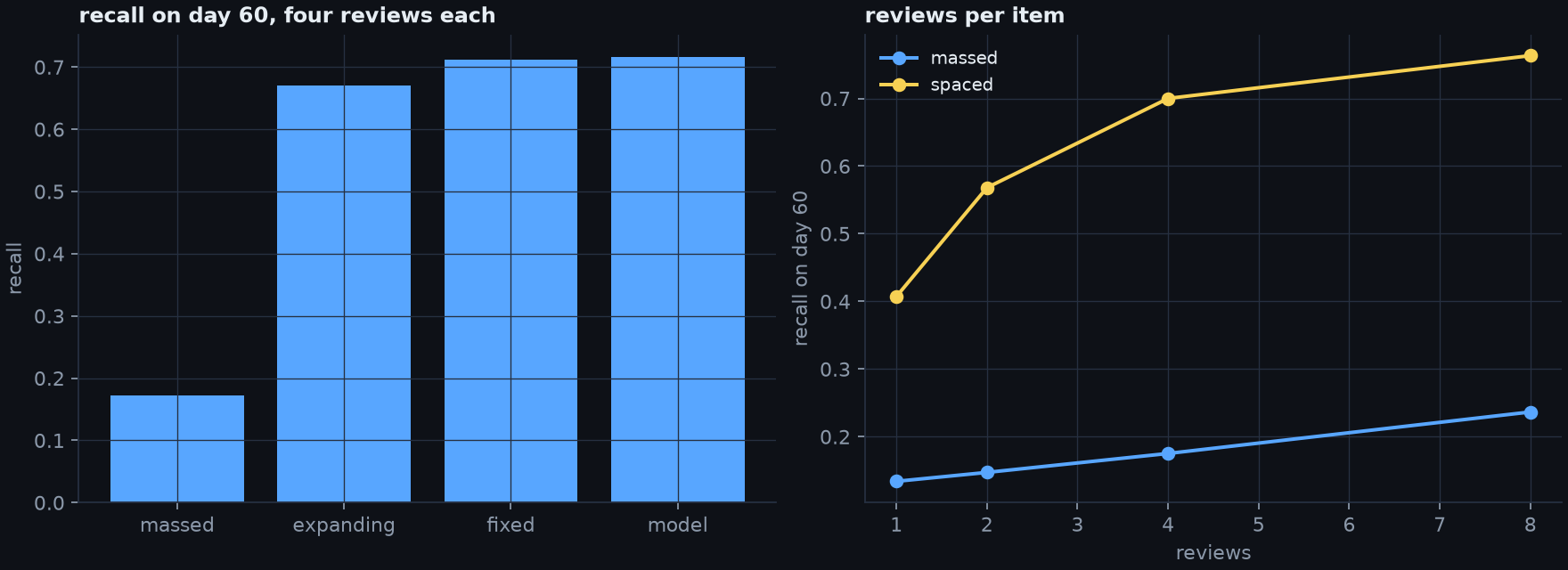
Here are four schedules, raced on Psyche at equal study time. Sixty items are studied on day zero, each gets four reviews before day twenty-eight, and the test is on day sixty. Massed in one session, recall is seventeen percent. With expanding gaps, sixty-seven percent. With equal gaps, seventy-one. At a long delay, expanding isn't better, as Jeffrey Karpicke and Henry Roediger found. The model's choice, the schedule that maximizes predicted recall on day sixty, does about as well as equal gaps, with gaps that shrink towards the end. What matters most is spacing at all. The schedule's shape matters less, and depends on the test date.
But best on the test day isn't the only goal. Here are the same four schedules for one item, followed every day instead of only on day sixty. Massed study stays above one half for about seventeen of the sixty days. Expanding gaps keep it above half on all sixty, because the early reviews come before the first forgetting. The model's schedule, chosen for day sixty, lets recall dip early, and is above half on about fifty-two days. A learner who'll be tested once wants the last. A nurse or a pilot, who may need the fact on any day, wants the second. The goal sets the schedule.
More reviews, or better-placed ones? Massed, even eight reviews in one session reach only about a quarter. Spaced, a single review four weeks later already gives forty percent. Where a review goes is worth more than how many there are. For a learner with an hour a week, the scheduler's job is to spend it where forgetting is about to happen.
What it does: From boxes to models; four schedules raced; more reviews or better-placed ones
10Learning to readPsych 101 and the major1 min
Why did the reading wars end? Start with a model. In 1986 Philip Gough and William Tunmer proposed that reading comprehension is the product of decoding words and understanding language. If either is zero, so is reading. Here are four hundred simulated children, coloured by comprehension. Good listeners who can't decode read about as poorly as good decoders who don't understand. Those are two different problems, needing two different kinds of teaching: phonics for one, and vocabulary and knowledge for the other.
For decades, the reading wars were fought between two views. Whole-language teaching held that children learn to read as they learn to talk, from meaning and context. The evidence says English spelling maps to sounds systematically enough that explicit, systematic phonics helps beginners, most of all those at risk. The US National Reading Panel concluded so in 2000. Guessing words from pictures and context, taught as a strategy, trains what skilled readers don't do. Part 18's eye movements land on nearly every word. Anne Castles, Kathleen Rastle and Kate Nation summed it up in 2018: phonics first, then fluency, vocabulary and knowledge. Decoding is necessary, and not sufficient.
What it does: The simple view of reading; the reading wars
11Beliefs about abilityGraduate1 min
Can a lesson about the brain change grades? The idea is that students who believe ability can grow persist after setbacks, and that a short lesson can teach the belief. Early small studies reported large effects; the first bar is illustrative. Victoria Sisk and colleagues' meta-analysis in 2018 found about zero point zero eight on achievement. Then David Yeager and colleagues ran a fifty-minute online lesson for about twelve thousand American ninth-graders, randomized. Grades rose by about a tenth of a grade point among lower-achieving students, and little overall. Small, real, and cheap. For a lesson under an hour, the Ledger says: replicated, smaller.
For whom, and where? The national study found the effect only in schools whose peer norms supported taking on challenges. The lesson needed fertile soil. Heterogeneity is the finding, not a footnote. An average of zero point zero eight can hide zero point two for some and nothing for most, which is Part 47's point. The risk is that praise effort turns into a slogan, without the lesson's content. So read an intervention by its size, for whom it works, at what cost, and against what alternative.
What it does: Growth mindset at scale; for whom and where
12FeedbackGraduate2 min
Does feedback always help? In 1996 Avraham Kluger and Angelo DeNisi pooled over six hundred effects of feedback on performance. The average effect was positive, about zero point four standard deviations. But in over a third of the comparisons, feedback made performance worse. Feedback that pointed attention at the self, praise or criticism of the person, tended to hurt. Feedback about the task, and how to improve it, tended to help. The same word names interventions with opposite effects.
What should the feedback say? After a wrong answer, being told "wrong" alone does little, because the learner still lacks the right answer. Harold Pashler and colleagues found this in 2005. The correct answer is what helps, and an explanation helps most when the task needs understanding rather than recall. After a right answer given with low confidence, feedback helps too. Andrew Butler, Jeffrey Karpicke and Henry Roediger showed it turns a guess into something known. And, surprisingly, errors made with high confidence are corrected best. The surprise marks them, like Part 17's prediction error.
So what does feedback that works look like? It's about the task: what was right, what to change, and the next step. It's timely, while the attempt is still in memory. For retrieval practice, that's right after the answer. It's acted on, with a chance to try again. Feedback without a second attempt is information without practice. And it's not a grade alone. A mark tells you where you stand, not how to improve.
What it does: A third of the time, worse; feedback that works
13The LedgerGraduate1 min
What the five have in common. The techniques built on memory research, interleaving like testing and spacing, hold up. The popular ideas, learning styles and the pen, fail or wobble, and the famous numbers, two sigma and mindset, shrink. Learners' own judgements point the wrong way, because fluency feels like learning. So here's the answer to this part's question. The most effective way to learn feels harder, and that's why learners choose the opposite.
What it does: Five rows; what they have in common
14In practice: a course's study plan, redesignedPractice1 min
What would you change in a course tomorrow?
Where is this a job? In course design: curricula with cumulative review, and assessments that ask for retrieval and application. In educational technology: flashcard and tutoring products, whose schedulers and student models are this part's mathematics. In corporate training, where a one-day workshop is massed practice, and spacing it costs little and keeps more. And in evaluation: randomized trials of products and programmes, judged by later learning, not by how satisfied the learners felt.
Here's a worked redesign of a twelve-week statistics course. Before: lectures, weekly problem sets on that week's topic, a midterm and a final, and students rereading slides before exams. Retrieval: a five-question quiz at the start of each class, low stakes, with the answers discussed. Spacing: every problem set includes two questions from three and six weeks earlier, and the final is cumulative, and says so. Interleaving: the last third of each set mixes kinds of test without labels, because choosing the test is the skill. Load: worked examples first, faded to completion problems, then full problems. And evaluation: a delayed test of the same items a term later, against last year's cohort, with the students told why the course feels harder.
What it does: Where this is a job; a worked redesign
15Frontier: AI tutors and what transfersResearch1 min
Will a machine tutor close the two sigma? Conversational tutors built on language models can reach every student. Early randomized trials are mixed, and the details of design matter. There's a crutch problem. Students who use an assistant to answer practice problems can do better during practice and worse on a later test without it. That's performance against learning, again. Tutors designed to give hints rather than answers aim to keep the desirable difficulty. And schedulers are being learned from millions of reviews, and should be judged by randomized comparison.
And the open problems. Transfer: what learning carries to new problems and new settings, and how to teach for it. Motivation: the best technique fails if the learner stops, so how do we make effective study the one people choose? Scale: why effects shrink from pilot to system, and how to stop it. And measurement: tests that measure lasting learning, not performance on the day.
What it does: What is new; open problems
Recap, problems, and the road aheadAll tracks3 min
First, your four numbers. Later reviews put human tutoring at about zero point eight standard deviations, and school trials at about zero point four. Psyche's crammed reviews left seventeen percent on day sixty, and spaced ones seventy-one. Over a third of feedback studies found performance got worse. And the national mindset lesson raised grades by about a tenth of a point, for some students. What feels like learning and what produces it point in opposite directions.
Part fifty-four in twelve lines. Two sigma became about half a sigma, and that's still large. A test is a learning event. Space reviews against the date you'll need them. Interleave confusable problems. Performance during practice misleads. Testing and spacing top the ten techniques. Cut extraneous load, and fade worked examples. Learning styles fail the crossover test. Tutors model the learner, in inner and outer loops. Where a review goes beats how many reviews there are. Reading needs decoding and comprehension. And mindset and feedback effects are small, for some, and sometimes negative.
Where this comes back. Interventions that shrink at scale are Part 55's subject. Memory goes to court in Part 56. Learning machines and learning minds meet in Part 60. And Part 62's dissertation can test a learning intervention properly.
Seven problems, with full solutions in this part's README. One reads the ridgeline. One writes schedules. One applies the simple view of reading. One computes the sample a small effect needs. One updates knowledge tracing after a wrong answer. One designs the learning-styles test. And the last, with the star, asks you to redesign a course you know. Pause here if you'd like to try them.
The books and papers behind this part are listed here and in the README. Make It Stick is the best short book for learners; Dunlosky and colleagues' review is the evidence in one place; and the Bjorks' chapter explains desirable difficulties.
Four parts of Act Twelve are done. This one turned memory research into engineering, and found learners pulling the other way. The next scales up from a classroom to a country. Why do nudges shrink when they leave the laboratory? Part 55: behaviour change at scale.
Where it goes next. Part 55 scales interventions from classrooms to countries; Part 56 takes memory to court; Part 62's dissertation can test a learning intervention.
Key results
The part's results in one place, for revision.
Try it
Lab 54 · The Science of Learning
Race massed, expanding, equal and model-chosen review schedules at equal study time, and see that where a review goes matters more than how many there are.
python -m videos.psychology.labs 54
needs numpy, scipy, matplotlib · download lab54.py ·
source on GitHubmassed: recall on day 60; review days 0.17; 0.0, 0.0, 0.0, 0.0
expanding: recall on day 60; review days 0.67; 1.9, 5.6, 13.1, 28.0
fixed: recall on day 60; review days 0.71; 7.0, 14.0, 21.0, 28.0
model: recall on day 60; review days 0.72; 10.2, 17.9, 23.7, 28.0
one spaced review against eight massed 0.41 against 0.23
simple view: decoding 0.4, comprehension 0.9 0.36
Spacing at all is most of the gain; the shape of the schedule matters less and depends on when the knowledge is needed.The code (53 lines; it asserts its own result)
"""Lab 54: the science of learning: review schedules on Part 21's memory model, the value of spacing against more
reviews, and the simple view of reading."""

import warnings

import numpy as np

from videos.coursekit import labs
from explainer.psychology.psyche import work as Wk

warnings.filterwarnings("ignore", category=RuntimeWarning)
TITLE = "The Science of Learning"
GOAL = ("Race massed, expanding, equal and model-chosen review schedules at equal study time, and see that where a "
        "review goes matters more than how many there are.")
TASKS = [
    "Move the test from day 60 to day 30. Which schedule wins now, and why?",
    "Give the learner six reviews instead of four. How much does each policy gain?",
    "Make the items easier (base 0.3). Does spacing still matter as much?",
]


def run(seed=0):
    out = labs.Lab()
    res = {p: Wk.schedule(p, seed=seed + 1, base=0.6, n_items=40) for p in ("massed", "expanding", "fixed", "model")}
    assert res["massed"]["recall"] < res["expanding"]["recall"] <= res["fixed"]["recall"] + 0.02
    for p, r in res.items():
        out.row(f"{p}: recall on day 60; review days", f"{r['recall']:.2f}; " +
                ", ".join(f"{t:.1f}" for t in r["first_item_times"][1:]))
    one_spaced = Wk.schedule("fixed", reviews=1, seed=seed + 2, base=0.6, n_items=40)["recall"]
    eight_massed = Wk.schedule("massed", reviews=8, seed=seed + 2, base=0.6, n_items=40)["recall"]
    assert one_spaced > eight_massed
    out.row("one spaced review against eight massed", f"{one_spaced:.2f} against {eight_massed:.2f}")
    out.row("simple view: decoding 0.4, comprehension 0.9", f"{float(Wk.simple_view(0.4, 0.9)):.2f}")

    out.note = ("Spacing at all is most of the gain; the shape of the schedule matters less and depends on when the "
                "knowledge is needed.")

    fig, ax = labs.figure(2, size=(11, 4.0))
    ax[0].bar(list(res), [r["recall"] for r in res.values()], color=labs.BLUE)
    ax[0].set(title="recall on day 60, four reviews each", ylabel="recall")
    ks = [1, 2, 4, 8]
    ax[1].plot(ks, [Wk.schedule("massed", reviews=k, seed=seed + 3, base=0.6, n_items=30)["recall"] for k in ks],
               "o-", label="massed")
    ax[1].plot(ks, [Wk.schedule("fixed", reviews=k, seed=seed + 3, base=0.6, n_items=30)["recall"] for k in ks],
               "o-", label="spaced")
    ax[1].set(title="reviews per item", xlabel="reviews", ylabel="recall on day 60")
    ax[1].legend()
    out.fig = fig
    return out


if __name__ == "__main__":
    print(run())
Now change it
- Move the test from day 60 to day 30. Which schedule wins now, and why?
- Give the learner six reviews instead of four. How much does each policy gain?
- Make the items easier (base 0.3). Does spacing still matter as much?
Problems, with solutions
Try each problem before opening its solution.
-
The ridgeline. A test is 60 days away. Using the ridgeline, roughly when should a single restudy happen?
Solution
In Psyche's ridgeline the best gap for a test 70 days away is about 35 days, and for 35 days about 21, so for 60 days about a month; Cepeda et al.'s data put the optimum nearer 10 to 20% of the delay for long delays (one to two weeks). Either way, err long: the cost of too long a gap is small.
-
Schedules. Three reviews per item, a 28-day window: write equal and expanding (doubling) schedules.
Solution
Equal: days 0, 9.3, 18.7, 28. Doubling: the unit is 28/7 = 4 days, so 0, 4, 12, 28.
-
The simple view. Reading comprehension = decoding \(\times\) language comprehension. Decoding 0.4, comprehension 0.9: predict, and say which teaching helps more.
Solution
0.4 x 0.9 = 0.36; decoding is the limit, so phonics and fluency work helps more than vocabulary for this child.
-
Power for a small effect. A mindset effect of 0.08 SD: how many students per arm for 80% power (two-sided, 5%)?
Solution
n = 2 (1.96 + 0.84)^2 / 0.08^2 = about 2,450 students per arm.
-
Knowledge tracing. Knowledge tracing with \(L\) = 0.5, guess 0.2, slip 0.1: the student answers wrong. Find P(known) after.
Solution
P(known | wrong) = 0.5 x 0.1 / (0.5 x 0.1 + 0.5 x 0.8) = 0.11.
-
The learning-styles test. Design the crossover test that would support learning styles. What result is needed?
Solution
Classify learners by style, randomize each to matched or mismatched teaching, test all on the same measure; the hypothesis needs a crossover interaction, with each group learning best from its own method. A main effect of method, or of style, does not support it.
-
★ A redesign. Redesign a course you know: retrieval, spacing, interleaving, load, and how you will evaluate it.
Solution
Start-of-class retrieval quizzes; cumulative questions in every set and a cumulative final; interleaved, unlabelled problem types; worked examples faded to problems; and a delayed test against a previous cohort, with students told why the course feels harder.
Notes and sources
Sources
- B. S. Bloom (1984); K. VanLehn (2011); A. Nickow, P. Oreopoulos and V. Quan (2020).
- H. L. Roediger and J. D. Karpicke, Test-enhanced learning, Psychological Science 17 (2006) 249-255; N. J. Cepeda, E. Vul, D. Rohrer, J. T. Wixted and H. Pashler, Spacing effects in learning: a temporal ridgeline of optimal retention, Psychological Science 19 (2008) 1095-1102; J. D. Karpicke and H. L. Roediger, Expanding retrieval practice promotes short-term retention, but equally spaced retrieval enhances long-term retention, Journal of Experimental Psychology: Learning, Memory, and Cognition 33 (2007) 704-719.
- D. Rohrer and K. Taylor (2007); D. Rohrer et al. (2020); M. Brunmair and T. Richter (2019).
- E. L. Bjork and R. A. Bjork, Making things hard on yourself, but in a good way, in Psychology and the Real World (Worth, 2011) 56-64; N. Kornell and R. A. Bjork, Learning concepts and categories: is spacing the "enemy of induction"?, Psychological Science 19 (2008) 585-592; L. Deslauriers, L. S. McCarty, K. Miller, K. Callaghan and G. Kestin, Measuring actual learning versus feeling of learning in response to being actively engaged in the classroom, Proceedings of the National Academy of Sciences 116 (2019) 19251-19257; S. Freeman et al., Active learning increases student performance in science, engineering, and mathematics, Proceedings of the National Academy of Sciences 111 (2014) 8410-8415.
- J. Dunlosky, K. A. Rawson, E. J. Marsh, M. J. Nathan and D. T. Willingham, Improving students' learning with effective learning techniques, Psychological Science in the Public Interest 14 (2013) 4-58.
- J. Sweller, Cognitive load during problem solving: effects on learning, Cognitive Science 12 (1988) 257-285; S. Kalyuga, P. Ayres, P. Chandler and J. Sweller, The expertise reversal effect, Educational Psychologist 38 (2003) 23-31.
- H. Pashler et al. (2008); B. A. Rogowsky et al. (2015); P. A. Mueller and D. M. Oppenheimer (2014); K. Morehead et al. (2019); H. L. Urry et al. (2021).
- A. T. Corbett and J. R. Anderson (1995); S. Leitner, So lernt man lernen (1972); P. A. Wozniak, SuperMemo algorithm SM-2 (1987); B. Settles and B. Meeder, A trainable spaced repetition model for language learning, Proceedings of ACL 2016, 1848-1858.
- P. B. Gough and W. E. Tunmer, Decoding, reading, and reading disability, Remedial and Special Education 7 (1986) 6-10; National Reading Panel, Teaching Children to Read (2000); A. Castles, K. Rastle and K. Nation, Ending the reading wars, Psychological Science in the Public Interest 19 (2018) 5-51.
- L. S. Blackwell et al. (2007); V. F. Sisk et al. (2018); D. S. Yeager et al. (2019).
- A. N. Kluger and A. DeNisi, The effects of feedback interventions on performance, Psychological Bulletin 119 (1996) 254-284.
About this partfrom its README
In 1984 Benjamin Bloom reported that pupils tutored one to one scored about two standard deviations above pupils taught in a class, and challenged education to find group methods as good. Forty years on the two sigma has shrunk to under one, still among the largest effects in education, and the study methods with the strongest evidence are ones students rate as less effective than rereading. This part turns Parts 20 and 21's memory research into an engineering problem, and asks why learners choose the opposite of what works.
The viewer is offered two word lists, one massed and one spaced, and predicts four numbers. Then the testing effect in the laboratory and the classroom; the spacing ridgeline as a design rule and interleaving; learning against performance, with Psyche cramming and spacing; Dunlosky and colleagues' ten techniques; cognitive load and worked examples; learning styles and other myths; tutoring measured again and how tutoring systems model a learner; four review schedules raced on Psyche; the simple view of reading and the end of the reading wars; growth-mindset lessons at national scale; and feedback that makes things worse.
What is computed and built
explainer/psychology/psyche/work.pygains a capped Pavlik-Anderson activation, a review scheduler comparing massed, expanding, equal and model-chosen schedules at equal study, and the simple view of reading. Tested intests/psychology/test_work.py.- The Ledger gains five rows; testing and spacing are Part 21's rows.
- The course's interactive: two lists of word pairs, one studied massed and one spaced, with the reader's prediction and then the test.
Chapter notes
| # | Chapter | What it does |
|---|---|---|
| 0 | Two sigma | Bloom's challenge; forty years on; the question; objectives |
| 1 | On you: two lists, and four numbers | Massed and spaced lists; four predictions |
| 2 | Retrieval practice | Study or test; in classrooms |
| 3 | Spacing and interleaving | The ridgeline as a design rule; interleaving |
| 4 | Learning against performance | Cramming wins the week and loses the term; the illusion of fluency |
| 5 | Ten techniques, ranked | Dunlosky et al.'s ratings; why the top two work |
| 6 | Cognitive load | Sweller's theory; worked examples and the expertise reversal |
| 7 | Myths | The learning-styles test; other myths, tested |
| 8 | Tutoring | Two sigma measured again; how a tutoring system models the learner |
| 9 | Scheduling reviews | From boxes to models; four schedules raced; more reviews or better-placed ones |
| 10 | Learning to read | The simple view of reading; the reading wars |
| 11 | Beliefs about ability | Growth mindset at scale; for whom and where |
| 12 | Feedback | A third of the time, worse; feedback that works |
| 13 | The Ledger | Five rows; what they have in common |
| 14 | In practice: a course's study plan, redesigned | Where this is a job; a worked redesign |
| 15 | Frontier: AI tutors and what transfers | What is new; open problems |
| Recap, problems, and the road ahead | Your numbers; twelve lines; payoffs; problems; references; Part 55 |
NotesWhere the numbers come from
| What | Source |
|---|---|
| Review schedules: 60 items studied on day 0, four reviews each before day 28, a test on day 60; Part 21's Pavlik-Anderson activation with each trace's decay capped at 1 (uncapped, presentations minutes apart overflow), items 0.6 harder than Part 21's default with SD 0.25; recall 17% massed, 67% expanding (gaps doubling), 71% equal, 71% for the schedule the model chooses (the best of fifteen with growing, equal or shrinking gaps) | Psyche (work.schedule, pa_activation_capped), item policies |
| Reviews per item: massed 15% to 25% for one to eight reviews; spaced over 28 days 41% to 76% | Psyche, item budget |
| Recall over 60 days for one item: crammed 92% on day 5 and 14% on day 60; spaced 32% on day 5 (a review due) and 74% on day 60 | Psyche, item curves |
| The spacing ridgeline: best gaps 2, 21, 35 and 90 days for tests 7, 35, 70 and 350 days later | Part 21's memory.spacing_ridge, item ridge |
| The simple view of reading: 400 simulated children, decoding and language comprehension each Beta(4, 2), comprehension their product plus noise; good listeners who cannot decode 0.29, good decoders who do not understand 0.28, both good 0.59 | Psyche (work.simple_view), item reading |
| The bars for Roediger and Karpicke (81% and 75% at five minutes, 42% and 56% at a week), tutoring (2.0, 0.79, 0.76, 0.37 SD) and mindset (0.08 and about 0.1) | the studies as reported; the bar for "early small studies" of mindset is illustrative |
| Every published number on screen | the studies listed under Sources, quoted as reported |
Notes
| Finding | Original | Status |
|---|---|---|
| Mixing problem types during practice improves later performance compared with practising each type in a block, though blocked practice looks better during learning. | Rohrer and Taylor 2007 | replicated |
| Teaching matched to a learner's preferred style (visual, auditory, kinaesthetic) improves learning. | Dunn and Dunn 1978 | failed |
| One-to-one tutoring raises achievement by about two standard deviations over conventional classroom teaching. | Bloom 1984 | replicated, smaller |
| Teaching students that ability can grow improves their academic achievement. | Blackwell, Trzesniewski and Dweck 2007 | replicated, smaller |
| Students who take notes by hand learn more from a lecture than those who type them. | Mueller and Oppenheimer 2014 | contested |
Shown without a row, with the reason recorded in explainer/psychology/ledger.py: Bloom; VanLehn; VanLehn with
Nickow and colleagues; Roediger and Karpicke; Deslauriers and colleagues; Dunlosky and colleagues; Sweller; Settles
and Meeder; Castles, Rastle and Nation; Kluger and DeNisi.
Notes
The web-search budget for this session was spent on earlier parts, so the facts in this part come from the standard literature and were not re-checked online today; each is listed here to be checked against its source: Bloom's two sigma and its studies; VanLehn's 0.79 and 0.76; Nickow et al.'s 0.37 and its moderators; Roediger and Karpicke's percentages at five minutes and a week; Karpicke and Roediger (2007); Rohrer and Taylor (2007) and the 2020 classroom trial; Brunmair and Richter (2019); Kornell and Bjork (2008); Deslauriers et al. (2019); Freeman et al.'s 225 studies and failure ratio; Dunlosky et al.'s ratings of each technique; Sweller (1988) and the expertise reversal effect; Pashler et al.'s review and the Dunns' model; Rogowsky et al. (2015); Mueller and Oppenheimer (2014), Morehead et al. (2019) and Urry et al. (2021); Leitner's boxes, SM-2's year and rule; Settles and Meeder (2016); Gough and Tunmer (1986); the National Reading Panel; Castles et al. (2018); Blackwell et al. (2007); Sisk et al.'s 0.08; Yeager et al.'s sample, lesson length and effects; Kluger and DeNisi's number of effects, mean and share negative; Pashler, Cepeda, Wixted and Rohrer (2005) on right-or-wrong against correct-answer feedback; Butler, Karpicke and Roediger (2008) on feedback after low-confidence correct answers; the hypercorrection of high-confidence errors; Richland, Kornell and Kao (2009) on pretesting; the randomized trials of language-model tutors and of assistants in practice; and every page range in Sources. The load budget in chapter six is schematic, and its heights are not measurements.
Companion material in this repository
The syllabus's plan for this partfrom SYLLABUS.md, the plan of record
- Hook: Bloom's two sigma, and what later tutoring trials found.
- On you: at the start of this part you studied two lists, one massed and one spaced. The test is now.
- Retrieval practice: the testing effect in classrooms.
- Spacing and interleaving: why mixed practice feels worse and works better.
- Learning against performance (Bjork): desirable difficulties, and the illusion of fluency. Students in active classes learn more and feel they learned less.
- Ten techniques ranked (Dunlosky et al. 2013): highlighting and rereading at the bottom.
- Cognitive load: worked examples, split attention, the expertise reversal effect.
- Myths: learning styles (the meshing hypothesis and its failed tests), left- and right-brained learners.
- Tutoring: human tutoring's real effect; intelligent tutoring systems; knowledge tracing (Part 45) as the student model.
- Scheduling reviews as control: from Leitner's boxes and SM-2 to models that estimate each memory's half-life and optimize the next interval. Part 21's memory model drives a scheduler, and it is raced against fixed schedules on the Pool.
- Reading: the simple view; phonics and the evidence that settled the "reading wars".
- Beliefs and feedback: growth-mindset interventions at national scale (small effects for some students); feedback that lowers performance a third of the time.
Psyche: psyche.work: a review scheduler on Part 21's memory model (fixed, expanding and model-based policies
compared at equal study time); a knowledge-tracing tutor on simulated students.
On you: the spaced-against-massed test; predict your own score first.
Ledger: the testing effect (replicated); spacing (replicated); interleaving (replicated); learning-styles
matching (failed); Bloom's two sigma (replicated, smaller); growth-mindset interventions (replicated, smaller; heterogeneous); longhand beating laptops for notes (contested).
In practice: curriculum and course design, edtech products, corporate training, spaced-repetition software; a
worked redesign of a course's study plan.
Frontier: randomized trials of AI tutors (verify); optimal scheduling with realistic memory models; what
transfers.
Reading: Bloom 1984; VanLehn 2011; Dunlosky et al. 2013; Roediger & Karpicke 2006; Bjork & Bjork 2011; Pashler
et al. 2008; Sweller 1988; Freeman et al. 2014; Deslauriers et al. 2019; Settles & Meeder 2016; Yeager et al.
2019; Castles, Rastle & Nation 2018.
Build the film
python -m videos.psychology.psych54.compute        # the part's numbers, into .cache/psych54
python tools/build.py psych54                  # render and assemble the film
EXPLAINER_TTS=silent python tools/qa_scene.py psych54 Hook   # one chapter, silent, with a contact sheet
Scenes: videos/psychology/psych54. Setup: see the course page. Source of these notes: the README and the scenes' narration.
Build it
python -m videos.psychology.psych54.compute            # every number (a minute)
python tools/qa_scene.py psych54 Scheduler             # one chapter, silent, at 480p, with a contact sheet
EXPLAINER_TTS=silent python tools/build.py psych54 -q l   # the whole part, silent preview
python tools/build.py psych54                          # 1080p30 with narration
python tools/qa_scene.py psych54 Bjork --lang zh       # the Chinese edition of one chapter
python tools/make.py psych54                           # both editions, with the checks a long build needs
python -m videos.psychology.labs 54                    # the lab: schedules, budgets and the simple view
python tools/check_ledger.py psych54                   # every study shown has its Ledger row, or a reason
python -m pytest tests/psychology                      # Psyche's work module, the Ledger, the Archive
The Chinese edition is zh_lines.py (the narration, line by line) and the series table
videos/psychology/psychology_text_zh.json (the text on screen); the terms are in
PSYCHOLOGY_ZH_GUIDE.md.