Social Influence
How much of what you do is decided by who is in the room?
In the summer of 1961, in a basement at Yale, an experimenter in a grey coat told ordinary men to give another man electric shocks, and 26 of 40 went to the last switch. The part tells the famous studies as they were run, as they were retold and as the record now shows them: Sherif's moving light and Asch's lines, with Bond and Smith's 133 studies and a 2023 replication at 33%; Milgram's variations as a dose-response curve from 0% to 92.5%, Burger's partial replication and Perry's archives, where only about half fully believed; the prison study's coaching and the BBC study's different result; the 38 witnesses as a parable, the bystander effect in the laboratory, and cameras showing help in nine of ten street fights. Then audiences, loafing, polarization, groupthink, a consistent minority, the hidden profile and persuasion's two routes. Psyche computes what the famous studies never had: Granovetter's thresholds, DeGroot's consensus, bounded confidence, simple and complex contagion, the diversity identity behind Galton's ox, and a music market where social information makes hits unequal and unpredictable.
What you need. Part 2's experiments, Part 4's replication record and Part 17's reinforcement learning. Probability, matrices and eigenvectors, and the binomial distribution.
- Hook
- the shock generator, 1961
- Ideas, models and mathematics
- conformity, obedience, bystanders, the prison study and its record, facilitation and loafing, persuasion, thresholds and cascades, opinion dynamics, the wisdom of crowds
- Psyche gains
- agents on a network
- On you
- Asch's lines; a crowd estimate
What you will be able to do
Psych 101 and the major
- Describe Asch's, Milgram's and Darley and Latané's studies, what later work found, and what the archives changed.
- Explain why the Stanford prison experiment and the 38 witnesses are stories that outran their records.
- Describe social facilitation, social loafing, group polarization, minority influence and the two routes to persuasion.
Graduate
- Solve Granovetter's threshold model and show how one changed threshold flips a crowd.
- Derive DeGroot's consensus as a left-eigenvector average, and simulate bounded confidence and simple and complex contagion on networks.
- Prove the diversity prediction identity, and compute the bystander and information-sampling formulas.
Research
- Explain why influence and homophily are confounded in observational network data, and design a study that separates them.
- Evaluate claims about algorithmic amplification and experiments on millions of users.
Practice
- Design a committee, rating system or seeding campaign that uses, or guards against, social influence.
Contents
Each chapter has a home level. Choose a track to see what to read and watch: Psych 101 and the major 35 min · Graduate 40 min · Research 42 min · Practice 37 min.
- 01961: the shock generatorPsych 101 and the major4 min
- 1Norms and linesPsych 101 and the major3 min
- 2On you: four numbersPsych 101 and the major1 min
- 3ObediencePsych 101 and the major4 min
- 4The prison that wasn'tPsych 101 and the major2 min
- 5BystandersPsych 101 and the major3 min
- 6The presence of othersPsych 101 and the major3 min
- 7Groups decidingPsych 101 and the major3 min
- 8PersuasionPsych 101 and the major3 min
- 9ThresholdsPsych 101 and the major2 min
- 10Opinions on a networkGraduate3 min
- 11The wisdom and the herdPsych 101 and the major3 min
- 12The LedgerPsych 101 and the major
- 13In practice: rooms, ratings and reachPractice2 min
- 14Frontier: influence at scaleResearch2 min
- Recap, problems, and the road aheadAll tracks4 min
Also on this page: Lecture · Key results · Try it · Lab · Problems · Notes and sources · Build the film.
Lecture
The text of each chapter is the film's narration, as it is spoken, so you can read along or revise without the film. The pictures are in the film. A dashed box stands for a number the film computes when it is rendered (hover over it to see what is computed); the README's figures for each chapter, where it lists them, follow the chapter's text.
1961: the shock generatorPsych 101 and the major4 min
In the summer of 1961, newspaper ads in New Haven offered men between twenty and fifty a small payment to take part in a study of memory and learning at Yale. Those who came were led to the basement of Linsly-Chittenden Hall. There they met an experimenter in a grey coat, and another volunteer, a pleasant middle-aged man, who was in fact working for the experimenter. A rigged draw made the real volunteer the teacher. The other man, the learner, was strapped into a chair in the next room. The teacher would read out word pairs, and for each wrong answer give the learner an electric shock, fifteen volts stronger than the last.
Here is the shock generator, as a strip of thirty switches, from fifteen to four hundred and fifty volts. No shock was real; the learner was an actor. In the first version Milgram published, he made no sound until three hundred volts, when he pounded on the wall. At three hundred and fifteen he pounded again, and then fell silent. The teacher was told to treat silence as a wrong answer, and go on. Four hundred and fifty is the last switch. Whenever the teacher hesitated, the experimenter had four prods, in order. Please continue. The experiment requires that you continue. It is absolutely essential that you continue. And: you have no other choice, you must go on.
Milgram asked psychiatrists to predict what people would do. They expected almost no one to go to the end, about one in a thousand. In the first version he published, in 1963, twenty-six of the forty men, sixty-five percent, went all the way to four hundred and fifty volts. Many sweated, trembled and argued, and kept going. The other fourteen stopped, none of them before three hundred volts. It became the most famous finding in psychology. This part tells it as it was run, as it was retold, and as the archives now show it.
So this part asks how much of what you do is decided by who is in the room. It takes the famous studies: Asch's lines, Milgram's generator, Zimbardo's prison and the thirty-eight witnesses. Each one as it was run, as it was retold, and as the record now shows it. Then it builds the mathematics those studies never had: thresholds, networks and crowds.
This is Part 34 of Psychology, Built: social influence, the first part of Act Nine, on other people. We'll start with norms and conformity: Sherif's moving light, Asch's lines, and what later samples found. We'll redraw obedience as a dose-response curve across Milgram's variations, and read what his archives show. We'll take two famous stories, the prison study and the thirty-eight witnesses, and set them against their records. We'll meet bystanders, audiences, loafers and groups that decide. We'll look at persuasion's two routes and at norms tested in the field. And we'll compute thresholds, opinions on networks, contagion and the wisdom of crowds.
What it does: The basement; the trial strip and the prods; prediction against result; the question; objectives
1Norms and linesPsych 101 and the major3 min
The first experiments on norms used an illusion. In 1935 Muzafer Sherif sat people in a dark room with a single, still point of light. In the dark it seems to drift, and he asked them how far it moved. Alone, each person settled on a range of their own. Put together, their estimates converged on a group norm. And tested alone afterwards, they kept the group's norm, as if it were what they'd seen. In 1961 Jacobs and Campbell planted an extreme norm with confederates and replaced members one by one. Newcomers took it up, but over the generations it decayed back toward the natural one.
Sherif's light was ambiguous. Solomon Asch wanted a task with an obvious answer. Between 1951 and 1956 he seated groups of students around a table. All but one were confederates. Each trial, they were shown a standard line, and asked aloud which of three lines matched it. There were eighteen trials. On twelve critical ones the confederates, answering before the real participant, all gave the same wrong answer. The lines were easy. Alone, almost nobody made a mistake. There are two reasons to go along with a group. The others may know something you don't, as in Sherif's dark room. Or standing out may cost you something, as at Asch's table, where the answer was plain.
What happened? Across a hundred and twenty-three men from three universities, thirty-seven percent of the critical answers went with the wrong majority. But people differed enormously. About a quarter never went along at all; about five percent always did; and three in four went along at least once. One other person giving the right answer cut errors to about a quarter. What did the work was unanimity, not size. A single opponent hardly moved anyone. The effect rose up to about three, and more people added little. Asch himself stressed the independence: most answers, even on critical trials, were right.
Has it lasted? In 1996 Bond and Smith gathered a hundred and thirty-three Asch-type studies from seventeen countries. Conformity was higher in collectivist cultures, and in the United States it had declined since the 1950s. In 2023 Franzen and Mader ran Asch's procedure again with two hundred and ten students and five confederates. Thirty-three percent of the critical answers were wrong. Paying people for correct answers cut that to twenty-five percent, and on political statements thirty-eight percent went along. So the effect is real and durable, and its size depends on the sample, the culture and the stakes.
What it does: Sherif's light; Asch's lines; what happened; seventy years later
2On you: four numbersPsych 101 and the major1 min
Your turn. Write down four numbers before the part answers them. One: in Milgram's first published study, what share of the forty men went all the way to four hundred and fifty volts? Two: in 2023, students ran Asch's lines again. What share of the critical answers went with the wrong majority? Three: cameras filmed two hundred and nineteen real public fights in three countries. In what share did at least one bystander step in? And four: seven hundred and eighty-seven people at a country fair guessed the weight of an ox. How far off was the middle guess? Pause here, and write them down.
You can also try Asch's task. This part's interactive runs twelve trials alone, then twelve more with five recorded answers shown before yours. On eight of the twelve, the five are unanimous, and wrong. The answers are scripted, and you know it, so the pull is weaker than at Asch's table, where the others sat beside you. You can measure it anyway. Nothing you answer is stored or sent.
What it does: Four predictions; Asch's task on you
3ObediencePsych 101 and the major4 min
The sixty-five percent is the number everyone remembers. But Milgram ran his procedure in many variations. Most had forty men each, and they were never meant to give one answer. When the teacher had to hold the learner's hand onto a shock plate, thirty percent went to the end. When the experimenter gave his orders by telephone, about twenty. When the study moved from Yale to an office building in Bridgeport, forty-seven and a half. It fell furthest when two other teachers, both confederates, refused to go on. Four of the forty continued. So the sixty-five percent wasn't a constant of human nature. It was one point on a curve that the situation sets.
In 2014 Haslam, Loughnan and Perry coded every condition Milgram ran. The whole programme was twenty-three conditions and seven hundred and eighty people. Twenty-one conditions, with seven hundred and forty people, could be compared. Across them, forty-three point six percent obeyed to the end, from none at all in some conditions to ninety-two and a half percent in one. The strongest predictors were features of the experimenter, how directive, how legitimate and how consistent he was, and how close the teacher was to the learner. Taken together, most of the people in Milgram's studies disobeyed.
No ethics board would allow the full procedure today, but one psychologist found a way to run part of it. In 2009 Burger tested seventy adults, and stopped every session at a hundred and fifty volts, the point at which the learner first asks to be released. His reason: in Milgram's matching condition, seventy-nine percent of those who passed that point went on to the end. Seventy percent of Burger's participants went past a hundred and fifty volts, against Milgram's eighty-two and a half, a difference that wasn't significant. A commentary in the same issue called it obedience lite. The most important part of the original was never run again.
Then the archives were opened. In 2012 the psychologist Gina Perry published Behind the Shock Machine, built on the tapes and papers Milgram left at Yale. The experimenter didn't keep to the script. He improvised prods, and pressed some people beyond the four. Perry and her colleagues later reanalysed six hundred and fifty-six questionnaires that Milgram had collected but never published. Only about half of the participants had fully believed the shocks were real. And those who believed the learner was in pain were about two and a half times as likely to refuse. So the sixty-five percent mixes obedience with doubt about whether anything bad was happening at all.
Why did people go on? Milgram's answer was the agentic state: people hand responsibility to the authority, and simply follow. But the only prod that is a true order, you have no other choice, you must go on, was the least effective of the four, in Burger's study and in analyses of Milgram's own recordings. In 2015 Alex Haslam, Stephen Reicher and Millard restaged the procedure with actors in immersive digital realism. After the fourth prod, nearly everyone refused. Haslam and Reicher's reading is that people went on when they identified with the experimenter's scientific cause: engaged followers, not automata. What's solid is that ordinary people will hurt someone at an authority's request in some situations. Why they do is still argued.
What it does: The variations as a curve; all the conditions at once; Burger; the archives; engaged followership
4The prison that wasn'tPsych 101 and the major2 min
If Milgram showed what an authority could make people do, the Stanford prison experiment seemed to show what a role could. In August 1971 Philip Zimbardo turned a basement corridor at Stanford into a mock prison. Twenty-four male students, screened as healthy, were assigned by chance to be guards or prisoners. The guards turned cruel within days, some prisoners left early, and the study was stopped after six of a planned fourteen days. The lesson taught for decades was simple. Put good people in a bad role, and the role takes over.
That isn't what the record shows. In 2019 Thibault Le Texier published, in American Psychologist, a study of the experiment's archives and interviews with fifteen of the participants. The guards had been given precise instructions about how to treat the prisoners, and weren't told that they were being studied too. Recordings he and others describe show the warden, a member of the research team, pressing a reluctant guard to be tougher. So it wasn't an experiment on what a role does by itself. It was a demonstration, staged by people who knew the result they wanted. Zimbardo replied that his critics ignored the data, and textbooks have only slowly begun to change.
What happens when you run a prison study without the coaching? For a BBC television series, Stephen Reicher and Alex Haslam randomly divided men into guards and prisoners, and filmed what happened. They published the study in 2006. The guards didn't take to their role. They were hesitant to use their authority, and never became a group. The prisoners did become a group, and in the end they overcame the guards. What people do in a role depends on whether they identify with it, which is the same reading as chapter three's engaged followers.
What it does: The textbook version; Le Texier's record; the BBC prison study
5BystandersPsych 101 and the major3 min
The study of bystanders began with a newspaper story. In March 1964 Kitty Genovese was murdered in Queens, New York. Two weeks later the New York Times reported, on its front page, that thirty-eight of her neighbours had watched and done nothing. It became the founding story of a field: apathy in the city, and a crowd that does not help. Later inquiries found about a dozen people who had heard or seen parts of the attack, and at least one who called the police. In 2007 Manning, Levine and Collins called it the parable of the thirty-eight witnesses. In 2016 the Times itself called its reporting flawed.
Two young psychologists, John Darley and Bibb Latané, took the story into the laboratory. In one study, students talking over an intercom heard another student apparently have a seizure. Alone, eighty-five percent went for help before the fit was over. When they believed four others could hear it too, thirty-one percent did. In another, smoke poured into a room where students were filling in questionnaires. Three quarters of those alone reported it. With two confederates who ignored the smoke, one in ten did. The more people who could help, the less likely each one was to do anything. They called it diffusion of responsibility, and added that other people's calm is read as a sign that nothing is wrong.
But there's a catch in that logic, and a little algebra shows it. Suppose one person alone helps with a chance of point eight five, and each of N bystanders with that chance shrunk by a power of N. The chance that anyone helps is one minus the chance that nobody does. If responsibility is shared exactly, so each person's chance falls as one over N, each helps much less, but the group as a whole barely less. Only a steeper fall makes a crowd worse than one person. So the laboratory's question, what each person does, and the victim's question, whether anyone helps, can have different answers.
What does the wider record show? In 2011 Fischer and colleagues pooled a hundred and five effects from more than seven thousand seven hundred people. The bystander effect is real, of moderate size, and weaker when the emergency is dangerous. Then in 2020 Philpot and colleagues looked at what actually happens, in city-centre camera footage of two hundred and nineteen real disputes in the Netherlands, the United Kingdom and South Africa. In about nine in ten, someone intervened, usually several people, and the more bystanders there were, the more likely help was. Each bystander may feel less responsible. But a crowd still means more people who might act, just as the algebra said.
What it does: The 38 witnesses; the intercom and the smoke; the algebra of diffusion; what cameras show
6The presence of othersPsych 101 and the major3 min
Social psychology likes to date its first experiment to 1898. Norman Triplett had children turn fishing reels as fast as they could, alone and in competition with another child. He reported that many were faster with a competitor beside them. But in 2012 Wolfgang Stroebe pointed out that reanalyses of Triplett's own figures show little effect, with about half the children no faster at all. The field's founding experiment was weaker than its legend, a pattern this part keeps finding.
Sometimes audiences helped and sometimes they hurt. In 1965 Zajonc proposed one rule for both. The presence of others raises arousal, or drive. And drive multiplies the strength of whatever response is already dominant. On a well-learned task the dominant response is the right one, so an audience helps. On a new task it's often wrong, so an audience hurts. Here it is in Psyche: the chance of the right response as drive rises, for an easy task and a hard one.
Zajonc tested his rule on cockroaches, whose dominant response is to run from light. In 1969, with two colleagues, he had them flee down a straight runway or through a maze, alone or watched by other roaches. With an audience they were faster on the runway and slower in the maze, just as drive predicts. In 2020 Halfmann and colleagues ran a preregistered direct replication. An audience slowed the roaches on both tasks. The famous interaction didn't reappear. In people, the effects of an audience are small, and vary with the task.
Groups can also make people work less. In 1979 Latané, Williams and Harkins had students shout as loudly as they could, sometimes believing others were shouting with them. Believing one other person shouted, they gave eighty-two percent of their solo effort. Believing five others did, seventy-four. In 1993 Karau and Williams pooled seventy-eight studies. Social loafing is moderate and general, and it shrinks when each person's work can be identified, or when the task matters to them. So the same crowd can energize and dilute. An audience watches you; a group hides you.
What it does: Triplett; Zajonc's drive; the cockroaches twice; social loafing
7Groups decidingPsych 101 and the major3 min
Do groups decide better than their members? In 1961 a master's student, James Stoner, found that groups chose riskier options than their members had chosen alone. It was called the risky shift. But later studies found groups shifting toward caution too, when their members leaned that way. In 1969 Moscovici and Zavalloni showed the general rule. French students who liked their president and disliked Americans felt both more strongly after discussing them. Group polarization: discussion moves a group further in the direction it already leaned. Chapter ten's model adds why: people mostly hear arguments from those who already agree with them.
The most famous idea about groups came from history, not experiments. In 1972 Janis studied American foreign-policy fiascos. A cohesive group, insulated, under a strong leader, seeks agreement, and stops testing its plan. He called it groupthink. The idea spread through business schools and governments, and into everyday speech. But experiments rarely found the pattern it predicts. Reviews in 1998 called it weakly supported, and one said it was virtually devoid of support after a quarter of a century. In 2005 Baron argued that its symptoms appear in many groups without Janis's conditions, so the conditions don't explain them. What survives is narrower: groups often suppress dissent, and share too little of what they know. The next two studies show both.
Influence doesn't only flow from the many to the few. In 1969 Moscovici and his colleagues showed groups of six thirty-six slides, all of them blue. Two of the six were confederates. When the two said green every time, about eight percent of the real participants' answers were green. With no confederates, almost none were. When the two said green only some of the time, they had almost no effect. A minority moves a majority by being consistent, and its influence often shows later and in private more than in public.
The second weakness of groups is subtler. In 1985 Stasser and Titus gave each member of a group part of the information about political candidates. Pooled, the information favoured one candidate; but each member's share, on its own, favoured another. Groups spent their time on what everyone already knew, and rarely found the best candidate. Their explanation was a sampling model. If each person who knows a fact mentions it with some chance, a fact known to more people is simply more likely to come up. Shared facts win the discussion by arithmetic alone. The remedy is cheap: ask members to write down what they know before anyone talks.
What it does: Polarization; groupthink and its evidence; a consistent minority; the hidden profile
8PersuasionPsych 101 and the major3 min
The experimental science of persuasion grew up at Yale. In 1953 Carl Hovland, Janis and Kelley broke persuasion into four parts: who says it, what is said, to whom, and how they respond. They tested each. In 1951 Hovland and Weiss had found something strange. An article from a doubtful source persuaded less at first, but its effect grew over the following weeks, as the source came apart from the message in memory. They called it the sleeper effect. Later work found it fragile, and a 2004 meta-analysis found it real under the right conditions.
Why does a source matter sometimes and not others? In 1981 Petty, Cacioppo and Goldman had students read a proposal for a new senior exam. The arguments were strong or weak, and came from an expert or not. When the exam would affect the students themselves, the quality of the arguments decided their attitude. When it wouldn't, the source's expertise did. Their elaboration likelihood model has two routes: a central one, through the arguments, when people are able and motivated to think; and a peripheral one, through cues like who is speaking. The charts show the pattern of the result, drawn schematically.
Meanwhile, persuasion was being studied in the field. In his 1984 book Influence, Cialdini drew on the work of salespeople, fund-raisers and recruiters, and sorted their tactics into six principles: reciprocity, commitment and consistency, social proof, authority, liking and scarcity. Social proof is this part's subject seen from the seller's side: people do what they see others do. The principles are well supported as tendencies. How large each effect is in a given campaign is a question for field experiments, Part 55's subject.
Here is social proof in a field experiment. In 2008 Goldstein, Cialdini and Griskevicius put cards in hotel rooms, and counted one thousand and fifty-eight chances to reuse a towel. A card saying that most guests reused their towels beat the standard appeal to help the environment, forty-four percent to thirty-five. A card about guests who'd stayed in that very room did best of all. In 2014 Bohner and Schlüter ran the study again in two German hotels. Both messages raised reuse above no message at all, but the norm did no better than the standard appeal. Descriptive norms work in some places and not in others, which is a reason to test them in the place you mean to use them.
What it does: The Yale programme and the sleeper effect; two routes; six principles; the hotel towels twice
9ThresholdsPsych 101 and the major2 min
Here's a way to think about crowds that the famous studies never had. Give each person a threshold: the number of others who must already be doing something before they'll join. In Granovetter's example, a hundred people stand in a square. One has a threshold of zero, one has a threshold of one, one of two, and so on, up to ninety-nine. The one at zero throws a stone. That's enough for the one at one, which makes two, which is enough for the one at two. Watch the count. Every person joins, and every one of them joined only when the count reached their own threshold. Nobody here needed to be a radical.
Now change one person. Crowd B is the same crowd, except that the person whose threshold was one now has a threshold of two. The instigator throws a stone. Nobody else's threshold is reached. One person riots, and gets arrested. A reporter would describe crowd A as a mob of radicals and crowd B as a crowd of moderates. They differ in one person, by one unit. What a crowd does depends on the whole distribution of its thresholds, not on its average member. That's why it's so hard to read people's minds from what a crowd did.
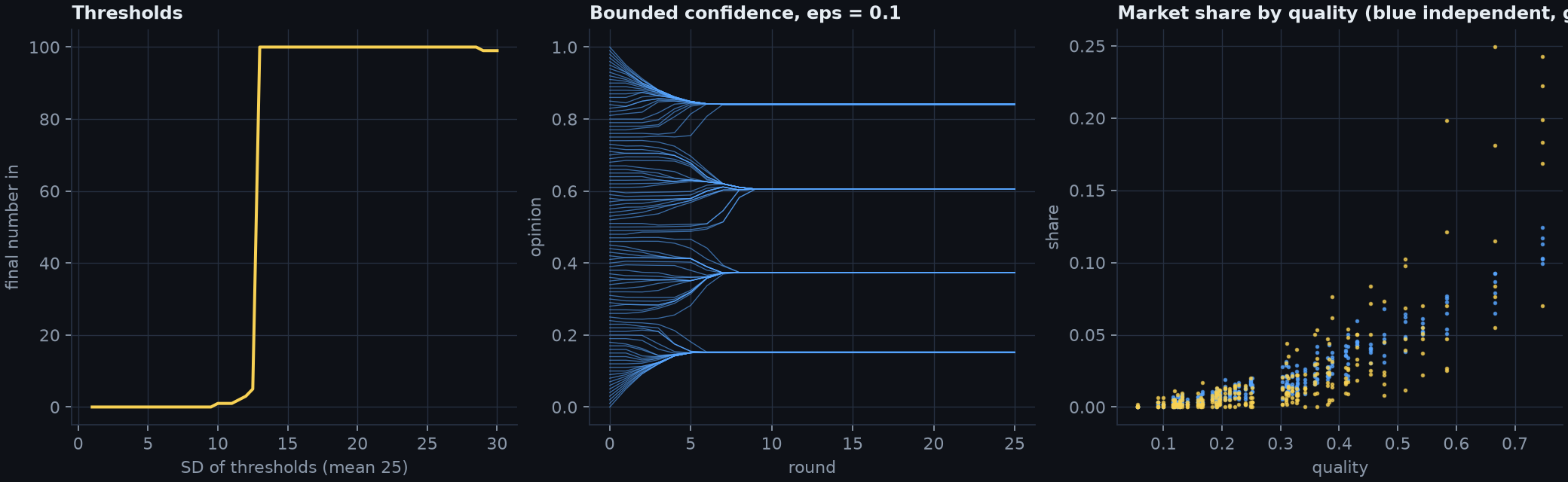
Real crowds aren't arranged one per threshold. So give a crowd of a hundred people thresholds from a bell curve, centred on twenty-five, and widen it a little at a time. When the crowd is uniform, nobody has a low enough threshold to start, so nobody joins. At a spread of about , the outcome jumps from no one to everyone. A smooth change in the people gives a sudden change in what they do together. It's a tipping point, like the ignition of Part 27.
What it does: Granovetter's hundred; change one person; smooth crowds, sudden outcomes
10Opinions on a networkGraduate3 min
The simplest model of influence is just averaging. In 1974 the statistician DeGroot proposed that in each round, everyone replaces their opinion with a weighted average of the opinions of the people they listen to. The thicker the line, the more two people listen to each other. If everyone is connected, they reach one opinion. Here it's , not the plain average of . The consensus counts each person by how much the others listen to them, which is the matrix's left eigenvector. The person in the middle, whom everyone hears, counts for .
But people don't listen to everyone. In 2002 Rainer Hegselmann and Ulrich Krause studied people who average only the opinions within some distance of their own. Sixty people start spread across the range. With narrow confidence, they settle into several camps that never meet again, roughly one over twice the distance of them. With wide confidence, everyone ends in one. Nobody in those camps is stubborn or irrational. Polarization can come from nothing more than who listens to whom.
Opinions are one thing that spreads; behaviours are another. A simple contagion, like a piece of news, needs only one contact to pass. A complex contagion, like a costly new habit, needs reinforcement: here, two neighbours who've already adopted it. On the left, sixty people tied to their nearest neighbours. On the right, the same sixty with the same number of ties, rewired at random. Seed four neighbours with a complex contagion. On the clustered ring it fills, neighbour by neighbour. In the random network the first four never give anyone a second contact, and it stops. In 2010 Damon Centola ran this as an online experiment with fifteen hundred people and an invitation to join a health forum. It spread further and faster in the clustered networks than in the random ones.
How much randomness does it take? Here's a ring of four hundred, with a complex contagion, rewired by different amounts. Rewire one percent of the ties, and the reach falls from everyone to about . A few shortcuts break the wide bridges a complex contagion needs. A simple contagion does the opposite. It reaches all four hundred in steps on the rewired network, and takes on the ring. So the shortcuts that spread news fast can stop a behaviour from spreading at all.
What it does: DeGroot; bounded confidence; simple and complex contagion; how much randomness
11The wisdom and the herdPsych 101 and the major3 min
Crowds can also be wiser than the people in them. In 1907 Francis Galton wrote to Nature about a weight-judging competition at a livestock fair in Plymouth. Visitors paid to guess the weight of an ox once it was slaughtered and dressed, and seven hundred and eighty-seven tickets could be read. The middlemost guess was one thousand two hundred and seven pounds. The ox weighed one thousand one hundred and ninety-eight: the middle guess was less than one percent too high. That's the answer to your fourth number. Galton called it vox populi, the voice of the people. A later look at his notes found small errors in transcription, and that the crowd's mean, about eleven hundred and ninety-six, was closer still.
Why does it work? A hundred and forty-four of Psyche's people each guess a quantity. Every guess is off, and the crowd as a whole leans a little high. Now an identity that's true of any set of numbers. The crowd's squared error equals the average person's squared error, minus the spread of the guesses. So the mean beats the average guesser whenever people disagree. Here it beats of them. But the disagreement has to be independent error. A bias everyone shares stays in the mean, however many people you ask.
Independence is exactly what social influence takes away. In 2011 Lorenz and colleagues asked a hundred and forty-four people to estimate quantities such as border lengths and crime rates, over several rounds, and let some of them see the others' answers in between. Psyche's version: each round, everyone moves forty percent of the way toward the crowd's mean. The guesses close in. Diversity collapses, but the crowd's error doesn't move at all, because the mean was never the problem. It's agreement without accuracy. By round the truth lies outside every guess anyone gives. The crowd now sounds sure of a wrong answer, which is the opposite of wisdom.
Influence doesn't only make crowds agree. It makes outcomes unpredictable. In 2006 Salganik, Dodds and Watts built an online market of forty-eight songs by unknown bands, and fourteen thousand three hundred and forty-one people used it. They were split into separate worlds. In eight, everyone could see how many times each song had been downloaded; in one, nobody could. Here's Psyche's version, run as eight worlds of each kind. With social information, the shares grow more unequal, and the same song lands in very different places from one world to the next. Quality still matters at the ends. The best songs rarely did badly, and the worst rarely did well. In between, early luck decided, and it would decide differently if you ran history again.
What it does: Galton's ox; the diversity identity; influence rounds; a music market
12The LedgerPsych 101 and the major
The tally. What holds: conformity to a unanimous group, less help from each bystander, and loafing in groups. What was never tested in full: Milgram's obedience. Two stories that outran their records: the prison study and the thirty-eight witnesses. And what's argued: audiences, groupthink, norm messages, and influence on crowds. The most famous studies in this part are the weakest; the dull ones held.
What it does: Ten rows and the tally
13In practice: rooms, ratings and reachPractice2 min
Influence can be designed for. Start with the room. Committees, juries and forecasting panels should collect independent judgements before anyone talks. That keeps the diversity that makes a crowd wise, and gets unshared facts onto the table. For speaking up about safety: one dissenter breaks a unanimous majority, and peers who refuse were the strongest brake on obedience Milgram found. So make dissent someone's job. In incident reviews and audits, ask what the situation made easy, not only who went along. And watch who is heard. A group that listens to one central voice amplifies it, right or wrong, so rotate who speaks first.
Next, ratings and reviews. In 2013 Muchnik, Aral and Taylor ran an experiment on a social news site. New comments were randomly given one up-vote, one down-vote, or nothing. A single up-vote raised the chance of the next positive rating by thirty-two percent, and final ratings by about a quarter on average. A down-vote was corrected by later readers. The herding ran one way. So a star rating partly measures how it started. One remedy is to hide early scores, or show them only after people have rated, which is the independent-judgement rule again.
Last, spreading a behaviour. On the day of the 2010 United States congressional elections, Bond and colleagues randomly showed sixty-one million Facebook users messages about voting. Those shown which of their friends had voted were about 0.4 percent more likely to vote. That's small for each person, and about a third of a million votes in all. Close friends carried most of the effect, about four times as much as the message itself. For anything costly, seed clusters of friends rather than scattered celebrities: complex contagion needs reinforcement. And experiments like this, on millions of people, raise their own question: who agreed to take part?
What it does: Designing the room; ratings that herd; spreading a behaviour
14Frontier: influence at scaleResearch2 min
The frontier is measuring influence at scale. The first problem is old. Here are two simulated worlds of four thousand pairs of friends, with the same correlation in what they do. In the first, one friend's adoption causes the other's. In the second, nobody influences anyone: friends share a trait that makes both of them adopt. In 2011 Cosma Shalizi and Andrew Thomas proved that, from observational network data, influence and hidden homophily are generically confounded. Without strong assumptions, they can't be told apart. Which is why the evidence in chapter thirteen came from randomized experiments.
The second problem is new. Much of who hears whom is now chosen by a ranking algorithm. In 2022 Huszár and colleagues used a randomized control group Twitter had kept: nearly two million accounts that saw their feed in reverse chronological order. Against it, the ranking algorithm amplified the mainstream political right more than the left in six of seven countries. Germany was the exception. It did not amplify the far left or far right over moderates. It's the same randomized logic as the music market, run by a platform on its own users. Who listens to whom, the parameter that decided chapter ten's camps, is now partly set by code.
So, open questions. How much of the famous obedience and conformity effects survives procedures that can't be disbelieved? How can influence be separated from homophily outside experiments? Which network structures keep crowds wise, and can platforms be designed for them? When does a norm message change behaviour, and where does it backfire? And who should run experiments on millions of people, and with what consent?
What it does: Contagion or homophily; algorithmic amplification; open questions
Recap, problems, and the road aheadAll tracks4 min
First, your four numbers. Milgram's men who went to four hundred and fifty volts: sixty-five percent, twenty-six of forty. Critical answers that went with the wrong majority in 2023: thirty-three percent. Filmed public fights in which someone stepped in: about nine in ten. And the middle guess of the ox: less than one percent off. The same species that obeys and conforms also steps in, and guesses well together.
Part thirty-four in ten lines. Groups make norms, and people keep them when they're alone again. A unanimous majority sways about a third of answers, and one ally removes most of that. Obedience is a dose-response curve, from none to ninety-two and a half percent, set by the situation. The archives show doubt, coaching and improvised prods behind the famous numbers. The prison study was coached, and the thirty-eight witnesses were a parable. Each bystander helps less, but a crowd still helps more often than not. Audiences inhibit, and groups loaf, polarize and under-share. Persuasion runs through arguments or through cues, and norm messages depend on the place. One person can flip a crowd, and clustered networks spread costly habits. And crowds are wise when they're independent; influence can destroy that, or, in the right network, improve it.
Kant's wager. The first objection, that mathematics can't apply to the mind, met thresholds, averaging, contagion and the diversity identity: crowds written as mathematics. The second, that the mind can't be experimented on, met randomized field experiments on bystanders, ratings and voting, some of them on millions of people. And the third, about introspection. Milgram's own questionnaires, and Perry's reanalysis of them, showed that what people believed about the situation changed what they did. Asking them mattered: a lighter green.
Where this comes back. Reading minds, your own included, is next, in Part 35. Groups against groups are Part 36; cooperation, trust and punishment Part 37; and culture as social learning Part 38. Field experiments and nudges are Part 55, and minds and machines Part 60.
Seven problems, with full solutions in this part's README. One solves Granovetter's cascade. One finds DeGroot's consensus. One proves the diversity identity. One asks whether a crowd of bystanders helps less than one person. One computes the hidden profile's arithmetic. One explains the camps of bounded confidence. And the last, with the star, asks you to design a study that could separate influence from homophily. Pause here if you'd like to try them.
The books and papers behind this part are listed here and in the README. Milgram's book is the study in his own words; Gina Perry's Behind the Shock Machine is what the archives show; and Cialdini's Influence is the field guide.
That begins Act Nine, on other people. This part watched what people do around others. The next asks what they think about each other, and about themselves. Students paid one dollar to tell a lie came to believe it more than students paid twenty. Part 35: social cognition.
Where it goes next. Reading minds, including your own, is Part 35; groups against groups are Part 36; cooperation and punishment are Part 37; culture as social learning is Part 38; field experiments and nudges are Part 55; minds and machines are Part 60.
Key results
The part's results in one place, for revision.
Try it
Lab 34 · Social Influence
Run Granovetter's riot with one threshold changed; watch DeGroot averaging reach consensus and bounded confidence leave camps; spread a simple and a complex contagion on a clustered and a rewired network; check the diversity prediction identity and see influence shrink a crowd's diversity without fixing its error; and build a music market with and without social information.
python -m videos.psychology.labs 34
needs numpy, scipy, matplotlib · download lab34.py ·
source on GitHubriot: thresholds 0, 1, ..., 99; the same with one threshold 1 -> 2 100 join; 1 joins
DeGroot consensus; left-eigenvector average 0.5745; 0.5745
bounded confidence, clusters at eps = 0.05, 0.10, 0.25 8, 4, 1
simple contagion: adopters (steps) on the lattice; rewired 400 (99); 400 (6)
complex contagion: adopters (steps) on the lattice; rewired 400 (198); 4 (0)
crowd: collective error = individual - diversity 677 = 101475 - 100798
influence rounds: diversity first and last; collective error first and last 0.586, 0.0035; 0.131, 0.131
music market, independent vs social: mean Gini; unpredictability 0.53 vs 0.68; 0.0057 vs 0.0147
Outcomes of crowds depend on the whole distribution of people, not on the average person; averaging reaches consensus with weights set by who listens to whom; behaviours that need reinforcement travel through clustered ties; and social information makes crowds more alike, markets more unequal and hits less predictable.The code (81 lines; it asserts its own result)
"""Lab 34: Granovetter's thresholds, DeGroot and bounded-confidence opinions, simple and complex contagion, the wisdom
of crowds under influence, and a cumulative-advantage market."""

import numpy as np

from videos.coursekit import labs
from explainer.psychology.psyche import social as S

TITLE = "Social Influence"
GOAL = ("Run Granovetter's riot with one threshold changed; watch DeGroot averaging reach consensus and bounded "
        "confidence leave camps; spread a simple and a complex contagion on a clustered and a rewired network; check "
        "the diversity prediction identity and see influence shrink a crowd's diversity without fixing its error; and "
        "build a music market with and without social information.")
TASKS = [
    "In the riot, give the instigator's two followers thresholds 0 and 2 instead of 1 and 2. What happens, and what "
    "would an observer who saw only the outcome conclude about the crowd?",
    "Rewire only 5% of the lattice's ties. Does the complex contagion still spread? Find the fraction at which it stops.",
    "In the music market, set social influence to 0.3 and to 0.95. How do inequality and unpredictability move?",
]


def run(seed=0):
    out = labs.Lab()
    t = np.arange(100)
    t2 = t.copy()
    t2[1] = 2
    out.row("riot: thresholds 0, 1, ..., 99; the same with one threshold 1 -> 2",
            f"{S.cascade_size(t)} join; {S.cascade_size(t2)} joins")

    rng = np.random.default_rng(seed)
    W = rng.random((5, 5)) + np.eye(5)
    W /= W.sum(axis=1, keepdims=True)
    x0 = np.array([0.0, 0.2, 0.5, 0.9, 1.0])
    end = S.degroot(W, x0, steps=200)[-1]
    w = S.influence_weights(W)
    out.row("DeGroot consensus; left-eigenvector average", f"{end[0]:.4f}; {w @ x0:.4f}")
    assert np.isclose(end[0], w @ x0)

    x = np.linspace(0, 1, 101)
    out.row("bounded confidence, clusters at eps = 0.05, 0.10, 0.25",
            ", ".join(str(S.clusters(S.bounded_confidence(x, e, 80)[-1], 1e-2)) for e in (0.05, 0.10, 0.25)))

    L = S.ring_lattice(400, 2)
    R = S.rewire(L, 1.0, seed=seed + 1)
    seeds = [0, 1, 2, 3]
    for need, name in ((1, "simple"), (2, "complex")):
        a, b = S.contagion(L, seeds, need), S.contagion(R, seeds, need)
        out.row(f"{name} contagion: adopters (steps) on the lattice; rewired",
                f"{a[-1]} ({len(a) - 1}); {b[-1]} ({len(b) - 1})")

    c = S.crowd(np.random.default_rng(seed + 2).lognormal(np.log(1200), 0.25, 800), 1198)
    out.row("crowd: collective error = individual - diversity",
            f"{c['collective']:.0f} = {c['individual']:.0f} - {c['diversity']:.0f}")
    r = S.influence_rounds(rounds=5, seed=seed)
    out.row("influence rounds: diversity first and last; collective error first and last",
            f"{r['diversity'][0]:.3f}, {r['diversity'][-1]:.4f}; {r['collective'][0]:.3f}, {r['collective'][-1]:.3f}")

    mk = {s: S.music_market(listeners=1500, worlds=6, social=s, seed=seed + 3) for s in (0.0, 0.8)}
    out.row("music market, independent vs social: mean Gini; unpredictability",
            f"{mk[0.0]['gini'].mean():.2f} vs {mk[0.8]['gini'].mean():.2f}; "
            f"{mk[0.0]['unpredictability']:.4f} vs {mk[0.8]['unpredictability']:.4f}")

    out.note = ("Outcomes of crowds depend on the whole distribution of people, not on the average person; averaging "
                "reaches consensus with weights set by who listens to whom; behaviours that need reinforcement travel "
                "through clustered ties; and social information makes crowds more alike, markets more unequal and "
                "hits less predictable.")

    fig, ax = labs.figure(3, size=(13, 4.0))
    cc = S.cascade_curve()
    ax[0].plot(cc["sd"], cc["size"], color=labs.GOLD)
    ax[0].set(title="Thresholds", xlabel="SD of thresholds (mean 25)", ylabel="final number in")
    path = S.bounded_confidence(x, 0.1, 25)
    ax[1].plot(path, color=labs.BLUE, lw=0.6, alpha=0.6)
    ax[1].set(title="Bounded confidence, eps = 0.1", xlabel="round", ylabel="opinion")
    for s, col in ((0.0, labs.BLUE), (0.8, labs.GOLD)):
        q = mk[s]["quality"]
        o = np.argsort(q)
        ax[2].plot(q[o], mk[s]["shares"][:, o].T, ".", color=col, ms=3, alpha=0.7)
    ax[2].set(title="Market share by quality (blue independent, gold social)", xlabel="quality", ylabel="share")
    out.fig = fig
    return out
Now change it
- In the riot, give the instigator's two followers thresholds 0 and 2 instead of 1 and 2. What happens, and what would an observer who saw only the outcome conclude about the crowd?
- Rewire only 5% of the lattice's ties. Does the complex contagion still spread? Find the fraction at which it stops.
- In the music market, set social influence to 0.3 and to 0.95. How do inequality and unpredictability move?
Problems, with solutions
Try each problem before opening its solution.
-
Granovetter's cascade. A crowd of \(n\) has thresholds \(0, 1, \dots, n - 1\). Show that everyone joins, and that raising one threshold from 1 to 2 stops the cascade at one person. In general, show the cascade ends at the first \(k\) with \(F(k) = k\), where \(F(k)\) counts thresholds \(\le k\).
Solution
Let F(k) be the number of thresholds at most k. Starting from 0, the number in after each step is F of the number before, so the process climbs to the first fixed point k* with F(k*) = k*. For thresholds 0, ..., n − 1, F(k) = k + 1 for every k < n, so there is no fixed point below n and all n join. Raise the threshold of 1 to 2: F(0) = 1, F(1) = 1, a fixed point, and the cascade stops at one person.
-
DeGroot's consensus. In DeGroot's model \(x_{t+1} = W x_t\) with \(W\) row-stochastic and primitive. Show that everyone converges to \(\pi^{\top} x_0\), where \(\pi^{\top} W = \pi^{\top}\), and that a doubly stochastic \(W\) gives the plain mean.
Solution
If W is row-stochastic and primitive, Perron-Frobenius gives W^t → 1π^⊤, with π the unique left eigenvector for eigenvalue 1 normalized to sum to 1. So x_t = W^t x_0 → (π^⊤x_0)1. If W is doubly stochastic, 1^⊤W = 1^⊤, so π = 1/n and the consensus is the plain mean.
-
The diversity identity. Prove the diversity prediction identity: \((\bar x - \theta)^2 = \overline{(x_i - \theta)^2} - \overline{(x_i - \bar x)^2}\).
Solution
Write x_i − θ = (x_i − x̄) + (x̄ − θ); square and average. The cross term averages to (x̄ − θ) times the average of (x_i − x̄), which is zero, so the average squared error is the diversity plus (x̄ − θ)².
-
Bystanders. Each of \(N\) bystanders helps with probability \(p/N\). Show that the chance someone helps tends to \(1 - e^{-p}\), and compare it with one person alone.
Solution
With p_N = p/N, the chance that nobody helps is (1 − p/N)^N → e^{−p}, so someone helps with probability tending to 1 − e^{−p}. For p = 0.85 that is 0.57, against 0.85 for one person alone: much less help from each, somewhat less from the crowd.
-
The hidden profile. In a group of four, each member mentions what they know with probability 0.3. Compare the chance that a fact known to all four comes up with one known to only one member.
Solution
A fact known to all four comes up with chance 1 − 0.7⁴ = 0.76; a fact known to one, with chance 0.3. Shared facts are 2.5 times as likely to be discussed by arithmetic alone.
-
Bounded confidence. In bounded confidence, show that the order of opinions never changes, and explain why roughly \(1/(2\varepsilon)\) camps remain from opinions spread evenly on \([0, 1]\).
Solution
If x_i ≤ x_j, every opinion within ε of x_i but not of x_j lies below the shared window, and every one within ε of x_j but not x_i lies above it, so the mean of i's window is at most the mean of j's: order is preserved. Opinions within 2ε of one another draw together until camps sit more than ε apart, so an even spread on [0, 1] ends with roughly one camp per 2ε.
-
★ Separating influence from homophily. Design a study that could separate social influence from homophily in a network of friends, and say what each part of your design rules out.
Solution
Randomize the treatment of one friend (for example, an invitation, a message or a product) and measure the other's behaviour: randomization breaks the link to any shared hidden trait. Without an experiment, use variation the friends do not choose (a plausibly random exposure), compare with sham ties (pairs who are not friends but are matched on observables), and test for "influence" on behaviour that could not have spread (a placebo outcome). Each check removes one route by which homophily can imitate contagion.
Notes and sources
Sources
- M. Sherif, A study of some social factors in perception, Archives of Psychology (1935); R. C. Jacobs and D. T. Campbell, The perpetuation of an arbitrary tradition through several generations of a laboratory microculture, Journal of Abnormal and Social Psychology (1961).
- S. E. Asch, Opinions and social pressure, Scientific American 193(5) (1955) 31-35; Studies of independence and conformity: I. A minority of one against a unanimous majority, Psychological Monographs 70(9) (1956).
- R. Bond and P. B. Smith, Culture and conformity, Psychological Bulletin (1996); A. Franzen and S. Mader, The power of social influence: a replication and extension of the Asch experiment, PLOS ONE 18 (2023) e0294325.
- S. Milgram, Behavioral study of obedience, Journal of Abnormal and Social Psychology 67 (1963) 371-378; Obedience to Authority (1974).
- J. M. Burger, Replicating Milgram: would people still obey today?, American Psychologist 64 (2009).
- N. Haslam, S. Loughnan and G. Perry, Meta-Milgram: an empirical synthesis of the obedience experiments, PLOS ONE 9 (2014) e93927.
- G. Perry, Behind the Shock Machine (2012); G. Perry, A. Brannigan, R. A. Wanner and H. Stam, Credibility and incredulity in Milgram's obedience experiments, Social Psychology Quarterly 83 (2020) 88-106.
- S. A. Haslam and S. D. Reicher, Contesting the "nature" of conformity, PLoS Biology 10(11) (2012) e1001426; S. A. Haslam, S. D. Reicher and K. Millard, Shock treatment, PLOS ONE (2015).
- T. Le Texier, Debunking the Stanford Prison Experiment, American Psychologist 74 (2019) 823-839; S. Reicher and S. A. Haslam, Rethinking the psychology of tyranny: the BBC prison study, British Journal of Social Psychology 45 (2006) 1-40.
- M. Gansberg, 37 who saw murder didn't call the police, The New York Times (27 March 1964); R. Manning, M. Levine and A. Collins, The Kitty Genovese murder and the social psychology of helping, American Psychologist 62 (2007) 555-562.
- J. M. Darley and B. Latané, Bystander intervention in emergencies, JPSP 8 (1968) 377-383; B. Latané and J. M. Darley, Group inhibition of bystander intervention in emergencies, JPSP 10 (1968) 215-221.
- P. Fischer et al., The bystander-effect, Psychological Bulletin 137 (2011) 517-537; R. Philpot, L. S. Liebst, M. Levine, W. Bernasco and M. R. Lindegaard, Would I be helped?, American Psychologist 75 (2020) 66-75.
- N. Triplett, The dynamogenic factors in pacemaking and competition, American Journal of Psychology (1898); W. Stroebe, The truth about Triplett (1898), but nobody seems to care, Perspectives on Psychological Science 7 (2012) 54-57.
- R. B. Zajonc, Social facilitation, Science (1965); R. B. Zajonc, A. Heingartner and E. M. Herman (1969); E. Halfmann, J. Bredehöft and J. A. Häusser, Replicating roaches, Psychological Science 31 (2020) 332-337.
- B. Latané, K. Williams and S. Harkins, Many hands make light the work (1979); S. J. Karau and K. D. Williams, Social loafing: a meta-analytic review (1993).
- J. A. F. Stoner, MIT master's thesis (1961); S. Moscovici and M. Zavalloni, The group as a polarizer of attitudes (1969); S. Moscovici, E. Lage and M. Naffrechoux, Influence of a consistent minority (1969).
- I. L. Janis, Victims of Groupthink (1972); S. R. Fuller and R. J. Aldag, Organizational Tonypandy, Organizational Behavior and Human Decision Processes 73 (1998) 163-184; R. S. Baron (2005).
- G. Stasser and W. Titus, Pooling of unshared information in group decision making, JPSP 48 (1985) 1467-1478.
- C. I. Hovland and W. Weiss, The influence of source credibility on communication effectiveness, Public Opinion Quarterly (1951); C. I. Hovland, I. L. Janis and H. H. Kelley, Communication and Persuasion (1953); G. T. Kumkale and D. Albarracín, The sleeper effect in persuasion: a meta-analytic review (2004).
- R. E. Petty, J. T. Cacioppo and R. Goldman, Personal involvement as a determinant of argument-based persuasion, JPSP 41 (1981) 847-855; R. B. Cialdini, Influence (1984).
- N. J. Goldstein, R. B. Cialdini and V. Griskevicius, A room with a viewpoint, Journal of Consumer Research 35 (2008) 472-482; G. Bohner and L. E. Schlüter, A room with a viewpoint revisited, PLOS ONE 9 (2014) e104086.
- M. Granovetter, Threshold models of collective behavior, American Journal of Sociology 83 (1978) 1420-1443; M. H. DeGroot, Reaching a consensus (1974); R. Hegselmann and U. Krause, Opinion dynamics and bounded confidence, JASSS 5(3) (2002); D. Centola, The spread of behavior in an online social network experiment, Science 329 (2010).
- F. Galton, Vox populi, Nature (7 March 1907); K. F. Wallis, Revisiting Francis Galton's forecasting competition, Statistical Science (2014); J. Lorenz, H. Rauhut, F. Schweitzer and D. Helbing, How social influence can undermine the wisdom of crowd effect, PNAS 108 (2011) 9020-9025; J. Becker, D. Brackbill and D. Centola, PNAS 114 (2017) E5070-E5076.
- M. J. Salganik, P. S. Dodds and D. J. Watts, Experimental study of inequality and unpredictability in an artificial cultural market, Science 311 (2006) 854-856.
- L. Muchnik, S. Aral and S. J. Taylor, Social influence bias: a randomized experiment, Science 341 (2013) 647-651; R. M. Bond et al., A 61-million-person experiment in social influence and political mobilization, Nature (2012).
- C. R. Shalizi and A. C. Thomas, Homophily and contagion are generically confounded in observational social network studies, Sociological Methods & Research 40 (2011) 211-239; F. Huszár et al., Algorithmic amplification of politics on Twitter, PNAS (2022).
About this partfrom its README
In the summer of 1961, in the basement of Linsly-Chittenden Hall at Yale, an experimenter in a grey coat told men who had answered a newspaper ad to give another man electric shocks, fifteen volts stronger for every mistake. Twenty-six of the first forty went to the last switch. Milgram's study, Asch's lines and Zimbardo's prison became the public face of psychology. This part tells each as it was run, as it was retold and as the record now shows it, and then builds the mathematics of influence that the famous studies never had.
The shock generator as a trial strip and the psychiatrists' prediction; Sherif's moving light and Jacobs and Campbell's decaying traditions; Asch's lines, his 36.8%, the quarter who never went along and the one ally, then Bond and Smith's 133 studies and a 2023 replication at 33%; the viewer predicts four numbers and can take Asch's task; Milgram's variations as a dose-response curve, Haslam, Loughnan and Perry's synthesis of 21 conditions at 43.6%, Burger's partial replication, Perry's archives and the engaged-followership reading; the Stanford prison experiment against Le Texier's archives and the BBC prison study; the 38 witnesses as a parable, Darley and Latané's intercom and smoke, an algebra of diffusion, Fischer et al.'s meta-analysis and Philpot et al.'s cameras; Triplett's reels, Zajonc's drive and the cockroaches twice, and social loafing; polarization, groupthink and its evidence, a consistent minority and the hidden profile; Hovland's programme, the sleeper effect, the two routes of persuasion, Cialdini's principles and the hotel towels twice. Then Psyche computes Granovetter's thresholds, DeGroot's consensus, bounded confidence, simple and complex contagion on rewired rings, Galton's ox and the diversity identity, rounds of influence on a guessing crowd, and a music market. The practice chapter is rooms, ratings and reach; the frontier is contagion against homophily, algorithmic amplification and open questions.
What is computed and built
explainer/psychology/psyche/social.py(committed ahead of the part): Granovetter's thresholds; DeGroot averaging and influence weights; Hegselmann-Krause bounded confidence; ring lattices, degree-preserving rewiring and threshold contagion; the diversity prediction identity and rounds of influence; a cumulative-advantage market with Gini and unpredictability; bystanders, social impact, drive and information sampling; and, for Part 35, an inverse planner, Kelley's cube and the Dunning-Kruger plot from noise. Tested intests/psychology/test_social.py.- The Ledger gains ten rows.
- The course's interactive is Asch's lines: twelve trials alone, then twelve with five scripted answers shown before yours, eight of them unanimous and wrong; it reports your errors in each condition.
Chapter notes
| # | Chapter | What it does |
|---|---|---|
| 0 | 1961: the shock generator | The basement; the trial strip and the prods; prediction against result; the question; objectives |
| 1 | Norms and lines | Sherif's light; Asch's lines; what happened; seventy years later |
| 2 | On you: four numbers | Four predictions; Asch's task on you |
| 3 | Obedience | The variations as a curve; all the conditions at once; Burger; the archives; engaged followership |
| 4 | The prison that wasn't | The textbook version; Le Texier's record; the BBC prison study |
| 5 | Bystanders | The 38 witnesses; the intercom and the smoke; the algebra of diffusion; what cameras show |
| 6 | The presence of others | Triplett; Zajonc's drive; the cockroaches twice; social loafing |
| 7 | Groups deciding | Polarization; groupthink and its evidence; a consistent minority; the hidden profile |
| 8 | Persuasion | The Yale programme and the sleeper effect; two routes; six principles; the hotel towels twice |
| 9 | Thresholds | Granovetter's hundred; change one person; smooth crowds, sudden outcomes |
| 10 | Opinions on a network | DeGroot; bounded confidence; simple and complex contagion; how much randomness |
| 11 | The wisdom and the herd | Galton's ox; the diversity identity; influence rounds; a music market |
| 12 | The Ledger | Ten rows and the tally |
| 13 | In practice: rooms, ratings and reach | Designing the room; ratings that herd; spreading a behaviour |
| 14 | Frontier: influence at scale | Contagion or homophily; algorithmic amplification; open questions |
| Recap, problems, and the road ahead | Your numbers; ten lines; Kant's three objections; payoffs; problems; references; Part 35 |
NotesWhere the numbers come from
| What | Source |
|---|---|
| Sherif's design: three people's estimates, alone, together and alone again (an illustration of the design, not his data) | Psyche (simulated), item sherif |
| Granovetter's crowd: thresholds 0 to 99 give 100 rioters; raising one threshold from 1 to 2 gives 1; thresholds drawn as normal quantiles with mean 25 jump from none to everyone at an SD of about 13 | Psyche (social.cascade, cascade_curve), item riot |
| DeGroot: five people, consensus 0.569 against a plain mean of 0.53; the middle person's weight 0.31 | Psyche (social.degroot, influence_weights), item degroot |
| Bounded confidence: 60 opinions; 7, 4 and 1 camps at eps 0.05, 0.12 and 0.30 | Psyche (social.bounded_confidence), item camps |
| Contagion on rings of 400 (degree 4): simple contagion reaches all in 99 steps on the ring and 6 on the rewired network; complex contagion fills the ring in 198 steps and stalls at its 4 seeds when rewired; rewiring 1% of ties cuts complex reach to 13% (mean of 8 rewirings) | Psyche (social.ring_lattice, rewire, contagion), item contagion |
| A guessing crowd of 144 (log scale): collective error 0.073 = average error 0.577 - diversity 0.504; the mean beats 72% of guessers; moving 40% toward the mean each round, diversity falls from 0.50 to 0.003 while the collective error stays at 0.073, and by round 4 the truth is outside every guess | Psyche (social.crowd, influence_rounds), item crowd |
| A music market, 48 songs, 2,700 listeners, 8 worlds of each kind: mean Gini 0.52 independent, 0.68 social; unpredictability 0.0045 against 0.0119 | Psyche (social.music_market), item market |
| Bystanders: one person helps with chance 0.85; with each helping as 0.85 N^-1, the chance anyone helps is 0.85, 0.67, 0.61, 0.59 and 0.58 for 1, 2, 5, 10 and 20 | Psyche (social.bystanders), item bystanders |
| Drive on an easy and a hard task; the information-sampling curve 1 - 0.7^k | Psyche (social.drive, mentions), item impact |
| Two worlds of 4,000 friend pairs with correlations 0.35 (influence) and 0.37 (a shared hidden trait) | Psyche (simulated), item twins |
| Every published number on screen | the studies listed under Sources, quoted as reported |
Notes
| Finding | Original | Status |
|---|---|---|
| People often give an answer they can see is wrong when a unanimous group gives it first | Asch 1956 | replicated, smaller |
| Most ordinary people will give apparently dangerous shocks to another person when an experimenter tells them to | Milgram 1963 | not directly tested |
| Randomly assigned to be guards, ordinary students spontaneously became abusive: a role takes over the person | Zimbardo and colleagues 1971 | story and record |
| Thirty-eight neighbours watched Kitty Genovese's murder and none called the police | Gansberg (The New York Times) 1964 | story and record |
| The more bystanders there are, the less likely each one is to help | Darley and Latané 1968 | replicated |
| The presence of others improves performance on simple tasks and impairs it on complex ones | Zajonc, Heingartner and Herman 1969 | contested |
| People exert less effort on a collective task than when working alone | Latané, Williams and Harkins 1979 | replicated |
| Cohesive, insulated groups under directive leaders seek consensus and make defective decisions | Janis 1972 | contested |
| Telling guests that most guests reuse their towels increases towel reuse more than an environmental appeal | Goldstein, Cialdini and Griskevicius 2008 | contested |
| Seeing others' estimates reduces a crowd's diversity without making it more accurate | Lorenz, Rauhut, Schweitzer and Helbing 2011 | contested |
Shown without a row, with the reason recorded in explainer/psychology/ledger.py: Sherif and Jacobs and Campbell,
Milgram's variations, Haslam and Reicher's readings, Triplett and Stroebe, Stoner and Moscovici and Zavalloni,
Moscovici, Lage and Naffrechoux, Stasser and Titus, Hovland's programme, Petty, Cacioppo and Goldman, Cialdini's
principles, Granovetter, DeGroot, Hegselmann and Krause, Centola, Galton, Salganik, Dodds and Watts, Muchnik, Aral
and Taylor, Bond et al., Shalizi and Thomas, and Huszár et al.
Notes
Checked against the articles, their abstracts or official pages, or named secondary summaries of them (2026-11-16): Asch's 18 trials, 12 critical, 123 men, 36.8%, the quarter who never conformed and the single ally; Bond and Smith's 133 studies in 17 countries; Franzen and Mader's 210 students, 33%, 25% and 38%; Linsly-Chittenden Hall, the ads and 26 of 40, defiance from 300 volts and the wall-pounding at 300 and 315; the four prods; the psychiatrists' prediction; the variations (30%, 20.5%, 47.5%, 10%) and the range 0% to 92.5%; Haslam, Loughnan and Perry's 23 conditions, 780 people, 21 conditions, 740 people and 43.6%; Burger's 70 adults, 70% against 82.5% and the 79%; Perry's archives, the 656 questionnaires and the improvised prods; Haslam, Reicher and Millard's restaging; the prison study's 24 students, six days of fourteen and the coin-flip assignment; Le Texier's archives and 15 interviews; the BBC prison study's eight days and its result; the Times headline and date and the dozen witnesses; Darley and Latané's 85%, 62% and 31%; the smoke study's 75%, 38% and 10%; Fischer et al.'s 105 effects and g = -0.35; Philpot et al.'s 219 conflicts in three countries and nine in ten; Stroebe on Triplett; the cockroach replication; the shouting study's 82% and 74%; Karau and Williams's 78 studies; Stoner, and Moscovici and Zavalloni's French students; Moscovici, Lage and Naffrechoux's design and about 8%; the groupthink reviews; Stasser and Titus; Hovland and Weiss and the sleeper effect's meta-analysis; Petty, Cacioppo and Goldman's design; the hotel towels' 1,058 chances, 44.1% and 35.1%, and Bohner and Schlüter's two hotels; Granovetter's example; Hegselmann and Krause; Centola's 1,528 people and health forum; Galton's 787 tickets, 1,207 and 1,198, and Wallis's reanalysis; Lorenz et al.'s 144 people; Salganik et al.'s 14,341 people and 48 songs; Muchnik et al.'s 32% and 25%; Bond et al.'s 61 million and 0.39%; Shalizi and Thomas; Huszár et al.'s six of seven countries.
Still to recheck against the full texts before the final cut:
- Asch's control condition: "almost nobody erred" is drawn as a bar of about 1%, from secondary summaries.
- The exact size of the one-ally effect ("about a quarter") and the majority-size curve, which secondary sources report differently; the film describes both qualitatively.
- Moscovici, Lage and Naffrechoux's inconsistent-condition figure, drawn as about 1%.
- Latané, Williams and Harkins's 82% and 74%, from secondary summaries.
- The Times's 2016 description of its own reporting as flawed, from secondary reports.
- The Princeton MusicLab data are behind a browser challenge, so the market chapter is simulated; the real worlds' shares would replace it if the data can be fetched by a plain request.
Companion material in this repository
The syllabus's plan for this partfrom SYLLABUS.md, the plan of record
- Hook: the shock generator. The procedure as a trial strip.
- Sherif's moving light (1935): norms form and persist. Asch's lines (1951): what happened (about a third of critical trials conformed; a quarter of participants never did), and one ally cuts it sharply.
- On you: Asch's lines with five recorded answers before yours.
- Milgram: 65% at the baseline; the variations as a dose–response curve (proximity, legitimacy, peers who refuse); the partial replication of 2009; the archives (prods, disbelief, coaching) and the "engaged followership" reading.
- The Stanford prison experiment (1971): the textbook version; the recordings of guards being instructed; the BBC Prison Study's different result.
- Bystanders: the murder of Kitty Genovese and the thirty-eight witnesses who were not; Darley and Latané's smoke-filled room; diffusion of responsibility; real street-camera footage showing intervention in nine of ten conflicts (2020).
- The presence of others: Triplett's reels (1898), Zajonc's drive theory and the cockroaches; social loafing.
- Groups deciding: polarization, groupthink (and its thin evidence), minority influence.
- Persuasion: the Yale programme; central and peripheral routes; Cialdini's principles and what field experiments find (Part 55).
- Thresholds: Granovetter's riot model (1978). Two crowds, one person different, opposite outcomes (computed).
- Opinion dynamics: DeGroot averaging and consensus; bounded confidence and polarization; simple against complex contagion (Centola 2010).
- The wisdom of crowds: Galton's ox (1907), the error decomposition, and how social influence destroys it (Lorenz et al. 2011); the Music Lab's unpredictable hits (2006).
Psyche: social: threshold cascades; DeGroot and bounded-confidence dynamics on networks; a crowd-estimation
model with and without influence; a cumulative-advantage market.
On you: the Asch lines; estimate a quantity before and after seeing others' guesses.
Ledger: Asch conformity (replicated; smaller in later and individualist samples); Milgram obedience (not directly tested in full; replicated in milder forms; interpretation contested); the Stanford prison
experiment (story and record: not an experiment and coached); the Genovese account (story and record); the
bystander effect (replicated, reversed in dangerous emergencies); groupthink (contested).
In practice: compliance and safety culture, jury and committee design, online review and rating systems,
viral marketing.
Frontier: influence measured in networks of millions; identifying contagion apart from homophily; algorithmic
amplification.
Reading: Asch 1956; Milgram 1974; Perry, Behind the Shock Machine; Haslam & Reicher 2012; Le Texier 2019;
Darley & Latané 1968; Manning, Levine & Collins 2007; Philpot et al. 2020; Granovetter 1978; DeGroot 1974; Lorenz
et al. 2011; Salganik, Dodds & Watts 2006.
Build the film
python -m videos.psychology.psych34.compute        # the part's numbers, into .cache/psych34
python tools/build.py psych34                  # render and assemble the film
EXPLAINER_TTS=silent python tools/qa_scene.py psych34 Hook   # one chapter, silent, with a contact sheet
Scenes: videos/psychology/psych34. Setup: see the course page. Source of these notes: the README and the scenes' narration.
Build it
python -m videos.psychology.psych34.compute            # every number (a few seconds)
python tools/qa_scene.py psych34 Thresholds            # one chapter, silent, at 480p, with a contact sheet
EXPLAINER_TTS=silent python tools/build.py psych34 -q l   # the whole part, silent preview
python tools/build.py psych34                          # 1080p30 with narration
python tools/qa_scene.py psych34 Norms --lang zh       # the Chinese edition of one chapter
python tools/make.py psych34                           # both editions, with the checks a long build needs
python -m videos.psychology.labs 34                    # the lab: thresholds, opinions, contagion, crowds, markets
python tools/check_ledger.py psych34                   # every study shown has its Ledger row, or a reason
python -m pytest tests/psychology                      # Psyche's social module, the Ledger, the Archive
The Chinese edition is zh_lines.py (the narration, line by line) and the series table
videos/psychology/psychology_text_zh.json (the text on screen); the terms are in
PSYCHOLOGY_ZH_GUIDE.md.