People at Work
How well can anyone predict who will be good at a job?
The Hawthorne lighting studies became the founding story of work psychology, though their data barely show the effect. The useful history is a correlation: how well a hiring method predicts later performance. The part simulates 200,000 applicants to show how selection and unreliable ratings hide validity and how corrections restore it or overshoot, sets Schmidt and Hunter's 1998 summary beside Sackett and colleagues' 2022 revision, models why unstructured interviews feel informative, turns validity into money with Taylor-Russell tables and the Brogden-Cronbach-Gleser formula, computes adverse impact and the validity-diversity frontier, and ends with goals, incentives, crowding out, teams and a randomized trial of working from home.
What you need. Part 3's reliability, Part 32's ability testing and Part 28's motivation; correlation, the normal distribution and a little algebra.
- Hook
- the Hawthorne plant
- Ideas, models and mathematics
- selection and validity, range restriction, utility analysis, adverse impact and the trade-off frontier, interviews, performance ratings, motivation and incentives, teams, remote work, hiring algorithms
- Psyche gains
- a selection simulator
- On you
- interview or test: who gets hired?
What you will be able to do
Psych 101 and the major
- Explain why a test can look weak among the people it selected, and why structured interviews beat unstructured ones.
- Apply the four-fifths rule and say what it does and does not establish.
Graduate
- Correct an observed validity for criterion unreliability and range restriction, in order, and show how a wrong correction overshoots.
- Compute Taylor-Russell success rates and Brogden-Cronbach-Gleser utility.
Research
- Evaluate the 2022 revision of selection validities and design a study that would settle it.
Practice
- Design a selection system with its utility, adverse-impact analysis and validation plan.
- Audit an algorithmic hiring tool for validity and impact.
Contents
Each chapter has a home level. Choose a track to see what to read and watch: Psych 101 and the major 19 min · Graduate 29 min · Research 30 min · Practice 26 min.
- 0The lights at HawthornePsych 101 and the major2 min
- 1On you: two candidates, and four numbersPsych 101 and the major1 min
- 2Testing a nationPsych 101 and the major1 min
- 3Validity and the criterionPsych 101 and the major1 min
- 4Why observed validities misleadGraduate1 min
- 5A century of evidence, revisedGraduate1 min
- 6The interviewPsych 101 and the major2 min
- 7From a correlation to moneyPractice2 min
- 8FairnessPractice2 min
- 9Algorithms in hiringPractice1 min
- 10GoalsPsych 101 and the major2 min
- 11Pay, and what money crowds outPsych 101 and the major1 min
- 12Satisfaction, teams and where people workPsych 101 and the major4 min
- 13The LedgerGraduate1 min
- 14In practice: a selection system, designedPractice2 min
- 15Frontier: new assessments, old questionsResearch1 min
- Recap, problems, and the road aheadAll tracks3 min
Also on this page: Lecture · Key results · Try it · Lab · Problems · Notes and sources · Build the film.
Lecture
The text of each chapter is the film's narration, as it is spoken, so you can read along or revise without the film. The pictures are in the film.
The lights at HawthornePsych 101 and the major2 min
Every course on psychology at work begins with the same story. From 1924 to 1927, at Western Electric's Hawthorne Works near Chicago, engineers varied the lighting in the rooms where workers assembled telephone parts. As the story goes, when they raised the light, output rose, and when they lowered it, output rose again. The moral drawn: workers respond to being watched and cared about, not to the conditions. Later studies at the plant, written up by Fritz Roethlisberger and William Dickson in 1939, made it the founding tale of human relations at work. And the Hawthorne effect entered every methods textbook, Part 2's included.
What do the data actually show? The illumination studies were never properly published, and their data were thought lost. In 2011 the economists Steven Levitt and John List found the original output records and analysed them. Output did rise in the experimental periods, but it also rose with the season, and the lighting changes always fell on a Monday, after the weekend. The evidence of a Hawthorne effect in the data was slight. The famous rise and rise again is mostly the retelling. The real history of work psychology is less romantic and more useful. It's about numbers that predict.
So this part asks: how well can anyone predict who will be good at a job? Validity: correlations between a method and later performance, and why they mislead. A century of evidence, and its revision in 2022. Money, fairness and algorithms. And goals, pay, teams, and where people work.
This is Part 53 of Psychology, Built: people at work. We'll define validity, and meet the problem of measuring job performance at all. We'll see how unreliability and range restriction hide validity, and how corrections can overshoot. We'll ask which hiring methods predict, after the revision of 2022. We'll turn a correlation into money. We'll compute adverse impact and the frontier between validity and diversity. And we'll look at goals, incentives, what money crowds out, teams, and working from home.
What it does: The story; the data, found again; the question; objectives
1On you: two candidates, and four numbersPsych 101 and the major1 min
Whom would you hire?
First, a choice. Two candidates. A has the much better test score and a polite, rather flat interview. B has the much lower score and a warm, confident, memorable interview. Whom do you hire? Most people lean towards B. The interview felt like evidence. In Psyche's world, with the validities this part will defend, A performed better in fifty-seven percent of a thousand such pairs. Not a sure thing. Even the better predictor leaves most of performance unexplained. That's the honest size of this part's numbers.
Now four numbers. One: a test that truly correlates zero point five with job performance. Among the people already hired with it, what correlation will you observe? Two: in the 2022 review of hiring methods, which single method came out best, and how valid was it? Three: you hire the top fifth on a test of validity zero point three, where half of all applicants would succeed. What share of your hires succeed? And four: a daycare centre starts fining parents who pick up their children late. What happens to late pick-ups? Pause here, and write them down.
What it does: The hiring choice; four predictions
2Testing a nationPsych 101 and the major1 min
Where did psychology at work begin?
Psychology at work began before the tests. Frederick Taylor's scientific management timed each motion, looked for the one best way, and paid by the piece. In 1913 Hugo Munsterberg applied laboratory psychology to work, with tests for tram drivers and telephone operators. Frank and Lillian Gilbreth studied motions, and Lillian Gilbreth attended to fatigue and to the worker. But none of them could yet say how well a test predicted who would do the job well.
Then came a war. It's Part 32's story. When the United States entered the First World War, Robert Yerkes's committee built group tests: Alpha for recruits who read English, and Beta for those who didn't. About one and three quarter million recruits were tested, the first mass testing. The tests sorted men into roles and officer training. Their later use to rank national groups was bad science and worse policy. After the war, testing moved into industry, and personnel psychology began asking this part's question with correlations.
What it does: Taylor, Münsterberg and the Gilbreths; the Army tests of 1917
3Validity and the criterionPsych 101 and the major1 min
What does it mean for a test to predict a job? Criterion-related validity is the correlation between a predictor, a test or an interview, and a criterion, usually later performance. Here are Psyche's applicants. The test's true validity is zero point five, and with a supervisor's rating as the criterion, the observed correlation is about zero point three nine. A correlation of zero point five is large for psychology, and still a wide cloud. Many high scorers do poorly, and the reverse. Predictive designs test applicants and wait. Concurrent designs test current staff, which is cheaper, and has consequences for the corrections of chapter four.
And then there's the criterion problem. What is performance? Output, quality, helping colleagues, not causing harm. Researchers distinguish task performance, contextual performance, and counterproductive behaviour. Who rates it? Usually one supervisor, once a year. In Steven Scullen, Michael Mount and Maynard Goff's analysis of multi-rater feedback, more of the variance in ratings belonged to the rater than to the person being rated. And two supervisors rating the same people agree at about zero point five. That's Part 3's attenuation, built into every validity.
What it does: A predictor and a criterion; the criterion problem
4Why observed validities misleadGraduate1 min
Why does a good test look weak among the hired?
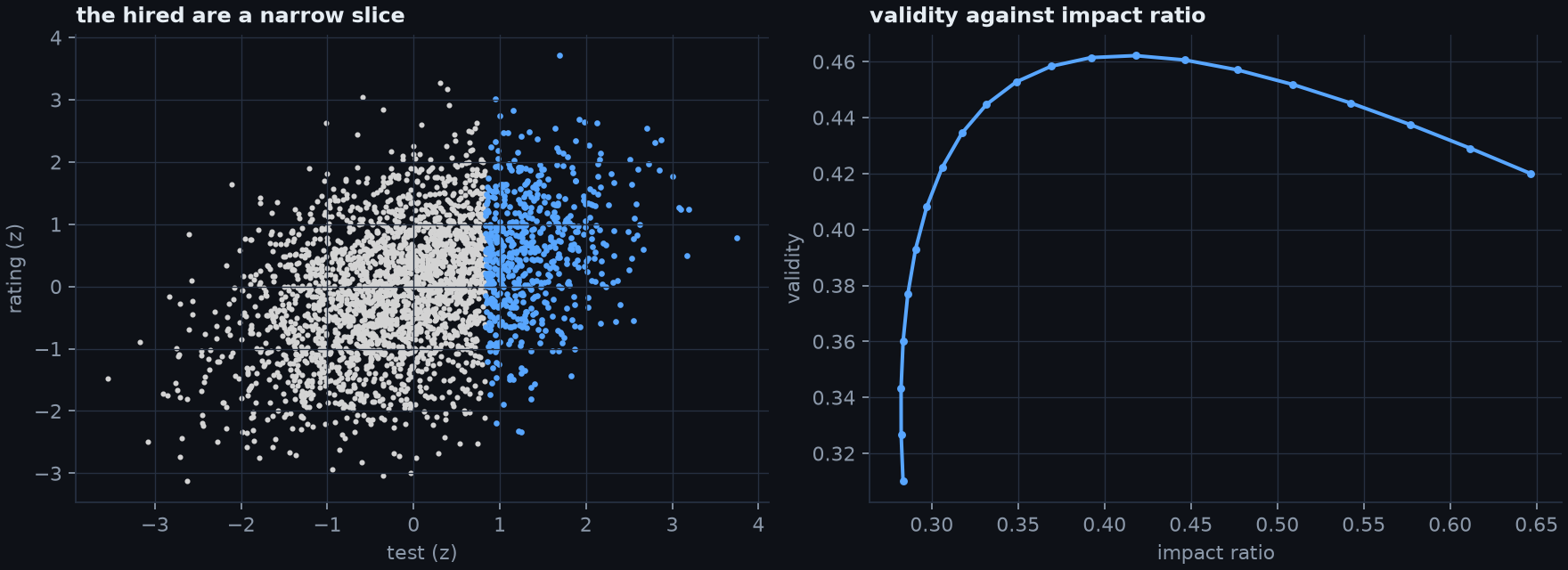
Why does a good test look weak among the people it hired? A company hires the top fifth on the test, and observes performance only for them. Within the hired, the test's spread is less than half the applicants', and the observed correlation falls to zero point one nine. The test still works. The hired are better on average. But the correlation inside that narrow slice can't show it. So the more selective the company, the weaker its own test looks. That's one reason good tests get dropped.
Two corrections, applied in order, can undo the damage. First, criterion unreliability: divide by the square root of the rating's reliability among the incumbents. That gives zero point two five. Then range restriction. Thorndike's Case Two formula, using the ratio of the applicants' spread to the hires', gives zero point four nine. The truth among applicants was zero point five. Done right, the corrections recover it. But done with the wrong ratio, or the wrong reliability, they can overshoot just as far. That's the next chapter's story.
What it does: Range restriction; two corrections, in order
5A century of evidence, revisedGraduate1 min
Which hiring methods predict, and how well? In 1998 Frank Schmidt and John Hunter summarized eighty-five years of studies. Ability tests and work samples came out near zero point five. In 2022 Paul Sackett and colleagues redid the range-restriction corrections, study design by study design. Nearly every estimate fell, ability tests most, to about zero point three. Structured interviews now top the list at about zero point four. The ranks moved less than the sizes. Structure, job knowledge, and samples of the work itself still lead.
How does a correction overshoot? The old practice corrected every study for range restriction with one typical ratio, borrowed from other settings. But most validity studies are concurrent. The incumbents were never selected on the test being studied, so their range is barely restricted. In Psyche, a study with no restriction observes zero point three nine. The borrowed correction lifts it to zero point seven eight, against a truth of zero point five. A correction is a model of how the data were filtered. With the wrong model it adds bias rather than removing it. It's Part 50's lesson, in hiring.
What it does: 1998 and 2022; how a correction overshoots
6The interviewPsych 101 and the major2 min
Why does a conversation feel so informative? In Psyche's model, an unstructured interview sees something real, buried in first impressions, rapport, and the interviewer's own tastes. Its validity is about zero point one eight. A recruiter who weighs that impression heavily against a test does slightly worse than the test alone. Jason Dana, Robyn Dawes and Nathanial Peterson found in 2013 that interviewers formed confident impressions even from interviews whose answers were random, and preferred having them to having no interview. The same information combined by a fixed rule predicts best. That's Part 39's actuarial prediction, at work.
Structure is the fix, and it's well understood. Base the questions on a job analysis, on what the job actually needs. Give every candidate the same questions in the same order, about past behaviour or about situations they might face. Rate each answer against written examples of poor, fair and good answers. And use several independent raters, averaged by rule, before anyone discusses the candidate. Scott Highhouse called the resistance to all this a stubborn reliance on intuition.
Here's one structured question, worked. For a ward nurse: tell me about a time you noticed a patient getting worse before the monitors did. The anchors are written in advance. One: waited to be told. Three: noticed and reported. Five: noticed, acted, escalated, and checked the result. Two interviewers score alone, then average, and a gap of more than a point is discussed against the anchors, not against impressions. Candidates tend to judge interviews fairer when the questions are visibly about the job. The cost is an afternoon of writing per role. The gain is the largest improvement in validity an interview can buy.
What it does: Noise that feels like signal; structure as the fix
7From a correlation to moneyPractice2 min
What is a validity of 0.3 worth?
What is a validity of zero point three worth? In 1939 H. C. Taylor and J. T. Russell answered with tables. Suppose half of all applicants would succeed, and you hire some share of them by a test with validity r. With a validity of zero point three and the top fifth hired, sixty-seven percent of hires succeed, against fifty by chance. The same test is worth more when you can be choosy. If you hire nine applicants in ten, almost nothing changes. A modest correlation is a real gain when the selection ratio is small. The tables made that visible in 1939.
Hubert Brogden, Lee Cronbach and Goldine Gleser turned validity into money. The gain from hiring N people for T years is the validity, times the money value of one standard deviation of performance, times how far above average the hires score on the predictor, minus the cost of testing. Take a hundred hires for five years, a standard deviation worth twenty thousand a year, the top fifth of applicants, and a hundred per test. A structured interview is worth almost six million. An ability test at the 2022 estimate, about four. At the 1998 estimate it would have been seven. The standard deviation in money is the shakiest number. Estimates of what a better worker is worth vary widely, so treat the money as a scale, not a promise.
What it does: Taylor and Russell; the Brogden-Cronbach-Gleser formula
8FairnessPractice2 min
Can a valid test be unfair? Take two groups of applicants and a cut that hires a fifth overall. The impact ratio is the lower-scoring group's selection rate over the other's. American guidelines flag a ratio below zero point eight, the four-fifths rule. It's a trigger for scrutiny, not a verdict. A difference of just zero point four standard deviations gives thirteen percent hired against twenty-three, a ratio of about zero point five five. Selective cuts magnify small differences in means, because the tails do the work, as Part 32 showed.
The law entered in 1971. In Griggs versus Duke Power, the US Supreme Court ruled against a diploma requirement and aptitude tests that excluded Black workers and weren't shown to relate to the jobs. That's disparate impact: a practice with adverse impact must be shown to be job-related, and a less discriminatory alternative can win. Psychologists also ask about differential prediction: does the same score predict the same performance in each group? Studies mostly find similar slopes, and differences in intercepts that shrink with better criteria. So a test can be equally valid for everyone and still produce adverse impact. Fairness has several definitions, and they conflict. Part 60 returns to that.
Organizations can choose where to stand. Take two predictors: an ability test, with validity zero point three one and a group difference of zero point eight standard deviations, and a structured interview, with zero point four two and zero point three. These inputs are illustrative. Weight them in every proportion. The interview alone gives the higher impact ratio, and here also the higher validity; the test alone gives the lowest of both. The most valid mix gives an impact ratio of about zero point four two. Where to stand on the curve is a trade-off chosen by an organization's values, not by the data. And after the 2022 revision the trade-off is gentler, because the most valid predictors are no longer the ones with the largest group differences.
What it does: Adverse impact; Griggs and after; the validity-diversity frontier
9Algorithms in hiringPractice1 min
What does a model learn from past hiring? A model trained to predict who was hired, or who was rated well, learns whatever those decisions rewarded. In 2018, reports described a large company's experimental resume screen that marked down words associated with women, learned from a decade of mostly male hires. The company dropped it. It's the criterion problem again. The model's target was past human judgement, not performance. And removing a group label doesn't remove the group. Colleges, clubs and gaps in a career are proxies.
So how do you audit an algorithm? Ask the same question as for any test: does the score predict performance, measured well, in a new sample? Compute selection rates by group and the impact ratio, on real applicants. Some laws now require it. New York City has required yearly independent bias audits of automated hiring tools since 2023. And tell candidates that a tool is used, and what it measures.
What it does: A screen that learned the past; auditing an algorithm
10GoalsPsych 101 and the major2 min
Does "do your best" get people's best?
Most textbooks still teach two older theories first. In 1959 Frederick Herzberg and colleagues asked engineers and accountants to describe times they had felt especially good or especially bad about their jobs. The good times were about achievement, recognition and the work itself; the bad times about pay, supervision and conditions. So, Herzberg concluded, the two are separate: hygiene factors can only remove dissatisfaction, and only motivators motivate. The split did not survive other methods. Asked the same way, people credit themselves for good events and their circumstances for bad ones, the self-serving bias of Part 35, and with other measures the two lists overlap. In 1964 Victor Vroom wrote motivation as a product: effort follows the expectancy that trying leads to performing, times the chance that performing pays, times how much the pay is wanted. When Wendelien Van Eerde and Henk Thierry pooled the tests in 1996, each part correlated modestly with effort and performance, and multiplying them added little. Goal setting, which follows, has the stronger record.
Does do your best get people's best? From the nineteen sixties, Edwin Locke and Gary Latham found that specific, difficult goals lead to higher performance than do your best. Hundreds of studies, in laboratories and workplaces, found the effect. It's one of the most replicated results in work psychology. A goal directs attention, raises effort, sustains persistence, and prompts people to look for strategies: Part 28's motivation, at work. But it needs commitment and feedback. A goal no one accepts, or progress no one can see, does little.
Goals can also go wrong. A hard performance goal on a task people haven't learned yet can hurt. Set learning goals first. What's counted improves, and what isn't counted can be neglected or gamed. That's Goodhart's law. People just short of a goal are more likely to misreport, as Maurice Schweitzer and colleagues found. So design several goals, including quality, with honest measurement and room to learn.
What it does: Goal-setting theory; when goals go wrong
11Pay, and what money crowds outPsych 101 and the major1 min
Does paying for performance get performance? In the nineteen nineties an American auto-glass company moved its installers from hourly wages to pay per windshield, with a guaranteed minimum. Edward Lazear analysed the company's records. Output per worker rose by about forty-four percent. About half came from the same workers working harder, and about half from who joined and who stayed. Incentives sort people as well as move them. Where output is easy to count and quality easy to check, piece rates work. Where it isn't, they reward the wrong things.
Money can also crowd out what it replaces. In Israel in the late nineteen nineties, ten daycare centres were studied, and six of them introduced a small fine for parents who picked up their children late. Late pick-ups didn't fall. They rose, to roughly twice the earlier level. And when the fine was removed, lateness stayed high. Uri Gneezy and Aldo Rustichini's reading: the fine turned a social obligation into a price, and a cheap one. Money crowded out the norm. It's one striking field experiment, widely cited, and not replicated at scale. The Ledger says so.
What it does: Paying by the windshield; a fine is a price
12Satisfaction, teams and where people workPsych 101 and the major4 min
Is a happy worker a productive one? The hypothesis is old, and it was once declared dead, because early reviews found tiny correlations. In 2001 Timothy Judge and colleagues corrected for unreliability across three hundred and twelve samples, and found a correlation of about zero point three. But which way does it run? Doing well can make people satisfied as much as the reverse, and a correlation can't say. Engagement surveys measure the same territory, with Part 46's cautions about how questions get answered.
Teams have their own psychology. In 1999 Amy Edmondson found that in a manufacturing company's teams, a shared belief that the team was safe for interpersonal risk predicted learning behaviour and performance. In hospital units, she had earlier found that the better teams reported more errors, not because they made more, but because they were willing to say so. It's the link to Part 51: crew resource management is psychological safety, trained. Most of the evidence is correlational and from surveys, and interventions that raise it are harder to test.
Every team has someone in charge, and leadership is one of the largest literatures in work psychology. It began with an experiment. In 1939 Kurt Lewin, Ronald Lippitt and Ralph White ran after-school clubs for ten-year-old boys, with adults trained to lead in an autocratic, a democratic or a laissez-faire style. The autocratic clubs turned either aggressive or apathetic; the democratic ones were the boys' favourites. It was a few small groups, and it's remembered more than it's repeated. The search for a leader's traits was declared a failure in the nineteen-forties, and then revived: in 2002 Timothy Judge and colleagues found that the Big Five predict who emerges as a leader and who is rated effective, extraversion most of all. Studies at Ohio State described leaders on two dimensions: consideration, care for the people, and initiating structure, care for the task. In 2004 Judge, Ronald Piccolo and Remus Ilies found both related to outcomes, consideration more to satisfaction and structure more to performance. The idea of the last forty years is transformational leadership: leaders who inspire, and change what followers want. Its questionnaires correlate well with outcomes. But in 2013 Daan van Knippenberg and Sim Sitkin argued that the questionnaires mix the leader's behaviour with its effects, and are usually filled in by the same people who rate the results, so the correlations say less than they seem to. A measure that contains its own outcome is Part 3's validity problem, at the top of the organisation.
And where people work can be randomized. In 2015 Nicholas Bloom and colleagues reported a trial at a Chinese travel company. Call-centre staff who volunteered were randomized to work from home for nine months. Performance rose by about thirteen percent, mostly more calls from fewer breaks and sick days, and quitting fell by about half. But promotion rates fell for the home workers, and many chose to return to the office afterwards. Later trials of hybrid work found little change in performance and lower quitting. The answer depends on the job and the arrangement.
What it does: Satisfaction and performance; psychological safety; working from home, randomized
13The LedgerGraduate1 min
What the four have in common. The famous stories, Hawthorne and the fine, are the least tested. The plain result, structure, is the best replicated, like Part 28's goal setting. And the biggest number in the field moved by a third when its corrections were rethought. So here's the answer to this part's question. Work psychology predicts, modestly, and its honest numbers are smaller than its stories.
What it does: Four rows; what they have in common
14In practice: a selection system, designedPractice2 min
How would you hire 100 people well?
Where is this a job? In talent assessment: designing and validating tests, interviews and assessment centres, under professional guidelines and the law. In people analytics: turnover, performance and engagement data inside a company, where Part 47's levels and Part 2's causes apply. In compensation: pay systems that reward what matters without crowding out what isn't paid for. And in engagement surveys, with Part 46's question writing and honest reporting of change.
Here's a worked design: a hundred hires from five hundred applicants. Start with a job analysis: the tasks, and the knowledge, skills and abilities they need. Use a structured interview and a job-knowledge test or a work sample, scored by rule and combined by fixed weights. The composite's expected validity is in the mid zero point fours, and the utility over five years is in the millions, against testing costs in the tens of thousands. Check adverse impact on the pilot sample. If the ratio falls below zero point eight, look along the frontier for a less discriminatory alternative with similar validity. Then run a predictive validation: collect performance a year later, with a good criterion, and correct only for the restriction that actually happened. And keep a decision log, written before the data: what counts as success, and when the system would be changed.
What it does: Where this is a job; a worked design
15Frontier: new assessments, old questionsResearch1 min
Do new ways of assessing people predict better? Game-based assessments score puzzles and games for traits and abilities. They're engaging, and their evidence of validity for job performance is thin. Automated interviews score video or text answers with models. Structure is built in, but what the score measures needs the old validation. Language models score essays and work samples. They're reliable and fast, and they can inherit the biases of the ratings they learned from. And performance without ratings: objective records and many raters instead of one annual rating. A better criterion would change every validity in this part.
And the open problems. Corrections: how restricted were the samples behind each validity? The argument of 2022 isn't settled. Remote and hybrid work: the long-run effects on promotion, learning and innovation, not just output. Algorithmic fairness: which definition of fairness a hiring model should meet, when the definitions conflict. And validity over time, because jobs change faster than validation studies are run.
What it does: What is new; open problems
Recap, problems, and the road aheadAll tracks3 min
First, your four numbers. A test with a true validity of zero point five shows about zero point one nine among the people it hired. The best single method in the 2022 review was the structured interview, at about zero point four two. With a validity of zero point three and the top fifth hired, sixty-seven percent of hires succeed, against fifty by chance. And the daycare fine roughly doubled late pick-ups. Modest correlations, honestly corrected, are worth a great deal when they're applied to many decisions.
Part fifty-three in twelve lines. Hawthorne's story outlived its data. Validity is a correlation with a criterion. Ratings are noisy, and the rater is half the rating. Selection hides validity, and corrections can restore it, but the wrong correction overshoots. In 2022, structured interviews came out on top and ability tests near zero point three. Unstructured impressions dilute good predictors. Taylor-Russell tables and utility turn a correlation into outcomes. Cuts magnify group differences, so choose on the frontier. Algorithms learn the criterion they're given. Goals work, and fines can become prices. And satisfaction, safety and where people work can all be tested.
Where this comes back. Learning and training are Part 54. Incentives, defaults and nudges at scale are Part 55. Tests and judgements in court are Part 56. And fairness in algorithms returns in Part 60.
Seven problems, with full solutions in this part's README. One corrects a validity twice. One computes utility. One applies the four-fifths rule. One finds a composite's validity. One uses Spearman-Brown on interview raters. One asks when a correction is needed. And the last, with the star, asks you to design a selection system for a role you know. Pause here if you'd like to try them.
The books and papers behind this part are listed here and in the README. Cronbach and Gleser's book turned selection into decision theory; Schmidt and Hunter, and Sackett and colleagues, are the two summaries to read side by side; and Levitt and List show how a famous story looks in its own data.
Three parts of Act Twelve are done. This one predicted who would do a job well, and found the honest numbers smaller than the stories. The next goes to school. Why do the study habits that feel best work worst? Part 54: the science of learning.
Where it goes next. Part 54 takes learning and training into the classroom; Part 55 scales incentives and defaults; Part 56 takes tests and judgement into court; Part 60 returns to fairness in algorithms.
Key results
The part's results in one place, for revision.
Try it
Lab 53 · People at Work
Watch selection hide a test's validity, correct it in the right order, turn validity into outcomes and money, and find where an organization can stand between validity and adverse impact.
python -m videos.psychology.labs 53
needs numpy, scipy, matplotlib · download lab53.py ·
source on GitHubobserved among hires; corrected (rel., then Case II); truth 0.20; 0.50; 0.50
overshoot: unrestricted 0.39 corrected with u = 2.1 0.77
Taylor-Russell: r 0.3, top 20%, base rate 0.5 0.668
utility: structured interview, net 5,829,200
impact ratio at d = 0.8, 20% hired 0.28
frontier: best validity and its impact ratio 0.462; 0.42
test; unstructured; holistic; mechanical 0.29; 0.18; 0.28; 0.48
Selection and unreliable criteria hide validity; corrections restore it only when they model what actually happened; the same information combined by rule predicts better than by impression.The code (58 lines; it asserts its own result)
"""Lab 53: people at work: range restriction and its corrections, Taylor-Russell, utility, adverse impact, the
validity-diversity frontier, and interviews combined by judgement or by rule."""

import numpy as np

from videos.coursekit import labs
from explainer.psychology.psyche import work as Wk

TITLE = "People at Work"
GOAL = ("Watch selection hide a test's validity, correct it in the right order, turn validity into outcomes and money, "
        "and find where an organization can stand between validity and adverse impact.")
TASKS = [
    "Hire the top 5% instead of 20%. How low does the observed validity fall, and does the correction still recover "
    "the truth?",
    "Apply the Case II correction to an unrestricted study with u = 2. How far does it overshoot?",
    "Make the interview's group difference 0.6 SD instead of 0.3. What happens to the frontier?",
]


def run(seed=0):
    out = labs.Lab()
    s = Wk.selection(n=100000, seed=seed + 1)
    assert s["r_obs"] < 0.3 and abs(s["r_both"] - s["r_all_true"]) < 0.05
    out.row("observed among hires; corrected (rel., then Case II); truth",
            f"{s['r_obs']:.2f}; {s['r_both']:.2f}; {s['r_all_true']:.2f}")
    out.row("overshoot: unrestricted 0.39 corrected with u = 2.1", f"{Wk.case2(0.39 / np.sqrt(0.6), 2.1):.2f}")
    tr = Wk.taylor_russell(0.3, 0.5, 0.2)
    assert 0.64 < tr < 0.70
    out.row("Taylor-Russell: r 0.3, top 20%, base rate 0.5", f"{tr:.3f}")
    u = Wk.bcg_utility(0.42, 0.2, 20000, n_hired=100, years=5, cost_per_applicant=100)
    out.row("utility: structured interview, net", f"{u['net']:,.0f}")
    ai = Wk.adverse_impact(0.8, 0.2)
    assert ai["impact_ratio"] < 0.8
    out.row("impact ratio at d = 0.8, 20% hired", f"{ai['impact_ratio']:.2f}")
    fr = Wk.frontier()
    k = int(np.argmax(fr["validity"]))
    out.row("frontier: best validity and its impact ratio", f"{fr['validity'][k]:.3f}; {fr['impact'][k]:.2f}")
    iv = Wk.interviews(n=20000, seed=seed + 2)
    assert iv["mechanical"] > iv["holistic"]
    out.row("test; unstructured; holistic; mechanical", f"{iv['test']:.2f}; {iv['unstructured']:.2f}; "
            f"{iv['holistic']:.2f}; {iv['mechanical']:.2f}")

    out.note = ("Selection and unreliable criteria hide validity; corrections restore it only when they model what "
                "actually happened; the same information combined by rule predicts better than by impression.")

    fig, ax = labs.figure(2, size=(11, 4.0))
    x, y, h = s["x"], s["y"], s["hired"].astype(bool)
    ax[0].scatter(x[~h], y[~h], s=3, color="lightgrey")
    ax[0].scatter(x[h], y[h], s=4, color=labs.BLUE)
    ax[0].set(title="the hired are a narrow slice", xlabel="test (z)", ylabel="rating (z)")
    ax[1].plot(fr["impact"], fr["validity"], "o-", ms=3)
    ax[1].set(title="validity against impact ratio", xlabel="impact ratio", ylabel="validity")
    out.fig = fig
    return out


if __name__ == "__main__":
    print(run())
Now change it
- Hire the top 5% instead of 20%. How low does the observed validity fall, and does the correction still recover the truth?
- Apply the Case II correction to an unrestricted study with u = 2. How far does it overshoot?
- Make the interview's group difference 0.6 SD instead of 0.3. What happens to the frontier?
Problems, with solutions
Try each problem before opening its solution.
-
Two corrections. An observed validity of 0.25 among hires, criterion reliability 0.5 among them, \(u\) = 1.5. Correct for both, in order.
Solution
0.25/sqrt(0.5) = 0.354; Case II with u = 1.5: 0.354 x 1.5 / sqrt(1 + 0.125 x 1.25) = 0.49.
-
Utility. Validity 0.3, top 10% hired: \(\bar z_x = \phi(1.28)/0.1\). With \(SD_y\) = 15,000, 50 hires, 4 years, find the gain before costs.
Solution
z = 1.28, phi(1.28) = 0.175, so the mean score of those hired is 1.75; 50 x 4 x 0.3 x 15,000 x 1.75 = about 1.58 million before costs.
-
Four-fifths. Selection rates 30% and 20%. Compute the impact ratio. Does it pass the four-fifths rule?
Solution
0.20/0.30 = 0.67 < 0.8: flagged for adverse impact.
-
A composite. Two predictors, validities 0.3 and 0.4, correlated 0.3, equal weights. Find the composite's validity.
Solution
(0.3 + 0.4)/sqrt(1 + 1 + 2 x 0.3) = 0.7/1.61 = 0.43.
-
Spearman-Brown. A structured interview's three raters each rate with reliability 0.5. Find the reliability of their mean (Spearman-Brown).
Solution
3 x 0.5/(1 + 2 x 0.5) = 0.75.
-
Concurrent studies. Why does a concurrent study need little or no range-restriction correction? Give one case where it needs some.
Solution
The incumbents were not selected on the new test, so its range among them is nearly the applicants' range. It needs a correction if the incumbents were selected on something correlated with the test (indirect restriction), or if poor performers have left (attrition on the criterion).
-
★ A design. Design a selection system for a role you know: job analysis, predictors, combination, adverse impact, validation and a decision log.
Solution
Job analysis; two or three predictors with evidence for the role (a structured interview, a job knowledge test or work sample), scored by anchored rules and combined by fixed weights; an adverse-impact check on a pilot with a search for alternatives along the frontier; a predictive validation with a multi-rater criterion a year on, corrected only for the restriction that happened; and a decision log written before the data.
Notes and sources
Sources
- F. J. Roethlisberger and W. J. Dickson (1939); S. D. Levitt and J. A. List (2011).
- H. Münsterberg, Psychology and Industrial Efficiency (Houghton Mifflin, 1913); F. W. Taylor, The Principles of Scientific Management (1911); R. M. Yerkes (ed.), Psychological Examining in the United States Army (1921).
- S. E. Scullen, M. K. Mount and M. Goff, Understanding the latent structure of job performance ratings, Journal of Applied Psychology 85 (2000) 956-970; C. Viswesvaran, D. S. Ones and F. L. Schmidt, Comparative analysis of the reliability of job performance ratings, Journal of Applied Psychology 81 (1996) 557-574.
- R. L. Thorndike, Personnel Selection (Wiley, 1949); F. L. Schmidt and J. E. Hunter (1998); P. R. Sackett, C. Zhang, C. M. Berry and F. Lievens (2022); I.-S. Oh, H. Le and P. L. Roth (2023).
- M. A. McDaniel et al. (1994); J. Dana, R. Dawes and N. Peterson, Belief in the unstructured interview: the persistence of an illusion, Judgment and Decision Making 8 (2013) 512-520; S. Highhouse, Stubborn reliance on intuition and subjectivity in employee selection, Industrial and Organizational Psychology 1 (2008) 333-342.
- H. C. Taylor and J. T. Russell, The relationship of validity coefficients to the practical effectiveness of tests in selection, Journal of Applied Psychology 23 (1939) 565-578; H. E. Brogden, When testing pays off, Personnel Psychology 2 (1949) 171-183; L. J. Cronbach and G. C. Gleser, Psychological Tests and Personnel Decisions (2nd edition, University of Illinois Press, 1965).
- Griggs v. Duke Power Co., 401 U.S. 424 (1971); Uniform Guidelines on Employee Selection Procedures (1978); W. De Corte, F. Lievens and P. R. Sackett, Combining predictors to achieve optimal trade-offs between selection quality and adverse impact, Journal of Applied Psychology 92 (2007) 1380-1393.
- New York City Local Law 144 of 2021 on automated employment decision tools (enforced from 2023).
- E. A. Locke (1968); E. A. Locke and G. P. Latham (2002); M. E. Schweitzer, L. Ordóñez and B. Douma, Goal setting as a motivator of unethical behavior, Academy of Management Journal 47 (2004) 422-432.
- E. P. Lazear, Performance pay and productivity, American Economic Review 90 (2000) 1346-1361; U. Gneezy and A. Rustichini (2000); U. Gneezy, S. Meier and P. Rey-Biel (2011).
- T. A. Judge, C. J. Thoresen, J. E. Bono and G. K. Patton, The job satisfaction-job performance relationship, Psychological Bulletin 127 (2001) 376-407; A. Edmondson, Psychological safety and learning behavior in work teams, Administrative Science Quarterly 44 (1999) 350-383; N. Bloom, J. Liang, J. Roberts and Z. J. Ying, Does working from home work? Evidence from a Chinese experiment, Quarterly Journal of Economics 130 (2015) 165-218.
About this partfrom its README
From 1924 to 1927 engineers at Western Electric's Hawthorne Works varied the lighting where workers assembled telephone parts, and, as the story goes, output rose whatever they did. The Hawthorne effect entered every textbook; when Steven Levitt and John List found the original records in 2011, the evidence for it was slight. The real history of work psychology is less romantic and more useful: the correlation between a hiring method and later performance, estimated across a century and revised sharply in 2022.
The viewer chooses between two candidates and predicts four numbers. Then the first tests and the Army's in 1917; validity, the criterion problem and rater noise; range restriction and unreliability simulated on 200,000 applicants, corrected in order, and a correction that overshoots; Schmidt and Hunter's 1998 summary against Sackett and colleagues' 2022 revision; interviews, noise and structure; Taylor-Russell tables and the Brogden-Cronbach-Gleser utility; adverse impact, Griggs and the validity-diversity frontier; algorithms that learned past hiring; Herzberg's two factors and Vroom's expectancy theory with their records; goals; pay by the windshield and a fine that became a price; satisfaction, psychological safety, leadership (Lewin's clubs, traits, the Ohio dimensions, transformational leadership and the critique of its measures) and a randomized trial of working from home.
What is computed and built
explainer/psychology/psyche/work.pygains a selection simulator (observed validity under unreliability and range restriction with Thorndike's Case II correction), Taylor-Russell success rates, the Brogden-Cronbach-Gleser utility, adverse impact with the four-fifths rule, the validity-diversity frontier, and an interview-noise model with holistic and mechanical combination. Tested intests/psychology/test_work.py.- The Ledger gains four rows; goal setting is Part 28's row.
- The course's interactive: hire from pairs of candidates described by a test score and an interview impression, then see how often your choices beat the test alone.
Chapter notes
| # | Chapter | What it does |
|---|---|---|
| 0 | The lights at Hawthorne | The story; the data, found again; the question; objectives |
| 1 | On you: two candidates, and four numbers | The hiring choice; four predictions |
| 2 | Testing a nation | Taylor, Münsterberg and the Gilbreths; the Army tests of 1917 |
| 3 | Validity and the criterion | A predictor and a criterion; the criterion problem |
| 4 | Why observed validities mislead | Range restriction; two corrections, in order |
| 5 | A century of evidence, revised | 1998 and 2022; how a correction overshoots |
| 6 | The interview | Noise that feels like signal; structure as the fix |
| 7 | From a correlation to money | Taylor and Russell; the Brogden-Cronbach-Gleser formula |
| 8 | Fairness | Adverse impact; Griggs and after; the validity-diversity frontier |
| 9 | Algorithms in hiring | A screen that learned the past; auditing an algorithm |
| 10 | Goals | Goal-setting theory; when goals go wrong |
| 11 | Pay, and what money crowds out | Paying by the windshield; a fine is a price |
| 12 | Satisfaction, teams and where people work | Satisfaction and performance; psychological safety; working from home, randomized |
| 13 | The Ledger | Four rows; what they have in common |
| 14 | In practice: a selection system, designed | Where this is a job; a worked design |
| 15 | Frontier: new assessments, old questions | What is new; open problems |
| Recap, problems, and the road ahead | Your numbers; twelve lines; payoffs; problems; references; Part 54 |
NotesWhere the numbers come from
| What | Source |
|---|---|
| 200,000 simulated applicants: predictor and true performance correlated 0.50; a rating with reliability 0.6 among applicants; the top 20% hired. Observed validity among the hired 0.19; incumbents' rating reliability 0.54; u = 2.12; corrected for unreliability 0.25, then for range restriction (Case II) 0.49; truth 0.50 | Psyche (work.selection, case2), item selection |
| The overcorrection: an unrestricted study observes 0.39; corrected with the borrowed u, 0.78; truth 0.50 | Psyche, item overcorrect |
| Taylor-Russell success rates at a base rate of 0.5, validities 0 to 0.5, selection ratios 0.05 to 0.9 (for example 0.67 at r = 0.3 and 20% hired) | Psyche (work.taylor_russell, bivariate normal), item tr |
| Brogden-Cronbach-Gleser utility: 100 hires, 5 years, SD_y 20,000 a year, top 20%, 100 per applicant tested; net 4.3 million (r = 0.31), 5.8 million (0.42), 2.6 million (0.19), 7.1 million (0.51) | Psyche (work.bcg_utility), item utility |
| Adverse impact at an overall selection ratio of 20% with 30% of applicants in the lower-scoring group: impact ratios 1.0, 0.75, 0.55, 0.40, 0.28, 0.20 for group differences 0 to 1.0 SD | Psyche (work.adverse_impact), item impact |
| The frontier: an ability test (validity 0.31, d = 0.8) and a structured interview (0.42, d = 0.3), correlated 0.3 (illustrative inputs); the most valid mix 0.46 with impact ratio 0.42; interview alone 0.42 and 0.65; test alone 0.31 and 0.28 | Psyche (work.frontier), item frontier |
| Interviews: 20,000 simulated candidates; validities of the test 0.29, unstructured interview 0.18, structured 0.39, a holistic combination weighting the unstructured impression 0.7: 0.28, the test and structured interview combined by regression 0.49 | Psyche (work.interviews), item interviews |
| The hiring choice: among 1,000 simulated pairs where A has the much better test and B the much better unstructured impression, A performs better 57% of the time | Psyche, item hire |
| The validities of 1998 and 2022 | Schmidt and Hunter (1998); Sackett et al. (2022), as reported |
| Every published number on screen | the studies listed under Sources, quoted as reported |
Notes
| Finding | Original | Status |
|---|---|---|
| In the Hawthorne illumination studies, output rose whenever the lighting was changed, because the workers knew they were being studied. | Roethlisberger and Dickson 1939 | story and record |
| Structured employment interviews predict job performance better than unstructured ones. | McDaniel, Whetzel, Schmidt and Maurer 1994 | replicated |
| General mental ability tests predict job performance with a corrected validity of about 0.5, the best single predictor. | Schmidt and Hunter 1998 | contested |
| Introducing a small fine for late pick-up at daycare centres increased late pick-ups, which stayed high after the fine was removed. | Gneezy and Rustichini 2000 | not directly tested |
Shown without a row, with the reason recorded in explainer/psychology/ledger.py: Lazear; Judge and colleagues;
Edmondson; Bloom and colleagues; the combined tag for Schmidt and Hunter with Sackett and colleagues.
Notes
The web-search budget for this session was spent on earlier parts, so the facts in this part come from the standard literature and were not re-checked online today; each is listed here to be checked against its source: the Hawthorne studies' dates, rooms and parts assembled; Levitt and List's findings and the Monday changes; Münsterberg's 1913 tests; the Army Alpha and Beta numbers (about 1.75 million); Scullen, Mount and Goff's share of rater variance; the inter-rater reliability of about 0.5 for supervisor ratings; Schmidt and Hunter's validities (0.51, 0.54, 0.51, 0.38, 0.48); Sackett et al.'s (0.42, 0.40, 0.33, 0.31, 0.19); Oh, Le and Roth's reply; McDaniel et al. (1994); Dana, Dawes and Peterson's random-answer interviews; Highhouse (2008); Taylor and Russell (1939); Brogden (1949); Griggs and the four-fifths rule; findings on differential prediction; De Corte et al. (2007); the 2018 reports of a company's résumé screen; New York City's Local Law 144; Locke (1968) and Locke and Latham (2002); Schweitzer et al. (2004); Lazear's 44% and its split; Gneezy and Rustichini's ten centres, six with the fine, and the doubling; Gneezy, Meier and Rey-Biel (2011); Judge et al.'s 0.30 and 312 samples; Edmondson's teams and her hospital-error finding; Bloom et al.'s 13%, attrition and promotion results; later hybrid-work trials; and every page range in Sources.
Companion material in this repository
The syllabus's plan for this partfrom SYLLABUS.md, the plan of record
- Hook: Hawthorne, as told and as reanalysed.
- The 1917 Army tests and the birth of mass testing (Part 32's history); Münsterberg and scientific management.
- Validity: correlating a predictor with performance. The criterion problem: what is job performance, and who rates it? Rater idiosyncrasy.
- On you: two candidates, an interview impression and a test score. Whom do you hire? Then the base rates of being right.
- Why observed validities understate and overstate: sampling error, unreliability (Part 3), range restriction (derived, simulated on the Pool).
- A century of evidence: the 1998 summary (ability tests and work samples near 0.5) and the 2022 revision (structured interviews at the top near 0.4, ability near 0.3) after range-restriction corrections were rethought.
- Interviews: why unstructured ones add noise and feel informative; structure as the fix.
- Utility: from a validity coefficient to money. Taylor–Russell tables; the Brogden–Cronbach–Gleser formula (derived); selection ratio and base rate.
- Fairness: adverse impact and the four-fifths rule; Griggs (1971); differential prediction; the validity– diversity trade-off as a Pareto frontier (computed).
- Algorithms in hiring: résumé screens that learned the past; audits and bias-audit laws.
- Motivation and pay (Part 28): goal setting; pay for performance (a glass-installation firm's 44% gain) and crowding out (a fine that increased late pick-ups).
- Satisfaction, teams and leadership: satisfaction and performance correlate near 0.3; psychological safety; what randomized trials say about working from home.
Psyche: psyche.work: a selection simulator on the Pool (validity, range restriction, selection ratio, utility
in currency, adverse impact and the trade-off frontier); an interview-noise model.
On you: the hiring choice.
Ledger: the Hawthorne effect in the original data (story and record); validity of structured over
unstructured interviews (replicated); the size of ability-test validity (contested since 2022); goal-setting
effects (replicated); the crowding-out daycare result (not directly tested at scale).
In practice: talent assessment, people analytics, compensation design, engagement surveys (Part 46); a worked
selection-system design with its utility and adverse-impact analysis.
Frontier: validity of game-based and language-model-scored assessments; performance measurement without
ratings; remote and hybrid work evidence (verify).
Reading: Roethlisberger & Dickson 1939, with Levitt & List 2011; Schmidt & Hunter 1998; Sackett et al. 2022;
Cronbach & Gleser 1965; Highhouse 2008; Dana, Dawes & Peterson 2013; Judge et al. 2001; Edmondson 1999; Lazear
2000; Gneezy & Rustichini 2000; Bloom et al. 2015.
Build the film
python -m videos.psychology.psych53.compute        # the part's numbers, into .cache/psych53
python tools/build.py psych53                  # render and assemble the film
EXPLAINER_TTS=silent python tools/qa_scene.py psych53 Hook   # one chapter, silent, with a contact sheet
Scenes: videos/psychology/psych53. Setup: see the course page. Source of these notes: the README and the scenes' narration.
Build it
python -m videos.psychology.psych53.compute            # every number (seconds)
python tools/qa_scene.py psych53 Corrections           # one chapter, silent, at 480p, with a contact sheet
EXPLAINER_TTS=silent python tools/build.py psych53 -q l   # the whole part, silent preview
python tools/build.py psych53                          # 1080p30 with narration
python tools/qa_scene.py psych53 Fairness --lang zh    # the Chinese edition of one chapter
python tools/make.py psych53                           # both editions, with the checks a long build needs
python -m videos.psychology.labs 53                    # the lab: restriction, utility, impact, the frontier
python tools/check_ledger.py psych53                   # every study shown has its Ledger row, or a reason
python -m pytest tests/psychology                      # Psyche's work module, the Ledger, the Archive
The Chinese edition is zh_lines.py (the narration, line by line) and the series table
videos/psychology/psychology_text_zh.json (the text on screen); the terms are in
PSYCHOLOGY_ZH_GUIDE.md.