Motivation
Why does a rat, or a person, do anything at all, and what do needs, rewards and goals each add?
In 1954 a rat with a misplaced electrode keeps returning to the corner of its box where a current came on, and given a lever it presses until exhausted. Psyche's learner shows why: a reward that bypasses the body's needs wins. From there the part climbs from homeostasis, a thermostat derived with its steady error, to hunger as a defended loop that makes diets regain; from curiosity and the Yerkes-Dodson law that was a story about mice, to wanting split from liking, with a cue whose value flips with the body's state and no new learning. Expected rewards undermine interest, explained as Bayesian self-perception; specific goals work; and the viewer measures their own discount curve. Then self-control, where famous findings fell: ego depletion, built from hundreds of small studies, pooled to d = 0.04 by twenty-three laboratories, recomputed here from their open data; the marshmallow test shrunk by controls and explained as rational waiting; grit nearly conscientiousness. Effort ends as a cost the brain chooses to pay.
What you need. Part 4's file drawer, Part 17's learner and Part 26's discounting. First-order differential equations, Bayes's rule, regression and meta-analysis.
- Hook
- the rat that would not stop pressing
- Ideas, models and mathematics
- drives and homeostasis as control, hunger, incentive salience, wanting and liking, intrinsic motivation, goals, self-control and the depletion story, delay of gratification
- Psyche gains
- a homeostat with wants
- On you
- discount your own delays
What you will be able to do
Psych 101 and the major
- Describe homeostasis, drive reduction and its limits, and the signals that control hunger.
- Distinguish wanting from liking, and intrinsic from extrinsic motivation.
- Describe the ego-depletion, marshmallow and grit findings and what happened to each.
Graduate
- Solve a proportional control loop, find its steady error, and remove it with an integral term.
- Model energy balance with a settling point and a defended set point, and compute a diet's course.
- Recompute a multi-laboratory meta-analysis from open data, and correct a literature for small-study bias.
Research
- Derive when giving up is rational from the distribution of waiting times.
- State the expected value of control and the opportunity-cost account of effort, and design a test between effort accounts.
Practice
- Judge an incentive scheme, a weight-loss programme or a habit app against the evidence on motivation.
Contents
Each chapter has a home level. Choose a track to see what to read and watch: Psych 101 and the major 47 min · Graduate 49 min · Research 59 min · Practice 49 min.
- 0The rat that would not stop pressingPsych 101 and the major4 min
- 1Drives and homeostasisPsych 101 and the major3 min
- 2Hunger as controlResearch4 min
- 3Beyond drives: curiosity and arousalPsych 101 and the major4 min
- 4Wanting is not likingPsych 101 and the major4 min
- 5Intrinsic and extrinsicPsych 101 and the major5 min
- 6GoalsPsych 101 and the major3 min
- 7On you: sooner or laterPsych 101 and the major3 min
- 8Self-control as a resourcePsych 101 and the major4 min
- 9Twenty-three laboratoriesPsych 101 and the major3 min
- 10The marshmallow testPsych 101 and the major4 min
- 11Grit and mindsetPsych 101 and the major3 min
- 12Effort as a costResearch3 min
- 13The LedgerPsych 101 and the major3 min
- 14In practice: incentives, diets and habitsPractice3 min
- 15Frontier: what is spent, and machines that wantResearch2 min
- Recap, problems, and the road aheadAll tracks4 min
Also on this page: Lecture · Key results · Try it · Lab · Problems · Notes and sources · Build the film.
Lecture
The text of each chapter is the film's narration, as it is spoken, so you can read along or revise without the film. The pictures are in the film. A dashed box stands for a number the film computes when it is rendered (hover over it to see what is computed); the README's figures for each chapter, where it lists them, follow the chapter's text.
The rat that would not stop pressingPsych 101 and the major4 min
Montreal, 1954. James Olds, a young psychologist, and Peter Milner, a graduate student, are implanting electrodes in rats' brains at McGill. The target is a region in the brainstem thought to control arousal. One electrode misses, and ends up further forward, near a region called the septal area. When the rat wanders into one corner of its box, the experimenters turn on a mild current. The rat comes back to that corner, and back again. Within a short while they can steer it anywhere in the box, simply by switching the current on where they want it to go.
Then they gave rats the switch. With a lever that turns the current on, rats pressed, and pressed again. In later studies with well-placed electrodes the rates ran to thousands of presses an hour, until the animals were exhausted. They crossed an electrified grid to reach the lever. And in 1965 Aryeh Routtenberg and Janet Lindy gave rats only a short time each day in which to choose between a food lever and a stimulation lever. Some chose the stimulation, and stopped eating. How hard a rat worked depended on exactly where its electrode was, so the experiments drew a map of reward across the brain. The newspapers called it the pleasure centre. Forty years later, the word pleasure would turn out to be the mistake.
Psyche can show why that happens without any pleasure at all. Take Part 17's learner, which learns the value of its actions from reward, and give it two levers. Food is worth as much as the learner is hungry, and eating lowers the hunger. The current is worth the same whatever the body's state, and changes nothing in it. While the current is worth less than food can ever be, the learner presses it when it is full and eats when it is hungry, and its energy store holds. Make the current worth a little more than food at its hungriest, past about on this scale, and the learner presses the current percent of the time. The store runs out. The learner isn't making a mistake. It is maximizing exactly the reward it is given. What went wrong is that something reached the reward signal directly, without passing through the body's needs.
So: why does anything do anything at all? We'll start where the body starts, with drives as control loops: a thermostat, hunger, and why weight lost on a diet comes back. Then motives no drive explains: curiosity, play, and a famous law about arousal that was never quite a law. Then the discovery that wanting and liking are different systems, and a cue whose value changes without being relearned. Then rewards that can undermine what they reward, goals that work, and a measurement of your own patience. And finally self-control, where several of psychology's most famous findings did not survive: ego depletion, the marshmallow test, grit, and what effort costs.
This is Part 28 of Psychology, Built, the first part of Act Six, on feeling and wanting: motivation. We'll derive homeostasis as negative feedback and compute a body weight that defends itself. We'll see what Yerkes and Dodson's mice actually showed. We'll separate wanting from liking, and compute incentive salience. We'll look at rewards that backfire, goals that work, and measure your own discount curve. We'll follow ego depletion from a literature of hundreds of studies to the twenty-three laboratories that tested it together, with their data. And we'll finish with delay of gratification, grit, and the idea that effort is a cost the brain chooses to pay.
What it does: Olds and Milner; the lever; Psyche's learner and the current; the questions; objectives
1Drives and homeostasisPsych 101 and the major3 min
The oldest answer to why animals act is that they are keeping something constant. In the 1860s the French physiologist Claude Bernard argued that the body keeps an internal environment steady whatever the world outside does. In 1932 Walter Cannon named the idea homeostasis: temperature, salt, sugar and water, each held near a set value by feedback. And in 1943 Clark Hull built a theory of behaviour on it. A need creates a drive, an unpleasant state of arousal. Anything that reduces the drive is reinforced, and that, for Hull, was what learning is.
The simplest such loop is a thermostat, and it's worth deriving. Let x be the room's temperature and s the set point. The heater pushes back in proportion to the error, at a rate k, and the world adds a disturbance D. This equation can be solved exactly. The temperature approaches its resting value exponentially. With no disturbance it returns to the set point, and half the error is gone after ln 2 over k, about three and a half minutes here. But open a window, a constant disturbance, and the loop settles somewhere else: at the set point plus D over k. A loop that only pushes in proportion to the error has to be off by something to push at all. Here it settles at degrees, not 20.
Engineers fix the steady error by giving the loop a memory. Add a term that pushes in proportion to the accumulated error, its running total, and the only resting state is zero error. That's called integral control. Start at the set point and open the same window. The room dips to degrees, and then returns to . Bodies use both kinds of correction: fast responses to the error right now, and slower changes, in hormones and in behaviour, that build up while the error lasts. And the set point itself can move. A fever is the thermostat turned up on purpose. Regulation that changes the target in anticipation of need is sometimes called allostasis.
Drive reduction explained a great deal, and then ran into animals doing things for no need at all. Rats work for saccharin, which is sweet and has no calories, so no need is reduced. Monkeys solve mechanical puzzles and open windows just to look out, as we'll see in chapter three. And the rat at the lever was seeking stimulation that raised its arousal rather than lowering it. What survived is this. The loops are real, and a need changes how much things are worth: food is worth more to the hungry. But behaviour is pulled toward incentives as well as pushed by drives, and that pull is where the rest of this part lives.
What it does: Bernard, Cannon and Hull; the thermostat derived; integral control and allostasis; what drive reduction cannot explain
2Hunger as controlResearch4 min
Hunger is the loop everyone knows from the inside. In the 1940s and 1950s, small lesions in one part of a rat's hypothalamus made it overeat until it was obese, and lesions in a nearby part made it stop eating. The brain had a controller. In 1994 Jeffrey Friedman's laboratory found one of its sensors: the gene for leptin, a hormone made by fat cells, which tells the brain how full the stores are. Mice without it eat without limit. In 1999 a Japanese group found a signal in the other direction, ghrelin, made in the stomach, which rises before meals. Leptin seemed like a cure for obesity, and for the few people born unable to make it, it is. But most people with more fat already have more leptin. The controller is not short of a signal; it defends a different level.
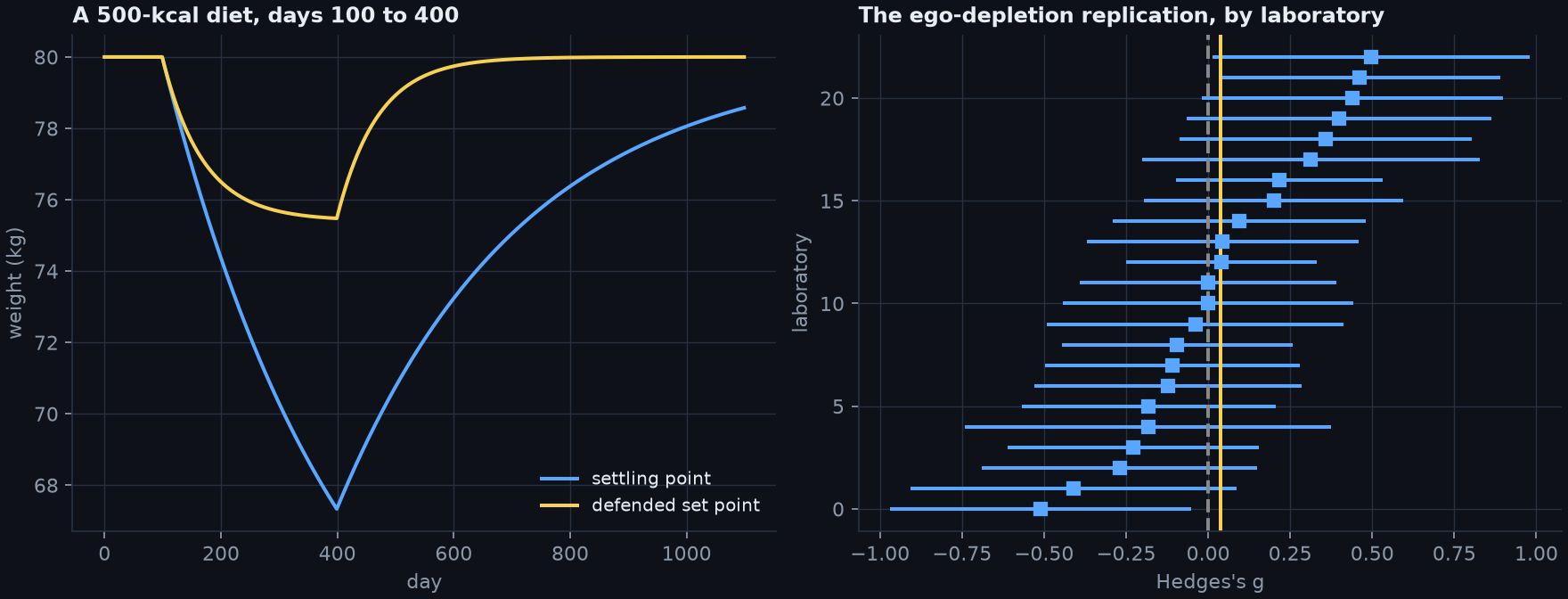
Put weight into the same kind of equation. Body mass changes with the difference between energy in and energy out, divided by the energy stored in a kilogram of tissue. Energy out rises with weight: a heavier body burns more. A kilogram of tissue holds about seventy-seven hundred kilocalories, and Kevin Hall and his colleagues' models put the extra burn at roughly twenty-four kilocalories a day for each extra kilogram. The old rule of thumb, thirty-five hundred kilocalories to a pound, ignores the loop. Cut five hundred kilocalories a day and it promises kilograms in three hundred days, and more for ever. The loop says otherwise. As weight falls, the body burns less, so loss slows and weight heads for a settling point kilograms lower, with a time constant of nearly a year. After three hundred days it has lost , not . And when the diet ends, weight drifts back, because nothing holds it at the new level.
Now let the body defend a set point. Below it, two things happen. Hunger rises, so more is eaten. And the body economizes, burning less than its size alone would predict; physiologists call it adaptive thermogenesis. The loop becomes stiffer. The same diet, kept just as faithfully, now loses only kilograms. By the end, the dieter eats about kilocalories a day more than the plan, without deciding to, and burns about fewer than at the start. And when the diet stops, the lost weight returns within months. The numbers for hunger and economy here are illustrative, not measured, but the shape is the point: a defended loop makes willpower fight a controller.
Is there really a set point? After large weight loss, people burn less energy than their new size predicts, and feel hungrier. That has been measured in controlled studies since the 1990s, and in a follow-up of contestants from a televised weight-loss competition it was still there six years later. But weight isn't fixed at one value for life. It drifts with what food is around, with age, with surroundings, more like a settling point than a set point. The current view mixes the two: the body defends against loss more strongly than against gain. And this is where motivation enters. Hunger is the controller's way of making food worth more. The rest of this part is about that worth.
What it does: The hypothalamus, leptin and ghrelin; a diet as a loop; a defended set point; set point or settling point
3Beyond drives: curiosity and arousalPsych 101 and the major4 min
If animals only act to reduce needs, a satisfied animal should sit still. They don't. In 1950 Harry Harlow, Margaret Harlow and Donald Meyer left mechanical puzzles in rhesus monkeys' cages: a pin to pull, a hook to lift, a hasp to open. The monkeys took them apart, again and again, with no food or anything else as a reward. And they got better at it, making fewer errors over the days: learning, with no drive reduced. A few years later Robert Butler showed that monkeys would learn a discrimination for nothing more than the chance to open a small window and look out at the laboratory. Harlow called it a manipulation drive, which renames the problem. The plainer statement is that exploring and solving are rewarding in themselves.
The second challenge to drive theory was arousal, and its most famous evidence is a law that wasn't one. In 1908 Robert Yerkes and John Dodson trained dancing mice to choose the lighter of two boxes; entering the darker one gave a shock, of one of several strengths. When the two boxes were easy to tell apart, the stronger the shock, the faster the mice learned. When they were hard to tell apart, learning was fastest at an intermediate shock. There were only a handful of mice in each condition. The thing varied was the strength of a shock, not arousal, and the thing measured was how fast a habit formed, not how well anyone performed. The inverted U relating arousal to performance, and the word law, were attached decades later, as Karl Teigen traced in 1994. The textbook law is mostly a story told about this experiment.
Here is why the later reading was attractive. In Psyche's sketch, arousal does two things. It energizes, which helps, and it narrows attention, which Easterbrook proposed in 1959. A hard task depends on subtle cues, and those are the first to be dropped as attention narrows. Multiply the two and you get inverted Us, with the best arousal at for the easy task and for the hard one. But this is a sketch of a hypothesis, not a fit to anything. Modern tests of the inverted U are mixed, partly because arousal is several different things that don't move together.
Curiosity itself became a subject. Daniel Berlyne argued in 1960 that novelty, surprise and complexity draw exploration, with too little being boring and too much aversive. George Loewenstein's 1994 theory treats curiosity as the feeling of a gap between what you know and what you want to know, strongest when the gap seems small enough to close. In 2009 Min Jeong Kang and colleagues asked people trivia questions. Curiosity rose with how close people felt to the answer, up to a point, and they would spend scarce tokens or wait longer to find answers they were curious about. Part 17's learner explores to reduce its uncertainty about the world. Curiosity may be that computation, felt from the inside.
What it does: Harlow's puzzles and Butler's window; what Yerkes and Dodson's mice showed; the inverted U as a sketch; curiosity as an information gap
4Wanting is not likingPsych 101 and the major4 min
Back to Olds and Milner's rat. Was it feeling pleasure? Kent Berridge spent decades showing that the question splits in two. Liking can be measured without words. Rats, monkeys and human infants make the same tongue protrusions to a sweet taste, and the same gapes to a bitter one, and those faces track how pleasant the taste is. Rats with nearly all of their dopamine destroyed still make the liking faces when sugar is put in their mouths, but they will not work for it, or even eat on their own. And mice engineered to have extra dopamine work harder to get sweet food, without liking it any more. So Berridge and Terry Robinson concluded in 1998: dopamine isn't pleasure. It is wanting, the pull that makes something an incentive. They called it incentive salience.
Liking turned out to have its own machinery. Berridge's laboratory found small hedonic hotspots, about a cubic millimetre each in a rat's brain, in the shell of the nucleus accumbens and in the ventral pallidum. Stimulating opioid receptors in a hotspot multiplies the liking faces to sugar. Stimulating dopamine in the same region raises wanting alone. The wanting system is large and robust; the liking system is small and fragile, which may be why desire is easier to produce than pleasure. And Olds and Milner's rat was probably wanting: stimulation that pulls without pleasing. That gap between wanting and liking is at the centre of addiction, in Part 41.
The clearest demonstration came in 2013, from Mike Robinson and Berridge. In training, a lever-like rod enters the cage, and then a squirt of intensely salty water, about three times as salty as seawater, goes into the rat's mouth. The rats learn to avoid the rod. Whatever value they have learned for it is negative. Then a drug puts the rats' bodies into a state of salt appetite, a state they have never been in. On the very first test, with no salt delivered, they jump on the rod and nibble it. Nothing was relearned. The cue's value changed the moment the body's state did.
Psyche can say what that requires. Part 17's learner caches a value from what has happened. During training the cue's value falls toward minus one. In the new state, with no salt delivered, it can only decay toward zero. It never turns positive. Jun Zhang, Berridge and their colleagues proposed in 2009 that incentive value is recomputed at the moment the cue appears, from the learned outcome and the body's present state, written kappa. Here the new state flips the sign of the salt's worth, and the cue's value jumps from to plus on the first test, with no learning. Wanting is computed when the cue arrives, from memory and need together. That's the homeostatic loop of chapter two, reaching into the learner of Part 17.
What it does: Liking faces and dopamine; hedonic hotspots; the salt cue; cached against incentive value
5Intrinsic and extrinsicPsych 101 and the major5 min
If rewards make things worth doing, more reward should mean more doing. In 1973 Mark Lepper, David Greene and Richard Nisbett showed a case where it means less. They found preschool children who already liked drawing with felt-tip markers. One group was promised a Good Player certificate, with a gold seal and a ribbon, for drawing. A second group got the same certificate as a surprise afterwards. A third got nothing. One to two weeks later, the markers were put out during free play, and observers behind a one-way mirror timed the children. Those who had drawn for the expected award spent about half as much time drawing as the other two groups. The surprise award did no harm. What mattered was having drawn in order to get it.
One explanation is a piece of inference. Daryl Bem proposed in 1972 that people infer their own attitudes partly from their own behaviour, the way an observer would. Write it as Bayes's rule. A child either likes drawing or doesn't, with even odds beforehand. Liking drawing makes drawing likelier, and so does a promised reward. Having drawn with no reward, the inference is that I like it. Having drawn for a reward, it's . The reward explains part of the drawing, so the drawing says less about the child. The stronger the reward's pull, the less the act reveals about the person. Harold Kelley called this the discounting principle, and here it discounts the child's interest in its own eyes. It's one account among several; the others say the reward feels controlling, and takes away a sense of choice.
This became one of psychology's longest arguments. Edward Deci had found the same thing with adults in 1971: students paid to solve puzzles spent less of a free period on them afterwards than students never paid. In 1994 Judy Cameron and David Pierce published a meta-analysis concluding that rewards do little overall harm. Deci, Richard Koestner and Richard Ryan answered in 1999 with a meta-analysis of a hundred and twenty-eight experiments. Expected, tangible rewards that depend on doing the task reliably reduced later free choice; verbal praise tended to raise it. And in 2014 Christopher Cerasoli, Jessica Nicklin and Michael Ford pulled together studies from schools and workplaces: incentives predicted the quantity of performance, intrinsic motivation its quality, and both mattered. The undermining effect is real. Its scope, how large it is and where it matters outside the laboratory, is still argued.
Deci and Ryan built the results into self-determination theory. It proposes three basic psychological needs: autonomy, competence and relatedness. When they're met, motivation becomes more internal, coming from enjoyment, or from values a person has made their own. On this view a reward that informs, you did well, supports competence, while a reward that controls, do this and you'll get that, thwarts autonomy. That's their account of the markers. It's a broad framework with a great deal of correlational support, and it's used in schools, clinics and workplaces, which we'll meet again in Part 53.
Self-determination theory has a famous ancestor. In 1943 Abraham Maslow proposed that human needs form a hierarchy: the body first, then safety, then love and belonging, then esteem, and at the top what he called self-actualization, becoming what one is able to become. A need higher up would motivate only once the ones below it were largely met. The pyramid that carries his name is not in his paper. Management writers drew it in the nineteen-sixties, and it became the best-known diagram in psychology. When the theory was tested, the ladder did not hold. In 1976 Mahmoud Wahba and Lawrence Bridwell reviewed the studies and found little support for the ranking. In 2011 Louis Tay and Ed Diener used surveys from 123 countries. Needs like Maslow's were found everywhere, and meeting them went with well-being, but people reported meeting the higher needs whether or not the lower ones were met. So the list survives and the ladder does not: a lesson in how a theory can be half right, and remembered for the wrong half.
What it does: The magic markers; self-perception as Bayes; the meta-analyses; self-determination theory
6GoalsPsych 101 and the major3 min
Goals bring the future into motivation, and the oldest formal model of them is still instructive. John Atkinson proposed in 1957 that the pull of a task is a person's motive to succeed, times the chance of success, times the incentive of succeeding, and that the incentive is larger the harder the task: pride in an easy win is small. Set the incentive to one minus P. The product P times one minus P peaks at even odds. People driven mainly by the hope of success should choose tasks of middling difficulty. For people more afraid of failing, the same algebra flips the sign, and they should prefer tasks so easy they can't fail or so hard that failing says nothing. In ring-toss games where people stand wherever they like, both patterns appear, in roughly the people the theory predicts.
The most successful theory of goals is also one of the plainest. Edwin Locke and Gary Latham gathered hundreds of studies, in laboratories and workplaces, of people from loggers to scientists. A specific, difficult goal leads to better performance than being told to do your best, which in practice sets no standard at all. Goals work by directing attention, raising effort, extending persistence, and prompting a search for strategies. They work when people are committed, get feedback, and can reach the goal. For a complex task that's new, a goal to learn how beats a goal to perform. And they have costs. A goal narrows attention to what it measures, and in 2009 Lisa Ordóñez and colleagues gathered cases where hard targets invited cutting corners, and outright cheating.
Most goals fail not at the setting but at the doing. Peter Gollwitzer's answer, in 1999, is the implementation intention. A goal says what you will do; an implementation intention says when, where and how, in the form if this, then that. The idea is that the cue in the if-clause comes to trigger the action automatically, like a habit made on purpose. A meta-analysis of many studies by Gollwitzer and Paschal Sheeran in 2006 found moderate to large effects on reaching goals. But a literature built from many small studies can overstate an effect, as chapter eight will show in detail. The gap between intending and doing is the real problem of motivation, and planning the moment is a partial answer.
What it does: Atkinson's model derived; specific, difficult goals and their costs; implementation intentions
7On you: sooner or laterPsych 101 and the major3 min
Let's measure something about you. Fifty pounds, or dollars, or euros, now, or a hundred in a month? Answer in your head, honestly. If you took the fifty, the next offer is lower; if you waited, it's higher. Say you waited: seventy-five now, or a hundred in a month? And if you'd now take the seventy-five, the step halves again: sixty-two fifty now, or a hundred in a month? Each answer moves the next offer halfway toward the point where you switch. Six questions pin it to within a couple of percent. It's called the adjusting-amount procedure, and this part's interactive runs it on you at six delays.
Here's the procedure run on Psyche. Psyche's chooser discounts hyperbolically, as in Part 26: a reward A at delay D is worth A over one plus k D, with k of 0.02 a day. We ask it about a hundred in thirty days. The offer starts at half, fifty. Each answer moves it by a step, and each step is half the last, so after six questions the offer is within about one and a half of the switching point. The procedure lands on , against a true indifference point of . People are noisier than Psyche, so the interactive asks one delay twice, to see how consistent you are.
Run the procedure at six delays, from a day to a year, and you have a discount curve. Here are three of Psyche's choosers, patient, middling and impulsive, each a set of six indifference points. Fitting the hyperbola recovers each chooser's rate. A second summary needs no model at all: the area under the points, with delay and value both scaled to run from zero to one. It's one for someone who doesn't discount, and near zero for someone who wants everything now. Joel Myerson, Leonard Green and Mel Warusawitharana proposed it in 2001, because people's curves often aren't quite hyperbolic.
What does your number measure? In 1999 Kris Kirby, Nancy Petry and Warren Bickel found that heroin users discounted delayed money more steeply than people who didn't use drugs, and similar results followed for smoking, problem drinking and gambling. It's a candidate marker across disorders, as Part 41 will discuss. But a choice about money is also a judgment about the world. Will the later payment really come? Is money needed now? Discounting is fairly stable within a person over months, and it also moves with circumstances. And that is the question behind the next three chapters. Is self-control a trait, a resource that runs down, or a sensible reading of one's world?
What it does: The titration on you and on Psyche; three discount curves and the area under them; what a discount rate measures
8Self-control as a resourcePsych 101 and the major4 min
Now to self-control, and one of the most influential ideas in social psychology. In 1998 Roy Baumeister, Ellen Bratslavsky, Mark Muraven and Dianne Tice brought hungry students into a room that smelled of freshly baked chocolate cookies. Some were allowed to eat the cookies. Others were told to eat only the radishes from a second bowl, and left alone to resist. Then everyone was given puzzles that, unknown to them, had no solution, and the experimenters timed how long they kept trying. The radish eaters gave up much sooner, in less than half the time. Resisting the cookies seemed to have used something up.
Baumeister's group gave the idea a name and a model. Ego depletion: every act of self-control draws on one limited resource, like a muscle that tires, so a first act leaves less for a second. Hundreds of studies followed, with many pairs of tasks: a Stroop task, then a handgrip; suppressing an emotion, then a puzzle; making hard choices, then anything at all. In 2007 Matthew Gailliot and colleagues proposed that the resource was blood glucose, since a sugary drink seemed to restore self-control. Critics such as Robert Kurzban pointed out that the brain's glucose use barely changes with mental effort, and later studies reported that merely rinsing the mouth with sugar water seemed to work too. Still, in 2010 Martin Hagger and colleagues pooled 198 tests in a meta-analysis and found an average effect of about six-tenths of a standard deviation, a medium-to-large effect, and very consistent.
But a consistent literature can be built from nothing, and Part 4's machinery shows how. Psyche's literature has small studies, ten to forty people a group, of an effect that is exactly zero. Each grey dot is a study: what it found, and how noisy it was, with the small studies higher up. Significant results are published. Five percent of the rest escape the file drawer, and thirty percent of the rest are nudged over the line by flexible analysis, the habits of Part 4. studies reach print, and percent of them are significant. They hug the red line, where p equals point oh five, and the small ones sit far to the right. A meta-analysis of what was published finds an effect of , with a narrow interval: precise, and wrong.
Can the bias be undone? If small studies only reach print when they find big effects, then the effects published grow with the standard error. The precision-effect test regresses each study's effect on its standard error and reads off the intercept, the effect predicted for a study with no noise at all. On Psyche's literature, the intercept is , give or take : nothing there. In 2015 Evan Carter, Lilly Kofler, Daniel Forster and Michael McCullough applied corrections like this to the ego-depletion literature, and found estimates near zero. Corrections can mislead too; they rest on assumptions about how the bias arose. The only clean answer was a new test, planned and registered in advance, which is the next chapter.
What it does: Cookies and radishes; the strength model and glucose; a literature built on nothing; the precision-effect test
9Twenty-three laboratoriesPsych 101 and the major3 min
In 2016 the journal Perspectives on Psychological Science published a Registered Replication Report on ego depletion, led by Martin Hagger and Nikos Chatzisarantis. The protocol came from a 2014 study by Chandra Sripada, Daniel Kessler and John Jonides. First, a letter-crossing task: cross out every e, which is easy, or cross out every e except when it's next to a vowel or one letter away from one, which means breaking the habit you just formed. Then a test of control, the multi-source interference task. The outcome: how variable the reaction times were. The protocol was written and registered before any data were collected, reviewed in advance, and run in twenty-three laboratories in many countries. And the result was to be published whatever it turned out to be.
Here are the results, recomputed from the report's own table of laboratories. At the top, the study the protocol came from: an effect of , from people, with a wide interval. Below it, the twenty-three laboratories, people in all, each with its estimate and interval, the squares sized by the sample. estimates are above zero and the rest below; are individually significant. Pooled by a random-effects meta-analysis, the effect is , with an interval from to . The published report gave the same estimate, point oh four. And the laboratories disagree with one another little more than chance alone predicts. Twenty-three teams found, together, almost nothing.
The original authors did not accept the result. Roy Baumeister and Kathleen Vohs replied that the letter-crossing task was too weak to deplete anyone, and that running one protocol in so many countries and languages was a mistake. So a second multisite test was designed with the theory's proponents, using tasks they chose, and led by Vohs herself. Published in 2021, it too found an effect close to zero. What remains is real enough. People do feel tired after sustained effort, and do then prefer easier things. What failed is the specific claim: a resource that one act of self-control uses up and the next runs short of. And something changed. A famous effect was checked in a way its own advocates had agreed to, and the field now registers its big tests before running them.
What it does: The registered protocol; the forest plot from the open data; after the report
10The marshmallow testPsych 101 and the major4 min
The most famous test of self-control was given to four-year-olds. In the late 1960s and early 1970s, at the nursery school on Stanford's campus, Walter Mischel and his colleagues offered children a choice: one treat now, a marshmallow or a pretzel, or two if they could wait until the experimenter came back. Ringing a bell ended the wait. The studies were about how children manage to wait. Covering the treat helped; so did thinking of the marshmallow as a puffy cloud, or singing to oneself. Years later, follow-ups found that the children who had waited longer had higher test scores and were rated by their parents as more competent adolescents. That became the famous claim: a preschooler's patience predicts a life. But each follow-up had a few dozen children, all from the families of one university.
Why might a small, privileged sample mislead? Draw what else could be going on. In this simulated pool, family background and early ability shape both how long a child waits at four and how well the child scores at fifteen. Waiting itself adds only a little. Waiting alone predicts the scores, with a correlation of . The regression slope on waiting alone is the true effect plus everything that flows through the background. Control for background and ability, and the slope falls from to , percent smaller, which here is the truth. In 2018 Tyler Watts, Greg Duncan and Haonan Quan repeated the follow-up in about nine hundred children from many backgrounds. The association was about half the size of the original, and shrank by about two-thirds more once family background and early ability were controlled. Those numbers aren't the simulation's; the simulation only shows how that can happen.
There is a second reason to doubt that waiting measures a trait. In 2013 Celeste Kidd, Holly Palmeri and Richard Aslin added a step before the marshmallow. The experimenter promised the children better art supplies, and then either brought them, or came back empty-handed with an apology. Children who had just met a reliable adult waited for the second marshmallow about four times as long as children who had met an unreliable one. A child who expects promises to be broken is not failing at self-control. They're reading their world correctly. Which raises a sharper question: when is giving up the rational thing to do?
Joseph McGuire and Joseph Kable gave the answer in 2013, and it can be derived. Having waited t minutes, the expected further wait is the area under the survival curve beyond t, divided by the chance of having got this far. Compare two worlds where the experimenter's return has the same median, five minutes, and only the tails differ. If returns are reliable, the longer you've waited, the sooner the end: at five minutes, about more. If they're unreliable, with a heavy tail, the longer you've waited, the longer you should expect still to wait: about more minutes at minute five, at minute ten. Each minute without a return is evidence that this is one of the long ones. A chooser who maximizes treats per minute should wait it out in the first world, and give up after about minutes in the second. McGuire and Kable showed that adults adjust their persistence to exactly this kind of difference. Giving up can be intelligence, not weakness.
What it does: Mischel's studies; confounding derived and simulated; reliable adults; when to stop waiting
11Grit and mindsetPsych 101 and the major3 min
If self-control isn't a fuel, perhaps it's a trait. In 2007 Angela Duckworth, Christopher Peterson, Michael Matthews and Dennis Kelly introduced grit, perseverance and passion for long-term goals, measured with a short questionnaire. Grittier cadets were likelier to get through their first summer at West Point, and grittier children went further in a national spelling bee. A best-selling book followed, and grit entered school curricula. In 2017 Marcus Credé, Michael Tynan and Peter Harms pooled samples, people. Grit's correlation with academic performance was : real, and modest. And its correlation with conscientiousness, one of the Big Five personality traits, corrected for unreliability, was . That's nearly the same trait under a new name, the jingle-jangle problem from Part 3.
How much does grit add? With three correlations, you can compute it. The variance in performance that grit explains beyond conscientiousness is this: grit's correlation with performance, minus the part it shares through conscientiousness, squared, over what is left of grit once conscientiousness is removed. Alone, grit explains percent of performance. Suppose conscientiousness predicts performance exactly as well as grit does. Then grit adds about percent: almost nothing. The answer depends on that assumption, and the README works through others. Credé's analysis found that the perseverance half of the scale did better than the passion half. Whether grit adds anything beyond conscientiousness is contested, and the Ledger records it that way.
A related idea is about belief rather than trait. Carol Dweck proposed that students who believe ability can grow, a growth mindset, respond to failure by trying harder, while those who believe it is fixed give up. In 2018 Victoria Sisk and colleagues published two meta-analyses. Mindset and achievement were weakly correlated, around a tenth, and mindset interventions had very small average effects. In 2019 David Yeager and colleagues ran a short online lesson with a national sample of American ninth graders, registered in advance. It raised grades a little among lower-achieving students, and did little for the rest. That's the pattern of this whole part: a real effect, smaller than the story told about it, and concentrated in some people and places. Part 54 continues it, in schools.
What it does: Grit and the meta-analysis; grit's increment computed; growth mindset
12Effort as a costResearch3 min
If self-control isn't a fuel, why does it feel like it runs out? A different answer starts from a simple observation. In 2010 Wouter Kool, Joseph McGuire, Zev Rosen and Matthew Botvinick let people choose between two decks of cards. Each card set a small task, and the decks differed only in how often the task switched. Most people drifted toward the deck with fewer switches, without being told the difference, and often without noticing it. In 2013 Andrew Westbrook, Daria Kester and Todd Braver showed that people will give up money to do an easier version of a memory task, so the price of mental effort can be measured, much like a discount rate. Effort, on this view, is a cost, weighed against rewards like any other.
Amitai Shenhav, Botvinick and Jonathan Cohen turned that into a model in 2013, the expected value of control. The brain chooses an intensity of control, u. More control raises the chance of success; control has a cost that grows with its square. The best intensity maximizes the difference. Psyche solves it for a task of fixed difficulty, across rewards. Below a reward of about , the best choice is not to try at all. Above it, control jumps up, and then grows only slowly. More reward buys a little more effort, not a lot.
Now vary the difficulty instead. As the task gets harder, control rises to meet it. Until success costs more than it's worth: then effort drops to nothing, at difficulty for a reward of four, and for a reward of eight. A larger reward keeps you trying on harder tasks, but not forever. Jack Brehm's motivational intensity theory said this in 1989, without the equation: effort follows difficulty until success is impossible or not worth it, and then collapses. Measures of effort in the body, such as how hard the heart contracts and how wide the pupils open, show this rise and fall.
But why should effort cost anything? Not because it burns fuel. The brain uses about the same energy whether it's solving a hard problem or idling. Robert Kurzban, Angela Duckworth, Joseph Kable and Justus Myers proposed in 2013 that the cost is an opportunity cost. Control is a limited channel, and using it on one task means not using it on another. On that view the feeling of effort, and the feeling of boredom, are the brain's running estimate of what else it could be doing, which explains why they grow with time on a task without anything being used up. And there is a paradox. People also seek effort out: they climb mountains, do crosswords, and value what they worked for. Michael Inzlicht, Shenhav and Christopher Olivola call it the effort paradox. Effort can add value as well as cost it.
What it does: Avoiding demand; the expected value of control over reward and difficulty; why effort costs anything
13The LedgerPsych 101 and the major3 min
Six new rows today. The first: animals will work for electrical stimulation of certain brain sites, often in preference to food. The original: Olds and Milner, 1954. The record: Olds's map of reward sites in 1958, Routtenberg and Lindy's rats that chose stimulation over food in 1965, and a standard laboratory method ever since. One of the most reproduced findings in behavioural neuroscience. What changed is what it means: wanting, not pleasure. Replicated.
The second: an expected, tangible reward for something people already enjoy reduces how much they choose to do it later. The original: Lepper, Greene and Nisbett's markers, 1973. The record: Cameron and Pierce's meta-analysis finding little harm, Deci, Koestner and Ryan's hundred and twenty-eight experiments, and Cerasoli and colleagues' forty years of field data. Reliable in the laboratory under the conditions the meta-analyses specify; how much it matters outside is contested. Replicated, with its scope argued.
The third: specific, difficult goals lead to better performance than do your best. The original: Locke, 1968. The record: Mento, Steel and Karren's meta-analysis in 1987, Locke and Latham's review of hundreds of studies, Ordóñez and colleagues on the costs, and the meta-analysis of if-then plans. Robust in the laboratory and the field, smaller for complex new tasks, and with costs when goals are narrow. Replicated.
The fourth: exerting self-control on one task impairs it on the next, as if a resource were used up. The original: Baumeister and colleagues' radishes, 1998. The record: a meta-analysis of a hundred and ninety-eight tests in 2010; bias corrections near zero in 2015; twenty-three laboratories finding point oh four in 2016; and a second multisite test, with tasks the proponents chose, close to zero in 2021. Fatigue after effort is real. A limited resource is not supported. Failed, in its sequential-task form.
The fifth: how long a preschooler waits for a larger treat predicts achievement years later. The original: Shoda, Mischel and Peake, 1990. The record: Kidd and colleagues' reliable and unreliable adults, McGuire and Kable's rational giving up, and Watts, Duncan and Quan's nine hundred children. The association exists, but it's small, and largely shared with family background and early ability. Replicated, smaller.
And the sixth: grit predicts achievement beyond conscientiousness. The original: Duckworth and colleagues, 2007. The record: a twin study in 2016 finding that grit added little beyond the Big Five, and Credé's meta-analysis in 2017. Grit predicts modestly and is nearly conscientiousness. Contested.
The tally. The mechanisms replicate: brain-stimulation reward, rewards that undermine interest, and goals that work. The self-control stories shrank or failed: a resource that runs out, a test at four that predicts a life, and a trait that turned out to be an old one with a new name. The survivors are effects measured inside experiments. The casualties were broad claims about people, built on small samples.
What it does: Brain-stimulation reward; overjustification; goals; ego depletion; delay of gratification; grit
14In practice: incentives, diets and habitsPractice3 min
Motivation is applied everywhere, often by people who've never read the research. In 2000 Uri Gneezy and Aldo Rustichini studied ten day-care centres in Israel. Six introduced a small fine for parents who picked their children up late. Late arrivals went up, not down, and stayed up after the fine was removed. A moral obligation to the staff had become a price, and a cheap one. Incentives that work tend to be large enough to matter, immediate, and attached to the behaviour itself. In smoking-cessation trials, money paid for verified quitting has raised quit rates. Gamification, points and badges and streaks, changes what people do while it lasts, and can teach them, as the markers did, that the activity is only worth doing for points. Incentive design at work returns in Part 53.
Weight-loss programmes are motivation meeting control theory. The static rule overpromises, so planners now use dynamic models of the loop, like the one Kevin Hall and his colleagues published in 2011, which chapter two's model imitates. In the loop, a lasting change of intake moves weight to a new settling point, with a time constant near a year; days in Psyche's version. Most diets lose weight for about six months, and the weight returns over the next few years. The defended set point is one reason. What lasts is what changes the loop for good: the food around a person, habits, and, for some, drugs that act on the hunger signals themselves, which is the newest chapter of this story.
And the last application is a way to need motivation less. In 2010 Phillippa Lally and her colleagues asked volunteers to choose a new daily habit, such as a walk or a glass of water with lunch, and to rate each day how automatic it felt. Automaticity rose and levelled off, on average after a couple of months, with enormous variation between people and between habits. A habit is an action triggered by a cue rather than by its goal: Part 17's cached, model-free values, and the if-then plans of chapter six. Habit apps work best when they fix the cue and the moment. Streaks and rewards help, for as long as they last.
What it does: Fines that backfire; weight-loss programmes as control; habits
15Frontier: what is spent, and machines that wantResearch2 min
If self-control isn't a resource, what is spent? The leading answer is opportunity cost: the feeling of effort, and of boredom, as the brain's estimate of the value of doing something else. In 2022 Mayank Agrawal, Marcelo Mattar, Jonathan Cohen and Nathaniel Daw built a model in which both fatigue and boredom follow from tracking that value as time passes. A related idea is that effort's price is learned. People adjust how hard they try to what trying has paid before, and may even come to find effort rewarding. What nobody can yet do is measure the cost of effort in the brain, in units a model can use, and from it predict who will persist.
Motivation is also an engineering problem now. A reinforcement learner wants exactly its reward, and Olds and Milner's rat is the oldest picture of what goes wrong when the reward signal can be reached directly. In artificial agents it's called reward hacking: finding a way to score without doing the task. Curiosity has been built into machines, as rewards for prediction error or for learning progress, from Jürgen Schmidhuber's work in 1991 to Deepak Pathak and colleagues' in 2017, and it makes agents explore. And some researchers give agents homeostatic rewards, for keeping internal variables in range: a body for the learner. The open question is shared by psychology and engineering: what should a system want, and how do you stop it wanting the measure instead? Part 60 returns to it.
Four open problems. Is wanting one system or many? Does dopamine's incentive salience explain motivation for food, money, people and ideas alike? What in the brain sets a defended body weight, and why does it defend against loss more than gain? Can self-control be measured reliably in one person at all? The tasks that show strong effects across people are often poor at ranking individuals, the reliability paradox of Part 59. And which motivational interventions survive large, registered tests, and for whom?
What it does: Opportunity cost; motivation in artificial agents; open problems
Recap, problems, and the road aheadAll tracks4 min
Part twenty-eight in ten lines. A rat at a lever showed reward reached directly, without passing through the body's needs. Homeostasis is negative feedback, with a steady error unless the loop remembers. Body weight has a settling point, defended more against loss than gain. Curiosity is rewarding in itself, and the Yerkes-Dodson law was mostly a story told about some mice. Wanting is not liking, and a cue's value can be recomputed from the body's state with no new learning. Expected rewards can undermine interest, and specific, difficult goals work. You measured your own discount curve with six questions per delay. Ego depletion grew from hundreds of studies, and twenty-three laboratories found almost nothing. The marshmallow test and grit are real effects, smaller than their stories, and mostly something else. And effort is a cost the brain chooses to pay: try when it pays, stop when it doesn't.
Kant's wager. The first objection, that mathematics can't apply to the mind, met control loops, Bayes's rule and the expected value of control: motives written as equations and solved. The second, that the mind can't be experimented on, met brain stimulation, dopamine lesions, and a registered test run by twenty-three laboratories at once. The third, that introspection disturbs what it observes, hit hardest where the measure was a questionnaire about oneself: grit and mindset, where most of what was measured turned out to be an old trait. Amber.
Where this comes back. Emotion is next, in Part 29. Wanting without liking is the centre of addiction in Part 41. Incentives and goals at work are Part 53, mindset and grit in schools are Part 54, and what machines should want is Part 60.
Seven problems, with full solutions in this part's README. One solves the thermostat and its integral term. One finds the settling point and its half-life. One works through Atkinson's model. One takes the self-perception model to its limit. One recomputes the replication's pooled effect a second way, from the open data. One proves the waiting result. And the last, with the star, asks you to design an experiment that the opportunity-cost account of effort would pass and the resource account would fail. Pause here if you'd like to try them.
The books and papers behind this part are listed here and in the README. Cannon's The Wisdom of the Body is still a pleasure to read; Berridge and Morten Kringelbach's review is the best short account of wanting and liking; and Mischel's own book on the marshmallow test is worth reading alongside the 2018 replication.
That's the first part of Act Six, on feeling and wanting. Motives come with feelings, and the next part is about them. In 1884 William James asked whether we run from a bear because we are afraid, or are afraid because we run, and answered: the second. Psychology has argued about the order of events ever since, through a pen held in the teeth, a rickety bridge, and faces photographed around the world. It's Part 29: emotion.
Where it goes next. Emotion is Part 29; wanting without liking returns in addiction, Part 41; incentives and goals at work are Part 53; grit and mindset in schools are Part 54; what machines should want is Part 60.
Key results
The part's results in one place, for revision.
Try it
Lab 28 · Motivation
Derive the thermostat's steady error and remove it; put a diet into an energy-balance loop with and without a defended set point; watch a learner abandon food for a current; recompute the ego-depletion replication's pooled effect from its 23 laboratories; and measure discount curves by titration.
python -m videos.psychology.labs 28
needs numpy, scipy, matplotlib · download lab28.py ·
source on GitHubthermostat at rest after the window opens: proportional, with an integral term (set 20 C) 15.00, 20.00
kg lost after 300 days of a 500-kcal cut: static rule, settling point, defended 19.5, 12.7, 4.5
current worth 0.5: share of presses on it, energy store (last 1,000 presses) 0.90, 0.69
current worth 1.0: share of presses on it, energy store (last 1,000 presses) 0.90, 0.36
current worth 1.5: share of presses on it, energy store (last 1,000 presses) 0.98, 0.01
RRR: laboratories; pooled d [95% CI]; I^2 23; 0.04 [-0.07, 0.14]; 35%
normal return: expected further wait at 0, 5, 10 minutes; best give-up time 5.0, 1.2, 0.4; 14.9
pareto return: expected further wait at 0, 5, 10 minutes; best give-up time 30.6, 54.3, 72.8; 3.6
titration, true k = 0.002: fitted k, area under the curve 0.0020, 0.76
titration, true k = 0.02: fitted k, area under the curve 0.0200, 0.30
titration, true k = 0.1: fitted k, area under the curve 0.0987, 0.11
Proportional control leaves an error an integral term removes; a defended set point stiffens the loop so a diet loses less; a learner given a reward that bypasses the body abandons food; 23 laboratories pool to almost nothing; heavy-tailed waits make quitting rational; and six questions per delay recover a discount rate.The code (92 lines; it asserts its own result)
"""Lab 28: a thermostat and a defended body weight, a hijacked learner, the ego-depletion replication's meta-analysis
recomputed from its open data, waiting under uncertainty, and a discount curve by titration."""

import numpy as np

from videos.coursekit import labs
from explainer.psychology import opendata
from explainer.psychology.psyche import drive as D

TITLE = "Motivation"
GOAL = ("Derive the thermostat's steady error and remove it; put a diet into an energy-balance loop with and without "
        "a defended set point; watch a learner abandon food for a current; recompute the ego-depletion "
        "replication's pooled effect from its 23 laboratories; and measure discount curves by titration.")
TASKS = [
    "Give the defended weight model a set point that drifts toward the current weight at 1% a day. Does the "
    "regain after the diet shrink? This is the settling point and set point mixed.",
    "Recompute the replication's pooled effect separately for English-speaking and other laboratories. Is the "
    "difference larger than the intervals allow?",
    "Add logistic noise (noise=5) to the titration chooser and run 200 seeds. How far is the fitted k from the "
    "truth, and is the area under the curve more stable?",
]


def run(seed=0):
    out = labs.Lab()

    # 1. the thermostat
    dist = lambda t: -1.0 if t >= 20 else 0.0  # noqa: E731
    p = D.thermostat(T=120.0, k=0.2, disturbance=dist)
    pi = D.thermostat(T=200.0, k=0.2, ki=0.05, disturbance=dist)
    out.row("thermostat at rest after the window opens: proportional, with an integral term (set 20 C)",
            f"{p['x'][-1]:.2f}, {pi['x'][-1]:.2f}")
    assert abs(p["x"][-1] - 15.0) < 0.01 and abs(pi["x"][-1] - 20.0) < 0.05

    # 2. weight
    settle = D.body_weight()
    defend = D.body_weight(hunger=60.0, thrift=25.0)
    out.row("kg lost after 300 days of a 500-kcal cut: static rule, settling point, defended",
            f"{80 - D.static_rule()[399]:.1f}, {80 - settle['W'][399]:.1f}, {80 - defend['W'][399]:.1f}")
    assert 80 - defend["W"][399] < 80 - settle["W"][399] < 80 - D.static_rule()[399]

    # 3. the learner and the current
    for v in (0.5, 1.0, 1.5):
        r = D.self_stimulation(stim=1, stim_value=v, seed=seed)
        out.row(f"current worth {v}: share of presses on it, energy store (last 1,000 presses)",
                f"{r['choice'][-1000:].mean():.2f}, {r['energy'][-1000:].mean():.2f}")

    # 4. the registered replication
    d = opendata.ego_depletion_rrr()
    g, v = [], []
    for i in range(len(d["lab"])):
        if d["original"][i]:
            continue
        gi, vi = D.hedges_g(d["m_dep"][i], d["sd_dep"][i], d["n_dep"][i], d["m_ctl"][i], d["sd_ctl"][i],
                            d["n_ctl"][i])
        g.append(gi)
        v.append(vi)
    re = D.random_effects(g, v)
    out.row("RRR: laboratories; pooled d [95% CI]; I^2",
            f"{re['k']}; {re['estimate']:.2f} [{re['lo']:.2f}, {re['hi']:.2f}]; {100 * re['I2']:.0f}%")
    assert re["k"] == 23 and abs(re["estimate"] - 0.04) < 0.01

    # 5. waiting
    for kind in ("normal", "pareto"):
        w = D.remaining_wait([0.0, 5.0, 10.0], kind)
        out.row(f"{kind} return: expected further wait at 0, 5, 10 minutes; best give-up time",
                f"{w[0]:.1f}, {w[1]:.1f}, {w[2]:.1f}; {D.give_up_time(kind)['best']:.1f}")

    # 6. discounting
    for k in (0.002, 0.02, 0.1):
        r = D.discount_titration(k)
        out.row(f"titration, true k = {k}: fitted k, area under the curve", f"{r['k_fit']:.4f}, {r['auc']:.2f}")
        assert abs(r["k_fit"] / k - 1) < 0.1

    out.note = ("Proportional control leaves an error an integral term removes; a defended set point stiffens the loop "
                "so a diet loses less; a learner given a reward that bypasses the body abandons food; 23 "
                "laboratories pool to almost nothing; heavy-tailed waits make quitting rational; and six questions "
                "per delay recover a discount rate.")

    fig, ax = labs.figure(2, size=(11, 4.2))
    ax[0].plot(settle["day"], settle["W"], color=labs.BLUE, label="settling point")
    ax[0].plot(defend["day"], defend["W"], color=labs.GOLD, label="defended set point")
    ax[0].set(title="A 500-kcal diet, days 100 to 400", xlabel="day", ylabel="weight (kg)")
    ax[0].legend()
    order = np.argsort(g)
    se = np.sqrt(np.array(v))[order]
    ax[1].errorbar(np.array(g)[order], np.arange(len(g)), xerr=1.96 * se, fmt="s", color=labs.BLUE)
    ax[1].axvline(re["estimate"], color=labs.GOLD)
    ax[1].axvline(0, ls="--", color="#888888")
    ax[1].set(title="The ego-depletion replication, by laboratory", xlabel="Hedges's g", ylabel="laboratory")
    out.fig = fig
    return out
Now change it
- Give the defended weight model a set point that drifts toward the current weight at 1% a day. Does the regain after the diet shrink? This is the settling point and set point mixed.
- Recompute the replication's pooled effect separately for English-speaking and other laboratories. Is the difference larger than the intervals allow?
- Add logistic noise (noise=5) to the titration chooser and run 200 seeds. How far is the fitted k from the truth, and is the area under the curve more stable?
Problems, with solutions
Try each problem before opening its solution.
-
The thermostat. Solve \(dx/dt = -k(x - s) + D\) from \(x(0) = x_0\), and show that the error at rest is \(D/k\). Why does adding \(-k_i \int (x - s)\,d\tau\) remove it?
Solution
With e = x − s, de/dt = −ke + D, so e(t) = D/k + (e₀ − D/k)e^(−kt) and e → D/k. A proportional controller only pushes when there is an error, and to cancel a constant D it must push with force D, which needs an error D/k. With the integral term, any steady state needs d/dt of ∫e = e = 0, so the error at rest is zero; the integral holds the push the disturbance needs.
-
The settling point. In the energy-balance loop, show that a lasting cut of \(c\) kcal a day lowers weight by \(c/a\) at rest, and find how long it takes to lose half of that.
Solution
ρ dW/dt = −c − a(W − W₀), so W − W₀ → −c/a, approached as e^(−at/ρ). Half of the loss takes ρ ln 2 / a: with ρ = 7,700 and a = 24, about 222 days. A defended set point adds h + g to a, shrinking both the loss and the time constant.
-
Atkinson. For Atkinson's \(T = (M_s - M_{af}) P (1 - P)\), find the preferred \(P\) for each sign of \(M_s - M_{af}\).
Solution
dT/dP = (M_s − M_af)(1 − 2P) = 0 at P = 1/2, a maximum when M_s > M_af and a minimum when M_s < M_af; the failure-anxious then prefer P near 0 or 1.
-
Self-perception. In the self-perception model, show that the inferred interest after drawing falls as the reward's pull \(\beta_R\) rises. What happens when \(\beta_R \to \infty\)?
Solution
With R = 1, the posterior odds of interest are the prior odds times σ(β₀ + β_I + β_R)/σ(β₀ + β_R). As β_R grows, both terms tend to 1 and the ratio to 1, so the posterior falls to the prior: an act fully explained by its reward says nothing about the actor. (With β_R = 0 the ratio is largest.)
-
The RRR, again. With the RRR table (
opendata.ego\_depletion\_rrr), recompute the pooled \(d\) with a fixed-effect model and compare. Why are they so close?Solution
The fixed-effect estimate is 0.036 against the random-effects 0.037: τ² is small (I² = 35%) and the laboratories' sample sizes are similar, so the two weightings nearly agree.
-
Remaining waits. Show that the expected remaining wait \(\mathbb{E}[T - t \mid T > t]\) falls with \(t\) for a normal \(T\) and rises for a Pareto \(T\).
Solution
E[T − t | T > t] = ∫ₜ^∞ S(u) du / S(t). Its derivative has the sign of h(t)·m(t) − 1, with h the hazard and m the mean residual life. For a normal T the hazard rises without bound, so m falls; for a Pareto T the hazard falls like 1/t and m(t) grows linearly with t.
-
★ A test between accounts of effort. Design a test of the opportunity-cost account of effort that the resource account would fail, and say what each predicts.
Solution
The resource account predicts that depletion depends on what was spent and carries over regardless of what comes next; the opportunity-cost account predicts that the cost of effort rises with the value of the alternatives available, and can be lowered by making the current task more valuable or the alternatives worse, with no rest. For example: hold the first task fixed, and vary whether an attractive alternative activity is visible during the second; or pay more for the second task without a break. Persistence that recovers with payment and falls with tempting alternatives favours opportunity cost.
Notes and sources
Sources
Homeostasis and drives: C. Bernard, Introduction à l'étude de la médecine expérimentale (1865); W. B. Cannon, The Wisdom of the Body (1932); C. L. Hull, Principles of Behavior (1943); F. D. Sheffield and T. B. Roby, Reward value of a non-nutritive sweet taste, Journal of Comparative and Physiological Psychology 43 (1950) 471-481.
Brain-stimulation reward: J. Olds and P. Milner (1954); J. Olds (1958); A. Routtenberg and J. Lindy (1965); W. A. Carlezon and E. H. Chartoff (2007) (full references in the Ledger).
Hunger: A. W. Hetherington and S. W. Ranson, Hypothalamic lesions and adiposity in the rat, Anatomical Record 78 (1940) 149-172; Y. Zhang et al., Positional cloning of the mouse obese gene and its human homologue, Nature 372 (1994) 425-432; M. Kojima et al., Ghrelin is a growth-hormone-releasing acylated peptide from stomach, Nature 402 (1999) 656-660; R. L. Leibel, M. Rosenbaum and J. Hirsch, Changes in energy expenditure resulting from altered body weight, New England Journal of Medicine 332 (1995) 621-628; K. D. Hall et al., Quantification of the effect of energy imbalance on bodyweight, Lancet 378 (2011) 826-837; E. Fothergill et al., Persistent metabolic adaptation 6 years after "The Biggest Loser" competition, Obesity 24 (2016) 1612-1619.
Curiosity and arousal: H. F. Harlow, M. K. Harlow and D. R. Meyer, Learning motivated by a manipulation drive,
Journal of Experimental Psychology 40 (1950) 228-234; R. A. Butler, Discrimination learning by rhesus monkeys to
visual-exploration motivation, Journal of Comparative and Physiological Psychology 46 (1953) 95-98; R. M. Yerkes and
J. D. Dodson (1908) and K. H. Teigen (1994) (archive.TEIGEN_1994); J. A. Easterbrook, The effect of emotion on cue
utilization and the organization of behavior, Psychological Review 66 (1959) 183-201; D. E. Berlyne, Conflict,
Arousal, and Curiosity (1960); G. Loewenstein, The psychology of curiosity: a review and reinterpretation,
Psychological Bulletin 116 (1994) 75-98; M. J. Kang et al., The wick in the candle of learning: epistemic curiosity
activates reward circuitry and enhances memory, Psychological Science 20 (2009) 963-973.
Wanting and liking: K. C. Berridge and T. E. Robinson, What is the role of dopamine in reward: hedonic impact, reward learning, or incentive salience?, Brain Research Reviews 28 (1998) 309-369; S. Peciña, B. Cagniard, K. C. Berridge, J. W. Aldridge and X. Zhuang, Hyperdopaminergic mutant mice have higher "wanting" but not "liking" for sweet rewards, Journal of Neuroscience 23 (2003) 9395-9402; S. Peciña and K. C. Berridge, Hedonic hot spot in nucleus accumbens shell, Journal of Neuroscience 25 (2005) 11777-11786; J. Zhang, K. C. Berridge, A. J. Tindell, K. S. Smith and J. W. Aldridge, A neural computational model of incentive salience, PLoS Computational Biology 5 (2009) e1000437; M. J. F. Robinson and K. C. Berridge, Instant transformation of learned repulsion into motivational "wanting", Current Biology 23 (2013) 282-289; K. C. Berridge and M. L. Kringelbach, Pleasure systems in the brain, Neuron 86 (2015) 646-664.
Rewards and goals: the overjustification and goal-setting rows' references in the Ledger; D. J. Bem, Self-perception theory, Advances in Experimental Social Psychology 6 (1972) 1-62; J. W. Atkinson, Motivational determinants of risk-taking behavior, Psychological Review 64 (1957) 359-372.
Discounting: J. E. Mazur (1987), in Quantitative Analyses of Behavior V; K. N. Kirby, N. M. Petry and W. K. Bickel, Heroin addicts have higher discount rates for delayed rewards than non-drug-using controls, Journal of Experimental Psychology: General 128 (1999) 78-87; J. Myerson, L. Green and M. Warusawitharana, Area under the curve as a measure of discounting, Journal of the Experimental Analysis of Behavior 76 (2001) 235-243.
Self-control: the ego-depletion, delay-of-gratification and grit rows' references in the Ledger; C. S. Dweck, Mindset (2006); V. F. Sisk et al., To what extent and under which circumstances are growth mind-sets important to academic achievement? Two meta-analyses, Psychological Science 29 (2018) 549-571; D. S. Yeager et al., A national experiment reveals where a growth mindset improves achievement, Nature 573 (2019) 364-369.
Effort: J. W. Brehm and E. A. Self, The intensity of motivation, Annual Review of Psychology 40 (1989) 109-131; W. Kool, J. T. McGuire, Z. B. Rosen and M. M. Botvinick, Decision making and the avoidance of cognitive demand, Journal of Experimental Psychology: General 139 (2010) 665-682; A. Westbrook, D. Kester and T. S. Braver, What is the subjective cost of cognitive effort?, PLoS ONE 8 (2013) e68210; A. Shenhav, M. M. Botvinick and J. D. Cohen, The expected value of control, Neuron 79 (2013) 217-240; R. Kurzban, A. Duckworth, J. W. Kable and J. Myers, An opportunity cost model of subjective effort and task performance, Behavioral and Brain Sciences 36 (2013) 661-679; M. Inzlicht, A. Shenhav and C. Y. Olivola, The effort paradox, Trends in Cognitive Sciences 22 (2018) 337-349.
Practice and frontier: U. Gneezy and A. Rustichini, A fine is a price, Journal of Legal Studies 29 (2000) 1-17; P. Lally, C. H. M. van Jaarsveld, H. W. W. Potts and J. Wardle, How are habits formed, European Journal of Social Psychology 40 (2010) 998-1009; M. Agrawal, M. G. Mattar, J. D. Cohen and N. D. Daw, The temporal dynamics of opportunity costs, Psychological Review 129 (2022) 564-585; J. Schmidhuber, Curious model-building control systems, Proceedings of the International Joint Conference on Neural Networks (1991) 1458-1463; D. Pathak, P. Agrawal, A. A. Efros and T. Darrell, Curiosity-driven exploration by self-supervised prediction, ICML (2017).
Data: the ego-depletion Registered Replication Report's per-laboratory table, osf.io/jymhe (component kh85v), no licence stated, fetched and never redistributed.
About this partfrom its README
In 1954 a rat with a misplaced electrode keeps returning to the corner of its box where a current came on, and given a lever it presses until it is exhausted. This part asks why anything does anything, from the body's control loops to goals and self-control, where several of psychology's most famous findings did not survive, and recomputes the largest test of one of them from its open data.
Olds and Milner's rat, and Psyche's learner abandoning food for a current; homeostasis from Bernard and Cannon to Hull, a thermostat derived with its steady error and an integral term that removes it; hunger's signals (the hypothalamus, leptin, ghrelin) and a diet as an energy-balance loop, with a settling point and a defended set point; curiosity and puzzles, what Yerkes and Dodson's mice showed and the later inverted U, sketched; wanting against liking, hedonic hotspots, the salt cue and incentive value recomputed from the body's state; overjustification with self-perception as Bayes, the meta-analyses and self-determination theory; Atkinson's expectancy-times-value model, goal-setting and implementation intentions; a discount curve on you by titration; ego depletion, a simulated literature of a null effect and the precision-effect test, then the Registered Replication Report's 23 laboratories as a forest plot; the marshmallow test with confounding derived and rational giving up; grit's increment over conscientiousness computed from a meta-analysis's correlations, and growth mindset; effort as a cost with the expected value of control. The practice chapter is incentives, weight-loss programmes and habits; the frontier is what is spent when effort is spent, and motivation in artificial agents.
What is computed and built
explainer/psychology/psyche/drive.py: a thermostat with proportional and integral control; energy balance with a settling point and a defended set point, and the static rule; Part 17's learner with a food lever and a current; an arousal sketch; the salt cue's cached and incentive values; self-perception as Bayes; Atkinson's tendency; the expected value of control and effort across difficulty; expected remaining waits and give-up times; a confounded delay-of-gratification study; Hedges's g, DerSimonian–Laird random effects and the precision-effect test; the adjusting-amount titration. Tested intests/psychology/test_drive.py.explainer/psychology/opendata.pyfetches the ego-depletion Registered Replication Report's per-laboratory table from OSF and checks it by SHA-256 (ego_depletion_rrr); the Archive registers it (EGO_DEPLETION_RRR).- The Ledger gains six rows.
- The course's interactive is a delay-discounting titration on you: six delays from a day to a year, six questions each, one delay measured twice, with your hyperbolic k and the area under your points.
Chapter notes
| # | Chapter | What it does |
|---|---|---|
| 0 | The rat that would not stop pressing | Olds and Milner; the lever; Psyche's learner and the current; the questions; objectives |
| 1 | Drives and homeostasis | Bernard, Cannon and Hull; the thermostat derived; integral control and allostasis; what drive reduction cannot explain |
| 2 | Hunger as control | The hypothalamus, leptin and ghrelin; a diet as a loop; a defended set point; set point or settling point |
| 3 | Beyond drives: curiosity and arousal | Harlow's puzzles and Butler's window; what Yerkes and Dodson's mice showed; the inverted U as a sketch; curiosity as an information gap |
| 4 | Wanting is not liking | Liking faces and dopamine; hedonic hotspots; the salt cue; cached against incentive value |
| 5 | Intrinsic and extrinsic | The magic markers; self-perception as Bayes; the meta-analyses; self-determination theory |
| 6 | Goals | Atkinson's model derived; specific, difficult goals and their costs; implementation intentions |
| 7 | On you: sooner or later | The titration on you and on Psyche; three discount curves and the area under them; what a discount rate measures |
| 8 | Self-control as a resource | Cookies and radishes; the strength model and glucose; a literature built on nothing; the precision-effect test |
| 9 | Twenty-three laboratories | The registered protocol; the forest plot from the open data; after the report |
| 10 | The marshmallow test | Mischel's studies; confounding derived and simulated; reliable adults; when to stop waiting |
| 11 | Grit and mindset | Grit and the meta-analysis; grit's increment computed; growth mindset |
| 12 | Effort as a cost | Avoiding demand; the expected value of control over reward and difficulty; why effort costs anything |
| 13 | The Ledger | Brain-stimulation reward; overjustification; goals; ego depletion; delay of gratification; grit |
| 14 | In practice: incentives, diets and habits | Fines that backfire; weight-loss programmes as control; habits |
| 15 | Frontier: what is spent, and machines that want | Opportunity cost; motivation in artificial agents; open problems |
| Recap, problems, and the road ahead | Ten lines; Kant's three objections; payoffs; problems; references; Part 29 |
NotesWhere the numbers come from
| What | Source |
|---|---|
| The self-stimulation learner: two levers, food worth the hunger and the current worth a fixed amount; past a current worth about 1.4 (food at its hungriest = 1) it presses the current 98% of the time and its energy store runs out | Psyche (drive.self_stimulation), item stim (five seeds per value) |
| The thermostat: k = 0.2 a minute, a window (D = −1) at minute 20; at rest 15 C with proportional control, 20 C with k_i = 0.05; half-time ln 2 / k = 3.5 minutes | Psyche (drive.thermostat), item thermostat |
| A 500-kcal cut for 300 days: the static rule promises 19.5 kg; a settling point (24 kcal a day per kg, 7,700 kcal per kg) loses 12.7 kg toward a steady 20.8 kg with a time constant of 321 days; a defended set point (hunger 60, thrift 25 kcal a day per kg below it, illustrative) loses 4.5 kg | Psyche (drive.body_weight, static_rule), item weight; the per-kilogram slope follows Hall et al. (2011) |
| Arousal sketch: best arousal 0.61 for an easy task and 0.31 for a hard one | Psyche (drive.arousal_performance), item arousal; illustrative |
| The salt cue: cached value −1.0 after training, decaying toward 0 in extinction; incentive value +0.9 on the first test after the state flips | Psyche (drive.salt_cue), item salt |
| Self-perception: inferred interest 0.73 after drawing unrewarded, 0.57 after drawing for a reward (prior 0.5) | Psyche (drive.self_perception), item perception |
| Titration: three hyperbolic choosers (k = 0.002, 0.02, 0.1 a day), six delays, six questions each; fitted k 0.0020, 0.0200, 0.0987; areas 0.76, 0.30, 0.11; at 30 days the procedure lands on 63.3 against a true 62.5 | Psyche (drive.discount_titration), item titration |
| A simulated literature: 1,500 studies of a null effect (10 to 40 per group), 550 published (90% significant); random-effects g = 0.49 [0.46, 0.51]; precision-effect intercept 0.04 (SE 0.05) | Psyche (evidence.literature, drive.random_effects, drive.pet), item literature |
| The Registered Replication Report: 23 laboratories, 2,141 people; Hedges's g recomputed per laboratory; random-effects d = 0.04 [−0.07, 0.14] (published: 0.04 [−0.07, 0.15]); 11 estimates above zero, 2 significant; I² = 35%; the protocol's source study g = 0.68 (47 people) | the report's open table (opendata.ego_depletion_rrr), item rrr |
| Waiting: return times with a median of 5 minutes; expected further wait at 5 minutes 1.2 (normal) or 54 (heavy-tailed); best give-up time 3.6 minutes for the heavy tail, wait it out otherwise | Psyche (drive.remaining_wait, give_up_time), item waiting |
| Confounding: 20,000 simulated children; waiting and later scores correlate 0.33; the slope falls from 0.33 to 0.10 (70%) with background and ability controlled, recovering the true 0.10 | Psyche (drive.confounded_delay), item confound |
| Grit: 88 samples, 66,807 people; grit and academic performance ρ = .18; grit and conscientiousness ρ = .84; grit alone explains 3.2% of variance and adds 0.3% beyond conscientiousness if conscientiousness also correlates .18 with performance (3.1% if it correlates only .10; least, 0%, at .18/.84 = .21; beyond that grit's weight turns negative and the increment grows again) | Credé, Tynan and Harms (2017) (archive.CREDE_2017), item grit |
| Effort: below a reward of about 2.25 the expected value of control says not to try; effort collapses at difficulty 1.55 (reward 4) or 2.30 (reward 8) | Psyche (drive.evc_curve, intensity), item effort |
| Hagger et al.'s 2010 meta-analysis: 198 tests, average d about 0.6 | Hagger, Wood, Stiff and Chatzisarantis (2010) |
| Deci, Koestner and Ryan: 128 experiments | Deci, Koestner and Ryan (1999) |
Notes
| Finding | Original | Status |
|---|---|---|
| Animals work for electrical stimulation of certain brain sites, often in preference to food | Olds and Milner 1954 | replicated |
| An expected, tangible reward for an enjoyed activity reduces later free choice of it | Lepper, Greene and Nisbett 1973 | replicated (scope contested) |
| Specific, difficult goals lead to better performance than "do your best" | Locke 1968 | replicated |
| Self-control on one task impairs it on the next, as if a resource were used up | Baumeister, Bratslavsky, Muraven and Tice 1998 | failed |
| How long a preschooler waits predicts achievement years later | Shoda, Mischel and Peake 1990 | replicated, smaller |
| Grit predicts achievement beyond conscientiousness | Duckworth, Peterson, Matthews and Kelly 2007 | contested |
Shown without a row, with the reason recorded in explainer/psychology/ledger.py: the history of homeostasis and
drive theory (Bernard, Cannon, Hull, saccharin), the physiology of hunger (hypothalamic lesions, leptin, ghrelin,
weight-loss physiology), Harlow's and Butler's monkeys, Yerkes and Dodson and Teigen's history, theories of
curiosity, wanting and liking's neuroscience (due a row with addiction in Part 41), self-determination theory,
Atkinson's model, the effort studies and theories, growth mindset (due a row in Part 54), the practice chapter's
applications, and the frontier's models and machine-learning papers.
Notes
Checked against the articles or their abstracts (2026-11-15): the radish eaters' persistence (less than half the time of the other groups); Hagger et al.'s 198 tests and d = 0.62; Vohs et al.'s 36 laboratories, 3,531 people and d = 0.06; Watts, Duncan and Quan's 918 children; Kidd, Palmeri and Aslin's waits of about 12 and 3 minutes (four times as long); Gneezy and Rustichini's ten Haifa day-care centres, six fined, with late arrivals rising and not falling after the fine was removed; Lally et al.'s median of 66 days to a modelled plateau, for the 39 participants whose curves could be fitted.
Still to recheck against the full texts before the final cut:
- Lepper, Greene and Nisbett (1973): "about half as much" drawing in the expected-award group (secondary sources agree; the article's own percentages were not read).
- Watts, Duncan and Quan (2018): "about half the original association" and "about two-thirds smaller again" with controls.
- Deci, Koestner and Ryan (1999): 128 experiments; Sisk et al. (2018): correlations "around a tenth"; Yeager et al. (2019): the effect concentrated in lower-achieving students.
- Routtenberg and Lindy (1965), Olds (1958) rates of "thousands an hour", the hedonic hotspots' size, and the 1940s–50s hypothalamic lesion results are described qualitatively.
- The defended-set-point coefficients (hunger 60, thrift 25 kcal a day per kg) are illustrative; the settling-point slope of 24 kcal a day per kg follows Hall et al.'s rule of thumb and should be checked against the paper.
Companion material in this repository
The syllabus's plan for this partfrom SYLLABUS.md, the plan of record
- Hook: Olds and Milner's rat.
- Drives and homeostasis: Cannon; Hull's drive reduction; a thermostat as a negative-feedback loop (derived).
- Hunger as control: glucose, leptin and ghrelin, the hypothalamus; set points and settling points; why diets regain (the loop, computed).
- Beyond drives: curiosity and play; Harlow's monkeys solving puzzles for nothing; optimal arousal (the Yerkes–Dodson "law", and what the 1908 mice showed).
- Wanting is not liking (Berridge and Robinson): dopamine and incentive salience; opioid hedonic hotspots. Returns in Part 41.
- Intrinsic and extrinsic: the overjustification effect (Lepper, Greene and Nisbett 1973); the meta-analyses; self-determination theory's three needs.
- Goals: goal-setting theory (Locke and Latham); implementation intentions; expectancy times value.
- On you: sooner-smaller or later-larger. Your discount curve (Part 26's model).
- Self-control as a resource: ego depletion (Baumeister et al. 1998), hundreds of studies, a meta-analysis, then the 2016 registered replication across twenty-three laboratories with an effect near zero.
- The marshmallow test (Mischel): the original follow-ups, and the 2018 conceptual replication in which the association shrinks by about two-thirds with family background controlled.
- Grit and mindset: what the large studies find (small effects, concentrated in some students). Continued in Part 54.
- Effort as a cost: the expected value of control; why mental effort feels like something.
Psyche: drive: a homeostatic controller with a defended set point; an incentive-salience term added to Part
17's learner; the expected-value-of-control model choosing how hard to try.
On you: a delay-discounting titration.
Ledger: brain-stimulation reward (replicated); overjustification (replicated; scope contested); ego
depletion (failed in its sequential-task form); delay of gratification predicting life outcomes (replicated, smaller); grit beyond conscientiousness (contested); goal-setting effects (replicated).
In practice: incentive design at work (Part 53), gamification, weight-loss programmes, habit apps.
Frontier: what, if anything, is depleted; computational accounts of effort and boredom; motivation in
artificial agents.
Reading: Olds & Milner 1954; Berridge & Robinson 1998; Deci, Koestner & Ryan 1999; Baumeister et al. 1998;
Hagger et al. 2016; Mischel, Shoda & Rodriguez 1989; Watts, Duncan & Quan 2018; Shenhav, Botvinick & Cohen 2013;
Locke & Latham 2002.
Build the film
python -m videos.psychology.psych28.compute        # the part's numbers, into .cache/psych28
python tools/build.py psych28                  # render and assemble the film
EXPLAINER_TTS=silent python tools/qa_scene.py psych28 Hook   # one chapter, silent, with a contact sheet
Scenes: videos/psychology/psych28. Setup: see the course page. Source of these notes: the README and the scenes' narration.
Build it
python -m videos.psychology.psych28.compute            # every number (under a minute; fetches the RRR table once)
python tools/qa_scene.py psych28 Replication           # one chapter, silent, at 480p, with a contact sheet
EXPLAINER_TTS=silent python tools/build.py psych28 -q l   # the whole part, silent preview
python tools/build.py psych28                          # 1080p30 with narration
python tools/qa_scene.py psych28 Wanting --lang zh     # the Chinese edition of one chapter
python tools/make.py psych28                           # both editions, with the checks a long build needs
python -m videos.psychology.labs 28                    # the lab: loops, weight, the current, the RRR, waiting
python tools/check_ledger.py psych28                   # every study shown has its Ledger row, or a reason
python -m pytest tests/psychology                      # Psyche's drive module, the Ledger, the Archive
The Chinese edition is zh_lines.py (the narration, line by line) and the series table
videos/psychology/psychology_text_zh.json (the text on screen); the terms are in
PSYCHOLOGY_ZH_GUIDE.md.