The Arithmetic of Democracy
social choice
Can a crowd have a will, and can any way of counting ballots find it?
The part opens with Rousseau's general will and one election of 55 voters that five standard rules give to five different candidates. Condorcet's paradox of 1785 shows a majority cycling among three options; its probability under impartial culture is computed exactly (1/18 with three voters) up to Guilbaud's limit of 8.77%. The rules are then compared on the same ballots, with agenda control and a search that finds instant runoff punishing a candidate for gaining support. May's theorem is proved by searching all 59,049 anonymous rules for two alternatives, and the part turns on Arrow's theorem: the Borda count is shown breaking independence, Geanakoplos's pivotal voter is drawn, and the case of two voters and three alternatives is encoded in 108 variables and 992 clauses and found unsatisfiable, the Wall's thirty-ninth brick. Gibbard-Satterthwaite follows by searching every profile for manipulations, and Black's median voter gives the escape by restricting the domain. The later chapters go beyond rankings, compute the jury theorem and its failure under an opinion leader, rebuild Hong and Page, and aggregate judgments and seats. It ends with deliberation, sortition and what a model trained on human comparisons aggregates.
What you need. Counting and school probability (the binomial distribution). Part 2's SAT solver is used, not re-derived.
- The calculation
- voting rules, judgment aggregation
- The wall
- Arrow; Gibbard–Satterthwaite; List–Pettit
- Built toy
- voting lab; Arrow checked by SAT; Condorcet's jury
What you will be able to do
Introductory
- Count a set of ranked ballots by plurality, runoff, instant runoff and Borda, and find the Condorcet winner or the cycle.
- Compute the probability that a majority of n independent voters is right, and say what happens when the voters copy one another.
Advanced
- State May's theorem and Arrow's theorem with every condition, and show the Borda count violating independence of irrelevant alternatives.
- Find a profitable misreport under a given rule, and state the Gibbard-Satterthwaite theorem.
- Prove that single-peaked preferences make the median voter's peak a Condorcet winner.
Research
- Prove Arrow's theorem by the pivotal-voter argument.
- State List and Pettit's impossibility for judgment aggregation and relate the premise-based and conclusion-based procedures to it.
Applied
- Encode a small social-choice impossibility as SAT and read its correction sets as the list of escapes.
- Say what a Bradley-Terry fit to pooled human comparisons aggregates, and when it disagrees with the majority.
Contents
Each chapter has a home level. Choose a track to see what to read and watch: Introductory 18 min · Advanced 46 min · Research 50 min · Applied 27 min.
- 0Can a crowd have a will?Introductory2 min
- 1Condorcet's paradoxIntroductory3 min
- 2Five rules, five winnersIntroductory6 min
- 3Majority rule, characterizedAdvanced3 min
- 4Arrow's theoremAdvanced4 min
- 5Arrow by machineApplied4 min
- 6ManipulationAdvanced4 min
- 7Single peaksAdvanced4 min
- 8Beyond rankingsAdvanced4 min
- 9Do crowds know?Introductory4 min
- 10Group minds and seatsResearch5 min
- 11Deliberation, delegation, and AIApplied5 min
- Recap, problems, and where this comes backAll tracks2 min
Also on this page: Lecture · Key results · Try it · Lab · Problems · Notes and sources · Build the film.
Lecture
The text of each chapter is the film's narration, as it is spoken, so you can read along or revise without the film. The pictures are in the film.
Can a crowd have a will?Introductory2 min
Part 38 asked what a society owes its members. This part asks how a society decides anything at all. Rousseau wrote that the general will is always right, but the judgment which guides it is not always enlightened. Two centuries of mathematics have asked whether there is any such thing as a general will to be found, and whether counting votes can find it.
Here is the problem in one picture. Fifty five voters rank five candidates, A to E. Count their ballots in five standard ways, and you get five different winners: A, B, C, D and E. Every one of these counting rules is used somewhere in the world. So which candidate did the voters want? This part shows that the question has no rule-free answer, proves why, and builds every theorem it uses.
Four questions run through the part. Aggregation: can individual rankings be combined into a social ranking fairly? Strategy: can any rule make honesty every voter's best policy? Truth: when is a majority more likely to be right than its members? And judgment: can a group hold consistent views when each of its members does? Three impossibility theorems answer the first, second and fourth: Arrow's, Gibbard and Satterthwaite's, and List and Pettit's. Together they are this part's brick in the Wall.
The plan. Condorcet's paradox, and the chance of a cycle, computed exactly and by simulation. Five rules with five winners, instant runoff, and the power of whoever sets the agenda. May's theorem on majority rule, checked against every rule there is. Arrow's theorem, with the pivotal voter proof, and the Borda count breaking independence. Arrow's theorem proved again by a SAT solver, and its Price List. Manipulation, searched on every small profile, and single-peaked preferences. Grades and quadratic voting, the jury theorem, and diversity, rebuilt. And the logic of group judgments, the arithmetic of seats, deliberation, and what today's reward models are really counting.
What it establishes: Rousseau (1762); one election, five winners; four questions; the plan.; Computed on screen: the 55-voter teaser
1Condorcet's paradoxIntroductory3 min
In 1785 the Marquis de Condorcet found the problem at the heart of this part. Three voters rank three candidates. The first ranks A, then B, then C; the second B, C, A; the third C, A, B. Each voter is perfectly consistent. Now take majorities, pair by pair. A beats B, two votes to one. B beats C, two to one. And C beats A, two to one. The majority prefers A to B, B to C, and C to A: a cycle. Every candidate loses to another, so there is no majority winner, and no majority ranking. The three ballots are a single ranking, rotated, and the symmetry is the problem.
The question is older than Condorcet. The Catalan philosopher Ramon Llull, in 1299, proposed electing by comparing every pair of candidates, the method Condorcet would champion. Nicholas of Cusa, in 1433, proposed ranking all candidates and adding up points, the method that bears Borda's name. Jean-Charles de Borda told the French Academy of Sciences in 1770 that plurality voting can elect a candidate whom a majority ranks last. Condorcet's Essay of 1785 proposed electing the candidate who beats every other head to head, if there is one, and found that sometimes there is none. A century later the Oxford mathematician Charles Dodgson, better known as Lewis Carroll, rediscovered the cycle and proposed electing whoever needs the fewest swaps on ballots to become a Condorcet winner.
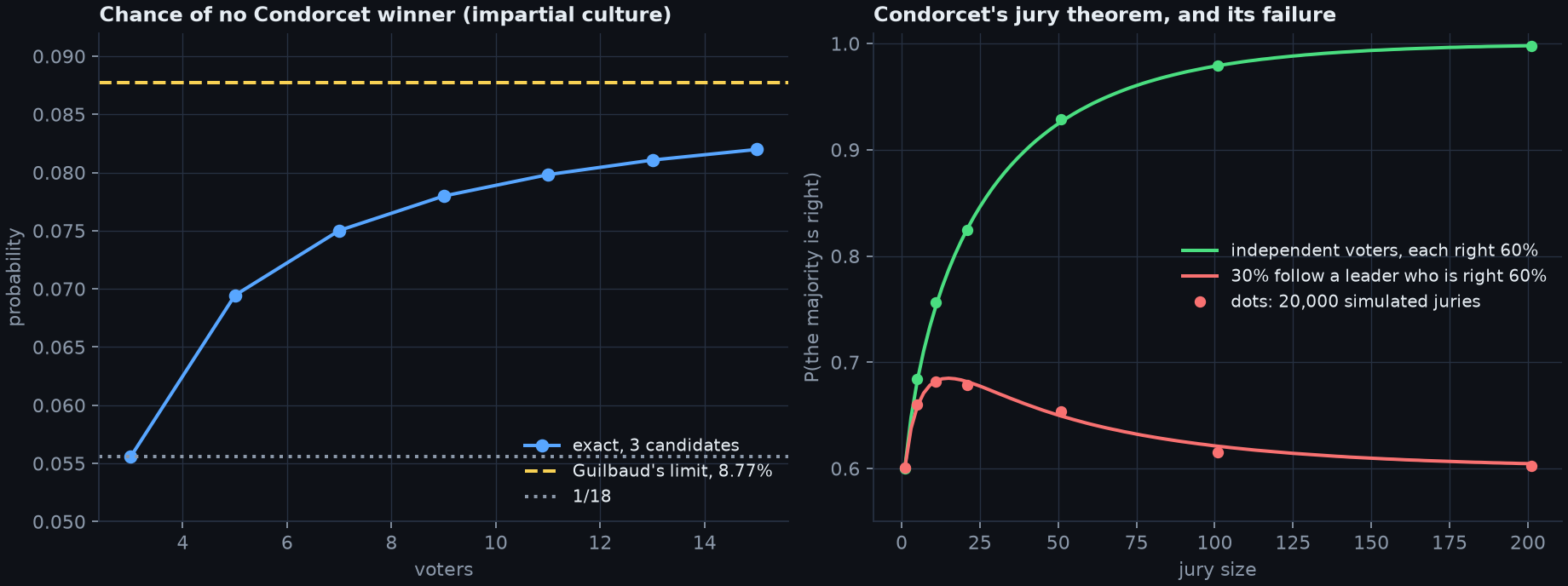
Is the cycle a curiosity? Suppose every voter picks one of the six possible rankings at random, the model called impartial culture. The Reasoner adds up the exact probability, over every way the votes could fall, that there is no Condorcet winner: one in eighteen with three voters, about seven percent with five, eight and a half percent with thirty one. As the electorate grows, the probability tends to a limit that Georges-Théodule Guilbaud found in 1952: a quarter, minus three over two pi times the arcsine of a third, about eight point eight percent. With more candidates, cycles become common: simulating twenty thousand elections of a hundred and one voters, seventeen percent have no winner with four candidates, and thirty seven percent with seven. Real electorates are far less random than impartial culture, and cycles in real elections are rare; but they are always possible.
Do cycles happen in real votes? William Riker claimed several, including the defeat of a school construction bill in the United States House in 1956, after an amendment by Adam Clayton Powell. Gerry Mackie's Democracy Defended, of 2003, re-examined Riker's cases and argued that most do not survive scrutiny. Michel Regenwetter and colleagues' Behavioral Social Choice, of 2006, found majority cycles rare in survey and election data. The reason is that real preferences are correlated, often along a single dimension, which is far from impartial culture, as chapter seven explains.
What it establishes: Condorcet (1785); Llull; Cusanus; Borda; Dodgson; Guilbaud (1952); Riker; Mackie; Regenwetter et al.; Computed on screen: the cycle; P(no winner), exact and simulated
2Five rules, five winnersIntroductory6 min
Condorcet and Borda disagreed about how to count. Here is why it matters. Fifty five voters rank five candidates; there are six kinds of ballot, with eighteen, twelve, ten, nine, four and two voters. Count first places, and A wins with eighteen: plurality. Hold a runoff between the top two, and B beats A thirty seven to eighteen. Eliminate the weakest candidate one at a time, transferring their ballots, and C wins: instant runoff. Give four points for a first place, three for a second, and so on, and D wins, a hundred and thirty six to E's hundred and thirty four: the Borda count. And E beats every other candidate head to head, so E is the Condorcet winner. The same ballots elect any of the five, depending on the rule.
Instant runoff deserves a closer look, because it is used for real elections. In round one, E has the fewest first places, six, and is eliminated; E's ballots pass to their next choices, four to B and two to C. In round two D goes, and D's nine voters move to C. In round three B goes, and all sixteen of B's ballots now prefer C to A. C wins with thirty seven of fifty five, though C had only ten first places at the start. The method is used in Australia and Ireland, and in Maine since 2018 and Alaska since 2022. Yet E, eliminated first, beats every other candidate head to head.
Instant runoff has a stranger flaw, which the Reasoner finds by search. Twenty one voters: six rank A, C, B; five B, A, C; two B, C, A; and eight C, B, A. In the first round A has six, B seven and C eight, so A is eliminated, A's voters move to C, and C wins fourteen to seven. Now two of the B, C, A voters decide they like C even more, and move C to the top. C has gained support, and nothing else has changed. The first round is now A six, B five, C ten. B is eliminated, B's five ballots go to A, and A beats C eleven to ten. More votes for C made C lose. This is a failure of monotonicity. The search checks three candidates, odd electorates, distinct totals in every round, and raises the winner on one ballot type at a time. Its first witness has twenty one voters. Plurality and Borda never do this.
Here is every head-to-head contest. E's row is all wins: E beats A, B and C easily, and D by the narrowest margin, twenty eight to twenty seven. Rules built on head-to-head contests agree: Copeland counts pairwise wins; Kemeny finds the ranking that agrees with the most pairwise preferences, E, D, C, B, A; and Schulze's method, used by the Wikimedia Foundation and the Debian project, also elects E. And A, the plurality winner, loses every head-to-head contest, eighteen to thirty seven: Borda's complaint of 1770, exactly.
A cycle hands power to whoever controls the order of voting. Take Condorcet's three voters and vote in pairs, the winner meeting the next candidate. A against B first: A wins, then loses to C. A against C first: C wins, then loses to B. B against C first: B wins, then loses to A. Every agenda elects someone different. Richard McKelvey proved in 1976 that with two or more issues, a skilled agenda setter can lead a majority from almost any point to almost any other. William Riker's Liberalism against Populism, of 1982, concluded that the will of the people is an artefact of the procedure, and that democracy can only promise the power to remove rulers, not to express a general will.
The old debate is still live, now with theorems. Peyton Young proved in 1975 that the scoring rules, like Borda's, are exactly the rules that are consistent: if two separate electorates both choose a candidate, so does their union. Donald Saari argued through the 1990s that the Borda count alone avoids a family of paradoxes that arise when candidates are added or removed. Young also showed in 1988 that Condorcet's own probabilistic argument, done correctly, yields Kemeny's rule, the most likely true ranking if each voter is more often right than wrong. But no rule is both Condorcet-consistent and consistent in Young's sense, so the choice between the two traditions is a choice between principles.
Electing a parliament raises a different question: not who is best, but who represents. Thomas Hare proposed the single transferable vote in 1857: any candidate who reaches a quota is elected, surplus votes and the weakest candidates' ballots are transferred, and the count repeats. The usual quota, Henry Droop's, is the smallest number of votes that no more than S candidates can reach when S seats are filled. List systems give parties seats in proportion to their votes, by the divisor methods of D'Hondt and Sainte-Laguë that chapter ten meets again. Proportional parliaments represent minorities, and usually need coalitions to govern.
What it establishes: plurality, runoff, IRV, Borda, Condorcet, Copeland, Kemeny, Schulze; McKelvey; Riker; Young; Saari; Hare; Droop.; Computed on screen: five winners; IRV rounds; pairwise matrix; agendas; IRV non-monotonicity
3Majority rule, characterizedAdvanced3 min
Before the impossibility, a possibility. In 1952 Kenneth May asked what is special about majority rule, when there are only two alternatives. Anonymity: every voter counts the same, so permuting the voters changes nothing. Neutrality: the alternatives are treated alike, with no built-in advantage for the status quo. Positive responsiveness: if the result is a tie or a win for x, and one voter moves toward x, then x wins. May proved that a rule has all three properties, on every profile, if and only if it is simple majority rule.
The Reasoner checks May's theorem by brute force, for three voters. An anonymous rule can only look at the counts: how many vote for x, how many abstain, how many vote for y. There are ten possible counts. A rule assigns each count a result, x, y or a tie, so there are three to the tenth, fifty nine thousand and forty nine rules. Keep those that are neutral: swapping the names of x and y swaps the result. And keep those that are positively responsive: if one voter moves toward x, a tie becomes a win for x, and a win stays a win. Exactly one rule survives, and it is simple majority: x wins when more vote for x than for y.
The proof for any number of voters is short. Anonymity means the result depends only on how many vote for x and how many for y. Neutrality means that swapping the counts swaps the result, so when the counts are equal, neither side can win: it must be a tie. Positive responsiveness then means that from a tie, one more vote for x makes x win, and every further vote keeps x winning. So x wins exactly when it has more votes than y: simple majority, and nothing else.
May's theorem explains both the appeal of majority rule and its departures. Supermajority rules, such as a two-thirds vote to amend a constitution, give up neutrality on purpose, to protect the status quo. Shareholder votes, weighted by shares, give up anonymity on purpose. Partha Dasgupta and Eric Maskin showed in 2008 that majority rule satisfies the key conditions on a wider range of electorates than any other rule. But May's theorem is about two alternatives. With three or more, majority rule can cycle, and the next chapter asks whether any rule can do better.
What it establishes: May (1952); Dasgupta and Maskin (2008).; Computed on screen: 59,049 rules searched
4Arrow's theoremAdvanced4 min
Kenneth Arrow's Social Choice and Individual Values, of 1951, his doctoral thesis, asked for a rule that turns individual rankings into a social ranking. He asked for five things. The rule must accept any profile of individual rankings. Its output must be a complete and transitive ranking. If everyone prefers x to y, so must society. Society's ranking of x and y must depend only on how individuals rank x and y. And there must be no dictator, no voter whose strict preference always becomes society's. With three or more alternatives, Arrow proved, no rule satisfies all five.
The condition that does the most work is the independence of irrelevant alternatives. On the fifty five voter ballots, the Borda count ranks D first, a hundred and thirty six to E's hundred and thirty four. Now candidate C, who was never going to win, withdraws. Recount: E has ninety eight, D ninety three, and E wins. No voter changed their mind about D and E; twenty eight voters prefer E to D before and after. Only an irrelevant alternative left. Independence forbids exactly this: society's ranking of two candidates may depend only on how voters rank those two.
Arrow's proof can be drawn. Here is John Geanakoplos's version, from 2005, with five voters. Start with every voter ranking candidate b last. By the Pareto principle, society ranks b last too. Now move b to the top of the voters' rankings, one voter at a time. Using independence, one can show that b must always be either at the very top or the very bottom of society's ranking, never in the middle. When every voter has moved b to the top, Pareto puts b on top of society. So at some voter, the pivotal voter, b jumps from the bottom to the top. Two more applications of independence show that this pivotal voter decides every other pair as well. The pivotal voter is a dictator. Any rule with Arrow's conditions hides one.
The theorem's reception shaped the field. Arrow shared the Nobel prize in economics in 1972, and the theorem founded social choice theory. Amartya Sen's Collective Choice and Social Welfare, of 1970, showed that the impossibility depends on using rankings alone: if utilities can be compared between people, utilitarian and leximin rules satisfy versions of all the conditions. William Riker drew a pessimistic conclusion for democratic theory, as chapter two showed. Gerry Mackie, John Dryzek and others replied that Arrow's conditions are idealized, and that deliberation can change the profile itself, a reply chapter eleven will test.
Arrow's theorem has relatives. Robert Wilson showed in 1972 that without Pareto, a rule satisfying independence is either imposed, dictatorial, or inversely dictatorial, always doing the opposite of one voter. Sen's liberal paradox, from Part 38, shows that even minimal rights conflict with Pareto. And Alan Kirman and Dieter Sondermann showed in 1972 that with infinitely many voters, Arrow's conditions can be met, but only by an invisible dictator: a decisive family of coalitions called an ultrafilter. The lesson is not that every rule always fails, but that every rule can fail at some profile.
This is the thirty ninth brick in the Wall. The dream was a fair way to add up preferences: a rule that turns any set of individual rankings into a social ranking, respects unanimity, judges each pair on its own merits, and gives no one the last word. Arrow proved there is none, and two further theorems in this part, Gibbard and Satterthwaite's on manipulation and List and Pettit's on judgments, build the same wall elsewhere. What it forces is a choice of which condition to give up, and every real voting system has made one.
What it establishes: Arrow (1951); Geanakoplos (2005); Wilson; Kirman–Sondermann; Sen; Riker; G. Mackie; Dryzek; the Wall's thirty-ninth brick.; Computed on screen: Borda breaks IIA
5Arrow by machineApplied4 min
Arrow's theorem can also be proved by machine. In 2009 Pingzhong Tang and Fangzhen Lin showed that the whole theorem reduces to its smallest case, two voters and three candidates, and checked that case with a SAT solver, the tool of Part 2. The Reasoner rebuilds it. A social welfare function is a choice, for each of the thirty six profiles, of a social ranking. One variable says whether society ranks x above y at profile P: a hundred and eight variables. Each of Arrow's conditions becomes clauses. Social rankings must have no cycles: seventy two clauses. Pareto fixes some variables: fifty four. Independence ties together profiles that agree on a pair: eight hundred and sixty four. Non-dictatorship says that somewhere society disagrees with voter one, and somewhere with voter two. Nine hundred and ninety two clauses in all.
Then the solver runs. With all five conditions, it reports unsatisfiable, after a single decision and two conflicts: Pareto and independence propagate through the formula almost by themselves. Drop non-dictatorship, and ask for every solution, blocking each one as it is found: there are exactly two. One copies voter one's ranking at every profile; the other copies voter two's. Independence and Pareto leave room for nothing but a dictator. Drop the ordering condition as well, and there are sixty four solutions, each deciding every pair on its own, and most of them producing cycles. The Reasoner checks all thirty two subsets of the conditions: drop any one, and a rule exists. That is the Price List.
Five conditions cannot all hold. A complete and transitive social ranking; respect for unanimity; each pair judged on its own; and no dictator, voter one or voter two. Every voting system pays somewhere. Allow cycles, and pairwise majority voting satisfies the rest, as Condorcet proposed. Give up independence, as the Borda count, Kemeny's rule, instant runoff and every ranked rule in real use do. Give up Pareto, and impose a ranking regardless of the votes. Or accept a dictator. And the encoding quietly assumed a sixth condition, that any profile can occur; chapter seven shows what happens when it cannot.
Computer-aided social choice is now a field of its own. Tang and Lin's induction lemma shows that if the theorem holds for two voters and three candidates, it holds for every number of each. Tobias Nipkow formally verified Arrow's theorem and Gibbard and Satterthwaite's in the proof assistant Isabelle in 2009. Christian Geist and Ulle Endriss had a computer search for impossibility theorems about ranking sets of objects, and it found eighty four new ones, in 2011. And Felix Brandt and Geist used SAT solvers to prove new impossibilities about efficient, strategy-proof rules, in 2016. Theorems that once took years can now be searched for.
The same tools now check real elections. Counting rules are complex: the single transferable vote used in Ireland, Malta and Australia's Senate comes in many variants. An error in counting code can change a result without anyone noticing, and a rule is only as good as its implementation. Milad Ghale, Rajeev Goré, Dirk Pattinson and Mukesh Tiwari built, in 2018, single transferable vote counters verified in a proof assistant. Their counters output a certificate, a proof that the result follows the rule, which anyone can check independently of the software that produced it.
What it establishes: Tang and Lin (2009); Nipkow; Geist and Endriss; Brandt and Geist; Ghale et al. (2018); the Price List.; Computed on screen: the SAT encoding, solve, model counts, correction sets
6ManipulationAdvanced4 min
Allan Gibbard in 1973 and Mark Satterthwaite in 1975 proved the second impossibility of this part. Call a rule strategy-proof if no voter can ever gain by misreporting her ranking. Every strategy-proof rule with three or more possible winners is a dictatorship. The proof shows that strategy-proofness forces conditions very like Arrow's, and then Arrow's theorem applies. In practice this is tactical voting: deserting a favourite who cannot win, or burying a rival at the bottom of one's ballot.
The Reasoner searches for manipulations directly. With three voters and three candidates there are two hundred and sixteen profiles. For each rule and each profile, it asks whether some voter, by reporting a different ranking, can get an outcome she truly prefers. Plurality can be manipulated at thirty six profiles, the Borda count at fifty one, instant runoff and Copeland at twenty four each. Here is one: three ballots, a b c, b a c and c b a. Every candidate has one first place, the tie is broken alphabetically, and a wins. The third voter, whose favourite c cannot win, votes for b instead, and b wins, which she prefers to a. Only two rules are never manipulable: a dictatorship, and a rule that only ever elects a or b. Exactly as the theorem says.
If manipulation cannot be prevented, perhaps it can be made hard. John Bartholdi, Craig Tovey and Michael Trick showed in 1989 that for some rules, finding a manipulation is NP-hard, and that even finding the winner under Kemeny's rule is NP-hard. Vincent Conitzer, Tuomas Sandholm and Jérôme Lang showed that coalitions face hard problems even with few candidates. But Ehud Friedgut, Gil Kalai and Noam Nisan proved in 2008 that at random profiles, a random manipulation succeeds with noticeable probability. Piotr Faliszewski and Ariel Procaccia's survey of 2010, AI's War on Manipulation: Are We Winning?, concluded that worst-case hardness is a weak shield.
Manipulation is not only a theorem; it shapes party systems. Maurice Duverger observed in 1951 that plurality voting tends to produce two parties, because voters desert third parties that cannot win. A third candidate who splits a majority can elect the candidate that majority opposes: the spoiler effect. Gary Cox's Making Votes Count, of 1997, generalized the law: in a district electing M members, strategic voting leaves at most M plus one viable candidates. Rules such as approval voting and runoffs let voters support a favourite without wasting their vote, at least partly; none escapes the theorem completely.
The theorem has escape routes, each with a price. If preferences are single-peaked, electing the median of the reported peaks is strategy-proof, as Hervé Moulin showed in 1980: the next chapter. With only two options, majority voting is strategy-proof. With money, the mechanisms of William Vickrey, Edward Clarke and Theodore Groves charge each person for the effect of their report on everyone else, and make honesty optimal. And Gibbard showed in 1977 that the strategy-proof random rules are lotteries over dictators and over pairwise votes.
What it establishes: Gibbard (1973); Satterthwaite (1975); Bartholdi, Tovey, Trick; Conitzer et al.; Friedgut, Kalai, Nisan; Faliszewski–Procaccia; Duverger; Cox; Moulin; Vickrey–Clarke–Groves; Gibbard (1977).; Computed on screen: 216 profiles × 6 rules
7Single peaksAdvanced4 min
Arrow's first condition was that any profile of rankings may occur. Often they cannot. Line the options up from left to right, here five positions from left to right in politics. Duncan Black, in 1948, called a voter's preferences single-peaked if she has a favourite position and likes the others less the further away they are. Three voters, with peaks at centre left, centre and centre right. Black proved that the median peak, here the centre, beats every other option by majority. Anything to its right is opposed by the median voter and everyone to her left, and anything to its left by the median voter and everyone to her right.
The Reasoner checks the theorem on every case. Of the hundred and twenty rankings of five positions, sixteen are single-peaked on this axis. Three voters with single-peaked rankings give sixteen cubed, four thousand and ninety six profiles. Every one of them has a Condorcet winner, and in every one it is the median voter's peak. Drop the restriction and draw ten thousand profiles at random: fifteen and a half percent have no Condorcet winner at all. Restricting the domain is the classic escape from Arrow's theorem: on single-peaked profiles, pairwise majority is transitive.
The median voter became a cornerstone of political science. Harold Hotelling observed in 1929 that two shops competing along a street will crowd together at its middle. Anthony Downs's An Economic Theory of Democracy, of 1957, applied the idea to two parties, who should converge on the median voter's position. Real parties often do not converge, because of turnout, activists, primaries, and politics having more than one dimension. With two or more issues, Charles Plott showed in 1967 that a point that beats every other by majority requires an improbable symmetry among voters, and McKelvey's chaos returns.
How close is real politics to a single dimension? Keith Poole and Howard Rosenthal's NOMINATE method, from 1985, places every legislator and every roll call in the space that best explains the votes. For most of the history of the United States Congress, a single dimension, roughly left to right on economics, explains most roll-call votes. The two parties' positions on it have moved steadily apart since the 1970s. Close to one dimension, cycles are unlikely and the median voter matters, which is one reason majority rule works as well as it does.
Other restrictions also work. Amartya Sen's value restriction of 1966 requires only that, in each triple of options, all voters agree that some option is not best, or not middle, or not worst. Single-crossing preferences, where voters can be lined up so that each pair's supporters form an interval, again yield a median voter. Hervé Moulin showed in 1980 that on single peaks, choosing the median of the reported peaks is also strategy-proof. And Christian List, Robert Luskin, James Fishkin and Iain McLean found in 2013 that deliberation made participants' preferences more single-peaked: talking may make democracy coherent.
What it establishes: Black (1948); Hotelling; Downs; Plott; Poole–Rosenthal; Sen (1966); Moulin; List et al. (2013).; Computed on screen: 4,096 single-peaked profiles
8Beyond rankingsAdvanced4 min
One response to Arrow is to ask voters for more than a ranking. Range voting asks for a score for every candidate, and the highest total wins. Approval voting, studied by Steven Brams and Peter Fishburn in 1978, lets voters approve as many candidates as they like; Fargo, North Dakota adopted it in 2018 and St. Louis in 2020. Michel Balinski and Rida Laraki's majority judgment asks voters to grade each candidate in words, from excellent to reject, and elects the one with the highest median grade. These rules take grades rather than rankings as input, so Arrow's theorem does not apply to them as stated. Whether grades mean the same to different voters is the question that remains.
Grading rules have been tried in the field. Balinski and Laraki ran majority judgment alongside the 2007 French presidential election in polling stations at Orsay, and found that voters used the grades readily. No rule escapes manipulation entirely; medians blunt the effect of exaggeration, and approval voting rewards a sincere vote for one's top choices. All of these rules assume that a grade such as good means the same to every voter, which is assumed rather than shown. If it does, independence can hold: Arrow's theorem had its force because rankings carry so little information.
Rankings cannot express how much a voter cares. Quadratic voting can. Each voter may cast as many votes as she likes, for or against, but v votes cost v squared. A voter who gains u if a measure passes buys the number of votes that maximizes u v minus v squared, which is u over two: votes in proportion to the stakes. Three voters gain ten each from a measure; one loses fifty. They buy five votes each; she buys twenty five against, at a cost of six hundred and twenty five. One person, one vote passes the measure, three to one. Quadratic voting rejects it, fifteen to twenty five, as the total stakes, minus twenty, say it should. Steven Lalley and Glen Weyl proved in 2018 that in large populations the outcome tends to maximize total value. Democrats in the Colorado House used it to rank bills in 2019, and quadratic funding allocates donations to open-source software. The objections: it lets money matter, and the rich can buy more votes.
Approval ballots also power a newer practice. In participatory budgeting, begun in Porto Alegre, Brazil, in 1989, citizens vote directly on part of a city's budget. Haris Aziz and colleagues defined justified representation in 2017: any large enough group of voters who agree on projects deserves some of what it wants. Dominik Peters and Piotr Skowron's method of equal shares gives each voter an equal share of the budget, to be spent only on projects that voter approves. It decided real budgets in Wieliczka, Poland, in 2023, and in Aarau, Switzerland.
The deepest escape changes the input. Arrow's rules see only rankings: no intensities, and no comparisons between people. Sen showed in 1970, and Claude d'Aspremont and Louis Gevers in 1977, that once utilities can be compared across people, the utilitarian sum and the leximin rule, which maximizes the position of the worst off, satisfy all of Arrow's other conditions. Harsanyi's theorem in Part 35 and the veil of ignorance in Part 38 are aggregation theorems of exactly this kind. The cost is that someone must decide how one person's gain compares with another's loss, and that is not a matter that voting can settle.
What it establishes: range; approval (Brams–Fishburn); majority judgment (Balinski–Laraki); Lalley–Weyl; Aziz et al.; Peters–Skowron; d'Aspremont–Gevers.; Computed on screen: quadratic voting
9Do crowds know?Introductory4 min
Condorcet had a second, more hopeful theorem. Suppose a question has a right answer, and each voter is independently more likely than not to get it right. Then the probability that the majority is right grows with the number of voters, toward certainty. The Reasoner computes it exactly: with each voter right sixty percent of the time, two hundred and one voters are right as a majority with probability point nine nine eight. Even at fifty five percent, the majority of two hundred and one is right ninety two percent of the time. But independence is doing the work. Let each voter, with probability thirty percent, copy an opinion leader who is right sixty percent of the time. Given the leader's answer, voters are right with probability point seven two or point four two, and the crowd simply follows the leader: however large it grows, it is right about sixty percent of the time. Krishna Ladha in 1992, and Franz Dietrich and Kai Spiekermann in 2013, made such results precise.
The jury theorem's fragility can be measured. Jan Lorenz and colleagues showed in 2011 that when participants saw each other's estimates, the crowd's range narrowed while its accuracy did not improve: people became more confident, not more right. Economists call the extreme case an information cascade: each person follows those before, and private evidence is lost. The remedy is to collect independent judgments first and discuss afterwards, engineering the very condition the theorem needs.
A school of democratic theory builds on these results. Francis Galton reported in 1907 that the median of seven hundred and eighty seven guesses of an ox's weight at a country fair was within one percent of the truth. David Estlund's Democratic Authority argued that democracy deserves authority because it does better than chance at getting things right, by procedures all reasonable people can accept. Hélène Landemore's Democratic Reason argued that many diverse minds outperform a few experts. Jason Brennan's Against Democracy replied that voters are often badly informed, and that rule by the knowledgeable deserves consideration. Which side the jury theorem supports depends on whether its conditions hold.
Markets are another way to pool judgments. Friedrich Hayek argued in 1945 that prices gather knowledge that no single person has. In a prediction market, a contract that pays a dollar if an event happens trades at roughly its probability; the Iowa Electronic Markets began trading on elections in 1988. Justin Wolfers and Eric Zitzewitz reviewed the record in 2004 and found such markets often as accurate as polls or experts, and sometimes more. Their limits are thin trading, a tendency to overprice long shots, and occasional attempts at manipulation.
A second argument for crowds concerns diversity. Lu Hong and Scott Page argued in 2004 that diversity trumps ability, and the Reasoner rebuilds their model. Values are scattered at random on a ring of two thousand points. An agent searches by trying three step sizes in a fixed order, moving whenever it finds a higher value; there are one thousand three hundred and twenty such agents. Teams work in relay, each member continuing from where the last one stopped. On this rugged landscape, a team of ten agents drawn at random beats the team of the ten best individuals in all five runs, ninety four to eighty nine in the first. The ten best are too alike: together they use only five step sizes, the random ten all twelve. Smooth the landscape, and the advantage vanishes. The mathematician Abigail Thompson argued in 2014 that Hong and Page's theorem is mathematically trivial and does not support the slogan; the simulation shows that the result depends on the problem.
What it establishes: Condorcet; Ladha; Dietrich–Spiekermann; Lorenz et al.; Hayek; Wolfers–Zitzewitz; Galton; Estlund; Landemore; Brennan; Hong–Page; Thompson.; Computed on screen: jury curves; Hong–Page in ten runs
10Group minds and seatsResearch5 min
Groups do not only rank options; they also make judgments. Lewis Kornhauser and Lawrence Sager described this case in 1986. A court of three judges must decide whether a defendant is liable, which by law holds exactly when a valid contract was breached, p, and damage resulted, q. The first judge says yes to both, so liable. The second says breach but no damage; the third damage but no breach. Majorities: breach, yes, two to one. Damage, yes, two to one. Liability, no, two to one. The majority accepts p, accepts q, and rejects p and q. Voting on the premises finds the defendant liable; voting on the conclusion does not. Philip Pettit called the general problem the discursive dilemma: any group that must give reasons for its decisions faces it.
Christian List and Philip Pettit proved in 2002 that the problem is general. The Reasoner checks the smallest case. Ask for a rule that treats judges equally and every proposition alike: whether the group accepts a proposition depends only on how many judges accept it. With three judges, such a rule is a function of a number from zero to three. Completeness means the group accepts each proposition or its negation, which leaves four rules: majority voting, and three stranger ones. For each, the Reasoner searches the sixty four profiles of consistent judges, and finds one where the group's judgments are inconsistent. So the group must give up something: treating propositions alike, as premise-based voting does; treating judges alike, by following one of them; or the freedom of judges to hold any consistent view. List and Pettit's Group Agency, of 2011, argued that groups that manage this are agents in their own right.
Groups also pool degrees of belief, the subject of Part 13. Averaging the members' probabilities, linear pooling, is the only rule that treats each event separately and preserves unanimity, as Kevin McConway proved in 1981. But it does not commute with learning: pooling and then updating on evidence gives a different answer from updating and then pooling. Averaging log-probabilities instead, geometric pooling, commutes with learning but gives up independence. Franz Dietrich and Christian List showed that every pooling rule trades one desideratum for another: Arrow's theorem again, now for credences.
A last problem of democratic arithmetic: dividing a parliament's seats among states in proportion to population. Three states with populations twenty, sixteen and seven. Each state's quota is its exact share of the seats. Alexander Hamilton's method gives each state the whole part of its quota, then hands the remaining seats to the largest fractional parts. With nine seats, Z gets two. Now enlarge the house to ten seats. Every quota grows, but Z's remainder is now the smallest, and Z drops to one seat. In 1880 the Census Office found that Alabama would lose a seat in exactly this way. Webster's divisor method gives Z two seats both times. But divisor methods have their own flaw: by search, the Reasoner finds a case where Jefferson's method gives a state eight seats when its quota is six point eight nine. Michel Balinski and Peyton Young proved in 1982 that no method both stays within quota and avoids such paradoxes.
Seats depend not only on how many each state gets, but on how districts are drawn. Gerrymandering packs opponents into a few districts and cracks the rest among many, winning seats without winning votes. Nicholas Stephanopoulos and Eric McGhee proposed in 2015 to measure it by comparing each party's wasted votes, the efficiency gap. Mathematicians, including Moon Duchin's group, generate thousands of random lawful maps by Markov chain sampling; an enacted map that is an extreme outlier among them is suspect. Such analyses have been offered in many recent court cases, with mixed success.
What it establishes: Kornhauser–Sager (1986); Pettit; List–Pettit (2002, 2011); McConway; Dietrich–List; Hamilton; Webster; Jefferson; Balinski–Young; Stephanopoulos–McGhee; Duchin.; Computed on screen: the doctrinal paradox; four rules fail; Alabama; a quota violation
11Deliberation, delegation, and AIApplied5 min
Arrow's theorem treats preferences as given. Deliberative democracy treats them as something to be formed. Jürgen Habermas's Between Facts and Norms, of 1992, located legitimacy in public reasoning among equals rather than in the aggregation of votes. James Fishkin's deliberative polls bring a random sample of citizens together to deliberate before they vote; their opinions shift, and, as chapter seven noted, grow more single-peaked. Ireland's Citizens' Assembly of ninety nine randomly chosen citizens deliberated on abortion from 2016, and a referendum followed in 2018. Tools such as Polis, used in Taiwan's vTaiwan process, map clusters of opinion online and surface the statements that every cluster supports.
Another reform changes who votes. In liquid democracy, proposed in this form by Bryan Ford in 2002, each person may vote on any issue or delegate their vote to someone else, who may delegate it again. Germany's Pirate Party used a version of it, LiquidFeedback. Anson Kahng, Simon Mackenzie and Ariel Procaccia showed in 2018 that no local delegation rule can guarantee better decisions than direct voting: delegation can concentrate votes in a few hands. In the language of chapter nine, delegation is correlation, and correlation is what undoes the jury theorem.
An older device is returning. In classical Athens most magistrates were chosen by lot, with a stone allotment machine called the kleroterion, and election was regarded as aristocratic. Alexander Guerrero proposed in 2014 a lottocracy of randomly chosen single-issue legislatures, informed by experts. Hélène Landemore's Open Democracy, of 2020, argues for open mini-publics in place of elected elites. And Bailey Flanigan and colleagues published in Nature, in 2021, algorithms that select citizens' assemblies representative of the population while giving every volunteer as equal a chance of selection as possible; they are used to select real assemblies.
Today's language models are tuned on human preferences, and that is social choice in disguise. Suppose sixty percent of annotators rank three answers x, y, z, and forty percent rank them y, z, x; each picks her preferred answer ninety percent of the time, and which group an annotator belongs to is hidden. The table shows how often each answer beats each other. x beats y and z fifty eight percent of the time: x is the Condorcet winner. Standard training fits a Bradley-Terry model, a score for each answer, by maximum likelihood. The Reasoner fits it, and the scores rank y first, then x, then z: exactly the order of the Borda count. Anand Siththaranjan, Cassidy Laidlaw and Dylan Hadfield-Menell proved in 2023 that this is general: when the comparisons hide differences between people, fitting a reward model implicitly aggregates them by Borda count. The choice of aggregation rule was made without anyone deciding it.
Language models are entering collective decisions themselves. Lisa Argyle and colleagues found in 2023 that language models can imitate the survey answers of demographic groups, imperfectly. Sara Fish and colleagues proposed generative social choice in 2024: a model drafts statements, and an algorithm picks a slate that represents every group, with proportionality guarantees. Michael Henry Tessler and colleagues reported in 2024 that an AI mediator wrote group statements that participants preferred to statements by human mediators. The worry is chapter two's lesson again: whoever writes the options, or the summaries, sets the agenda.
Social choice theorists have taken notice. Vincent Conitzer and colleagues argued in 2024 that social choice should guide AI alignment: the aggregation rule should be chosen deliberately, with its axioms in view. Luise Ge and colleagues showed the same year that the standard way of fitting reward models violates basic axioms of social choice. In 2023 Anthropic and the Collective Intelligence Project asked about a thousand Americans to draft and vote on principles for a language model, using Polis. Part 41 turns to fairness criteria for machines that cannot all hold together, and Part 42 to the question of whose values a machine should have.
What it establishes: Habermas (1992); Fishkin; Ireland; Polis; Ford; Kahng et al.; Guerrero; Landemore; Flanigan et al.; Siththaranjan et al.; Conitzer et al.; Ge et al.; Argyle et al.; Fish et al.; Tessler et al.; Computed on screen: Bradley–Terry against Borda and Condorcet
Recap, problems, and where this comes backAll tracks2 min
Let's gather what we built. Condorcet's cycle, and its probability: one in eighteen with three voters, eight point eight percent in the limit, and thirty seven percent with seven candidates. Five rules with five winners, and an agenda that decides the outcome. May's theorem: of fifty nine thousand rules, only simple majority survives. Arrow's theorem and the pivotal voter, this part's brick in the Wall, and the Borda count breaking independence. Arrow proved again by a SAT solver, with exactly two dictatorships left, and its Price List. Manipulations found for every reasonable rule, and the median voter winning every single-peaked profile. Quadratic voting, the jury theorem and its fragility, and diversity rebuilt. The discursive dilemma, Alabama's lost seat, and the discovery that reward models count like Borda.
The Reasoner has a new module, vote. It counts ballots by nine rules, computes the chance of a cycle exactly and by simulation, proves May's and Arrow's theorems by search and by SAT, searches for manipulations, checks the median voter theorem, computes juries, rebuilds Hong and Page, checks List and Pettit, divides seats, and fits reward models. And the Wall has its thirty ninth brick.
Six problems, with full solutions in this part's notes. Why an odd electorate never ties; a Borda winner who is not the Condorcet winner; why single peaks forbid cycles; why a dictator cannot be manipulated; the smallest jury theorem; and two seat methods that disagree. Pause here, and try them.
Where this comes back. Part 40 asks whether judgments of beauty can be right or wrong, and whether a crowd of critics converges. Part 41 meets fairness criteria for machines that cannot all hold together, an impossibility in Arrow's style. And Part 42 asks how to aggregate human feedback, and whose values a machine should have. Next, Part 40: beauty.
The books and papers this part follows are on screen, and in the notes. Thanks for watching.
Where it goes next. Part 40 asks whether a panel of critics converges as a jury does. Part 41 meets fairness criteria that cannot hold together, an impossibility in Arrow's style, and Part 42 uses the Borda lesson for learning from human feedback and asks whose values a machine should aggregate.
Key results
The part's results in one place, for revision.
Try it
Lab 39 · Five winners, a cycle's probability, and Arrow by machine
Count the film's 55 ballots by five rules, check on random electorates that three rules always elect a Condorcet winner while plurality and Borda do not, compare the chance of no Condorcet winner with 1/18 and Guilbaud's limit, and compare simulated juries with the binomial formula, with and without an opinion leader.
python -m videos.philosophy.labs 39
needs numpy, scipy, matplotlib · download lab39.py ·
source on GitHub55 voters: plurality, runoff, IRV, Borda, Condorcet A, B, C, D, E (film: A, B, C, D, E)
random electorates with a Condorcet winner 184 of 250
... Copeland, Kemeny, Schulze elect it 184 of 184 (theory: always)
... plurality, Borda, IRV miss it 69, 27, 22 times
P(no Condorcet winner), 3 voters, 3 candidates 0.05556 (theory: 1/18 = 0.05556)
... 101 voters, simulated 0.0853 (Guilbaud's limit 0.0877)
... 3, 4, 5, 6 candidates, simulated 0.080, 0.178, 0.241, 0.302
Arrow, 2 voters and 3 alternatives, as SAT 108 variables, 992 clauses, satisfiable: False (film: 108, 992, no)
rules with ORDER, PARETO and IIA 2, dictators [[1], [2]]
majority of 201 independent voters right 0.998 (theory 0.998; film 0.998)
... when 30% follow a leader 0.602 (theory 0.605, stuck near the leader's 0.60)
The rules disagree because there is often no fact for them to agree on: a majority can cycle, and Arrow's axioms leave only dictators. A crowd is wise only when its errors are independent.The code (104 lines; it asserts its own result)
"""Lab 39: count one election five ways, measure how often a majority cycles, and rerun Arrow's theorem by SAT."""

import numpy as np

from videos.coursekit import labs
from explainer.philosophy.reasoner import vote

TITLE = "Five winners, a cycle's probability, and Arrow by machine"
GOAL = ("Count the film's 55 ballots by five rules, check on random electorates that three rules always elect a "
        "Condorcet winner while plurality and Borda do not, compare the chance of no Condorcet winner with 1/18 and "
        "Guilbaud's limit, and compare simulated juries with the binomial formula, with and without an opinion leader.")
TASKS = [
    "In the random electorates use 3 candidates instead of 5. How often do plurality and Borda now miss the "
    "Condorcet winner, and how often is there none?",
    "Call vote.arrow_models with axioms ('ORDER', 'PARETO'). How many social welfare functions are there once "
    "independence is dropped, and why does the count stop at the limit?",
    "Set follow=0.6 in the jury simulation. Where does the majority's accuracy now peak, and what does it tend to?",
]


def _random_profile(rng, voters, alts="ABCDE"):
    orders = [tuple(alts[i] for i in rng.permutation(len(alts))) for _ in range(voters)]
    return [(orders.count(o), o) for o in sorted(set(orders))]


def run(seed=0):
    rng = np.random.default_rng(seed)
    lab = labs.Lab()

    z = vote.zoo()
    winners = [z["plurality"]["winner"], z["runoff"]["winner"], z["irv"]["winner"], z["borda"]["winner"], z["condorcet"]]
    lab.row("55 voters: plurality, runoff, IRV, Borda, Condorcet", f"{', '.join(winners)}   (film: A, B, C, D, E)")
    assert winners == list("ABCDE") and z["voters"] == 55

    n_elections, with_cw, miss = 250, 0, {"plurality": 0, "borda": 0, "irv": 0}
    for _ in range(n_elections):
        p = _random_profile(rng, 25)
        cw = vote.condorcet_winner(p)
        if cw is None:
            assert vote.majority_cycle(p) is not None, "25 voters cannot tie, so no winner means a top cycle"
            continue
        with_cw += 1
        for rule in (vote.copeland, vote.kemeny, vote.schulze):
            assert rule(p)["winner"] == cw, f"{rule.__name__} missed the Condorcet winner"
        for name in miss:
            miss[name] += getattr(vote, name)(p)["winner"] != cw
    lab.row("random electorates with a Condorcet winner", f"{with_cw} of {n_elections}")
    lab.row("... Copeland, Kemeny, Schulze elect it", f"{with_cw} of {with_cw}   (theory: always)")
    lab.row("... plurality, Borda, IRV miss it", f"{miss['plurality']}, {miss['borda']}, {miss['irv']} times")
    assert miss["plurality"] > 0 and miss["borda"] > 0, "neither is Condorcet-consistent"

    ns = [3, 5, 7, 9, 11, 13, 15]
    exact = [vote.paradox_exact(n) for n in ns]
    sim = vote.paradox_simulated(3, n=101, trials=20000, seed=1785 + seed)
    by_m = [vote.paradox_simulated(m, n=101, trials=3000, seed=1785 + seed) for m in (3, 4, 5, 6)]
    lab.row("P(no Condorcet winner), 3 voters, 3 candidates", f"{exact[0]:.5f}   (theory: 1/18 = {1 / 18:.5f})")
    lab.row("... 101 voters, simulated", f"{sim:.4f}   (Guilbaud's limit {vote.GUILBAUD:.4f})")
    lab.row("... 3, 4, 5, 6 candidates, simulated", ", ".join(f"{x:.3f}" for x in by_m))
    assert abs(exact[0] - 1 / 18) < 1e-12 and all(a < b < vote.GUILBAUD for a, b in zip(exact, exact[1:]))
    assert abs(sim - vote.GUILBAUD) < 0.012, "101 voters are close to the limit"
    assert by_m[0] < by_m[1] < by_m[2] < by_m[3], "more candidates, more cycles"

    arrow, models = vote.arrow_sat(), vote.arrow_models()
    lab.row("Arrow, 2 voters and 3 alternatives, as SAT", f"{arrow['n_vars']} variables, {arrow['total_clauses']} clauses, "
            f"satisfiable: {arrow['satisfiable']}   (film: 108, 992, no)")
    lab.row("rules with ORDER, PARETO and IIA", f"{models['models']}, dictators {models['dictator_of_each']}")
    assert (arrow["n_vars"], arrow["total_clauses"], arrow["satisfiable"]) == (108, 992, False)
    assert len(arrow["mus"]) == 1 and len(arrow["mus"][0]) == 5 and len(arrow["mcs"]) == 5, "every axiom is needed"
    assert models["models"] == 2 and sorted(models["dictator_of_each"]) == [[1], [2]]

    p, lead, follow, juries = 0.6, 0.6, 0.3, 20000
    sizes = np.array([1, 5, 11, 21, 51, 101, 201])
    sim_ind, sim_led = [], []
    for n in sizes:
        sim_ind.append(float((rng.binomial(n, p, juries) > n / 2).mean()))
        right = rng.random(juries) < lead
        q = np.where(right, follow + (1 - follow) * p, (1 - follow) * p)
        sim_led.append(float((rng.binomial(n, q) > n / 2).mean()))
    theory = vote.jury(ps=(p,), ns=tuple(int(n) for n in sizes), leader_p=lead, follow=follow)
    th_ind, th_led = np.array(theory["independent"][str(p)]), np.array(theory["correlated"])
    lab.row("majority of 201 independent voters right", f"{sim_ind[-1]:.3f}   (theory {th_ind[-1]:.3f}; film 0.998)")
    lab.row("... when 30% follow a leader", f"{sim_led[-1]:.3f}   (theory {th_led[-1]:.3f}, stuck near the leader's 0.60)")
    assert abs(th_ind[-1] - 0.998) < 5e-4 and np.abs(np.array(sim_ind) - th_ind).max() < 0.015
    assert np.abs(np.array(sim_led) - th_led).max() < 0.015 and abs(th_led[-1] - lead) < 0.03
    lab.note = ("The rules disagree because there is often no fact for them to agree on: a majority can cycle, and "
                "Arrow's axioms leave only dictators. A crowd is wise only when its errors are independent.")

    fig, ax = labs.figure(2, size=(11.5, 4.3))
    ax[0].plot(ns, exact, "o-", color=labs.BLUE, label="exact, 3 candidates")
    ax[0].axhline(vote.GUILBAUD, color=labs.GOLD, ls="--", label="Guilbaud's limit, 8.77%")
    ax[0].axhline(1 / 18, color=labs.MUTED, ls=":", label="1/18")
    ax[0].set(title="Chance of no Condorcet winner (impartial culture)", xlabel="voters", ylabel="probability",
              ylim=(0.05, 0.092))
    ax[0].legend(loc="lower right")
    curve = vote.jury(ps=(p,), leader_p=lead, follow=follow)
    ax[1].plot(curve["ns"], curve["independent"][str(p)], color=labs.GREEN, label="independent voters, each right 60%")
    ax[1].plot(curve["ns"], curve["correlated"], color=labs.RED, label="30% follow a leader who is right 60%")
    ax[1].plot(sizes, sim_ind, "o", color=labs.GREEN, ms=5)
    ax[1].plot(sizes, sim_led, "o", color=labs.RED, ms=5, label="dots: 20,000 simulated juries")
    ax[1].set(title="Condorcet's jury theorem, and its failure", xlabel="jury size", ylabel="P(the majority is right)",
              ylim=(0.55, 1.01))
    ax[1].legend(loc="center right")
    lab.fig = fig
    return lab
Now change it
- In the random electorates use 3 candidates instead of 5. How often do plurality and Borda now miss the Condorcet winner, and how often is there none?
- Call vote.arrow_models with axioms ('ORDER', 'PARETO'). How many social welfare functions are there once independence is dropped, and why does the count stop at the limit?
- Set follow=0.6 in the jury simulation. Where does the majority's accuracy now peak, and what does it tend to?
Problems, with solutions
Try each problem before opening its solution.
-
Show that with an odd number of voters, pairwise majority on two alternatives is never tied.
Solution
With two alternatives and strict preferences, every voter votes for exactly one of them, so the two tallies add to the number of voters, \(n\). A tie would mean each tally is \(n/2\), which is not a whole number when \(n\) is odd. So one alternative always has a strict majority. (Abstention or indifference would bring ties back.)
-
Find a profile of 3 voters on which the Borda winner is not the Condorcet winner.
Solution
With three voters and three alternatives no profile does it, but four alternatives suffice. Voters 1 and 2 rank \(a \succ b \succ c \succ d\); voter 3 ranks \(b \succ c \succ d \succ a\). Borda scores (3, 2, 1, 0 points): \(a\) gets \(3 + 3 + 0 = 6\), \(b\) gets \(2 + 2 + 3 = 7\), \(c\) gets 4, \(d\) gets 1, so \(b\) wins. But \(a\) beats every rival by two votes to one, so \(a\) is the Condorcet winner. Borda rewards \(b\) for voter 3's strong dislike of \(a\), which pairwise majority ignores.
-
Show that if preferences are single-peaked, the majority relation among 3 options has no cycle.
Solution
Order the options \(a < b < c\) on the line. Single-peakedness rules out ranking the middle option \(b\) last, so each voter ranks \(abc\), \(bac\), \(bca\) or \(cba\). A cycle \(a \succ b \succ c \succ a\) needs a majority with \(a\) over \(b\) (only \(abc\) voters) and a majority with \(c\) over \(a\) (\(bca\) and \(cba\) voters); these groups are disjoint, so both cannot be majorities. The reverse cycle \(a \succ c \succ b \succ a\) needs majorities with \(c\) over \(b\) (only \(cba\)) and with \(a\) over \(c\) (\(abc\) and \(bac\)), again disjoint. So no cycle: Black's median-voter theorem in miniature.
-
Show that a dictatorship is strategy-proof.
Solution
A dictatorship picks the dictator's reported top choice. Reporting truthfully already gets the dictator her favourite, so no misreport can do better for her. Every other voter's report is ignored, so no one else can change the outcome at all, and in particular cannot improve it by lying. So no one ever gains by misreporting: strategy-proof, which is why the Gibbard–Satterthwaite theorem must exclude dictatorship by assumption.
-
With p = 0.6, compute the probability that a majority of 3 independent voters is right.
Solution
A majority of three is right when at least two are right: \(p^3 + 3p^2(1 - p) = 0.216 + 3 \times 0.36 \times 0.4 = 0.216 + 0.432 = 0.648\). The group (64.8%) beats each voter (60%), and by Condorcet's jury theorem the margin grows with the number of independent voters.
-
Find quotas where Hamilton's method and Webster's method disagree.
Solution
The film's states, populations 20, 16 and 7 (43 in all), with 10 seats. Quotas: \(10 \times 20/43 = 4.65\), \(3.72\) and \(1.63\). Hamilton gives the floors 4, 3, 1, then the two remaining seats to the largest remainders, 0.72 and 0.65: \((5, 4, 1)\). Webster's divisor method rounds each population divided by a common divisor to the nearest whole number, with the divisor chosen so the seats add to 10; with divisor 4.5: \(4.44 \to 4\), \(3.56 \to 4\), \(1.56 \to 2\), giving \((4, 4, 2)\). The two methods disagree about whether the smallest state gets one seat or two.
Notes and sources
About this partfrom its README
Part 39 of Philosophy, Built (series plan, syllabus), in Act VII, Value: social choice. Rousseau's general will (1762) and a teaser: one 55-voter election, five standard rules, five winners. Condorcet's paradox (1785) as a cycle; Llull (1299), Cusanus (1433), Borda (1770), Dodgson (1876); the probability of no Condorcet winner under impartial culture, exact for 3 to 31 voters (1/18 at 3) with Guilbaud's limit (1952, 8.77%), and simulated for 3 to 7 candidates (8.5% to 37%); Riker's claimed cycles, Mackie (2003), Regenwetter et al. (2006). Five rules, five winners (plurality A, runoff B, instant runoff C, Borda D, Condorcet E), instant runoff round by round, the head-to-head matrix (Copeland, Kemeny, Schulze), agenda control (McKelvey 1976; Riker 1982), instant runoff's non-monotonicity found by search (a 21-voter witness in the restricted search), Young's consistency (1975), Saari, Young's Kemeny (1988), STV, Droop and list systems. May's theorem (1952) by exhaustive search (59,049 rules, 1 survivor) and its proof; Dasgupta–Maskin (2008). Arrow's theorem (1951): the conditions, the Borda count breaking IIA (withdraw C and D and E swap), Geanakoplos's pivotal voter (2005) drawn, Wilson (1972), Kirman–Sondermann (1972), Sen (1970) — the Wall's thirty-ninth brick. Arrow by SAT (Tang and Lin 2009): 108 variables, 992 clauses, unsatisfiable; ORDER, PARETO and IIA have exactly two models, both dictatorships; all 32 subsets checked; a Price List of Arrow's conditions; Nipkow (2009), Geist–Endriss (2011), Brandt–Geist (2016), verified STV counting (2018). Gibbard–Satterthwaite (1973, 1975) and every profile of 3 voters and 3 candidates searched for manipulations (plurality 36, Borda 51, IRV 24, Copeland 24, dictator 0, two-winner majority 0); Bartholdi–Tovey–Trick (1989), Friedgut–Kalai–Nisan (2008), Duverger, Cox, VCG and Gibbard (1977). Black's median voter (1948) checked on all 4,096 single-peaked profiles; Hotelling, Downs, Plott, NOMINATE, Sen's value restriction, Moulin (1980), List et al. (2013). Range, approval and majority judgment; quadratic voting computed against one person, one vote; participatory budgeting and the method of equal shares; interpersonal comparisons (d'Aspremont–Gevers 1977). The Condorcet jury theorem computed (0.998 at 201 voters with p = 0.6) and with an opinion leader (stuck near 0.60); Lorenz et al. (2011); prediction markets; epistemic democracy; Hong and Page rebuilt (random team beats the ten best on a rugged landscape in 5 runs out of 5; the advantage vanishes on a smooth one) and Thompson (2014). The doctrinal paradox and List and Pettit's impossibility by enumeration (all four systematic anonymous rules fail); linear and geometric pooling; the Alabama paradox (Hamilton against Webster) and a Jefferson quota violation found by search; Balinski–Young (1982); gerrymandering ensembles. Deliberation (Habermas, Fishkin, Ireland's assembly, Polis), liquid democracy, sortition, and social choice for AI: Bradley–Terry fitted to hidden-group comparisons ranks like Borda, not Condorcet (Siththaranjan, Laidlaw and Hadfield-Menell 2023), Conitzer et al. (2024), Ge et al. (2024), collective constitutions (2023), generative social choice and AI mediation (2024).
The worked model results are computed by the Reasoner's new module explainer/philosophy/reasoner/vote.py (with
prop.cdcl for the SAT proofs), tested in tests/philosophy/test_vote.py and cached by compute.py.
Chapter notes
| # | Scene | What it establishes | Computed on screen |
|---|---|---|---|
| 0 | Hook |
Rousseau (1762); one election, five winners; four questions; the plan. | the 55-voter teaser |
| 1 | Condorcet |
Condorcet (1785); Llull; Cusanus; Borda; Dodgson; Guilbaud (1952); Riker; Mackie; Regenwetter et al. | the cycle; P(no winner), exact and simulated |
| 2 | Rules |
plurality, runoff, IRV, Borda, Condorcet, Copeland, Kemeny, Schulze; McKelvey; Riker; Young; Saari; Hare; Droop. | five winners; IRV rounds; pairwise matrix; agendas; IRV non-monotonicity |
| 3 | May |
May (1952); Dasgupta and Maskin (2008). | 59,049 rules searched |
| 4 | Arrow |
Arrow (1951); Geanakoplos (2005); Wilson; Kirman–Sondermann; Sen; Riker; G. Mackie; Dryzek; the Wall's thirty-ninth brick. | Borda breaks IIA |
| 5 | Machine |
Tang and Lin (2009); Nipkow; Geist and Endriss; Brandt and Geist; Ghale et al. (2018); the Price List. | the SAT encoding, solve, model counts, correction sets |
| 6 | Strategy |
Gibbard (1973); Satterthwaite (1975); Bartholdi, Tovey, Trick; Conitzer et al.; Friedgut, Kalai, Nisan; Faliszewski–Procaccia; Duverger; Cox; Moulin; Vickrey–Clarke–Groves; Gibbard (1977). | 216 profiles × 6 rules |
| 7 | Peaks |
Black (1948); Hotelling; Downs; Plott; Poole–Rosenthal; Sen (1966); Moulin; List et al. (2013). | 4,096 single-peaked profiles |
| 8 | Cardinal |
range; approval (Brams–Fishburn); majority judgment (Balinski–Laraki); Lalley–Weyl; Aziz et al.; Peters–Skowron; d'Aspremont–Gevers. | quadratic voting |
| 9 | Jury |
Condorcet; Ladha; Dietrich–Spiekermann; Lorenz et al.; Hayek; Wolfers–Zitzewitz; Galton; Estlund; Landemore; Brennan; Hong–Page; Thompson. | jury curves; Hong–Page in ten runs |
| 10 | Judgment |
Kornhauser–Sager (1986); Pettit; List–Pettit (2002, 2011); McConway; Dietrich–List; Hamilton; Webster; Jefferson; Balinski–Young; Stephanopoulos–McGhee; Duchin. | the doctrinal paradox; four rules fail; Alabama; a quota violation |
| 11 | Machines |
Habermas (1992); Fishkin; Ireland; Polis; Ford; Kahng et al.; Guerrero; Landemore; Flanigan et al.; Siththaranjan et al.; Conitzer et al.; Ge et al.; Argyle et al.; Fish et al.; Tessler et al. | Bradley–Terry against Borda and Condorcet |
| 12 | Outro |
recap; the Reasoner's module; the Wall; problems; payoffs; references. | — |
Notes
The monotonicity search uses three candidates, odd electorates, distinct totals in every round, and promotes the winner to the top on one ballot type at a time. Its first witness has 21 voters; the minimum applies to these search restrictions.
Ties are broken alphabetically throughout (the manipulation counts depend on this). The impartial-culture simulation uses 20,000 elections of 101 voters for each number of candidates (seeds 1785 + m). The SAT encoding uses strict social rankings; unrestricted domain is built in. The Hong–Page model is a rebuilt toy, not their exact code: 2,000 points, 1,320 agents of three step sizes from 1 to 12, teams of ten in relay; "smooth" is a 25-point moving average. The opinion-leader jury model conditions on the leader: voters are independent given the leader's answer. The Bradley–Terry fit uses the infinite-data comparison probabilities and gradient ascent.
Companion material in this repository
The syllabus's plan for this partfrom SYLLABUS.md, the plan of record
- Condorcet's paradox (1785): a cycle from three transitive voters; the rotating triangle.
- The probability of a Condorcet cycle under impartial culture: Guilbaud's limit (≈ 8.77% for three alternatives), derived and checked by simulation; how it grows with the number of alternatives.
- Borda vs Condorcet; the voting rules zoo (plurality, IRV, approval, Copeland, Kemeny, Schulze, Borda), with the same profile giving different winners.
- May's theorem (1952): majority rule characterized, proved.
- Arrow's theorem (1951): the conditions; Geanakoplos's pivotal voter proof drawn as a sweep.
- Arrow by computer: the 2-voter, 3-alternative case encoded as SAT and proved unsatisfiable by the Part 2 solver (after Tang and Lin 2009), with the MUS shown.
- Gibbard–Satterthwaite (1973–75): manipulability; computer-found manipulations of each rule.
- Computational resistance: manipulation is NP-hard for some rules (Bartholdi, Tovey and Trick 1989); Kemeny is NP-hard.
- Domain restrictions: single-peaked preferences; Black's median voter theorem, proved; Hotelling–Downs.
- Cardinal voting: range, majority judgment (Balinski and Laraki); quadratic voting (Lalley and Weyl), with industry uses (Gitcoin; Colorado legislature, cited).
- The Condorcet jury theorem, computed; its correlated-voter failures; epistemic democracy.
- Diversity trumps ability (Hong and Page 2004), rebuilt; Thompson's critique (2014) checked.
- Judgment aggregation: the doctrinal paradox; the discursive dilemma; List and Pettit's impossibility (2002); premise-based vs conclusion-based procedures.
- Apportionment: the Alabama paradox (1880 census figures, cited) and Balinski–Young (1982).
- Deliberative democracy (Habermas, Fishkin's polls) and liquid democracy.
- Social choice for AI: RLHF aggregates annotators' comparisons; Bradley–Terry fitting implicitly behaves like the Borda count (Siththaranjan, Laidlaw and Hadfield-Menell 2023), demonstrated; Conitzer et al. 2024; collective constitutions (Anthropic and CIP 2023, cited).
- Recap and Problems.
Built: reasoner.vote (profiles, rules, Condorcet cycles, impartial-culture simulation, SAT encodings of Arrow and
Gibbard–Satterthwaite cases, juries, judgment aggregation, apportionment).
Wall: Arrow; Gibbard–Satterthwaite; List–Pettit.
Price List: Arrow's set itself (unrestricted domain; Pareto; IIA; non-dictatorship; transitivity), with each
escape as a correction set and its real-world rule.
Visuals: VoteLab permutation ballots; the cycle triangle; the pivotal voter moving down the line; single-peaked
curves stacked over a left–right axis.
References: Arrow, Social Choice and Individual Values; Sen, Collective Choice and Social Welfare; Gaertner;
Brandt et al. (eds.); List and Pettit, Group Agency; Saari, Chaotic Elections!; Balinski and Young, Fair
Representation; Conitzer et al. 2024 (ICML position paper).
Build the film
python -m videos.philosophy.philosophy39.compute        # the part's numbers, into .cache/philosophy39
python tools/build.py philosophy39                  # render and assemble the film
EXPLAINER_TTS=silent python tools/qa_scene.py philosophy39 Hook   # one chapter, silent, with a contact sheet
Scenes: videos/philosophy/philosophy39. Setup: see the course page. Source of these notes: the README and the scenes' narration.
Build it
python -m videos.philosophy.philosophy39.compute       # every computed item (about a minute; .cache/philosophy39)
python tools/build.py philosophy39 -q l                # 480p preview
python tools/build.py philosophy39                     # 1080p30 -> renders/philosophy39.mp4
python tools/qa_scene.py philosophy39 Machine          # one chapter, silent, with a contact sheet