Consciousness
What is it like to be anything, and why does that seem to resist every physical explanation?
The part opens with Nagel's sentence of 1974: an organism is conscious if and only if there is something it is like to be that organism. Block's access and phenomenal consciousness and Chalmers's easy and hard problems set the question, and the hard problem is the Wall's thirty-first brick. Mary's room is built as an epistemic model in which three possibilities agree on every physical truth, and the zombie argument is run through Part 22's two-dimensional matrices and a modal check, then priced on a Price List. The part turns from the arguments to the science: a global workspace written as one recurrent equation that ignites and draws a masking curve, a higher-order observer that is 77% correct with confidence at chance, and a simplified integrated information computed by cutting a loop of three logic gates. Aaronson's XOR lattices and the unfolding argument are computed against that measure, and a T-maze agent minimizes expected free energy. It ends with the Cogitate adversarial collaboration, the declarations on animal consciousness, and the indicator properties for machines applied to the Reasoner's own toys.
What you need. School mathematics and logarithms. The zombie chapter uses the modal logic of Part 4 and the two-dimensional semantics of Part 22; the free-energy chapter uses a Kullback-Leibler divergence.
- The calculation
- Φ, global workspace, free energy
- The wall
- the hard problem; IIT's expander objection
- Built toy
- Φ computed on small networks; workspace ignition
What you will be able to do
Introductory
- State the hard problem and say what separates it from the easy problems of explaining function and report.
- Set out the knowledge argument about Mary and the ability, acquaintance and phenomenal-concept replies to it.
Advanced
- Compute the two-dimensional matrix of a sentence on three scenarios and read off whether it is a priori and whether it is necessary.
- Compute the simplified phi of a three-gate network by finding the bipartition that loses the least effective information.
- Explain ignition in the workspace equation as bistability, and predict how the masking curve moves with stimulus strength.
Research
- Reconstruct the zombie argument in two-dimensional semantics and say which premise type-A physicalism, type-B physicalism and Russellian monism each deny.
- State the unfolding argument and Aaronson's objection, and explain why any measure that is zero on feedforward networks faces the first.
Applied
- Apply the indicator properties of Butlin, Long and colleagues to a described system, and explain why its self-reports are weak evidence.
- Read an adversarial collaboration's preregistered predictions and say which results count against which theory.
Contents
Each chapter has a home level. Choose a track to see what to read and watch: Introductory 18 min · Advanced 44 min · Research 51 min · Applied 27 min.
- 0What is it like to be anything?Introductory2 min
- 1What it is likeIntroductory3 min
- 2The hard problemIntroductory3 min
- 3Mary's roomIntroductory3 min
- 4ZombiesAdvanced4 min
- 5The explanatory gapAdvanced2 min
- 6Illusionism and the meta-problemResearch4 min
- 7Mind in matterIntroductory2 min
- 8The global workspaceIntroductory3 min
- 9Higher-order theoriesAdvanced3 min
- 10Integrated informationAdvanced4 min
- 11Counterexamples to IITResearch3 min
- 12Prediction and free energyAdvanced3 min
- 13The theories, testedApplied3 min
- 14Other animalsApplied3 min
- 15Could a machine be conscious?Applied4 min
- Recap, problems, and where this comes backAll tracks2 min
Also on this page: Lecture · Key results · Try it · Lab · Problems · Notes and sources · Build the film.
Lecture
The text of each chapter is the film's narration, as it is spoken, so you can read along or revise without the film. The pictures are in the film.
What is it like to be anything?Introductory2 min
Part 30 asked whether a machine could have a mind, and left one question for later: whether anyone would be home. In 1974 Thomas Nagel put it in a sentence: an organism has conscious mental states if and only if there is something that it is like to be that organism, something it is like for the organism. This part is about that something: why it seems to resist every physical explanation, the arguments that it does, the scientific theories that try anyway, and who, among animals and machines, might have it.
Four questions run through it. What experience is: the felt quality of seeing red or tasting coffee. Is it one more thing for science to explain, or the one thing it cannot? Why it resists: every physical fact seems compatible with its absence. Does that show something about the world, or only about our concepts? This is the hard problem, this part's brick in the Wall. How it works: a global workspace, a higher-order state, integrated information, a prediction. Which theory, and how could we tell? And who has it: other people, octopuses, bees, perhaps a language model.
The plan. Nagel's bat, and Ned Block's two kinds of consciousness. The hard problem, this part's brick in the Wall, and Mary's room, as a model of what she can rule out. Zombies, with the two-dimensional matrix from Part 22 computed, and the zombie argument's Price List. The explanatory gap, phenomenal concepts, and illusionism, with a self-model the Reasoner builds. Panpsychism, and the problem of combining minds. Then the science: a global workspace that ignites, and higher-order theories, with blindsight simulated. Integrated information, computed, and two objections to it, computed too. An agent that minimizes free energy; the great experiment that tested the theories; and the question of animals and machines.
What it establishes: Nagel (1974); four questions; the plan.
1What it is likeIntroductory3 min
Nagel chose bats because they are mammals, close enough to us that few doubt they have experience, yet strange. A bat finds its way by sound: it shrieks, and reads the world from the echoes. It is a sense we lack, fine enough to catch a moth in flight. We can learn every fact about the mechanism: the frequencies, the neurons, the timing of the echoes. And still, Nagel argued, we would not know what it is like for the bat. Imagining ourselves hanging upside down with webbing on our arms tells us what it would be like for us to behave like a bat, not what it is like for a bat to be a bat.
Nagel's deeper point was about objectivity. Science becomes objective by stepping back from any one point of view: from how things seem to me, to how they are for humans, to how they would be for any perceiver, to how they are from no point of view at all. That is how we got physics. For most things, each step loses nothing that matters. But experience is the point of view. Stepping back from it does not get closer to it; it leaves it behind. Nagel did not conclude that physicalism is false. He concluded that we do not yet have the concepts to understand how it could be true, as a pre-Socratic philosopher could not have understood that matter is energy.
In 1995 Ned Block drew a distinction that runs through the rest of this part. Phenomenal consciousness is what it is like: the redness of red, the hurt of pain. Access consciousness is a matter of function: a state is access conscious when its content is available for reasoning, for report, and for the control of action. Access is defined by what it does, so science knows how to study it. Block argued that the two can come apart: perhaps in blindsight, which chapter nine simulates, and perhaps in overflow, when we seem to see more than we can report. Whether phenomenal consciousness is anything over and above access is the question of this part, and the next chapter gives it its name.
What it establishes: Nagel (1974); Block (1995).
2The hard problemIntroductory3 min
In 1995 David Chalmers sorted the problems of consciousness into two piles. The easy problems are to explain how a system discriminates and reacts to stimuli, integrates information, reports its states, accesses its own internal states, focuses attention, controls behaviour deliberately, and differs awake from asleep. They are not easy in practice; they are the work of a century of neuroscience. They are easy in principle, because each is the explanation of a function: find the mechanism that performs it, and the problem is solved.
And then there is the hard problem. The really hard problem of consciousness, Chalmers wrote, is the problem of experience. Why is it that when our cognitive systems engage in visual and auditory information processing, we have visual or auditory experience? Suppose every easy problem were solved, every function explained. A further question seems to remain: why is all that processing accompanied by experience, rather than going on in the dark? Experience is not obviously a function, so it is not obviously answered by finding the mechanism that performs one. Whether that appearance is to be trusted is what the next chapters argue about.
This is the thirty first brick in the Wall. The dream was that consciousness, like everything else, would be entailed by the physical truths: given all of physics, the facts about experience would follow, as the facts about water follow from chemistry. The hard problem and the explanatory gap say that the entailment seems to fail. What it forces is a choice: new fundamental properties, new kinds of concept that hide an entailment we cannot see, or the conclusion that the felt quality we think needs explaining is an illusion.
Chalmers later mapped the responses, by letter. Type A: there is no hard problem; explain the functions and nothing is left over. Daniel Dennett and Keith Frankish. Type B: the problem is real, but experience is physical all the same, by an identity we can know only a posteriori, like water and H two O. Type C: there is a gap now, and some future physics will close it. Type D: experience is non-physical and acts on the physical: interactionist dualism. Type E: it is non-physical and does nothing: epiphenomenalism. And type F: experience is the intrinsic nature of matter, which physics describes only from outside, Russell's view, which chapter seven takes up. The next three chapters give the arguments that sort people into these rows.
What it establishes: Chalmers (1995, 2003); the Wall's thirty-first brick.
3Mary's roomIntroductory3 min
Frank Jackson's argument of 1982 is a story. Mary is a brilliant scientist who has lived all her life in a black-and-white room, learning about the world through a black-and-white monitor. She becomes the world's expert on colour vision. She knows every physical fact there is to know about what happens when we see a ripe tomato: the wavelengths, the cones, the neural pathways, the words we say. Then one day she walks out, and sees a ripe tomato. Does she learn something new? It seems obvious that she does: she learns what it is like to see red.
Laid out, the knowledge argument is short. One: before her release, Mary knows every physical truth about colour vision. Two: on her release she learns a truth about colour vision, what it is like to see red. So not every truth is a physical truth, and physicalism is false. The argument is valid. Every reply presses on the second premise, on what exactly she learns, and the Reasoner can make that precise.
Model what Mary knows as the set of possibilities she cannot rule out. Before her release she knows every physical truth, so every possibility she leaves open agrees on all of them. What she cannot tell from her books is what seeing red is like. Perhaps it is like this. Perhaps it is the way green looks to the rest of us. Perhaps it is like nothing at all. Three possibilities, all physically the same. She sees the tomato, and two of them are gone. Now the readings divide. For the dualist, the three were real possibilities, so in ruling two out she learnt a fact that the physical truths left open. The physicalist has two ways to deny it: that she ruled anything out, or that what she ruled out were ever worlds. The next section takes them in turn.
Four replies. David Lewis and Laurence Nemirow: what Mary gains is know-how, not know-that. She becomes able to imagine red, to recognize it, and to remember it. She rules out nothing; she acquires abilities. Earl Conee: she becomes acquainted with a property she already knew all about, as you might meet someone you have read about. Brian Loar: she learns an old fact in a new way, under a phenomenal concept that picks out the same physical state her textbook concepts did. On this view the three possibilities were never three worlds, only three ways the one fact might have been presented to her. And Jackson himself changed sides around 1998. He came to think that the sense that Mary learns a new fact is an illusion produced by introspection, an idea chapter six develops.
What it establishes: Jackson (1982, 1998); Lewis (1988); Nemirow (1990); Conee (1994); Loar (1990).; Computed on screen: what Mary can rule out
4ZombiesAdvanced4 min
The sharpest form of the hard problem is a thought experiment. Imagine a being physically identical to you, atom for atom, in a world physically identical to ours. It walks, talks, and writes papers about consciousness, just as you do, and for the same physical reasons. But there is nothing it is like to be it. The lights are on, and no one is home. Robert Kirk named it a zombie in 1974; Chalmers made it famous in 1996. Its words about red are produced by the same mechanisms as yours. It simply has no experience of red at all. The question is whether such a world is even coherent.
Part 22 built two-dimensional semantics; here it earns its keep. Three scenarios: Earth; Twin Earth, where the watery stuff is XYZ; and the zombie world, physically like Earth, with no experience. Each row takes a scenario as actual; each column considers a world as counterfactual. Water is H two O. Take Earth as actual, and water is H two O in every column: the statement is necessary. But take Twin Earth as actual, and the watery stuff there is XYZ: the diagonal has a false entry, so it is not knowable a priori. A posteriori necessity opens a gap between the diagonal and the row. Now pain is C-fibre firing. The word pain picks out the feeling itself, whichever scenario is actual, so every row is the same, and the diagonal and the row agree. In the zombie world the C-fibres fire and nothing hurts: false. So if the zombie scenario is coherent, the falsity on the diagonal carries straight over to a world: the identity is not necessary, and physicalism, which needs it, fails. The physicalist's way out for water, a gap between the two dimensions, is not available for pain, Chalmers argues, because pain has no hidden essence that only its appearance picks out: for pain, the appearance is the essence, as Kripke said.
The Reasoner's modal logic from Part 4 makes the argument's target exact. Let P be the conjunction of all the physical truths, and Q a phenomenal truth, say that someone feels pain. Physicalism, as the argument understands it, says that P necessitates Q: box, P implies Q. Zombies say it is possible to have P without Q. The Reasoner searches every frame up to three worlds for a model of both, and finds none; in fact none exists in any normal modal logic. A weaker claim, that P implies Q merely here in our world, is consistent with zombies: two worlds, Q only in ours. So the zombie argument refutes only a physicalism of necessitation, which is the physicalism nearly everyone holds, since supervenience in Part 30 was a modal claim. And everything turns on the step from conceivable to possible, the step the two-dimensional matrix examined.
Four claims cannot all be true. A zombie world is conceivable. Whatever is ideally conceivable is possible. If a zombie world is possible, physicalism is false. And physicalism is true. One has to go. The type-A physicalist denies the first: we only think we can conceive zombies, Dennett says, because we have not really imagined all the physical facts. The type-B physicalist denies the second: zombies are conceivable, as water without H two O is, and impossible all the same. The Russellian monist denies the third: what we conceive is a world with the same structure, but if experience is the intrinsic nature of matter, that world is not a full physical duplicate. And the property dualist denies the last. Experience is a further fact about our world, over and above the physical: Chalmers's own conclusion.
What it establishes: Kirk (1974); Chalmers (1996); Kripke; the Price List.; Computed on screen: two 2D matrices; a modal check; the argument's minimal conflicts
5The explanatory gapAdvanced2 min
In 1983 Joseph Levine separated the epistemic problem from the metaphysical one. Heat is the mean kinetic energy of molecules. Once we see that molecular motion plays every role that heat plays, raising thermometers and cooking food, there is no further question why molecular motion is heat. Pain is, let us say, C-fibre firing. Even if C-fibre firing plays every role of pain, a question remains: why does that firing feel like this, rather than like something else, or like nothing? Levine did not claim that physicalism is false. He claimed that it leaves an explanatory gap, even if it is true.
Most physicalists now answer with what is called the phenomenal concept strategy. We have two kinds of concept for one and the same state: a physical concept, C-fibre firing, from the textbooks, and a phenomenal concept, this feeling, which we apply from the inside by recognizing the state when we have it. The two concepts have no a priori link, so no amount of reasoning from the one gets you to the other. That explains why zombies seem conceivable and why Mary seems to learn something. Brian Loar and David Papineau argue that phenomenal concepts refer directly, almost by quoting the experience itself. So the gap is in our concepts, not in the world: a type-B physicalism.
Chalmers replied in 2007 with a dilemma, sometimes called the master argument. Suppose phenomenal concepts have some feature C that explains the gap. Is a zombie conceivable that lacks C? If so, C is not itself physically explained: the gap has just moved up a level. If not, the zombie shares C. But the zombie is not in our epistemic situation: it has no experience to be ignorant about. So C cannot explain our situation either. Defenders reply that the zombie's situation is not as different as Chalmers says. On both sides the arguments are precise, and neither has carried the field.
What it establishes: Levine (1983); Loar (1990); Papineau (2002); Chalmers (2007).
6Illusionism and the meta-problemResearch4 min
The type-A answer has a modern name: illusionism. In 1988 Daniel Dennett argued, in Quining Qualia, that nothing has all the properties philosophers give qualia at once: ineffable, intrinsic, private, and directly known. His book of 1991 replaced the inner theatre with multiple drafts of content, studied from the outside, as Part 29 described. Keith Frankish's illusionism of 2016 says it directly: experiences seem to have phenomenal properties, but they do not. The seeming is a representation, a model the brain has of its own states. The hard problem is replaced by the illusion problem: explain why it seems this way, which is an easy problem. The cost is high. Galen Strawson called the denial of experience the silliest claim ever made, and many ask how a seeming could itself be an illusion, since seeming is already experience.
In 2018 Chalmers found common ground with the illusionists, and called it the meta-problem. We say things like: I know I am conscious, whatever else I doubt. No physical story could explain this redness. My experience is simple and indescribable. A robot could do all this without feeling anything. These are problem intuitions. They are reports, and reports are behaviour, so explaining them is an easy problem: find the mechanism that produces them. Chalmers argued that any solution constrains every theory. If the mechanism that makes us say these things has nothing to do with experience, our belief in experience would be unjustified. If it does, the solution tells us something about experience itself.
The Reasoner builds a toy version of the meta-problem, labelled as an analogy. A perceiver tells apart sixteen levels of each of three colour channels: four thousand and ninety six shades, twelve bits of discrimination. Here is one slice of its colour space. But its model of its own states keeps only which of eleven basic colour words a state falls under, the eleven that Brent Berlin and Paul Kay found across languages: three and a half bits. Of the eight point four million pairs of shades it can tell apart, nine hundred and thirty three thousand fall under the same word. Ask it how two of those differ, and its self-model has nothing to offer but: they just do; it is like this. Such a system would report that its experiences are simple, intrinsic, and ineffable, which is just what our problem intuitions say. For the illusionist, that is the whole story. For Chalmers, it explains the reports and leaves the redness.
A scientific version of this idea has a name. In 2013 the neuroscientist Michael Graziano proposed that the brain controls its own attention, a messy competition between signals, using a simplified model of it, as it controls an arm with a model of the body. The model leaves out the mechanism, the neurons and their competition. What it depicts instead is something simpler and stranger: an inner awareness that takes hold of things. When we report being aware, on this view, we report what the model says. That is the attention schema theory, the meta-problem solved by a mechanism. It returns in chapter fifteen as one of the indicators that a machine might be conscious: a model of its own attention.
What it establishes: Dennett (1988, 1991); Frankish (2016); Chalmers (2018); Berlin and Kay (1969); Graziano (2013).; Computed on screen: a self-model's capacity
7Mind in matterIntroductory2 min
Type F, the last row of Chalmers's map, goes back to Bertrand Russell's book of 1927. Physics tells us what matter does: mass is resistance to acceleration and the source of gravity; charge is how a particle pushes and pulls on others. Every property is defined by its relations. Physics is silent about what it is that has these dispositions, the intrinsic nature that plays the roles. And there is one intrinsic nature we know from the inside: our own experience. Russell, and Arthur Eddington a year later, suggested that these might be the same kind of thing: that experience, or something like it, is what the equations of physics are equations of.
The view is called Russellian monism, and it has varieties. Its appeal is that it gives experience something to do. If experience is the intrinsic nature of the physical causes, the exclusion problem of Part 30 never arises: mental causes are physical causes, seen from within. Panpsychism says the intrinsic natures are themselves experiential, all the way down: Galen Strawson in 2006, Philip Goff in 2017. Panprotopsychism says they are not experiential, but something that combines to make experience. And cosmopsychism starts at the other end: the universe as a whole is the one fundamental subject, and we are its parts.
Its great difficulty was stated before the theory existed. William James, in 1890: take a sentence of a dozen words, and take twelve men and tell to each one word; nowhere will there be a consciousness of the whole sentence. Each man knows his word. No one knows the sentence. That is the combination problem: how could the tiny experiences of particles add up to the single, unified experience of a person? It is to panpsychism what the hard problem is to physicalism: an entailment, from parts to a whole, that seems to fail. The view trades one gap for another, and its defenders argue the new one is smaller.
What it establishes: Russell (1927); Eddington (1928); Strawson (2006); Goff (2017); James (1890).
8The global workspaceIntroductory3 min
The leading scientific theory began with a metaphor. Bernard Baars, in 1988, pictured the mind as a theatre: many specialist processes, vision, hearing, memory, language, working in parallel and out of sight. And a stage of limited capacity, the global workspace. Whatever wins a place on it is broadcast to every specialist at once. Being conscious of something, on this theory, is its being globally available. Stanislas Dehaene, Michel Kerszberg and Jean-Pierre Changeux turned the metaphor into a neural model in 1998, with long-range neurons in the prefrontal and parietal cortex as the stage.
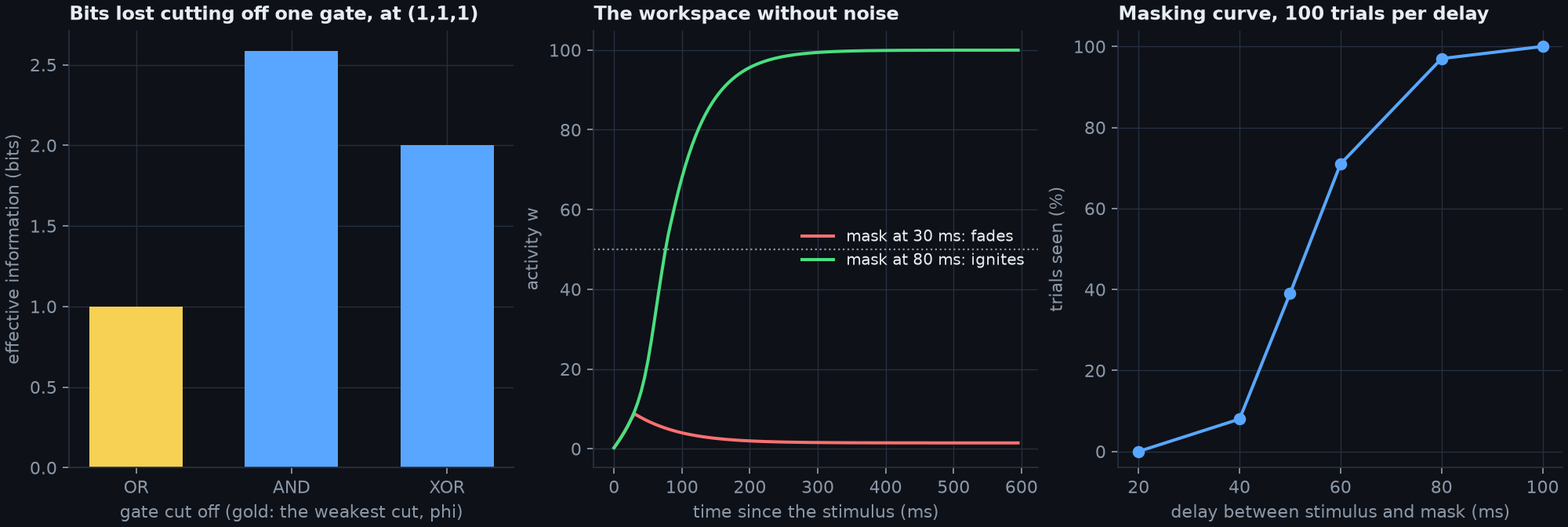
The Reasoner builds the core of the neural model in one equation. A workspace population with activity w is driven by the stimulus, I, and by its own recurrent excitation, r times w, through a steep sigmoid. A stimulus is shown, then a mask cuts it off. Mask it after thirty milliseconds, and activity rises a little, then fades away. Mask it after eighty, and before the mask arrives the loop has crossed its threshold. The recurrent excitation takes over and holds the activity high long after the stimulus is gone. The loop has two stable states, low and high, with a threshold between. Crossing it is called ignition, and on this theory it is the moment of conscious access.
Now add a little noise, and run two hundred trials at each delay between stimulus and mask. Up to thirty milliseconds, the workspace never ignites. At forty, it ignites on twenty four trials of two hundred; at fifty, eighty one; at sixty, a hundred and forty one; by ninety, almost always. The curve is a steep sigmoid. Look at the trials at the threshold delay of fifty milliseconds. Four hundred milliseconds in, the activity is either low, on a hundred and thirty six trials, or high, on sixty four. Nothing in between. That is the signature the theory predicts, and that Antoine Del Cul, Sylvain Baillet and Dehaene reported in 2007: subjective visibility jumps at a threshold near fifty milliseconds, and late brain activity is all or none. The toy produces the shape from nothing but a loop that can hold itself on. Whether the loop explains the seeing, or only the reporting, is the question from chapter two.
What it establishes: Baars (1988); Dehaene, Kerszberg and Changeux (1998); Del Cul et al. (2007).; Computed on screen: ignition; a masking curve; bimodality
9Higher-order theoriesAdvanced3 min
Higher-order theories start from a different thought. A mental state is conscious, David Rosenthal argued, when one is aware of being in it. Seeing red becomes a conscious seeing when it is accompanied by a suitable higher-order thought: I am seeing red. For Rosenthal the awareness is a thought; for David Armstrong and William Lycan, a kind of inner perception. The theory explains unconscious perception neatly: the first-order state is present, and the higher-order state is not. Ned Block pressed the other case. What if there is a higher-order state with no first-order state for it to be about? Is there then something it is like to see a red that is not there?
The evidence comes from a strange condition. After damage to the primary visual cortex, a patient reports a region of the visual field as blind. Yet asked to guess, Lawrence Weiskrantz found, the patient points to objects there, and names the orientation of lines, far above chance. And he insists he is only guessing. For Hakwan Lau and Rosenthal, this is first-order processing without higher-order monitoring: the information is used, but the system does not represent it as reliable perception. Lau's later theory calls the monitor perceptual reality monitoring.
The Reasoner simulates the dissociation in signal detection theory. A stimulus is present or absent; the observer's internal signal is noisy, with a sensitivity, d prime, of one and a half. It says present when the signal is above zero. A second-order monitor reads the same signal, with noise of its own, and turns it into confidence. Twenty thousand trials. A normal observer is right seventy seven percent of the time, and its confidence tracks its accuracy: the area under the type-two curve is 0.70. With a noisier monitor, 0.60. And when the monitor's noise swamps it, the observer is still right exactly as often, seventy seven percent, but its confidence says nothing about whether it is right: 0.498, chance. That is blindsight in miniature: the first-order state does its work, and the higher-order representation of it is missing. On a higher-order theory, what is missing is the experience.
The same result as a picture. For each confidence threshold, plot how often the observer is confident when it is wrong, across, against how often it is confident when it is right, up. A good monitor bows far above the diagonal: when it is confident, it is usually right. A noisier monitor bows less. And the blindsight observer lies on the diagonal itself: its confidence carries no information about its own success, though its first-order answers are just as good. The area under each curve is the number in the table. Metacognitive measures like this are now used in experiments on consciousness, precisely because they separate how well a system performs from how well it knows that it does.
What it establishes: Rosenthal (1986); Weiskrantz (1986); Lau and Rosenthal (2011).; Computed on screen: performance and confidence, 20 000 trials; type-2 ROC curves
10Integrated informationAdvanced4 min
Integrated information theory, due to Giulio Tononi, runs in the opposite direction from the others. It starts from experience itself. Every experience, it says, is intrinsic: it exists for itself. So its physical substrate must have cause-effect power on itself. Every experience is specific, this one and not another. So the substrate must specify one cause-effect state. Every experience is unified: you do not have one experience of the left half of the room and another of the right. So the substrate must be irreducible to its parts; a measure of that irreducibility is called phi. Every experience is definite, with just these contents, so the substrate is the set of elements with the most phi. And every experience is structured, so the substrate must unfold a structure of causes and effects. The theory's fourth version, of 2023, then says: the experience is that structure.
Phi can be computed exactly for tiny systems, and the Reasoner does, with a simplified measure in the style of the theory's second version, labelled as such. Three logic gates, OR, AND and XOR, each reading the other two, all now in state one. Given that present state, the whole system constrains its own past: only some earlier states could have produced it. Now cut the system in two, and let each part constrain its own past, treating inputs across the cut as noise. The information lost is how much more the whole says about its past than the parts say separately. Cutting off the OR gate loses one bit. Cutting off AND loses two point five eight. Cutting off XOR, two. Phi is the information lost across the weakest cut, here one bit. The system is irreducible: no way of cutting it loses nothing.
Phi belongs to a system in a state, not just to its wiring. The Reasoner computes it for the loop in each of its eight states. Two of them have no possible past: no state leads to them, so once running the system never gets into them, and phi is undefined there. In five of the rest phi is one bit; in the state one, zero, zero, the parts lose more, and phi is one point five eight. For IIT that is a prediction: the same wiring in a different state is a different experience, and elements that are switched off still contribute, because what matters is what the system could have done.
The same measure on four systems. Two separate pairs of gates, each pair copying back and forth: cut between the pairs and nothing is lost. Phi is zero: two systems, not one. A feedforward chain, each gate copying the one before: cut it at the source and nothing is lost either. Phi is zero. The loop of three gates: one bit. And a ring of four XOR gates, each reading its two neighbours: one bit. The pattern is the theory's central claim. Only systems whose parts feed back on each other have phi, and so, on IIT, only such systems can be conscious. A feedforward system, however intelligent its behaviour, has none. The next chapter turns that claim against the theory.
What it establishes: Tononi (2004); Balduzzi and Tononi (2008); Albantakis et al. (2023).; Computed on screen: cuts; Φ in eight states; four systems
11Counterexamples to IITResearch3 min
In 2014 the computer scientist Scott Aaronson asked what phi actually rewards. The Reasoner compares four systems under the simplified measure. A two-bit adder, eight gates, which adds two numbers correctly every time: it is feedforward, and its phi is zero. A ring of ten XOR gates, doing nothing in particular: two bits. A two-by-five torus of XOR gates: six. Random networks of XOR gates, each reading three others, averaged over six draws: four point one seven. Phi rewards structure that is hard to cut, whatever it computes. Aaronson gave constructions, expanders of XOR gates, whose phi grows without bound as they grow, so a simple lattice of parity gates could be vastly more conscious than any human brain. Tononi bit the bullet. In his reply he accepted that a large enough grid of XOR gates would be conscious. For the theory, that is a prediction; for its critics, a reductio.
A second objection uses IIT's own central claim. Take the loop of three gates from the last chapter, with phi of one bit. Now unroll it in time: a layer that holds the starting state, then one layer of OR, AND and XOR gates for each step, each reading the layer before. Twelve gates, and no feedback at all. From every one of the eight starting states, the last layer of the unrolled network ends exactly where the loop does after three steps. But it is feedforward, so its phi is zero. Adrien Doerig and colleagues made this the unfolding argument in 2019: for any recurrent network there is a feedforward one with the same input-output behaviour. If phi says one is conscious and the other is not, then no experiment on behaviour or report could ever tell which theory is right. Either phi is about nothing testable, or behaviour is not the test, and IIT's defenders take the second horn.
These consequences led to an unusually public fight. IIT implies that some very simple systems with feedback have a little consciousness, and that feedforward systems have none, however intelligently they behave. In September 2023, after the theory was widely reported as having passed an experimental test, an open letter signed by one hundred and twenty four researchers called it pseudoscience. Many others, including critics of IIT, replied that the label was unjustified and damaging to the field. What remains is a theory whose core claims are hard to test, though some of its predictions can be, as chapter thirteen shows.
What it establishes: Aaronson (2014); Tononi (2014); Doerig et al. (2019); the 2023 letter.; Computed on screen: an adder against XOR structures; unfolding
12Prediction and free energyAdvanced3 min
A third family of theories says the brain is a prediction machine. The idea is Hermann von Helmholtz's, from 1867: perception is unconscious inference about the causes of our sensations. Karl Friston gave it a single quantity, the variational free energy F of a belief q about hidden states s, given an observation o. It splits into two terms: how far the belief is from the true posterior, which is never negative, minus the log probability of the observation. It is the negative of the evidence lower bound that trains variational autoencoders in AI, Built. A small example. A cue says the reward is on the left, and is right ninety eight times in a hundred. Believe the exact posterior, and F is 0.693 nats. Keep the even prior, and it is 1.966. Believe the cue backwards, and it is 3.891. The minimum is the surprise of the observation itself, the log of two: minimizing free energy is doing Bayesian inference, and bounding surprise.
Active inference extends the idea to action. Friston and colleagues' T-maze, simplified. A reward is in the left arm or the right, with even odds. The agent can go straight to an arm, where it must stay, or first visit a cue at the bottom that points the right way ninety eight times in a hundred. Each plan is scored by its expected free energy: risk, how far the expected outcomes fall short of what the agent prefers, minus epistemic value, how much it expects to learn about where the reward is. Going straight to an arm has no expected reward, a coin toss, but it does teach the agent where the reward was: G is minus 0.66. Staying put teaches nothing: zero. Looking at the cue, then following it, both teaches and rewards: minus 3.43. Following the cue backwards: plus 2.10. Choosing in proportion to the exponential of minus G, the agent looks before it leaps eighty six percent of the time. Curiosity and reward come out of one quantity.
How does any of this bear on experience? For Andy Clark and Jakob Hohwy, perception is controlled hallucination: the brain's predictions, held in check by the errors that the senses send back. What we experience is the prediction, not the input. Anil Seth's book of 2021 makes the body central: we are beast machines, and emotion and selfhood are predictions of the body's own condition, made to keep it alive. Seth calls his project the real problem: explain, predict and control the properties of experience, and the hard problem may come to look like the vital spirit of chapter ten of Part 30. The worries are two. The free-energy principle, Friston says, applies to anything that persists, so it cannot by itself pick out what is conscious. And the old question returns: why would predicting feel like anything?
What it establishes: Helmholtz (1867); Friston (2010); Friston et al. (2015); Clark; Hohwy (2013); Seth (2021).; Computed on screen: free energy of three beliefs; a T-maze agent
13The theories, testedApplied3 min
Theories of consciousness have usually been tested by their own proponents. That began to change with a bet. In 1998 the neuroscientist Christof Koch bet Chalmers a case of wine that a clear neural signature of consciousness would be found within twenty five years. In 2019 the Templeton World Charity Foundation began funding structured adversarial collaborations: the proponents of rival theories design one experiment together. The rule is that each side says in advance, in public, which results would count against its own theory. The first such collaboration, called Cogitate, pitted integrated information against the global workspace. In June 2023, when its first results were presented, Koch conceded the bet.
The design was simple to state. People looked at pictures of faces, objects, letters and meaningless symbols, each shown for half a second, a second, or a second and a half, so that the duration of the experience could be tracked in the brain. Brain activity was recorded with three methods, functional MRI, MEG and electrodes inside the skull in epilepsy patients, in several laboratories, with the predictions of each theory registered before any data were collected. The protocol was published by Lucia Melloni and colleagues, and the results appeared in Nature in 2025.
The results challenged both. Where is the content of experience? IIT predicted the posterior cortex; the workspace theory predicted that prefrontal cortex would carry it too. Content was found in posterior regions, and in prefrontal cortex only for some of its features. How long does it last? IIT predicted activity sustained in the posterior cortex for as long as the experience lasts. The workspace theory predicted ignition when the picture appears, and again when it disappears. Posterior responses were sustained; ignition at the offset was not found. What connects? IIT predicted sustained synchronization within the posterior cortex; it was not found. The paper's own summary: some predictions of each theory were confirmed, and key tenets of both were substantially challenged. Each side found its theory bruised but standing. It was a first, not a verdict, and further collaborations are testing other theories the same way.
What it establishes: Koch and Chalmers (1998); Melloni et al. (2021, 2023); Cogitate (2025).
14Other animalsApplied3 min
Who else is conscious? Two declarations mark how scientific opinion has moved. In 2012 a group of neuroscientists meeting in Cambridge declared that humans are not unique in possessing the neurological substrates of consciousness: all mammals and birds, and many other creatures, including octopuses, have them too. In 2024 the New York Declaration on Animal Consciousness went further. It found strong scientific support for conscious experience in mammals and birds, and at least a realistic possibility of it in all vertebrates, reptiles, amphibians and fishes, and in many invertebrates, including at minimum octopuses and squid, crabs and lobsters, and insects. And it added a third sentence, about ethics: when there is a realistic possibility of conscious experience in an animal, it is irresponsible to ignore it in decisions that affect that animal.
How is such evidence weighed? In 2021 Jonathan Birch and colleagues reviewed the evidence for sentience in octopuses, squid, crabs and lobsters for the British government, with eight criteria. Does the animal have receptors for damage? Brain regions that integrate their signals, and connections between the two? Are its responses changed by anaesthetics or painkillers? Does it trade off threat against reward? Does it protect an injury flexibly? Does it learn to avoid harm? Does it seek out painkillers when injured? No one criterion settles it; the markers are weighed together. They found very strong evidence for octopuses, and strong evidence for true crabs. Following the review, the Animal Welfare Sentience Act that the United Kingdom passed in 2022 covers decapod crustaceans and cephalopod molluscs as well as vertebrates.
This is reasoning under deep uncertainty. The theories of this part draw the line in different places: a workspace, a higher-order state, or phi would each give a different answer for a bee. So Birch recommends markers rather than theories: features of behaviour and anatomy that most theories would count as evidence. And in his book of 2024 he argues for proportionate precaution: when sentience is a realistic possibility, take it seriously, at a cost that is reasonable for what is at stake. The same question can be asked of machines, with one difference that makes it harder: a system trained on human behaviour can produce the behavioural markers without what they mark.
What it establishes: Cambridge (2012); New York (2024); Birch et al. (2021); Birch (2024).
15Could a machine be conscious?Applied4 min
In 2023 nineteen researchers led by Patrick Butlin and Robert Long asked what the science of consciousness implies for AI. Assuming computational functionalism, that the right computations would suffice, they drew fourteen indicator properties from the leading theories. From recurrent processing theory, recurrence in perception. From the global workspace, specialised modules, a limited-capacity workspace, global broadcast, and attention that queries modules in turn. From higher-order theories, metacognitive monitoring of perception, among others. One from attention schema theory, one from predictive processing, and two from agency and embodiment. Their conclusion: no current AI system was a strong candidate for consciousness, but there were no obvious technical barriers to building systems that satisfy many of the indicators.
The Reasoner can check its own toys against the list, by reading its own code. The workspace of chapter eight has recurrence, and a bottleneck that a stimulus must pass through: two indicators. The metacognitive observer of chapter nine has a noisy perception and a monitor of its reliability: two more. The T-maze agent predicts its observations, and models how its moves change them: two more. Six indicators between them, in a few dozen lines each, and no one thinks any of them is conscious. That is not a flaw in the method, which its authors anticipated. Indicators are evidence that adds up as more of them are met, and met together, in one system. They are not a test that a system passes.
What about simply asking? A language model will talk fluently about its inner life, or deny having one, depending on how it was trained, because it learned from human writing, full of talk about experience. Jonathan Birch and Kristin Andrews call this the gaming problem: a system trained to reproduce our behaviour can produce the behavioural markers of consciousness without what they mark. In the terms of chapter six, the reports need explaining, and for a model the training already explains them, whether or not anything is felt. So the evidence that matters is about mechanism and architecture: which computations happen, in what structure, which is where the indicators and the theories come back in.
Where does that leave us? Chalmers argued in 2023 that current language models are unlikely to be conscious, but that successors with recurrence, a workspace and unified agency might be. In 2024 Robert Long, Jeff Sebo and colleagues argued that there is a realistic possibility, not a certainty, that some AI systems will be conscious or robustly agentic in the near future, and so have interests that matter morally. They asked AI developers to acknowledge the question, to assess their systems for the relevant markers, and to prepare policies. Under this kind of uncertainty there are two ways to be wrong: to treat a conscious system as a mere tool, or to treat a tool as someone. Both have costs, and the next parts on agency, value and fair machines return to how to weigh them.
What it establishes: Butlin, Long et al. (2023); Chalmers (2023); Long, Sebo et al. (2024).; Computed on screen: fourteen indicators, applied to three toys
Recap, problems, and where this comes backAll tracks2 min
Let's gather what we built. Nagel's bat, and Block's two kinds of consciousness. The hard problem, this part's brick in the Wall, and the map of responses to it. Mary's room, as three possibilities reduced to one, and three ways to deny that she learns a fact. Zombies, with the two-dimensional matrices for water and for pain, and the Price List. The explanatory gap, phenomenal concepts, illusionism, and a self-model that sees twelve bits and can say three and a half. Russell's intrinsic natures, and the combination problem. A workspace that ignites and draws a masking curve, and blindsight: seventy seven percent correct, with confidence at chance. Phi, computed by cutting; an adder with none and lattices with more; the unfolding argument; an agent that looks before it leaps; the great test of the theories; and the questions of animals and machines.
The Reasoner has a new module, consciousness. It evaluates two-dimensional matrices and what Mary can rule out, measures a self-model's capacity, runs a workspace that ignites and an observer with and without a monitor, computes a simplified phi by cutting, checks two objections to it, and runs an agent that minimizes expected free energy. And the Wall has its thirty first brick.
Six problems, with full solutions in this part's notes. A third sentence for the two-dimensional matrix; what the ability hypothesis needs of Mary's possibilities; the workspace's half-way delay as the noise changes; a proof that feedforward networks have no phi; phi for a lattice in two states; and a T-maze agent with a poor cue. Pause here, and try them.
Where this comes back. Agents, causes and free will, in Part 32. Minds that choose under uncertainty, in Part 33. Whose welfare counts, and how much, in Parts 35 and 36. Machines that decide about people, in Part 41. And aligned reasoners, and whether they matter morally, in Part 42. Next, Part 32: free will.
The books and papers this part follows are on screen, and in the notes. Thanks for watching.
Where it goes next. Agents, causes and free will follow in Part 32, and minds that choose under uncertainty in Part 33. Whose welfare counts, and how much, returns in Parts 35 and 36; machines that decide about people in Part 41; and the moral status of aligned reasoners in Part 42.
Key results
The part's results in one place, for revision.
Try it
Lab 31 · Phi by cutting, and a workspace that ignites
Recompute the Reasoner's simplified integrated information for the OR, AND, XOR loop from the definition, in each of its eight states and across each cut, and check it against the library. Then run the global workspace with noise at six mask delays and check that report is all or none.
python -m videos.philosophy.labs 31
needs numpy, scipy, matplotlib · download lab31.py ·
source on GitHubstate (1,1,1): bits lost cutting off OR, AND, XOR 1.000, 2.585, 2.000 (film: 1, 2.585, 2)
phi in the eight states, from the definition 1 1 none none 1.585 1 1 1
phi in the eight states, reasoner.consciousness 1 1 none none 1.585 1 1 1
phi of four systems two separate pairs: 0; a feedforward chain: 0; OR, AND, XOR loop: 1; a ring of four XORs: 1
seen at mask delays 20, 40, 50, 60, 80, 100 ms 0% 8% 39% 71% 97% 100%
at 50 ms, activity at 400 ms: low / between / high 50 / 0 / 50
Every way of cutting the loop loses information, so its phi is positive and depends on the state; the workspace's report jumps from never to always within a few tens of milliseconds, with almost no trial in between.The code (103 lines; it asserts its own result)
"""Lab 31: compute a simplified phi by cutting a three-gate loop, and draw a workspace's masking curve."""

import itertools
import math

import numpy as np

from videos.coursekit import labs
from explainer.philosophy.reasoner import consciousness as cs

TITLE = "Phi by cutting, and a workspace that ignites"
GOAL = ("Recompute the Reasoner's simplified integrated information for the OR, AND, XOR loop from the definition, "
        "in each of its eight states and across each cut, and check it against the library. Then run the global "
        "workspace with noise at six mask delays and check that report is all or none.")
TASKS = [
    "Replace the XOR gate by a COPY of the OR gate. Which cut now loses nothing, and what does that say about "
    "the loop?",
    "In cs.workspace, raise noise from 0.6 to 1.5. Does the half-way delay move, and does the 50 ms histogram "
    "stay bimodal?",
    "Compute phi for a ring of five XOR gates (each reading its two neighbours) in a reachable state, and "
    "compare it with the ring of four.",
]

GATES = {"OR": lambda a, b: a | b, "AND": lambda a, b: a & b, "XOR": lambda a, b: a ^ b}


def cut_loss(names, inputs, x1, part):
    """Effective information of state x1 across the cut part | rest, in bits, straight from the definition: the
    whole's distribution over its pasts against the product of each side's own, inputs across the cut being noise."""
    n = len(names)
    pasts = list(itertools.product((0, 1), repeat=n))
    step = {s: tuple(GATES[names[i]](s[inputs[i][0]], s[inputs[i][1]]) for i in range(n)) for s in pasts}
    causes = [s for s in pasts if step[s] == tuple(x1)]
    if not causes:
        return None
    sides = [tuple(part), tuple(i for i in range(n) if i not in part)]
    q = {s: 1.0 for s in pasts}
    for side in sides:
        ok = [s for s in pasts if all(step[s][i] == x1[i] for i in side)]
        count = {}
        for s in ok:
            key = tuple(s[i] for i in side)
            count[key] = count.get(key, 0) + 1
        for s in pasts:
            q[s] *= count.get(tuple(s[i] for i in side), 0) / len(ok)
    return sum(math.log2((1 / len(causes)) / q[s]) for s in causes) / len(causes)


def run(seed=0):
    lab = labs.Lab()
    names, inputs = cs.NETWORKS["OR, AND, XOR loop"]
    cuts = {name: cut_loss(names, inputs, (1, 1, 1), (i,)) for i, name in enumerate(names)}
    lab.row("state (1,1,1): bits lost cutting off OR, AND, XOR",
            ", ".join(f"{cuts[k]:.3f}" for k in names) + "   (film: 1, 2.585, 2)")
    assert abs(cuts["OR"] - 1) < 1e-9 and abs(cuts["AND"] - math.log2(6)) < 1e-9 and abs(cuts["XOR"] - 2) < 1e-9

    mine, theirs = [], []
    for x1 in itertools.product((0, 1), repeat=3):
        losses = [cut_loss(names, inputs, x1, (i,)) for i in range(3)]
        mine.append(None if losses[0] is None else round(min(losses), 4))  # each cut has a part of size one
        try:
            theirs.append(cs.phi_simple(names, inputs, x1)["phi"])
        except ValueError:
            theirs.append(None)
    show = lambda v: "none" if v is None else f"{v:g}"  # noqa: E731
    lab.row("phi in the eight states, from the definition", "  ".join(show(v) for v in mine))
    lab.row("phi in the eight states, reasoner.consciousness", "  ".join(show(v) for v in theirs))
    assert mine == theirs == [1.0, 1.0, None, None, 1.585, 1.0, 1.0, 1.0], "two states have no past; (1,0,0) has more"

    four = {k: v["phi"] for k, v in cs.phi_examples().items()}
    lab.row("phi of four systems", ";  ".join(f"{k}: {v:g}" for k, v in four.items()))
    assert four["two separate pairs"] == 0 and four["a feedforward chain"] == 0, "no loop, or two systems: phi 0"
    assert four["OR, AND, XOR loop"] == 1 and four["a ring of four XORs"] == 1

    soas, trials = (20, 40, 50, 60, 80, 100), 100
    ws = cs.workspace(soas=soas, trials=trials, seed=2001 + seed)
    seen = np.array([r["seen"] for r in ws["rows"]]) / trials
    lab.row("seen at mask delays 20, 40, 50, 60, 80, 100 ms", "  ".join(f"{s:.0%}" for s in seen))
    lab.row("at 50 ms, activity at 400 ms: low / between / high",
            f"{ws['late_low']} / {trials - ws['late_low'] - ws['late_high']} / {ws['late_high']}")
    assert seen[0] == 0 and seen[-1] >= 0.95, "never seen at 20 ms, almost always at 100 ms"
    assert np.all(np.diff(seen) > -0.05) and 0.1 < seen[2] < 0.9, "a steep sigmoid with its middle near 50 ms"
    assert ws["late_low"] + ws["late_high"] >= 0.95 * trials, "ignition is all or none"
    lab.note = ("Every way of cutting the loop loses information, so its phi is positive and depends on the state; "
                "the workspace's report jumps from never to always within a few tens of milliseconds, with almost "
                "no trial in between.")

    fig, ax = labs.figure(3, size=(12.5, 4.2))
    ax[0].bar(names, [cuts[k] for k in names], color=[labs.GOLD, labs.BLUE, labs.BLUE], width=0.6)
    ax[0].set_axisbelow(True)
    ax[0].set(title="Bits lost cutting off one gate, at (1,1,1)", xlabel="gate cut off (gold: the weakest cut, phi)",
              ylabel="effective information (bits)")
    t = np.arange(len(ws["trace_sub"])) * ws["dt_trace"]
    ax[1].plot(t, ws["trace_sub"], color=labs.RED, label="mask at 30 ms: fades")
    ax[1].plot(t, ws["trace_sup"], color=labs.GREEN, label="mask at 80 ms: ignites")
    ax[1].axhline(50, color=labs.MUTED, ls=":", lw=1)
    ax[1].set(title="The workspace without noise", xlabel="time since the stimulus (ms)", ylabel="activity w")
    ax[1].legend(loc="center right")
    ax[2].plot(soas, 100 * seen, "o-", color=labs.BLUE)
    ax[2].set(title=f"Masking curve, {trials} trials per delay", xlabel="delay between stimulus and mask (ms)",
              ylabel="trials seen (%)", ylim=(-4, 104))
    lab.fig = fig
    return lab
Now change it
- Replace the XOR gate by a COPY of the OR gate. Which cut now loses nothing, and what does that say about the loop?
- In cs.workspace, raise noise from 0.6 to 1.5. Does the half-way delay move, and does the 50 ms histogram stay bimodal?
- Compute phi for a ring of five XOR gates (each reading its two neighbours) in a reachable state, and compare it with the ring of four.
Problems, with solutions
Try each problem before opening its solution.
-
Extend the 2D matrix to 'heat is molecular motion'; where do its primary and secondary intensions differ?
Solution
Take two worlds: Earth, where what causes the feeling of heat is molecular motion, and Caloric, where it is a subtle fluid. "Heat" picks out, in the world considered as actual, whatever causes heat sensations there. Row Earth: heat is molecular motion, and molecular motion is molecular motion at every world: T, T. Row Caloric: heat is caloric, which is never molecular motion: F, F. The actual row is all true, so the sentence is necessary; the diagonal reads T, F, so it is not a priori. The two intensions differ at the Caloric world: as a counterfactual world it makes the sentence true (heat is still molecular motion there, just not felt as heat), as an actual world it makes it false. Chalmers's point is that "pain is C-fibre firing" has no such row, because what fixes the reference of "pain" is the feeling itself.
-
In Mary's model, what must be true of the possibilities for the ability hypothesis to be right?
Solution
On the ability hypothesis Mary rules out nothing on her release: what she gains is the ability to imagine, recognize and remember red. So the three possibilities she leaves open beforehand cannot be three ways the world might be; they must be one world described three times, or not possibilities at all. In the model: the three must agree not only on every physical truth but on every truth, so that seeing the tomato removes no world from her information state. If even one of them is a genuine alternative that her experience eliminates, she has learnt a fact, and the ability hypothesis is not the whole story.
-
Find the delay at which the workspace ignites on half the trials, as a function of the noise.
Solution
In the Reasoner's workspace (stimulus strength 30, masks at varying delays, 80 trials per delay), the delay at which the workspace ignites on half the trials falls as noise rises: about 56 ms with no noise (a sharp threshold), 55 ms at noise 0.3, 54 ms at 0.6, 48 ms at 1.0 and 35 ms at 1.5. The curve also widens: the delays between 10% and 90% seen run 48–64 ms at noise 0.3 and 20–72 ms at 1.5. Noise lets subthreshold trials ignite by chance, so the midpoint moves earlier and ignition becomes a probability rather than a step.
-
Show that a feedforward network has \(\Phi = 0\) under the simplified measure, for any state.
Solution
Let the sources \(A\) be the nodes that take input only from themselves, with an invertible update (COPY or NOT of their own past), and \(B\) the rest, arranged in layers with no loops, so no arrow runs from \(B\) into \(A\). Given the current state \((a_1, b_1)\), the whole system's cause repertoire fixes \(a_0\) exactly (invert the sources) and then constrains \(b_0\) only through the deeper layers of \(B\), whose current values are functions of \(b_0\) alone; the first layer's values depend only on \(a_0\) and are already consistent with it, since the state is reachable. The partitioned repertoires give the same thing: \(A\)'s own repertoire fixes \(a_0\), and \(B\)'s, with \(a_0\) treated as noise, imposes exactly the deeper-layer constraints on \(b_0\). The two distributions are equal, the effective information across \(A \mid B\) is 0, and since \(\Phi\) is the minimum over bipartitions, \(\Phi = 0\) in every state. The Reasoner's chain and a COPY–OR–AND–XOR tree give 0 in every reachable state, with this bipartition as the MIB.
-
Compute \(\Phi\) for a 3-by-3 torus of XOR gates in two different states. Does it depend on the state?
Solution
The 3-by-3 torus of XOR gates, each reading its four neighbours, has 16 reachable states. The simplified \(\Phi\) is 2.0 bits in every one of them, with the minimum-information bipartition always cutting off a diagonal of three nodes. It does not depend on the state: XOR is linear over GF(2), so every reachable state has the same number of past states and the same cause repertoires up to a shift, and the measure sees only that structure. A grid of XORs that does nothing but compute parities has the same nonzero \(\Phi\) whatever it is doing, Aaronson's complaint in miniature.
-
Give the T-maze agent an unreliable cue (60%). When does it stop looking before it leaps?
Solution
With a 60% cue, looking first still wins: its expected free energy is \(-1.17\) nats against \(-0.66\) for going straight to an arm, so the agent picks it with probability 0.35 against 0.21 for each arm, where a 98% cue gave 0.86. The epistemic value of the cue shrinks as it becomes less reliable, but its risk term is no worse, so the cue policy stays best down to a validity of about 0.51. Only when the cue carries almost no information does the agent stop looking before it leaps.
Notes and sources
Sources
Texts: Chalmers, The Conscious Mind (1996) and The Character of Consciousness (2010); Dennett, Consciousness Explained (1991); Seth, Being You (2021); Dehaene, Consciousness and the Brain (2014); Albantakis et al., 'Integrated information theory (IIT) 4.0' (2023); Butlin, Long et al., 'Consciousness in Artificial Intelligence' (2023); Frankish, 'Illusionism as a Theory of Consciousness' (2016); Birch, The Edge of Sentience (2024).
Primary texts and papers: Helmholtz (1867); James (1890); Russell (1927); Eddington (1928); Berlin and Kay (1969); Nagel (1974); Kirk (1974); Jackson (1982, 1998); Levine (1983); Rosenthal (1986); Weiskrantz (1986); Baars (1988); Dennett (1988, 1991); Lewis (1988); Loar (1990); Nemirow (1990); Conee (1994); Block (1995, 2011); Chalmers (1995, 2003, 2007, 2018, 2023); Dehaene, Kerszberg and Changeux (1998); Papineau (2002); Tononi (2004, 2014); Strawson (2006); Del Cul, Baillet and Dehaene (2007); Balduzzi and Tononi (2008); Friston (2010); Lau and Rosenthal (2011); the Cambridge Declaration (2012); Clark (2013); Graziano (2013); Hohwy (2013); Aaronson (2014); Friston et al. (2015); Goff (2017); Doerig, Schurger, Hess and Herzog (2019); Birch et al. (2021); Melloni et al. (2021, 2023); Fleming et al. (2023); the New York Declaration (2024); Long, Sebo et al. (2024); Cogitate Consortium (2025).
About this partfrom its README
Part 31 of Philosophy, Built (series plan, syllabus), the fifth part of Act VI, Mind and Meaning: what it is like, why it seems to resist physical explanation, and the scientific theories that try anyway, with a workspace that ignites, an observer that loses its confidence, a simplified Φ computed by cutting, and an agent that minimizes expected free energy. Nagel's bat (1974) and the view from nowhere; Block's access and phenomenal consciousness (1995). Chalmers's easy problems and the hard problem (1995), the Wall's thirty-first brick, and his map of responses, types A to F (2003). Jackson's Mary (1982) as an epistemic model (three possibilities agree on every physical truth; the tomato leaves one), and the ability, acquaintance and phenomenal-concept replies. Zombies (Kirk 1974; Chalmers 1996): two-dimensional matrices computed for 'water is H2O' (necessary, not a priori: the diagonal and the actual row differ) and 'pain is C-fibre firing' (the two coincide, so the zombie scenario's falsity carries over), the argument in modal logic (□(P → Q) ∧ ◇(P ∧ ¬Q) has no model; the weaker P → Q has a two-world one), and the zombie argument as a Price List (type-A and type-B physicalism, Russellian monism, property dualism). Levine's explanatory gap (1983), the phenomenal concept strategy (Loar, Papineau) and Chalmers's master argument (2007). Illusionism (Dennett 1988, 1991; Frankish 2016), the meta-problem (Chalmers 2018) and a self-model built (4096 shades told apart, 12 bits; eleven basic colour words, 3.46 bits; 933 278 of 8 386 560 discriminable pairs share a word: an analogy), and Graziano's attention schema theory (2013). Russellian monism, panpsychism and the combination problem (James 1890). The global workspace (Baars 1988; Dehaene, Kerszberg and Changeux 1998): one recurrent equation that ignites, a masking curve over 200 trials per delay (0 seen up to 30 ms, 24 at 40, 81 at 50, 141 at 60, 200 by 100), and all-or-none activity at the threshold delay (136 low, 64 high, none between). Higher-order theories (Rosenthal; Armstrong; Lau), blindsight, and an observer simulated over 20 000 trials (77% correct; type-2 AUROC 0.705 with a good monitor, 0.498 in 'blindsight'), with the three type-2 ROC curves drawn. Integrated information (Tononi 2004; IIT 4.0, 2023): a simplified Φ in the style of IIT 2.0, labelled as such, computed by cutting the OR–AND–XOR loop (cuts lose 1, 2.585 and 2 bits; Φ = 1), in each of its eight states (two have no past; one has Φ = 1.585), and on four systems (separate pairs and a feedforward chain 0; loops 1). Aaronson's objection (2014): a 2-bit adder scores 0, a ring of ten XORs 2, a 2×5 torus 6, random XOR expanders 4.17 on average; the unfolding argument (Doerig et al. 2019): the loop unrolled for three steps matches it from all 8 starts, with Φ = 0; the 2023 open letter. Predictive processing and the free-energy principle (Helmholtz; Friston 2010; Clark; Hohwy; Seth 2021): F for three beliefs (0.693, 1.966, 3.891 nats) and a T-maze agent scored by expected free energy (looking at the cue, then following it: G = −3.43, chosen 86% of the time). The Koch–Chalmers bet and the Cogitate adversarial collaboration (Nature, 2025). Animal consciousness: the Cambridge (2012) and New York (2024) declarations, Birch's eight criteria (2021) and the UK Sentience Act (2022). Machines: Butlin, Long et al.'s fourteen indicator properties (2023), applied to the Reasoner's own toys (two each, six in all), the gaming problem for self-reports, and Long, Sebo et al. (2024) on AI welfare.
The worked model results are computed by the Reasoner's new module explainer/philosophy/reasoner/consciousness.py
(with prop for the Price List and modal for the modal check), tested in tests/philosophy/test_consciousness.py
and cached by compute.py.
Chapter notes
| # | Scene | What it establishes | Computed on screen |
|---|---|---|---|
| 0 | Hook |
Nagel (1974); four questions; the plan. | — |
| 1 | Bat |
Nagel (1974); Block (1995). | — |
| 2 | Hard |
Chalmers (1995, 2003); the Wall's thirty-first brick. | — |
| 3 | Mary |
Jackson (1982, 1998); Lewis (1988); Nemirow (1990); Conee (1994); Loar (1990). | what Mary can rule out |
| 4 | Zombies |
Kirk (1974); Chalmers (1996); Kripke; the Price List. | two 2D matrices; a modal check; the argument's minimal conflicts |
| 5 | Gap |
Levine (1983); Loar (1990); Papineau (2002); Chalmers (2007). | — |
| 6 | Illusion |
Dennett (1988, 1991); Frankish (2016); Chalmers (2018); Berlin and Kay (1969); Graziano (2013). | a self-model's capacity |
| 7 | Panpsychism |
Russell (1927); Eddington (1928); Strawson (2006); Goff (2017); James (1890). | — |
| 8 | Workspace |
Baars (1988); Dehaene, Kerszberg and Changeux (1998); Del Cul et al. (2007). | ignition; a masking curve; bimodality |
| 9 | Higher |
Rosenthal (1986); Weiskrantz (1986); Lau and Rosenthal (2011). | performance and confidence, 20 000 trials; type-2 ROC curves |
| 10 | IIT |
Tononi (2004); Balduzzi and Tononi (2008); Albantakis et al. (2023). | cuts; Φ in eight states; four systems |
| 11 | Aaronson |
Aaronson (2014); Tononi (2014); Doerig et al. (2019); the 2023 letter. | an adder against XOR structures; unfolding |
| 12 | Predict |
Helmholtz (1867); Friston (2010); Friston et al. (2015); Clark; Hohwy (2013); Seth (2021). | free energy of three beliefs; a T-maze agent |
| 13 | Cogitate |
Koch and Chalmers (1998); Melloni et al. (2021, 2023); Cogitate (2025). | — |
| 14 | Animals |
Cambridge (2012); New York (2024); Birch et al. (2021); Birch (2024). | — |
| 15 | Machines |
Butlin, Long et al. (2023); Chalmers (2023); Long, Sebo et al. (2024). | fourteen indicators, applied to three toys |
| 16 | Outro |
recap; the Reasoner's module; the Wall; problems; payoffs; references. | — |
Companion material in this repository
The syllabus's plan for this partfrom SYLLABUS.md, the plan of record
- Nagel's bat (1974): what it is like.
- The hard problem (Chalmers 1995) vs the easy problems.
- Jackson's Mary (1982); the ability hypothesis (Lewis, Nemirow) and the acquaintance reply.
- Zombies: the conceivability argument formalized via two-dimensional semantics (callback to Part 22).
- The explanatory gap (Levine); the phenomenal concept strategy.
- Illusionism (Frankish, Dennett); the meta-problem (Chalmers 2018).
- Panpsychism and the combination problem; Russellian monism.
- Global workspace theory (Baars; Dehaene). Built: a toy workspace network with ignition (non-linear broadcast above a threshold), reproducing a masking curve.
- Higher-order theories (Rosenthal, Lau).
- Integrated information theory (Tononi; IIT 4.0, 2023). Built: Φ computed exhaustively for small logic-gate networks, using a simplified measure that is labeled as such.
- Aaronson's expander objection (2014), computed: a simple grid or expander can reach high Φ with no plausible experience.
- Predictive processing and the free-energy principle (Friston; Clark): variational free energy (callback to the AI series' ELBO). Built: a toy active-inference agent.
- The adversarial collaboration of IIT vs GNWT (Cogitate, published 2025; results cited), and the 2023 open letter controversy over IIT.
- Animal consciousness: the Cambridge (2012) and New York (2024) declarations; markers.
- AI consciousness: indicator properties derived from the theories (Butlin, Long et al. 2023); LLM self-reports and why they are weak evidence; AI moral patienthood under uncertainty (Long, Sebo et al. 2024).
- Recap and Problems.
Built: reasoner.consciousness (workspace ignition; small-system Φ; active inference).
Wall: the hard problem (a priori entailment from physical to phenomenal truths seems to fail); IIT's
counterexamples.
Price List: the zombie argument (zombies are conceivable; conceivability entails possibility; possibility of
zombies refutes physicalism; physicalism).
Visuals: the workspace lighting up on ignition; Φ's cut search over bipartitions; the 2D zombie matrix.
References: Chalmers, The Conscious Mind and The Character of Consciousness; Dennett; Seth, Being You;
Dehaene, Consciousness and the Brain; Albantakis et al. 2023 (IIT 4.0); Butlin, Long et al. 2023 (arXiv); Frankish
(ed.), Illusionism.
Build the film
python -m videos.philosophy.philosophy31.compute        # the part's numbers, into .cache/philosophy31
python tools/build.py philosophy31                  # render and assemble the film
EXPLAINER_TTS=silent python tools/qa_scene.py philosophy31 Hook   # one chapter, silent, with a contact sheet
Scenes: videos/philosophy/philosophy31. Setup: see the course page. Source of these notes: the README and the scenes' narration.
Build it
python -m videos.philosophy.philosophy31.compute       # every computed item (a minute; .cache/philosophy31)
python tools/build.py philosophy31 -q l                # 480p preview
python tools/build.py philosophy31                     # 1080p30 -> renders/philosophy31.mp4
python tools/qa_scene.py philosophy31 Workspace        # one chapter, silent, with a contact sheet