Free Will
Could you have done otherwise, and is anything you do up to you?
The part opens with Schopenhauer's line that a man can do what he wills but cannot will what he wills, and with the dilemma: determined acts seem not up to us, undetermined ones seem luck. After Aristotle's sea battle and Chrysippus's answer to the lazy argument, van Inwagen's consequence argument is derived with the operator N and the rules alpha and beta. The Reasoner then models options as sets of worlds an action might lead to, and on McKay and Johnson's coin rule beta fails in two of sixty-four instances while the repaired rule fails in none: the Wall's thirty-second brick. Frankfurt's case is put on the same model, compatibilism gets its Price List, and van Inwagen's rollback is replayed a thousand times. The part turns to the science with Libet's readiness potential, rebuilt from a leaky accumulator fed nothing but noise, and with a diagonal agent that no predictor on a list gets right. It ends with the free will theorem, six careless drivers in ten thousand and their two ledgers of blame, and the responsibility gaps that learning machines open.
What you need. School mathematics. The consequence argument uses the box of Part 4's modal logic; determinism is defined as in Part 24.
- The calculation
- the consequence argument in modal logic
- The wall
- McKay–Johnson; self-prediction
- Built toy
- rollback simulator; leaky accumulator for Libet
What you will be able to do
Introductory
- State the dilemma of determinism and luck, and say what compatibilists, libertarians and hard incompatibilists each deny.
- Describe a Frankfurt case and say what it is meant to show about alternative possibilities.
Advanced
- Derive the consequence argument from rules alpha and beta, and evaluate N on a model of options.
- Reproduce McKay and Johnson's countermodel and show that rule beta with alpha implies agglomeration.
- Explain how averaging a noisy accumulator backward from its threshold crossings produces a ramp with no decision in the model.
Research
- Prove that the repaired rule (from N p and the necessity of p implies q, infer N q) is valid on every model of options, and say what stronger premise Finch and Warfield's argument then needs.
- State what the Conway-Kochen free will theorem assumes and what it does not show about agency.
Applied
- Read a Libet-style result and say what a stochastic-accumulator account predicts differently from an early-decision account.
- Separate blame by outcome from blame by risk in a case of moral luck, and identify a responsibility gap in a system that learns.
Contents
Each chapter has a home level. Choose a track to see what to read and watch: Introductory 19 min · Advanced 44 min · Research 50 min · Applied 26 min.
- 0Could you have done otherwise?Introductory2 min
- 1Determinism, and luckIntroductory3 min
- 2FateIntroductory2 min
- 3The consequence argumentAdvanced3 min
- 4Rule beta, brokenResearch4 min
- 5Frankfurt casesIntroductory3 min
- 6CompatibilismAdvanced5 min
- 7LibertarianismAdvanced4 min
- 8No free willAdvanced2 min
- 9Freedom and resentmentIntroductory3 min
- 10Libet's clockApplied4 min
- 11Predicting yourselfAdvanced4 min
- 12The free will theoremResearch3 min
- 13Moral luckIntroductory3 min
- 14Responsibility gapsApplied3 min
- Recap, problems, and where this comes backAll tracks2 min
Also on this page: Lecture · Key results · Try it · Lab · Problems · Notes and sources · Build the film.
Lecture
The text of each chapter is the film's narration, as it is spoken, so you can read along or revise without the film. The pictures are in the film.
Could you have done otherwise?Introductory2 min
Part 31 asked what it is like to be a mind. This part asks what a mind can do: whether anything we do is up to us. Arthur Schopenhauer put the worry in 1839, in a line usually quoted this way: a man can do what he wills, but he cannot will what he wills. If our willing has causes we did not choose, in what sense are we free, and in what sense are we to blame?
Four questions run through it. The dilemma: if every act is determined by what came before, is any of it up to us? And if some acts are not determined, are they anything but luck? The arguments: can the incompatibility of freedom and determinism be proved? Its proofs use a modal operator whose rules the Reasoner can check on models, and one of them fails. This is the consequence argument, this part's brick in the Wall. The science: does the brain decide before we do, and can a mind be predicted, even by itself? And the stakes: praise and blame, luck, and machines that act with no one left to answer for them.
The plan. What determinism is, Laplace's demon, and the dilemma of luck. Aristotle's sea battle, and the Stoics' answer to fate. The consequence argument, with its operator N. A model on which one of its rules fails, this part's brick in the Wall, and a repaired rule that holds. Frankfurt's cases, modelled, compatibilism, and the free will Price List. Libertarianism, with a rollback simulated, the case against free will, and Strawson's reactive attitudes. Libet's readiness potential, rebuilt from noise, and the diagonal that stops a mind predicting itself. And the free will theorem of physics, moral luck, and machines that leave a gap where responsibility should be.
What it establishes: Schopenhauer (1839); four questions; the plan.
1Determinism, and luckIntroductory3 min
The modern worry has a famous image. In 1814 Pierre-Simon Laplace imagined an intellect that knew, at one moment, every force in nature and the position of every particle. For such an intellect, he wrote, nothing would be uncertain, and the future, like the past, would be present before its eyes. The state of the world now, together with the laws, would fix every later state, including the state of your brain at the moment you decide what to do.
Philosophers state determinism without the demon, as Part 24 did. The laws are deterministic if any two possible worlds that obey them, and agree completely at any one time, agree at all times. Two histories may differ in the past, but once they coincide at a time, they coincide for ever after: no branching. It is a thesis about the laws, not about what anyone could predict. A chaotic system is deterministic, though no one could ever measure it well enough to predict it.
Christian List has argued that determinism and alternatives can both be real, at different levels. The Reasoner builds a small world of nine hundred microstates. Each has exactly one successor: the physics is deterministic. Now describe it the way psychology does, at the level of the agent. Group the microstates into three agent-level states: deliberating, choosing tea, and choosing coffee. From the agent-level state alone, what comes next? From deliberating: tea forty five percent of the time, coffee forty, and still deliberating fifteen. At that level the future is open, and the agent has alternatives. Refine the description down to single microstates and determinism returns. List's claim is that free will is a matter of the agential level, the level at which we describe choosers, and that its alternatives are as real as the categories of psychology. Critics answer that the openness is only in our description, not in the world; whether higher-level possibilities count is the question of the next chapters.
This gives the problem the shape of a dilemma. If determinism is true, every act we perform was fixed before we were born, by the laws of nature and the distant past, and neither of those is up to us. If it is false, some acts are undetermined. But an undetermined act is one that nothing about us settled. How is that more our doing than the toss of a coin? Either way, freedom seems to vanish. The three main replies say that freedom survives determinism, that it needs indeterminism of the right kind, or that it does not exist. Chapters six to eight take them in turn.
What it establishes: Laplace (1814); determinism defined (Part 24); List (2019); the dilemma.; Computed on screen: a world deterministic below, open at the agent's level
2FateIntroductory2 min
The oldest version of the worry is about truth, not causes. If it is already true today that there will be a sea battle tomorrow, the battle cannot fail to happen. Generalized, that is logical fatalism: whatever will happen happens necessarily, and deliberation is idle. Aristotle seems to have answered that statements about contingent futures are not yet true or false, the third value of Part 5. Most logicians now answer differently: from it is true that p, it does not follow that p is necessary. The argument confuses the necessity of a conditional with the necessity of its consequent.
The Stoics believed in fate, a single chain of causes running through everything, and also in responsibility. Chrysippus explained how with a cylinder, in Cicero's report. Push a cylinder at the top of a slope, and it rolls. The push is only the starting cause. That the cylinder rolls, rather than sliding or spinning, comes from its own shape: the principal cause. So with us. An impression strikes the mind from outside, but whether and how we assent to it comes from our own character. The act is fated, and it is still ours: a compatibilism, two thousand years before the word.
The Stoics' opponents pressed them with the lazy argument. If it is fated that you will recover from this illness, you will recover whether or not you call the doctor. If it is fated that you will not, you will not, whether or not you call. So calling the doctor is pointless. Chrysippus replied that some events are co-fated: if your recovery is fated, it is fated to come about by way of your calling the doctor. That is still the standard answer to fatalism: even if everything is determined, our deliberations and choices are among the causes, not spectators of them.
What it establishes: Aristotle; Chrysippus (Cicero, On Fate); the lazy argument.
3The consequence argumentAdvanced3 min
The strongest argument that freedom and determinism cannot both be true is Peter van Inwagen's. In his words: if determinism is true, then our acts are the consequences of the laws of nature and events in the remote past. But it is not up to us what went on before we were born, and neither is it up to us what the laws of nature are. Therefore, the consequences of these things, including our present acts, are not up to us. The past is not up to us. The laws are not up to us. So nothing that follows from them is up to us, and if determinism is true, that is everything.
To make the argument exact, van Inwagen introduced an operator. N p means: p is true, and no one has, or ever had, any choice about whether p. Two rules govern it. Rule alpha: from the necessity of p, infer N p. No one has a choice about what is necessary, about two plus two being four. Rule beta: from N p, and N of p implies q, infer N q. If no one has a choice about p, and no one has a choice about p's leading to q, then no one has a choice about q. Both look like pieces of logic. With them, and the claim that the past and the laws are fixed, the argument goes through.
Here is the whole argument. Let P nought describe the world in the remote past, L be the laws, and P any truth at all, say that I raised my hand. Determinism says that the past and the laws together necessitate P. By logic, the past necessitates that the laws imply P. By rule alpha, no one has a choice about that. No one has a choice about the remote past. So, by rule beta, no one has a choice about whether the laws imply P. No one has a choice about the laws. So, by rule beta again, no one has a choice about whether I raised my hand, or about anything else. Every step but two is uncontroversial. The two uses of rule beta are where, in 1996, the argument was found to break.
What it establishes: van Inwagen (1983): N, α, β, the derivation.
4Rule beta, brokenResearch4 min
To test the rules, the Reasoner needs a model of what it is to have a choice. Take the worlds that might come about from here. Each action available to the agent is the set of worlds it might lead to: one world, if its outcome is certain; several, if chance has a say. The agent has a choice about whether p if some available action is guaranteed to make p false. And N p holds when p is true, and no available action guarantees not p.
Thomas McKay and David Johnson found the countermodel in 1996. I have a coin, and I do not toss it, though I could. If I toss it, it lands heads or tails, and nothing I can do settles which. Two actions: refrain, which leads to the coin not being tossed; and toss, which leads to heads or to tails. Let p be: the coin does not land heads. It is true, and no action guarantees heads, so N p. Let q be: the coin does not land tails. By the same reasoning, N q. But p and q together say the coin is not tossed, and I do have a choice about that: I can toss it. No choice about each, a choice about both. The principle of agglomeration, from N p and N q infer N of p and q, fails.
Why does that sink rule beta? Because beta, with alpha, gives agglomeration. From N p and N q: it is necessary that p implies that q implies p and q, so by alpha no one has a choice about it. By beta, N of q implies p and q. By beta again, N of p and q. The Reasoner checks every instance on the coin model: its eight propositions, and all sixty four pairs of them. Rule alpha never fails. Rule beta fails twice, at p equal to no heads or no tails, and q equal to the coin not being tossed. And a repaired rule, beta box, which needs the connection between p and q to be necessary rather than merely not up to us, never fails at all.
The argument can be repaired. Alicia Finch and Ted Warfield, in 1998, start from the premise that no one has a choice about the past and the laws taken together. Determinism says the two together necessitate P. And the valid rule, beta box, gives N P. The repaired argument uses only a rule the Reasoner has checked. The price is a stronger first premise, and that is where compatibilists now push back, as chapter six shows.
This is the thirty second brick in the Wall. The dream was freedom and determinism together: a world fixed by its past and laws, in which some acts are still up to us. The consequence argument, repaired, says that if determinism is true nothing is up to us; and Frankfurt's cases, next, question what freedom needs in the first place. What it forces is a choice: redefine freedom so that it does not need the past or the laws to be up to us, or deny determinism.
What it establishes: McKay and Johnson (1996); Finch and Warfield (1998); the Wall's thirty-second brick.; Computed on screen: every instance of α, β and β□ on the coin
5Frankfurt casesIntroductory3 min
In 1969 Harry Frankfurt attacked a principle almost everyone had assumed. The principle of alternative possibilities: a person is morally responsible for what he has done only if he could have done otherwise. Jones decides, for reasons of his own, to shoot Smith, and does. Unknown to Jones, Black wanted Smith shot too, and had arranged to intervene, with a device in Jones's brain, at the first sign that Jones was about to decide otherwise, and make him shoot anyway. Black never had to act. Jones could not have done otherwise, yet he seems fully responsible, because Black's device played no part in what he did.
The Reasoner puts the case on the model of chapter four. Jones has two options. If he decides to shoot, he shoots on his own. If he begins to decide otherwise, he shows the sign, and Black makes him shoot. Jones shoots is true in both worlds, so N holds: Jones has no choice about whether he shoots. But Jones shoots on his own is true in only one, and he could make it false by beginning to decide otherwise. So he does have a choice: not about what happens, but about whether it happens through him. John Martin Fischer calls this a flicker of freedom, and asks whether so thin an alternative could be what responsibility rests on.
The cases have been argued over ever since. Fischer himself thinks the flickers are too thin to carry responsibility, and so concludes that Frankfurt is right. David Widerker posed a dilemma for the libertarian reading. Either the sign Black watches for determines Jones's decision, in which case the case assumes determinism, which begs the question; or it does not, in which case Black cannot be sure to intervene in time. David Hunt and Derk Pereboom built buffered cases that block every route to the other decision in advance. If Frankfurt is right, responsibility is a matter of the actual sequence that produced the act, not of alternatives, and the consequence argument, even if it is sound, does not show that we are never responsible.
What it establishes: Frankfurt (1969); Fischer (1994); Widerker (1995); Hunt; Pereboom.; Computed on screen: the case on the options model
6CompatibilismAdvanced5 min
Compatibilists say that freedom, properly understood, is something determinism leaves intact. For Thomas Hobbes, liberty is just the absence of external impediments to doing what one wills. For David Hume, it is a power of acting or not acting, according to the determinations of the will. On this view, he could have done otherwise means: he would have, had he chosen to; and that can be true in a deterministic world. The trouble is a person who could not have chosen otherwise, someone in the grip of a phobia or a compulsion. The conditional is true of them too, and they are not free.
Frankfurt's second great paper, of 1971, located freedom in the structure of the will. We have desires, and we also have desires about our desires. Consider two addicts. The unwilling addict craves the drug, and wants not to want it. When he takes it, he acts on a desire he repudiates. The willing addict craves it too, but endorses the craving. Both are equally unable to stop; only the second acts freely. Free will, for Frankfurt, is having the will you want to have. Nothing in that requires the will to be undetermined.
The most developed compatibilism today is John Martin Fischer and Mark Ravizza's. An agent has guidance control of an act when it issues from a mechanism that is the agent's own and that responds to reasons. Responds moderately: it would recognize sufficient reasons to do otherwise across a range of cases, and act on them in at least one. That is a fact about the mechanism, and it holds in a deterministic world. David Lewis attacked the consequence argument directly. I could have raised my hand, he said, though only in the weak sense that I could have done something such that, had I done it, a law would have been broken, a small local miracle. In that sense the laws are not fixed, and the repaired argument's first premise is false.
The conditions can be checked on mechanisms. Each faces eleven scenarios in which a desire of strength five to take a drug meets a reason to refrain of strength zero to ten. The responsive agent refrains exactly when the reason outweighs the desire. The erratic agent refrains at seven and at ten, but takes it at eight and nine. It responds to some sufficient reason, so it is weakly reactive, but its refusals form no intelligible pattern: it is not regularly receptive. The compulsive agent takes it whatever the reason: not reactive at all. Only the first is moderately reasons-responsive, and so, on Fischer and Ravizza's view, responsible, whether or not its mechanism is deterministic.
Lewis's point can be seen on a toy world. Here is a deterministic world, sixty one cells wide, run for thirty steps by a reversible law: each state fixes the next, and the previous. One cell at the top is an agent's act. What would a world be like in which the act differed? One answer: a small miracle. Change one cell just before the act, and let the laws resume. The act differs, and the whole past is exactly ours. The other answer: no miracle at all. Then the laws hold everywhere, and running them backward from the different act, the difference spreads into the past, one cell per step. By time zero, seventeen cells of the world differ, scattered across its whole width. Lewis argued that when we say we could have done otherwise, we mean the first kind of world: one that departs from ours by a small miracle just before we act. We are able to do something such that, had we done it, a law would have been broken; we are not able to break a law.
Four claims cannot all be true. Some of our acts are free. An act is free only if the agent could have done otherwise. If determinism is true, no one could ever have done otherwise. And determinism is true. One has to go. Deny the first: there is no free will, the view of hard determinists and of Derk Pereboom, held by eleven percent of philosophers in the PhilPapers survey of 2020. Deny the second, with Frankfurt and Fischer: freedom does not need alternatives. Deny the third, with Hume and Lewis: we could have done otherwise, in the sense that matters, even if determinism is true. Compatibilists of both kinds together are fifty nine percent. Or deny the fourth: libertarians, nineteen percent, hold that freedom requires indeterminism, and that we have it. The next chapter asks how.
What it establishes: Hobbes (1651); Hume (1748); Frankfurt (1971); Fischer and Ravizza (1998); Lewis (1981); the Price List.; Computed on screen: the tetrad's minimal conflicts
7LibertarianismAdvanced4 min
Libertarians hold that freedom requires indeterminism, and that we are free. There are two main pictures. On agent causation, from Thomas Reid to Roderick Chisholm, the agent herself, not any event within her, causes her decision. Each of us, Chisholm wrote, is a prime mover unmoved. Timothy O'Connor and Randolph Clarke defend a version consistent with physics, provided its laws leave room. Robert Kane's event-causal view needs no new kind of cause: some decisions are simply undetermined events in the brain. Both require that some choice was genuinely open until we settled it.
Kane's central case is a businesswoman on her way to an important meeting, who sees an assault in an alley. She is torn: her moral reasons pull her to stop and help, her ambition to hurry on. She makes an effort of will in both directions at once. Noise in her brain makes the outcome undetermined. Whichever way it goes, Kane says, she chose it, for reasons that were hers, and having chosen she will endorse it. Such self-forming actions, he argues, are where we become the authors of our characters.
Where in a brain could indeterminism do this work? Kane suggested that chaotic processes might amplify quantum indeterminacy, and Mark Balaguer described torn decisions, in 2010, as ones where the reasons on each side are balanced. The Reasoner models such a decision as a ball balanced on the hump between two wells: help, or hurry on. It obeys a simple damped equation. At the top, any offset, however tiny, grows exponentially, so the ball falls to the side the offset points to. The Reasoner starts it ten to the minus three from the top, then ten to the minus six, down to ten to the minus thirty, far below any quantum scale in a neuron. Each factor of ten adds the same delay, and even the smallest decides in finite time. So a balanced system can let an undetermined microscopic event settle a choice. Max Tegmark estimated in 2000 that quantum superpositions in neurons decohere within ten to the minus thirteen seconds, far too fast to be directly involved, but amplified noise needs no superposition, only chance. The physics can make room. What it cannot do is answer the next objection: if chance settles the choice, how is that the agent settling it?
Van Inwagen, an incompatibilist himself, pressed the luck objection against such views with a thought experiment. Alice is undecided between telling the truth and lying, and at an undetermined moment she tells the truth. Now suppose God rolls the universe back to just before that moment, and lets it run again, and again, a thousand times. The Reasoner runs the replays, with a seventy percent chance of the truth each time. Early on the share bounces around. After ten replays it is ninety percent; after a hundred, seventy four. After a thousand, seven hundred and eight truths: point seven oh eight. The frequency settles to the chance. Watching the replays, van Inwagen says, we could only conclude that what happens on any one of them is a matter of chance. If that is what an undetermined choice looks like, how can it be up to Alice? Libertarians reply that chance at the level of outcomes is compatible with the choice being hers at the level of reasons; the debate is far from over.
What it establishes: Reid; Chisholm (1964); O'Connor (2000); Kane (1996); Balaguer (2010); Tegmark (2000); van Inwagen (2000).; Computed on screen: a torn decision in a double well; 1000 replays of one moment
8No free willAdvanced2 min
Derk Pereboom argues that the compatibilist conditions are not enough, with four cases. In the first, neuroscientists manipulate Professor Plum's brain moment by moment, so that he reasons his way to killing Ms White. He meets every compatibilist condition: he acts on desires he endorses, for reasons he responds to. Yet he is plainly not to blame. In the second, they programmed him at the start of his life to reason that way. In the third, his community trained him to, by ordinary means. In the fourth, there are no manipulators: the past and the laws of a deterministic world produced him. Pereboom argues there is no relevant difference between any case and the next. If Plum is not responsible in the first, he is not responsible in the fourth, and neither are we.
Galen Strawson's basic argument goes further: it says freedom of the kind desert needs is impossible, whether determinism is true or not. You do what you do because of how you are. So to be truly responsible for what you do, you must be responsible for how you are. But to be responsible for how you are, you must have made yourself that way, intentionally, acting on principles you already had. And to be responsible for those, you must have made yourself have them, and so on. The regress never ends. Since no one can be the cause of himself, Strawson concludes, no one is ultimately responsible for anything.
What would follow, if they were right? Pereboom's answer is that what goes is basic desert: the idea that someone deserves blame or punishment just because of what they did, regardless of any good it does. What stays are forward-looking reasons: protecting others, helping people become better, repairing relationships. For crime, he and Gregg Caruso propose a model like public-health quarantine: restraint where it protects, and no more harm than that requires. And love, gratitude and the sense of achievement, he argues, survive the loss. Whether they do is the question of the next chapter.
What it establishes: Pereboom (2001, 2014); G. Strawson (1994); Caruso.
9Freedom and resentmentIntroductory3 min
In 1962 Peter Strawson changed the subject. Look, he said, at the attitudes we actually take to one another: resentment when someone wrongs us, gratitude when they help, indignation on another's behalf, love, forgiveness, hurt feelings. These reactive attitudes are responses to the good or ill will that others show us. They are not a theory we hold, which the discovery of determinism could refute. They are part of what it is to live among persons at all. And holding people responsible just is taking these attitudes to them. Responsibility is not answerable to metaphysics; it is constituted by the practice.
Strawson contrasted two stances. The participant stance is engaged: we resent, thank and forgive. It is our default toward other adults. The objective stance sees a person as something to be managed, treated, or avoided, and we take it to small children, or to someone in the grip of illness. Excuses work inside the participant stance: he did not mean it, he was pushed, he was not himself. Determinism is not an excuse of that kind. Could we take the objective stance toward everyone, all the time, if determinism were proved? Strawson thought that was not a real option for creatures like us.
Strawson's picture has been refined by asking what, exactly, responsibility is. Gary Watson distinguished two faces in 1996. One is attributability: does the act express who you are, your values and what you care about? Admiration and disdain respond to that. Thomas Scanlon and Angela Smith stressed answerability: may you be asked for your reasons, and must you give them? And accountability: is it fair to hold you to a demand, and to blame or sanction you for failing it? That is the face Strawson's resentment belongs to, and the one free will debates usually mean. David Shoemaker argued in 2015 that the faces come apart at the margins of agency. A cruel act may be wholly attributable to someone who cannot grasp why it matters to others, and yet resentment, which demands that they feel its force, may be unfair. Which face determinism threatens may differ: the hard incompatibilist's target is accountability.
Strawson's approach has been developed and tested. R. Jay Wallace recast responsibility as a matter of when it is fair to hold someone to moral demands. Gary Watson studied the case of Robert Harris, a murderer whose crimes provoke outrage, until one reads of his childhood of abuse. Our reactive attitudes waver, and Watson asked what that wavering tracks. Experimental philosophers, Eddy Nahmias among them, have asked people directly. Most judge agents in a deterministic world to be responsible, when the case is concrete; abstract framings can reverse the verdict. The practice is robust, but it is sensitive to how a life came to be what it is, which is the topic of the next chapter's experiments too.
What it establishes: P. F. Strawson (1962); Watson (1996); Scanlon; Shoemaker (2015); Wallace (1994); Watson (1987); Nahmias.
10Libet's clockApplied4 min
In 1983 Benjamin Libet and his colleagues brought the question into the laboratory. Subjects flexed their wrist whenever they felt like it, while watching a spot circle a fast clock, and reported where the spot was when they first felt the urge to move. The reported urge came about two hundred milliseconds before the movement. But a slow negative wave over the motor areas, the readiness potential, had begun some five hundred and fifty milliseconds before it. The brain, it seemed, starts preparing a third of a second before we decide. Libet himself left room for a veto: the urge could still be stopped.
In 2012 Aaron Schurger, Jacobo Sitt and Stanislas Dehaene offered another reading, and the Reasoner builds their model. Activity x drifts slowly upward, leaks back toward rest, and is jostled by noise. That is all: no decision anywhere in the equation. When x first crosses a threshold, the movement happens. Here are five runs. Each wanders, until the noise happens to carry it over the line. Over a thousand runs, crossings come at all sorts of times, on average after six point three seconds, like the spontaneous movements in Libet's task.
Now do what Libet did with brain recordings. Take the eight hundred and ninety nine runs that waited at least two seconds, line them up at the moment each one crossed, and average backward. A slow, smooth build-up appears, rising from point one two to the threshold, half of it in the last third of a second: the shape of a readiness potential. But nothing in the model prepared anything. The build-up is the average of the noise that happened, on each run, to carry the activity over. Lining runs up at their crossings selects exactly those stretches.
The model made a prediction, which the same paper tested. Interrupt subjects with a click at a random moment, and ask them to move at once. In the model the click adds a strong drift, and the time to reach threshold depends on where the noise had already carried x. The Reasoner clicks at random on two thousand three hundred trials. Sorted by where x was at the click, the mean response falls from two hundred and sixty eight milliseconds in the lowest quarter to seventy five in the highest. In the experiment, too, the fastest responses came when the slow brain signal was already furthest along, as the model predicts, and as the reading of the readiness potential as an early decision does not.
So what do the experiments show? On the accumulator reading, the decision is the crossing, close to the movement, not the beginning of the potential, which only looks like preparation when runs are averaged after the fact. In 2008 Chun Siong Soon and colleagues predicted, from brain scans, which of two buttons people would press, seconds ahead, but only about sixty percent of the time: a bias, not a verdict. And in 2019 Uri Maoz and colleagues found that for deliberate choices that mattered to the subjects, the readiness potential was absent altogether. Philosophically, an arbitrary flick of the wrist is a poor model of choosing, and a cause in the brain is not a cause outside us. These experiments matter, but less than the headlines said.
What it establishes: Libet et al. (1983); Schurger, Sitt and Dehaene (2012); Soon et al. (2008); Maoz et al. (2019).; Computed on screen: a leaky accumulator; its backward average
11Predicting yourselfAdvanced4 min
Before prediction from outside, a point of Daniel Dennett's about what determinism does not mean. The Reasoner builds a deterministic world: rocks fall down a strip, one row a step, at columns fixed in advance, and an agent stands on the bottom row. One agent is blind and stays put. In four hundred steps it is hit thirty four times. The other looks one row up, and steps aside when a rock is about to land on it. It is hit no times, and dodges thirty two. Run the world again and every step repeats exactly: nothing here is undetermined. Yet each dodge supports a counterfactual: had the agent stayed, it would have been hit. Dennett's lesson is that determinism is not inevitability. In a determined world some things are avoided, by systems built to avoid them, and the capacity to avoid is what freedom, in the sense worth wanting, is made of. Incompatibilists reply that what is avoided was still fixed before the agent existed.
Suppose determinism is true, and a perfect predictor exists. Could it tell you what you will do? Imagine an agent who, before choosing left or right, reads the prediction of its choice, and does the opposite. If the prediction says left, it goes right. If it says right, it goes left. Both possible predictions are wrong. Donald MacKay argued in 1960 that there is no prediction of your choice that you would be correct to believe, since your believing it is among the causes of what you do. That is not a gap in determinism. A predictor that kept its prediction to itself could be right. It is a fact about predictions that become causes.
The contrarian generalizes, by the diagonal argument of Part 7. List any predictors you like, six here, each a function from situations to predicted acts: left or right. Now build an agent that, in situation k, consults predictor k and does the opposite of what it says there. The agent differs from predictor one in situation one, from predictor two in situation two, and so on down the diagonal: it differs from every predictor on the list. The same holds for any list, however long, as long as the agent can consult the predictions. It is Cantor's diagonal, and Turing's: an agent that can read its predictions is not on any list of predictions it can read.
Hide the prediction, and a different puzzle appears. Robert Nozick published it in 1969 as Newcomb's problem. Two boxes: a clear one with a thousand dollars, and an opaque one, which a very reliable predictor filled with a million dollars only if it predicted you would take the opaque box alone. Do you take one box, or both? Here the agent cannot defy the prediction, because it cannot see it; it can only decide how to respond to the fact that it was made. Which answer is rational divides decision theorists to this day, and is where Part 33 begins.
What it establishes: Dennett (1984, 2003); MacKay (1960); the diagonal (Part 7); Nozick (1969).; Computed on screen: a deterministic avoider; a contrarian; a diagonal over six predictors
12The free will theoremResearch3 min
Physics entered the debate in 2006, with a theorem by John Conway and Simon Kochen. Its first axiom, SPIN, is a prediction of quantum mechanics: measure the squared spin of a spin-one particle along three perpendicular axes, and you get one, zero and one in some order, the structure behind the Kochen–Specker theorem of Part 26. TWIN: two entangled particles measured along the same axis give the same answer. MIN: two experimenters far apart choose their axes independently; relativity forbids one choice from influencing the other. From these, they proved that if the experimenters' choices are not functions of the past, then neither are the particles' responses. As they put it, if experimenters have even a modicum of free will, elementary particles have their own share of it.
The theorem rests on the same logic as Bell's, which the Reasoner can check in a few lines. Two particles each answer one of two questions, chosen independently, with plus or minus one. Combine the correlations into this sum, S. If each particle's answers were fixed in advance, there are sixteen ways to fix them, and every one gives S equal to plus or minus two; any mixture of them stays in between. Quantum mechanics predicts, and experiments find, about two point eight three. So answers fixed in advance, with independent settings, cannot reproduce what is observed, and Conway and Kochen's theorem sharpens the same conclusion.
The theorem is real mathematics, and easy to oversell. What it shows is that no local deterministic theory can fix the outcomes in advance, if the settings are chosen independently: it is a cousin of Bell's theorem from Part 26. Free, in the theorem, means only not a function of what lies in the past light cone. It does not show that we are free in the sense the consequence argument is about, or that a particle's indeterminism is a choice. It can be escaped by superdeterminism, which denies the independence of the settings, at a cost to the whole of experimental science that few accept. The lesson for free will is the one from chapter one: indeterminism is cheap. The question is whether any of it is up to us.
What it establishes: Conway and Kochen (2006); Kochen–Specker; Bell (Part 26).
13Moral luckIntroductory3 min
Even without determinism, control has limits. Imagine ten thousand drivers, each equally careless: each runs one red light. The Reasoner gives each a one in two thousand chance that a child is on the crossing. Six of them kill a child. Nine thousand nine hundred and ninety four go home and forget about it. Their choices and characters were the same; only luck differed. Yet we blame the six, and they blame themselves, far more. That conflicts with a principle most of us also accept: we are morally assessable only for what is within our control. Bernard Williams and Thomas Nagel named the conflict moral luck, in a symposium of 1976.
Nagel distinguished four kinds. Resultant luck, in how things turn out: the drivers, or Williams's painter, Gauguin, who abandoned his family to paint, and whose choice only success could vindicate. Circumstantial luck, in the situations we face: an ordinary citizen of Germany in the 1930s was tested in ways others never are. Constitutive luck, in the kind of person one is: temperament, inclinations, capacities. And causal luck, in how one is determined by what came before, which Nagel saw as the free will problem itself. The responses: deny moral luck and judge only the will, as Kant would; accept it as part of morality; or, with Williams, separate the agent-regret of the unlucky driver from blame.
The Reasoner keeps two ledgers for the ten thousand drivers. First, notice what is not luck. With ten thousand drivers each taking a one in two thousand chance, the probability that some child is hit is ninety nine point three percent. That there will be victims is close to certain. Which drivers kill is luck. The first ledger blames by outcome. Six drivers carry a full unit of blame each, and the other nine thousand nine hundred and ninety four carry none. The second blames by the risk each driver imposed. Every one of the ten thousand carries one two-thousandth of a unit, and the total is five, the expected harm. Michael Zimmerman defended the second in 2002: luck changes what we are responsible for, but not how responsible we are. Each careless driver is as blameworthy as the others. The law mostly keeps the first ledger: an attempt is usually punished less than a completed crime, though the agent did all he could. David Enoch and Andrei Marmor argued that this can be defended without moral luck, since the law has reasons of its own, such as evidence and the costs of punishing, that moral blame does not share.
What it establishes: Williams and Nagel (1976, 1979); Zimmerman (2002); Enoch and Marmor (2007).; Computed on screen: 10 000 careless drivers; two ledgers of blame
14Responsibility gapsApplied3 min
The questions of this part now arise for machines. Since Aristotle, responsibility has been thought to need two things: control over what one does, and knowledge of it. A learning machine's behaviour is shaped by training that no one fully specified, and may change after it is deployed. So, Andreas Matthias argued in 2004, there can be a gap. The makers could not foresee what it would do, the operators could not steer it, and the machine itself is not the kind of thing we can blame. Robert Sparrow drew the conclusion for autonomous weapons in 2007: if no one can be held responsible for a killing, that is itself a reason the killing is wrong.
There is a precise way to spread responsibility over many hands. Hana Chockler and Joseph Halpern, in 2004, defined a degree of responsibility using the structural causal models of Part 17. Your degree is one over k plus one, where k is the fewest other changes that would make your contribution critical. In an eleven-member vote won six to five, every majority voter was critical: degree one. Won seven to four, one other vote must change to make you critical: a half. Won eleven to nothing, five must change: one sixth. Now a harm with many hands. It happens if the designer ships a flaw, and either the deployer skips the test or the overseer is absent; all three failed. The designer's degree is one; the deployer's and the overseer's, a half each, since each would have been critical had the other done their job. It is a measure of causal contribution, not yet of blame, which Chockler and Halpern weigh further by what each agent could have known.
There are several proposals to close the gap. Spread responsibility over the many hands that made, deployed and oversaw the system, as we do for institutions. Impose strict liability: whoever profits from deploying the system answers for its harms, whether or not they were at fault. Require meaningful human control: keep a person able to understand the system, to intervene, and to answer for it, and make that a requirement of design. Or ask whether the machine itself could ever be responsible. On Strawson's view, blame is an attitude toward a participant in our relationships, and whether a machine could be one returns us to Part 31's question about minds. Fair machines come in Part 41, and aligned reasoners in Part 42.
What it establishes: Matthias (2004); Sparrow (2007).
Recap, problems, and where this comes backAll tracks2 min
Let's gather what we built. Determinism, Laplace's demon, a world determined below and open above, and the dilemma of luck. The sea battle, the cylinder and the lazy argument. The consequence argument, with its operator and rules. Rule beta failing on McKay and Johnson's coin, two instances in sixty four, and the repaired rule failing on none: this part's brick in the Wall. Frankfurt's case on the same model, compatibilism, and the Price List. Kane's self-forming actions, a torn decision, a thousand replays with seven hundred and eight truths, Pereboom's cases, and both Strawsons. A readiness potential built from nothing but noise, a deterministic avoider, and the diagonal that keeps a mind from predicting itself. The free will theorem, six careless drivers in ten thousand and their two ledgers, and the gaps machines open in responsibility.
The Reasoner has a new module, free will. It models options and the operator N, checks the consequence argument's rules on every instance, models Frankfurt's case, replays an undetermined moment, rebuilds a readiness potential from a noisy accumulator and interrupts it, checks reasons-responsiveness and Lewis's miracles, diagonalizes against predictors, builds a world that is deterministic below and open at the agent's level, a torn decision and a deterministic avoider, counts moral luck in two ledgers, and measures degrees of responsibility. And the Wall has its thirty second brick.
Six problems, with full solutions in this part's notes. Rule beta on deterministic models; beta without agglomeration; a buffered Frankfurt case; how many replays the rollback needs; the noiseless accumulator; and a diagonal agent against infinitely many predictors. Pause here, and try them.
Where this comes back. Newcomb's predictor and rational choice, in Part 33. Agents in games and the social contract, in Part 34. Desert and punishment, in Parts 35 and 38. Machines that decide about people, in Part 41. And aligned reasoners, and who answers for them, in Part 42. Next, Part 33: rational choice.
The books and papers this part follows are on screen, and in the notes. Thanks for watching.
Where it goes next. Newcomb's predictor returns as a decision problem in Part 33 and agents meet in games in Part 34. Desert and punishment return in Parts 35 and 38, machines that decide about people in Part 41, and the question of who answers for an aligned reasoner in Part 42.
Key results
The part's results in one place, for revision.
Try it
Lab 32 · Rule beta on a coin, a rollback, and Libet's ramp from noise
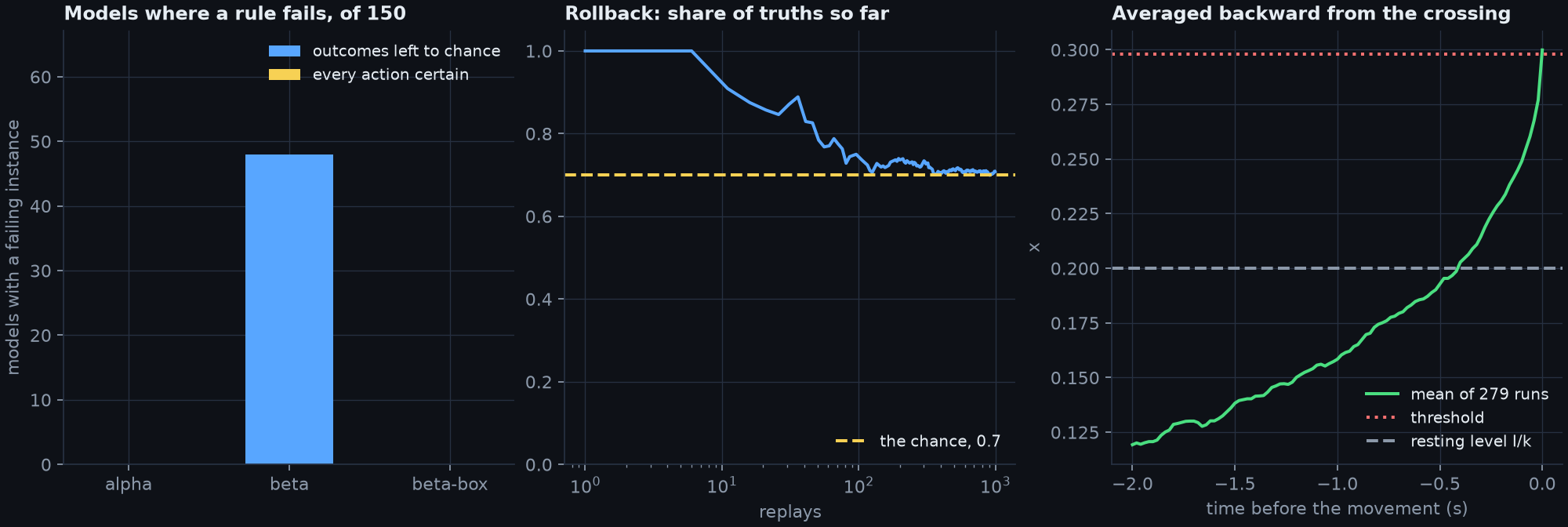
Check rules alpha, beta and beta-box on McKay and Johnson's coin and on 300 random models of options, replay an undetermined moment a thousand times, and average a leaky noisy accumulator backward from the moments it crosses its threshold.
python -m videos.philosophy.labs 32
needs numpy, scipy, matplotlib · download lab32.py ·
source on GitHubthe coin: failures of alpha, beta, beta-box 0, 2, 0 in 64 pairs (film: 0, 2, 0 in 64)
N(no heads), N(no tails), N(no heads and no tails) True, True, False
150 random models with chancy actions alpha fails in 0, beta-box in 0, beta in 48 models, agglomeration in 48
150 random models, every action certain beta fails in 0 models
rollback: truths in 1000 replays at chance 0.7 708 (after 10 replays: 0.90; three standard errors: 0.043)
accumulator: resting level I/k against the threshold 0.200 < 0.298
runs that cross within 20 s, mean wait 292 of 300, 6.5 s
backward average: 2 s before, at the crossing 0.119 -> 0.300 (half the rise in the last 0.33 s)
Rule beta fails only where an action's outcome is left to chance, which is where agglomeration fails; the repaired rule never fails. The ramp before each movement is what averaging noise backward from a threshold crossing looks like: nothing in the model decides.The code (97 lines; it asserts its own result)
"""Lab 32: check the consequence argument's rules on models of options, replay one moment, and build a readiness potential from noise."""

import numpy as np

from videos.coursekit import labs
from explainer.philosophy.reasoner import freewill as fw

TITLE = "Rule beta on a coin, a rollback, and Libet's ramp from noise"
GOAL = ("Check rules alpha, beta and beta-box on McKay and Johnson's coin and on 300 random models of options, "
        "replay an undetermined moment a thousand times, and average a leaky noisy accumulator backward from the "
        "moments it crosses its threshold.")
TASKS = [
    "Give the coin a third action, 'toss a two-headed coin', leading only to heads. Which of N(no heads), "
    "N(no tails) survive, and does rule beta still fail?",
    "Set leak = 0 in fw.accumulator (a pure drift with noise). Is the backward average still a late curve, or "
    "a straight ramp?",
    "Run fw.rollback with p_truth = 0.5 and 100 replays, twenty times with different seeds. How far does the "
    "share of truths stray, and what does one replay tell you?",
]


def random_model(rng, chancy):
    """Four worlds and three actions; with chancy=False every action leads to exactly one world."""
    worlds = list(range(4))
    actions = {}
    for a in range(3):
        k = int(rng.integers(1, 4)) if chancy else 1
        actions[a] = [int(w) for w in rng.choice(4, size=k, replace=False)]
    actual = actions[0][0]
    return fw.Options(worlds, actual, actions)


def run(seed=0):
    rng = np.random.default_rng(seed)
    lab = labs.Lab()

    coin = fw.rule_check()
    lab.row("the coin: failures of alpha, beta, beta-box", f"{coin['alpha_fail']}, {coin['beta_fail']}, "
            f"{coin['beta_box_fail']} in {coin['pairs']} pairs   (film: 0, 2, 0 in 64)")
    lab.row("N(no heads), N(no tails), N(no heads and no tails)",
            f"{coin['N_no_heads']}, {coin['N_no_tails']}, {coin['N_both']}")
    assert (coin["alpha_fail"], coin["beta_fail"], coin["beta_box_fail"], coin["pairs"]) == (0, 2, 0, 64)
    assert coin["N_no_heads"] and coin["N_no_tails"] and not coin["N_both"], "agglomeration fails on the coin"

    tally = {}
    for chancy in (True, False):
        checks = [fw.rule_check(random_model(rng, chancy)) for _ in range(150)]
        tally[chancy] = (sum(c["alpha_fail"] for c in checks), sum(c["beta_fail"] > 0 for c in checks),
                         sum(c["beta_box_fail"] for c in checks), sum(c["agg_fail"] > 0 for c in checks))
    lab.row("150 random models with chancy actions", f"alpha fails in 0, beta-box in 0, beta in {tally[True][1]} "
            f"models, agglomeration in {tally[True][3]}")
    lab.row("150 random models, every action certain", f"beta fails in {tally[False][1]} models")
    assert tally[True][0] == tally[True][2] == tally[False][0] == tally[False][2] == 0, "alpha and beta-box are valid"
    assert tally[True][1] > 10 and tally[True][1] == tally[True][3], "beta fails exactly where agglomeration does"
    assert tally[False][1] == 0, "without chance in the outcomes, beta never fails"

    p = 0.7
    roll = fw.rollback(p_truth=p, replays=1000, seed=2000 + seed)
    share = roll["truths"] / 1000
    lab.row("rollback: truths in 1000 replays at chance 0.7", f"{roll['truths']}   (after 10 replays: "
            f"{roll['running'][3]:.2f}; three standard errors: 0.043)")
    assert abs(share - p) < 3 * np.sqrt(p * (1 - p) / 1000), "the replays settle at the chance"

    acc = fw.accumulator(trials=300, seed=2012 + seed)
    par = acc["params"]
    rest = par["drift"] / par["leak"]
    lab.row("accumulator: resting level I/k against the threshold", f"{rest:.3f} < {par['threshold']}")
    lab.row("runs that cross within 20 s, mean wait", f"{acc['crossed']} of {acc['trials']}, {acc['mean_wait']:.1f} s")
    lab.row("backward average: 2 s before, at the crossing", f"{acc['rp_start']:.3f} -> {acc['rp_end']:.3f}"
            f"   (half the rise in the last {-acc['half_rise']:.2f} s)")
    assert rest < par["threshold"] and acc["crossed"] > 0.9 * acc["trials"], "only noise carries it over, and it does"
    assert acc["rp_start"] < rest and acc["rp_end"] > 0.29, "the average climbs from below the resting level"
    assert -0.8 < acc["half_rise"] < -0.1, "and most of the climb is in the last second"
    lab.note = ("Rule beta fails only where an action's outcome is left to chance, which is where agglomeration "
                "fails; the repaired rule never fails. The ramp before each movement is what averaging noise "
                "backward from a threshold crossing looks like: nothing in the model decides.")

    fig, ax = labs.figure(3, size=(12.5, 4.2))
    ax[0].set_axisbelow(True)
    ax[0].bar(["alpha", "beta", "beta-box"], [tally[True][0], tally[True][1], tally[True][2]], width=0.55,
              color=labs.BLUE, label="outcomes left to chance")
    ax[0].bar(["alpha", "beta", "beta-box"], [tally[False][0], tally[False][1], tally[False][2]], width=0.3,
              color=labs.GOLD, label="every action certain")
    ax[0].set(title="Models where a rule fails, of 150", ylabel="models with a failing instance",
              ylim=(0, 1.4 * max(tally[True][1], 1)))
    ax[0].legend()
    ax[1].plot(np.arange(len(roll["curve"])) * 5 + 1, roll["curve"], color=labs.BLUE)
    ax[1].axhline(p, color=labs.GOLD, ls="--", label="the chance, 0.7")
    ax[1].set(title="Rollback: share of truths so far", xlabel="replays", xscale="log", ylim=(0, 1.05))
    ax[1].legend(loc="lower right")
    ax[2].plot(acc["rp_t"], acc["rp"], color=labs.GREEN, label=f"mean of {acc['averaged']} runs")
    ax[2].axhline(par["threshold"], color=labs.RED, ls=":", label="threshold")
    ax[2].axhline(rest, color=labs.MUTED, ls="--", label="resting level I/k")
    ax[2].set(title="Averaged backward from the crossing", xlabel="time before the movement (s)", ylabel="x")
    ax[2].legend(loc="lower right")
    lab.fig = fig
    return lab
Now change it
- Give the coin a third action, 'toss a two-headed coin', leading only to heads. Which of N(no heads), N(no tails) survive, and does rule beta still fail?
- Set leak = 0 in fw.accumulator (a pure drift with noise). Is the backward average still a late curve, or a straight ramp?
- Run fw.rollback with p_truth = 0.5 and 100 replays, twenty times with different seeds. How far does the share of truths stray, and what does one replay tell you?
Problems, with solutions
Try each problem before opening its solution.
-
Show that rule \(\beta\) is valid on every model in which each action leads to a single world.
Solution
\(N p\) holds when \(p\) is true at the actual world and no available action leads only to \(\lnot p\)-worlds. If every action leads to a single world, "no action guarantees \(\lnot p\)" means every action's world is a \(p\)-world. Suppose \(N p\) and \(N(p \to q)\). Then every action's world is in \(p\) and in \(p \to q\), hence in \(q\); and the actual world, in \(p\) and \(p \to q\), is in \(q\). So \(N q\): rule \(\beta\) holds. It fails only when an action can lead to more than one world, as with McKay and Johnson's coin.
-
Find a model on which \(\beta\) fails but agglomeration holds, or prove there is none.
Solution
There is none. In this semantics \(N\) is closed under entailment: if \(X \subseteq Y\) and \(N X\), then the actual world is in \(Y\), and an action leading only to \(\lnot Y\) would lead only to \(\lnot X\), which \(N X\) excludes. Now suppose agglomeration holds and \(N p\), \(N(p \to q)\). Agglomeration gives \(N(p \land (p \to q))\), that is \(N(p \land q)\), and closure gives \(N q\). So agglomeration implies \(\beta\), and a model where \(\beta\) fails must be one where agglomeration fails too. (A brute-force search over every model with up to four worlds and three actions finds no counterexample, as it should.)
-
Give a buffered Frankfurt case on the options model, with no flicker at all.
Solution
Make Black's trigger something Jones does not do: an involuntary sign, a blush that would appear only if Jones were going to decide not to shoot, and that does not appear. Then Jones's only available action is to deliberate and decide, and it leads to one world, "shoots on his own". In the options model there is a single action, so Jones has no choice about anything: \(N\)(shoots) and \(N\)(shoots on his own) both hold, and there is no flicker of freedom at all. Yet he shoots on his own, for his own reasons, and seems responsible. Pereboom's buffered version gets the same result with a voluntary but non-robust precondition for deciding otherwise. The cost, as Widerker argued, is that the sign must be a reliable indicator of a future free decision, which an indeterminist can deny exists.
-
For the rollback, how many replays make the share within 0.01 of 0.7, 95% of the time?
Solution
The share in \(n\) replays has standard deviation \(\sqrt{0.7 \times 0.3/n}\). For it to lie within 0.01 of 0.7 with probability 95% we need \(1.96\sqrt{0.21/n} \le 0.01\), so \(n \ge 1.96^2 \times 0.21/0.0001 \approx 8{,}070\). The exact binomial calculation first reaches 95% at about \(n = 8{,}000\) (the lattice of possible shares makes it oscillate slightly). A thousand replays, as in the film, pin the share down only to within about 0.03.
-
Show that with no noise, the accumulator never crosses a threshold above \(I/k\).
Solution
Without noise the accumulator is \(dx/dt = I - kx\) from \(x(0) = 0\), whose solution is \(x(t) = (I/k)(1 - e^{-kt})\). This increases toward \(I/k\) but is below it at every finite time. So a threshold above \(I/k\) is never crossed, and one at \(I/k\) only in the limit. In the film's units, \(I = 0.1\) and \(k = 0.5\), so the ceiling is 0.2: crossing a higher threshold is the work of noise alone, which is Schurger's point about the readiness potential.
-
Write the diagonal agent for infinitely many predictors, and say what it needs to compute.
Solution
Let \(P_1, P_2, \ldots\) be the predictors, each a function from situations to acts (left or right), with situations numbered \(1, 2, \ldots\). The diagonal agent, in situation \(k\), does the opposite of \(P_k(k)\). It differs from every predictor \(P_k\) at situation \(k\), so no predictor on the list predicts it correctly everywhere. To act, it must compute \(P_k(k)\) for each \(k\): it needs an effective enumeration of the predictors and the ability to run each on its own index. If the list is given by a program (an effective listing of total computable predictors), the agent is computable, and so no effective list of predictors can include every computable agent. If the list is all total computable predictors, there is no such enumeration (deciding which programs are total is undecidable), and the agent would need an oracle: Cantor's diagonal, and Turing's, again.
Notes and sources
Sources
Texts: Kane (ed.), The Oxford Handbook of Free Will (2nd ed., 2011); van Inwagen, An Essay on Free Will (1983); Fischer, Kane, Pereboom and Vargas, Four Views on Free Will (2007); McKenna and Pereboom, Free Will: A Contemporary Introduction (2016).
Primary texts and papers: Aristotle, On Interpretation 9; Cicero, On Fate; Hobbes (1651); Hume (1748); Laplace (1814); Schopenhauer (1839); MacKay (1960); P. F. Strawson (1962); Chisholm (1964); Frankfurt (1969, 1971); Nozick (1969); Williams (1976); Nagel (1979); Lewis (1981); Libet et al. (1983); Watson (1987); G. Strawson (1994); Fischer (1994); Wallace (1994); Widerker (1995); Kane (1996); McKay and Johnson (1996); Finch and Warfield (1998); Fischer and Ravizza (1998); O'Connor (2000); van Inwagen (2000); Pereboom (2001, 2014); Matthias (2004); Conway and Kochen (2006); Sparrow (2007); Soon et al. (2008); Schurger, Sitt and Dehaene (2012); Maoz et al. (2019); Bourget and Chalmers (2023).
About this partfrom its README
Part 32 of Philosophy, Built (series plan, syllabus), the last part of Act VI, Mind and Meaning: whether anything we do is up to us, with the consequence argument's rules checked on a model, Frankfurt's case modelled, an undetermined moment replayed a thousand times, a readiness potential rebuilt from noise, and a diagonal that keeps a mind from predicting itself. Schopenhauer (1839); determinism defined (Laplace 1814; Part 24) and the dilemma of luck. Aristotle's sea battle and logical fatalism; Chrysippus's cylinder (Cicero, On Fate) and the lazy argument with co-fated events. List's levels (2019): 900 microstates, each with one successor, grouped into three agent-level states, from which 'deliberating' leads to tea 0.45, coffee 0.40, still deliberating 0.15. Van Inwagen's consequence argument (1983) with the operator N and rules α and β, derived step by step. A model of options (each action the set of worlds it might lead to; N p when p is true and no action guarantees not-p): on McKay and Johnson's coin (1996) N(no heads) and N(no tails) hold but N(not tossed) does not, so agglomeration fails, and with it rule β; checked on all 64 pairs of the model's 8 propositions (α fails 0 times, β twice, β□ never), the repaired argument of Finch and Warfield (1998), and the Wall's thirty-second brick. Frankfurt cases (1969) on the same model (no choice about whether Jones shoots, a choice about whether he shoots on his own: a flicker of freedom), Fischer's flickers, Widerker's dilemma and buffered cases. Compatibilism: Hobbes and Hume and the conditional analysis; Frankfurt's hierarchy (1971); Fischer and Ravizza's reasons-responsiveness (1998); Lewis's local miracles (1981); the free will tetrad as a Price List with the PhilPapers 2020 shares (compatibilism 59%, libertarianism 19%, no free will 11%). Libertarianism: agent causation (Chisholm; O'Connor) and Kane's self-forming actions (1996); van Inwagen's rollback simulated (708 truths in 1000 replays at a chance of 0.7). Where indeterminism could act: a torn decision as a damped double well, where an offset of 10⁻³⁰ still decides, each factor of ten adding 2.95 time units (Balaguer 2010; Tegmark 2000). Pereboom's four cases and Galen Strawson's basic argument (1994); life without basic desert. P. F. Strawson's 'Freedom and Resentment' (1962), the participant and objective stances, the faces of responsibility (Watson 1996; Shoemaker 2015), Wallace, Watson and experimental philosophy. Libet (1983) and Schurger, Sitt and Dehaene's leaky stochastic accumulator (2012), built: 964 of 1000 runs cross within 20 s, mean 6.3 s; averaged backward from the crossings, the noise alone rises from 0.118 to 0.300, half of it in the last 0.35 s; Soon et al. (2008) and Maoz et al. (2019). Dennett's evitability: in a deterministic world of falling rocks a blind agent is hit 34 times in 400 steps, a sighted one dodges 32 times and is never hit, and a rerun repeats every step. Self-prediction: a contrarian agent defeats both public predictions (MacKay 1960), a diagonal agent differs from every one of six predictors (Part 7), and Newcomb's problem (Nozick 1969). The free will theorem (Conway and Kochen 2006) and what it does and does not show. Moral luck (Williams; Nagel 1976): six of ten thousand equally careless drivers kill a child; four kinds of luck; two ledgers, by outcome (6 units on 6 drivers) and by risk (0.0005 on each, 5 in all), with a victim 99.33% certain (Zimmerman 2002). Responsibility gaps for learning machines (Matthias 2004; Sparrow 2007) and ways to close them.
The worked model results are computed by the Reasoner's new module explainer/philosophy/reasoner/freewill.py (with
prop for the Price List), tested in tests/philosophy/test_freewill.py and cached by compute.py.
Chapter notes
| # | Scene | What it establishes | Computed on screen |
|---|---|---|---|
| 0 | Hook |
Schopenhauer (1839); four questions; the plan. | — |
| 1 | Dilemma |
Laplace (1814); determinism defined (Part 24); List (2019); the dilemma. | a world deterministic below, open at the agent's level |
| 2 | Fate |
Aristotle; Chrysippus (Cicero, On Fate); the lazy argument. | — |
| 3 | Consequence |
van Inwagen (1983): N, α, β, the derivation. | — |
| 4 | Beta |
McKay and Johnson (1996); Finch and Warfield (1998); the Wall's thirty-second brick. | every instance of α, β and β□ on the coin |
| 5 | Frankfurt |
Frankfurt (1969); Fischer (1994); Widerker (1995); Hunt; Pereboom. | the case on the options model |
| 6 | Compatibilism |
Hobbes (1651); Hume (1748); Frankfurt (1971); Fischer and Ravizza (1998); Lewis (1981); the Price List. | the tetrad's minimal conflicts |
| 7 | Libertarian |
Reid; Chisholm (1964); O'Connor (2000); Kane (1996); Balaguer (2010); Tegmark (2000); van Inwagen (2000). | a torn decision in a double well; 1000 replays of one moment |
| 8 | Hard |
Pereboom (2001, 2014); G. Strawson (1994); Caruso. | — |
| 9 | Reactive |
P. F. Strawson (1962); Watson (1996); Scanlon; Shoemaker (2015); Wallace (1994); Watson (1987); Nahmias. | — |
| 10 | Libet |
Libet et al. (1983); Schurger, Sitt and Dehaene (2012); Soon et al. (2008); Maoz et al. (2019). | a leaky accumulator; its backward average |
| 11 | Predict |
Dennett (1984, 2003); MacKay (1960); the diagonal (Part 7); Nozick (1969). | a deterministic avoider; a contrarian; a diagonal over six predictors |
| 12 | Theorem |
Conway and Kochen (2006); Kochen–Specker; Bell (Part 26). | — |
| 13 | Luck |
Williams and Nagel (1976, 1979); Zimmerman (2002); Enoch and Marmor (2007). | 10 000 careless drivers; two ledgers of blame |
| 14 | Machines |
Matthias (2004); Sparrow (2007). | — |
| 15 | Outro |
recap; the Reasoner's module; the Wall; problems; payoffs; references. | — |
Companion material in this repository
The syllabus's plan for this partfrom SYLLABUS.md, the plan of record
- The dilemma: determinism undermines freedom; indeterminism makes it luck.
- Aristotle and the Stoics: Chrysippus's cylinder; the lazy argument.
- The consequence argument (van Inwagen 1983) formalized with the N operator: rules α and β.
- McKay and Johnson (1996): rule β is invalid, shown on a Kripke model built by the Reasoner. The repaired versions and the debate.
- Frankfurt cases (1969): the principle of alternative possibilities; flickers of freedom.
- Compatibilism: hierarchical desires (Frankfurt); reasons-responsiveness (Fischer and Ravizza).
- Libertarianism: agent causation, event-causal views (Kane). The luck objection and van Inwagen's rollback argument. Built: a rollback simulator shows that replays converge to frequencies.
- Hard incompatibilism (Pereboom); Galen Strawson's basic argument as a regress.
- P. F. Strawson's "Freedom and Resentment" (1962): reactive attitudes.
- Libet (1983): the readiness potential. Schurger, Sitt and Dehaene (2012): a leaky stochastic accumulator reproduces it. Built: the accumulator generates RPs from noise.
- Predictability and self-prediction: MacKay's argument; a diagonal proof that no agent can, in general, act on a prediction of itself. Newcomb's predictor previews Part 33.
- The free will theorem (Conway and Kochen) and what it does and doesn't show.
- Moral luck (Nagel, Williams): resultant, circumstantial, constitutive.
- Responsibility for artificial agents: responsibility gaps (Matthias 2004) and who answers for what (previews Part 41).
- Recap and Problems.
Built: reasoner.freewill (the N-operator model checker for rule β; rollback; leaky accumulator; self-prediction
diagonal).
Wall: the McKay–Johnson countermodel (but stronger rules survive); the self-prediction diagonal.
Price List: the free will tetrad (some acts are free; free acts require alternative possibilities; determinism
rules out alternatives; determinism or randomness holds), with the PhilPapers 2020 shares.
Visuals: rollback replays fanning out from one moment; the accumulator crossing threshold; the Frankfurt
intervener hovering unseen.
References: Kane (ed.), Oxford Handbook of Free Will; van Inwagen, An Essay on Free Will; Fischer, Kane,
Pereboom and Vargas, Four Views on Free Will; McKenna and Pereboom, Free Will: A Contemporary Introduction;
Schurger et al. 2012 (PNAS).
Build the film
python -m videos.philosophy.philosophy32.compute        # the part's numbers, into .cache/philosophy32
python tools/build.py philosophy32                  # render and assemble the film
EXPLAINER_TTS=silent python tools/qa_scene.py philosophy32 Hook   # one chapter, silent, with a contact sheet
Scenes: videos/philosophy/philosophy32. Setup: see the course page. Source of these notes: the README and the scenes' narration.
Build it
python -m videos.philosophy.philosophy32.compute       # every computed item (seconds; .cache/philosophy32)
python tools/build.py philosophy32 -q l                # 480p preview
python tools/build.py philosophy32                     # 1080p30 -> renders/philosophy32.mp4
python tools/qa_scene.py philosophy32 Beta             # one chapter, silent, with a contact sheet