Mind and Machine
What is a mind, and could a machine have one?
The part opens with Turing's question of 1950, can machines think, and tests each theory of mind against a machine. Descartes's two substances meet Elisabeth of Bohemia's question of how they could interact; behaviourism and the identity theory fall to super-spartans and to multiple realizability. Functionalism is built: one probabilistic machine table for a pain role is realized in threshold units and in a water tank and run in lockstep for 1000 steps, and the Ramsey-Lewis definition finds exactly one occupant of the role among 1806 assignments. The imitation game, a Chinese rulebook that is perfect on a narrow test and helpless outside it, and Blockhead's table of about 10^25764 entries ask whether passing the test is enough. Supervenience is checked in its weak, strong and global forms, and the part turns on Kim's exclusion argument: a mind that is physical and yet causally its own is the Wall's thirtieth brick, priced as a tetrad, with Yablo's pigeon and proportional causes as the reply. It ends with emergence in Gosper's glider gun, Dennett's real patterns, Dretske's fuel gauge, systematicity, and a probe that reads from a network what the network does not use.
What you need. State tables of a machine and probabilities; the possible worlds of Part 22 for supervenience, and bits of information for the fuel gauge.
- The calculation
- functionalism, supervenience
- The wall
- causal exclusion; Blockhead
- Built toy
- Turing test; Chinese room; Game of Life emergence
What you will be able to do
Introductory
- Set out dualism, behaviourism, the identity theory and functionalism, each with the objection that moved the debate on.
- Describe the imitation game and the Chinese room, and state the systems and robot replies.
- Estimate the size of Blockhead's table for a test of a given length.
Advanced
- Realize a machine table in a second substrate and check the two in lockstep; write the Ramsey sentence of a small theory and count its realizations.
- Define weak, strong and global supervenience, and decide each on a small set of worlds.
- Lay out Kim's exclusion argument and say which premise each of the four positions gives up.
Research
- Prove that strong supervenience implies weak and global, and show by examples that weak and global are independent.
- Assess the proportionality reply to exclusion with an interventionist measure of the difference a cause makes.
Applied
- Test a system for systematicity on held-out compositions of known parts.
- Probe a network for a variable, remove the probe's direction, and say what the result shows about use as against mere presence of information.
Contents
Each chapter has a home level. Choose a track to see what to read and watch: Introductory 21 min · Advanced 48 min · Research 51 min · Applied 23 min.
- 0Could a machine have a mind?Introductory2 min
- 1Two substancesIntroductory3 min
- 2Behaviour, and the brainIntroductory3 min
- 3Minds as machine tablesAdvanced5 min
- 4The imitation gameIntroductory3 min
- 5The Chinese roomIntroductory4 min
- 6Blockhead and the China brainIntroductory3 min
- 7SupervenienceAdvanced3 min
- 8Causal exclusionAdvanced5 min
- 9EmergenceAdvanced4 min
- 10Eliminating the mindAdvanced4 min
- 11Content, naturalizedAdvanced3 min
- 12The language of thoughtApplied3 min
- 13Representation in networksResearch3 min
- Recap, problems, and where this comes backAll tracks2 min
Also on this page: Lecture · Key results · Try it · Lab · Problems · Notes and sources · Build the film.
Lecture
The text of each chapter is the film's narration, as it is spoken, so you can read along or revise without the film. The pictures are in the film.
Could a machine have a mind?Introductory2 min
Part 29 ended with a question: what is a mind, and could a machine have one? This part takes it head on. In 1950 Alan Turing opened a paper with it: I propose to consider the question, can machines think? To answer, we need a theory of what minds are. This part follows the theories, from Descartes's two substances through behaviourism, the identity theory and functionalism, and tests each against machines that philosophers have imagined, and some that the Reasoner builds.
Four questions run through it. What minds are: a separate substance, a way of behaving, a state of the brain, or a role that anything, brain or silicon, could play. What minds do: if every physical event has a physical cause, what is left for the mind to cause? This is the problem of causal exclusion, this part's brick in the Wall. What mental states mean: how can a state of a brain, or of a machine, be about anything, Brentano's question from Part 29? And machines: would a program that passed every test understand anything at all?
The plan. Descartes's two substances, and the question Princess Elisabeth asked him. Behaviourism, and the theory that the mind is the brain. Functionalism, with one machine table realized in two very different substrates, and the occupants of a role counted. Turing's imitation game, and Searle's Chinese room, with a rulebook the Reasoner writes. Block's lookup table, measured against the universe, and the China brain. Supervenience, checked on small sets of worlds, and Kim's exclusion argument, this part's brick in the Wall and its Price List, and a pigeon that complicates it. Emergence, with a glider gun firing, the proposal to eliminate the mind altogether, and Dennett's real patterns, measured. And how mental states could have content, the language of thought, and what it means for a network to represent something.
What it establishes: Turing (1950); four questions; the plan.
1Two substancesIntroductory3 min
The thought experiment is older than Descartes. Around 1020, Ibn Sīnā, known in Latin as Avicenna, asked us to imagine a man created all at once in mid-air, fully formed, his eyes covered, his limbs held apart so that they do not touch. He senses nothing, not even his own body. Yet, Avicenna argued, he would affirm that he exists. So the self he affirms is something other than the body he does not know: the floating man.
René Descartes, in his Meditations of 1641, made the distinction the starting point of modern philosophy. The mind is a thinking thing: unextended, indivisible, and known with more certainty than anything else, since I can doubt everything but that I am thinking. The body is an extended thing: it takes up space, it is divisible, it does not think, and it is known only through the senses, which can deceive. Two substances, each able to exist without the other. Yet they interact: a pin pricks the hand and I feel pain; I decide to raise my arm and it rises. Descartes located the meeting point in the pineal gland, at the centre of the brain.
Descartes's main argument can be put in the modal logic of Part 4. It is possible that I exist and my body does not: I can clearly and distinctly conceive it, and whatever I can so conceive, God can bring about. If a is b, then necessarily a is b: identity holds in every possible world, as Part 22 showed. So I am not my body. The premise that does the work is the first. The standard reply is that conceivability is a poor guide to possibility: that water is not H two O was once conceivable, and it is impossible, as Part 27 found. The argument, sharpened, returns in Part 31 as the argument from zombies.
In 1643 the twenty-four-year-old Princess Elisabeth of Bohemia wrote to Descartes with the objection that has followed dualism ever since. How can the soul of a human being, being only a thinking substance, determine the bodily spirits to perform voluntary actions? Every cause of motion she knew worked by contact, pushing, and so needed extension; the soul has none. Descartes answered that the union of mind and body is a primitive notion, known not by thinking about it but by living it. Elisabeth was not satisfied. It would be easier for me, she wrote, to concede matter and extension to the soul than the capacity of an immaterial being to move a body. The question of how mind and matter could interact is still the chief obstacle to dualism, and it returns, in a new form, in chapter eight.
What it establishes: Avicenna (c. 1020); Descartes (1641); Elisabeth of Bohemia (1643).
2Behaviour, and the brainIntroductory3 min
In 1949 Gilbert Ryle mocked Descartes's picture as the dogma of the ghost in the machine. His parable: a visitor to Oxford is shown the colleges, the libraries, the laboratories and the offices, and then asks: but where is the University? He has made a category mistake. The University is not one more building alongside the others; it is the way they are all organized. The mind, Ryle argued, is like that: not a hidden extra thing inside the body, but the way a person's doings and dispositions hang together.
Behaviourists made the thought precise. To say that Jones is in pain is to say that Jones is disposed to wince, cry out, reach for aspirin, and so on, as to call glass fragile is to say it would break if struck. It failed for three reasons. First, circularity: whether pain makes you reach for aspirin depends on whether you believe aspirin helps and want the pain to stop, so the analysis needs more mental terms. Second, Hilary Putnam's super-spartans, people who feel pain as we do but are trained never to show it. Third, perfect actors, who show pain and feel nothing. Pain and its behaviour can come apart in both directions.
The next proposal was bolder. In 1956 U. T. Place, and in 1959 J. J. C. Smart, argued that sensations are simply brain processes. Science has discovered that lightning is electrical discharge, that water is H two O, that heat is mean molecular kinetic energy. Why not that pain is C-fibre firing? The identity would be discovered by science, not by analysing what the word pain means, so the behaviourists' problems do not arise. C-fibre firing became the philosophers' standard example, a placeholder for whatever neuroscience eventually finds.
Two objections changed the field. Saul Kripke argued in 1970 that identities between rigidly designated things are necessary, as Part 22 showed, so if pain is C-fibre firing it is so in every possible world. Yet it seems possible to have pain without C-fibres. With heat, the appearance can be explained away: something could feel like heat without being heat, or heat could feel different. But anything that feels like pain is pain. The second objection was Putnam's. An octopus, with a very different nervous system, can surely be in pain, and so could a Martian, or a robot. Pain is multiply realizable, so it cannot be identical with any one kind of physical state. If pain is not a kind of stuff, perhaps it is a kind of role.
What it establishes: Ryle (1949); Putnam (1963); Place (1956); Smart (1959); Kripke (1970).
3Minds as machine tablesAdvanced5 min
In 1967 Putnam proposed that pain is a functional state: a state defined by what causes it and what it causes, like a state of a machine defined by its machine table. Here is a small probabilistic machine table for a pain role. Three states: calm, hurt and soothed. Three inputs: a bump, nothing, or an aspirin. Each entry gives the chances of the next state and the output. A bump makes a calm creature hurt, nine times in ten, and it says ouch. Hurt and given aspirin, it is usually soothed, and sighs. On this view, the hurt state is the pain: whatever state is caused by damage, causes wincing and saying ouch, and is relieved by aspirin. It is defined by its relations to inputs, outputs and other states, not by what it is made of.
The Reasoner builds the same role twice. Once in a network of threshold units: the state is which of three units is on, and a unit for each table entry fires only when the state, the input and the random draw all match it. And once in water: the state is the level in a tank, empty for calm, one litre for soothed, two for hurt, and the table is a set of valves. Feed them the same inputs and the same random draws. A bump: the units switch to hurt, the tank fills to two litres, and both say ouch. Aspirin: both are soothed, and both sigh. Over a thousand steps the outputs agree a thousand times out of a thousand: carry on four hundred and sixty-eight times, ouch two hundred and eighty-two, wince a hundred and eighty, sigh seventy, in both. Yet physically the two never look alike: a pattern of electrical units in one, a level of water in the other. If pain is the role, both are in pain, or neither is. That is functionalism's promise, and, as the next chapters show, its problem.
Functionalism came in several forms. Putnam's machine functionalism identified mental states with states of a probabilistic automaton. David Lewis and David Armstrong took the roles from ordinary psychology, the platitudes everyone knows about pain and belief, and left it to science to find what plays them. Lewis gave a method, after Ramsey: write down the whole theory, replace each mental term by a variable, and define pain as whatever occupies the pain place. That leaves a choice. Is pain the role itself, or the physical state that plays the role in us? And it leaves a worry, which the next three chapters press: could the role be played with no one home?
The Ramsey–Lewis method can be carried out, and counted. Take the folk theory of the pain role as a list of platitudes: from calm, a bump leads to hurt and ouch, or now and then leaves it calm; from hurt, aspirin leads to soothed and a sigh; and so on, every entry of the table. Replace the three mental terms by variables, and close them off: there exist x, y and z such that the platitudes hold of them. That is the theory's Ramsey sentence. Pain is defined as the y that does the job. Now take a brain with seven microstates, more states than the theory has terms. The Reasoner tries every way of grouping the seven into three kinds and naming the kinds calm, hurt and soothed: one thousand eight hundred and six assignments. Exactly one makes the theory true. Pain is the disjunction of three microstates, h one, h two or h three, multiply realized inside a single brain. The water tank has one realization out of six. A thermostat with three states, the same inputs and the same outputs, has none: nothing in it is in pain. And the theory matters. Leave out the aspirin platitudes and the brain still has one realization. Keep only the bump platitudes and it has two: calm and soothed can be swapped. Lewis held that the terms name only if the role is uniquely occupied; with two occupants, the theory does not say which state is calm. And a realization, in general, is a grouping of states that the dynamics respects, what Part 4 called a bisimulation: functional equivalence is bisimilarity, up to the grain the theory describes.
What it establishes: Putnam (1967); Armstrong (1968); Lewis (1970, 1972).; Computed on screen: one role in two substrates, 1000 steps; a Ramsey sentence's occupants
4The imitation gameIntroductory3 min
Turing thought the question can machines think too vague to answer, and replaced it with a game. An interrogator, C, talks by typed messages with two players hidden from view. One, A, is a machine; the other, B, is a person. C may ask anything. If C cannot reliably tell which is the machine, the machine has won. Turing forecast that by the year 2000 computers would play so well that an average interrogator would have no more than a seventy percent chance of making the right identification after five minutes of questioning.
Turing then answered nine objections. The theological objection: thinking is a function of the soul. Turing: God could give a soul to a machine if he chose. The heads in the sand objection: the consequences would be too dreadful. That is a consolation, not a refutation. The mathematical objection: by Gödel's theorem, a machine cannot see the truth of its own Gödel sentence, from Part 7. Nor, Turing replied, has anyone shown that we can see ours. The argument from consciousness: Geoffrey Jefferson said no machine equals a brain until it writes a sonnet because of thoughts and emotions felt. Turing: then we cannot know that other people think either. Arguments from disabilities: it will never be kind, enjoy strawberries and cream, or fall in love. These are inductions from the machines we happen to have seen. Lady Lovelace's objection: a machine can only do what we order it to do. Turing: machines surprise him all the time. Continuity: the nervous system is not a discrete machine. But a discrete machine can imitate a continuous one well enough. Informality: no set of rules could cover every circumstance. Perhaps no rules of conduct, Turing said, but there may still be laws of behaviour. And extrasensory perception, which Turing took surprisingly seriously: put the players in a telepathy-proof room.
The test has had a long afterlife. In 1966 Joseph Weizenbaum's ELIZA imitated a therapist by matching patterns in what users typed; to his dismay, some confided in it as if it understood. Competitions like the Loebner Prize, from 1991 to 2019, were often won by programs that dodged questions and faked typing errors. In 2025 Cameron Jones and Benjamin Bergen reported three-party tests, in Turing's own format, in which GPT-4.5, prompted to adopt a persona, was judged to be the human seventy-three percent of the time, more often than the real humans were. What would that show? The test measures indistinguishability in conversation. Whether that is thinking is the question of the next two chapters.
What it establishes: Turing (1950); Weizenbaum (1966); Jones and Bergen (2025).
5The Chinese roomIntroductory4 min
In 1980 John Searle answered Turing with a thought experiment. He imagines himself locked in a room with boxes of Chinese characters and a rulebook, written in English, that says which strings of shapes to send out in response to which strings come in. He knows no Chinese; to him the characters are just squiggles. Questions in Chinese are passed in through a slot. He looks up the shapes, follows the rules, and passes out answers. From outside, the room answers as well as a native speaker. But he understands nothing. And a computer running a program has nothing more than he has: the rules. So running the right program, however well, is not sufficient for understanding. Syntax is not sufficient for semantics.
The Reasoner writes a rulebook of its own. The story, in Chinese: a man went into a restaurant and ordered a hamburger; when it came it was burnt, and he was angry and left without paying. Searle borrowed the example from Roger Schank's story-understanding programs. Eight rules, each of the form: if the question contains these shapes, send out those. Did he eat the hamburger? No. Did he pay? No. What did he order? A hamburger. On a narrow test about the story the rulebook is perfect: eight of eight. Outside the script it is helpless. Do you like hamburgers, and what is the weather today, match no rule. Why didn't he eat? matches the rule for eat, and gets the answer no. Who are you? gets: a man. Searle's claim is stronger than that this rulebook is bad. A perfect rulebook, one that never slipped, would still be shapes in and shapes out, and so would understand no more than this one.
Searle's paper was published with replies, and he answered them. The systems reply: the man does not understand, but the whole system, man plus rulebook plus paper, does. Searle: let him memorize the rules and do it all in his head. Now he is the whole system, and he still understands nothing. The robot reply: put the program in a robot, with cameras and arms, so its symbols connect to the world. Searle: what comes in from the camera is just more symbols. The brain simulator reply: let the program simulate the firing of every neuron in a Chinese speaker's brain. Searle: imagine the simulation done with water pipes and valves; the pipes understand nothing. The other minds reply: how do you know that anyone understands Chinese, except by their behaviour? Searle: the question is what understanding is, not how we know it is there. His conclusion: brains have intrinsic intentionality, caused by their specific biology; programs have only the meaning we lend them.
The argument is still argued over. Daniel Dennett and Douglas Hofstadter called it an intuition pump: picturing one slow man with a book hides how complex a system that really conversed would have to be. For functionalism it poses a dilemma. If the room understands, understanding is cheaper than we thought; if it does not, the functional role leaves something out. Language models revive it. They were not handed a rulebook; they learned from text, which is the situation of the octopus in Part 28. What, then, makes a state mean something? Chapter eleven returns to that question.
What it establishes: Searle (1980); Schank and Abelson; Dennett and Hofstadter (1981).; Computed on screen: a rulebook, inside and outside its script
6Blockhead and the China brainIntroductory3 min
In 1981 Ned Block imagined a machine built to pass the Turing test by brute force. For every possible conversation up to some length, it stores one sensible next reply. Its programmers, working in advance, thought of every sensible reply to everything that could be typed. It would pass any test of that length, by looking up the conversation so far and printing what it finds. Yet, Block argued, it has the intelligence of a jukebox. Intelligence depends on how behaviour is produced, not only on what the behaviour is. He called this view psychologism.
How big would Blockhead be? It needs an entry for every string the interrogator might type: at least twenty-seven to the power of the number of characters, counting letters and the space. The observable universe holds about ten to the eighty atoms. A one-minute test, at three hundred characters a minute, needs about ten to the four hundred and twenty-nine entries. Ten minutes, ten to the four thousand two hundred and ninety-four. An hour, ten to the twenty-five thousand seven hundred and sixty-four. Here each bar's length is the number of digits. The universe is a sliver at the top. Blockhead is logically possible and physically absurd, which is Block's point: the test can be passed in principle by something that plainly does not think, so passing it cannot be what thinking is.
The worry behind Blockhead is old. In 1714 Leibniz wrote: imagine a machine whose structure produced thought, feeling and perception, enlarged so that one could walk into it as into a mill. Inside, we would find nothing but parts pushing one against another, and never anything by which to explain a perception. Leibniz's mill is the ancestor of every argument in this chapter.
Block's earlier example, from 1978, is the China brain. Suppose the whole population of China, a billion people, were each given a two-way radio and the job of doing what one neuron in your brain does: when these messages come in, send that one out. Connect the network to an artificial body. For an hour, it realizes exactly your functional organization. Would the nation, as a whole, feel pain when the body is pricked? Most people find it absurd that it would: the qualia, the felt qualities, seem absent. A related worry is inverted qualia: a system functionally just like you that sees red where you see green. If either is possible, functional role does not fix experience. That is the subject of Part 31.
What it establishes: Block (1978, 1981); Leibniz (1714).; Computed on screen: Blockhead's table against the universe
7SupervenienceAdvanced3 min
If pain is not identical with any one physical kind, how is the mental tied to the physical at all? Donald Davidson held in 1970 that every mental event is a physical event, but that there are no strict laws linking mental kinds with physical kinds: anomalous monism. That needed a tie weaker than identity. The tie is supervenience: things alike in every physical respect cannot differ in any mental respect. As a picture's beauty supervenes on its pixels: no change in the beauty without some change in the pixels, though beauty is no particular pattern of them. Jaegwon Kim showed in 1984 that the slogan hides at least three different relations.
Write x is physically like y, and x is mentally like y. Weak supervenience: within each possible world, any two things that are physical twins are mental twins. Strong supervenience: the same holds across worlds; a physical twin of yours in any possible world is your mental twin. Global supervenience compares whole worlds: any two worlds with the same physical distribution have the same mental distribution.
The Reasoner checks all three on small sets of worlds, each with two individuals, a and b. In set A, a and b are physical and mental twins within each world, so weak supervenience holds. But a has the same physical state in both worlds and a different mental state, so strong supervenience fails, and so does global: the two worlds are physically identical and mentally different. In set B, a and b are physical twins in world one with different mental states, so weak supervenience fails. Yet global supervenience holds, because no two worlds share their physical distribution. In set C, one function from physical to mental states holds everywhere, and all three hold. Strong supervenience implies the other two; weak and global are independent of each other. Which one physicalism needs is itself a question.
What is supervenience good for? Frank Jackson used global supervenience to state minimal physicalism: any world that is a minimal physical duplicate of ours is a duplicate of it in every respect. But supervenience only states a pattern of covariation. It does not explain why the mental depends on the physical, as Terence Horgan stressed. And it is weaker than it looks: a dualist's God could guarantee it by decree, so it is compatible with genuinely emergent minds. The pressing question comes next. If the mental merely supervenes on the physical, can it cause anything?
What it establishes: Davidson (1970); Kim (1984); Jackson (1998); Horgan (1993).; Computed on screen: three relations on three sets of worlds
8Causal exclusionAdvanced5 min
Jaegwon Kim turned supervenience against the non-reductive physicalist. Suppose a mental event M, my wanting water, causes a physical event P star, my arm reaching for the glass. M is realized by some neural event P. But the physical world is causally closed: P star has a sufficient physical cause, and P is the obvious candidate. So what is left for M to do? Either M is P, or M's causal work is pre-empted by P, or the arm's motion has two sufficient causes, which would have to be so for every mental cause there ever was. Kim called the conclusion the exclusion problem.
Laid out, the argument has five steps. One: distinctness. The mental property is not the physical property that realizes it; that is what non-reductive physicalism says. Two: mental causation. My wanting water causes my arm to move. Three: closure. Every physical event that has a cause has a sufficient physical cause. Four: exclusion. No event has more than one sufficient cause, unless it is overdetermined, like a man shot by two firing-squad marksmen at once. Five: mental causes do not systematically overdetermine their effects. Together, the five are inconsistent. Kim concluded that the only way to keep mental causation is to reduce the mental to the physical.
This is the thirtieth brick in the Wall. The dream was a mind that is both physical, fully part of the natural world, and causally its own, making a difference that is not just the difference its physical basis makes. Kim's exclusion argument says you cannot have both. What it forces is a choice: reduce the mental, accept overdetermination, or let the mind be an epiphenomenon, a side effect that does nothing.
Four claims cannot all be true. Mental events are not physical events. Mental events cause physical events. Every physical event that has a cause has a sufficient physical cause. And the effects of mental causes are not systematically overdetermined. Something has to give. The reductive physicalist gives up the first: mental properties are physical properties after all, Kim's own conclusion. The epiphenomenalist gives up the second: the mind is caused but causes nothing, as Thomas Huxley held of consciousness, and Frank Jackson in 1982 of qualia. The interactionist dualist gives up the third: some physical events have mental causes and no sufficient physical ones, as Descartes held, and in the twentieth century Karl Popper and John Eccles. And some give up the fourth: Karen Bennett argued in 2003 that the overdetermination is harmless, because the mental cause is realized by the physical one, and the two do not compete.
There is a fifth answer, which questions the exclusion principle itself. Stephen Yablo, in 1992, imagined Sophie, a pigeon trained to peck at red. Shown scarlet, she pecks. Was it the scarlet that caused it, or the red? Red supervenes on the exact shade, as the mental supervenes on the physical. The Reasoner puts six shades in front of her. Three are reds, and she pecks at them ninety five times in a hundred; at the others, five. Now compare candidate causes, in James Woodward's interventionist way: set the cause's value by intervention, with equal chances, and see what difference it makes to the pecking. Red against not red makes a difference of ninety points, and carries 0.714 bits about the peck. Scarlet against not scarlet makes only fifty four points, 0.369 bits, because some non-scarlets are red. The exact shade carries the same 0.714 bits as red, but needs 2.58 bits of cause to do it: most of its detail makes no difference. And being coloured, which every shade is, makes none. Red is the proportional cause: it carries all the difference the shade makes, and nothing that makes none. It is also realization-insensitive, in the terms of Christian List and Peter Menzies in 2009: had the red been a different red, she would still have pecked. So too, they argue, for a thirst realized by a neural state P: had it been realized differently, I would still have reached for the glass, so the thirst, not the exact neural state, is the difference-maker, and the exclusion principle fails for causes at different grains. Kim replied that the realizer still does all the producing; proportionality is about which description explains best, not about what makes the arm move. That disagreement is where the debate stands.
What it establishes: Kim (1998); Huxley; Jackson (1982); Popper and Eccles (1977); Bennett (2003); the Wall's thirtieth brick; the Price List; Yablo (1992); Woodward (2003); List and Menzies (2009).; Computed on screen: the tetrad's minimal conflicts; proportional causes
9EmergenceAdvanced4 min
Perhaps minds are emergent: features of wholes that no part has. John Stuart Mill, in 1843, noted that chemical compounds have properties not predictable from those of their elements. C. D. Broad, in 1925, made it a theory: emergent properties obey trans-ordinal laws, linking one level to the next, that could not be deduced even in principle from complete knowledge of the lower level. Within a decade quantum mechanics had explained the chemical bond, and chemistry, emergentism's flagship example, had been reduced. The case that survived was the mind. To see what emergence could still mean, consider a world whose laws we know completely.
In 1970 John Conway invented a universe with two rules, published by Martin Gardner in Scientific American. Space is a grid of cells, each alive or dead, and time goes in steps. A dead cell with exactly three live neighbours comes alive. A live cell with two or three live neighbours survives; every other cell dies. That is the whole physics. Here is a pattern found by Bill Gosper the same year. Watch it run. Every thirty generations it emits a small shape, a glider, that travels away across the grid, one cell diagonally every four generations, keeping its shape. After a hundred and fifty generations, four gliders are in flight. Nothing in the rules mentions guns, gliders or motion. They are only cells being born and dying.
The gun obeys a law of its own. The Reasoner runs it for six hundred generations, on a board large enough for every glider to fly free, and counts the live cells at each one. The count wobbles through every thirty-generation cycle. But at every thirtieth generation it lands on a straight line: thirty six cells, plus five for each glider fired. At generation six hundred there are one hundred and thirty six live cells, ninety five of them in the nineteen gliders already clear of the gun. The law holds at all twenty one checks. It is a law about guns and gliders, as exact as any law of chemistry, about things the two rules never mention. And the rules entail it, but nothing in the rules, inspected, says thirty: the Reasoner found it by running them. The next idea gives that a name.
Mark Bedau, in 1997, used worlds like this to define weak emergence. A macro-property is weakly emergent if it is derivable from the micro-dynamics, but only by simulation: there is no shortcut, you have to run it. The glider is a perfect example. In Life the lack of shortcuts is a theorem. Life can carry out any computation, so whether a pattern will ever die out is, in general, undecidable. Strong emergence is more: a property not derivable from the low-level facts even in principle. David Chalmers has argued that consciousness is the only clear candidate. Weak emergence sits comfortably with physicalism. Strong emergence would be a new kind of law, and it runs straight into the exclusion problem of chapter eight.
What it establishes: Mill (1843); Broad (1925); Conway (1970); Gosper (1970); Bedau (1997); Chalmers (2006).; Computed on screen: Gosper's gun, 150 generations; its law, to 600
10Eliminating the mindAdvanced4 min
Paul and Patricia Churchland proposed something more radical than any reduction. Science has often found that the things a theory talked about do not exist. Phlogiston gave way to oxygen, caloric fluid to molecular motion, vital spirit to biochemistry. Nobody reduced phlogiston to oxygen; phlogiston was eliminated. Paul Churchland argued in 1981 that beliefs and desires may go the same way. Folk psychology, our everyday practice of explaining behaviour by beliefs and desires, is a theory, and not a good one: it has hardly changed in two thousand years, and it says nothing about sleep, learning or mental illness. If neuroscience does not vindicate it, its entities should be eliminated.
There were sharp replies. Lynne Rudder Baker argued that eliminativism refutes itself: the eliminativist believes there are no beliefs, and argues in order that we come to believe it too. The Churchlands answered that this begs the question: it assumes the old theory in order to criticize the new, which would be stated in better terms once we have them. A stronger reply is folk psychology's success. Knowing only that a friend wants to meet you and believes you will be at the station at noon, you can predict where she will be tomorrow, something no neuroscience can yet do. And Jerry Fodor held that the theory would be vindicated: beliefs are real, as sentences in a language of thought.
Daniel Dennett took a middle way. We can predict a system from three stances: the physical stance, from its physics; the design stance, from what it is for; and the intentional stance, by treating it as a rational agent with beliefs and desires. A system has beliefs, he argued, if the intentional stance predicts it well. In a paper of 1991, Real Patterns, his example was the Game of Life from the last chapter. Gliders are real, though nothing exists but cells: talking about gliders lets us compress the history of the grid and predict it. Beliefs, likewise, are real patterns in behaviour: neither eliminated nor reduced.
Dennett's argument can be measured. His paper's figure was a set of frames of dots, each a bar code, ten black dots and ten white, repeated, with some of the dots flipped at random. The Reasoner draws six such frames of nine hundred dots, with noise from none to one half. Is the bar code really there? Dennett's test: a pattern is real if describing the frame by the pattern, plus a list of its exceptions, is shorter than giving every dot. With no noise, the pattern and its phase take three percent of the bit map. At one percent noise, seven percent. At five, thirty one percent. At ten percent noise, forty eight; at a quarter, eighty five. The pattern is there at every one of these levels, ever more faintly. At one half, describing the frame by the bar code costs more than the bit map: there is no pattern to find. An off-the-shelf compressor, run on long stretches of each, agrees. And the pattern pays off in prediction too: betting on the bar code wins ninety percent of the time at ten percent noise. That, for Dennett, is all it takes for beliefs to be real: a pattern in behaviour that predicts better than the alternatives, though the noise never goes away.
What it establishes: Churchland (1981); Baker (1987); Dennett (1987, 1991).; Computed on screen: a bar code's description length at six noise levels
11Content, naturalizedAdvanced3 min
Brentano's question, from Part 29, is how a physical state could be about anything. Fred Dretske's answer began with information. Tree rings carry information about a tree's age; smoke, about fire. Precisely: a signal carries the information that s is F if, given the signal, the probability that s is F is one. If mental content is a kind of information, and information is a matter of physical law, then meaning would be part of nature.
The Reasoner tests the idea on a fuel gauge with four marks. With a perfect needle, a reading carries two bits about the tank, and every reading is certain: read two thirds, and the tank is at two thirds. Let the needle err one time in ten, to a neighbouring mark. The gauge still carries one point four eight bits. At three errors in ten, under one bit; at six in ten, about two thirds of a bit. But with any error at all, not one reading makes any level certain, so on Dretske's strict definition no reading carries the information that the tank is at any level. And that exposes the deeper problem. A gauge that reads full on a half-empty tank is not carrying no information; it is misrepresenting. Representation can be wrong; information, in this sense, cannot. Something must say what the gauge is supposed to indicate.
Ruth Millikan, in 1984, supplied the missing ingredient: function. On her teleosemantics, a state means what it was selected, by evolution or learning, to indicate. A frog's tongue snaps at small dark moving things. The detector was selected because it caught flies, so it means fly, even when it fires at a pellet flicked past by a scientist. Misrepresentation is failing to do what the system was selected for. Fodor pressed a puzzle. The frog's ancestors were selected for catching flies, but also for catching food, and for catching small dark moving things, since around ponds these came to the same. Which is the content? Selection alone does not seem to choose.
Fodor's own answer was asymmetric dependence. Cows cause tokens of the mental word cow. So, sometimes, do horses on a dark night. Why does cow mean cow, and not cow or horse on a dark night? This is the disjunction problem. Fodor: the horse-to-cow law depends on the cow-to-cow law, and not the other way round. If cows did not cause cow, horses would not either; but cows would go on causing cow even if horses stopped. So the cow law is basic, and it fixes the content. Critics found the counterfactuals hard to assess, and the account tailored to its examples. Naturalizing content remains an open problem, and it is exactly the problem of saying what a language model's internal states are about.
What it establishes: Dretske (1981); Millikan (1984); Fodor (1987, 1990).; Computed on screen: a gauge's bits at four error rates
12The language of thoughtApplied3 min
Fodor's own theory of the mind was the language of thought, set out in 1975. Thoughts are sentences in a mental language, which he called Mentalese. Like any language it has a compositional syntax: the content of the thought that John loves Mary is built from the contents of John, loves and Mary. Thinking is computation: the application of rules to these mental sentences in virtue of their form, as a proof checker manipulates formulas. The computational theory of mind was, Fodor said, the best account we have, because it was the only one.
In 1988 Fodor and Zenon Pylyshyn used the theory against neural networks. Thought is systematic: anyone who can think that John loves Mary can think that Mary loves John. A compositional system gets this for free: the same parts, recombined by the same rule. A network of learned associations need not: it could learn one capacity without the other. So, they argued, connectionism is either false as a theory of the mind, or a mere implementation of a language of thought.
The Reasoner sets up the test in a tiny command language, after Brenden Lake and Marco Baroni's SCAN. Commands like jump twice and look thrice mean sequences of actions: jump, jump, look, look, look. There are four verbs, two repeaters and the word and. In training, jump appears only on its own; ninety-one commands are seen, and sixty-five commands that combine jump with anything are held out. A lookup table of the training pairs gets none of the sixty-five right. A compositional interpreter, told only what jump means, gets all sixty-five. That is systematicity, in miniature: the capacity to use a part comes with the capacity to combine it.
The networks answered back, slowly. In 2018 Lake and Baroni found that standard sequence-to-sequence networks failed the held-out jump test almost completely. In 2023 the same authors showed that a network meta-trained on many such composition tasks generalized systematically, and even made the same kinds of errors people make. Large language models are strong on many compositional tasks and uneven on others. The question Fodor and Pylyshyn posed as a matter of principle has become an empirical one: if networks can be systematic without explicit symbols, the language of thought is not the only game in town.
What it establishes: Fodor (1975); Fodor and Pylyshyn (1988); Lake and Baroni (2018, 2023).; Computed on screen: a table and a compositional interpreter on 65 commands
13Representation in networksResearch3 min
If functionalism is right, minds are defined by roles, and roles need not stop at the skull. Part 29 met Otto, whose notebook plays the role that memory plays for Inga. Andy Clark and David Chalmers's parity principle: if a process in the world does what we would without hesitation call cognitive if it happened in the head, it is part of the cognitive process. Their conditions were that the resource be reliably available, automatically trusted and easily consulted, which a phone now meets for most people every day. A language model consulted the same way raises the same question. But first, a prior one: what is it for a network's internal state to represent anything?
Nicholas Shea's book of 2018 combines Dretske and Millikan. A state carries information if it correlates with something in the world. The system has a task function: it was trained, or selected, to achieve some outcome. And the crucial condition: the system exploits the correlation to achieve it. The content of a representation is then the correlation that explains how the system succeeds. On this view, carrying information is not enough: the information must be used.
The Reasoner builds the distinction. A small network takes two binary inputs, x and y, mixes them in thirty-two hidden units, and outputs y. It has no use for x. Train a linear probe to read x from the hidden layer, and it succeeds on all two thousand test cases: one hundred percent. The information about x is there. Now remove from the hidden layer the one direction the probe relied on, and train a fresh probe. It falls to chance, forty-nine percent. The network's output is untouched: still one hundred percent right about y. This is the idea behind amnesic probing, from Yanai Elazar and colleagues in 2021: information that can be decoded from a network is not thereby information the network uses. By Shea's standard, x is carried, but not represented.
Interpretability research on neural networks inherits this whole part. From Dretske, the idea that a feature direction carries information about inputs. From Millikan and Shea, the requirement that it represents only if the network's success depends on using it, which is why ablation and intervention matter more than probes alone. From Searle, the question whether any of this is meaning the network has, or only meaning it has for us. And from Kim, the exclusion problem again: if the weights do all the causal work, do representations do any? Consciousness comes next, in Part 31; aligned systems at the end, in Part 42.
What it establishes: Clark and Chalmers (1998); Shea (2018); Elazar et al. (2021).; Computed on screen: a probe, and its direction removed
Recap, problems, and where this comes backAll tracks2 min
Let's gather what we built. The floating man, Descartes's dualism and Elisabeth's question. Behaviourism, the identity theory, and the objections that ended it. Functionalism, with one machine table run in two substrates in lockstep, and the occupants of its role counted. Turing's imitation game, and the Chinese room with a rulebook built. Blockhead's table, measured against the universe, Leibniz's mill and the China brain. Supervenience, checked on small sets of worlds, and Kim's exclusion argument, this part's brick in the Wall and its Price List, with Yablo's pigeon and proportional causes. Emergence, Life's glider gun, eliminativism and Dennett's real patterns, measured. And content: Dretske's gauge, Millikan, Fodor, systematicity built, and a probe that reads what a network does not use.
The Reasoner has a new module, mind. It runs one functional role in two substrates and counts the occupants of a role, writes a Chinese rulebook, sizes Blockhead's table, checks three kinds of supervenience, finds a proportional cause, runs the Game of Life, prices a real pattern, measures the information in a gauge, tests systematicity, and probes a network for information it does not use. And the Wall has its thirtieth brick.
Six problems, with full solutions in this part's notes. A third realizer for the pain table; strong supervenience implies the other two; independence of weak and global; Kim's argument formalized; Blockhead with a vocabulary of words; and a network whose probe direction matters. Pause here, and try them.
Where this comes back. Qualia, zombies and the hard problem, in Part 31. Agents, causes and free will, in Part 32. Minds that decide, in Part 33. Machines that decide about people, in Part 41. And aligned reasoners, in Part 42. Next, Part 31: consciousness.
The books and papers this part follows are on screen, and in the notes. Thanks for watching.
Where it goes next. Qualia, zombies and the hard problem follow in Part 31; agents, causes and free will in Part 32; minds that decide in Part 33; machines that decide about people in Part 41; aligned reasoners in Part 42.
Key results
The part's results in one place, for revision.
Try it
Lab 30 · One role, two realizers; three kinds of supervenience
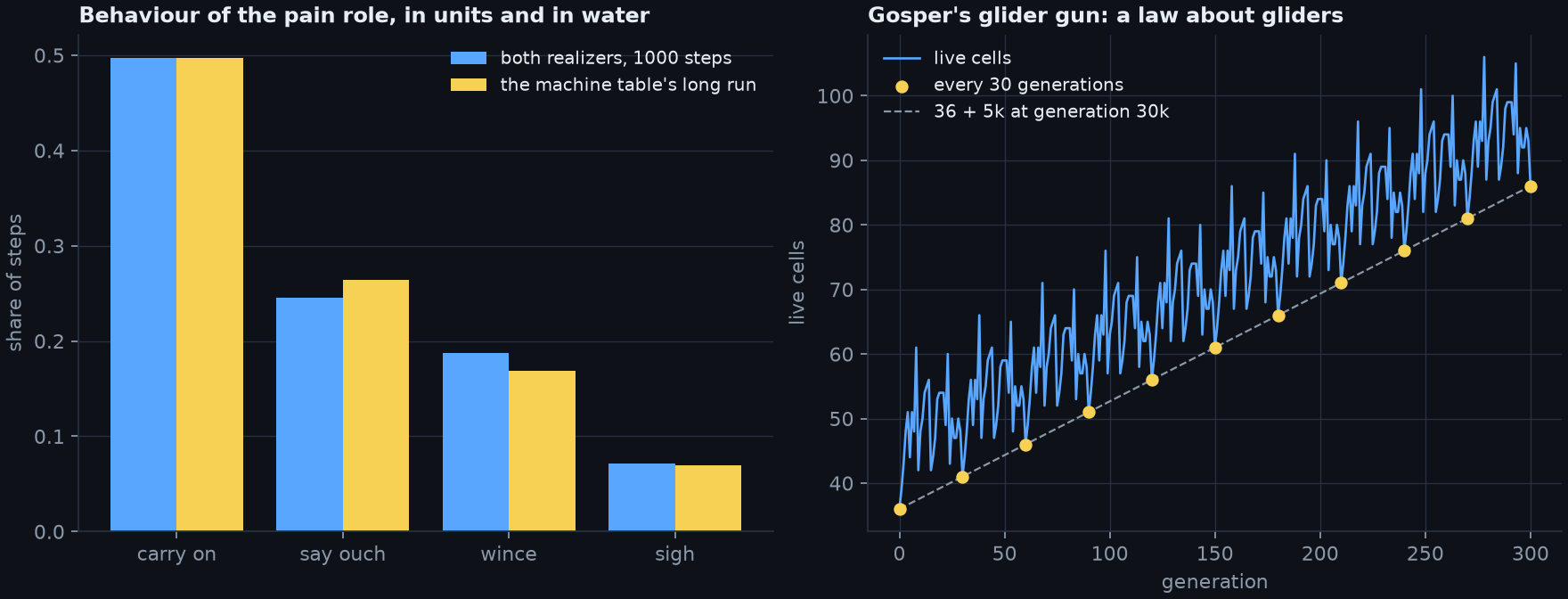
Feed a network of threshold units and a water tank the same 1000 inputs and compare their behaviour with each other and with the machine table's long-run prediction, check the implications between weak, strong and global supervenience on random sets of worlds, and count the live cells of Gosper's glider gun.
python -m videos.philosophy.labs 30
needs numpy, scipy, matplotlib · download lab30.py ·
source on GitHubneural units and water tank, 1000 steps outputs agree at 1000 steps
their physical states at steps 0, 1, 2 units 100 / 0 litres, units 100 / 0 litres, units 100 / 0 litres
share of 'carry on' 0.497 (the table's long run: 0.497)
share of 'say ouch' 0.245 (the table's long run: 0.265)
share of 'wince' 0.187 (the table's long run: 0.169)
share of 'sigh' 0.071 (the table's long run: 0.069)
600 random sets of worlds strong holds in 57, and always with weak and global
weak without global / global without weak 55 / 300
Gosper's gun: live cells = 36 + 5k at generation 30k holds at 11 of 11 checks
What the two machines share is the table, not the stuff; strong supervenience is the strongest of the three relations and the other two do not imply each other; and the gun obeys a law that mentions gliders, not cells.The code (109 lines; it asserts its own result)
"""Lab 30: run one mind in two substrates, test supervenience on random worlds, and find a law of gliders."""

import numpy as np

from videos.coursekit import labs
from explainer.philosophy.reasoner import mind

TITLE = "One role, two realizers; three kinds of supervenience"
GOAL = ("Feed a network of threshold units and a water tank the same 1000 inputs and compare their behaviour with "
        "each other and with the machine table's long-run prediction, check the implications between weak, strong "
        "and global supervenience on random sets of worlds, and count the live cells of Gosper's glider gun.")
TASKS = [
    "Write a third realizer of mind.TABLE (say, the state as the position of a marble in one of three cups) and "
    "run it in lockstep with the other two.",
    "Change the table so that aspirin never soothes (('hurt', 'aspirin') always stays 'hurt'). Recompute the "
    "long-run frequencies. Which output disappears?",
    "Search the random world sets for one where weak supervenience holds and global fails, and one where global "
    "holds and weak fails. What do the film's sets A and B have in common with them?",
]
WEIGHTS = {"bump": 0.3, "nothing": 0.5, "aspirin": 0.2}        # how often mind.realizers gives each input


def _long_run():
    """The table as a Markov chain on the three states: its stationary law, and the share of each output."""
    S = mind.STATES
    P = np.zeros((3, 3))
    for (s, i), opts in mind.TABLE.items():
        for p, nxt, _ in opts:
            P[S.index(s), S.index(nxt)] += WEIGHTS[i] * p
    vals, vecs = np.linalg.eig(P.T)
    pi = np.real(vecs[:, np.argmax(np.real(vals))])
    pi /= pi.sum()
    out = {}
    for (s, i), opts in mind.TABLE.items():
        for p, _, o in opts:
            out[o] = out.get(o, 0.0) + pi[S.index(s)] * WEIGHTS[i] * p
    return pi, out


def _random_worlds(rng):
    """A set of two or three worlds, each with two or three individuals with a physical and a mental state."""
    n_ind = int(rng.integers(2, 4))
    return [{f"x{k}": (f"P{rng.integers(1, 3)}", f"M{rng.integers(1, 3)}") for k in range(n_ind)}
            for _ in range(int(rng.integers(2, 4)))]


def run(seed=0):
    rng = np.random.default_rng(seed)
    lab = labs.Lab()

    # 1. multiple realizability
    r = mind.realizers(steps=1000, seed=seed)
    pi, theory = _long_run()
    lab.row("neural units and water tank, 1000 steps", f"outputs agree at {r['agree']} steps")
    assert r["agree"] == r["steps"], "the two substrates realize one machine table"
    first = r["trace"][:3]
    lab.row("their physical states at steps 0, 1, 2", ", ".join(f"{t['neural']} / {t['hydraulic']}" for t in first))
    worst = 0.0
    for o in ("carry on", "say ouch", "wince", "sigh"):
        got = r["outputs"].get(o, 0) / r["steps"]
        worst = max(worst, abs(got - theory[o]))
        lab.row(f"share of '{o}'", f"{got:.3f}   (the table's long run: {theory[o]:.3f})")
    assert worst < 0.07, "behaviour follows the table, whatever it is made of"
    assert abs(sum(theory.values()) - 1) < 1e-9 and abs(pi.sum() - 1) < 1e-9

    # 2. supervenience
    film = mind.supervenience()
    assert [film[k][j] for k in "ABC" for j in ("weak", "strong", "global")] == [True, False, False, False, False,
                                                                                 True, True, True, True]
    tally = {"strong": 0, "weak only": 0, "global only": 0}
    for _ in range(600):
        ws = _random_worlds(rng)
        w, s, g = mind._weak(ws), mind._strong(ws), mind._global(ws)
        assert not s or (w and g), "strong supervenience implies weak and global"
        tally["strong"] += s
        tally["weak only"] += w and not g
        tally["global only"] += g and not w
    lab.row("600 random sets of worlds", f"strong holds in {tally['strong']}, and always with weak and global")
    lab.row("weak without global / global without weak", f"{tally['weak only']} / {tally['global only']}")
    assert tally["weak only"] > 0 and tally["global only"] > 0, "weak and global are independent"

    # 3. a law at the level of gliders
    law = mind.glider_law(gens=300, size=160)
    lab.row("Gosper's gun: live cells = 36 + 5k at generation 30k", f"holds at {law['holds']} of {law['points']} checks")
    assert law["holds"] == law["points"] == 11
    lab.note = ("What the two machines share is the table, not the stuff; strong supervenience is the strongest of "
                "the three relations and the other two do not imply each other; and the gun obeys a law that "
                "mentions gliders, not cells.")

    fig, ax = labs.figure(2, size=(11, 4.2))
    names = ["carry on", "say ouch", "wince", "sigh"]
    x = np.arange(4)
    ax[0].bar(x - 0.2, [r["outputs"].get(o, 0) / r["steps"] for o in names], 0.4, color=labs.BLUE,
              label="both realizers, 1000 steps")
    ax[0].bar(x + 0.2, [theory[o] for o in names], 0.4, color=labs.GOLD, label="the machine table's long run")
    ax[0].set_xticks(x, names)
    ax[0].set_axisbelow(True)
    ax[0].set(title="Behaviour of the pain role, in units and in water", ylabel="share of steps")
    ax[0].grid(False, axis="x")
    ax[0].legend(loc="upper right")
    gens = np.arange(len(law["pop"]))
    ax[1].plot(gens, law["pop"], color=labs.BLUE, lw=1.2, label="live cells")
    ax[1].scatter([p["gen"] for p in law["rows"]], [p["pop"] for p in law["rows"]], s=30, color=labs.GOLD, zorder=3,
                  label="every 30 generations")
    ax[1].plot(gens, 36 + gens / 6, color=labs.MUTED, ls="--", lw=1, label="36 + 5k at generation 30k")
    ax[1].set(title="Gosper's glider gun: a law about gliders", xlabel="generation", ylabel="live cells")
    ax[1].legend(loc="upper left")
    lab.fig = fig
    return lab
Now change it
- Write a third realizer of mind.TABLE (say, the state as the position of a marble in one of three cups) and run it in lockstep with the other two.
- Change the table so that aspirin never soothes (('hurt', 'aspirin') always stays 'hurt'). Recompute the long-run frequencies. Which output disappears?
- Search the random world sets for one where weak supervenience holds and global fails, and one where global holds and weak fails. What do the film's sets A and B have in common with them?
Problems, with solutions
Try each problem before opening its solution.
-
Realize the pain table of chapter 3 in a third substrate; prove the outputs agree step by step.
Solution
Third substrate: a register holding an integer, 0 for calm, 1 for soothed, 2 for hurt, updated by a lookup from (register, input, random draw) to (new register, output) that copies the table entry for entry. Claim: fed the same inputs and the same draws, the units, the tank and the register give the same outputs at every step. Proof by induction, with the encodings units-on \(\leftrightarrow\) litres \(\leftrightarrow\) register value. At step 0 all three encode calm. If at step \(t\) they encode the same table state, then each applies the same table entry to the same input and draw, so each emits that entry's output and moves to the encoding of that entry's next state. So they agree at step \(t + 1\), and for all steps. Physically the three share nothing but the table.
-
Show that strong supervenience implies weak and global supervenience.
Solution
Weak: within each world, physical twins are mental twins. Strong: for any \(x\) and \(y\), in the same world or different ones, physical twins are mental twins. Strong implies weak by taking \(x\) and \(y\) in the same world. Strong implies global: suppose worlds \(w_1, w_2\) have the same physical distribution, matched by a bijection \(f\) between their individuals that preserves physical properties. By strong supervenience each \(x\) in \(w_1\) is a mental twin of \(f(x)\) in \(w_2\), so \(f\) also preserves mental properties, and the mental distributions are the same.
-
Find two sets of worlds: weak but not global, and global but not weak.
Solution
Weak but not global (the film's set A): worlds \(w_1, w_2\), individuals \(a, b\), all four physically alike; in \(w_1\) both are mentally M, in \(w_2\) both are mentally N. Within each world physical twins are mental twins, so weak supervenience holds; but the two worlds are physically identical and mentally different, so global fails. Global but not weak (set B): in \(w_1\), \(a\) and \(b\) are physically alike but \(a\) is M and \(b\) is N, so weak fails; let \(w_2\) differ physically in any way. Since no two worlds share a physical distribution, global supervenience holds vacuously.
-
State Kim's argument as five propositions and find every minimal inconsistent subset.
Solution
(1) Distinctness: \(M \ne P\). (2) Mental causation: \(M\) causes \(P^*\). (3) Closure: \(P^*\) has a sufficient physical cause, \(P\). (4) Exclusion: no event has two sufficient causes unless it is overdetermined. (5) No systematic overdetermination. From (1)–(3), \(P^*\) has two distinct causes, \(M\) and \(P\); by (4) it is overdetermined, which (5) forbids. Every proper subset is consistent, as the positions on the Price List show: drop (1) and you are a reductive physicalist, (2) an epiphenomenalist, (3) an interactionist dualist, (4) with Yablo or List and Menzies, (5) with Bennett. So the only minimal inconsistent subset is all five.
-
Estimate Blockhead's table for a 5-minute test with a 10,000-word vocabulary.
Solution
At the film's rate of 300 characters a minute, about 60 words a minute, a five-minute test is about 300 words of the interrogator's. With a 10,000-word vocabulary there are \(10{,}000^{300} = 10^{1200}\) possible inputs, and Blockhead needs an entry for each (and for every prefix, which adds less than one part in ten thousand). Against \(10^{80}\) atoms in the observable universe that is more than \(10^{1100}\) entries per atom.
-
Build a network that uses \(x\), and show that removing the probe's direction now hurts the output.
Solution
Use the film's network (two binary inputs, 32 hidden units) but make the output depend on \(x\): output \(x \oplus y\). A linear probe reads \(x\) from the hidden layer perfectly, and a linear readout computes \(x \oplus y\) perfectly. Remove the probe's direction: the trained readout falls to chance (51% in one run), because it was using that direction. Repeat, removing each new probe direction until \(x\) can no longer be read (three directions here): a freshly trained readout of the output is then at chance too. Now the information about \(x\) is not just carried but used, by Shea's standard represented, and amnesic probing shows the difference that the film's network, which ignored \(x\), did not.
Notes and sources
Sources
Texts: Kim, Philosophy of Mind (3rd ed., 2011) and Mind in a Physical World (1998); Turing (1950); Searle (1980, with the BBS commentaries); Block (1981); Bedau (1997); Shea, Representation in Cognitive Science (2018); Ravenscroft, Philosophy of Mind: A Beginner's Guide.
Primary texts and papers: Avicenna (c. 1020); Descartes (1641); Elisabeth of Bohemia (1643); Leibniz (1714); Mill (1843); Huxley (1874); Broad (1925); Ryle (1949); Turing (1950); Place (1956); Smart (1959); Putnam (1963, 1967); Weizenbaum (1966); Armstrong (1968); Davidson (1970); Kripke (1970); Conway (1970); Lewis (1970, 1972); Fodor (1975, 1987, 1990); Popper and Eccles (1977); Block (1978, 1981); Searle (1980); Churchland (1981); Dretske (1981); Dennett and Hofstadter (1981); Jackson (1982, 1998); Kim (1984, 1998); Millikan (1984); Baker (1987); Dennett (1987, 1991); Fodor and Pylyshyn (1988); Yablo (1992); Horgan (1993); Bedau (1997); Clark and Chalmers (1998); Bennett (2003); Woodward (2003); Chalmers (2006); List and Menzies (2009); Lake and Baroni (2018, 2023); Elazar et al. (2021); Jones and Bergen (2025).
About this partfrom its README
Part 30 of Philosophy, Built (series plan, syllabus), the fourth part of Act VI, Mind and Meaning: the philosophy of mind, from Descartes's two substances to representation in neural networks, with a functional role realized twice and a Chinese rulebook written. Avicenna's floating man; Descartes's dualism, the pineal gland and the conceivability argument in modal logic; Elisabeth of Bohemia's question (1643). Ryle's category mistake; logical behaviourism and its failures (circularity, Putnam's super-spartans, perfect actors); the identity theory of Place and Smart; Kripke's objection and multiple realizability. Functionalism: a probabilistic machine table for a pain role, realized in a network of threshold units and in a water tank, run in lockstep for 1000 steps (outputs agree 1000 times; 'carry on' 468, 'say ouch' 282, 'wince' 180, 'sigh' 70 in both), machine and analytic functionalism, and the Ramsey–Lewis definition carried out: a seven-microstate 'brain' has exactly one realization of the theory among 1806 assignments (pain = h1 ∨ h2 ∨ h3), a tank one of 6, a thermostat none, and with only the bump platitudes the brain has two (calm and soothed swap). Turing's imitation game, his nine objections answered one by one, and the test since (ELIZA, the Loebner Prize, Jones and Bergen 2025). Searle's Chinese room, a rulebook of 8 rules that is perfect on a narrow test about Schank's restaurant story (8 of 8) and helpless outside it, the systems, robot, brain-simulator and other-minds replies, and the dilemma for functionalism. Block's Blockhead, its table measured (an hour's test needs about 10^25 764 entries against 10^80 atoms), Leibniz's mill, the China brain, absent and inverted qualia. Supervenience, weak, strong and global, defined and checked on three sets of worlds (A: weak only; B: global only; C: all three). Kim's exclusion argument, step by step, the Wall's thirtieth brick, and the mind–body tetrad as a Price List (reductive physicalism, epiphenomenalism, interactionist dualism, harmless overdetermination), and the autonomy reply: Yablo's pigeon under interventions ('red' carries 0.714 bits about pecking with one bit of cause, as much as the exact shade with 2.58; 'scarlet' 0.369), proportionality and realization-insensitivity (List and Menzies 2009), and Kim's answer. Emergence: Mill and Broad, Conway's Game of Life with Gosper's glider gun simulated for 150 generations (a glider every 30; four in flight), a law about gliders found by running the rules for 600 generations (36 + 5k live cells at generation 30k, at all 21 checks), Bedau's weak emergence and Chalmers's strong emergence. Eliminativism, its replies, and Dennett's real patterns, measured on his bar code: pattern plus exceptions costs 3% of the bit map with no noise, 48% at 10%, 85% at 25%, and more than the bit map at 50% (a compressor agrees). Content naturalized: Dretske's information on a fuel gauge (2 bits with a perfect needle, 1.48 at 10% error, and no reading certain once there is any error), the misrepresentation problem, Millikan's teleosemantics and the frog, Fodor's asymmetric dependence. The language of thought, systematicity (Fodor and Pylyshyn 1988) and a SCAN-like test built (a lookup table gets 0 of 65 held-out commands with 'jump', a compositional interpreter all 65), with Lake and Baroni's networks. And representation in networks: the extended mind revisited, Shea's varitel semantics, and a network whose hidden layer carries x perfectly while the output ignores it (a probe reads x at 100%; after the probe's direction is removed a new probe is at 49.3%, and the task is still at 100%).
The worked model results are computed by the Reasoner's new module explainer/philosophy/reasoner/mind.py (with prop for
the Price List), tested in tests/philosophy/test_mind.py and cached by compute.py.
Chapter notes
| # | Scene | What it establishes | Computed on screen |
|---|---|---|---|
| 0 | Hook |
Turing (1950); four questions; the plan. | — |
| 1 | Dualism |
Avicenna (c. 1020); Descartes (1641); Elisabeth of Bohemia (1643). | — |
| 2 | Identity |
Ryle (1949); Putnam (1963); Place (1956); Smart (1959); Kripke (1970). | — |
| 3 | Function |
Putnam (1967); Armstrong (1968); Lewis (1970, 1972). | one role in two substrates, 1000 steps; a Ramsey sentence's occupants |
| 4 | Turing |
Turing (1950); Weizenbaum (1966); Jones and Bergen (2025). | — |
| 5 | Room |
Searle (1980); Schank and Abelson; Dennett and Hofstadter (1981). | a rulebook, inside and outside its script |
| 6 | Block |
Block (1978, 1981); Leibniz (1714). | Blockhead's table against the universe |
| 7 | Supervenience |
Davidson (1970); Kim (1984); Jackson (1998); Horgan (1993). | three relations on three sets of worlds |
| 8 | Exclusion |
Kim (1998); Huxley; Jackson (1982); Popper and Eccles (1977); Bennett (2003); the Wall's thirtieth brick; the Price List; Yablo (1992); Woodward (2003); List and Menzies (2009). | the tetrad's minimal conflicts; proportional causes |
| 9 | Emergence |
Mill (1843); Broad (1925); Conway (1970); Gosper (1970); Bedau (1997); Chalmers (2006). | Gosper's gun, 150 generations; its law, to 600 |
| 10 | Eliminate |
Churchland (1981); Baker (1987); Dennett (1987, 1991). | a bar code's description length at six noise levels |
| 11 | Content |
Dretske (1981); Millikan (1984); Fodor (1987, 1990). | a gauge's bits at four error rates |
| 12 | LOT |
Fodor (1975); Fodor and Pylyshyn (1988); Lake and Baroni (2018, 2023). | a table and a compositional interpreter on 65 commands |
| 13 | Represent |
Clark and Chalmers (1998); Shea (2018); Elazar et al. (2021). | a probe, and its direction removed |
| 14 | Outro |
recap; the Reasoner's module; the Wall; problems; payoffs; references. | — |
Companion material in this repository
The syllabus's plan for this partfrom SYLLABUS.md, the plan of record
- Descartes's dualism and Elisabeth of Bohemia's interaction problem (1643); Avicenna's floating man.
- Behaviorism (Ryle's ghost in the machine); the identity theory (Place, Smart).
- Functionalism: Putnam's multiple realizability (1967); machine-table states. Built: one probabilistic automaton "pain role" realized in two substrates, with behavior identical by construction.
- Turing's 1950 paper: the imitation game, and his nine objections answered one by one.
- Searle's Chinese room (1980); the systems, robot and brain-simulator replies. Built: a rulebook that passes a narrow test.
- Block's Blockhead (1981): a lookup table that passes the test. Its size is computed (for a 1-hour conversation it exceeds the atoms of the universe by many orders), so intelligence is about how, not just what.
- Block's China brain; absent qualia.
- Supervenience: weak, strong and global, defined modally and checked on toy world sets.
- Kim's causal exclusion argument (1998), formalized; the overdetermination and autonomy replies.
- Emergence: weak vs strong. Built: Conway's Life with gliders and guns; weak emergence and simulation-only derivability (Bedau).
- Eliminativism (Churchlands): folk psychology as a theory.
- Intentionality naturalized: Dretske's information-theoretic content (mutual information, from Part 1 of the AI series); Millikan's teleosemantics; Fodor's asymmetric dependence.
- The language of thought (Fodor 1975) vs connectionism; the systematicity challenge (Fodor and Pylyshyn 1988) and neural networks' answers (compositional generalization benchmarks, cited).
- The extended mind (Clark and Chalmers 1998): Otto's notebook; parity principle; the phone and the LLM.
- Representation in interpretability: what makes a direction in activation space a representation (Shea's Representation in Cognitive Science; linear probes and their limits, callback to AI, Built Part 30).
- Recap and Problems.
Built: reasoner.mind (multiply realized automata; supervenience checker; Life; Blockhead's size).
Wall: causal exclusion; the Chinese room's dilemma for functionalism (contested; both sides shown).
Price List: the mind–body tetrad (the mental is not physical; mental events cause physical ones; the physical
is causally closed; no systematic overdetermination).
Visuals: two automata in different materials running in lockstep; the exclusion argument as an arrow being
pre-empted; a Life glider gun firing.
References: Kim, Philosophy of Mind; Turing 1950; Searle 1980 (BBS) with commentaries; Block 1981 (Phil Rev);
Kim, Mind in a Physical World; Bedau 1997; Shea, Representation in Cognitive Science.
Build the film
python -m videos.philosophy.philosophy30.compute        # the part's numbers, into .cache/philosophy30
python tools/build.py philosophy30                  # render and assemble the film
EXPLAINER_TTS=silent python tools/qa_scene.py philosophy30 Hook   # one chapter, silent, with a contact sheet
Scenes: videos/philosophy/philosophy30. Setup: see the course page. Source of these notes: the README and the scenes' narration.
Build it
python -m videos.philosophy.philosophy30.compute       # every computed item (seconds; .cache/philosophy30)
python tools/build.py philosophy30 -q l                # 480p preview
python tools/build.py philosophy30                     # 1080p30 -> renders/philosophy30.mp4
python tools/qa_scene.py philosophy30 Function         # one chapter, silent, with a contact sheet