Possible Worlds
modal metaphysics
When we say things could have been otherwise, what are we talking about?
Part 4 gave possible worlds as a semantics; this part asks what they are. It starts with the difference between necessity de dicto and de re, Quine's mathematical cyclist evaluated on a model, and Kripke's answer: names are rigid, so the name tracks Aristotle across four worlds while the description tracks whoever taught Alexander. Rigid names make 'Hesperus is Phosphorus' necessary though known only by observation, and the standard metre contingent though known a priori. Lewis's concrete worlds and his counterpart theory are then built: the 1968 translation into first-order logic is checked against the direct semantics, and a census of small models shows the necessity of identity failing where Kripke's semantics keeps it. Ersatz worlds, alien properties and the Barcan formula follow. The turn is the two-dimensional matrix: the a priori is its diagonal, the necessary its actual row, so conceivability is no simple guide to possibility, which is the Wall's twenty-second brick. The part ends with Pierre's puzzle, Fine's essences, impossible worlds, dispositions, and possible worlds at work in counterfactual explanations and probabilistic programs.
What you need. Nothing beyond Part 4's box and diamond and Part 3's quantifiers.
- The calculation
- counterpart theory, 2D semantics
- The wall
- modal collapse
- Built toy
- the two-dimensional matrix engine
What you will be able to do
Introductory
- Separate the de dicto from the de re reading of a modal sentence and evaluate each on a small model.
- Explain with Kripke's modal argument why a name is not short for a description.
- Give an example of a necessary truth known only by experience and say why it is necessary.
Advanced
- Fill the two-dimensional matrix of an identity sentence and classify it by its diagonal and its actual row.
- Evaluate a counterfactual by closest worlds, and a disposition claim against a fink and a mask.
Research
- Translate a quantified modal sentence into counterpart theory and build a counterpart model in which the necessity of identity fails.
- State the Barcan formula, give a varying-domain countermodel, and say what necessitism and contingentism each make of it.
- Use impossible worlds to give a counterpossible a non-vacuous truth value.
Applied
- Find the closest worlds that flip a classifier's decision and explain why ties matter for recourse.
- Compute the probability of a query in a small ProbLog program by summing over possible worlds.
Contents
Each chapter has a home level. Choose a track to see what to read and watch: Introductory 26 min · Advanced 49 min · Research 61 min · Applied 30 min.
- 0Things could have been otherwiseIntroductory4 min
- 1De re and de dictoIntroductory5 min
- 2Names and rigid designationIntroductory4 min
- 3The necessary a posterioriIntroductory4 min
- 4Lewis's modal realismIntroductory4 min
- 5Counterpart theory, translatedResearch5 min
- 6Ersatz worldsAdvanced4 min
- 7Necessitism and contingentismResearch4 min
- 8Conceivability and possibilityIntroductory4 min
- 9Two dimensionsAdvanced5 min
- 10A puzzle about beliefAdvanced3 min
- 11Essence without modalityAdvanced4 min
- 12Impossible worldsResearch3 min
- 13Dispositions, finks and masksAdvanced3 min
- 14Possible worlds at workApplied4 min
- Recap, problems, and where this comes backAll tracks2 min
Also on this page: Lecture · Key results · Try it · Lab · Problems · Notes and sources · Build the film.
Lecture
The text of each chapter is the film's narration, as it is spoken, so you can read along or revise without the film. The pictures are in the film.
Things could have been otherwiseIntroductory4 min
Part 21 asked what makes a thing the same thing over time. This part asks about all the ways things could have been. David Lewis opened a chapter of his book on counterfactuals with a sentence that made his colleagues stare: I believe that there are possible worlds other than the one we happen to inhabit. He meant it literally. By the end of this part we will see why a careful philosopher could believe it, what the alternatives cost, and why engineers now compute with possible worlds every day.
We talk about what is not actual all the time. The bridge could have collapsed. You could have been born a day later. Two plus two must be four; a bachelor must be unmarried. If I had left earlier, I would have caught the train. Even the little suffixes are modal: a fragile glass is one that would break if struck; soluble sugar would dissolve. And machine learning is full of it: a model trained on other data would have decided otherwise. Every one of these sentences is about what is not actual. Some of them are plainly true. So what makes them true?
Part 4 gave the answer that logic needs. Picture a space of worlds, each a complete way things might have been, with one of them actual. Then necessarily p is true when p is true at every world, and possibly p when p is true at some world. Leibniz had the picture; Kripke and others turned it into a semantics in the late nineteen fifties, and it made modal logic precise. But a semantics is not yet a metaphysics. What is a possible world? A universe as concrete as ours? A book that describes one? A way things might have been, existing but never instantiated? Or a useful fiction? This part takes the question seriously.
Five questions will run through the part. When I say that Hubert Humphrey, who lost the 1968 presidential election, might have won, who is it, at the other world, that wins? Humphrey himself, or someone like him? How can it be necessary that water is H two O, when chemists had to discover it? Are worlds real things, or representations, and what does each answer cost? Does being conceivable make something possible? That question carries the weight of famous arguments about the mind. And is necessity the deepest notion here, or is there something deeper, essence, which explains it?
The plan. The two places a modal word can sit, and Quine's puzzle about them. Kripke's rigid names, and truths that are necessary but known only by experience. Lewis's modal realism, and his counterpart theory, which the Reasoner translates and checks on thousands of models. The alternatives: worlds as representations, and the view that everything exists necessarily. Conceivability, and the two-dimensional semantics built to tame it, computed cell by cell: this part's brick in the Wall. Kripke's puzzle about belief, on a Price List, and essence prised apart from necessity. Impossible worlds, and dispositions. And the engineering: explanations that search for the closest world where a decision flips, and programs that put probabilities on worlds.
What it establishes: Lewis (1973); modal talk; worlds as semantics and as metaphysics; five questions; the plan.
1De re and de dictoIntroductory5 min
Quine's example. The number of planets is necessarily greater than seven. True or false? Read one way, the necessity applies to the whole sentence: necessarily, whatever number the planets come to, it exceeds seven. That is the reading de dicto, about what is said. Read the other way, we pick out a number, the number of planets, and say of that number that it is necessarily greater than seven. That is the reading de re, about the thing. Look at three worlds. Ours has eight planets; in one there are five; in another, nine. De dicto, we check the number of planets at each world: eight, five, nine. Five fails, so the de dicto claim is false. De re, we take the actual number, eight, and check eight at every world. Eight exceeds seven everywhere, so the de re claim is true. The difference is only where the box sits, relative to the description.
Quine thought the de re reading was in deep trouble, and he said why in a paper on three grades of modal involvement. At the first grade, necessary is a predicate of sentences: the sentence nine is greater than seven is necessary. Quine could live with that, if it meant analytic, true by virtue of meaning. At the second grade, necessarily is an operator on sentences. Tolerable, if it is only the first grade in disguise. The third grade quantifies into a modal context: there is an x such that necessarily x is greater than seven. Which object is that? Nine is, under the name nine. But nine is the number of planets, and the number of planets is not necessarily greater than seven. Substituting one name of the object for another changes the truth value. So, Quine concluded, quantifying in makes sense only if objects themselves, however described, have some properties necessarily and others contingently. He called that Aristotelian essentialism, and he did not mean it as praise.
Quine pressed the point with a famous example. Mathematicians are necessarily rational and not necessarily two-legged; cyclists are necessarily two-legged and not necessarily rational. John is a mathematician and a cyclist. Is John, the man himself, necessarily rational? Necessarily two-legged? Considered as a mathematician, it seems yes to the first; considered as a cyclist, yes to the second; and neither consideration has a better claim. The Reasoner builds a model. Three worlds. At ours, John is both, and rational and two-legged. At u he cycles but does no mathematics, and is not rational. At v he does mathematics but not cycling, and has one leg. Both de dicto claims come out true: at every world, every mathematician is rational, and every cyclist two-legged. But neither de re claim is true of John. Quine took the lesson to be that there is no fact about which of John's properties are necessary, only facts relative to how he is described.
The answer to Quine came from two directions. Kripke's: we do not peer at another world through a telescope, find a man there, and wonder whether he is John. Possible worlds are stipulated, not discovered. Ruth Barcan Marcus had argued that proper names are tags, attached to a thing without describing it; substituting one tag for another of the same thing is always safe. And Kripke: when we consider whether John might have been irrational, we consider a situation of which we say: suppose John, this man, had never studied mathematics. De re modality is then about the thing itself, however we describe it. Whether John could have been irrational is a question about John, and it may have a definite answer. Everything turns on the difference between a name, like nine, and a description, like the number of planets. That is the next chapter.
What it establishes: Quine (1953, 1960); Marcus (1961); Kripke (1980).; Computed on screen: the planets on three worlds; the cyclist on a model
2Names and rigid designationIntroductory4 min
What does a proper name mean? The tradition from Frege and Russell answered: a description. The name Aristotle abbreviates something like the teacher of Alexander the Great, born in Stagira, who wrote the Metaphysics. The description fixes the reference: the name refers to whatever satisfies it. John Searle loosened this into a cluster: the name refers to whatever satisfies enough of the descriptions its users associate with it. The theory has real virtues. It explains why Hesperus is Phosphorus is informative: the two names come with different descriptions. And it explains how we manage to refer at all. It even handles empty names: Vulcan, the planet once posited inside Mercury's orbit, means a description that nothing satisfies.
In three lectures at Princeton in January 1970, Saul Kripke attacked the description theory. Take four worlds. In ours and in w one, Aristotle taught Alexander. In w two, Xenocrates did; in w three, Speusippus. Follow the name. Aristotle picks out the same man at every world: Aristotle, whatever he did there. Follow the description. The teacher of Alexander picks out whoever taught Alexander there: a different man in w two and w three. Now compare two sentences. Aristotle might not have taught Alexander: true, as w two shows. The teacher of Alexander might not have taught Alexander: false, read as a claim about whoever fits the description. Substituting the description for the name changes the truth value, so the name does not mean the description. Kripke's diagnosis: names are rigid designators. They designate the same object at every world where it exists. Most descriptions are not rigid.
Kripke added two further arguments. The epistemic argument: if Aristotle meant the teacher of Alexander, then Aristotle, if he existed, taught Alexander would be knowable a priori, like a definition. It is not; historians could find it false. The semantic argument. Most of us associate the name Gödel with one description: the man who proved the incompleteness of arithmetic. Suppose that in fact a man named Schmidt found the proof, and Gödel stole it. On the description theory, our word Gödel would refer to Schmidt. It plainly would not; we would say that Gödel stole Schmidt's proof. And many speakers know only that Feynman was a physicist. That fits thousands of people, yet they refer to Feynman. Descriptivists have replies: use rigidified descriptions, the actual teacher of Alexander, or descriptions of the name's own history. The debate is alive, and it returns in Part 27.
In place of descriptions Kripke offered a picture, not quite a theory. A name is attached to a thing at a baptism: this child is Aristotle. Then it is passed from speaker to speaker, each intending to use it as the one they learned it from did, down to you, today. Your word refers to Aristotle because it stands at the end of this chain, not because of anything you know about him. A description may still fix the reference at the start, as when the metre was fixed as the length of a certain bar, without becoming the meaning of the word. Gareth Evans found the picture too simple. Madagascar was once a name for a part of the African mainland; Marco Polo, misunderstanding his sources, applied it to the island, and now it names the island. So chains can shift; what matters is also where the speaker's information dominantly comes from.
What it establishes: Frege; Russell; Searle (1958); Kripke (1970); Evans (1973).; Computed on screen: a name and a description across four worlds
3The necessary a posterioriIntroductory4 min
The ancients named a bright star of the evening Hesperus, and a bright star of the morning Phosphorus. Both are Venus, seen on either side of the Sun. That was a discovery, credited in the Greek tradition to Pythagoras or Parmenides. Now run the argument. Hesperus is Phosphorus, as observation showed. If a is b, then necessarily a is b: that was the necessity of identity, proved in Part 21 from Leibniz's law. And the names are rigid, so they pick out Venus at every world. So it is necessary that Hesperus is Phosphorus. There is no possible world where Venus is two planets. Yet nobody could have known it from the armchair. A truth that is necessary and known only a posteriori. Kant had taken it for granted that whatever is necessary can be known a priori. Kripke pulled the two notions apart.
Two distinctions are at work. A priori and a posteriori belong to the theory of knowledge: can the truth be known without experience? Necessary and contingent belong to metaphysics: is it true at every possible world? Cross them and you get four boxes. Necessary a priori: two plus two is four. Contingent a posteriori: Venus is visible tonight; Humphrey lost. Necessary a posteriori: Hesperus is Phosphorus, water is H two O, and, Kripke argued, a given wooden table could not have been made of ice, since its origin is essential to it. And the strangest box, the contingent a priori, which we meet in a moment. Kant had held that the two distinctions coincide. Kripke argued that they come apart in both directions.
Hilary Putnam extended the point to natural kinds. Imagine Twin Earth, exactly like Earth except that the clear liquid in its rivers and taps is not H two O but a different compound, XYZ. Go back to 1750, before chemistry could tell them apart. Oscar on Earth and Twin Oscar on Twin Earth are in the same inner state when they say water. Yet Oscar's word refers to H two O and Twin Oscar's to XYZ. Meanings, Putnam concluded, just ain't in the head. Kripke and Putnam agreed that water works like a name: it rigidly picks out the stuff that is actually here, H two O, at every world. So water is H two O is necessary, though discovered. And Twin Earth is not a world where water is XYZ. It is a world without water, where something else plays water's role.
The fourth box. Wittgenstein remarked that there is one thing of which we can say neither that it is one metre long nor that it is not: the standard metre bar in Paris. Kripke disagreed. Suppose we fix the reference of one metre by stipulation: one metre is the length of stick S at time t nought. Then we know without measuring that S is one metre long at t nought. But it is not necessary. Had S been heated at t nought, it would have been longer than one metre, since one metre rigidly names the length S actually has. A priori, yet contingent. Gareth Evans made the same point with a stipulated name: let Julius be whoever invented the zip. Then Julius invented the zip, if anyone did, is known a priori, though Julius might have spent his life on something else. Necessity and knowability really are two different things.
What it establishes: Hesperus and Phosphorus; Kant (1781); Putnam (1975); Wittgenstein; Kripke; Evans (1979).
4Lewis's modal realismIntroductory4 min
Lewis's view is called modal realism. Other possible worlds exist, and they are things of the same kind as our world: concrete universes, with stars and people and, as he liked to say, talking donkeys. They are isolated: no spatial, temporal or causal relation connects one world to another. That is what makes them different worlds. There are enough of them: every way a world could be is a way some world is. And Lewis gave a principle of plenitude with teeth, recombination: duplicates of any possible things, patched together in any arrangement that fits in spacetime, make up a possible world. A dragon is possible because duplicates of possible parts, a reptile's body and a bird's wings, could be patched together.
What, then, makes our world the actual one? Nothing special about it, Lewis said. Actual is an indexical word, like here or now. Here picks out the place where the speaker is; actual picks out the world where the speaker is. Every world is actual to its own inhabitants, as every place is here to whoever is there. Then the modal words become quantifiers: necessarily p means p at all worlds, possibly p means p at some. That is the payoff Lewis wanted. Modality is not an unexplained primitive; it is quantification over worlds and the things in them.
Why believe it? Lewis's argument was from utility. Take eight worlds, differing in whether it rains, whether it is windy, whether it is cold. A proposition can be identified with the set of worlds where it is true: it rains is these four. Rain and wind is a smaller set, inside the first; one proposition entails another when its set is included in the other's. The content of a belief state is the set of worlds compatible with what one believes, the picture that Part 12 used for knowledge. A property is the set of its instances, actual and merely possible. Counterfactuals are true when their consequent holds at the closest worlds where their antecedent does. Worlds, Lewis said, are a paradise for philosophers, as set theory is a paradise for mathematicians: a single ontology in which many notions can be built. The price is believing in the worlds.
Most philosophers do not believe it. Lewis described their main response as the incredulous stare, and admitted he could not refute a stare. He counted the view's cost as a conflict with common opinion, and judged it worth paying. There are arguments too. If other worlds are causally isolated from us, how can we know anything about them? Lewis answered that modal knowledge is like mathematical knowledge: it needs no causal contact. And there is an ethical worry, which Lewis took up at length: if every possibility is realized somewhere, preventing suffering here seems only to shift it around logical space. Lewis replied that we rightly care about our own world and its inhabitants. Peter Forrest and David Armstrong argued that unrestricted recombination is inconsistent: patch together duplicates of every world and you get a world bigger than any world. Lewis added a size restriction. And Kripke had an objection about Humphrey, which needs the next chapter.
What it establishes: Lewis (1973, 1986); Forrest and Armstrong (1984).; Computed on screen: propositions as sets of eight worlds
5Counterpart theory, translatedResearch5 min
Lewis's worlds are isolated, so no individual is in two of them. Then how can Humphrey have possibly won, if Humphrey exists only here? Lewis's answer came in a paper of 1968. Take three primitives: being a world, being in a world, and being a counterpart of something. Then postulates. Nothing is in anything but a world. Nothing is in two worlds. Nothing is a counterpart of anything else in its own world. And anything in a world is a counterpart of itself. So individuals are world-bound. What links them across worlds is the counterpart relation, a relation of similarity: your counterparts in another world are the things there that resemble you closely enough, and more closely than anything else there does. Similarity need not be transitive, or symmetric, or one-one, and neither need the counterpart relation.
With these primitives, every sentence of quantified modal logic can be translated into plain first-order logic about worlds and their inhabitants. A quantifier is restricted to the world of evaluation: for all x becomes for all x in the actual world. A box over a formula about x becomes: in every world, every counterpart of x satisfies the formula. A diamond becomes: in some world, some counterpart of x satisfies it. The Reasoner implements the translation. Humphrey might have won becomes: there is a world, and something in it that is a counterpart of Humphrey, and it won. Modal logic has been reduced to first-order logic with an extra relation, and the Reasoner can check the reduction.
Here is the model the Reasoner uses. Four worlds. In ours, Humphrey and Nixon ran, and Nixon won. In w one, Humphrey's counterpart won. In w two, two people resemble Humphrey equally well: identical twins, both his counterparts. In w three, one person, m, resembles both Humphrey and Nixon enough to be a counterpart of each. The bridges are the counterpart relation. Humphrey might have won: true, because his counterpart in w one won. Everything is necessarily self-identical: true. But the necessity of identity fails. Let x and y both be Humphrey. In w two, x has one counterpart and y another, and they are different people, so necessarily x equals y is false. And the necessity of distinctness fails: Humphrey and Nixon are two, but in w three they share a counterpart. On each row, evaluating the modal sentence directly and evaluating its first-order translation give the same answer.
One model shows that principles can fail. To see which fail in general, the Reasoner checks every model up to a size. For counterpart theory: three worlds, up to two individuals in one of them, every counterpart relation and every extension of a predicate: nearly seventeen thousand models, each principle evaluated at every world. For Kripke's semantics: every two-world model over two individuals, with the same domain at both worlds or different ones. With constant domains, Kripke's semantics validates everything here. With varying domains, the Barcan formula fails, so does its converse, and so does the claim that everything necessarily exists. Counterpart theory gives a different logic. The necessity of identity and of distinctness fail; so do the four and B axioms, because the counterpart relation need not be transitive or symmetric; so does the Barcan formula. But T holds, since everything is its own counterpart; the converse Barcan formula holds; and, oddly, so does the claim that everything necessarily exists, because a thing with no counterpart in a world is simply not considered there. And along the way the Reasoner checked the translation against the direct semantics on fifteen hundred cases: they always agree.
Kripke's objection is famous. When we say Humphrey might have won, we are talking about Humphrey. On Lewis's view we seem to be talking about someone else, however much he resembles Humphrey, and Humphrey could not care less whether someone else would have been victorious in another world. Lewis replied that the modal property is Humphrey's own. Humphrey himself has the property of possibly winning; he has it in virtue of his counterpart, as you have the property of being reflected in virtue of a mirror. And the counterpart relation is inconstant: context selects which similarities count. That pays off in Part 21's puzzle. The statue and the lump can be one object. Under the statue counterpart relation, which weighs shape, it could not survive squashing; under the lump counterpart relation, which weighs matter, it could. Allan Gibbard's contingent identity of Lumpl and Goliath stops being a paradox. Counterpart theory pays for that with the necessity of identity.
What it establishes: Lewis (1968, 1971); Kripke (1980); Gibbard (1975).; Computed on screen: Lewis's translation; Humphrey's islands; the census of small models
6Ersatz worldsAdvanced4 min
Most philosophers who use possible worlds do not believe in Lewis's plurality. They take worlds to be ersatz: substitutes, representations of how things might have been. Linguistic ersatzism: a world is a maximal consistent set of sentences, a complete book about a world, in the tradition of Carnap's state descriptions. Alvin Plantinga: a world is a maximal possible state of affairs, and the actual world is the one that obtains. Robert Stalnaker: worlds are ways things might have been, properties the whole world might have had. David Armstrong: worlds are recombinations of the actual particulars and universals. What they share: worlds are actual things, abstract ones, and there is only one concrete world, ours.
The linguistic version is easy to build. Take a tiny language: two individuals, a and b, and two predicates, F and G. A state description says, of each atomic sentence, whether it or its negation holds. There are two to the fourth, sixteen of them. Each is a complete, consistent book about a possible world. Then necessary means: in every book; possible means: in some book. For all x, F x is in four of the books; F a or not F a is in all sixteen. And one book is special, not because it is concrete but because it is true. That book is the actual world. No talking donkeys are required, only sentences.
Lewis pressed two objections. First: which sets of sentences are worlds? The consistent ones. Consistent in the narrow sense, by logic alone? Then the sentence this patch is red all over and green all over gets a world, since logic alone does not rule it out. So it must be consistent in the broad sense: possibly true together. But then the account uses the notion of possibility in saying what a world is. It cannot reduce modality to anything else. Lewis's worlds explained possibility; ersatz worlds presuppose it. Most ersatzers accept the charge. They wanted a semantics that makes modal reasoning precise, not a reduction; and modality, they say, may simply be primitive.
The second objection is subtler. Suppose there could have been properties that nothing actual has and that nothing actual is made of: alien properties, X and Y. In world one, a has X and b has Y; in world two, the other way round. Two different possibilities. An ersatz book is written in our vocabulary, which has no names for X and Y. The best it can do is say that some alien property holds of a alone, and another of b alone. Both worlds get the same description. The Reasoner counts. Over two individuals, with our two properties and two alien ones, there are two hundred and fifty-six genuine possibilities. In the actual vocabulary only one hundred and sixty distinct descriptions are possible. Ninety-six of them each stand for two worlds that differ only by swapping the alien properties: a hundred and ninety-two worlds whose differences cannot be told apart. Linguistic ersatzism undercounts the possibilities, unless the language is enriched with names for things that do not exist.
Ersatz views are usually actualist. Everything that exists actually exists; there are no merely possible people or donkeys waiting in the wings. But there could have been someone distinct from everyone who actually exists: a child your grandparents never had. An actual book must somehow describe that very person, who is not there to be named. Plantinga's answer was individual essences: properties, existing though uninstantiated, that would have made something that particular person. Critics found them as mysterious as the possible people they replace. Which suggests a bolder thought: perhaps the possible person does exist, only not concretely. That is the next chapter.
What it establishes: Carnap (1947); Plantinga (1974); Stalnaker (1976); Armstrong (1989); Lewis (1986).; Computed on screen: sixteen state descriptions; alien properties counted
7Necessitism and contingentismResearch4 min
In 1946 Ruth Barcan published the first systems of quantified modal logic, and with them a formula that now bears her name. If possibly there is an F, then there is something that possibly is an F. Equivalently, if everything is necessarily F, then necessarily everything is F. In words: if there could have been an F, there is something which could have been an F. In Kripke's semantics the formula holds when every world has the same domain of objects, and fails when domains can vary from world to world. So which logic is right depends on a metaphysical question: could there have been things other than the things there are?
Take an example. Ludwig Wittgenstein had no children, but he might have had one. The contingentist model: at the actual world there is Wittgenstein; at world u there is Wittgenstein and a child, b, who does not exist at the actual world at all. The necessitist model: the same domain everywhere. At the actual world b exists too, but only as a merely possible object: not concrete, not a person, not anyone's child. At u, b is concrete, and a child. The Reasoner evaluates three formulas at the actual world. The Barcan formula: possibly there is a child, so there is something that could have been a child. False for the contingentist, true for the necessitist. Necessarily everything is necessarily something: false for the contingentist, since b exists at u but not at the actual world; true for the necessitist. And there is something not concrete that could have been concrete: the necessitist's b.
Timothy Williamson defended necessitism in a book of 2013. Necessarily, everything is necessarily something. Whatever there could have been, there is. What is contingent is only whether a thing is concrete: a person, a planet, a child. The payoff is logic. Necessitism allows the simplest and strongest quantified modal logic: S5 with the Barcan formula, its converse, and the ordinary rules for quantifiers. The cost is ontological. There is something that could have been Wittgenstein's child, though in fact it is nothing concrete at all. Williamson reframed the old debate. The question is not whether merely possible things exist, but whether it is contingent what there is. And he argued for a method: choose the metaphysics by the strength and simplicity of the logic it supports, as scientists choose theories by abduction.
Why can't we simply choose varying domains? Because of a proof. Arthur Prior showed in 1956 that in quantified S5 with the standard quantifier rules, the Barcan formula is a theorem. The steps are on screen: instantiate, take possibilities, use S5's characteristic axiom, chain, generalize, and necessitate. So a contingentist must change something in the logic: use a free logic, in which quantifier instantiation needs an existence premise, or give up some of S5. Kripke's 1963 semantics blocks the proof by not allowing formulas with free variables to be necessitated, generalizing first. The metaphysics of what there could have been is written into the rules of inference.
What it establishes: Barcan (1946); Kripke (1963); Prior (1956); Williamson (2013).; Computed on screen: the Barcan formula on two models
8Conceivability and possibilityIntroductory4 min
Philosophers have long reasoned from what can be conceived to what can be. Descartes, in the Sixth Meditation: I can clearly and distinctly conceive of my mind existing without my body. Whatever I clearly and distinctly conceive is possible; God, at least, could make it so. So my mind could exist without my body. And so my mind is not my body. Notice that the last step needs the necessity of identity from Part 21: if mind and body were one thing, they could not come apart. Hume stated the bridge principle plainly: whatever the mind clearly conceives includes the idea of possible existence. The same shape of argument returns in Kripke's case against identifying pain with a brain state, and in David Chalmers's zombies, in Part 31. Everything depends on the bridge.
But the bridge has cracks. Draw what seems conceivable beside what is possible. Much is in both: a talking donkey; your being born a day later. Some possibilities may outrun what we can conceive: a proof too long for any mind to follow, colours no creature has ever seen. The trouble is the other crescent. It seems conceivable that water is not H two O, and that Hesperus is not Phosphorus; Kripke says both are impossible. And Goldbach's conjecture and its negation both seem conceivable, though one of them is a necessary falsehood. In the left crescent sit a posteriori necessities, and mathematics we have not settled. If such cases exist, conceiving is not always a guide.
The modern answer is to distinguish kinds of conceivability. Stephen Yablo: p is conceivable for you if you can imagine a situation that you take to verify p. Prima facie versus ideal: conceivable on first reflection, or still conceivable after ideal reflection. The negation of a true arithmetical conjecture is conceivable only in the first sense. Positive versus negative: imagining a situation, as opposed to merely being unable to rule p out. And the key distinction: conceiving of p as a hypothesis about how our own world might turn out to be, or as a counterfactual, given how our world actually is. David Chalmers argued that a bridge survives: ideal conceivability in the first, hypothetical sense entails possibility of the corresponding kind. To make that precise, he needed two dimensions.
Kripke himself explained away the cracks, case by case. When we seem to imagine that water is not H two O, what we actually imagine is a situation where the clear, drinkable stuff in the rivers is not H two O. And that situation is perfectly possible: it is Twin Earth, a world with no water in it. We conceive an epistemic counterpart of our own situation, and mistake it for a world where water itself is something else. So the illusion that it is contingent is explained. But try the same move with pain. The reference of pain is fixed by how it feels, so a situation that feels exactly like pain is a situation with pain. There is no counterpart to fall back on. If we can conceive pain without C-fibres firing, that is a real possibility, and pain is not C-fibre firing. That is Kripke's argument against the identity theory of mind.
What it establishes: Descartes (1641); Hume (1739); Yablo (1993); Chalmers (2002); Kripke (1970).
9Two dimensionsAdvanced5 min
Two-dimensional semantics starts from an observation. A world can play two different roles in evaluating a sentence. Write the truth value of a sentence S as depending on two worlds. The first, w, is the world considered as actual: it settles what our words pick out. If Twin Earth turned out to be our world, water would pick out XYZ. The second, v, is the world considered as counterfactual: the one at which we then check whether S is true. Fix both worlds to be the same and you get the primary intension: how S fares if w turns out to be actual. Fix the first to be our actual world and you get the secondary intension: Kripke's counterfactual truth conditions. The idea goes back to Robert Stalnaker's diagonal propositions, and to Martin Davies and Lloyd Humberstone; Chalmers and Frank Jackson made it a theory of meaning.
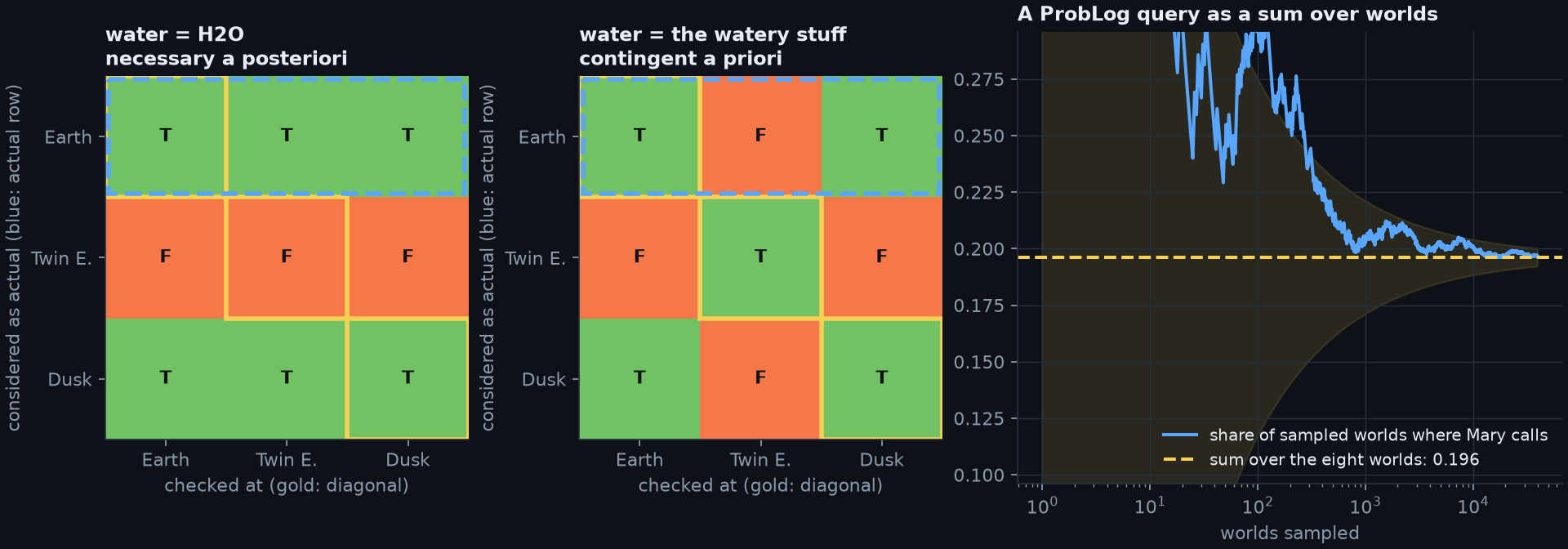
The Reasoner builds it for three worlds. Earth: the watery stuff is H two O. Twin Earth: the watery stuff is XYZ. And a third world, Dusk, which differs in the evening sky and will matter for other sentences. The matrix for water is H two O. Row by row, a world is considered as actual; column by column, a world is considered as counterfactual. In the Earth row, water picks out H two O, and H two O is H two O wherever we check: true, true, true. In the Twin Earth row, water picks out XYZ, which is never H two O: false all along. The Dusk row is like Earth's. Read the diagonal: true, false, true. If Twin Earth had turned out to be actual, the sentence would have been false; so it cannot be known a priori. Read the actual row: true everywhere. So it is necessary. Necessary a posteriori, computed from the matrix.
Now six sentences. Water is H two O, and Hesperus is Phosphorus: actual row all true, diagonal not. Necessary a posteriori. Water is the watery stuff, and the length of stick S is one metre: the diagonal is all true, since whatever world is actual, water and the metre are fixed by that world's watery stuff and that world's stick. But the actual row has a false: in Twin Earth the watery stuff is not water, and S is longer than a metre. Contingent a priori, Kripke's strange box, computed. The evening star is Venus: false at Dusk, on both readings. Contingent a posteriori. And H two O is H two O: true everywhere. Necessary a priori. The two notions that Kant fused, and Kripke split, are two readings of one matrix: the a priori is the diagonal, the necessary is the actual row.
The machinery was built for a purpose, and here it is in outline, to be examined in Part 31. Let P be all the physical truths, and Q a truth about consciousness, say that someone is in pain. Chalmers argues that P and not Q is ideally conceivable in the primary sense: a zombie world. Then, by the defensible bridge, it is primarily possible. For consciousness, the two intensions coincide; there is no Twin Earth for pain, because what fixes the reference of pain is how it feels. So the zombie world is possible in the ordinary, counterfactual sense. And then the physical truths do not necessitate all the truths, and materialism is false. Each step can be resisted, and each has been.
This is the twenty-second brick in the Wall. The dream: conceivability as a straightforward guide to possibility, a way to learn what could be from the armchair. The wall: Kripke's necessary a posteriori. Some things that seem conceivable, like water not being H two O, are impossible, and we learn which only by experience. What it forces: either two dimensions of meaning, with the bridge rebuilt on the diagonal, or no general bridge at all.
What it establishes: Stalnaker (1978); Davies and Humberstone (1980); Chalmers and Jackson (2001); Chalmers (2006); the Wall's twenty-second brick.; Computed on screen: six two-dimensional matrices and their classes
10A puzzle about beliefAdvanced3 min
Kripke's puzzle about belief, from 1979. Pierre grows up in France, speaking only French. From pictures and stories he comes to believe that London is beautiful, and he says: Londres est jolie. Later he moves to London, to an unattractive part of the city, and learns English from the people around him, not by translation. He comes to say, sincerely: London is not pretty. He never realizes that London is the city he called Londres. He assents sincerely to both sentences, and he is a competent logician. Does Pierre believe that London is pretty? Yes seems wrong, because he believes it is not. No seems wrong, because he has never given up his French belief.
The puzzle is a Price List. Disquotation: a sincere, reflective speaker who assents to a sentence believes what it says. Translation: what is true in French stays true translated into English. Pierre is rational: he holds no contradictory beliefs that reflection would reveal. And Millianism: Londres and London say the same, since a name contributes only its bearer. Together they make Pierre believe that London is pretty and that it is not, while being rational. All four cannot hold. Kripke himself concluded that our practice of reporting beliefs is strained to the breaking point in such cases, and the question may have no clear answer. One might deny translation, but the next example shows that translation is not the culprit. Millians such as Nathan Salmon and Scott Soames keep the names and give up the rationality principle as stated: Pierre believes both, under two different guises, and since he cannot detect the clash, he is not irrational. Fregeans deny Millianism: for Pierre the two names differ in sense, or, in this part's terms, in primary intension.
Kripke gave a second case to show that translation is not to blame. Peter hears of Paderewski the pianist, and of Paderewski the Polish statesman, and takes them to be two men; in fact they are one. He says Paderewski had musical talent, and also, sincerely, that Paderewski had none. One language, one name. Only disquotation is needed, and the puzzle returns. The lesson most take is that belief reports are hyperintensional: they can distinguish contents that are necessarily equivalent, which chapter twelve makes room for. And it is where the theory of names meets the theory of mind, in Parts 27 and 29.
What it establishes: Kripke (1979); Salmon (1986); Soames (2002); Kripke's puzzle as a Price List.; Computed on screen: the conflict and its exits
11Essence without modalityAdvanced4 min
If necessity is truth at all worlds, perhaps essence can be defined in the same terms. The modal account: a property is essential to a thing if, necessarily, if the thing exists, it has the property. Kripke's examples fit: this wooden table could not have been made of ice; the Queen could not have had different parents. Origin is essential. So does kind: water is essentially H two O. The attraction is that essence becomes something we already understand, necessity, and so, ultimately, worlds. In 1994 Kit Fine argued that the account gets even the simplest cases wrong.
Fine's example. Take worlds where Socrates exists, and worlds where he does not. Wherever Socrates exists, so does his singleton: the set whose only member is Socrates. Set theory guarantees it. Now ask which properties Socrates has at every world where he exists. Being human: yes, and that is plausibly part of what he is. Being a member of his singleton: also yes. So on the modal account it is essential to Socrates that he belongs to a set. Being distinct from the Eiffel Tower: yes, necessarily. Being such that two plus two is four: yes, trivially. On the modal account these are all essential to Socrates. But it is no part of what Socrates is, of his nature, that he belongs to a set, or differs from a tower, or coexists with arithmetic. Teaching Plato and being seated are contingent, and the account rightly leaves them out. The Reasoner's table shows the gap: three properties the modal account counts as essential that are not part of his essence at all.
The failure has a structure. Necessarily, if either exists, Socrates is a member of his singleton. As far as modality goes, the connection runs equally in both directions. But essence is not symmetric. It lies in the nature of the singleton to have Socrates as its member: a set is defined by its members. It does not lie in the nature of Socrates to be a member of anything. Fine's alternative: essence is real definition, the definition of a thing rather than of a word. He wrote it with a box indexed to the thing: it is true in virtue of the nature of x that phi. And then the order of explanation reverses. Necessity is not prior to essence. What is metaphysically necessary is what is true in virtue of the natures of all things.
If Fine is right, essence explains necessity. Why is water necessarily H two O? Because that is what water is. Then we can know necessities by knowing natures, as Jonathan Lowe and Bob Hale argued; and sometimes, as with water, we learn a nature by experiment. That is the necessary a posteriori, explained. Essence also joins hands with grounding: Part 20's in virtue of. Modalists have replies: refine the modal definition, for instance by requiring the property to be sparse, or intrinsic. The stakes are which notion is fundamental: worlds, or natures.
What it establishes: Kripke on origins; Fine (1994); Lowe; Hale (2013).; Computed on screen: the modal account against real essence
12Impossible worldsResearch3 min
Possible worlds have a blind spot. If a proposition is the set of worlds where it is true, then every necessary truth is the same proposition: the set of all worlds. Two plus two is four holds at every world. So does Fermat's last theorem, now that Andrew Wiles has proved it. The two sentences express one proposition. Yet mathematicians knew the first for millennia while doubting the second. Knowledge, belief, proof and information distinguish things that are true at exactly the same worlds; they are hyperintensional. This was Pierre's lesson too. And on the standard semantics every counterfactual whose antecedent is impossible is true, vacuously: there are no worlds to check.
Daniel Nolan proposed taking impossible worlds seriously. The Reasoner draws six worlds as sets of sentences. Two are possible: in neither does Hobbes square the circle, which mathematics forbids. Then impossible worlds, which need not respect mathematics or even logic. In i one Hobbes squares the circle and nothing else is different; in i two he squares it and sick children in the mountains of South America care; in i three Fermat's theorem fails. And the trivial world, where everything is true. Distances follow Nolan's strangeness of impossibility: every possible world is closer to ours than any impossible one, and among the impossible, less change is closer. Now Nolan's example: if Hobbes had squared the circle, sick children in South America would have cared. With possible worlds only, there is no world where Hobbes squares the circle, so this is vacuously true, and so is its opposite. With impossible worlds, the closest world where he squares it is i one, where the children do not care. So the first counterpossible is false and the second true, as intuition says.
Impossible worlds have work to do. In epistemic logic, Part 12 met the problem of logical omniscience: on the standard semantics, anyone who knows anything knows all its consequences. Letting impossible worlds into an agent's space of possibilities removes that. Mathematicians reason through counterpossibles all the time: if there were a largest prime, multiplying all the primes and adding one would give a larger one. And so does the philosophy of logic: if intuitionistic logic were the correct logic, excluded middle would fail, which seems true; if it were correct, excluded middle would still hold, which seems false. If classical logic is in fact correct, both have impossible antecedents, yet they differ in truth. The vacuist, Timothy Williamson for one, holds that every counterpossible is true, and explains the appearance of falsity pragmatically. The price of the alternative is a theory of which impossible worlds there are, and how near each is. Francesco Berto and Mark Jago's book of 2019 is the current map.
What it establishes: Nolan (1997); Hintikka; Williamson (2007); Berto and Jago (2019).; Computed on screen: counterpossibles on six worlds
13Dispositions, finks and masksAdvanced3 min
Possible worlds also promise to explain dispositions: fragility, solubility, the power of a drug to heal. The simple conditional analysis: x is fragile if and only if, were x struck, it would break. The idea goes back to Gilbert Ryle, and to Rudolf Carnap's reduction sentences for words like soluble. With Lewis's semantics for counterfactuals, the conditional is true when the closest worlds where x is struck are worlds where it breaks. It is attractive: no mysterious powers, only facts about what would happen. But in 1994 C. B. Martin described the fink.
The Reasoner sets up four objects and strikes each one. A plain glass: it breaks. A finked glass. A sorcerer watches it, and at the very moment it is struck, he makes it hard, so it does not break. The glass is fragile, yet it is false that it would break if struck. A reverse fink: a piece of steel, not fragile at all, which the sorcerer makes brittle at the moment of the blow, so it breaks. And a masked glass, packed in foam: it keeps its fragile structure, but the blow never reaches it. Mark Johnston and Alexander Bird called such interferers masks and antidotes.
Now the two analyses, evaluated on all four. The simple analysis gets the plain glass right, and every other case wrong: it denies that the finked and masked glasses are fragile, and says the steel is. David Lewis's reformed analysis of 1997: x is fragile if it has some intrinsic property such that, if x were struck and kept that property, the striking and the property together would make it break. Holding the intrinsic property fixed defeats the fink and the reverse fink: the Reasoner's table turns right for both. But the mask is external; the foam stops the break while the glass keeps its structure, and the reformed analysis still says, wrongly, that the masked glass is not fragile.
Some philosophers drew the opposite moral. C. B. Martin, Stephen Mumford and Alexander Bird: dispositions are real and irreducible powers of things, and the conditionals are only evidence of them. On dispositional essentialism a property's powers are its essence, and then the laws of nature, which describe those powers, are necessary: the view from Part 18. The price is a strange directedness in matter: a power points at a manifestation that may never happen. On the other side stands Lewis's Humean supervenience: everything there is supervenes on the local arrangement of qualities, and powers are patterns in it.
What it establishes: Ryle (1949); Carnap (1936); Martin (1994); Johnston (1992); Bird (1998, 2007); Lewis (1997); Mumford.; Computed on screen: two analyses on four struck objects
14Possible worlds at workApplied4 min
Possible worlds are not only for metaphysicians. In verification, the states of a program are worlds, and always and eventually are modal operators: Part 4 built a model checker on exactly that. Distributed protocols reason about what each process knows, as the worlds it cannot distinguish from the actual one: the epistemic logic of Part 12. Probabilistic programming languages define distributions over possible worlds. Explanations of automated decisions are counterfactuals: you would have been given the loan if your income had been higher. And one definition of fairness, Matt Kusner and colleagues' counterfactual fairness, asks whether a decision would have been the same in the world where your demographic group were different. Two of these are built now.
First, an explanation. A toy credit model scores applicants by income, debt and years employed, and approves when the score is at least zero. An applicant earning thirty-five thousand, with ten thousand in debt and two years in the job, scores minus one point four, and is refused. Why? Sandra Wachter, Brent Mittelstadt and Chris Russell proposed answering with a counterfactual: the smallest change that would have flipped the decision. The Reasoner searches every change on a grid, four hundred and sixty-two candidate worlds, of which four hundred and five flip the decision, and keeps the nearest by a weighted distance. Here is one: had your income been five thousand higher, your debt two thousand lower, and your time in the job two years longer, you would have been approved. This is Lewis's semantics, run as an algorithm: an explanation is a counterfactual true at the closest world.
There is a twist. The search finds not one closest world but four, all at the same distance: more income and fewer extra years, or less income and more years, each with the same small cut in debt. Robert Stalnaker's semantics for counterfactuals assumed that there is always a unique closest world; Lewis denied it. Take an example of Quine's: if Bizet and Verdi had been compatriots, would Bizet have been Italian, or Verdi French? Neither counterfactual is true, because the closest worlds tie. For a person who was refused, ties mean several explanations, and some of them describe worlds they cannot reach: no one can add three years of employment tonight. Berk Ustun and colleagues call the reachable ones actionable recourse.
Second, probabilities. Here is a tiny probabilistic logic program in the style of ProbLog. A burglary with probability one in ten, an earthquake with probability one in five, and Mary hearing the alarm with probability seven in ten. Rules say that either a burglary or an earthquake sets off the alarm, and that Mary calls if there is an alarm and she hears it. Taisuke Sato's distribution semantics: each choice of the probabilistic facts is a possible world, eight of them, with probability the product of the choices; the rules then settle everything else in each world. The probability of a query is the total probability of the worlds where it holds: the alarm sounds with probability zero point two eight, and Mary calls with probability zero point one nine six. Conditioning is renormalizing over the worlds that fit the evidence: given that Mary calls, the probability of a burglary is about thirty-six percent. Carnap's state descriptions, with weights, running in production.
What it establishes: Kusner et al. (2017); Wachter, Mittelstadt and Russell (2017); Stalnaker (1968); Lewis (1973); Ustun et al. (2019); Sato (1995); De Raedt et al. (2007).; Computed on screen: the closest worlds that flip a decision; a ProbLog query over eight worlds
Recap, problems, and where this comes backAll tracks2 min
Let's gather what we built. The distinction between necessity de dicto and de re, Quine's objection, and his cyclist on a model. Kripke's rigid names, and three arguments against the description theory. Necessity and a priority prised apart, in both directions. Lewis's concrete worlds, with actuality as an indexical and propositions as sets of worlds. Counterpart theory, translated into first-order logic and checked on every small model. Ersatz worlds, alien properties, and Williamson's necessitism. Conceivability, the two-dimensional matrix and this part's brick in the Wall, Kripke's Pierre, and Fine's essences. And impossible worlds, dispositions, and possible worlds at work in machine learning and probabilistic programming.
The Reasoner has a new module, worlds. It evaluates quantified modal logic in Kripke's semantics and in Lewis's, translates modal sentences into counterpart theory, checks every small model, fills two-dimensional matrices, counts ersatz descriptions, tests the Barcan formula and the modal account of essence, evaluates counterpossibles and dispositions, and searches for the closest world where a decision flips, or sums probabilities over worlds. And the Wall has its twenty-second brick.
Six problems, with full solutions in this part's notes. A de re and de dicto exercise; a translation into counterpart theory, with a countermodel; a counterpart model breaking the four axiom; a two-dimensional matrix for Evans's Julius; the Fregean's price in Pierre's puzzle; and a counterpossible of your own. Pause here, and try them.
Where this comes back. The modal ontological argument for God's existence, in Part 23. Necessary laws, chance and the open future, in Parts 24 and 25. Everett's branching worlds in quantum mechanics, in Part 26. Names and meaning, in Parts 27 and 28. Conceivability and zombies, in Parts 30 and 31. Alternative possibilities and free will, in Part 32. And possible people, who might or might not be brought into existence, and counterfactual fairness, in Parts 36 and 41. Next, Part 23: God and the philosophers.
The books and papers this part follows are on screen, and in the notes. Thanks for watching.
Where it goes next. The modal ontological argument uses these frames in Part 23; necessary laws and chance return in Part 24, Everett's branching worlds in Part 26, names and meaning in Parts 27 and 28, conceivability and zombies in Parts 30 and 31, and counterfactual fairness in Part 41.
Key results
The part's results in one place, for revision.
Try it
Lab 22 · Worlds twice over, and worlds with weights
Classify six identity sentences by the diagonal and the actual row of their two-dimensional matrices, check that Lewis's first-order translation agrees with counterpart semantics on Humphrey's islands, and estimate a ProbLog query by sampling worlds against the exact sum over all eight.
python -m videos.philosophy.labs 22
needs numpy, scipy, matplotlib · download lab22.py ·
source on GitHubwater = H2O necessary a posteriori
Hesperus = Phosphorus necessary a posteriori
water = the watery stuff contingent a priori
the length of S = one metre contingent a priori
the evening star = Venus contingent a posteriori
H2O = H2O necessary a priori
Humphrey's islands: translation agrees 5 of 5 sentences
might have won / necessity of identity True / False
P(calls): sum over 8 worlds 0.1960 (closed form 0.1960)
P(calls): 40,000 sampled worlds 0.1966 (standard error 0.0020)
The a priori is the diagonal and the necessary is the actual row, so all four combinations occur; and a probabilistic program's answer is nothing but the total weight of the worlds where the query holds.The code (91 lines; it asserts its own result)
"""Lab 22: fill two-dimensional matrices, check Lewis's translation, and sum probabilities over possible worlds."""

import numpy as np

from videos.coursekit import labs
from explainer.philosophy.reasoner import worlds as Wd

TITLE = "Worlds twice over, and worlds with weights"
GOAL = ("Classify six identity sentences by the diagonal and the actual row of their two-dimensional matrices, "
        "check that Lewis's first-order translation agrees with counterpart semantics on Humphrey's islands, and "
        "estimate a ProbLog query by sampling worlds against the exact sum over all eight.")
TASKS = [
    "Add Evans's 'Julius invented the zip' in your own copy: a rigid term fixed by the actual world's inventor "
    "against a description. Which box does its matrix land in?",
    "Run Wd.census() (about seven seconds) and list the principles that have countermodels in counterpart theory "
    "but none in Kripke's semantics with constant domains.",
    "Change the sampler so that burglary makes an earthquake report more likely. Is the exact product formula "
    "for P(calls) still right, and what replaces it?",
]

EXPECTED = {
    "water = H2O": "necessary a posteriori", "Hesperus = Phosphorus": "necessary a posteriori",
    "water = the watery stuff": "contingent a priori", "the length of S = one metre": "contingent a priori",
    "the evening star = Venus": "contingent a posteriori", "H2O = H2O": "necessary a priori",
}


def run(seed=0):
    rng = np.random.default_rng(seed)
    lab = labs.Lab()

    two = Wd.twod()
    for s in two["sentences"]:
        m = np.array(s["matrix"])
        actual = two["worlds"].index(two["actual"])
        assert s["necessary"] == bool(m[actual].all()) and s["a_priori"] == bool(np.diag(m).all())
        assert s["class"] == EXPECTED[s["sentence"]], s["sentence"]
        lab.row(s["sentence"], s["class"])
    assert len({s["class"] for s in two["sentences"]}) == 4, "all four boxes are occupied"

    rows = Wd.humphrey()["rows"]
    agree = sum(r["direct"] == r["translated"] for r in rows)
    verdict = {r["key"]: r["direct"] for r in rows}
    lab.row("Humphrey's islands: translation agrees", f"{agree} of {len(rows)} sentences")
    lab.row("might have won / necessity of identity", f"{verdict['might']} / {verdict['NI']}")
    assert agree == len(rows) and verdict["might"] and not verdict["NI"] and not verdict["ND"] and verdict["refl"]

    exact = Wd.distribution_semantics()
    p = dict(exact["facts"])
    closed = (1 - (1 - p["burglary"]) * (1 - p["earthquake"])) * p["hears"]
    n = 40000
    b, e, h = (rng.random(n) < p[k] for k in ("burglary", "earthquake", "hears"))
    calls = (b | e) & h
    est = np.cumsum(calls) / np.arange(1, n + 1)
    se = np.sqrt(closed * (1 - closed) / n)
    lab.row("P(calls): sum over 8 worlds", f"{exact['p_calls']:.4f}   (closed form {closed:.4f})")
    lab.row("P(calls): 40,000 sampled worlds", f"{est[-1]:.4f}   (standard error {se:.4f})")
    assert abs(exact["p_calls"] - closed) < 1e-9 and abs(sum(w["p"] for w in exact["worlds"]) - 1) < 1e-9
    assert abs(est[-1] - closed) < 4 * se, "sampling worlds estimates the same sum"
    lab.note = ("The a priori is the diagonal and the necessary is the actual row, so all four combinations occur; "
                "and a probabilistic program's answer is nothing but the total weight of the worlds where the query "
                "holds.")

    fig, ax = labs.figure(3, size=(12, 4.2), gridspec_kw={"width_ratios": [1, 1, 1.5]})
    from matplotlib.patches import Rectangle

    names = ["Earth", "Twin E.", "Dusk"]
    for a, k in zip(ax[:2], (0, 2)):
        s = two["sentences"][k]
        m = np.array(s["matrix"], float)
        a.imshow(m, cmap="RdYlGn", vmin=-0.4, vmax=1.4)
        for i in range(3):
            for j in range(3):
                a.text(j, i, "T" if m[i, j] else "F", ha="center", va="center", color=labs.BG, fontweight="bold")
            a.add_patch(Rectangle((i - 0.5, i - 0.5), 1, 1, fill=False, ec=labs.GOLD, lw=2.5))
        a.add_patch(Rectangle((-0.47, -0.47), 2.94, 0.94, fill=False, ec=labs.BLUE, lw=2.5, ls="--"))
        a.set_xticks(range(3), names)
        a.set_yticks(range(3), names)
        a.grid(False)
        a.set(title=f"{s['sentence']}\n{s['class']}", xlabel="checked at (gold: diagonal)",
              ylabel="considered as actual (blue: actual row)")
    ks = np.arange(1, n + 1)
    ax[2].plot(ks, est, color=labs.BLUE, label="share of sampled worlds where Mary calls")
    ax[2].axhline(closed, color=labs.GOLD, ls="--", label=f"sum over the eight worlds: {closed:.3f}")
    ax[2].fill_between(ks, closed - 2 * np.sqrt(closed * (1 - closed) / ks), closed + 2 * np.sqrt(closed * (1 - closed) / ks),
                       color=labs.GOLD, alpha=0.12)
    ax[2].set(title="A ProbLog query as a sum over worlds", xlabel="worlds sampled", xscale="log",
              ylim=(closed - 0.1, closed + 0.1))
    ax[2].legend(loc="lower right")
    lab.fig = fig
    return lab
Now change it
- Add Evans's 'Julius invented the zip' in your own copy: a rigid term fixed by the actual world's inventor against a description. Which box does its matrix land in?
- Run Wd.census() (about seven seconds) and list the principles that have countermodels in counterpart theory but none in Kripke's semantics with constant domains.
- Change the sampler so that burglary makes an earthquake report more likely. Is the exact product formula for P(calls) still right, and what replaces it?
Problems, with solutions
Try each problem before opening its solution.
-
Show that 'the number of planets is necessarily odd' is false de dicto. Is it true de re?
Solution
Use the film's three worlds, with eight, five and nine planets. De dicto, \(\Box(\text{the number of planets is odd})\) needs the number of planets to be odd at every world; at ours it is eight, so the claim is false. De re, we take the actual number, eight, and ask whether that number is odd at every world: eight is even at every world, so the de re claim is false too, and necessarily so. The two readings come apart in the other direction when the actual count is odd: in Quine's day, with nine planets, the de re claim was true (nine is necessarily odd) and the de dicto claim still false (there could have been eight).
-
Translate \(\Box \exists x\, Fx \to \exists x\, \Box Fx\) into counterpart theory. Find a countermodel.
Solution
Translated, the antecedent \(\Box\exists x\,Fx\) says: every world contains something that is F. The consequent \(\exists x\,\Box Fx\) says: something \(x\) in the actual world is such that, in every world, every counterpart of \(x\) is F. Countermodel: the actual world contains \(a\), which is F; a second world contains \(b\), which is F, and \(c\), which is not, and \(c\) is \(a\)'s counterpart there. Every world has an F, so the antecedent holds. The only actual thing, \(a\), has a counterpart that is not F, so the consequent fails.
-
Build a counterpart model where the 4 axiom fails, with one individual per world.
Solution
Take three worlds with one individual each, \(a_0, a_1, a_2\). Let \(a_1\) be a counterpart of \(a_0\) and \(a_2\) a counterpart of \(a_1\), but \(a_2\) not a counterpart of \(a_0\); everything is its own counterpart. Let F hold of \(a_0\) and \(a_1\) only. At the first world, \(\Box Fa_0\) is true: \(a_0\)'s counterparts are \(a_0\) and \(a_1\), both F. But \(\Box\Box Fa_0\) needs \(\Box F\) of every counterpart of \(a_0\), including \(a_1\), and \(a_1\) has the counterpart \(a_2\), which is not F. So \(\Box Fa_0\) holds and \(\Box\Box Fa_0\) fails: the 4 axiom fails because the counterpart relation is not transitive.
-
Fill the two-dimensional matrix of 'Julius invented the zip'. Which box does it belong in?
Solution
Take two worlds: \(w_1\), where Judson invented the zip, and \(w_2\), where Sundback did and Judson did not. The name "Julius" picks out, in the world considered as actual, whoever invented the zip there. Rows are worlds considered as actual, columns worlds considered as counterfactual. Row \(w_1\): Julius is Judson, who invents the zip at \(w_1\) and not at \(w_2\): T, F. Row \(w_2\): Julius is Sundback: F, T. The diagonal is all true, so the sentence is a priori; the actual row has a false, so it is contingent. It belongs in Kripke's box of the contingent a priori, beside the metre stick.
-
Pierre's puzzle: which principle does a Fregean give up, and what does it cost?
Solution
A Fregean gives up Millianism: for Pierre, "Londres" and "London" have different senses, different ways of presenting the same city, so "Londres est jolie" and "London is pretty" express different thoughts, and he can believe one and deny the other without contradiction. The cost is that a name's sense is not part of the public language. Peter's two uses of the single name "Paderewski" have two senses, so senses vary from speaker to speaker and occasion to occasion, belief reports become hostage to how each believer thinks of the thing, and the Fregean owes an account of sense that survives Kripke's arguments against identifying it with a description.
-
Give a counterpossible about logic that seems false, and say which impossible world decides it.
Solution
"If intuitionistic logic were the correct logic, excluded middle would still hold" seems false, while "... excluded middle would fail" seems true. If classical logic is correct, both antecedents are impossible, so with possible worlds only both are vacuously true. With impossible worlds, evaluate each at the closest world where intuitionistic logic is correct: an impossible world that differs from ours only in what logic holds, with some instance of excluded middle failing and as little else changed as possible. There excluded middle fails, so the first counterpossible is false and the second true. The vacuist (Williamson) instead accepts both as true and explains away the appearance of falsity.
Notes and sources
Sources
Texts: Kripke, Naming and Necessity (1980); Lewis, Counterfactuals (1973) and On the Plurality of Worlds (1986); Plantinga, The Nature of Necessity (1974); Armstrong, A Combinatorial Theory of Possibility (1989); Williamson, Modal Logic as Metaphysics (2013); Gendler and Hawthorne (eds.), Conceivability and Possibility (2002); García-Carpintero and Macià (eds.), Two-Dimensional Semantics (2006); Hale, Necessary Beings (2013); Berto and Jago, Impossible Worlds (2019); Bird, Nature's Metaphysics (2007); Menzel, "Possible Worlds" (Stanford Encyclopedia of Philosophy, 2021).
Papers: Barcan (1946); Quine (1953, 1956); Prior (1956); Searle (1958); Marcus (1961); Kripke (1963, 1979); Lewis (1968, 1971, 1997); Stalnaker (1968, 1976, 1978); Evans (1973, 1979); Adams (1974); Putnam (1975); Davies and Humberstone (1980); Forrest and Armstrong (1984); Salmon (1986); Johnston (1992); Yablo (1993); Fine (1994); Martin (1994); Sato (1995); Nolan (1997); Bird (1998); Chalmers and Jackson (2001); Chalmers (2002, 2006); De Raedt, Kimmig and Toivonen (2007); Wachter, Mittelstadt and Russell (2017); Kusner, Loftus, Russell and Silva (2017); Ustun, Spangher and Liu (2019).
About this partfrom its README
Part 22 of Philosophy, Built (series plan, syllabus): the metaphysics of modality,
from the semantics of Part 4 to the engineering that runs on it today. Modal talk everywhere (could, must, would,
fragile), and five questions. De re and de dicto: the number of planets on three worlds, Quine's three grades of modal
involvement, his mathematical cyclist evaluated on a model (both de dicto claims true, both de re claims false), and
the replies of Marcus and Kripke. Names: the description theory (Frege, Russell, Searle), Kripke's modal argument drawn
across four worlds (the name tracks Aristotle; the description tracks whoever taught Alexander), the epistemic and
semantic arguments (Gödel and Schmidt, Feynman), and the causal picture with Evans's Madagascar. The necessary
a posteriori: Hesperus and Phosphorus, the four boxes of necessity and a priority, Putnam's Twin Earth, and the
contingent a priori (the standard metre; Evans's Julius). Lewis's modal realism: concrete isolated worlds,
recombination, actuality as an indexical, propositions as sets of worlds (eight worlds drawn), and the incredulous
stare with the other objections. Counterpart theory: Lewis's 1968 postulates, the translation scheme, Humphrey and
Nixon on four islands with counterpart bridges (both the direct semantics and the first-order translation give: might
have won, true; necessity of identity and of distinctness, false), a census of every small model (16 896 counterpart
models, 64 Kripke models) showing which principles fail where, and Kripke's Humphrey objection with Lewis's reply and
its payoff for Part 21's statue. Ersatz worlds: linguistic, Plantinga's, Stalnaker's and Armstrong's; Carnap's sixteen
state descriptions; Lewis's two objections (primitive modality; alien properties, counted: 256 genuine worlds, only 160
descriptions in the actual vocabulary); actualism. Necessitism: the Barcan formula (1946), Wittgenstein's possible
child on a contingentist and a necessitist model, Williamson (2013), and Prior's proof that quantified S5 forces the
formula. Conceivability: Descartes's argument, where the bridge seems to fail, Yablo's and Chalmers's distinctions, and
Kripke's diagnosis. Two-dimensional semantics: the matrix of water = H₂O filled cell by cell over Earth, Twin Earth
and a third world, then six sentences classified into all four boxes by their diagonals and actual rows; the bridge to
Part 31's zombies; and the Wall's twenty-second brick. Kripke's puzzle about belief (Pierre and Londres) as a
Price List, and Paderewski. Fine's counterexamples to the modal account of essence, tabulated, and essence as real
definition. Impossible worlds: why intensions are too coarse, Nolan's counterpossibles computed (vacuous on possible
worlds; discriminating with impossible ones), and what impossible worlds are for. Dispositions: the conditional
analysis against finks, reverse finks and masks, with Lewis's reformed analysis checked on all four cases; powers.
Possible worlds at work: verification, epistemic protocols, counterfactual fairness; a counterfactual explanation of a
credit decision found by searching 462 worlds (four tie for closest: Lewis against Stalnaker, and actionable recourse);
and Sato's distribution semantics on a ProbLog program (eight worlds; P(calls) = 0.196).
The worked model results are computed by the Reasoner's new module explainer/philosophy/reasoner/worlds.py, tested in
tests/philosophy/test_worlds.py and cached by compute.py.
Chapter notes
| # | Scene | What it establishes | Computed on screen |
|---|---|---|---|
| 0 | Hook |
Lewis (1973); modal talk; worlds as semantics and as metaphysics; five questions; the plan. | — |
| 1 | DeRe |
Quine (1953, 1960); Marcus (1961); Kripke (1980). | the planets on three worlds; the cyclist on a model |
| 2 | Rigid |
Frege; Russell; Searle (1958); Kripke (1970); Evans (1973). | a name and a description across four worlds |
| 3 | Aposteriori |
Hesperus and Phosphorus; Kant (1781); Putnam (1975); Wittgenstein; Kripke; Evans (1979). | — |
| 4 | Realism |
Lewis (1973, 1986); Forrest and Armstrong (1984). | propositions as sets of eight worlds |
| 5 | Counterparts |
Lewis (1968, 1971); Kripke (1980); Gibbard (1975). | Lewis's translation; Humphrey's islands; the census of small models |
| 6 | Ersatz |
Carnap (1947); Plantinga (1974); Stalnaker (1976); Armstrong (1989); Lewis (1986). | sixteen state descriptions; alien properties counted |
| 7 | Necessitism |
Barcan (1946); Kripke (1963); Prior (1956); Williamson (2013). | the Barcan formula on two models |
| 8 | Conceive |
Descartes (1641); Hume (1739); Yablo (1993); Chalmers (2002); Kripke (1970). | — |
| 9 | TwoD |
Stalnaker (1978); Davies and Humberstone (1980); Chalmers and Jackson (2001); Chalmers (2006); the Wall's twenty-second brick. | six two-dimensional matrices and their classes |
| 10 | Pierre |
Kripke (1979); Salmon (1986); Soames (2002); Kripke's puzzle as a Price List. | the conflict and its exits |
| 11 | Essence |
Kripke on origins; Fine (1994); Lowe; Hale (2013). | the modal account against real essence |
| 12 | Impossible |
Nolan (1997); Hintikka; Williamson (2007); Berto and Jago (2019). | counterpossibles on six worlds |
| 13 | Dispositions |
Ryle (1949); Carnap (1936); Martin (1994); Johnston (1992); Bird (1998, 2007); Lewis (1997); Mumford. | two analyses on four struck objects |
| 14 | Industry |
Kusner et al. (2017); Wachter, Mittelstadt and Russell (2017); Stalnaker (1968); Lewis (1973); Ustun et al. (2019); Sato (1995); De Raedt et al. (2007). | the closest worlds that flip a decision; a ProbLog query over eight worlds |
| 15 | Outro |
recap; the Reasoner's module; the Wall; problems; payoffs; references. | — |
Companion material in this repository
The syllabus's plan for this partfrom SYLLABUS.md, the plan of record
- De re vs de dicto; Quine's mathematical cyclist.
- Kripke's Naming and Necessity (1970): rigid designation; the modal argument against descriptivism.
- The necessary a posteriori: water = H₂O; Hesperus = Phosphorus; the contingent a priori (the standard metre).
- Lewis's modal realism (1986): concrete worlds; the incredulous stare; the argument from utility.
- Counterpart theory: translating quantified modal logic into counterpart theory (Lewis 1968), and what it validates or not (necessity of identity fails). Built: the translator, checked on test formulas.
- Ersatzism: Plantinga's states of affairs, Stalnaker's actualism; the problem of alien properties.
- Necessitism vs contingentism (Williamson 2013): the Barcan formula's metaphysics.
- Modal epistemology: conceivability and possibility (Yablo, Gendler and Hawthorne).
- Two-dimensional semantics (Chalmers, Jackson): primary and secondary intensions. Built: the 2D matrix engine on the water/XYZ case. The bridge to Part 31's zombie argument.
- Essence: Fine's "Essence and Modality" (1994): Socrates and {Socrates}; essence is not modal.
- Hyperintensionality: impossible worlds (Nolan, Berto); counterpossibles ("if Hobbes had squared the circle …").
- Dispositions and their conditional analysis; finks and masks.
- Recap and Problems.
Built: reasoner.worlds (counterpart translation; 2D matrices; impossible-world models).
Wall: the Kripkean necessary a posteriori splits conceivability from possibility; Fine's counterexamples to modal
accounts of essence.
Price List: Kripke's puzzle about belief (Pierre and Londres).
Visuals: worlds as islands with counterpart bridges; the 2D matrix filling cell by cell; impossible worlds drawn
outside the possible.
References: Kripke, Naming and Necessity; Lewis, On the Plurality of Worlds; Williamson, Modal Logic as
Metaphysics; Chalmers 2006 ("The Foundations of Two-Dimensional Semantics"); Menzel (SEP), "Possible Worlds"; Berto
and Jago, Impossible Worlds.
Build the film
python -m videos.philosophy.philosophy22.compute        # the part's numbers, into .cache/philosophy22
python tools/build.py philosophy22                  # render and assemble the film
EXPLAINER_TTS=silent python tools/qa_scene.py philosophy22 Hook   # one chapter, silent, with a contact sheet
Scenes: videos/philosophy/philosophy22. Setup: see the course page. Source of these notes: the README and the scenes' narration.
Build it
python -m videos.philosophy.philosophy22.compute       # every computed item (seconds; .cache/philosophy22)
python tools/build.py philosophy22 -q l                # 480p preview
python tools/build.py philosophy22                     # 1080p30 -> renders/philosophy22.mp4
python tools/qa_scene.py philosophy22 TwoD             # one chapter, silent, with a contact sheet