Sense and Reference
What does a word contribute to what a sentence says: the thing it stands for, or something more?
Act VI opens with Frege's observation of 1892 that 'a = a' is trivial while 'a = b' can be a discovery, although both are about one thing. After Gongsun Long's white horse, read as identity and as inclusion on a herd of six, Frege's sense and reference are computed on his own example of a triangle's medians, and Russell's theory of descriptions is evaluated in four models with both scopes of negation. Kripke's rigid names, Putnam's Twin Earth and Kaplan's character and content pull meaning out of the head and into the world and the context. The second half builds truth-conditional semantics: Tarski's Convention T, Davidson's programme and Foster's problem, Montague's typed lambda calculus, and a Heim-Kratzer parser that interprets every node of a tree. Generalized quantifiers are checked for conservativity on 256 pairs of sets, where only 'only' fails, and an Ehrenfeucht-Fraïssé game shows that 'most' is not first-order. The turn is belief reports: Lois Lane and Kripke's Pierre make Frege's puzzle a Price List, the Wall's twenty-seventh brick. The part ends with donkey sentences in dynamic predicate logic and with the parser's logical forms compiled to SQL.
What you need. Sets and the first-order notation of Part 3; the possible worlds of Part 22 help with rigid designation and the two-dimensional matrix.
- The calculation
- Montague's λ-semantics
- The wall
- Frege's puzzle; Kripke's modal argument
- Built toy
- a λ-calculus semantic parser
What you will be able to do
Introductory
- State Frege's puzzle and say how sense and reference, and Russell's descriptions, each answer it.
- Give Kripke's modal argument against descriptivism using a rigid name and a description that is not rigid.
- Set out the three claims about belief reports that cannot all be true and who gives up which.
Advanced
- Write Russell's analysis of a sentence with a definite description and evaluate both scopes of its negation in a model.
- Beta-reduce the lambda term for 'every student smokes' and interpret a tree by functional application and quantifier raising.
- Test a determiner for conservativity and monotonicity, and play the Ehrenfeucht-Fraïssé game that separates 'most' from first-order logic.
Research
- Prove that no first-order sentence defines 'most' from the Ehrenfeucht-Fraïssé theorem.
- Explain the problem of logical omniscience for propositions as sets of worlds, and show that dynamic predicate logic gives the donkey sentence its universal reading.
Applied
- Compile a logical form to an SQL query and check its answer against the model.
- Build an inference test whose gold labels are theorems, and say what monotonicity it probes.
Contents
Each chapter has a home level. Choose a track to see what to read and watch: Introductory 23 min · Advanced 49 min · Research 55 min · Applied 27 min.
- 0What do words do?Introductory2 min
- 1The School of NamesIntroductory2 min
- 2Sense and referenceIntroductory3 min
- 3Russell's descriptionsIntroductory3 min
- 4Presupposition and useAdvanced3 min
- 5Naming and necessityIntroductory4 min
- 6Twin EarthIntroductory3 min
- 7Indexicals and two dimensionsAdvanced4 min
- 8Truth and meaningAdvanced4 min
- 9English as a formal languageAdvanced4 min
- 10A semantic parser, builtAdvanced3 min
- 11Generalized quantifiersAdvanced5 min
- 12Intensions and omniscienceResearch3 min
- 13Belief reportsIntroductory3 min
- 14Donkeys and dynamicsResearch3 min
- 15Meaning in machinesApplied4 min
- Recap, problems, and where this comes backAll tracks2 min
Also on this page: Lecture · Key results · Try it · Lab · Problems · Notes and sources · Build the film.
Lecture
The text of each chapter is the film's narration, as it is spoken, so you can read along or revise without the film. The pictures are in the film.
What do words do?Introductory2 min
Part 26 ended a long walk through physics with a question about what a theory's words refer to. This part, the first of a new act on mind and meaning, asks that question about all words. Gottlob Frege opened the subject in 1892 with a sentence that looks too simple to matter: a equals a, and a equals b, are obviously statements of differing cognitive value. The first is trivial. The second, if true, can be a discovery. Yet if a really is b, they seem to say the same thing. Explaining the difference, and what words contribute to what we say, is the work of this part.
Four questions run through it. Names: if a name means just the thing it names, why is it news that Hesperus is Phosphorus? Descriptions: what does the phrase the present king of France contribute to a sentence, when there is no king? Context: the sentence I am here now cannot be false when I say it, and yet I might have been somewhere else. And composition: we understand sentences we have never heard before, so their meanings must be built from the meanings of their parts, by rules precise enough for a machine. This part builds that machine.
The plan. An ancient puzzle about a white horse, from the Chinese School of Names. Frege's distinction between sense and reference, with his own geometric example computed. Russell's theory of descriptions, and the replies of Strawson and Donnellan. Kripke's revolution in the theory of names, and Putnam's Twin Earth. Kaplan's logic of indexicals, and the two-dimensional picture. Truth-conditional semantics, from Tarski and Davidson to Montague, ending in a working semantic parser. Quantifiers as relations between sets, and a proof, by a game, that most cannot be said in first-order logic. And intensions; belief reports, where Frege's puzzle becomes this part's brick in the Wall; donkey sentences; and what all of this means for machines that use language.
What it establishes: Frege (1892); four questions; the plan.
1The School of NamesIntroductory2 min
Around 300 BCE, in the period of the Warring States, the Chinese logician Gongsun Long defended a notorious thesis. A white horse is not a horse. Picture a herd: white horses, yellow, black. The horses are all of them; the white horses are some of them. Read is as inclusion, and the white horses are among the horses: the thesis is false. Read is as identity, and the white horses are not the same as the horses: the thesis is true. So the puzzle is already a puzzle about what words pick out, and about what the little word is is doing.
His argument is about requests. If you ask for a horse, a yellow or a black horse may be brought. If you ask for a white horse, a yellow or black one may not. So what satisfies the one request does not satisfy the other, and horse and white horse do not pick out the same thing. Readers still disagree about what Gongsun Long was doing: a sophism, a provocation, or a serious point about how compound terms like white horse are built from simple ones. His opponents, the later Mohists, answered with a theory of names.
The later Mohist canons sort names into three kinds. Unrestricted names, like thing, which apply to everything. Classifying names, like horse, which apply to everything of a kind. And private names, like Zang, the name of one person: what we call proper names. Two thousand years later John Stuart Mill drew the same line. Proper names, he wrote in 1843, are not connotative: they denote the individuals who are called by them, but they do not imply any attributes. On this Millian view, a name's whole contribution to what we say is its bearer. Frege's puzzle is the first serious trouble for it.
What it establishes: Gongsun Long (c. 300 BCE); the later Mohist canons; Mill (1843).; Computed on screen: the white horse: inclusion and identity
2Sense and referenceIntroductory3 min
Frege's example came from the sky. After sunset, a bright star appears in the west: the Greeks called it Hesperus, the evening star. Before sunrise, a bright star appears in the east: Phosphorus, the morning star. They are one object, the planet Venus, seen on either side of the Sun. Hesperus is Hesperus tells you nothing. Hesperus is Phosphorus was a discovery of ancient astronomy. If a name contributed only its bearer, as Mill held, the two sentences would say the same thing, and they plainly do not.
Frege gave his own example from geometry. Take a triangle, and draw the lines a, b and c from each corner to the midpoint of the opposite side. Now consider three descriptions: the point where a meets b, the point where b meets c, and the point where c meets a. The Reasoner computes all three intersections. They are the same point, to the last digit of the arithmetic. The three descriptions present that point in different ways. Frege called the way of presentation the sense of an expression, and the thing presented its reference. That the first point is the second is a theorem of geometry, not a triviality, because the senses differ though the reference is the same.
Frege applied the distinction to every kind of expression. A name has a sense, a mode of presentation, and a reference, its bearer. A predicate refers to a concept, which Frege took to be a function from objects to truth values. And a whole sentence has a thought as its sense, and a truth value as its reference: the True or the False. Swap Hesperus for Phosphorus in Hesperus is a planet, and the reference of the whole is unchanged: still the True. But the thought changes, since someone could believe the first and doubt the second. Both levels obey one principle, compositionality: the sense and the reference of a whole are fixed by those of its parts. Every formal semantics in this part builds on it.
The theory meets its hardest case in reports of belief. The ancients believed that Hesperus is seen in the evening: true. Swap in the co-referring name: the ancients believed that Phosphorus is seen in the evening. That is false; they believed it was seen in the morning. So inside believes that, substitution of co-referring names can change the truth value, and compositionality of reference seems to fail. Frege's answer: in such indirect contexts, words refer not to their usual referents but to their customary senses. Hesperus and Phosphorus have different senses, so in a belief report they do not co-refer, and nothing has been substituted for its equal. Compositionality survives; the price is a reference that shifts with linguistic context. Chapter thirteen comes back to belief reports and to the rivals of this answer.
What it establishes: Frege (1892): sense and reference; compositionality; indirect contexts.; Computed on screen: the medians' intersections
3Russell's descriptionsIntroductory3 min
In 1905 Bertrand Russell published On Denoting, about phrases like the present king of France. It solves three puzzles. Excluded middle: either the present king of France is bald, or he is not. But list the bald things and the things that are not bald, and he is on neither list. Negative existence: the present king of France does not exist. What is that sentence about, if there is nothing for it to be about? Substitution: George the Fourth wished to know whether Scott was the author of Waverley. Scott was the author of Waverley. Yet George the Fourth did not wish to know whether Scott was Scott. Of the first puzzle, Russell remarked that the Hegelians, who love a synthesis, will probably conclude that he wears a wig.
Russell's answer is that the phrase is not a name at all. The present king of France is bald says three things at once. There is a king of France; there is at most one; and he is bald. The description has no meaning in isolation. It is an incomplete symbol: it disappears when the sentence is analysed, and leaves only quantifiers, a predicate and a variable. With no king, the first part is false, so the whole sentence is simply false. And the present king of France does not exist becomes: it is not the case that there is exactly one king. That is true, and it is about nothing at all, which solves the second puzzle.
Now the first puzzle. The present king of France is not bald can be analysed in two ways, because the negation can go in two places. Wide scope: it is not the case that there is exactly one king who is bald. Narrow scope: there is exactly one king, and he is not bald. The Reasoner evaluates all three sentences in four models: no king, one bald king, one king with hair, and two kings. With no king, the plain sentence is false, the narrow negation is false too, and the wide negation is true. Excluded middle holds where it should, between a sentence and its wide negation, and the king needs no wig.
The third puzzle dissolves the same way. Analysed, George the Fourth's wish contains no name for the author of Waverley, only quantifiers and a predicate, so there is nothing to substitute Scott for. Frank Ramsey called the theory that paradigm of philosophy: the grammar of a sentence can mislead about its logical form, and analysis reveals it. Russell went further. He held that ordinary proper names are disguised descriptions: Homer means something like the author of the Iliad. This view of names, shared in different forms by Frege and Russell, is called descriptivism. It was the received view for sixty years, until Saul Kripke attacked it, in chapter five.
What it establishes: Russell (1905); Ramsey; descriptivism.; Computed on screen: three formulas in four models
4Presupposition and useAdvanced3 min
In 1950 Peter Strawson objected. Sentences, he said, are not true or false; uses of sentences, to make statements, are. Someone who uses the phrase the present king of France presupposes that there is one. If there is not, they have failed to say anything true or false: the question of truth does not arise. Here are the two views side by side, model by model. Where there is exactly one king, they agree. Where there is no king, or two, Russell says false, and false again for the narrow negation; Strawson says neither. Truth-value gaps, from Part 5's three-valued logics, have come back as a theory of meaning.
Both views face a problem with ordinary talk. Say the table is covered with books, in a room with one table. But the world has many tables. Read literally, Russell's uniqueness clause fails, and the sentence comes out false. The Reasoner checks: false over the whole world. Restricted to the room, true. The usual answer is that context restricts the domain of quantification, as it does in everyone is here, which never means everyone in the universe. How context does this, and whether it is semantics or pragmatics, is still debated.
Keith Donnellan, in 1966, noticed that descriptions are used in two ways. At a party, someone says: the man drinking a martini is a philosopher. The speaker is looking at Jones, whose martini glass holds only water. In the corner, unnoticed, Smith is drinking the only martini. Used attributively, the description is about whoever fits it: Smith, who is no philosopher, so the statement is false. Used referentially, it is a tool for picking out the man the speaker has in mind: Jones, who is a philosopher. Something true has been said about him, with a description he does not fit.
Saul Kripke replied in 1977 with a distinction that is now standard. Semantic reference is fixed by the words and the conventions of the language; speaker's reference by what the speaker intends to talk about. So Russell's theory can stand as an account of semantics, and Donnellan's cases become facts about communication: the speaker said something false, and conveyed something true. Kripke's test: imagine a language that encoded the two uses with different words. If it would work just as English does, the distinction is not semantic. The debate continues in linguistics, between treating the as a quantifier, with Russell, and treating it as a marker of a familiar, presupposed object, with Strawson and Irene Heim.
What it establishes: Strawson (1950); incomplete descriptions; Donnellan (1966); Kripke (1977).; Computed on screen: gaps against values; domain restriction; the party
5Naming and necessityIntroductory4 min
In January 1970, in three lectures at Princeton given without notes, Saul Kripke attacked descriptivism. Descriptivism says a name means what some description means, or, in John Searle's version of 1958, a cluster of descriptions: Aristotle means the teacher of Alexander, the author of the Metaphysics, and so on. Kripke gave three arguments against it. The modal argument: names and descriptions behave differently when we talk about how things might have been. The epistemic argument: that Aristotle taught Alexander is not something we know a priori, as we would if it were part of the name's meaning. And the semantic argument: we can refer with a name even when the description we attach to it fits someone else, or nobody at all.
The modal argument rests on a notion Kripke made precise. Picture four possible worlds: the actual one, as Kripke's story will have it; one where things went as we believe; one where Gödel became a lawyer and von Neumann proved the theorem; and one where nobody did. The name Gödel picks out the same man in every world. It is a rigid designator. The description, the man who proved the incompleteness of arithmetic, picks out whoever proved it in each world, or nobody. It is not rigid. So Gödel might not have proved the theorem is true. But if Gödel meant the man who proved it, that sentence would mean the man who proved it might not have proved it, which, read de dicto, is false. The name cannot mean the description.
The semantic argument is a story. Suppose the incompleteness theorem was actually proved by an unknown man called Schmidt, whose body was found in Vienna, and Gödel got hold of the manuscript and took the credit. If the name Gödel meant the man who proved incompleteness, then when we say Gödel we would be talking about Schmidt. But we would not. We would be talking about Gödel, the fraud. Kripke's other example: most people who use the name Feynman know only that he was a famous physicist, a description that fits many people. They still refer to Feynman. And the payoff for Frege's puzzle: since names are rigid, if Hesperus is Phosphorus, it is so in every possible world. The identity is necessary, and yet it was discovered by observation. Kripke separated what is necessary from what is known a priori.
In place of descriptivism Kripke offered a picture, not a theory, he insisted. A name is introduced at a baptism: this baby is Richard, or the star we see there is Hesperus. Then it passes from speaker to speaker. Each borrows it, intending to refer to whatever the person they learned it from referred to. Reference is fixed by that chain of uses, not by a description in anyone's head. Kripke extended the picture to natural kind terms like water and gold, which the next chapter takes up. Gareth Evans found a problem in 1973. Madagascar was, apparently, a native name for part of the African mainland; Marco Polo, mistaking what he heard, applied it to the island, and the island is what it names now. So the chain alone does not fix reference. What a community now uses a name to talk about can override where the chain began.
What it establishes: Kripke (1970/1980); Searle (1958); Evans (1973).; Computed on screen: rigid designation across four worlds
6Twin EarthIntroductory3 min
In 1975 Hilary Putnam told a story about a planet. Twin Earth is exactly like Earth, except that the clear, drinkable liquid in its lakes and rain is not H2O but a different substance, with a long formula he abbreviated XYZ. Go back to 1750, before chemistry. Oscar on Earth and his twin on Twin Earth are molecule for molecule alike, and have the same experiences and the same thoughts about the stuff they call water. Yet Oscar's word water refers to H2O, and his twin's to XYZ. The Reasoner tabulates it: same state in the head, different extension. So whatever fixes the extension of water is not in the head. Cut the pie any way you like, Putnam wrote, meanings just ain't in the head.
Putnam's second point was social. He confessed that he could not tell an elm from a beech. His concept of each was the same: a common deciduous tree. Yet his word elm refers to elms and his word beech to beeches. That is possible because language is a cooperative enterprise: a community of speakers includes experts who can tell the trees apart, and ordinary speakers defer to them. Putnam called it the division of linguistic labour. So reference is fixed by the world and by other people, as well as by what is in a speaker's head.
Tyler Burge, in 1979, carried the argument from words to thoughts. A patient tells his doctor: I have arthritis in my thigh. Arthritis is inflammation of the joints, so his belief is false. Now imagine a community where the experts apply the word arthritis to ailments of the thigh as well. Put the same patient there: the same body, the same history described without reference to meanings, the same inner life. His words now express a true belief. So the contents of his beliefs depend on his community's usage. Externalism is not only about the meanings of words; it reaches the contents of thought.
Externalism has costs, and they are still argued over. Jerry Fodor held that there must also be a narrow content, which Oscar and his twin share, since it is what psychology needs to explain why they both drink when thirsty. And there is a worry about self-knowledge. If what I am thinking depends on my environment, how can I know what I am thinking without investigating the world? Burge replied that a thought like I am thinking that water is wet inherits its content from the thought it is about, so it cannot go wrong in that way. These debates lead to the mind, and to the questions about minds and machines in Parts 30 and 31.
What it establishes: Putnam (1975); Burge (1979); Fodor (1987).; Computed on screen: Oscar and his twin; the arthritis patient
7Indexicals and two dimensionsAdvanced4 min
Words like I, here and now pose a different puzzle: their reference changes from one use to the next, though their meaning does not. David Kaplan's paper Demonstratives, circulated in 1977, gave the standard logic of them. A context of use supplies a speaker, a place, a time and a world. An expression's character is a rule that takes a context to a content, what is said. And a content, evaluated at a world, gives an extension: an object, or a truth value. The character of I is: the agent of the context. Its content, in a context, is that very person, in every world, so I is rigid. The character is what every competent speaker knows; the content is what a particular utterance says. When Ann says I am hungry and Ben says I am hungry, the character is the same and the contents differ.
Now the sentence I am here now. The Reasoner builds a small model: two agents, two places, two times and two worlds, and lists every proper context, one whose agent is at its place at its time in its world. There are eight. In every one of them, I am here now is true. It cannot be uttered falsely, so it is knowable a priori. But take the content it expresses in a context, that this person is at this place at this time, and ask whether it holds in the other world too. In four of the eight contexts, it does not: I might have been elsewhere. So I am here now is, in Kaplan's logic, a logical truth that is not necessary. The a priori and the necessary come apart again, in the opposite direction from Kripke's.
Kaplan's two steps, from context to content and from content to truth, can be drawn as a matrix. Robert Stalnaker and, later, David Chalmers built on the idea. Each row takes a world as actual, which fixes what the words refer to; each column evaluates the result at a world. Here the worlds are Earth and Twin Earth. Water is H2O: if Earth is actual, water is H2O everywhere, so the top row is all true, and the sentence is necessary. But if Twin Earth is actual, water is XYZ. The diagonal is not all true, so the sentence is not a priori: necessary, a posteriori. Water is the watery stuff: the diagonal is all true, since whatever world is actual, water is the stuff in its lakes. A priori. But the top row is not: had the lakes held XYZ, water, which is H2O, would not have been the watery stuff. Contingent, a priori. And H2O is H2O is true everywhere: necessary and a priori.
Kaplan added a bold claim. No operator in English can shift the context that indexicals depend on. However you embed I, it refers to the speaker. An operator that could shift it he called a monster, and he said English has none: monsters, he wrote, begat by elegance. In 2003 Philippe Schlenker argued that Amharic has them: in a report like John says that I am a hero, the word for I can refer to John. So whether natural languages contain monsters turned out to be an empirical question, now studied across many languages.
What it establishes: Kaplan (1977/1989); Stalnaker; Chalmers; Schlenker (2003).; Computed on screen: 8 contexts for 'I am here now'; three 2-D matrices
8Truth and meaningAdvanced4 min
The tools for a theory of meaning came from the theory of truth. In 1933 Alfred Tarski set a condition on any definition of truth. Snow is white, in quotation marks, is true if and only if snow is white. In general: S is true if and only if p, where p translates S. Tarski's Convention T requires an adequate definition to entail every such sentence. On the left the sentence is mentioned, in the object language; on the right it is used, in the metalanguage. For a language with quantifiers, truth is defined by way of satisfaction, a relation between formulas and assignments of objects to variables: the same recursion the Reasoner's model checker runs. And, as Part 8 showed, the definition must be given in a richer metalanguage, never inside the language itself, or the liar returns.
The Reasoner derives T-sentences for a small language. It has three atomic sentences, each with its own axiom, and one axiom for each connective. Start with a compound sentence: not snow is green, and, grass is green or snow is green. Ask when it is true. The axiom for and splits it in two. The axioms for not and or split the parts. The atomic axioms remove the last mention of truth, leaving a condition stated in the metalanguage: a T-sentence, derived from finitely many axioms. Evaluated in the actual world, it is true.
In 1967 Donald Davidson turned Tarski's tool around. Tarski used meaning to define truth; Davidson used truth to explain meaning. A theory of meaning for a language, he proposed, is a finite truth theory that entails a T-sentence for every sentence of the language. Because the axioms are finite and the sentences infinite, such a theory shows how a finite mind can understand a language. And it needs no entities called meanings: S means that p is replaced by S is true if and only if p. How would we find such a theory for an unknown language? By radical interpretation: observe which sentences speakers hold true in which circumstances, and assume, by a principle of charity, that they are mostly right.
In 1976 John Foster found a problem. Take the right theory, and a deviant one whose axiom says snow is white is true if and only if grass is green. Since snow is white and grass is green, the deviant theory's T-sentences are all true. The Reasoner compares the two theories on ninety-nine sentences of the small language: in the actual world they agree on every one. In a world where grass is not green, they disagree on twenty-nine. So a truth theory can fit all the facts and still give the wrong meanings. Davidson's reply was to require more: the theory must hold as a law, supporting counterfactuals, which brings back exactly the modal facts that truth conditions in one world leave out. The next chapters build those modal facts in.
What it establishes: Tarski (1933); Davidson (1967, 1973); Foster (1976).; Computed on screen: a T-sentence derived; Foster's two theories on 99 sentences
9English as a formal languageAdvanced4 min
The logicians of the twentieth century mostly thought natural language too messy for logic; it was to be replaced, not analysed. Richard Montague disagreed. There is in my opinion, he wrote in 1970, no important theoretical difference between natural languages and the artificial languages of logicians. His method: build syntax and semantics in parallel, so that every rule that forms a phrase comes with a rule that interprets it. The interpretations compose by applying functions to arguments, in a typed lambda calculus. It is Frege's principle of compositionality turned into an algorithm.
Every expression gets a type. Type e is for individuals, like the referent of Ann; type t for truth values, like the referent of a sentence, as Frege said. Every other type is a function type. A property, like smokes, takes an individual to a truth value: type e to t. In the model, it is the set of smokers, Ann and Bob. A transitive verb takes an individual and gives a property. A noun phrase like every student is a property of properties: it is true of exactly the properties every student has. And a determiner like every relates two properties: every A is B is true when the A's are among the B's.
The glue is Alonzo Church's lambda calculus. Lambda z, smoke of z, is a function: the property of being a z such that z smokes. Apply it to Ann. The rule, called beta reduction, substitutes the argument for the variable: smoke of Ann. That is the whole of the machinery: lambda to make functions, application to use them, and beta reduction to simplify. Evaluated in the model, smoke of Ann is true.
Now a quantified sentence. The meaning of every is a function that takes two properties, P and Q, and says that everything P is Q. Apply it to the meaning of student, and then to the meaning of smokes. The Reasoner reduces the term one step at a time. First the outer lambda P takes student. Then lambda Q takes smokes. Then the two inner applications reduce, leaving a plain first-order formula: for every x, if x is a student, x smokes. In the model the students are Ann, Bob and Cy, and Cy does not smoke, so the sentence is false.
One of Montague's insights is that noun phrases are not names. Every student denotes a property of properties: the set of properties every student has. Even a name can be lifted to that type: Ann, as lambda Q, Q of Ann, the set of properties Ann has. Montague treated every noun phrase this way, so all of them have one type. But there is a mismatch. In Ann likes every student, the verb likes wants an individual as its object, and every student is a quantifier. The types do not fit. The standard fix moves the quantifier out of the way, leaving a variable behind. The next chapter builds it, in a working parser.
What it establishes: Montague (1970); Church.; Computed on screen: types in the model; β-reduction step by step
10A semantic parser, builtAdvanced3 min
Irene Heim and Angelika Kratzer's textbook of 1998 reduced the system to a handful of rules that interpret a syntax tree from the bottom up. Functional application: if one branch denotes a function that takes the other's type, apply it. Predicate modification: two properties side by side, as in Swiss linguist, combine into their conjunction. Predicate abstraction: a node marked lambda n binds the trace t n beneath it, turning a sentence with a gap into a property. And quantifier raising, a rule of syntax: a quantified phrase moves to the top of the sentence, leaving a trace and a lambda behind. The Reasoner implements all four.
Here is the parser on a first sentence: a Swiss linguist smokes. The tree comes from the syntax. At the leaves, the lexicon supplies a lambda term for each word. The Reasoner works upward. Swiss and linguist are both properties, so predicate modification makes Swiss linguist: the property of being both, true here only of Ann. The determiner a takes that property, and then smokes, by functional application, and beta reduction leaves a formula: there is an x that is Swiss, a linguist, and smokes. In the model, Ann is all three, so the sentence is true.
Now the sentence that defeated plain function application: Ann likes every student. Quantifier raising moves every student to the top and leaves a trace, t one, in object position. Now the types fit. Likes applies to the trace, an individual variable, then to Ann: Ann likes x one. Predicate abstraction at lambda one turns that into a property: the things Ann likes. In the model, Bob and Cy. Every student applies to that property. The result says that every student is liked by Ann. Ann is a student and does not like herself, so it is false.
Quantifier raising also explains ambiguity. Every student read a book has two readings. On the surface reading, every student takes wide scope: each student read some book or other. On the inverse reading, a book takes wide scope: there is one book that every student read. The two logical forms differ only in which quantifier is raised higher. In the model, each student read a different book. The Reasoner computes both: the surface reading is true, the inverse reading false. One string of words, two trees, two truth values.
What it establishes: Heim and Kratzer (1998).; Computed on screen: every node of three trees; both scopes
11Generalized quantifiersAdvanced5 min
Montague treated every as a relation between two properties. Jon Barwise and Robin Cooper, in 1981, made that the basis of a general theory. A determiner relates two sets: the noun's set A, the students, and the verb phrase's set B, the smokers. Every A is B says A is included in B. Some A is B says they overlap; no A is B, that they do not. Most A are B compares two regions of the diagram: more students who smoke than students who do not. Exactly two, at least half, and many more fit the same pattern: each determiner is a condition on the sizes and inclusions of two sets.
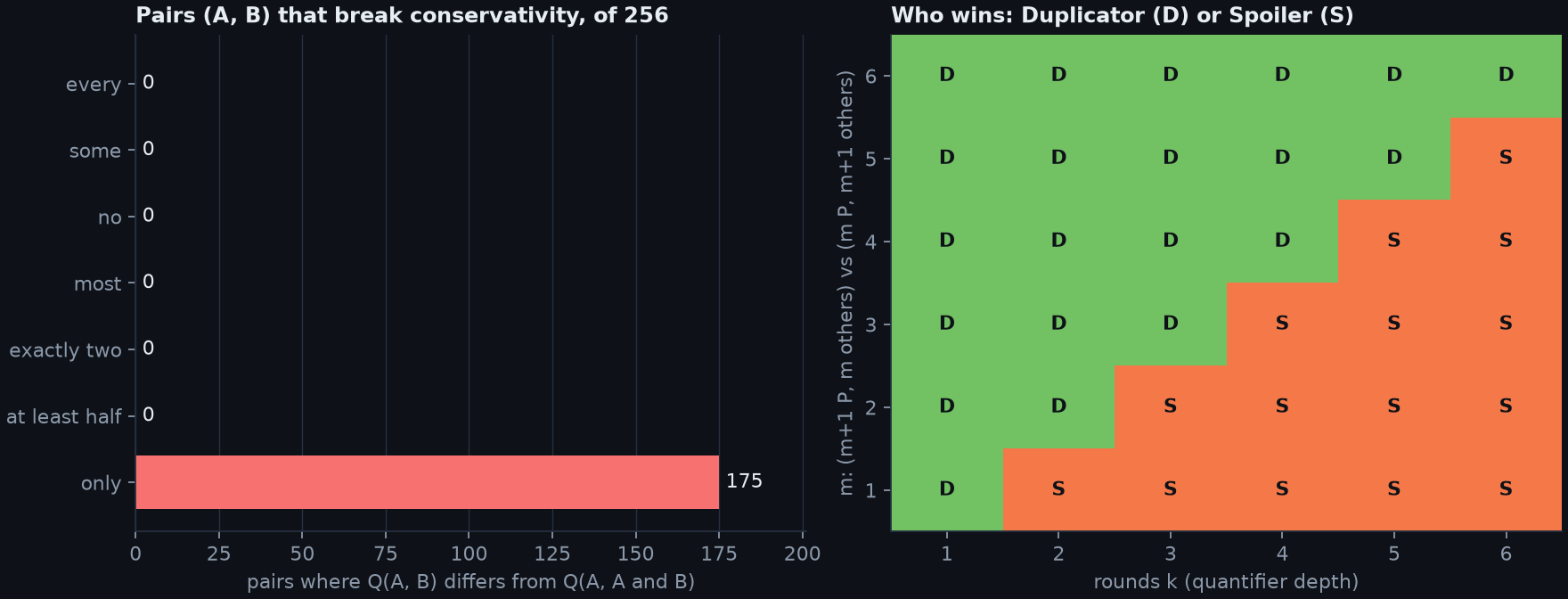
Now a surprise about natural language. Every determiner the theory has found obeys a law called conservativity: whether Q A's are B depends only on the A's. Every student smokes is equivalent to every student is a student who smokes. The Reasoner checks seven candidates on every pair of sets over a four-element universe, two hundred and fifty-six pairs. Six pass. The one that fails is only. Only students smoke is not equivalent to only students are students who smoke, which is trivially true. And only is not a determiner at all: it attaches to names and verbs too. Conservativity is a strong restriction. On a universe of just two things, there are sixty-five thousand five hundred and thirty-six relations between sets; the Reasoner counts the conservative ones by brute force: five hundred and twelve. Edward Keenan and Jonathan Stavi conjectured in 1986 that every determiner in every human language is among them.
Determiners also differ in which inferences they license. The Reasoner checks, for each, whether making the noun's set bigger or smaller, or the verb's set bigger or smaller, preserves truth, on every choice of sets. Every is downward in the noun and upward in the verb: every dog barks entails every small dog barks, and every dog makes noise. Some is upward in both places, and no is downward in both. Most is upward in the verb but neither way in the noun: most dogs bark does not tell you whether most small dogs do. These monotonicity patterns decide a large share of everyday reasoning, and chapter fifteen tests machines on them.
Can most be defined in first-order logic, from every, some and not? The answer is no, and the proof is a game. Take two structures. The first has four things that are P and three that are not, so most things are P. The second has three that are P and four that are not, so most things are not. Two players, Spoiler and Duplicator, play for three rounds. Each round, Spoiler places a pebble on an element of either structure, and Duplicator answers with a pebble in the other. Duplicator wins if, at the end, the pebbled elements match: the same colours, and the same pattern of which are equal. Spoiler picks a P in the first; Duplicator answers with a P. Spoiler picks a non-P in the second; Duplicator answers in kind. Spoiler picks another P; Duplicator still has one to give. With three rounds, Duplicator can always keep up, because each colour has at least three elements on both sides.
The Reasoner plays the game exhaustively for four sizes. For each k, the first structure has k plus one P's and k others, the second the reverse. Duplicator wins every k-round game, and loses with one round more. The theorem of Andrzej Ehrenfeucht and Roland Fraïssé says Duplicator wins the k-round game exactly when the two structures satisfy the same sentences with at most k nested quantifiers. So no first-order sentence of depth k can tell these two structures apart. But most things are P is true in one and false in the other. Since every first-order sentence has some depth k, none of them means most. Natural language, in one small word, outruns the logic that Frege and Russell built to analyse it.
What it establishes: Barwise and Cooper (1981); Keenan and Stavi (1986); Ehrenfeucht (1961); Fraïssé (1954).; Computed on screen: conservativity on 256 pairs; 512 of 65 536; monotonicity; EF games for k = 1..4
12Intensions and omniscienceResearch3 min
Possible worlds, from Part 22, give the cleanest precise version of Frege's senses. Take three worlds. A name like Ortcutt picks out the same man in each. A description like the tallest spy picks out different people in different worlds. And a sentence like snow is white is true in some worlds and false in others. Rudolf Carnap, in 1947, called what an expression picks out at a world its extension there, and the function from worlds to extensions its intension. A sentence's intension is, in effect, a set of worlds: the worlds where it is true. David Lewis and Robert Stalnaker took that set to be the proposition it expresses. Senses, which Frege left mysterious, become mathematical objects.
But sets of worlds are too coarse. The Reasoner builds every formula from two letters, p and q, with not, and, or and if, nested two deep: seven hundred and eighty-six formulas. Over the four worlds that settle p and q, they express only fifteen different sets of worlds. And the two hundred and twelve tautologies among them all express the same one: the set of every world. Now model belief the same way, as a set of worlds the believer cannot rule out. Then anyone who believes anything believes all its logical consequences. Two plus two is four and Fermat's last theorem express the same proposition, so believing one is believing the other, and, on this model, every mathematician knew Fermat's theorem long before Andrew Wiles proved it. Jaakko Hintikka's logic of knowledge, of 1962, has this property built in. It is called the problem of logical omniscience.
There are four main responses. Add impossible worlds, where logic fails, so that different necessary truths come apart, as Part 22 described. Give propositions structure, like sentences, with parts, a view going back to Russell and defended today by Scott Soames and Jeffrey King. Or keep the worlds, and say with Robert Stalnaker that a mind holds several separate belief states, each closed under logic, which it never puts together. Whatever the answer, contexts like belief are hyperintensional: they distinguish even sentences true in exactly the same worlds. That is the setting of the next chapter.
What it establishes: Carnap (1947); Lewis; Stalnaker; Hintikka (1962); Berto and Jago (2019).; Computed on screen: 786 formulas, 15 propositions
13Belief reportsIntroductory3 min
Frege's puzzle returns in its sharpest form in reports of belief. Superman and Clark Kent are one man, with two names. Lois Lane believes that Superman flies. She would sincerely deny that Clark Kent flies; it seems false to say she believes it. So swapping co-referring names inside a belief report seems to change its truth value, just as in chapter two.
Three claims cannot all be true. A name's meaning is just its referent, as Mill and the direct-reference theorists say. Co-referring names can be swapped without changing a sentence's truth, given the first claim and compositionality. And Lois believes that Superman flies but does not believe that Clark Kent flies. Each position gives up one. Frege gives up the first: names have senses, and in belief reports they refer to them. The Russellians, Nathan Salmon in 1986 and Scott Soames, give up the third: strictly, Lois does believe that Clark Kent flies, under a guise she does not recognize, and the report only sounds false because of what it suggests. Mark Crimmins and John Perry, in 1989, give up the second: a belief report says something about a mode of presentation that is not spelled out, so swapping names changes which mode is meant.
Kripke showed in 1979 that the problem is not just about substituting names. Pierre grows up in France and hears of a beautiful city. He says, sincerely, Londres est jolie. Later he moves, without realizing it, to an ugly district of the same city, which he learns to call London, and says London is not pretty. He never connects the two names. By translation, Pierre believes that London is pretty. By disquotation, Pierre believes that London is not pretty. No co-referring names were swapped; only two principles everyone uses. Yet Pierre is no fool, and does not hold contradictory beliefs in any ordinary sense. Kripke concluded that every theory of belief reports faces the puzzle, and none has a comfortable answer.
This is the twenty-seventh brick in the Wall. The dream was that meaning is reference: that a name contributes only its bearer, and a sentence only its truth conditions. Frege's puzzle, sharpened by belief reports, and Kripke's modal argument, which rules out the easy rescue by descriptions, stand in the way. The way through costs something: senses, with their shifting references, or Russellian meanings, with reports that are true when they sound false, or a hidden layer of context.
What it establishes: Salmon (1986); Soames; Crimmins and Perry (1989); Kripke (1979); the Price List; the Wall's twenty-seventh brick.
14Donkeys and dynamicsResearch3 min
Peter Geach, in 1962, posed a puzzle with a farmer and a donkey. Translate every farmer who owns a donkey beats it into first-order logic in the obvious way, and the pronoun it becomes a variable outside the scope of the quantifier that should bind it. The formula does not say what the sentence says. The formula that gets the truth conditions right turns a donkey into a universal: for every farmer and every donkey he owns, he beats it. But elsewhere the indefinite a donkey is existential: a farmer owns a donkey means there is one. So the same word seems to mean some in one place and every in another, depending on a pronoun that comes later.
In 1991 Jeroen Groenendijk and Martin Stokhof proposed changing what a formula means. In dynamic predicate logic, a formula's meaning is not a set of assignments but a relation between them: given an input assignment of objects to variables, it returns the outputs. An existential resets its variable to any object and passes the result on. A conjunction feeds the outputs of its left side into its right side, so a variable set by an existential stays set to the right of it. And if-then requires every output of the antecedent to be extendable by the consequent, which is where the universal force comes from. The Reasoner implements it and tests the obvious translation of the donkey sentence, read dynamically, on four hundred random models. It agrees with the correct first-order formula every time. Read statically, with y left unbound, it is wrong on forty-eight of them.
The same mechanism handles pronouns across sentences. A farmer owns a donkey. He beats it. Hans Kamp, in 1981, and Irene Heim, in 1982, represented a discourse as a growing box. Each sentence adds discourse referents, here x and y, and conditions on them. The pronouns he and it pick up referents introduced earlier, so the second sentence adds beats x y to the same box. In dynamic predicate logic, the conjunction of the two sentences, with the variables apparently free in the second, comes out equivalent to the single existential claim we want. The Reasoner checks it on the same four hundred models: they agree every time.
This was a change in the idea of meaning itself. On the static view, from Frege to Montague, the meaning of a sentence is its truth conditions. On the dynamic view, its meaning is its context change potential: the way it changes the information state of whoever accepts it. That matters for pronouns, for presuppositions like Strawson's, which a context must already satisfy, and for words like might, which comment on the information gathered so far. It also points toward the idea that meaning is something we do with words, which Part 28 takes up.
What it establishes: Geach (1962); Kamp (1981); Heim (1982); Groenendijk and Stokhof (1991).; Computed on screen: DPL against first-order on 400 models
15Meaning in machinesApplied4 min
Formal semantics is not only philosophy. It is the theory behind every system that turns language into something a computer can execute. The Reasoner takes the logical forms its parser produced in chapter ten and compiles them into the database language SQL. Every student smokes becomes a query: there is no row in the entity table that is a student and not a smoker. It loads the model into a sqlite database, runs all seven queries, and compares the answers with its own model checker. They agree on every sentence, including both readings of the scope ambiguity. Turning sentences into executable meanings like this is called semantic parsing, and it is what a question-answering system over a database has to do.
How do we test whether a machine handles meaning? FraCaS, a suite of inference problems written by semanticists in 1996, covers quantifiers, plurals, anaphora and attitude reports. Spider, from Tao Yu and colleagues in 2018, pairs questions with SQL queries over two hundred databases. SCAN, from Brenden Lake and Marco Baroni, and COGS, from Najoung Kim and Tal Linzen, test compositional generalization: can a network interpret a combination of parts it never saw combined? And MED, from Hitomi Yanaka and colleagues in 2019, tests exactly the monotonicity inferences of chapter eleven. Across these benchmarks the broad pattern has been that neural models do well on common cases and less well on systematic ones: scope, negation, and downward-entailing contexts.
The Reasoner can build such a test itself. Take a premise like every dog barks, and edit it: narrow the noun to small dogs, widen it, narrow the verb to something stronger, or widen it to makes noise. For each of four determiners and each edit, it decides whether the edited sentence follows, by checking every choice of sets over a four-element universe. The answers are the monotonicity profiles: every licenses narrowing the noun and widening the verb; some, widening both; no, narrowing both; most, only widening the verb. Every label in this suite is a theorem. There is no annotator disagreement and no label noise. A language model's answers can be scored against the logic, case by case.
One recent finding goes back to the first page of this part. In 2023 Lukas Berglund and colleagues reported what they called the reversal curse: language models trained on statements of the form A is B often fail to answer questions that need B is A. In one test, a leading model answered who is Tom Cruise's mother correctly about four times in five, and who is Mary Lee Pfeiffer's son only about a third of the time. Frege's identity statements are symmetric in logic. But a equals b carries information that a equals a does not, and a learner that stores it in one direction shows it. Do such models refer to anything at all? Matthew Mandelkern and Tal Linzen have argued that they may, by the externalist route of chapters five and six: their words come to them through a long history of use by people who did.
What it establishes: FraCaS (1996); Yu et al. (2018); Lake and Baroni (2018); Kim and Linzen (2020); Yanaka et al. (2019); Berglund et al. (2023); Mandelkern and Linzen.; Computed on screen: SQL in sqlite; an inference suite proved
Recap, problems, and where this comes backAll tracks2 min
Let's gather what we built. The white horse, and the two readings of is, with the Mohist and Millian theories of names. Frege's sense and reference, with his medians computed. Russell's descriptions and the scope of negation, Strawson's gaps and Donnellan's two uses. Kripke's rigid names and causal chains, Twin Earth, and Burge's arthritis. Kaplan's indexicals and the two-dimensional matrix. Truth-conditional semantics, from Tarski to Montague, ending in a working parser. Generalized quantifiers, conservativity counted, and a game that proves most is not first-order. And intensions, belief reports, this part's brick in the Wall, donkey sentences, and meaning in machines.
The Reasoner has a new module, semantics. It computes Frege's medians and Russell's scopes, rigid designation across worlds, Kaplan's contexts and two-dimensional matrices, derives T-sentences, reduces lambda terms, interprets trees by Heim and Kratzer's rules, checks conservativity, plays Ehrenfeucht–Fraïssé games, runs dynamic predicate logic, and compiles meanings to SQL. And the Wall has its twenty-seventh brick.
Six problems, with full solutions in this part's notes. Russell's scopes for a negated identity; the matrix for I am here now; a truth theory Foster cannot fool; a scope ambiguity with no and every; a conservativity proof; and an Ehrenfeucht–Fraïssé game for parity. Pause here, and try them.
Where this comes back. Meaning as use, rule-following and speech acts, in Part 28. Externalism and the contents of the mind, in Parts 30 and 31. Belief and knowledge, which Parts 11 and 12 built, now with their reports. And language models and what their words mean, in Parts 41 and 42. Next, Part 28: meaning in use.
The books and papers this part follows are on screen, and in the notes. Thanks for watching.
Where it goes next. Meaning as use, rule-following and speech acts follow in Part 28; externalism and the contents of the mind return in Parts 30 and 31; belief and knowledge from Parts 11 and 12 now have their reports; what the words of language models mean is taken up in Parts 41 and 42.
Key results
The part's results in one place, for revision.
Try it
Lab 27 · Quantifiers as relations between sets
Test seven candidate determiners for conservativity on every pair of subsets of a four-element universe, count the conservative relations on two elements by brute force, play Ehrenfeucht-Fraïssé games on structures that differ only in whether most things are P, and compare dynamic predicate logic with first-order translations of the donkey sentence.
python -m videos.philosophy.labs 27
needs numpy, scipy, matplotlib · download lab27.py ·
source on GitHubconservative on all 256 pairs every, some, no, most, exactly two, at least half
'only': pairs where Q(A, B) differs from Q(A, A & B) 175 of 256
conservative relations on 2 elements 512 of 65536 (theory 2^(3^2) = 512)
random games against the counting criterion 150 of 150 agree
(m+1 P, m others) against (m P, m+1 others) Duplicator wins k rounds iff k <= m, for m = 1..6
DPL donkey sentence = 'for all x, y' translation 400 of 400 random models
DPL = static reading with y left free 351 of 400
DPL discourse = 'exists x, y' translation 400 of 400
Every determiner tested looks only at the noun's set, 'only' does not; 'most' separates structures that no first-order sentence of bounded depth can; and a dynamic existential binds the pronoun that a static one leaves free.The code (93 lines; it asserts its own result)
"""Lab 27: check determiners for conservativity, play the game that 'most' wins, and run the donkey sentence."""

import numpy as np

from videos.coursekit import labs
from explainer.philosophy.reasoner import semantics as sem

TITLE = "Quantifiers as relations between sets"
GOAL = ("Test seven candidate determiners for conservativity on every pair of subsets of a four-element universe, "
        "count the conservative relations on two elements by brute force, play Ehrenfeucht-Fraïssé games on "
        "structures that differ only in whether most things are P, and compare dynamic predicate logic with "
        "first-order translations of the donkey sentence.")
TASKS = [
    "Add 'not all' and 'fewer than half' to sem.GQ and rerun sem.quantifiers(4). Are they conservative, and what "
    "are their monotonicity profiles?",
    "Add 'an even number of' (len(A & B) % 2 == 0) and find, with sem.ef_duplicator_wins, two structures that "
    "disagree on it but that Duplicator can defend for k rounds.",
    "Lower the chance of a 'beats' pair in sem._random_model from 0.35 to 0.05 and rerun sem.donkeys. Why does the "
    "naive translation now agree more often?",
]


def _rank(m1, m2):
    """The fewest rounds in which Spoiler tells m1 from m2: theory says a colour with n1 != n2 elements is exposed
    in min(n1, n2) + 1 rounds."""
    return min((min(a, b) + 1 for a, b in zip(m1, m2) if a != b), default=None)


def run(seed=0):
    rng = np.random.default_rng(seed)
    lab = labs.Lab()

    # 1. conservativity: Q(A, B) iff Q(A, A & B)
    q = sem.quantifiers(4)
    S = sem._subsets(range(4))
    breaks = {name: sum(Q(A, B) != Q(A, A & B) for A in S for B in S) for name, Q in sem.GQ.items()}
    passed = [n for n, r in q["rows"].items() if r["conservative"]]
    lab.row(f"conservative on all {q['pairs']} pairs", ", ".join(passed))
    lab.row("'only': pairs where Q(A, B) differs from Q(A, A & B)", f"{breaks['only']} of {q['pairs']}")
    assert set(passed) == set(sem.GQ) - {"only"} and breaks["only"] > 0
    assert all((breaks[n] == 0) == q["rows"][n]["conservative"] for n in sem.GQ), "the count agrees with the library"
    every, most = q["rows"]["every"], q["rows"]["most"]
    assert every["left_down"] and every["right_up"] and not every["left_up"]
    assert most["right_up"] and not most["left_up"] and not most["left_down"], "'most' is monotone in the verb only"
    cc = sem.count_conservative(2)
    lab.row("conservative relations on 2 elements", f"{cc['conservative']} of {cc['all']}   (theory 2^(3^2) = {cc['formula']})")
    assert cc["conservative"] == cc["formula"] == 512

    # 2. Ehrenfeucht-Fraisse games: Duplicator survives k rounds iff every colour has equal counts or both >= k
    checked = 0
    for _ in range(150):
        m1, m2 = tuple(rng.integers(0, 6, 2)), tuple(rng.integers(0, 6, 2))
        k = int(rng.integers(1, 6))
        r = _rank(m1, m2)
        assert sem.ef_duplicator_wins(m1, m2, k) == (r is None or k < r), (m1, m2, k)
        checked += 1
    lab.row("random games against the counting criterion", f"{checked} of {checked} agree")
    ks = list(range(1, 7))
    grid = np.array([[sem.ef_duplicator_wins((m + 1, m), (m, m + 1), k) for k in ks] for m in ks])
    for m in ks:
        assert all(grid[m - 1, k - 1] == (k <= m) for k in ks), "Duplicator wins exactly the games of at most m rounds"
    lab.row("(m+1 P, m others) against (m P, m+1 others)", "Duplicator wins k rounds iff k <= m, for m = 1..6")

    # 3. donkey sentences
    d = sem.donkeys(trials=400, seed=seed)
    lab.row("DPL donkey sentence = 'for all x, y' translation", f"{d['dpl_vs_fo']} of {d['trials']} random models")
    lab.row("DPL = static reading with y left free", f"{d['dpl_vs_naive']} of {d['trials']}")
    lab.row("DPL discourse = 'exists x, y' translation", f"{d['discourse']} of {d['trials']}")
    assert d["dpl_vs_fo"] == d["trials"] == d["discourse"] and d["dpl_vs_naive"] < 0.95 * d["trials"]
    lab.note = ("Every determiner tested looks only at the noun's set, 'only' does not; 'most' separates structures "
                "that no first-order sentence of bounded depth can; and a dynamic existential binds the pronoun "
                "that a static one leaves free.")

    fig, ax = labs.figure(2, size=(11, 4.2))
    names = list(sem.GQ)
    ax[0].barh(names[::-1], [breaks[n] for n in names[::-1]],
               color=[labs.RED if breaks[n] else labs.GREEN for n in names[::-1]])
    for i, n in enumerate(names[::-1]):
        ax[0].text(breaks[n] + 2, i, str(breaks[n]), va="center", color=labs.INK)
    ax[0].set_axisbelow(True)
    ax[0].set(title="Pairs (A, B) that break conservativity, of 256", xlabel="pairs where Q(A, B) differs from Q(A, A and B)",
              xlim=(0, max(breaks.values()) * 1.15))
    ax[0].grid(False, axis="y")
    ax[1].imshow(grid, origin="lower", cmap="RdYlGn", vmin=-0.4, vmax=1.4, extent=(0.5, 6.5, 0.5, 6.5), aspect="auto")
    for m in ks:
        for k in ks:
            ax[1].text(k, m, "D" if grid[m - 1, k - 1] else "S", ha="center", va="center", color=labs.BG,
                       fontweight="bold")
    ax[1].set(title="Who wins: Duplicator (D) or Spoiler (S)", xlabel="rounds k (quantifier depth)",
              ylabel="m: (m+1 P, m others) vs (m P, m+1 others)")
    ax[1].grid(False)
    lab.fig = fig
    return lab
Now change it
- Add 'not all' and 'fewer than half' to sem.GQ and rerun sem.quantifiers(4). Are they conservative, and what are their monotonicity profiles?
- Add 'an even number of' (len(A & B) % 2 == 0) and find, with sem.ef_duplicator_wins, two structures that disagree on it but that Duplicator can defend for k rounds.
- Lower the chance of a 'beats' pair in sem._random_model from 0.35 to 0.05 and rerun sem.donkeys. Why does the naive translation now agree more often?
Problems, with solutions
Try each problem before opening its solution.
-
Give Russell's analysis of 'the author of Waverley is not Scott' in both scopes; find a model separating them.
Solution
With \(W\) for "wrote Waverley" and \(s\) for Scott: narrow scope (the description outside the negation), \(\exists x\,(Wx \land \forall y\,(Wy \to y = x) \land x \ne s)\), "exactly one person wrote Waverley, and it was not Scott". Wide scope (the negation outside), \(\lnot\exists x\,(Wx \land \forall y\,(Wy \to y = x) \land x = s)\), "it is not the case that Scott and Scott alone wrote Waverley". They come apart when there is no unique author. In a model with Scott and Tom where nobody wrote Waverley (or where both wrote it together), the narrow reading is false and the wide reading true.
-
Draw the two-dimensional matrix for 'I am here now', with contexts as rows.
Solution
Take two proper contexts: \(c_1\), Ann in Paris at noon in world \(w_1\), and \(c_2\), Ann in Rome at noon in \(w_2\) (in \(w_1\) she is in Paris, in \(w_2\) in Rome). Rows are contexts, columns circumstances of evaluation. Row \(c_1\): the content is "Ann is in Paris at noon", true at \(w_1\), false at \(w_2\). Row \(c_2\): "Ann is in Rome at noon", false at \(w_1\), true at \(w_2\). The diagonal (each context evaluated at its own world) is true, as it is for every proper context: the sentence cannot be uttered falsely, a logical truth in Kaplan's logic. But no row is true throughout, so what it says is contingent: Ann might have been elsewhere.
-
Write a truth theory for 'and', 'or' and 'not' that Foster's trick cannot fool. What did you add?
Solution
The clauses: "\(\varphi\) and \(\psi\)" is true iff \(\varphi\) is true and \(\psi\) is true; "\(\varphi\) or \(\psi\)" iff at least one is; "not \(\varphi\)" iff \(\varphi\) is not true; plus one clause per atomic sentence. Foster's deviant theory changes a clause (say, "snow is white" is true iff grass is green, or "\(\varphi\) and \(\psi\)" is true iff both are true and the earth moves) and still yields only true T-sentences in the actual world. To stop it, require more than truth: every axiom must hold as a law, true in every world of the model, as the film's comparison across worlds does. In a world where grass is not green the deviant atomic clause makes false predictions, so it is ruled out. What was added is modal strength (Davidson's lawlikeness), with T-sentences derived canonically from the axioms.
-
Interpret 'no student read every book' in both scopes; build a model where they differ.
Solution
Surface scope: \(\lnot\exists s\,(\text{Student}(s) \land \forall b\,(\text{Book}(b) \to \text{Read}(s, b)))\), "no student read all the books". Inverse scope: \(\forall b\,(\text{Book}(b) \to \lnot\exists s\,(\text{Student}(s) \land \text{Read}(s, b)))\), "every book went unread by every student". Model: students \(s_1, s_2\), books \(b_1, b_2\), with \(s_1\) having read only \(b_1\) and \(s_2\) only \(b_2\). No student read both books, so the surface reading is true; but \(b_1\) was read, so the inverse reading is false. (The inverse reading entails the surface one whenever there is at least one book.)
-
Prove that 'at least half' is conservative and right-upward but neither way on the left.
Solution
"At least half the A are B" is \(|A \cap B| \ge |A|/2\). Conservative: the condition mentions only \(A\) and \(A \cap B\), and \(A \cap (A \cap B) = A \cap B\), so it holds of \((A, B)\) iff it holds of \((A, A \cap B)\). Right-upward monotone: if \(B \subseteq B'\) then \(|A \cap B'| \ge |A \cap B| \ge |A|/2\). Not left-upward: with \(A = \{a\} \subseteq A' = \{a, b, c\}\) and \(B = \{a\}\), it holds of \((A, B)\) (\(1 \ge 1/2\)) and fails of \((A', B)\) (\(1 < 3/2\)). Not left-downward: with \(A' = \{a, b\}\), \(A = \{b\}\), \(B = \{a\}\), it holds of \((A', B)\) (\(1 \ge 1\)) and fails of \((A, B)\) (\(0 < 1/2\)).
-
Show by an Ehrenfeucht–Fraïssé game that 'there is an even number of \(P\)' is not first-order.
Solution
Fix \(k\) and compare two structures in which everything is P: one with $2k$ elements, one with $2k + 1$. In each of \(k\) rounds, Spoiler picks an element in either structure; Duplicator answers with the element matched to it before if Spoiler repeats one, and otherwise with a fresh element of the other structure, which always exists since each has at least \(k\) elements. After \(k\) rounds the chosen elements match one-for-one, with equalities and the predicate P preserved, so Duplicator wins. By the Ehrenfeucht–Fraïssé theorem the two structures agree on every sentence of quantifier depth \(k\). One has an even number of P's and the other an odd number, and every first-order sentence has some finite depth, so no first-order sentence says "there is an even number of P".
Notes and sources
Sources
Texts: Lycan, Philosophy of Language (3rd ed., 2019); Kripke, Naming and Necessity (1980); Heim and Kratzer, Semantics in Generative Grammar (1998); Gamut, Logic, Language, and Meaning (1991); Peters and Westerståhl, Quantifiers in Language and Logic (2006); Speaks, "Theories of Meaning" (Stanford Encyclopedia of Philosophy).
Papers and primary texts: Gongsun Long, Bai Ma Lun; the later Mohist canons; Mill (1843); Frege (1892); Russell (1905); Tarski (1933); Carnap (1947); Strawson (1950); Searle (1958); Ehrenfeucht (1961); Geach (1962); Hintikka (1962); Donnellan (1966); Davidson (1967, 1973); Montague (1970); Kripke (1970/1980, 1977, 1979); Evans (1973); Putnam (1975); Foster (1976); Kaplan (1977/1989); Burge (1979); Barwise and Cooper (1981); Kamp (1981); Heim (1982); Keenan and Stavi (1986); Salmon (1986); Fodor (1987); Crimmins and Perry (1989); Groenendijk and Stokhof (1991); FraCaS (1996); Soames (2002); Schlenker (2003); Lake and Baroni (2018); Yu et al. (2018); Yanaka et al. (2019); Kim and Linzen (2020); Berglund et al. (2023); Mandelkern and Linzen (2024).
About this partfrom its README
Part 27 of Philosophy, Built (series plan, syllabus), the first part of Act VI, Mind and Meaning: the philosophy of language, from names to formal semantics, with a working semantic parser built. Gongsun Long's white horse, with 'is' read as identity and as inclusion on a herd of six horses; the later Mohists' three kinds of name, and Mill. Frege's puzzle (Hesperus and Phosphorus), his own example computed (the three pairwise intersections of a triangle's medians, one point), sense and reference for names, predicates and sentences, and indirect contexts. Russell's theory of descriptions in first-order logic, both scopes of negation drawn as trees and evaluated in four models; Strawson's truth-value gaps against Russell's values; incomplete descriptions and domain restriction; Donnellan's referential and attributive uses at a party, and Kripke's speaker's reference. Kripke's three arguments against descriptivism: rigid designation across four worlds, Gödel and Schmidt, the necessary a posteriori, and the causal-historical picture, with Evans's Madagascar. Putnam's Twin Earth, the division of linguistic labour, Burge's arthritis, narrow content and self-knowledge. Kaplan's character and content, 'I am here now' in all eight proper contexts of a small model (a priori, contingent in four), the two-dimensional matrix for 'water = H₂O' (necessary a posteriori) and 'water is the watery stuff' (contingent a priori), and Schlenker's monsters. Tarski's Convention T, a T-sentence derived step by step, Davidson's programme and Foster's problem (two truth theories agreeing on all 99 sentences in the actual world, and differing on 29 in another). Montague's types and the λ-calculus, 'every student smokes' β-reduced step by step; a Heim–Kratzer parser (FA, PM, PA, QR) that interprets every node of a tree, 'Ann likes every student' after quantifier raising, and both scopes of 'every student read a book'. Generalized quantifiers: conservativity checked on 256 pairs of sets (only 'only' fails), the 512 conservative relations among 65 536 on a two-element universe, monotonicity profiles, and an Ehrenfeucht–Fraïssé game proving that 'most' is not first-order. Intensions and logical omniscience (786 formulas, 15 propositions, 212 tautologies all one set of worlds). Belief reports: Lois Lane, Frege's puzzle as a Price List (Frege; Salmon and Soames; Crimmins and Perry), Kripke's Pierre, and the Wall's twenty-seventh brick. Donkey sentences and dynamic predicate logic, checked against first-order translations on 400 random models, and discourse representation. Meaning in machines: the parser's logical forms compiled to SQL and run in sqlite, the benchmarks (FraCaS, Spider, SCAN, COGS, MED), an inference suite whose gold labels are theorems, and the reversal curse.
The worked model results are computed by the Reasoner's new module explainer/philosophy/reasoner/semantics.py (with
fol for Russell's formulas and prop for the Price List), tested in tests/philosophy/test_semantics.py and cached
by compute.py.
Chapter notes
| # | Scene | What it establishes | Computed on screen |
|---|---|---|---|
| 0 | Hook |
Frege (1892); four questions; the plan. | — |
| 1 | Names |
Gongsun Long (c. 300 BCE); the later Mohist canons; Mill (1843). | the white horse: inclusion and identity |
| 2 | Frege |
Frege (1892): sense and reference; compositionality; indirect contexts. | the medians' intersections |
| 3 | Russell |
Russell (1905); Ramsey; descriptivism. | three formulas in four models |
| 4 | Strawson |
Strawson (1950); incomplete descriptions; Donnellan (1966); Kripke (1977). | gaps against values; domain restriction; the party |
| 5 | Kripke |
Kripke (1970/1980); Searle (1958); Evans (1973). | rigid designation across four worlds |
| 6 | Twin |
Putnam (1975); Burge (1979); Fodor (1987). | Oscar and his twin; the arthritis patient |
| 7 | Kaplan |
Kaplan (1977/1989); Stalnaker; Chalmers; Schlenker (2003). | 8 contexts for 'I am here now'; three 2-D matrices |
| 8 | Tarski |
Tarski (1933); Davidson (1967, 1973); Foster (1976). | a T-sentence derived; Foster's two theories on 99 sentences |
| 9 | Montague |
Montague (1970); Church. | types in the model; β-reduction step by step |
| 10 | Parser |
Heim and Kratzer (1998). | every node of three trees; both scopes |
| 11 | Quantifiers |
Barwise and Cooper (1981); Keenan and Stavi (1986); Ehrenfeucht (1961); Fraïssé (1954). | conservativity on 256 pairs; 512 of 65 536; monotonicity; EF games for k = 1..4 |
| 12 | Intensions |
Carnap (1947); Lewis; Stalnaker; Hintikka (1962); Berto and Jago (2019). | 786 formulas, 15 propositions |
| 13 | Belief |
Salmon (1986); Soames; Crimmins and Perry (1989); Kripke (1979); the Price List; the Wall's twenty-seventh brick. | — |
| 14 | Donkey |
Geach (1962); Kamp (1981); Heim (1982); Groenendijk and Stokhof (1991). | DPL against first-order on 400 models |
| 15 | Machines |
FraCaS (1996); Yu et al. (2018); Lake and Baroni (2018); Kim and Linzen (2020); Yanaka et al. (2019); Berglund et al. (2023); Mandelkern and Linzen. | SQL in sqlite; an inference suite proved |
| 16 | Outro |
recap; the Reasoner's module; the Wall; problems; payoffs; references. | — |
Companion material in this repository
The syllabus's plan for this partfrom SYLLABUS.md, the plan of record
- The School of Names: Gongsun Long's white horse dialogue as a puzzle about reference and predication.
- Frege's puzzle (1892): a = a vs a = b; sense (Sinn) and reference (Bedeutung); Frege's compositionality.
- Russell's theory of descriptions (1905): "the present king of France is bald", formalized; the scope ambiguity of negation, shown as two trees.
- Strawson's presupposition; Donnellan's referential vs attributive uses.
- Kripke's modal, epistemic and semantic arguments against descriptivism; the Gödel/Schmidt case; the causal- historical picture.
- Putnam's Twin Earth (1975): "meanings ain't in the head"; semantic externalism; Burge's arthritis.
- Kaplan's indexicals: character and content; "I am here now" is a priori but contingent.
- Tarski–Davidson: truth-conditional semantics; a T-theory for a toy language.
- Montague (1970): "English as a formal language". λ-calculus, types e and t.
- Built: a Heim–Kratzer semantic parser. The tree of a sentence is computed with λ-terms beta-reducing up to a truth value in a model.
- Generalized quantifiers (Barwise and Cooper 1981): conservativity; "most" is not first-order definable, proved by the Reasoner with an Ehrenfeucht–Fraïssé game on finite models.
- Intensional semantics: propositions as sets of worlds; the problem of logical omniscience.
- Belief reports and opacity: Frege's answer, Russellianism (Salmon, Soames), hidden indexicals.
- Dynamic semantics: donkey sentences ("every farmer who owns a donkey beats it"); DRT and dynamic predicate logic (meaning as context change), built as a small example.
- Industry: formal semantics in NLP (semantic parsing to SQL and logical forms); where LLMs succeed and fail on scope and quantifiers (benchmarks cited).
- Recap and Problems.
Built: reasoner.semantics (typed λ-calculus over a model; a Heim–Kratzer fragment; generalized quantifiers; EF
games; a DPL fragment).
Wall: Frege's puzzle and the failure of substitution in belief contexts; the inexpressibility of "most" in FOL.
Price List: Frege's puzzle (names have only referents; co-referential names are substitutable; Lois believes
Superman flies but not that Clark flies).
Visuals: the syntax tree with λ-terms flowing upward; scope trees rotating; two models in an EF game with pebbles.
References: Lycan; Heim and Kratzer; Gamut; Kripke; Kaplan, "Demonstratives"; Barwise and Cooper 1981; Kamp and
Reyle, From Discourse to Logic.
Build the film
python -m videos.philosophy.philosophy27.compute        # the part's numbers, into .cache/philosophy27
python tools/build.py philosophy27                  # render and assemble the film
EXPLAINER_TTS=silent python tools/qa_scene.py philosophy27 Hook   # one chapter, silent, with a contact sheet
Scenes: videos/philosophy/philosophy27. Setup: see the course page. Source of these notes: the README and the scenes' narration.
Build it
python -m videos.philosophy.philosophy27.compute       # every computed item (seconds; .cache/philosophy27)
python tools/build.py philosophy27 -q l                # 480p preview
python tools/build.py philosophy27                     # 1080p30 -> renders/philosophy27.mp4
python tools/qa_scene.py philosophy27 Parser           # one chapter, silent, with a contact sheet