Being and Time-Consciousness
phenomenology, existentialism, hermeneutics
What is it to experience a world, and can what matters in it be written down as rules?
The part opens with Husserl's slogan of 1900, back to the things themselves, and with four questions about aboutness, time, world and relevance. Brentano's thesis makes intentionality the mark of the mental, and Husserl's method is shown on a cube seen from 4000 viewpoints, never more than three faces at once. The living present is built from his 1905 diagram: on all 120 orderings of five notes a knife-edge present tells 5 apart, a two-note window 20, and a fading trace all 120. Heidegger's hammer and being-in-the-world lead to Dreyfus's attack on symbolic AI, and to the turn of the part, the frame problem. Frame axioms are counted against Reiter's successor-state axioms, Dennett's robots are acted out by a planner whose work grows with every irrelevant fluent, and relevance by rule becomes the Wall's twenty-ninth brick with a Price List of three claims. The second half takes the lived body with Braitenberg's vehicles, Sartre and Beauvoir, Nietzsche's eternal return tested on a reversible automaton and on Simmel's wheels, hermeneutics, Saussure and Derrida on rotated word vectors, Foucault with a gamed threshold, Habermas and the Kyoto school. It ends at Davos, with the bridges between the continental and analytic traditions.
What you need. No mathematics beyond counting and powers. Part 28's word vectors are reused, and Part 25's block universe is the contrast for the lived present.
- The calculation
- phenomenology's structures
- The wall
- the frame problem
- Built toy
- Husserl's time diagram; Saussure's relational meaning
What you will be able to do
Introductory
- State Brentano's thesis and one objection to it, and describe Husserl's epoché.
- Explain with Husserl's diagram why a melody cannot be heard in a knife-edge present, and what retention and protention add.
- Describe Heidegger's ready-to-hand and present-at-hand with the hammer.
Advanced
- Count frame axioms against successor-state axioms, and write the successor-state axiom for a fluent in Dennett's room.
- Explain why Fredkin's second-order automata are reversible and why a finite reversible world must return, and give Simmel's counterexample for a continuous one.
- Find the words a closed dictionary cannot define without leaving itself.
Research
- Separate the logical frame problem from the philosophical one, and set out the three inconsistent claims with the position that gives up each.
- Show that the similarity structure of word vectors is invariant under rotation, and say what that does and does not establish about Saussure's and Derrida's claims.
Applied
- Run a planner on Dennett's room and measure how its work grows with irrelevant fluents.
- Simulate a threshold that people can game and report how the selected group changes, as Goodhart's law predicts.
Contents
Each chapter has a home level. Choose a track to see what to read and watch: Introductory 30 min · Advanced 56 min · Research 64 min · Applied 40 min.
- 0What is it like to be in a world?Introductory2 min
- 1Consciousness of somethingIntroductory4 min
- 2To the things themselvesIntroductory4 min
- 3The living presentIntroductory4 min
- 4Being-in-the-worldIntroductory4 min
- 5What computers can't doApplied3 min
- 6The frame problemAdvanced6 min
- 7The lived bodyAdvanced3 min
- 8Condemned to be freeIntroductory4 min
- 9The individual and the eternal returnIntroductory5 min
- 10The hermeneutic circleAdvanced4 min
- 11Structure and differenceResearch5 min
- 12Power and the gazeApplied4 min
- 13Reason in communicationApplied3 min
- 14The place of nothingnessAdvanced3 min
- 15Across the divideResearch3 min
- Recap, problems, and where this comes backAll tracks2 min
Also on this page: Lecture · Key results · Try it · Lab · Problems · Notes and sources · Build the film.
Lecture
The text of each chapter is the film's narration, as it is spoken, so you can read along or revise without the film. The pictures are in the film.
What is it like to be in a world?Introductory2 min
Part 28 ended with a question about machines that have only ever seen text: is there meaning without a world? This part turns from language to the world as it is lived: to experience itself, and to the tradition that made experience its subject. In 1900 Edmund Husserl gave that tradition its slogan. We must go back to the things themselves: not to theories about experience, but to what shows itself, exactly as it shows itself. From Husserl came phenomenology; from phenomenology, Heidegger and the existentialists, hermeneutics, and the critique of artificial intelligence that gave AI one of its hardest problems.
Four questions run through it. Aboutness: every thought is a thought of something, every fear a fear of something, even when the thing does not exist. How can a state of mind be about anything? Time: we hear a melody, though at each instant only one note is sounding. Where, in the present, is the rest of the melody? World: is the world first of all a collection of objects with properties, as science describes it, or a field of things to do things with? And relevance: a robot that acts must know what its actions change and what they leave alone. Can any finite set of rules tell it? That last question, the frame problem, is this part's brick in the Wall.
The plan. Brentano's thesis that the mental is the intentional, and Husserl's method for describing experience, with a cube that is never seen whole. Husserl's analysis of the living present, with his own diagram animated, and a model of retention built. Heidegger's being-in-the-world and the hammer, and Hubert Dreyfus's attack on symbolic AI. The frame problem, with a planner and Daniel Dennett's three robots, this part's brick in the Wall and its Price List. Merleau-Ponty's lived body, embodied cognition, and vehicles that seem to have feelings. The existentialists, and Nietzsche's eternal return, tested on a reversible world. Interpretation, structure and difference, with word vectors rotated. And power, communication, the Kyoto school, and the bridges between continental and analytic philosophy.
What it establishes: Husserl (1900); four questions; the plan.
1Consciousness of somethingIntroductory4 min
In 1874 Franz Brentano, a former priest teaching in Vienna, set out to make psychology a science, and began by asking what separates mental phenomena from physical ones. His answer: every mental phenomenon is characterized by what the Scholastics of the Middle Ages called the intentional inexistence of an object, what we might call reference to a content, or direction toward an object. Seeing is seeing something; judging is judging something; loving is loving someone. No physical phenomenon, he claimed, is directed like this. Intentionality, from the Latin for aiming, is the mark of the mental. This is Brentano's thesis.
Picture the acts on one side and their objects on the other. Seeing the oak tree. Fearing the dog next door. Hoping for rain tomorrow, which does not exist yet. Thinking of Pegasus, which never will. That is the puzzle. A physical relation needs both its ends: you cannot kick what does not exist, or stand next to it. But you can think of it, and the thinking is complete, with nothing at the other end. Brentano's phrase, intentional inexistence, meant existence in the mind: the object of a thought exists, he suggested, as an object of the thought. Whether that is an answer or a restatement of the puzzle has been argued ever since.
Brentano's students pulled the thesis apart. Kazimierz Twardowski, in 1894, distinguished three things: the act of thinking, its content, and its object. The content is in the mind and exists whenever the act does. The object is what the act is about, and may be missing. Alexius Meinong went further: there are objects that do not exist, like the golden mountain, and even impossible ones, like the round square, which really is round and square. Russell's theory of descriptions, from Part 27, was in part a reply: the golden mountain is a description, not a name, and no object is needed. And Husserl, another of Brentano's students, said that an act reaches its object through a sense, which he called the noema. That is where phenomenology begins.
The thesis has had a long life. Roderick Chisholm, in 1957, gave logical marks of sentences about intentional states. From I think of Pegasus, it does not follow that there is a Pegasus; and co-referring names cannot always be swapped without changing the truth value, the failures of substitution that Part 27 found in belief reports. Is every mental state intentional? The main counterexamples are pains and moods. Is a pain about anything? Is a free-floating anxiety? Intentionalists, like Michael Tye and Tim Crane, say yes: a pain represents damage in a part of the body, and a mood is directed at the world as a whole. And the hardest question it raises is for physicalists. If minds are physical systems, how can a physical state be about anything, let alone about something that does not exist? Part 30 takes up that question.
What it establishes: Brentano (1874); Twardowski (1894); Meinong (1904); Chisholm (1957); Tye; Crane.
2To the things themselvesIntroductory4 min
Husserl's method begins with a change of attitude. In ordinary life we are in what he called the natural attitude: the world is simply there, and we take for granted that the tree exists, that it was planted years ago, that it is made of cells, that others see it too. The phenomenologist puts all of this in brackets. Husserl called it the epoché, Greek for holding back. It is not doubt, as with Descartes: the world is not denied, only the question of its existence is set aside. What remains is the tree exactly as it appears: green and in blossom, seen from this side, with its back side expected, as lovely. The description of this, and of the acts in which it appears, is phenomenology. The reduction is not a loss of the world. It is a way of seeing, for the first time, how the world is given.
Within experience, Husserl distinguishes two sides. The noesis is the act: this perceiving, this remembering, this imagining. The noema is what is meant, exactly as it is meant: the tree as perceived, from this side, in this light. Through the noema the act reaches the tree itself. Husserl drew the line sharply. The tree simpliciter can burn up, be resolved into its chemical elements, and so on. But the sense of this perception cannot burn up. What is a noema? Aron Gurwitsch read it as the object itself, just as it is perceived. Dagfinn Føllesdal argued in 1969 that it is a sense, Frege's notion from Part 27 generalized from words to every act of consciousness: a mode of presentation through which an act is directed at its object, if there is one.
Husserl's favourite example is a perceived thing, and how it is given. A cube can be seen from straight on, showing one face; from an edge, showing two; or from a corner, showing three. The Reasoner looks at a cube from four thousand random viewpoints close around it. One face is seen from eleven hundred and ninety-three of them, two faces from two thousand two hundred and thirty-two, three from five hundred and seventy-five. Not one shows four. Yet every one of the six faces is seen from somewhere. The cube is never given all at once. Husserl's word was Abschattungen, adumbrations: a thing is given only in profiles. And still we see a cube, not a few squares. The hidden sides are meant along with the visible ones, as a horizon of what further looking would show. The thing is given as a rule for its profiles, confirmed or surprised as we move around it.
Husserl also wanted the essences of things: what makes a triangle a triangle, or a perception a perception. His method was free variation. Imagine a triangle, and vary it freely: stretch it, flatten it, tilt it. Some features survive every variation. In five thousand random triangles the Reasoner finds five that hold in every one: three sides, angles summing to a hundred and eighty degrees, the longest side facing the largest angle, at least two acute angles, and each side shorter than the other two together. Others come and go. Seventy-three percent are obtuse and twenty-seven acute; isosceles and right-angled triangles are rare accidents. What survives every variation is a candidate for the essence, the eidos. This is only an analogy. Husserl's variation runs in imagination, and he claimed it lets us see necessity directly. Sampling can only find candidates. Each needs a proof: for instance, two angles of ninety degrees or more would already add up to a hundred and eighty, so at least two angles must be acute.
What it establishes: Husserl (1900, 1913); Gurwitsch; Føllesdal (1969).; Computed on screen: a cube from 4000 viewpoints; 5000 triangles varied
3The living presentIntroductory4 min
Listen to a melody: C, D, E, F, G. At each instant only one note is sounding. If consciousness were a series of instants, each holding only what is present at it, we would hear a sequence of separate notes, never a melody. Take the instant when F sounds. Up to then the melody might have been D, E, F, rising, or A, G, F, falling; on a knife-edge present they end the same, but they sound different. William James, in 1890, borrowed a name for the alternative: the specious present. The practically cognized present, he wrote, is no knife-edge, but a saddle-back, with a certain breadth of its own. But what is that breadth? It is not memory: when I hear the melody I am not remembering D and E, as I might remember yesterday's concert. They are still heard, as just past.
In lectures given in 1905, and published in 1928, Husserl drew a diagram of it. The horizontal line is the series of now-points: C, then D, E, F and G. From each now-point a diagonal runs down: the same note, sinking into the past as new nows arrive. Now stand at G and look down the vertical. It cuts every diagonal: G as it sounds, F just past, E further, D and C further still, each fainter. That vertical is the living present. Husserl named its parts. The primal impression is the note now sounding. Retention holds the just-past, not as an image or a memory, but as the tail of the present itself. And protention reaches forward: the note we expect next, which is why a wrong note is heard as wrong.
The Reasoner tests the idea on every ordering of five notes: a hundred and twenty melodies. At the last note, what can each kind of present tell apart? A knife-edge present, holding only the note now sounding, sorts them into just five groups, by their last note. A present that holds the last two notes tells apart twenty. A retentional present holds every past note, fainter by half with each step it sinks. It tells apart all one hundred and twenty. And from the fading weights alone the whole order can be read back: the faintest note came first. This is a model, not Husserl's analysis, but the shape is the same: a present with a tail. The recurrent networks of the AI series carry exactly such a state.
Philosophers of time now sort the options into three models, in Barry Dainton's terms. On the cinematic model, experience is a series of momentary snapshots, and succession is judged rather than seen. On the retentional model, Husserl's, each momentary experience contains retentions of the past and protentions of the future. On the extensional model, experiences themselves are extended in time, lasting a short while, and the succession is in them. Rick Grush gave the retentional model a computational form in 2006: the brain keeps an estimate of a short trajectory, smoothing the recent past and predicting the next moment, as an engineer's filter does. And Francisco Varela tied the width of the present to the time neural assemblies take to integrate, from half a second to a few seconds. A century after the lectures, Husserl's diagram had become a hypothesis about brains.
What it establishes: James (1890); Husserl (1905/1928); Dainton (2000); Grush (2006); Varela (1999).; Computed on screen: Husserl's diagram; three presents on 120 melodies
4Being-in-the-worldIntroductory4 min
Husserl's assistant, Martin Heidegger, turned phenomenology in a new direction. In 1927 he published Being and Time. Its question is the oldest in philosophy: what does it mean to be? Not which things exist, the question of Part 20, but what the being of anything consists in. He approaches it through the one entity that asks it: Dasein, being-there, his word for the kind of being we are, the entity for which its own being is an issue. And he begins not with perception or knowledge, as Husserl did, but with how we ordinarily exist, before any theory: everyday being-in-the-world.
Compare two pictures. In the picture that runs from Descartes to much of cognitive science, a mind sits on one side, objects on the other, and the mind relates to the world by representing it, by having inner pictures of outer things. Heidegger rejects the starting point. We are not first minds who then reach out to a world. We are always already in a world: a web of involvements, things to use, tasks under way, other people. Hence the hyphens. Being-in-the-world is a single phenomenon, not a mind plus a world plus a relation between them.
The famous example is a hammer. Hammering, I do not perceive the hammer as an object with a weight and a shape. It withdraws. My attention is on the nail, and through the nail on the board, the roof, the shelter it gives, and what it is all for. Heidegger calls this being ready-to-hand. Each piece of equipment refers to others: the hammer is in order to drive nails, the nails in order to hold boards, the boards in order to make a roof, and the chain ends in a way of living that it is all for the sake of. To look at the hammer as an object with properties, a weight of four hundred grams, a steel head, is to treat it as present-at-hand. For Heidegger this is a derived and special attitude, the attitude of theory. We are thrown into it when equipment breaks down. The head flies off, and the hammer suddenly becomes conspicuous; if it is missing, or in the way, the same. And in the breakdown, the whole web of references that was there all along lights up.
What is the being of Dasein? We are thrown: we find ourselves already in a situation we did not choose, with a body, a language, a history. We are projecting: we understand ourselves by our possibilities, by what we can be. And we are falling: absorbed in what Heidegger calls the they, das Man, where one does what one does and thinks what one thinks. The unity of these is care. Facing our own death, which no one can die for us, pulls us out of the they; authenticity is owning our possibilities as ours. And care is temporal through and through: having-been, being-ahead-of-itself, being alongside things. Husserl's retention and protention, from chapter three, become the structure of existence itself.
This chapter cannot end without the shadow over it. In 1933 Heidegger joined the Nazi party and became rector of the University of Freiburg. He resigned the rectorship in 1934, but remained a party member until 1945. His private notebooks, published from 2014, contain antisemitic passages. Whether, and how far, the politics infects the philosophy is still argued, with answers from not at all to through and through. What is not in doubt is the influence: Sartre, Hannah Arendt, Gadamer, Emmanuel Levinas, Derrida and Hubert Dreyfus all start from him, and so does much of the rest of this part.
What it establishes: Heidegger (1927); the Black Notebooks (2014).
5What computers can't doApplied3 min
In 1965 the RAND Corporation published a memo by a young philosopher at MIT, Hubert Dreyfus, called Alchemy and Artificial Intelligence. The researchers were furious, and when, in 1967, Dreyfus lost a game of chess to one of their programs, they made sure everyone knew. In 1972 the memo became a book, What Computers Can't Do. He argued that symbolic AI rested on four assumptions. Biological: the brain processes information in discrete steps, like switches. Psychological: the mind operates on bits of information according to formal rules. Epistemological: all knowledge can be formalized. Ontological: the world consists of independent, context-free facts. Every one, he argued, is false, and the reasons are Heidegger's: what we know is mostly know-how, not facts; and what a fact means depends on a situation that no list of facts can capture.
Hubert and his brother Stuart, an engineer, studied how people actually acquire skills: drivers, chess players, pilots. The novice follows context-free rules: shift gear at twenty miles an hour. The advanced beginner learns aspects that no rule defines, like the sound of the engine. The competent performer chooses a plan, and feels responsible for it. The proficient performer sees what needs doing, but still decides how. The expert sees what to do and does it, without consulting any rules at all. Rules are the ladder, not the skill. If expertise is the end of rule-following, then a system made only of rules is a permanent novice.
Fifty years on, how did the critique fare? Part of it was answered by a kind of AI Dreyfus himself favoured over symbols: learning. Vision, speech and the game of Go are now handled by networks trained on examples, with no explicit rules; AlphaGo's moves in 2016 were described, by professionals, as intuitive. Dreyfus was not satisfied. In 2007 he argued that even the embodied robotics of the 1990s still represented the world rather than coping with it. Two problems remain open. The first is relevance: knowing, in a situation never met before, what matters and what can be ignored. That is the frame problem, the next chapter. The second is mattering itself. As John Haugeland put it, the trouble with artificial intelligence is that computers don't give a damn. Whether models trained on what people have written inherit some of their background, or only its traces, is a question for the last parts of this series.
What it establishes: Dreyfus (1965, 1972, 2007); Dreyfus and Dreyfus (1980); Haugeland.
6The frame problemAdvanced6 min
In 1969 John McCarthy and Patrick Hayes asked what it would take for a machine to reason about action. Their logic is the situation calculus: a situation s, and do of a and s for the situation after action a. An effect axiom says what an action changes: after picking up x, the robot is holding x. But nothing yet says what it leaves alone. Does picking up a block change the colour of the walls? The logic does not know, unless told by a frame axiom: if y had colour c, it still has colour c after the pickup. One is needed for nearly every pair of an action and a property it does not affect, about two times A times F of them. Ten actions and fifty fluents need a thousand; a hundred actions and a thousand fluents, two hundred thousand. That is the frame problem, in its original, logical form. In 1991 Ray Reiter, building on others, compressed them into one successor-state axiom per fluent: F holds after a if a made it true, or it held before and a did not make it false. A thousand axioms instead of two hundred thousand.
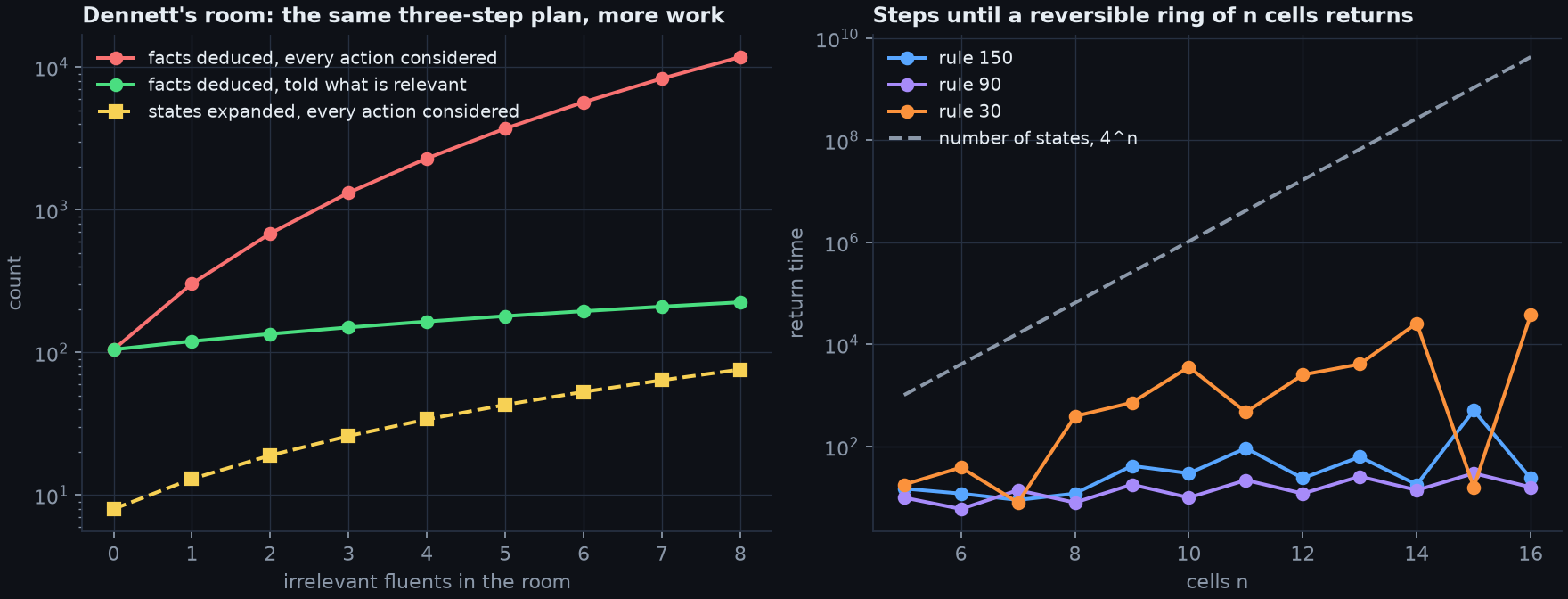
In 1984 Daniel Dennett told the problem as a story, and the Reasoner can act it out. A robot, R1, must fetch its spare battery from a room. The battery is on a wagon, and so is a time bomb. R1 knows the bomb is on the wagon, but its model of pulling lists only what it cares about: the wagon and the battery come out. Its plan: open the door, pull the wagon out. The bomb comes too. With successor-state axioms, which say that whatever is on the wagon moves with it, the planner finds the right plan: open the door, take the bomb off, pull. But Dennett's next robot, R1D1, deduced every consequence of every action it considered, and the bomb went off while it was still at work. The Reasoner's planner does the same: with no irrelevant fluents in the room, it expands eight states and deduces a hundred and five facts. Add eight irrelevant ones, a light switch, the paint, and so on, and it expands seventy-six states and deduces eleven thousand eight hundred and five facts, for the same three-step plan. Told in advance which actions matter, it needs eight states again. But being told is the whole problem. Dennett's third robot, R2D1, was built to ignore irrelevant implications; it sat outside the room, busily ignoring thousands of them, as the bomb went off.
So there are two frame problems. The logical one, representing compactly what an action does not change, is largely solved, by circumscription in 1980 and successor-state axioms in 1991, as Murray Shanahan's survey of the field concludes. The philosophical one is not: deciding, in a situation never met before, what is relevant, without first considering everything. Jerry Fodor argued in 1983 that this is a problem about all of thinking. Belief fixation is isotropic: anything you know might bear on anything else. And it is Quinean: how well a belief is confirmed depends on the whole system. No local rule can capture that. He called it Hamlet's problem: when to stop thinking. And Dreyfus said the problem only arises for a reasoner that starts from neutral facts and must work out what matters. A skilled coper never starts there: it is already in a situation where things matter.
This is the twenty-ninth brick in the Wall. The dream was relevance by rule: a finite set of explicit rules that tells a reasoner, in any situation, what matters and what can be ignored. The frame problem, in its philosophical form, says no such set has been found, and gives reasons to think none can be. What it forces is attention to background know-how: the skills, habits and learned sensitivities that settle relevance before any rule is applied, whether in people or in machines that learn.
Three claims cannot all be true. Intelligent action is guided by explicit rules over explicit representations. No finite set of explicit rules settles what is relevant in every situation. And people do pick out what is relevant, in every situation they meet. If the first and third are true, the rules people follow are a finite set that settles relevance, and the second is false. Something has to give. Dreyfus gives up the first: intelligence is skilled coping, not rules over representations. The logicists, from McCarthy on, give up the second: with the right formalism, and the right defaults, a finite set of rules can settle relevance. And a follower of Herbert Simon can give up the third. People do not solve the problem either. They satisfice, settling for good enough, and outside the niches their habits were shaped for they get relevance wrong all the time.
What it establishes: McCarthy and Hayes (1969); McCarthy (1980); Fodor (1983, 1987); Dennett (1984); Reiter (1991); Shanahan; the Wall's twenty-ninth brick; the Price List.; Computed on screen: axioms counted; Dennett's robots planned
7The lived bodyAdvanced3 min
For Maurice Merleau-Ponty, in 1945, the subject of perception is not a mind but a body. The body schema is not an object I have, but my hold on the world: I know where my hand is without looking, and can reach a cup in the dark. Consciousness is originally not I think but I can: motor intentionality, directed at things as things to do. His evidence included a patient, Schneider, studied by Adhémar Gelb and Kurt Goldstein, who after a war wound could grasp his nose to blow it, but could not point to it on command. Concrete action survived; abstract movement did not. A blind man's cane, with practice, stops being an object in his hand: its tip becomes the place where he feels the pavement. And the phantom limb, an arm that is gone but still reaches for things, shows the body schema outliving its organ.
In 1984 the neuroscientist Valentino Braitenberg imagined the simplest possible bodies. A vehicle with two light sensors at the front and two wheels at the back, and a wire from each sensor to a wheel. More light, and the wheel turns faster, or, with an inhibiting wire, slower. The Reasoner simulates four of them from the same start. Wire each sensor to the wheel on its own side, and the vehicle turns away from the light and leaves: Braitenberg called it fear. Cross the wires, and it turns toward the light and rushes at it, passing within half a unit: aggression. Make the wires inhibiting, uncrossed, and it turns toward the light and slows, coming to rest facing it, a little over one unit away: love. Inhibiting and crossed, it approaches, then veers off and away: exploration. Nothing inside any of them represents the light, or has a goal. The behaviour, which an observer cannot help describing in the language of feeling, lives in the coupling of a body with its world.
Merleau-Ponty's body returned to cognitive science as four E's. Embodied: cognition depends on the form and skills of the body, the thesis of Francisco Varela, Evan Thompson and Eleanor Rosch's book The Embodied Mind, in 1991. Embedded: we offload work onto the world. David Kirsh and Paul Maglio found that Tetris players rotate pieces on the screen to help them decide where they fit, faster than they could rotate them in their heads. Enactive: perceiving is knowing how sensations change as we move, in Kevin O'Regan and Alva Noë's sensorimotor account. Extended: Andy Clark and David Chalmers argued in 1998 that Otto, who has Alzheimer's and relies on a notebook, has a mind that includes it, because the notebook plays the role that memory plays for Inga. The critics, Fred Adams and Ken Aizawa among them, reply that this confuses coupling with constitution: a notebook can cause thinking without itself thinking.
What it establishes: Merleau-Ponty (1945); Braitenberg (1984); Varela, Thompson and Rosch (1991); Kirsh and Maglio (1994); O'Regan and Noë (2001); Clark and Chalmers (1998); Adams and Aizawa (2008).; Computed on screen: four vehicles simulated
8Condemned to be freeIntroductory4 min
Jean-Paul Sartre read Husserl in Berlin in the 1930s, and in 1943 published Being and Nothingness. In a lecture of 1945, Existentialism Is a Humanism, he put its core in a slogan. For a made thing, like a paper-knife, essence comes before existence: the maker had the idea of it, its purpose and design, before it existed. For a human being it is the other way round. Existence precedes essence. We exist first, and only afterwards define ourselves, by what we do. There is no human nature that settles in advance what we should be, and, for Sartre, no God who conceived us. So we are condemned to be free. Anguish is the awareness of this: nothing outside our choices settles them for us.
Freedom is hard to bear, so we flee it, and Sartre's name for the flight is bad faith. A human being is both facticity, what is given, our past, our body, our situation, and transcendence, what we can make of it. A café waiter's movements are a little too precise, a little too eager. He is playing at being a waiter, as if he could be a waiter the way an inkwell is an inkwell. A woman on a first date lets her companion take her hand, and leaves it there as though it were a thing, not hers, to avoid deciding. Bad faith is lying to oneself: collapsing into pure facticity, I am just like this, I can't help it; or into pure transcendence, I am not really what I have done.
Others complicate freedom. Sartre's example: I am looking through a keyhole, wholly absorbed in what is going on inside, not even aware of myself. Then I hear footsteps in the corridor behind me, and suddenly I am someone: seen, a spy, ashamed. The look of the other makes me an object, with a nature I did not choose and cannot control. In his play No Exit, three people are shut in a room forever, each the judge of the others, and one of them concludes that hell is other people. Frantz Fanon, in Black Skin, White Masks, in 1952, turned the phenomenology of the look on race: what it is to be fixed, from outside, by a gaze that has already decided what you are.
Simone de Beauvoir, Sartre's companion and an original philosopher in her own right, published The Second Sex in 1949. Its most famous sentence: one is not born, but rather becomes, a woman. What it is to be a woman is not given by nature but made, in a situation, by others and by oneself. Men had defined themselves as the subject, the absolute, and women as the Other, defined relative to them. Against Sartre's early picture of freedom as absolute, Beauvoir stressed situated freedom: freedom is always exercised in a situation, and oppression is a situation that closes it down. Her Ethics of Ambiguity, of 1947, argued that to will oneself free is also to will others free. The book founded much of modern feminist philosophy.
What it establishes: Sartre (1943, 1944, 1946); Fanon (1952); Beauvoir (1947, 1949).
9The individual and the eternal returnIntroductory5 min
The existentialists had two nineteenth-century ancestors. The first is Søren Kierkegaard, writing in Copenhagen under a series of pseudonyms. In Either/Or, of 1843, and later books, he describes stages of existence: the aesthetic, living for the interesting moment; the ethical, choosing oneself under universal duties; and the religious, the single individual before God. No argument carries you from one to the next; each transition is a leap. In Fear and Trembling, Abraham, ready to sacrifice Isaac at God's command, stands outside the ethical altogether: a teleological suspension of the ethical. Anxiety, he wrote in 1844, is the dizziness of freedom. And truth is subjectivity: what matters most is not what one can prove, but how one exists.
The second ancestor is Friedrich Nietzsche. In The Gay Science, of 1882, a madman runs into the market place with a lantern in daylight, crying that God is dead, and we have killed him. It is not an argument against God's existence, but a diagnosis: the belief that grounded European values has collapsed, and most people have not noticed. In the Genealogy of Morality, of 1887, he traced our values to their origins: a master morality of good and bad, and a slave morality, born of resentment, of good and evil. He held that there are no facts free of every perspective, only interpretations. And so values must be created, not found: the task he gave to the figure of the Übermensch in Thus Spoke Zarathustra.
The Gay Science also contains Nietzsche's most famous thought experiment. What, if some day or night a demon were to steal after you into your loneliest loneliness and say to you: this life as you now live it and have lived it, you will have to live once more and innumerable times more, every pain and every joy, in the same succession and sequence. Would you curse the demon? Or would you answer: never have I heard anything more divine? Whether you could will your life again, exactly as it is, is the test of how you are living it. But Nietzsche also wondered whether it was true. In unpublished notes he sketched a proof: if the world has a finite amount of force and infinite time, its states must recur. The Reasoner can test both halves of that.
First, a world that is finite and deterministic, and whose law can be run backwards. Take a ring of eleven cells, each on or off, and a rule due to Edward Fredkin: a cell's next state is a fixed function of its neighbourhood now, combined, by exclusive or, with its state one step ago. Any such rule can be run backwards. Start from a single live cell and let it run. The pattern grows, breaks up, recombines, and at step ninety-three it is exactly where it began, and so it will be again every ninety-three steps, forever. On other rings the return takes from nine steps to more than five hundred, but it always comes. The reason is simple. There are finitely many states, and a reversible law never sends two states to the same successor, so the history can never fall into a cycle that excludes its start. Henri Poincaré proved the continuous version in 1890 for bounded mechanical systems, which return arbitrarily close to where they began.
Now the objection. In 1907 the sociologist Georg Simmel imagined three wheels on one axle, marked at the top, turning at rates one, two, and one over pi. The first two are back at the top together at every whole number of turns. The third never is, because one over pi is irrational. It comes close. By time ten its closest return is four and a half hundredths of a turn; by a hundred, under three thousandths; at time three hundred and fifty-five, less than one hundred thousandth, because three hundred and fifty-five over a hundred and thirteen is the famous approximation of pi. And then nothing better until a hundred and three thousand nine hundred and ninety-three. Close, but never exact. So the cosmological proof needs a world with finitely many discrete states. As a test of how you live, the demon needs no physics at all.
What it establishes: Kierkegaard (1843, 1844); Nietzsche (1882, 1887); Poincaré (1890); Simmel (1907).; Computed on screen: a reversible automaton's return; Simmel's wheels
10The hermeneutic circleAdvanced4 min
Hermeneutics began as the art of interpreting texts: the Bible, the law, the classics. Friedrich Schleiermacher, in lectures in the early nineteenth century, made it general, and noticed a circle: each sentence of a work is understood through the whole, and the whole only through its sentences. Wilhelm Dilthey made it the method of the human sciences. The natural sciences explain; history and the study of culture understand, from the inside. Heidegger made it ontology. Understanding is not a method we sometimes apply, but our way of being: we never come to anything without a fore-structure of expectations.
Hans-Georg Gadamer, a student of Heidegger, published Truth and Method in 1960. The circle is not vicious; it spirals. We start with a guess about the whole, read the parts in its light, revise the guess, and read again. Gadamer's most provocative move was to rehabilitate prejudice, in its literal sense of pre-judgement. The Enlightenment taught us to put prejudices aside; but we cannot, and without them we could not begin to understand at all. We understand from within a tradition that has shaped us, what he called effective history. And understanding is a fusion of horizons: not escaping our own point of view, but widening it until it meets the text's.
The Reasoner can play out the shape of the circle, as an analogy, not as Gadamer's theory. Here is a short text. Some of its words are ambiguous: bank, current, deposit and branch could belong to a story about a river or about money. Others, fish, boat, reeds, belong only to the river. The reader starts with a prejudice about the whole, say only one chance in ten that it is about the river. Reading each word in the light of that, and re-estimating the whole from the readings, the guess climbs to about a half after one round, and to the river within a few more. Start with the opposite prejudice, and it arrives at the same place. Now a text of only the four ambiguous words. It cannot answer back, and the prejudice stays exactly where it began: one in ten, or nine in ten. And a mixed text, with one river word and one money word, brings both readers to the same point: a half. That is the lesson Gadamer drew. Prejudice is where understanding starts, and a text that can speak back corrects it. A text that cannot simply returns it to us.
Gadamer's view drew strong replies. Jürgen Habermas, in a debate that ran from 1967 to 1971, objected that tradition is not innocent: it can be distorted by power, so interpretation needs a critique of ideology, not only a fusion of horizons. Paul Ricoeur named a hermeneutics of suspicion, practised by Marx, Nietzsche and Freud, which reads meaning as a disguise for something else: class interest, the will to power, desire. And E. D. Hirsch, in 1967, defended the author: a text means what its author meant. Gadamer held that its meaning always goes beyond its author.
What it establishes: Schleiermacher; Dilthey (1883); Gadamer (1960); Habermas; Ricoeur (1965); Hirsch (1967).; Computed on screen: the circle as an iteration (an analogy)
11Structure and differenceResearch5 min
Structuralism began with lectures on linguistics that Ferdinand de Saussure gave in Geneva, published by his students in 1916. A sign unites a concept, the signified, with a sound-image, the signifier. The bond between them is arbitrary: arbor, Baum and tree all do the job. Linguistics should study langue, the system a community shares, not parole, the individual acts of speaking. And in that system, Saussure said, there are only differences, without positive terms. A sign's value is fixed by its contrasts with the others. His analogy was chess: a knight can be made of wood or ivory, or replaced by a button; it is a knight because of its role among the other pieces.
Part 28 built word vectors from a small corpus. They make Saussure's claim exact. Rotate the whole space by a random rotation Q. The words' coordinates change, king's included. The coordinate correlation is shown on screen. But every cosine between words stays the same, to fifteen decimal places, and so does every word's nearest neighbour. If meaning is the network of similarities, the rotation changed nothing. And the rotation can be recovered from the structure. Given just eight anchor words in both spaces, orthogonal Procrustes finds the rotation, the matrix U V transpose from a singular value decomposition, to within ten to the minus fifteen, and carries every word to its image. Aligning embeddings learned in two languages works on this principle. There is a twist. In this corpus England, France, Germany, Italy and the word big keep exactly the same company, and they sit at exactly the same point; other groups do too. No structure can tell them apart. That is Saussure again: a difference that makes no difference to the relations makes no difference to value.
Jacques Derrida took Saussure's differences further. He coined a word, différance, spelled with an a and pronounced like the ordinary French word for difference. It means both to differ, Saussure's point, and to defer: the meaning of a sign is never fully present in it, but always put off along a chain of other signs. Western philosophy, he argued, is organised by oppositions in which one term is privileged: speech over writing, presence over absence, the literal over the metaphorical. Each hierarchy can be shown to depend on the term it subordinates. Deconstruction is the practice of reading a text against its own oppositions, which is not the same as destroying it. His most quoted sentence, there is no outside-text, is often read as saying that nothing exists but language. Derrida later glossed it as: there is nothing outside context.
There is an old observation behind différance, which the Reasoner can make precise as an analogy. Here is a small dictionary of eighteen words, each defined by one or two others. Thing is defined by being, being by existing, existing by thing again; good by valuable, valuable by worthy, worthy by good. Follow any definition, then a word in that definition, and so on, and you never leave the dictionary: every chain ends in a circle. The meaning of a word is always deferred to other words. To break every circle, some words must get their meaning from outside the dictionary altogether, by pointing, perceiving or doing. The smallest number here is three, one from each circle, and there are twenty-seven ways to choose them. This is Stevan Harnad's grounding problem from Part 28, in miniature. Derrida would not have accepted the escape route; that is the disagreement in a nutshell.
Derrida's work divided philosophers like almost no other. John Searle, in 1977, replied to Derrida's reading of Austin, from Part 28, that he had simply misunderstood it, and the exchange grew bitter. In 1992, when Cambridge proposed Derrida for an honorary degree, senior philosophers from several countries wrote to The Times in protest; the degree was approved by a vote of the university. The charge was that obscurity was being used as a shield; the defence, that his readings are serious and exact, and his influence on literary theory, law and architecture is beyond dispute.
What it establishes: Saussure (1916); Derrida (1967, 1968, 1988); Searle (1977); Cambridge (1992).; Computed on screen: rotation and Procrustes; a closed dictionary
12Power and the gazeApplied4 min
Michel Foucault's Discipline and Punish, of 1975, opens with two documents. The first describes the public execution of Damiens, who had tried to kill the king, in 1757: power displayed on a body, as spectacle. The second, from eighty years later, is a timetable for young prisoners in Paris: rise at six, prayer, work, school, meals, each to the minute. Between them punishment moved from the body to the soul. Its aim was no longer to destroy but to train: discipline. Its tools spread from prisons to schools, barracks, hospitals and factories: hierarchical observation, normalizing judgement, and their combination, the examination, which ranks each individual against a norm.
Its emblem is a prison designed by Jeremy Bentham in 1791. Cells in a ring, each lit from behind, so that every prisoner is visible. In the centre, a tower with blinds, from which a guard can see every cell, while no prisoner can see whether he is being watched. So each must behave, at every moment, as if he were. Foucault: he who is subjected to a field of visibility, and who knows it, assumes responsibility for the constraints of power; he becomes the principle of his own subjection. The tower may as well be empty. Visibility, not violence, does the work.
From this Foucault drew a general view of power. Power is not only a force that says no. It is productive: it produces knowledge, categories, and the very kinds of people the categories describe, the delinquent, the patient, the pupil. He wrote of power slash knowledge. Its characteristic operation is normalization: the norm sorts the normal from the abnormal, and people come to measure themselves by it. In 1976 he named biopower: the government not of individuals but of populations, through birth rates, public health and statistics. And in The Order of Things, a decade earlier, he had argued that man, as the object of the human sciences, is a recent invention, and may be erased, like a face drawn in sand at the edge of the sea.
Normalization can be computed. Twenty thousand people are sorted by a score, and those at or above a threshold are accepted: for a loan, a school, a job. At first, the score honestly measures their underlying quality. Now the threshold becomes known, and everyone within reach of it does what it takes to reach it exactly. Three thousand and forty-nine people move. The population piles up at the norm, and the region just below it empties. The number accepted rises from six thousand one hundred and seventy-nine to nine thousand two hundred and twenty-eight. And the score stops measuring what it measured: of those accepted, only sixty-seven percent now truly qualify. The economist Charles Goodhart observed in 1975 that any observed statistical regularity tends to collapse once pressure is placed upon it for control purposes; more briefly, when a measure becomes a target, it ceases to be a good measure. Machine learning now studies this as strategic classification and performative prediction.
Foucault's analysis was extended to the age of data. Gilles Deleuze, in 1990, described societies of control, run not by enclosures like the prison but by codes and passwords, dealing not with individuals but with what he called dividuals, people split into data. Shoshana Zuboff, in 2019, described surveillance capitalism, in which behaviour is harvested to predict and shape behaviour. Fairness, privacy and gaming in algorithmic decisions return in Part 41.
What it establishes: Bentham (1791); Foucault (1966, 1975, 1976); Goodhart (1975); Deleuze (1990); Zuboff (2019).; Computed on screen: a threshold gamed
13Reason in communicationApplied3 min
The Frankfurt school began at the Institute for Social Research, founded in 1923. Its director, Max Horkheimer, called its programme critical theory: theory that aims not only to describe society but to free the people in it. In exile in America during the war, Horkheimer and Theodor Adorno wrote Dialectic of Enlightenment, published in 1947. Enlightenment, meant to free us from myth, reverts to myth: reason shrinks to instrumental reason, a tool for controlling nature and people, blind to ends. Its emblem is the culture industry, mass culture as a standardized product that produces conformity. Herbert Marcuse, in 1964, described a one-dimensional society that absorbs even its own opposition.
Jürgen Habermas, once Adorno's assistant and later Horkheimer's successor, looked for a reason that was not merely instrumental, and found it in communication. His Theory of Communicative Action appeared in 1981. Take an ordinary request: the window is open, please close it. In saying it, a speaker raises three validity claims at once: a claim to truth, about the objective world, that the window is open; a claim to rightness, about the social world, that this is a request I may make of you; and a claim to sincerity, about the speaker's own world, that I mean it. It builds on the speech acts of Part 28. Action oriented to understanding, which relies on such claims, Habermas calls communicative; action oriented only to success, strategic. Any claim can be challenged, and then must be redeemed with reasons, or withdrawn.
What does arguing commit us to? Following Robert Alexy, Habermas lists the rules of an ideal speech situation. Everyone who can speak and act may take part. Everyone may question any assertion, and introduce any assertion. Everyone may express attitudes, desires and needs. And no one may be prevented, by coercion from inside or outside the discourse, from using these rights. From this comes the principle of discourse ethics: a norm is valid only if all affected could agree to it, as participants in a practical discourse. The ideal speech situation is not a description of any real conversation. It is what we must presuppose, Habermas argues, whenever we argue seriously at all, because to argue is to try to convince by reasons rather than force. Its political version, democracy as deliberation, returns in Part 39.
Habermas's rationalism was challenged from several sides. Jean-François Lyotard, in The Postmodern Condition of 1979, defined the postmodern as incredulity toward metanarratives, the grand stories of emancipation through reason, and consensus among them. Foucault's followers replied that no discourse is free of power, and that an ideal of free discourse hides the power that sets its rules. And an epilogue. In 2024 Michael Henry Tessler and colleagues at Google DeepMind reported an AI mediator, nicknamed the Habermas Machine, that drafted group statements; in their experiments, participants preferred its statements to those of human mediators, and groups moved toward common ground.
What it establishes: Horkheimer (1937); Horkheimer and Adorno (1947); Marcuse (1964); Habermas (1981); Alexy; Lyotard (1979); Tessler et al. (2024).
14The place of nothingnessAdvanced3 min
Phenomenology also met a philosophy that had grown up in Kyoto. In 1911 Nishida Kitarō published An Inquiry into the Good, the first major work of modern Japanese philosophy. Its starting point is pure experience: experience before it is split into a subject and an object. When you are absorbed in music, there is the music; only afterwards comes the judgement, I hear music. Nishida drew on William James's radical empiricism, and on years of Zen practice. His aim was to explain everything from pure experience, as the only reality.
Nishida's mature thought is a logic of place, basho. Aristotle's logic is a logic of the subject: the rose is red puts the rose in the universal red. Nishida reads every judgement as placing something within a wider place. Objects are placed within consciousness. But consciousness is not one more object; relative to objects, it is a nothing. And consciousness in turn is placed within a place that has no further place: absolute nothingness. This nothingness is not a thing, and not the mere absence of things. It is the field in which everything, the self included, appears: closer, Nishida thought, to the Buddhist idea of emptiness than to any Western concept of being.
Nishida's students and colleagues became known as the Kyoto school. Nishitani Keiji, who had studied with Heidegger in Freiburg, argued in Religion and Nothingness that the way through European nihilism leads to the Buddhist field of emptiness, śūnyatā. Watsuji Tetsurō, reading Being and Time, objected that Heidegger had made existence a matter of time and neglected space, climate and community; the human being, ningen, is a betweenness, aidagara. Heidegger, for his part, wrote a dialogue with a Japanese visitor, published in 1959, about whether the two traditions could understand each other at all. Like Heidegger, the school has a wartime shadow: some of its members joined published discussions on Japan's world-historical role, and how far the philosophy of nothingness lent itself to nationalism is weighed in a collection of 1994, Rude Awakenings.
The dialogue had deep roots. In 1240 the Zen master Dōgen wrote an essay called Uji, being-time: time is already being, and all being is time. There is no being outside time, and no time apart from beings: the pine tree is time, the bamboo is time. Behind Dōgen stands Nāgārjuna, around the year 150, for whom emptiness means dependent origination: nothing has a nature on its own, apart from its relations. His four-cornered logic, is, is not, both, neither, was Part 5's. Seven centuries before Being and Time, being had been thought as time.
What it establishes: Nishida (1911, 1926); Watsuji (1935); Nishitani (1961); Heidegger (1959); Dōgen (1240); Nāgārjuna.
15Across the divideResearch3 min
This part has been, mostly, about what is called continental philosophy, and the rest of the series is mostly analytic. On one bank, Frege, Russell and Carnap: logic and science, clarity and argument. On the other, Husserl, Heidegger and Sartre: history and lived experience, depth and interpretation. The divide is often dated to 1929, at Davos in Switzerland, where Ernst Cassirer and Heidegger debated how to read Kant, with the young Rudolf Carnap in the audience. It is a divide of style, canon and institutions more than of doctrine: both grew from the same soil, Kant, Brentano, and the crisis in the foundations of logic and mathematics around 1900.
The sharpest exchange came soon after. In his inaugural lecture of 1929, What Is Metaphysics?, Heidegger wrote of anxiety revealing the nothing, and said: the nothing itself nothings. In 1932 Carnap made the sentence his prime example of a pseudo-sentence. There is nothing outside has a perfectly good logical form: it is not the case that something is outside. Heidegger, Carnap argued, had treated nothing as a name for something, and then given that something an activity. The sentence has no logical form at all, and so no meaning. Metaphysics, Carnap concluded, expresses an attitude toward life, and metaphysicians are musicians without musical ability.
Bridges have been built from both banks. In a debate from 2005 to 2007, John McDowell, an analytic philosopher, and Hubert Dreyfus argued over whether skilled coping is conceptual all the way down: McDowell said yes, Dreyfus no. A volume of 1999, Naturalizing Phenomenology, edited by Jean Petitot, Francisco Varela and others, proposed treating Husserl's descriptions as data for cognitive science. Varela's neurophenomenology trained subjects to give careful first-person reports, and correlated them with measurements of the brain. Daniel Dennett's heterophenomenology takes the same reports as data about how things seem, without treating them as infallible. In 1986 Terry Winograd and Fernando Flores used Heidegger's breakdowns as a theory of how people use computers, a book that shaped interface design. And theories of the brain as a prediction machine have given Husserl's protention a second life. The next part asks the question all of this leads to: what is a mind, and could a machine have one?
What it establishes: Davos (1929); Heidegger (1929); Carnap (1932); Winograd and Flores (1986); Dennett (1991); Varela (1996); Petitot et al. (1999); Dreyfus–McDowell (2005–07).
Recap, problems, and where this comes backAll tracks2 min
Let's gather what we built. Brentano's thesis that the mental is the intentional, its critics, and Husserl's method. A cube never seen whole, and free variation, computed as an analogy. The living present, with Husserl's diagram and three models of the present tested on every five-note melody. Heidegger's being-in-the-world, and Dreyfus's critique of rules. The frame problem, with its axioms counted and Dennett's robots planned, this part's brick in the Wall and its Price List. The lived body, embodied cognition and Braitenberg's vehicles; and the existentialists. Kierkegaard and Nietzsche, and the eternal return tested on a reversible world and on Simmel's wheels. And interpretation, structure and difference with word vectors rotated, power, communication, and the Kyoto school.
The Reasoner has a new module, phenomenology. It computes a cube's profiles, free variation and a retentional present; counts frame axioms and plans for Dennett's robots; drives Braitenberg's vehicles; runs a reversible world to its return; iterates the hermeneutic circle; rotates and realigns word vectors; games a threshold; and finds the words a dictionary cannot define without leaving itself. And the Wall has its twenty-ninth brick.
Six problems, with full solutions in this part's notes. Faces of a polyhedron seen at once; why a fading present determines order, and when it does not; successor-state axioms for Dennett's room; why Fredkin's automata are reversible; a fixed point of the hermeneutic circle; and a dictionary of your own. Pause here, and try them.
Where this comes back. Brentano's problem, how a physical thing can be about anything, and the Chinese room, in Part 30. The first person, qualia and the hard problem, in Part 31. Freedom, in Part 32. Deliberation and democracy, in Part 39. Normalization, gaming and fairness, in Part 41. And relevance and the background, for machines we want to align, in Part 42. Next, Part 30: mind and machine.
The books and papers this part follows are on screen, and in the notes. Thanks for watching.
Where it goes next. Brentano's problem and the Chinese room follow in Part 30; the first person, qualia and the hard problem in Part 31; freedom in Part 32; deliberation and democracy in Part 39; normalization, gaming and fairness in Part 41; relevance and the background for machines to be aligned in Part 42.
Key results
The part's results in one place, for revision.
Try it
Lab 29 · A present with a tail, a planner with a frame, a world that returns
Count the melodies that a knife-edge, a two-note and a fading present can tell apart, let a planner fetch the battery from Dennett's room as irrelevant fluents are added, and run reversible cellular automata with random rules until their first state comes back.
python -m videos.philosophy.labs 29
needs numpy, scipy, matplotlib · download lab29.py ·
source on GitHub120 melodies of five notes knife-edge 5, two-note window 20, fading trace 120 (theory 5, 20, 120)
six random (notes, decay) pairs every ordering told apart and read back: [(6, 0.32), (5, 0.13), (3, 0.75), (3, 0.83), (5, 0.68), (5, 0.53)]
at the ends: decay 0 and decay 1 5 and 1 melodies told apart
243 melodies with repeated notes decay 0.5 tells apart 243, decay 0.618 only 162
100 actions, 1000 fluents 200000 frame axioms against 1000 successor-state axioms
R1's plan ['open_door', 'pull_wagon_out']: bomb out = True
with successor-state axioms ['open_door', 'remove_bomb', 'pull_wagon_out']
states expanded, 0 and 8 irrelevant fluents 8 and 76; told what is relevant: 8
12 random reversible worlds all return; longest wait 63 steps (rule 220)
rule 150 on 11 cells returns after 93 steps (film: 93)
Simmel's wheels up to time 100000 closest approach 9.6e-06 of a turn, at time 355
A present needs a fading tail to hold a melody's order; a planner with complete axioms still does work that grows with everything irrelevant; and a finite reversible world must return, while three wheels with an irrational ratio never do.The code (108 lines; it asserts its own result)
"""Lab 29: test three kinds of present on every melody, plan for Dennett's robots, and wait for a world to return."""

import itertools
import math

import numpy as np

from videos.coursekit import labs
from explainer.philosophy.reasoner import phenomenology as ph

TITLE = "A present with a tail, a planner with a frame, a world that returns"
GOAL = ("Count the melodies that a knife-edge, a two-note and a fading present can tell apart, let a planner fetch "
        "the battery from Dennett's room as irrelevant fluents are added, and run reversible cellular automata "
        "with random rules until their first state comes back.")
TASKS = [
    "Allow repeated notes: call _fading_states(3, 5, d) for decays d from 0.5 to 0.7. Where do collisions start, "
    "and what equation does 0.618 satisfy?",
    "Give R1 the full model but forbid 'remove_bomb' (filter it out of ph._actions). Is there still a plan, and "
    "what does the planner report?",
    "Run ph.reversible_ca(n, 150) for n = 12 to 20 and plot the return times. Which ring sizes return quickly, and "
    "can you say why?",
]


def _fading_states(n_pitches, length, decay):
    """How many melodies with repeated notes a fading present tells apart (the library's test uses distinct notes)."""
    seen = set()
    for m in itertools.product(range(n_pitches), repeat=length):
        w = np.zeros(n_pitches)
        for age, note in enumerate(reversed(m)):
            w[note] += decay ** age
        seen.add(tuple(np.round(w, 9)))
    return len(seen)


def run(seed=0):
    rng = np.random.default_rng(seed)
    lab = labs.Lab()

    # 1. the living present
    film = ph.retention(5, 0.5)
    d = film["distinct"]
    lab.row("120 melodies of five notes", f"knife-edge {d['knife']}, two-note window {d['window']}, fading trace "
            f"{d['retention']}   (theory 5, 20, 120)")
    assert (d["knife"], d["window"], d["retention"], film["decoded"]) == (5, 20, 120, 120)
    tried = []
    for _ in range(6):
        n, decay = int(rng.integers(3, 7)), float(rng.uniform(0.1, 0.9))
        r = ph.retention(n, decay)
        tried.append((n, round(decay, 2)))
        assert r["distinct"]["retention"] == r["decoded"] == math.factorial(n), "any decay in (0, 1) keeps the order"
        assert r["distinct"]["knife"] == n and r["distinct"]["window"] == n * (n - 1)
    lab.row("six random (notes, decay) pairs", f"every ordering told apart and read back: {tried}")
    edge = (ph.retention(5, 0.0)["distinct"]["retention"], ph.retention(5, 1.0)["distinct"]["retention"])
    lab.row("at the ends: decay 0 and decay 1", f"{edge[0]} and {edge[1]} melodies told apart")
    assert edge == (5, 1), "no tail is the knife-edge; a tail that does not fade keeps the notes and loses the order"
    half, golden = _fading_states(3, 5, 0.5), _fading_states(3, 5, (math.sqrt(5) - 1) / 2)
    lab.row("243 melodies with repeated notes", f"decay 0.5 tells apart {half}, decay 0.618 only {golden}")
    assert half == 243 and golden < 243, "with repeats the order survives at 1/2 and not at the golden ratio"

    # 2. the frame problem
    ax_rows = ph.axiom_counts()["rows"]
    lab.row("100 actions, 1000 fluents", f"{ax_rows[-1]['frame_axioms']} frame axioms against {ax_rows[-1]['ssa']} "
            f"successor-state axioms")
    rob = ph.robots(irrelevant=tuple(range(0, 9)))
    lab.row("R1's plan", f"{rob['r1_plan']}: bomb out = {rob['r1_outcome']['bomb_out']}")
    lab.row("with successor-state axioms", f"{rob['plan']}")
    assert rob["r1_outcome"]["bomb_out"] and rob["plan"] == ["open_door", "remove_bomb", "pull_wagon_out"]
    rows = rob["rows"]
    lab.row("states expanded, 0 and 8 irrelevant fluents", f"{rows[0]['expanded']} and {rows[-1]['expanded']}; told what "
            f"is relevant: {rows[-1]['expanded_relevant']}")
    assert all(a["expanded"] < b["expanded"] and a["derived"] < b["derived"] for a, b in zip(rows, rows[1:]))
    assert all(r["expanded_relevant"] == rows[0]["expanded"] and r["plan_len"] == 3 for r in rows)

    # 3. recurrence: any rule, made reversible, returns on a finite ring
    worlds = []
    for _ in range(12):
        n, rule = int(rng.integers(5, 10)), int(rng.integers(0, 256))
        t, _ = ph.reversible_ca(n, rule)
        assert t is not None and t <= 4 ** n, "a finite reversible world returns within its number of states"
        worlds.append((n, rule, t))
    lab.row("12 random reversible worlds", f"all return; longest wait {max(w[2] for w in worlds)} steps "
            f"(rule {max(worlds, key=lambda w: w[2])[1]})")
    t11, _ = ph.reversible_ca(11, 150)
    simmel = ph.recurrence(sizes=(5,))["simmel"][-1]
    lab.row("rule 150 on 11 cells returns after", f"{t11} steps   (film: 93)")
    lab.row("Simmel's wheels up to time 100000", f"closest approach {simmel['closest']} of a turn, at time {simmel['at']}")
    assert t11 == 93 and simmel["closest"] > 0
    lab.note = ("A present needs a fading tail to hold a melody's order; a planner with complete axioms still does "
                "work that grows with everything irrelevant; and a finite reversible world must return, while "
                "three wheels with an irrational ratio never do.")

    fig, ax = labs.figure(2, size=(11, 4.2))
    k = [r["irrelevant"] for r in rows]
    ax[0].plot(k, [r["derived"] for r in rows], "o-", color=labs.RED, label="facts deduced, every action considered")
    ax[0].plot(k, [r["derived_relevant"] for r in rows], "o-", color=labs.GREEN, label="facts deduced, told what is relevant")
    ax[0].plot(k, [r["expanded"] for r in rows], "s--", color=labs.GOLD, label="states expanded, every action considered")
    ax[0].set(title="Dennett's room: the same three-step plan, more work", xlabel="irrelevant fluents in the room",
              ylabel="count", yscale="log")
    ax[0].legend(loc="upper left")
    sizes = list(range(5, 17))
    for rule, color in ((150, labs.BLUE), (90, labs.PURPLE), (30, labs.ORANGE)):
        ax[1].plot(sizes, [ph.reversible_ca(n, rule)[0] for n in sizes], "o-", color=color, label=f"rule {rule}")
    ax[1].plot(sizes, [4.0 ** n for n in sizes], color=labs.MUTED, ls="--", label="number of states, 4^n")
    ax[1].set(title="Steps until a reversible ring of n cells returns", xlabel="cells n", ylabel="return time", yscale="log")
    ax[1].legend(loc="upper left")
    lab.fig = fig
    return lab
Now change it
- Allow repeated notes: call _fading_states(3, 5, d) for decays d from 0.5 to 0.7. Where do collisions start, and what equation does 0.618 satisfy?
- Give R1 the full model but forbid 'remove_bomb' (filter it out of ph._actions). Is there still a plan, and what does the planner report?
- Run ph.reversible_ca(n, 150) for n = 12 to 20 and plot the return times. Which ring sizes return quickly, and can you say why?
Problems, with solutions
Try each problem before opening its solution.
-
Prove that no viewpoint outside a convex polyhedron shows all its faces at once; find one that shows all but one.
Solution
Let face \(i\) have area \(A_i\), outward unit normal \(n_i\), and supporting plane \(n_i \cdot x = h_i\), with an interior point at the origin so every \(h_i > 0\). Face \(i\) is visible from \(p\) exactly when \(n_i \cdot p > h_i\). Minkowski's relation for a closed polyhedron is \(\sum_i A_i n_i = 0\). If every face were visible, then \(\sum_i A_i\, n_i \cdot p > \sum_i A_i h_i > 0\), while the left side is \((\sum_i A_i n_i) \cdot p = 0\): a contradiction. All but one is possible for some polyhedra: look at a pyramid from a point high above its apex, and every lateral face is visible while the base is not. (A cube is never seen on more than three faces, since opposite faces exclude each other.)
-
With decay \(\lambda = \tfrac12\), show that the retentional present always determines the order of distinct notes. What if \(\lambda = 1\)?
Solution
With \(\lambda = \tfrac12\) the present gives the note heard \(k\) steps ago weight \(2^{-k}\). For distinct notes the weights are distinct powers of two, so sorting the notes by weight recovers the order: the faintest came first. In fact even repeated notes are recovered, since each note's total weight is a sum of distinct powers of two, a binary numeral, which says exactly at which ages that note sounded. With \(\lambda = 1\) every past note has weight 1: the present records only which notes have sounded (with repetitions, how often), and all orderings of the same notes give the same present. Order is lost.
-
Write successor-state axioms for Dennett's room, including the ramification 'things on the wagon move with it'.
Solution
Fluents: DoorOpen\((s)\), On\((x, s)\) (\(x\) is on the wagon), Out\((x, s)\) (\(x\) is outside the room). Actions: open, pull, takeoff\((x)\). Successor-state axioms: DoorOpen\((do(a, s)) \leftrightarrow a = \text{open} \lor \text{DoorOpen}(s)\). On\((x, do(a, s)) \leftrightarrow \text{On}(x, s) \land a \ne \text{takeoff}(x)\). Out\((x, do(a, s)) \leftrightarrow \text{Out}(x, s) \lor (a = \text{pull} \land \text{DoorOpen}(s) \land (x = \text{wagon} \lor \text{On}(x, s)))\). The ramification "things on the wagon move with it" is the last disjunct: pulling moves whatever is on the wagon, so the planner sees the bomb come out and finds open, takeoff(bomb), pull.
-
Show that a second-order cellular automaton \(x_{t+1} = f(x_t) \oplus x_{t-1}\) is invertible for every \(f\).
Solution
The rule maps the pair \((x_{t-1}, x_t)\) to \((x_t, x_{t+1})\) with \(x_{t+1} = f(x_t) \oplus x_{t-1}\). Since \(\oplus\) is its own inverse, \(x_{t-1} = f(x_t) \oplus x_{t+1}\): from the later pair the earlier one is computed with the same \(f\), whatever \(f\) is. So the map on pairs is a bijection, its inverse is the same kind of rule run backwards, and on a finite ring every history returns to its start.
-
In the hermeneutic toy, prove that a text of only ambiguous words leaves every prejudice fixed.
Solution
In the toy, an ambiguous word \(w\) with senses river and money is read as river with probability \(\theta/2 \big/ (\theta/2 + (1 - \theta)/2) = \theta\), where \(\theta\) is the current belief that the text is about the river. The new belief is the average of the words' readings. If every word is ambiguous, every reading is \(\theta\) and the average is \(\theta\): every prejudice is a fixed point, and iterating changes nothing. Only an unambiguous word, read as river or money with certainty, pulls the average away from \(\theta\).
-
Find the minimum grounding set of a dictionary of your own design; when is it a single word?
Solution
Treat the dictionary as a graph with an arrow from each word to the words in its definition. A grounding set must meet every cycle (a word grounded from outside breaks every circle through it), so the minimum grounding set is a minimum feedback vertex set: in the film's dictionary, one word from each of three disjoint circles. Example: \(a\) is defined by \(b\), \(b\) by \(c\), \(c\) by \(a\), and \(d\) by \(a\) and \(c\). There is one cycle, and grounding \(a\) grounds everything: the set is \(\{a\}\). In general a single word suffices exactly when one word lies on every cycle of the definition graph.
Notes and sources
Sources
Texts: Moran, Introduction to Phenomenology (2000); Zahavi, Husserl's Phenomenology (2003); Dreyfus, Being-in-the-World (1991) and What Computers Still Can't Do (1992); Gallagher and Zahavi, The Phenomenological Mind (2008); Varela, Thompson and Rosch, The Embodied Mind (1991); Shanahan, "The Frame Problem" (Stanford Encyclopedia of Philosophy); Heisig, Philosophers of Nothingness (2001).
Primary texts and papers: Dōgen, Uji (1240); Bentham (1791); Kierkegaard (1843, 1844); Brentano (1874); Nietzsche (1882, 1887); James (1890); Twardowski (1894); Husserl (1900–01, 1905/1928, 1913); Meinong (1904); Simmel (1907); Nishida (1911, 1926); Saussure (1916); Heidegger (1927, 1929); Carnap (1932); Watsuji (1935); Sartre (1943, 1946); Merleau-Ponty (1945); Beauvoir (1947, 1949); Horkheimer and Adorno (1947); Fanon (1952); Chisholm (1957); Gadamer (1960); Nishitani (1961); Marcuse (1964); Ricoeur (1965); Foucault (1966, 1975, 1976); Derrida (1967, 1988); Hirsch (1967); McCarthy and Hayes (1969); Føllesdal (1969); Dreyfus (1965, 1972, 2007); Goodhart (1975); Searle (1977); Lyotard (1979); McCarthy (1980); Dreyfus and Dreyfus (1980); Habermas (1981); Fodor (1983, 1987); Dennett (1984, 1991); Braitenberg (1984); Winograd and Flores (1986); Deleuze (1990); Reiter (1991); Kirsh and Maglio (1994); Varela (1996, 1999); Clark and Chalmers (1998); Petitot et al. (1999); Dainton (2000); O'Regan and Noë (2001); Grush (2006); Adams and Aizawa (2008); Zuboff (2019); Tessler et al. (2024).
About this partfrom its README
Part 29 of Philosophy, Built (series plan, syllabus), the third part of Act VI, Mind and Meaning: phenomenology, existentialism, hermeneutics and their heirs, with the frame problem built. Brentano's thesis that intentionality is the mark of the mental, acts directed at what does not exist, Twardowski's act, content and object, Meinong's objects, Chisholm's marks and the pains-and-moods objection. Husserl's epoché and the natural attitude, noesis and noema (Gurwitsch's and Føllesdal's readings), a cube seen from 4000 viewpoints (1193 show one face, 2232 two, 575 three, none more, yet all six are seen from somewhere), and eidetic variation on 5000 random triangles as an analogy (five invariants; obtuse 73%, acute 27%). The living present: James's specious present, Husserl's 1905 diagram of sinking retentions animated, and a retentional present tested on all 120 orderings of five notes (a knife-edge present tells 5 apart, a two-note window 20, a fading trace all 120, and the order can be read back), with Dainton's cinematic, retentional and extensional models, Grush and Varela. Heidegger's question of being, Dasein and being-in-the-world against the Cartesian picture, the hammer (ready-to-hand, present-at-hand, breakdown and the referential whole), care, das Man, being-towards-death, and the political shadow. Dreyfus: the four assumptions of symbolic AI, the five stages of skill, and what learning answered and did not. The frame problem: McCarthy and Hayes's situation calculus, frame axioms against Reiter's successor-state axioms (200 000 against 1000 for 100 actions and 1000 fluents), Dennett's robots acted out by a planner (R1 carries the bomb out; with successor-state axioms the plan is open, remove the bomb, pull; the work grows from 8 states and 105 deduced facts to 76 states and 11 805 facts as irrelevant fluents are added), the logical and the philosophical problem (Fodor's isotropy, Hamlet's problem), the Wall's twenty-ninth brick, and a Price List of three claims (Dreyfus, the logicists, bounded rationality). Merleau-Ponty's body schema, motor intentionality, Schneider, the cane and the phantom limb; Braitenberg's vehicles 2a, 2b, 3a and 3b simulated; and 4E cognition with its critics. Sartre's existence before essence, bad faith and the look; Fanon; Beauvoir's situated freedom. Kierkegaard's stages and Nietzsche's death of God, genealogy and eternal return: a reversible cellular automaton on 11 cells returns after 93 steps (return times from 9 to 513 on rings of 5 to 20 cells), and Simmel's wheels (rates 1, 2, 1/π) come within 0.0000096 of a turn by time 355 and never return. The hermeneutic circle from Schleiermacher to Gadamer, with an iteration of part and whole as an analogy (a text that can answer back corrects any prejudice; a wholly ambiguous one leaves it as it was), and its critics. Saussure's signs and differences, made exact on Part 28's word vectors (a random rotation changes the coordinates, with their measured correlation shown, and no cosine or neighbour; Procrustes recovers it from 8 anchors to 10⁻¹⁵; several groups of words share a point), Derrida's différance stated carefully, a closed dictionary in which every chain of definitions ends in a circle and 3 of 18 words must be grounded from outside, and the critics. Foucault's discipline, the Panopticon, power/knowledge and biopower, a threshold gamed by 3049 of 20 000 people (acceptances 6179 → 9228, only 67% of them qualified), Goodhart, Deleuze and Zuboff. The Frankfurt school, Habermas's validity claims, the ideal speech situation and principle (D), its critics, and the 'Habermas Machine'. Nishida's pure experience and logic of place, the Kyoto school, Dōgen's being-time and Nāgārjuna. And the analytic–continental divide: Davos, Carnap against 'the nothing itself nothings', and the bridges (Dreyfus–McDowell, naturalized phenomenology, neurophenomenology, heterophenomenology, Winograd and Flores, predictive processing).
The worked model results are computed by the Reasoner's new module explainer/philosophy/reasoner/phenomenology.py
(with pragmatics for the word vectors and prop for the Price List), tested in
tests/philosophy/test_phenomenology.py and cached by compute.py.
Chapter notes
| # | Scene | What it establishes | Computed on screen |
|---|---|---|---|
| 0 | Hook |
Husserl (1900); four questions; the plan. | — |
| 1 | Brentano |
Brentano (1874); Twardowski (1894); Meinong (1904); Chisholm (1957); Tye; Crane. | — |
| 2 | Husserl |
Husserl (1900, 1913); Gurwitsch; Føllesdal (1969). | a cube from 4000 viewpoints; 5000 triangles varied |
| 3 | Time |
James (1890); Husserl (1905/1928); Dainton (2000); Grush (2006); Varela (1999). | Husserl's diagram; three presents on 120 melodies |
| 4 | Heidegger |
Heidegger (1927); the Black Notebooks (2014). | — |
| 5 | Dreyfus |
Dreyfus (1965, 1972, 2007); Dreyfus and Dreyfus (1980); Haugeland. | — |
| 6 | Frame |
McCarthy and Hayes (1969); McCarthy (1980); Fodor (1983, 1987); Dennett (1984); Reiter (1991); Shanahan; the Wall's twenty-ninth brick; the Price List. | axioms counted; Dennett's robots planned |
| 7 | Body |
Merleau-Ponty (1945); Braitenberg (1984); Varela, Thompson and Rosch (1991); Kirsh and Maglio (1994); O'Regan and Noë (2001); Clark and Chalmers (1998); Adams and Aizawa (2008). | four vehicles simulated |
| 8 | Sartre |
Sartre (1943, 1944, 1946); Fanon (1952); Beauvoir (1947, 1949). | — |
| 9 | Recurrence |
Kierkegaard (1843, 1844); Nietzsche (1882, 1887); Poincaré (1890); Simmel (1907). | a reversible automaton's return; Simmel's wheels |
| 10 | Hermeneutic |
Schleiermacher; Dilthey (1883); Gadamer (1960); Habermas; Ricoeur (1965); Hirsch (1967). | the circle as an iteration (an analogy) |
| 11 | Signs |
Saussure (1916); Derrida (1967, 1968, 1988); Searle (1977); Cambridge (1992). | rotation and Procrustes; a closed dictionary |
| 12 | Foucault |
Bentham (1791); Foucault (1966, 1975, 1976); Goodhart (1975); Deleuze (1990); Zuboff (2019). | a threshold gamed |
| 13 | Habermas |
Horkheimer (1937); Horkheimer and Adorno (1947); Marcuse (1964); Habermas (1981); Alexy; Lyotard (1979); Tessler et al. (2024). | — |
| 14 | Kyoto |
Nishida (1911, 1926); Watsuji (1935); Nishitani (1961); Heidegger (1959); Dōgen (1240); Nāgārjuna. | — |
| 15 | Bridges |
Davos (1929); Heidegger (1929); Carnap (1932); Winograd and Flores (1986); Dennett (1991); Varela (1996); Petitot et al. (1999); Dreyfus–McDowell (2005–07). | — |
| 16 | Outro |
recap; the Reasoner's module; the Wall; problems; payoffs; references. | — |
Companion material in this repository
The syllabus's plan for this partfrom SYLLABUS.md, the plan of record
- Brentano's thesis: intentionality as the mark of the mental (previews Part 30).
- Husserl: the phenomenological reduction (epoché); noesis and noema; eidetic variation (shown as variation over a
parameter space, labeled
analogy). - Husserl's analysis of time-consciousness: retention, primal impression, protention. His own diagram (1905) animated.
- Heidegger's Being and Time (1927): being-in-the-world; ready-to-hand vs present-at-hand; the hammer.
- Dreyfus's What Computers Can't Do (1972): the phenomenological critique of symbolic AI; what deep learning answered and what it didn't.
- The frame problem (McCarthy and Hayes 1969): the logical version and Dennett's robot; solutions in logic (successor-state axioms) and the philosophical residue.
- Merleau-Ponty: the body schema; embodied, embedded, enactive, extended cognition (4E).
- Sartre: existence precedes essence; bad faith. Beauvoir: The Second Sex; situated freedom.
- Kierkegaard and Nietzsche: the individual, value creation, eternal recurrence as a thought experiment.
- Hermeneutics: Gadamer's fusion of horizons; the hermeneutic circle (part ↔ whole), with an iteration toy
labeled
analogy. - Structuralism and post-structuralism: Saussure's differential meaning; Derrida's différance, carefully stated and with the critiques.
- Foucault: power/knowledge; the panopticon; the datafied subject.
- The Frankfurt school and Habermas: communicative rationality; the ideal speech situation (previews Part 39).
- Kyoto school (Nishida's basho) and the dialogue with Buddhism.
- The analytic–continental divide and its bridges (Dreyfus–McDowell debate, phenomenology and cognitive science: neurophenomenology, Varela).
- Recap and Problems.
Built: Husserl's time diagram; a successor-state axiom planner showing the frame problem solved and not solved; Saussure on embeddings (the meaning of a word is invariant under rotations of the whole space, computed with Procrustes). Wall: the frame problem (relevance is not formalizable in general, according to its critics). Visuals: Husserl's retention diagonal; the hammer withdrawing into use; the hermeneutic circle as a spiral. References: Moran, Introduction to Phenomenology; Zahavi, Husserl's Phenomenology; Dreyfus, Being-in-the-World and What Computers Still Can't Do; Shanahan (SEP), "The Frame Problem"; Gallagher and Zahavi, The Phenomenological Mind; Varela, Thompson and Rosch, The Embodied Mind.
Build the film
python -m videos.philosophy.philosophy29.compute        # the part's numbers, into .cache/philosophy29
python tools/build.py philosophy29                  # render and assemble the film
EXPLAINER_TTS=silent python tools/qa_scene.py philosophy29 Hook   # one chapter, silent, with a contact sheet
Scenes: videos/philosophy/philosophy29. Setup: see the course page. Source of these notes: the README and the scenes' narration.
Build it
python -m videos.philosophy.philosophy29.compute       # every computed item (seconds; .cache/philosophy29)
python tools/build.py philosophy29 -q l                # 480p preview
python tools/build.py philosophy29                     # 1080p30 -> renders/philosophy29.mp4
python tools/qa_scene.py philosophy29 Frame            # one chapter, silent, with a contact sheet