Meaning in Use
Is the meaning of a word its use, and can use be computed?
The part opens with Wittgenstein turning against his own picture theory: for a large class of cases, the meaning of a word is its use in the language. The Tractatus is built first, with all 16 truth functions of two propositions generated from the single operation N, and then the Investigations: the builders, language games, and family resemblance computed on six games. The turn is Kripke's plus and quus. A record of 1000 sums fits both rules and 143 rivals below 200, no fact about the speaker settles which was meant, and the sceptical solution moves meaning into a community's practice: the Wall's twenty-eighth brick. Quine's gavagai and a proxy function that keeps the truth value of all 300 sentences make reference inscrutable, and Davidson's charity picks the true translation out of six. Austin's speech acts and Grice's maxims lead to the Rational Speech Acts model, in which a listener who reasons about a speaker hears 'some' as 'some but not all'. The part ends with conventions learned in Lewis signalling games, word vectors from a small corpus, and the question whether a model trained on text alone means anything, priced as four claims and probed.
What you need. Truth tables (Part 2) and Bayes' rule (Part 13); logarithms for the bits a signal carries.
- The calculation
- Bayesian pragmatics, signalling games
- The wall
- Kripkenstein; Quine's indeterminacy
- Built toy
- Rational Speech Acts model; evolving signals; plus vs quus
What you will be able to do
Introductory
- State Kripke's sceptical paradox with plus and quus, and say why past use, mental images and dispositions each fail to fix the rule.
- Derive 'some but not all' from Grice's maxim of quantity, and tell an implicature from an entailment by cancelling it.
Advanced
- Compute the literal listener, the speaker and the pragmatic listener of the Rational Speech Acts model for a small reference game.
- Run Roth-Erev reinforcement on a Lewis signalling game and measure the bits a learned signal carries.
- Construct a proxy function that changes every reference and no truth value.
Research
- Set out the four inconsistent claims about meaning in language models and the position that gives up each.
- Explain why a linear probe that succeeds shows a property is encoded, and why one that fails may show only that the corpus does not mark it.
Applied
- Build a pragmatic captioner from a literal one by one step of speaker reasoning.
- State Grice's maxims as requirements for an assistant and give a failure of each.
Contents
Each chapter has a home level. Choose a track to see what to read and watch: Introductory 25 min · Advanced 45 min · Research 51 min · Applied 27 min.
- 0Is meaning use?Introductory2 min
- 1The picture theoryIntroductory3 min
- 2Language gamesIntroductory3 min
- 3Following a ruleIntroductory3 min
- 4A private language?Introductory3 min
- 5GavagaiAdvanced3 min
- 6Radical interpretationAdvanced3 min
- 7Doing things with wordsIntroductory2 min
- 8What is meantIntroductory4 min
- 9Some, not allIntroductory2 min
- 10Rational speech acts, builtAdvanced5 min
- 11Conventions from nothingAdvanced4 min
- 12You shall know a wordAdvanced3 min
- 13Do language models mean?Research4 min
- 14What a model representsResearch2 min
- 15Pragmatics in machinesApplied2 min
- Recap, problems, and where this comes backAll tracks2 min
Also on this page: Lecture · Key results · Try it · Lab · Problems · Notes and sources · Build the film.
Lecture
The text of each chapter is the film's narration, as it is spoken, so you can read along or revise without the film. The pictures are in the film.
Is meaning use?Introductory2 min
Part 27 built meaning out of reference: names and their bearers, sentences and their truth conditions, a parser that computes them. This part asks whether that is the right foundation. Ludwig Wittgenstein, who had built the most austere version of the reference picture, came to reject it. For a large class of cases, he wrote in the Investigations, the meaning of a word is its use in the language. Use: what speakers do with words, in context, with each other, for purposes. This part follows that idea from Wittgenstein through Quine, Austin and Grice to the mathematics of conversation, and to the question of whether machines trained on text can mean anything.
Four questions run through it. Rules: what fact about me makes it true that by plus I have always meant addition, and not some other function that agrees with it on every sum I have done? Translation: could two translations of a language fit every fact about its speakers, and still disagree? What is meant: some of the students passed usually conveys that not all did. How, if the words do not say it? And machines: a model that has only ever seen text. Do its words mean anything at all?
The plan. Wittgenstein's early picture theory, with every truth function built from a single operation. His later language games and family resemblance. Kripke's sceptical paradox about rules, built with plus and quus, this part's brick in the Wall, and the private language argument. Quine's indeterminacy of translation, and Davidson's principle of charity, computed. Speech acts, Grice's theory of implicature, and why some means not all. A working model of conversation as recursive reasoning, the Rational Speech Acts model. Conventions that emerge from nothing in signalling games, and meaning as distribution in word vectors. And whether language models mean anything, priced, probed, and tested.
What it establishes: four questions about use; the plan.
1The picture theoryIntroductory3 min
Wittgenstein's first book, the Tractatus, published in 1921, is a sequence of numbered remarks. It opens: the world is all that is the case. What is the case, a fact, is the existence of states of affairs. And a proposition is a picture of reality. A proposition shows how things stand if it is true, and says that they do so stand. A picture works by sharing a logical form with what it pictures: the way its elements are arranged mirrors a way objects could be arranged. The idea came to him, it is said, from a report of a Paris court reconstructing a traffic accident with toy cars and dolls.
The picture has a precise logical core. Elementary propositions are independent of one another; with two of them, p and q, there are four ways things could be. Every other proposition is a truth function of the elementary ones, true in some of these possibilities and false in the rest: p or q is true in three of the four. Wittgenstein set this out with truth tables, in the same year that Emil Post did, as Part 2 told. With two propositions there are sixteen possible columns, so sixteen truth functions.
Wittgenstein made a stronger claim: one operation generates every truth function. Call it N: applied to any collection of propositions, it is true when every one of them is false. Applied to one proposition, it is negation; to two, neither, nor. The Reasoner starts from p and q, written as columns of their truth table. One application of N gives not p, not q, and neither p nor q. Two give five more, among them and, or, and the contradiction. Three give the last six, including if-then, if and only if, and the tautology. All sixteen, from a single operation: what the Tractatus calls the general form of a proposition.
The book ends strangely. Its own sentences, it says, are nonsense: whoever understands them must throw away the ladder after climbing up it. And the last line: whereof one cannot speak, thereof one must be silent. The Vienna Circle read the Tractatus as a manifesto for the verificationism of Part 18. Its author, after years away from philosophy, came to think its picture of language was a distortion. The Investigations, published after his death, names the author of the Tractatus among the logicians who got the multiplicity of language wrong.
What it establishes: Wittgenstein (1921); Post (1921).; Computed on screen: logical space; all 16 truth functions from N
2Language gamesIntroductory3 min
The Investigations begins with a different picture. A builder, A, and his assistant, B, are building with stones: blocks, pillars, slabs and beams. A calls out a word, slab, and B brings the stone he has learned to bring at that call. Imagine this, Wittgenstein says, as a complete primitive language. Is slab a name? An order? Short for bring me a slab? Nothing in the word decides. What it means is the role it plays in the activity of building.
There are countless such games, he says, and lists some. Giving orders and obeying them; describing an object; reporting an event; forming and testing a hypothesis; making up a story; play-acting; guessing riddles; making a joke; translating; asking, thanking, cursing, greeting, praying. The point is that the speaking of language is part of an activity, or of a form of life. Describing how things are, the job the Tractatus gave every proposition, is one game among many.
What do all these games have in common? Don't say there must be something, Wittgenstein writes: look and see. Take six games: chess, patience, ring-a-ring-a-roses, tennis, catch and poker, and list some of their features: a board, cards, a ball, winning, skill, luck, rules, a song. The Reasoner checks. No feature is shared by all six. But most pairs share something, and following the shared features you can get from any game to any other: the network is connected. A complicated network of similarities, overlapping and criss-crossing, Wittgenstein called it: family resemblance. Concepts like game need no common essence to be perfectly usable.
From this comes the slogan. For a large class of cases, the meaning of a word is its use in the language. The rules of a language game Wittgenstein calls grammar: not a theory of what words stand for, but a description of how they are used. Philosophical problems arise, he says, when language goes on holiday: when words are pulled out of the games that give them sense, as when we ask what time really is. The method is to assemble reminders of how words are actually used, until the problem disappears. Whether every problem disappears so easily is the question of the next chapter.
What it establishes: Wittgenstein (1953), §§2, 23, 43, 66.; Computed on screen: family resemblance on six games
3Following a ruleIntroductory3 min
Saul Kripke's book of 1982 drew from Wittgenstein's remarks on rules a paradox he called the most radical and original sceptical problem that philosophy has seen. Define a function, quus. For numbers below fifty-seven, quus is just plus. For anything else, the answer is five. Here are all the pairs up to seventy-six, green where plus and quus agree, red where they differ. Suppose every sum you have ever done involved numbers below fifty-seven. The Reasoner makes a record of a thousand such sums: plus and quus agree on all of them. Now you are asked for sixty-eight plus fifty-seven, for the first time. You answer one hundred and twenty-five. But what makes that the answer that accords with what you meant before, rather than five?
The sceptic asks for a fact, any fact, that makes it true that you meant plus. Not your past use: it is finite, and fits both. Worse, for every bound from fifty-seven up, there is a rival rule like quus that fits your record. The Reasoner counts a hundred and forty-three below two hundred, and there are infinitely many beyond. Not anything in your mind: an image, a feeling, an instruction to count, each needs interpreting in its turn, and could be interpreted quus-wise. Not your dispositions, what you would answer: they are finite too, they include mistakes, and they tell what you would do, not what you ought to do. Meaning is normative. So, the sceptic concludes, there is no fact about you that makes plus mean addition. And the argument generalizes to every word.
Kripke offered what he called a sceptical solution. Concede the sceptic's point: no fact makes it true that Jones means plus, in the sense the sceptic demands. But look at when we are entitled to say it. We say Jones means plus when his answers agree with ours, often enough. And look at what the saying does: it lets us trust Jones at the shop till, in the workshop, in the laboratory. So meaning lives in a community's shared practice. A person considered in isolation, with no community to agree with, cannot be said to follow a rule. Many readers call this view Kripkenstein: neither Kripke's own nor clearly Wittgenstein's. Section 201 of the Investigations states the paradox, then says it rests on a misunderstanding: there is a way of grasping a rule which is not an interpretation.
This is the twenty-eighth brick in the Wall. The dream was a fact that fixes what a rule means: something in the speaker, her history or her mind, that settles every future case. The rule-following paradox says no such fact can do the job. The way through is meaning located in community and use, with all the questions that raises about who counts as the community, and what agreement can and cannot settle.
What it establishes: Kripke (1982); the Wall's twenty-eighth brick.; Computed on screen: plus and quus on 1000 sums; 143 rivals
4A private language?Introductory3 min
The rule-following argument has a famous corollary. Suppose I keep a diary about a certain sensation, and write S on every day I have it. S is defined by me alone: I concentrate my attention on the sensation and say to myself, this is S. Next time, how do I know I am using S correctly, for the same kind of sensation? Only by its seeming the same to me. But then, Wittgenstein writes, whatever is going to seem right to me is right, and that only means that here we can't talk about right. Without a criterion of correctness there is no rule, and without a rule, no meaning. A language whose words refer to what only its speaker can know is impossible.
Wittgenstein's second image is a game with boxes. Suppose everyone has a box with something in it, which we call a beetle. No one can look into anyone else's box, and everyone says he knows what a beetle is only by looking at his own. It would be quite possible for everyone to have something different in his box, or for the thing to be constantly changing, or for a box to be empty. The thing in the box, he concludes, has no place in the language game at all. It cancels out, whatever it is. So if a word like pain worked like beetle, the private object would be irrelevant to what the word means.
What does the argument show? Not that sensations are nothing, as a behaviourist might say. Wittgenstein's interlocutor asks if he is a behaviourist in disguise, and he replies that the conclusion is only that a nothing would serve just as well as a something about which nothing could be said. The target is a picture: an inner object, named by a private act of pointing. Critics such as A. J. Ayer, in 1954, asked about Robinson Crusoe, alone on his island: surely he could keep records. Defenders reply that what matters is whether the rules could be shared and checked, not whether anyone else is around. The argument returns when Part 31 asks about qualia and the hard problem of consciousness.
What it establishes: Wittgenstein (1953), §§258, 293; Ayer (1954).
5GavagaiAdvanced3 min
W. V. O. Quine, in Word and Object of 1960, imagined a linguist among speakers of a language no one has translated. A rabbit scurries by, and a speaker says: Gavagai! The linguist writes down, tentatively, gavagai means rabbit. But it could mean undetached rabbit part, or rabbit stage, a temporal slice of a rabbit. The Reasoner shows the speaker forty scenes and asks gavagai? under each hypothesis. In every scene with a rabbit there are also undetached rabbit parts and a rabbit stage, so the speaker assents in exactly the same twenty scenes. The three translations have the same stimulus meaning. No observation of when speakers assent can choose between them.
Quine drew a sweeping conclusion. Manuals for translating one language into another can be set up in divergent ways, all compatible with the totality of speech dispositions, yet incompatible with one another. The trick is to adjust everything together: translate the native expressions for same, for plurals and for pronouns differently, and rabbit part can replace rabbit everywhere without any mismatch with behaviour. And this is not ignorance. There is, Quine says, no fact of the matter about which manual is right. Physics, too, is underdetermined by the evidence, but Quine held that within our best physics there is a fact. In translation there is no fact beyond behaviour at all.
Quine made the point exact with what he called proxy functions. Take a model with five objects, and a permutation of them. Now reinterpret every predicate: wherever R was true of an object, make it true of that object's image. The Reasoner generates three hundred random sentences of first-order logic and evaluates each under both interpretations. Every one keeps its truth value. Yet the predicate R, which applied to a and c, now applies to a and e. So the truth values of all our sentences, the most any evidence could fix, leave reference unfixed. Quine called it the inscrutability of reference.
There are three main replies. Noam Chomsky argued that this is just the underdetermination of theory by evidence that every science faces, and gives no special reason to doubt facts about meaning. David Lewis argued in 1983 that some properties are more natural than others. Rabbit carves nature at a joint; rabbit-stage-or-prime-number does not. Reference is drawn toward the natural, as by a magnet. And Donald Davidson tied interpretation to a principle of charity, applied across a whole theory: the next chapter. What is at stake: if reference is inscrutable, so are all of Part 27's semantic values, except relative to a manual we choose.
What it establishes: Quine (1960, 1968); Chomsky (1969); Lewis (1983).; Computed on screen: gavagai in 40 scenes; a proxy function on 300 sentences
6Radical interpretationAdvanced3 min
Donald Davidson replaced Quine's translator with an interpreter. What she can observe is which sentences speakers hold true, and in which circumstances. But a sentence is held true because of two things together: what it means, and what the speaker believes. A speaker holds true a sentence when it rains either because it means that it is raining and she believes that, or because it means something else and she believes that instead. One equation, two unknowns. Davidson's way out is charity: assume that speakers are mostly right about their surroundings, and solve for meaning.
The Reasoner plays interpreter. Three alien sentences, blim, zorf and kua, are heard sixty times, each under rain, snow or sunshine. The speakers are not perfect: one time in ten they say the wrong one. There are six ways to translate the three sentences. For each, the Reasoner counts how many observations it makes come out true. Charity picks the scheme that maximizes agreement: blim means snow, zorf sun, kua rain, which is the truth. It makes fifty of the sixty right, not all: the interpreter attributes errors where it must, and only there.
How wrong can the speakers be before charity fails? The Reasoner repeats the experiment at each error rate, from none to seven in ten, with two hundred fresh sets of sixty observations each. Up to three errors in ten, charity finds the true translation every time. At four in ten it misses twice in two hundred; at half, it is still right a hundred and eighty-two times. Then it falls away. At two thirds it is right thirty-four times, which is chance, one in six: with three sentences, a speaker who errs two times in three picks her words independently of the weather, and there is nothing left to interpret. Beyond that point it does worse than chance, because the errors now carry more pattern than the truths. So charity does not need speakers who are always right, only speakers whose words track the world better than chance. Davidson's own claim was stronger: that most of a speaker's beliefs must be true.
Charity has striking consequences. In 1974 Davidson argued against the very idea of a conceptual scheme radically different from ours: a language we could not translate at all would not be recognizable as a language. And if interpreting anyone requires taking most of their beliefs to be true, then massive error is impossible, a reply to Cartesian scepticism. Later he spoke of triangulation: meaning is fixed by a speaker, an interpreter, and a world they share, together. Critics say charity is too strong; whole communities have been wrong about a great deal. Richard Grandy proposed a principle of humanity instead: attribute the beliefs it would be reasonable to have, not the true ones.
What it establishes: Davidson (1973, 1974); Grandy (1973).; Computed on screen: six translation schemes on 60 observations; the error-rate sweep
7Doing things with wordsIntroductory2 min
J. L. Austin, lecturing at Harvard in 1955, noticed sentences that do not describe anything. I name this ship the Queen Elizabeth, said while smashing a bottle against the bow. I do, said in a wedding. I bet you sixpence it will rain tomorrow. None of these is true or false. To say it, in the right circumstances, is to do it: to name, to marry, to bet. He called them performatives. Instead of truth they have felicity conditions. There must be an accepted procedure, invoked by the right persons; if not, the act misfires and is void. It must be carried out correctly and completely. And the participants must have the right thoughts and intentions; a promise you do not mean to keep is not void, but an abuse.
Austin then dissolved his own distinction. Take an utterance: shoot her! The locutionary act is saying those words with their meaning: shoot meaning shoot, her referring to her. The illocutionary act is what is done in saying them: urging, advising, or ordering me to shoot her. The perlocutionary act is what is brought about by saying them: persuading me to shoot her, or frightening me. Every utterance has all three layers. Even a plain statement is an act, with a force; describing the world is one thing among many that words do.
John Searle, Austin's student, systematized the forces in 1975. Assertives, like it is raining, aim to fit the world: words to world. Directives, like close the door, aim to make the world fit the words, by the hearer's action. Commissives, like a promise, do the same by the speaker's action. Expressives, like thank you, have no direction of fit: they presuppose it. And declarations, like you're fired, make it so by saying it: both directions at once. Searle also studied indirect speech acts. Can you pass the salt is a question in form and a request in force. Explaining how a hearer gets from one to the other is the work of the next chapter.
What it establishes: Austin (1955/1962); Searle (1969, 1975).
8What is meantIntroductory4 min
Paul Grice, in his William James lectures of 1967, gave the theory of how hearers get from what is said to what is meant. It starts from a principle: make your contribution such as is required, at the stage at which it occurs, by the accepted purpose of the talk exchange. He called it the cooperative principle. Under it fall four maxims. Quantity: be as informative as is required, and no more. Quality: say only what you believe true, and have evidence for. Relation: be relevant. Manner: be perspicuous; avoid obscurity and ambiguity; be brief and orderly.
Now watch the maxims work. A says: I am out of petrol. B says: there is a garage round the corner. B has not said the garage is open. But if B is being relevant, B must think it is open and sells petrol; so that is what B conveys. Grice called it a conversational implicature. A harsher example. A professor writes a reference for a philosophy job: Mr X's command of English is excellent, and his attendance at tutorials has been regular. The writer is obviously saying far less than is required. A cooperative writer would only do that if he had nothing good to say about X's philosophy. The maxim is flouted, openly, to convey something it would be rude to say. What is meant is what is said, plus what the hearer must assume to keep the speaker cooperative.
Grice gave tests that separate implicature from what is said. It is cancellable: there is a garage round the corner, but it's closed, is not a contradiction. It is calculable: the hearer can work it out from what was said, the maxims and the context. It is non-detachable: say the same thing in other words, and the implicature remains. So it is not part of what the sentence says, and the truth conditions of Part 27 can stay simple. Behind all this was Grice's account of meaning itself, from 1957: to mean something by an utterance is to intend to produce an effect in a hearer by means of the hearer's recognition of that very intention.
Maxims can also be broken in the open. Grice called this flouting: a speaker plainly fails to observe a maxim, and the hearer, still assuming cooperation, looks for what is meant instead. War is war is a tautology. Taken literally it says nothing, so it must be meant to convey something, perhaps that terrible things happen in war, and that is how it goes. He is a fine friend, said of someone who has just betrayed you, flouts Quality, and is heard as irony; you are the cream in my coffee flouts it too, and is heard as metaphor. A reviewer who writes that Miss X produced a series of sounds that corresponded closely with the score of Home Sweet Home, rather than that she sang it, flouts Manner, and conveys what she thought of the singing. Grice also distinguished generalized implicatures, which arise by default, like some suggesting not all, from particularized ones, which need a special context, like the garage. His successors simplified the maxims. Laurence Horn reduced them to two opposed principles: say as much as you can, and say no more than you must. Stephen Levinson used three heuristics; Dan Sperber and Deirdre Wilson, in their theory of relevance, kept only one.
What it establishes: Grice (1957, 1967/1975); Horn (1984); Levinson (2000); Sperber and Wilson (1986).
9Some, not allIntroductory2 min
One implicature is so regular that it can be studied like a law. Laurence Horn noticed in 1972 that words come in scales: some and all; warm and hot; possible and certain; or and and; good and excellent. In each pair the stronger term entails the weaker. All the students passed entails that some did; not the other way. And using the weaker term conveys that the stronger one does not hold. Some passed suggests not all; warm suggests not hot; possible suggests not certain. The pattern is systematic enough to be called scalar implicature.
Grice's maxims derive it. She said some of the students passed. All of them passed would have been more informative, and no harder to say. She is cooperative, so by the maxim of Quantity she would have said it, if she believed it. She is well informed about the exam; she would know. So she believes that not all of them passed. And the inference can be cancelled: some of the students passed, in fact all of them did, is not a contradiction. The not all is implicated, not said.
Scalar implicature became one of the best studied phenomena in experimental pragmatics. Ira Noveck found in 2001 that children accept statements like some giraffes have long necks far more often than adults do. Children are more literal; adults hear not all, and object. Lewis Bott and Noveck found in 2004 that adults who take some to mean not all are slower to respond, as if the inference costs effort. The implicature also weakens when the stronger alternative is irrelevant, or the speaker is not in a position to know. Whether it is a pragmatic inference, as the neo-Griceans and relevance theorists hold, or the work of a silent grammatical operator like only, as Gennaro Chierchia, Danny Fox and Benjamin Spector have argued, is still debated. The next chapter builds the pragmatic account as explicit probabilistic reasoning.
What it establishes: Horn (1972); Noveck (2001); Bott and Noveck (2004).
10Rational speech acts, builtAdvanced5 min
In 2012 Michael Frank and Noah Goodman turned Grice's reasoning into a model you can compute: the Rational Speech Acts model. Start with a literal listener. Hearing an utterance u, she spreads her belief over the states where u is literally true, in proportion to their prior probability. Then a speaker. Wanting to convey a state s, she chooses among utterances in proportion to how well each would lead the literal listener to s, sharpened by a rationality parameter alpha, and discounted by cost. Then a pragmatic listener, who reasons about that speaker by Bayes' rule: which state would have made her say this? Each level reasons about the one below. Grice's maxims become consequences of a speaker trying to be understood.
Here is the model on Frank and Goodman's kind of game. Three objects: a blue square, a blue circle, a green square. A speaker may say one word: blue, green, square or circle. The literal listener hearing blue has no reason to prefer either blue object: fifty fifty. The speaker. Wanting the blue circle, she could say blue, or circle, which picks it out uniquely; she says circle twice as often. Wanting the blue square, blue and square are equally good. The pragmatic listener reasons backwards: if the speaker had meant the blue circle, she would more likely have said circle. So hearing blue, she favours the blue square, sixty to forty. The Reasoner's numbers, and the direction people's choices go in Frank and Goodman's experiments.
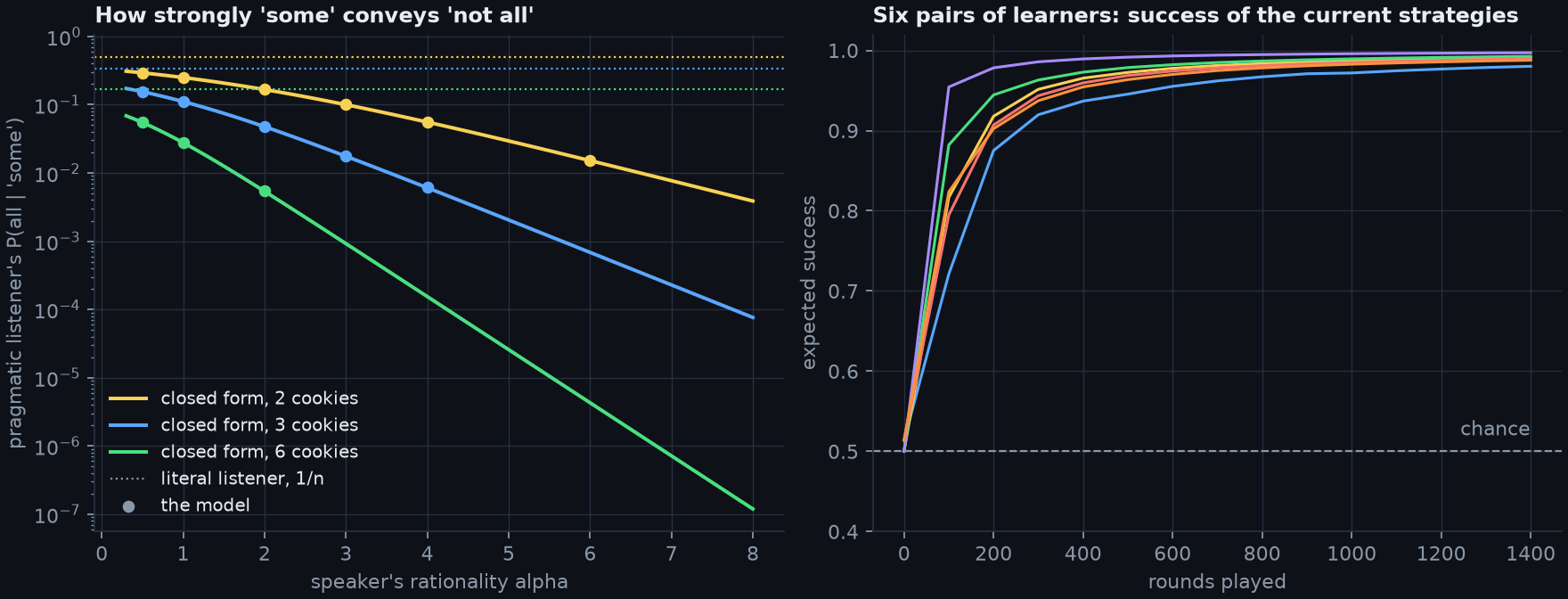
Now the scalar implicature. Someone ate some of three cookies; the states are how many: none, one, two or three. The words: none, some, all. Literally, some is true if one, two or three were eaten; the literal listener gives each a third. The pragmatic listener, with a fairly rational speaker, gives three almost nothing: about six in a thousand. A speaker who saw all three eaten would have said all. Some has come to mean some but not all, with no change in its literal meaning. And the strength of the inference depends on how rational the listener takes the speaker to be: as alpha grows from a half to eight, the chance of all, given some, falls from fifteen percent to almost zero.
How deep does the reasoning go? The model can be iterated: a speaker who reasons about the pragmatic listener, a listener who reasons about that speaker, and so on, level after level. In the reference game, the credence that blue means the blue square rises from a half to point six at the first level, then to point six four, and then creeps up, toward about two thirds. In the cookie game, with a speaker of ordinary rationality, the credence that some means all three falls from a third to a ninth, then to under a twentieth, roughly halving at each further level. Each level adds less than the one before. Which level do people use? Fitting the model to individual participants in reference games, Michael Franke and Judith Degen found in 2016 that people differ: some reason literally, others a level deep or more. In the model, at least, the first step of reasoning about the other does most of the work.
The model has been extended in many directions. It predicts which object a speaker means in reference games like this one. Justine Kao and colleagues extended it in 2014 to hyperbole: it cost a million dollars, understood as it cost a lot, and I'm annoyed. Others added politeness, as speakers trade being informative against being kind. Its main limit is that the alternatives a speaker considers, the utterances she might have said instead, must be given in advance. Where they come from is one of the open questions. Noah Goodman and Michael Frank reviewed the programme in 2016: pragmatic language understanding as probabilistic inference.
What it establishes: Frank and Goodman (2012); Goodman and Frank (2016); Kao et al. (2014); Franke and Degen (2016).; Computed on screen: a reference game; 'some' over four states; the effect of α; recursion depth
11Conventions from nothingAdvanced4 min
Where do conventions of meaning come from, if not from a prior agreement, which would itself need language? David Lewis, in 1969, modelled the simplest case as a game. A sender sees which of two states the world is in, and sends one of two signals. A receiver sees only the signal, and acts. Both are rewarded when the act fits the state. A signalling system, a pairing of states with signals and signals with acts, is an equilibrium: neither player can do better by changing alone. Which pairing is used is arbitrary: a convention.
Brian Skyrms showed that such conventions can emerge from the simplest learning. Give the sender an urn for each state, holding one ball for each signal, and the receiver an urn for each signal, holding one ball for each act. Each round, draw a ball to choose. When the act fits the state, add a ball of the colours just used. This is Roth–Erev reinforcement. The Reasoner plays the game. Here are six runs: the chance of success climbs from a half toward one. Of two hundred runs of six thousand rounds, a hundred and ninety-six end above ninety percent success, and a hundred and seventy-two above ninety-nine. No one chose the convention, and which signal comes to mean which state differs from run to run. Meaning, of a minimal kind, out of nothing but reward.
With more states, learning can fail. Here are the final success rates of all two hundred runs, for two states in blue and three states in orange. With three states, a hundred and sixty-nine runs still end above ninety percent. But twenty-six end near two thirds. In these runs two states have come to share one signal, and the receiver can only guess between them: a partial pooling equilibrium. The learners have settled into a worse convention than they could have had, and reinforcement will not get them out. Skyrms's book Signals, of 2010, studies when such traps occur, and what, like forgetting or invention, lets learners escape them.
How much do the learned signals say? Measure it in bits: the mutual information between the state and the signal, which is how much seeing the signal reduces uncertainty about the state. A signal can carry at most the logarithm of the number of states: one bit for two, about one point five eight for three. The successful runs come close: point nine eight bits of one, and one point five two of one point five eight. The twenty-seven pooled runs carry about point nine: two states share a signal, and what would distinguish them is lost. None of this is in a signal taken alone. The same mark would carry nothing if the sender used it at random. Information, like meaning on Lewis's view, belongs to the convention.
What do such signals mean? For Lewis, a convention is a regularity that everyone conforms to because everyone expects everyone else to, and prefers to conform if the others do. Skyrms measures the information in a signal by how much it shifts the probabilities of the states. And he gives it a content: the states it makes more likely, and the acts it makes fitting. Bees and vervet monkeys use signals like these. Whether they mean anything in the full sense, and what more would be needed, is the question chapter thirteen asks about machines.
What it establishes: Lewis (1969); Skyrms (2010); Roth and Erev (1995).; Computed on screen: 200 runs with two states and with three; bits carried
12You shall know a wordAdvanced3 min
A different idea of meaning came from structural linguistics. Ferdinand de Saussure taught that a sign has its value through its differences from other signs: meaning is relational. Zellig Harris, in 1954, made it measurable: words that occur in the same contexts tend to have similar meanings. John Firth put it as a slogan in 1957: you shall know a word by the company it keeps. The bet is that if you collect contexts, count them and compress the counts, similarity of meaning becomes nearness in a space. Part 3 of the AI series built word vectors this way, and every language model since extends the idea.
The Reasoner builds a tiny version. A small corpus: sentences about cats and dogs, kings and queens, cities, food, and some people, real and fictional. For every pair of words, count how often they occur near each other in a sentence. Reweight each count by how much more often the pair occurs than chance would predict, keeping only the positive excess. Compress the table to six dimensions by singular value decomposition, and compare words by the angle between their vectors. Among the nouns, the nearest neighbours of cat are dog, bird and mouse; of king, prince, land and crown; of Paris, the train and two other cities; of cheese, butter, seed and bone. No definitions were given and nothing was pointed at: only which words keep which company.
Take the vectors of these twenty-two words and project them onto their two main directions. Without being told anything about kinds, the words gather: animals together, royalty together, cities together, food together, people together. The distribution of words in text carries a great deal of what we call meaning. The question is whether it carries all of it.
If similar meanings are nearby points, perhaps relations between meanings are directions. Take the vector for king, subtract prince, and add princess. If the difference between king and prince is a direction, the result should land near queen. On the Reasoner's tiny vectors, it does. But London minus England plus France lands on Rome, not Paris, and Rome minus Italy plus Germany lands on London, with Berlin second. One of three. In this corpus each city meets its country in a single sentence, which is too little to carve out a direction. The word2vec models of Tomas Mikolov and colleagues, in 2013, found such directions reliably, in billions of words. It is Saussure's point, in geometry: what a word means is a matter of where it stands among the others.
What it establishes: Saussure (1916); Harris (1954); Firth (1957); Mikolov et al. (2013).; Computed on screen: PPMI vectors and SVD on a small corpus; three analogies
13Do language models mean?Research4 min
In 2020 Emily Bender and Alexander Koller made the sceptical case with a thought experiment. A and B are stranded on two islands and talk by telegraph cable. An octopus, O, very intelligent, taps the cable. It learns the statistics of their messages perfectly, cuts B off, and starts replying in B's place. A notices nothing. Then A writes: a bear is chasing me, and all I have are two sticks; what should I do? The octopus has never seen a bear or a stick. Its reply will be a plausible string, but it cannot connect the words to the world. Form alone, they argue, cannot give meaning, and a model trained only on text learns form.
The argument has a history, and replies. Stevan Harnad named the symbol grounding problem in 1990: symbols defined only by other symbols are like a Chinese-to-Chinese dictionary for someone who knows no Chinese. Steven Piantadosi and Felix Hill replied in 2022 that much of meaning is conceptual role: the web of relations among concepts, which text can teach. Dimitri Coelho Mollo and Raphaël Millière argued in 2023 that a model's representations can be grounded after all: through the causal links to the world that its training data carry, in the spirit of Part 27's externalism, and through the feedback it receives in fine-tuning. And Robert Brandom's inferentialism, from 1994, says that to mean something is to take part in the game of giving and asking for reasons, a game that might be played in text.
Brandom's picture can itself be built. A scorekeeper keeps a score for each speaker: what she is committed to, and which of those commitments she is entitled to. A asserts that the apple is red. That commits her to it, and to what it materially implies: that the apple is coloured. B challenges, and A's entitlement is suspended. A gives a reason: she can see it. The entitlement returns. B defers to A, and inherits both the commitment and the entitlement. A asserts something unrelated, that Pittsburgh is west of Philadelphia, and is committed to its converse as well. Then A asserts that the apple is green. Red and green are incompatible, so A loses her entitlement to both, and to coloured, which rested on them. B, who relied on A, loses hers too. Pittsburgh is untouched. On this view, to grasp red is to know its place in such a game: what it commits you to, and what it rules out. Nothing in the game requires seeing an apple, though a reason like I can see it is one move in it.
Four claims cannot all be true. Meaning requires reference. Reference requires causal contact with what is referred to. A model trained only on text has no such contact. And a language model's outputs are meaningful. Something has to give. Bender and Koller give up the last: the outputs only seem meaningful, and the meaning is supplied by the reader. Mollo and Millière give up the third: text carries causal contact, at second hand. Conceptual role theorists give up the second: reference needs only the right inferential role. And a follower of the later Wittgenstein can give up the first: meaning is use, not reference, and a model's use of words is a use.
What it establishes: Harnad (1990); Bender and Koller (2020); Piantadosi and Hill (2022); Mollo and Millière (2023); Brandom (1994); the Price List.; Computed on screen: a scorekeeper's six moves; the four claims' minimal conflicts
14What a model representsResearch2 min
How could we tell what a model represents? One method is probing: train a simple classifier to read some property off the model's internal vectors. If the probe succeeds on words or inputs it was not trained on, the information is there, in a usable form. It does not show that the model uses it, or that it is about the world rather than about the text. The most striking example is Othello-GPT, from Kenneth Li and colleagues in 2023: a model trained only on sequences of legal moves, from whose activations a probe can recover the state of the board, as the AI series showed.
The Reasoner probes its own small word vectors from chapter twelve. The first probe asks each word's kind: animal, royalty, city, or food. Each word is held out in turn and assigned to the nearest average of the others. Fifteen of seventeen come out right, against about one in four by chance. The second asks whether a person is fictional: Holmes, Watson and Frodo against Darwin, Newton and Dickens. It gets none of the six right. In this corpus fictional and real people appear in the same kinds of sentences: they live in London, write books, meet kings. Nothing in the distribution marks the difference, and each name sits next to the real or fictional people it shares sentences with. So a model can represent a great deal from text, and still be blind to facts about reference that the text does not encode.
What do the probes teach? That a great deal can be learned from form alone: kinds, relations, even, in Othello-GPT, the state of a board. Text encodes much of the world's structure. And that whatever the text does not mark is missing: here, fiction against fact. Real corpora do often mark it, with in the novel, the detective, born in 1809, which is why large models usually know that Holmes is fictional. The open question is whether a big enough model of text has everything meaning requires, or only everything that form can carry.
What it establishes: Li et al. (2023).; Computed on screen: two probes: kinds and fiction
15Pragmatics in machinesApplied2 min
Language models now take part in conversations, so they can be tested on implicature. Are you coming to the party tonight? I have to work. The answer meant is no, though no one said it. Laura Ruis and colleagues tested models on thousands of exchanges like this one in 2023. Many models were close to chance; models fine-tuned on instructions and dialogue did much better, some approaching people. Jennifer Hu and colleagues compared models with people on seven pragmatic phenomena the same year. The largest models came close to people on many, and were weakest where social expectations matter. The moral: pragmatic competence does not come automatically with scale; how a model is trained to converse matters.
The Rational Speech Acts model has also been put to work. Take the three objects of chapter ten, and ask a system to describe the green square. A literal speaker says any true word: green or square, evenly. The pragmatic speaker of chapter ten prefers green, two to one, because square would leave the listener unsure. Jacob Andreas and Dan Klein in 2016, and Reuben Cohn-Gordon and colleagues in 2018, put this kind of reasoning on top of neural captioning systems, and their captions became more discriminating: better at picking out one image among similar ones.
For an assistant built on a language model, Grice's maxims are design requirements. Can you open the file wants the file opened, not the answer yes. Quantity: answers as informative as the user needs, and no more. Quality: say only what there is evidence for, the maxim a model violates when it makes things up. And above all, what is meant: a request's purpose, not just its words. Working out what people want from what they say is the problem of Part 42, aligning reasoners.
What it establishes: Ruis et al. (2023); Hu et al. (2023); Andreas and Klein (2016); Cohn-Gordon et al. (2018).; Computed on screen: a literal and a pragmatic captioner
Recap, problems, and where this comes backAll tracks2 min
Let's gather what we built. The Tractatus, with every truth function made from one operation. The Investigations: the builders, language games, and family resemblance, computed. Plus and quus, the sceptical paradox, this part's brick in the Wall, and the private language argument. Quine's gavagai and proxy functions, and Davidson's charity, computed. Speech acts, and Grice's theory of implicature. Some, not all, derived by the Rational Speech Acts model. Conventions emerging in signalling games, and meaning as distribution. And the question whether language models mean, priced, probed and tested.
The Reasoner has a new module, pragmatics. It generates truth functions by operation N, checks family resemblance, builds plus and quus, applies proxy functions, plays interpreter, runs the Rational Speech Acts model, plays signalling games, and builds and probes word vectors. And the Wall has its twenty-eighth brick.
Six problems, with full solutions in this part's notes. Generating every truth function from neither-nor; a rival to plus and what rules it out; a proxy function for the numbers; the RSA listener for four cookies; why partial pooling is an equilibrium; and a corpus that would let a probe recover fiction. Pause here, and try them.
Where this comes back. Meaning in a lived world, in Part 29's phenomenology. Minds, machines and the Chinese room, in Part 30. Qualia and the beetle in the box, in Part 31. Games, conventions and the social contract, in Part 34. And aligning reasoners with what is meant, not just said, in Part 42. Next, Part 29: being and time-consciousness.
The books and papers this part follows are on screen, and in the notes. Thanks for watching.
Where it goes next. Meaning in a lived world follows in Part 29; minds, machines and the Chinese room in Part 30; qualia and the beetle in the box in Part 31; games, conventions and the social contract in Part 34; aligning reasoners with what is meant and not only said in Part 42.
Key results
The part's results in one place, for revision.
Try it
Lab 28 · Some, not all; and a convention from nothing
Run the Rational Speech Acts model on the cookie game for random numbers of cookies and rationality parameters, check the pragmatic listener against a closed form, and let thirty pairs of Roth-Erev learners play Lewis's signalling game until their signals carry information.
python -m videos.philosophy.labs 28
needs numpy, scipy, matplotlib · download lab28.py ·
source on GitHubhearing 'blue': blue square against blue circle 0.6 to 0.4 (by hand: 0.6 to 0.4)
3 cookies, alpha = 4: P(all | 'some') 0.0061 (closed form 1/165 = 0.0061)
60 random games (n cookies, alpha) largest gap from the closed form 5.0e-05
deeper listeners, alpha = 1 P(all | 'some') = [0.3333, 0.1111, 0.0476, 0.0222, 0.0108]
1000 past sums: plus and quus agree on 1000; rival rules below 200: 143
signalling, 30 runs of 1500 rounds 29 end above 90% success (chance: 50%)
bits carried by the learned signals 0.95 of 1
A listener who reasons about why the speaker did not say 'all' hears 'some' as 'not all', more strongly the more rational she takes the speaker to be; and two learners rewarded only for success end up with signals that carry nearly one bit.The code (85 lines; it asserts its own result)
"""Lab 28: compute what 'some' conveys with the Rational Speech Acts model, and grow a convention from reward."""

import numpy as np

from videos.coursekit import labs
from explainer.philosophy.reasoner import pragmatics as pr

TITLE = "Some, not all; and a convention from nothing"
GOAL = ("Run the Rational Speech Acts model on the cookie game for random numbers of cookies and rationality "
        "parameters, check the pragmatic listener against a closed form, and let thirty pairs of Roth-Erev "
        "learners play Lewis's signalling game until their signals carry information.")
TASKS = [
    "Give the state 'all' a prior of 0.7 (prior=[0.1, 0.1, 0.1, 0.7] in pr.rsa). Does 'some' still convey 'not all'?",
    "Make 'all' costly (cost=[0, 0, 2] in pr.rsa). How does the implicature change, and why?",
    "Play the signalling game with three states (pr.signalling(n=3, rounds=1500, runs=30)). How many runs stop "
    "near 2/3, and how many bits do their signals carry?",
]


def _closed(n, alpha):
    """L1(all | some) with n cookies and a uniform prior: the speaker who saw all says 'some' with chance q."""
    q = 1 / (1 + n ** alpha)
    return q / (n - 1 + q)


def run(seed=0):
    rng = np.random.default_rng(seed)
    lab = labs.Lab()

    # 1. the reference game and the cookie game
    ref = pr.reference_game()
    lab.row("hearing 'blue': blue square against blue circle", f"{ref['L1'][0][0]} to {ref['L1'][0][1]}   (by hand: 0.6 to 0.4)")
    assert abs(ref["L0"][0][0] - 0.5) < 1e-9 and abs(ref["L1"][0][0] - 0.6) < 1e-4
    film = pr.scalar()
    lab.row("3 cookies, alpha = 4: P(all | 'some')", f"{film['L1'][1][3]:.4f}   (closed form 1/165 = {1 / 165:.4f})")
    worst = 0.0
    for _ in range(60):
        n, alpha = int(rng.integers(2, 8)), float(rng.uniform(0.3, 6))
        r = pr.scalar(n=n, alpha=alpha)
        got = r["L1"][1][n]
        worst = max(worst, abs(got - _closed(n, alpha)))
        assert got < r["L0"][1][n], "the pragmatic listener always gives 'all' less than the literal one"
    lab.row("60 random games (n cookies, alpha)", f"largest gap from the closed form {worst:.1e}")
    assert worst < 1e-4, "the model matches q / (n - 1 + q)"
    rec = pr.recursion()
    lab.row("deeper listeners, alpha = 1", f"P(all | 'some') = {rec['some_all'][:5]}")
    assert all(a > b for a, b in zip(rec["some_all"], rec["some_all"][1:])), "each level strengthens the implicature"

    # 2. plus and quus
    pq = pr.plus_quus(seed=seed)
    lab.row("1000 past sums: plus and quus agree on", f"{pq['agree']}; rival rules below 200: {pq['rival_bounds_below_200']}")
    assert pq["agree"] == pq["history"] and pq["rival_bounds_below_200"] == 199 - pq["biggest"]
    assert pq["plus_68_57"] == 125 and pq["quus_68_57"] == 5

    # 3. the signalling game
    sig = pr.signalling(n=2, rounds=1500, runs=30, seed=seed, threshold=0.9)
    lab.row("signalling, 30 runs of 1500 rounds", f"{sig['perfect']} end above 90% success   (chance: 50%)")
    lab.row("bits carried by the learned signals", f"{sig['info_top']:.2f} of {sig['max_info']:.0f}")
    assert sig["perfect"] >= 18 and sig["mean_final"] > 0.85, "reinforcement alone finds a signalling system"
    assert 0.7 < sig["info_top"] <= 1.0 + 1e-9, "the signals carry most of one bit, and never more"
    lab.note = ("A listener who reasons about why the speaker did not say 'all' hears 'some' as 'not all', more "
                "strongly the more rational she takes the speaker to be; and two learners rewarded only for "
                "success end up with signals that carry nearly one bit.")

    fig, ax = labs.figure(2, size=(11, 4.2))
    alphas = np.linspace(0.3, 8, 80)
    for n, color in ((2, labs.GOLD), (3, labs.BLUE), (6, labs.GREEN)):
        ax[0].plot(alphas, [_closed(n, a) for a in alphas], color=color, label=f"closed form, {n} cookies")
        pts = np.array([a for a in (0.5, 1, 2, 3, 4, 6, 8) if _closed(n, a) > 5e-3])  # the library rounds to 4 places
        ax[0].scatter(pts, [pr.scalar(n=n, alpha=float(a))["L1"][1][n] for a in pts], s=26, color=color, zorder=3)
        ax[0].axhline(1 / n, color=color, ls=":", lw=1)
    ax[0].plot([], [], color=labs.MUTED, ls=":", lw=1, label="literal listener, 1/n")
    ax[0].scatter([], [], s=26, color=labs.MUTED, label="the model")
    ax[0].set(title="How strongly 'some' conveys 'not all'",
              xlabel="speaker's rationality alpha", ylabel="pragmatic listener's P(all | 'some')", yscale="log")
    ax[0].legend(loc="lower left")
    t = 100 * np.arange(len(sig["curves"][0]))
    for i, c in enumerate(sig["curves"]):
        ax[1].plot(t, c, color=labs.CYCLE[i % len(labs.CYCLE)], lw=1.4)
    ax[1].axhline(0.5, color=labs.MUTED, ls="--", lw=1)
    ax[1].text(t[-1], 0.52, "chance", color=labs.MUTED, ha="right")
    ax[1].set(title="Six pairs of learners: success of the current strategies", xlabel="rounds played",
              ylabel="expected success", ylim=(0.4, 1.02))
    lab.fig = fig
    return lab
Now change it
- Give the state 'all' a prior of 0.7 (prior=[0.1, 0.1, 0.1, 0.7] in pr.rsa). Does 'some' still convey 'not all'?
- Make 'all' costly (cost=[0, 0, 2] in pr.rsa). How does the implicature change, and why?
- Play the signalling game with three states (pr.signalling(n=3, rounds=1500, runs=30)). How many runs stop near 2/3, and how many bits do their signals carry?
Problems, with solutions
Try each problem before opening its solution.
-
Show that 'neither \dots nor' alone generates all 16 truth functions of two propositions.
Solution
Write \(p \downarrow q\) for "neither \(p\) nor \(q\)". Then \(\lnot p = p \downarrow p\); \(p \lor q = (p \downarrow q) \downarrow (p \downarrow q)\); \(p \land q = (p \downarrow p) \downarrow (q \downarrow q)\). Every truth function of \(p, q\) has a disjunctive normal form built from \(\lnot\), \(\land\) and \(\lor\), and the tautology is \(p \lor \lnot p\) and the contradiction \(p \land \lnot p\), so all sixteen are expressible with \(\downarrow\) alone. Wittgenstein's N, applied to collections, reaches them in three rounds from \(p\) and \(q\), as the film's table shows.
-
Define a rival to 'plus' that agrees with it on all sums below 1000. What fact rules it out?
Solution
Define "quus\(_{1000}\)": \(x \oplus y = x + y\) when \(x, y < 1000\), and \(5\) otherwise. If every sum you have done had arguments below 1000, your record fits both. Kripke's sceptic says no fact about you rules it out: not your finite past use, not any mental image or instruction (which also needs interpreting), not your dispositions (finite, error-prone, and descriptive where meaning is normative). The sceptical solution answers instead with conditions of assertion: a community that corrects deviant answers is entitled to say you mean plus. Lewis's alternative names a fact: plus is the more natural function, and reference goes to the most natural candidate that fits use ("reference magnetism").
-
Give a proxy function for a model of the natural numbers with '\(<\)'. What is preserved?
Solution
Take the standard model of the natural numbers with \(<\), and any permutation \(f\) of its domain, say swapping 0 and 1. Reinterpret "\(<\)" as the relation \(R = \{(f(m), f(n)) : m < n\}\), so that now 1 "comes before" 0 and both before 2, 3, .... The map \(f\) is then an isomorphism from the old model to the new one, so every sentence keeps its truth value, but the numeral "0" in effect refers to a different object's role. (No nontrivial permutation preserves \(<\) itself, since the natural numbers are well ordered; the proxy function works by moving the extension of the predicate along with the objects.) What is preserved is structure and truth; what is not fixed is reference.
-
Compute the RSA listener for 'some' with 4 cookies and \(\alpha = 1\).
Solution
States 0 to 4; "none" true at 0, "some" at 1–4, "all" at 4; uniform prior, \(\alpha = 1\), no costs. Literal listener on "some": \(1/4\) on each of 1–4. Speaker: in states 1, 2, 3 "some" is the only true word, so she says it with probability 1; in state 4 she weighs "some" by \(L_0 = 1/4\) and "all" by 1, so she says "some" with probability \(0.2\). Pragmatic listener on "some": proportional to \(1, 1, 1, 0.2\), that is \(0.3125\) each for 1, 2 and 3 and \(0.0625\) for all four. The implicature is already there at \(\alpha = 1\), weaker than at the film's \(\alpha = 4\).
-
In a 3-state signalling game, why is partial pooling an equilibrium?
Solution
In a partial pooling equilibrium the sender uses one signal for two states (say \(s_1\) and \(s_2\)) and a second signal for \(s_3\), and leaves the third signal unused; the receiver answers the pooled signal with the act for \(s_1\) and the second with the act for \(s_3\). Success is \(2/3\). No one gains by deviating alone: if the sender switched \(s_2\) to the unused signal, the receiver's reply to that signal is not the act for \(s_2\), so nothing improves; if the receiver answered the pooled signal with the act for \(s_2\), she would gain \(s_2\) and lose \(s_1\). So it is a Nash equilibrium, though not the best one. Under reinforcement learning the unused signal is never rewarded for \(s_2\), so the trap is stable.
-
Design a corpus in which a probe can recover fictionality. What did you add?
Solution
Add sentences in which distribution tracks fictionality: "Holmes is a character in a novel", "Frodo appears in a book by Tolkien", "Watson is a character" against "Darwin was born in 1809", "Newton died in 1727", "Dickens was born in Portsmouth". Now fictional names share contexts with "character", "novel" and "appears", and real ones with "born" and "died", and a nearest-centroid probe can separate them. What was added is text that marks the difference, not contact with the world: the probe recovers how the corpus talks about fictionality, which is exactly the limit the film drew.
Notes and sources
Sources
Texts: Wittgenstein, Tractatus Logico-Philosophicus (1921) and Philosophical Investigations (1953); Kripke, Wittgenstein on Rules and Private Language (1982); Quine, Word and Object (1960); Davidson, Inquiries into Truth and Interpretation (1984); Grice, Studies in the Way of Words (1989); Lewis, Convention (1969); Skyrms, Signals (2010); Levinson, Pragmatics (1983); Lycan, Philosophy of Language (3rd ed., 2019).
Papers and primary texts: Saussure (1916); Post (1921); Ayer (1954); Harris (1954); Austin (1955/1962); Firth (1957); Grice (1957, 1975); Quine (1968); Horn (1984); Levinson (2000); Chomsky (1969); Searle (1969, 1975); Horn (1972); Davidson (1973, 1974); Grandy (1973); Lewis (1983); Harnad (1990); Brandom (1994); Roth and Erev (1995); Noveck (2001); Bott and Noveck (2004); Frank and Goodman (2012); Mikolov et al. (2013); Kao et al. (2014); Sperber and Wilson (1986); Andreas and Klein (2016); Franke and Degen (2016); Goodman and Frank (2016); Cohn-Gordon et al. (2018); Bender and Koller (2020); Piantadosi and Hill (2022); Mollo and Millière (2023); Li et al. (2023); Ruis et al. (2023); Hu et al. (2023).
About this partfrom its README
Part 28 of Philosophy, Built (series plan, syllabus), the second part of Act VI, Mind and Meaning: meaning as use, from Wittgenstein to computed pragmatics, with a Rational Speech Acts model and a signalling game built. The Tractatus: pictures and logical space, truth tables, and all 16 truth functions of two propositions generated from Wittgenstein's single operation N (by depth: 2, 3, 5 and 6 new functions), and the ladder thrown away. The Investigations: the builders of §2, the multiplicity of language games (§23), family resemblance computed on six games (no feature shared by all six, yet 10 of the 15 pairs share something and the network is connected), and meaning as use (§43). Kripke's plus and quus: a record of 1000 sums that both rules fit, the 143 rival 'quus_b' rules for bounds 57–199, the sceptic's four candidate facts, the sceptical solution, Kripkenstein, and the Wall's twenty-eighth brick. The private language argument: the diary of §258 and the beetle in the box of §293. Quine's gavagai (rabbit, undetached rabbit part and rabbit stage assented to in the same 20 of 40 scenes), the indeterminacy of translation, and proxy functions computed: a permutation of the domain that keeps the truth value of all 300 random first-order sentences while every name and predicate now applies to something else; Chomsky's and Lewis's replies. Davidson's radical interpretation and charity computed: three alien sentences heard 60 times by speakers who err one time in ten, all six translation schemes tried, and charity picking the true one (50 of 60 right, not 60), and charity against the speakers' error rate (200 trials at each rate: the truth every time up to 3 errors in 10, 182 of 200 at a half, chance, 34 of 200, at two thirds); the very idea of a conceptual scheme, triangulation and Grandy's humanity. Austin's performatives, felicity conditions and the three acts; Searle's taxonomy and directions of fit; indirect speech acts. Grice's cooperative principle and maxims, implicature (the garage, the reference letter), the tests for it, flouting (tautology, irony, metaphor, 'Home Sweet Home'), and Horn's, Levinson's and Sperber and Wilson's successors. Horn scales and the Gricean derivation of 'some, not all'; Noveck's children and Bott and Noveck's reaction times. The Rational Speech Acts model (Frank and Goodman) built: the literal listener, the speaker and the pragmatic listener on a three-object reference game (hearing 'blue', 0.6 for the blue square against 0.4), 'some' over four states of three cookies (the pragmatic listener gives 'all' about 6 in 1000), how the effect grows with α, and the listener at recursion depths 0 to 6 (0.5, 0.6, 0.64, ... 0.66; Franke and Degen on how deep people go); hyperbole, politeness, and where the model reaches. Lewis signalling games learned by Roth–Erev reinforcement (Skyrms): of 200 runs of 6000 rounds, 196 end above 90% success and 172 above 99%; with three states 169 succeed and 26 stick near two thirds in partial pooling; the information the learned signals carry (0.98 of 1 bit; 1.52 of 1.58; the pooled runs 0.90); Lewis's conventions and Skyrms's informational content. Distributional semantics built: Saussure, Harris and Firth, a small corpus turned into positive-PMI word vectors and a truncated SVD, nearest neighbours (cat → dog; king → prince) the space of words, and analogies as directions (king − prince + princess → queen; the city–country analogies fail on so small a corpus). The octopus (Bender and Koller), Harnad's grounding problem, conceptual role and the replies, Brandom's deontic scorekeeping built (commitments and entitlements over a six-move conversation), a Price List of four inconsistent claims; probing the Reasoner's own vectors (kinds: 15 of 17 held-out words; fiction against fact: 0 of 6, because the corpus does not mark it), and Othello-GPT. Pragmatics in machines: implicature benchmarks, a pragmatic captioner (the green square called 'green' two to one), and Grice's maxims as requirements for assistants.
The worked model results are computed by the Reasoner's new module explainer/philosophy/reasoner/pragmatics.py (with
prop for the Price List), tested in tests/philosophy/test_pragmatics.py and cached by compute.py.
Chapter notes
| # | Scene | What it establishes | Computed on screen |
|---|---|---|---|
| 0 | Hook |
four questions about use; the plan. | — |
| 1 | Tractatus |
Wittgenstein (1921); Post (1921). | logical space; all 16 truth functions from N |
| 2 | Games |
Wittgenstein (1953), §§2, 23, 43, 66. | family resemblance on six games |
| 3 | Rules |
Kripke (1982); the Wall's twenty-eighth brick. | plus and quus on 1000 sums; 143 rivals |
| 4 | Private |
Wittgenstein (1953), §§258, 293; Ayer (1954). | — |
| 5 | Quine |
Quine (1960, 1968); Chomsky (1969); Lewis (1983). | gavagai in 40 scenes; a proxy function on 300 sentences |
| 6 | Charity |
Davidson (1973, 1974); Grandy (1973). | six translation schemes on 60 observations; the error-rate sweep |
| 7 | Acts |
Austin (1955/1962); Searle (1969, 1975). | — |
| 8 | Grice |
Grice (1957, 1967/1975); Horn (1984); Levinson (2000); Sperber and Wilson (1986). | — |
| 9 | Scalar |
Horn (1972); Noveck (2001); Bott and Noveck (2004). | — |
| 10 | RSA |
Frank and Goodman (2012); Goodman and Frank (2016); Kao et al. (2014); Franke and Degen (2016). | a reference game; 'some' over four states; the effect of α; recursion depth |
| 11 | Signals |
Lewis (1969); Skyrms (2010); Roth and Erev (1995). | 200 runs with two states and with three; bits carried |
| 12 | Vectors |
Saussure (1916); Harris (1954); Firth (1957); Mikolov et al. (2013). | PPMI vectors and SVD on a small corpus; three analogies |
| 13 | Octopus |
Harnad (1990); Bender and Koller (2020); Piantadosi and Hill (2022); Mollo and Millière (2023); Brandom (1994); the Price List. | a scorekeeper's six moves; the four claims' minimal conflicts |
| 14 | Probe |
Li et al. (2023). | two probes: kinds and fiction |
| 15 | Machines |
Ruis et al. (2023); Hu et al. (2023); Andreas and Klein (2016); Cohn-Gordon et al. (2018). | a literal and a pragmatic captioner |
| 16 | Outro |
recap; the Reasoner's module; the Wall; problems; payoffs; references. | — |
The word-vector tables and plots keep the toy corpus's English words verbatim in both editions. These are the model's inputs and outputs; headings, category labels and explanations are translated.
Companion material in this repository
The syllabus's plan for this partfrom SYLLABUS.md, the plan of record
- Wittgenstein's Tractatus (1921): the picture theory; truth tables invented (callback to Part 2).
- The Investigations (1953): meaning as use; language games; family resemblance.
- Rule-following (Kripke's Wittgenstein on Rules and Private Language, 1982): plus vs quus, built. Every finite record of use fits both; the skeptical paradox and its "solution".
- The private language argument.
- Quine's radical translation (1960): gavagai; the indeterminacy of translation and the inscrutability of reference (proxy functions).
- Davidson's radical interpretation; the principle of charity; truth and meaning together.
- Speech acts: Austin's performatives; Searle's taxonomy.
- Grice: the cooperative principle and the maxims; conversational implicature; cancellability.
- Scalar implicature: "some" → "not all".
- The Rational Speech Acts model (Frank and Goodman 2012). Built: a literal listener, a pragmatic speaker and a pragmatic listener as recursive Bayesian reasoning; it derives "some, not all" and reference games.
- Lewis's Convention (1969) and signalling games; Skyrms's evolution of meaning. Built: Roth–Erev reinforcement learning on a 2×2 and a 3×3 signalling game; with seeds and spreads, how often perfect signalling emerges vs partial pooling equilibria.
- Structuralism's relational meaning (Saussure; Harris's distributional hypothesis) and word vectors (callback to AI, Built Part 3).
- Do LLMs mean anything? The octopus argument (Bender and Koller 2020); the symbol grounding problem (Harnad 1990); replies (Piantadosi and Hill; Mollo and Millière 2023 on vector grounding); inferentialism (Brandom).
- A probe on the AI series' novels model (
explainer.ai.novels): what it represents about referents in its training stories, and what that does and doesn't show. - Recap and Problems.
Built: reasoner.pragmatics (RSA; signalling games; plus vs quus).
Wall: Kripkenstein (no fact about past use fixes a rule); Quine's indeterminacy.
Price List: the grounding question (meaning requires reference; reference requires causal contact; text-only
models have none; LLM outputs are meaningful).
Visuals: the RSA listener and speaker as alternating matrices sharpening; signalling-game urns filling; plus and
quus diverging only past 57.
References: Wittgenstein; Kripke 1982; Quine, Word and Object; Davidson, Inquiries into Truth and
Interpretation; Grice, Studies in the Way of Words; Goodman and Frank 2016 (TiCS); Skyrms, Signals; Bender and
Koller 2020 (ACL).
Build the film
python -m videos.philosophy.philosophy28.compute        # the part's numbers, into .cache/philosophy28
python tools/build.py philosophy28                  # render and assemble the film
EXPLAINER_TTS=silent python tools/qa_scene.py philosophy28 Hook   # one chapter, silent, with a contact sheet
Scenes: videos/philosophy/philosophy28. Setup: see the course page. Source of these notes: the README and the scenes' narration.
Build it
python -m videos.philosophy.philosophy28.compute       # every computed item (about a minute; .cache/philosophy28)
python tools/build.py philosophy28 -q l                # 480p preview
python tools/build.py philosophy28                     # 1080p30 -> renders/philosophy28.mp4
python tools/qa_scene.py philosophy28 RSA              # one chapter, silent, with a contact sheet