Laws, Chance and the Arrow
What is a law of nature, and why does time run one way if the laws run both?
A film of colliding molecules looks the same run backwards, a film of milk mixing into coffee does not: the part asks what holds the world together. Laws come first: the regularity view and van Fraassen's two spheres, then Lewis's best system built as a contest of polynomial laws scored in bits on a falling ball, and the rival views on which laws govern. Humean chance is tested in a world of twenty coin tosses, where undermining futures carry 75% of the chance and the Principal Principle contradicts itself until the New Principle repairs it. Determinism is defined by models and broken by Norton's dome; chaos shows a deterministic system that cannot be forecast. Then the arrow: Boltzmann's counting, the H-theorem, and the objections of Loschmidt and Zermelo, all made visible in the Kac ring, which decays, recurs, reverses, and from a typical low-entropy present gains entropy toward the past as well as the future. That is the Wall's twenty-fourth brick, and the Past Hypothesis is the price of the arrow. The part ends with Maxwell's demon, Szilard's engine, Landauer's bound and reversible computing.
What you need. Newton's second law, logarithms and binomial counting. Part 13's credences are used for chance.
- The calculation
- best systems, typicality
- The wall
- Loschmidt and Zermelo; the big bad bug
- Built toy
- Norton's dome; Kac ring; Szilard engine
What you will be able to do
Introductory
- Tell a law from an accidental regularity with van Fraassen's two spheres, and say what the best-system account adds.
- Explain with a counting argument why a gas spreads out, and why that argument alone points the same way into the past.
- Distinguish unpredictability from indeterminism using the Lorenz system and Norton's dome.
Advanced
- Score candidate laws by two-part description length and pick the best system.
- Derive the decay of the Kac ring's colour imbalance under the molecular-chaos assumption and show where recurrence refutes it.
- Compute the expected work of a Szilard engine and the erasure cost that cancels it.
Research
- Derive the big bad bug from the Principal Principle in a finite Humean world and show how the New Principle removes it.
- Verify Norton's solutions of the dome and identify the Lipschitz condition whose failure allows them.
Applied
- Estimate a forecast horizon from a Lyapunov exponent and an initial error.
- Compute the Landauer cost of an irreversible gate and say how compute, copy and uncompute avoids it.
Contents
Each chapter has a home level. Choose a track to see what to read and watch: Introductory 23 min · Advanced 49 min · Research 57 min · Applied 26 min.
- 0What holds the world together?Introductory3 min
- 1Laws as regularitiesIntroductory3 min
- 2The best systemAdvanced4 min
- 3Laws that governAdvanced4 min
- 4Chance and the big bad bugResearch4 min
- 5What determinism saysIntroductory3 min
- 6Norton's domeResearch4 min
- 7ChaosIntroductory3 min
- 8Counting microstatesIntroductory3 min
- 9Loschmidt and ZermeloAdvanced3 min
- 10The Kac ringAdvanced4 min
- 11A special beginningAdvanced4 min
- 12Maxwell's demonIntroductory4 min
- 13The thermodynamics of computingApplied3 min
- 14Many arrows, one?Advanced3 min
- Recap, problems, and where this comes backAll tracks2 min
Also on this page: Lecture · Key results · Try it · Lab · Problems · Notes and sources · Build the film.
Lecture
The text of each chapter is the film's narration, as it is spoken, so you can read along or revise without the film. The pictures are in the film.
What holds the world together?Introductory3 min
Part 23 asked whether the world needs a cause outside itself. This part asks what holds it together from inside. In 1814 Pierre-Simon Laplace imagined an intelligence that knew every force in nature and the position of every particle. For such a mind, he wrote, nothing would be uncertain, and the future, like the past, would be present to its eyes. Laplace's demon packs three philosophical ideas into one sentence: that there are laws, that the laws fix everything, and that the future and the past are on the same footing. Each of the three is in trouble, and this part builds the trouble.
Here is the trouble with the third idea. Forty-six molecules in a box, each moving in a straight line and bouncing off the walls, exactly as Newton's laws say. Those laws run equally well backwards: reverse every velocity and the motion retraces itself. Run the film forwards and the gas spreads out from its corner, as gas does. Now run it backwards. Every frame still obeys the laws of motion, and the gas gathers itself back into the corner, which no gas has ever been seen to do. Only one direction looks like our world. If the laws do not care which way the film runs, where does the difference come from? That question, Loschmidt's, is this part's brick in the Wall.
So this part asks three questions, and a fourth that grows out of them. What is a law of nature? A regularity in the pattern of facts, a relation between properties, a power in things, or something that cannot be analyzed at all? What is chance? If the laws fix everything, how can a coin have a chance of one half of landing heads; and what in the world makes a statement of chance true? Why does time have a direction, when the laws of motion run both ways? And the fourth: Maxwell's demon, a creature that seems to beat the second law of thermodynamics by knowing where the molecules are. Its exorcism shows that information is physical, and that forgetting has a price in heat, a price that today's computer chips pay many times over.
The plan. First, laws as regularities, and David Lewis's best-system account, built as a contest between simplicity and strength measured in bits. Then the rivals: laws as relations between universals, as powers, or as primitive. Chance, Lewis's Principal Principle, and the bug that nearly killed his account, computed. What determinism means, and a dome on which Newton's laws fail to fix the future. Chaos, and why unpredictable is not the same as undetermined. Entropy, the objections of Loschmidt and Zermelo, and a toy universe that answers them, this part's brick in the Wall. The special beginning that the arrow of time seems to need, and the Boltzmann brains that haunt the alternative. And the thermodynamics of information, from Maxwell's demon to reversible computers.
What it establishes: Laplace (1814); a film that runs both ways; three questions and a fourth; the plan.; Computed on screen: the hook's gas
1Laws as regularitiesIntroductory3 min
Start with the simplest answer. A law of nature is a true generalization: everything that is F is G. Hume is the source. When one billiard ball strikes another, we see the first move and then the second, but never a necessity connecting them; all experience shows is constant conjunction. So, on the regularity view, a law is nothing more than a pattern that holds everywhere and always. All copper conducts electricity; every massive body attracts every other. The trouble is that a great many true generalizations are not laws at all.
Bas van Fraassen made the point with a famous pair of sentences. Every sphere of gold is less than a mile across. True, as far as anyone knows: there is not that much gold gathered in one place. But it is an accident. Nothing in nature forbids a golden sphere a mile wide; the world simply never made one. Every sphere of uranium-235 is less than a mile across. Also true, and no accident. Gather about fifty-two kilograms of uranium-235 into a sphere some seventeen centimetres across, and it is critical: a chain reaction runs away, and a larger sphere cannot hold together. The two sentences have exactly the same logical form. Whatever makes the second a law and the first an accident, it is not the form of the sentence.
Laws do jobs that accidents cannot. A law supports counterfactuals: if this were a mile-wide sphere of uranium, it would have exploded. Nothing similar holds for gold. A law explains its instances: this sphere is small because larger ones go critical. The gold sphere is small for no reason in particular. And a law is confirmed by its instances, as Part 15 found when Goodman separated lawlike from accidental predicates. Both sentences are true. Truth alone does not separate them. Worse, some laws have no instances at all. Newton's first law describes bodies on which no force acts, and there may be none. Michael Tooley imagined ten kinds of fundamental particle, with laws for every pair that meets, and one pair that never does: surely there is still a fact about how they would interact. On the regularity view every vacuous generalization is true, so every one would be a law.
David Lewis kept Hume's picture and repaired it. All there is to the world, he wrote, is a vast mosaic of local matters of particular fact, just one little thing and then another. This is Humean supervenience: no necessary connections, only the mosaic. Here is a toy mosaic, a strip of cells, some lit. There is a pattern in it, with a few cells that break it. For Lewis the laws are not extra ingredients in the mosaic. They are the best summary of it. The next chapter builds that idea and puts a number on what best means.
What it establishes: Hume; van Fraassen (1989); Tooley (1977); Lewis's mosaic (1986).
2The best systemAdvanced4 min
Lewis's account goes back to Frank Ramsey in 1928, and Lewis gave it its classic form in 1973. Consider every true deductive system that describes the mosaic: sets of axioms, all true, with their consequences. Some are simple: a few short axioms. Some are strong: they say a great deal about what happens. The two pull against each other. The list of every fact is as strong as can be and hopelessly complicated; the single axiom, something happens, is as simple as can be and says nothing. A law, Lewis said, is a theorem of every true system that strikes the best balance of simplicity and strength. The laws are the mosaic's best summary.
Here is a best system, built. The mosaic is forty measurements of the height of a falling ball, with some noise. The candidate systems are polynomial laws of rising degree. Degree zero says the height is constant: very simple, and very weak. Degree one, a straight line, does better. Degree two, a parabola, captures the fall: twenty metres, a small linear term, and minus about four point six times t squared, close to Galileo's law, with g over two equal to four point nine. Degree seven has eight parameters and hugs the noise. It is the strongest of all, and the least simple. Which is best depends on how strength trades against simplicity.
Part 15 gave us an exchange rate between simplicity and strength: description length. Write down the law, then write down the data with the law's help, and count the bits. The law's own length grows with its parameters, about half the logarithm of the number of data points for each one. The data's length shrinks as the law fits better: a strong law leaves little to say. Add them up. The constant and the line leave too much unexplained. Beyond degree two each extra parameter costs more bits than it saves. The best system is degree two, at about sixty bits. So minimum description length is a precise best-system account. The machine-learning idea and Lewis's metaphysics of law are the same idea.
Three objections. The language. Simplicity depends on the words. Let F be a predicate true of exactly the things in our world, each doing just what it does. Then the single axiom, everything is F, is perfectly simple and perfectly strong. Lewis replied in 1983 that the axioms must be stated in terms of natural properties, the ones that carve nature at its joints. The balance. Who decides how much strength is worth how much simplicity? Lewis hoped that nature is kind: that one system wins under any reasonable exchange rate, as degree two won here. And explanation. We explain why the ball fell by citing the law. But if the law is just a summary of facts like the ball's fall, the explanation seems to run in a circle. Humeans answer that scientific explanation unifies facts; it need not produce them.
David Albert and Barry Loewer push the best-system account as far as it goes. They borrowed a name from a Coen brothers film: the Mentaculus, a probability map of the world. Its axioms are the dynamical laws, a statement that the universe began in a state of very low entropy, which we will meet in chapter eleven, and a uniform probability over the states compatible with that beginning. Together, they claim, these three assign a probability to every macroscopic history, which is to say they would put chance and the arrow of time inside the best system. Hold on to all three ingredients: this part builds each of them.
What it establishes: Ramsey (1928); Lewis (1973, 1983, 1994); Rissanen; Albert and Loewer's Mentaculus.; Computed on screen: polynomial laws scored in bits
3Laws that governAdvanced4 min
In 1977 Fred Dretske and Michael Tooley, and in 1983 David Armstrong, gave a rival answer: laws are relations between properties. Take two universals, F and G: being a sphere of uranium-235 above critical mass, say, and exploding. A law is a second-order relation between them, which Armstrong called necessitation, and wrote N of F and G. The particulars come below: each thing that has F also has G, because the universals stand in N. So the law entails the regularity: if F necessitates G, everything that is F is G. But the regularity does not entail the law. That gap is the difference between a law and an accident.
The relation buys a great deal. It separates laws from accidents: N holds between the uranium properties, and nothing holds between gold and smallness; that pattern is luck. It supports counterfactuals: had there been a large uranium sphere, N would still have held, so the sphere would have exploded. It explains: the regularity holds because the universals are related, and there is no circle, since the relation is something over and above the pattern. And Armstrong thought it solved Hume's problem of induction, the subject of Part 15: the law is the best explanation of the observed pattern, so inferring it is rational, and the law then covers the unobserved cases too.
The trouble is in the word. Armstrong called the relation necessitation, and of course if F necessitates G and a is F, a must be G. But David Lewis pointed out that the relation does not get its power from its name: it cannot enter into necessary connections just by bearing a name, he wrote, any more than one can have mighty biceps just by being called Armstrong. This is the inference problem. What is it about the relation N that makes N of F and G, together with a being F, entail that a is G? And the identification problem: which relation is N? Bas van Fraassen argued that any answer to one leaves the other unsolved. Armstrong's late answer was that N is the relation whose instances are causings, and that we meet causing directly, when we push and pull things ourselves.
Two more answers. Dispositional essentialism, defended by Alexander Bird: properties are powers. To be negatively charged is to be disposed to repel other negative charges; that is the whole nature of the property. Then the laws flow from the essences of properties, and they are necessary: there is no world where charge behaves otherwise, because it would not be charge. The price: some properties, like shape and distance, do not look like powers, and the deepest laws, symmetries and conservation laws, are not about any one property. Primitivism, defended by Tim Maudlin: the laws are basic. They are not summaries and not relations between universals; they are what produces each state of the world from the one before. Its price is honesty: nothing more can be said about what a law is.
So there are four views. For Lewis the laws are the best summary of the mosaic: they do not govern, and they are contingent. For Armstrong they are relations between universals that govern, though they hold contingently. For Bird they are essences of powers, and necessary. For Maudlin they are primitive, and govern the passage from one moment to the next. Each has a hard question. Keep the scorecard: the arrow of time will put the views to the test, because the arrow is a pattern that the laws themselves seem not to contain.
What it establishes: Dretske, Tooley (1977); Armstrong (1983); Lewis (1983); van Fraassen; Bird (2007); Maudlin (2007).
4Chance and the big bad bugResearch4 min
Laws in physics are often probabilistic, so a theory of law needs a theory of chance. Lewis's Principal Principle says how chance and belief connect. Your credence in A, given that the chance of A at time t is x, and given any further admissible evidence E, should be x. C is a rational initial credence, of the kind Part 13 built; ch sub t is the chance at time t. Admissible evidence is the history up to t, and the theory of how chances work; a crystal ball showing the coin's outcome is not admissible. Lewis thought the principle captures everything we know about chance: whatever chance is, it is what credence should follow.
Lewis wanted chances to be Humean, like laws: nothing over and above the mosaic. The best system gets a third virtue besides simplicity and strength: fit, the probability the system gives to what actually happens. Picture a world that contains nothing but coin tosses: twenty of them, ten in the past and ten still to come. The best system for such a world says that the chance of heads is the frequency of heads over the whole history, past and future. Suppose the whole history has exactly ten heads. Then the chance of heads is one half, and what makes that true is the pattern, including the part of the pattern that has not happened yet.
Now look ahead. Given the chance of one half, each possible future of ten tosses has a chance: the binomial distribution. If exactly five more heads come up, the frequency stays at one half, and so does the chance. But in any other future, the whole history would have a different frequency, and so, by Lewis's own account, a different chance. These are undermining futures: had they happened, the present chance would not have been one half. The Reasoner adds up their chance: about seventy-five per cent. The theory of chance gives most of its probability to futures in which the theory itself is false.
Now the bug. Let T be the theory of chance: the chance of heads is one half. Let F be an undermining future: say, all ten tosses heads. T and F cannot both be true: if F happened, the frequency would be three quarters, and T would be false. So any rational credence gives F probability zero, given T. But T is admissible evidence, so the Principal Principle says that credence in F given T should equal the chance of F, which is positive: one in 1024. Zero equals something positive. Humean chance and the Principal Principle cannot both be right. Lewis called it the big bad bug, and for years he could not fix it.
The repair came in 1994, from Ned Hall and from Lewis himself. The New Principle says: given the history and the theory of chance, your credence in A should be the chance of A conditional on the theory. Conditioning on T rules out the undermining futures, so they get credence zero, and the contradiction goes away. Does it change the numbers we use? Take A to be: the next three tosses are heads. The old principle says one eighth. With ten future tosses the new one says one in twelve. But as the world grows, the two agree: with ten thousand future tosses they agree to four decimal places. So the Principal Principle survives as an excellent approximation, and Humean chance survives, at the price of a principle that is no longer quite the simple rule we started with.
What it establishes: Lewis (1980, 1986, 1994); Thau (1994); Hall (1994).; Computed on screen: undermining futures; the New Principle
5What determinism saysIntroductory3 min
Laplace's demon needs determinism, so say exactly what determinism is. John Earman's definition, after Richard Montague, is about theories. Draw each possible history the theory allows, its models, as a curve of the world's state against time. A theory is deterministic if two histories that agree at any one time agree at all times: the curves never meet, so a slice through any moment picks out one history. A theory is indeterministic if two of its histories agree completely up to some moment, and then part. In symbols: if W and W prime are models of the theory and they match at time t nought, they are the same model. Determinism is then a property you can check, theory by theory.
Check it, theory by theory, and the answers surprise. Newtonian mechanics of point particles is not deterministic. Particles can be accelerated to infinity in finite time, as Zhihong Xia proved for five bodies in 1992; run the film backwards and particles arrive from infinity without warning, Earman's space invaders. And the next chapter builds an even simpler failure. Maxwell's equations for the electromagnetic field are deterministic. General relativity can fail, with spacetimes whose futures are not fixed by any slice, and Part 25's hole argument. Quantum theory's Schrödinger equation is deterministic, but if measurement collapses the wave function, outcomes are chancy, which is Part 26's puzzle. So determinism is not the default, even in classical physics. It is a substantive claim about a theory, and often false.
Can there be chance in a deterministic world? Lewis said no. If the past and the laws fix the future, the chance of every future event is zero or one. A coin toss in a Newtonian world has no chance of one half. Barry Loewer said yes. The Mentaculus puts a probability over the initial states of the universe, and that probability, part of the best system, gives genuine chances to coin tosses and gas molecules even when the dynamics is deterministic. And real coins are interesting. Persi Diaconis, Susan Holmes and Richard Montgomery modelled the physics of a toss in 2007 and predicted a small bias: a coin lands the way it started about fifty-one per cent of the time. In 2023 František Bartoš and colleagues flipped coins three hundred and fifty thousand times, and found fifty point eight per cent. So the chance of heads depends on physics. Where do such chances come from, if the dynamics is deterministic? Chapter seven answers: from sensitivity.
What it establishes: Laplace; Montague; Earman (1986); Xia (1992); Loewer (2001); Diaconis, Holmes and Montgomery (2007); Bartoš et al. (2023).
6Norton's domeResearch4 min
In 2003 John Norton described a simple system on which Newton's laws do not fix the future. A frictionless dome, shaped so that its height falls off with the distance from the top raised to the power three halves. Put a ball exactly at the top, at rest. Measure r as the distance from the top along the surface. On this shape the pull of gravity along the surface grows like the square root of r, so Newton's second law, in suitable units, says that the acceleration of r equals the square root of r. One solution is obvious: r is always zero. The ball sits at the top forever.
But there are others. For any time T, let the ball sit still until T, and after T let r grow as t minus T, to the fourth power, over a hundred and forty-four. Check it: the second derivative is twelve times t minus T squared, over a hundred and forty-four, which is t minus T squared over twelve; and the square root of r is exactly the same. Newton's law holds at every moment, including the moment T itself, where position, velocity and acceleration are all zero. The Reasoner checks the solutions numerically, for T equal to zero, one, two and three, and by finite differences. Every T gives a solution, and so does never. The ball may begin to slide at any moment, in any direction, or not at all, and Newton's laws do not say which.
Watch four of these histories side by side. Four copies of the same ball, at the top of the same dome. In the first history it starts to slide at time zero, in the second at time one, then two, then three, each in its own direction. Until the first departure, every history is identical: same position, same velocity, same forces. Afterwards they part. By Earman's definition, the theory that allows these four histories is not deterministic. Nothing in the state of the ball at the top, and nothing in Newton's laws, fixes when or whether it will move.
How can a law fail to fix the future? The theory of differential equations has a uniqueness theorem, Picard and Lindelöf's: if the force changes no faster than in proportion to the change in position, a Lipschitz condition, then from any starting state there is exactly one solution. The square root of r fails the condition at the top of the dome: its graph is infinitely steep at zero. So uniqueness is not guaranteed there, and it fails. Norton offers a better way to see it. Push a ball up the dome with exactly the right speed and it will reach the top in a finite time and stop there, which is unremarkable. Run that film backwards and you have a ball at rest that, at some moment, begins to slide. David Malament and Alexandre Korolev replied that the dome is an idealization no real surface obeys, and that a well-posed Newtonian theory should exclude it. Norton's answer: perhaps, but then determinism is something we add to Newton's physics, not something we find in it.
What it establishes: Norton (2003, 2008); Picard and Lindelöf; Malament (2008); Korolev (2007).; Computed on screen: the dome's solutions, checked
7ChaosIntroductory3 min
In 1963 the meteorologist Edward Lorenz studied three equations, a drastic simplification of convection in the atmosphere. Three variables, three equations, with constants ten, twenty-eight and eight thirds. Nothing is random: this is a deterministic system, and its solutions are unique. Start two copies one billionth apart. For a long time they trace the same path, looping around one wing of the attractor, then the other. Then, around time twenty, the difference has grown large enough to see, and soon the two are on different wings, as different as two randomly chosen states.
Plot the gap between the two runs, on a logarithmic scale. It climbs along a straight line: the error grows exponentially, multiplied by e to the lambda t. Lambda is the largest Lyapunov exponent. The Reasoner estimates it the standard way, following a tiny gap, shrinking it back after every step, and averaging the stretching: about zero point nine. So the error grows tenfold roughly every two and a half time units, until it is as large as the attractor itself, and then it can grow no more. That is what chaos means: deterministic dynamics with exponential sensitivity to the starting point.
What does a better measurement buy? Start with an error of one in a thousand and the forecast fails at about time seven. One in a million: about thirteen. One in a billion: about twenty-two. One in a trillion: about twenty-nine. The last column is the simple estimate, the logarithm of one over the error, divided by lambda. Each thousandfold gain in precision buys only about seven more units of time. Lorenz put it as a question in a talk in 1972: does the flap of a butterfly's wings in Brazil set off a tornado in Texas? For the real atmosphere, the horizon of detailed forecasting is about two weeks. But notice what chaos does not show. The Lorenz system is perfectly deterministic. Unpredictable is not the same as undetermined: Laplace's demon would need infinite precision, not new laws.
Chaos also explains where deterministic chances come from. Henri Poincaré's example was a roulette wheel. Spin it with some initial speed and it slows to a stop; where it stops is a fixed function of the speed. Here is that function, red or black, as the speed runs over a narrow range: it changes colour twenty-eight times. Now let the croupier's speed vary according to any smooth spread of values, however lopsided. The Reasoner tries four very different spreads. The chance of red comes out at one half every time, to within a hundredth. This is the method of arbitrary functions, developed by Poincaré and, in our time, by Michael Strevens: when the outcome flips back and forth faster than the spread of initial conditions can follow, the probability of each outcome is fixed by the dynamics alone. Deterministic laws, and real chances.
What it establishes: Lorenz (1963, 1972); Benettin; Poincaré (1896); Strevens (2003).; Computed on screen: the Lyapunov exponent; horizons; the roulette wheel
8Counting microstatesIntroductory3 min
Return to the film of the gas. In 1865 Rudolf Clausius summed up thermodynamics in two sentences: the energy of the world is constant; the entropy of the world tends to a maximum. The second is the second law: in an isolated system, entropy never decreases. It is why heat flows from hot to cold, why gases spread, why eggs break and stay broken. But the gas is made of molecules obeying laws that run equally well in both directions. How can a one-way law come out of two-way laws? Ludwig Boltzmann spent his life on that question.
Boltzmann's answer begins with a distinction. A hundred molecules in a box, all starting in the left half. The microstate is everything: exactly where each molecule is and how it moves. The macrostate is what we can measure, here just how many molecules are on the left. Let them move. Many microstates share each macrostate, and W counts them. Boltzmann's entropy is the logarithm of W, times a constant: S equals k log W, the formula on his grave in Vienna, written in Max Planck's notation. A macrostate has high entropy when a great many microstates look like it.
Count. With a hundred molecules, each on the left or the right, there are two to the hundred microstates. The number with exactly k on the left is a binomial coefficient, plotted here on a logarithmic scale. Half and half: about ten to the twenty-nine microstates. All on the left: exactly one, a probability of one in ten to the thirty. Between forty and sixty on the left: ninety-six and a half per cent of all microstates. And a real gas has something like ten to the twenty-three molecules. Then the macrostates near equilibrium contain all but a vanishing fraction of the microstates.
Now the picture Boltzmann had in mind. Phase space: every point is one microstate of the whole gas, every position and velocity at once. The macrostates cut it into cells, and a cell's size is W. A tiny cell for the gas crowded in its corner, larger cells as it spreads, and one cell, equilibrium, that fills almost everything. The drawing is not to scale: the real ratios have ten to the twenty-three in the exponent. As the microstate moves under the laws of motion, it wanders, and it is overwhelmingly likely to wander into bigger cells, simply because there is so much more of them. Entropy rises. So Boltzmann's second law is not a certainty but an overwhelming probability. And there is a catch, which the next chapter makes precise.
What it establishes: Clausius (1865); Boltzmann (1877); Planck.; Computed on screen: microstates of a hundred molecules
9Loschmidt and ZermeloAdvanced3 min
In 1872 Boltzmann thought he had proved the second law from mechanics. Describe the gas by f, the distribution of molecular velocities, and define H as the integral of f log f. Boltzmann's equation for a dilute gas implies that H can only fall, until the velocities reach Maxwell's distribution. Minus H is the entropy. The Reasoner builds a toy version. Six thousand molecules, all moving at the same speed in random directions: this spiky distribution of one velocity component. Let them collide in random pairs, each collision keeping momentum and energy. H falls round after round, and the velocities settle into Maxwell's bell curve, drawn in gold. It looks like a proof that entropy must rise.
In 1876 Josef Loschmidt, Boltzmann's friend and colleague in Vienna, raised the objection that bears his name. The laws of mechanics are invariant under time reversal: take any state, keep the positions, flip every velocity, and the laws run the history backwards. Here is the film from the start of this part, with its entropy measured by dividing the box into sixteen cells. As the gas spreads, the entropy climbs toward four bits. Now reverse every velocity. The same laws carry the gas back into its corner, and the entropy falls to zero. For every history in which entropy rises, there is one in which it falls. So no theorem that uses only the laws of motion can prove that entropy always rises. Something else went into the H-theorem.
The something else is an assumption Boltzmann called the Stosszahlansatz, the hypothesis about the number of collisions. Molecules about to collide are assumed to have independent velocities: nothing about one tells you anything about the other. After they collide, their velocities are correlated, because they just met. The H-theorem assumes independence before every collision, never after. Run time backwards and the assumption fails, since every collision's after becomes a before. The asymmetry of the result was put in by an asymmetric assumption. So the real question is why the assumption holds toward the future and not toward the past.
The second objection came in 1896 from Ernst Zermelo, using a theorem Henri Poincaré proved in 1890. Poincaré's recurrence theorem: a bounded mechanical system returns arbitrarily close to its starting state, and does so again and again. So, said Zermelo, entropy cannot rise forever: the gas will one day gather itself back into its corner. Boltzmann agreed, and pointed to the time it takes. The Reasoner shows why, with rotors turning at incommensurable rates, all starting from zero, and counts how often every rotor is back within a twentieth of a turn of the start. One rotor returns every seven-tenths of a time unit; two, every three; three, every twenty; four, every hundred and forty. Each new degree of freedom multiplies the wait. A gas has ten to the twenty-three of them.
What it establishes: Boltzmann (1872); Loschmidt (1876); Poincaré (1890); Zermelo (1896).; Computed on screen: H falling; Loschmidt's reversal; recurrence
10The Kac ringAdvanced4 min
In 1959 the mathematician Mark Kac built a toy universe that shows the whole puzzle in miniature. A ring of sites, here thirty-six, with a ball on each, white or black. Some of the edges between sites carry a mark, and the marks never move. At each tick of the clock every ball moves one site clockwise, and if it crosses a marked edge, it changes colour. Start with every ball white, and run it. The rule is deterministic. It is reversible: move the balls anticlockwise and every step is undone. And it is recurrent: after twice N ticks every ball has crossed every mark twice, so everything is back where it started. Every objection of the last chapter applies to this toy, and yet.
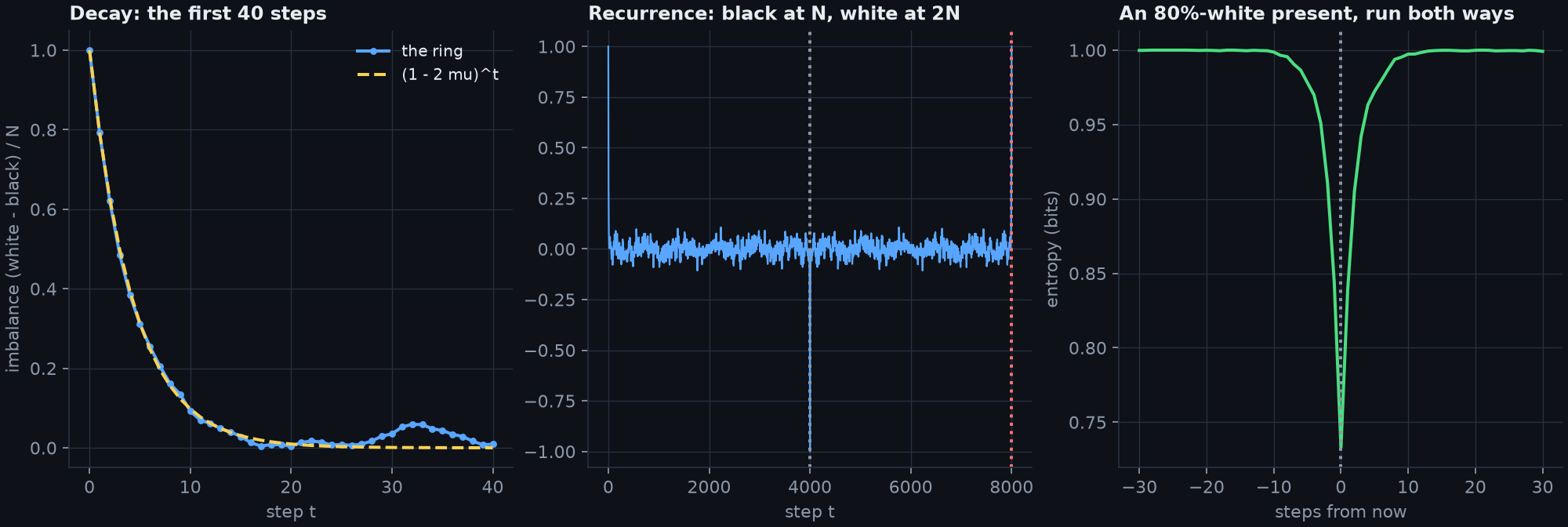
Now a ring of two hundred sites, with marks on about one edge in seven, chosen at random. Measure the colour imbalance: white minus black, over the number of balls. It starts at one. It decays toward zero, and then wanders near zero, as if the ring had reached equilibrium. Kac showed that if the marks are uncorrelated with the colours, his version of Boltzmann's assumption, the imbalance falls like one minus twice the fraction of marked edges, to the power t: the gold curve. But the ring is recurrent. At tick two hundred every ball has crossed every mark exactly once. There are twenty-seven marks, an odd number, so every ball is black: perfect order, in a single tick. At tick four hundred, every ball is white again. Equilibrium is what the ring does almost all the time, not what it does forever.
Loschmidt's objection works on the ring too. Run sixty ticks forward: the imbalance decays, as before. Now reverse the motion: every ball steps anticlockwise. The imbalance climbs back, and after sixty more ticks every ball is white. So the decay is not written into the rule. It depends on the state: on the colours being uncorrelated with the marks they are about to cross. After sixty forward ticks the colours are correlated with the marks behind them, and reversing the motion turns those into the marks ahead.
Here is the deepest version of the puzzle. Take a big ring, two thousand sites, and a state that is eighty per cent white, chosen at random among such states, with nothing special about how it came to be. Call this moment now. Run the ring forward: entropy rises. Run it backward: entropy rises too. The typical state of low entropy is a dip, with higher entropy on both sides. So if all we assume is the time-symmetric rule and a typical present, then the most probable past is one of higher entropy. David Albert's example: by this reasoning, a half-melted ice cube in a glass of water was most probably more melted a minute ago, not less, and assembled itself by a fluctuation. Our memories and records would most probably be flukes too.
This is the twenty-fourth brick in the Wall, Loschmidt's. The dream was to get the arrow of time out of the laws. Reversibility and recurrence block it: time-symmetric dynamics, applied to a typical state, gives entropy rising toward the past as well as the future. The way through is not in the dynamics at all. It is in the boundary: a special beginning. The next chapter takes it.
What it establishes: Kac (1959); the Wall's twenty-fourth brick.; Computed on screen: the Kac ring, every way
11A special beginningAdvanced4 min
David Albert's name for the special beginning is the Past Hypothesis. The universe began in a macrostate of very low entropy. Without it, a typical present is a dip, with entropy rising in both directions: the last chapter's picture. With it, the history starts at a low point, and entropy rises all the way from the beginning to now and beyond. Add the Past Hypothesis to the dynamics and the uniform probability, and the Mentaculus is complete. Conditional on the special beginning and on what we see now, the past was lower in entropy than the present, the half-melted ice cube was recently less melted, and our records and memories are reliable.
How special was the beginning? Roger Penrose estimated it: of all the ways the matter of the universe could have been arranged, a fraction of about one in ten to the ten to the one hundred and twenty-three would have the low entropy ours had. There is a twist. The early universe was hot and nearly uniform, which for a gas in a box is maximum entropy. But gravity reverses the rule: gravitating matter gains entropy by clumping, so a smooth universe is the rare, low-entropy state. Penrose's Weyl curvature hypothesis of 1979 says the initial singularity was smooth in just this sense. Is the Past Hypothesis a law? Albert and Loewer say yes, an axiom of the best system, as simple and as strong as any. Craig Callender says it is a brute fact that needs no explanation. Huw Price argues that the special beginning, not the rise of entropy since, is the real puzzle of time's arrow; and Sean Carroll and Jennifer Chen have proposed that universes like ours are born as baby universes from a high-entropy parent.
Boltzmann had another idea. In 1895, crediting his assistant Dr Schuetz, he suggested that the universe as a whole is in equilibrium, and that our region is a rare fluctuation, the only kind of place where observers could exist. No special beginning is needed: wait long enough and every fluctuation happens. But fluctuations are exponentially rarer the larger they are. The Reasoner counts them in the box of a hundred molecules: a drop of two units of entropy has a chance of one in a hundred; a drop to perfect order, one in ten to the thirty. So if we are a fluctuation, we are almost certainly the smallest fluctuation that could contain us: a single brain, assembled for a moment with false memories of a past that never was, is vastly more probable than a whole low-entropy universe. Eddington made the point in 1931 and Feynman in his lectures; Andreas Albrecht and Lorenzo Sorbo named the result Boltzmann brains in 2004. A theory on which you are probably a Boltzmann brain undermines its own evidence.
Put the arrow on a Price List. The fundamental dynamics is time-symmetric. Entropy was lower in the past, so our records and memories are reliable. The rise of entropy is lawlike, not a fluke. And nothing about the beginning is special. The Kac ring showed why the four cannot all hold: symmetric laws and a typical state give entropy rising toward the past. Albert and Loewer give up the fourth: the beginning was special, and that is a law. Others give up the first, and look for time-asymmetric fundamental laws: Penrose, Ilya Prigogine, or Albert's suggestion that the collapse of the wave function in the theory of Ghirardi, Rimini and Weber does the work. Boltzmann's fluctuation gives up the third, and pays with Boltzmann brains. And giving up the second is the skeptic's price: our records and memories are illusions, a skeptical catastrophe that nobody accepts.
What it establishes: Albert (2000); Penrose (1979, 1989); Callender; Price; Carroll and Chen; Boltzmann (1895); Albrecht and Sorbo (2004); the arrow as a Price List.; Computed on screen: fluctuation probabilities
12Maxwell's demonIntroductory4 min
In 1867 James Clerk Maxwell, in a letter to Peter Guthrie Tait, imagined a way to break the second law. A box of gas, divided by a wall with a small door. The molecules move at different speeds, fast and slow, mixed on both sides at the same temperature. A tiny being, later called Maxwell's demon, watches the door. It opens it only when a fast molecule approaches from the left or a slow one from the right. The door is light and frictionless, so no work is done. Yet the right side fills with fast molecules and grows hot, and the left grows cold. Entropy has fallen, and all it took was information about the molecules. Either the second law is false, or knowing has a physical cost. It took more than a century to find out which.
In 1929 Leo Szilard boiled the demon down to one molecule. A single molecule in a box, at temperature T. Slide a partition into the middle. Look to see which side the molecule is on: one bit of information. Now let the molecule push the partition outward, like a piston, while heat flows in from the surroundings to keep the temperature fixed. The work gained is k T log two. Repeat, and heat turns into work forever. The Reasoner runs the engine twenty thousand times, with the partition at different places. The average work is k T times the information the measurement gives, in natural units, and it is largest, log two, when the partition is in the middle and the answer is a full bit. Information is worth work, at an exact exchange rate.
The answer came from computing. In 1961 Rolf Landauer, at IBM, asked what it costs to compute. Store a bit as a particle that sits in one of two wells, zero or one. To erase the bit, to reset it to zero whatever it was, lower the barrier, tilt the landscape so the particle rolls into the zero well, and raise the barrier again. Two possible states have become one. The memory's entropy has fallen by k log two, and by the second law at least k T log two of heat must flow into the surroundings. Erasing information is irreversible, and has a minimum price. At room temperature the price is about three times ten to the minus twenty-one joules per bit. In 2012 Antoine Bérut and colleagues measured it, with a glass bead held in a double-welled laser trap: when the erasure was done slowly enough, the heat released approached Landauer's bound.
In 1982 Charles Bennett put the pieces together. Measuring the molecule need cost nothing: a measurement can be done reversibly, by copying. The engine then turns k T log two of heat into work. But the demon now remembers which side the molecule was on. To run the next cycle it must clear that memory, and erasing one bit costs at least k T log two of heat. The books balance, at best. The demon cannot win. The cost was never in knowing; it is in forgetting. Information is physical, as Landauer liked to say, and the second law covers it.
What it establishes: Maxwell (1867); Szilard (1929); Landauer (1961, 1991); Bérut et al. (2012); Bennett (1982).; Computed on screen: Szilard's engine, simulated
13The thermodynamics of computingApplied3 min
Landauer's principle says that what costs is forgetting, so look at what ordinary logic forgets. An AND gate takes two bits and outputs one: zero unless both inputs are one. Three different inputs give the output zero. From the output you cannot tell which of them it was: the gate has erased information. On uniformly random inputs, two bits go in and the output carries only about point eight one bits. So each operation destroys about one point one nine bits, and must release at least that many units of k T log two as heat. Ordinary computers forget at every step.
Logic does not have to forget. Tommaso Toffoli's gate takes three bits, passes the first two through, and flips the third if the first two are both one. Its eight inputs go to eight different outputs. It is a permutation, so it can be run backwards and erases nothing. And it computes AND: set the third input to zero, and the third output is a and b. Toffoli gates alone can build any computation. Edward Fredkin and Toffoli called this conservative logic: computing that conserves information, and so has no Landauer cost.
Charles Bennett showed in 1973 that any computation at all can be made reversible. Start from the input. Compute with reversible gates; the trouble is that they leave garbage, intermediate bits you would normally erase. Copy the answer, which can be done reversibly into a blank register. Then run the whole computation backwards, uncomputing the garbage back to blank. You are left with the input and the answer, and nothing has been erased. The price is paid in time and memory instead of heat. And quantum computers are reversible by nature: every quantum gate is a unitary transformation, and the Toffoli gate is one of them, which Part 26 takes up.
How close are real computers to Landauer's floor? Put energies per operation on a logarithmic line. The floor, k T log two at room temperature, is near three times ten to the minus twenty-one joules. A switching event in today's logic costs somewhere around attojoules to femtojoules, ten to the minus eighteen to ten to the minus fifteen. So we are hundreds to hundreds of thousands of times above the floor, and the floor is not yet what limits us. But every joule a data centre draws ends up as heat, and the second law sends the bill. Reversible and adiabatic circuits, which recover the energy of each switching event instead of dumping it, are being built to approach the floor. Maxwell's demon taught physics that information is physical. It is now an engineering problem.
What it establishes: Bennett (1973); Toffoli (1980); Fredkin and Toffoli (1982).; Computed on screen: the AND gate's lost bits; the Toffoli gate
14Many arrows, one?Advanced3 min
Entropy is not the only arrow. Drop a stone in a pond, and circular waves spread outward from it. The wave equation is time-symmetric: it equally allows waves that converge from the edge of the pond onto a point, and lift a stone out of the water. We never see them. Karl Popper pointed out in 1956 that converging waves would need disturbances all around the rim, perfectly coordinated. In 1909 Walther Ritz and Albert Einstein argued over this radiative arrow. Ritz thought it was a fundamental law, and the source of the thermodynamic arrow. Einstein thought it was a matter of probability, like the second law.
List the arrows. Thermodynamic: entropy rises. Radiative: waves spread out from their sources. Causal: causes come before their effects; and, as Part 17 found with Reichenbach, correlated events trace back to common causes in their past, not to common effects in their future. Counterfactual: what happens tomorrow depends on what we do today, but yesterday does not. Epistemic: we have records of the past, and none of the future. Psychological: we remember the past, and only anticipate the future. And cosmological: the universe expands. Are these seven arrows, or one arrow seen seven ways?
Why does the future depend on us and the past not? David Lewis, in 1979, located the answer in an asymmetry of traces. A window breaks. Afterwards the world fills with traces of the event: shards of glass, sound waves spreading, memories, a photograph. Each one alone is enough to tell that the window broke. The past is overdetermined by the present, many times over, so no small change now could have made it different. A future event leaves almost no traces in the present, so small changes now make a difference to it. And Albert argues that the asymmetry of traces is itself statistical: traces are reliable records only given the Past Hypothesis, just as the ice cube was.
There are three verdicts. The reductionists, Albert and Loewer: every arrow, causal, counterfactual, epistemic and psychological, comes from the Past Hypothesis together with the statistical postulate and time-symmetric dynamics. One arrow, the thermodynamic, explains the rest. Tim Maudlin dissents: time passes, its direction is a fundamental fact, and the laws are what produce each moment from the one before. Huw Price takes the opposite line: the arrow is in us, and in the boundary conditions, not in time itself, and physics should be done from a view from nowhen. Whether time passes at all is the question of Part 25, where relativity takes away the universal now.
What it establishes: Ritz and Einstein (1909); Popper (1956); Reichenbach; Lewis (1979); Albert; Maudlin; Price (1996).
Recap, problems, and where this comes backAll tracks2 min
Let's gather what we built. Laws as regularities, the two spheres, and Lewis's best system, built as a contest measured in bits. Laws as relations between universals, with the inference problem; laws as powers; laws as primitive. Humean chance, the undermining futures that carry three quarters of the probability in a small world, the big bad bug, and the New Principle that fixes it. Determinism, and Norton's dome. Chaos, with its Lyapunov exponent and forecast horizons, and the roulette wheel that turns determinism into chance. Boltzmann's entropy, his H-theorem, and the objections of Loschmidt and Zermelo. The Kac ring, which decays, recurs, reverses, and shows that a typical present is a dip in entropy: this part's brick in the Wall. And the special beginning, the Boltzmann brains, the Price List of the arrow, and the thermodynamics of information.
The Reasoner has a new module, physlaws. It scores candidate laws by description length, computes undermining futures and the New Principle, solves Norton's dome, integrates the Lorenz system and spins Poincaré's wheel, counts microstates and runs a toy kinetic gas, builds the Kac ring, and prices Szilard's engine and Landauer's erasure. And the Wall has its twenty-fourth brick.
Six problems, with full solutions in this part's notes. Find how much data the best system needs to detect a small cubic term; count undermining futures in a bigger world; find which domes break determinism; price a long Lorenz forecast; prove the Kac ring's early return; and balance the books of a lopsided Szilard engine. Pause here, and try them.
Where this comes back. Relativity, the block universe, and whether time passes, in Part 25. Quantum chance, collapse and probability in a branching universe, in Part 26. Information and the mind, in Part 30. Determinism and free will, in Part 32. Decisions, counterfactuals and chance, in Part 33. And the value of the long-run future, in Parts 36 and 42. Next, Part 25: space and time.
The books and papers this part follows are on screen, and in the notes. Thanks for watching.
Where it goes next. The block universe and whether time passes follow in Part 25, quantum chance and probability in a branching universe in Part 26, information and the mind in Part 30, determinism and free will in Part 32, and chance in decisions in Part 33.
Key results
The part's results in one place, for revision.
Try it
Lab 24 · A reversible ring with an arrow
Run Kac's ring of 4,000 balls: compare the decay of its colour imbalance with (1 - 2 mu)^t, check that it returns exactly after 2N steps and retraces itself when reversed, run a typical low-entropy state both ways in time, and compare a Szilard engine's simulated work with kT times the measurement's entropy.
python -m videos.philosophy.labs 24
needs numpy, scipy, matplotlib · download lab24.py ·
source on GitHubmarkers 415 of 4000 edges (mu = 0.104)
imbalance at t = 5 +0.311 (theory (1 - 2 mu)^5 = +0.313)
largest gap from the theory, t <= 15 0.012
imbalance at t = N and t = 2N -1 and +1 (theory -1 and +1)
entropy now, 30 steps later, 30 steps earlier 0.733, 0.999, 1.000 bits
Szilard engine, partition at 1/2 0.6931 kT (theory ln 2 = 0.6931 kT)
Szilard engine, worst gap over five partitions 0.0050 kT
The same deterministic, reversible ring decays like a dissipative system, comes back exactly, and from a typical low-entropy present gains entropy in both directions: the dynamics alone gives no arrow.The code (70 lines; it asserts its own result)
"""Lab 24: run the Kac ring forwards, round and backwards, and price Szilard's engine."""

import numpy as np

from videos.coursekit import labs
from explainer.philosophy.reasoner import physlaws

TITLE = "A reversible ring with an arrow"
GOAL = ("Run Kac's ring of 4,000 balls: compare the decay of its colour imbalance with (1 - 2 mu)^t, check that it "
        "returns exactly after 2N steps and retraces itself when reversed, run a typical low-entropy state both "
        "ways in time, and compare a Szilard engine's simulated work with kT times the measurement's entropy.")
TASKS = [
    "Shrink the ring to N = 50. How far does the decay now stray from (1 - 2 mu)^t, and at which t does the "
    "theory first fail badly?",
    "In physlaws.kac_both_ways, start from white = 0.99 instead of 0.8. Is the present still an entropy minimum, "
    "and how many steps does either direction take to reach equilibrium?",
    "Put the Szilard partition at x = 0.01. How much work does the rare outcome yield, and what is the average?",
]


def run(seed=0):
    lab = labs.Lab()
    N = 4000
    ring = physlaws.kac_ring(N=N, marker_fraction=0.1, steps=2 * N, seed=seed)
    delta, theory = np.array(ring["delta"]), np.array(ring["theory"])
    early = slice(0, 16)
    gap = float(np.max(np.abs(delta[early] - theory[early])))
    late = float(np.max(np.abs(delta[40:N - 40])))
    lab.row("markers", f"{ring['markers']} of {N} edges (mu = {ring['mu']:.3f})")
    lab.row("imbalance at t = 5", f"{delta[5]:+.3f}   (theory (1 - 2 mu)^5 = {theory[5]:+.3f})")
    lab.row("largest gap from the theory, t <= 15", f"{gap:.3f}")
    lab.row("imbalance at t = N and t = 2N", f"{delta[N]:+.0f} and {delta[2 * N]:+.0f}   (theory {(-1) ** ring['markers']:+d} and +1)")
    assert gap < 0.12, "early decay follows (1 - 2 mu)^t"
    assert late < 0.25, "in between the ring sits near equilibrium"
    assert delta[N] == (-1) ** ring["markers"], "after N steps every ball has crossed every marker once"
    assert delta[2 * N] == 1.0 and ring["returns"], "Zermelo: exact recurrence at 2N, where the theory says 0"
    assert abs(theory[2 * N]) < 1e-3
    assert ring["reverse_returns"], "Loschmidt: the reversed motion goes back to all white"

    both = physlaws.kac_both_ways(N=4000, seed=seed)
    lab.row("entropy now, 30 steps later, 30 steps earlier", f"{both['now']:.3f}, {both['future_end']:.3f}, "
            f"{both['past_end']:.3f} bits")
    assert both["future_end"] > both["now"] + 0.15 and both["past_end"] > both["now"] + 0.15, "a dip, both ways"

    engine = physlaws.szilard(seed=seed)["rows"]
    worst = max(abs(r["simulated_kT"] - r["theory_kT"]) for r in engine)
    half = next(r for r in engine if r["x"] == 0.5)
    lab.row("Szilard engine, partition at 1/2", f"{half['simulated_kT']:.4f} kT   (theory ln 2 = {np.log(2):.4f} kT)")
    lab.row("Szilard engine, worst gap over five partitions", f"{worst:.4f} kT")
    assert worst < 0.03 and all(r["theory_kT"] <= np.log(2) + 1e-9 for r in engine)
    lab.note = ("The same deterministic, reversible ring decays like a dissipative system, comes back exactly, and "
                "from a typical low-entropy present gains entropy in both directions: the dynamics alone gives no "
                "arrow.")

    fig, ax = labs.figure(3, size=(12.5, 4.2))
    t = np.arange(41)
    ax[0].plot(t, delta[:41], "o-", ms=3, color=labs.BLUE, label="the ring")
    ax[0].plot(t, theory[:41], "--", color=labs.GOLD, label="(1 - 2 mu)^t")
    ax[0].set(title="Decay: the first 40 steps", xlabel="step t", ylabel="imbalance (white - black) / N")
    ax[0].legend()
    ax[1].plot(np.arange(2 * N + 1), delta, color=labs.BLUE, lw=1)
    ax[1].axvline(N, color=labs.MUTED, ls=":")
    ax[1].axvline(2 * N, color=labs.RED, ls=":")
    ax[1].set(title=f"Recurrence: {'black' if delta[N] < 0 else 'white'} at N, white at 2N", xlabel="step t",
              ylim=(-1.08, 1.08))
    ax[2].plot(both["t"], both["entropy"], color=labs.GREEN)
    ax[2].axvline(0, color=labs.MUTED, ls=":")
    ax[2].set(title="An 80%-white present, run both ways", xlabel="steps from now", ylabel="entropy (bits)")
    lab.fig = fig
    return lab
Now change it
- Shrink the ring to N = 50. How far does the decay now stray from (1 - 2 mu)^t, and at which t does the theory first fail badly?
- In physlaws.kac_both_ways, start from white = 0.99 instead of 0.8. Is the present still an entropy minimum, and how many steps does either direction take to reach equilibrium?
- Put the Szilard partition at x = 0.01. How much work does the rare outcome yield, and what is the average?
Problems, with solutions
Try each problem before opening its solution.
-
Add a term \(0.5\,t^3\) to the falling-body law. How many data points before the best system finds it?
Solution
Use the film's mosaic: \(t\) from 0 to 2, noise of standard deviation 0.6, code length \(\tfrac{n}{2}\log_2(2\pi e\,\hat\sigma^2) + \tfrac{d+1}{2}\log_2 n\). On \([0, 2]\) the cubic term is mostly absorbed by the quadratic: the best parabola misses \(0.5\,t^3\) by only about 0.076 in standard deviation, an eighth of the noise. So the extra parameter pays for itself only with many points. Over 300 noise draws each, the cubic is chosen about 20% of the time with 40 points, half the time at about 400, 84% at 800 and 92% at 1,000. The best system finds a small, nearly collinear term only when the mosaic is large; until then the quadratic really is the better system.
-
Past: 50 heads in 100 tosses. What chance do the next 100 tosses give to undermining futures?
Solution
On the Humean view the chance of heads is the frequency over the whole history of 200 tosses, so "the chance is one half" requires exactly 50 heads in the next 100. Every other future undermines it. The theory gives that future probability \(\binom{100}{50}/2^{100} = 0.080\), so it gives undermining futures probability \(0.920\), more than the film's 75% with ten tosses: the longer the future, the more of its probability the theory spends on its own falsity.
-
For a dome of height \(\propto r^{a}\), for which exponents \(a\) can the ball start to slide on its own?
Solution
Along the surface the pull of gravity is proportional to the slope, so the equation of motion is \(\ddot r = c\,r^{a-1}\). Try \(r = A\,t^k\), which starts at rest at the top: \(k(k-1)\,A\,t^{k-2} = c\,A^{a-1}\,t^{k(a-1)}\), so \(k - 2 = k(a - 1)\), \(k = 2/(2 - a)\). This is a genuine start from rest (\(k > 1\), so \(\dot r(0) = 0\)) exactly when \(0 < a < 2\). The top must also be an equilibrium, a point where the force vanishes, which needs \(a > 1\) (at \(a = 1\) the dome is a cone and the ball cannot rest at the apex). So the ball can start to slide on its own for \(1 < a < 2\); Norton's dome, \(a = 3/2\), gives \(r \propto t^4\). At \(a = 2\) the force is linear, Lipschitz, and the solution is unique.
-
With \(\lambda = 0.9\), what initial precision forecasts the Lorenz system to time 50?
Solution
A forecast fails when the error, growing like \(\varepsilon\,e^{\lambda t}\), reaches the size of the attractor, about 1 in the film's units, so the horizon is \(t \approx \ln(1/\varepsilon)/\lambda\). For \(t = 50\) with \(\lambda = 0.9\), \(\ln(1/\varepsilon) = 45\) and \(\varepsilon = e^{-45} \approx 3 \times 10^{-20}\): about twenty correct decimal digits in the initial state, where one in a thousand bought about seven time units.
-
Show that a Kac ring with an even number of marks returns to its start after \(N\) ticks.
Solution
After \(N\) ticks every ball has moved once around the ring of \(N\) sites, so it is back at its starting site, and it has crossed every edge exactly once, so it has changed colour once for each mark. With an even number of marks every ball has changed colour an even number of times and has its original colour. So the whole configuration recurs after \(N\) ticks. (With an odd number of marks every ball has the opposite colour at \(N\), and the start recurs at \(2N\), as in the film.)
-
Szilard's engine with the partition at \(\tfrac13\): the expected work, and the cost of erasing the record.
Solution
With the partition at \(x = 1/3\), the molecule is on the small side with probability \(1/3\) and expands it to the whole box, gaining \(kT\ln 3\); on the large side, probability \(2/3\), it gains \(kT\ln(3/2)\). Expected work: \(kT\big(\tfrac13\ln 3 + \tfrac23\ln\tfrac32\big) = kT \times 0.637\), the Shannon entropy of the measurement in nats (0.918 bits), less than the \(kT\ln 2\) of a central partition. Erasing the record costs at least \(kT\) times its entropy, \(0.637\,kT\), if the eraser exploits the known odds, and \(kT\ln 2\) for a memory treated as a full bit. Either way the cycle gains nothing.
Notes and sources
Sources
Texts: Armstrong, What Is a Law of Nature? (1983); Earman, A Primer on Determinism (1986); Sklar, Physics and Chance (1993); Price, Time's Arrow and Archimedes' Point (1996); Albert, Time and Chance (2000); Strevens, Bigger than Chaos (2003); Leff and Rex (eds.), Maxwell's Demon 2 (2003); Bird, Nature's Metaphysics (2007); Maudlin, The Metaphysics Within Physics (2007); Kac, Probability and Related Topics in Physical Sciences (1959).
Papers and primary texts: Laplace (1814); Clausius (1865); Maxwell (1867); Boltzmann (1872, 1877, 1895); Loschmidt (1876); Poincaré (1890, 1896); Zermelo (1896); Ritz and Einstein (1909); Ramsey (1928); Szilard (1929); Popper (1956); Landauer (1961, 1991); Lorenz (1963); Bennett (1973, 1982); Lewis (1973, 1979, 1980, 1983, 1986, 1994); Dretske (1977); Tooley (1977); Penrose (1979, 1989); Toffoli (1980); Fredkin and Toffoli (1982); van Fraassen (1989); Xia (1992); Hall (1994); Thau (1994); Loewer (2001); Norton (2003, 2008); Albrecht and Sorbo (2004); Callender (2004); Carroll and Chen (2004); Diaconis, Holmes and Montgomery (2007); Korolev (2007); Malament (2008); Bérut et al. (2012); Bartoš et al. (2023).
About this partfrom its README
Part 24 of Philosophy, Built (series plan, syllabus): the metaphysics of physics, with every toy universe built. What laws are: the regularity view and van Fraassen's two spheres (gold, and uranium-235 above its 52 kg critical mass); Lewis's best-system account built as a contest of polynomial laws on 40 noisy measurements of a falling ball, scored by two-part description length (the quadratic wins, at about 60 bits); Armstrong, Dretske and Tooley's necessitation and Lewis's "mighty biceps" objection; Bird's powers and Maudlin's primitivism; Albert and Loewer's Mentaculus. Chance: the Principal Principle; Humean chance in a world of twenty coin tosses, where undermining futures carry 75% of the chance; the big bad bug derived; Hall's and Lewis's New Principle, checked against the old as the world grows (one in twelve against one eighth, agreeing to four decimals at 10 000 tosses). Determinism defined by models (Earman, Montague) and checked theory by theory; Norton's dome, its solutions r(t) = (t − T)⁴/144 verified numerically and animated as four histories that agree and then part, and the Lipschitz condition they violate. Chaos: the Lorenz system, two runs 10⁻⁹ apart, a Lyapunov exponent of about 0.90, forecast horizons; Poincaré's roulette wheel, where four very different spreads of speeds all give red with chance one half. Statistical mechanics: Boltzmann's counting for a hundred molecules; a toy kinetic gas in which H falls to Maxwell's distribution; Loschmidt's reversal of the hook's gas; Poincaré recurrence with rotors; the Kac ring of 1959, built: decay like (1 − 2μ)ᵗ, all black at t = N (27 marks), all white at 2N, reversal, and a typical low-entropy present that is a dip, with entropy rising toward the past as well as the future: the Wall's twenty-fourth brick (Loschmidt). The Past Hypothesis, Penrose's 1 in 10^(10^123), Boltzmann's fluctuation and Boltzmann brains, and the arrow of time as a Price List. Maxwell's demon, Szilard's engine simulated (expected work kT times the entropy of the measurement), Landauer's bound (2.87 × 10⁻²¹ J per bit at 300 K) and Bérut's measurement, Bennett's exorcism; the AND gate's 1.19 lost bits, the Toffoli gate, compute–copy–uncompute, and how far today's chips sit above the floor. The other arrows (radiative, causal, counterfactual, epistemic) and Lewis's asymmetry of traces.
The worked model results are computed by the Reasoner's new module explainer/philosophy/reasoner/physlaws.py (with
prop for the Price List), tested in tests/philosophy/test_physlaws.py and cached by compute.py.
Chapter notes
| # | Scene | What it establishes | Computed on screen |
|---|---|---|---|
| 0 | Hook |
Laplace (1814); a film that runs both ways; three questions and a fourth; the plan. | the hook's gas |
| 1 | Regularity |
Hume; van Fraassen (1989); Tooley (1977); Lewis's mosaic (1986). | — |
| 2 | BestSystem |
Ramsey (1928); Lewis (1973, 1983, 1994); Rissanen; Albert and Loewer's Mentaculus. | polynomial laws scored in bits |
| 3 | Universals |
Dretske, Tooley (1977); Armstrong (1983); Lewis (1983); van Fraassen; Bird (2007); Maudlin (2007). | — |
| 4 | Chance |
Lewis (1980, 1986, 1994); Thau (1994); Hall (1994). | undermining futures; the New Principle |
| 5 | Determinism |
Laplace; Montague; Earman (1986); Xia (1992); Loewer (2001); Diaconis, Holmes and Montgomery (2007); Bartoš et al. (2023). | — |
| 6 | Dome |
Norton (2003, 2008); Picard and Lindelöf; Malament (2008); Korolev (2007). | the dome's solutions, checked |
| 7 | Chaos |
Lorenz (1963, 1972); Benettin; Poincaré (1896); Strevens (2003). | the Lyapunov exponent; horizons; the roulette wheel |
| 8 | Entropy |
Clausius (1865); Boltzmann (1877); Planck. | microstates of a hundred molecules |
| 9 | Reversal |
Boltzmann (1872); Loschmidt (1876); Poincaré (1890); Zermelo (1896). | H falling; Loschmidt's reversal; recurrence |
| 10 | Kac |
Kac (1959); the Wall's twenty-fourth brick. | the Kac ring, every way |
| 11 | Past |
Albert (2000); Penrose (1979, 1989); Callender; Price; Carroll and Chen; Boltzmann (1895); Albrecht and Sorbo (2004); the arrow as a Price List. | fluctuation probabilities |
| 12 | Demon |
Maxwell (1867); Szilard (1929); Landauer (1961, 1991); Bérut et al. (2012); Bennett (1982). | Szilard's engine, simulated |
| 13 | Reversible |
Bennett (1973); Toffoli (1980); Fredkin and Toffoli (1982). | the AND gate's lost bits; the Toffoli gate |
| 14 | Arrows |
Ritz and Einstein (1909); Popper (1956); Reichenbach; Lewis (1979); Albert; Maudlin; Price (1996). | — |
| 15 | Outro |
recap; the Reasoner's module; the Wall; problems; payoffs; references. | — |
Companion material in this repository
The syllabus's plan for this partfrom SYLLABUS.md, the plan of record
- What is a law? The regularity view and accidental generalizations (gold spheres vs uranium spheres).
- Lewis's best-system account: strength vs simplicity; the Mentaculus (Albert and Loewer).
- Armstrong, Dretske and Tooley: necessitation between universals; the inference problem.
- Dispositional essentialism (Bird); primitivism (Maudlin).
- Chance: Lewis's Principal Principle; undermining futures and the "big bad bug", derived; the New Principle (Hall, Lewis 1994).
- Determinism (Earman): Laplace's demon; definitions by models.
- Norton's dome (2003): Newtonian mechanics with non-unique solutions, r(t) = (1/144)(t − T)⁴, computed and animated for several T.
- Chaos: sensitive dependence, the Lorenz attractor; Lyapunov exponents computed; unpredictability ≠ indeterminism.
- Statistical mechanics: Boltzmann entropy S = k log W; macrostates as cells of phase space.
- The H-theorem; Loschmidt's reversibility objection; Zermelo's recurrence objection.
- The Kac ring (1959). Built: a reversible, recurrent toy model whose "entropy" still rises toward equilibrium for almost all initial conditions. Typicality explains the arrow.
- The Past Hypothesis (Albert 2000): a low-entropy beginning; Boltzmann brains and the case against fluctuation cosmology.
- Maxwell's demon and Szilard's engine (1929); Landauer's principle (kT ln 2 per erased bit) derived, with its experimental tests (Bérut et al. 2012, cited); Bennett's exorcism.
- Industry: reversible computing and the energy cost of erasure; the thermodynamics of computation.
- Other arrows: the causal, the epistemic (records), the radiative; are they the thermodynamic arrow?
- Recap and Problems.
Built: reasoner.physlaws (best-system toy: candidate laws scored for simplicity and strength on generated
data; Norton's dome solutions; Lorenz Lyapunov exponents; the Kac ring; Szilard's engine).
Wall: Loschmidt and Zermelo (no time-symmetric dynamics gives the arrow alone); the big bad bug.
Price List: the arrow of time (dynamics are time-symmetric; entropy increases; the increase is lawlike; no special
initial condition).
Visuals: the dome with balls rolling off at different T; the Kac ring's balls flipping on markers and the
entropy curve rising then recurring; phase-space cells for macrostates.
References: Lewis 1994 ("Humean Supervenience Debugged"); Armstrong, What Is a Law of Nature?; Earman, A Primer
on Determinism; Albert, Time and Chance; Loewer, Laws of Nature and Chance (2023); Sklar, Physics and Chance;
Leff and Rex (eds.), Maxwell's Demon 2.
Build the film
python -m videos.philosophy.philosophy24.compute        # the part's numbers, into .cache/philosophy24
python tools/build.py philosophy24                  # render and assemble the film
EXPLAINER_TTS=silent python tools/qa_scene.py philosophy24 Hook   # one chapter, silent, with a contact sheet
Scenes: videos/philosophy/philosophy24. Setup: see the course page. Source of these notes: the README and the scenes' narration.
Build it
python -m videos.philosophy.philosophy24.compute       # every computed item (seconds; .cache/philosophy24)
python tools/build.py philosophy24 -q l                # 480p preview
python tools/build.py philosophy24                     # 1080p30 -> renders/philosophy24.mp4
python tools/qa_scene.py philosophy24 Kac              # one chapter, silent, with a contact sheet