God and the Philosophers
the philosophy of religion
Can an argument, checked line by line, establish that God exists or that God does not?
The part asks what a proof of God would need (valid, sound, not too strong, reaching the right God) and then checks each family of argument. Anselm's reductio is valid, and Gaunilo's island and Kant's thalers attack its premises. Plantinga's modal argument is valid on every S5 frame with up to three worlds, and so is its mirror image from 'possibly there is no God'. The turn is Gödel's proof, formalized in a finite higher-order modal logic: his own axioms have no model, and every model of Scott's repaired axioms has a single world, the modal collapse that is the Wall's twenty-third brick. The cosmological arguments follow, with a countermodel to Aquinas's third way and van Inwagen's collapse of the principle of sufficient reason; then fine-tuning with and without a multiverse, Pascal's wager undone by mixed strategies, and the problem of evil as a logical and then a Bayesian argument. Hume's maxim on miracles is computed against the number of independent witnesses, the sea battle is settled two ways in branching time, and the part ends with arguments from Udayana, Dharmakīrti and Avicenna.
What you need. Bayes's rule (Part 13) and the modal systems of Part 4. No theology is assumed.
- The calculation
- modal ontological proofs
- The wall
- Gödel's modal collapse
- Built toy
- Gödel's proof machine-checked; branching time
What you will be able to do
Introductory
- Lay out Anselm's argument as a reductio and say which premise Gaunilo and Kant each reject.
- Compute how many independent witnesses it takes to make a one-in-a-million event more probable than not, and say why the independence matters.
- State Mackie's inconsistent set and show how the free-will defence makes it consistent.
Advanced
- Check Plantinga's argument and its mirror image on a small frame, and find a reflexive frame on which the argument fails.
- Compare the fine-tuning likelihoods for design, chance and a multiverse on the evidence that some universe permits life and on the evidence that this one does.
Research
- Derive modal collapse from Scott's axioms and explain why Gödel's original definition of essence makes his axioms inconsistent.
- Reconstruct van Inwagen's argument that the principle of sufficient reason leaves no contingent truths, and assess Pruss's and Della Rocca's replies.
- Evaluate future contingents in Prior's Peircean and Ockhamist semantics.
Applied
- Apply the likelihood form of Bayes's rule to testimony, with witnesses who may be copying one another.
- Recognise the inverse gambler's fallacy in an argument from a selection effect.
Contents
Each chapter has a home level. Choose a track to see what to read and watch: Introductory 26 min · Advanced 42 min · Research 52 min · Applied 26 min.
- 0Can reason reach God?Introductory3 min
- 1That than which nothing greater can be conceivedIntroductory4 min
- 2The modal ontological argumentAdvanced3 min
- 3Gödel's proof, checkedResearch3 min
- 4First causes and contingencyIntroductory4 min
- 5The principle of sufficient reasonResearch3 min
- 6Did the universe begin?Advanced3 min
- 7Design and fine-tuningIntroductory4 min
- 8Pascal's wagerIntroductory4 min
- 9The logical problem of evilIntroductory3 min
- 10The evidential problem of evilAdvanced4 min
- 11Hume on miraclesIntroductory3 min
- 12Foreknowledge and the open futureResearch3 min
- 13Faith, experience and disagreementAdvanced4 min
- 14Arguments beyond the WestAdvanced3 min
- Recap, problems, and where this comes backAll tracks2 min
Also on this page: Lecture · Key results · Try it · Lab · Problems · Notes and sources · Build the film.
Lecture
The text of each chapter is the film's narration, as it is spoken, so you can read along or revise without the film. The pictures are in the film.
Can reason reach God?Introductory3 min
Part 22 built the logic of what must be and what might have been. This part turns it on the oldest question that logic has been asked to settle. Leibniz put it in seven words: why is there something rather than nothing? For two thousand years philosophers have tried to answer with proofs: that a perfect being must exist, that the world needs a cause, that its order needs a designer; and others have tried to prove the opposite, from the evil in the world. This part checks the proofs. Some are valid and rest on a premise that does all the work; one, when a machine checked it, turned out to prove far too much.
What would a proof of God need? To be valid: the conclusion must follow, and the Reasoner can check that, as it has checked every argument in this series. To be sound: its premises must be true, and here the arguments live or die. Not to prove too much: an argument that proves everything, or that proves rival gods equally well, proves nothing. To reach the right God: from a first cause to a person who knows and loves you is a long way. And the arguments against God, above all the problem of evil, are arguments too, and get the same scrutiny.
The arguments fall into four families. Ontological arguments start from the concept of God alone: Anselm, Descartes, and, with modal logic, Plantinga and Gödel. Cosmological arguments start from the fact that anything exists at all: Aquinas, Leibniz, and the Islamic kalām tradition of al-Ghazālī. Teleological arguments start from order: Paley's watch, and today the fine-tuning of physical constants. And practical arguments ask what it is rational to do or to trust: Pascal's wager, William James, and Plantinga's reformed epistemology.
The plan. Anselm's argument, its critics, and Plantinga's modal version, checked on every small model of modal logic. Gödel's proof, formalized in a finite higher-order modal logic: the Reasoner rediscovers that Gödel's own axioms are inconsistent, and that the repaired version collapses all possibility into necessity, this part's brick in the Wall. The cosmological arguments, and van Inwagen's proof that the principle of sufficient reason makes everything necessary. The kalām argument and the infinite; design and fine-tuning, with a multiverse in the calculation. Pascal's wager, and what infinite utilities do to decision theory. The problem of evil in its logical and evidential forms. Hume on miracles, by the numbers, and whether divine foreknowledge leaves us free, with branching time built. And faith, experience, and arguments from Buddhist, Nyāya and Islamic philosophy.
What it establishes: Leibniz (1714); what a proof would need; four families; the plan.
1That than which nothing greater can be conceivedIntroductory4 min
Around 1078 Anselm, then abbot of Bec, wrote a prayer that contains an argument. God is that than which nothing greater can be conceived. Even the fool of the Psalm, who says in his heart that there is no God, understands these words; so that than which nothing greater can be conceived exists at least in his understanding. But to exist in reality as well as in the understanding is greater than to exist in the understanding alone. So suppose it existed only in the understanding. Then we could conceive of something greater: the same thing, existing in reality. That contradicts the definition. So that than which nothing greater can be conceived exists, in the understanding and in reality.
Strip the argument to its skeleton. U: it exists in the understanding. If it does not exist in reality, something greater can be conceived. Nothing greater can be conceived. Therefore R: it exists in reality. The Reasoner checks every assignment of truth values: there is none on which the premises are true and the conclusion false. The form is a reductio, and it is valid. So a critic must reject a premise, or deny that the concept of greatness behaves as the argument needs. Is existing in reality a way of being greater? Does it make sense to say that a thing exists in the understanding at all? Nine centuries of criticism focus there.
The first reply came at once, from a monk named Gaunilo. Think of the Lost Island, the island than which no greater island can be conceived. By Anselm's reasoning it must exist, since an island that existed in reality would be greater than one that existed only in the understanding. The same form proves too much, so something in it is wrong. Anselm replied that the argument applies only to the greatest conceivable being, not to the greatest of a kind. Alvin Plantinga sharpened the reply: island greatness has no intrinsic maximum. However many palm trees the island has, one more would make it better. This is the parody test, which this part will use again and again: if an argument's form also proves something false, the form is not enough, and a premise is doing hidden work.
The most famous objection is Kant's. Being, he wrote, is obviously not a real predicate: it adds nothing to the concept of a thing. A hundred real thalers contain not a coin more than a hundred possible thalers. The concept is the same; what differs is whether something answers to it. So that God exists cannot follow from what the word God means. Frege made the point precise. Existence is not a property of things but of concepts: to say that there are horses is to say that the concept horse has instances, the quantifier of Part 20. Defenders have tried to avoid the predicate. Descartes argued that existence belongs to God's essence as the sum of its angles belongs to a triangle's. And the most powerful modern version replaces existence with necessity.
What it establishes: Anselm (1078); Gaunilo; Plantinga (1974); Kant (1781); Frege.; Computed on screen: Proslogion II checked for validity
2The modal ontological argumentAdvanced3 min
In the twentieth century the ontological argument was reborn in modal logic. Alvin Plantinga defined maximal excellence: omniscience, omnipotence and moral perfection, in a given world. And maximal greatness: maximal excellence in every possible world. Necessary existence is part of the concept. The idea is already in Anselm's third chapter: a being that cannot be thought not to exist is greater than one that can. Norman Malcolm and Charles Hartshorne had revived it. The only premise is that maximal greatness is possibly exemplified. Write g for a maximally excellent being exists; the premise is that possibly, necessarily, g.
The argument is four lines long. Possibly, necessarily, g: the premise. In S5, if it is possible that g is necessary, then g is necessary. So g is necessary. And what is necessary is actual: a maximally excellent being exists. Why does line two hold? In S5 every world is accessible from every other. If g is necessary at some world, it holds at every world that world sees, which is all of them; and from every world that world is visible. Necessary somewhere means true everywhere.
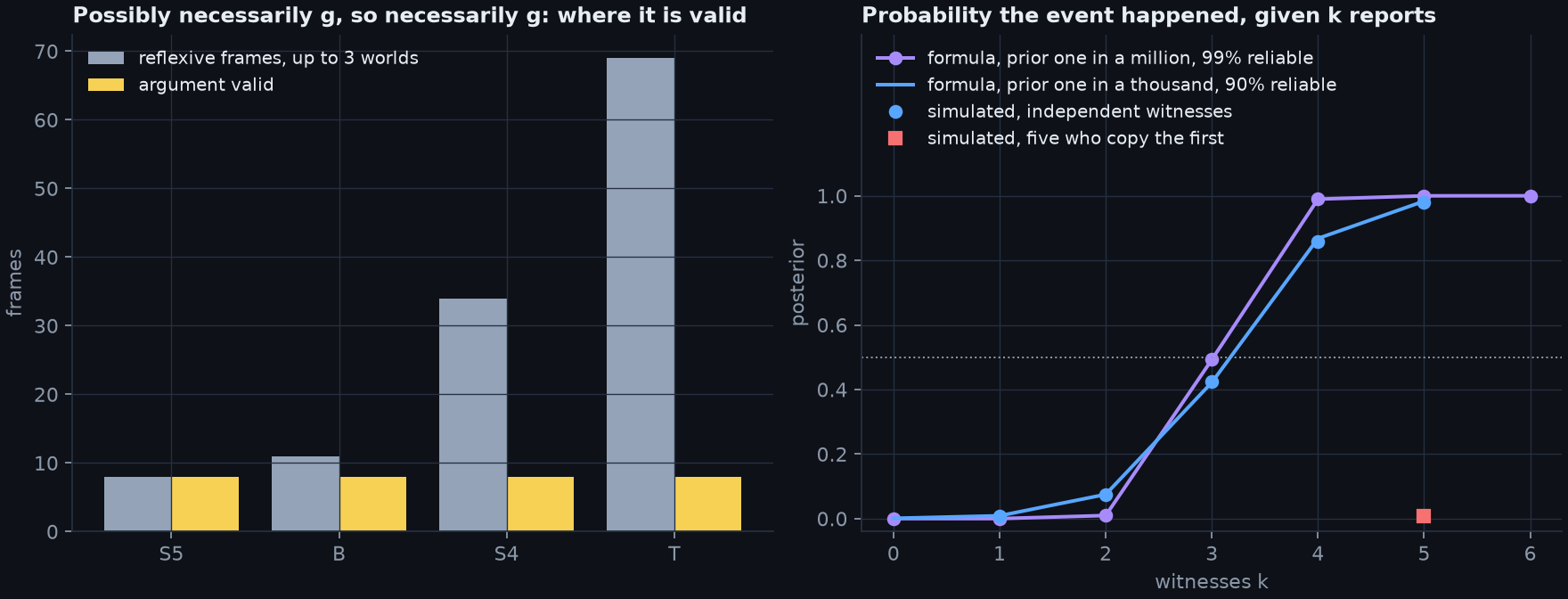
The Reasoner checks this, not with a proof but on models. It generates every reflexive frame with up to three worlds and tests the formula under every valuation. Line two holds on all eight S5 frames, and on only eight of the thirty-four S4 frames: without symmetry, a world can see a world where g is necessary while g fails elsewhere. The conclusion that g is actual needs only the B axiom, symmetry: it holds on every B frame. So the logic is impeccable, provided metaphysical necessity obeys S5, and most philosophers think it does.
But the logic cuts both ways. Start instead from the premise that possibly no maximally excellent being exists. In S5 that entails that it is not possible that one exists necessarily, and so that maximal greatness is impossible. The Reasoner finds the mirror argument valid on every S5 frame too. Each premise seems conceivable, yet in S5 they cannot both be true: one of them is necessarily false. So the argument transfers all its force to the possibility premise, and anyone who doubts the conclusion has equal reason to doubt it. Plantinga himself did not claim a proof. He claimed that the argument shows that belief in God is rationally acceptable, for someone who finds the premise compelling.
What it establishes: Plantinga (1974); Malcolm (1960); Hartshorne (1962).; Computed on screen: the argument and its mirror on every small frame
3Gödel's proof, checkedResearch3 min
Kurt Gödel worked on an ontological proof for decades; a two-page note of 1970 was published only in 1987, after his death. It is a proof in higher-order modal logic, about properties. The undefined notion is a positive property. Of a property and its negation, exactly one is positive. Whatever a positive property necessarily entails is positive. Something is God-like if it has every positive property, and being God-like is itself positive. An essence of a thing is a property that necessarily entails every property the thing has. A thing exists necessarily if every essence of it is necessarily exemplified; and necessary existence is positive. From these Gödel derived that, necessarily, a God-like being exists.
Can the Reasoner check a proof in higher-order logic? On finite models it can. Take two worlds and two individuals: four cells, each an individual at a world. A property is any set of cells, which says which individuals have it at which worlds; there are sixteen. Positiveness is a set of properties. Axiom one forces it to contain exactly one property from each complementary pair, so there are two hundred and fifty-six candidates. Necessity is truth at every world; the quantifier ranges over the individuals. Then the Reasoner tests every axiom, on every candidate, for every small model: one world or several, one individual or several.
Here is the search. Gödel's axioms, exactly as in his note: across every model with up to four cells, not a single one satisfies them. They are inconsistent. The reason is a missing clause. Gödel's definition of essence does not require the thing to have the property, so the empty property counts as an essence of everything; nothing exemplifies it, so nothing exists necessarily; and then necessary existence is the empty property, which cannot be positive. Christoph Benzmüller and Bruno Woltzenlogel Paleo found this in 2016 with automated theorem provers. Dana Scott's version adds the clause. Now models exist, and in each there is exactly one God-like being. But look at the worlds column. Every model the Reasoner finds for Scott's axioms has a single world.
A single world means that whatever is true is necessary. That is modal collapse, and Jordan Howard Sobel proved it from Scott's axioms in 1987: this is the twenty-third brick in the Wall. The dream: a proof of God from the mere possibility of perfection. The wall: the axioms that deliver God also deliver that every truth is necessary. Nothing could have been otherwise: not your birth, not this sentence. What it forces: weaken the axioms, as Anderson and Fitting did, and lose some of the proof's power; or accept that everything true is necessary, which almost no one, theist or atheist, will do.
What it establishes: Gödel (1970, published 1987); Scott; Sobel (1987); Benzmüller and Woltzenlogel Paleo (2016); Anderson; Fitting; the Wall's twenty-third brick.; Computed on screen: every finite model of Gödel's and Scott's axioms
4First causes and contingencyIntroductory4 min
Thomas Aquinas, in the Summa Theologiae, offered five ways. From motion: whatever is moved is moved by another, so there is a first, unmoved mover. From efficient causes: there cannot be an infinite chain of them, so there is a first cause. From contingency: not everything can be merely possible, so there is a necessary being. From gradation: more and less good point to a maximum. From governance: things without minds act for ends, so an intelligence directs them. Each way ends with the same line: and this everyone understands to be God. The first three are cosmological, and the third is the most interesting logically.
The third way argues like this. Each contingent thing, at some time, does not exist. So, if everything were contingent, at some time nothing would have existed; and since nothing comes from nothing, nothing would exist now. The Reasoner builds a relay: eight things, each existing for three moments, their lives overlapping like runners passing a baton. Every one of them fails to exist at some time; true. But there is no time at which nothing exists; false. The step from each thing being absent at some time to some time at which everything is absent swaps the order of the quantifiers, and it is invalid. Aquinas also leaned on the principle that in infinite time every possibility is realized. Repaired, the argument becomes Leibniz's: grant the relay; why is there a relay at all?
Aquinas's first and second ways rest on a distinction often missed. A hand moves a stick, which moves a stone. The stick moves the stone only while the hand moves the stick: the series is ordered per se, all at once. A grandparent begets a parent, who begets a child; the grandparent may be long gone. That series is ordered per accidens. Aquinas thought reason could not rule out an infinite series of the second kind; a world without a beginning was, he said, not impossible. But a series of the first kind needs a first member, because the intermediaries have only borrowed power. So his first cause is a sustaining cause, holding things in being now, not a first event long ago. Critics ask why there could not be an infinite chain of borrowers, each sustained by the next.
Leibniz's argument from contingency is the strongest of the cosmological family. Every fact has a sufficient reason why it is so and not otherwise. The world, the whole series of contingent things, is a fact. Its reason cannot lie inside the series, since each member is contingent and needs a reason itself. So it lies outside, in a necessary being, which carries the reason for its existence within itself. In Hume's Dialogues, Cleanthes objected that if you have explained each member of a series, you have explained the whole. Paul Edwards's example: five Inuit standing on a corner in New York. Explain why each is there, and nothing remains to explain about the group. Everything rests on the first premise, the principle of sufficient reason.
What it establishes: Aquinas (1270); Leibniz (1714); Hume (1779); Edwards (1959).; Computed on screen: a countermodel to the third way
5The principle of sufficient reasonResearch3 min
Leibniz stated the principle in the Monadology. No fact can be real or existing, no statement true, unless there is a sufficient reason why it is so and not otherwise. Its appeal is obvious: science, detective work and ordinary life all assume that things have explanations, and we are rightly suspicious of anyone who says that something just happened, for no reason. Spinoza took it all the way: in nature, he wrote, there is nothing contingent. The question is whether the principle can hold for every truth, including the biggest one.
Peter van Inwagen showed what the full principle costs. Let p be the conjunction of all contingent truths: the big conjunctive contingent fact. By the principle, some truth q explains it; and suppose, as Leibniz did, that a sufficient reason entails what it explains. If q is necessary, then p, which q entails, is necessary too, contradicting the fact that p is contingent. If q is contingent, then q is one of the contingent truths, a conjunct of p itself, and p would be explaining itself. Nothing explains itself. So if the principle holds without exception, there are no contingent truths at all: everything is necessary. The cosmological argument's best premise implies modal collapse, the same wall Gödel's proof ran into.
The Reasoner checks the argument on finite spaces of worlds. Propositions are sets of worlds. The conjunction of all truths at the actual world is the proposition true there and nowhere else. An explanation of it must be true, must entail it, and must not be it. With one world there is nothing contingent to explain. With two, three or four worlds there are contingent truths, and the number of propositions that could explain the big fact is zero every time, because the only true proposition that entails it is itself. So the principle can hold only if there is one world: everything true is necessary.
There are ways out. Alexander Pruss denies that explanation must entail: a free choice, or a chance event, can explain what follows without necessitating it. Then God's free choice could explain the world while the world stays contingent. Or restrict the principle: every contingent being has a cause, without every truth having an explanation. Or accept the collapse, as Spinoza did and as Michael Della Rocca defends: rationalism all the way down, and necessity everywhere. Or accept brute facts: some truths have no explanation; the world is just this way. The lesson is the one Gödel's proof taught: the strongest premises for theism often cost modal collapse, and the price has to be checked.
What it establishes: Leibniz; Spinoza (1677); van Inwagen (1983); Pruss (2006); Della Rocca (2010).; Computed on screen: explainers of the big conjunctive contingent fact
6Did the universe begin?Advanced3 min
A different cosmological argument comes from the kalām, the dialectical theology of medieval Islam. Whatever begins to exist has a cause. The universe began to exist. So the universe has a cause. William Lane Craig revived it in 1979. Its great medieval champion was al-Ghazālī, arguing against Avicenna and the Aristotelian thesis that the world had no beginning. Everything turns on the second premise, and it has two kinds of defence: that an actually infinite past is impossible, and that physics shows a beginning.
Al-Ghazālī's argument against an infinite past used the planets. Each year the sun goes round once; Jupiter, roughly, once in twelve years; Saturn once in thirty. Over any finite past the counts keep their proportions: in six thousand years, five hundred revolutions of Jupiter and two hundred of Saturn. But if the past were infinite, both would have made infinitely many revolutions, and the same number, though one turns two and a half times as fast as the other. Al-Ghazālī took that to be absurd; and he asked whether the number of revolutions is odd or even. After Cantor, and Part 6, we can say: it is not absurd, only infinite. A part of an infinite set can have as many members as the whole.
The philosophical defence says that an actual infinite cannot exist. Craig's version uses Hilbert's hotel from Part 6. If the guests in the odd-numbered rooms check out, infinitely many remain; if all guests above room three check out, three remain. The same number has left in both cases, yet different numbers remain: absurd, says Craig, so no actual infinite can exist. Mathematicians reply that transfinite subtraction is simply undefined, like division by zero; set theory has no contradiction here. The second defence asks whether an infinite series can be completed by adding one member after another, as the years of an infinite past would have to be. Bertrand Russell's Tristram Shandy takes a year to write up each day of his life. Given an infinite past, is the autobiography finished? Philosophers have argued both ways.
The scientific defence appeals to cosmology. The universe has expanded from a hot, dense state about thirteen point eight billion years ago. Arvind Borde, Alan Guth and Alexander Vilenkin proved in 2003 that a spacetime which has expanded on average cannot be extended indefinitely into the past. But that is a statement about classical spacetime breaking down, not a proof that there was a first moment. Quantum cosmology offers models without a boundary, like James Hartle and Stephen Hawking's, as well as bouncing and eternal models. And the first premise meets a puzzle of its own: a cause of time itself cannot be a cause that comes before its effect in time, so the familiar notion of cause is being stretched.
What it establishes: al-Ghazālī (1095); Craig (1979); Russell; Borde, Guth and Vilenkin (2003); Hartle and Hawking (1983).; Computed on screen: planetary revolutions over growing pasts
7Design and fine-tuningIntroductory4 min
The teleological argument has had three lives. William Paley: a watch found on a heath implies a watchmaker, and the eye is more intricate than any watch. Hume had already objected that the analogy is weak, that we have one universe and no frequencies of universes made by gods, and that the argument cannot tell us whether the designer is one, or good. Darwin answered the biological version: natural selection makes eyes without foresight, as Part 19 built. Elliott Sober recast what remains as a likelihood argument. Evidence favours design over chance if it is much more probable given design, and only if the design hypothesis really predicts it.
Its third life is physics. Several constants of nature appear to lie in narrow ranges compatible with life: the cosmological constant, the strength of gravity relative to electromagnetism, the energy level in carbon that lets stars make it. Model one constant as a point on a line, and the life-permitting values as a window one thousandth wide. By chance, landing in the window has probability one in a thousand. A designer who wanted life would aim for the window; say, with probability one half. The likelihood ratio, design to chance, is five hundred. On these numbers, life-permitting constants strongly favour design over a single chancy universe.
The usual reply is the multiverse. If there are ten thousand universes with independently chancy constants, it is almost certain that some universe permits life. On the evidence that some universe does, the multiverse fits as well as design, and with equal priors it ends up the most probable hypothesis. But Ian Hacking and Roger White pointed out that our evidence is that this universe permits life, and the chance that this particular universe lands in the window is one in a thousand however many others there are. On that evidence the multiverse does no better than a single chancy universe, and design dominates. Inferring many universes from one fine-tuned universe is the inverse gambler's fallacy: thinking that a double six makes it likely the dice have been thrown many times. Others reply that, since we could only ever observe a life-permitting universe, the correct evidence is that some universe permits life, and then the multiverse is confirmed. The calculation is easy; choosing the evidence is the philosophy.
There are other objections. The measure problem: if a constant could take any of infinitely many values, there is no uniform probability distribution over them, and one in a thousand has no clear meaning. The prediction problem: what would a designer choose? Without independent knowledge of a designer's aims, Sober argues, the probability of the evidence given design is simply unknown. Other values might permit other kinds of life. A deeper physical theory might fix the constants, which would move the question to the laws themselves. And Brandon Carter's anthropic principle reminds us that we could only observe a universe compatible with observers.
What it establishes: Paley (1802); Hume; Darwin; Sober (2003); Hacking (1987); White (2000); McGrew, McGrew and Vestrup (2001); Carter (1974).; Computed on screen: fine-tuning likelihoods and posteriors with a multiverse
8Pascal's wagerIntroductory4 min
Blaise Pascal changed the question: not whether God exists, but whether it is rational to wager that God does. Two acts, two states. If you wager for God and God exists, the reward is infinite: an eternity of happiness. If God does not exist, you have lost some finite pleasures, c. If you wager against, the outcomes are finite either way. Now take expected utilities. For any probability p greater than zero that God exists, the expected utility of wagering for God is p times infinity, which is infinite. Wagering against has a finite expected utility. So, said Pascal, you must wager for God, however improbable you think God is: one in a hundred, or one in a billion.
Alan Hájek found a flaw in the reasoning itself. Consider mixed strategies. Flip a coin, and wager for God if it lands heads. Or wager only if a die shows six; or only if you win the lottery. Each gives some positive probability of ending up wagering for God, and so an expected utility of p times infinity, which is infinite. The Reasoner computes all five strategies: four of them tie at infinity. So wagering for God outright is no better than flipping a coin, or than doing nothing and hoping you are somehow brought to belief. The deeper lesson is about decision theory: when one outcome is infinitely good, infinity swamps the probabilities, and expected utility can no longer rank the options.
Pascal is not the only place where infinity breaks expected utility. In Daniel Bernoulli's St. Petersburg game, a fair coin is tossed until it lands heads, and if that takes k tosses you win two to the k ducats. The expected prize is a half times two, plus a quarter times four, and so on: one plus one plus one, forever. Infinite. The Reasoner plays the game. After ten games the average prize is about four; after a hundred thousand, about twenty-two. The average creeps up roughly like the logarithm of the number of games, and erratically, since rare huge prizes dominate. No sensible person would pay a large fee to play, though the expectation is infinite. Decision theory with unbounded utilities is fragile, a theme for Part 33.
There are older objections too. The many-gods problem: imagine two jealous gods, each rewarding only those who worship it. Each wager has infinite expected utility, and the matrix cannot choose between them. Belief is not chosen like an action. Pascal answered that one can act as if one believed, take holy water, have masses said, and belief will follow. Would a just God reward belief adopted as a bet? William James defended a cousin of the wager: when a choice between beliefs is live, forced and momentous, and the evidence cannot decide it, we may let our passional nature choose. He was answering W. K. Clifford, who held that it is wrong always, everywhere, and for anyone, to believe anything upon insufficient evidence.
What it establishes: Pascal (1670); Hájek (2003); Bernoulli (1738); James (1896); Clifford (1877).; Computed on screen: five strategies' expected utilities; the St. Petersburg game
9The logical problem of evilIntroductory3 min
Part 2 opened the series' first Price List with this problem. J. L. Mackie's version: God exists; God is omnipotent; omniscient; wholly good; a good being that knows and can will always prevent evil; and there is evil. The Reasoner confirms that the six are jointly unsatisfiable, and that dropping any one of them restores consistency. Mackie concluded that theism is not merely unsupported but positively irrational: its central beliefs contradict one another. The question is which claim a theist can give up at an acceptable price.
Alvin Plantinga's free-will defence gives up Mackie's bridge principle and replaces it with a weaker one. A good being prevents every evil it can, unless preventing it would lose a greater good. A world with significantly free creatures, who freely do good, is better than a world without them. But it may be that in every world God could actualize containing free creatures, some of them do wrong. Plantinga called this transworld depravity: God cannot make free creatures freely do only good, since then they would not be free. Add that there is evil, and ask the Reasoner for a model. There is one: every claim true together. That is all a defence needs. It need not be true, only possible, to show that God and evil are consistent. A theodicy, by contrast, claims to give God's actual reason. Most philosophers, including many atheists, now agree that the logical problem, in Mackie's form, has been answered.
Picture the idea. Each island is a world God could bring about by creating free people and putting them in circumstances. In every one of them, someone freely goes wrong at least once. Which of these worlds is actual depends on what the free creatures would freely do in each situation: on counterfactuals of freedom. On Luis de Molina's theory of middle knowledge, God knows these counterfactuals but does not make them true; if he did, the creatures would not be free. Robert Adams objected that nothing could make such counterfactuals true before the creatures exist, so there is nothing there for God to know. The defence is consistent; whether its metaphysics is coherent is still debated.
Free will does not obviously cover everything. Earthquakes and cancers are not chosen by any creature. Plantinga noted that, for a defence, it is enough that they might be caused by free non-human persons: consistent, if not plausible. Richard Swinburne argued that a world of regular natural laws is needed for free action to have predictable consequences, and regular laws bring natural evils with them. John Hick's soul-making theodicy: a world without suffering could not grow courage, compassion or patience. And so the debate turned. Perhaps consistency is not the issue. How probable is God, given this much evil, and evil of these kinds?
What it establishes: Mackie (1955); Plantinga (1974); Molina (1588); Adams (1977); Swinburne; Hick (1966).; Computed on screen: Mackie's set and the free-will defence's model
10The evidential problem of evilAdvanced4 min
William Rowe's evidential argument does not claim a contradiction. There exist instances of intense suffering which an omnipotent, omniscient being could have prevented without thereby losing some greater good. An omniscient, wholly good being would prevent any such suffering, unless it could not. So there is no such being. His example: in a distant forest, lightning strikes a tree; a fawn is trapped in the fire, horribly burned, and dies after days of agony, unseen by anyone. Rowe does not claim to prove premise one. He argues that it is reasonable to believe it, because we can see no good that the fawn's suffering serves.
The evidential argument is naturally Bayesian. Let E be the evidence: suffering like the fawn's, with no good we can see that it serves. The probability of God given E depends on how probable E is if God exists, compared with how probable it is if God does not. Start from a prior of one half, and say E is very probable without God: nine in ten. If E is improbable given God, five in a hundred, the posterior falls to about one in twenty. If E is about as probable given God as without, the posterior barely moves. Everything turns on one number: the probability of unexplained suffering if there is a God.
The debate is a Price List. God exists. A perfect being would permit no evil that serves no greater good. The fawn's agony serves no greater good that we can see. And if an evil served a greater good, we would probably see it. All four cannot hold. Rowe gives up God. Peter van Inwagen gives up the second claim: for any amount of evil God permits, slightly less would have served as well, so there is no sharp line, and God may permit some evils that serve nothing in particular. Theodicists deny the third: we can see the goods, such as freedom, soul-making, and regular natural laws. Skeptical theists, following Stephen Wykstra and Michael Bergmann, deny the fourth. If God's reasons concern goods beyond our ken, we would not expect to see them; our failing to see a reason is no evidence that there is none.
Skeptical theism has its own price. Wykstra's condition, CORNEA: the claim that I see no reason supports the claim that there is none only if I would see a reason if there were one. But if we cannot judge God's reasons here, can we judge them anywhere? Critics fear a moral paralysis: we could never be confident that preventing a harm is good. And the ignorance cuts both ways: there may be evils beyond our ken as well as goods. Paul Draper argued that the overall pattern of pleasure and pain in nature is far more probable on the hypothesis of indifference than on theism. No knock-down argument stands on either side. The debate is now about likelihoods, exactly where the Bayesian picture put it.
What it establishes: Rowe (1979); van Inwagen (2006); Wykstra (1984); Bergmann (2001); Draper (1989); the evidential problem as a Price List.; Computed on screen: Rowe's posterior as a function of P(E given God)
11Hume on miraclesIntroductory3 min
In section ten of the Enquiry, David Hume argued that testimony can never make it reasonable to believe in a miracle. A miracle is a violation of a law of nature, and against it stands the whole of our uniform experience. So, Hume concluded, no testimony is sufficient to establish a miracle unless its falsehood would be more miraculous than the fact it tries to establish. Richard Price, the same Price who published Bayes's essay, answered him in 1767. In Bayesian terms Hume's maxim compares two products: the probability of the testimony if the miracle happened, times the prior of the miracle; and the probability of the testimony if it did not, times the prior of no miracle.
Put numbers on it. Let the prior probability of the miracle be one in a million. Let each witness be very reliable: if the miracle happened, they report it ninety-nine times in a hundred; if it did not, they falsely report it only once in a hundred. After one such witness the probability of the miracle is about one in ten thousand. Hume is right: one excellent witness is nowhere near enough. But add witnesses whose errors are independent. Each multiplies the odds by ninety-nine. With four, the miracle becomes more probable than not. So Hume's maxim is sound for a single witness, and wrong as a claim about testimony in principle. Charles Babbage made this point in 1837, and John Earman's book of 2000 called Hume's argument an abject failure.
Hume's caution still bites, in the second part of his essay. Witnesses who talk to each other, or who share a hope, are not independent, and correlated errors do not multiply away. Hume pointed to the love of wonder, to stories that grow in the telling, and to the miracles of rival religions, which cancel each other out. And the prior is disputed: how improbable a resurrection is depends on whether there is a God who might raise the dead. So Hume's argument is not a proof but a calculation, with disputed inputs. The same mathematics governs every judgment about independent sources: how forecasts combine, how clinical trials replicate, how journalists confirm a story.
What it establishes: Hume (1748); Price (1767); Babbage (1837); Earman (2000).; Computed on screen: the posterior against the number of witnesses
12Foreknowledge and the open futureResearch3 min
If God knows everything, God knows the future, including what I will freely do. Does that leave me free? Yesterday God knew that I would mow the lawn today. The past is now fixed: nothing I can do will make it the case that God did not know it. And necessarily, if God knew it, it is true, since knowledge implies truth. So nothing I can do will make it false that I mow the lawn. So I do not mow freely, if freedom requires being able to do otherwise. The argument is old, and Part 32 will meet its secular twin, fatalism.
There are four classic answers. Boethius, writing in prison around 524, said that God is not in time. God sees all times at once, as we might watch a man walking, and seeing a man walk does not make him walk. William of Ockham: God's past belief is a soft fact, partly about the future, so it is not fixed in the way a hard fact about the past is. Molina's middle knowledge, from chapter nine: God knows what I would freely do in every circumstance. Open theists deny that future free actions are there to be known; God knows all that can be known, and the free future cannot. Behind all of them stands Aristotle's sea battle: is it true today that there will be a sea battle tomorrow?
Arthur Prior turned the sea battle into logic, and the Reasoner builds his two semantics. Time branches: from today there is a history with a sea battle tomorrow and one without. On the Peircean reading, it will be that p means that p happens on every branch. Then it will be that there is a battle is false, it will be that there is no battle is also false, and so is their disjunction; though it will be that there is a battle or no battle is true. On the Ockhamist reading, truth is relative to a history. On the first history, there will be a battle; on the second, there will not; on each, one of the two is true. But neither is settled: what is true on every history is only the disjunction. Ockhamism gives God something to foreknow, truths relative to the history that will be actual, without making them settled now.
Where does it leave us? Choose your logic of tense, and you have chosen whether statements about the free future have truth values now. Ockhamists and Molinists keep full foreknowledge; open theists keep an open future, and a God who learns. Physics may take sides: the block universe of relativity, in Part 25, makes every future event as real as every past one. And Harry Frankfurt asked whether freedom needs the ability to do otherwise at all, a question for Part 32.
What it establishes: Boethius (524); Ockham; Molina; open theism; Prior (1967); Frankfurt (1969).; Computed on screen: the sea battle in Peircean and Ockhamist time
13Faith, experience and disagreementAdvanced4 min
Perhaps belief in God does not need an argument at all. The evidentialist, from Clifford on, says that it does: a rational belief in God must be based on good arguments. Plantinga's reformed epistemology replies that belief in God can be properly basic, like belief in other minds or in the past. No one has a proof that other people are conscious, as Part 30 will show; yet the belief is rational. On Plantinga's account a belief is warranted if it is produced by cognitive faculties working properly, in the right environment, aimed at truth: a cousin of Part 11's reliabilism. If God exists and made us to know him, belief in God may be warranted; if not, probably not. Critics ask why, then, belief in the Great Pumpkin could not be basic too. The reply is that only beliefs formed by properly working faculties count; which beliefs those are is the very question at issue.
A second line appeals to experience. We trust our senses without any independent proof that they are reliable; any such proof would itself use the senses. Millions of people report experiences of God's presence. William Alston argued that a socially established practice of forming beliefs is rational to engage in unless it has been shown to be unreliable, and that Christian mystical practice is such a practice. Richard Swinburne's principle of credulity says the same more simply: how things seem is evidence for how they are, unless there is reason for doubt. The objections: religious experience lacks the cross-checks that vision has, where others can look too; and rival traditions report experiences of rival gods, or of no god.
Experience cuts the other way too. J. L. Schellenberg's argument from divine hiddenness: a perfectly loving God would always be open to a personal relationship with each of us. So such a God would make sure that no one who is not resisting fails to believe that God exists, since belief is a precondition of the relationship. But there are nonresistant nonbelievers: honest seekers, and whole peoples who never heard of God. So there is no perfectly loving God. Replies say that freedom needs epistemic distance, as John Hick held; that belief is not yet relationship; or, again, that God may have reasons beyond our ken. It is an argument from absence: the evidence it appeals to is the persistence of reasonable unbelief, including the debates of this part.
Finally, disagreement. Thoughtful, informed people, equally intelligent and equally sincere, disagree about God. Part 12 asked what you should do when an epistemic peer disagrees with you. Conciliationists say: move towards them; on a question this contested, suspend judgment. Steadfast views say that your evidence includes how things seem to you, which your peer lacks. John Hick proposed religious pluralism: the great traditions as different human responses to one ultimate reality. Exclusivists reply that the existence of disagreement does not make truth relative; someone may simply be right.
What it establishes: Plantinga (2000); Alston (1991); Swinburne; Schellenberg (1993); Hick (1989).
14Arguments beyond the WestAdvanced3 min
Philosophy of religion is not only a Western conversation. In India, the Nyāya school built arguments for a creator, Īśvara, on its theory of inference. Udayana, around 984, argued: the earth is an effect, like a pot, so it has a maker who knows its materials. At creation the atoms combine, and something must set them moving. The world is held in place and will one day be dissolved, which requires a sustaining will. These are design and cosmological arguments, framed in Nyāya's careful theory of inference from signs. Udayana answered objections: the makers of pots have bodies and are many; Īśvara has no body and is one, so the analogy fails there. He argued that such differences are irrelevant to the inference.
Buddhist philosophers argued the other way. Dharmakīrti, in the seventh century, posed a dilemma for a permanent creator. The creator is permanent, unchanging at every moment. It is by itself a sufficient cause of the world's events. Those events arise one after another, not all at once. And an unchanging sufficient cause would produce all its effects at once, since nothing about it is different at one moment from another. The four claims are inconsistent, and the Reasoner shows that giving up any one of them restores consistency. Dharmakīrti concluded that nothing permanent can cause a changing world. The Nyāya reply gave up the second claim: God's will operates together with other conditions, the merits of beings, the seasons, the materials, and those conditions change.
Avicenna, the Persian philosopher Ibn Sīnā, gave the contingency argument its classic form, five centuries before Leibniz. Every existent is, considered in itself, either necessary or merely possible. A merely possible existent exists only through something else that makes it exist. The whole collection of possible existents is itself possible, so it too needs a cause. That cause cannot be inside the collection; so there is a Necessary Existent, which exists through itself. Unlike the kalām, the argument needs no beginning in time. Avicenna held the world to be eternal, yet eternally dependent; it was al-Ghazālī who objected, and argued for a beginning.
Some traditions answer Leibniz's question without a person at all. The Daodejing opens: the Dao that can be told is not the constant Dao. The Dao gives rise to the ten thousand things without intending, ruling or owning them. It is a ground that is not an agent; compare Spinoza's God or Nature. Buddhist dependent arising, from Part 21, offers no first cause, only conditions. Most of the arguments in this part assume that the answer, if there is one, is a person. These traditions question that assumption.
What it establishes: Udayana (984); Dharmakīrti (c. 640); Avicenna (1037); the Daodejing.; Computed on screen: Dharmakīrti's four claims checked
Recap, problems, and where this comes backAll tracks2 min
Let's gather what we built. Anselm's argument, valid as a reductio, with its parody and Kant's objection. Plantinga's modal argument, valid on every S5 frame, and its mirror image, equally valid. Gödel's proof in a finite higher-order modal logic: his own axioms have no model, and Scott's have models only with one world, the modal collapse that is this part's brick in the Wall. The cosmological arguments, a countermodel to the third way, and van Inwagen's collapse of the principle of sufficient reason. The kalām and the infinite; fine-tuning, with and without a multiverse. Pascal's wager and the trouble with infinity. The problem of evil, logical and evidential. Hume on miracles, branching time, and arguments from India and the Islamic world.
The Reasoner has a new module, theism. It checks the modal ontological argument on every small frame, searches every finite model of Gödel's and Scott's axioms, tests the principle of sufficient reason on spaces of worlds, builds a countermodel to the third way, computes fine-tuning likelihoods with a multiverse, Pascal's expected utilities, Rowe's and Hume's posteriors, and Prior's branching time. And the Wall has its twenty-third brick.
Six problems, with full solutions in this part's notes. Formalize Gaunilo's island; find the frame that breaks the modal argument; show what goes wrong in Gödel's essence; rescue the wager from mixed strategies; balance Rowe's likelihoods; and model correlated witnesses for Hume. Pause here, and try them.
Where this comes back. Time, its arrow, and the beginning of the universe, in Parts 24 and 25. Quantum cosmology and many worlds, in Part 26. Consciousness, souls and other minds, in Parts 30 and 31. Freedom and fatalism, in Part 32. Decisions with infinite stakes, in Part 33. Whether morality needs God, in Parts 35 and 37. And value over the very long future, in Parts 36 and 42. Next, Part 24: laws, chance, and the arrow of time.
The books and papers this part follows are on screen, and in the notes. Thanks for watching.
Where it goes next. The beginning of the universe and the arrow of time return in Parts 24 and 25, fatalism and freedom in Part 32, decisions with infinite stakes in Part 33, whether morality needs God in Parts 35 and 37, and value over the very long future in Parts 36 and 42.
Key results
The part's results in one place, for revision.
Try it
Lab 23 · Proofs on frames, miracles by witnesses
Count the frames on which Plantinga's argument and its mirror image are valid, search the finite models of Gödel's and Scott's axioms, and simulate a rare event reported by one to five witnesses, independent or copying one another, against the Bayesian formula.
python -m videos.philosophy.labs 23
needs numpy, scipy, matplotlib · download lab23.py ·
source on GitHubargument valid on S5 / S4 / T frames 8 of 8 / 8 of 34 / 8 of 69 (film: 8 of 8, 8 of 34)
models of Gödel's own axioms 0 among 810 candidates
models of Scott's axioms 10, all with 1 world and one God
1 independent witness 0.0089 (formula 0.0089)
3 independent witnesses 0.4250 (formula 0.4219)
4 independent witnesses 0.8573 (formula 0.8679)
5 witnesses copying the first 0.0089 (one witness: 0.0089)
The modal argument is exactly as strong as S5 and proves its mirror image as well; and testimony overcomes a tiny prior only when the witnesses are independent, since copies multiply nothing.The code (86 lines; it asserts its own result)
"""Lab 23: check the modal ontological argument on every small frame, and Hume's maxim on simulated witnesses."""

import numpy as np

from videos.coursekit import labs
from explainer.philosophy.reasoner import theism

TITLE = "Proofs on frames, miracles by witnesses"
GOAL = ("Count the frames on which Plantinga's argument and its mirror image are valid, search the finite models of "
        "Gödel's and Scott's axioms, and simulate a rare event reported by one to five witnesses, independent or "
        "copying one another, against the Bayesian formula.")
TASKS = [
    "Make the witnesses less reliable (HIT = 0.8, FALSE = 0.2). How many independent witnesses does a "
    "one-in-a-thousand event now need to pass one half?",
    "Call theism.plantinga(max_worlds=4) and check whether the argument is still valid on exactly the S5 frames.",
    "Set COPY = 0.5, so that half of the later witnesses repeat the first. Derive the likelihood ratio of k reports "
    "and compare it with the simulation.",
]

PRIOR, HIT, FALSE, COPY = 1e-3, 0.9, 0.1, 1.0


def run(seed=0):
    rng = np.random.default_rng(seed)
    lab = labs.Lab()

    frames = theism.plantinga()
    arg = {s: frames[s]["argument"] for s in frames}
    lab.row("argument valid on S5 / S4 / T frames", " / ".join(f"{arg[s]['valid_on']} of {arg[s]['frames']}"
                                                                for s in ("S5", "S4", "T")) + "   (film: 8 of 8, 8 of 34)")
    assert arg["S5"] == {"frames": 8, "valid_on": 8} and arg["S4"] == {"frames": 34, "valid_on": 8}
    assert frames["S5"]["mirror"]["valid_on"] == 8, "the mirror image is valid wherever the argument is"
    assert frames["B"]["conclusion"]["valid_on"] == frames["B"]["conclusion"]["frames"], "the conclusion needs only B"

    g = theism.godel()
    n_godel = sum(r["models"] for r in g["godel"])
    scott = [r for r in g["scott"] if r["models"]]
    lab.row("models of Gödel's own axioms", f"{n_godel} among {sum(r['candidates'] for r in g['godel'])} candidates")
    lab.row("models of Scott's axioms", f"{sum(r['models'] for r in scott)}, all with "
            f"{max(r['worlds'] for r in scott)} world and one God")
    assert n_godel == 0, "Gödel's axioms are inconsistent"
    assert scott and all(r["worlds"] == 1 and r["collapse"] == r["models"] == r["one_god"] for r in scott), "modal collapse"

    # Hume: a rare event, k witnesses; every world in which all k report, and the share of those where it happened
    n, ks = 3_000_000, np.arange(1, 6)
    happened = rng.random(n) < PRIOR
    rate = np.where(happened, HIT, FALSE)
    reports = rng.random((5, n)) < rate
    all_report = np.cumprod(reports, axis=0).astype(bool)
    sim = np.array([happened[all_report[k - 1]].mean() for k in ks])
    exact = np.array([r["posterior"] for r in theism.hume(PRIOR, HIT, FALSE, 5)["rows"]][1:])
    first = reports[0]
    copied = np.where(rng.random((4, n)) < COPY, first, reports[1:])
    all_copied = np.vstack([first, copied]).all(axis=0)
    sim_copy = happened[all_copied].mean()
    for k in (1, 3, 4):
        lab.row(f"{k} independent witness{'es' if k > 1 else ''}", f"{sim[k - 1]:.4f}   (formula {exact[k - 1]:.4f})")
    lab.row("5 witnesses copying the first", f"{sim_copy:.4f}   (one witness: {exact[0]:.4f})")
    assert np.all(np.abs(sim - exact) < 0.03), "the simulation matches Bayes's rule"
    assert abs(sim[0] - exact[0]) < 0.002 and abs(sim_copy - exact[0]) < 0.002, "copied testimony adds nothing"
    assert exact[2] < 0.5 < exact[3]
    film = theism.hume()
    assert film["first_over_half"] == 4 and abs(film["rows"][1]["posterior"] - 1e-4) < 2e-6
    lab.note = ("The modal argument is exactly as strong as S5 and proves its mirror image as well; and testimony "
                "overcomes a tiny prior only when the witnesses are independent, since copies multiply nothing.")

    fig, ax = labs.figure(2, size=(11, 4.2))
    systems = ["S5", "B", "S4", "T"]
    x = np.arange(4)
    ax[0].bar(x - 0.2, [arg[s]["frames"] for s in systems], 0.4, color=labs.GREY, label="reflexive frames, up to 3 worlds")
    ax[0].bar(x + 0.2, [arg[s]["valid_on"] for s in systems], 0.4, color=labs.GOLD, label="argument valid")
    ax[0].set_xticks(x, systems)
    ax[0].set(title="Possibly necessarily g, so necessarily g: where it is valid", ylabel="frames")
    ax[0].legend()
    k6 = np.arange(0, 7)
    ax[1].plot(k6, [r["posterior"] for r in film["rows"]], "o-", color=labs.PURPLE,
               label="formula, prior one in a million, 99% reliable")
    ax[1].plot(np.r_[0, ks], np.r_[PRIOR, exact], "-", color=labs.BLUE, label="formula, prior one in a thousand, 90% reliable")
    ax[1].plot(ks, sim, "o", color=labs.BLUE, label="simulated, independent witnesses")
    ax[1].plot([5], [sim_copy], "s", color=labs.RED, label="simulated, five who copy the first")
    ax[1].axhline(0.5, color=labs.MUTED, ls=":", lw=0.9)
    ax[1].set(title="Probability the event happened, given k reports", xlabel="witnesses k", ylabel="posterior",
              ylim=(-0.04, 1.5), yticks=np.linspace(0, 1, 6))
    ax[1].legend(loc="upper left")
    lab.fig = fig
    return lab
Now change it
- Make the witnesses less reliable (HIT = 0.8, FALSE = 0.2). How many independent witnesses does a one-in-a-thousand event now need to pass one half?
- Call theism.plantinga(max_worlds=4) and check whether the argument is still valid on exactly the S5 frames.
- Set COPY = 0.5, so that half of the later witnesses repeat the first. Derive the likelihood ratio of k reports and compare it with the simulation.
Problems, with solutions
Try each problem before opening its solution.
-
Formalize Gaunilo's island in Anselm's form. Which premise does Plantinga's reply reject?
Solution
Gaunilo's parody, in Anselm's form: (1) the island than which no greater island can be conceived exists in the understanding; (2) if it existed only in the understanding, a greater island could be conceived, one existing in reality as well; (3) so it exists in reality. Each step copies Anselm's, and the conclusion is absurd. Plantinga's reply rejects premise (1) as stated: there is no such island to conceive, because island-greatness has no intrinsic maximum (one more palm tree, one more dancing girl, always makes a greater island), so the description is incoherent. Maximal greatness, he claims, does have a maximum, so the parody does not carry over.
-
Find a T frame on which \(\Diamond\Box g \to \Box g\) fails. Which world falsifies it?
Solution
Take two worlds: \(w_1\) sees itself and \(w_2\), and \(w_2\) sees only itself, so the frame is reflexive (T) but not symmetric. Let \(g\) be true at \(w_2\) and false at \(w_1\). At \(w_2\), \(\Box g\) holds, since \(w_2\) sees only itself. So at \(w_1\), \(\Diamond\Box g\) holds (\(w_1\) sees \(w_2\)). But \(\Box g\) fails at \(w_1\), which sees itself, where \(g\) is false. So \(w_1\) falsifies \(\Diamond\Box g \to \Box g\); this is why the modal argument needs symmetry (B), or S5.
-
Show that Gödel's definition of essence makes the empty property an essence of everything.
Solution
Gödel defined: \(\varphi\) is an essence of \(x\) if every property \(\psi\) that \(x\) has is necessarily entailed by \(\varphi\): \(\forall\psi\,(\psi(x) \to \Box\forall y\,(\varphi(y) \to \psi(y)))\). Take the empty property \(E(y) := y \ne y\). Nothing has \(E\) at any world, so \(\Box\forall y\,(E(y) \to \psi(y))\) holds for every \(\psi\), and the definition is met: \(E\) is an essence of everything. Since Gödel's definition omits the clause "and \(x\) has \(\varphi\)", nothing stops this. Then necessary existence (every essence of \(x\) is necessarily exemplified) fails for everything, because \(E\) is never exemplified; so necessary existence is empty, and the axiom that it is positive contradicts the axiom that positive properties are possibly exemplified.
-
Pascal: give a decision rule under which wagering beats flipping a coin. What does it give up?
Solution
Rank options lexicographically: first by the probability of reaching the infinite reward, then by finite expected utility. Wagering outright reaches it with probability \(p\) (if God exists); flipping a coin first gives \(p/2\); waiting for the lottery gives \(p\) times a tiny number. So wagering outright wins. The price is the continuity (Archimedean) axiom of expected utility: any increase in the chance of the infinite prize, however small, outweighs any finite cost, however large. That is fanaticism, and it makes the theory hostage to whoever promises the largest reward. (Surreal or hyperreal utilities, where \(p \cdot \omega > (p/2) \cdot \omega\), encode the same rule.)
-
Rowe: for what value of \(P(E \mid G)\) does the posterior stay at one half?
Solution
With prior one half, the posterior is \(\tfrac12 P(E \mid G) \big/ \big(\tfrac12 P(E \mid G) + \tfrac12 P(E \mid \lnot G)\big)\). It stays at one half exactly when \(P(E \mid G) = P(E \mid \lnot G)\), here 0.9: when unexplained suffering is as likely if there is a God as if there is not. The skeptical theist argues for something near this; Rowe for something far below it.
-
Hume: with correlated witnesses, how many does it take? Model the correlation.
Solution
A simple model: the first witness reports independently; each later witness, with probability \(\rho\), repeats what the others said (a shared source or a shared hope), and otherwise reports independently with the film's reliability (0.99 if the miracle happened, 0.01 if not). Each extra witness then multiplies the odds by \((\rho + 0.99(1 - \rho))/(\rho + 0.01(1 - \rho))\) instead of 99. With the prior at one in a million: independent witnesses (\(\rho = 0\)) make the miracle more likely than not with 4 witnesses; with \(\rho = 0.5\) it takes 15; with \(\rho = 0.9\), 91. As \(\rho \to 1\) no number suffices. Hume's second part is right that correlation, not reliability, is the real obstacle.
Notes and sources
Sources
Texts: Oppy, Arguing about Gods (2006); Mackie, The Miracle of Theism (1982); Swinburne, The Existence of God (2nd ed., 2004); Plantinga, God, Freedom, and Evil (1974) and Warranted Christian Belief (2000); Craig and Moreland (eds.), The Blackwell Companion to Natural Theology (2009); Sobel, Logic and Theism (2004); Pruss, The Principle of Sufficient Reason (2006); Earman, Hume's Abject Failure (2000); van Inwagen, The Problem of Evil (2006); Hájek, "Pascal's Wager" (Stanford Encyclopedia of Philosophy).
Papers and primary texts: Anselm (1078); Aquinas, Summa Theologiae I q. 2 a. 3; al-Ghazālī (1095); Avicenna; Udayana; Dharmakīrti; Boethius (524); Molina (1588); Pascal (1670); Leibniz (1714); Hume (1748, 1779); Kant (1781); Paley (1802); Clifford (1877); James (1896); Mackie (1955); Malcolm (1960); Hick (1966); Prior (1967); Rowe (1979); Craig (1979); van Inwagen (1983); Wykstra (1984); Sobel (1987); Hacking (1987); Draper (1989); Schellenberg (1993); White (2000); Hájek (2003); Borde, Guth and Vilenkin (2003); Benzmüller and Woltzenlogel Paleo (2016).
About this partfrom its README
Part 23 of Philosophy, Built (series plan, syllabus): the philosophy of religion, with every argument's logic checked. What a proof of God would need (valid, sound, not too strong, reaching the right God), and four families of argument. Anselm's Proslogion II as a reductio, checked for validity; Gaunilo's island and Plantinga's reply; Kant's thalers and Frege's second-level existence. Plantinga's modal ontological argument in four lines, checked on every reflexive frame with up to three worlds (valid on all 8 S5 frames, on only 8 of 34 S4 frames; the conclusion needs only B), and its mirror image, equally valid. Gödel's ontological proof formalized in a finite higher-order modal logic (properties as sets of world-individual cells, positiveness as a set of properties): across every model with up to four cells, Gödel's own axioms have no model (Benzmüller and Woltzenlogel Paleo, 2016), and every model of Scott's axioms has one God and a single world, the modal collapse Sobel proved in 1987: the Wall's twenty-third brick. Aquinas's five ways, with a relay of overlapping lifetimes as a countermodel to the third way's quantifier shift; causal series per se and per accidens; Leibniz's argument from contingency, Cleanthes and Edwards's Inuit. The principle of sufficient reason and van Inwagen's collapse argument, checked on finite spaces of worlds (no proposition can explain the big conjunctive contingent fact once there are two worlds), with Pruss's, Spinoza's and Della Rocca's responses. The kalām: al-Ghazālī's planets counted over growing pasts, Hilbert's hotel and Craig's subtraction argument, Tristram Shandy, and what cosmology (Borde, Guth and Vilenkin; Hartle and Hawking) does and does not show. Design: Paley, Hume, Darwin and Sober's likelihoods; fine-tuning with a window of width 0.001 (likelihood ratio 500), a multiverse of 10 000 universes on the evidence that some universe permits life and on the evidence that this one does (Hacking's and White's inverse gambler's fallacy), and the measure and prediction problems. Pascal's wager with infinite utilities, Hájek's mixed strategies (four of five strategies tie at infinity), Bernoulli's St. Petersburg game simulated, many gods, James and Clifford. The logical problem of evil (Part 2's six claims, Mackie) and Plantinga's free-will defence given a model; transworld depravity pictured; Molina and Adams; natural evil. Rowe's fawn as a Bayesian update and the evidential problem as a Price List (Rowe, van Inwagen, theodicy, skeptical theism), CORNEA and Draper. Hume on miracles by the numbers: one witness leaves a one-in-a-million miracle at about one in ten thousand; four independent witnesses make it more probable than not (Price, Babbage, Earman), and why independence matters. Foreknowledge and freedom: Boethius, Ockham, Molina, open theism, and Prior's branching time built (the Peircean and Ockhamist verdicts on the sea battle). Reformed epistemology, Alston's perception of God, Schellenberg's hiddenness argument, and religious disagreement. Udayana's Nyāya proofs, Dharmakīrti's dilemma for a permanent creator (checked for consistency), Avicenna's Necessary Existent, and the Dao.
The worked model results are computed by the Reasoner's new module explainer/philosophy/reasoner/theism.py (with
prop for the consistency checks), tested in tests/philosophy/test_theism.py and cached by
compute.py.
Chapter notes
| # | Scene | What it establishes | Computed on screen |
|---|---|---|---|
| 0 | Hook |
Leibniz (1714); what a proof would need; four families; the plan. | — |
| 1 | Anselm |
Anselm (1078); Gaunilo; Plantinga (1974); Kant (1781); Frege. | Proslogion II checked for validity |
| 2 | Plantinga |
Plantinga (1974); Malcolm (1960); Hartshorne (1962). | the argument and its mirror on every small frame |
| 3 | Godel |
Gödel (1970, published 1987); Scott; Sobel (1987); Benzmüller and Woltzenlogel Paleo (2016); Anderson; Fitting; the Wall's twenty-third brick. | every finite model of Gödel's and Scott's axioms |
| 4 | Cosmos |
Aquinas (1270); Leibniz (1714); Hume (1779); Edwards (1959). | a countermodel to the third way |
| 5 | PSR |
Leibniz; Spinoza (1677); van Inwagen (1983); Pruss (2006); Della Rocca (2010). | explainers of the big conjunctive contingent fact |
| 6 | Kalam |
al-Ghazālī (1095); Craig (1979); Russell; Borde, Guth and Vilenkin (2003); Hartle and Hawking (1983). | planetary revolutions over growing pasts |
| 7 | Design |
Paley (1802); Hume; Darwin; Sober (2003); Hacking (1987); White (2000); McGrew, McGrew and Vestrup (2001); Carter (1974). | fine-tuning likelihoods and posteriors with a multiverse |
| 8 | Wager |
Pascal (1670); Hájek (2003); Bernoulli (1738); James (1896); Clifford (1877). | five strategies' expected utilities; the St. Petersburg game |
| 9 | Evil |
Mackie (1955); Plantinga (1974); Molina (1588); Adams (1977); Swinburne; Hick (1966). | Mackie's set and the free-will defence's model |
| 10 | Evidence |
Rowe (1979); van Inwagen (2006); Wykstra (1984); Bergmann (2001); Draper (1989); the evidential problem as a Price List. | Rowe's posterior as a function of P(E given God) |
| 11 | Miracles |
Hume (1748); Price (1767); Babbage (1837); Earman (2000). | the posterior against the number of witnesses |
| 12 | Foreknow |
Boethius (524); Ockham; Molina; open theism; Prior (1967); Frankfurt (1969). | the sea battle in Peircean and Ockhamist time |
| 13 | Experience |
Plantinga (2000); Alston (1991); Swinburne; Schellenberg (1993); Hick (1989). | — |
| 14 | Traditions |
Udayana (984); Dharmakīrti (c. 640); Avicenna (1037); the Daodejing. | Dharmakīrti's four claims checked |
| 15 | Outro |
recap; the Reasoner's module; the Wall; problems; payoffs; references. | — |
Companion material in this repository
The syllabus's plan for this partfrom SYLLABUS.md, the plan of record
- Anselm's ontological argument (1078); Gaunilo's island; Kant's "existence is not a predicate".
- Plantinga's modal ontological argument in S5, proved valid by the Reasoner; the possibility premise and its mirror image ("possibly God does not exist").
- Gödel's ontological proof (published 1987). Built: formalized in higher-order modal logic and checked; it reproduces the known results (Benzmüller and Woltzenlogel Paleo 2014, 2016) that Gödel's original axioms are inconsistent and that Scott's variant implies modal collapse (□(p ↔ □p)).
- Cosmological arguments: Aquinas's five ways; Leibniz's PSR argument; the Kalam (al-Ghazālī; Craig) and the infinity premises (callback to Part 6's Hilbert hotel).
- The PSR and van Inwagen's modal collapse argument against it.
- Design and fine-tuning: the likelihood argument (Sober); the multiverse reply and the inverse gambler's fallacy (Hacking 1987; White 2000), all computed on a toy model.
- Pascal's wager: decision theory with infinite utility; many gods; Hájek's mixed-strategy objection (2003), computed.
- The logical problem of evil (Mackie 1955) and Plantinga's free-will defense: consistency shown with a model.
- The evidential problem (Rowe 1979) as a Bayesian argument; skeptical theism.
- Hume on miracles (1748): a Bayesian formalization (Earman's "Hume's Abject Failure", and the replies).
- Divine foreknowledge and free will: Boethius's eternity; Ockhamism. Prior's branching-time logic: Ockhamist vs Peircean semantics, built; Aristotle's sea battle resolved in each.
- Religious epistemology: reformed epistemology (Plantinga), religious experience, religious disagreement.
- Non-theistic traditions: Buddhist arguments against a creator (Dharmakīrti); the Dao as non-agential ground.
- Recap and Problems.
Built: reasoner.theism (a small higher-order modal logic, enough for Gödel's proof; Ockhamist and Peircean
semantics for branching time).
Wall: modal collapse in Gödel's and Scott's systems; the symmetry of the modal ontological argument.
Price List: the problem of evil (from Part 2), with each theodicy as a correction set.
Visuals: S5 worlds where God exists in one and therefore all; the modal collapse proof lighting every □;
branching time with Ockhamist "thin red line" vs Peircean all-branches truth.
References: Oppy, Arguing about Gods; Plantinga, The Nature of Necessity; Sobel, Logic and Theism;
Benzmüller and Woltzenlogel Paleo 2014 (ECAI), 2016 (IJCAI); Hájek (SEP), "Pascal's Wager"; Earman, Hume's Abject
Failure; Øhrstrøm and Hasle, Temporal Logic: From Ancient Ideas to Artificial Intelligence.
Build the film
python -m videos.philosophy.philosophy23.compute        # the part's numbers, into .cache/philosophy23
python tools/build.py philosophy23                  # render and assemble the film
EXPLAINER_TTS=silent python tools/qa_scene.py philosophy23 Hook   # one chapter, silent, with a contact sheet
Scenes: videos/philosophy/philosophy23. Setup: see the course page. Source of these notes: the README and the scenes' narration.
Build it
python -m videos.philosophy.philosophy23.compute       # every computed item (seconds; .cache/philosophy23)
python tools/build.py philosophy23 -q l                # 480p preview
python tools/build.py philosophy23                     # 1080p30 -> renders/philosophy23.mp4
python tools/qa_scene.py philosophy23 Godel            # one chapter, silent, with a contact sheet