Space and Time
What are space and time: a container, a web of relations, or something built from neither?
The part opens with Augustine's remark that he knows what time is until he is asked, and with four questions: is space a thing, is its geometry a discovery or a convention, is the present special, and could the past be changed. Newton's bucket and Leibniz's shifts are checked on a universe of six bodies: every distance between bodies survives a shift, a boost and a rotation in time, yet only the last curves the water. Kant's hands, hyperbolic triangles in the Poincaré disk and Poincaré's disk world of shrinking rulers lead to Earman's principle that spacetime should have the symmetries of the laws, which picks Galilean spacetime. Special relativity then tilts the slices of simultaneity, and the Rietdijk-Putnam boost turns that into an argument from the present to the block. The turn is the hole argument: spacetime points with their own identities, determinism, and diffeomorphic models as distinct worlds cannot all be kept, which is the Wall's twenty-fifth brick. The part ends with Barbour's best matching, Deutsch's fixed points for the grandfather and knowledge paradoxes, and, labelled as speculative, a causal set whose dimension is recovered from its order alone.
What you need. School geometry and algebra, including square roots; no physics beyond speed and acceleration is assumed.
- The calculation
- spacetime structures
- The wall
- the hole argument
- Built toy
- Poincaré's disk world; Minkowski diagrams; CTC fixed points
What you will be able to do
Introductory
- State the static and kinematic shift arguments and say why the rotating bucket is not answered by them.
- Find the boost v = t/x that makes a spacelike event simultaneous with here-now, and say why no boost does this for a timelike event.
Advanced
- Compute a hyperbolic triangle's area from its angles, and the measurements a disk-world inhabitant would report for a circle.
- Apply Earman's symmetry principle to Newtonian, Galilean and Leibnizian spacetime.
- Solve Deutsch's consistency condition for a one-bit time-travel circuit.
Research
- Set out the hole argument as an inconsistent triad and state what sophisticated substantivalism and relationalism each give up.
- State Malament's theorem on standard simultaneity and the assumption Sarkar and Stachel drop.
Applied
- Estimate the dimension of a sprinkled causal set from its fraction of related pairs, and say how the estimate's error depends on the number of events.
Contents
Each chapter has a home level. Choose a track to see what to read and watch: Introductory 24 min · Advanced 44 min · Research 50 min · Applied 28 min.
- 0What are space and time?Introductory2 min
- 1Newton's bucketIntroductory3 min
- 2Leibniz and ClarkeIntroductory3 min
- 3Incongruent counterpartsIntroductory3 min
- 4Geometries other than Euclid'sAdvanced3 min
- 5Geometry by convention?Advanced3 min
- 6Spacetime structuresAdvanced3 min
- 7Special relativityIntroductory4 min
- 8Is simultaneity a convention?Research3 min
- 9McTaggart's paradoxIntroductory3 min
- 10What exists: now, or always?Introductory4 min
- 11The hole argumentResearch3 min
- 12Relationalism rebuiltAdvanced3 min
- 13Time travelAdvanced3 min
- 14Spacetime from something else?Applied4 min
- Recap, problems, and where this comes backAll tracks2 min
Also on this page: Lecture · Key results · Try it · Lab · Problems · Notes and sources · Build the film.
Lecture
The text of each chapter is the film's narration, as it is spoken, so you can read along or revise without the film. The pictures are in the film.
What are space and time?Introductory2 min
Part 24 asked why time has a direction. This part asks what space and time are in the first place. Augustine put the difficulty sixteen hundred years ago: what then is time? If no one asks me, I know; if I wish to explain it to one who asks, I know not. Physics has since given us more to explain, not less: geometries other than Euclid's, simultaneity that depends on how you move, spacetime that bends, and solutions of Einstein's equations in which you can travel into your own past. This part builds each of them, and asks what they tell us about what is real.
Four questions run through the part. Is space a thing, a container that would exist even if it held nothing, as Newton thought; or is it nothing but the relations between things, as Leibniz thought? Is the geometry of space a fact we could discover, or a convention we choose, as Poincaré argued? Is the present special: does only the present exist, or are the past and the future just as real, as relativity seems to imply? And could the past be changed? General relativity allows worlds with closed paths through time. What, then, stops the time traveller from preventing their own birth?
The plan. Newton's bucket and the arguments of Leibniz and Clarke, checked. Kant's left and right hands, and the strip that turns one into the other. Non-Euclidean geometry, built in the Poincaré disk. Poincaré's case that geometry is a convention, and the ladder of spacetime structures from Newton to Galileo. Special relativity, the relativity of simultaneity, and whether simultaneity is itself a convention. McTaggart's argument that time is unreal, the theories of time it provoked, and the argument from relativity against the present. Einstein's hole argument, this part's brick in the Wall, and a relationalist's reconstruction of dynamics. And time travel, with the paradoxes computed.
What it establishes: Augustine; four questions; the plan.
1Newton's bucketIntroductory3 min
In the Principia of 1687, Newton set out his view of space. Absolute space, in its own nature, without relation to anything external, remains always similar and immovable. Space is a container, and it would exist even if nothing were in it. Absolute motion is change of place in that container. The obvious objection: we only ever see bodies move relative to other bodies. How could we know anything about motion relative to space itself? Newton's answer was that some motions show themselves by their effects, and his example was a bucket of water.
Hang a bucket of water from a twisted rope and let it go. At the start, bucket and water are at rest, and the surface is flat. The rope unwinds and spins the bucket. At first the water lags behind: it moves relative to the bucket, and its surface stays flat. Friction slowly brings the water up to speed. Now the water and the bucket turn together, with no motion relative to each other, and the surface is curved, climbing the walls. Grab the bucket and stop it. The water keeps spinning, now in motion relative to the bucket again, and the surface stays curved. So the curvature does not track motion relative to the bucket. Newton concluded that it tracks rotation relative to absolute space.
The shape is easy to compute. In a rotating bucket the surface is a paraboloid: its height grows as omega squared r squared over twice g. The Reasoner draws it for a bucket fifteen centimetres in radius, at rest and at two, four and six radians a second. At about one turn a second, the water at the wall rises some four centimetres above the centre. The size of the effect depends only on the rotation rate, which is exactly Newton's point: the rotation is a definite physical quantity, and it is not relative to the bucket.
Relative to what, though? For Newton, rotation relative to absolute space. In 1883 Ernst Mach proposed instead: rotation relative to the fixed stars, the bulk of the matter in the universe. Hold the bucket still and spin the whole universe around it, and the water, Mach suggested, would curve just the same. No one can spin the universe, so the proposal is hard to test; but it raises a real question, whether distant matter makes the difference. Mach's principle inspired Einstein, and general relativity obeys it only in part. Tim Maudlin draws a sharper moral, which chapter six will build: the bucket shows that rotation, and acceleration generally, is absolute. It does not show that there is absolute position, or absolute velocity.
What it establishes: Newton (1687); Mach (1883); Maudlin.; Computed on screen: the bucket's paraboloid
2Leibniz and ClarkeIntroductory3 min
From 1715 to 1716, Leibniz exchanged letters with Samuel Clarke, who spoke for Newton. Leibniz's weapon was the shift argument. If space were a container, God could have created the whole universe five metres east of where it is. Every distance between bodies, every relation of any kind, would be exactly the same. So, said Leibniz, the two situations are indiscernible, and by his principle of the identity of indiscernibles, they are one and the same. And besides, God could have had no reason to put the universe here rather than five metres east, which breaks the principle of sufficient reason. Space is nothing but the order of coexisting things.
The second shift is in motion. Take the universe, and a copy of it moving uniformly eastward through absolute space at a thousand kilometres a second, every body with the same extra velocity. Galileo had already seen the point on board a ship: in a cabin moving smoothly, every experiment comes out as it would at rest. Newton's laws are the same in both universes, so no observation could ever tell them apart. Newton accepted this. Absolute velocity, he admitted, is undetectable. Yet his theory said there was a fact about it.
The Reasoner checks both shifts, and two more, on a small universe of six moving bodies. Move everything five metres; turn the whole universe through an angle; give everything the same extra velocity; and set the whole universe rotating. In every case, every distance between every pair of bodies, at every moment, is unchanged, down to rounding error. Relationally, all four are the same world. But the fourth is the bucket writ large: in a rotating universe, Newton's water would climb the walls. Clarke's reply to Leibniz was exactly this: absolute motion has effects, so absolute space is real.
Where did the correspondence leave things? It ended with Leibniz's death in 1716. Leibniz: space is the order of coexisting things, and the shifted worlds are one world. Clarke: absolute motion has real effects, so space is real; Newton had even called it, in a phrase Leibniz mocked, a kind of sensorium of God. Leibniz owed an account of the bucket, of rotation without absolute space, and he never gave one. The lasting lesson is a principle of economy: what a theory says exists should match what its laws can detect. Chapter six follows that principle to a better spacetime than Newton's.
What it establishes: Leibniz and Clarke (1715–16); Galileo's ship.; Computed on screen: shifted universes, every distance checked
3Incongruent counterpartsIntroductory3 min
In 1768 Immanuel Kant found a new argument for Newton. Take a left hand and a right hand, exact mirror images. Every relation among the parts of one is the same as among the parts of the other: the same lengths, the same angles, the same distances between every pair of points. Yet you cannot lay one exactly on top of the other; a right glove will not fit a left hand. They are incongruent counterparts. So, Kant argued, the difference between them cannot lie in the relations of their parts. It must be a relation to space itself, which is therefore real and absolute.
Kant's observation can be computed. Walk around the outline of a hand and add up this sum: it gives the area, with a sign that records which way round the outline goes. For the left hand the signed area is positive; for the right hand, the same size, negative. Any rotation or translation of the plane has determinant plus one, and keeps the sign. The Reasoner tries two hundred random rigid motions: not one changes the sign. But lift the hand out of the plane and turn it over through the third dimension, and the sign flips. In the plane the two are incongruent; in space, a flat hand and its mirror image are congruent.
There is a better reply to Kant, and it uses a strip of paper. Glue the ends of a strip together with a half twist, so that the arrows match: a Möbius strip. Draw a left hand on it. Slide the hand along the strip. When it passes the glued edge it comes back in at the other end, upside down: once round the strip, the left hand has become a right hand, without ever leaving the surface. The Reasoner carries a frame round the strip's centre line and finds its width direction reversed at the end. So whether two hands are incongruent depends on the global shape, the topology, of the space they live in. On a non-orientable space there is no fact about which hand is left.
What do the hands show? In 1768 Kant took them to prove absolute space. By 1783 he used them for a different conclusion: that space is a form of our intuition, not a feature of things in themselves. A relationalist answers that handedness is a relation, to other hands, or to the orientation of the space as a whole, which the Möbius strip shows is a global, structural fact. Kant's own test case was a universe containing a single hand. Is it left or right? Perhaps neither, until there is something to compare it with. And physics added a twist of its own in 1957: the weak interaction is not mirror-symmetric. In the decay of cobalt-60, nature itself prefers one hand.
What it establishes: Kant (1768, 1783); Möbius; Wu (1957).; Computed on screen: signed areas; Möbius transport
4Geometries other than Euclid'sAdvanced3 min
Euclid's fifth postulate is the odd one out. In the form we learn it: through a point off a line there is exactly one line that never meets it, the parallel. For two thousand years geometers tried to prove it from the other, simpler axioms, and failed. Then Nikolai Lobachevsky in 1829, János Bolyai in 1832, and Gauss privately before both, tried denying it, and found no contradiction, only a new geometry. In hyperbolic geometry, through the point there are infinitely many lines that never meet the given line. And Part 7's lesson applies: the parallel postulate is independent of the other axioms.
Henri Poincaré found a way to draw it. The whole infinite hyperbolic plane fits inside a circle. Its straight lines, the geodesics, are arcs of circles that meet the rim at right angles, and diameters. Distances are measured by this formula, which grows without bound as you approach the rim, so the rim is infinitely far away and never reached. And through a point off a line, many lines miss it: here the pink line and three green ones through the gold point, none of which meets it.
Now draw triangles. The Reasoner places five equilateral triangles at the centre of the disk, each larger than the last, and measures their angles; the disk is conformal, so angles can be read off the drawing. The smallest has angles summing to just under a hundred and eighty degrees. As they grow, the sum falls: a hundred and fifty-five, a hundred and sixteen, sixty-nine, twenty-three. And the area is exactly the shortfall, pi minus the angle sum, in units set by the curvature. So no hyperbolic triangle, however large, has area greater than pi. In a curved space, measuring the angles of a big enough triangle reveals the curvature.
Did anyone ever check space itself? In the 1820s Gauss led a survey of the kingdom of Hanover, with a great triangle between three mountain tops, the Brocken, the Inselsberg and the Hohenhagen, with sides of roughly seventy, eighty-five and a hundred and seven kilometres. Because the survey follows the curved surface of the Earth, the angles must add to more than a hundred and eighty degrees, by the area over the Earth's radius squared: the Reasoner gets about fifteen arcseconds. The famous story says Gauss was testing whether space itself is curved, and found it Euclidean within his errors. Historians think that story is mostly legend: the survey was geodesy. But in 1854 Bernhard Riemann, Gauss's student, made the question real: the geometry of space is a matter of fact, to be settled by measurement and by physics. Sixty years later, Einstein made curvature part of physics.
What it establishes: Euclid; Lobachevsky (1829); Bolyai (1832); Gauss; Poincaré; Riemann (1854).; Computed on screen: hyperbolic triangles; Gauss's excess
5Geometry by convention?Advanced3 min
Henri Poincaré argued in 1902 that geometry is not something we discover. He asked us to imagine a world. A flat disk, hot at the centre and growing colder toward the rim, with the temperature falling off as one minus r squared over R squared. Every body in this world expands and shrinks with the temperature, all in the same proportion. So the inhabitants' rulers shrink as they carry them outward, and since everything shrinks together, they can never notice it. Walking toward the rim, they take smaller and smaller steps, and never arrive. To them, their world is infinite.
What do their rulers measure? If every length shrinks in proportion to one minus r squared, a step of coordinate size dx measures as twice dx over one minus r squared: exactly the distance of the Poincaré disk from the last chapter. The Reasoner measures circles as the inhabitants would. The measured radius grows without bound toward the rim. And the circumference grows faster still: the ratio of circumference to diameter, divided by pi, rises from just over one to nearly nineteen. The inhabitants, measuring carefully, conclude that they live in an infinite hyperbolic plane. And they could equally say: our space is a flat, finite disk, and a universal force shrinks every ruler. The two descriptions agree on every observation.
The moral is Poincaré's conventionalism. What experience tests is never geometry alone, but geometry plus physics: how rulers and light behave. Choose any geometry you like and adjust the physics to match. Poincaré thought we would always choose Euclid, because it is simplest. Hans Reichenbach sharpened the point in 1928. Forces that act on all bodies alike, universal forces, cannot be detected; set them to zero by definition, and the geometry becomes a matter of fact relative to that definition. Einstein agreed that geometry alone says nothing about experience. But history turned Poincaré's prediction upside down: general relativity keeps a curved geometry and no universal forces, because that combination is simpler overall. This is Duhem and Quine's holism from Part 18, applied to space.
Is it really a matter of convention? For: two theories that agree on every possible observation say the same thing, as the verificationists of Part 18 held. Against: Hilary Putnam argued that a realist can hold that one of two empirically equivalent theories is true and the other false. The disk dwellers' universal force is a test case: a force with no source, no other effect, and no way to switch it off. Is it real, or an artefact of a choice of words? Behind the debate is the next chapter's question: how much structure should we believe space and time have?
What it establishes: Poincaré (1902); Reichenbach (1928); Einstein; Putnam; Duhem and Quine.; Computed on screen: the disk world's measurements
6Spacetime structuresAdvanced3 min
Picture spacetime as a stack of instants, each instant a slice of space, time running upward. Newton's spacetime has two kinds of structure: the slices, which say what is simultaneous; and vertical lines through them, which say what is at the same place from one moment to the next. Those lines are absolute rest. Galilean spacetime, sometimes called neo-Newtonian, keeps the slices but replaces the vertical lines with a family of straight lines at every slope: the paths of bodies moving inertially. It can tell a straight path from a wiggling one, but it has no notion of rest. Leibnizian spacetime keeps only the slices, with their distances. In it, no path is straighter than any other.
Here is the key symmetry, computed. A Galilean boost shears every worldline: each position x becomes x minus v t. The body at rest, the vertical line, now leans: it is moving. So whether something is at rest depends on the frame. The Reasoner checks the wiggling body by finite differences: every velocity changes by the same amount, minus the boost speed, and every acceleration is unchanged, to rounding error. That is why Newton's laws can be stated in terms of acceleration, and why absolute velocity never enters them.
Tabulate what each structure makes absolute. Aristotle's universe had all of it, and a centre too, the natural place toward which heavy things fall. Newton's keeps absolute simultaneity, distance, velocity and acceleration, and drops the centre. Galilean spacetime drops absolute velocity, and keeps acceleration and rotation. Leibnizian spacetime drops acceleration too. Each row takes one structure away. Which row is right?
John Earman gave a principle for choosing. The symmetries of the laws should be the symmetries of spacetime, and the other way round. Newton's laws are unchanged if everything is given the same extra velocity, so absolute velocity is idle structure, making no difference to anything: Newtonian spacetime has too much. But F equals m a needs a difference between a straight path and a curved one, an acceleration, and Leibnizian spacetime cannot even state it, let alone explain the bucket: it has too little. Galilean spacetime is just right. Rotation is absolute, velocity is not. Leibniz was right that the shifted worlds are the same, and Newton was right about the bucket. Tim Maudlin's lesson: ask what the laws need, and believe in that much spacetime structure. Relativity is about to change what the laws need.
What it establishes: Aristotle; Newton; Galileo; Leibniz; Earman (1989); Maudlin (2012).
7Special relativityIntroductory4 min
In 1905 Einstein took two principles. The laws of physics are the same in every inertial frame: Galileo's ship, extended to electromagnetism. And the speed of light is the same in every inertial frame. Together they force a revolution: observers in relative motion disagree about lengths, about durations, and about which distant events are simultaneous. Three years later his former teacher Hermann Minkowski put it in geometric form: henceforth space by itself, and time by itself, are doomed to fade away into mere shadows, and only a kind of union of the two will preserve an independent reality.
Draw it. Time runs up the page and one dimension of space runs across. Every point is an event: a place at a time. Light travels on the diagonals, at forty-five degrees, and by Einstein's second principle it does so for every observer. Now an observer moving to the right. Their worldline leans over. And their slices of simultaneity, the events they count as happening at the same time, tilt up toward the light line by the same angle. As the speed grows, the tilt grows. So observers in relative motion slice spacetime differently. There is no single now spread across space.
Make it concrete with Einstein's train. Lightning strikes at two points, A and B, one unit either side of an observer on the platform, at the same moment in the platform's frame. The Lorentz transformation gives the times in a moving frame. For a passenger moving right at three tenths of the speed of light, B strikes first; at six tenths, first by an even larger margin. For a passenger moving left, A strikes first. Which strike came first has no frame-independent answer. But this only happens for events too far apart for any signal to connect them. For pairs that could be cause and effect, every frame agrees on the order, which is why relativity never lets an effect precede its cause.
What is left that everyone agrees on? Take an event two units of time up and half a unit across, and look at it from four frames. Its time and its place both change from frame to frame. But t squared minus x squared, the spacetime interval, is the same in all of them: three point seven five. That is the structure of Minkowski spacetime: light cones and intervals are absolute, simultaneity is not. Chapter six's lesson again: the symmetries of the laws decide which structure is real. The Lorentz symmetry of Maxwell's equations dissolves absolute simultaneity, just as Galileo's symmetry dissolved absolute rest.
The interval also settles the most famous puzzle of relativity. One twin stays home for ten years. The other flies out at four fifths of the speed of light and comes back. The time a clock records along a worldline, its proper time, adds up the square root of d t squared minus d x squared. Along the bent path it comes to six years: the traveller returns four years younger. The Reasoner computes it for several speeds. Isn't the situation symmetric, since each twin sees the other moving? No. In Minkowski geometry the triangle inequality is reversed: of all the worldlines between two events, the straight one has the most proper time. The Reasoner draws two hundred random worldlines between the same two events: none reaches ten years. The asymmetry is geometric. One worldline is bent, the other straight, and proper time depends on the path, just as distance in space does.
What it establishes: Einstein (1905); Minkowski (1908).; Computed on screen: simultaneity in four frames; the interval
8Is simultaneity a convention?Research3 min
Relativity says that different observers disagree about simultaneity. Hans Reichenbach argued that even a single observer has to choose it. I send a light signal at time t one to a distant mirror, and it comes back at t three. When did it reach the mirror? I can only time the round trip; to time the outward leg I would need a clock at the mirror already synchronized with mine, which is the very thing in question. Einstein's definition: halfway, epsilon equal to one half. Reichenbach: any epsilon between zero and one is consistent with every observation, so long as we use it consistently. If so, which distant events are happening now is fixed by a convention, not by the world.
Is there an independent way to synchronize distant clocks? Set two clocks side by side, then carry one of them to the distant mirror. Moving clocks run slow, so the carried clock falls behind, by this amount, which for slow transport is about L v over two. The Reasoner tabulates it for speeds from half the speed of light down to a thousandth. The lag vanishes as the speed goes to zero, and the synchrony it gives approaches epsilon equal to one half, Einstein's choice, as Arthur Eddington and later Brian Ellis and Peter Bowman pointed out. The conventionalist's reply is that the formula for time dilation was itself derived using Einstein's synchrony, so slow transport cannot independently confirm it.
In 1977 David Malament proved a theorem that most physicists and many philosophers took to settle the matter. Start only from the causal structure of Minkowski spacetime: which events can send a signal to which. Add the worldline of one inertial observer. Now ask which simultaneity relations can be defined from those alone, in a way that respects their symmetries. Malament showed there is exactly one, apart from trivial relations that make everything or nothing simultaneous, and it is Einstein's, epsilon equal to one half. So standard simultaneity is not a convention after all: the causal structure already determines it.
Is it settled? Mostly. Critics, among them Sahotra Sarkar and John Stachel in 1999, pointed out that Malament assumes the simultaneity relation is unchanged by reflecting time; drop that, and other choices become definable. The reply is that any epsilon other than one half picks out a direction in space for no physical reason. What is not in dispute: for each observer there is a natural simultaneity, and across observers none is privileged. That raises the question of the next two chapters. If now depends on who is asking, what becomes of the present, and of the idea that only the present is real?
What it establishes: Reichenbach (1928); Malament (1977); Sarkar and Stachel (1999).; Computed on screen: Reichenbach's ε
9McTaggart's paradoxIntroductory3 min
In 1908 the Cambridge idealist J. M. E. McTaggart published a paper called The Unreality of Time. Take three events in order. There are two ways to locate them in time. The A-series: one is past, one present, one future. These positions change: the first Moon base is future now, and will one day be past. The B-series: one is earlier than another. These relations never change: Caesar's crossing is always earlier than this sentence. McTaggart argued first that time needs the A-series. Change is an event's ceasing to be future and becoming present and then past; the B-series alone is a static order, like the order of the letters of the alphabet.
Then came the paradox. First: there is time only if there is an A-series. Second: being past, being present and being future are incompatible; nothing can have two of them at once. Third: yet every event has all three. Caesar's crossing is past, but it was present, and it was future. So the A-series is contradictory and cannot be real. And so, McTaggart concluded, time is unreal.
The obvious reply is that no event has the three properties at once. Caesar's crossing is past, was present, and was future earlier still. McTaggart's rejoinder: was present means present at some past moment, which uses the A-series again. And that past moment is itself past, was present, was future, which raises the same problem one level up. Each attempt to remove the contradiction uses the very A-properties it is meant to explain, so the regress never ends. Whether the regress is really vicious is still debated; but the argument forced philosophers to say what tense is.
There are two ways out, and they define the modern debate. The A-theorist, like Arthur Prior, takes tense as basic and real. There is no regress: is past is simply true, now, and needs no further analysis. The B-theorist denies McTaggart's first premise. Time is the B-series; the word now is like the word here, an indexical that picks out the moment of speaking, as Russell, Hugh Mellor and J. J. C. Smart held. Change, for the B-theorist, is just a thing being one way at one time and another way at another: the poker is hot at noon and cold at midnight. Each side owes something. The A-theorist owes an account of how a single real present fits relativity's many frames. The B-theorist owes an account of why the present seems to move.
What it establishes: McTaggart (1908); Prior; Russell, Mellor, Smart.
10What exists: now, or always?Introductory4 min
McTaggart's debate became a debate about what exists. Draw time running up the page; shade what is real. Presentism: only the present exists. Dinosaurs did exist, but there are none. The growing block: the past and the present exist, the future does not yet, and reality grows as time passes. The moving spotlight: every time exists, but one is objectively present, lit up, and the light moves. Eternalism, the block universe: every time exists equally, and now picks out a time the way here picks out a place. The first three are A-theories; the last is the B-theory's natural home.
Before relativity enters, a classic puzzle for the A-theories. If time really passes, how fast does it pass? A rate is change per unit of time, so the answer seems to be one second per second, which J. J. C. Smart and Huw Price argue is no rate at all. Tim Maudlin replies that there is nothing wrong with a rate of one: the exchange rate of a dollar for a dollar is perfectly good, and passage is a basic fact that needs no second time to measure it. Then there is experience. We seem to feel time flowing. L. A. Paul has suggested that the feeling is like the phi phenomenon, in which two flashes in quick succession look like one moving light: an illusion of motion that the brain constructs. For the block theorist, passage is in us. For the A-theorist, it is the most basic fact there is.
In 1966 C. W. Rietdijk, and in 1967 Hilary Putnam, argued that relativity refutes presentism. Take me, here and now, and an event E, outside my light cone: a little in my future by my clocks, but too far away for any signal to connect us. Suppose, first, that what is present for me is real. Second, that whatever is real for someone who is real for me is real for me. Now an observer passes me at six tenths of the speed of light. Their slice of simultaneity tilts, and the Reasoner's Lorentz boost puts E exactly in their present. That observer is here-now with me, so is real for me; E is present for them; so E is real. Repeat with other observers and other events, and every event in spacetime turns out to be real. Presentism collapses into the block.
Presentists have replies. Howard Stein argued in 1968 that in relativity only the here-now is present, and that being real for me is not transitive; but that leaves almost nothing real. Others posit a hidden preferred frame, whose simultaneity is the true one though no experiment can detect it: a neo-Lorentzian version of relativity. Or they point to cosmic time: in our expanding universe, the frame at rest relative to the cosmic microwave background is natural. The cost of each is the same: it adds structure that relativity's laws do not use, exactly what chapter six's principle counts against. That is a main reason why many philosophers of physics are eternalists.
What it establishes: Rietdijk (1966); Putnam (1967); Stein (1968).; Computed on screen: the Rietdijk–Putnam boost
11The hole argumentResearch3 min
General relativity, completed by Einstein in 1915, makes geometry dynamical. The field equations set the curvature of spacetime, built from a metric field g, equal to the matter and energy it contains. John Wheeler's summary: matter tells spacetime how to curve; spacetime tells matter how to move. And the equations take the same form in every coordinate system, a property called general covariance. Two years earlier, general covariance had made Einstein despair.
In 1913 Einstein gave an argument against general covariance, and two years later he found the flaw in it. John Earman and John Norton revived it in 1987 as an argument about what spacetime is. Take a solution of the equations: a metric and matter fields, laid out over the points of spacetime. Pick a region, the hole. Now push every field around inside the hole, smoothly, while leaving everything outside exactly where it was. Because the equations are generally covariant, the shuffled fields are also a solution. The two solutions agree everywhere outside the hole, and in particular at every time before it. But inside, they differ about which point has which field: the orange event's matter now sits at a different point.
Here is the dilemma. Substantivalism, Newton's heir, says that spacetime points exist in their own right and have their own identities. Then the two solutions describe different possible worlds, because they differ about which point has which field. But they agree everywhere up to the hole. So the whole past, together with the laws, fails to determine what happens in the hole. Substantivalism makes general relativity indeterministic, and for a reason no experiment could ever detect, since the two worlds look exactly alike. Earman and Norton concluded that this price is too high, and that we should give up substantivalism.
Make it a Price List. Spacetime points are real things with identities of their own. General relativity is deterministic. And diffeomorphic models, the shuffled and the unshuffled, represent different possible worlds. The hole argument shows the three cannot all hold. The most popular position gives up the third: sophisticated substantivalism. Points are real, but two models related by a diffeomorphism represent one and the same world; this is Leibniz equivalence, the shift argument's conclusion, turned into a principle. Relationalists give up the first: there are no points in their own right, only the fields and their relations. And almost no one gives up the second, accepting an undetectable indeterminism.
This is the twenty-fifth brick in the Wall. The dream was spacetime points as real things in a deterministic theory. The hole argument blocks it. The way through is a choice: sophisticated substantivalism, which counts shuffled models as one world, or relationalism, which never had the points. The next chapter builds the relationalist's best attempt.
What it establishes: Einstein (1913, 1915); Earman and Norton (1987); the Wall's twenty-fifth brick; the hole as a Price List.; Computed on screen: the hole diffeomorphism
12Relationalism rebuiltAdvanced3 min
Leibniz left a debt: explain inertia, and the bucket, using only relations between bodies. For a long time no one paid it. Julian Barbour's approach starts from snapshots. A history is a sequence of configurations of bodies, shapes only, with no position or orientation in any absolute space. The question is how to compare two snapshots: what changed, and which body went where? Barbour and Bruno Bertotti's answer in 1982 was best matching: slide and turn one snapshot over the other until they fit as well as possible. Whatever difference remains is the real change.
Here it is built. Five bodies at one instant, in blue, and at the next, in orange, as some arbitrary observer recorded them, shifted and turned. Measured naively, point by point, the two differ a great deal. Now best-match them: find the shift and rotation of the orange configuration that bring it as close as possible to the blue, using an algorithm from crystallography, Wolfgang Kabsch's. What remains is small: the intrinsic change in the shape, the only change a relationalist recognizes. The shift and the rotation it found were artefacts of the recording, not physics. Barbour showed that dynamics built from best-matched intrinsic changes reproduces Newtonian physics for a universe with no total angular momentum, and that a version of it reproduces general relativity.
How Machian is general relativity? In 1918 Josef Lense and Hans Thirring showed that a spinning mass drags the inertial frames near it around with it. In 2011 Gravity Probe B, four gyroscopes in polar orbit around the Earth, measured the effect: a drift of thirty-seven milliarcseconds a year, give or take seven, against thirty-nine predicted. So matter does shape local inertia, as Mach hoped, a little. But the theory also has empty spacetimes with perfectly good inertia and no matter at all, and Gödel's universe, whose matter rotates relative to the local compass of inertia. General relativity is not Mach's principle; Barbour's best-matching version of it builds the principle in.
What does it buy? The bucket. In a universe with no total rotation, best matching makes the water's curvature track its rotation relative to all the other matter: Mach's principle, made precise. The cost: a whole universe in net rotation is ruled out by fiat, where Newton allows it, and we cannot check which is right. Barbour went further in The End of Time, in 1999, arguing that time itself is nothing but the ordering of configurations. And many now suspect that sophisticated substantivalism and relationalism differ less than they seem: both say that what is physically real is the pattern of relations, not which point has which field.
What it establishes: Barbour and Bertotti (1982); Barbour (1999); Kabsch (1976).; Computed on screen: best matching
13Time travelAdvanced3 min
In 1949 Kurt Gödel, Einstein's friend at Princeton, gave him a birthday present: a solution of the field equations describing a rotating universe. In it, the light cones tip over as you travel around, so that a path that always heads into its own local future can come back to the very event where it started. This is a closed timelike curve: a traveller along it meets their own past. Gödel drew a philosophical moral: if such a world is possible, the passage of time cannot be an objective feature of reality.
In 1976 David Lewis took on the paradoxes. Tim builds a time machine, travels back, and sets out to kill his grandfather before his father is born. Can he? Lewis: in one sense, yes. Relative to the local facts, a gun, a clear shot, years of training, Tim can kill him. In another sense, no. Relative to all the facts, including that grandfather lived to have children, Tim cannot. Can is relative to a set of facts, and there is no contradiction: the story must be one in which Tim fails, perhaps by slipping on a banana peel. What is ruled out is not time travel but changing the past. The past happened once, and Tim was already in it.
In 1991 David Deutsch made time travel a problem in quantum computing. A bit, or qubit, travels along a closed timelike curve, interacting on the way with ordinary bits. Consistency demands that the state that comes out of the curve is the state that went in: a fixed point of this map. The grandfather paradox as a circuit: the bit comes back flipped. Classically there is no consistent history at all: no bit equals its own negation. But Deutsch's equation has a solution, which the Reasoner computes: the bit is zero or one with probability a half each, a mixture, and the paradox dissolves into a coin toss. The knowledge paradox, the unproven theorem that a traveller brings back from the future: the bit is copied and sent back. Now every history is consistent, and nothing decides which. Deutsch's rule picks the most mixed state, again a half each.
Could it really happen? Igor Novikov's self-consistency principle says only consistent histories occur, which is Lewis's conclusion as a law of physics. Stephen Hawking conjectured in 1992 that the laws protect chronology: quantum effects might always destroy a time machine before it could form. Traversable wormholes would need matter with negative energy in bulk, which no one has. So the verdict is split. Time travel is logically consistent, as Lewis showed. Whether our laws allow it is an open question in physics.
What it establishes: Gödel (1949); Lewis (1976); Deutsch (1991); Novikov; Hawking (1992).; Computed on screen: Deutsch's fixed points
14Spacetime from something else?Applied4 min
This part's last question is about the frontier, and it comes with a warning. General relativity treats spacetime as a smooth, dynamical field, with no fixed background. Quantum field theory puts its fields on a fixed spacetime stage. Where both matter, at black holes and in the first instant, we would need a superposition of geometries, and neither theory tells us what that is. There are programmes: string theory and holography, loop quantum gravity, causal sets, asymptotic safety. Everything in this chapter is speculative. There is no confirmed theory of quantum gravity.
One striking idea, drawn here only schematically. In 1997 Juan Maldacena found a duality: a theory with gravity in a region of space is equivalent to a quantum theory without gravity living on the region's boundary, like a hologram. In 2006 Shinsei Ryu and Tadashi Takayanagi showed that the entanglement between parts of the boundary measures the areas of surfaces deep in the interior. Mark Van Raamsdonk argued in 2010 that if you remove the entanglement, the interior space comes apart: connected geometry is built from entanglement. And Maldacena and Leonard Susskind conjectured in 2013 that every pair of entangled particles is joined by a microscopic wormhole, ER equals EPR. These results hold for model universes unlike ours; whether they apply to our world is unknown.
Another programme on that list, causal set theory, makes the idea concrete enough to compute. In 1987 Luca Bombelli, Joohan Lee, David Meyer and Rafael Sorkin proposed that spacetime is, at bottom, a discrete set of events with only one relation: which events can influence which. Why might order be enough? Results by Stephen Hawking, Andrew King and Patrick McCarthy, and by David Malament, in 1976 and 1977, show that the causal order of a spacetime fixes its geometry up to a local scale. Counting events supplies the scale: order plus number equals geometry, in Sorkin's slogan. The Reasoner tests the slogan. It scatters events at random through a diamond of flat spacetime, keeps only who can signal to whom, and forgets every coordinate. From the order alone it counts the related pairs. In two dimensions about half of all pairs are related; in four, about a tenth. Inverting the formula recovers the dimension: about two, three and four. Dimension, a geometric fact, is read off a pattern of influence. Whether all of spacetime can be recovered this way, and what space would then be, is the philosophers' question.
If spacetime is emergent, what would that mean? At the deepest level there would be no points at all, and the old fight between substantivalism and relationalism would be about a derived, not a fundamental, structure. Nick Huggett and Christian Wüthrich have pressed a worry: all our evidence consists of observations at places and times. Can a theory without spacetime even explain the evidence for itself? The likeliest answer is functionalism: spacetime is whatever plays the spacetime role, as a gas's temperature is whatever plays the temperature role, real, but not fundamental. If so, Leibniz's idea that space is an order of relations may come back, at the very bottom of physics.
What it establishes: Maldacena (1997); Ryu and Takayanagi (2006); Van Raamsdonk (2010); Maldacena and Susskind (2013); Hawking, King and McCarthy (1976); Malament (1977); Bombelli, Lee, Meyer and Sorkin (1987); Huggett and Wüthrich.; Computed on screen: a causal set's links; the dimension from order
Recap, problems, and where this comes backAll tracks2 min
Let's gather what we built. Newton's bucket and Leibniz's shifts, which showed that relations cannot see rotation. Kant's hands, and the strip that swaps them. Hyperbolic geometry in the Poincaré disk. Poincaré's conventionalism, and the ladder of spacetime structures. Relativity's tilting simultaneity, and whether simultaneity is a convention. McTaggart, the theories of time, and the argument from relativity to the block. The hole argument, this part's brick in the Wall, and the relationalist's best matching. And time travel, with its paradoxes computed, and a glimpse of spacetime as something emergent.
The Reasoner has a new module, spacetime. It computes the bucket's paraboloid, checks the shifts, measures orientation and transports a frame round a Möbius strip, draws geodesics and triangles in the Poincaré disk, applies Lorentz transformations, builds the hole diffeomorphism, best-matches configurations, and solves Deutsch's consistency condition for time travel. And the Wall has its twenty-fifth brick.
Six problems, with full solutions in this part's notes. Spin a bucket; prove that rotations keep orientation; find a hyperbolic triangle's area from its angles; find the boost that makes an event simultaneous with you; try the hole argument in Newton's world; and solve a new time-travel circuit. Pause here, and try them.
Where this comes back. Quantum theory, its fixed stage, and what measurement does, in Part 26. The lived present, and Husserl's analysis of time-consciousness, in Part 29. Free will in a block universe, in Part 32. And the long future and its value, in Parts 36 and 42. Next, Part 26: the quantum puzzle.
The books and papers this part follows are on screen, and in the notes. Thanks for watching.
Where it goes next. Quantum theory on a fixed stage and what measurement does follow in Part 26; the lived present and Husserl's time-consciousness in Part 29; free will in a block universe in Part 32; the long future and its value in Parts 36 and 42.
Key results
The part's results in one place, for revision.
Try it
Lab 25 · Geometry from measurement, dimension from order
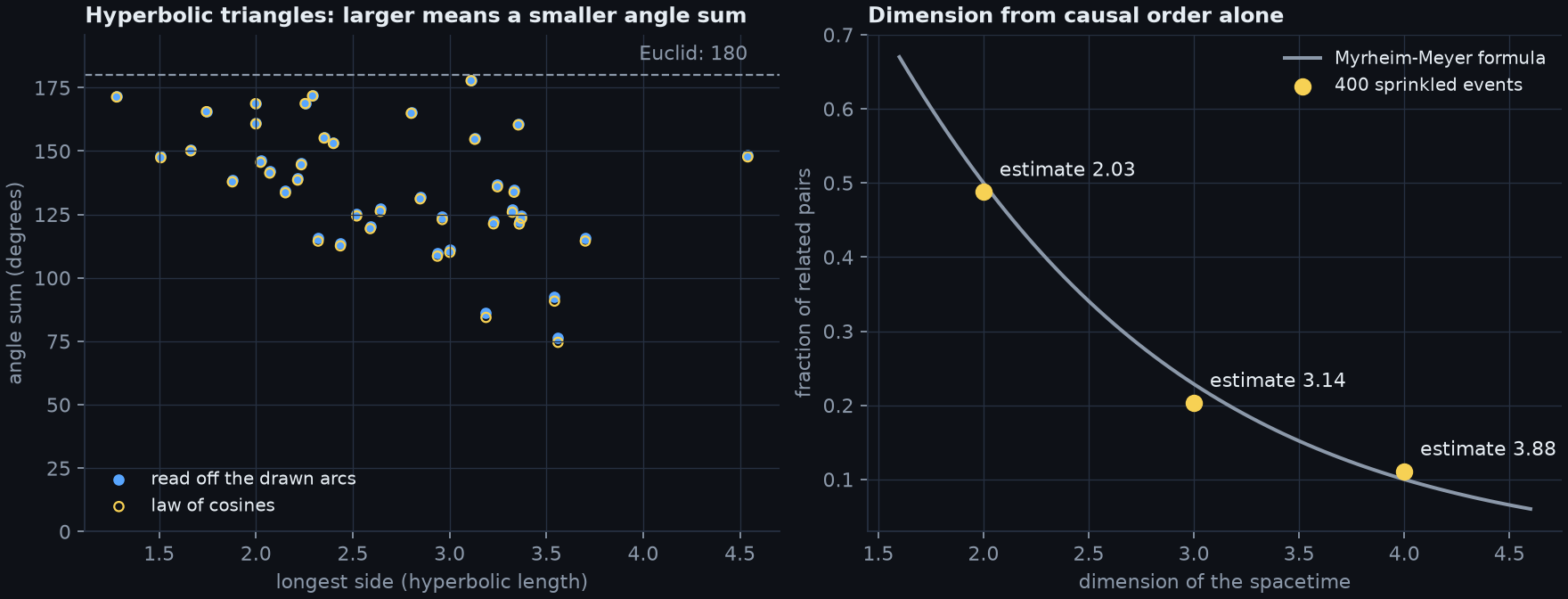
Draw random triangles in the Poincaré disk and check their angle sums against the hyperbolic law of cosines, find the boost that puts a spacelike event in the present, and sprinkle 400 events into flat spacetime of 2, 3 and 4 dimensions to recover the dimension from the causal order alone.
python -m videos.philosophy.labs 25
needs numpy, scipy, matplotlib · download lab25.py ·
source on GitHub40 random triangles: angle sums 76.4 to 177.8 degrees (Euclid: 180)
drawn arcs against the law of cosines largest gap 1.79 degrees
centred triangles, vertex radius 0.1 to 0.9 sums 177.09 to 23.51 degrees, areas 0.0508 to 2.7313 (limit pi = 3.1416)
200 spacelike events 200 made simultaneous with here-now by v = t/x, interval unchanged
a timelike event (2, 0.5) in 199 frames later than here-now in 199
sprinkling in 2 dimensions related pairs 0.488 (theory 0.500), estimated dimension 2.03
sprinkling in 3 dimensions related pairs 0.203 (theory 0.229), estimated dimension 3.14
sprinkling in 4 dimensions related pairs 0.111 (theory 0.100), estimated dimension 3.88
Angle sums below 180 degrees are measurable facts about the disk; which events are simultaneous is frame-relative for spacelike pairs only; and the fraction of causally related pairs carries the dimension, with no coordinates kept.The code (104 lines; it asserts its own result)
"""Lab 25: measure triangles in the Poincaré disk, boost events, and recover a spacetime's dimension from order."""

import math

import numpy as np

from videos.coursekit import labs
from explainer.philosophy.reasoner import spacetime as st

TITLE = "Geometry from measurement, dimension from order"
GOAL = ("Draw random triangles in the Poincaré disk and check their angle sums against the hyperbolic law of "
        "cosines, find the boost that puts a spacelike event in the present, and sprinkle 400 events into flat "
        "spacetime of 2, 3 and 4 dimensions to recover the dimension from the causal order alone.")
TASKS = [
    "Raise the sprinkling to n = 1600 events (st.causal_set(n=1600, seed=seed), a few seconds). By how much does "
    "the dimension estimate's error shrink?",
    "Make the event timelike, for example (1.0, 0.6), and call st.rietdijk_putnam on it. What speed would the "
    "boost need, and why does the Lorentz transformation fail there?",
    "Solve a new circuit with st.deutsch_fixed_point: a Hadamard on the time-travelling qubit instead of a NOT. "
    "Is the fixed point unique?",
]


def _cosine_sum(P):
    """The angle sum of the hyperbolic triangle P, in degrees, from its three side lengths."""
    a, b, c = st.hyp_dist(P[1], P[2]), st.hyp_dist(P[0], P[2]), st.hyp_dist(P[0], P[1])

    def ang(a, b, c):
        return math.acos((math.cosh(b) * math.cosh(c) - math.cosh(a)) / (math.sinh(b) * math.sinh(c)))

    return math.degrees(ang(a, b, c) + ang(b, c, a) + ang(c, a, b))


def run(seed=0):
    rng = np.random.default_rng(seed)
    lab = labs.Lab()

    # 1. triangles: the library reads angles off the drawn arcs; the law of cosines reads them off distances
    drawn, theory, size = [], [], []
    while len(drawn) < 40:
        P = rng.uniform(-0.8, 0.8, (3, 2))
        d1, d2 = P[1] - P[0], P[2] - P[0]
        if max(np.hypot(*p) for p in P) > 0.85 or abs(d1[0] * d2[1] - d1[1] * d2[0]) < 0.05:
            continue
        t = st.hyp_triangle(*map(tuple, P))
        drawn.append(t["sum_deg"])
        theory.append(_cosine_sum(P))
        size.append(max(t["lengths"]))
    drawn, theory, size = np.array(drawn), np.array(theory), np.array(size)
    gap = float(np.abs(drawn - theory).max())
    lab.row("40 random triangles: angle sums", f"{drawn.min():.1f} to {drawn.max():.1f} degrees   (Euclid: 180)")
    lab.row("drawn arcs against the law of cosines", f"largest gap {gap:.2f} degrees")
    assert theory.max() < 180 and drawn.max() < 180 + gap, "every hyperbolic triangle falls short of two right angles"
    assert gap < 4.0, "angles read off the arcs agree with angles computed from the distances"
    rows = st.disk_triangles()["rows"]
    lab.row("centred triangles, vertex radius 0.1 to 0.9", f"sums {rows[0]['sum_deg']} to {rows[-1]['sum_deg']} "
            f"degrees, areas {rows[0]['area']} to {rows[-1]['area']}   (limit pi = {math.pi:.4f})")
    assert all(a["area"] < b["area"] < math.pi for a, b in zip(rows, rows[1:])), "the area is the defect, below pi"

    # 2. the Rietdijk-Putnam boost, and the interval it leaves alone
    kept = 0
    for _ in range(200):
        x = rng.uniform(0.5, 3) * rng.choice([-1, 1])
        t = rng.uniform(-0.95, 0.95) * abs(x)
        rp = st.rietdijk_putnam((t, x))
        tp, xp = st.lorentz(t / x, [(t, x)])[0]
        assert rp["spacelike"] and abs(rp["t_prime"]) < 1e-9, "the boost v = t/x puts the event in the present"
        assert abs((tp * tp - xp * xp) - (t * t - x * x)) < 1e-9, "the interval is the same in both frames"
        kept += 1
    order = [st.lorentz(v, [(2.0, 0.5)])[0][0] > 0 for v in np.linspace(-0.99, 0.99, 199)]
    lab.row("200 spacelike events", f"{kept} made simultaneous with here-now by v = t/x, interval unchanged")
    lab.row("a timelike event (2, 0.5) in 199 frames", f"later than here-now in {sum(order)}")
    assert all(order), "no boost reverses the order of timelike-separated events"

    # 3. a causal set: dimension from the fraction of related pairs
    cs = st.causal_set(n=400, seed=seed)
    for r in cs["rows"]:
        lab.row(f"sprinkling in {r['d']} dimensions", f"related pairs {r['fraction']:.3f} (theory {r['theory']:.3f}), "
                f"estimated dimension {r['estimate']:.2f}")
        assert abs(r["estimate"] - r["d"]) < 0.45, "the order alone recovers the dimension"
    lab.note = ("Angle sums below 180 degrees are measurable facts about the disk; which events are simultaneous is "
                "frame-relative for spacelike pairs only; and the fraction of causally related pairs carries the "
                "dimension, with no coordinates kept.")

    fig, ax = labs.figure(2, size=(11, 4.2))
    ax[0].scatter(size, drawn, s=22, color=labs.BLUE, label="read off the drawn arcs")
    ax[0].scatter(size, theory, s=22, facecolors="none", edgecolors=labs.GOLD, label="law of cosines")
    ax[0].axhline(180, color=labs.MUTED, ls="--", lw=1)
    ax[0].text(size.max(), 188, "Euclid: 180", color=labs.MUTED, va="center", ha="right")
    ax[0].set(title="Hyperbolic triangles: larger means a smaller angle sum", xlabel="longest side (hyperbolic length)",
              ylabel="angle sum (degrees)", ylim=(0, 196))
    ax[0].legend(loc="lower left")
    ds = np.linspace(1.6, 4.6, 80)
    ax[1].plot(ds, [st.ordering_fraction(d) for d in ds], color=labs.MUTED, label="Myrheim-Meyer formula")
    ax[1].scatter([r["d"] for r in cs["rows"]], [r["fraction"] for r in cs["rows"]], s=60, color=labs.GOLD, zorder=3,
                  label="400 sprinkled events")
    for r in cs["rows"]:
        ax[1].annotate(f"estimate {r['estimate']:.2f}", (r["d"], r["fraction"]), xytext=(8, 8),
                       textcoords="offset points", color=labs.INK)
    ax[1].set(title="Dimension from causal order alone", xlabel="dimension of the spacetime",
              ylabel="fraction of related pairs")
    ax[1].legend(loc="upper right")
    lab.fig = fig
    return lab
Now change it
- Raise the sprinkling to n = 1600 events (st.causal_set(n=1600, seed=seed), a few seconds). By how much does the dimension estimate's error shrink?
- Make the event timelike, for example (1.0, 0.6), and call st.rietdijk_putnam on it. What speed would the boost need, and why does the Lorentz transformation fail there?
- Solve a new circuit with st.deutsch_fixed_point: a Hadamard on the time-travelling qubit instead of a NOT. Is the fixed point unique?
Problems, with solutions
Try each problem before opening its solution.
-
How fast must a 15 cm bucket spin for the water to rise 10 cm at the wall?
Solution
The surface is the paraboloid \(h(r) = \omega^2 r^2/2g\), so the rise at the wall, \(R = 0.15\) m, is \(\omega^2R^2/2g\). Setting it to 0.10 m: \(\omega^2 = 2 \times 9.81 \times 0.10 / 0.0225 = 87.2\), \(\omega = 9.3\) rad/s, about 1.5 turns a second (89 rpm). As a check, the film's one turn a second (\(\omega = 6.28\)) gives \(6.28^2 \times 0.0225/19.62 = 4.5\) cm.
-
Show that a rotation of the plane keeps the sign of a polygon's signed area.
Solution
The signed area of a polygon with vertices \((x_i, y_i)\) is \(A = \tfrac12\sum_i (x_i y_{i+1} - x_{i+1} y_i)\), a sum of two-dimensional cross products of successive vertices. Under a linear map \(M\) each cross product is multiplied by \(\det M\), so \(A\) becomes \((\det M) A\). A rotation has \(\det M = \cos^2\theta + \sin^2\theta = 1\), so the sign is kept. A translation adds the same vector to every vertex; the extra terms telescope around the closed polygon and cancel. A reflection has \(\det M = -1\) and flips the sign: that is Kant's left and right hand.
-
A hyperbolic triangle has angles \(30^\circ\), \(45^\circ\), \(60^\circ\). What is its area?
Solution
In the hyperbolic plane of curvature \(-1\) a triangle's area is its angle defect, \(\pi\) minus the angle sum. Here the angles are \(\pi/6 + \pi/4 + \pi/3 = 3\pi/4\), so the area is \(\pi/4 \approx 0.785\). (With curvature \(-K\) the area is \((\pi/4)/K\).)
-
Find the boost that makes the event \((t, x) = (0.3, 0.5)\) simultaneous with the origin.
Solution
In units with \(c = 1\), a boost of velocity \(v\) gives \(t' = \gamma(t - vx)\), \(x' = \gamma(x - vt)\). The event is simultaneous with the origin when \(t' = 0\), so \(v = t/x = 0.6\), and \(\gamma = 1/\sqrt{1 - 0.36} = 1.25\). In that frame \(x' = 1.25\,(0.5 - 0.18) = 0.4\). Check: the interval is \(x^2 - t^2 = 0.25 - 0.09 = 0.16 = 0.4^2\). Such a boost exists because the event is spacelike, \(|x| > |t|\); for a timelike event no observer would call it simultaneous with the origin.
-
State the hole argument for Newtonian gravity in Galilean spacetime. Does it go through?
Solution
Set Newtonian gravity in Galilean spacetime: fixed absolute time, Euclidean space on each instant, a fixed flat connection, and a potential \(\varphi\) with \(\nabla^2\varphi = 4\pi G\rho\). The hole argument needs a transformation that is the identity outside a region and not inside it, and that carries solutions to solutions. Here it would have to preserve the fixed structure, and the symmetries of Galilean spacetime (rotations, translations, boosts) are rigid: one that is the identity on an open region is the identity everywhere. So no hole transformation exists and the argument does not go through. It does go through for the generally covariant Newton–Cartan version, where the connection is itself a dynamical field: then the hole argument is a lesson about any theory with no fixed background, not about relativity alone.
-
Grandfather circuit with a CNOT instead of a NOT: find Deutsch's fixed points.
Solution
Let the ordinary bit be the control and the time-travelling qubit the target of the CNOT. Deutsch's condition is that the state entering the curve, \(\rho\), equals what comes out of the interaction, traced over the ordinary bit. If the ordinary bit is 0 the CNOT does nothing, and every state is a fixed point: a knowledge paradox, with Deutsch's maximum-entropy rule picking \(I/2\). If it is 1, the CNOT is a NOT on the loop, the grandfather paradox: fixed points are the states with \(\rho = X\rho X\), that is \(\tfrac12(I + r_x X)\), including \(I/2\) and the states \(|{+}\rangle\), \(|{-}\rangle\), and no classical bit. If it is \(|{+}\rangle\), the map averages the two cases and the fixed points are the same as for 1. In every case \(I/2\) is consistent, and the classical paradox appears only when the control is definitely 1.
Notes and sources
Sources
Texts: Earman, World Enough and Space-Time (1989); Huggett (ed.), Space from Zeno to Einstein (1999); Barbour, The End of Time (1999); Dainton, Time and Space (2nd ed., 2010); Maudlin, Philosophy of Physics: Space and Time (2012); Arntzenius, Space, Time, and Stuff (2012); Norton, "The Hole Argument" (Stanford Encyclopedia of Philosophy).
Papers and primary texts: Newton (1687); Leibniz and Clarke (1715–16); Kant (1768); Lobachevsky (1829); Bolyai (1832); Riemann (1854); Mach (1883); Poincaré (1902); Einstein (1905, 1915); Minkowski (1908); McTaggart (1908); Reichenbach (1928); Gödel (1949); Rietdijk (1966); Putnam (1967); Stein (1968); Hawking, King and McCarthy (1976); Lewis (1976); Malament (1977); Barbour and Bertotti (1982); Bombelli, Lee, Meyer and Sorkin (1987); Earman and Norton (1987); Meyer (1988); Deutsch (1991); Hawking (1992); Maldacena (1997); Sarkar and Stachel (1999); Ryu and Takayanagi (2006); Van Raamsdonk (2010); Maldacena and Susskind (2013); Huggett and Wüthrich (2013).
About this partfrom its README
Part 25 of Philosophy, Built (series plan, syllabus): the philosophy of space and time, with every geometry and spacetime built. Newton's absolute space and his bucket, its paraboloid computed (a 15 cm bucket at about one turn a second climbs some 4 cm), and Mach's reply. The Leibniz–Clarke correspondence: the static and kinematic shifts, checked on a universe of six moving bodies (every inter-body distance unchanged by a shift, a rotation, a boost and a rotation in time, though only the last would curve the water). Kant's incongruent counterparts: orientation as signed area, two hundred rigid motions that never change its sign, and a frame carried round a Möbius strip that comes back reversed. Non-Euclidean geometry built in the Poincaré disk: geodesics, many parallels, hyperbolic triangles whose angle sums fall from 177° to 23.5° while their areas (the defect) approach π; Gauss's survey triangle and its 15 arcseconds of spherical excess. Poincaré's disk world, whose shrinking rulers measure a hyperbolic plane, and conventionalism (Poincaré, Reichenbach, Einstein, Putnam). Spacetime structures from Aristotle to Leibniz, and Earman's symmetry principles: Galilean spacetime has just enough. Special relativity: the Minkowski diagram with tilting slices of simultaneity, Einstein's lightning strikes in four frames, the invariant interval. Reichenbach's ε and Malament's theorem. McTaggart's A- and B-series and his regress; presentism, the growing block, the moving spotlight and eternalism; the Rietdijk–Putnam argument with its boost computed, and the presentist's replies. General relativity and the hole argument (Einstein 1913; Earman and Norton 1987), the hole diffeomorphism animated, as a Price List and the Wall's twenty-fifth brick. Barbour and Bertotti's best matching, built with the Kabsch algorithm. Gödel's rotating universe, Lewis's grandfather paradox, and Deutsch's closed timelike curves, whose fixed points are computed for the grandfather and knowledge paradoxes. And, labelled as speculative, spacetime from entanglement (Maldacena; Ryu and Takayanagi; Van Raamsdonk; ER = EPR), and causal sets (Bombelli, Lee, Meyer and Sorkin): four hundred events sprinkled into flat spacetime, the coordinates forgotten, and the dimension (2, 3, 4) recovered from the causal order alone by the Myrheim–Meyer estimator.
The worked model results are computed by the Reasoner's new module explainer/philosophy/reasoner/spacetime.py (with
prop for the Price List), tested in tests/philosophy/test_spacetime.py and cached by compute.py.
Chapter notes
| # | Scene | What it establishes | Computed on screen |
|---|---|---|---|
| 0 | Hook |
Augustine; four questions; the plan. | — |
| 1 | Bucket |
Newton (1687); Mach (1883); Maudlin. | the bucket's paraboloid |
| 2 | Leibniz |
Leibniz and Clarke (1715–16); Galileo's ship. | shifted universes, every distance checked |
| 3 | Hands |
Kant (1768, 1783); Möbius; Wu (1957). | signed areas; Möbius transport |
| 4 | Geometry |
Euclid; Lobachevsky (1829); Bolyai (1832); Gauss; Poincaré; Riemann (1854). | hyperbolic triangles; Gauss's excess |
| 5 | Convention |
Poincaré (1902); Reichenbach (1928); Einstein; Putnam; Duhem and Quine. | the disk world's measurements |
| 6 | Structures |
Aristotle; Newton; Galileo; Leibniz; Earman (1989); Maudlin (2012). | — |
| 7 | Relativity |
Einstein (1905); Minkowski (1908). | simultaneity in four frames; the interval |
| 8 | Simultaneity |
Reichenbach (1928); Malament (1977); Sarkar and Stachel (1999). | Reichenbach's ε |
| 9 | McTaggart |
McTaggart (1908); Prior; Russell, Mellor, Smart. | — |
| 10 | Theories |
Rietdijk (1966); Putnam (1967); Stein (1968). | the Rietdijk–Putnam boost |
| 11 | Hole |
Einstein (1913, 1915); Earman and Norton (1987); the Wall's twenty-fifth brick; the hole as a Price List. | the hole diffeomorphism |
| 12 | Relational |
Barbour and Bertotti (1982); Barbour (1999); Kabsch (1976). | best matching |
| 13 | TimeTravel |
Gödel (1949); Lewis (1976); Deutsch (1991); Novikov; Hawking (1992). | Deutsch's fixed points |
| 14 | Emergence |
Maldacena (1997); Ryu and Takayanagi (2006); Van Raamsdonk (2010); Maldacena and Susskind (2013); Hawking, King and McCarthy (1976); Malament (1977); Bombelli, Lee, Meyer and Sorkin (1987); Huggett and Wüthrich. | a causal set's links; the dimension from order |
| 15 | Outro |
recap; the Reasoner's module; the Wall; problems; payoffs; references. | — |
Companion material in this repository
The syllabus's plan for this partfrom SYLLABUS.md, the plan of record
- Newton's bucket (1687) and absolute space.
- The Leibniz–Clarke correspondence: static and kinematic shift arguments; the principle of the identity of indiscernibles applied to the universe.
- Kant's incongruent counterparts (1768): left and right hands; a Möbius strip turns one into the other.
- Non-Euclidean geometry: Gauss, Bolyai and Lobachevsky; the Poincaré disk drawn with its geodesics; Gauss's triangle measurement.
- Conventionalism: Poincaré's disk world (temperature that shrinks rulers); Reichenbach's universal forces.
- Spacetime structures: Aristotelian, Galilean, Newtonian, neo-Newtonian (Maudlin's diagrams), each with what it keeps.
- Special relativity: the Minkowski diagram; the relativity of simultaneity as a tilting slice in
SpacetimeView. - The conventionality of simultaneity: Reichenbach's ε; Malament's theorem (1977).
- McTaggart (1908): A-series and B-series; the argument for the unreality of time.
- Presentism, eternalism, the growing block, the moving spotlight.
- The Rietdijk–Putnam argument: special relativity against presentism; the presentist replies.
- General relativity: curvature; the hole argument (Einstein 1913; Earman and Norton 1987). Diffeomorphism invariance drawn as a deformation inside a hole.
- Sophisticated substantivalism; Leibniz equivalence; relationalism revived (Barbour).
- Time travel: Gödel's rotating universe (1949); Lewis's "Paradoxes of Time Travel" (1976); the grandfather paradox; Novikov's self-consistency; Deutsch's CTC model, whose fixed points are computed for a toy circuit.
- Quantum gravity and the emergence of spacetime (holography, ER=EPR), shown schematically and labeled as speculative.
- Recap and Problems.
Built: reasoner.spacetime (Poincaré disk geometry; Minkowski diagram engine; Deutsch CTC fixed-point
solver).
Wall: the hole argument (substantivalism seems to imply indeterminism); Malament vs Reichenbach.
Price List: the hole-argument cluster (spacetime points are real; GR is deterministic; diffeomorphic models
differ).
Visuals: the bucket's water surface curving; the Möbius strip flipping a hand; Poincaré's world with shrinking
rulers; simultaneity slices rotating; the hole deformation.
References: Maudlin, Philosophy of Physics: Space and Time; Earman, World Enough and Space-Time; Huggett (ed.),
Space from Zeno to Einstein; Dainton, Time and Space; Norton (SEP), "The Hole Argument"; Arntzenius, Space, Time,
and Stuff.
Build the film
python -m videos.philosophy.philosophy25.compute        # the part's numbers, into .cache/philosophy25
python tools/build.py philosophy25                  # render and assemble the film
EXPLAINER_TTS=silent python tools/qa_scene.py philosophy25 Hook   # one chapter, silent, with a contact sheet
Scenes: videos/philosophy/philosophy25. Setup: see the course page. Source of these notes: the README and the scenes' narration.
Build it
python -m videos.philosophy.philosophy25.compute       # every computed item (seconds; .cache/philosophy25)
python tools/build.py philosophy25 -q l                # 480p preview
python tools/build.py philosophy25                     # 1080p30 -> renders/philosophy25.mp4
python tools/qa_scene.py philosophy25 Hole             # one chapter, silent, with a contact sheet